Watch Peluca, the Student Film That Became the Cultural Phenomenon Napoleon Dynamite (2002)
You could say that Jared and Jerusha Hess got lucky. When first the husband-and-wife team got the chance to make a feature, it turned out to be Napoleon Dynamite, the movie that launched a million “VOTE FOR PEDRO” shirts. But that visually, narratively, and culturally askew tale didn’t emerge fully formed into the theaters. Nor did its title character, an extravagantly nerdy and savagely defensive high-school student in small-town Idaho. Napoleon Dynamite has a predecessor in Peluca, the short film Jared Hess made for an assignment at Brigham Young University’s film school. Napoleon Dynamite himself has a predecessor in Seth, whose curly hair, enormous spectacles, severe awkwardness, and penchant for thrifting and faux cursing will look familiar indeed.
Peluca appears to have much the same to relationship to Napoleon Dynamite as Wes Anderson’s Bottle Rocket short has to the feature version. Both were shot in black-and-white in locales their filmmakers clearly know well, both are memorably scored (Anderson uses jazz, Hess uses Burt Bacharach), and both tell in a basic form stories that would later unfold to their full cinematic length.
Just as Bottle Rocket, the short, stars Owen and Luke Wilson, who would go on to reprise their roles and gain fame thereafter, Jon Heder played Seth in Peluca before playing Napoleon Dynamite. And just as there’s little obvious difference between the two versions of the character besides their names, the distinctiveness of Hess’ cinematic sensibility shows through in Peluca just as it would, to a much wider audience, in Napoleon Dynamite.
The Hesses once drew frequent comparisons to Anderson, though the past decade and a half has exposed their cinematic enterprises as entirely different. Their second feature Nacho Libre, a Mexican wrestling comedy starring Jack Black, fit comfortably enough into the Hollywood zone of adolescent goofiness. But New Yorker film critic Richard Brody saw something deeper, calling it “the strangest American religious film since The Last Temptation of Christ,” one that “presents a case for nothing less than Catholic-Protestant reconciliation.” The Hesses’ third feature Gentlemen Broncos, the story of a young aspiring science-fiction writer in northern Utah, went almost completely ignored, but Brody deemed it an “even more ecstatic and personal exploration — in loopy, gross-out comic form — of the essence of faith in cosmic religious vision itself, and the ease with which those visions can be perverted to worldly ends.”
Brody continues to speak for the cinephiles who’ve paid to the work of Jared and Jerusha Hess ever more attention, not less, since Napoleon Dynamite. 2015’s Don Verdean, about a crooked Biblical archaeologist, is “a purer, stranger, and more dangerous religious vision than the three films that preceded it.” 2016’s Masterminds, a Hessian treatment of a real-life North Carolina heist gone wrong due to sheer incompetence, “has the religious intensity and spiritual resonance that marks all of Hess’s other films” and “extends his vision into darker corners of existence than he had formerly contemplated.” Considering that picture, Brody sees “a wide-eyed frontality to Hess’s filmmaking, including face-to-face set pieces and action scenes done in wide and static tableaux that suggest a kinship with the transcendental cinema of Robert Bresson and Carl Theodor Dreyer.” And from the right critical perspective, we can see it in Peluca as well.
Related Content:
Wes Anderson’s First Short Film: The Black-and-White, Jazz-Scored Bottle Rocket (1992)
The First Films of Great Directors: Kubrick, Coppola, Scorsese, Tarantino & Truffaut
Tim Burton’s Early Student Films: King and Octopus & Stalk of the Celery Monster
The Art of Sci-Fi Book Covers: From the Fantastical 1920s to the Psychedelic 1960s & Beyond
Based in Seoul, Colin Marshall writes and broadcasts on cities, language, and culture. His projects include the book The Stateless City: a Walk through 21st-Century Los Angeles and the video series The City in Cinema. Follow him on Twitter at @colinmarshall or on Facebook.
Read More...A Brief History of John Baldessari (RIP) Narrated by Tom Waits: A Tribute to the Late “Godfather of Conceptual Art”
All modern art is conceptual in some way, bound to aesthetic theories and combative manifestoes against complacency. But only in the movement known as capital “C” Conceptual Art do the ideas become more important than the objects. Conceptual Art traces its history to Marcel Duchamp and the Surrealists who declared war on the bourgeois cultural status quo.
Later experimental artists did the same by elevating mass culture to the status of high art: advertising, comic books, Hollywood spectacle, and—in the past twenty-five years or so—the Internet: Pop Art foregrounded concepts over objects by means of pastiche and metacommentary. The work of L.A. artist Ed Ruscha, for example, centers slogans and clichés over ambiguous images that sometimes look like stock desktop backgrounds.
Both Duchamp and Ruscha were influences on American Conceptualist John Baldessari, who passed away yesterday at age 88, leaving behind a legacy as “arguably America’s most influential Conceptual artist,” according to L.A. Times critic Christopher Knight. Born of European parents and raised in Southern California, Baldessari incorporated humor, satire, and Pop Art elements into his work.
He did not begin his career, however, as part of a movement, and he never expected to have much of an audience. In the early sixties, he was teaching high school art in San Diego and felt “totally isolated,” he says in the interview with Knight below. Baldessari resigned himself to a “normal life,” painting when he could on the weekends. These conditions inspired him to “try to figure out what art meant for me, what was the bottom line.”
Baldessari answers the question, to laughs from the audience, with typical laconic wit: “anything you put on canvas is art.” Baldessari reversed Duchamp’s formula. Put a cinderblock in a museum, he says, and it becomes art through context, but put a canvas on the street and it doesn’t become something else. It always retains its status as an art object. Such objects, for Baldessari, served mainly as material platforms for ideas.
“Pictures are not enough, Baldessari seems to suggest,” writes Alex Greenberger in an ARTnews tribute. “Concepts matter equally, if not even more.” Baldessari has been called “the godfather of Conceptual Art” for this insight, says Tom Waits says in his narration of “A Brief History of John Baldessari” at the top. He’s also been called a “master of appropriation” and “Surrealist for the digital age.” He never limited himself to just canvas but worked in almost every medium of visual and textual art.
Those media included credit card and iPhone app design. Art isn’t only material: it is virtual, ephemeral, and disposable. Baldessari demonstrated his own commitment to destroying the past when, in 1970, he burned all of the work he had made between 1953 and 1966 for a conceptual piece called The Cremation Project. But he wasn’t an art world anarchist. As he toyed with and challenged tradition, he also helped instill it.
Baldessari become famous enough to have warranted a guest spot on The Simpsons (and was awarded a National Medal of Arts). He became wealthy enough by far to quit his day job. But he never stopped teaching, from high school to posts at CalArts, UCLA, and UC San Diego. “I’ve taught all my life,” he said in 2003, “Everything from grade school to college to juvenile delinquents.”
We might be inclined to see in his teaching philosophy a key to understanding his conceptual universe: “I set out to right all the things wrong with my own art education. But I found that you can’t really teach art, you can just sort of set the stage for it.”
Related Content:
Hear Marcel Duchamp Read “The Creative Act,” A Short Lecture on What Makes Great Art, Great
Roy Lichtenstein and Andy Warhol Demystify Their Pop Art in Vintage 1966 Film
When Brian Eno & Other Artists Peed in Marcel Duchamp’s Famous Urinal
Josh Jones is a writer and musician based in Durham, NC. Follow him at @jdmagness
Read More...Peter Singer’s The Life You Can Save Available as a Free AudioBook and eBook: Features Narrations by Paul Simon, Kristen Bell & Stephen Fry
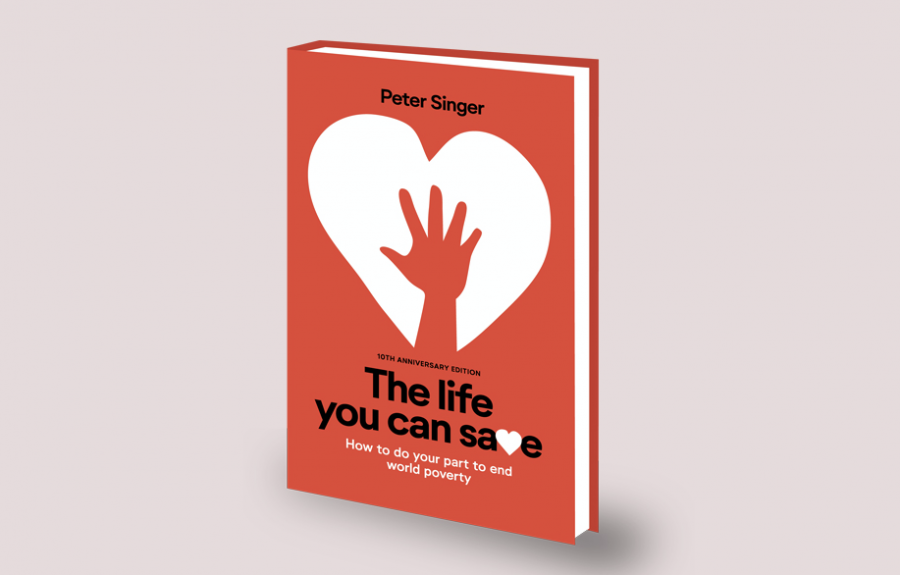
In 2009, Princeton philosopher Peter Singer published his practical handbook/manifesto The Life You Can Save: How to Do Your Part to End World Poverty. Bill and Melinda Gates called it “a persuasive and inspiring work that will change the way you think about philanthropy”–a book that “shows us we can make a profound difference in the lives of the world’s poorest.”
Now, on its tenth anniversary, Singer has released an updated version of The Life You Can Save. And he’s made it available as a free ebook, and also as a free audiobook featuring narrations by Kristen Bell, Stephen Fry, Paul Simon and Natalia Vodianova, among others. You can get the downloads here.
Singer’s website features a page where you can find the best charities that address global poverty. Each charity has been “rigorously evaluated to help you make the biggest impact per dollar.” If you are looking for an efficient approach, you can also make one single donation to support all of the charities vetted and recommended by Singer’s organization.
The audio version of The Life You Can Save will be added to our meta collection, 1,000 Free Audio Books: Download Great Books for Free.
Related Content:
The Life You Can Save in 3 Minutes, by Peter Singer
Peter Singer’s Course on Effective Altruism Puts Philosophy Into Worldly Action
Richard Dawkins’ Uncut Interviews with Peter Singer & Big Thinkers
Read More...
The Vatican Library Goes Online and Digitizes Tens of Thousands of Manuscripts, Books, Coins, and More
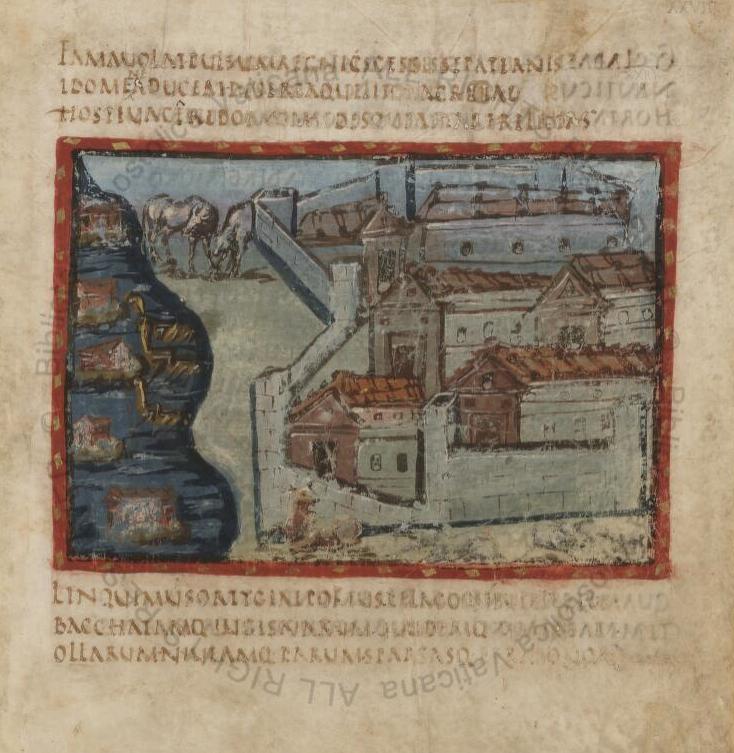
If any one of us ran our own country, we’d surely drive no small amount of resources toward building an impressive national library. That would be true even if we ran a country the size of the Vatican, the smallest sovereign state in the world — but one that, unsurprisingly, punches well above its weight in terms of the size and historical value of its holdings. “It was in 1451 when Pope Nicholas V, a renowned bibliophile himself, attempted to re-establish Rome as an academic center of global importance,” writes Aleteia’s Daniel Esparza. That formidable task involved first “building a relatively modest library of over 1,200 volumes, including his personal collection of Greek and Roman classics and a series of texts brought from Constantinople.”

The Vatican Apostolic Library, known as “VAT,” has grown a bit over the past five and a half centuries. Today it contains around 75,000 codices and 85,000 incunabula (which Esparza defines as “editions made between the invention of the printing press and the 16th century”) amid a total of over one million volumes.
And in the case of increasingly many of these documents, you no longer have to make the journey to Vatican City to see them. Thanks to an ongoing digitization project launched a decade ago, increasingly many have become searchable and downloadable on DigiVatLib, a database of the Vatican Library’s digitized collections including not just the aforementioned codices and incunabula but “archival materials and inventories as well as graphic materials, coins and medals.”
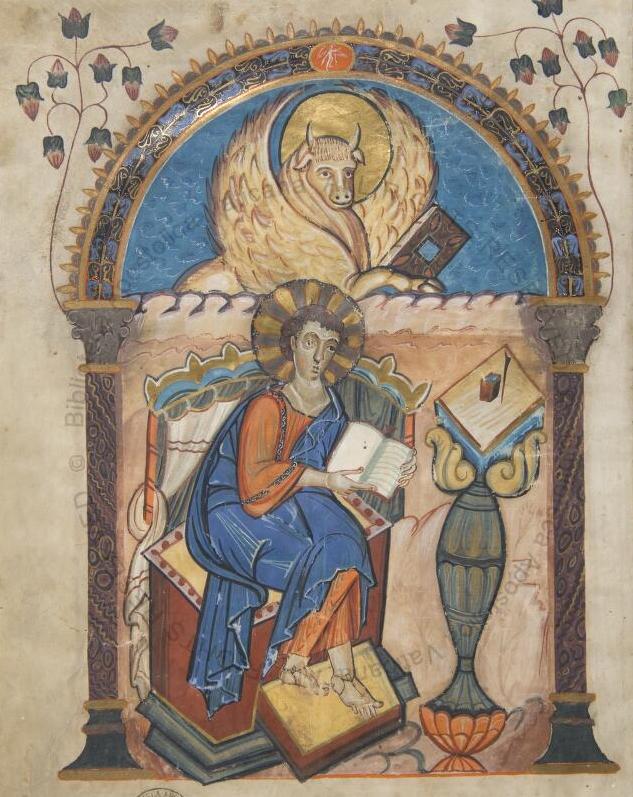
Back in 2016 we featured a digital collection of 5,300 rare manuscripts digitized by the collection, including the Iliad and Aeneid as well as Japanese and Aztec illustrations. The VAT’s scanning, uploading, and organizing has continued apace since, and though it prioritizes manuscripts “from the Middle Age and Humanistic period,” its materials taken together have a wider historical and indeed cultural sweep, one that only gets wider with each page added. You can get started exploring this wealth of documents by scrolling down a little on DigiVatLib’s front page, in the middle of which you’ll find the latest digitized materials as well as a host of selected manuscripts, a few of whose pages you see above. The VAT has enjoyed its status as one of the chief repositories of Western civilization longer than any of us has been alive, but we can count ourselves in the first generation of humanity to see it open up to the world.
Related Content:
1,600-Year-Old Illuminated Manuscript of the Aeneid Digitized & Put Online by The Vatican
Based in Seoul, Colin Marshall writes and broadcasts on cities, language, and culture. His projects include the book The Stateless City: a Walk through 21st-Century Los Angeles and the video series The City in Cinema. Follow him on Twitter at @colinmarshall or on Facebook.
Read More...Free Online Writing & Journalism Courses
- A Beginner’s Guide to Writing in English for University Study — Massive Open Online Course (MOOC) — University of Reading
- An Introduction to Screenwriting — Massive Open Online Course (MOOC) — University of East Anglia
- Advanced Writing — Massive Open Online Course (MOOC) — UC Irvine
- Business Writing — Massive Open Online Course (MOOC) — UC-Boulder
- Creative Writing: The Craft of Character — Massive Open Online Course (MOOC) — Wesleyan
- Creative Writing: The Craft of Plot — Massive Open Online Course (MOOC) — Wesleyan
- Creative Writing: The Craft of Setting and Description — Massive Open Online Course (MOOC) — Wesleyan
- Creative Writing: The Craft of Style — Massive Open Online Course (MOOC) — Wesleyan
- Discovering Science: Science Writing — Massive Open Online Course (MOOC) — University of Leeds
- English for Journalists, Part 1 — Massive Open Online Course (MOOC) — UC Berkeley
- English for Journalists, Part 2 — Massive Open Online Course (MOOC) — UC Berkeley
- Getting Started with Essay Writing — Massive Open Online Course (MOOC) — UC Irvine
- Grammar and Punctuation — Massive Open Online Course (MOOC) — UC Irvine
- Grammar and Punctuation Advanced — Massive Open Online Course (MOOC) — UC Irvine
- How To Make A Poem — Massive Open Online Course (MOOC) — Manchester Metropolitan University
- How to Write an Essay — Massive Open Online Course (MOOC) — UC Berkeley
- Journalistic Ethics — Free Online Course — Jim Newton, UCLA
- Journalism Under Siege — Free Online Course — Multiple Faculty, Stanford University
- Memoir and Personal Essay: Managing Your Relationship with the Reader — Massive Open Online Course (MOOC) — Wesleyan University
- Press and Society — Free iTunes Audio — Christopher Scanlon, La Trobe University
- Rhetoric: The Art of Persuasive Writing and Public Speaking — Massive Open Online Course (MOOC) — Harvard University
- Script Writing: Write a Pilot Episode for a TV or Web Series — Massive Open Online Course (MOOC) — Michigan State
- Sharpened Visions: A Poetry Workshop — Massive Open Online Course (MOOC) — Cal Arts
- Songwriting: Writing the Lyrics — Massive Open Online Course (MOOC) — Berklee College of Music
- Start Fiction Writing — Massive Open Online Course (MOOC) — Open University
- Start Writing Essays — Free Course - Open University
- Writing in the Sciences — Massive Open Online Course (MOOC) — Stanford University
- Writing Science Fiction & Fantasy — Free Online Videos — BYU, Brandon Sanderson
- Writing Stories About Ourselves — Massive Open Online Course (MOOC) — Wesleyan University
For a complete list of online courses, please visit our complete collection, 1,700 Free Online Courses from Top Universities.
For a list of online certificate programs, visit 200 Online Certificate & Microcredential Programs from Leading Universities & Companies, which features programs from our partners Coursera, Udacity, FutureLearn and edX.
And if you’re interested in Online Mini-Masters and Master’s Degrees programs from universities, see our collection: Online Degrees & Mini Degrees: Explore Masters, Mini Masters, Bachelors & Mini Bachelors from Top Universities.
Read More...38 Major Pop Songs Played with the Exact Same Four Chords: Watch a Captivating Medley Performed by the Axis of Awesome
When we call music a universal language, it’s usually understood to be a metaphor. In its purest theoretical form, music may be more like math—a truly universal language—but in its manifestations in the real world, it resembles more the great diversity of tongues around the globe. Each regional, national, and global music has its grammar of scales, rhythms, and chords, each its syntax of melodies and harmonies, though these share some important commonalities.
The syntax of pop music, like its blues predecessor, consists of standard chord progressions, easily swapped from song to song: repeatable units that form a range of available emotional expression. Want to see that range on full display, in a bravado performance by an Australian comedy rock band? Look no further: just above, the Axis of Awesome perform their live rendition of “4 Chord Song,” a stunning medley of pop hits from Journey to Missy Higgins that all use the same four-chord sequence.
With the exception of an original composition, “Birdplane,” the ensemble’s selection of 38 songs includes some of the biggest hits of the past few decades. The tonal breadth is surprising, as we leap from “Don’t Stop Believing” to “Can You Feel the Love Tonight” to “With or Without You” to Aqua’s “Barbie Girl” and Lady Gaga’s “Poker Face.” Imagine Natalie Imbruglia, Green Day, and Toto trading licks, or Pink, the Beatles, and A‑Ha. Maybe these artists have more in common, linguistically speaking, than we thought. Or, as one of the Axis of Awesome bandmember asks, mock-incredulously, “You can take those four chords, repeat them, and pop out every pop song ever?”
Well, maybe not every pop song. One could choose other progressions and make similar compilations. These particular four chords have something of a melancholy sound, and tend to come up music with an undercurrent of sadness (yes, even “Barbie Girl”). One can quibble with some of the particulars here. “Don’t Stop Believing,” for example, throws a different chord into the second phrase of its progression. But the ubiquity of this melody in pop is quite revealing, and amusing in this musical mashup. See the Axis of Awesome in a polished video version of “4 Chord Song,” above, and consider all the other ways pop music recycles and reuses the same elements over and over to convey its range of feelings.
Related Content:
Alan Lomax’s Massive Music Archive Is Online: Features 17,000 Historic Blues & Folk Recordings
Josh Jones is a writer and musician based in Durham, NC. Follow him at @jdmagness
Read More...Free Art & Art History Courses
- Aesthetics & the Philosophy of Art - Free Online Video — James Grant, Oxford University
- Art Through Time: A Global View — Free Online Video — Annenberg Media
- Digital Photography — Free Online Course — Dan Armendariz, Harvard
- Effective Fundraising and Leadership in Arts and Culture — Massive Open Online Course (MOOC) — University of Leeds
- European Paintings: From Leonardo to Rembrandt to Goya — Massive Open Online Course (MOOC) — Universidad Carlos III de Madrid
- Fashion as Design — Massive Open Online Course (MOOC) — Museum of Modern Art
- Foundations of American Cyber-Culture — Free Online Video — UC Berkeley
- In the Studio: Postwar Abstract Painting — Massive Open Online Course (MOOC) — Museum of Modern Art
- Intentional Public Disruptions: Art, Responsibility, and Pedagogy — Free Online Video — Stephen Carpenter II and Lawrence Susskind, MIT
- Introduction to Digital Photography — Free Online Course — Marc Levoy, Stanford/Google
- Introduction to Visual Design - Free Online Course — Carnegie Mellon
- Introduction to Visual Thinking — Free Online Video — John McNamara, UC Berkeley
- Islamic Calligraphy: An Introduction to the Art of Handwriting — Massive Open Online Course (MOOC) — University of Malaya
- Italian Renaissance — Free Online Course — Dr. Vida Hull, East Tennessee State University
- Italic Calligraphy & Handwriting — Free Online Course — Lloyd Reynolds, Reed College
- Let This Be a Lesson: Heroes, Heroines & Narrative in Paintings at Yale — Free Online Video — John Walsh, Yale
- Modern Art & Ideas — Massive Open Online Course (MOOC) — Museum of Modern Art
- Photography Lectures from the School of Visual Arts (SVA) — Free Online Lectures
- Seeing Through Photographs — Massive Open Online Course (MOOC) - Museum of Modern Art
- SmARThistory Video Lectures — Free Online Video/Audio — Beth Harris, MoMA & Steven Zucker, Pratt Institute
- Teaching Critical Thinking through Art with the National Gallery of Art — Massive Open Online Course (MOOC)
- The Elements of Drawing — Free Online Course — Stephen Farthing, Oxford University
- What Is Contemporary Art? — Massive Open Online Course (MOOC) — Museum of Modern Art
For a complete list of online courses, please visit our complete collection, 1,700 Free Online Courses from Top Universities.
For a list of online certificate programs, visit 200 Online Certificate & Microcredential Programs from Leading Universities & Companies, which features programs from our partners Coursera, Udacity, FutureLearn and edX.
And if you’re interested in Online Mini-Masters and Master’s Degrees programs from universities, see our collection: Online Degrees & Mini Degrees: Explore Masters, Mini Masters, Bachelors & Mini Bachelors from Top Universities.
Read More...Watch A‑ha’s “Take On Me” Video Newly Remastered in 4K .… and Learn About the Band’s Struggle to Make the Classic Song
Though the ‘80s didn’t invent music videos, they did become an essential form of cultural currency, as high profile directors, big budgets, and a channel that played them non-stop pushed them into our collective consciousness. But it’s only recently that those original videos–most shot on film, not video by the way–have been getting the remaster treatment that Hollywood blockbusters and art house classics receive. Last month, we saw the film grain and romantic lighting in Wham’s “Last Christmas” video remastered in 4K. And now another inescapably ‘80s earworm gets the treatment: “Take on Me” by Norway’s finest, A‑ha.
For those who haven’t seen the video, it’s a fairytale of a down-on-her luck girl who falls in love with the hero (A‑ha’s lead singer Morten Harket) in a comic book, then falls into the comic book where both become pencil drawings. Under attack from wrench-wielding bad guys, she escapes back into the real world and in a love-conquers-all miracle, Morten makes it into the real world and into the arms of his love. All in three minutes and change.
A‑ha might have been seen as a one-hit wonder band by some, but the loving doc on the making of the song and video demonstrates there’s no such thing as an overnight success. The band struggled for years to make it, and “Take On Me” wasn’t even their first choice for a song–the band called it “Juicy Fruit” because its relentless cheerful pop sounded to the band like an American chewing gum ad.
And they struggled to get the song right–an early version was released three times but failed to catch on. They even recorded a version and filmed a bland music video for it. For some groups, this failure might have been it, but you have to admire A‑ha. They were hungry and they knew, just knew, that the song should be a hit.
As the doc shows, several music industry execs thought so too. The band pleaded and got themselves a new producer: Alan Tarney. He went back to the group’s original demo and brought back what their first producer had taken out, but layered on synth after synth as well. From original demo to the hit single, it had taken four years.
For the video, Warner Bros. exec Jeff Ayeroff wanted something comic book based, and co-worker John Beug knew what might work. He had seen a student animation called “Commuter” by Candace Reckinger and Mike Patterson, and the two were hired to recreate their rotoscoped technique for the video, taking months and months of hand-drawn hard work to complete.
The resulting video, directed by Steve Barron is a classic. It’s been parodied on Family Guy and as a Children In Need charity special. And it still works as a mini narrative: each verse adds an element to the story, the frenetic piano instrumental bridge brings in the element of danger, and the final chorus brings it all together with a tear and an embrace. (The influence of Ken Russell’s Altered States is not mentioned in the doc, but it’s an obvious touchstone.)
The young woman co-starring in the video is Bunty Bailey, who appeared in several other ‘80s videos (like this one for Billy Idol). For a lump in the throat moment reunion, keep watching through to the end, where old friends get reunited.
Related Content:
A‑ha’s “Take On Me” Performed by North Korean Kids with Accordions
19-Year-Old Russian Guitarist Plays an Ingenious Cover of Michael Jackson’s “Billie Jean”
The Trick That Made Animation Realistic: Watch a Short History of Rotoscoping
Ted Mills is a freelance writer on the arts who currently hosts the artist interview-based FunkZone Podcast and is the producer of KCRW’s Curious Coast. You can also follow him on Twitter at @tedmills, read his other arts writing at tedmills.com and/or watch his films here.
Read More...How Cartoons Saved R. Crumb’s Life, and How R. Crumb Turned Cartoons into an Art Form (NSFW)
Robert Crumb, the iconic, founding figure of the underground and alternative comix scene, began his career as the ultimate outsider. “I was so alienated when I was young that drawing was like my only connection to society,” he says in the video interview above from the Louisiana Channel, “the only thing I could see that was gonna save me from a really dismal fate of god knows what.” He had no social skills and no other abilities to speak of. He was debilitated by self-doubt yet inflated by the buoyant ego of the lone artist determined to “make [his] mark on the world.”
What Crumb calls his “two sides” have never been reconciled, although he has left behind certain racial caricatures in more recent work and he claims, in a recent interview with Nadja Sayej, that he is “no longer a slave to a raging libido.” But his shameless indulgence in exaggerated stereotypes was always a blunt instrument that both pulled readers in and pushed them away from the more subtle satire and pathos in his comics. As an editor at a London gallery put it, “there’s something irreconcilable at the heart of the work that doesn’t resolve towards a single vision of beauty.”
Crumb’s comics are “about seduction and repulsion. You are drawn into the work and you are judging yourself as you look at it.” We are also judging the artist. Crumb has been called racist, misogynist, a bitter, hateful loner with a nihilistic streak five miles wide. These descriptions happen to apply to a significant number of convicted and potential terrorist killers these days, the very people we seek to marginalize from public discourse with hate speech laws and public shaming and shunning.
As you might expect, Crumb has no tolerance for such things as fall under the heading “political correctness.” Suppressing art that offends “can even lead to censorial policies in the government,” he says, defending the rights of the artist to say whatever they deem necessary. His work, he says, even at its most extreme, was necessary. It saved his life. “The artwork I did that used those images and expressed those kinds of feelings, I stand by it…. I still think that’s something that needed to be said and needed to be done…. It probably hurts some people’s feelings to see those images, but still, I had to put it out there.”
Some of Crumb’s imagery is hard to defend, such as his use of blackface imagery from the 1920s and 30s, and his sometimes violent objectification of women, from the point of view of characters nearly impossible to separate from their creator. But why, if his art is confessional, should he not confess? In so doing, he reveals not only his own teeming desires. Crumb illustrated the male hippie unconscious as well as his own.
After starting a relative mass movement in underground comix in the 60s (and becoming a reluctant legend for “Keep on Truckin’”), he says, “I decided I don’t want to be America’s best-loved hippie cartoonist. I don’t want that role. So I’ll just be honest about who I am, and the weirdness, and take my chances.” Crumb’s candor happened to lay bare many of the attitudes he observed not only in himself but in the denizens of the San Francisco scene, as he told Jacques Hyzagi in a very revealing Observer interview (which prompted a very bitter feud between the two).
The hippie culture of Haight-Ashbury, where it all started for me, was full of men doing nothing all day and expecting women to bring them food. The ‘chick’ had to provide a home for them, cook meals for them, even pay the rent. It was still very much ingrained from the earlier patriarchal mentality of our fathers, except that our fathers, generally, were providers. Free love meant free sex and food for men. Sure, women enjoyed it, too, and had a lot of sex, but then they served men. Even among left-wing political groups, women were always relegated to secretarial, menial jobs. We were all on LSD, so it took a few years for the smoke to dissipate and for women to realize what a raw deal they were getting with the ne’er-do-well hippie male.
Do we see in Crumb’s work, in which burly, huge-calved women dominate weak-willed men, a celebration or a condemnation of these attitudes? We can say, “it’s complicated,” which sounds like a cop out, or we can go back to the source. Hear Crumb himself explain his work, as a product of two warring selves and a need to draw himself into the world without holding anything back. He showed other artists and writers who were also “born weird,” as he says, that they could tell their stories entirely their own way too.
Related Content:
R. Crumb Illustrates Genesis: A Faithful, Idiosyncratic Illustration of All 50 Chapters
Josh Jones is a writer and musician based in Durham, NC. Follow him at @jdmagness
Read More...The Music, Books & Films Liberated into the Public Domain in 2020: Rhapsody in Blue, The Magic Mountain, Sherlock, Jr., and More
“I heard it as a sort of musical kaleidoscope of America, of our vast melting pot, of our unduplicated national pep, of our blues, our metropolitan madness.” So said Porgy and Bess composer George Gershwin of Rhapsody in Blue, the orchestral piece he wrote back in 1924 and which has remained in the American canon ever since. It will surely become even more widely heard from this year on, since 1924 plus 95 — the term of a copyright under current United States law — equals 2020. Given that Rhapsody in Blue’s entrance into the public domain means that creators can now freely do what they like with it, the piece will also, no doubt, undergo all manner of creative rearrangement and repurposing in order to reflect the America of the 2020s.
Copyright terms didn’t always last nearly a century. Before the 1998 Copyright Term Extension Act they lasted only 75 years, and for the additional two decades of waiting for works to enter the public domain we usually blame Disney. That entertainment giant did indeed do much of the lobbying for copyright extension, seeking to retain its rights to Mickey Mouse’s 1928 debut Steamboat Willie.
But as Duke Law’s Center for the Study of the Public Domain reports in a post on the works newly in public domain this year, “the Gershwin Family Trust also pushed for the extension, so that George and Ira Gershwin’s works from the 1920s and 1930s would remain under copyright.” But now several been liberated from it: not just Rhapsody in Blue, but also standards (with lyrics penned by Gershwin’s brother Ira) like “Fascinating Rhythm” and “Oh, Lady Be Good!”
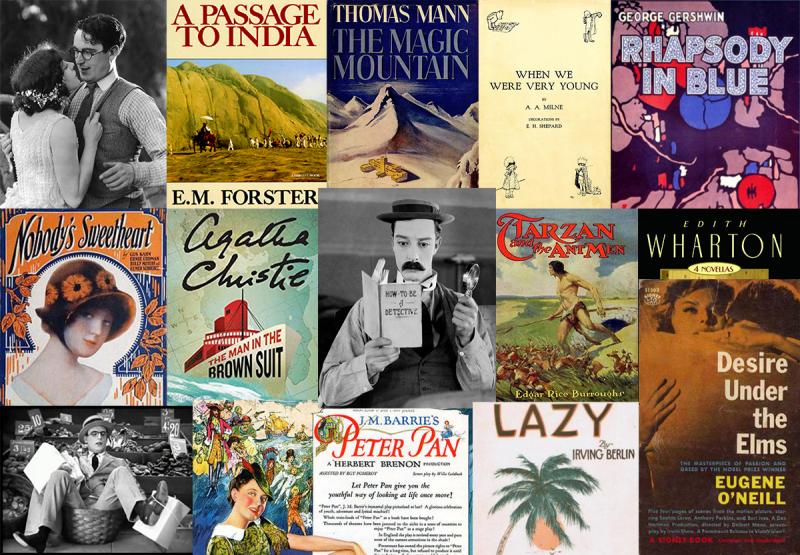
2020’s is a promising Public Domain Day indeed for fans of the Great American Songbook, what with the work of other composers like Irving Berlin (specifically the popular tune “Lazy,” well known from Marilyn Monroe’s performance in There’s No Business Like Show Business.) But the list of literary works that have just gone public-domain is even more impressive, boasting internationally acclaimed books like Thomas Mann’s The Magic Mountain, E.M. Forster’s A Passage to India, Edith Wharton’s novella collection Old New York, and the pillar of modern dystopian literature that is Yevgeny Zamyatin’s We (in English translation by Gregory Zilboorg). In many works of 1924, we can see the roots of the art we make and enjoy in 2020.
That holds especially true in the realm of film, which this year contributes to the public domain pictures from two masters of silent comedy: Harold Lloyd’s Girl Shy and Hot Water, and Buster Keaton’s The Navigator and Sherlock, Jr. That last film has the honor of being preserved by the United States Library of Congress for its cultural significance, as well as of having been named by the American Film Institute one of the funniest motion pictures in American history. You can learn more about all that entered the public domain this year (and what might, but for changes in the law, have entered it) at the Center for the Study of the Public Domain and the Public Domain review. But even more important than what enters the increasingly kaleidoscopic melting pot of the public domain, of course, is what we do with it. Future George Gershwins, Thomas Manns, and Buster Keatons, take note.
Related Content:
Ella Fitzgerald Sings ‘Summertime’ by George Gershwin, Berlin 1968
Rare 1940 Audio: Thomas Mann Explains the Nazis’ Ulterior Motive for Spreading Anti-Semitism
Based in Seoul, Colin Marshall writes and broadcasts on cities, language, and culture. His projects include the book The Stateless City: a Walk through 21st-Century Los Angeles and the video series The City in Cinema. Follow him on Twitter at @colinmarshall or on Facebook.
Read More...Support Us
We're hoping to rely on loyal readers, rather than erratic ads. Please click the Donate button and support Open Culture. You can use Paypal, Venmo, Patreon, even Crypto! We thank you!

About Us

Open Culture scours the web for the best educational media. We find the free courses and audio books you need, the language lessons & educational videos you want, and plenty of enlightenment in between.
Advertise With Us

FREE UPDATES!
GET OUR DAILY EMAIL
Get the best cultural and educational resources on the web curated for you in a daily email. We never spam. Unsubscribe at any time.
FOLLOW ON SOCIAL MEDIA

Open Culture editor Dan Colman scours the web for the best educational media. He finds the free courses and audio books you need, the language lessons & movies you want, and plenty of enlightenment in between.
Advertise With Us

