14 Paris Museums Put 390,000 Works of Art Online: Download Classics by Monet, Cézanne & More
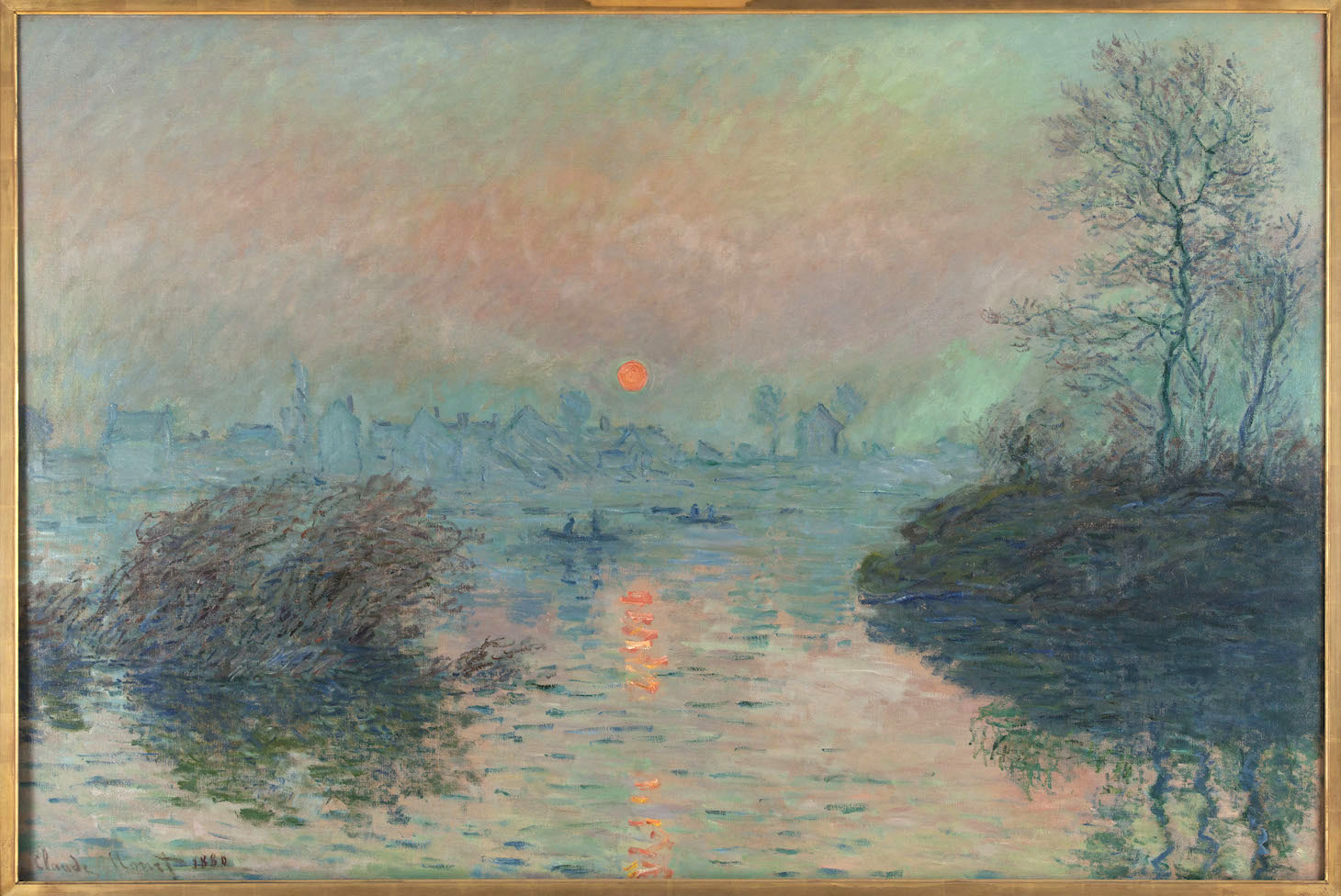
First trips to Paris all run the same risk: that of the museums consuming all of one’s time in the city. What those new to Paris need is a museum-going strategy, not that one size will fit all. Tailoring such a strategy to one’s own interests and pursuits requires a sense of each museum’s collection, something difficult to attain remotely before Paris Musées opened up its online collections portal.
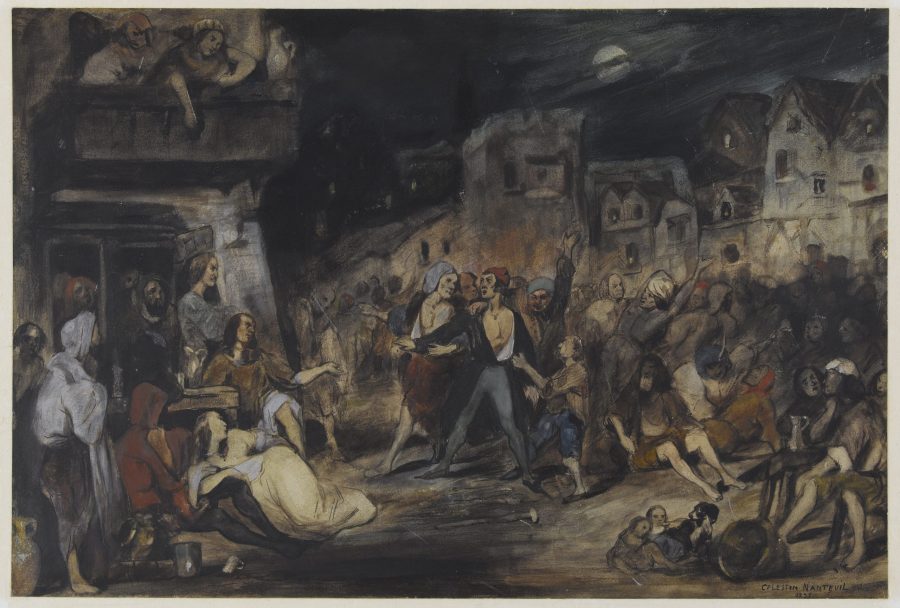
There, a counter tracks the number of artworks from the museums of Paris digitized and uploaded for all the world to see, which as of this writing comes in at 321,055. 150,222 images, notes a counter below, are in the public domain, and below that, another counter reveals that the archive now contains 621,075 pieces of digital media in total.
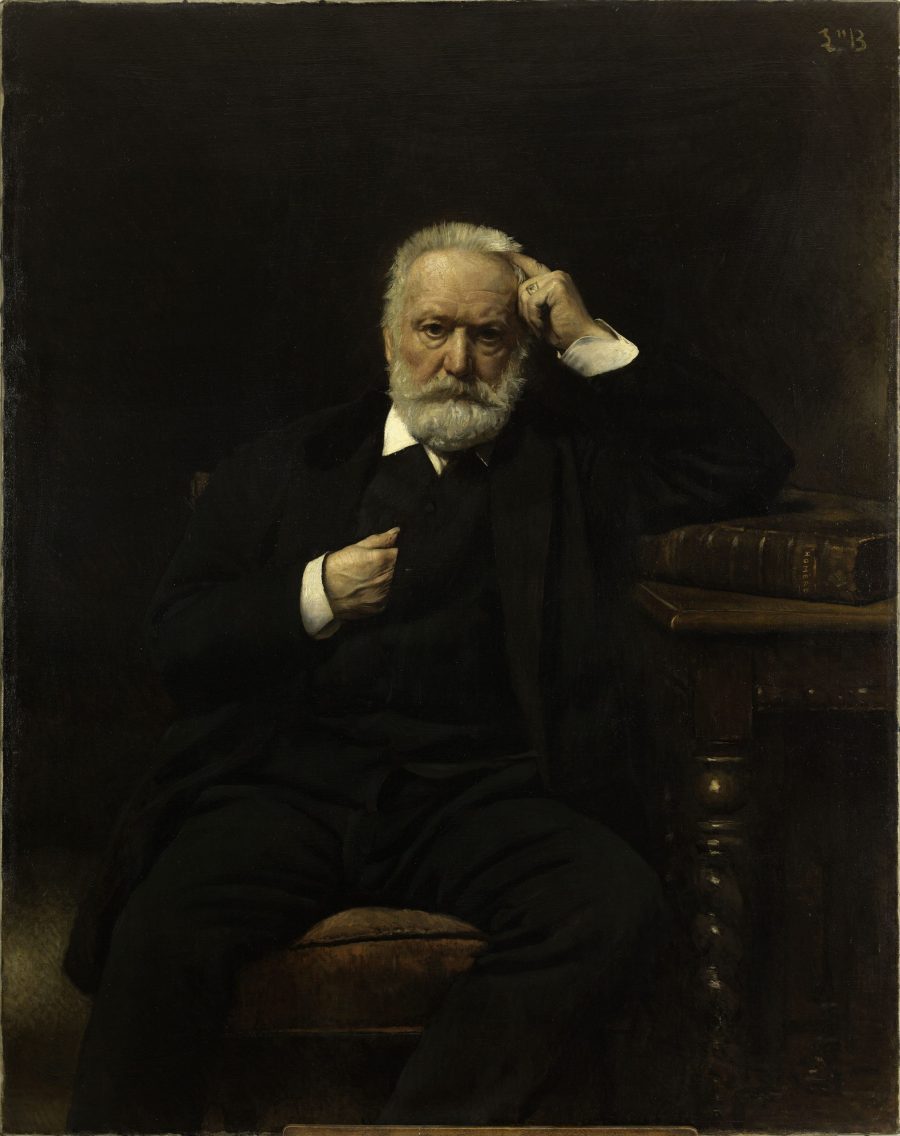
Among these, writes Hyperallergic’s Valentina Di Liscia, “masterpieces by renowned artists such as Rembrandt, Gustave Courbet, Eugène Delacroix, and Anthony van Dyck, among many other familiar and lesser-known names, can now be accessed and enjoyed digitally.”
She highlights “Paul Cézanne’s enchanting 1899 portrait of the French art dealer Ambroise Vollard,” pictures taken by “Eugène Atget, the French photographer known for documenting and immortalizing old Paris,” and Gustave Courbet’s Les demoiselles des bords de la Seine, which became “the subject of controversy at the Paris Salon of 1857 for what some deemed an indecorous and even sensual portrayal of working class women.”
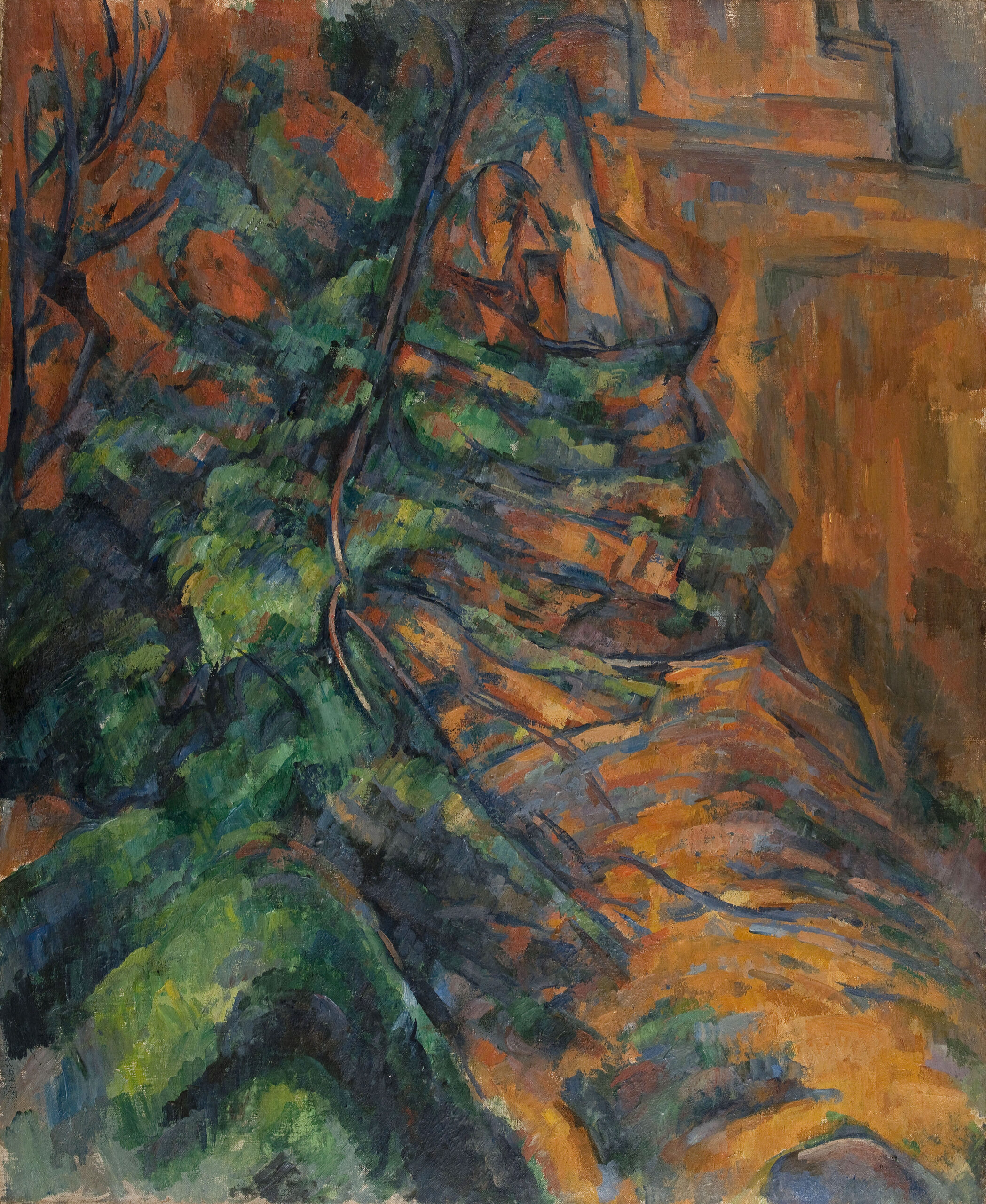
Paul Cezanne (1839–1906). “Rochers et branches à Bibémus”. Huile sur toile. Musée des Beaux-Arts de la Ville de Paris, Petit Palais.
Paris Musées oversees the fourteen City of Paris Museums, including the Musée d’Art Moderne de la Ville de Paris and the Petit Palais as well as the Maison de Balzac and Maison de Victor Hugo. That last now has a virtual exhibition up called “Light and Shade,” which, through the illustrations of Hugo’s literary works, reveals the “frenzy of images that adorned 19th century literature,” from “the blossoming of the romantic vignette, to the flood of popular editions, and the swansong of those collectors’ editions celebrating the glories of the Third Republic.” The “thematic discovering” section of Paris Musées portal also features sections on caricatures of Victor Hugo, on the 18th century, on portraits, and on Paris in the year 1900, when Art Nouveau made it “the capital of Europe.”
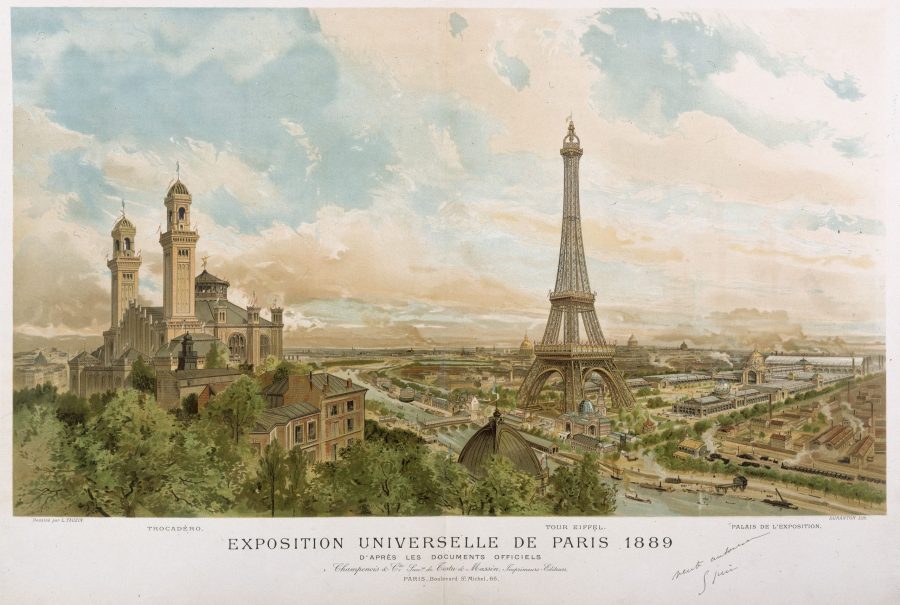
“Users can download a file that contains a high definition (300 DPI) image, a document with details about the selected work, and a guide of best practices for using and citing the sources of the image,” writes Di Liscia. Shown here are Claude Monet Soleil couchant sur la Seine à Lavacourt, effet d’hiver, Célestin Nanteuil’s La Cour des Miracles, Léon Bonnat’s Portrait de M. Victor Hugo, Cézanne’s Rochers et branches à Bibémus, and a postcard for the Exposition universelle de Paris 1889. These images are released under a CC0 (Creative Commons Zero) license, and “works still in copyright will be available as low definition files, so users can still get a feel for the museums’ collections online.” Do bear in mind that Paris Musées does not have under its umbrella that most famous museum of all, the Louvre. If you’re looking to get a feel for that world-renowned destination’s formidable collection, you may just have to visit it — a cultural task that necessitates a battle plan of its own.
Related Content:
1.8 Million Free Works of Art from World-Class Museums: A Meta List of Great Art Available Online
Download 100,000 Free Art Images in High-Resolution from The Getty
The Art Institute of Chicago Puts 44,000+ Works of Art Online: View Them in High Resolution
A 3D Animated History of Paris: Take a Visual Journey from Ancient Times to 1900
Based in Seoul, Colin Marshall writes and broadcasts on cities, language, and culture. His projects include the book The Stateless City: a Walk through 21st-Century Los Angeles and the video series The City in Cinema. Follow him on Twitter at @colinmarshall or on Facebook.
Read More...“Mr. Tambourine Man” & Other Bob Dylan Classics, Sung Beautifully by Kids
New Zealander David Antony Clark grew up with the music of Bob Dylan, and, like many his age, felt sad that the youngun’s had no idea who that was. Instead of moaning, he decided to produce Kids Sing Bob Dylan, an 11-track CD of covers sung by the Starbugs, Clark’s children’s group.
Before you flinch, check the YouTube clip above. These kids can actually sing, right? The harmonies are there…I mean possibly cleaned up a bit with technology, I can’t say for sure.
Here’s “Forever Young,” from Dylan’s 1974 Planet Waves. An appropriate song for this quintet: Jessie Hillel, Rebecca Jenkins, Sarah Whitaker, Ben Anderson, and Roisin Anderson, all from Wellington, NZ, and raging in age from 7 to 15.
According to a Stuff.nz article on the release, Jessie Hillel said about the recording: “Hearing and listening to him was really fun. But you can do whatever you want to the songs, but at the same time I really wanted to have his standard because he did such a good job. I feel proud of myself, it’s just so good.”
Ben Anderson, age 12, was the only one with previous knowledge of Dylan: ““I’d heard about him a few times before, I was really excited. He’s a really good singer, just the emotion that he puts into his songs, I was really excited to sing them. I was really nervous that I wouldn’t live up to it, and do it right, but it got easier as the song went on.”
Now, you might have noticed two things from a quick listen. One of the younger kids, Jessie Hillel, might be small, but she packs a voice from someone twice her age. (She handles the lower range in the harmonies.) The other thing: these videos are from 2011.
Where is Jessie now? Funny you ask:
In 2012 she made her way onto the finals of New Zealand’s Got Talent, and in 2016 she sang Puccini in Melbourne. She’s currently studying music in Melbourne and is in a jazz-fusion band called Jakal.
Sarah Whitaker also has her own music channel on YouTube.
Funny about kids–they grow up right in front of your eyes.
Related Content:
Tangled Up in Blue: Deciphering a Bob Dylan Masterpiece
Bob Dylan Potato Chips, Anyone?: What They’re Snacking on in China
Ted Mills is a freelance writer on the arts who currently hosts the artist interview-based FunkZone Podcast and is the producer of KCRW’s Curious Coast. You can also follow him on Twitter at @tedmills, read his other arts writing at tedmills.com and/or watch his films here.
Read More...Range: Why Generalists Triumph in a Specialized World
Below, you can hear journalist David Epstein talks with Recode’s Kara Swisher about his book, Range: Why Generalists Triumph in a Specialized World. In it, “he argues that the world’s most successful athletes, artists, musicians, inventors, forecasters and scientists are more likely to be dabblers, rather than people who set out to do what they do best from a young age — and, in fact, the people who have highly specialized training from an early age tend to have lower lifetime earnings overall.” The #1 New York Times bestselling book makes the case that “in most fields—especially those that are complex and unpredictable—generalists, not specialists, are primed to excel. Generalists often find their path late, and they juggle many interests rather than focusing on one. They’re also more creative, more agile, and able to make connections their more specialized peers can’t see.”
You can pick up a copy of Range: Why Generalists Triumph in a Specialized World in print, or get it as a free audio book if you sign up for a 30-day free trial with Audible.com.
If you would like to support the mission of Open Culture, consider making a donation to our site. It’s hard to rely 100% on ads, and your contributions will help us continue providing the best free cultural and educational materials to learners everywhere. You can contribute through PayPal, Patreon, and Venmo (@openculture). Thanks!
Related Content:
Noam Chomsky Defines What It Means to Be a Truly Educated Person
Oxford’s Free Course Critical Reasoning For Beginners Teaches You to Think Like a Philosopher
How to Focus: Five Talks Reveal the Secrets of Concentration
Read More...How Dick Cavett Brought Sophistication to Late Night Talk Shows: Watch 270 Classic Interviews Online
Just as the avuncular presence of Ed Sullivan helped ease middle America into accepting Elvis Presley and The Beatles, the aw-shucks midwestern charm of Dick Cavett made Woodstock hippies seem downright cuddly when he had Jefferson Airplane, David Crosby, and Joni Mitchell on just after the legendary music festival in 1969. He had a way of making everyone around him comfortable enough to reveal just a little more than they might otherwise. (See Jimi Hendrix talk about his National Anthem performance, below.)
Born in Nebraska in 1937, “the only persona [Cavett] bothered to, or needed to, develop for working on camera was of a boy from Nebraska dazzled by the bright lights of New York,” as Clive James writes in an appreciation of the TV host. As he interviewed the biggest stars of late sixties, seventies, and eighties on the long-running Dick Cavett Show, Cavett’s easygoing Midwestern demeanor disarmed both his guests and audiences. He kept them engaged with his erudition, quick wit, and breadth of cultural knowledge.
Cavett, writes James, was “the most distinguished talk-show host in America… a true sophisticate with a daunting intellectual range.” He was also an empathic interviewer who could lead his guests beyond the stock responses they were used to giving in TV interviews. (David Bowie, below, reveals how he was influenced by his fans.)
A trained gymnast and self-taught magician—Cavett met fellow magician Johnny Carson in the early 50s at a magic convention—the talk-show host left Nebraska for Yale and never looked back. (He once joked, quoting Abe Burrows, “How ya gonna keep ‘em down on the farm, after they’ve seen the farm?”) After college, he moved to New York to pursue acting. There, he got his first comedy writing job, when he handed some of his jokes to Tonight Show host Jack Paar in an elevator. He befriended Stan Laurel, Groucho Marx, and all the biggest names in comedy, and wrote for Jerry Lewis and Merv Griffin.
Once he had his own late-night talk show, however, which ran opposite Johnny Carson’s Tonight Show, it became clear that he was doing something very different. “Cavett never mugged, never whooped it up for the audience, rarely told a formally constructed joke, and listened to the guest,” writes James. He became “famous enough not to be able to go out except in disguise,” but “his style did not suit a mass audience.” This is what made—and still makes—Cavett worth watching.
He had Brian de Palma and Martin Scorsese on to talk about how they’re each other’s best critics, and Scorsese revealed that he did additional shooting for The Last Waltz after De Palma saw it.
Robin Williams came on to demonstrate his developing Popeye voice during the shooting of the Robert Altman film in 1979. In the clip above, he talks about feeling like “a monkey on a string” and working through his depression.
Lucille Ball told the story of her early years in show business, and her time working as a model, and Dick Van Dyke talked frankly about his alcoholism and the stigma surrounding addiction.
These are just a few of the 270+ surprising clips you’ll find on the Dick Cavett Show YouTube channel, where George Carlin, Muhammad Ali, Marlon Brando, George Harrison, John Lennon, Ian McKellen, Julie Andrews, and too many more stars to name say things they rarely said anywhere else, as Cavett draws them out and keeps them talking.
Related Content:
George Harrison in the Spotlight: The Dick Cavett Show (1971)
John Lennon & Yoko Ono’s Two Appearances on The Dick Cavett Show in 1971 and 72
Josh Jones is a writer and musician based in Durham, NC. Follow him at @jdmagness
Read More...The Magic of Chess: Kids Share Their Uninhibited, Philosophical Insights about the Benefits of Chess
From the US Chess Federation and director Jenny Schweitzer comes the short documentary, The Magic of Chess. “Filmed at the 2019 Elementary Chess Championships at the Nashville Opryland resort, a group of children share their uninhibited, philosophical insights about the benefits of chess.” Jenny Schweitzer added: “For me, as a mother of a child who simply loves the game, it was my intention to focus not on the competitive aspects of the chess world, but rather what a deep commitment to chess can potentially offer someone, young or old.” If this whets your appetite, explore some of our chess resources below.
If you would like to support the mission of Open Culture, consider making a donation to our site. It’s hard to rely 100% on ads, and your contributions will help us continue providing the best free cultural and educational materials to learners everywhere. You can contribute through PayPal, Patreon, and Venmo (@openculture). Thanks!
Related Content:
A Free 700-Page Chess Manual Explains 1,000 Chess Tactics in Plain English
A Brief History of Chess: An Animated Introduction to the 1,500-Year-Old Game
Garry Kasparov Now Teaching an Online Course on Chess
A Beautiful Short Documentary Takes You Inside New York City’s Last Great Chess Store
Vladimir Nabokov’s Hand-Drawn Sketches of Mind-Bending Chess Problems
Chess Grandmaster Garry Kasparov Relives His Four Most Memorable Games
A Human Chess Match Gets Played in Leningrad, 1924
Read More...Pretty Much Pop: A Culture Podcast #26 Discusses Alan Moore’s Watchmen Comic and the HBO Show with Cornell Psychology Professor David Pizarro

Perhaps the most lauded graphic novel has been sequelized for HBO, and amazingly, it turned out pretty darn well (with a 96% Rotten Tomatoes rating!).
Your hosts Mark Linsenmayer, Erica Spyres, and Brian Hirt are joined by the Cornell’s David Pizarro, host of the popular Very Bad Wizards podcast. We consider Alan Moore’s 1986 graphic novel, the 2009 Zack Snyder film, and of course mostly the recently completed (we hope) show by Damon Lindelof, the creator of Lost and The Leftovers.
How does Moore’s idiosyncratic writing style translate to the screen? Did the show make best use of its nine hours? Are there other stories in this alternate history that should still be told, perhaps to reflect on other recurrent social ills or crises of whatever moment might be depicted? Was Lindelof really the guy to tell this story about race, and does making the show about racism (which is bad!) undermine Moore’s rejection of (morally) black-and-white heroes and villains?
Some of the articles we used to warm up for this discussion included:
- “Some Watchmen Fans Are Mad that HBO’s Version Is Political. But Watchmen Has Always Been Political” by Alex Abad-Santos
- “How HBO’s ‘Watchmen’ Can Avoid the Misogynistic Missteps of Its Past” by Rosie Knight
- “The Right-Wing Troll Backlash Against HBO’s Watchmen Is Hilariously Stupid” by Matt Miller
- “How ‘Watchmen’s’ Misunderstanding of Vietnam Undercuts its Vision of Racism” by Viet Thanh Nguyen
- “Why We Don’t Want to Watch Watchmen Season 2” by David Opie
- “When Sex Scenes Go Wrong: Zack Snyder’s Watchmen“ by Jim Vorel
You might want to also check out HBO’s Watchmen page, which includes extra essays and the official podcast with Damon Lindelof commenting on the episodes.
Follow Dave @peez. Hear him on The Partially Examined Life, undoubtedly the apex of his professional career.
This episode includes bonus discussion that you can only hear by supporting the podcast at patreon.com/prettymuchpop. This podcast is part of the Partially Examined Life podcast network.
Pretty Much Pop: A Culture Podcast is the first podcast curated by Open Culture. Browse all Pretty Much Pop posts or start with the first episode.
Read More...Free Online Writing & Journalism Courses

Image by Book Mama, via Flickr Commons
- A Beginner’s Guide to Writing in English for University Study — Massive Open Online Course (MOOC) — University of Reading
- An Introduction to Screenwriting — Massive Open Online Course (MOOC) — University of East Anglia
- Advanced Writing — Massive Open Online Course (MOOC) — UC Irvine
- Business Writing — Massive Open Online Course (MOOC) — UC-Boulder
- Creative Writing: The Craft of Character — Massive Open Online Course (MOOC) — Wesleyan
- Creative Writing: The Craft of Plot — Massive Open Online Course (MOOC) — Wesleyan
- Creative Writing: The Craft of Setting and Description — Massive Open Online Course (MOOC) — Wesleyan
- Creative Writing: The Craft of Style — Massive Open Online Course (MOOC) — Wesleyan
- Discovering Science: Science Writing — Massive Open Online Course (MOOC) — University of Leeds
- English for Journalists, Part 1 — Massive Open Online Course (MOOC) — UC Berkeley
- English for Journalists, Part 2 — Massive Open Online Course (MOOC) — UC Berkeley
- Getting Started with Essay Writing — Massive Open Online Course (MOOC) — UC Irvine
- Grammar and Punctuation — Massive Open Online Course (MOOC) — UC Irvine
- Grammar and Punctuation Advanced — Massive Open Online Course (MOOC) — UC Irvine
- How To Make A Poem — Massive Open Online Course (MOOC) — Manchester Metropolitan University
- How to Write an Essay — Massive Open Online Course (MOOC) — UC Berkeley
- Journalistic Ethics — Free Online Course — Jim Newton, UCLA
- Journalism Under Siege — Free Online Course — Multiple Faculty, Stanford University
- Memoir and Personal Essay: Managing Your Relationship with the Reader — Massive Open Online Course (MOOC) — Wesleyan University
- Press and Society — Free iTunes Audio — Christopher Scanlon, La Trobe University
- Rhetoric: The Art of Persuasive Writing and Public Speaking — Massive Open Online Course (MOOC) — Harvard University
- Script Writing: Write a Pilot Episode for a TV or Web Series — Massive Open Online Course (MOOC) — Michigan State
- Sharpened Visions: A Poetry Workshop — Massive Open Online Course (MOOC) — Cal Arts
- Songwriting: Writing the Lyrics — Massive Open Online Course (MOOC) — Berklee College of Music
- Start Fiction Writing — Massive Open Online Course (MOOC) — Open University
- Start Writing Essays — Free Course - Open University
- Writing in the Sciences — Massive Open Online Course (MOOC) — Stanford University
- Writing Science Fiction & Fantasy — Free Online Videos — BYU, Brandon Sanderson
- Writing Stories About Ourselves — Massive Open Online Course (MOOC) — Wesleyan University
See our meta collection–1,700 Free Online Courses from Top Universities–for a complete list of online courses, covering nearly every subject.
If you would like to support the mission of Open Culture, consider making a donation to our site. It’s hard to rely 100% on ads, and your contributions will help us continue providing the best free cultural and educational materials to learners everywhere. You can contribute through PayPal, Patreon, and Venmo (@openculture). Thanks!
Read More...The Strange, Spiritual Origins of the Ouija Board
Even as an avid horror movie fan, I find it hard to suspend disbelief when Ouija boards show up, and they show up often enough, in classics like The Exorcist and modern favorites like Paranormal Activity. Ouija boards have always seemed more like wands with plastic flowers in them than telegraphs to the afterlife or the infernal abyss. But I grew up with people who considered it a gateway to hell, just as spiritualists have considered it a portal to the beyond, where their dead relatives waited to give them messages.
So, how did this novelty item become such a potent figure of fear and fascination in America? When it was mass-marketed by “a Pittsburgh toy and novelty shop” in the late 19th century, as Linda Rodriquez McRobbie writes at Smithsonian, “this mysterious talking board was basically what’s sold in board game aisles today.” Its advertisements promised “never failing amusement and recreation for all the classes,” and a bridge “between the known and unknown, the material and immaterial.”
The Ouija board might have become a toy by the end of the century, but throughout the earlier decades, belief in the supernatural held serious sway among “all the classes.” The average lifespan was less than 50. “Women died in childbirth; children died of disease; and men died in war. Even Mary Todd Lincoln, wife of the venerable president, conducted séances in the White House after their 11-year-old son died of a fever in 1862.” Disease epidemics and the Civil War left millions bereft.
“Communicating with the dead was common,” says Ouija historian Robert Murch. “It wasn’t seen as bizarre or weird,” even among the staunchest religious people who filled the pews each Sunday. “It’s hard to imagine that now, we look at that and think, ‘Why are you opening the gates of hell?’” These commonly held beliefs may not have damned anyone’s soul, but they made even the rarest minds, like Sherlock Holmes’ creator Arthur Conan Doyle, susceptible to fraud and trickery.
It was only a matter of time before believers in spiritualism became a target demographic for the cheap commodities spreading across the country with the railroads. “People were desperate for methods of communication” with the dead “that would be quicker” than the local medium. “While several entrepreneurs realized that,” McRobbie writes, “it was the Kennard Novelty Company that really nailed it” with their 1886 product. But they didn’t invent it. Such devices date back years earlier.
Some early versions “looked like Ouija boards, and some didn’t,” notes Vox. “Some devices even used planchettes (that’s the name for the thing you hold when you operate a Ouija.” (Planchette, from medieval French, means a small board.) As for the nonsense word “Ouija,” one legend has it that the name came from an 1890 session in which the board was asked what it would like itself to be called. Learn more in the Vox video above about why the Ouija board came to loom so large, or in their words, became so “overrated,” in the American imagination.
Related Content:
Josh Jones is a writer and musician based in Durham, NC. Follow him at @jdmagness
Read More...An Animated Look at the Charade of the Global Elites: Claiming They Want to “Change the World,” They End Up Preserving the Unjust Status Quo
From Peter Kropotkin to Leo Tolstoy to Noam Chomsky, some of the most revered anarchist thinkers have exhausted page after page explaining why power over others is unjustified, no matter how it justifies itself. To those who say the wealthy and powerful benefit society with charitable works and occasionally humane policy, Tolstoy might reply with the following illustration, which opens Time editor Anand Giridharadas’ talk above, “Winner Take All,” as animated by the RSA:
I sit on a man’s back, choking him and making him carry me, and yet assure myself and others that I am sorry for him and wish to lighten his load by all means possible… except by getting off his back.
The author of Winners Take All: The Elite Charade of Changing the World, Giridharadas doesn’t make the case for anarchism here, except perhaps by the slightest implication in his choice of epigraph. But he does call out the “winners of our age,” no matter how much they determine to make a difference with humanitarian aid, for being “unwilling to get off the man’s back.” Unwilling to pay taxes, close loopholes and tax shelters, pay higher wages, or stop lobbying to slash public services. Unwilling to reinvest in the communities that made them.
“What does it look like to imagine the kind of change,” Giridharadas asks, “that would involve the winners of our age stepping off that guy’s back? Or being made to step off that guy’s back?” Here, he leaves us with an ellipses and moves to critique the idea of the “win-win” as a means of making change, rather than just exchange.
The market economy has imported the criteria of exchange into politics and social action. Everything is transactional. But in order to address the gross inequities that result in people figuratively sitting on the backs of others, some must gain more power and others must have less. The parties do not meet in a state of ceteris paribus.
One might take issue with the very terms used in “win-win” thinking. Rather than winners, some would call powerful capitalists opportunists, profiteers, and worse. (The term “robber baron” was once in common circulation.) To claim that good works and good intentions obviate massive power imbalances is to presume that such imbalances are justifiable in the first place. Answering this theoretical question doesn’t, however, address the practical problem.
In the current system of corporate misrule, says Giridharadas, “when everything is couched as a win-win, what you are really saying… is that the best kinds of solutions don’t ask anyone to get off anyone’s back.” Unfettered capitalism has brought us the “privatization of public problems.” That is to say, companies profit from the same issues they help create through pollution, predatory schemes, and undue political influence.
You don’t have to be an anarchist to see a serious problem with that. But if you see the problem, you should want to imagine how things could be otherwise.
Related Content:
Saul Alinsky’s 13 Tried-and-True Rules for Creating Meaningful Social Change
Teaching Tolerance to Activists: A Free Course Syllabus & Anthology
Josh Jones is a writer and musician based in Durham, NC. Follow him at @jdmagness
Read More...Pink Floyd Films a Concert in an Empty Auditorium, Still Trying to Break Into the U.S. Charts (1970)
It’s hard to imagine that in the late 60s, the band who would become the most famous of the psychedelic era was still an obscurity to most U.S. listeners. Nowadays “Pink Floyd may be the only rock band that can credibly be compared to both the Beatles and Spinal Tap,” writes Bill Wyman in a Vulture retrospective of their entire catalogue. Indeed, it’s possible their stadium-sized popularity has been underestimated. According to the data, they’ve actually sold more albums worldwide than the Fab Four.
But they had to pay dues in the States. “In the last week of April 1973,” notes KQED’s Richie Unterberger, Dark Side of the Moon “reached No. 1 on the American charts. In the last week of April 1970, though, they had yet to crack the U.S. Top 50 after three years of recording and performing.”
Their first singer/songwriter, and later tragic muse, Syd Barrett, had come and gone after their debut album, The Piper at the Gates of Dawn. They were already well into what Wyman describes as the second phase of “four, or arguably five, Pink Floyds.”
This version “was one of the founders of progressive rock, a psychedelic, space-rock‑y, quasi-improvisational ensemble.” They were excellent live musicians and masters of mood and atmosphere. But their experimental direction didn’t sell. “At that point, they were really anxious to have whatever publicity they could,” says Jim Farber, who co-produced the hour-long TV concert film above for KQED, San Francisco’s public television station.
We did not have much of a budget. Pink Floyd did the performance and offered the rights for a certain number of airings for practically nothing. My memory is we paid them $200.
The band played in the empty Fillmore Auditorium for a film crew. The venue wasn’t empty because no one showed up. They could draw a crowd and had already played the Fillmore West and toured the U.S. three times. But, “for as strong an underground following as they were building in the United States,” writes Unterberger, they “were so eager for an American audience that they played a free concert at UCLA a week later” after the KQED taping.
The station, which in 1970 “was more known for Sesame Street than psychedelic rock,” had already begun to move into concert films. “Local icons” like “Big Brother & the Holding Company, Jefferson Airplane, and Quicksilver Messenger Service all got airtime.” But Pink Floyd was something different indeed. The film, broadcast in January of ’71, “got an incredibly positive response when we aired it in San Francisco,” says Farber. “After that, it had two national broadcasts on PBS.”
You can watch the full “Hour with Pink Floyd,” as the program was called, just above. At the top, see the band play “Astronomy Domine” in footage cut from the original broadcast. Further up, see the sixteen minute “Atom Heart Mother,” a testament to how far out Pink Floyd could go, and how much a local public television station was willing to go with them. The track opens with five minutes of aerial footage of the San Joaquin Valley, the band nowhere in sight. When Pink Floyd finally arrives onscreen, the desert vistas continue to weave in and out.
In “Grantchester Meadows,” below, forest sounds and images introduce the song. The effect was to translate the mystique British listeners associated with Pink Floyd to U.S. audiences just on the verge of being blown away by a very different-sounding band who released Dark Side of the Moon three years later.
via Laughing Squid
Related Content:
An Hour-Long Collection of Live Footage Documents the Early Days of Pink Floyd (1967–1972)
Josh Jones is a writer and musician based in Durham, NC. Follow him at @jdmagness
Read More...Support Us
We're hoping to rely on loyal readers, rather than erratic ads. Please click the Donate button and support Open Culture. You can use Paypal, Venmo, Patreon, even Crypto! We thank you!

About Us

Open Culture scours the web for the best educational media. We find the free courses and audio books you need, the language lessons & educational videos you want, and plenty of enlightenment in between.
Advertise With Us

FREE UPDATES!
GET OUR DAILY EMAIL
Get the best cultural and educational resources on the web curated for you in a daily email. We never spam. Unsubscribe at any time.
FOLLOW ON SOCIAL MEDIA

Open Culture editor Dan Colman scours the web for the best educational media. He finds the free courses and audio books you need, the language lessons & movies you want, and plenty of enlightenment in between.
Advertise With Us

