The Internet Archive Is Digitizing & Preserving Over 100,000 Vinyl Records: Hear 750 Full Albums Now
There seems to be widespread agreement—something special was lost in the rushed-to-market move from physical media to digital streaming. We have come to admit that some older musical technologies cannot be improved upon. Musicians, producers, engineers spend thousands to replicate the sound of older analog recording technology, with all its quirky, inconsistent operation. And fans buy record players and vinyl records in surprisingly increasing numbers to hear the warm and fuzzy character of their sound.
Neil Young, who has relentlessly criticized every aspect of digital recording, has dismissed the resurgence of the LP as a “fashion statement” given that most new albums released on vinyl are digital masters. But buyers come to vinyl with a range of expectations, writes Ari Herstand at Digital Music News: “Vinyl is an entire experience. Wonderfully tactile…. When we stare at our screens for the majority of our days, it’s nice to look at art that doesn’t glow and isn’t the size of my hand.” Vinyl can feel and look as good as it sounds (when properly engineered).
While shiny, digitally mastered vinyl releases pop up in big box stores everywhere, the real musical wealth lies in the past—in thousands upon thousands of LPs, 45s, 78s—relics of “the only consumer playback format we have that’s fully analog and fully lossless,” says vinyl mastering engineer Adam Gonsalves. Few institutions can afford to store thousands of physical albums, and many rarities and oddities exist in vanishingly fewer copies. Their crackle and hiss may be forever lost without the intervention of digital preservationists like the Internet Archive.
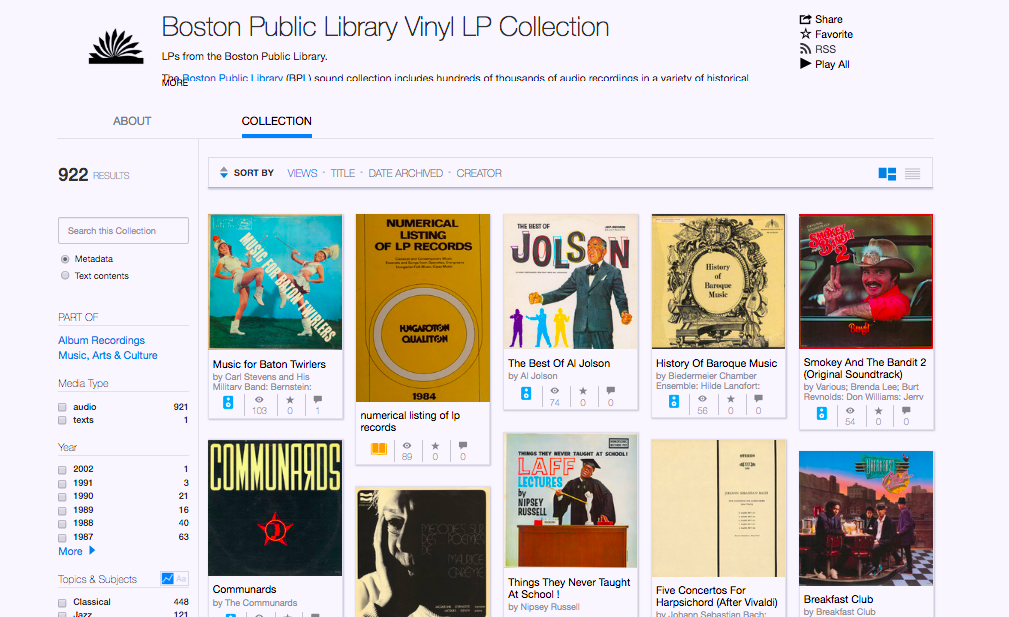
The Archive is “now expanding its digitization project to include LPs,” reports Faye Lessler on the organization’s blog. This will come as welcome news to cultural historians, analog conservationists, and vinyl enthusiasts of all kinds, who will mostly agree that digitization is far better than extinction, though the tactile and visual pleasures may be irreplaceable. The Archive has focused its efforts on the over 100,000 audio recordings from the Boston Public Library’s collection, “in order to prevent them from disappearing forever when the vinyl is broken, warped, or lost.”
“These recordings exist in a variety of historical formats, including wax cylinders, 78 rpms, and LPs,” though the project is currently focused on the latter. “They span musical genres including classical, pop, rock, and jazz, and contain obscure recordings like this album of music for baton twirlers, and this record of radio’s all-time greatest bloopers.” The method of rapidly converting the artifacts at the rate of ten LPs per hour (which you can read more about at the Archive blog) serves as a testament to what digital technology does best—using machine learning and metadata to automate the archival process and create extensive, searchable databases of catalogue information.
Currently, the project has uploaded 1,180 recordings to its site, “but some of the albums are only available in 30 second snippets due to rights issues,” Lessler points out. Browse the “Unlocked Recordings” category to hear 750 digitized LPs available in full: these include a recording of Gian Carlo Menotti’s ballet The Unicorn, the Gorgon, and the Manticore, further up; The Begetting of the President, above, a satire of Nixon’s rise to power as Biblical epic, read by Orson Welles in his King of Kings’ voice; and Tchaikovsky’s Piano Concerto no. 1 in B‑flat minor, played by Van Cliburn, below.
The range and variety captured in this collection—from fireworks sound effects to Elton John’s second, self-titled album to classic Pearl Baily to 80s new wave band The Communards to Andres Segovia playing Bach to the Smokey and the Bandit 2 soundtrack—will outlast copyright restrictions. And they will leave behind an extensive record, no pun intended, of the LP: “our primary musical medium for over a generation,” says the Archive’s special projects director CR Saikley, “witness to the birth of both Rock & Roll and Punk Rock… integral to our culture from the 1950s to the 1980s.” Vinyl remains the most revered of musical formats for good reason—reasons future generations will discover, at least virtually, for themselves someday.
via Kottke
Related Content:
How Vinyl Records Are Made: A Primer from 1956
An Interactive Map of Every Record Shop in the World
Josh Jones is a writer and musician based in Durham, NC. Follow him at @jdmagness
Read More...An Animated Leonard Cohen Offers Reflections on Death: Thought-Provoking Excerpts from His Final Interview
A month before Leonard Cohen died in November, 2016, The New Yorker’s editor David Remnick traveled to the songwriter’s Los Angeles home for a lengthy interview in which Cohen looked both forward and back.
As a former Zen monk, he was also adept at inhabiting the present, one in which the shadow of death crept ever closer.
His former lover and muse, Marianne Ihlen, had succumbed to cancer earlier in the summer, two days after receiving a frank and loving email from Cohen:
Well, Marianne, it’s come to this time when we are really so old and our bodies are falling apart and I think I will follow you very soon. Know that I am so close behind you that if you stretch out your hand, I think you can reach mine. And you know that I’ve always loved you for your beauty and your wisdom, but I don’t need to say anything more about that because you know all about that. But now, I just want to wish you a very good journey. Goodbye old friend. Endless love, see you down the road.
The New Yorker has never shied from over-the-top physical descriptions. The courteous, highly verbal young poet, who’d evinced “a kind of Michael Corleone Before the Fall look, sloe-eyed, dark, a little hunched” was now very thin, but still handsome, with the handshake of “a courtly retired capo.”
In addition to an album, You Want It Darker, to promote, Cohen had a massive backlog of unpublished poems and unfinished lyrics to tend to before the sands of time ran out.
At 82, he seemed glad to have all his mental faculties and the support of a devoted personal assistant, several close friends and his two adult children, all of which allowed him to maintain his music and language-based workaholic habits.
Time, as he noted, provides a powerful incentive for finishing up, despite the challenges posed by the weakening flesh:
At a certain point, if you still have your marbles and are not faced with serious financial challenges, you have a chance to put your house in order. It’s a cliché, but it’s underestimated as an analgesic on all levels. Putting your house in order, if you can do it, is one of the most comforting activities, and the benefits of it are incalculable.
He had clearly made peace with the idea that some of his projects would go unfinished.
You can hear his fondness for one of them, a “sweet little song” that he recited from memory, eyes closed, in the animated interview excerpt, above:
Listen to the hummingbird
Whose wings you cannot see
Listen to the hummingbird
Don’t listen to me.
Listen to the butterfly
Whose days but number three
Listen to the butterfly
Don’t listen to me.
Listen to the mind of God
Which doesn’t need to be
Listen to the mind of God
Don’t listen to me.
These unfinished thoughts close out Cohen’s beautifully named posthumous album, Thanks for the Dance, scheduled for release later this month.
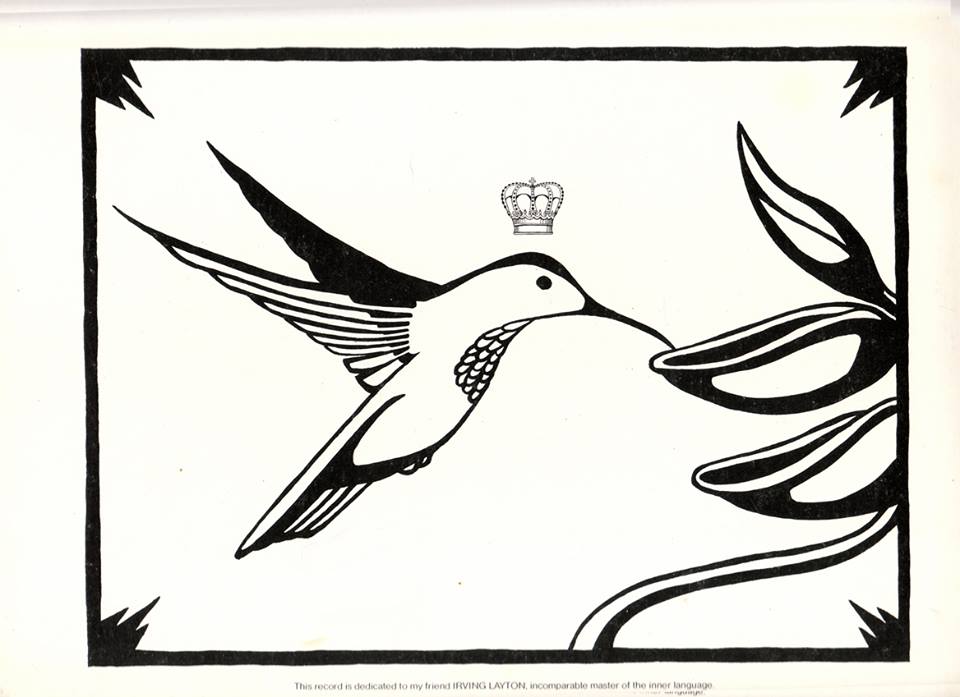
Dianne V. Lawrence, who designed Cohen’s hummingbird logo, a motif beginning with 1979’s Recent Songs album, speculates that Cohen equated the hummingbird’s enormous energy usage and sustenance requirements with those of the soul.
Read Remnick’s article on Leonard Cohen in its entirety here. Hear a recording of David Remnick’s interview with Cohen–his last ever–below:
Related Content:
Hear Leonard Cohen’s Final Interview: Recorded by David Remnick of The New Yorker
How Leonard Cohen Wrote a Love Song
Ayun Halliday is an author, illustrator, theater maker and Chief Primatologist of the East Village Inky zine. Join her in NYC on Monday, December 9 for her monthly book-based variety show, Necromancers of the Public Domain. Follow her @AyunHalliday.
Read More...Lou Reed’s Mixtape for Andy Warhol Discovered by Cornell University Professor: Features 12 Previously Unreleased Songs
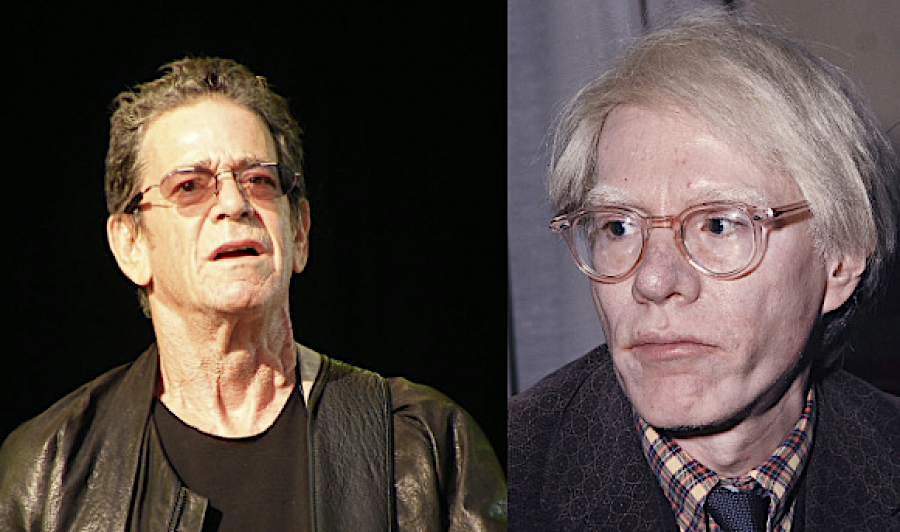
Image via Wikimedia Commons
It’s every researcher’s dream: that somewhere among the pile of materials lies gold, an undiscovered masterpiece, or an unknown piece to a puzzle that complicates conventional knowledge. That’s what Cornell University’s Judith Peraino discovered while going through some of the 3,500 cassettes in the Andy Warhol archive. Here she found a mix-tape cassette that Lou Reed had made for Andy in the mid-seventies, with one side a selection of songs from recent live gigs, the other side containing 12 unknown and unreleased songs by Reed, accompanied by only his guitar, recorded at home in New York City.
Labeled “The Philosophy Songs (From A to B and Back),” the songs are Reed’s response to Warhol’s 1975 book The Philosophy of Andy Warhol: From A to B and Back Again, which his mentor had sent to Reed in galley proof. Their relationship was always difficult. After an unpleasant breakup after the Velvet Underground came out from under Warhol’s shadow, the two never worked together again. But they kept in touch in the way that certain bitter exes do: keeping it cordial, possibly considering working together again, then realizing why they broke up in the first place.
Prof. Peraino surmised that the tape is related to a musical Warhol wanted to create with Reed based on Warhol’s book. And in fact Reed uses passages from the book as jumping off points for the lyrics, she found. There’s a song each about “fame, sex, and the business of art,” and two about drag queens. But Reed used other songs to criticize Warhol for his seeming indifference to the deaths of Factory stars Candy Darling and Eric Emerson, adding that he should have died after being shot in 1968. Reed then apologies to Warhol at the end of the song.
Because her research was about the beginnings of mixtape culture, queerness, and Warhol’s endless boxes of cassettes, she is excited about both sides of the tape. Mixtapes, she explains, were a way for people to communicate complex emotions without having to simply write them down. Songs strike emotional chords in so many ways.
The tape “is an example of Lou Reed curating himself, putting together an ideal set list for Andy Warhol,” Peraino says in Cornell’s video interview. “I see the message of the tape as being both courtship and breakup in a sense. The one side is saying, look at me, what I’ve able to do this year…and now look at you.”
Apart from a 30-second excerpt, found on Variety’s web page, there are no current plans to release something so rough, and with so many rights issues at stake.
Lou Reed did go on to make something similar however, when in 1990 he wrote Songs for Drella with fellow Velvet John Cale.
Related Content:
Andy Warhol Demystified: Four Videos Explain His Groundbreaking Art and Its Cultural Impact
Ted Mills is a freelance writer on the arts who currently hosts the artist interview-based FunkZone Podcast and is the producer of KCRW’s Curious Coast. You can also follow him on Twitter at @tedmills, read his other arts writing at tedmills.com and/or watch his films here.
Read More...What to Wear to a Successful PhD Thesis Defense? A Skirt’s Worth of Academic Rejection Letters
Some people are paralyzed by rejection.
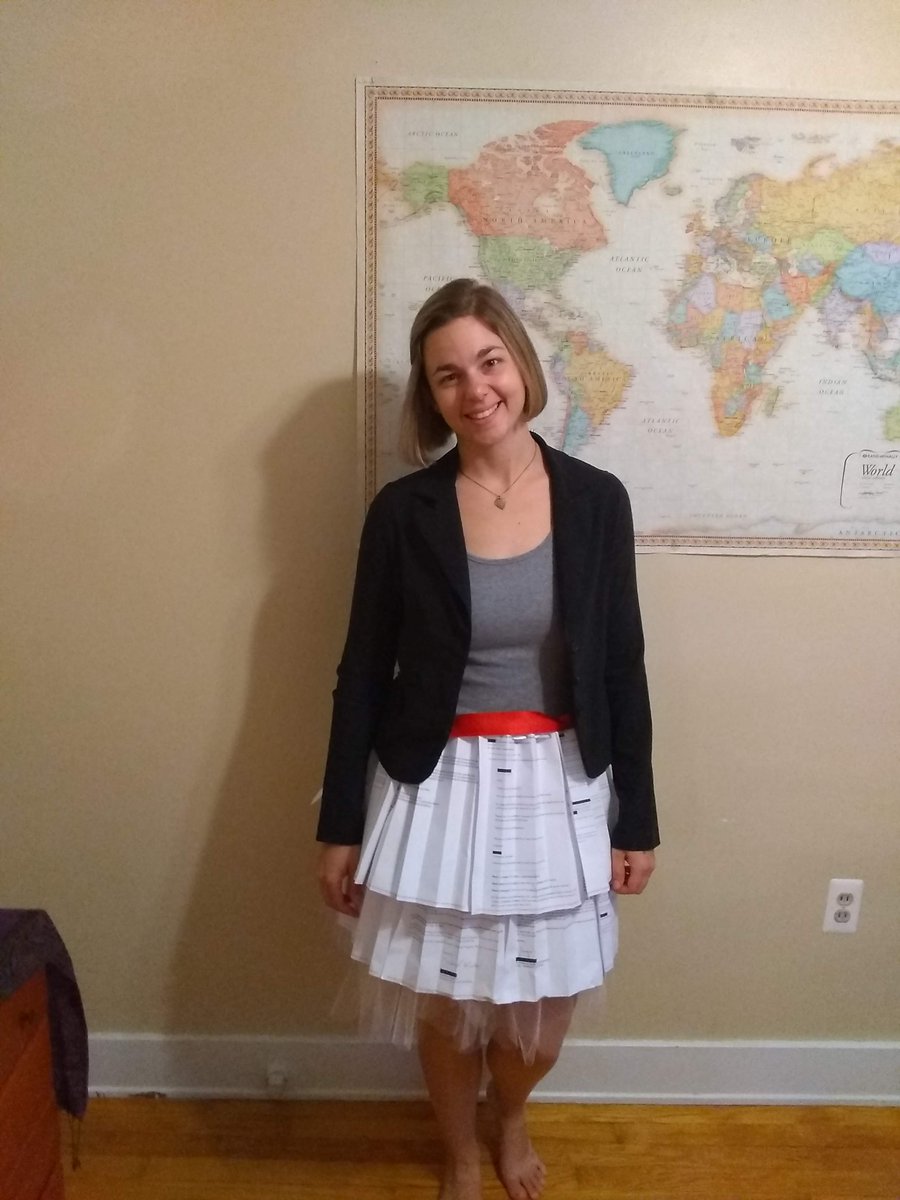
Others, like Michigan State University’s Earth and Environmental Sciences PhD candidate, Caitlin Kirby, sport rejection like a mantle of honor… or more accurately, a pleated skirt falling to just below mid-thigh.
“Successfully defended my PhD dissertation today!” Kirby wrote in a Tweet that has since garnered over 25,000 likes. “In the spirit of acknowledging & normalizing failure in the process, I defended in a skirt made of rejection letters from the course of my PhD.”
The custom garment, which Kirby teamed with a dark blazer and red waistband, was organized in two tiers, with a tulle ruffle peeping out beneath.
MSU’s Career Services Network’s Director of Employer Relations, Karin Hanson, told the Lansing State Journal that rejection comes as a shock to many high achieving MSU students.
Kirby’s decision to upcycle 17 disappointing letters received over the course of her academic career was partially inspired by a Parks and Recreation episode in which the skirt of Leslie Knope’s wedding dress is a wearable collage of newspaper articles about the character, drawn from earlier episodes
More to the point, Kirby’s skirt is part of an ongoing campaign to acknowledge rejection as a necessary, if painful, part of academic growth.
The whole process of revisiting those old letters and making that skirt sort of reminded me that you have to apply to a lot of things to succeed. It seems counterintuitive to wear your rejections to your last test in your Ph.D, but we talked about our rejections every week and I wanted them to be a part of it.
And, as she later noted in a tweet:
Acceptances and rejections are often based on the traditional values of academia, which excludes POC by not valuing the approaches, research questions, and experiences that POC tend to bring to their work.
Kirby’s letters were culled from a variety of sources—scholarship applications, submissions to academic journals, and proposals for conference presentations. Unfortunately and We regret to inform you are recurrent motifs. About 8 letters were left on the cutting room floor.
But she is prepared to lower her hemline, when she starts applying for jobs, following a stint at the Research Institute for Urban and Regional Development in Dortmund, Germany, the result of a successful Fulbright application.
Follow Kirby’s example and turn your temporary setbacks into a power skirt, using the tutorial above.
via Boing Boing
Related Content:
Read Rejection Letters Sent to Three Famous Artists: Sylvia Plath, Kurt Vonnegut & Andy Warhol
Gertrude Stein Gets a Snarky Rejection Letter from Publisher (1912)
Ayun Halliday is an author, illustrator, theater maker and Chief Primatologist of the East Village Inky zine. Join her in NYC on Monday, December 9 when her monthly book-based variety show, Necromancers of the Public Domain, resurrects Dennison’s Christmas Book (1921). Follow her @AyunHalliday.
Read More...The Benefits of Boredom: How to Stop Distracting Yourself and Get Creative Ideas Again
Here in the 21st century, we have conquered boredom. Impressive though that achievement may be, it hasn’t come without cost: As with many other conditions we’ve managed to eliminate from our lives, boredom now looks to have been essential to full human existence. Has our reality of on-demand distractions, tailored ever more closely to our impulses and desires, robbed us of yet another form of everyday adversity that built up the character of previous generations? Perhaps, but more importantly, it may also have dried up our well of creativity. The frustration that descends on us when trying to come up with new ideas; the itch we feel, whenever we start doing something, to do something else; our inability to go more than a few minutes without looking at our phones: we can hardly assume these modern problems are unrelated.
“When you’re bored, you tend to daydream, and your mind wanders, and this is a very, very important part of the creative process,” says psychologist Sandi Mann in the animated BBC REEL video at the top of the post. “If you find that you’re stuck on a problem, or you’re really worried about something and can’t seem to find a way out, take some time out. Just be bored. Let your mind wander, and you might just find that a creative solution will pop into your head.”
But we’ve fallen into the habit of “swiping and scrolling our boredom away,” seeking “a dopamine hit from new and novel experiences” — most often digital ones — to assuage our fears of boredom. And the more such stimulation we get, the more we need, meaning that, “paradoxically, the way to deal with boredom is to allow more of it into our life.”
“Once you start daydreaming and allow your mind to really wander,” Mann says, “you start thinking a little bit beyond the conscious, a little bit into the subconscious, which allows sort of different connections to take place.” She says it in “How Boredom Can Lead to Your Most Brilliant Ideas,” a TED Talk by journalist Manoush Zomorodi. Like the public-radio podcaster she is, Zomorodi brings in interview clips from not just Mann but a range of experts on the subject of boredom and distraction, including neuroscientist Daniel Levitin, who warns that “every time you shift your attention from one thing to another, the brain has to engage a neurochemical switch that uses up nutrients in the brain to accomplish that.” And so the “multitasking” in which we once prided ourselves amounts to nothing more than “rapidly shifting from one thing to the next, depleting neural resources as you go.”
We’ve become like the experiment subjects, described in the Veritasium video above, who were asked to sit alone in an empty room for a few minutes with nothing in front of them but a button that they knew would shock them. In the end, 25 percent of the women and 60 percent of the men chose, unasked, to shock themselves, presumably out of a preference for painful stimulation over no stimulation at all. How much, we have to wonder, does that ultimately differ from the distractions we compulsively seek at every opportunity in the form of social media, games, and other addictive apps? And what do these increasingly frequent self-administered jolts do to our ability to identify promising avenues of thought and follow them all the way to their most fruitful conclusions? As the old saying goes, only the boring are bored. But if our technological lives keep going the way they’ve been going, soon only the bored will be interesting.
Related Content:
How to Take Advantage of Boredom, the Secret Ingredient of Creativity
How Information Overload Robs Us of Our Creativity: What the Scientific Research Shows
How to Focus: Five Talks Reveal the Secrets of Concentration
Why Time Seems to Speed Up as We Get Older: What the Research Says
Based in Seoul, Colin Marshall writes and broadcasts on cities, language, and culture. His projects include the book The Stateless City: a Walk through 21st-Century Los Angeles and the video series The City in Cinema. Follow him on Twitter at @colinmarshall, on Facebook, or on Instagram.
Read More...When White Supremacists Overthrew a Government (1898): The Hidden History of an American Coup
White supremacist ideology has found a home in both major political parties at different times in the country’s history. But it has not always been openly acknowledged, receding into coded language and whispers when out of political favor. In the decades after Reconstruction and after World War I, however, politicians shouted racist, xenophobic speeches through bullhorns, inciting thousands of lynchings across the country.
One incredibly bloody mass killing, the so-called Tulsa “Race Riot” of 1921—actually a massacre and decimation of a thriving business district—has come back into public consciousness after a fictionalized depiction on HBO’s Watchmen series. Twelve years earlier, another definitive event took place in Wilmington, North Carolina. If mentioned at all, it’s been glossed over quickly in textbooks and the town’s historical memory, but the Wilmington Massacre is part of a history of racial terrorism many celebrated openly, then sought to suppress, deny, and ignore when it became embarrassing.
Yale professor of history Glenda Gilmore calls the period a “50-year black hole of information.” Growing up in North Carolina herself, she says, “I had never heard the word ‘lynching’ until I was 21.” In fact, as the Vox video above notes, librarians in Wilmington refused even to release materials related to the massacre. This is odd considering its significance to American history as the only successful violent overthrow of an elected U.S. government on U.S. soil.
It was a coup (despite the way that word has been deliberately misused) involving no due process or constitutional checks and balances. The violence began on the morning of November 10, 1898, when the offices of The Daily Record were set on fire. By the day’s end, “as many as 60 people had been murdered, and the local government that was elected two days prior had been overthrown and replaced by white supremacists,” writes The Atlantic.
This was no spontaneous riot. The events had been planned and promoted by the most prominent leaders in the city and state, who gathered at the Thalian Hall opera house in Wilmington the previous month to hear a speech in which Democratic Congressman Alfred Waddell declared “We will never surrender to a ragged raffle of Negroes, even if we have to choke the Cape Fear River with carcasses.”
This kind of rhetoric was commonplace. White supremacist clubs around the State, goaded on by South Carolina senator Ben Tillman, resounded with talk of “shotgun politics” to oust elected Black Republicans. After Waddell’s Thalian Hall speech, he traveled to Goldsboro for a “White Supremacy Convention” attended by 8,000 people. There, Major William Guthrie promised, “Resist our march of progress and civilization and we will wipe you off the face of the earth.”
The convention was hailed in The Fayetteville Observer as “A White Man’s Day.” and Tillman’s exhortation “in behalf of the restoration of white rule” by violence was called “a great speech for democracy.” The massacre and overthrow of Wilmington’s government followed soon after. Historians were able to reconstruct the events after their suppression in part because they were so widely celebrated for decades afterward. “In the 1910s, 1920s, 1930s, 1940s, they bragged about it,” says historian David S. Cecelski.
Along with a disturbing resurgence, we’ve also recently seen a public reckoning with the racial terror and tyranny of the late-19th and early 20th centuries, as the memory of lynching is enshrined in memorials and museums, and stories buried since the 50s are unearthed. This history has been also been used by some modern-day Republicans to grind political axes against modern-day Democrats, as though the major 1960s Civil Rights realignment never happened.
Shallow partisanship aside, the fact remains: what the Wilmington insurrectionists and their allies and inciters campaigned, burned, and killed for was a return to the oppressive rule of an elite white minority, against a multiracial democratic coalition that had united former slaves and poor white farmers in a fusion government representing working people in North Carolina and the thriving, majority Black population in Wilmington, its largest city at the time.
Learn more about the history of the Wilmington Massacre in the Vox video above and in the excellent collection Democracy Betrayed.
Related Content:
New Interactive Map Visualizes the Chilling History of Lynching in the U.S. (1835–1964)
Josh Jones is a writer and musician based in Durham, NC. Follow him at @jdmagness
Read More...Comic Sans Turns 25: Graphic Designer Vincent Connare Explains Why He Created the Most Hated Font in the World
What we write reveals who we are, but so, and often more clearly, does how we write. And in an age when handwriting has given way to typing, how we write has much to do with which font we use. Many of us play it safe, rarely straying from the realm of twelve-point Times New Roman hypernormality, but even there “type is a voice; its very qualities and characteristics communicate to readers a meaning beyond mere syntax.” That observation comes from the Ban Comic Sans Manifesto, drawn up two decades ago by graphic designers Holly and David Combs as a strike against the font that, 25 years after its creation, remains a hate object of choice for the visually literate everywhere.
“You don’t like that your coworker used me on that note about stealing her yogurt from the break room fridge?” asks Comic Sans itself, ventriloquized in McSweeney’s by Mike Lacher. “You don’t like that I’m all over your sister-in-law’s blog? You don’t like that I’m on the sign for that new Thai place? You think I’m pedestrian and tacky?” Well, tough: “People love me. Why? Because I’m fun. I’m the life of the party. I bring levity to any situation. Need to soften the blow of a harsh message about restroom etiquette? SLAM. There I am. Need to spice up the directions to your graduation party? WHAM. There again. Need to convey your fun-loving, approachable nature on your business’ website? SMACK.”
In the Great Big Story video above, Comic Sans creator Vincent Connare tells his side of the story. While employed at Microsoft in the early 1990s, he saw a prototype version of Microsoft Bob, a kind of add-on to the Windows interface designed for maximum user friendliness. It featured onscreen animal characters that spoke in speech bubbles, but the words in those speech bubbles appeared in what was everyone’s default font. When it hit him that “dogs don’t talk in Times New Roman,” Connare, a graphic-novel fan, got to work on a typeface for the speech bubbles modeled on the lettering by John Costanza in The Dark Knight Returns and by Dave Gibbons in Watchmen.
Comic Sans didn’t make it into Microsoft Bob, it did make it into a somewhat more successful Microsoft product: Windows 95, which David Kadavy at Design for Hackers calls “the first operating system to really hit it big. Just as computers were starting to pop up in nearly every home in America, Windows 95 was finding itself installed on all of those computers, and with it, the font Comic Sans. So now, nearly every man, woman, child, and bake sale organizer find themselves armed with publishing power unlike civilization had ever seen; and few of them really had any design sense.” Then came the internet boom, which meant that “instead of flyers posted in break rooms, Comic Sans was showing up on websites, and even as the default font for many people’s emails. Now, any one person could write a message that could potentially be read by millions, in Comic Sans.”
What makes Comic Sans so reviled? Kadavy points to several reasons having to do with typographical aesthetics, including awkward weight distribution (“weight” being the thickness of its lines) and poor letterfit (meaning that its letters don’t, or can’t, sit well next to each other). But the problem most of us notice is that “Comic Sans isn’t used as intended”: A typeface meant only for speech bubbles in Microsoft Bob has somehow become one of the most popular in the world, appearing unsuitably in everything from Cleveland Cavaliers owner Dan Gilbert’s open letter on the departure of LeBron James to CERN’s announcement of evidence of the Higgs boson particle to, just last month, a letter from Donald Trump’s lawyer’s to the House Intelligence Committee.
Through it all, Connare himself — who has designed such relatively respectable typefaces as Trebuchet, and has famously only used Comic Sans once, in a complaint letter to his cable company — has kept his sense of humor, as evidenced by his talk entitled “Comic Sans Is the Best Font in the World.” Even the Combs’ movement has changed its name, if not without irony, into “Use Comic Sans.” Pieces marking the font’s 25th anniversary include “Hating Comic Sans Is Not a Personality” by The New York Times’ Emma Goldberg and “In Bad Taste or Not, I’ll Keep My Comic Sans” by The Washington Post’s Joseph Epstein (published, entirely and courageously, in Comic Sans). If you love the font, Connare often says, you don’t know much about typography, but if you hate it, “you should get another hobby.” Besides, the story of Comic Sans also contains an important life lesson: “You have to do things that aren’t beautiful sometimes.”
Related Content:
The History of Typography Told in Five Animated Minutes
Download Iconic National Park Fonts: They’re Now Digitized & Free to Use
How to Write Like an Architect: Short Primers on Writing with the Neat, Clean Lines of a Designer
Based in Seoul, Colin Marshall writes and broadcasts on cities, language, and culture. His projects include the book The Stateless City: a Walk through 21st-Century Los Angeles and the video series The City in Cinema. Follow him on Twitter at @colinmarshall, on Facebook, or on Instagram.
Read More...The Difference Between the United Kingdom, Great Britain and England: A (Pre-Brexit) Video Explains
I once played in a New York pub band with an Englishman, a Northern Irishman, and a Scotsman. This is not the setup for a joke. (We weren’t that bad!) But I had questions. Were they all from different countries or different parts of one country called Britain, or Great Britain, or the grander-sounding United Kingdom?
British history could be a contentious subject in such company, and no wonder given that the violence of the Empire began at home, or with the neighboring people who were absorbed—sometimes, partly, but not always—against their will into a larger entity. So, what to call that territory of the crown which once claimed one fourth of the world as its own property?
CGP Grey, maker of the YouTube explainer above, aims to clear things up in five minutes, offering his own spin on British imperial history along the way. The United Kingdom is a “country of countries that contains inside it four coequal and sovereign nations,” England, Scotland, Wales, and Northern Ireland. “You can call them all British,” says Grey, but “it’s generally not recommended as the four countries generally don’t like each other.”
Like it or not, however, they are all British citizens of “The United Kingdom of Great Britain and Northern Ireland.” Still confused? Well, Britain and the United Kingdom name the same country. But “Great Britain” is a geographical term that includes Scotland, England, and Wales, but not Northern Ireland. As a “geographical rather than a political term,” Great Britain sounds silly when used to describe nationality.
But it gets a bit more complicated. All of the countries located within Great Britain have neighboring islands that are not part of Great Britain, such as the Hebrides, Shetland and Orkney Islands, and Isles of Anglesey and Wight. Ireland is a geographical term for the land mass encompassing two nations: Northern Ireland, which is part of Britain, or the United Kingdom, and the Republic of Ireland, which—as you know—is decidedly not.
All of these countries and “countries of countries” are part of the European Union, says Grey, at which point it becomes clear that the video, posted in 2011, did not anticipate any such thing as Brexit. Nonetheless, this information holds true for the moment, though that ugly saga is sure to reach some resolution eventually, at which point, who knows what new maps, independence referenda, and border wars will arise, or resurrect, on the British Isles.
Related Content:
The Entire History of the British Isles Animated: 42,000 BCE to Today
The History of Europe from 400 BC to the Present, Animated in 12 Minutes
Josh Jones is a writer and musician based in Durham, NC. Follow him at @jdmagness
Read More...Pretty Much Pop #18 Discusses Stephen King’s Media Empire

Is the most popular writer of our time actually a good writer? Or maybe he used to be good but has long since run out of inspiration? What are the most effective ways to adapt these very readable short stories and novels? Does showing us the evil in a film lessen its impact? While you’ve been thinking about those questions, King has already written another book.
Mark Linsenmayer, Erica Spyres, and Brian Hirt share their experiences with and opinions about King’s oeuvre and the films and shows that have come out of it, including It, “The Body” (aka Stand By Me), The Shining, In the Tall Grass, The Dark Tower, The Stand, Children of the Corn, From a Buick 8, Under the Dome, The Outsider, Mr. Mercedes, Castle Rock, Pet Sematary, Misery, The Shawshank Redemption, and more.
Some articles we read to prepare for this discussion include:
- “Stephen King Has Spent Half a Century Scaring Us, but His Legacy Is So Much More Than Horror” by Aja Romano
- “Is Stephen King a Great Writer?” by Jane Ciabattari
- “Stephen King Responds to Controversy Surrounding Excluded ‘IT’ Child Orgy Scene” by Helen Meriel Thomas
- “This Stephen King Novel Will Never Be Printed Again After It Was Tied To School Shootings” by Corey Adwar
If you’ve never actually read a Stephen King novella, go ahead and read “The Body.”
This episode includes bonus discussion that you can only hear by supporting the podcast at patreon.com/prettymuchpop. This podcast is part of the Partially Examined Life podcast network.
Pretty Much Pop: A Culture Podcast is the first podcast curated by Open Culture. Browse all Pretty Much Pop posts or start with the first episode.
Read More...
Watch J.S. Bach’s “Air on the G String” Played on the Actual Instruments from His Time
There is no wrong way to listen to the music of Johann Sebastian Bach. You may prefer the austere, idiosyncratic piano interpretations of Glenn Gould; you may prefer the groundbreaking analog-synthesizer renditions painstakingly recorded by Wendy Carlos (whose early fans included Gould himself); or you may prefer faithful performances using only the instruments extant in the late 17th to mid-18th century period in which Bach lived. In that last case, the San Francisco early-music ensemble Voices of Music has you covered. You may remember us previously featuring their performances of Vivaldi and Pachelbel; in the video above, you can hear and see them play Bach.
More specifically, you can hear them play the second movement, Aria, from Bach’s orchestral suite in D Major, BWV 1068. The instruments they play it on include an Italian baroque violin from 1660 and an Austrian baroque viola from 1680, as well as more recently crafted examples rigorously modeled after instruments from that same era. “As instruments became modernized in the 19th century, builders and players tended to focus on the volume of sound and the stability of tuning,” says VoM’s explanation of their use of period instruments. “Modern steel strings replaced the older materials, and instruments were often machine made. Historical instruments, built individually by hand and with overall lighter construction, have extremely complex overtones — which we find delightful.”
Any lover of Bach’s music has heard this piece many times, not least due to its popularization in the late 19th century, in an arrangement by German violinist August Wilhelmj, as “Air on the G String.” The original work dates to “some time between the years 1717 and 1723,” writes music blogger Özgür Nevres, when Bach composed it for his patron Prince Leopold of Anhalt. It also holds the honor of being the first work by Bach ever recorded, “by the Russian cellist Aleksandr Verzhbilovich and an unknown pianist, in 1902 (as the Air from the Overture No. 3 in D major, BWV 1068).” But no matter how many different recordings from different eras of Bach’s orchestral suite in D Major in which you’ve steeped yourself, if you’ve only heard it played on modern instruments, a performance like Voices of Music’s shows that it still has surprises to offer.
Related Content:
Watch Glenn Gould Perform His Last Great Studio Recording of Bach’s Goldberg Variations (1981)
All of Bach for Free! New Site Will Put Performances of 1080 Bach Compositions Online
How a Bach Canon Works. Brilliant
Based in Seoul, Colin Marshall writes and broadcasts on cities, language, and culture. His projects include the book The Stateless City: a Walk through 21st-Century Los Angeles and the video series The City in Cinema. Follow him on Twitter at @colinmarshall, on Facebook, or on Instagram.
Read More...Support Us
We're hoping to rely on loyal readers, rather than erratic ads. Please click the Donate button and support Open Culture. You can use Paypal, Venmo, Patreon, even Crypto! We thank you!

About Us

Open Culture scours the web for the best educational media. We find the free courses and audio books you need, the language lessons & educational videos you want, and plenty of enlightenment in between.
Advertise With Us

FREE UPDATES!
GET OUR DAILY EMAIL
Get the best cultural and educational resources on the web curated for you in a daily email. We never spam. Unsubscribe at any time.
FOLLOW ON SOCIAL MEDIA

Open Culture editor Dan Colman scours the web for the best educational media. He finds the free courses and audio books you need, the language lessons & movies you want, and plenty of enlightenment in between.
Advertise With Us

