Women Scientists Launch a Database Featuring the Work of 9,000 Women Working in the Sciences

“Why are there so few women in science?” has almost become a tiresome refrain over the years, given how little the answers engage with the thousands of female scientists working all over the world. “Too often,” writes the project 500 Women Scientists, “high-profile articles, conference panels, and boards are filled with a disproportionate number of male voices. News stories are reported by more men by a huge margin, and this imbalance is reflected in how frequently women are quoted in news stories unless journalists make a conscious effort to reach out.
“Most keynote speakers at conferences are men. Panels are so frequently all-male that a new word evolved to describe the phenomenon: manels. These imbalances add up and reinforce the inaccurate perception that science is stale, pale and male.” The next time the question arises—“why are there so few women in science?”—or any other question needing scientific expertise, one need only gesture silently to 500 Women Scientists, a grassroots organization consisting of far more scientists than its title suggests.
Described as “a resource for journalists, educators, policy makers, scientists and anyone needing scientific expertise,” the project began in 2016 as an open letter penned by its founders, then graduate students at Colorado University, Boulder, who decided to re-affirm their values against reactionary attacks by amassing 500 signatures on an open letter. They’ve since built a searchable database of over 9,000 women researchers from around the world, and a resource that helps build local scientific communities.
Since launching last year, their Request a Scientist database has shown “the excuse that you can’t find a qualified woman just doesn’t hold,” says co-founder and microbial ecologist Dr. Kelly Ramirez-Donders. It has also provided much more detailed data on women in science, which was published in a paper at PLOS Biology in April. “The group has ambitious plans to keep expanding its reach,” writes STAT. “They’re raising money to start a fellowship for women of color… and they have already launched an affiliate group, 500 Women in Medicine.”
“We’re scientists. We’re lovers of evidence and data points,” says co-founder Maryam Zaringhalam, a molecular biologist. “And so now anytime somebody tells us they couldn’t find someone or there just aren’t enough women in STEM fields, we can point them to [the database] and say, ‘Well, actually, this is the tip of the iceberg, and there’s over 8,000.’… ensuring that women’s voices are represented in the media narratives is really essential for showing that, ‘No, we are here, it’s just that people haven’t necessarily been aware of us or done the work to find us.’”
Correcting misperceptions not only helps reduce biases within scientific communities; it also encourages budding scientists who might otherwise be discouraged from the pursuit. “It’s not that girls are not interested in science,” co-founder Jane Zelikova tells Good Morning America. “Something happens where they don’t see women or girls represented as scientists and they don’t think it’s for them.” 500 Women in Science proves that notion wrong—science is for them, and for everyone who wants to devote their lives to scientific research. Just look at the data.
Related Content:
Real Women Talk About Their Careers in Science
Josh Jones is a writer and musician based in Durham, NC. Follow him at @jdmagness
Read More...The Very First Picture of the Far Side of the Moon, Taken 60 Years Ago
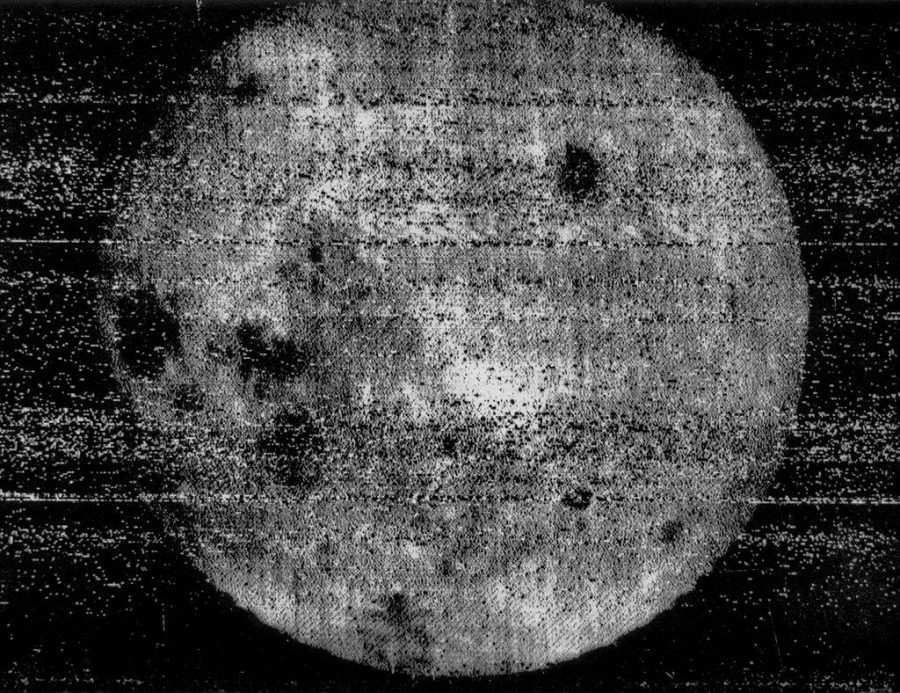
Sixty years ago, mankind got its very first glimpse of the far side of the Moon, so called because it faces away from the Earth. (And as astronomers like Neil DeGrasse Tyson have long taken pains to point out to Pink Floyd fans, it isn’t “dark.”) Taken by the Soviet Union, that first photo may not look like much today, especially compared to the high-resolution color images sent back from the surface itself by China’s Chang’e‑4 probe earlier this year. But with the technology of the late 1950s, even the technology commanded by the Soviets’ then-world-beating space program, the fact that it was taken at all seems not far short of miraculous. How did they do it?
“This photograph was taken by the Soviet spacecraft Luna 3, which was launched a month after the Luna 2 spacecraft became the first man-made object to impact on the surface of the Moon,” explains astronomer Kevin Hainline in a recent Twitter thread. “Luna 2 followed Luna 1, the first spacecraft to escape a geosynchronous Earth orbit.” Luna 3 was designed to take photographs of the Moon, hardly an uncomplicated prospect: “To take pictures you have to be stable on three-axes. You have to take the photographs remotely. AND you have to somehow transfer those pictures back to Earth.” The first three-axis stabilized spacecraft ever sent on a mission, Luna 3 “had to use a little photocell to orient towards the Moon so that now, while stabilized, it could take the pictures. Which it did. On PHOTOGRAPHIC FILM.”
Even those of us who took pictures on film for decades have started to take for granted the convenience of digital photography. But think back to all the hassle of traditional photography, then imagine making a robot carry them out in space. Once taken Luna 3’s photos “were then moved to a little CHEMICAL PLANT to DEVELOP AND DRY THEM.” (In other words, “Luna 3 had a little 1 Hour Photo inside.”) Then they continued into “a device that shone a cathode ray tube, like in an older TV, through them, towards a device that recorded the brightness and converted this to an electrical signal.” You can read about what happened then in more detail at Damn Interesting, where Alan Bellows describes how the spacecraft sent “the lightness and darkness information line-by-line via frequency-modulated analog signal — in essence, a fax sent over radio.”
Soviet Scientists could thus “retrieve one photographic frame every 30 minutes or so. Due to the distance and weak signal, the first images received contained nothing but static. In subsequent attempts in the following few days, an indistinct, blotchy white disc began to resolve on the thermal paper printouts at Soviet listening stations.” As Luna 3’s photos became clearer, they revealed, as Hainline puts it, that “the backside of the moon was SO WEIRD AND DIFFERENT” — covered in the craters, for example, which have become its visual signature. For a modern-day equivalent to this achievement, we might look not just to Chang’e‑4 but to the image of a black hole captured by the Event Horizon Telescope this past April — the one that led to an abundance of articles like “In Defense of the Blurry Black Hole Photo” and “We Need to Admit That the Black Hole Photo Isn’t Very Good.” Astrophotography has come a long way, but at least back in 1959 it didn’t produce quite so many takes.
Related Content:
Mankind’s First Steps on the Moon: The Ultra High Res Photos
8,400 Stunning High-Res Photos From the Apollo Moon Missions Are Now Online
How Scientists Colorize Those Beautiful Space Photos Taken By the Hubble Space Telescope
There’s a Tiny Art Museum on the Moon That Features the Art of Andy Warhol & Robert Rauschenberg
The Glorious Poster Art of the Soviet Space Program in Its Golden Age (1958–1963)
Wonderfully Kitschy Propaganda Posters Champion the Chinese Space Program (1962–2003)
Based in Seoul, Colin Marshall writes and broadcasts on cities, language, and culture. His projects include the book The Stateless City: a Walk through 21st-Century Los Angeles and the video series The City in Cinema. Follow him on Twitter at @colinmarshall or on Facebook.
Read More...Oscar-Nominated Composer Danny Elfman Teaches an Online Course on Writing Music for Film: A Look Inside His Creative Process
FYI: If you sign up for a MasterClass course by clicking on the affiliate links in this post, Open Culture will receive a small fee that helps support our operation.
To have watched some of the greatest film and television in the last thirty-five years is to have been immersed in the music of Mark Mothersbaugh and Danny Elfman—two artists who have scored Hollywood blockbusters and indie hits alike since the mid-eighties when they started on TV’s Pee-wee’s Playhouse and Tim Burton’s 1985 comedy Pee-wee’s Big Adventure, respectively. They also happen to have played in two of the 1980’s weirdest, most experimental New Wave bands, Devo and Oingo Boingo.
Mothersbough went on to score everything from Rugrats to Thor: Ragnarok, but he’s maybe best known for his work with Wes Anderson. Likewise, Elfman—who has worked with everyone from Gus Van Sant to Brian De Palma to Peter Jackson to Ang Lee—formed a creative bond with Burton, to such a degree that it’s near impossible to imagine a Tim Burton film without a Danny Elfman score.
When Burton first approached him for Pee-wee’s Big Adventure, the Oingo Boingo frontman was just about to release “Weird Science,” for the infamous John Hughes film of the same name. Already a band with a massive cult following, they became pop stars, and Elfman became one of the most distinctive film composers of the last several decades.
He scored Beetlejuice, Batman, Edward Scissorhands, Batman Returns, Sleepy Hollow, The Nightmare Before Christmas, Corpse Bride, and, most recently, Burton’s Dumbo. Now he’s sharing his secrets for aspiring film composers everywhere with his very own Masterclass. “I’m going to tell you from my perspective,” he says in the trailer above, “how I do these things”: things including instrumentation, orchestration, melody, and tone—“the most important thing you’re going to capture in a film score.”
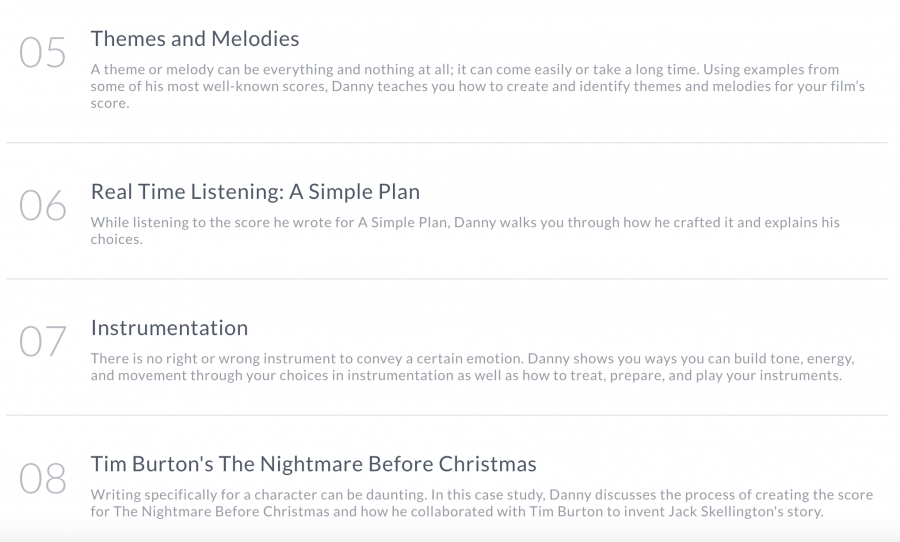
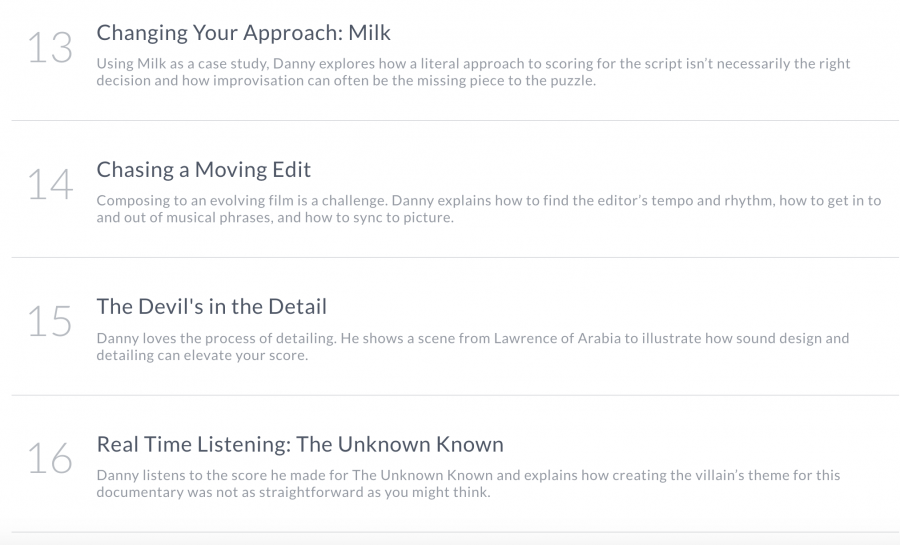
In the screenshots here, see excerpts of the course topics, which include units on the films Milk, The Unknown Known, and The Nightmare Before Christmas, an example of “writing specifically for a character”—a character, Jack Skellington, whose singing voice Elfman also provided.
For those who feel they’ll never measure up to a career like Danny Elfman’s, he introduces all important units on insecurity and failure. Perhaps the most important lesson of all, he says above, with infectious enthusiasm, is learning that “it’s okay to fail, to feel insecure. Doubting yourself, finding confidence and moving forward, and then doubting what you’ve just done…. I think this is the life of a composer. I think it’s the life of an artist.”
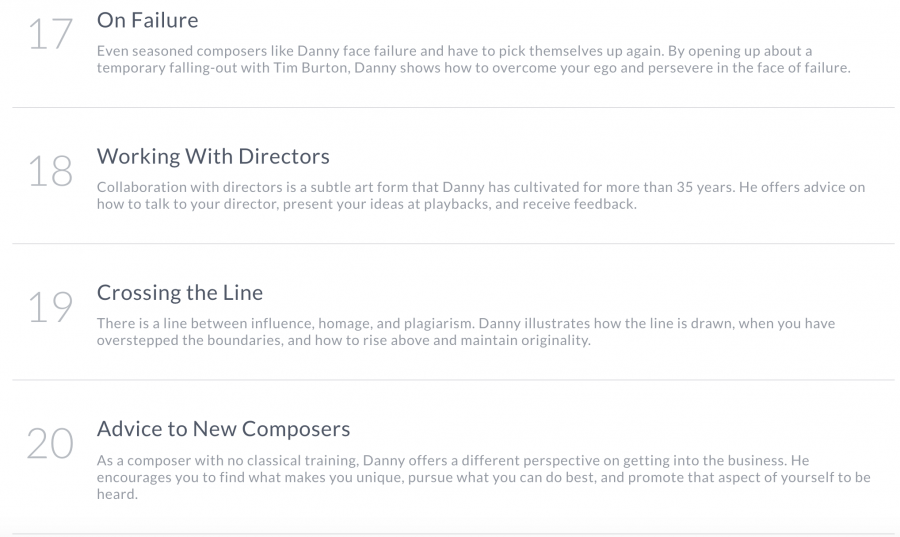
Can such things be taught, or can they only be lived? Each teacher and student of the arts must at some point ask themselves this question. Perhaps they only learn the answer when they try, and fail, and try again anyway. Sign up for Elman’s course here.
You can take this class by signing up for a MasterClass’ All Access Pass. The All Access Pass will give you instant access to this course and 85 others for a 12-month period.
Related Content:
How to Take Every MasterClass Course For Less Than a Cup of Good Coffee
All of the Music from Martin Scorsese’s Movies: Listen to a 326-Track, 20-Hour Playlist
Brian Eno Reveals His Favorite Film Soundtracks
Josh Jones is a writer and musician based in Durham, NC. Follow him at @jdmagness
Read More...Art Class Instead Of Jail: New Program Lets Young Offenders Take Free Art Classes Rather Than Spend Time in the Criminal System
Art saves lives, and art can also save an individual from the stigma of an arrest record, provided that the arrest is for one of 15 non-violent misdemeanors.
Project Reset, a museum-based early diversion program in three of New York City’s five boroughs, aims to reframe the way youthful (and not so youthful) offenders see themselves, by considering an artwork via a collective interpretive process, before using it as the inspiration for a collage or oil pastel-based project of their own.
The stakes are higher and far more personal than they are on the average public school field trip. Upon completion of a class ranging from 2.5 to 4 hours, the participant’s record is wiped clean and their assigned court date is rendered moot.
Rather than being herded through a number of galleries, participants zero in on a single work.
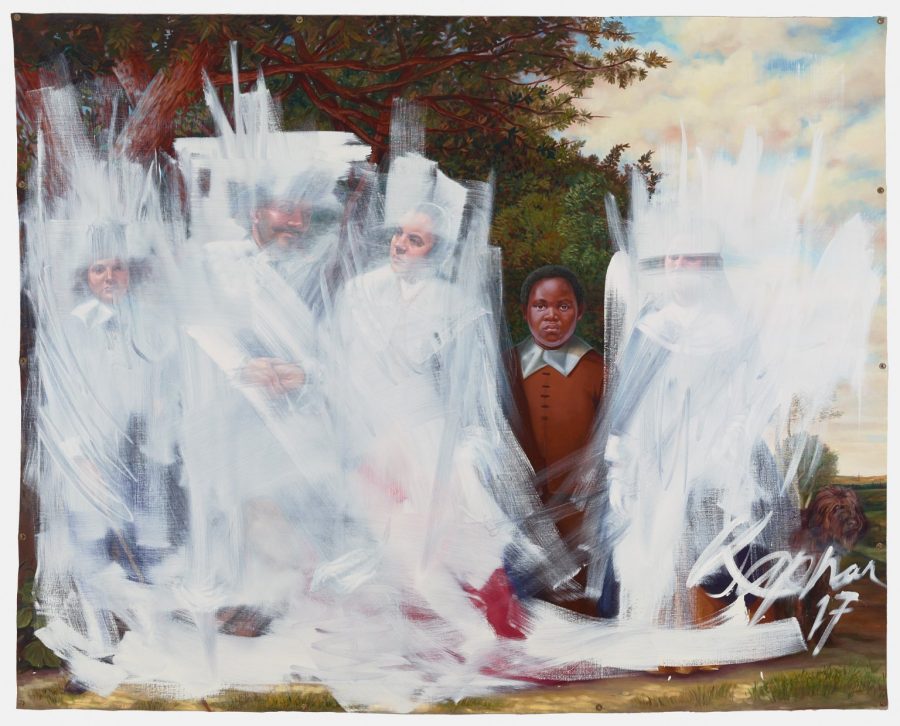
At the Brooklyn Museum, participants in the under-25 age range get a crash course in Shifting the Gaze, Titus Kaphar’s intentional palimpsest, in which all the figures in a replica of Frans Hals’ Family Group in a Landscape are whited out so viewers may focus in on the only character of color, a young boy who appears to be a family servant.
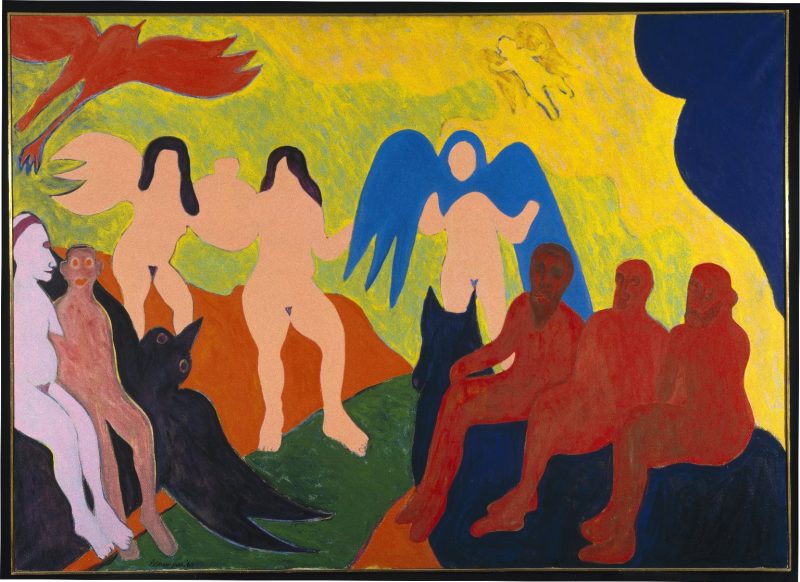
Older participants undertake a similarly deep dive on The Judgement by Bob Thompson, an African American artist who was inspired by the constant interplay between good and evil.
While this may strike some as a cushy punishment, it’s a legitimate attempt to acquaint participants with the very real impact their actions could have on future plans—including college admissions and job applications.
Manhattan District Attorney, Cyrus Vance Jr., one of Project Reset’s architects, shared a non-partisan fiscal take with City Lab’s Rebecca Bellan that may persuade naysayers who feel the program rewards budding criminals by giving them an easy out:
If you jump subway turnstiles in Manhattan, you never go to jail. You can do it 100 times and no court is ever going to send you to jail. So we spend about $2,200 to process a theft of services arrest for a $2.75 fare. Our justice system falls most heavily on communities of color, and we really need to rethink how we approach these cases, both to get better outcomes, but also to reduce the impact which is very often viewed as targeted and unfair on particular communities.

Above is a list of the non-violent misdemeanors that can channel first timers toward the aptly named Project Reset.
Related Content:
Wonderfully Offbeat Assignments That Artist John Baldessari Gave to His Art Students (1970)
The Art Institute of Chicago Puts 44,000+ Works of Art Online: View Them in High Resolution
Ayun Halliday is an author, illustrator, theater maker and Chief Primatologist of the East Village Inky zine. Join her in NYC for her monthly book-based variety show, Necromancers of the Public Domain. Follow her @AyunHalliday.
Read More...What Happens to the Clothes We Throw Away?: Watch Unravel, a Short Documentary on the Journey Our Waste Takes
When we throw our clothes away in the West, they don’t all go to a thrift store or to a recycling center or a local landfill. Instead, every year 100,000 tons of clothes make their way across the ocean to India. In this awareness raising short doc from UK-based filmmaker Meghna Gupta, we see the end point of these bales and bales of Western fashion, and the women and men who turn our waste back into thread. The thread then begins its own journey, inevitably winding back up as cheap imported clothes. And the cycle begins again.
Gupta lets the women speak for themselves, in particular Reshma, a young mother and wife who works in one such recycling center in Panipat, North India. We see her daily life as well as the process turning our castoffs into thread. Upon entering the country, the clothes are cut so they can’t be re-sold. Then women like Reshma remove buttons, zippers, and any other non-cloth component.
Far, far away from even a passing encounter with a Westerner (apart from what they’ve seen on the Discovery Channel), Reshma and her co-workers create a narrative and an image of the people sending all these clothes. The West must have a water shortage, Reshma says, that is stopping people from washing their clothes. The West also must have a very strange diet to produce the plus-size garments they keep coming across.
Now, the West doesn’t have a water shortage, but according to EDGE (Emerging Designers Get Exposed), the clothing and textile industry is the second largest polluter in the world, second only to oil, producing 20 percent of global waste water, and a global waste total of nearly 13 million tons of fabric. Producing cotton is water-intensive—with 5,000 gallons needed just to make a pair of jeans and a t‑shirt.
Recycling is important—it’s been a constant message to the public since the 1970s. But the global footprint that this film hints at, all those cargo ships, all those trucks, all that fuel and those miles traveled…is this really a solution? How do we stop the demand and the disposability?
The doc doesn’t answer those questions, and doesn’t mean to do so. It just wants you to see a small family in the middle of a large global machine. They seem happy enough. But they also see their fate as God-given, at least in this life this time ’round.
“You tend to get dressed for other people,” Reshma’s husband says. “But at the end of the day you’ll be as beautiful as God made you. All people have a natural beauty.”
Related Content:
M.I.T. Computer Program Alarmingly Predicts in 1973 That Civilization Will End by 2040
Ted Mills is a freelance writer on the arts who currently hosts the FunkZone Podcast. You can also follow him on Twitter at @tedmills, read his other arts writing at tedmills.com and/or watch his films here.
Read More...An Animated Introduction to Medieval Taverns: Learn the History of These Rough-and-Tumble Ancestors of the Modern Pub
When I think of the medieval tavern, I see grim footage from Bergman’s The Seventh Seal and grimy drinking scenes from Game of Thrones and Lord of the Rings. While only the first of these uses an ostensibly historical setting, the imagery of them all is what we think of when we think of taverns. Huge casks in the corners, great, indestructible wooden tables and wooden mugs, signs with pictures instead of words; drunken singing and the occasional axe fight.
The crudely animated Simple History video above confirms these impressions, describing the taverns, inns, and ale houses that were ancestors of the modern pub as “places of drinking, gambling, violence, and criminal activity.” Art history and scholarship further confirm our impression of taverns as rough-hewn, rowdy houses where brawls frequently broke out and all sorts of shady business transacted.
Ale houses had an “ale stake or ale pole” that could be raised to show they had a brew ready to serve. Taverns had a pole with leaves, called a “bush,” for the same purpose. Wine might be pricey, but beer was cheap, as “taxing it would not have been well-received.” Barmaids poured drinks from pitchers of leather into mugs of wood. Food was… well, not so good…. Maybe we can visualize tavern life by extrapolating backwards from our local dive bars.
However, we might find it hard to imagine living in a time before beer. Milan Pajic, junior research fellow at the University of Cambridge, found that beer made a relatively late entry in the history of English drink, arriving only in the latter half of the 14th century when introduced by Dutch immigrants and demanded by soldiers returning from the 100 Years War.
Between around 1350 and around 1400, Pajic claims, all of the beer drunk in English taverns was imported from the Netherlands. “The first evidence of someone brewing beer” in England, Pajic writes in an article published in the Journal of Medieval History, “comes from 1398–9.” The brewer, a “Ducheman,” was “fined for buying ‘wheat in the market in order to produce beer, to the great damage of the same market.”
Such persecution could not last. In a hundred year’s time, a few hundred brewers could be found around the country, most of them immigrants from the Low Countries. But in part because the English distrusted the Dutch, “it took almost a century from the moment it was introduced as an imported commodity and consumed largely by immigrants before it came to be produced on English soil and accepted by the natives.”
Tavern, inn, and ale house designs would have conformed to local joinery trends, but the medieval English tavern’s chief draw—cheap, freshly-brewed beer, and lots of it—was a suspicious continental import before it became a national treasure.
Related Content:
Beer Archaeology: Yes, It’s a Thing
The First Known Photograph of People Sharing a Beer (1843)
Discover the Oldest Beer Recipe in History From Ancient Sumeria, 1800 B.C.
Josh Jones is a writer and musician based in Durham, NC. Follow him at @jdmagness
Read More...The Entire Archive of Contact: A Journal for Contemporary Music Has Been Digitized and Put Online
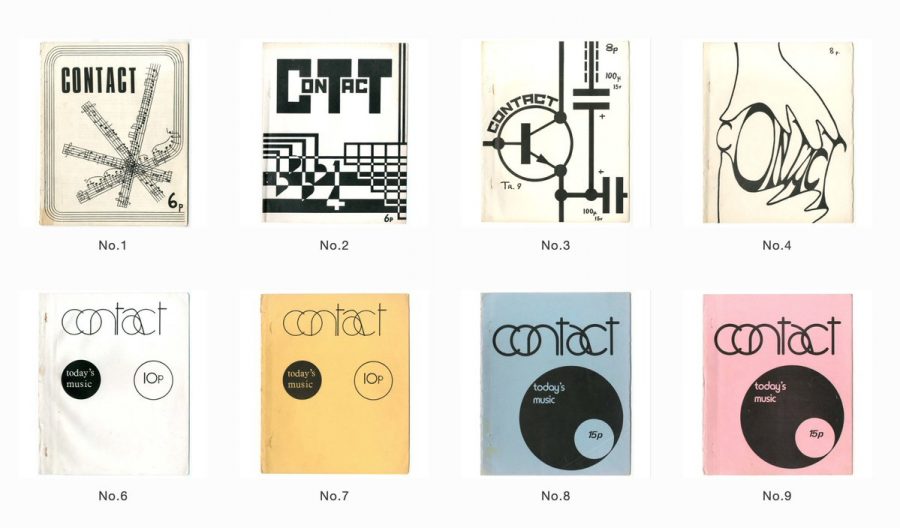
FYI on a new digitization project:
“Contact: A Journal for Contemporary Music was active from 1971–1990 and independently published by its editors. As with many independent print publications of that era, this has meant that, for readers and researchers operating in a contemporary digital landscape, the richness of its resource has been all but inaccessible. In recognition of this situation, in the years 2016–2019, the entire journal was digitised and made available over the course of a three-year research project..”
“Contact’s basic intentions – as set out fully in the first issue, dated Spring 1971 – were to promote informed discussion of 20th-century music in general and the music of our own time in particular. Among the original concerns of the founders of the magazine were that popular musics, jazz and contemporary folk music should play a part in our scheme. In the earlier days, especially, we continually sought for good writing in these fields, as well as contributions on ‘serious’ music.”
Enter the Contact online archive here…
via @ideoforms
If you would like to support the mission of Open Culture, consider making a donation to our site. It’s hard to rely 100% on ads, and your contributions will help us continue providing the best free cultural and educational materials to learners everywhere. You can contribute through PayPal, Patreon, and Venmo (@openculture). Thanks!
Read More...
Watch the Opening of Kubrick’s 2001: A Space Odyssey with the Original, Unused Score
How does a movie become a “classic”? Explanations, never less than utterly subjective, will vary from cinephile to cinephile, but I would submit that classic-film status, as traditionally understood, requires that all elements of the production work in at least near-perfect harmony: the cinematography, the casting, the editing, the design, the setting, the score. Outside first-year film studies seminars and deliberately contrarian culture columns, the label of classic, once attained, goes practically undisputed. Even those who actively dislike Stanley Kubrick’s 2001: A Space Odyssey, for instance, would surely agree that its every last audiovisual nuance serves its distinctive, bold vision — especially that opening use of “Thus Spake Zarathustra.”
But Kubrick didn’t always intend to use that piece, nor the other orchestral works we’ve come to closely associate with mankind’s ventures into realms beyond Earth and struggles with intelligence of its own invention. According to Jason Kottke, Kubrick had commissioned an original score from A Streetcar Named Desire, Spartacus, Cleopatra, and Who’s Afraid of Virginia Woolf composer Alex North.
At the top of the post, you can see 2001’s opening with North’s music, and below you can hear 38 minutes of his score on Spotify. As to the question of why Kubrick stuck instead with the temporary score of Strauss, Ligeti, and Khatchaturian he’d used in editing, Kottke quotes from Michel Ciment’s interview with the filmmaker:
However good our best film composers may be, they are not a Beethoven, a Mozart or a Brahms. Why use music which is less good when there is such a multitude of great orchestral music available from the past and from our own time? [ … ] Although [North] and I went over the picture very carefully, and he listened to these temporary tracks and agreed that they worked fine and would serve as a guide to the musical objectives of each sequence he, nevertheless, wrote and recorded a score which could not have been more alien to the music we had listened to, and much more serious than that, a score which, in my opinion, was completely inadequate for the film.
North didn’t find out about Kubrick’s choice until 2001’s New York City premiere. Not an enviable situation, certainly, but not the worst thing that ever happened to a collaborator who failed to rise to the director’s expectations.
For more Kubrick and classical music, see our recent post: The Classical Music in Stanley Kubrick’s Films: Listen to a Free, 4 Hour Playlist
Note: An earlier version of this post appeared on our site in December 2014.
If you would like to support the mission of Open Culture, consider making a donation to our site. It’s hard to rely 100% on ads, and your contributions will help us continue providing the best free cultural and educational materials to learners everywhere. You can contribute through PayPal, Patreon, and Venmo (@openculture). Thanks!
Related Content:
4,000+ Free Movies Online: Great Classics, Indies, Noir, Westerns, Documentaries & MoreWatch a Newly-Created “Epilogue” For Stanley Kubrick’s 2001: A Space Odyssey
1966 Film Explores the Making of Kubrick’s 2001: A Space Odyssey (and Our High-Tech Future)
James Cameron Revisits the Making of Kubrick’s 2001: A Space Odyssey
Rare 1960s Audio: Stanley Kubrick’s Big Interview with The New Yorker
Colin Marshall hosts and produces Notebook on Cities and Culture and writes essays on cities, language, Asia, and men’s style. He’s at work on a book about Los Angeles, A Los Angeles Primer. Follow him on Twitter at @colinmarshall or on Facebook.
Read More...What Guitars Were Like 400 Years Ago: An Introduction to the 9 String Baroque Guitar
Maybe it’s just me, but it sometimes feels like guitar music is on the wane. Sure, there are plenty of guitar bands out there, guitar sales seem to hold steady, but the synthesizer, midi controller, and digital audio workstation have become the dominant instruments of popular music. Then again, it’s short-sighted to count the guitar out just yet, given the 500-year longevity of its design.
In the 17th century, the Lute Society of Dartmouth notes, the guitar was “cultivated by players and composers within the courts of princes and kings.” The Baroque guitar was very much like the modern six string (or, as often these days, seven and eight string) that we know today, “aside from a difference of tuning,” writes luthier Clive Titmuss. Where “the modern guitar is a baritone/tenor… the baroque is an alto instrument, about the size of a viola.”
The differences in size and pitch change the sustain and articulation. The Baroque guitar’s tonal characteristics are much more delicate, percussive, and lute-like. “The greatest music for baroque guitar is difficult to render adequately on the modern guitar because the traditions of the two instruments have diverged so widely: They speak basically the same language, but with a different vocabulary and accent.” Early Renaissance guitars had what is called a “four course” string arrangement, with eight doubled strings. The baroque guitar added one more for a “five course” instrument with nine strings.
Like its Renaissance forebear, lutes, and modern twelve-string guitars today, four of those “courses” were doubled, with pairs of strings tuned to the same note. This essentially made it a five string guitar with the ringing sonority of a mandolin. In the video at the top, Brandon Acker explains what this means in theory and practice. The tuning was fairly close to a modern six-string, but one octave up and missing the low E. The lone high E string was called the chanterelle or “singing string.”
Popular mainly in southern Europe, the Baroque guitar “may well have been used as it frequently is today,” the Lute Society points out: “to provide a simple strummed accompaniment for a singer or small group.” It was first held in contempt by early Spanish composers who preferred the similar vihuela. But the guitar would displace that instrument, as well as the lute, in musical compositions across Spain, Italy, France and elsewhere in Europe.
In the videos above, you can see and hear some fine demonstrations from Acker, who plays period pieces like Suite in D Minor by Robert de Visée, court composer and musician for Louis XIV and Louis XV. Below, see guitarist Stefano Maiorana play a gorgeous Spanish piece.
Given the 400 years that separate the modern guitar from its Baroque ancestor, the resemblances are remarkable, proving that the instrument’s 17th century refiners hit on a design that perfectly complements the human voice, sounds great solo and in groups, and can handle both rhythm and lead. Even if most guitars in the future double as midi-controlling synth instruments, it’s probably safe to say modern music won’t give up this brilliant, time-tested design any time soon.
Related Content:
The Story of the Guitar: The Complete Three-Part Documentary
The History of the Guitar & Guitar Legends: From 1929 to 1979
The Encyclopedia Of Alternate Guitar Tunings
Josh Jones is a writer and musician based in Durham, NC. Follow him at @jdmagness
Read More...Are Stand-Up Comedians Our Modern Day Philosophers? Pretty Much Pop #17 Considers

In an age where the average person can’t name a living academic philosopher, it’s been claimed that the social role of an individual orating to the masses and getting them to think about fundamental questions is actually not performed by academics at all, and certainly not by politicians and religious figures who need to keep on message in one way or other, but by stand-up comedians.
This is the premise of the Modern Day Philosophers podcast, where comedian Daniel Lobell interviews some of our best known and loved comics. However, as Daniel has discovered in the course of that show, only some comedians are trying to express original views on the world. Many are just trying to tell good jokes. So do the routines of those more idea-based comedians count as philosophy? Or does telling the whole truth (instead of a funny one-side or exaggerated take on truth) rule out being funny?
Daniel joins your hosts Mark Linsenmayer (of The Partially Examined Life philosophy podcast), actor Erica Spyres, and sci-fi author/linguist Brian Hirt to consider questions of authenticity and offensive humor. We look at how philosophers and comics can use some of the same communicative tools like inventing new words, irony, and autobiography. We touch on Dave Chappelle, Bill Burr, Hannah Gadsby, George Carlin, Emo Phillips, Rodney Dangerfield, Louis CK, Between Two Ferns, Berkeley, Socrates, Kierkegaard, and more.
A few sources:
- “Hannah Gadsby: If Political Correctness Can Kill Comedy, It’s Already Dead” from NPR’s All Things Considered
- “Comedians Are Our Modern Day Philosophers” by Dana Espinosa
- And here’s a Quora discussion on the topic
Find out about Danny’s podcasts, graphic novel, album, and videos at dannylobell.com.
This episode includes bonus discussion (including some out-takes from the interview where we got too off-topic) that you can only hear by supporting the podcast at patreon.com/prettymuchpop. This podcast is part of the Partially Examined Life podcast network.
Pretty Much Pop is the first podcast curated by Open Culture. Browse all Pretty Much Pop posts or start with the first episode.
Read More...
Support Us
We're hoping to rely on loyal readers, rather than erratic ads. Please click the Donate button and support Open Culture. You can use Paypal, Venmo, Patreon, even Crypto! We thank you!

About Us

Open Culture scours the web for the best educational media. We find the free courses and audio books you need, the language lessons & educational videos you want, and plenty of enlightenment in between.
Advertise With Us

FREE UPDATES!
GET OUR DAILY EMAIL
Get the best cultural and educational resources on the web curated for you in a daily email. We never spam. Unsubscribe at any time.
FOLLOW ON SOCIAL MEDIA

Open Culture editor Dan Colman scours the web for the best educational media. He finds the free courses and audio books you need, the language lessons & movies you want, and plenty of enlightenment in between.
Advertise With Us

