A Documentary Introduction to Nick Drake, Whose Haunting & Influential Songs Came Into the World 50 Years Ago Today
“All smokers will recognise the meaning of the title — it refers to five leaves left near the end of a packet of cigarette papers. It sounds poetic and so does composer, singer, and guitarist Nick Drake. His debut album for Island is interesting.” There, in its entirety, is Melody Maker’s review of Nick Drake’s Five Leaves Left, which came out fifty years ago today. Drake now stands in music history as something of a doomed romantic hero, an artist who crafted a few dozen strikingly beautiful, haunting songs and delivered them into a world in which he never felt at home. Unable to make that world appreciate his work, Drake departed from it at the early age of 26, and only decades later would Five Leaves Left and the other two albums he recorded in his lifetime find their listeners.
Simplified though it is, that conception adheres to the broad contours of Drake’s life. Born in Burma to an English civil engineer and the musically inclined daughter of a higher-up in the Indian Civil Service, he played in school orchestras and cover bands growing up and signed to Island Records while still a student at Cambridge.
By that point, having experienced the music of predecessors like Bob Dylan and Van Morrison, stints in Morocco and the south of France, and the mind-altering substances popular in the late 1960s, Drake had fashioned himself into an acoustic guitar-playing singer-songwriter who must have seemed well suited to the transatlantic folk-music boom then in effect. He certainly managed to impress Joe Boyd, the young American record producer responsible for bringing acts like Fairport Convention, John Martyn, and the Incredible String Band into the mainstream.
Boyd didn’t need to hear much of Drake’s demo tape before he decided to produce a proper album, and in the 2014 event above he remembers the experience of bringing Drake into the studio and recording what would become Five Leaves Left. Accompanying Drake’s voice and guitar with a string section, the album showcases all the qualities that set him apart from most singer-songwriters then and still do now, from his unusual compositional structures and guitar tunings to the unapologetic Englishness of his pronunciation and cadence. And unlike so many of the much bigger records that came out in 1969, it all sounds like it could have been recorded yesterday — an achievement whose techniques engineer John Wood has, for the past half-century, declined to explain. But Drake’s shyness and sensitivity made him temperamentally unsuited to live performance; he struggled to promote himself, and died of an antidepressant overdose five years and two albums later.
For some time thereafter it looked as if Drake’s music might have died with him. But Five Leaves Left and its follow-ups remained in Island’s back catalog and by the early 1980s had built up a cult following, especially among other musicians. (The Cure’s Robert Smith has credited his band’s name to a line from Drake’s “Time Has Told Me.”) The 1997 publication of Patrick Humphries’ Nick Drake: The Biography opened the period of wide-ranging discovery of Nick Drake, furthered by the BBC Radio 2 documentary Fruit Tree: The Nick Drake Story, the BBC2 television documentary Nick Drake: A Stranger Among Us, the Dutch documentary A Skin Too Few: The Days of Nick Drake, and the many other books about him published since. (Ten years ago, for Five Leaves Left’s 40th anniversary, I myself interviewed Humphries and two other authors of books about Drake; you can download the program as an MP3 here.)
In 2004 BBC2 produced a second radio documentary called Lost Boy: In Search Of Nick Drake, and to narrate it brought in a fan by the name of Brad Pitt. “I was introduced to Nick Drake’s music about five years ago, and am a huge admirer of his records,” the actor said at the time, and it may not be a coincidence that the year 1999 saw the highest-profile use of one of Drake’s songs by far — as the soundtrack to a Volkswagen commercial. Two decades after that big break, and nearly 45 years after his death, Nick Drake is at the height of his popularity, both in terms of how many listeners claim his songs as favorites and how many current singer-songwriters claim him as an influence. Yet to this day, no other performer sounds quite like him; in all probability, none ever will. And no matter how many times one has heard it, Five Leaves Left remains more “interesting” than ever.
Related Content:
Ladies and Gentlemen… Mr. Leonard Cohen: The Poet-Musician Featured in a 1965 Documentary
James Taylor Performs Live in 1970, Thanks to a Little Help from His Friends, The Beatles
89 Essential Songs from The Summer of Love: A 50th Anniversary Playlist
Joni Mitchell: Singer, Songwriter, Artist, Smoking Grandma
Tom Petty Takes You Inside His Songwriting Craft
Based in Seoul, Colin Marshall writes and broadcasts on cities, language, and culture. His projects include the book The Stateless City: a Walk through 21st-Century Los Angeles and the video series The City in Cinema. Follow him on Twitter at @colinmarshall, on Facebook, or on Instagram.
Read More...Anton Chekhov’s Six Rules For Writing Fiction
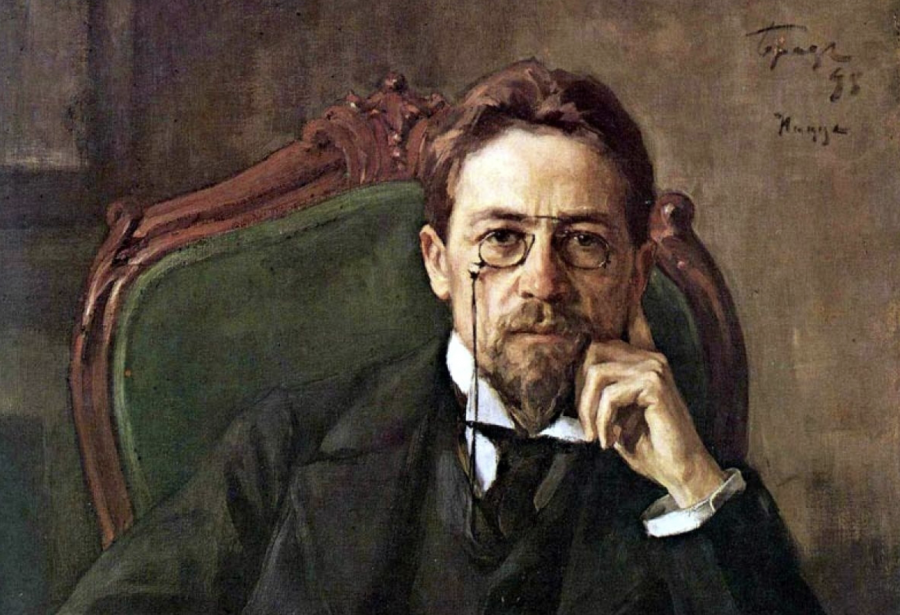
Whether due to insecurity, inexperience, or just intellectual curiosity, writers of fiction can sometimes privilege sounding smart over connecting with their readers. The result is the dreaded “information dump,” an attempt to include everything: everything, that is, but that which makes fiction compelling: minutely detailed descriptions of characters we care about; sharply observed situations that move us; moral complexity that feels earned and genuine…
All qualities that might fall under the adjective “Chekhovian.”
Anton Pavlovich Chekhov, country doctor and masterful short story writer, put himself through medical school by writing fiction readers could not put down. He has since become a standard for realist concision—the short story analogue to Gustave Flaubert’s mastery of the novel form.
And like Flaubert, Chekhov mastered his art by placing strict limits on himself. These he outlined in an 1886 letter to his brother Aleksandr in a concise six-point list, which you’ll find below.
- Absence of lengthy verbiage of political-social-economic nature;
- Total objectivity;
- Truthful description of persons and objects;
- Extreme brevity;
- Audacity and originality: flee the stereotype;
- Compassion
Many of these prescriptions can sound like the CIA-approved rules informally enforced by the 20th-century Iowa Writer’s Workshop. One can draw a line from Chekhov to Raymond Carver, Flannery O’Connor, John Updike, and other writers likely to have appeared in The New Yorker. But many writers besides Chekhov have complained of overly verbose, opinionated fiction.
19th century writer Henry James disparaged what he called the “large loose baggy monsters” of Fyodor Dostoevsky and other serial novelists, for example. Another novelist, Jay McInerney takes a phrase from Renaissance scholar Walter Pater to describe the brevity of the short story: the form, he writes, creates a “hard, gemlike flame.” This seems to be what Chekhov strove for in his mature work.
But three years earlier, he had perfected a very different kind of story, and issued a very different list of prescriptions to his brother. In 1883, Chekhov advised that if Aleksandr wished to get published in the magazine Fragments, he should observe the following: “1. The shorter, the better; 2. A bit of ideology and being up to date is most à propos; 3. Caricature is just fine, but ignorance of civil service ranks and of the seasons is strictly prohibited.”
We can see the author’s noted concern for accuracy, but not the ultimate and most concise item on his mature list: Compassion, a quality that eclipses typology and ideology. Chekhov may not always have adhered closely to some of his own rules, as ethnographic writer Kirin Narayan shows. After all, who can achieve “total objectivity”? But “embedded” in this ideal is “the recognition” writes Maria Popova at Brain Pickings, “that no depiction of reality is realistic unless it includes an empathic account of all perspectives.”
via Brain Pickings
Related Content:
Toni Morrison Dispenses Sound Writing Advice: Tips You Can Apply to Your Own Work
Josh Jones is a writer and musician based in Durham, NC. Follow him at @jdmagness
Read More...Hear Wade in the Water: An Unprecedented 26-Hour-Long Exploration of the African American Sacred Music Tradition
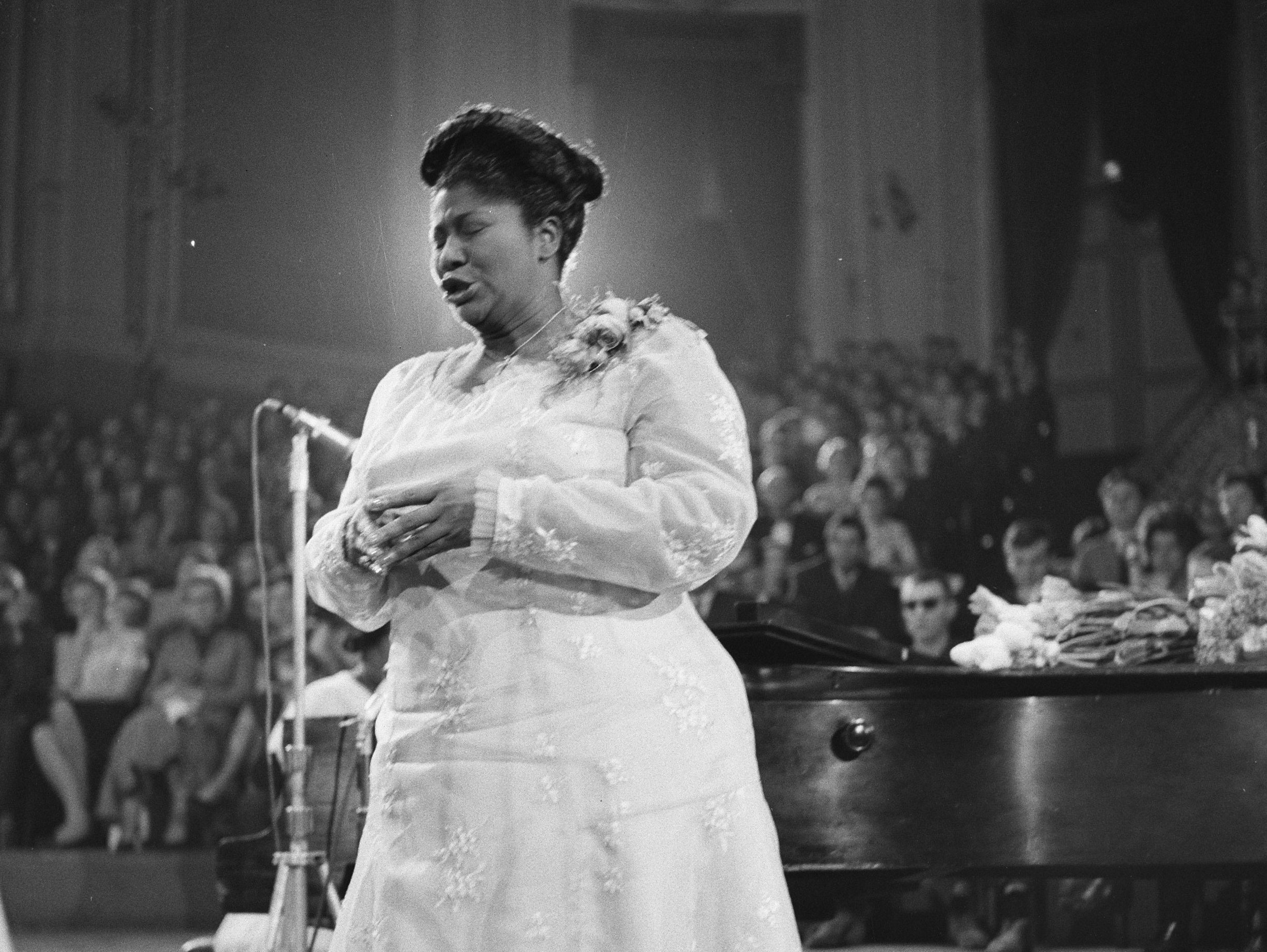
Photo of Mahalia Jackson by Dave Brinkman, via Wikimedia Commons
It may well be a truism to say that American music is African American music, but that doesn’t make it any less true. And when we reduce truths down to truisms they lose the granular detail that makes them interesting and relevant. Everyone knows, for example, that there would be no rock and roll without Robert Johnson at the crossroads and Little Richard in his sequined jacket and pompadour. But how many people know that without North Carolina-born Lesley Riddle, A.P. Carter’s onetime musical partner, folk and country music as we know it might not exist?
Likewise, Negro Spirituals and the black gospel tradition are legendary—birthing such towering figures as Aretha Franklin and Sam Cooke. But that history has often been turned into stereotype, an easy reference for down-home authenticity. Divorced from their roots, easy evocations of African American gospel glide over a complex tapestry of syncretism and synchronicity, innovation and preservation, and the building of local and national communities with a global scope and presence.
Black sacred music touches every part of U.S. history. To hear this history in granular detail, you need to hear NPR’s just-re-released audio series Wade in the Water: African American Sacred Music Traditions. First released in 1994 by NPR and the Smithsonian, the 26-part documentary details “the history of American gospel music and its impact on soul, jazz and R&B.” The series begins with a conceptual overview and carries us all the way through to the contemporary gospel scene.
Along the way, we learn about regional scenes, the growth and worldwide popularity of the Jubilee singers who so inspired W.E.B. Du Bois, the lined hymn and shaped-note traditions, and the use of gospel as a documentary medium itself, chronicling the sinking of the Titanic, the Depression, World Wars I and II, and more. Sacred music supported Civil Rights struggles, and movement leaders like Fannie Lou Hamer sang as they marched and organized, a powerful sound folk singers like Pete Seeger and Bob Dylan picked up and emulated.
Talking about music can only take us so far. Wade in the Water succeeded by keeping music at the center, even releasing a four-CD set, with extensive liner notes. This time around, the digital release comes with Spotify playlists like the one above in which you can hear a sampling of songs from the series. Here you’ll find the usual crossover gospel greats—Aretha, the Staple Singers, Billy Preston, Mahalia Jackson, BeBe and Cece Winans. You’ll also hear unknown community groups like a Demopolis, Alabama Congregation singing “Come and Go with Me” and the Gatling Funeral Home singing “Gatling Devotional.”
The series was researched, produced, and presented by Bernice Johnson Reagon, who is both a living example and a historian of the African American musical tradition. A founder of the SNCC Freedom Singers during the Civil Rights movement, she went on to found and direct Sweet Honey in the Rock, who appear in Wade in the Water and the playlist above. Reagon earned her Ph.D. from Howard University and published several scholarly books on the history she explores in the documentary series. Learn more about her (and hear more of her music) here, and hear all 26 episodes of Wade in the Water at NPR.
Related Content:
African-American History: Modern Freedom Struggle (A Free Course from Stanford)
Josh Jones is a writer and musician based in Durham, NC. Follow him at @jdmagness
Read More...How Sleep Can Become Your “Superpower:” Scientist Matt Walker Explains Why Sleep Helps You Learn More and Live Longer
“I’ll sleep when I’m dead”: those words have been a mantra to hard-living types everywhere since Warren Zevon first sang them back in 1976, but as Berkeley sleep scientist and Why We Sleep author Matt Walker sees it, taking them to heart is a “mortally unwise” choice. The example of Zevon himself, who died at the age of 53, would seem to validate that judgement, but it also comes backed by serious research. In the TED Talk “Sleep Is Your Superpower” above, Walker builds on what we all know — that we need to sleep, regularly and without interruption — by explaining “the wonderfully good things that happen when you get sleep, but the alarmingly bad things that happen when you don’t get enough, both for your brain and for your body.”
Not only, for example, do “you need sleep after learning to essentially hit the save button on those new memories so that you don’t forget,” you also “need sleep before learning to actually prepare your brain, almost like a dry sponge ready to initially soak up new information.”

As anyone who has tried to pull an all-nighter before a big test has felt, sleep deprivation shuts down your “your memory inbox,” and any incoming files just get “bounced” without being retained. But deep-sleep brainwaves, as Walker puts it, act as a “file-transfer mechanism at night, shifting memories from a short-term vulnerable reservoir to a more permanent long-term storage site within the brain, and therefore protecting them, making them safe.”
Improper sleep threatens not just learning but life itself: compromised sleep means a compromised immune system, hence the “significant links between short sleep duration and your risk for the development of numerous forms of cancer” now being discovered. “The shorter your sleep, the shorter your life,” as Walker starkly puts it. As far as how to improve your sleep and, with luck, elongate your life, he has two main pieces of advice: “Go to bed at the same time, wake up at the same time, no matter whether it’s the weekday or the weekend,” and “aim for a bedroom temperature of around 65 degrees, or about 18 degrees Celsius,” slightly cooler than may feel normal. We’d also do well to remember the importance of breaking the habit of staying on the internet late into the night — or more specifically, having stayed up well past midnight writing this very post, I’d do well to remember it.
Related Content:
How a Good Night’s Sleep — and a Bad Night’s Sleep — Can Enhance Your Creativity
Dr. Weil’s 60-Second Technique for Falling Asleep
Based in Seoul, Colin Marshall writes and broadcasts on cities, language, and culture. His projects include the book The Stateless City: a Walk through 21st-Century Los Angeles and the video series The City in Cinema. Follow him on Twitter at @colinmarshall, on Facebook, or on Instagram.
Read More...How to Read Many More Books in a Year: Watch a Short Documentary Featuring Some of the World’s Most Beautiful Bookstores
You don’t have enough time in life to read all the books you want to. But if you change your habits just a bit, you’ll be able to read many more books in the time you do have left than you otherwise could have. Filmmaker Max Joseph learns these and other lessons about reading in this short documentary, Bookstore: How to Read More. In it he travels in search of not just the advice of some of the world’s most expert readers (or at least some of the most expert readers in America), but also in search of the experience of the most beautiful bookstores in the world (or at least in western Europe and South America).
Wait But Why blogger Tim Urban tells Joseph he would need to read for only half an hour per day to have read more than a thousand books by the end of his time on Earth, versus the single shelf he might read through with his current habits.
Eric Barker of Barking Up the Wrong Tree suggests that Joseph redirect his social media-viewing instincts toward whichever book he feels most excited about reading in the moment, and that he begin by setting his daily reading goal so low at first — say, just one page — that it’s practically easier to meet it than not. (To quote from Moby-Dick, “What cannot habit accomplish?”) Then Howard Berg, who holds the Guinness World Record declaring him the fastest reader alive, breaks down the techniques that can theoretically make each page go by in seconds.
But how fast do we really want to read? For counsel on the what and the why, Joseph visits the office of Ruth J. Simmons, president of Prairie View A&M University and former president of Brown University. She emphasizes the importance of reading not just frequently but widely, a condition that shouldn’t be terribly hard to fulfill given Joseph’s travel and shopping habits: in the video we see him visit a variety of highly Instagrammable (and drone-filmable) bookstores everywhere from Brussels and Maastricht to São Paulo and Buenos Aires. One of them, Lisbon’s Ler Devagar, tells him to “read slowly” with its very name, echoing Simmons’ description of reading as “forced meditation.” That framing is apt, but just like visiting a new bookstore, meditation makes the true bibliophile think of only one thing first: all the volumes out there still to be read.
Related Content:
7 Tips for Reading More Books in a Year
The Last Bookstore: A Short Documentary on Perseverance & the Love of Books
A Secret Bookstore in a New York City Apartment: The Last of a Dying Breed
Based in Seoul, Colin Marshall writes and broadcasts on cities, language, and culture. His projects include the book The Stateless City: a Walk through 21st-Century Los Angeles and the video series The City in Cinema. Follow him on Twitter at @colinmarshall, on Facebook, or on Instagram.
Read More...Segregated By Design: An Animated Look at How African-American Enclaves in U.S. Cities Is Hardly an Accident
From historian Richard Rothstein comes a sobering animated video called “Segregated by Design.” Author of the 2017 book The Color of Law: A Forgotten History of How Our Government Segregated America, Rothstein has created a video that’s as informative as it is visually captivating. Here’s what ground it covers:
Examine the forgotten history of how our federal, state and local governments unconstitutionally segregated every major metropolitan area in America through law and policy.
‘Segregated By Design’ examines the forgotten history of how our federal, state and local governments unconstitutionally segregated every major metropolitan area in America through law and policy.
Prejudice can be birthed from a lack of understanding the historically accurate details of the past. Without being aware of the unconstitutional residential policies the United States government enacted during the middle of the twentieth century, one might have a negative view today of neighborhoods where African Americans live or even of African Americans themselves.
We can compensate for this unlawful segregation through a national political consensus that leads to legislation. And this will only happen if the majority of Americans understand how we got here. Like Jay‑Z said in a recent New York Times interview, “you can’t have a solution until you start dealing with the problem: What you reveal, you heal.” This is the major challenge at hand: to educate fellow citizens of the unconstitutional inequality that we’ve woven and, on behalf of our government, accept responsibility to fix it.
Learn more about the film at the website, Segregated by Design. And find it added to our list of Free Animations, a subset of our collection, 4,000+ Free Movies Online: Great Classics, Indies, Noir, Westerns, Documentaries & More.
If you would like to support the mission of Open Culture, consider making a donation to our site. It’s hard to rely 100% on ads, and your contributions will help us continue providing the best free cultural and educational materials to learners everywhere. You can contribute through PayPal, Patreon, and Venmo (@openculture). Thanks!
Related Content:
How Martin Luther King, Jr. Used Nietzsche, Hegel & Kant to Overturn Segregation in America
Read More...Watch The Velvet Underground Perform in Rare Color Footage: Scenes from a Vietnam War Protest Concert (1969)
There are many reasons to think of The Velvet Underground forever in black and white: Nico’s Nordic monotone; John Cale and Moe Tucker’s monochromatic drones; Lou Reed’s perpetual invocation of rock and roll’s black and white 50s origins. White Light/White Heat and its stark black-and-white cover; “The Black Angel’s Death Song,” from their debut; pallid, sun-starved faces and a penchant for black sunglasses; an indelible association with Warhol’s black and white Factory scene….
Then there’s literally the fact that we’ve almost aways seen the band filmed and photographed in black and white, until now. “Yes, you read that right,” announces Dangerous Minds, “previously unseen color film of the Velvet Underground has been discovered!” and boy is it groovy.
Always walking an avant-garde line between proto-punk and psychedelic folk/rock, this footage from 1969 seems to catch the band leaning in the latter direction for Dallas Peace Day, a Vietnam War Protest held on the grounds of the Winfrey Point building overlooking White Rock Lake.
“There were likely between 600 and 3,000 people in attendance,” and the performers that day included Lou Rawls and groups like Velvet Dream, Stone Creek, and Bradley & David. “The VU were in town for a week of shows at a Dallas club.… These were the first concerts they ever played in the south. It’s unknown how the group became involved with Dallas Peace Day.” They were a band in transition. Bassist Doug Yule had recently taken over for the departed John Cale. They were leaving behind their Warhol/Nico/Factory days.
The unearthed film here includes some performance footage, at the top. The band plays “I’m Wating for the Man,” “Beginning to the See the Light,” and “I’m Set Free.” There’s also an interview with Sterling Morrison, who talks about the “tone of anarchy” at New York anti-war rallies and the violence in Chicago the previous year. Above, see some silent B‑roll and below, a little more footage, with some unrelated, overdubbed music. All of this film comes courtesy of the G. William Jones Film & Video Collection.
The footage “was uncovered only by chance and the archive doesn’t know the original motives for recording it, or even know how they came to obtain the film.” It’s a side of the band we don’t often see. While hardcore fans may be familiar with the post-John Cale—and post-Lou Reed—years, most people tend to associate The Velvet Underground with black leather and white… um… substances… not paisley and peace rallies.
Related Content:
Hear Lost Acetate Versions of Songs from The Velvet Underground & Nico (1966)
Josh Jones is a writer and musician based in Durham, NC. Follow him at @jdmagness
Read More...The First Museum Dedicated Exclusively to Poster Art Opens Its Doors in the U.S.: Enter the Poster House
How times have changed since our late 80s college days. Undergrads do research online, upload assignments to a server, stream music, download affirmative sexual consent contracts, and turn to Facebook when it’s time to find a ride home for the holidays.
But one aspect of the collegiate lifestyle remains unchanged.
They still festoon their dorm rooms with posters—the actual paper article, affixed to the walls with blue putty, a carefully curated collection of taste and aspiration.
As Cait Munro writes in Refinery 29:
Freshman, already scrambling to find and loudly articulate an identity, can leave the poster sale with two or three plastic tubes housing scrolls that represent the very essence of their new, parent-free, on-campus selves. Posters become an affordable, demonstrable expression of who they are as a person — or, in the tradition of people eager to leave behind their hometown selves, who they want to be.
Legions of style blogs have decreed that these posters should be given the heave-ho along with the plastic milk crate shelving, come graduation.
Personally, I would rather gaze upon the tattered reproduction of the first painting that spoke to me at the Art Institute of Chicago than anything the design experts float as an acceptably grown up alternative.
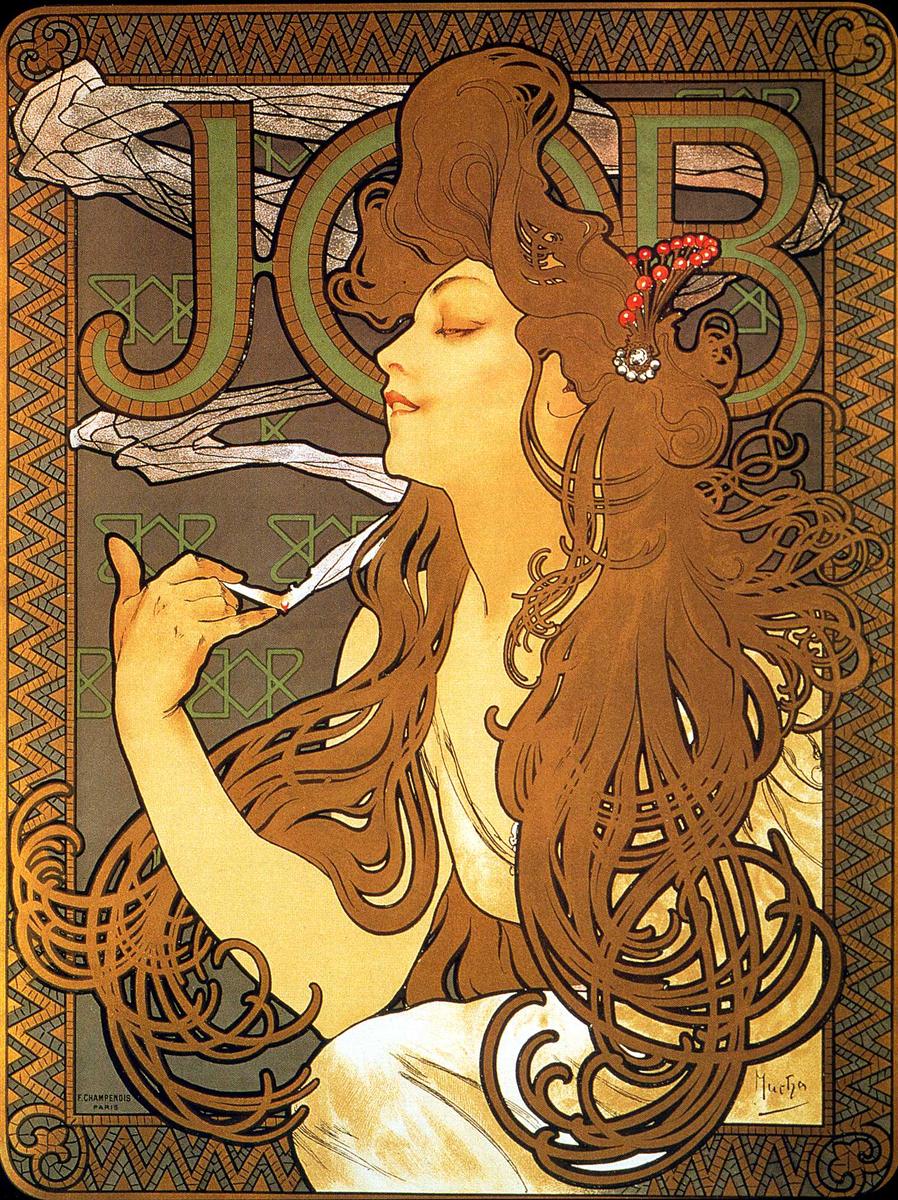
Is Alphonse Mucha’s Byzantine 1896 ad for Job rolling papers somehow unworthy because legions of dewy eyed undergrads have given it a perennial place of unframed honor?
The driving forces behind the newly opened Poster House in New York City would say no. The first American museum dedicated exclusively to poster art, its curators cast a wide net through the form’s 160 year history, whether the end goal of the work was war bond sales, public health education, or straight-up box office sales. As the Poster House writes:
For a poster to succeed, it must communicate. By combining the power of images and words, posters speak to audiences quickly and persuasively. Blending design, advertising, and art, posters clearly reflect the place and time in which they were made.
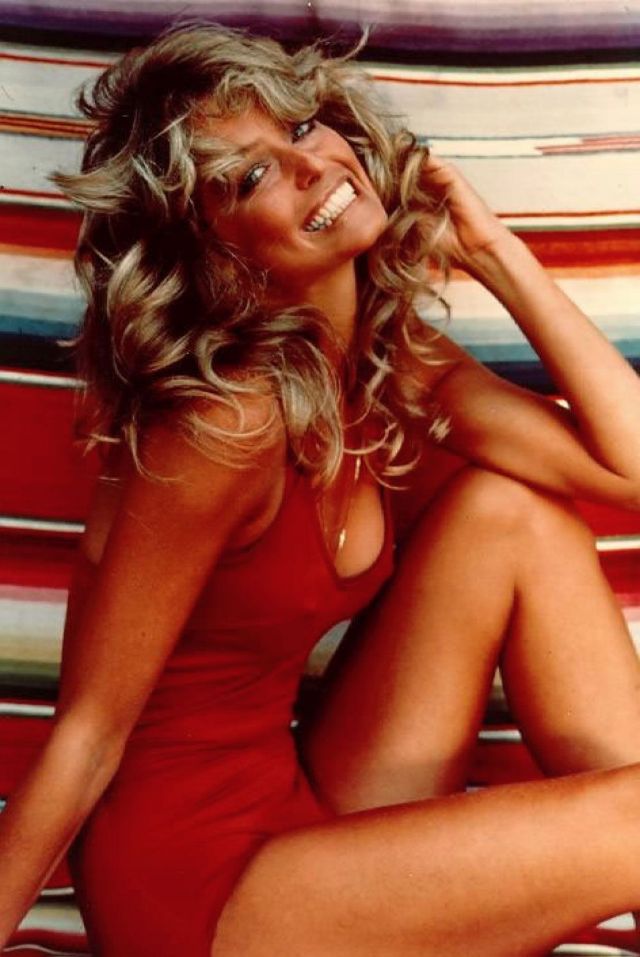
What did the best-selling poster of actress Farrah Fawcett in a red tank suit say to—and about—teenage boys in 1976? What did it say about American values and gender norms in that Bicentennial year? Why no posters of Betsy Ross?
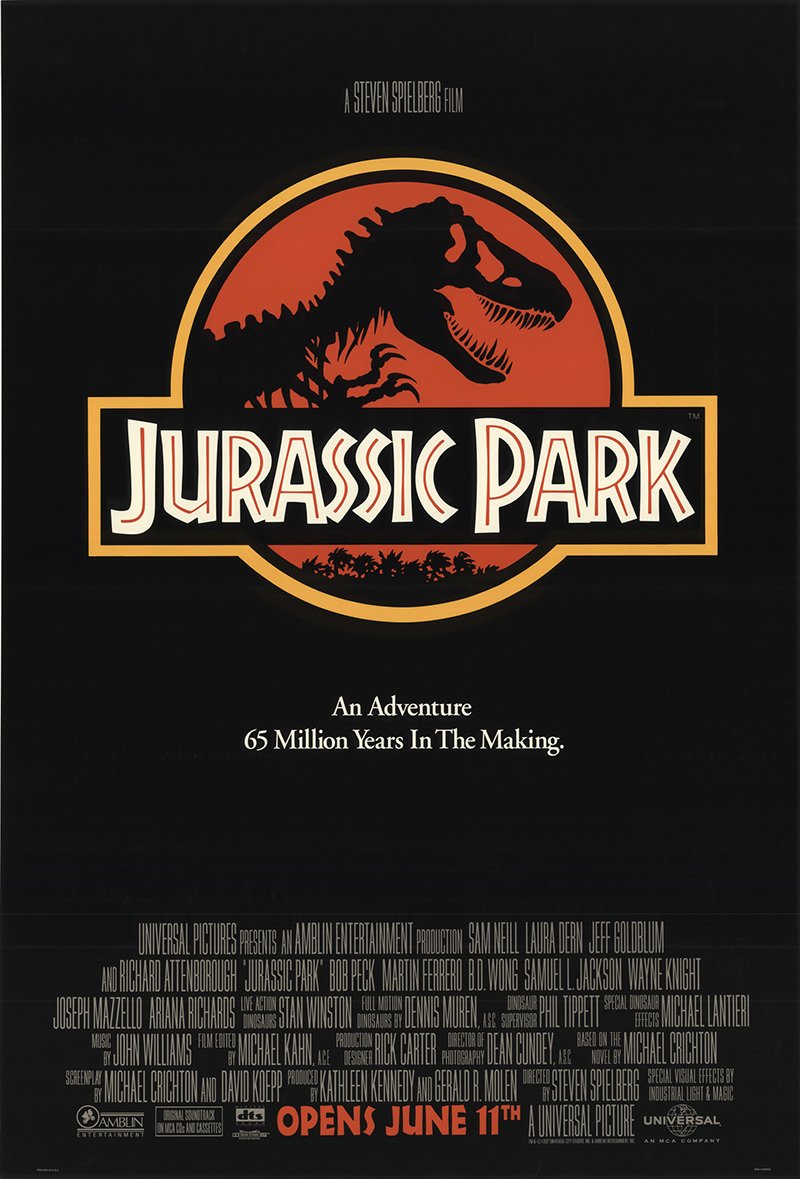
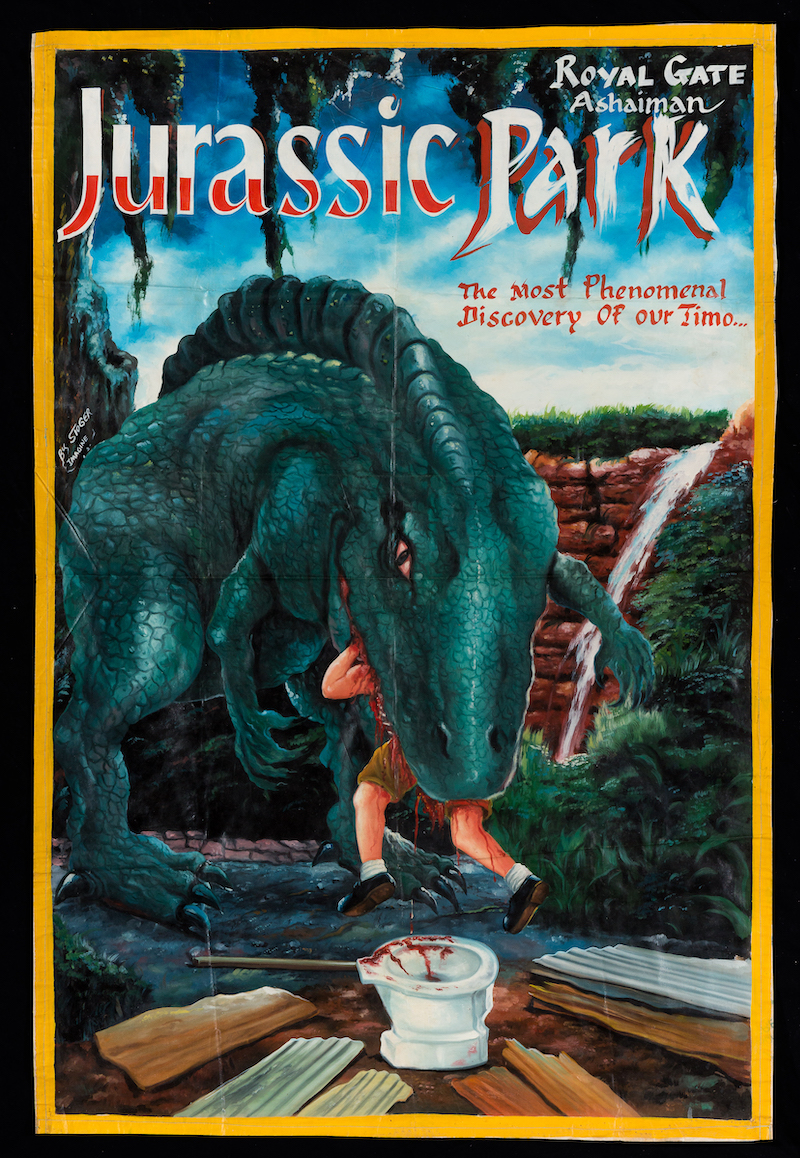
How does the official poster for Jurassic Park, above, compare to the hand-painted, presumably unauthorized image used to market it to audiences in Ghana?
(Endless gratitude to illustrator and monster movie fan Aeron Alfrey for bringing this and other Ghanian spins on American film releases to our attention.)
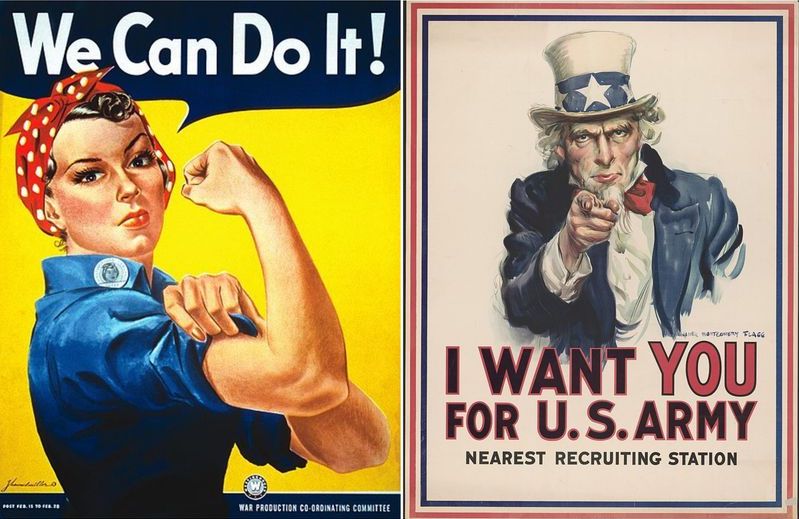
Some posters have remarkable staying power, reappearing in a number of guises. Witness Rosie the Riveter and James Montgomery Flagg’s Uncle Sam-themed WWI recruitment poster, to say nothing of the Barack Obama “Hope” poster by Shepard Fairey, the poster that launched a thousand parodies, mostly digital, but even so.

To learn more about visiting Poster House, its inaugural Alphonse Mucha exhibit and upcoming events such as Drink and Draw, click here.
via Hyperallergic
Related Content:
The Film Posters of the Russian Avant-Garde
Chilling and Surreal Propaganda Posters from the NSA Are Now Declassified and Put Online
Vintage 1930s Japanese Posters Artistically Market the Wonders of Travel
100 Greatest Posters of Film Noir
Ayun Halliday is an author, illustrator, theater maker and Chief Primatologist of the East Village Inkyzine. Follow her @AyunHalliday.
Read More...
Watch a Star-Studded Cast Read The Mueller Report: John Lithgow, Kevin Kline, Sigourney Weaver, Annette Bening & More
Laughter is good medicine, but I’ve found little genuine humor in satire of the 2016 election and subsequent events. Political reality defies parody. So, I guess I wasn’t particularly amused by the idea of a comic staging of the Mueller Report. But aside from whether or not the report has comic potential, the exercise raises a more serious question: Should ordinary citizens read the report?
Given the snowjob summary offered by the Attorney General—and certain press outfits who repeated claims that it exonerated the president—probably. Especially (good luck) if they can score an unredacted copy. Yet, this raises yet another question: Does anyone actually want to read it? The answer appears to be a resounding yes. Even though it’s free, the [redacted] report is a bestseller.
And yet, “the published version is as dry as a [redacted] saltine,” writes James Poniewozik at The New York Times. “Robert Mueller himself has the stoic G‑man bearing of someone who would laugh by writing ‘ha ha’ on a memo pad.” (Now that’s a funny image.) One wonders how many people dutifully downloading it have stayed up late by the light of their tablets compelled to read it all.
But of course, one does not approach any government document with the hopes of being entertained, though unintentional hilarity can leap from the page at any time. How should we approach The Investigation: A Search for the Truth in 10 Acts? Scripted by Pulitzer Prize-winning playwright Robert Schenkkan from the Mueller Report’s transcripts, the production is “part old-time public recitation,” writes Poneiwozik, and “part Hollywood table read.”
The staging above at New York’s Riverside Church was hosted by Law Works and performed live by a cast including Annette Bening, Kevin Kline, John Lithgow (as “Individual 1” himself), Michael Shannon, Justin Long, Jason Alexander, Wilson Cruz, Joel Gray, Kyra Sedgwick, Alfre Woodard, Zachary Quinto, Mark Ruffalo, Bob Balaban, Alyssa Milano, Sigourney Weaver, Julia Louis-Dreyfus, Mark Hamill, and more. Bill Moyers serves as emcee.
Can this darkly comic production deliver some comic balm for having lived through the sordid reality of the events in question? It has its moments. Can it offer us something resembling truth? You be the judge. Or you be the producer, director, actor, etcetera. If you find value—civic, entertainment, or otherwise—in the exercise, Schenkkan encourages you to put on your own version of The Investigation. “Your production can be as modest or extravagant as you like,” he writes at Law Works, followed by a list of further instructions for a possible staging.
If, like maybe millions of other people, you’ve got an unread copy of the Mueller Report on your nightstand, maybe watching—or performing—The Investigation is the best way to get yourself to finally read it. Or the most grimly humorous, moronic, pathetic, and surreal parts of it, anyway.
Related Content:
Saturday Night Live: Putin Mocks Trump’s Poorly Attended Inauguration
The Mueller Report Is #1, #2 and #3 on the Amazon Bestseller List: You Can Get It Free Online
Josh Jones is a writer and musician based in Durham, NC. Follow him at @jdmagness
Read More...Queen Guitarist Brian May Is Also an Astrophysicist: Read His PhD Thesis Online

Photo by ESO/G. Huedepohl, via Wikimedia Commons
Queen couldn’t possibly have been Queen without Freddie Mercury, nor could it have been Queen without Brian May. Thanks not least to the recent biopic, Bohemian Rhapsody, the band’s already larger-than-life lead singer has become even larger still. But its guitarist, despite the film’s surface treatment of his character, is in his own way an equally implausible figure. Not only did he show musical promise early, forming his first group while still at school, he also got his A Levels in physics, mathematics, and applied mathematics, going on to earn a Bachelor of Science in Physics with honors at Imperial College London.
Naturally, May then went for his PhD, continuing at Imperial College where he studied the velocity of, and light reflected by, interplanetary dust in the Solar System. He began the program in 1970, but “in 1974, when Queen was but a princess in its infancy, May chose to abandon his doctorate studies to focus on the band in their quest to conquer the world.” So wrote The Telegraph’s Felix Lowe in 2007, the year the by-then 60-year-old (and long world-famous) rocker finally handed in his thesis. “The 48,000-word tome, Radial Velocities in the Zodiacal Dust Cloud, which sounds suspiciously like a Spinal Tap LP, was stored in the loft of his home in Surrey.” You can read it online here.
According to its abstract, May’s thesis “documents the building of a pressure-scanned Fabry-Perot Spectrometer, equipped with a photomultiplier and pulse-counting electronics, and its deployment at the Observatorio del Teide at Izaña in Tenerife, at an altitude of 7,700 feet (2567 m), for the purpose of recording high-resolution spectra of the Zodiacal Light.” Space.com describes the Zodiacial Light as “a misty diffuse cone of light that appears in the western sky after sunset and in the eastern sky before sunrise,” one that has long tricked casual observers into “seeing it as the first sign of morning twilight.” Astronomers now recognize it as “reflected sunlight shining on scattered space debris clustered most densely near the sun.”
In his abstract, May also notes the unusually long period of study as 1970–2007, made possible in part by the fact that little other research had been done in this particular subject area during Queen’s reign on the charts and thereafter. Still, he had catching up to do, including observational work in Tenerife (as much of a hardship posting as that isn’t). Since being awarded his doctorate, May’s scientific activities have continued, as have his musical ones and other pursuits besides, such as animal-rights activism and stereography. (Sometimes these intersect: the 2017 photobook Queen in 3‑D, for example, uses a VR viewing device of May’s own design.) The next time you meet a youngster dithering over whether to go into astrophysics or found one of the most successful rock bands of all time, point them to May’s example and let them know doing both isn’t without precedent.
Related Content:
Guitarist Brian May Explains the Making of Queen’s Classic Song, ‘Bohemian Rhapsody’
Brian May’s Homemade Guitar, Made From Old Tables, Bike and Motorcycle Parts & More
Based in Seoul, Colin Marshall writes and broadcasts on cities, language, and culture. His projects include the book The Stateless City: a Walk through 21st-Century Los Angeles and the video series The City in Cinema. Follow him on Twitter at @colinmarshall, on Facebook, or on Instagram.
Read More...Support Us
We're hoping to rely on loyal readers, rather than erratic ads. Please click the Donate button and support Open Culture. You can use Paypal, Venmo, Patreon, even Crypto! We thank you!

About Us

Open Culture scours the web for the best educational media. We find the free courses and audio books you need, the language lessons & educational videos you want, and plenty of enlightenment in between.
Advertise With Us

FREE UPDATES!
GET OUR DAILY EMAIL
Get the best cultural and educational resources on the web curated for you in a daily email. We never spam. Unsubscribe at any time.
FOLLOW ON SOCIAL MEDIA

Open Culture editor Dan Colman scours the web for the best educational media. He finds the free courses and audio books you need, the language lessons & movies you want, and plenty of enlightenment in between.
Advertise With Us


