Watch 3,000 Films Free Online from the National Film Board of Canada, Including Portraits of Leonard Cohen, Margaret Atwood & Jack Kerouac
What, exactly, is Canada? The question sometimes occurs to Americans, living as they do right next door. But it might surprise those Americans to learn that Canadians themselves ask the very same question, living as they do in a country that could be defined by any number of its elements — its vastness, its multiculturalism, The Kids in the Hall — but never seems defined by any one of them in particular. Many individuals and groups throughout Canadian history have participated in the project of explaining Canada, and indeed defining it. Few have done as much as the National Film Board of Canada and the filmmakers it has supported, thanks to whom “three thousand films, from documentaries to narrative features to experimental shorts, are available to stream free of charge, even for Americans.”
Those words come from The Outline’s Chris R. Morgan, who writes that, “for the ‘Canuckophile’ (not my coinage but a term I happily own), the NFB’s Screening Room is one of the supreme pleasures of the internet. Since 1939, the NFB has facilitated the telling of Canada’s story in its people’s own words and images.”
Morgan points up to such NFB-supported productions as 1965’s Ladies and Gentlemen … Mr. Leonard Cohen, which “follows the titular 30-year-old poet giving witty readings, partying, and living around Montreal,” and the 2014 Shameless Propaganda, described at the Screening Room as an examination of “Canada’s national art form.” That art form developed in the years after the NFB’s founding in 1939, a time when its founding commissioner John Grierson called documentaries a “hammer to shape society.”
Not that most of what you’ll find to watch in the NFB’s screening room comes down like a hammer — nor does it feel especially propagandistic, as we’ve come to understand that term in the 21st century. Take, for instance, the documentary portraits of Canadian writers like Margaret Atwood and Jack Kerouac.
The latter lead a life described by filmmaker Herménégilde Chiasson as “a Franco-American odyssey,” which will remind even the most Canada-unaware Americans of one thing that clearly sets Canada apart: its bilingualism. That, too, provides material for a few NFB productions, including 1965’s Instant French, a short about “the adventures of a group of businessmen who are forced into taking French lessons to stay competitive in their field.”
“At first put out by this news,” continues the description at the Screening Room, “one by one they begin to realize that gaining fluency in another language has its benefits.” Hokey though it may sound — “definitely a product of its time,” as the NFB now says — a film like Instant French offers a glimpse into not just Canada’s past but the vision for society that has shaped Canada’s present and will continue to shape its future. You can browse the NFB’s large and growing online archive by subject (with categories including literature and language, music, and history) as well as through playlists like “Expo 67: 50 Years Later,” “Extraordinary Ordinary People,” — and, of course, “Hockey Movies,” which reminds us that, elusive though Canadian culture as a whole may sometimes feel, certain important parts of it aren’t that hard to grasp.
Related Content:
4,000+ Free Movies Online: Great Classics, Indies, Noir, Westerns, Documentaries & More
Listen to Glenn Gould’s Shockingly Experimental Radio Documentary, The Idea of North (1967)
Glenn Gould Gives Us a Tour of Toronto, His Beloved Hometown (1979)
William Shatner Sings O Canada (and Happy Canada Day)
1,150 Free Movies Online: Great Classics, Indies, Noir, Westerns, etc.
Based in Seoul, Colin Marshall writes and broadcasts on cities, language, and culture. His projects include the book The Stateless City: a Walk through 21st-Century Los Angeles and the video series The City in Cinema. Follow him on Twitter at @colinmarshall, on Facebook, or on Instagram.
Read More...Andy Warhol Explains Why He Decided to Give Up Painting & Manage the Velvet Underground Instead (1966)
In Good Omens—the six-episode adaptation of Terry Pratchett and Neil Gaiman’s satirical fantasy about the Biblical end of the world—a running joke relies on the viewer’s offhand knowledge of the Velvet Underground’s significance. A refined, rare bookshop-owning angel calls the band “bebop” and has no idea who they are or what they sound like, a forgivable sin in the 70s, but seriously out of touch decades later in the 21st century.
The scheming supernatural agent should probably know that the Lou Reed (and briefly Nico)-fronted, Andy Warhol-managed late-1960s-70s experimental New York art rock band had an outsized influence on human affairs. Bridging a divide no one even knew existed between beat poetry, avant-garde jazz, psychedelic garage rock, doo-wop, and European folk music, the band is anecdotally credited with launching thousands of others—having as much impact, perhaps, on modern rock as Charlie Parker had on modern jazz.
Warhol could not have known any of this when he decided to sponsor and promote the Velvet Underground in 1966. He only managed the band for a year, in what seemed like both a stunt and a performance art project, part of his traveling multimedia show Exploding Plastic Inevitable, which he calls “the biggest discotheque in the world” in the 1966 interview above. Warhol acted, and the band reacted, shaping themselves around his provocations. He projected high-contrast films at them onstage, they put on sunglasses. He pushed deadpan German model and singer Nico on them, they wrote and recorded what some consider the greatest debut album in history.
Warhol couldn’t have known how any of it would pan out, but in hindsight his patronage can seem like a prescient, almost metaphysical, act of cultural subversion—and the work of a guileless savant compelled by vague intuitions and whims. He preferred to give off the latter impression, then let critics infer the former. Warhol explains that he has abandoned painting and started managing the band because “I hate objects, and I hate to go to museums and see pictures of the world, because they look so important and they don’t really mean anything.”
Few people doubt the management of his public persona was at least partially calculated. But so much of it clearly wasn’t—as evidenced by his own exhaustive recording of every detail of his life. Despite the amount of calculation ascribed to him, a quality the interviewer awkwardly tries to ask him about, he seems to have been stupefied about his own motivations much of the time, beyond the fact that he strongly liked and disliked certain simple things—Elvis, Campbell’s Soup, obscure blonde femme fatales. At other times, Warhol issued aphorisms as cryptic and profound as an ancient sage or post-war critical theorist.
Was the Velvet Underground more like Warhol’s uncomplicated love of cheeseburgers and Batman or more like his sophisticated deconstruction of film, media, and fashion, or are these not mutually exclusive ways of looking at his work? The question may not really concern music historians, for whom Warhol’s early influence was formative, but maybe musically marginal. But if we think of him as a motive force behind the band’s look and early sound—a kind of conscious creative reagent—we might be curious about what he meant by it, if anything.
Related Content:
The Big Ideas Behind Andy Warhol’s Art, and How They Can Help Us Build a Better World
Three “Anti-Films” by Andy Warhol: Sleep, Eat & Kiss
Josh Jones is a writer and musician based in Durham, NC. Follow him at @jdmagness
Read More...Jeff Tweedy Explains How to Learn to Love Music You Hate: Watch a Video Animated by R. Sikoryak
Punk rock peer pressure forced Jeff Tweedy, founder of Wilco, to shun Neil Young and other “hippie“musical greats.
Ah, youth…
Were Tweedy, now a seasoned 51-year-old, to deliver a commencement speech, he’d do well to counsel younger musicians to reject such knee jerk rejection, as he does in the above animated interview for Topic magazine.
Not because he’s now one of those grey beards himself, but rather because he’s come to view influence and taste as living organisms, capable of interacting in surprising ways.
That’s not to say the youngsters are obliged to declare an affinity for what they hear when venturing into the past, just as Tweedy doesn’t fake a fondness for much of the new music he checks out on the regular.
Think of this practice as something similar to one millions of childish picky eaters have endured. Eat your vegetables. Just a taste. You can’t say you don’t like them until you’ve actively tasted them. Who knows? You may find one you like. Or perhaps it’ll prove more of a slow burn, becoming an unforeseen ingredient of your maturity.
In other words, better to sample widely from the unending musical buffet available on the Internet than conceive of yourself as a wholly original rock god, sprung fully formed from the head of Zeus, capiche?
The narration suggests that Tweedy’s got some problems with online culture, but he gives props to the digital revolution for its softening effect on the ironclad cultural divide of his 70s and 80s youth.
Was it really all just a marketing scheme?
Unlikely, given the Vietnam War, but there’s no denying that educating ourselves in our passion includes approaching its history with an at-least-partially open mind.
If you want to snap it shut after you’ve had some time to consider, that’s your call, though Tweedy suggests he’s never comfortable writing something off forever.
If nothing else, the stuff he dislikes teaches him more about the stuff he loves—including, presumably, some of his own impressive catalog.
Kudos to director Keith Stack and Augenblick Studios, animator of so many Topic interviews, for matching Tweedy with cartoonist R. Sikoryak, an artist who clearly shares Tweedy’s creative philosophy as evidenced by such works as Terms and Conditions and Masterpiece Comics. Here is another who clearly knows how to make a meal from mixing old and new, traditional and experimental, high and low. One of the bonus joys of this animated life lesson is catching all of Sikoryak’s musical Easter eggs—including a cameo by Nipper, the face of His Master’s Voice.
Related Content:
Kurt Cobain Lists His 50 Favorite Albums: Features LPs by David Bowie, Public Enemy & More
‘Beastie Boys on Being Stupid’: An Animated Interview From 1985
Ayun Halliday is an author, illustrator, theater maker and Chief Primatologist ofthe East Village Inky zine. Join her in New York City June 17 for the next installment of her book-based variety show, Necromancers of the Public Domain. Follow her @AyunHalliday.
Read More...African American History-Emancipation to the Present: A Free Online Course from Yale University
This course, African American History: Emancipation to the Present, was presented by Jonathan Holloway, when he was Professor of History at Yale University. He is now the President of Rutgers University.
According to the course description, “The purpose of this course is to examine the African American experience in the United States from 1863 to the present. Prominent themes include the end of the Civil War and the beginning of Reconstruction; African Americans’ urbanization experiences; the development of the modern civil rights movement and its aftermath; and the thought and leadership of Booker T. Washington, Ida B. Wells-Barnett, W.E.B. Du Bois, Marcus Garvey, Martin Luther King Jr., and Malcolm X.”
We should add the warning, “Some of the lectures in this course contain graphic content and/or adult language that some users may find disturbing.”
You can watch Lecture 1 of 25 above, or find them all on YouTube. You can see the syllabus for the course here.
African American History: Emancipation to the Present has been added to our list of Free History Courses, a subset of our larger collection, 1,700 Free Online Courses from Top Universities.
If you would like to support the mission of Open Culture, consider making a donation to our site. It’s hard to rely 100% on ads, and your contributions will help us continue providing the best free cultural and educational materials to learners everywhere. You can contribute through PayPal, Patreon, and Venmo (@openculture). Thanks!
Related Content:
African-American History: Modern Freedom Struggle (A Free Course from Stanford)
Free Online History Courses
Read More...How David Bowie Delivered His Two Most Famous Farewells: As Ziggy Stardust in 1973, and at the End of His Life in 2016
When David Bowie left us on January 10, 2016, we immediately started seeing the just-released Blackstar, which turned out to be his final album, as a farewell. But then, if we looked back across his entire career — a span of more than half a century — we saw that he had been delivering farewells the whole time. Throughout much of that career, Bowie’s observers have reflexively compared him to a chameleon, so often and so dramatically did he seem to revise his performative identity to suit the zeitgeist (if not to shape the zeitgeist). But periodic creative rebirth entails periodic creative death, and as the Polyphonic video essay above shows us, no rock star could die as creatively as Bowie.
The video concentrates on two of Bowie’s most famous farewells, in particular: his last, on Blackstar and the musical Lazarus, and his first, delivered onstage 43 years earlier in his last performance in the character of Ziggy Stardust. “Not only is it the last show of the tour,” he announced to 3,500 screaming fans at London’s Hammersmith Odeon, “but it’s the last show that we’ll ever do.”
There followed a closing performance of “Rock ‘n’ Roll Suicide,” a song described by the video’s narrator as “Ziggy Stardust’s final moments, washed up and exhausted from life as a rock star.” Though only 26 years old at the time, Bowie had already released six studio albums and experienced more than enough to reflect eloquently in song on “a life well lived.”
But then, if the phenomenon of David Bowie teaches us anything, it teaches us how a life can be composed of various discrete lifetimes. Bowie understood that, as did the other artists whose work he referenced in his farewells: names cited in this video’s analysis include Jacques Brel, Charles Bukowski, and the Spanish poet Manuel Machado. And as any fan knows, Bowie was also adept at referencing his own work, a tendency he kept up until the end as in, for example, the reappearance of his mid-70s character (and subject of a previous Polyphonic study) the Thin White Duke in the “Lazarus” music video. In that work he also left plenty of material to not just inspire subsequent generations of creators, but to send them back to the realms of culture that inspired him. We may have heard David Bowie’s final farewell, but in our own lifetimes we surely won’t hear the end of his influence.
Related Content:
David Bowie Sings “Changes” in His Last Live Performance, 2006
The Thin White Duke: A Close Study of David Bowie’s Darkest Character
How Leonard Cohen & David Bowie Faced Death Through Their Art: A Look at Their Final Albums
Dave: The Best Tribute to David Bowie That You’re Going to See
Based in Seoul, Colin Marshall writes and broadcasts on cities, language, and culture. His projects include the book The Stateless City: a Walk through 21st-Century Los Angeles and the video series The City in Cinema. Follow him on Twitter at @colinmarshall, on Facebook, or on Instagram.
Read More...What Did Old English Sound Like? Hear Reconstructions of Beowulf, The Bible, and Casual Conversations
What is the English language? Is it Anglo-Saxon? It is tempting to think so, in part because the definition simplifies a linguistic history that defies linear summary. Over the course of 1000 years, the language came together from extensive contact with Anglo-Norman, a dialect of French; then became heavily Latinized and full of Greek roots and endings; then absorbed words from Arabic, Spanish, and dozens of other languages, and with them, arguably, absorbed concepts and pictures of the world that cannot be separated from the language itself.
Shakespeare and other writers filled in the gaps (and still do), inventing words where they were lacking. Why do we then refer to the long-dead Anglo-Saxon language as “Old English,” if it is only a distant ancestor, and one, you’ll note, no English speaker today understands? There are many technical reasons for this, but to put it in plain terms: if English were a body, Anglo-Saxon might be the bones and ligaments: not only for the hardness of its consonants and its blunt, unadorned poetry, but because it contains the most common words in the language, the structural bits that hold together all those pan-linguistic borrowings.
Observe the piece of verse known as Cædmon’s Hymn, below. Amidst the tangle of unfamiliar phonemes and extinct letters like the “þ,” you cannot miss such bedrock words as “and,” “his,” “or,” “He,” and “to.” In other texts, you’ll find recognizable equivalents of “father,” “mother,” “husband,” “wife,” “good,” “god,” and many other common household words.
Nu sculon herian heofonrices Weard,
Metodes mihte and his modgeþanc,
weorc Wuldorfæder, swa he wundra
gehwæs
ece Dryhten, or onstealde.
He ærest scop eorþan bearnum
heofon to hrofe halig Scieppend.
þa middangeard mancynnes Weard
ece Dryhten, æfter teode
firum foldan Frea ælmihtig.
Despite sharing many words with modern English, however, Anglo Saxon is another language, from an entirely different world long disappeared. No one living, of course, knows exactly what it sounded like, so scholars make their best educated guesses using internal evidence in the scant literature, secondary sources in other languages from the time, and similarities to other, living languages. Now that you’ve seen what Old English looks like, hear how it sounds to modern ears.
In the video at the top, student of the language Stephen Roper reenacts a casual conversation with an Anglo-Saxon speaker, one who can understand but cannot speak contemporary English. The other examples here come from literary contexts. Further up, Justin A. Jackson, Professor of English at Hillsdale College, reads the opening lines of Beowulf, and just above, hear an unnamed narrator read the epic poem’s full Prologue.
Just below—backed by a dramatic, droning score and recited over footage of misty English moors—a reading of “The Lord’s Prayer” in 11th century Old English. In this text, you’ll pick out quite a few more familiar words, though the fact that most readers know the modern English equivalent probably doesn’t hurt. But if you feel confident after listening to these speculative reconstructions of the language, enough to take a crack at reading it aloud yourself, head over this University of Glasgow collection of Old English readings.
Related Content:
Hear Beowulf Read In the Original Old English: How Many Words Do You Recognize?
Josh Jones is a writer and musician based in Durham, NC. Follow him at @jdmagness
Read More...A New Photo Book Documents the Wonderful Homemade Cat Ladders of Switzerland

There are days when Calgon is not escape enough…
Days when one longs to be a cat, specifically a free-ranging feline of Bern, Switzerland, as featured in graphic designer Brigitte Schuster’s forthcoming book, Swiss Cat Ladders…
Some American cats come and go freely through—dare we say—doggie doors, those small apertures cut into existing points of entry, most commonly the one leading from kitchen to Great Outdoors.
The citizens of Bern have aimed much higher, customizing their homes in alignment with both the feline commitment to independence and their fearlessness where heights are concerned.
As Schuster documents, there’s no one solution designed to take cats from upper residential windows and patios to the destinations of their choosing.

Some buildings boast sleek ramps that blend seamlessly into the existing exterior design.

In others, surefooted pussies must navigate ramshackle wooden affairs, some of which seem better suited to the hen house.

One cat ladder connects to a nearby tree.

Another started life as a drain spout.

Humans who prefer to outsource their cat ladders may elect to purchase a prefabricated spiral staircase online.

Pre-order Swiss Cat Ladders for 45 € using the order form at the bottom of this page. The text, which is in both German and English, includes diagrams to inspire those who would cater to their own cat’s desire for high flying independence.
All photographs © Brigitte Schuster
Related Content:
Meet Freddie Mercury and His Faithful Feline Friends
Ayun Halliday is an author, illustrator, theater maker and Chief Primatologist of the East Village Inky zine. Join her in New York City this June for the next installment of her book-based variety show, Necromancers of the Public Domain. And congratulations to her homeschooled senior, Milo Kotis, who graduates today! Follow her @AyunHalliday.
Read More...The Longest of the Grateful Dead’s Epic Long Jams: “Dark Star” (1972), “The Other One” (1972) and “Playing in The Band” (1974)
As a dedicated fan of the long jam—I always felt like I should try to dig the Grateful Dead. I didn’t not dig the Grateful Dead. But I suffered from underexposure to their music, if not to their reputation as endless noodlers. By the time I gave the Dead a chance my head was full of ideas of what a long jam should be, from the likes of Kraftwerk, Coltrane, Neil Young, Velvet Underground, Sonic Youth, Pink Floyd, Sun Ra…
Herein lies a difference. Some jams are structured, controlled, almost orchestral, building into movements or droning on into a haze of noise and sonic wash. Then there’s the Dead, the world’s finest purveyors of meandering endless noodling. I don’t mean that to sound derogatory. One could say the same thing about many jazz ensembles—like Sun Ra’s Arkestra or Miles Davis’ Bitches Brew period—without taking away from the brilliant abstraction, the keen conversational interplay, the dynamic range and moments of anticipation, the phenomenal solos.…
Maybe there’s a lot more going on than noodling, after all, even if the “endless” part can seem accurate when it comes to the Dead, a point on which I’ve seen Deadheads agree. Of what might be the band’s longest jam—a nearly 47-minute live rendition of “Playing in The Band” from 1974 (top)—one Reddit fan, MrCompletely, writes, “Playin’ is significantly longer than it is good.” Form your own opinion. Your attention span might make up your mind for you.
A far more common topic in forums like Reddit’s r/gratefuldead are conversations about not only which live song ranks as the longest jam, but how blissful and magical said jam was and whether the Deadhead saw the jam or forever regrets missing the jam. One Dead fan, Pyratefish, cites “The Other One” from 9–17-72 as “a beast” to beat them all. “Forty minute ride in to the far reaches of the universe that culminates in a battle for your very soul.” Top that.
Maybe we can, with another candidate for longest jam, a performance of “Dark Star” in Rotterdam in 1972. Mention of this jam brought up other contenders, most of them versions of “Dark Star” or “Dark Star” medleys. One fan, lastLeafFallen, even suggests a “jazzy, experimental, and mind-bending” version of the song from 1990, but they don’t get any takers on that one, even though “Branford Marsalis sits in on sax making this jam especially special!”
The Grateful Dead were genuine jazzheads and meshed well with musicians like Marsalis and Miles Davis. But they didn’t play jazz themselves so much as they used loose jazz figures and ideas to make experimental rock. When done well, it is done exceptionally well, as in the inevitably-overstuffed, 48-minute-long Rotterdam “Dark Star” further up. We can hear strains of future post-rock bands like Tortoise and even late Radiohead, hints of music that hadn’t arrived yet on the planet. And other long passages that sound like something only the Grateful Dead could play.
Just as their early fusion of country, rock, and blues had produced something unlike any of them, their fusion of jazz and rock could synthesize new forms. Or it could fall apart, or both several times over in the same song or at the same time. Hear the full 1974 concert at the University of Seattle at the site Live for Live Music. The epic, 47-minute “Playing in The Band” is track 17. Suggest other candidates for longest Grateful Dead jam in the comments.
Related Content:
Stream 36 Recordings of Legendary Grateful Dead Concerts Free Online (aka Dick’s Picks)
Josh Jones is a writer and musician based in Durham, NC. Follow him at @jdmagness
Read More...Download Iconic National Park Fonts: They’re Now Digitized & Free to Use

Fonts put in the service of the public good, like road signs, and street names, try to be invisible most of the time. They’re here to do their job and nothing else. But certain fonts accumulate something else, a sense of familiarity, a feeling of comfort and affection. That’s the thinking behind this recreation of America’s National Park font, which a team of five designers has created after much loving research.
Jeremy Shelhorn, the font studio’s founder, pinpoints exactly that kind of comfort:
Anyway I wasn’t fishing for some reason and was wandering around following a deer trail turned into fisherman’s trail then back to another trail as sometime fisherman do. I had trekked pretty far that day and wasn’t exactly lost, but I needed a little reassurance that I was heading the right direction when I came across one of those ubiquitous signs you see in a national park. You know the ones that have the text carved or “routed” into it. Entering Rocky Mountain National Park.
The font is “routed” into wooden signs and follows familiar rules: rounded serifs, simple angles. Shelhorn began to wonder:
…if it actually was a typeface or “font” that anyone could download and use? Do park rangers have this as a typeface on their computers to set in their word docs, pdfs and power point slides?…Turns out it isn’t a typeface at all but a system of paths, points and curves that a router follows.
The National Park Type Face was created by Shelhorn, his partner Andrea Herstowski, two students from the University of Kansas– Chloe Hubler and Jenny O’Grady–and an actual NPS Ranger Miles Barger. It looks like the real thing and comes in three weights and one outline font. Research was done by taking pencil rubbings of various signs. And now you can download the fonts here.
Outside this font, Jeremy Shellhorn and associates work on other projects involving our National Parks (always under threat from big industry and rapacious capitalists). You can check their various work here.
Melbourne typographer Stephen Banham once described the cultural baggage that comes with Gil Sans:
Whenever I read text set in Gill Sans, I can’t help but hear the voice of an English narrator reading along with me.
With that in mind, what does the National Park font (download here) sound like to you? A friendly ranger? The sound of hiking boots on a trail? Birdsong? A babbling brook? The voice of nature itself? Let us know in the comments.
Related Content
The History of Typography Told in Five Animated Minutes
Ted Mills is a freelance writer on the arts who currently hosts the artist interview-based FunkZone Podcast and is the producer of KCRW’s Curious Coast. You can also follow him on Twitter at @tedmills, read his other arts writing at tedmills.com and/or watch his films here.
Read More...When Kraftwerk Issued Their Own Pocket Calculator Synthesizer — to Play Their Song “Pocket Calculator” (1981)
Kraftwerk put out their eighth studio album in 1981, and they titled it presciently: Computer World was released into what humanity had only just begun to realize would become a world of computers. But back then, most people either had never used a computer at all, or had used no computer more advanced than a pocket calculator. But the boys from Düsseldorf had a song for them too: the album’s first single “Pocket Calculator.” And it wasn’t just a name: the Casio fx-501P programmable calculator appeared on the list of “instruments” used in its recording.

Kraftwerk had become world-famous by the early 1980s, and on the international music scene they parodied the stiff, precision-obsessed German stereotype to perfection. You’d think that they would thus demonstrate allegiance to the formidable Dieter Rams-designed Braun ET55 calculator, but by the time Computer Love came out, Japanese companies like Casio had come to dominate the personal-electronics market. Kraftwerk even recorded a Japanese version of “Pocket Calulator,” “Dentaku,” along with ones in German (“Taschenrechner”), French (“Mini Calculateur”), and Italian (“Mini Calcolatore”).
“I’m the operator with my pocket calculator,” go the song’s English lyrics. “I am adding and subtracting. I’m controlling and composing.” And whichever language you listen to it in, it has a line equivalent to, “By pressing down a special key, it plays a little melody.”
Kraftwerk actually commissioned as a promotional item a special calculator from Casio that could do just that, a version of the company’s VL-80 model that was also a musical synthesizer. You can see and hear the basic, non-Kraftwerk model demonstrated in the video above. Casio, a name that in the music world would become a byword for simple, inexpensive synthesizers, had already brought to market in 1979 the VL‑1, the first commercial digital synthesizer (which itself included a calculator function).
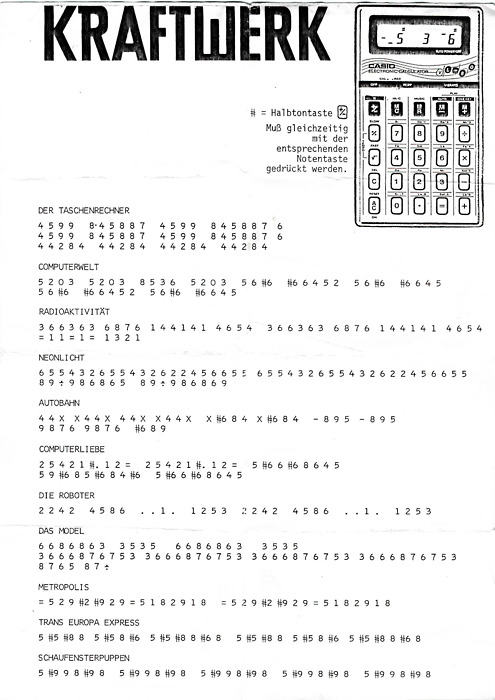
With a Kraftwerk taschenrechner, even those without technical or musical knowledge, let alone a full-fledged synthesizer, could make music. “Kraftwerk was eager for fans to play Kraftwerk hits on their own calculators,” writes Dangerous Minds’ Martin Schneider, “so they issued these special instructions — OK, let’s call it ‘sheet music’ — to play not just the new material but also classics like ‘Trans Europa Express’ and ‘Schaufensterpuppen.’ ” Today, Kraftwerk continues to perform all over the computer world in which we now live. With the 40th anniversary of Computer World approaching, perhaps the time has come to bring the calculators back on stage.
(via Dangerous Minds)
Related Content:
The Case for Why Kraftwerk May Be the Most Influential Band Since the Beatles
The Psychedelic Animated Video for Kraftwerk’s “Autobahn” from 1979
Kraftwerk’s “The Robots” Performed by German First Graders in Adorable Cardboard Robot Outfits
The Keaton Music Typewriter: An Ingenious Machine That Prints Musical Notation
Based in Seoul, Colin Marshall writes and broadcasts on cities, language, and culture. His projects include the book The Stateless City: a Walk through 21st-Century Los Angeles and the video series The City in Cinema. Follow him on Twitter at @colinmarshall, on Facebook, or on Instagram.
Read More...Support Us
We're hoping to rely on loyal readers, rather than erratic ads. Please click the Donate button and support Open Culture. You can use Paypal, Venmo, Patreon, even Crypto! We thank you!

About Us

Open Culture scours the web for the best educational media. We find the free courses and audio books you need, the language lessons & educational videos you want, and plenty of enlightenment in between.
Advertise With Us

FREE UPDATES!
GET OUR DAILY EMAIL
Get the best cultural and educational resources on the web curated for you in a daily email. We never spam. Unsubscribe at any time.
FOLLOW ON SOCIAL MEDIA

Open Culture editor Dan Colman scours the web for the best educational media. He finds the free courses and audio books you need, the language lessons & movies you want, and plenty of enlightenment in between.
Advertise With Us

