See the Very First Solar Eclipse Captured on Film: A Magical Moment in Science and Filmmaking (1900)
The “conquest of space,” so to speak—the human understanding of and travel to the cosmos—has come about through a succession of great scientific minds, as well as some of the most interesting and accomplished people all around. We never seem to tire of learning about their devotion to mathematics, physics, medicine, and scientific discovery writ as large as possible. But sometimes the conquest of space has required the unique talents of magicians. From the ancient mages who excited human imagination about the stars for thousands of years, to alchemists like Isaac Newton and beyond.
Witness the strange career of Marvel Whiteside Parsons, better known as Jack Parsons: sci-fi fanatic, occultist, disciple of Aleister Crowley, and onetime magical partner of L. Ron Hubbard. Parsons is most famous for founding the Jet Propulsion Laboratory, the research center that powers NASA. Then we have magician Nevil Maskelyne—son of magician John Nevil Maskelyne, and possible descendent, so he said, of the fifth British Royal Astronomer, “also named Nevil Maskelyne,” writes Jason Daley at Smithsonian. Maskelyne the very much younger documented the first total solar eclipse ever captured on film.
Granted, he was a stage magician, not a follower of “The Great Beast 666.” Maskelyne’s interest in showmanship and spectacle drew him not to sex magic but to filmmaking and astronomy, interests he combined when he made the first film ever of a total solar eclipse. Nowadays, millions of people have the means to make such a film in their pocket, provided they have a good view of the infrequent cosmic event (and do not ever look at it directly). In 1900, when Maskelyne undertook the challenge, filmmaking was just emerging from infancy into toddlerhood.
The Lumière brothers, often credited as the first filmmakers, had held their first public screening only five years earlier. They called their early productions actualités, essentially “reality films.” Some of these, like the legendary L’arrivée d’un train en gare de La Ciotat, famously shocked and terrified audiences out of their seats. In 1900, film was still a kind of magic, and “like magic,” says Bryony Dixon, curator at the British Film Institute (BFI), film “combines both art and science.” The story of Maskelyne’s achievement is “a story about magic.”
Maskelyne’s love for film inspired in him a passion for astronomy as well, and he eventually became a fellow of the Royal Astronomical Society. Unfortunately, his first cinematic contribution to the field disappeared, never to be seen again. Two years before he shot the footage above from the ground in North Carolina on May 28, 1900, on a venture funded by the British Astronomical Association, Maskelyne traveled to India to document a similar event. The film cannister was stolen on his return trip home
But he had learned what he needed to, having designed “a special telescopic adapter for a movie camera,” just as he and his father had earlier improved upon the film projector by building their own. Maskelyne had his spectacle. He showed the film in his theater, and the Royal Astronomical Society ensured that we could see it almost 120 years later by archiving a minute of the footage. Thanks to a partnership between the British Film Institute and the RAS, the film has been restored, digitized in 4K resolution, and made freely available online as part of a trove of Victorian-era films” just released by the BFI.
While thousands, maybe millions, of different moving images of 2017’s solar eclipse exist on social media accounts, of this event 120 years ago there has existed only one. Now that brief moment in time can reach millions of people in an instant, and exist in an infinite number of perfect copies, a phenomenon that might have seemed in 1900 like an advanced form of magic.
via Smithsonian
Related Content:
Moons, Moons, They’re Everywhere. The Unexpected Shadows of the Solar Eclipse
Last Night’s Solar Eclipse in a 60-Second, 700-Picture Timelapse Video
Solar Eclipse Seen From Outer Space
Josh Jones is a writer and musician based in Durham, NC. Follow him at @jdmagness
Read More...Pulitzer Prize-Winning Author Jared Diamond Describes How the U.S. Could Become a Dictatorship in 10 Years
It can happen here, and it has.
By “it” I mean the enormous concentration of wealth and political power in the hands of a very few, and by “here” I mean the United States of America, a country that advertises itself as a democracy, but should rightly be referred to as an oligarchy, ruled by a wealthy elite.
But the country is not a dictatorship yet. I say “yet” because that too can happen here, given the aforementioned concentration of wealth and power, the increasing tolerance for nationalism, cruelty, xenophobia, and near-constant lying, and the craven acquiescence so many of the country’s legislators—who are supposed to put a check on such things—have shown to the whims of a baldly autocratic executive.
Perhaps it is only a matter of time, given the above. How much time? Maybe ten years, argues Jared Diamond, Pulitzer Prize-winning anthropologist, geographer, historian, and ecologist, and author of The Third Chimpanzee; Guns, Germs, and Steel; Collapse: How Societies Choose to Fail or Succeed; and The World Until Yesterday.
In the Big Think video interview clip above, Diamond frames the problem as one of an unwillingness to compromise, using the analogy of a happy marriage. “The best you can hope for in a marriage is an agreement on 80%. If you agree on 80%, that’s fantastic.” For any two people, married or otherwise, 80% agreement seems optimistic. For an entire country, it seems almost utopian.
But whatever number you want to set as a realistic goal, the U.S. has fallen far below it—at least when it comes to the way our governmental bodies work, or don’t, together. This is not a problem reducible to “both sides.” One party in particular has consistently refused to work with the other and used every dirty trick—from extreme gerrymandering to refusing to let a sitting President appoint a Supreme Court Justice—to hold power.
Politics is a dirty business, you may say, and yes, it is. But—to return to Diamond’s point—a functioning democracy requires compromise. These days, congress cannot pass legislation; “legislatures are at odds with the judiciary” (Diamond cites the example of the Republican-controlled West Virginia congress impeaching the state’s entire, Democratic-majority, supreme court in 2018); state governments are suing the federal government, and vice-versa.
The failure of compromise, says Diamond, is “the only problem that could precipitate the United States into the end of democracy and into a dictatorship in the next decade.” The usual historical examples can be more or less instructive on this point. But there are other, more recent, dictatorships that do not receive nearly enough attention—perhaps by design, since they have been “friendly” regimes that the U.S. helped create.
Diamond describes the situation in Chile, for example, where he lived in the late 60s. When he first moved there, it had been “the most democratic country in Latin America,” a country that prided itself on its ability to compromise. But this quality was in decline, he says, and its loss led to the country’s military coup in 1973, which brought the brutal dictator Augusto Pinochet to power (with the help of the CIA and certain American economists).
The new Chilean government “smashed world records for sadism and torture,” says Diamond, shocking those Chileans who believed their country was immune to the excesses of other Latin American nations that had succumbed to repressive authoritarianism. If that happens here, he argues, it will not come through a military coup, but rather through “what we see going on now”—namely restrictions on the right to vote and voter apathy.
Voting is the primary solution, Diamond claims, but voting alone may not address the problem of oligarchy. When a handful of the wealthy control mass media, fund local and national political campaigns, and otherwise exert undue influence, through mass surveillance, manipulation, and the use of foreign agents, the possibility of free and fair elections may disappear, if it hasn’t already.
Nonetheless, Diamond’s point deserves some serious consideration. If we want to avert dictatorship in the U.S., how can we encourage compromise—without, that is, relinquishing our most fundamental values? It’s a point to ponder.
Related Content:
Aldous Huxley Warns Against Dictatorship in America
Umberto Eco Makes a List of the 14 Common Features of Fascism
Josh Jones is a writer and musician based in Durham, NC. Follow him at @jdmagness
Read More...136 Maps Reveal Where Tourists & Locals Take Photos in Major Cities Across the Globe
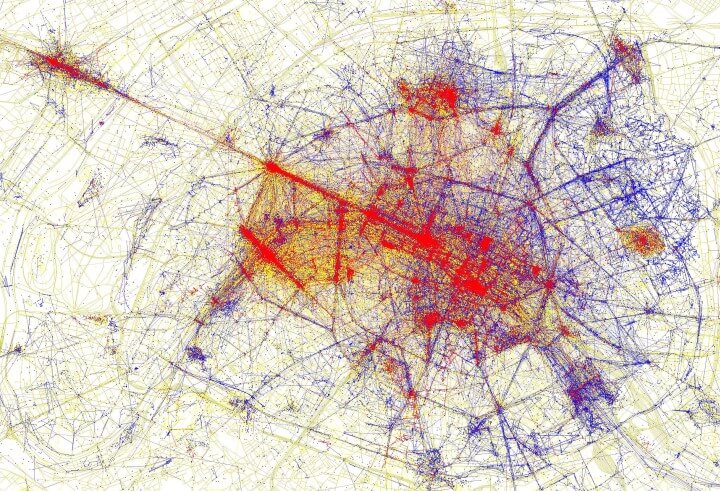
How to tell the tourists in a city from the locals? Potentially reliable indicators include the language they speak, the terms they use, the way they dress, the way they walk, and whether they’re standing in the middle of the sidewalk squinting at a map. But few factors draw the line between tourist and local more starkly than where they go and don’t go: no matter the city, one will sooner or later hear talk of places locals know that tourists don’t, places locals don’t go because tourists do know about them, places tourists go when they want to act like locals, places locals go when they want to act like tourists, and so on.

In his project “Tourists and Locals,” Eric Fischer has found one way of quantifying this great divide: where do the members of each group take the photos they upload to the internet? You can view the results in 136 different city maps or explore a whole world map, both of which use the same color coding: “The red bits indicate photos taken by tourists,” says Brilliant Maps, “while the blue bits indicate photos taken by locals and the yellow bits might be either.”
Using “MapBox and Twitter data from Gnip to create the maps,” Fischer defined locals as “those who tweeted from the same location for at least a month” and tourists as “those who were considered local in another city but were tweeting in a different location.”

Here, from the top of the post down, we have Fischer’s maps of Paris, Tokyo, Dublin, and San Francisco, all cities with varying degrees of overlap between the realm of the local and that of the tourist. Parisian attractions like the Parc de Belleville and the Bassin de la Villette show a relatively healthy tourist-local balance, whereas outsiders dominate in places like La Défense with its highly photographable skyscrapers, and of course the Louvre (to say nothing of the red-saturated Versailles, not pictured in this segment of the map). Compare that with Tokyo, which of course has world-famous spots — the quaintly historic Asakusa, the sublimely urban Shibuya Crossing — but whose form doesn’t encourage quite as strict a physical separation of tourist and local.

The path a tourist takes through Dublin might overlap a great deal with the one Leopold Bloom took on June 16, 1904, but less so with the paths an average Dubliner takes in the 2010s. The Irish capital also offers a host of must-sees apart from the Ulysses tour — the Guinness Storehouse, Trinity College’s Old Library, home of The Book of Kells— but visitors would do well to follow the example of Dublin’s locals and get a bit more distance from the city center. They could do the same in San Francisco, a city of iconic tourist attractions on which, before the tech boom, its very survival seemed to depend. But do true travelers, as opposed to tourists, need this kind of data processing and information design to know their time would be better spent somewhere other than Fisherman’s Wharf?
See 136 different city maps here.
via Brilliant Maps
Related Content:
Take a Visual Journey Through 181 Years of Street Photography (1838–2019)
The Shifting Power of the World’s Largest Cities Visualized Over 4,000 Years (2050 BC-2050 AD)
How Leonardo da Vinci Drew an Accurate Satellite Map of an Italian City (1502)
James Joyce’s Dublin Captured in Vintage Photos from 1897 to 1904
An Online Gallery of Over 900,000 Breathtaking Photos of Historic New York City
A Wonderful Archive of Historic Transit Maps: Expressive Art Meets Precise Graphic Design
Based in Seoul, Colin Marshall writes and broadcasts on cities, language, and culture. His projects include the book The Stateless City: a Walk through 21st-Century Los Angeles and the video series The City in Cinema. Follow him on Twitter at @colinmarshall, on Facebook, or on Instagram.
Read More...Marie Curie Became the First Woman to Win a Nobel Prize, the First Person to Win Twice, and the Only Person in History to Win in Two Different Sciences
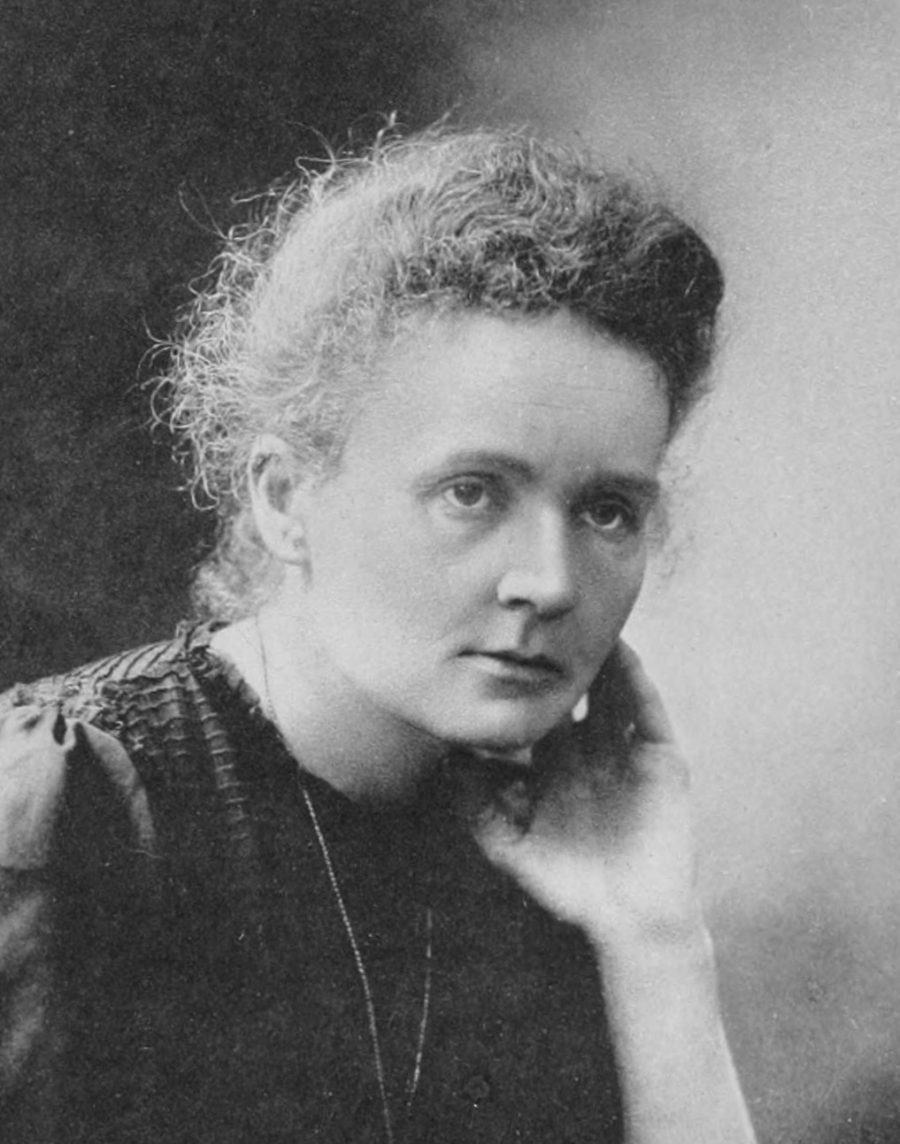
For most of scientific history, women who made contributions to various fields have been sidelined or ignored in favor of male colleagues, who reaped fame, professional recognition, and cash rewards that come with prestigious prizes like the Nobel. Cornell historian of science Margaret Rossiter coined the term “The Matilda Effect” to describe sexist bias in the sciences. Rossiter’s work and popular reappraisals like book-turned-film Hidden Figures have inspired other women in academia to search for forgotten female scientists, and to find them, literally, in footnotes.
When systematic discrimination limits opportunities for any group, those who do receive recognition, the exceptions to the rule, must often be truly exceptional to succeed. There has been little doubt, both in her lifetime and in the many decades afterward, that Marie Curie was such a person. Although forced to study science in secret at a clandestine “Floating University” in her native Poland—since the universities refused to admit women—Curie (born Marie Salomea Sklodowska in 1867) would achieve such renown in her field that she was awarded not one, but two Nobel Prizes.
Curie and her husband Pierre shared the Nobel Prize in Physics with Antoine Henri Becquerel, discoverer of radioactivity, in 1903. The second prize, in Chemistry, was hers alone in 1911, “in recognition of her services to the advancement of chemistry by the discovery of the elements radium and polonium, by the isolation of radium and the study of the nature and compounds of this remarkable element.” Curie was not only the first woman to win a Nobel, but she was also the first person to win twice, and the only person to win in two different sciences.
These are but a handful of achievements in a string of firsts for Curie: denied positions in Poland, she earned a Ph.D. in France, awarded the degree in 1903 by the Sorbonne, the same year she won her first Nobel. “Her examiners,” notes the site Famous Scientists, “were of the view that she had made the greatest contribution to science ever found in a Ph.D. thesis.” Three years later, after Pierre was killed in an accident, Marie was offered his professorship and became the first female professor at the University of Paris.
Curie succeeded not in the absence of, but in spite of the sexist obstacles placed in her path at nearly every stage in her career. After she received her doctorate, the Curies were invited to the Royal Institution in London. Only Pierre was permitted to speak. That same year, the Nobel Committee decided to honor only her husband and Becquerel. The Academy relented when Pierre protested. Curie fell victim to a wave of xenophobia and anti-Semitism (though she was not Jewish) that swept through France in the 1900s, most famously in the so-called “Dreyfus Affair.”
In 1911, the year of her second Nobel, Curie was passed over for membership in the French Academy of Sciences. It would take another 51 years before the first woman, Marguerite Perey, a former doctoral student of Curie, would be elected to that body. That same year, Curie was persecuted relentlessly by the French press, the public, and her scientific rivals after it was revealed that she had had a brief affair with physicist Paul Langevin, one of Pierre Curie’s former students.
But no matter how many men in positions of power wanted to deter Curie, there always seemed to be more influential scientists and politicians who recognized the supreme value of her work and the need to help her continue it. After her second Nobel Prize, her native country finally recognized her with the offer to direct her own laboratory in Warsaw. Curie turned it down to focus on directing the Curie Laboratory in the Radium Institute of the University of Paris, which she founded in 1914, a major achievement and, again, only a small part of her legacy.
Curie is known, of course, foremost for her exceptional scientific work, but also for opening doors for women in science all over the world, though much of that door-opening may only have happened decades after her death in 1934, and much of it hasn’t happened at all yet. Incidentally, in the following year, the Curies’ daughter Irène Joliot-Curie and her husband Frédéric Joliot-Curie were jointly awarded the Nobel Prize in Chemistry. Since then, only two other women have claimed that honor, and only two women, including Marie Curie, have won the Prize in physics, out of 203 winners total.
There may be nothing yet like gender parity in the sciences, but those who know where to look can find the names of dozens of women scientists running women-owned companies, women-founded research institutes and academic departments, and, like the famous Curies, making major contributions to chemistry. Perhaps not long from now, many of those exceptional scientists will be as well-known and widely celebrated as Marie Curie.
Related Content:
Josh Jones is a writer and musician based in Durham, NC. Follow him at @jdmagness
Read More...Watch the First Trailer for Martin Scorsese’s New Film, Rolling Thunder Revue: A Bob Dylan Story
Rolling Thunder Revue: A Bob Dylan Story “captures the troubled spirit of America in 1975, and the joyous music that Bob Dylan performed that fall [during the Rolling Thunder Revue tour]. Master filmmaker Martin Scorsese creates a one-of-a-kind movie experience: part documentary, part concert film, part fever dream. Featuring Joan Baez, Rubin Hurricane Carter, Sam Shepard, Allen Ginsberg, and Bob Dylan giving his first on-camera interview in over a decade. The film goes beyond mere reclamation of Dylan’s extraordinary music—it’s a roadmap into the wild country of artistic self-reinvention.”
Watch the brand new trailer above, and mark June 12th on your calendar when the film arrives on Netflix.
Relatedly, June 7th is when Dylan will release The Rolling Thunder Revue: The 1975 Live Recordings, a 14CD box set that features all five sets from the Rolling Thunder Revue tour that were professionally recorded.
If you would like to support the mission of Open Culture, consider making a donation to our site. It’s hard to rely 100% on ads, and your contributions will help us continue providing the best free cultural and educational materials to learners everywhere. You can contribute through PayPal, Patreon, and Venmo (@openculture). Thanks!
Related Content:
Tangled Up in Blue: Deciphering a Bob Dylan Masterpiece
Watch Joan Baez Endearingly Imitate Bob Dylan (1972)
Hear Bob Dylan’s Newly-Released Nobel Lecture: A Meditation on Music, Literature & Lyrics
Read More...Exercise May Prove an Effective Natural Treatment for Depression & Anxiety, New Study Shows

Image by cuegalos, via Flickr Commons
Maybe it seems intuitive that exercise would be prescribed to treat anxiety and depression, lower stress levels, and make people happier. After all, exercise and nutritional interventions are regularly discussed in the context of the U.S.’s other major killers: heart disease, diabetes, various cancers, even Alzheimer’s. How often have we heard about the dangers of a sedentary lifestyle or over-processed foods? Or read about remedies from walking, yoga, and spin cycling to the Mediterranean diet?
But mental health is seemingly different—the disease model that guided depression research for so long has faltered. “We do not have a biology for mental illness,” writes Derek Beres at Big Think. Researchers lack a medical pathology for mood disorders that affect overall health, careers, relationships, and quality of life for millions. The antidepressants once sold as a cure-all and prescribed to dizzying degrees proved to have limited efficacy and unfortunate side effects. No one seems to know exactly how or why or if they work. “Mental health scripts are guesswork,” Beres writes, “more of an art than science.”
Where does this leave the state of mental health research these days? One team of scientists at the University of Vermont found evidence that exercise significantly improved mood in patients with severe and chronic mental illnesses. As Newsweek reports, “a total of 100 patients signed up to participate in the study,” whose results were published recently in the journal Global Advances in Health and Medicine. The study volunteers came from “wards that dealt with conditions such as bipolar disorder, depression, borderline personality disorder, generalized anxiety disorder and schizophrenia.”
After a workout schedule that included cardio, resistance, and flexibility training, four times a week for sixty minutes at a time, as well as nutritional programs “tailored” for each patient, 95 percent of the participants “said their mood has improved… and 63 percent said they were ‘happy’ or ‘very happy,’ rather than ‘neutral,’ ‘sad,’ or ‘very sad.’” 97.6 said they were motivated to continue working out and eating better. “The research yielded positive outcomes in all areas investigated,” write authors David Tomasi, Sheri Gates, and Emily Reyns of the study’s results. They conclude that physical exercise may contribute to “a more balanced and integrated sense of self.”
The researchers also recommend exercise as a treatment before the prescription of psychiatric drugs. There may not yet be a clear medical explanation for why it works. But that may be because modern medicine has only recently begun to see the mind and the body as one, at a time when our cultural evolution sends us hurtling toward a greater artificial divide between the two. “We’ve constructed a world in which most of the population survives by performing minimal physical activity.” A world soon to be engulfed in VR, AR, self-driving cars, and an “internet of things” that promises to eliminate the few physical tasks we have left.
We are in danger of forgetting that our mental and emotional health are directly tied to the needs of our physical bodies, and that our bodies need to move, stretch, and bend in order to stay alive and thrive. Read more summary of the study at Newsweek and see the full results from Global Advances in Health and Medicine here.
Related Content:
What’s a Scientifically-Proven Way to Improve Your Ability to Learn? Get Out and Exercise
How Stress Can Change Your Brain: An Animated Introduction
Josh Jones is a writer and musician based in Durham, NC. Follow him at @jdmagness.
Read More...What If We’re Wrong?: An Animated Video Challenges Our Most Deeply Held Beliefs–With the Help of a Ludwig Wittgenstein Thought Experiment
Philosopher Ludwig Wittgenstein asked us to imagine a rope stretched around the earth at the equator (and imagine the earth as a perfect sphere). Were we to add one more yard to the rope, then stretch it out taut again, would anyone be able to notice the difference? Most of us will intuit that it couldn’t possibly be so, a yard would disappear in the immensity of the Earth’s circumference.
Some geometry and algebra show, in fact, that the rope would hover about 6 inches off the ground, becoming a hazardous tripwire spanning the globe. The video above from the Center for Public Philosophy at the University of California, Santa Cruz begins with this odd thought experiment and ends with a call to action: to apply more skepticism to our political positions.
If we can be so wrong about a problem with a mathematical proof, we’re asked, “how should an open-minded honest person regard her own certainty in areas where there are often no proofs, like politics, philosophy, ethics, or aesthetics? Maybe we should be a lot less confident in our beliefs. After all, we might be wrong more than we realize.” Maybe so. But it seems there’s some slippery use of terminology here.
In any case, the short video is not, we should point out, a representation of Wittgenstein’s thought, only a riff on his imagining a rope around the world. What did Wittgenstein himself have to say about skepticism and certainty? It’s complicated. Attempting to characterize his thought in brief might be an impossible task. He can seem like a highly contradictory thinker, refuting the ideas in his first book, the Tractatus Logico-Philosophicus, in his posthumously published Philosophical Investigations, for example.
But perhaps it is more so the case—as A.C. Grayling writes of another posthumously published Wittgenstein collection, On Certainty—that the stages of the enigmatic thinker’s career were each “a collection of provisional notes, recording a journey not an arrival.” He had begun in the Tractatus by considering philosophy “a spurious enterprise.” Most famously, Wittgenstein wrote, “Whereof one cannot speak, thereof one must be silent,” sweeping away with one lofty gesture all metaphysics and abstract speculation.
In On Certainty, he appears to finally accept philosophy’s “legitimacy.” Any conflict with his earlier positions does not trouble him at all. Wittgenstein attempts to refute skepticism, returning to the image of a “world picture” that recurs again and again in his work, building his case with aphorisms like “I have a world picture. Is it true or false? Above all it is the substratum of all my enquiring and asserting.” Drawing on the foundationalism of G.E. Moore, Wittgenstein deploys rhetoric that sounds downright fundamentalist:
If I say ‘we assume that the earth has existed for many years past’ (or something similar), then of course it sounds strange that we should assume such a thing. But in the entire system of our language-games it belongs to the foundations. The assumption, one might say, forms the basis of action, and therefore, naturally, of thought.
Isn’t the question this: ‘What if you had to change your opinion even on these most fundamental things?’ And to that the answer seems to me to be: ‘You don’t have to change. That is just what their being “fundamental” is.’
This does not sound like a person likely to ever change their mind about what one might call their “strongly-held beliefs.” Wittgenstein constructs another view at the very same time. His second argument “is not comfortably consistent with—perhaps, indeed, undermines” the first. While defending certainty, he argues for “relativism… the view that truth and knowledge are not absolute or invariable, but dependent upon viewpoint, circumstances or historical conditions.”
Our thoughts about the world, or our “world-picture,” writes Wittgenstein, “might be part of a kind of mythology…. The mythology may change back into a state of flux, the river-bed of thoughts may shift.” Our beliefs change as the “language-game” changes. We put on new discursive clothing, contingent on our present circumstances. “The difficulty,” writes the philosopher, with almost a hint of sympathy, “is to realize the groundlessness of our believing.”
Neither of these positions—that we are justified in believing “fundamental,” self-evident propositions because they’re fundamental; or that we change our beliefs because of a change in relative “language-games”—fit neatly with the idea that we should try to be less certain and more open to changing our minds. Nor is any reference in Wittgenstein likely to help resolve our political disagreements.
We may find it a comfort, or a deeply unsettling proposition, that certain beliefs might be anchored more deeply than proof or skepticism can reach. Or as Wittgenstein put it: “And now if I were to say ‘It is my unshakeable conviction that etc.,’ this means in the present case too that I have not consciously arrived at the conviction by following a particular line of thought, but that it is anchored in all my questions and answers, so anchored that I cannot touch it.” Yet, perhaps it is the case that we share more of these convictions than we know.
Related Content:
Hear Wittgenstein’s Tractatus Logico-Philosophicus Sung as a One-Woman Opera
Ludwig Wittgenstein’s Short, Strange & Brutal Stint as an Elementary School Teacher
In Search of Ludwig Wittgenstein’s Secluded Hut in Norway: A Short Travel Film
Josh Jones is a writer and musician based in Durham, NC. Follow him at @jdmagness.
Read More...Watch John Bonham’s Blistering 13-Minute Drum Solo on “Moby Dick,” One of His Finest Moments Live Onstage (1970)
Sometimes I play air drums, when at home before a roaring pair of speakers. No one would know it, but I’m not half bad. Except when it comes to jazz. Then it’s too ridiculous even for solitary goofing off. But I’m just competent enough to fake most basic rock beats… most… that is, but those of the most loudly sung drummers in classic rock: Keith Moon and John Bonham.
In categories all their own, it’s no surprise both drummers loved jazz, especially the hyperkinetic Gene Krupa. (Tragically, they also shared an interest in fatal overindulgence.) They took some common influences, however, in very different directions.
For one thing, Moon hated drum solos, that staple of the jazz drummer’s kit. The one exception to his rule may be Moon’s last appearance onstage in 1977, playing percussion in a cameo on Bonham’s solo on “Moby Dick,” one of the Led Zeppelin drummer’s finest moments. “Bonham was known to solo on this song for up to 30 minutes live!” writes Drum! magazine. It’s even said he “sometimes drew blood performing ‘Moby Dick’ from using his bare hands to beat his snare and tom toms.”
The live version above, clocking in at a mere 15 minutes, comes from a 1970 show at Royal Albert Hall. Robert Plant introduces the drummer with his full name, John Henry Bonham, before he even names the song. Then, after a minute of Page, Bonham, and Jones playing the opening riff together, the solo begins.
Bonham leads us in slowly at first, then, with jaw-dropping skill, puts on display what made him “a very special drummer” indeed, as the site Classic Rock writes: “doing things with a bass pedal that it took two of James Brown’s drummers to try and emulate—and they knew a bit about rhythm.”
His “pioneering use of bass drum triplets” is only a small part of his “important discovery that all drumming is just triplets, or should be,” declares Michael Fowler’s reverently tongue-in-cheek McSweeney’s tribute. “The next step, he saw, was in speeding up the beat without losing the basic triplet pattern… flying around the kit with blinding speed, hitting every drum and cymbal in those negligible spaces.”
Bonham’s ridiculously fast and complex patterns—whether deployed in half-hour solos or five-second drum fills (as above in “Achilles Last Stand” from 1979)—“shouldn’t be humanly possible,” Dave Grohl once said. But they were possible for the great John Bonham, born on May 31st, 1948.
“Let’s face it,” writes Fowler, “no one else does or ever will” sound like Led Zeppelin’s drummer. Celebrate his just-belated birthday by revisiting more of his greatest live moments at Drum! and, just below, hear Robert Plant sing “Happy Birthday” to his celebrated bandmate in 1973.
Related Content:
What Makes John Bonham Such a Good Drummer? A New Video Essay Breaks Down His Inimitable Style
John Bonham’s Isolated Drum Track For Led Zeppelin’s ‘Fool in the Rain’
Josh Jones is a writer and musician based in Durham, NC. Follow him at @jdmagness.
Read More...Why You Should Read The Master and Margarita: An Animated Introduction to Bulgakov’s Rollicking Soviet Satire
Which are the essential Russian novels? Quite a few undeniable contenders come to mind right away: Fathers and Sons, Crime and Punishment, War and Peace, Anna Karenina, The Brothers Karamazov, Dr. Zhivago, One Day in the Life of Ivan Denisovich. But among serious enthusiasts of Russian literature, novels don’t come much less deniable than The Master and Margarita, Mikhail Bulgakov’s tale of the Devil’s visit to Soviet Moscow in the 1930s. This “surreal blend of political satire, historical fiction, and occult mysticism,” as Alex Gendler describes it in the animated TED-Ed video above, “has earned a legacy as one of the 20th century’s greatest novels — and one of its strangest.”
The Master and Margarita consists of two parallel narratives. In the first, “a meeting between two members of Moscow’s literary elite is interrupted by a strange gentleman named Woland, who presents himself as a foreign scholar invited to give a presentation on black magic.” Then, “as the stranger engages the two companions in a philosophical debate and makes ominous predictions about their fates, the reader is suddenly transported to first-century Jerusalem,” where “a tormented Pontius Pilate reluctantly sentences Jesus of Nazareth to death.”
The novel oscillates between the story of the historical Jesus — though not quite the one the Bible tells — and that of Woland and his entourage, which includes an enormous cat named Behemoth with a taste for chess, vodka, wisecracks, and firearms. Dark humor flows liberally from their antics, as well as from Bulgakov’s depiction of “the USSR at the height of the Stalinist period. There, artists and authors worked under strict censorship, subject to imprisonment, exile, or execution if they were seen as undermining state ideology.”
The devilish Woland plays this overbearing bureaucratic life like a fiddle, and “as heads are separated from bodies and money rains from the sky, the citizens of Moscow react with petty-self interest, illustrating how Soviet society bred greed and cynicism despite its ideals.” Such content would naturally render a book unpublishable at the time, and though Bulgakov’s earlier satire The Heart of a Dog (in which a surgeon transplants human organs into a dog and then insists he behave as a human) circulated in samizdat form, he couldn’t even complete The Master and Margarita before his death in 1940.
“Bulgakov’s experiences with censorship and artistic frustration lend an autobiographical air to the second part of the novel, when we are finally introduced to its namesake,” says Gendler. “The Master is a nameless author who’s worked for years on a novel but burned the manuscript after it was rejected by publishers — just as Bulgakov had done with his own work. Yet the true protagonist is the Master’s mistress Margarita,” whose “devotion to her lover’s abandoned dream bears a strange connection to the diabolical company’s escapades — and carries the story to its surreal climax.”
In the event, a censored version of The Master and Margarita was first published in the 1960s, and an as-complete-as-possible version eventually appeared in 1973. Against the odds, the manuscript that Bulgakov left behind survived him to become a masterpiece that has inspired not just other Russian writers, but creators like the Rolling Stones, Patti Smith, and (in a perhaps less than safe-for-work manner) H.R. Giger as well. Perhaps the author himself had some premonition of the book’s potential: manuscripts, as he famously has Woland say to the Master, don’t burn.
Looking for free, professionally-read audio books from Audible.com? (This could include The Master and Margarita.) Here’s a great, no-strings-attached deal. If you start a 30 day free trial with Audible.com, you can download two free audio books of your choice. Get more details on the offer here.
Related Content:
Mikhail Bulgakov’s The Master and Margarita, Animated in Two Minutes
Patti Smith’s Musical Tributes to the Russian Greats: Tarkovsky, Gogol & Bulgakov
Why Should We Read Ray Bradbury’s Fahrenheit 451? A New TED-Ed Animation Explains
Why You Should Read One Hundred Years of Solitude: An Animated Video Makes the Case
Based in Seoul, Colin Marshall writes and broadcasts on cities, language, and culture. His projects include the book The Stateless City: a Walk through 21st-Century Los Angeles and the video series The City in Cinema. Follow him on Twitter at @colinmarshall, on Facebook, or on Instagram.
Read More...Elton John Takes Us Through the Creative Process of His Early Hit “Tiny Dancer” (1970)
We all have our favorites from Elton John’s vast catalog, and I’ll admit that 1970’s “Tiny Dancer” has never been one of mine.
Call me crass, but I tend to get it confused with 1973’s “Candle in the Wind,” which John retooled so swiftly for Princess Diana’s 1997 funeral.
But then Sir Elton—or “Reg” as close friends and long-time lyricist Bernie Taupin call the artist formerly known as Reginald Kenneth Dwight—has always had a knack for working quickly, as Taupin explains above.
I’d never been curious enough to investigate, but assumed, correctly, that the lyric “seamstress for the band” referred to an actual person.
John actually seems a bit blasé, explaining that it’s about Taupin’s then girlfriend and eventual first wife, Maxine Feibelman, whom I must thank for inadvertently supplying the title of my favorite track, “The Bitch is Back,” which was her code phrase for “Elton’s in a mood.”
As per Sir Elton, “Tiny Dancer”’s lyrics informed the sound, which is more ballerina than pirate smile.
And while the original liner notes’ dedication suggests that “Tiny Dancer” is indeed a tribute to Feibelman, three wives later, Taupin revised things a bit, telling author Gavin Edwards:
We came to California in the fall of 1970, and sunshine radiated from the populace. I was trying to capture the spirit of that time, encapsulated by the women we met—especially at the clothes stores up and down the Strip in L.A. They were free spirits, sexy in hiphuggers and lacy blouses, and very ethereal, the way they moved. So different from what I’d been used to in England. And they all wanted to sew patches on your jeans. They’d mother you and sleep with you—it was the perfect Oedipal complex.
Writer-director Cameron Crowe must’ve absorbed that message, to go by his memorable use of the song in Almost Famous’ tour bus scene,
Those communal good vibes permeate director Max Weiland’s winning entry in a recent John-sponsored contest on The Cut, which, like the opening scene of La La Land, gets a lot of mileage from LA’s reputation for traffic jams.
Can ticket buyers expect to find the song featured prominently in the just released John biopic, Rocketman?
No.
(Just kidding. Why else would John and his Rocketman doppelgänger, actor Taron Egerton choose that one for a duet at John’s annual Oscar party?)
Related Content:
Elton John Sings His Classic Hit ‘Your Song’ Through the Years
Ayun Halliday is an author, illustrator, theater maker and Chief Primatologist of the East Village Inky zine. Join her in New York City this June for the next installment of her book-based variety show, Necromancers of the Public Domain. Follow her @AyunHalliday.
Read More...Support Us
We're hoping to rely on loyal readers, rather than erratic ads. Please click the Donate button and support Open Culture. You can use Paypal, Venmo, Patreon, even Crypto! We thank you!

About Us

Open Culture scours the web for the best educational media. We find the free courses and audio books you need, the language lessons & educational videos you want, and plenty of enlightenment in between.
Advertise With Us

FREE UPDATES!
GET OUR DAILY EMAIL
Get the best cultural and educational resources on the web curated for you in a daily email. We never spam. Unsubscribe at any time.
FOLLOW ON SOCIAL MEDIA

Open Culture editor Dan Colman scours the web for the best educational media. He finds the free courses and audio books you need, the language lessons & movies you want, and plenty of enlightenment in between.
Advertise With Us

