Learn Philosophy with a Wealth of Free Courses, Podcasts and YouTube Videos
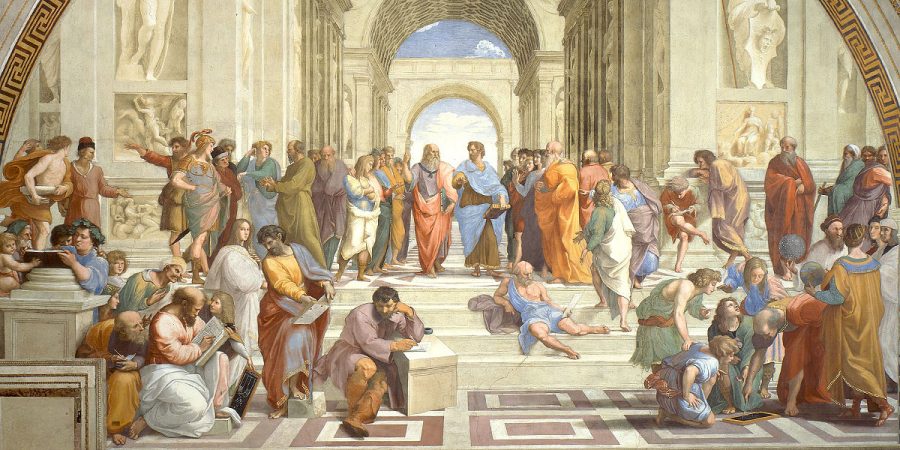
Used to be, a few thousand years ago, if you wanted to learn philosophy, you’d hang out in the agora, the public space in ancient Greece whose name turned into verbs meaning both “to shop” and “to speak in public.” Politics and metaphysics mingled freely with commerce. If a Socrates-like sage took a liking to you, you might follow him around. If not, you might pay a sophist—a word meaning wise teacher before it became a term of abuse that Plato lobbed at rivals who charged for their services. Only certain people had the means and leisure for these pursuits. Nonetheless, philosophy was a public activity, not one sequestered in libraries and seminar rooms.
Even though philosophy moved indoors—to monasteries, colleges, and the libraries of aristocrats—it did not stay cooped up for long. With the modern age arrived new public squares, centered around coffeehouses where all sorts of people gathered, rubbed elbows, formed discussion groups. Philosophy may not have been the public spectacle it seemed to have been in antiquity, but neoclassical thinkers tried to recreate its character of free and open inquiry in public spaces.
Widespread literacy and publishing brought philosophy to the masses in new ways. Philosophical works trickled down in affordable editions to the intellectually curious, who might read and discuss them with like-minded laypeople. But philosophy also became a professional discipline, governed by associations, conferences, journals, and arcane vocabularies. Outside of France, philosophers rarely acted as public intellectuals addressing public issues. They were academics whose primary audiences were other academics.
The culture suffered immensely, one might argue, in the withdrawal of philosophy from public life.
The broad outline above does not pretend to be a history of philosophy, but rather a sketch of some of the ways Western culture has engaged with philosophy, treating it as a public good and resource, or a domain of specialists and an activity divorced from ordinary life. Unfortunately for us in the 21st century, dreams of a digital agora have collapsed in the dystopian surveillance schemes of social media and the toxic sludge of comments sections. But the internet has also, in a way, returned philosophy to the public square.
Philosophers can once again share knowledge freely and openly, and anyone with access can stream and download hundreds of lessons, courses, entertaining explainers, interviews, podcasts, and more. We have featured many of these resources over the years in hopes that more people will discover the art of thinking deeply and critically. Today, we gather them in a master list, below.
Learn the in-depth history of philosophy from Peter Adamson’s acclaimed series The History of Philosophy… Without Any Gaps; listen in on roundtable discussions on famous thinkers and theories with the Partially Examined Life podcast, or “repave the Agora with the rubble of the Ivory Tower!” with the accessible, comprehensive philosophy videos of Carneades. These are but a few of the many quality resources you’ll find below. Technology may never recreate the early atmosphere of public philosophy—for that you’ll need to get out and mingle. But it can deliver more philosophy than anyone has ever had before, literally right into the palms of our hands.
Courses
187 Free Philosophy Courses: In a neat, handy list, we’ve amassed a collection of free philosophy courses recorded at great universities. Pretty much every facet of philosophy gets covered here.
YouTube
Wireless Philosophy: Learn about philosophy with professors from Yale, Stanford, Oxford, MIT, and more. 130+ animated videos introduce people to the practice of philosophy. The videos are free, entertaining, interesting and accessible to people with no background in the subject.
School of Life: This collection of 35 animated videos offers an introduction to major Western philosophers—Wittgenstein, Foucault, Camus and more. The videos were made by Alain de Botton’s School of Life.
Gregory Sadler’s Philosophy Videos: After a decade in traditional academic positions, Gregory Sadler started bringing philosophy into practice, making complex classic philosophical ideas accessible for a wide audience of professionals, students, and life-long learners. His YouTube channel includes extensive lecture series on Kierkegaard, Sartre, Hegel and more.
A History of Philosophy in 81 Video Lectures: Watch 81 video lectures tracing the history of philosophy moving from Ancient Greece to modern times. Arthur Holmes presented this influential course at Wheaton College for decades and now it’s online for you.
Carneades: Repave the Agora with the rubble of the Ivory Tower! Put your beliefs to the test! Learn something about philosophy! Doubt something you thought you knew before. Find on this channel 400 videos on the subjects of philosophy and skepticism.
What the Theory?: This collection provides short introductions to theories and theoretical approaches in cultural studies and the wider humanities. Covers semiotics, phenomenology, postmodernism, marxist literary criticism, and much more.
Crash Course Philosophy: In 46 episodes, Hank Green will teach you philosophy. This course is based on an introductory Western philosophy college level curriculum. By the end of the course, you will be able to examine topics like the self, ethics, religion, language, art, death, politics, and knowledge. And also craft arguments, apply deductive and inductive reasoning, and identify fallacies.
Podcasts:
Partially Examined Life: Philosophy, philosophers and philosophical texts. This podcast features an informal roundtable discussion, with each episode loosely focused on a short reading that introduces at least one “big” philosophical question, concern, or idea. Recent episodes have focused on Nietzsche, Sartre and Aldous Huxley, and featured Francis Fukuyama as a guest.
Hi-Phi-Nation: Created by Barry Lam (Associate Professor of Philosophy at Vassar College), Hi-Phi Nation is a philosophy podcast “that turns stories into ideas.” Consider it “the first sound and story-driven show about philosophy, bringing together narrative storytelling, investigative journalism, and soundtracking.”
The History of Philosophy … Without Any Gaps: Created by Peter Adamson, Professor of Ancient and Medieval Philosophy at King’s College London, this podcast features more than 300 episodes, each about 20 minutes long, covering the PreSocratics (Pythagoras, Zeno, Parmenides, etc) and then Socrates, Plato, Aristotle, and much more.
Philosophy Bites: David Edmonds (Uehiro Centre, Oxford University) and Nigel Warburton (freelance philosopher/writer) interview top philosophers on a wide range of topics. Two books based on the series have been published by Oxford University Press. There are over 400 podcasts in this collection.
In Our Time: Philosophy: In Our Time is a live BBC radio discussion series exploring the history of ideas, presented by Melvyn Bragg since October 1998. It is one of BBC Radio 4’s most successful discussion programmes, acknowledged to have “transformed the landscape for serious ideas at peak listening time.’”
Related Content:
Free Courses in Ancient History, Literature & Philosophy
Introduction to Indian Philosophy: A Free Online Course
Josh Jones is a writer and musician based in Durham, NC. Follow him at @jdmagness
Read More...Watch “Critical Living,” a Stop-Motion Film Inspired by the 1960s Movement That Rejected Modern Ideas About Mental Illness
Along with Michel Foucault’s critique of the medical model of mental illness, the work of Scottish psychiatrist R.D. Laing and other influential theorists and critics posed a serious intellectual challenge to the psychiatric establishment. Laing’s 1960 The Divided Self: An Existential Study in Sanity and Madness theorized schizophrenia as a philosophical problem, not a biological one. Other early works like Self and Others and Knots made Laing something of a star in the 1960s and early 70s, though his star would fade once French theory began to take over the academy.
Glasgow-born Laing is described as part of the so-called “anti-psychiatry movement”—a loose collection of psychiatrists and characters like L. Ron Hubbard, Gilles Deleuze and Felix Guattari, Foucault, and Erving Goffman, pioneering sociologist and author of The Presentation of Self in Everyday Life. For his part, Laing did not deny the existence of mental illness, nor oppose treatment. But he questioned the biological basis of psychological disorders and opposed the prevailing chemical and electroshock cures. He was seen not as an antagonist of psychiatry but as a “critical psychiatrist,” continuing a tradition begun by Freud and Jung: “the alienist or ‘head shrinker’ as public intellectual,” as Duquesne University’s Daniel Burston writes.
Like many other philosophically-minded intellectuals in his field, Laing not only offered compelling alternative theories of mental illness but also pioneered alternative therapies. He was inspired by Existentialism; the many hours he had spent “in padded cells with the men placed in his custody” while apprenticed in psychiatry in the British Army; and to a large extent by Foucault. (Laing edited the first English translation of Foucault’s Madness and Civilization.) Armed with theory and clinical experience, he co-founded the Philadelphia Association in 1965, an organization “centred on a communal approach to wellbeing,” writes Aeon, “where people who are experiencing acute mental distress live together in a Philadelphia Association house, with routine visits from therapists.”
Based not in the Pennsylvania city, but in London, the Philadelphia Association still operates—along with several similar orgs influenced by Laing’s vision of therapeutic communities. In “Critical Living,” the animated stop-motion film above, filmmaker Alex Widdowson excerpts interviews with “a current house therapist, a former house resident, and the UK author and cultural historian Mike Jay, to explore the thinking behind the organization’s methodology and contextualize its legacy.” For Laing, mental illnesses, even extreme psychoses like schizophrenia, are personal struggles that can best be worked through in interpersonal settings which eliminate distinctions between doctor and patient and abolish methods Laing called “confrontational.”
Laing’s work began to be discredited in the mid-seventies, as breakthroughs in brain imaging provided neurological evidence for mainstream psychiatric theories, and as the culture changed and left his theories behind. A friend of Timothy Leary, Ram Dass, and Allen Ginsberg, and an intellectual hero to many in the counterculture, Laing began to move into stranger territory, holding workshops for “rebirthing” therapies and giving people around him reason to doubt his own grasp on reality. Burston lists a number of other reasons his experiments with “therapeutic community” largely fell into obscurity, including the significant investment of time and effort required. “We want a quick fix: something clean and cost-effective, not messy and time consuming.”
But for many, Laing’s ideas of mental illness as an existential problem—one which could be just as much a breakthrough as a breakdown—continue to resonate, as do the many political and social critiques he and his contemporaries raised. “In the system of psychiatry,” says one interviewee in the video above, “there’s a huge emphasis on goals, and on an ending. In the more in-depth therapies, they’re more sensitive to the fact that the psyche can’t be rushed, it takes time.”
via Aeon
Related Content:
Free Online Psychology & Neuroscience Courses
Josh Jones is a writer and musician based in Durham, NC. Follow him at @jdmagness
Read More...Would You Go Back to 1889 and Take Out Baby Hitler?: Time-Travel Expert James Gleick Answers the Philosophical Question
The vast majority of us have no inclination to kill anyone, much less a small child. But what if we had the chance to kill baby Adolf Hitler, preventing the Holocaust and indeed the Second World War? That hypothetical question has endured for a variety of reasons, touching as it does on the concepts of genocide and infant murder in forms even more highly charged than usual. It also presents, in the words of Time Travel: A History author James Gleick, “two problems at once. There’s a scientific problem — you can set your mind to work imagining, ‘Could such a thing be possible and how would that work?’ And then there’s an ethical problem. ‘If I could, would I, should I?’ ”
By the simplest analysis, writes Vox’s Dylan Matthews, the question comes down to, “Is it ethical to kill one person to save 40-plus million people?” But time-travel fiction has been around long enough that we’ve all internalized the message that it’s not quite so simple. We can even question the assumption that killing baby Hitler would prevent the Holocaust and World War II in the first place.
Maybe those terrible events happen on any timeline, regardless of whether Hitler lives or dies: that would align with the Novikov self-consistency principle, which holds that “time travel could be possible, but must be consistent with the past as it has already taken place,” and which has been dramatized in time-travel stories from La Jetée to The Terminator.
Gleick doesn’t have a straight answer in the Vox video on the killing-baby-hitler question above as to whether he himself would go back to 1889 and put baby Hitler out of action. “When you change history,” he says of the moral of the countless many time travel stories he’s read, “you don’t get the result you’re looking for. Every day, everything we do is a turning point in history, whether it’s obvious to us or not.” This in contrast to former Florida governor and United States presidential candidate Jeb Bush, who, when he had the big baby-Hitler question put to him by the Huffington Post, returned a hearty “Hell yea I would.” But given time to reflect, even he concluded that such an act “could have a dangerous effect on everything else.” It appears that some of the lessons of time-travel stories have been learned, but as for what humanity will do if it actually develops time-travel technology — maybe we’d rather not peer into the future to find out.
Related Content:
What Happened When Stephen Hawking Threw a Cocktail Party for Time Travelers (2009)
Professor Ronald Mallett Wants to Build a Time Machine in this Century … and He’s Not Kidding
Based in Seoul, Colin Marshall writes and broadcasts on cities, language, and culture. His projects include the book The Stateless City: a Walk through 21st-Century Los Angeles and the video series The City in Cinema. Follow him on Twitter at @colinmarshall, on Facebook, or on Instagram.
Read More...Introduction to Philosophy: A Free Course
In the playlist above, Gregory Sadler presents a 67-lecture course, “Introduction to Philosophy.” Presented at Marist College, the course goes in historical order–from Plato to Kierkegaard. Watch the playlist above, or find the video on YouTube here.
“Introduction to Philosophy” has been added to our list of Free Philosophy Courses, a subset of our collection, 1,700 Free Online Courses from Top Universities.
If you would like to support the mission of Open Culture, consider making a donation to our site. It’s hard to rely 100% on ads, and your contributions will help us continue providing the best free cultural and educational materials to learners everywhere. You can contribute through PayPal, Patreon, and Venmo (@openculture). Thanks!
Related Content:
Oxford’s Free Introduction to Philosophy: Stream 41 Lectures
Oxford’s Free Course Critical Reasoning For Beginners Teaches You to Think Like a Philosopher
32 Animated Videos by Wireless Philosophy Teach You the Essentials of Critical Thinking
Introduction to Philosophy: A Free Online Course
Read More...Ethics: A Free Online Course
Taught at Marist College by Gregory Sadler, this course on Ethics starts “with discussing Emotivism and contrasting it with a Natural Law and Virtue Ethics Perspective, then move[s] into Virtue Ethics, Egoism, Might Makes Right, and Contractarian moral theory as depicted in Plato’s dialogues. After that we discuss ancient Hedonist and Stoic theories, then move into Utilitarianism with Bentham and Mill, followed by Deontology with Kant and Ross. Ethics of Care follows, as well as a return to Virtue Ethics with in-depth study of Aristotle, finishing with study of Thomas Aquinas’ Natural Law moral theory.”
Ethics has been added to our list of Free Philosophy Courses, a subset of our collection, 1,700 Free Online Courses from Top Universities. Watch the 32 lectures above, or on YouTube here.
If you would like to support the mission of Open Culture, consider making a donation to our site. It’s hard to rely 100% on ads, and your contributions will help us continue providing the best free cultural and educational materials to learners everywhere. You can contribute through PayPal, Patreon, and Venmo (@openculture). Thanks!
Related Content:
Journalistic Ethics: A Free Online Course from UCLA
Do Ethicists Behave Any Better Than the Rest of Us?: Here’s What the Research Shows
Professional Ethics: A Free Online Course
Read More...Critical Thinking: A Free Course
In the playlist above, Gregory Sadler presents a 24-lecture course on “Critical Thinking.” Presented at Fayetteville State University in 2011, the course features lectures on topics like Deductive and Inductive Arguments, Fallacies, Rhetorical Devices, Appeals to Authority and much more. Also find the playlist of lectures on YouTube here.
“Critical Thinking” has been added to our list of Free Philosophy Courses, a subset of our collection, 1,700 Free Online Courses from Top Universities.
If you would like to support the mission of Open Culture, consider making a donation to our site. It’s hard to rely 100% on ads, and your contributions will help us continue providing the best free cultural and educational materials to learners everywhere. You can contribute through PayPal, Patreon, and Venmo (@openculture). Thanks!
Related Content:
Oxford’s Free Course Critical Reasoning For Beginners Teaches You to Think Like a Philosopher
32 Animated Videos by Wireless Philosophy Teach You the Essentials of Critical Thinking
Read More...Oliver Sacks’ Recommended Reading List of 46 Books: From Plants and Neuroscience, to Poetry and the Prose of Nabokov
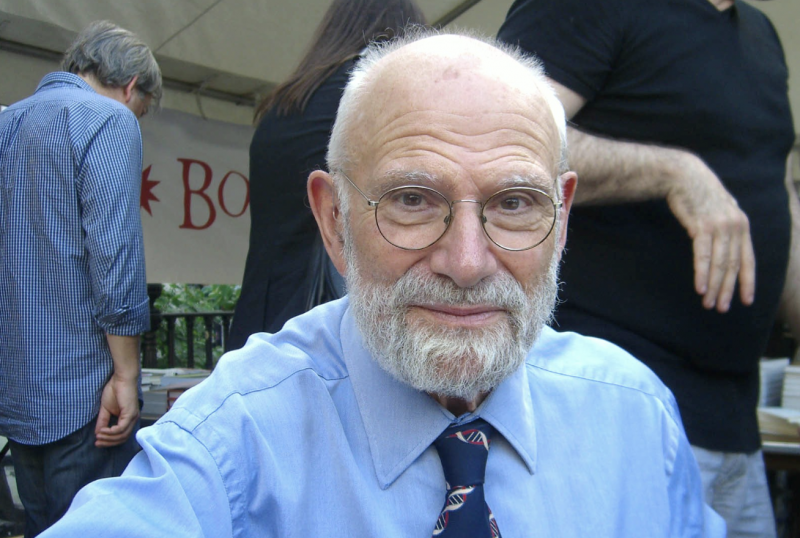
Image by Luigi Novi. Licensed under CC BY 3.0 via Wikimedia Commons
We remember Oliver Sacks as a neurologist, but we remember him not least because he wrote quite a few books as well. If you read those books, you’ll get a sense of Sacks’ wide range of interests — invention, perception and misperception, hallucination, and more — few of which lack a connection to the human mind. His passion for ferns, the core subject of a travelogue he wrote in Oaxaca as well as an unexpectedly frequent object of reference in his other writings and talks, may seem an outlier. But for Sacks, ferns offered one more window into the kingdom of nature that produced humanity, and which throughout his life he tried to understand by observing from as many different angles as possible.
No small amount of evidence of that pursuit appears in Sacks’ list of 46 book recommendations commissioned for The Strand’s “Author’s Bookshelf” series. (See the full list below.) A fair few of its selections, including William James’ The Principles of Psychology, A.R. Luria’s The Mind of a Mnemonist, and Antonio Damasio’s The Feeling of What Happens, seem like natural favorites for a writer so endlessly fascinated by human cognition and consciousness.
Tracing the development of the human brain and mind would, of course, lead to an interest in biology and evolution, here resulting in such picks as Edward O. Wilson’s Naturalist, Carl Zimmer’s Evolution: The Triumph of an Idea, and the journals Charles Darwin kept aboard the Beagle.
But Sacks wasn’t just an observer of the brain: some of his most interesting writings come out of the times he used himself as a kind of research subject — as when he found out what he could learn on amphetamines and LSD. A similar line of inquiry no doubt showed him the value of Aldous Huxley’s The Doors of Perception and Heaven and Hell, and in less altered states the likes of Sigmund Freud’s The Interpretation of Dreams. But whichever paths took Sacks toward his knowledge, he ultimately had to get that knowledge down on paper himself, and the prose of Vladimir Nabokov, the poetry of W.H. Auden and the philosophy of David Hume surely did their part to inspire his incisive and evocative style. We would all, whatever our interests, like to write like Oliver Sacks: if these books shaped him as a writer and thinker, who are we to demur from, say, A Natural History of Ferns?
- A Natural History of Ferns by Robbin C. Moran
- A Rum Affair: A True Story of Botanical Fraud by Karl Sabbagh
- A Treatise of Human Nature by David Hume
- A Visionary Madness: The Case of James Tilly Matthews and the Influencing Machine by Mike Jay
- Actual Minds, Possible Worlds by Jerome Bruner
- Being Mortal: Medicine and What Matters in the End by Atul Gawande
- Cannery Row (Steinbeck Centennial Edition (1902–2002)) by John Steinbeck
- Challenger & Company: the Complete Adventures of Professor Challenger and His Intrepid Team-The Lost World, The Poison Belt, The Land of Mists, The Disintegration Machine and When the World Screamed by Arthur Conan Doyle
- Collected Poems by W.H. Auden
- Curious Behavior: Yawning, Laughing, Hiccupping, and Beyond by Robert R. Provine
- Darwin and the Barnacle: The Story of One Tiny Creature and History’s Most Spectacular Scientific Breakthrough by Rebecca Stott
- Disturbing the Universe by Freeman Dyson
- Earth Abides by George R. Stewart
- Evolution: The Triumph of an Idea by Carl Zimmer
- Eye of the Beholder: Johannes Vermeer, Antoni van Leeuwenhoek, and the Reinvention of Seeing by Laura J. Snyder
- God’s Hotel: A Doctor, a Hospital, and a Pilgrimage to the Heart of Medicine by Victoria Sweet
- Ignorance: How It Drives Science by Stuart Firestein
- Imagining Robert: My Brother, Madness, and Survival by Jay Neugeboren
- In Search of Memory: The Emergence of a New Science of Mind by Eric R. Kandel
- Inward Bound: Of Matter and Forces in the Physical World by Abraham Pais
- Lise Meitner: A Life in Physics by Ruth Lewin Sime
- Lost in America: A Journey with My Father by Sherwin B. Nuland
- Music, Language, and the Brain by Aniruddh D. Patel
- Naturalist by Edward O. Wilson
- Phantoms in the Brain: Probing the Mysteries of the Human Mind by V.S. Ramachandran
- Plutonium: A History of the World’s Most Dangerous Element by Jeremy Bernstein
- Same and Not the Same by Roald Hoffmann
- Selected Poems by Thom Gunn
- Silent Thunder: In the Presence of Elephants by Katy Payne
- Speak, Memory: An Autobiography Revisited by Vladimir Nabokov
- Swimming to Antarctica: Tales of a Long-Distance Swimmer by Lynne Cox
- The Age of Wonder: How the Romantic Generation Discovered the Beauty and Terror of Science by Richard Holmes
- The Anatomist: A True Story of Gray’s Anatomy by Bill Hayes
- The Doors of Perception and Heaven and Hell by Aldous Huxley
- The Elephanta Suite by Paul Theroux
- The Feeling of What Happens: Body and Emotion in the Making of Consciousness by Antonio Damasio
- The Interpretation of Dreams by Sigmund Freud
- The Lunar Men: Five Friends Whose Curiosity Changed the World by Jenny Uglow
- The Mind of a Mnemonist: A Little Book about a Vast Memory by A. R. Luria
- The Principles of Psychology (Volume Two) by William James
- The World Without Us by Alan Weisman
- Thinking in Pictures: And Other Reports from My Life with Autism by Temple Grandin
- Time, Love, Memory: A Great Biologist and His Quest for the Origins of Behavior by Jonathan Weiner
- Voyage of the Beagle: Charles Darwin’s Journals of Researches by Charles Darwin
- What a Plant Knows: A Field Guide to the Senses by Daniel Chamovitz
- What Mad Pursuit: A Personal View of Scientific Discovery by Francis Crick
- Wonderful Life: The Burgess Shale and the Nature of History by Stephen Jay Gould
To purchase books on this list, visit The Strand’s website.
Related Content:
This is What Oliver Sacks Learned on LSD and Amphetamines
Oliver Sacks’ Final Interview: A First Look
Based in Seoul, Colin Marshall writes and broadcasts on cities, language, and culture. His projects include the book The Stateless City: a Walk through 21st-Century Los Angeles and the video series The City in Cinema. Follow him on Twitter at @colinmarshall, on Facebook, or on Instagram.
Read More...An Animated Introduction to the World’s Five Major Religions: Hinduism, Judaism, Buddhism, Christianity & Islam
No matter the strength of particular beliefs, or disbeliefs, religions of every kind are all equally fundamental to the human experience. This was so for thousands of years before the advent of the world’s big five religions, and for thousands of years after. “Religion has been an aspect of culture for as long as it has existed, and there are countless variations of its practice,” says Episcopal priest and anthropologist John Bellaimey in the TED-Ed video above. “Common to all religions is an appeal for meaning beyond the empty vanities and lowly realities of existence.”
Religions particularize a set of archetypal human responses to universal metaphysical questions like “Where do we come from?” and “How do I live a life of meaning?” and “What happens to us after we die?” Such questions find answers outside the boundaries of religious faith. For an increasing number of people, science and secular philosophy offer comforting, even beautiful naturalistic explanations. And millions more feel the pull of intuitions about a higher power or “a source from which we all come and to which we must return.”
Religion gives the big questions faces and names, of divinities, demons, and holy men (in the five big, it has been almost entirely men). Whether these figures existed or not, their legends shape culture and history and are shaped and changed in turn. Bellamy surveys the big five world religions with an overview of their central narratives, illustrated with montages of religious art. The information is at the level of a 101 course introduction, but the number of people in the world who know little to nothing about other religions is likely quite high, given the numbers of people who know so little about their own. We can probably all learn something here we didn’t know before.
Bellamy’s approach broadly suggests that what matters most in religion is story. But to dismiss religions as “just stories” misses the point. Purely at the level of narrative, we can think of religions as creative ways to tell the stories we find untellable. This says nothing about religion’s effects on the world. Is it a force for good or ill? Given its role in every stage of human cultural development, both positive and negative, maybe the question is unanswerable. There are too many varieties of religious experience over too great a span of time to reckon with.
Bellamy’s charitable explanations of the major five religions highlight their contingent nature—he locates each faith in its particular time and place of origin. But he also shows the universalizing tendencies of each tradition, qualities that made them so portable. He does not, however, mention that more inclusive interpretations usually came from revolts against more limited original designs. Religions and cultures evolved together, materially and culturally. As they spread and occupied more territory with wider populations, they grew and adapted.
In his book The Tree of World Religions, Bellamy develops such historical material into an exploration of twenty world religions from Hinduism to Rastafarianism, showing each one as a collective act of storytelling. Compiled from a 25-year high school world religions class Bellamy taught, the book covers the Mayans, the Norse, and Socrates, Laozi, the Hebrew Prophets, and the Buddha. In what Karl Jaspers called “the Axial Age,” writes Amazon, these later sages “moved religion from mostly-supernatural to mostly-humanistic, shifting the focus on God’s inscrutable otherness to God’s increasing insistence on ethical behavior as the highest form of worship.”
Related Content:
A Visual Map of the World’s Major Religions (and Non-Religions)
Christianity Through Its Scriptures: A Free Course from Harvard University
Josh Jones is a writer and musician based in Durham, NC. Follow him at @jdmagness
Read More...Economic Geography of the Industrial World: A Free Course from UC Berkeley
Taught by Professor Richard A. Walker at UC Berkeley, this course, Economic Geography of the Industrial World, covers the following topics: Industrialization, urbanization, and economic growth in the global North. Locational patterns in manufacturing, retailing trade, and finance. Geographic dynamics of technical change, employment, business organization, resource use, and divisions of labor. Property, labor, and social conflict as geographic forces. Local, national, and continental rivalries in a global economy, and challenges to U.S.
Lecture 01 — Geography & Economy, The Economy Today, Political Economy (above)
Lecture 02 — Markets: A World for Sale
Lecture 03 — Industry: Revolutions in Production
Lecture 04 — Technology: Progress & Knowledge
Lecture 05 — Capital: The Accumulation of Money & Trouble
Lecture 06 — Localization of Industry: Places of Production
Lecture 07 — Globalization of Industry: Production Chains
Lecture 08 — The Space of Flows: Logistics & Systems
Lecture 09 — Retail Location: Spaces for Selling
Lecture 10 — National Economies: States, Difference & Trade
Lecture 11 — State Economic Policy: Development & Stabilization
Lecture 12 — Stabilization (cont.), Empire & Economy
Lecture 13 — Cities & Regions
Lecture 14 — Class Struggle in the USA: Capital Triumphant
Lecture 15 — Will Work for (Fast) Food: The New Economy of Labor
Lecture 16 — Workers of the World: Hope in the East?
Lecture 17 — New Divisions of Labor: The Changing Nature of Work
Lecture 18 — Elements of Finance: Money, Banks & Securities
Lecture 19 — Global Finance: Money Makes the World Go Round
Lecture 20 — Finance & Growth: The Control of Capital
Lecture 21 — Financial Frenzy: Bubble Economics & Dysfunctional Finance
Lecture 22 — Natural Resources & Industry
Lecture 23 — Energy Lifelines
Lecture 24 — Energy Lifelines (cont.), Waste of the World: Neglected Geographies
Economic Geography of the Industrial World has been added to our collection, 1,700 Free Online Courses from Top Universities.
Read More...Mastering Econometrics: A Free Online Course
From Marginal Revolution University comes a new course, Mastering Econometrics, taught by MIT professor Josh Angrist. They write:
If you’re looking to untangle cause and effect in a complex world, then econometrics is what you seek. Join MIT professor Josh Angrist, aka Master Joshway, and learn to master the econometrics “Furious Five”: random assignment, regression, instrumental variables, regression discontinuity designs, and differences-in-differences methods. Think econometrics is boring? So it was once, but will be no more! Skipping theoretical tedium, we use real empirical questions to bring the numbers to life. Does an expensive private university education pay off with higher earnings? Does health insurance really make you healthier? Does legal drinking cost lives? Econometrics is a journey, grasshopper.
Get started on the course here. Also see the professor’s book, Mostly Harmless Econometrics: An Empiricist’s Companion.
Mastering Econometrics will be added to our list of Free Economics Courses, a subset of our collection, 1,700 Free Online Courses from Top Universities.
If you would like to support the mission of Open Culture, consider making a donation to our site. It’s hard to rely 100% on ads, and your contributions will help us continue providing the best free cultural and educational materials to learners everywhere. You can contribute through PayPal, Patreon, and Venmo (@openculture). Thanks!
Read More...Support Us
We're hoping to rely on loyal readers, rather than erratic ads. Please click the Donate button and support Open Culture. You can use Paypal, Venmo, Patreon, even Crypto! We thank you!

About Us

Open Culture scours the web for the best educational media. We find the free courses and audio books you need, the language lessons & educational videos you want, and plenty of enlightenment in between.
Advertise With Us

FREE UPDATES!
GET OUR DAILY EMAIL
Get the best cultural and educational resources on the web curated for you in a daily email. We never spam. Unsubscribe at any time.
FOLLOW ON SOCIAL MEDIA

Open Culture editor Dan Colman scours the web for the best educational media. He finds the free courses and audio books you need, the language lessons & movies you want, and plenty of enlightenment in between.
Advertise With Us


