The “Weird Objects” in the New York Public Library’s Collections: Virginia Woolf’s Cane, Charles Dickens’ Letter Opener, Walt Whitman’s Hair & More
On March 28, 1941, Virginia Woolf took her final walk, into the River Ouse near her home in Sussex. She did it with her trusty cane in hand, the very cane you can see laid out alongside other Woolf-related artifacts in the New Yorker video above. Its five minutes provide a short introduction to the “weird objects” of the New York Public Library’s Berg Collection, an archive containing, in the words of the New Yorker’s Gareth Smit, “roughly two thousand linear feet of manuscripts and archival materials” donated in 1940 by the brothers Henry W. and Albert A. Berg, doctors who were also “avid collectors of English and American literature — and of literary paraphernalia.”
The NYPL labels as “realia” such non-paper items as Woolf’s cane as well as “Charlotte Brontë’s writing desk, with a lock of her hair inside; trinkets belonging to Jack Kerouac, including his harmonicas, and a card upon which he wrote ‘blood’ in his own blood; typewriters belonging to S. J. Perelman and Paul Metcalf; Mark Twain’s pen and wire-rimmed glasses; Vladimir Nabokov’s butterfly drawings; and the death masks of the poets James Merrill and E. E. Cummings.” We’ve previously featured Nabokov-drawn butterflies here on Open Culture, as well the letter opener seen in the video that Charles Dickens had made from the foot of his beloved cat Bob.
All this may sound on the grim side, but these objects bring their beholders that much closer to the long-passed literary figures who once possessed them. “If you are looking at, say, Jack Kerouac’s lighter or his boots, you’re seeing the man, in a sense,” the NYPL’s director of exhibitions Declan Kiely says in the video. “What you’re trying to get closest to is the creative spirit at work, and I think that’s why these objects are so evocative.” Though visitors to the Berg Collection can only do so by appointment, the library, as Kiely told Smit, “does intend to have an exhibition to present these and other treasures in the Gottesman Hall by 2020.” Something to look forward to for anyone who yearns to approach the creative spirit — and who among us doesn’t?
Related Content:
Vladimir Nabokov’s Delightful Butterfly Drawings
Charles Dickens Gave His Cat “Bob” a Second Life as a Letter Opener
Based in Seoul, Colin Marshall writes and broadcasts on cities and culture. His projects include the book The Stateless City: a Walk through 21st-Century Los Angeles and the video series The City in Cinema. Follow him on Twitter at @colinmarshall or on Facebook.
Read More...A Modern Drummer Plays a Rock Gong, a Percussion Instrument from Prehistoric Times
Rock Gong. It sounds like a B‑52s song. But a rock gong is not a New Wave surf-rock party groove. It’s not a neo-synthpop act, hip hop group, or indie band (not yet). It’s a prehistoric instrument—as far away in time as one can get from synthesizers and electric guitars. Rock gongs are ancient, maybe as old as humankind. But they’re still groovy, in their way. As they say, the groove is in the player, not the instrument.
Rock gongs, or “lithophones,” if you want to get technical, have been found all over the African continent, in South America, Australia, Azerbaijan, England, Hawaii, Iceland, India, and everywhere else prehistoric people lived. Not the cultural property of any one group, the rock gong came, rather, from a universal human insight into the natural sonic properties of stone. (One theory even speculates that Stonehenge might have been a massive collection of rock gongs.)
Though some scholars have suggested that the term “rock gong” should be reserved for stationary, rather than portable, rocks that were used as instruments, the British Museum seems untroubled by the distinction. In the video above, archaeologist Cornelia Kleinitz explains the principles of rock gongs found in Sudan to modern rock drummer Liam Williamson of the band Cats on the Beach.
You can hear one of those Nubian rock gongs in its natural habitat, before it was moved to the British Museum, in the clip just above. The rock, the narrator tells us, has been “worn smooth by the action of people playing it more than 7,000 years ago. Long before the Romans, long before the Pharaohs.” Early humans would have searched long and hard for rocks that resonated at particular frequencies, for ringing rocks that could be combined into scales for early xylophones or produce a variety of tones like a steel drum.
Despite their antiquity, the study of rock gongs is a rather recent phenomenon, part of the emerging field of archaeoacoustics. “Methodologically,” write the authors of a 2016 paper on the subject, “this field of research is still in its infancy,” and there is much researchers do not know about the uses and varieties of rock gongs around the world. As Kleinitz explains to Williamson in the video at the top, archaeologists are trying to understand the context in which the Nubian gongs at the British Museum would have been played, whether as instruments for rituals, signaling, fun, or all of the above.
As for the techniques involved in rock gong playing, we can only guess, but Williamson does his best to adapt his drum chops to the ancient stone kit. One critical difference between our modern human musical instruments and this ancient kind, Kleinitz notes, is that the latter were integrated into the landscape; their distinctive sound depended not only on the rock itself, but on its interaction with the wild and unpredictable environment around it.
Related Content:
Hear a 9,000 Year Old Flute—the World’s Oldest Playable Instrument—Get Played Again
What Did Ancient Greek Music Sound Like?: Listen to a Reconstruction That’s ‘100% Accurate’
Visit an Online Collection of 61,761 Musical Instruments from Across the World
Josh Jones is a writer and musician based in Durham, NC. Follow him at @jdmagness
Read More...A Visionary 115-Year-Old Color Theory Manual Returns to Print: Emily Noyes Vanderpoel’s Color Problems
Nobody can doubt that we can live in an age of screen-reading, nor that it has brought a few problems along with its considerable conveniences. To name just one of those problems, each of us reads on our own screen, and each screen reproduces the information fed into it to display differently. A color, for instance, might well not look quite the same to any given reader of an e‑book as it did to the designer who originally chose it. This imbues with a new relevance the old dorm-room philosophical question of whether what I call “blue” really looks the same as what you call “blue,” and at least the more controllable nature of old-fashioned print books takes the issue of screen variation out of the equation.

Hence the value in bringing back to print certain visually-oriented books, even when we can already read them on our screens. This goes especially for volumes like Emily Noyes Vanderpoel’s Color Problems: a Practical Manual for the Lay Student of Color, which deals directly with issues of color in the physical world and its representation. Vanderpoel, an artist and historian, first published the book “under the guise of flower painting and decorative arts, subjects that were appropriate for a woman of her time,” writes Colossal’s Kate Sierzputowski. But “the study provided an extensive look at color theory ideas of the early 20th century,” and one whose techniques proved silently influential over time. “Many of the included studies predict design and art trends that wouldn’t occur for several decades, such as a concentric square format that predates Joseph Albers’s Homage to the Square by fifty years.”
You can read a digitized version of Color Problems at the Internet Archive (or embedded right above), but know that publisher The Circadian Press and Sacred Bones Records recently raised well over $200,000 on Kickstarter to republish the book in its full paper glory. “With this new edition we have taken meticulous measures to reproduce the original artifact at an affordable price,” says the project’s about page. “Working with the Historical Society that Emily Noyes Vanderpoel helped establish, we are the first to invest the time, money, and love it takes to replicate this brilliant collection of color studies accurately. Using the most current digital methods and archival printing production, we aim to finally do justice to Vanderpoel’s forgotten legacy as visionary and pioneer.”
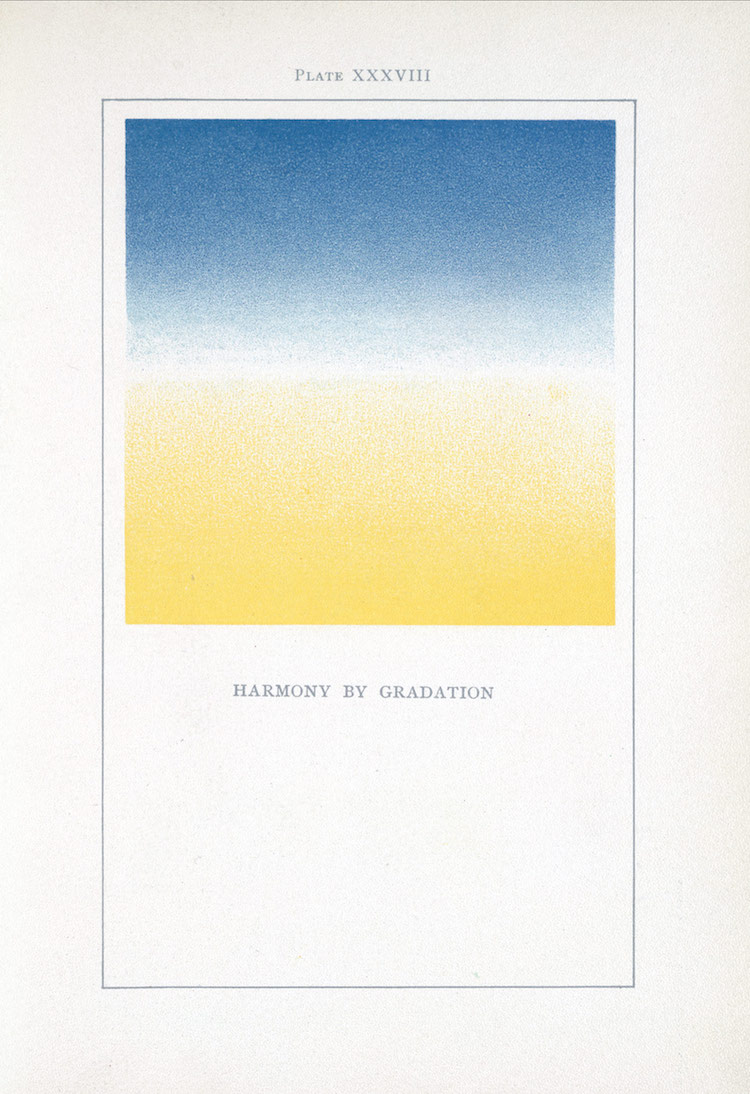
This new edition will also feature an introduction by design scholar Alan P. Bruton meant to “reflect on her incredible body of work from the vantage point of 21st century art history and women’s movements, helping to illustrate that Vanderpoel remains one of the most important, underrated, and contemporarily relevant artists of her time and of the last century.” Had Vanderpoel published Color Problems thirty years later, writes John F. Ptak in his examination of the book, “we’d call it some sort of constructivist/constructionist art form. But since the artwork in the book comes a decade before the first non-representational artwork in human history (or so), I don’t know exactly what to call it.” Its republication will allow generations of new readers, seeing it in the way Vanderpoel intended it to be seen, to come to conclusions like Ptak’s: “I still do not know what this book is trying to tell me, but I do know that it is remarkable.”
Related Content:
A Pre-Pantone Guide to Colors: Dutch Book From 1692 Documents Every Color Under the Sun
The Vibrant Color Wheels Designed by Goethe, Newton & Other Theorists of Color (1665–1810)
Based in Seoul, Colin Marshall writes and broadcasts on cities and culture. His projects include the book The Stateless City: a Walk through 21st-Century Los Angeles and the video series The City in Cinema. Follow him on Twitter at @colinmarshall or on Facebook.
Read More...Italian Street Musician Plays Amazing Covers of Pink Floyd Songs, Right in Front of the Pantheon in Rome
Before Pink Floyd, rock and roll was all about attitude. After Pink Floyd, it could be all atmosphere. Though perfectly suited for headphones and hi-fis, their sound is architectural, and almost requires the grandest of settings for its full realization. The bombast of the band’s stadium shows, with all their theatrical excesses, seems entirely justified by the music, unlike the Spinal Tap-like pretensions of many other arena rock bands. In 1989, Pink Floyd (sans Roger Waters) played for 20,000 Italian fans from a massive stage floating in the canals of Venice, a fascinating contrast to a 1972 performance, when the band played for no one but a film crew, in an amphitheater in the ruined city of Pompeii.
Invoking these magical moments, a street musician named Serin plays the music of Pink Floyd in the streets of Rome, parking himself right in front of the Pantheon. With pre-recorded backing tracks and a black Stratocaster reminiscent of David Gilmour’s signature instrument, Serin not only nails the songs, he gets the atmosphere just right, an achievement no doubt aided by his choice of setting. At the top, see him play “Shine on You Crazy Diamond,” just above, “Comfortably Numb” and, below, an excellent rendition of “Time” (on a white Strat this time). For comparison’s sake, watch Pink Floyd themselves play “Echoes” at Pompeii, further down. (Stream more clips of their Pompeii concert film here).
For another version of the one-man-Pink Floyd-cover band concept, see 19-year-old Ewan Cunningham cover “Echoes,” “Comfortably Numb” and other songs, multitracking himself on every instrument.
via Laughing Squid
Related Content:
Josh Jones is a writer and musician based in Durham, NC. Follow him at @jdmagness
Read More...Hunter S. Thompson Sends a Letter to the Indianapolis Colts, Urging Them to Pick Ryan Leaf Over That “Peyton Manning Kid” (1998)
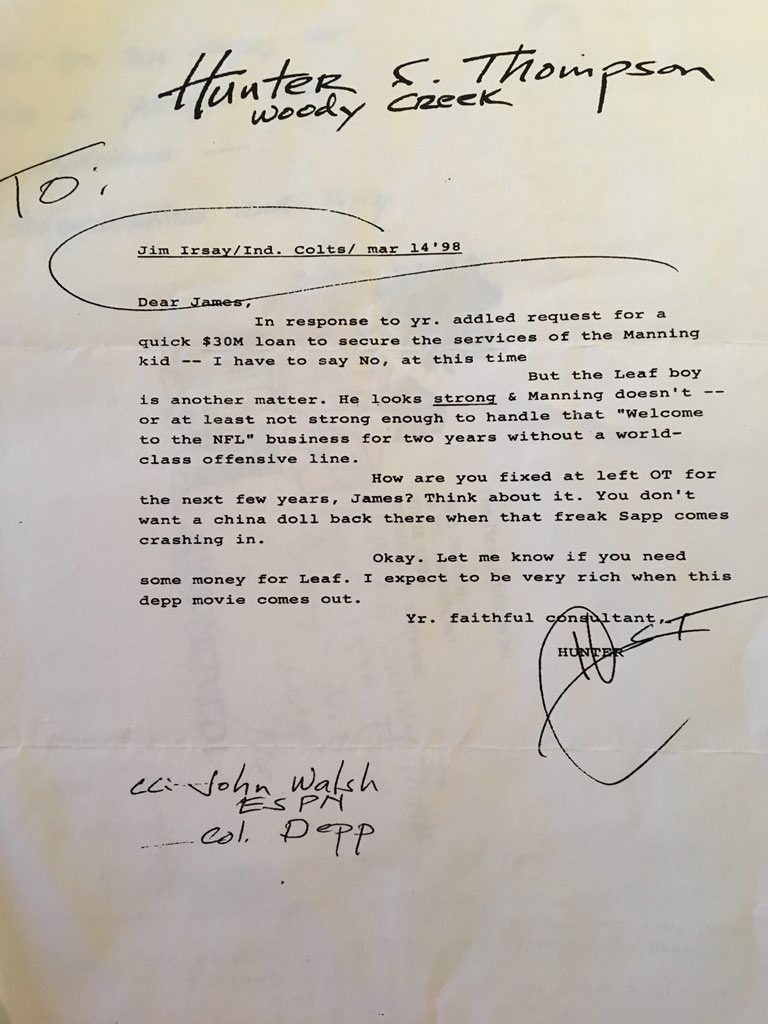
The 1998 NFL draft was a memorable one. A debate raged around whether the Indianapolis Colts should use their first round pick to select Ryan Leaf or Peyton Manning. Everyone had an opinion about these two quarterbacks, including Hunter S. Thompson. The author of Fear and Loathing in Las Vegas and Hell’s Angels sent a letter to Colts owner Jim Irsay, urging him to select the highly-touted Leaf.
Dear James,
In response to yr addled request for a quick $30M loan to secure the services of the Manning kid — I have to say No, (sic) at this time
But the Leaf boy is another matter. He looks strong & Manning doesn’t — or at least not strong enough to handle that “Welcome to the NFL” business for two years without a world-class offensive line.
How are you fixed at left OT for the next few years, James? Think about it. You don’t want a china (sic) doll back there when that freak [Warren] Sapp comes crashing in.
Okay. Let me know if you need some money for Leaf. I expect to be very rich when this [Johnny] depp (sic) movie comes out.
Yr. faithful consultant,
HUNTER
Twenty years later, we know how things played out. The Colts ultimately picked Manning, who became one of the most productive and celebrated quarterbacks ever. As for Leaf, he played four seasons and exited the sport, considered by some the No. 1 “draft bust” in NFL history. But he’s certainly a good sport. Leaf posted Thompson’s letter (above) on his Twitter stream last month.
If you would like to support the mission of Open Culture, consider making a donation to our site. It’s hard to rely 100% on ads, and your contributions will help us continue providing the best free cultural and educational materials to learners everywhere. You can contribute through PayPal, Patreon, and Venmo (@openculture). Thanks!
Related Content:
Hear the 10 Best Albums of the 1960s as Selected by Hunter S. Thompson
Read 11 Free Articles by Hunter S. Thompson That Span His Gonzo Journalist Career (1965–2005)
Read More...The Surprising Pattern Behind the Names of Colors Around the World
People in South Korea, where I live, often ask if I don’t find the Korean language awfully hard. I reply by asking them what they imagine the most difficult part might be. Almost everyone has the same answer: “There are so many words for colors.” (Many add, with a strangely consistent specificity, that there are so many words for yellow.) Though each new language one learns presents a unique set of challenges, that set does invariably include memorizing the names of the colors all over again. And as with any element of grammar or vocabulary, some languages do make this more difficult than others, dividing the visible spectrum up with a set of more numerous, subtler distinctions than those made by one’s native tongue.
But then any language, no matter where it originated, ultimately has to describe the very same colors present in the physical world. The Vox video above shows what the ways in which they vary in so doing, and more so the ways in which they don’t, reveal about language itself. English has eleven “basic color categories,” the video’s narrator says, while Russian, for example, has twelve. But some languages, like Wobé of Côte d’Ivoire, have as few as three.
In those cases, language researchers have found that they can predict what those few color categories will be. In the late 1960s, UC Berkeley’s Paul Kay and Brent Berlin found that “if a language had six basic color words, they were always for black or dark, white or light, red, green, yellow, and blue. If it had four terms, they were for black, white, red, and then either green or yellow. If it had only three, they were always for black, white, and red.” See their book, Basic Color Terms: Their Universality and Evolution.
So it appears that, though specifics varied, languages tended to come up with their color terms in the same basic order. But “why would a word for red come before a word for blue? Some have speculated that the stages correspond to the salience of the color in the natural environment. Red is in blood and in dirt. Blue, on the other hand, was fairly scarce before manufacturing.” Cognitive science and artificial intelligence research further support this hierarchy with red at the top, green and yellow lower down, and blue lower still. This tells us that “despite our many differences across cultures and societies, there is something universal about how humans try to make sense of the world.” Something universal, certainly, but an infinitude of small differences as well: therein lies both the challenge and the fascination of not just language but human interaction itself.
Related Content:
A Pre-Pantone Guide to Colors: Dutch Book From 1692 Documents Every Color Under the Sun
The Vibrant Color Wheels Designed by Goethe, Newton & Other Theorists of Color (1665–1810)
What It’s Like to Be Color Blind and See Art in Color for the First Time
Based in Seoul, Colin Marshall writes and broadcasts on cities and culture. His projects include the book The Stateless City: a Walk through 21st-Century Los Angeles and the video series The City in Cinema. Follow him on Twitter at @colinmarshall or on Facebook.
Read More...Hear Freddie Mercury & Queen’s Isolated Vocals on Their Enduring Classic Song, “We Are The Champions”
In the age of Auto-Tune, it’s a pleasure to have proof that certain greats had no need of pitch correction.
Queen front man Freddie Mercury’s legendarily angelic, five octave-range pipes deliver extra chills on the isolated vocal track for “We Are the Champions.”
Playback.fm, a free online radio app, stripped the beloved Queen hit of everything but the vocal wave form, then synched it to footage from four concert films and a rare recording session, above.
You’ll also hear backing vocals courtesy of guitarist Brian May, drummer Roger Taylor, and Mercury himself.
Their practice was to record two takes of each background part—high, medium and low—in unison, yielding an eighteen voice backing choir. Bassist John Deacon, inventor of the Deacy amp, left the singing to his bandmates, though he did compose several of their top ten hits including “You’re My Best Friend” and “Another One Bites the Dust.”
Cowing though it may be, don’t let these accomplished musicians’ abundance of talent keep you from singing along. Remember that in 2011, a team of scientific researchers voted “We Are the Champions” the catchiest song in pop music history, thanks in part to Mercury’s “high effort” vocals. As participant and music psychologist Daniel Müllensiefen observed:
Every musical hit is reliant on maths, science, engineering and technology; from the physics and frequencies of sound that determine pitch and harmony, to the hi-tech digital processors and synthesisers which can add effects to make a song more catchier. We’ve discovered that there’s a science behind the sing-along and a special combination of neuroscience, math and cognitive psychology that can produce the elusive elixir of the perfect sing-along song.
When the audience is allowed in at the three minute mark, you can pretend that that thunderous applause is partly due to you.
Enjoy more Freddie Mercury isolated vocal tracks here and here.
Related Content:
Hear Freddie Mercury’s Vocals Soar in the Isolated Vocal Track for “Somebody to Love”
Freddie Mercury: The Untold Story of the Singer’s Journey From Zanzibar to Stardom
Ayun Halliday is an author, illustrator, theater maker and Chief Primatologist of the East Village Inky zine. Follow her @AyunHalliday.
Read More...Meet Grace Hopper, the Pioneering Computer Scientist Who Helped Invent COBOL and Build the Historic Mark I Computer (1906–1992)
On a page for its School of Technology, Rasmussen College lists six “Assumptions to Avoid” for women who want to enter the field of computer science. I couldn’t comment on whether these “assumptions” (alleged misconceptions like “the work environment is hostile to women”) are actually disproved by the commentary. But I might suggest a seventh “assumption to avoid”—that women haven’t always been computer scientists, integral to the development of the computer, programming languages, and every other aspect of computing, even 100 years before computers existed.
In fact, one of the most notable women in computer science, Grace Hopper, served as a member of the Harvard team that built the first computer, the room-sized Mark I designed in 1944 by physics professor Howard Aiken. Hopper also helped develop COBOL, the first universal programming language for business, still widely in use today, a system based on written English rather than on symbols or numbers. And she is credited with coining the term “computer bug” (and by extension “debug”), when she and her associates found a moth stuck inside the Mark II in 1947. (“From then on,” she told Time magazine in 1984, “when anything went wrong with a computer, we said it had bugs in it.”)
These are but a few of her achievements in a computer science career that spanned more than 42 years, during which time she rose through the ranks of the Naval Reserves, then later active naval duty, retiring as the oldest commissioned officer, a rear admiral, at age 79.
In addition to winning distinguished awards and commendations over the course of her career—including the first-ever computer science “Man of the Year” award—Hopper also acquired a few distinguished nicknames, including “Amazing Grace” and “Grandma COBOL.” She may become known to a new generation by the nickname, “Queen of Code,” the title of a recent documentary from FiveThirtyEight’s “Signals” series. Directed by Community star Gillian Jacobs, the short film, which you can watch in full here, tells the story of her “inimitable legacy as a brilliant programmer and pioneering woman in a male-dominated field,” writes Allison McCann at FiveThirtyEight.
Hopper’s name may be “mysteriously absent from many history books,” as Amy Poehler’s Smart Girls notes, but before her death in 1992, she was introduced to millions through TV appearances on shows like Late Night with David Letterman (top) and 60 Minutes, just above. As you’ll see in these clips, Hopper wasn’t just a crack mathematician and programmer but also an ace public speaker whose deadpan humor cracked up Letterman and the groups of students and fellow scientists she frequently addressed.
The 60 Minutes segment notes that Hopper became “one of that small band of brothers and sisters who ushered in the computer revolution” when she left her professor’s job at Vassar at the start of WWII to serve in the Naval Reserve, where she was assigned to the Bureau of Ships Computation Project at Harvard. But she never stopped being an educator and considered “training young people” her second-most important accomplishment. In this, her legacy lives on as well.
The world’s largest gathering of women technologists is called “The Grace Hopper Celebration.” And a documentary in production called Born with Curiosity (see a teaser above) hopes that “shining a light on and humanizing role models like Grace makes them relatable in a way that inspires others to greatness.” At a time when women make up the lowest enrollment in computer science out of all of the STEM fields, Hopper’s example and encouragement may be much needed.
Related Content:
Introduction to Computer Science and Programming: A Free Course from MIT
Josh Jones is a writer and musician based in Durham, NC. Follow him at @jdmagness
Read More...How Steely Dan Went Through Seven Guitarists and Dozens of Hours of Tape to Get the Perfect Guitar Solo on “Peg”
It’s easy to call the music of Steely Dan cynical ersatz: slick, clinical jazz-rock, with nary a hair out of place on any of their nine studio albums; soulless soul music beloved by pretentious jerks like the duo in Nick Kroll and John Mulaney’s satirical Broadway show Oh, Hello, a comic play featuring two sleazy 70-something Upper West Side bachelors—failed artists, casual racists, longtime beneficiaries of a rent-controlled apartment, and the two biggest Steely Dan fans you’ll ever meet. But theirs is a purely affectionate homage.
“There hasn’t been any good music since Steely Dan,” Mulany half-joked in a recent interview. “The best music is precise rock-pop-jazz in a studio, on a multitrack.” Every take that calls Steely Dan calculating hipster pretenders and studio perfectionists isn’t wrong, exactly, it’s only that the band already anticipated and surpassed it by couching knowing inauthenticity and subversion in the most finely-crafted pop ever created. It’s hardly an exaggeration to say that nothing in popular music has lived up to their masterpiece, Aja, so arch and shiny that it’s “also kind of punk,” argues Variety’s Chris Morris.
Guitarist Walter Becker, “the Larry David of Steely Dan,” approached everything with irreverence except the music, writes L.A. Times pop critic Mikael Wood. The same could be said of his bandmate, singer and keyboard player Donald Fagen. If you think you don’t know Steely Dan, you do, from the hundreds of songs that have sampled and copied them, most nicking beats and hooks from Aja. One of those most-sampled songs, “Peg,” also serves as a mini-lesson on the duo’s exacting work ethic and meticulous compositional methods. (See Fagen explain and demonstrate the song’s complex chord voicings below.)
In a commemoration of Aja’s fortieth anniversary last year, Newseek’s Zach Schonfeld described Becker and Fagen’s “odd, neurotic approach” to recording “that turned the creative pair into musical auteurs of sorts, but made finishing a record nearly impossible.” As you’ll hear musicians like drummer Rick Marotta explain in the “Peg” making-of video at the top, the duo would bring in a crew of top-notch players for a session, then scrap every performance and bring an entirely new band in the next day, unhappy with virtually every take. “Every track, every overdub,” says engineer Elliot Scheiner, “had to be the perfect overdub. They didn’t settle for anything. They were always looking for the perfect.”
The almost unlimited power granted them by “guaranteed sales” may have been a “license for abuse,” as “Peg” rhythm guitarist Steve Kahn tells Schonfield, but it also meant they never had to grudgingly settle for “good enough.” They acted as curators for the best musicians in the business, figuring out whose distinctive style best fit which song, a process that involved a lot of trial and error. The approach is most evident in the legendary story of “Peg”’s guitar solo, performed on the record by session player Jay Graydon, who made the cut after seven previous guitarists, including Robben Ford and Becker himself recorded hours and hours of tape.
“I’m sure that each of us walked away feeling really good about it,” remembers guitarist Elliot Randall, who had played the solo on “Reelin’ in the Years.” But each time, Fagen and Becker knew it wasn’t right. “We felt silly spending all this money for this one brief blues solo,” Fagen says. When they finally recruited Graydon, he was ecstatic, as he relates in the interview above. “Every studio guitar player wanted to be on a Steely Dan record,” he says. Finally, it was a match:
For about an hour and a half, I’m playing my hip, melodic kind of jazz style. Then Donald says to me, “Naw, man. Try to play the blues.” I’m thinking, if I gotta play blues in this solo, I can’t use a B‑flat. Because B is in that chord. I can’t use an F unless it’s running through the chord… So I can make it be a believable seventh chord by using the seventh in part of the line. I play bluesy for a while. I get melodic for a while. I get bluesy again. Then I get melodic and bluesy.
The brief solo suits the song perfectly, though we might say the same if they’d chosen one of hundreds of other takes. We’ll never know, though we do hear a few failed contenders at the top, and they’re all clearly inferior. After four or five hours of playing, Graydon himself left the studio still not knowing if “it was a keeper.” Then he “turned the radio on one day, and there it is.” He’s since relearned it several times to play for others, including a 2016 documentary about top session players and rock sidemen called Hired Gun.
As for all the Youtube videos floating around that claim to teach the solo (see one above), Graydon says none of them get it right. But luckily for him, somehow, he did, a lucky break, he says, that easily could have ended up in the bin with the other hundreds of hours of tape cut from the Aja sessions, victims of the ultimate jazz-funk-soul-rock auteurs.
Related Content:
How Steely Dan Wrote “Deacon Blues,” the Song Audiophiles Use to Test High-End Stereos
Josh Jones is a writer and musician based in Durham, NC. Follow him at @jdmagness
Read More...Meet Ellen Rubin (aka The Popuplady) and Her Collection of 9,000 Pop-Up Books
It’s unusual to encounter a pop-up book for sale in a thrift store.
Their enthusiastic child owners tend to work them so hard, that eventually even sentimental value is trashed.
Stuck slider bars and torn flaps scotch the element of surprise.
Scenes that once sprang to crisp attention can barely manage a flaccid 45° angle.
One good yank and Cinderella’s coach gives way forever, leaving an unsightly crust of dried glue.
Their natural tendency toward obsolescence only serves to make author Ellen G. K. Rubin’s international collection of more than 9000 pop-up and moveable books all the more astonishing.
The Popuplady—an honorific she sports with pride—would like to correct three commonly held beliefs about the objects of her highly specialized expertise:
- They are not a recent phenomenon. One item in her collection dates back to 1547.
- They were not originally designed for use by children (as a 1933 flip book with photo illustrations on how women can become better sexual partners would seem to indicate.)
- They were once conceived of as excellent educational tools in such weighty subjects as mathematics, astronomy, medicine… and, as mentioned above, the boudoir.
A Yale trained physician’s assistant, she found that her hobby generated much warmer interest at social events than her daily toil in the area of bone marrow transplants.
And while paper engineering may not be not brain surgery, it does require high levels of artistry and technical prowess. It galls Rubin that until recently, paper engineers went uncredited on the books they had animated:
Paper engineers are the artists who take the illustrations and make them move. They are puppetmasters, but they hand the strings to us, the reader.
As seen in Atlas Obscura’s video, above, Rubin’s collection includes a moving postage stamp, a number of wheel-shaped volvelles, and a one-of-a-kind elephant-themed mini-book her friend, paper engineer, Edward H. Hutchins, created from elephant dung paper she found on safari.
She has curated or served as consultant for a number of pop-up exhibitions at venues including the Brooklyn Public Library, the Biennes Center of the Literary Arts and the Smithsonian’s National Museum of American History. See a few more examples from her collection, which were displayed as part of the latter’s Paper Engineering: Fold, Pull, Pop & Turn exhibition here.
Related Content:
The Raven: a Pop-up Book Brings Edgar Allan Poe’s Classic Supernatural Poem to 3D Paper Life
French Bookstore Blends Real People’s Faces with Book Cover Art
Wonderfully Weird & Ingenious Medieval Books
Ayun Halliday is an author, illustrator, theater maker and Chief Primatologist of the East Village Inky zine. Follow her @AyunHalliday.
Read More...Support Us
We're hoping to rely on loyal readers, rather than erratic ads. Please click the Donate button and support Open Culture. You can use Paypal, Venmo, Patreon, even Crypto! We thank you!

About Us

Open Culture scours the web for the best educational media. We find the free courses and audio books you need, the language lessons & educational videos you want, and plenty of enlightenment in between.
Advertise With Us

FREE UPDATES!
GET OUR DAILY EMAIL
Get the best cultural and educational resources on the web curated for you in a daily email. We never spam. Unsubscribe at any time.
FOLLOW ON SOCIAL MEDIA

Open Culture editor Dan Colman scours the web for the best educational media. He finds the free courses and audio books you need, the language lessons & movies you want, and plenty of enlightenment in between.
Advertise With Us

