The Rise and Fall of the Great Library of Alexandria: An Animated Introduction
The demise of the Library of Alexandria has for centuries been cast as one of history’s greatest tragedies, an incalculable and senseless loss of ancient knowledge in an act of war. “Once the largest library in the ancient world,” writes Brian Haughton at Ancient History Encyclopedia, “containing works by the greatest thinkers and writers of antiquity, including Homer, Plato, Socrates and many more, the Library of Alexandria, northern Egypt, is popularly believed to have been destroyed in a huge fire around 2000 years ago and its voluminous works lost.”
Ancient accounts, including those of Julius Caesar himself, that detail the multiple burnings of Alexandria seem to support this story. But in truth, the Library’s disappearance has been a historical mystery, “perpetuated by the fact that no architectural remains or archaeological finds that can definitely be attributed to the ancient Library have ever been recovered.” The TED-Ed lesson above tells the story of the Library’s rise and fall, which is, as history tends to be, “much more complex.”
Built 2300 years ago by Alexander the Great’s successor, Ptolemy I, the Library was intended to rival any scholarly institution in Athens, and by all accounts, it did. Alexandria’s rulers attempted to collect a copy of every manuscript in the world. Any ship that docked in the city had to “turn over its books for copying.” Book hunters were sent all over the Mediterranean. The Library was in fact, notes Haughton, “two or more libraries,” one of them named the “Temple of the Muses,” or “the Musaeum,” (Greek, Mouseion), from which the modern word “museum” derives.
As a cultural center, it was unusually democratic. “Unlike the many private libraries that existed in the palaces of the wealthy in the ancient world,” writes Annalee Newitz at io9, “the library at Alexandria was open to anyone who could prove themselves a worthy scholar.” Among them were Callimachus of Cyrene, who created the first library catalog to help navigate the vast collection, and Eratosthenes, one of the Library’s directors, who calculated the Earth’s circumference and diameter (and knew that it was round) within only a few miles of their actual size.
The Library thrived for around 300 years before it went into a very long period of decline. Though Julius Caesar’s siege of Alexandria in 45 BCE has been blamed for its destruction, and may have decimated part of its collection, we know that it survived and that scholars continued to visit it for several hundred more years. Its last recorded director was scholar and mathematician Theon, father of famed female philosopher Hypatia, who was murdered by a Christian mob in 415 CE. As the city became ruled by a succession of empires—Greek, Roman, Christian, and Muslim—the Library seemed increasingly to pose a threat to its rulers.
The TED-Ed video implicates the ravages of time and the fear of knowledge as historical culprits in the Library’s demise. Newitz points to a much more mundane cause, budget cuts. She quotes library historian Heather Phillips’ explanation of its downfall as “gradual, often bureaucratic, and by comparison to our cultural imaginings, somewhat petty.” The causes of its fall included abolishing stipends and expelling foreign scholars. While we have imagined the Library burning down or torn to pieces by religious fanatics, the truth may be that it slowly fell victim to other ancient ills: institutionalized greed, short-sightedness, bigotry, and ignorance.
Related Content:
How Arabic Translators Helped Preserve Greek Philosophy … and the Classical Tradition
Josh Jones is a writer and musician based in Durham, NC. Follow him at @jdmagness
Read More...Did Lennon or McCartney Write the Beatles 1965 Song “In My Life”? A Math Professor, Using Statistics, Solves the Decades-Old Mystery
In 2009, guitarist Randy Bachman of the Guess Who and Bachman-Turner Overdrive had the rare opportunity to hear the individual tracks that make up that mythic opening chord in the Beatles’ “A Hard Day’s Night,” an enigma that has baffled musicians for decades. Bachman found that it’s actually made up of a combination of different chords played all at once by George, John, and Paul. The discovery made for a great story, and Bachman told it the following year on his CBC radio show. Unbeknownst to him, it seems, another Canadian Beatles lover, Dalhousie University math professor Jason Brown, claimed he had cracked the code the previous year, without setting foot in Abbey Road.
Instead, Brown used what is called a Fourier Analysis, based on work done in the 1820s by French scientist Joseph Fourier, which reduces sounds into their “constituent sine or cosine waves.” The problem with Bachman’s explanation, as Eliot Van Buskirk notes at Wired, is that the chord “contains a note that would be impossible for the Beatles’ two guitarists and bassist to play in one take.” Since there was no overdubbing involved, something else must have been happening. Through his mathematical analysis, Brown determined that something else to have been five notes played on the piano, apparently by George Martin, “who is known to have doubled on piano George Harrison’s solo on the track.”
After ten years of work, Brown has returned with the solution to another longtime Beatles mystery, this time with a little help from his colleagues, Harvard mathematicians Mark Glickman and Ryan Song. The problem: who wrote the melody for “In My Life,” Rubber Soul’s nostalgic ballad? The song is credited to the crack team of Lennon-McCartney, but while the two agreed that Lennon penned the lyrics, both separately claimed in interviews to have written the music. Brown and his collaborators used statistical methods to determine that it was, in fact, Lennon who wrote the whole song.
They present their research in a paper titled “Assessing Authorship of Beatles Songs from Musical Content: Bayesian Classification Modeling from Bags-Of-Words Representations.” In the NPR Weekend Edition interview above, you can hear Stanford mathematician Keith Devlin break down the terms of their project, including that odd phrase “bags-of-words representations,” which “actually goes back to the 1950s,” he says. “Bags-of-words”—like the word clouds we now see on websites—take text, “ignore the grammar” and word order and produce a collection of words. The method was used to generate the first spam filters. Rather than use words, however, the mathematicians decontextualized snippets of sound.
In an analysis of “about 70 songs from Lennon and McCartney… they found there were 149 very distinct transitions between notes and chords.” These are unique to one or the other songwriters. “When you do the math,” Devlin says, it turns out “the probability that McCartney wrote it was .o18—that’s essentially zero.” Why might Paul have misremembered this—even saying specifically in a 1984 Playboy interview that he recalled “going off for half an hour and sitting with a Mellotron… writing the tune”? Who knows. Mashable has reached out to McCartney’s publicist for comment. But in the final analysis, says Devlin, “I would go with mathematics” over faulty human memory.
Related Content:
Guitarist Randy Bachman Demystifies the Opening Chord of The Beatles’ “A Hard Day’s Night”
Artificial Intelligence Program Tries to Write a Beatles Song: Listen to “Daddy’s Car”
The Beatles “While My Guitar Gently Weeps” Gets a Dreamy New Music Video from Cirque du Soleil
Josh Jones is a writer and musician based in Durham, NC. Follow him at @jdmagness
Read More...Aretha Franklin’s Most Powerful Early Performances: “Respect,” “Chain of Fools,” “Say a Little Prayer” & More
Surely you’ve heard, the Queen of Soul, Aretha Franklin, is gravely ill with terminal cancer and has been moved to hospice care. The news has brought tearful tributes from celebrities and fans; lengthy retrospectives of her almost sixty-year career will follow. In a life as rich, troubled, and glamorous as hers, with so many intense highs and lows, it’s almost impossible to know where to begin, though a number of biographers have already told her story—or stories. She kept many of the details of her life private for years, and denied the sensational details in a recent biography by David Ritz, who collaborated with her on an earlier bio, 1999’s Aretha: From These Roots.
Her struggles with alcohol and overeating, pregnancies at 12 and 14 years old, tumultuous and abusive relationships… describing her challenges and her wilder times, claims Ritz in his defense, throws her incredible talent and success into even higher relief. It probably won’t hurt sales, either. In any case, there’s no doubt that Aretha is a survivor. She sang anthems of self-reliance like “Respect” and “Think” from deep wells of personal feeling and experience. Music, she told Essence magazine in 1973, “is my way of communicating that part of me I can get out front and share. It’s what I have to give; my way of saying, ‘Let’s find one another.’”
A musical prodigy as a singer and pianist, America’s reigning diva “grew up surrounded by gospel greats,” notes Biography.com, “such as Mahalia Jackson, Sam Cooke and Clara Ward, as well as civil rights icons including Martin Luther King Jr.,” whom she mourned in song at his funeral. She’s won 18 Grammys, sung at the inauguration of three presidents, became the first woman inducted into the Rock & Roll Hall of Fame, had 43 singles in the top 40 charts… this list of accomplishments seems to just scratch the surface. What matters in the end, and what will endure, are not the honors, awards, and chart positions, but her incredible musicianship and voice. Her gospel roots drove every performance, giving even the lightest of songs, like Burt Bacharach and Hal David’s “I Say a Little Prayer,” a stirring power and conviction.
As millions around the world offer prayers for Aretha, revisit some of the finest live moments in her early career in the clips here— “Respect” in 1967, at the top, the year she won her first Grammy for best R&B recording. See her perform “Chain of Fools” in 1968—the year she appeared on the cover of Time magazine under the headline “The Sound of Soul”—and “Say a Little Prayer” on The Cliff Richard Show in 1970. Just above, catch a stunning performance of one of her most beloved hits, “(You Make Me Feel Like) A Natural Woman.” And below, see her soulful take on Paul Simon’s “Bridge Over Troubled Water” at the Fillmore West in 1971. Our thoughts are with Aretha and her family. May she continue to inspire new generations for many decades more after she leaves us.
Related Content:
Josh Jones is a writer and musician based in Durham, NC. Follow him at @jdmagness
Read More...The Surreal Paintings of the Occult Magician, Writer & Mountaineer, Aleister Crowley
I am not equipped to judge whether the notorious Aleister Crowley—whom the British press once called “the wickedest man in the world”—was an overrated magician (or “Magick-ian”). His banishment from the Hermetic Order of the Golden Dawn, by none other than William Butler Yeats, may not speak well of him. But this is an area of debate best left to experts in the mystic arts.
Nor do I feel qualified to venture an opinion on Crowley’s mountaineering. It’s true, he did not reach the summit of K2, but he gets more than partial credit as part of the first expedition to make the attempt in 1902.
As for Crowley the poet… well, he was a lesser literary talent than his rival Yeats, whom he supposedly envied. One writer remarks of the conflict between them that Crowley “was never able to speak the language of poetic symbol with the confidence of a native speaker in the way Yeats definitely could.”
Still, many of his poems have an undeniably enchanting quality. Their obscure mythic depths show the prominent influence of William Blake. Others, like the obscenely puerile “Leah Sublime” derive from the libertine tradition of John Wilmot.
What of Crowley the painter? I must say, until recently, I knew little of this side of him, though I’ve had many encounters with this weird character’s life and work. While longtime fans and followers surely know his visual art well, the casually curious rarely get a glimpse.
Crowley, writes Robert Buratti at Raw Vision, “has never been as well known for his artistic pursuits as for his more esoteric interests,” and that especially goes for his painting. His art apparently did not pique the prurient interest of the tabloids, the primary source of his popular fame, but maybe it deserves at least as much attention as his spellwork and sex magic.
Buratti, a Crowley disciple of Thelema and member of the Art Guild of Ordo Templi Orientis Australia, curated a 2013 exhibition called Windows to the Sacred that featured several of Crowley’s paintings. He argues that Crowley’s “significance as an artist lies in his reconsideration of art as a central component in his magical theory of the universe and, in particular, its ability to awaken, as he put it, ‘our Secret Self—our Subconscious Ego, whose magical Image is our individuality expressed in mental and bodily form.”
As for the formal properties of the paintings themselves, Buratti references the Surrealists, and notes in an interview that Crowley “was quite inspired by Paul Gauguin.” The paintings’ rough, childlike primitivism also resembles the technique of artists like Georges Rouault and the early, pre-abstraction Wassily Kandinsky.
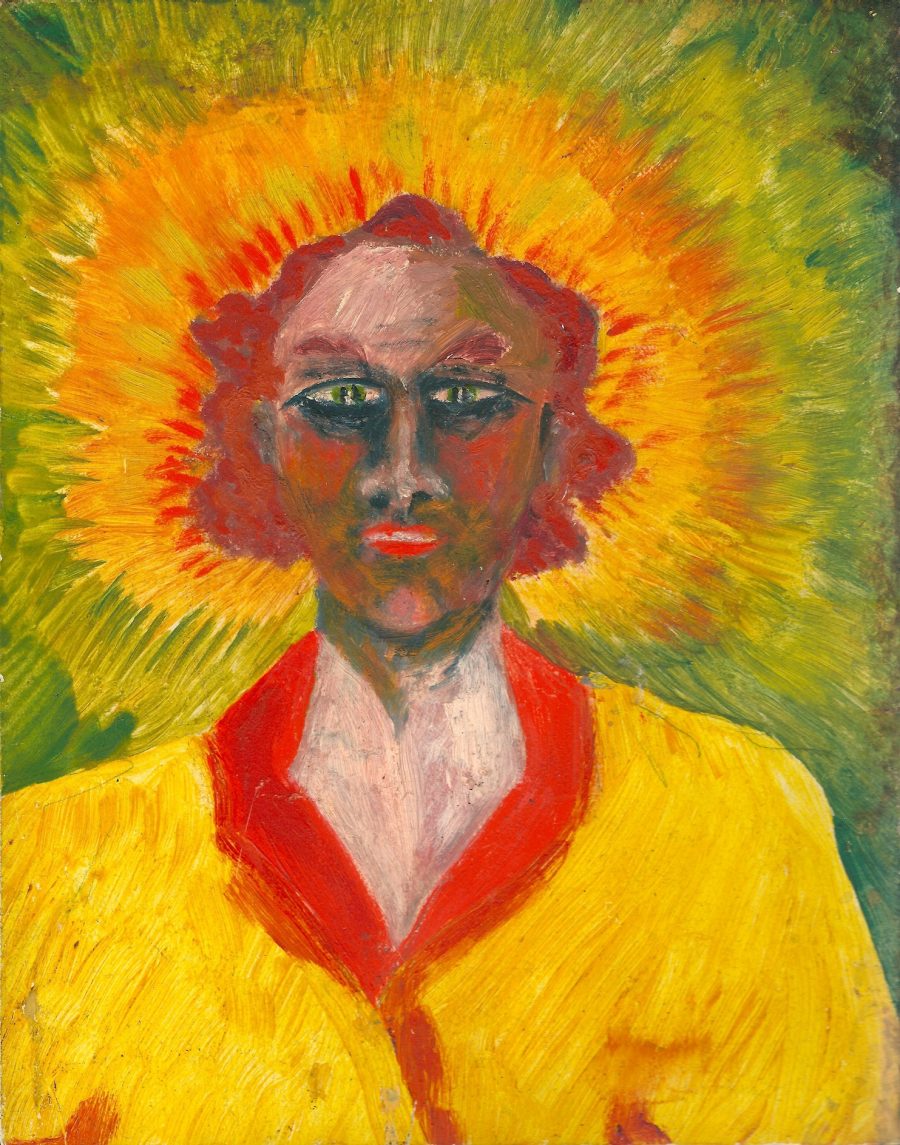
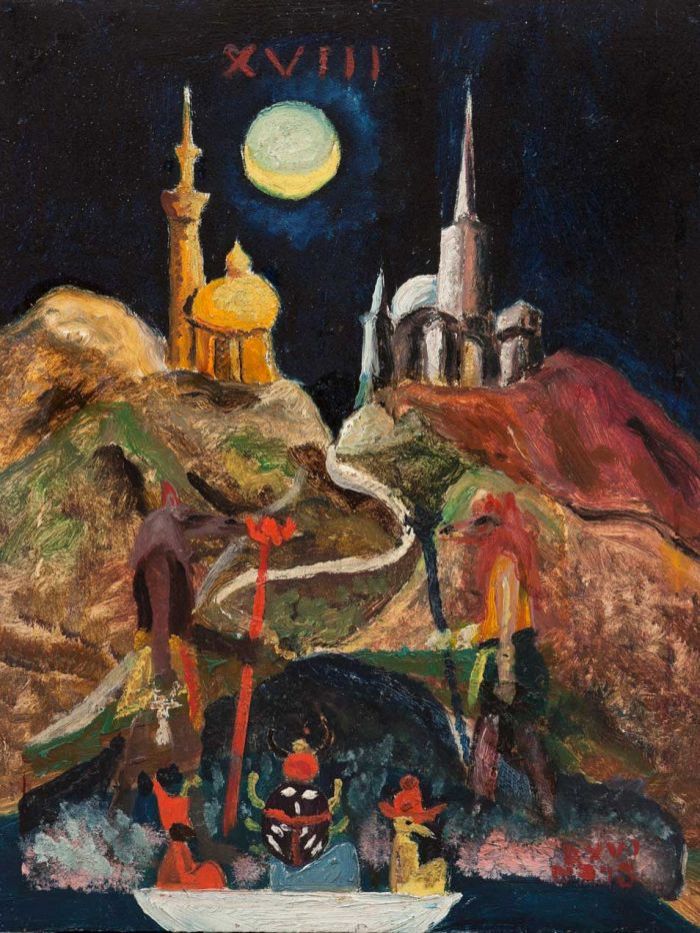
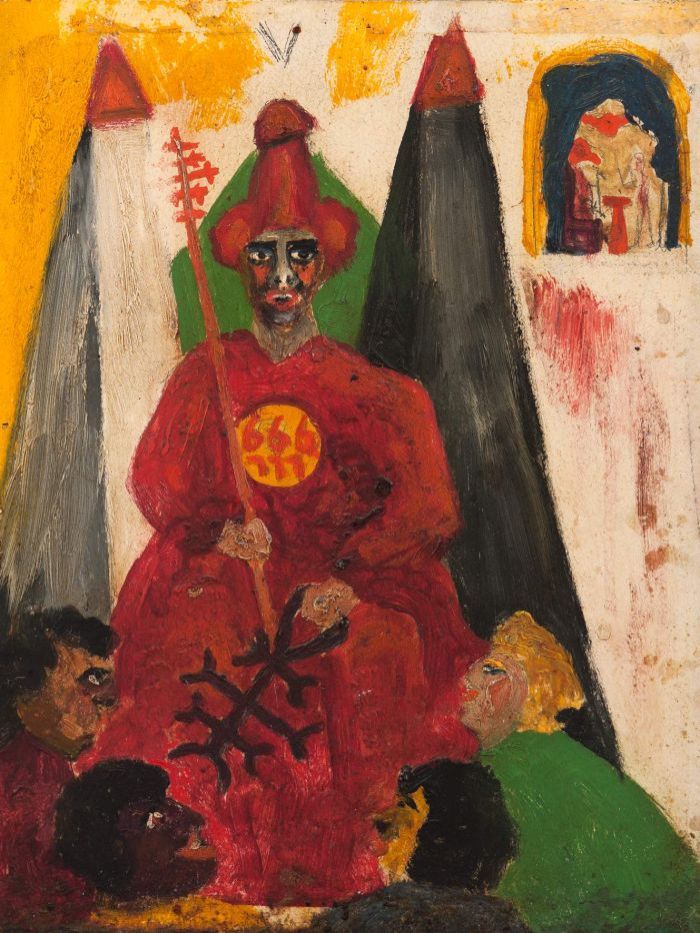
Who knows whether “The Great Beast 666,” as Crowley liked to call himself, would take these comparisons as a compliment. But I expect it takes a true adept to unravel the mysteries of enigmatic works from 1920–21 like The Sun (Auto Portrait), at the top, The Moon (Study for Tarot), further down, or The Hierophant, below. Avant-garde filmmaker Kenneth Anger is such an adept, a convert to Crowley’s religion, which exerted much influence on his work.
Above, see Anger’s “Brush of Baphoment,” a short film in which his camera zooms and pans over Crowley’s paintings, picking up mystical symbols and intriguingly indecipherable symbolism. And learn more about Crowley’s visual art in this radio interview with Buratti and his edited collection of Crowley’s work, The Nightmare Paintings.
Related Content:
Aleister Crowley Reads Occult Poetry in the Only Known Recordings of His Voice (1920)
The Thoth Tarot Deck Designed by Famed Occultist Aleister Crowley
Josh Jones is a writer and musician based in Durham, NC. Follow him at @jdmagness
Read More...Ken Burns Teaches Documentary Filmmaking with His New Online Masterclass
FYI: If you sign up for a MasterClass course by clicking on the affiliate links in this post, Open Culture will receive a small fee that helps support our operation.
The historian Stephen Ambrose once said that “more Americans get their history from Ken Burns than from any other source.” That quote sounds plausible enough, and Burns’ company Florentine Films certainly hasn’t hesitated to put it to promotional use. For almost four decades now, Burns has indeed demonstrated not just his skill at crafting long-form documentaries about American history — most famously, 11 hours on the Civil War, 18 hours on baseball, and 19 hours on jazz — but his skill at placing his work, and that of his collaborators, centrally in the culture as well. What can we learn from his career in documentary filmmaking, with its seeming infinitude of both historical material and critical acclaim? Masterclass now offers one set of answers to that question with the online course “Ken Burns Teaches Documentary Filmmaking.”
Priced at $90, the course covers every step of the documentary-filmmaking process, from writing a script to finding source materials to interviewing subjects to designing sounds and recording voiceovers. Most of this has, in a technical sense, become vastly easier since Burns began his career in the late 1970s, and iMovie has made his signature pans across still photos effortlessly implementable with the “Ken Burns Effect” option.
But it takes much more than pans across photographs to make the kind of impact Burns does with his documentaries, and the most valuable insight provided by a course like this one is the insight into how its teacher sees the world.
“People are realizing that there’s as much drama in what is and what was as anything that the human imagination dreams of,” says Burns in the course’s trailer, “and you have the added advantage of it being true.” But at the same time, Burns also believes that “there’s no objective truth. This is human experience. We see things from different perspectives. And that’s okay.” This brings to mind a line from Burns’ Jazz, originally spoken by Wynton Marsalis but quoted by Burns in a New Yorker profile last year: “Sometimes a thing and the opposite of a thing are true at the same time.” A tolerance for contradiction, in Burns’ book, makes you a better documentarian, but it may also make you a sharper observer of the world around you. Now, in what Burns calls “one of the most challenging moments in the history of the United States,” the world needs the sharpest observers it can get. You can sign up for Burns’ course here.
You can take this class by signing up for a MasterClass’ All Access Pass. The All Access Pass will give you instant access to this course and 85 others for a 12-month period.
Related Content:
Martin Scorsese Teaches His First Online Course on Filmmaking: Features 30 Video Lessons
Werner Herzog Teaches His First Online Course on Filmmaking
Based in Seoul, Colin Marshall writes and broadcasts on cities and culture. His projects include the book The Stateless City: a Walk through 21st-Century Los Angeles and the video series The City in Cinema. Follow him on Twitter at @colinmarshall or on Facebook.
Read More...Watch 13 Comedians Take “The Bob Ross Challenge” & Help Raise Money for The Leukemia & Lymphoma Society
The late Bob Ross, the almost laughably calm host of PBS’ popular how-to series, the Joy of Painting, was a boss of many things—business, branding, the 16th-century wet-on-wet ”Alla Prima” technique…
Also speed, as thirteen New York City comedians recently discovered firsthand.
Invited to participate in The Bob Ross Challenge, a web series-cum-fundraiser hatched by comedians Micah Sherman and Mark Stetson, they gamely plunged ahead, regardless of artistic talent or familiarity with the master.
Some like, Julia Duffy, are simply too young to have encountered Ross in his public television heyday.
(For the record, all 403 episodes of Ross’ painting show are now viewable online for free.)
Others, like Aparna Nancherla, above, chanced upon reruns screened for ironic effect in dive bars…
Or, like Keisha Zollar, they’re in a romantic relationship with someone who uses The Joy of Painting to combat insomnia.
The majority seem to share a latch key kid’s fondness for the gentle Ross, whose show proved a chill pairing with afterschool snacks.
“We spent about $1000 on official Bob Ross supplies,” Sheman reports. From easel to the fan brush, everything was set up for the participating comedians’ success. Like Ross, who typically shot a season’s worth of episodes over a single weekend, the first season’s shoot transpired over a few days.
The ground rules were simple. Armed with an arsenal of officially sanctioned supplies, each comedian entered a studio where a Joy of Painting episode was screening, charged with recreating that canvas in real time. At the end of the episode, it was “brushes down” whether or not the canvas bore passing resemblance to Bob’s.
“Our original title was Bob Ross Fails, but people were actually succeeding,” Sherman confesses.
That said, there’s a definite edge. The participants may be trained in improv, but as performers, there’s an imperative to get over, and, as stated, Ross moves fast. In the time it takes an average mortal to apply a sky wash, he’s likely fan brushed in a couple of happy little trees.
Tough nuts.
The rules of the game decree that the stopwatch abides.
As Ralf Jean-Pierre observes, it’s a race against time.
Though not everyone plays by the rules…
David Carl, above, creator of Trump Lear, declares (in character) that he not only defeated Bob Ross, but that “no one’s ever had a better tree than that” and that his clouds are “beautifully tremendous.”
Sherman and his co-creator Mark Stetson have conceived of The Bob Ross Challenge as a fundraiser for the Leukemia & Lymphoma Society. Like Ross, Stetson’s father was prematurely claimed by lymphoma. Make a donation in their honor here.
Watch the first season of The Bob Ross Challenge here.
#BobRossIsABoss
Related Content:
Chris Rock Creates a List of His 13 Favorite Standup Comedy Specials
Ayun Halliday is an author, illustrator, theater maker and Chief Primatologist of the East Village Inky zine. Her recent trip to Mexico City is the inspiration for her latest short play at The Tank in New York City on August 23, Follow her @AyunHalliday.
Read More...A Free Course from MIT Teaches You How to Speak Italian & Cook Italian Food All at Once
At MIT, Dr. Paola Rebusco usually teaches physics to freshmen. But, on behalf of the MIT Experimental Study Group, Rebusco has devised an appealing course — Speak Italian with Your Mouth Full — where she combines teaching two things many people love: learning to speak Italian and cooking Italian food. The course summary reads:
The participants in this seminar will dive into learning basic conversational Italian, Italian culture, and the Mediterranean diet. Each class is based on the preparation of a delicious dish and on the bite-sized acquisition of parts of the Italian language and culture. A good diet is not based on recipes only, it is also rooted in healthy habits and in culture. At the end of the seminar the participants will be able to cook some healthy and tasty recipes and to understand and speak basic Italian.
As Rebusco explains in a short video, this course has the advantage of making the language lessons a little less abstract. It gives students a chance to apply what they’ve learned (new vocabulary words, pronunciations, etc.) in a fun, practical context.
Above, we start you off with the first language lesson in the seminar. It begins where all basic courses start — with how to say your name. Below, you can watch the class learn to cook fresh pasta. Along the way, the course also teaches students how to make espresso, risotto, homemade pizza, bruschetta, and biscotti. Lectures for the course can be found on the MIT web site, YouTube and iTunes. Speak Italian with Your Mouth Full also appears in our collection of Free Foreign Language Lessons and 1200 Free Courses Online. Buon Appetito!
Ingredients & Cooking Instruction:
Food Preparation
Note: An earlier version of this post appeared on our site way back in 2012.
If you would like to support the mission of Open Culture, consider making a donation to our site. It’s hard to rely 100% on ads, and your contributions will help us continue providing the best free cultural and educational materials to learners everywhere. You can contribute through PayPal, Patreon, and Venmo (@openculture). Thanks!
Related Content:
Science & Cooking: Harvard Profs Meet World-Class Chefs in Unique Online Course
David Lynch Teaches You to Cook His Quinoa Recipe in a Weird, Surrealist Video
The Futurist Cookbook (1930) Tried to Turn Italian Cuisine into Modern Art
How to Bake Ancient Roman Bread Dating Back to 79 AD: A Video Primer
Read More...See Ancient Greek Music Accurately Reconstructed for the First Time
Imagine trying to reconstruct the music of the Beatles 2,500 years from now, if nothing survived but a few fragments of the lyrics. Or the operas of Mozart and Verdi if all we had were pieces of the librettos. In a 2013 BBC article, musician and classics professor at Oxford Armand D’Angour used these comparisons to illustrate the difficulty of reconstructing ancient Greek song, a task to which he has set himself for the past five years.
The comparison is not entirely apt. Scholars have long had clues to help them interpret the ancient songs that served as vehicles for Homeric and Sapphic verse or the later drama of Aeschylus, almost all of which was sung with musical accompaniment. In a recent article at The Conversation, D’Angour points out that many literary texts of antiquity “provide abundant and highly specific details about the notes, scales, effects, and instruments used,” the latter including the lyre and the aulos, “two double-reed pipes played simultaneously by a single performer.”
But these musical instructions have proved elusive; “the terms and notations found in ancient sources—mode, enharmonic, diesis, and so on—are complicated and unfamiliar,” D’Angour writes. Nonetheless, using recreations of ancient instruments, close analysis of poetic meter, and careful interpretation of ancient texts that discuss melody and harmony, he claims to have accurately deciphered the sound of ancient Greek music.
D’Angour has worked to turn the “new revelations about ancient Greek music” that he wrote of five years ago into performances that reconstruct the sound of Euripides and other ancient literary artists. In the video at the top, see a choral and aulos performance of Athanaeus’ “Paean” from 127 BC and Euripides Orestes chorus from 408 BC. D’Angour and his colleagues break in periodically to talk about their methodology.
In the 2017 interview above from the Greek television channel ERT1, D’Angour discusses his research into the music of ancient Greek verse, from epic, to lyric, to tragedy, to comedy, “all of which,” he says, “was sung music, either entirely or partly.” Central to the insights scholars have gained in the past five years are “some very well preserved auloi,” he notes, that “have been reconstructed by expert technicians” and which “provide a faithful guide to the pitch range of ancient music, as well as to the instruments’ own pitches, timbres, and tunings.”
Determining tempo can be tricky, as it can with any music composed before “the invention of mechanical chronometers,” when “tempo was in any case not fixed, and was bound to vary between performances.” Here, he relies on poetic meter, which gives indications through the patterns of long and short syllables. “It remains for me to realize,” D’Angour writes, “in the next few years, the other few dozen ancient scores that exist, many extremely fragmentary, and to stage a complete drama with historically informed music in an ancient theater such as that of Epidaurus.” We’ll be sure to bring you video of that extraordinary event.
Related Content:
What Ancient Greek Music Sounded Like: Hear a Reconstruction That is ‘100% Accurate’
Hear Homer’s Iliad Read in the Original Ancient Greek
Josh Jones is a writer and musician based in Durham, NC. Follow him at @jdmagness
Read More...What Made Robin Williams a Uniquely Expressive Actor: A Video Essay Explores a Subtle Dimension of His Comic Genius
“He had admirers but no imitators,” writes Dave Itzkoff in Robin, his new biography of Robin Williams. “No one combined the precise set of talents he had in the same alchemical proportions.” Though Itzkoff’s book has received a great deal of acclaim, many fans may still feel that important elements of Williams’ particular genius remain less than fully understood. Scholars of comedy will surely continue to scrutinize the beloved comic’s persona for decades to come, just as they have over the past four years since his death. The cinema-analyzing video essay series Every Frame a Painting produced one of the first such examinations of Williams’ technique, “Robin Williams — In Motion,” and its insight still holds up today.
“Few actors could express themselves as well through motion,” narrator Tony Zhou says of Williams, “whether that motion was big or small. Even when he was doing the same movement in two different scenes, you could see the subtle variations he brought to the arc of the character.” This goes for Williams’ manic, impression laden performances as well as his low-key, slow-burning ones. “To watch his work,” Zhou says over a montage of entertaining examples, “is to see the subtle thing that an actor can do with his hands, his mouth, his right leg, and his facepalm. Robin Williams’ work is an encyclopedia of ways that an actor can express himself through movement, and he was fortunate to work with filmmakers who used his talents to their fullest.”
Those filmmakers included Barry Levinson (Good Morning Vietnam, Toys, Man of the Year), Peter Weir (Dead Poets Society), Terry Gilliam (The Adventures of Baron Munchausen, The Fisher King), and Gus Van Sant (Good Will Hunting). Zhou credits them and others with letting Williams “play it straight through” rather than adhering to the more common stop-start shooting method that only permits a few seconds of acting at a time; they gave him “something physical to do,” without which his skill with motion couldn’t come through in the first place; they used “blocking,” meaning the arrangement of the actors in the space of the scene, “to tell their story visually”; they “let him listen,” a little-acknowledged but nonetheless important part of a performance, especially a Williams performance.
Finally, these directors “didn’t let perfection get in the way of inspiration.” While the quality of the individual works in Williams’ impressively large filmography may vary, his performances in them are almost all unfailingly compelling. Even during his lifetime Williams was described as a comic genius, and he showed us that comic geniuses have to take risks. And even though every risk he took might not have paid off, his body of work, taken as a whole, teaches us a lesson: “Be open. This was a man who improvised many of his most iconic moments. Maybe he was on to something.” Or as Williams himself put it on an Inside the Actors Studio interview, “When the stuff really hits you, it’s usually something that happened, and it happened then. That’s what film is about: capturing a moment.”
Related Content:
Robin Williams Uses His Stand-Up Comedy Genius to Deliver a 1983 Commencement Speech
Robin Williams & Bobby McFerrin Sing Fun Cover of The Beatles’ “Come Together”
Based in Seoul, Colin Marshall writes and broadcasts on cities and culture. His projects include the book The Stateless City: a Walk through 21st-Century Los Angeles and the video series The City in Cinema. Follow him on Twitter at @colinmarshall or on Facebook.
Read More...Native Lands: An Interactive Map Reveals the Indigenous Lands on Which Modern Nations Were Built

“Now when I was a little chap I had a passion for maps. I would look for hours at South America, or Africa, or Australia, and lose myself in the all the glories of exploration. At that time there were many blank spaces on the earth, and when I saw one that looked particularly inviting on a map (but they all look that) I would put my finger on it and say, ‘When I grow up I will go there.’”
—Joseph Conrad, Heart of Darkness
In his post-WWII historical survey, The Story of Maps, Lloyd A. Brown observes that “the very material used in the making of maps, charts and globes contributed to their destruction.” Paper burns, rots, succumbs to water-damage and insects. Maps and globes made from solid silver, brass, copper, and other metals made too-tempting targets for looters and thieves. In this way, maps serve doubly as symbolic indices of what they represent—lands that, in the very act of mapping them, were often despoiled, overrun, and stolen from their inhabitants.
Moreover, in mapping history, it often happened that “if a map were old and obsolete and parchment was scarce, the old ink and rubrication could be scraped off and the skin used over again. This practice, accounting for the loss of many codices as well as valuable maps and charts, at one time became so pernicious” that the Catholic Church issued decrees to forbid it. What better allegory for conquest, the wiping away of civilizations in order to write new names and borders over them?
The old imperial tropes of “blank spaces” on the map and “dark places of the earth” (like “darkest Africa”), used with such effectiveness in Joseph Conrad’s Heart of Darkness, hide the plain truth, in the words of Conrad’s Marlow:
The conquest of the earth, which mostly means the taking it away from those who have a different complexion or slightly flatter noses than ourselves, is not a pretty thing when you look into it too much. What redeems it is the idea only. An idea at the back of it; not a sentimental pretence but an idea; and an unselfish belief in the idea—something you can set up, and bow down before, and offer a sacrifice to.…
Blank spaces represent those areas that had not yet been forcibly brought into the European economy of property, the sine qua non of Enlightenment humanity. “Once discovered by Europeans,” writes historian Michel-Rolph Trouillot—once classified, mapped, and made subject, “the Other finally enters the human world.” For several decades now, postcolonial projects have engaged in the progressive disenchantment of “the idea,” in the recognition of messy relationships between naming, mapping, and power, and the recovery, to the extent possible, of the names, borders, and identities beneath palimpsest histories.

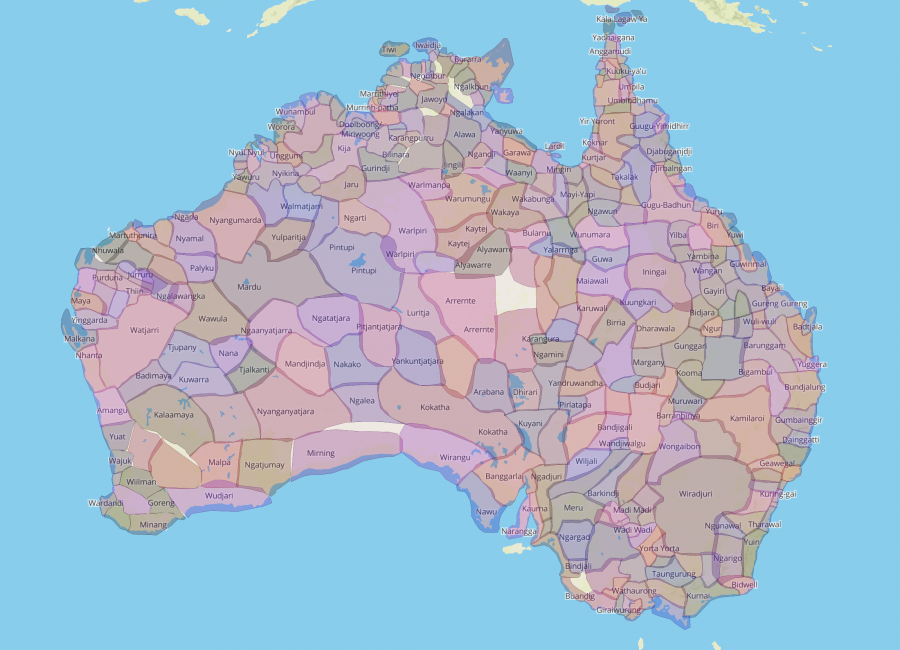
Such projects proliferate outside academia as technology amplifies previously unheard dissenting voices and perspectives and as, to use an old postcolonial phrase, “the empire writes back”—or, in this case, “maps back.” Such is the intent of the online project Native Land, an interactive website that “does the opposite” of centuries of colonial mapping, writes Atlas Obscura, “by stripping out country and state borders in order to highlight the complex patchwork of historic and present-day Indigenous territories, treaties, and languages that stretch across the United States, Canada,” the Canadian Arctic, Greenland, and Australia.
Also a mobile app for Apple and Android, the map allows visitors to enter street addresses or ZIP codes in the search bar, “to discover whose traditional territory their home was built on.”
White House officials will discover that 1600 Pennsylvania Avenue is found on the overlapping traditional territories of the Pamunkey and Piscataway tribes. Tourists will learn that the Statue of Liberty was erected on Lenape land, and aspiring lawyers that Harvard was erected in a place first inhabited by the Wamponoag and Massachusett peoples.
The map was created by Canadian activist and programmer Victor Temprano, founder of the company Mapster, which funds the project. Temprano prefaces the Native Land “About” page with a disclaimer: “This is not an academic or professional survey,” he writes, and is “constantly being refined from user input.” He defines his purpose as “helping people get interested and engaged” by asking questions like “who has the right to define where a particular territory ends, and another begins?”
As neo-colonial projects like oil pipelines once again threaten the survival of Indigenous communities, and indigenous people find themselves and their children caged in prisons for crossing militarized national borders, such questions could not be more relevant. Temprano does not make any claims to definitive historical accuracy and points to other, similar projects that supplement the “blank spaces” in his own online map, such as huge areas of South America being re-mapped on the ground by Amazonian tribes entering field data into smart phones, and Aaron Capella’s Tribal Nations Maps, which offers attractive printed products, perfect for use in classrooms.
Temprano quotes Capella in order to illuminate his work: “This map is in honor of all the Indigenous Nations [of colonial states]. It seeks to encourage people—Native and non-Native—to remember that these were once a vast land of autonomous Native peoples, who called the land by many different names according to their languages and geography. The hope is that it instills pride in the descendants of these People, brings an awareness of Indigenous history and remembers the Nations that fought and continue to fight valiantly to preserve their way of life.”
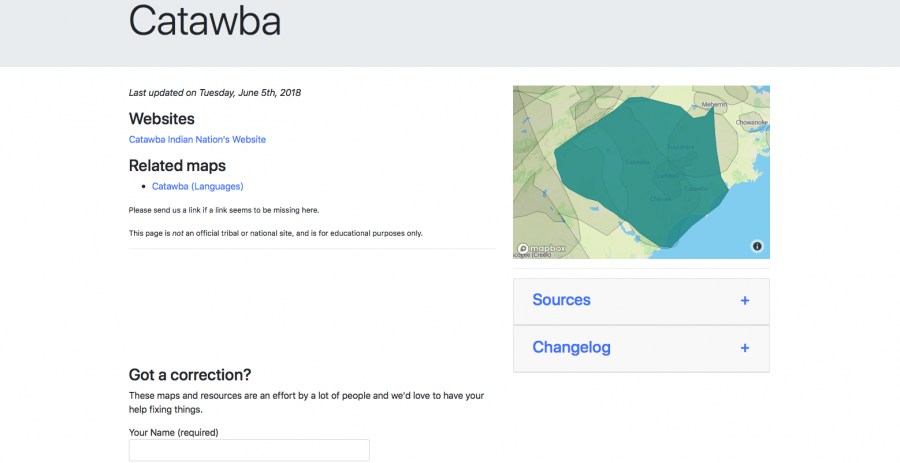
Visit Native Land here and enter an address in North or South America or Australia to learn about previous or concurrent Native inhabitants, their languages, and the historical treaties signed and broken over the centuries. Clicking on the territory of each Indigenous nation brings up links to other informative sites and allows users to submit corrections to help guide this inclusive project toward greater accuracy.
The site also features a Teacher’s Guide, Blog by Temprano, and a page on the importance of Territory Acknowledgement, a way for us to “insert an awareness of indigenous presence and land rights in everyday life,” and one of many “transformative acts,” as Chelsea Vowel, a Métis woman from the Plains Cree writes, “that to some extent undo Indigenous erasure.”
Related Content:
Josh Jones is a writer and musician based in Durham, NC. Follow him at @jdmagness
Read More...Support Us
We're hoping to rely on loyal readers, rather than erratic ads. Please click the Donate button and support Open Culture. You can use Paypal, Venmo, Patreon, even Crypto! We thank you!

About Us

Open Culture scours the web for the best educational media. We find the free courses and audio books you need, the language lessons & educational videos you want, and plenty of enlightenment in between.
Advertise With Us

FREE UPDATES!
GET OUR DAILY EMAIL
Get the best cultural and educational resources on the web curated for you in a daily email. We never spam. Unsubscribe at any time.
FOLLOW ON SOCIAL MEDIA

Open Culture editor Dan Colman scours the web for the best educational media. He finds the free courses and audio books you need, the language lessons & movies you want, and plenty of enlightenment in between.
Advertise With Us

