The Books on Barack Obama’s Summer Reading List: Naipaul, Ondaatje & More

Photo by Pete Souza via obamawhitehouse.archive.gov
As the current president grinds his ax on Twitter, the former one reads and reflects. Yesterday, Barack Obama posted on Facebook his summer reading list, a mix of novels, memoirs, and instructive non-fiction. He writes:
One of my favorite parts of summer is deciding what to read when things slow down just a bit, whether it’s on a vacation with family or just a quiet afternoon. This summer I’ve been absorbed by new novels, revisited an old classic, and reaffirmed my faith in our ability to move forward together when we seek the truth. Here’s what I’ve been reading:
Tara Westover’s Educated is a remarkable memoir of a young woman raised in a survivalist family in Idaho who strives for education while still showing great understanding and love for the world she leaves behind.
Set after WWII, Warlight by Michael Ondaatje is a meditation on the lingering effects of war on family.
With the recent passing of V.S. Naipaul, I reread A House for Mr Biswas, the Nobel Prize winner’s first great novel about growing up in Trinidad and the challenge of post-colonial identity.
An American Marriage by Tayari Jones is a moving portrayal of the effects of a wrongful conviction on a young African-American couple.
Factfulness by Hans Rosling, an outstanding international public health expert, is a hopeful book about the potential for human progress when we work off facts rather than our inherent biases.
POTUS’ previous lists of recommended books can be found in the Relateds below.
If you would like to support the mission of Open Culture, consider making a donation to our site. It’s hard to rely 100% on ads, and your contributions will help us continue providing the best free cultural and educational materials to learners everywhere. You can contribute through PayPal, Patreon, and Venmo (@openculture). Thanks!
Related Content:
Barack Obama Shares a List of Enlightening Books Worth Reading
The 5 Books on President Obama’s 2016 Summer Reading List
A Free POTUS Summer Playlist: Pres. Obama Curates 39 Songs for a Summer Day
Read More...Hundreds of Classical Sculptures from the Uffizi Gallery Now Digitized & Put Online: Explore a Collection of 3D Interactive Scans
Read More...Aretha Franklin’s Pitch-Perfect Performance in The Blues Brothers, the Film That Reinvigorated Her Career (1980)
There are many films of the 70s and 80s that could never get made today. This is not your grumpy uncle’s rant about political correctness gone wild. In many cases, it’s very much for the best. (And did we ever need “movies” like Porky’s or Hardbodies in the first place? I’m going to say no.) Styles and social mores change. Actors and directors who alone could have pulled off what they did, when they did, pass away. And so too do musicians whose equal we will never see again. When these inimitable forces come together, it’s once-in-a-lifetime celluloid magic. Remakes and ill-advised sequels seem like sacrilege.
I am speaking on this occasion of The Blues Brothers, the 1980 musical comedy that brought together a pantheon of legends now mostly departed for that hall of fame in the sky. John Belushi, of course, but also John Candy and Carrie Fisher. James Brown, Cab Calloway, Ray Charles, John Lee Hooker… and Aretha Franklin, whom the whole world now mourns. Charges of cultural appropriation might get lobbed at The Blues Brothers, but they would be misplaced. For all its absurdist slapstick, the film was nothing if not a celebration of black American music, a reverent, loving tribute to the blues, R&B, and classic soul that went directly to the source, and in so doing, reinvigorated Aretha’s flagging career.
The music scene of the late seventies had “turned away from soul and toward disco,” writes Laura Bradley at Vanity Fair. “Franklin was struggling to make the transition, especially after Atlantic allowed her contract to expire.” Her attempt to keep up in the 1979 disco album La Diva had flopped. She was the Queen of Soul, not sweaty dancefloors, and so she would remain, thanks in part to the antics of Jake and Elwood and writer/director John Landis, who cast her as Mrs. Murphy, a diner waitress who gets to call the brothers “two honkys dressed like Hasidic diamond merchants” who “look like they’re from the CIA.”
The story of her casting is bittersweet. “You have to remember that in 1979,” says Landis, “rhythm and blues was basically over, and the number one music in the world was Abba, the Bee Gees… when people ask, how did you get the likes of Aretha Franklin and James Brown, it was easy. We just called them and said, ‘Wanna job?’” Studio executives balked, wanting hipper acts like Rose Royce, who had sung the theme from Car Wash. It would have been a tragedy.
Thankfully, Landis persisted—he had written the part for her. “Everyone in the movie,” he says in a recent interview, “the parts were written specifically for them.” (Except James Brown, who took over as the preacher when Little Richard “found Jesus, again,” and went to back to his church in Tennessee.) Landis also insisted on Aretha singing “Think,” a song from her 1968 album Aretha Now, instead of her biggest hit. (“Really?” he recalls her saying, “Don’t you want me to sing ‘Respect’?”) The song came directly out of the dialogue between her and blues guitarist Matt Murphy, playing her husband.
Landis remembers Aretha’s re-recording of the extended film version of the song:
So, we laid down the tracks for “Think.” She came in, a couple days before she was to be shot. She listened to the track once and said, “OK, but I would like to replace the piano.” We said, great, what do you want to do? She said, “I’ll play.”
So we got a piano, she sat in a recording studio, and it was Universal Studios’ recording studios in Chicago, a very old, funky studio we were delighted to be in because it was where Chess Records did all their recordings. We had a piano for her. She sat with her back to us, at the keys, and the piano and her voice was mic’d. She did it once, listened to the playback. She said, “I’d like to do it again.” She played piano as she sang, and the second take is the one in the movie. She was just wonderful. She didn’t like doing so many takes and she had issues with lip-syncing.
Franklin also thought of the experience fondly, writing in her autobiography that it was “something I enjoyed making tremendously.” She did finally get the chance to sing “Respect” in a Blues Brothers film, almost twenty years later, when she reprised her role in Blues Brothers 2000. It’s arguable whether that movie ever should have been made. But there’s never any arguing with Aretha Franklin’s commanding voice. See her tell off Murphy and Elwood Blues, again, in a clip from the belated sequel below. Queen Aretha may have left us, but her legacy will live forever.
Related Content:
John Belushi and Dan Aykroyd Get Brian Wilson Out of Bed and Force Him to Go Surfing, 1976
Josh Jones is a writer and musician based in Durham, NC. Follow him at @jdmagness
Read More...David Bowie’s “Heroes” Delightfully Performed by the Ukulele Orchestra of Great Britain
Cover tunes are not tribute bands. The best covers don’t aim to be carbon copies. They expand our concept of the original with an unexpected element or fresh lens.
Would you believe me if I told you that the Ukulele Orchestra of Great Britain’s take on David Bowie’s “Heroes”—the second most covered tune in the late rocker’s canon—is even sexier than the original?
No?
Good.
Nothing ever will be.
It is, however, a compelling case for the power of multiple ukuleles.
A single uke could only be dwarfed by the memory of “Heroes”’ driving, famously layered sound, a group effort that included producer Tony Visconti and guitarist Robert Fripp.
Bowie may have referred to the tempo and rhythm as “plodding,” but co-writer Brian Eno’s description of the sound as something “grand and heroic” comes much closer to the mark.
Are eight ukes grand and heroic? Well, no. Not really.
And there is something undeniably humorous about a row of formally attired, seated, middle-aged men and women, wailing away in unison with their right hands, but it’s telling that the audience at New York’s multimedia art cabaret (le) Poisson Rouge isn’t laughing.
Admittedly, there were a few isolated chuckles in the beginning, a few notes in.
Philistines.
Probably been dragged there on blind dates with ukulele-enthusiasts.
To be charitable, there will always be those in need of convincing that the ukulele is a legitimate instrument.
Who better to convince them than the Ukulele Orchestra of Great Britain, whose very name suggests that its members are in on the joke, and capable of turning it on its head?
The lyrics, as most Bowie fans can tell you, were inspired by real life, but not exactly Bowie’s. The tune was on solid footing, but the words were still slow to come, when Bowie glanced out the window of his Berlin recording studio to catch a back up singer and Visconti, married at the time, enjoying what they believed was a stolen kiss.
The rest, as they say is history, kept somewhat shrouded in mystery until relatively recently.
The Ukulele Orchestra singers wisely steer clear of Bowie’s howling, emotional delivery, which Visconti got on tape almost before the ink on those lyrics had time to dry.
Instead, they honor him, and the place this song has in so many people’s hearts, with their sincerity.
Listen to the Ukulele Orchestra of Great Britain’s take on Bowie’s Life on Mars here.
Related Content:
George Harrison Explains Why Everyone Should Play the Ukulele
Ayun Halliday is an author, illustrator, theater maker and Chief Primatologist of the East Village Inky zine. Join her in NYC on Monday, September 24 for another monthly installment of her book-based variety show, Necromancers of the Public Domain. Follow her @AyunHalliday.
Read More...See the First Ever Video of Elvis Costello Performing, Summer 1974
The setting: London. In particular, Stepney, London E1. The year, a warm summer in 1974, July 21 to be exact. And a very early video camera, only able to shoot in black and white, records the events of the E1 Festival, a free day out for families, restless teens, and bell bottomed, long-haired youth enjoying the sun. There’s Indian musicians, face painting, carnival games, jazz bands, folk dancing, and a “Wellie Boot Chucking Competition”. You know, “the lot,” as the English would say. But then, around 40 minutes in, the videographer decides to shoot the pub rock band playing on the main stage.
If the bespectacled 19 year old looks and sounds a bit familiar, well luvvies, you’re not seeing things. This is the first filmed appearance of a young Elvis Costello, beclad in very fetching dungarees and fronting his first band Flip City. This was their third ever gig, according to the Elvis Costello fan site.
A full three years before Declan MacManus would change his name and burst upon the scene with My Aim Is True, here he is paying his dues.
Flip City was Costello’s second group, the first being a folk rock duo called Rusty that played John Prine, Jesse Winchester, and Van Morrison covers in between their own songs. After Costello split from Liverpool and left for London, he jumped on the pub rock bandwagon that was already formed around Nick Lowe, Dr. Feelgood, and Brinsley Schwarz, mixing up Americana and R’n’B covers with very British originals. They even recorded demos a few years after this gig, which were widely bootlegged until most of them appeared on bonus tracks on various CD reissues. (You can listen to them here.)
But back to 1974. We have no record of their full set, but the two songs on the video are from the Coasters’ “I’m a Hog for You” (the B‑side of “Charlie Brown” but covered by Screaming Lord Sutch in 1963) and from the Isley Brothers, “This Old Heart of Mine,” a Motown staple. Despite Costello’s encyclopediac knowledge of music, he never again played these two songs live again.
It might be 20/20 hindsight, but one can already hear the talent and the confidence (or at least mock confidence) that would soon propel the young man into the charts. The rest, as they say, is much better than winning the wellie chucking contest.
Related Content:
The Stunt That Got Elvis Costello Banned From Saturday Night Live (1977)
Elvis Costello Sings “Penny Lane” for Sir Paul McCartney at The White House
Ted Mills is a freelance writer on the arts who currently hosts the artist interview-based FunkZone Podcast and is the producer of KCRW’s Curious Coast. You can also follow him on Twitter at @tedmills, read his other arts writing at tedmills.com and/or watch his films here.
Read More...Bauhaus Ballet: A Dance of Geometry
During the past month, the Great Big Story has released a series of videos that revisit the design aesthetic of the Bauhaus movement. Their first video explored the radical buildings designed by Bauhaus architects. A second focused on the legacy of minimalist Bauhaus furniture. And now a third takes as its subject Oskar Schlemmer’s 1922 “Triadic Ballet”–a ballet famous for putting geometry and structure into dance. The video above shows the “Bayerisches Junior Ballet München as they prepare to bring Bauhaus center stage again.” You can watch a full recreation of the ballet and learn much more about Schlemmer’s experimental production by reading this post from our archive.
If you would like to support the mission of Open Culture, consider making a donation to our site. It’s hard to rely 100% on ads, and your contributions will help us continue providing the best free cultural and educational materials to learners everywhere. You can contribute through PayPal, Patreon, and Venmo (@openculture). Thanks!
Related Content:
32,000+ Bauhaus Art Objects Made Available Online by Harvard Museum Website
Bauhaus, Modernism & Other Design Movements Explained by New Animated Video Series
Read More...How Aleister Crowley, the Infamous Occultist, Led the First Attempt to Reach the Summit of K2 (1902)
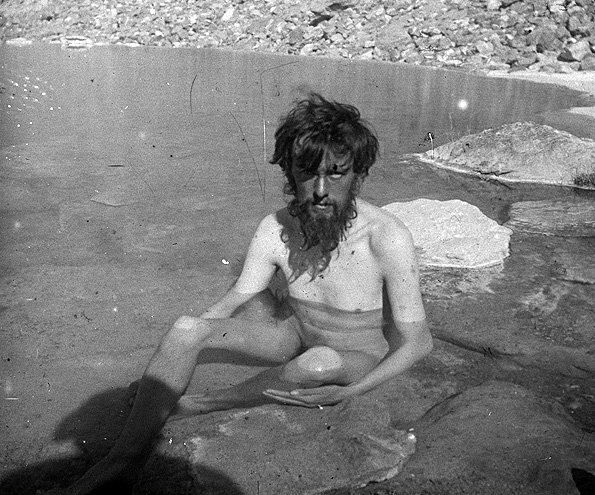
It sounds like the plot of a Werner Herzog film: Aleister Crowley, heir to a brewing fortune and “flamboyant, bisexual drug fiend with a fascination for the occult,” meets “son of a well-known Jewish Socialist” Oscar Eckenstein, “a chemist turned railway engineer.” The two strike up a friendship over their mutual passion for mountaineering, and, in four years time, co-lead an expedition to reach the summit of K2, the second highest mountain in the world.
The descriptions of these characters come from Mick Conefrey’s The Ghosts of K2: The Race for the Summit of the World’s Most Deadly Mountain, a book detailing the many grueling attempts, many deaths, and few successes, in over a century of climbs to the mountain’s peak. Crowley and Eckenstein’s expedition, undertaken in 1902, was the first. Though unsuccessful, their effort remains a legendary feat of historical bravery, or hubris, or insanity—an ascent up the face of what climber George Bell called “a savage mountain that tries to kill you.”
In an interview with National Geographic, Conefrey sums up the doomed expedition:
In those days, nobody had a clue about what it was going to be like. They thought they would go to the Himalayas and knock off K2 in a couple of days. But as the expedition proceeded, it started falling apart. Eckenstein, the leader, had a bad respiratory infection. Crowley had malaria and spent most of the time in his tent with a high fever. At one point he got so delirious, he started waving his revolver at other members of the team.
There are many other Herzogian touches. In his book Fallen Giants, Maurice Isserman describes the team—also consisting of a novice Englishman, a Swiss doctor, and two experienced Austrian climbers—as “unreasonably burdened by three tons of luggage.” Some of that unnecessary burden came from a “several-volume library” Crowley “intended to haul onto the glacier.” The others “objected to the superfluous weight, but Crowley had read enough Joseph Conrad to know what happened to those who let go of their hold on civilization in the wild.” The library stayed, and a train of 200 porters hauled the team’s luggage to Baltoro Glacier. (See Crowley in a photo from the expedition above, presumably stricken with malaria.)
Prior to setting off for K2 Eckenstein and Crowley had climbed volcanoes in Mexico, then the latter had traveled to San Francisco, Hawaii, Japan, Sri Lanka, and India—along the way having affairs, learning meditation, and developing a “lifelong devotion to Shiva, the Hindu god of destruction.” While it takes a certain rare personality to subject themselves to the rigors of scaling a mountain almost five miles high, Crowley—notorious for his “magick,” sexual adventures, drug use, lewd poetry, and founding of a religious order—is arguably the most out-there personality in the history of a very extreme sport.
But mountaineering “is not a normal pursuit,” writes Scottish climber Robin Campbell, “and we should not be too surprised to find its adepts showing odd behavior in other spheres of life.” Like all devotees of strenuous, death-defying pursuits, Crowley “wanted extreme experiences,” says Conefrey, “where he pushed himself to the limit.” It just so happened that he wanted to push far beyond the natural and human worlds. After the failed K2 attempt, he would only make one more daring expedition with Eckenstein, in 1905, a climb up the Himalayan mountain of Kangchenjunga, the third highest mountain in the world.
On the trip, Crowley, the leader, reportedly treated the local porters with brutal arrogance, and when three of them were killed along with one of the expedition members, he refused to help, writing to a Darjeeling newspaper, “a mountain ‘accident’ of this sort is one of the things for which I have no sympathy whatever.” He left the following day and gave up mountaineering, devoting the rest of his life to his occult interests and the exploits that earned him the tabloid reputation as “the wickedest man in the world.”
K2 was finally conquered by two Italian climbers in 1954, who reached the summit, frostbitten and half-mad, as Joanna Kavenna puts it in a review of Conefrey’s spellbinding book, “in a moment of sublime anticlimax.”
Related Content:
The Surreal Paintings of the Occult Magician, Writer & Mountaineer, Aleister Crowley
Josh Jones is a writer and musician based in Durham, NC. Follow him at @jdmagness
Read More...What English Would Sound Like If It Was Pronounced Phonetically
The English language presents itself to students and non-native speakers as an almost cruelly capricious entity, its irregularities of spelling and conjugation impossible to explain without an advanced degree. It wasn’t until graduate school that I came to understand how spellings like “rough” and “knight” survived several hundreds of years of linguistic change, and preserved vestiges of phonetic pronunciations that had long since disappeared in historic upheavals like the Great Vowel Shift and subsequent spelling wars.
The importation of huge numbers of loan words from other languages, and exportation of English to the world, has made it a polyglot tongue that contains a multitude of spellings and pronunciations, to the consternation of everyone. Unlike French, which has a centralized body that adjudicates language change, English grows and evolves wildly. Dictionaries and linguistics departments struggle to keep up.
One almost wants to apologize to non-native speakers for the following sentence: “Though I coughed roughly and hiccoughed throughout the lecture, I still thought I could plough through the rest of it.” As Aaron Alon, narrator of the video above, points out, the “incredible inconsistency” of words with “ough” in them “can make English incredibly hard to master.” What if a governing body of English language scholars, like the Académie française, came together to prescribe a phonetically consistent pronunciation?
For one thing, they would have to deal with the diversity of vowel sounds—like the “a” in “father,” “ape,” and “apple.” As the video proceeds, we hear these regularized in the narrator’s speech. Students of the language’s history might immediately recognize something like the sound of Shakespeare’s Early Modern English, which did have a more phonetically consistent pronunciation. Soon the sounds of Romance languages—French, Spanish, Italian, Romanian—and the accents speakers of those languages bring to English, start to emerge.
By the time Alon has regularized the vowel sounds, and launched into a recitation of Hamlet’s famous soliloquy, his pronunciation begins to sound like Chaucer’s Middle English, which you can hear pronounced above in a reading of The Canterbury Tales. If we hear the accent this way, the exercise shows that English once made far more phonetic sense (and had a more pleasing musical lilt) than it does today. Alternately, we may hear, as Jason Kottke does, an accent that “sounds a little like Werner Herzog doing an impression of someone from Wales doing an impression of an Italian who doesn’t speak English that well.” Which, he writes, “makes sense because that’s pretty much how the language came together in the first place!” More or less….
Related Content:
Where Did the English Language Come From?: An Animated Introduction
The History of the English Language in Ten Animated Minutes
What Shakespeare’s English Sounded Like, and How We Know It
Josh Jones is a writer and musician based in Durham, NC. Follow him at @jdmagness
Read More...NASA Creates a Visualization That Sets Breathtaking Footage of the Moon to Claude Debussy’s “Clair de Lune” (Moonlight)
From NASA’s Ernie Wright comes “Moonlight (Clair de Lune),” a visualization that takes beautiful images of the lunar terrain and sets them to Claude Debussy’s 1905 composition, Clair de Lune (1905). Here’s how Wright describes the project:
This visualization attempts to capture the mood of Claude Debussy’s best-known composition, Clair de Lune (moonlight in French). The piece was published in 1905 as the third of four movements in the composer’s Suite Bergamasque, and unlike the other parts of this work, Clair is quiet, contemplative, and slightly melancholy, evoking the feeling of a solitary walk through a moonlit garden. The visuals were composed like a nature documentary, with clean cuts and a mostly stationary virtual camera. The viewer follows the Sun throughout a lunar day, seeing sunrises and then sunsets over prominent features on the Moon. The sprawling ray system surrounding Copernicus crater, for example, is revealed beneath receding shadows at sunrise and later slips back into darkness as night encroaches. The visualization was created to accompany a performance of Clair de Lune by the National Symphony Orchestra Pops, led by conductor Emil de Cou, at the Kennedy Center for the Performing Arts in Washington, DC, on June 1 and 2, 2018, as part of a celebration of NASA’s 60th anniversary. The visualization uses a digital 3D model of the Moon built from Lunar Reconnaissance Orbiter global elevation maps and image mosaics. The lighting is derived from actual Sun angles during lunar days in 2018.
Enjoy…
Related Content:
Hear Debussy Play Debussy: A Vintage Recording from 1913
Pianist Plays Beethoven, Bach, Chopin, Ravel & Debussy for Blind Elephants in Thailand
Read More...How Jean-Luc Godard Liberated Cinema: A Video Essay on How the Greatest Rule-Breaker in Film Made His Name
Few can think of the very concept of the auteur without thinking of Jean-Luc Godard. That goes for those of us exhilarated by his movies, those of us amused by them, those of us frustrated by them, and those of us who experience any combination of those emotions and more. Godard’s early audiences, at the dawn of the French New Wave in the late 1950s and the decade or so thereafter, reacted in all those ways, and somehow time hasn’t drained his work in that period of its power.
“How Jean-Luc Godard Liberated Cinema,” the video essay from The Discarded Image above, shows us how a young filmmaker in mid-century France, working under severely limited environments and in a whole new postwar reality — cultural as well as economic — imbued them with that power. Starting with a bang, his 1959 feature debut Breathless, Godard took cinema, says Discarded Image creator Julian Palmer, and “tore through its foundations, reinventing the form and reinventing himself, picture by picture.” This entailed “a haphazard ethos toward editing” as well as oscillation between “genre and the everyday, actors and non-professionals, black and white and color.”
Godard “found the modern world, engulfed with commercialism, both appealing in its pop-art aesthetic, but also repellent,” and his early films vividly express both halves of that worldview. All the while he “toys with the conventions of cinema,” for example by severing the “umbilical cord” of the musical score, “making you aware of how you’re being manipulated by his medium,” and littering the frame with text, “often with abstract phrases, possibly just to provoke a reaction” — or, as some Godard enthusiasts might put it, definitely just to provoke a reaction.
The Godard films on which this video essay focuses — the formidable stretch from Breathless to 1967’s Week-end, with pictures like Vivre sa vie, Contempt, and Alphaville in-between — also draw deeply from cinema itself. “Movies surround these characters’ lives, providing a contrast to their existence,” says Palmer. “This fantasy can allow them to momentarily escape their reality.” But as the 1960s became the 1970s, “like a film coming off its projector, Godard himself was coming off track. He was increasingly disgusted by consumer culture, which was only becoming more dominant.”
Thereafter, as some critics see it, the delicate balance between Godard’s politics and his aesthetics was overturned by the former, but his initial “manic period of fertile creation is still unmatched to this day, and Godard’s influence is immeasurable.” We should not only be thankful that Godard still makes films (his latest, The Image Book, won the very first “Special Palme d’Or” at this year’s Cannes Film Festival), but also hope that the next generation of filmmakers continues to look to his example. Godard may have liberated cinema, but it always and everywhere threatens to put itself back in chains.
Related Content:
An Introduction to Jean-Luc Godard’s Innovative Filmmaking Through Five Video Essays
Jean-Luc Godard Takes Cannes’ Rejection of Breathless in Stride in 1960 Interview
The Entirety of Jean-Luc Godard’s Breathless Artfully Compressed Into a 3 Minute Film
Based in Seoul, Colin Marshall writes and broadcasts on cities and culture. His projects include the book The Stateless City: a Walk through 21st-Century Los Angeles and the video series The City in Cinema. Follow him on Twitter at @colinmarshall or on Facebook.
Read More...Support Us
We're hoping to rely on loyal readers, rather than erratic ads. Please click the Donate button and support Open Culture. You can use Paypal, Venmo, Patreon, even Crypto! We thank you!

About Us

Open Culture scours the web for the best educational media. We find the free courses and audio books you need, the language lessons & educational videos you want, and plenty of enlightenment in between.
Advertise With Us

FREE UPDATES!
GET OUR DAILY EMAIL
Get the best cultural and educational resources on the web curated for you in a daily email. We never spam. Unsubscribe at any time.
FOLLOW ON SOCIAL MEDIA

Open Culture editor Dan Colman scours the web for the best educational media. He finds the free courses and audio books you need, the language lessons & movies you want, and plenty of enlightenment in between.
Advertise With Us

