Watch the First “Interactive” TV Show: Winky Dink and You Encouraged Kids to Draw on the Screen (1953)
Nearly everyone born within the past fifteen years naturally thinks of screens as both touchable and responsive to touch. But smartphones, tablets, and the other devices those kids have never known a world without will always look like technological marvels to their grandparents’ generation. Growing up in the 1950s as part of one of television’s most enthusiastic viewerships, they experienced the rise of that then-marvelous medium and the various concepts it tried out before settling into convention. Some may even remember happy Saturday mornings with CBS’ Winky Dink and You, the show that they didn’t just watch but actually “interacted” with by breaking out their crayons and drawing on the screen.
First aired in 1953, Winky Dink and You came hosted by Jack Barry, a famous television personality since the beginning of television broadcasting. (He would remain so until his death in the mid-1980s, having bounced back from the quiz show scandals of the later 1950s.) His animated sidekick, the titular Winky Dink, was voiced by Mae Questel, best known as the voice of Betty Boop and Olive Oyl. “Winky Dink said he wanted the children to mail away for a ‘Magic Window,’ which was actually a cheaply produced, thin sheet of plastic that adhered to the TV screen by static electricity,” writes Winky Dink-generation columnist Bob Greene. “Along with the plastic sheet that arrived in the mail were ‘magic crayons.’ Children were encouraged to place the sheet on their TV screen and watch the show each Saturday, so that Winky Dink could tell them what to do.”
Winky Dink, and Barry, often told them to draw in the missing parts of a picture, or to connect dots that would reveal a coded message. In the episode above, writes Paleofuture’s Matt Novak, Barry invites kids to “draw things on Winky Dink’s family members, like flowers on the button hole of Uncle Slim’s jacket, or an entirely new nose on the old guy. Uncle Slim sneezes in reaction to getting a nose drawn on his face, as you might expect” — by the standards of 1950s children’s programming, “comedy gold.” Dull though it may sound today, Winky Dink and You dates from an era when television “was still seen as an education force for good,” when “Americans weren’t quite jaded enough to believe TV was a passive technology that didn’t actually stimulate the mind.”
And though the show managed to move two million magic screens, concerns about X‑rays emanating from picture tubes (as well as the likelihood of impatient kids drawing right on the glass) ended its run in 1957. But in a sense, its legacy lives on: a much-circulated quote attributed to Bill Gates describes Winky Dink and You “the first interactive TV show,” and it does indeed seem to have pioneered a kind of content that has only in recent years reached full technological possibility. Anyone who has watched young children of the 21st century play on smartphones and tablets will notice a striking resemblance to the activities led by Winky Dink and Barry. Different reboots have been attempted in different eras, but has the time come for a Winky Dink and You app?
(via Paleofuture)
Related Content:
Did Stanley Kubrick Invent the iPad in 2001: A Space Odyssey?
Before Mad Men: Familiar and Forgotten Ads from 1950s to 1980s Now Online
Based in Seoul, Colin Marshall writes and broadcasts on cities and culture. His projects include the book The Stateless City: a Walk through 21st-Century Los Angeles and the video series The City in Cinema. Follow him on Twitter at @colinmarshall or on Facebook.
Read More...How Carol Kaye Became the Most Prolific Session Musician in History
They don’t spend their lives on tour buses, performing for hundreds or thousands of fans. They don’t make music videos or appear on album covers and late-night TV show couches—all the things musicians are supposed to do in the popular imagination. But they constantly compose, play, and record music. And their work may get heard far more than that of most aspiring stars, though we may never know their names.
They are session musicians, the seasoned players that songwriters, singers, and producers call on when it’s time to get into the studio and get serious. And Carol Kaye may be the most prolific of them all, “with a career spanning more than half a century and appearances on an estimated 10,000 recordings,” as the Polyphonic video profile above notes.
Name a classic rock, pop, R&B, or soul album and there’s a very good chance Kaye’s bass appears on it. The Beach Boys, Neil Young, Frank Zappa, Lou Rawls, Ike & Tina Turner, Dusty Springfield, Love, The Monkees, Ray Charles, The Righteous Brothers, Wayne Newton, and on and on.
She started as a guitar prodigy at the age of 13. Soon, she was teaching the instrument and playing jazz clubs at night. At 25, she caught the attention of bandleader “Bumps” Blackwell, who recruited her for her debut session gig, playing on Sam Cooke’s “Summertime.” Her rhythm guitar work can also be heard on Richie Valens’ “La Bamba” and several Sonny & Cher hits.
But it’s Kaye’s work on the bass that made her most renowned, the result of a “happy accident” when the bass player in a recording session failed to show up. Kaye took over and loved it so much that she stuck with the instrument, saying in one interview that she found in the bass “my own little spot. I knew what to do and what to invent.”
Invent she did, on both guitar and bass, contributing her tasteful playing to so many classics that the history of modern music cannot be told without her. She has influenced countless bass players, from Gene Simmons to Tina Weymouth and written some of the most iconic grooves of all time. How’s that for a musician who never made a video?
Related Content:
Meet Carol Kaye, the Unsung Bassist Behind Your Favorite 60s Hits
Carol Kaye, 81-Year-Old Pioneer of Rock, Gives Kiss’ Gene Simmons a Bass Lesson
7 Female Bass Players Who Helped Shape Modern Music: Kim Gordon, Tina Weymouth, Kim Deal & More
Josh Jones is a writer and musician based in Durham, NC. Follow him at @jdmagness
Read More...How Charlie Kaufman Goes Deep into the Human Condition in Being John Malkovich, Eternal Sunshine of the Spotless Mind, and Other Movies
We all remember our early encounters with the work of Charlie Kaufman, though few of us knew at the time — or even know now — that it was the work of Charlie Kaufman. Now acclaimed as a screenwriter and the director of the films Synecdoche, New York and Anomalisa, he brought his penchant for the intersection of the philosophical and surreal even to the first projects he worked on. These include episodes of television shows like Get a Life, the early-1990s sitcom known primarily for its weirdness, and the more subtly askew Ned and Stacey a few years later. But only at the end of the 1990s did Hollywood and its audiences taste Kaufman’s writing in its purest form in Being John Malkovich.
Directed by Spike Jonze, Being John Malkovich, a film about a puppeteer who discovers a tunnel into the mind of the titular actor, launched a cinematic exploration of Kaufman’s signature themes: control, connection, identity, mortality. That exploration would continue in Kaufman and Jonze’s next film, Adaptation, as well as in his collaborations with director Michel Gondry, Human Nature and Eternal Sunshine of the Spotless Mind. “Writing with Honesty,” the Channel Criswell video essay above, shows us how Kaufman has approached those themes in the films he has written for other directors as well as for himself.
In Kaufman’s work, says Channel Criswell creator Lewis Bond, “the craft and struggle of the writer is ever-present with the raw sincerity with which the angst of every person is put on display.” This has required Kaufman not just to break long-established rules of screenwriting but to put himself into his screenplays in unusually direct ways (as evidenced by Adaptation’s depiction of screenwriting guru Robert McKee and use of a screenwriter main character named Charlie Kaufman). His “exploration of the human condition” necessitates “placing his own anxieties at the center of his work. His naked ego is completely exposed to the audience, to the point of unbridled self-scrutiny.” In other words, “the further he probes into his characters, the deeper he actually delves into himself.”
This may sound self-indulgent — and nobody acknowledges that more than Kaufman himself — but Bond describes the process as “testing his own persona as he’s placing himself in situations that he doesn’t know how to overcome. He watches others watching himself, giving him the liberty to write as he discovers.” He discovers, as his writing takes him into the realms of the abstract, the metaphorical, and the symbolic, that he and his viewers share an inner self. “Portals to the head of John Malkovich, a fake twin brother he writes as real, a theater the size of a city taking priority over the end of the world: all these are clear peeks into the soul of Kaufman, his attempts to reconcile his personal foibles, and through this we recognize our own frailties and anxieties in his.” Hence, perhaps, the memorability of our encounters with Kaufman’s work: they’re also encounters with ourselves.
Related Content:
What Makes a David Lynch Film Lynchian: A Video Essay
Watch a Video Essay on the Poetic Harmony of Andrei Tarkovsky’s Filmmaking
44 Essential Movies for the Student of Philosophy
Based in Seoul, Colin Marshall writes and broadcasts on cities and culture. His projects include the book The Stateless City: a Walk through 21st-Century Los Angeles and the video series The City in Cinema. Follow him on Twitter at @colinmarshall or on Facebook.
Read More...Prince Plays Guitar for Maria Bartiromo: It’s Awkward (2004)
This uncomfortable scene played out on CNBC in 2004.
Related Content:
Hear Prince’s Personal Playlist of Party Music: 22 Tracks That Will Bring Any Party to Life
Read More...The Believer Magazine Has Put Its Entire Archive Online for Free
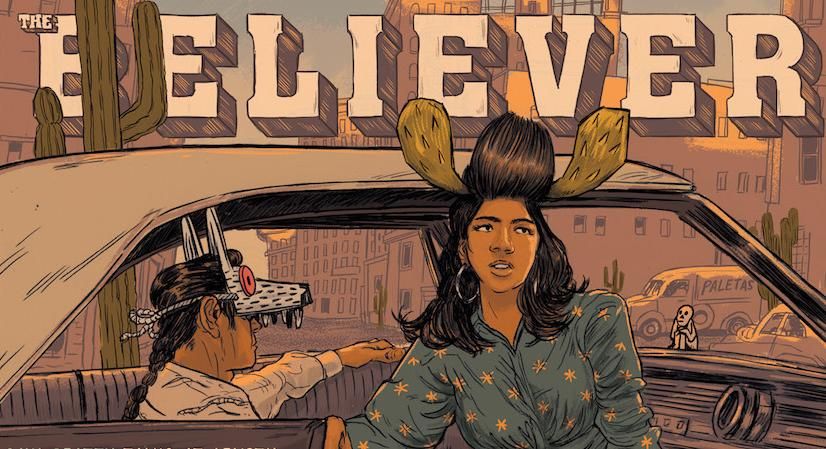
Founded in 2003, The Believer magazine gained a reputation for being an off-beat literary magazine with a commitment “to journalism and essays that are frequently very long, book reviews that are not necessarily timely, and interviews that are intimate, frank and also very long.” Founded by authors Vendela Vida, Ed Park and Heidi Julavits, and originally published Dave Eggers’ McSweeney’s, The Believer has featured contributions by Nick Hornby, Anne Carson, William T. Vollmann; columns by Amy Sedaris and Greil Marcus; and also interviews–like this one where director Errol Morris talks with filmmaker Werner Herzog.
Now published by the Black Mountain Institute at the University of Nevada, Las Vegas, The Believer has entered a new era. It has launched a brand new web site and made its 15-year archive freely available online. It’s a first for the publication. Enter the archive of the “highbrow but delightfully bizarre” magazine here.
If you would like to support the mission of Open Culture, consider making a donation to our site. It’s hard to rely 100% on ads, and your contributions will help us continue providing the best free cultural and educational materials to learners everywhere. You can contribute through PayPal, Patreon, and Venmo (@openculture). Thanks!
Related Content:
Enter “The Magazine Rack,” the Internet Archive’s Collection of 34,000 Digitized Magazines
Read 1,000 Editions of The Village Voice: A Digital Archive of the Iconic New York City Paper
Read More...An Asbestos-Bound, Fireproof Edition of Ray Bradbury’s Fahrenheit 451 (1953)
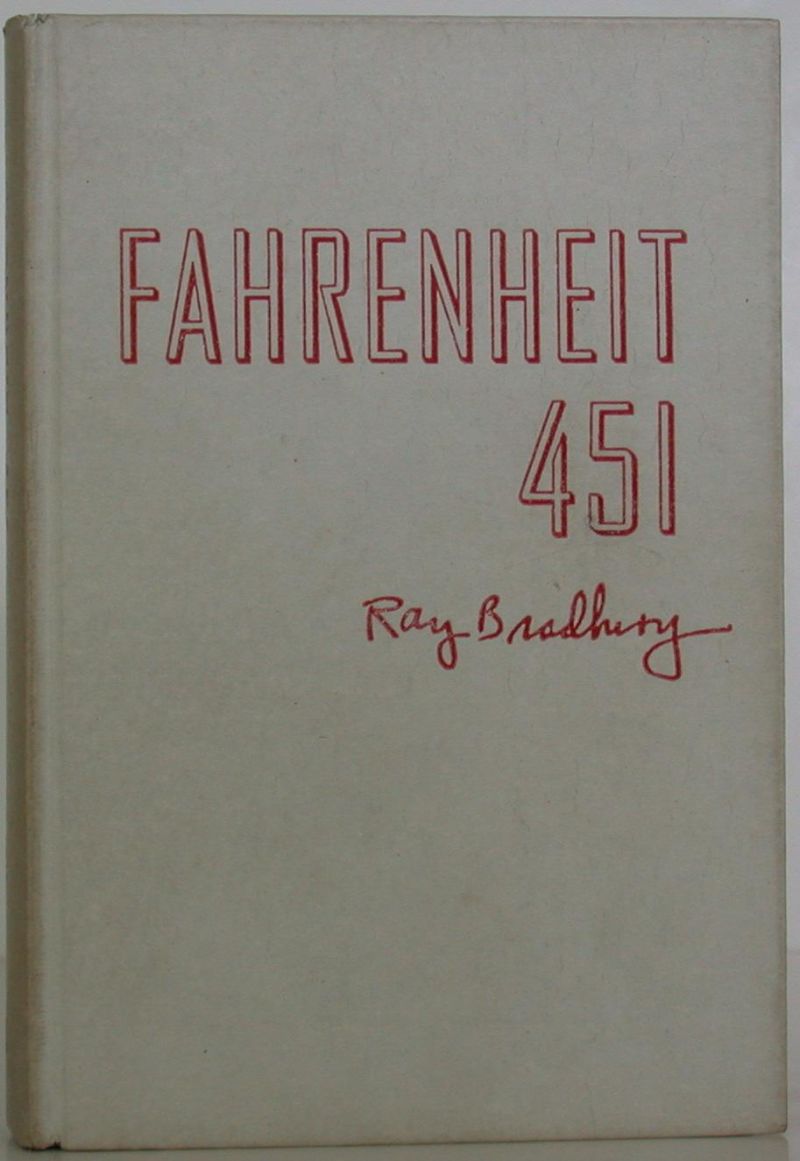
Even by the extreme standards of dystopian fiction, the premise of Ray Bradbury’s Fahrenheit 451 can seem a little absurd. Firemen whose job is to set fires? A society that bans all books? Written less than a decade after the fall of the Third Reich, which announced its evil intentions with book burnings, the novel explicitly evokes the kind of totalitarianism that seeks to destroy culture—and whole peoples—with fire. But not even the Nazis banned all books. Not a few academics and writers survived or thrived in Nazi Germany by hewing to the ideological orthodoxy (or at least not challenging it), which, for all its terrifying irrationalism, kept up some semblance of an intellectual veneer.
The novel also recalls the Soviet variety of state repression. But the Party apparatus also allowed a publishing industry to operate, under its strict constraints. Nonetheless, Soviet censorship is legendary, as is the survival of banned literature through self-publishing and memorization, vividly represented by the famous line in Mikhail Bulgokov’s The Master and Margarita, “Manuscripts don’t burn.”
Bulgakov, writes Nathaniel Rich at Guernica, is saying that “great literature… is fireproof. It survives its critics, its censors, and even the passage of time.” Bulgakov wrote from painful experience. When his diary was discovered by the NKVD in 1929, then returned to him, he “promptly burned it.” Sometime afterward, during the long composition of his posthumously published novel, he burned the manuscript, then later reconstructed it from memory.
These examples bring to mind the exiled intellectuals in Bradbury’s novel, who have memorized whole books in order to one day reconstruct literary culture. Europe’s totalitarian regimes provide essential background for the novel’s plot and imagery, but its key context, Bradbury himself noted in a 1956 radio interview, was the anti-Communist paranoia of the U.S. in the early 1950s. “Too many people were afraid of their shadows,” he said, “there was a threat of book burning. Many of the books were being taken off the shelves at that time.” Reading the novel as a chilling vision of a future when all books are banned and burned makes the artifact pictured above particularly poignant—an edition of Fahrenheit 451 bound in fireproof asbestos.
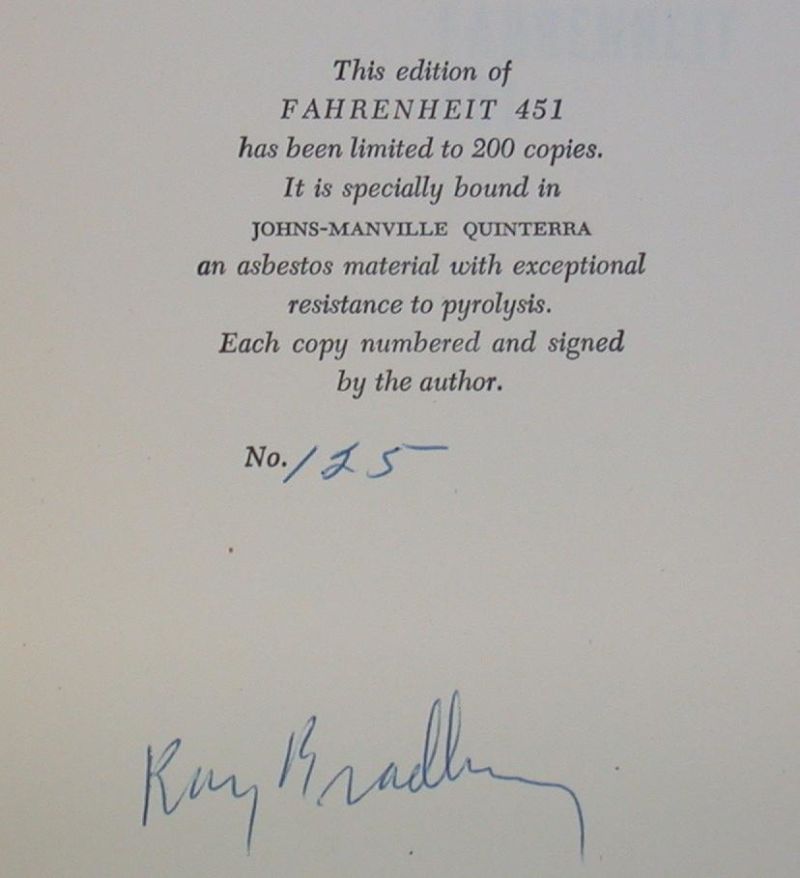
Released in 1953 by Ballantine in a limited run of two-hundred signed copies, the books were “bound in Johns-Manville Qinterra,” notes Lauren Davis at io9, “a chrysolite asbestos material.” Now the fireproof covers, with their “exceptional resistance to pyrolysis,” are “much sought after by collectors” and go for upwards of $20,000. A fireproof Fahrenheit 451, on the one hand, can seem a little gimmicky (its pages still burn, after all). But it’s also the perfect manifestation of a literal interpretation of the novel as a story about banning and book burning. All of us who have read the novel have likely read it this way, as a vision of a repressive totalitarian nightmare. As such, it feels like a product of mid-twentieth century fears.
Rather than fearing mass book burnings, we seem, in the 21st century, on the verge of being washed away in a sea of information (and dis- and mis-information). We are inundated with writing—in print and online—such that some of us despair of ever finding time to read the accumulating piles of books and articles that daily surround us, physically and virtually. But although books are still published in the millions, with sales rising, falling, then rising again, the number of people who actually read seems in danger of rapidly diminishing. And this, Bradbury also said, was his real fear. “You don’t have to burn books to destroy a culture,” he claimed, “just get people to stop reading them.”
We’ve misread Fahrenheit 451, Bradbury told us in his later years. It is an allegory, a symbolic representation of a grossly dumbed-down society, hugely oppressive and destructive in its own way. The firemen are not literal government agents but symbolic of the forces of mass distraction, which disseminate “factoids,” lies, and half-truths as substitutes for knowledge. The novel, he said, is actually about people “being turned into morons by TV.” Add to this the proliferating amusements of the online world, video games, etc. and we can see Bradbury’s Fahrenheit 451 not as a dated representation of 40s fascism or 50s repression, but as a too-relevant warning to a distractible society that devalues and destroys education and factual knowledge even as we have more access than ever to literature of every kind.
Related Content:
Josh Jones is a writer and musician based in Durham, NC. Follow him at @jdmagness
Read More...Meet Sergei Parajanov, the Filmmaker Persecuted & Imprisoned by the Soviets, and Championed by Tarkovsky, Fellini, Godard, Buñuel, and Others
“Whoever tries to imitate me is lost,” said the Soviet filmmaker Sergei Parajanov. Not so long ago, whoever tried to imitate him would also be in deep trouble. Persecuted by the Soviet authorities for the “subversive” nature of both his work and his lifestyle, he spent four years of the 1970s in a Siberian hard-labor camp. Nothing could speak more highly to his artistry than the fact that, even before his sentencing, Andrei Tarkovsky wrote a letter in his defense. “Artistically, there are few people in the entire world who could replace Parajanov,” argued the director of Mirror and Stalker. “He is guilty – guilty of his solitude. We are guilty of not thinking of him daily and of failing to discover the significance of a master.”
Alas, Tarkovsky’s protestations fell on deaf ears, as did those of Jean-Luc Godard, François Truffaut, Luis Buñuel, Federico Fellini, Michelangelo Antonioni, and other creators besides. Parajanov had earned their respect with two features, 1965’s Shadows of Forgotten Ancestors and 1969’s The Color of Pomegranates, clips of which you can see here.
The powers that be actually looked kindly on the former, praising its poetic adaptation of a classic novel by Ukranian writer Mykhailo Kotsiubynsky. But the latter, a life of the 18th-century Armenian singer Sayat-Nova (the Georgia-born director was himself of Armenian heritage), seems to have gone too far in its break from the state-approved style of Socialist realism in which Parajanov once worked.
“Even when he was released, Parajanov was ‘silenced,’ as he said,” writes Messy Nessy. “He tried to get back on his movie making, but struggled for another ten years until the Soviet Union collapsed in the 1980s. When he died in 1990 at only 66, he left his final work unfinished, leaving the world to wonder what other visions of his were lost to time.” As the world has since slowly rediscovered the visions Parajanov did realize, his influence has here and there made itself felt. “I believe you have to be born a director,” he says in the interview clip above. “A director can’t be trained, not even in film school.” Directing, to his mind, “is basically the truth, transformed into images: sorrow, hope, love, beauty.” And as all those respected auteurs understood, no other filmmaker has ever seen the truth quite like he did.
via Messy Nessy
Related Content:
Watch Earth, a Landmark of Soviet Cinema (1930)
The Film Posters of the Russian Avant-Garde
Based in Seoul, Colin Marshall writes and broadcasts on cities and culture. His projects include the book The Stateless City: a Walk through 21st-Century Los Angeles and the video series The City in Cinema. Follow him on Twitter at @colinmarshall or on Facebook.
Read More...How to Build a Custom Handcrafted Acoustic Guitar from Start to Finish: The Process Revealed in a Fascinating Documentary
Every serious guitarist learns to set up, repair, and maybe even customize their own instruments. It’s economical and fun and gives players insight into how and why their instruments sound the way they do, and how to make them sound better. Some amateur luthiers will even build their own instruments, at least those not famous enough to have custom guitars built for them by famous makers, an honor—maybe not unlike a basketball player having their own shoes—that tells the world they’re at the top of the game.
Everyone else labors away in basements, garages, and woodworking shops, leaning heavily on advice from master luthiers like Dan Erlewine. If you’re one of those lucky enough to have the space, tools, and know-how to make your own guitars, then the video above from Montreal-based master builder Michael Greenfield of Greenfield Guitars is for you. It shows every step in the process of his custom built acoustic guitars, and along the way shows you how you can build your own.
Electric guitars derive their sound from magnetic pickups, which can be affixed to everything from oil cans to plexiglass. Materials and workmanship can majorly affect tone and sustain, but not nearly to the degree they do in an acoustic guitar, in which the sound comes entirely from the instrument itself—from its shape, size, bracing style, wood selection, and even, believe it or not, the finish. The shaping, carving, and joining of each of the guitar’s structural parts—sides, top, back, and neck—makes its own unique contribution to the finished instrument’s tone.
Greenfield’s documentary isn’t only for the amateur—or professional, for that matter—luthier. It’s also an all-around fascinating look at how fine, hand-crafted acoustic guitars get made, of interest to anyone from woodworkers to sound engineers to music fans in general. Most consumer-grade guitars get an assembly-line factory build, turned out by the thousands to keep superstores like Guitar Center stocked. Master builders like Greenfield devote considerable time and attention to every individual instrument—the process documented here for a single guitar, he tells us, took place over a period of four to five months.
Want to hear the finished product? Skip ahead to 57:47 for a demonstration by Canadian Celtic-folk singer Lizzy Hoyt. Learn more about Michael Greenfield’s handcrafted guitars at greenfieldguitars.com.
Related Content:
Brian May’s Homemade Guitar, Made From Old Tables, Bike and Motorcycle Parts & More
Mark Knopfler Gives a Short Masterclass on His Favorite Guitars & Guitar Sounds
Josh Jones is a writer and musician based in Durham, NC. Follow him at @jdmagness
Read More...Every Cover of MAD Magazine, from 1952 to the Present: Behold 553 Covers from the Satirical Publication
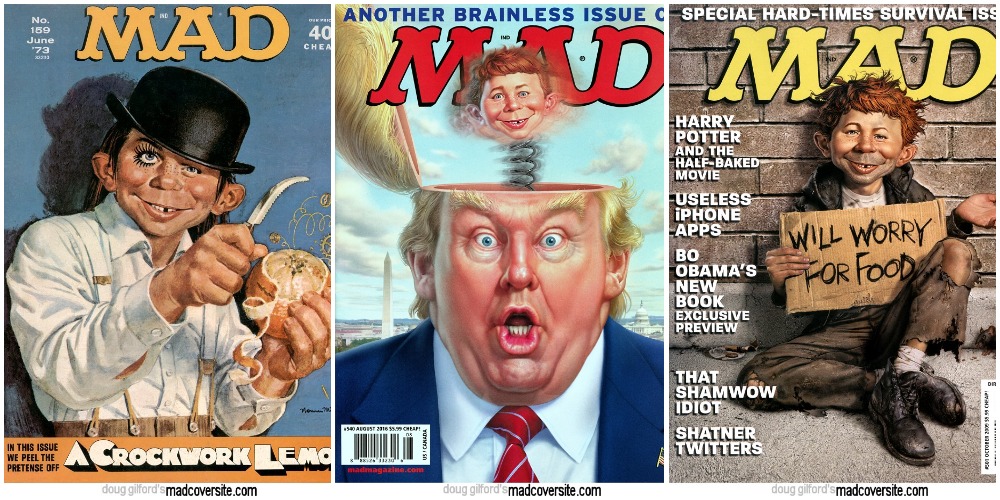
For 65 years and counting, the pages of Mad magazine have entertained readers by satirizing all the cultural items, social fads, news items, and political issues of the moment. Throughout that span of time the covers of Mad magazine have done the same, except that they’ve entertained everyone, even those who’ve never opened an issue, whether they want it or not. Though on one level designed purely as disposable visual gags, Mad’s covers collectively provide a satirical history of America, and one you can easily browse at Doug Gilford’s Mad Cover Site, “a resource for collectors and fans of the world’s most important (ecch!) humor publication.”
Gilford started the site back in 1997, a year that saw Mad’s covers take on such phenomena as The X‑Files, the Spice Girls, the Tamagotchi, and Seinfeld. That last seizes the presumably irresistible opportunity to draw Jerry Seinfeld scowling in irritation at “Neuman” — not his nemesis-neighbor Newman, but Mad’s mascot Alfred E. Neuman, who appears in one form or another on almost all of the magazine’s covers.
These sort of antics had already been going on for quite some time, as evidenced, for instance, by the June 1973 cover above in which Neuman dons a Droog outfit to take the place of Malcolm McDowell in A Clockwork Orange — or, in Mad’s, view, A Crockwork Lemon.
To see the archive’s covers in a large format, you need only scroll to the desired year, click on the issue number, and then click on the image that appears. (Alternatively, those with advanced Mad knowledge can simply pick an issue number from the pull-down “Select-a-Mad” menu at the top of the page.) Gilford keeps the site updated with covers right up to the latest issue: number three, as of this writing, since the magazine “rebooted” this past June as it relocated its offices from New York to California. Recent targets have included Donald Trump, Donald Trump, Donald Trump, and, of course, Donald Trump. Mad’s longevity may be surprising, but it certainly doesn’t look like America will stop providing the ridiculousness on which it has always survived any time soon.
Related Content:
A Gallery of Mad Magazine’s Rollicking Fake Advertisements from the 1960s
Mad Magazine’s Al Jaffee & Other Cartoonists Create Animations to End Distracted Driving
Enter “The Magazine Rack,” the Internet Archive’s Collection of 34,000 Digitized Magazines
Based in Seoul, Colin Marshall writes and broadcasts on cities and culture. His projects include the book The Stateless City: a Walk through 21st-Century Los Angeles and the video series The City in Cinema. Follow him on Twitter at @colinmarshall or on Facebook.
Read More...New York Public Library Card Now Gives You Free Access to 33 NYC Museums

If you’re one of the 8.5 million people living in New York City, take note of this: When you sign up for a library card from the New York Public Library, you can get access to 30,000 free movies (including many from the Criterion Collection) and also some 300,000 Free eBooks. But that’s not all. A new initiative lets members of the New York Public Library (plus the Brooklyn and Queens libraries) to sign up for a Culture Pass and thereby gain free entrance to 33 museums across NYC. The list of participating museums includes some big ones–the Met, Morgan, Whitney, Frick and Guggenheim. Also the MoMA, Brooklyn Museum, and Brooklyn Botanic Garden, and more. Find a complete list below.
The Culture Pass website has more information about this new program. The website is also where you will need to actually make reservations to visit the museums. According to Hyperallergic, “Each cardholder is eligible for one pass per cultural institution annually and allowed to reserve two impending visits at any given time.”
New Yorkers, you can sign up for library cards via these links: New York Public Library, Brooklyn Library, and Queens Library.
If you would like to support the mission of Open Culture, consider making a donation to our site. It’s hard to rely 100% on ads, and your contributions will help us continue providing the best free cultural and educational materials to learners everywhere. You can contribute through PayPal, Patreon, and Venmo (@openculture). Thanks!
Participating Museums
- Brooklyn Botanic Garden
- Brooklyn Children’s Museum
- Brooklyn Historical Society
- Brooklyn Museum
- Children’s Museum of Manhattan
- Children’s Museum of the Arts
- Cooper Hewitt, Smithsonian Design Museum
- The Drawing Center
- The Frick Collection
- Historic Richmond Town
- International Center of Photography
- Intrepid Sea, Air & Space Museum
- Jacques Marchais Museum of Tibetan Art
- The Jewish Museum
- Louis Armstrong House
- The Metropolitan Museum of Art
- The Morgan Library & Museum
- Museum of Modern Art, MoMA PS1
- Museum of Chinese in America
- Museum of Jewish Heritage — A Living Memorial to the Holocaust
- Museum of the City of New York
- New York Transit Museum
- Noguchi Museum
- Queens Historical Society
- Queens Museum
- Rubin Museum of Art
- SculptureCenter
- Smithsonian National Museum of the American Indian
- Society of Illustrators
- Solomon R. Guggenheim Museum
- Sugar Hill Children’s Museum
- Wave Hill
- Whitney Museum of American Art
Related Content:
The New York Public Library Lets Patrons Download 300,000 eBooks
Read More...Support Us
We're hoping to rely on loyal readers, rather than erratic ads. Please click the Donate button and support Open Culture. You can use Paypal, Venmo, Patreon, even Crypto! We thank you!

About Us

Open Culture scours the web for the best educational media. We find the free courses and audio books you need, the language lessons & educational videos you want, and plenty of enlightenment in between.
Advertise With Us

FREE UPDATES!
GET OUR DAILY EMAIL
Get the best cultural and educational resources on the web curated for you in a daily email. We never spam. Unsubscribe at any time.
FOLLOW ON SOCIAL MEDIA

Open Culture editor Dan Colman scours the web for the best educational media. He finds the free courses and audio books you need, the language lessons & movies you want, and plenty of enlightenment in between.
Advertise With Us

