Watch the Original TV Coverage of the Historic Apollo 11 Moon Landing: Recorded on July 20, 1969
During a recent dinner a few friends and I found ourselves reminiscing about formative moments in our collective youth. The conversation took a decidedly downbeat turn when a nationally televised moment we all remembered all too well came up: the 1986 explosion of the space shuttle Challenger. Like millions of other schoolkids at the time we had been glued to the live broadcast, and became witnesses to horror. “It was NASA’s darkest tragedy,” writes Elizabeth Howell at Space.com, an accident that “changed the space program forever.”
The contrast with our parents’ indelible memories of a televised space broadcast from seventeen years earlier could not be starker. On July 20, 1969, the nation witnessed what could easily be called NASA’s greatest triumph, the Apollo 11 moon landing, which not only really happened, but was broadcast live on CBS, with commentary by Walter Cronkite and former astronaut Wally Schirra and live audio from Mission Control in Houston and Buzz Aldrin himself, “whose job during the landing,” Jason Kottke writes, “was to keep an eye on the LM (lunar module)’s altitude and speed.”
We don’t hear much from Neil Armstrong—“he’s busy flying and furiously searching for a suitable landing site. But it’s Armstrong that says after they land, ‘Houston, Tranquility Base here. The Eagle has landed.’” Kottke’s fascinating description of the events points out details that heighten the drama, such as the fact that Armstrong’s heartrate “peaked at 150 beats per minute at landing” (his resting heartrate was 60 bpm). At around 10 minutes to landing, the astronauts link to Mission Control cut out briefly, which must have been terrifying.
“Then there were the intermittent 1201 and 1202 program alarms, which neither the LM crew nor Houston had encountered in any of the training simulations.” These turn out “to be a simple case,” notes NASA, “of the computer trying to do too many things at once.” Given that the Lunar Module’s computer only had 4KB of memory, this is hardly a surprise. What is astonishing is that such a relatively primitive machine could handle the task at all.
The film viewers saw on their screens was not, of course, a live feed—CBS did not have cameras in space or on the moon—but rather an animation.
The CBS animation shows the fake LM landing on the fake Moon before the actual landing — when Buzz says “contact light” and then “engine stop”. The animation was based on the scheduled landing time and evidently couldn’t be adjusted. The scheduled time was overshot because of the crater and boulders situation mentioned above.
There were, however, cameras mounted on the Lunar Module, and that 16mm footage of the landing, which you can see above, was later released. And then there’s that moon walk (which really happened), which you can see below—blurry and indistinct but no less amazing.
Just a little over eight years “since the flights of Gagarin and Shepard,” NASA writes, “followed quickly by President Kennedy’s challenge to put a man on the moon before the decade is out,” it happened. Armstrong, Aldrin, and Michael Collins landed on the moon. Armstrong and Aldrin walked around and collected samples for two hours, then returned safely to Earth. In a post-flight press conference, Armstrong called the successful mission “a beginning of a new age,” and it was, though his optimism would seem almost quaint when a couple decades later, the U.S. turned its sights on weaponizing space.
Read more about this extraordinary event at NASA and Kottke.
via Kottke
Related Content:
Stanley Kubrick’s Daughter Vivian Debunks the Age-Old Moon Landing Conspiracy Theory
The Source Code for the Apollo 11 Moon Landing Mission Is Now Free on Github
Josh Jones is a writer and musician based in Durham, NC. Follow him at @jdmagness
Read More...The Discipline of D.E.: Gus Van Sant Adapts a Story by William S. Burroughs (1978)
Everyone who’s read Jack Kerouac knows what it means to go visit the sage Old Bill Lee. And even many who haven’t read Kerouac know who Old Bill Lee really was: innovative writer, Beat Generation elder statesman, and substance enthusiast William S. Burroughs. Gus Van Sant, who had imbibed from the counterculture early on, paid his own visit to Old Bill Lee a few years after graduating from the Rhode Island School of Design. On a recent episode of WTF, Van Sant tells Marc Maron how, having read a Burroughs essay called “The Discipline of DE” back in Providence, he looked Burroughs up in the New York City phone book, called him, and paid him a visit — not just because Kerouac’s characters did it, but because he wanted the rights to turn the story into a film.
The resulting nine-minute short puts images to Burroughs’ words. “DE is a way of doing,” says its narrator Ken Shapiro, who had directed the television-satrizing cult film The Groove Tube a few years earlier. “DE simply means doing whatever you do in the easiest most relaxed way you can manage, which is also the quickest and most efficient way, as you will find as you advance in DE.”
We then see various cinematically illustrated examples of DE in action, including “the art of ‘casting’ sheets and blankets so they fall just so,” picking up an object by dropping “cool possessive fingers onto it like a gentle old cop making a soft arrest,” and even gun fighting in the old west as practiced by Wyatt Earp, the only gun fighter who “ever really grasped the concept of DE.”
Van Sant completed The Discipline of DE, his sixth short film, in 1978. Just over a decade later he would cast Burroughs in a highly Old Bill Lee-like role in his second feature Drugstore Cowboy, bringing him back a few years later for Even Cowgirls Get the Blues. Van Sant adapted both of those films from novels, as he’s done in much of his filmography. Traveling Europe with a film club after college, he told Maron, he got the chance to visit famed auteurs like Federico Fellini, Lina Wertmüller, and Pier Paolo Pasolini. It was Pasolini to whom he explained his own ambition in filmmaking: “to translate literature into film.” Paolini’s less-than-encouraging response: “Why would you do that? Why would you bother?” Yet Van Sant’s drive to make cinema “more malleable, like the novel,” has served him well ever since, as — if he adheres to it — has the discipline of DE.
Related Content:
The Making of Drugstore Cowboy, Gus Van Sant’s First Major Film (1989)
William S. Burroughs’ “The Thanksgiving Prayer,” Shot by Gus Van Sant
William S. Burrough’s Avant-Garde Movie ‘The Cut Ups’ (1966)
William S. Burroughs’ Home Movies, Featuring Patti Smith, Allen Ginsberg, Steve Buscemi & Cats
Based in Seoul, Colin Marshall writes and broadcasts on cities and culture. His projects include the book The Stateless City: a Walk through 21st-Century Los Angeles and the video series The City in Cinema. Follow him on Twitter at @colinmarshall or on Facebook.
Read More...What Is Stoicism? A Short Introduction to the Ancient Philosophy That Can Help You Cope with Our Hard Modern Times
The word “stoic” (from the Greek stoa) has come to mean a few things in popular parlance, most of them related directly to the ancient Greek, then Roman, philosophy from which the term derives. Stoic people seem unmovable. They stay cool in a crisis and “keep calm and carry on” when others lose their heads. For several, perhaps obvious, reasons, these qualities of “calm, resilience, and emotional stability” are particularly needed in a time like ours, says Alain de Botton in his School of Life video above.
But how do we acquire these qualities, according to the Stoics? And what philosophers should we consult to learn about them? One of the most prolific of Stoic philosophers, the Roman writer and statesman Seneca, advised a typical course of action. In a letter to his friend Lucilius, who feared a potentially career-ending lawsuit, Seneca counseled that rather than resting in hopes of a happy outcome, his friend should assume that the worst will come to pass, and that, no matter what, he can survive it.
The goal is not to make Debbie Downers of us all, but to convince us that we are stronger than we think—that even our worst fears needn’t mean the end of the world. Seneca’s stoicism is a thoroughgoing realism that asks us to account for the entire range of possible outcomes—even the absolute worst we can imagine—rather than only those things we want or have previously experienced. In this way, we will not be caught off-guard when bad things come to pass, because we have already made a certain peace with them.
Rather than a pessimistic philosophy, Seneca’s thought seems entirely practical, a means of piercing our pleasant illusions and comfortable bubbles of self-regard, and considering ourselves just as subject to misfortune as anyone else in the world, and just as capable of enduring it as well.
To partake of Seneca’s wisdom yourself, consider reading this online three-volume collection of his letters, The Tao of Seneca. And for a longer list of Stoic thinkers, ancient and modern, see this post from Ryan Holiday of the Daily Stoic, a blog that offers useful Stoic advice for contemporary people.
Related Content:
Three Huge Volumes of Stoic Writings by Seneca Now Free Online, Thanks to Tim Ferriss
Josh Jones is a writer and musician based in Durham, NC. Follow him at @jdmagness
Read More...Watch Kraftwerk Perform a Real-Time Duet with a German Astronaut Living on the International Space Station
Last Friday, Alexander Gerst, an astronaut living aboard the International Space Station, welcomed Kraftwerk and 7500 attendees to the Jazz Open Festival in Stuttgart. There, writes the European Space Agency, “Kraftwerk founding member Ralf Hütter and Alexander played a special duet version of the track Spacelab, for which Alexander had a tablet computer configured with virtual synthesizers on board.” You can watch the far-out scene play out above.
If you would like to support the mission of Open Culture, consider making a donation to our site. It’s hard to rely 100% on ads, and your contributions will help us continue providing the best free cultural and educational materials to learners everywhere. You can contribute through PayPal, Patreon, and Venmo (@openculture). Thanks!
Related Content:
The Psychedelic Animated Video for Kraftwerk’s “Autobahn” from 1979
Kraftwerk’s “The Robots” Performed by German First Graders in Adorable Cardboard Robot Outfits
Kraftwerk’s First Concert: The Beginning of the Endlessly Influential Band (1970)
Read More...What a Conductor Actually Does on Stage: Two Short Videos Explain the Little-Understood Art
When we imagine a symphony orchestra, even those of us otherwise unfamiliar with classical music imagine a conductor standing up front. We know the conductor leads the orchestra, but how exactly does he/she do it? “What the public needs to understand about conducting is that it’s an anticipatory art,” says conductor James Gaffigan in the short Vox explainer video above. “What we do takes place before the music happens,” all of it meant “to do justice to the composer.” He then breaks down the function of the main tools available to the conductor to do that: the right hand, which holds the baton, and the left hand, which “has a much more complicated, strange role in our physical world.”
Clearly some aspects of conducting aren’t so easily explained. Hence the beauty of conducting as an art form, which encompasses exemplars as different as Gustav Mahler, represented in his day by caricatures “making crazy gestures” and “jumping up and down on the podium,” and Mahler’s contemporary Richard Strauss, who conducted by “barely moving.”
Gaffigan also brings in the example of Leonard Bernstein, the best-known conductor of the 20th century in the West, who in recordings of his performances is “always dancing,” who “can’t help moving around the podium, and his rhythm is contagious.” (But as Open Culture readers know, Bernstein could also conduct with only his eyebrows.)
You can hear, and see, another perspective on what a conductor does in the New York Times video just above. “There’s no way to really put your finger on what makes conducting great, even what makes conducting work,” says New York Philharmonic director Alan Gilbert. Gilbert provides several examples of the techniques he uses while conducting not just to tell which musicians to start playing when, but to imbue their collective performance with just the desired textures and nuances and bring out all the layers of the music and the relationship between them. All the while, the conductor must remain in constant communication: sometimes with all the players at once, sometimes with just one section, and sometimes with just one individual.
“There are some conductors who look as if they’re incredibly well put together, and physically all in order,” Gilbert says. “That doesn’t necessarily mean that you’ll hear inspired music-making. There will be some conductors whose technique is ostensibly all over the place, not necessarily so clear, but something comes across, and it can even be extremely precise.” A conductor can have all manner of ideas about how the orchestra should play, but without the faith of the musicians, none of those ideas can take musical form. “One of the ways to make your sound better is to make it really obvious that you’re really listening, and that it really matters to you what it sounds like. That’s not actually conducting; that’s embodying or representing an aspiration.” Conductors, in other words, must be the music they wish to hear.
Related Content:
What Happens When Everyday People Get a Chance to Conduct a World-Class Orchestra
Watch Leonard Bernstein Conduct the Vienna Philharmonic Using Only His Eyebrows
Based in Seoul, Colin Marshall writes and broadcasts on cities and culture. His projects include the book The Stateless City: a Walk through 21st-Century Los Angeles and the video series The City in Cinema. Follow him on Twitter at @colinmarshall or on Facebook.
Read More...Stream Online the Complete “Lost” John Coltrane Album, Both Directions at Once
Expectations ran high when it was announced last month that a lost (!) John Coltrane album, Both Directions at Once, had been discovered by the family of his ex-wife Naima, and would finally be released for fans to hear. Would it prove worthy of Sonny Rollin’s comparison to “finding a new room in the Great Pyramid”? Such discoveries can lead to dead ends and disappointments as often as to revelations. In this case, the album yields neither, which is not to say it isn’t, as Chris Morris writes at Variety, “a godsend.”
The album lives up to its title, chosen by Coltrane’s son Ravi, as a transitional document, stunning, but not particularly surprising. Hear all 7 cuts on the single-disc version of the release on this page, with typically excellent playing by Coltrane’s classic quartet (bassist Jimmy Garrison, drummer Elvin Jones, and pianist McCoy Tyner) and an early take on “one of the warhorses of the Coltrane catalog”—“Impressions”—including three additional takes on the Deluxe Version, which you can stream on Spotify here or purchase here. (Tyner sits out the take on the single disc version, turning it into a “hard-edged, percolating showcase for Coltrane in trio format.”)
Several critics have suggested that this “lost album” isn’t a proper album at all, but rather, as Ravi Coltrane put it, “a kicking-the-tires kind of session,” and perhaps that’s so. Nonetheless, it works as “a portrait of an artist and a band on the brink of a historic explosion,” Morris writes.
“The bracing, probing, self-questioning and keenly played music on this collection is the missing link between the provisional work heard on 1962’s ‘Coltrane’ and the quartet’s epochal studio albums – ‘Crescent,’ the devout ‘A Love Supreme’ and (with additional personnel) the free jazz magnum opus ‘Ascension.’”
Others echo this assessment. Drowned in Sound’s Joe Goggins calls Both Directions at Once “hard evidence that he was still looking for new sounds within old structures,” and The New Yorker’s Richard Brody describes the session as “something of a stocktaking” that balances the experiments of the band’s live sets with the reigned-in discipline of its early 60s studio work. Brody also laments that “little on the album matches the music that Coltrane was making at the time in concert.” Winston Cook-Wilson at Spin describes the music as “sometimes at war with itself…. The contrasts of their catalogue are pushed against each other, sometimes within the same song.”
All of this internal tension makes for an exciting listen, especially in its two new originals, known only as “Untitled Original 11383” and “Untitled Original 11386,” and the 11-minute “Slow Blues,” which Morris aptly describes as “a geared-down, encyclopedic workout on blues changes” that builds, after its tempo doubles, to a “full-cry conclusion.”
In all, the new lost album shows Coltrane just about to break new ground, but not quite yet, which perhaps makes it a newly essential document for the Coltrane completist. For most lovers of the great innovator, it’s just a damn fine “new” Coltrane record, both daring and accessible at once.
Related Content:
John Coltrane’s Handwritten Outline for His Masterpiece A Love Supreme (1964)
Josh Jones is a writer and musician based in Durham, NC. Follow him at @jdmagness
Read More...The 10 Rules for Students and Teachers Popularized by John Cage: “Nothing Is a Mistake,” “Consider Everything an Experiment” & More
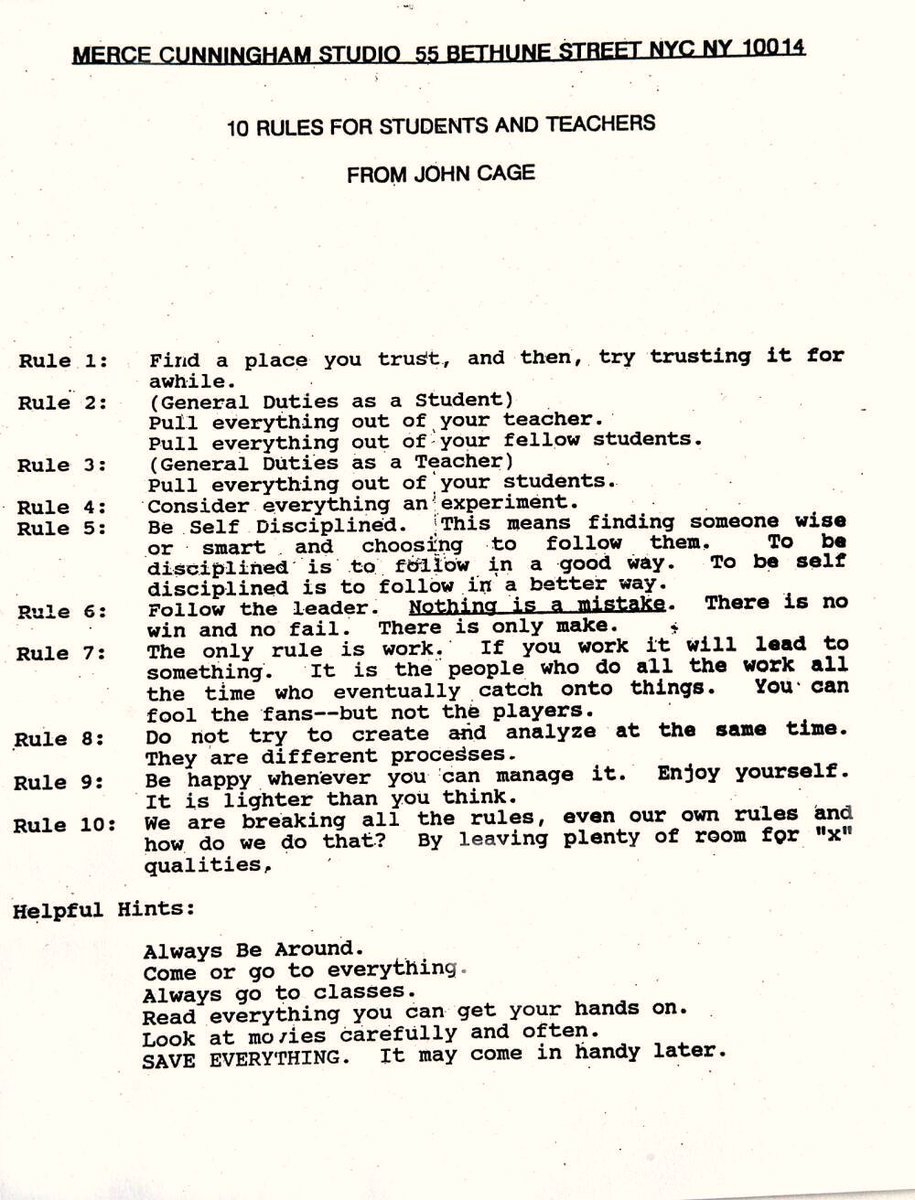
The Brian Eno archive More Dark than Shark recently posted on its Twitter account a list of twelve rules for students and teachers used by John Cage. Though much has been written about the artistic affinities between Eno and Cage, both of whose compositions have pushed the boundaries of how we think about music itself, they also both have a deep connection to the idea of using rules to enhance the experience of creation. Where Eno has his deck of creative process-enhancing Oblique Strategies cards, Cage had this list of rules first composed by an educator, silkscreen artist, and nun named Sister Corita Kent.
Kent came up with the list, writes Brainpickings’ Maria Popova, “as part of a project for a class she taught in 1967–1968. It was subsequently appropriated as the official art department rules at the college of LA’s Immaculate Heart Convent, her alma mater, but was commonly popularized by Cage, whom the tenth rule cites directly.”
That tenth rule, more of a meta-rule, reminds the reader that “we’re breaking all the rules” by “leaving plenty of room for X quantities.” But one can easily imagine how the previous nine, having as much to do with the enjoyment of the work of learning, teaching, and creating as with its rigorous performance, might appeal to Cage as well. The complete list runs as follows:
RULE ONE: Find a place you trust, and then try trusting it for a while.
RULE TWO: General duties of a student: Pull everything out of your teacher; pull everything out of your fellow students.
RULE THREE: General duties of a teacher: Pull everything out of your students.
RULE FOUR: Consider everything an experiment.
RULE FIVE: Be self-disciplined: this means finding someone wise or smart and choosing to follow them. To be disciplined is to follow in a good way. To be self-disciplined is to follow in a better way.
RULE SIX: Nothing is a mistake. There’s no win and no fail, there’s only make.
RULE SEVEN: The only rule is work. If you work it will lead to something. It’s the people who do all of the work all of the time who eventually catch on to things.
RULE EIGHT: Don’t try to create and analyze at the same time. They’re different processes.
RULE NINE: Be happy whenever you can manage it. Enjoy yourself. It’s lighter than you think.
RULE TEN: We’re breaking all the rules. Even our own rules. And how do we do that? By leaving plenty of room for X quantities.
HINTS: Always be around. Come or go to everything. Always go to classes. Read anything you can get your hands on. Look at movies carefully, often. Save everything. It might come in handy later.
Some of the rules on Kent’s list, which has now exerted its influence for half a century, sound faintly like the Oblique Strategies Eno and the painter Peter Schmidt would come up with in the 1970s. Take rule number six, “Nothing is a mistake,” which brings to mind the Oblique Strategy “Honor thy error as a hidden intention.” But we’re all on the same field when it comes to techniques to move our minds in worthwhile new directions, as Cage, Kent, Eno, Schmidt, and most other serious students, teachers, and creators might agree. They’d certainly agree that, all rules aside, everything ultimately comes down to doing the work itself, day in and day out. “Craft,” as Eno once said,” is what enables you to be successful when you’re not inspired.”
Related Content:
An Impressive Audio Archive of John Cage Lectures & Interviews: Hear Recordings from 1963–1991
How to Get Started: John Cage’s Approach to Starting the Difficult Creative Process
Jump Start Your Creative Process with Brian Eno’s “Oblique Strategies” Deck of Cards (1975)
Based in Seoul, Colin Marshall writes and broadcasts on cities and culture. His projects include the book The Stateless City: a Walk through 21st-Century Los Angeles and the video series The City in Cinema. Follow him on Twitter at @colinmarshall or on Facebook.
Read More...Hear Miles Davis & John Coltrane Battle It Out on Their Final Tour Together, 1960
One of the greatest tour stories of jazz takes place not in its birthplace but in Europe, where John Coltrane reluctantly joined Miles Davis for a nine-date “Jazz At The Philharmonic European Tour” in 1960. It’s not down to any shenanigans offstage, but the pure musical fire that erupted onstage. This is the sound of two geniuses pulling apart and heading in different directions. They may have returned to the States at the same terminus, but Coltrane and Davis landed on different planets afterwards.
You can hear that in the above video. Kind of Blue had been released the year before–imagine a time where that was the case!–and here the Davis quintet dive in to “So What” with a fury not heard on the record.
The concerts have been endlessly bootlegged, and rightly so. They are stunning. Several were recorded for radio broadcast, others went into the hands of collectors. Not all of the nine dates are complete, but there’s plenty of magic in those sets to satisfy the curious.
But the final meeting of Coltrane and Davis nearly didn’t happen. Months after the release of Kind of Blue, Coltrane had recorded Giant Steps and was pretty much ready to go his own way. But Davis pleaded with Coltrane–he knew the material really well, of course, having played it all that year–who eventually, reluctantly gave in. (Coltrane did suggest Wayne Shorter take his place, and Davis later brought the young sax man into the group).
Along with Davis and Coltrane, the European tour quintet featured pianist Wynton Kelly, bassist Paul Chambers, and drummer Jimmy Cobb. And according to Cobb, it was obvious Coltrane’s mind was elsewhere on the trip.
“He sat next to me on the bus, looking like he was ready to split at any time. He spent most of the time looking out the window and playing Oriental-sounding scales on soprano.”
But when he was onstage, that tension resulted in the kind of mind-melting solos that made these recordings so essential. The “sheets of sound” that one critic used to describe Coltrane’s style is all here, as are moments where Coltrane just seems to be obsessed with two or three notes, toying with them, trying to uncover their essence. (Some in the audience thought it was too indulgent–you can hear them whistling in disapproval on some of the numbers.) In some of these recordings you also hear Davis becoming the sideman in his own band as Coltrane takes off into the stratosphere. By the way, you can stream the full album on Spotify.
It’s not animosity, just the sound of two artists going their own way, and that’s rarely something that gets recorded. Fortunately, the best of five dates–two in Paris, two in Stockholm, one in Copenhagen–are now officially released, 50-some odd years later for the rest of us to enjoy.
Related Content:
Hear a 65-Hour, Chronological Playlist of Miles Davis’ Revolutionary Jazz Albums
Kind of Blue: How Miles Davis Changed Jazz
Ted Mills is a freelance writer on the arts who currently hosts the artist interview-based FunkZone Podcast and is the producer of KCRW’s Curious Coast. You can also follow him on Twitter at @tedmills, read his other arts writing at tedmills.com and/or watch his films here.
Read More...David Foster Wallace Explains How David Lynch’s Blue Velvet Taught Him the True Meaning of Avant Garde Art
Imagine you’re a “hypereducated avant-gardist in grad school learning to write.” But at your grad school, “all the teachers are realists. They’re not at all interested in postmodern avant-garde stuff.” They take a dim view of your writing, you assume because “they just don’t happen to like this kind of aesthetic,” but actually because your writing isn’t very good. Amid all this, with you “hating the teachers but hating them for exactly the wrong reasons,” David Lynch’s Blue Velvet comes out. Not only does it belong to “an entirely new and original kind of surrealism,” it shows you that “what the really great artists do is they’re entirely themselves. They’ve got their own vision, their own way of fracturing reality, and that if it’s authentic and true, you will feel it in your nerve endings.”
This happened to David Foster Wallace, as he says in the clip above from his 1997 appearance on Charlie Rose, one of his very few interviews on video. He went on the show, seemingly under duress, to promote his collection A Supposedly Fun Thing I’ll Never Do Again, which among its long-form essays on the cruise ship experience, the Illinois State Fair, and professional tennis contains a piece on the man who made Blue Velvet.
“Lynch has remained remarkably himself throughout his filmmaking career,” Wallace writes in the version of the article that first ran in Premiere. Whether “Lynch hasn’t compromised or sold out” or whether “he hasn’t grown all that much,” the fact remains that he has “held fast to his own intensely personal vision and approach to filmmaking, and that he’s made significant sacrifices in order to do so.”
Elsewhere in the piece, Wallace describes the adjective “Lynchian” as “referring to a particular kind of irony where the very macabre and the very mundane combine in such a way as to reveal the former’s perpetual containment within the latter.” When Rose asks Wallace about the meaning of the word, Wallace explains that “a regular domestic murder is not Lynchian. But if the police come to the scene and see the man standing over the body and the woman’s 50s bouffant is undisturbed and the man and the cops have this conversation about the fact that the man killed the woman because she persistently refused to buy, say, for instance, Jif peanut butter rather than Skippy, and how very, very important that is, and if the cops found themselves somehow agreeing that there were major differences between the brands and that a wife who didn’t recognize those differences was deficient in her wifely duties, that would be Lynchian.”
A few years ago Youtube channel Dom’s Sketch Cast turned Wallace’s vision of an ideally Lynchian scene into the animation above. Lynch’s visions exist, Wallace says to Rose, at “this weird confluence of very dark, surreal, violent stuff and absolute, almost Norman Rockwell-banal American stuff, which is terrain he’s been working for quite a while — I mean, at least since Blue Velvet.” Though Lynch may owe certain stylistic debts — “to Hitchcock, to Cassavetes, to Robert Bresson and Maya Deren and Robert Wiene” — nothing like the Lynchian existed in any tradition before he came along. Lynch has his detractors, but “if you think about the outrageous kinds of moral manipulation we suffer at the hands of most contemporary directors, it will be easier to convince you that something in Lynch’s own clinically detached filmmaking is not only refreshing but redemptive” — and, as a young David Foster Wallace found in the theater that spring of 1986, revelatory.
Related Content:
What Makes a David Lynch Film Lynchian: A Video Essay
The Surreal Filmmaking of David Lynch Explained in 9 Video Essays
David Foster Wallace on What’s Wrong with Postmodernism: A Video Essay
David Foster Wallace’s Surprising List of His 10 Favorite Books, from C.S. Lewis to Tom Clancy
30 Free Essays & Stories by David Foster Wallace on the Web
Based in Seoul, Colin Marshall writes and broadcasts on cities and culture. His projects include the book The Stateless City: a Walk through 21st-Century Los Angeles and the video series The City in Cinema. Follow him on Twitter at @colinmarshall or on Facebook.
Read More...Patti Smith Reads Oscar Wilde’s 1897 Love Letter De Profundis: See the Full Three-Hour Performance
In her landmark study The Body in Pain, Elaine Scarry describes “the annihilating power of pain,” which is “visible in the simple fact of experience observed by Karl Marx, ‘There is only one antidote to mental suffering, and that is physical pain.’” Marx’s comment defines a class distinction between types of pain: that of the overtaxed body of the worker and the mind of the bourgeois subject with the liberty for morbid self-reflection. His pronouncement, Scarry writes, is “only slightly distorted in Oscar Wilde’s ‘God spare me physical pain and I’ll take care of the moral pain myself,’” a somewhat glib admission of the relative privilege of mental suffering in comparison to torture.
This distinction becomes even more pronounced in later reflections, such as ultra-conservative German writer and WWI war hero Ernst Jünger’s Nietzschean 1934 essay “On Pain,” which asks, “what role does pain play in the new race we have called the worker that is now making its appearance on the historical stage?” Physical pain, writes Jünger is one of “several great and unalterable dimensions that show a man’s stature… the most difficult in a series of trials one is accustomed to call life…. Tell me your relation to pain, and I will tell you who you are!”
This idea of the sharpening effect of physical pain as an “antidote” or heroic trial distinct from mental suffering persists long into the 20th century when Freudian trauma studies, the diagnosis of PTSD in veterans, and the work of psychiatrists like Bessel Van Der Kolk begins to collapse the categories and unite the suffering of mind and body. The experiences of soldiers, prisoners, victims of abuse and assault, Holocaust survivors, enslaved people, etc. are then seen in a different light, as composed of emotional anguish as real as their physical suffering, which manifests somatically and in extreme cases even, perhaps, alters DNA.
Long before the paradigmatic shift in the recognition of trauma, Wilde, who had made light of “moral pain” in his aphorism, explored suffering in great depth in his De Profundis. Ostensibly an open letter to his lover Lord Alfred Douglass, Wilde penned the piece while imprisoned in Reading Jail from 1895–97 for “gross indecency.” While there, he endured both physical and psychological torment. As Ireland’s Raidió Teilifís Éireann writes:
Wilde was kept in total isolation, first in Pentonville and Wandsworth prisons. For the first month of his sentence, he was tethered to a treadmill six hours a day, with five minutes’ rest after every 20 minutes. At Reading Jail, to which he was moved in November 1895, he slept on a plank bed with no mattress and he was allowed only one hour’s exercise a day. He would walk in single file in the yard with other prisoners but was forbidden contact with them. Wilde slept little, was hungry all of the time, and suffered from dysentery during his incarceration.
During his two-year incarceration, his mother died. “I, once a lord of language,” he wrote, “have no words in which to express my anguish and shame.” Nonetheless, he found the words, a profusion of them, writes Max Nelson at The Paris Review, “petulant, vindictive, bathetic, indulgent, excessive, florid, massively arrogant, self-pitying, repetitive, showy, sentimental, and shrill,” searching, as he put it, to express “that mode of existence in which soul and body are one and indivisible: in which the outward is expressive of the inward: in which Form reveals.”
They were first published in 1905 in an edited version, and it is that version you can hear read—prefaced by a sung lament—above in a dolorous monotone by Patti Smith, who conveys with voice and body the tenor of Wilde’s prose. The letter, writes Wilde’s biographer Richard Ellmann, is “one of the greatest and the longest” love letters “ever written.” (See a scan of the original manuscript at the British Library site.)
The reading took place in the former chapel of Reading Jail in 2016, opened to the public for the first time “for an exhibition of art, writing and performance,” notes Artangel, sponsor of the event. We’ve previously featured a short excerpt of Smith’s reading. Above, you can see her full 3‑hour performance, complete with her own interjections and interactions with the audience. De Profundis begins with one of the most eloquent descriptions of deep depression in modern literature, an experience of paralysis that traps its sufferer in a mental prison of stuckness in time:
. . . Suffering is one very long moment. We cannot divide it by seasons. We can only record its moods, and chronicle their return. With us time itself does not progress. It revolves. It seems to circle round one centre of pain. The paralysing immobility of a life every circumstance of which is regulated after an unchangeable pattern, so that we eat and drink and lie down and pray, or kneel at least for prayer, according to the inflexible laws of an iron formula: this immobile quality, that makes each dreadful day in the very minutest detail like its brother, seems to communicate itself to those external forces the very essence of whose existence is ceaseless change. Of seed-time or harvest, of the reapers bending over the corn, or the grape gatherers threading through the vines, of the grass in the orchard made white with broken blossoms or strewn with fallen fruit: of these we know nothing and can know nothing.
For us there is only one season, the season of sorrow.
Read a later 1913 edition of Wilde’s letter here. The complete, unedited text was first published in 1962.
Related Content:
Patti Smith’s List of Favorite Books: From Rimbaud to Susan Sontag
900 Free Audio Books: Download Great Books for Free
Josh Jones is a writer and musician based in Durham, NC. Follow him at @jdmagness
Read More...Support Us
We're hoping to rely on loyal readers, rather than erratic ads. Please click the Donate button and support Open Culture. You can use Paypal, Venmo, Patreon, even Crypto! We thank you!

About Us

Open Culture scours the web for the best educational media. We find the free courses and audio books you need, the language lessons & educational videos you want, and plenty of enlightenment in between.
Advertise With Us

FREE UPDATES!
GET OUR DAILY EMAIL
Get the best cultural and educational resources on the web curated for you in a daily email. We never spam. Unsubscribe at any time.
FOLLOW ON SOCIAL MEDIA

Open Culture editor Dan Colman scours the web for the best educational media. He finds the free courses and audio books you need, the language lessons & movies you want, and plenty of enlightenment in between.
Advertise With Us

