Chilling and Surreal Propaganda Posters from the NSA Are Now Declassified and Put Online
“Omg wow this is rly cool and unique like I never knew the govermnet was wacthing me.”
So wrote an anonymous internet commenter on a Washington Post article about NSA mobile phone tracking, joking, or just emerging from a bunker somewhere off the grid. Everyone knows the government is watching or might be. Or at least we should since the infamous 2013 revelations about the massive scope of NSA domestic surveillance. Reports of domestic spying first appeared in 2005. In 2009, Alex Kingsbury at U.S. News and World Report described the Agency as “one of the most secretive fiefdoms inside the American government… probably familiar to most people only as the guys who may or may not be listening to your phone calls and reading your E‑mails as they surveil terrorists.”
As is often the case when government overreach, abuse, or corruption become public knowledge, the question is not whether most Americans know, but whether they care. An often-misused Ben Franklin quote pops up frequently in arguments about a necessary balance between “liberty” and “security.” The latter now seems to inevitably entail extra-constitutional spying (as well as torture, indefinite detention, police militarization and other totally normal government operations).
These days, as often as not, government surveillance takes place by proxy, by way of tech monopolies like AT&T, Amazon, and Google (which the NSA helped create). Maybe, when it comes to the government watching, resistance is futile, as a species of outer space cyborg totalitarians likes to say.

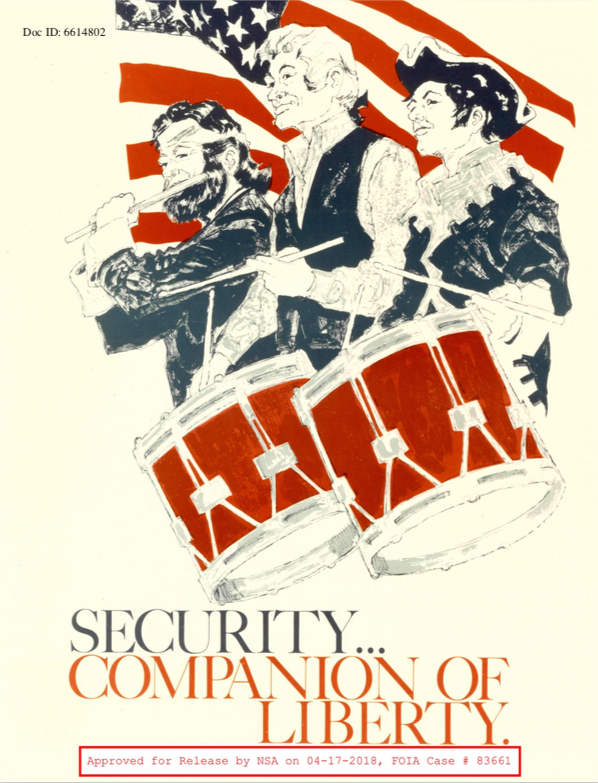
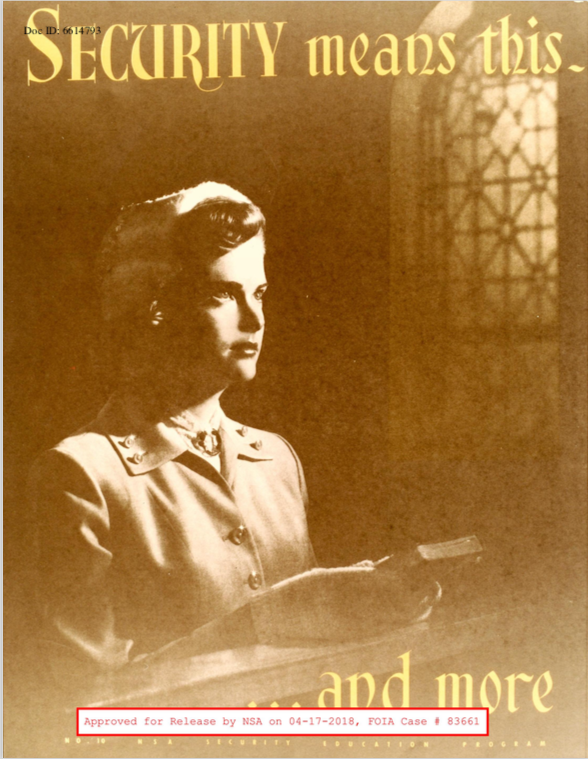
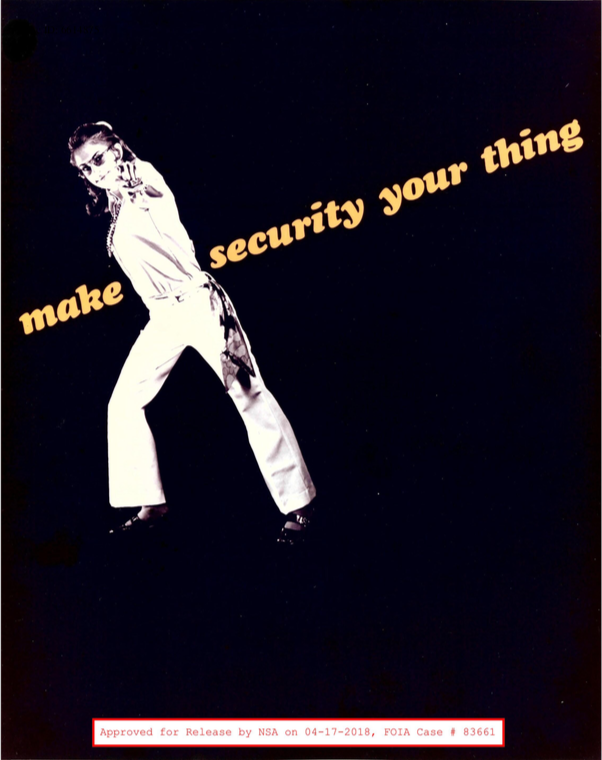
In any case, we might imagine that public debates about civil liberties and privacy are laughable to many a seasoned intelligence agent. A recently declassified trove of propaganda posters aimed at NSA employees, dating from the 50s, 60s, and 70s, shows that in the mind of the Agency, there is no conflict between liberty and security. Without security (or total secrecy), many of these posters suggest, all freedom is lost. They do so in some “super freaky” ways, to quote Jason Kottke, looking like “they were cooked up by Salvador Dali or the Dadaists. Or even Mad Magazine.”

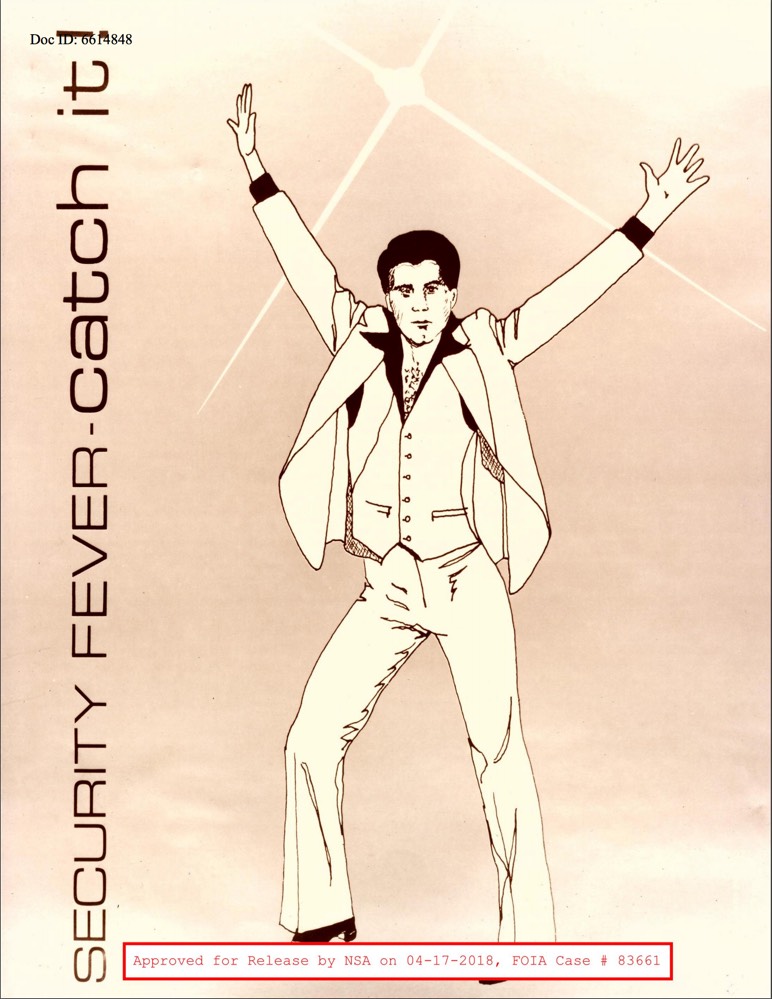
Some of the posters, especially those from the Cold War, look pretty chilling in hindsight, with their theocratic overtones and anti-Communist apocalypticism. Agency employees were to understand that not only might they risk their jobs and clearances if they happened to spill classified info, but that everything they held dear—Christmas, prayer, fishing, freedom of the press—might be destroyed. The posters get progressively groovier as things thawed between the superpowers, and they stop alluding to specific enemies and threats to Christian piety. Still, there’s something a little creepy about an intelligence agency co-opting the Mona Lisa and Saturday Night Fever.
The agency was officially created in 1952 to monitor foreign electronic signals, which at the time meant radio and telephone traffic. The comparatively bronze-age technology available in the decades these posters were printed makes them seem all the more quaint, with their references to carelessly discarded documents and getting too chatty in the car pool. Is the government still warrantlessly spying on Americans? There may have been several recent “inadvertent compliance lapses,” the NSA admits, but surely a secret court and trustworthy Congress will keep everyone honest.
See many more of these bizarre posters here.
via Kottke
Related Content:
Josh Jones is a writer and musician based in Durham, NC. Follow him at @jdmagness
Read More...Ralph Steadman Creates an Unorthodox Illustrated Biography of Sigmund Freud, the Father of Psychoanalysis (1979)
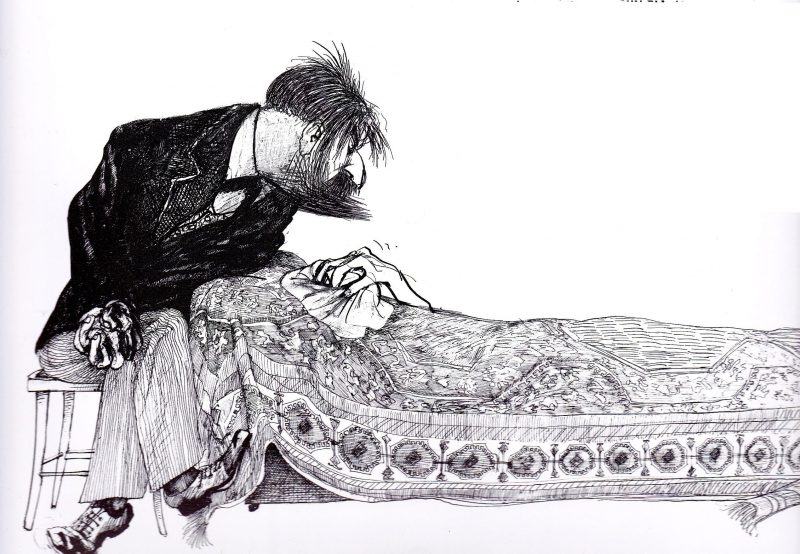
Sigmund Freud died in 1939, and the nearly eight decades since haven’t been kind to his psychoanalytical theories, but in some sense he survives. “For many years, even as writers were discarding the more patently absurd elements of his theory — penis envy, or the death drive — they continued to pay homage to Freud’s unblinking insight into the human condition,” writes the New Yorker’s Louis Menand. He claims that Freud thus evolved, “in the popular imagination, from a scientist into a kind of poet of the mind. And the thing about poets is that they cannot be refuted. No one asks of ‘Paradise Lost’: But is it true? Freud and his concepts, now converted into metaphors, joined the legion of the undead.”
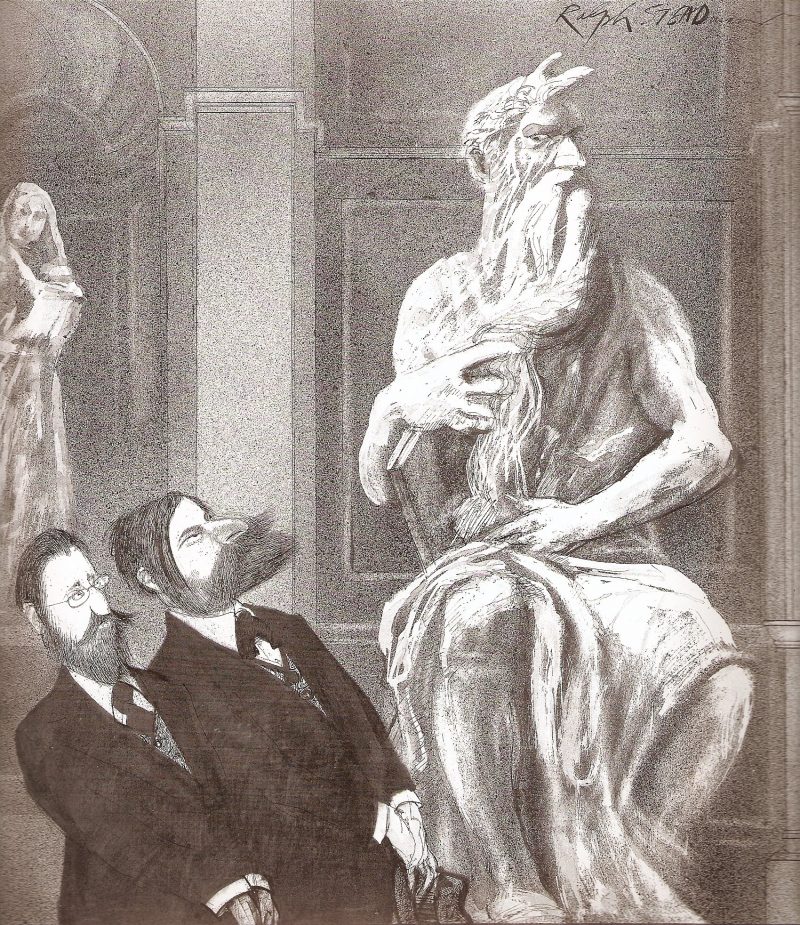
The master of a legion of undead psychological metaphors — who, in the ranks of living illustrators, could be more suited to render such a figure than Ralph Steadman? And how many of us know that he actually did so in 1979, when he produced an “art-biography” of the “Father of Psychoanalysis”?
Sigmund Freud, which has spent long stretches out of print since its first publication, tells the story of Freud’s life, beginning with his childhood in Austria to his death, not long after his emigration in flight from the Nazis, in London. It was there that he met Virginia Woolf, who in her diary describes him as “a screwed up shrunk very old man: with a monkey’s light eyes, paralyzed spasmodic movements, inarticulate: but alert.”
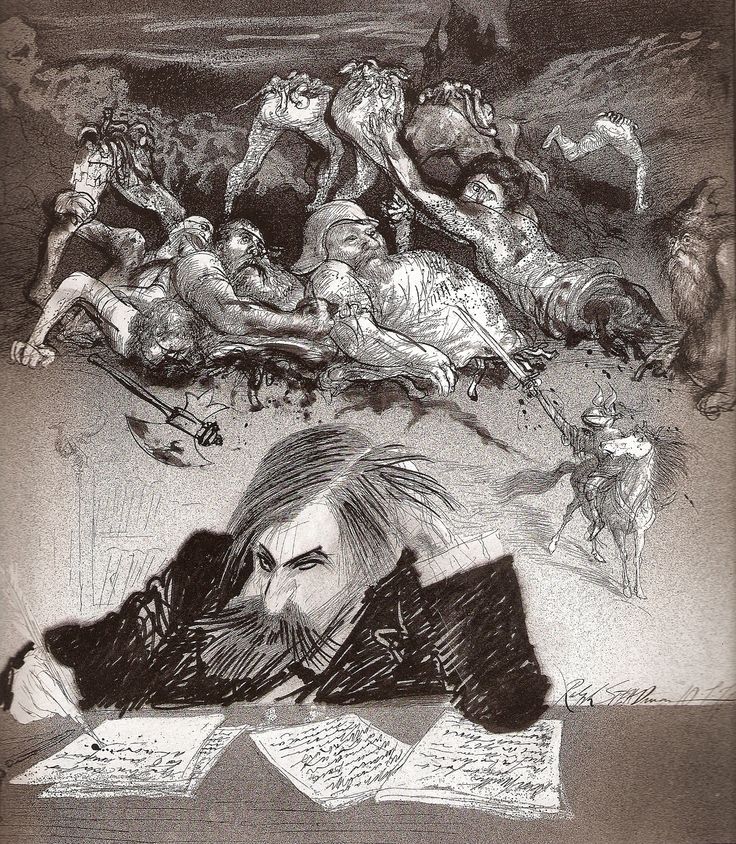
There, again, Freud sounds like one of Steadman’s drawings, sometimes outwardly unappealing but always possessed of an unignorable vitality generated by a solid core of perceptiveness. Earlier chapters of Freud’s life, characterized by intellectual as well as physical vigorousness aided by the 19th-century “miracle drug” of cocaine, also give the illustrator rich material to work with. One can’t help but think of Fear and Loathing in Las Vegas, which forged a permanent cultural link between Steadman’s art and Hunter S. Thompson’s prose. How “true” is the drug-fueled desert odyssey that book recounts? More so, perhaps, than many of Freud’s supposedly scientific discoveries. But as with the work of Freud, so with that of Thompson and Steadman: we return to it not because we want the truth, exactly, but because we can’t turn away from the often grotesque versions of ourselves it shows us.
You can pick up a copy of Steadman’s illustrated Sigmund Freud here.
Related Content:
Sigmund Freud, Father of Psychoanalysis, Introduced in a Monty Python-Style Animation
How a Young Sigmund Freud Researched & Got Addicted to Cocaine, the New “Miracle Drug,” in 1894
Ralph Steadman’s Wildly Illustrated Biography of Leonardo da Vinci (1983)
Gonzo Illustrator Ralph Steadman Draws the American Presidents, from Nixon to Trump
Based in Seoul, Colin Marshall writes and broadcasts on cities and culture. His projects include the book The Stateless City: a Walk through 21st-Century Los Angeles and the video series The City in Cinema. Follow him on Twitter at @colinmarshall or on Facebook.
Read More...Winston Churchill’s List of Tips for Surviving a German Invasion: See the Never-Distributed Document (1940)
More than half a century after his death, Winston Churchill continues to draw both great admiration and great fascination. Interest in the wartime Prime Minister of the United Kingdom has even increased in recent years, as evidenced last year by Joe Wright’s highly praised film Darkest Hour. Starring Gary Oldman as Churchill, it tells the story of his assumption of the office in May 1940 and navigation of the dire global geopolitical situation (including but not limited to the Battle of Dunkirk, also cinematically recreated last year by Christopher Nolan) into which it immediately plunged him.
“We get the greatest hits, out loud,” writes the New Yorker’s Anthony Lane on Oldman’s performance in a piece on why actors love to play Churchill. “We get the blood and the sweat, barked to the House of Commons, and, needless to say, we get the most celebrated speech of all, unleashed on June 4th, when the Prime Minister informed the world that Britain would fight the Germans on the beaches, in the streets, and wherever else they chose to intrude.”
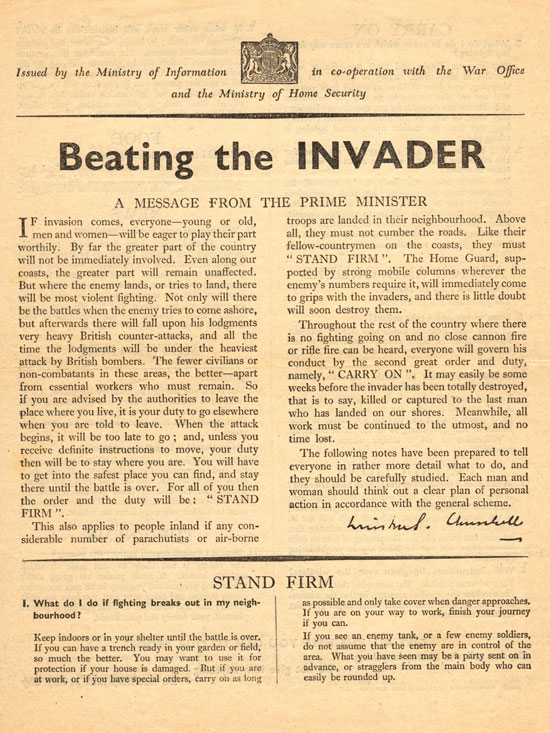
Churchill could issue a compelling communiqué on the subject not just in speech but in writing, and he even prepared one for distribution in the event of a German invasion. Its characteristic title: “Beating the Invader.”
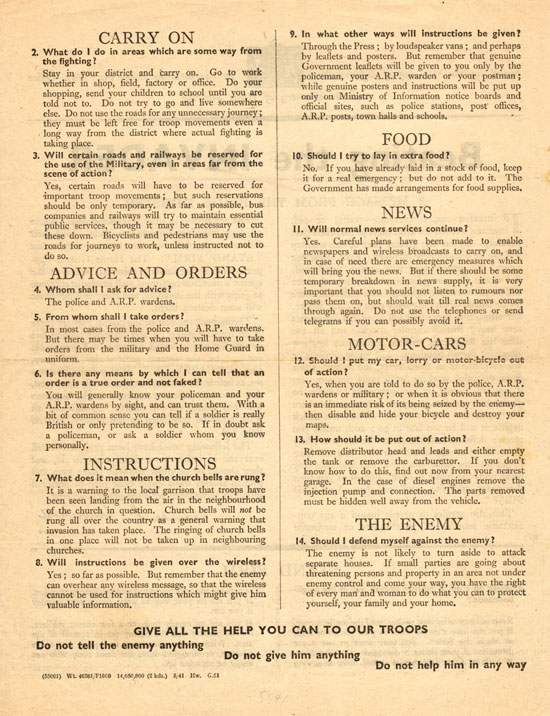
“If invasion comes, everyone – young or old, men and women – will be eager to play their part worthily,” Churchill proclaims in the leaflet, which you can read in full at AbeBooks. “If you are advised by the authorities to leave the place where you live, it is your duty to go elsewhere when you are told to leave. When the attack begins, it will be too late to go; and, unless you receive definite instructions to move, your duty then will be to stay where are. You will have to get into the safest place you can find, and stay there until the battle is over. For all of you then the order and the duty will be: ‘STAND FIRM’.”
Churchill provides more specifics of his expectations in a Q&A section, addressing such concerns as “What do I do if fighting breaks out in my neighbourhood?”, “Is there any means by which I can tell that an order is a true order and not faked?” (“With a bit of common sense you can tell if a soldier is really British or only pretending to be so”), and “Should I defend myself against the enemy?” To that last he assures his reader that “you have the right of every man and woman to do what you can to protect yourself, your family and your home.” Thanks to those who gave their all to win the war, it never came to that. And even now, though Britain faces no apparent danger of imminent invasion, many still govern their conduct in the spirit of Churchill’s “second great order and duty, namely, ‘CARRY ON’.”
If you want to purchase an original copy of the document, find some here.
Related Content:
Oh My God! Winston Churchill Received the First Ever Letter Containing “O.M.G.” (1917)
‘Keep Calm and Carry On’: The Story of the Iconic World War II Poster
The Moon Disaster That Wasn’t: Nixon’s Speech In Case Apollo 11 Failed to Return
Based in Seoul, Colin Marshall writes and broadcasts on cities and culture. His projects include the book The Stateless City: a Walk through 21st-Century Los Angeles and the video series The City in Cinema. Follow him on Twitter at @colinmarshall or on Facebook.
Read More...Learn How to Play the Theremin: A Free Short Video Course
When Leon Theremin debuted his strange electronic device on the world stage, it seemed to many people more like a curious toy than a serious musical instrument. The theremin soon became associated with B‑grade sci-fi movies and novelty soundtracks, an association that made Clara Rockmore furious. Determined to achieve respectability for the theremin, she championed it as “a legitimate classical instrument that deserves a place in the pit,” writes Atlas Obscura, “right next to the violins and piano.” Rockmore’s ambitions may have been outsized, but her talent was undeniable. “As serious as anyone has ever been about the theremin… she left behind a number of valuable lessons,” including a book, freely available, in which she dispenses some very practical advice.
But much has changed since her day, including popular methods of instruction and some of the technical design of theremins. Now, aspiring players will likely go looking for video lessons before consulting Rockmore’s guide, which requires that students read music in order to transition from exercises to “easy pieces” by Camille Saint-Saëns and J.S. Bach.
One series of video lessons offered by “thereminist” Thomas Grillo, an earnest instructor in a white shirt and tie, begins with the very basics and works up to more advanced techniques, including possible mods to the device (Grillo plays a Moog-made theremin himself).
Grillo opens with a disclaimer that his short course is “no substitute for professionally done how-to videos on how to play the theremin,” thereby humbly acknowledging the low production values of his series. Nonetheless, I imagine his classes are as good a place to start as any for newcomers to theremin-ing, not a skill one can pick up as readily online as playing the guitar or piano. He clearly knows his stuff. With the look and demeaner of a high school algebra teacher, Grillo patiently explains and demonstrates many techniques and principles, beginning with lesson one above, then continuing in lessons two, three, four, five, six, and seven.
Once you’ve reached an intermediate stage, or if you already find yourself there, you may benefit from the instruction of Carolina Eyck, who has carried on the serious classical work of Clara Rockmore. See her just above perform a stirring rendition of Rachmaninoff’s “Vocalise,” accompanied on piano by Christopher Tarnow, and check out her YouTube channel for more performances and short lessons.
Related Content:
Josh Jones is a writer and musician based in Durham, NC. Follow him at @jdmagness
Read More...
How William S. Burroughs Embraced, Then Rejected Scientology, Forcing L. Ron Hubbard to Come to Its Defense (1959–1970)

Image by Christiaan Tonnis, via Wikimedia Commons
William S. Burroughs was a cultural prism. Through him, the mid-century demi-monde of illicit drug use and marginalized sexualities—of occult beliefs, alternative religions, and bizarre conspiracy theories—was refracted on the page in experimental writing that inspired everyone from his fellow Beats to the punks of later decades to name-your-countercultural-touchstone of the past fifty years or so. There are many such people in history: those who go to the places that most fear to tread and send back reports written in language that alters reality. To quote L. Ron Hubbard, another writer who purported to do just that, “the world needs their William Burroughses.”
And Burroughs, so it appears, needed L. Ron Hubbard, at least for most of the sixties, when the writer became a devout follower of the Church of Scientology. The sci-fi-inspired “new religious movement” that needs no further introduction proved irresistible in 1959 when Burroughs met John and Mary Cooke, two founding members of the church who had been trying to recruit Burroughs’ friend and frequent artistic partner Brion Gysin. “Ultimately,” writes Lee Konstantinou at io9, “it was Burroughs, not Gysin, who explored the Church that L. Ron Hubbard built. Burroughs took Scientology so seriously that he became a ‘Clear’ and almost became an ‘Operating Thetan.’ ”
Burroughs immersed himself without reservation in the practices and principles of Scientology, writing letters to Allen Ginsberg that same year in which he recommends his friend “contact [a] local chapter and find an auditor. They do the job without hypnosis or drugs, simply run the tape back and forth until the trauma is wiped off. It works. I have used the method—partially responsible for recent changes.” No doubt Burroughs had his share of personal trauma to overcome, but he also found Scientology especially conducive to his greater creative project of countering “the Reactive Mind… an ancient instrument of control designed to stultify and limit the potential for action in a constructive or destructive direction.”
The method of “auditing” gave Burroughs a good deal of material to work with in his fiction and filmmaking experiments. He and Gysin included Scientology’s language in a short 1961 film called “Towers Open Fire,” which was, writes Konstantinou, “designed to show the process of control systems breaking down.” Scientology appeared in 1962’s The Ticket That Exploded and again in 1964’s Nova Express. Each novel references the concept of “engrams,” which Burroughs succinctly defines as “traumatic material.” During this hugely productive period, the radically anti-authoritarian Burroughs “associated the group with a range of mind-expanding and mind-freeing practices.”
It’s easy to say Burroughs uncritically partook of a certain sugary beverage. But he clearly made his own idiosyncratic uses of Scientology, incorporating it within the syncretic constellation of references, practices, and cut-up techniques “designed to jam up what he called ‘the Reality Studio,’ aka the everyday, conditioned, mind-controlled reality.” An inevitable turning point came, however, in 1968, as Burroughs journeyed deeper into Scientology’s secret order at the world headquarters in Saint Hill Manor in the UK. There, he reported, he “had to work hard to suppress or rationalize his persistently negative feelings toward L. Ron Hubbard during auditing sessions.”
Burroughs’ dislike of the church’s founder and extreme aversion to “what he considered its Orwellian security protocols” eventuated his break with Scientology, which he undertook gradually and publicly in a series of “bulletins” published during the late sixties in the London magazine Mayfair. Before his “clearing course” with Hubbard, in a 1967 article excerpted and republished as a pamphlet by the church itself, Burroughs praises Scientology and its founder, and claims that “there is nothing secret about Scientology, no talk of initiates, secret doctrines, or hidden knowledge.”
By 1970, he had made an about-face, in a fiercely polemical essay titled “I, William Burroughs, Challenge You, L. Ron Hubbard,” published in the Los Angeles Free Press. While he continues to value some of the benefits of auditing, Burroughs declares the church’s founder “grandiose” and “fascist” and lays out his objections to its initiations, secret doctrines, and hidden knowledge, among other things:
…One does not simply pay the tuitions, obtain the materials and study. Oh no. One must JOIN. One must ‘sign up for the duration of the universe’ (Sea Org members are required to sign a billion-year contract)…. Furthermore whole categories of people are automatically excluded from training and processing and may never see Mr Hubbard’s confidential materials.
Burroughs challenges Hubbard to “show his confidential materials to the astronauts of inner space,” including Gysin, Ginsberg, and Timothy Leary; to the “students of language like Marshall MacLuhan and Noam Chompsky” [sic]; and to “those who have fought for freedom in the streets: Eldridge Cleaver, Stokely Carmichael, Abe Hoffman, Dick Gregory…. If he has what he says he has, the results should be cataclysmic.”
The debate continued in the pages of Mayfair when Hubbard published a lengthy and blandly genial reply to Burroughs’ challenge, in an article that also contained, in an inset, a brief rebuttal from Burroughs. The debate will surely be of interest to students of the strange history of Scientology, and it should most certainly be followed by lovers of Burroughs’ work. In the process of embracing, then rejecting, the controlling movement, he compellingly articulates a need for “unimaginable extensions of awareness” to deal with the trauma of living on what he calls the “sinking ship” of planet Earth.
Related Content:
William S. Burroughs Tells the Story of How He Started Writing with the Cut-Up Technique
When William S. Burroughs Appeared on Saturday Night Live: His First TV Appearance (1981)
Hear a Great Radio Documentary on William S. Burroughs Narrated by Iggy Pop
Josh Jones is a writer and musician based in Durham, NC. Follow him at @jdmagness
Read More...Modernist Birdhouses Inspired by Bauhaus, Frank Lloyd Wright and Joseph Eichler
Study nature, love nature, stay close to nature. It will never fail you. — Frank Lloyd Wright
Is there a design geek lurking among your fine feathered friends?
Some chickadee or finch who values clean lines over the fripperies of the gilded cage?
Or perhaps you’re a bird lover who’s loathe to junk up your mid-century modernist view by hanging a folksy miniature saltbox from a branch outside the kitchen window.…
California-based cabinetmaker Douglas Barnhard’s Bauhaus birdhouses offer a minimalist solution.
No word on the interiors, but the exteriors are gorgeous, with additional inspiration coming from the likes of Frank Lloyd Wright and Joseph Eichler.
Barnhard, who studied architecture briefly, repurposes walnut, bamboo, teak, and mahogany in his designs, which extend to dog beds, breadboxes, and planters.
His birdhouses feature living walls and green roofs planted with succulents.
Some have tiny longboards propped on their decks, a reflection of the time Barnhard spent in Kauai.
Is it wishful thinking to believe it’s only a matter of time ’til tiny wetsuits and empty Fosters and Pacificos start festooning the rails?
Browse Barnhard’s birdhouses here and follow him on Instagram to get a peek at custom orders, many for customers residing in the sorts of homes he recreates for the birds.
Related Content:
Harvard Puts Online a Huge Collection of Bauhaus Art Objects
Ayun Halliday is an author, illustrator, theater maker and Chief Primatologist of the East Village Inky zine. Her solo show Nurse!, in which one of Shakespeare’s best loved female characters hits the lecture circuit to set the record straight premieres in June at The Tank in New York City. Follow her @AyunHalliday.
Read More...Download 50,000 Art Books & Catalogs from the Metropolitan Museum of Art’s Digital Collections

If you’ve lived in or visited New York City, you must know the laughable futility of trying to “do the Met” in a day, or even a weekend. Not only is the museum enormous, but its permanent collections demand to be studied in detail, an activity one cannot rush through with any satisfaction. If you’re headed there for a special exhibit, be especially disciplined—make a beeline and do not stop to linger over elaborate Edo-period samurai armor or austere Shaker-made furniture.
I thought I’d learned my lesson after many years of residence in the city. When I returned last summer for a visit, family in tow, I vowed to head straight for the Rei Kawakubo exhibit, listing all other priorities beneath it. More fool me.
Immediate overwhelm overtook as we entered, on a weekend, in a crush of tourist noise. After hours spent admiring sarcophagi, neoclassical paintings, etc., etc., we had to nix the exhibit and push our way into Central Park for fresh air and recuperative ice cream.
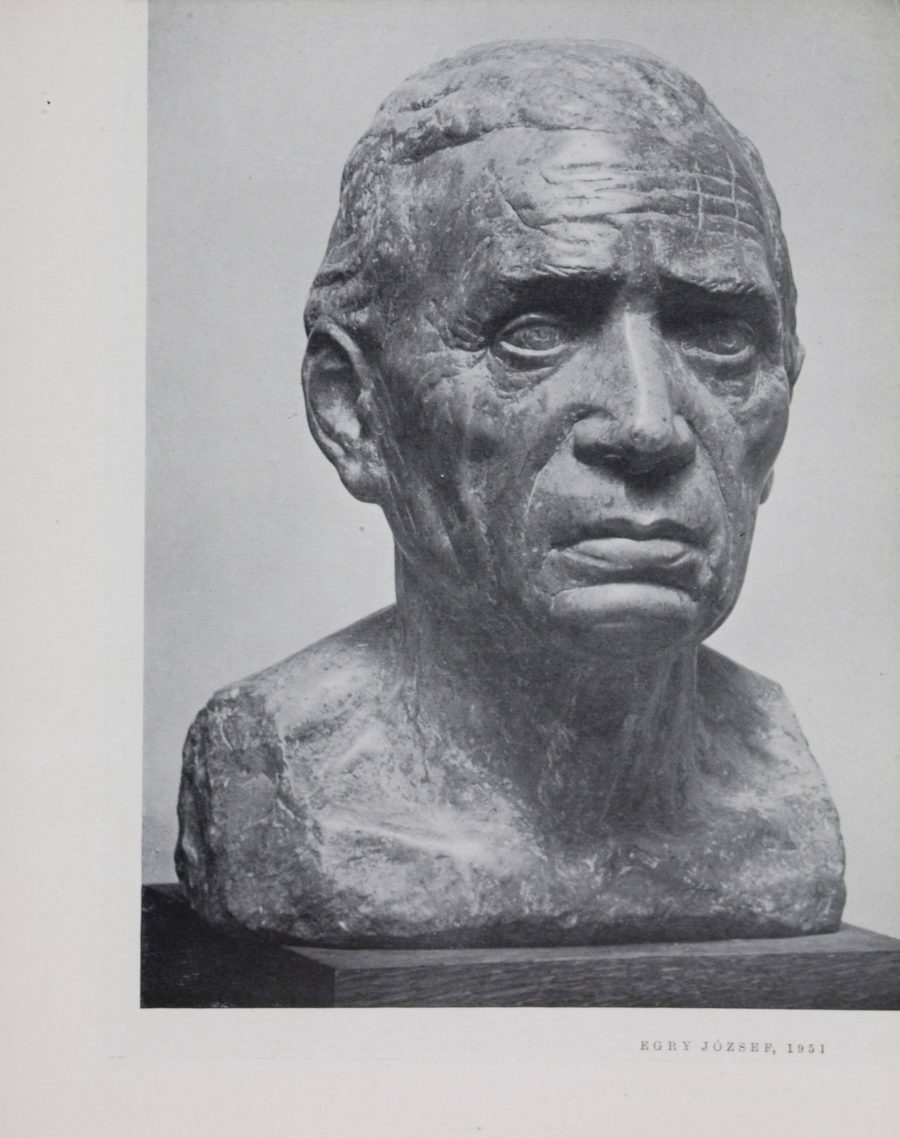
Does an exhibition checklist, with photographs and descriptions of every piece on display, make up for missing the Kawakubo in person? Not exactly, but at least I can linger over it, virtually, in solitude and at my leisure. If you value this experience, cannot make it to the Met, or want to see several hundred past exhibitions from the comfort of your home, you can do so easily thanks to the wealth of catalogs the Met has uploaded to its Digital Collections.

These catalogs document special exhibits not only at the New York landmark, but also at galleries around the world from the past 100 years or so. In a recent blog post, the Met points to one such scanned catalog—out of almost a hundred from the Hungarian Gallery Nemzeti Szalon—from a 1957 exhibition of sculptor Miklós Borsos. The text is in Hungarian, but the artwork (further up), in detailed black and white photographs, speaks a universal visual language.
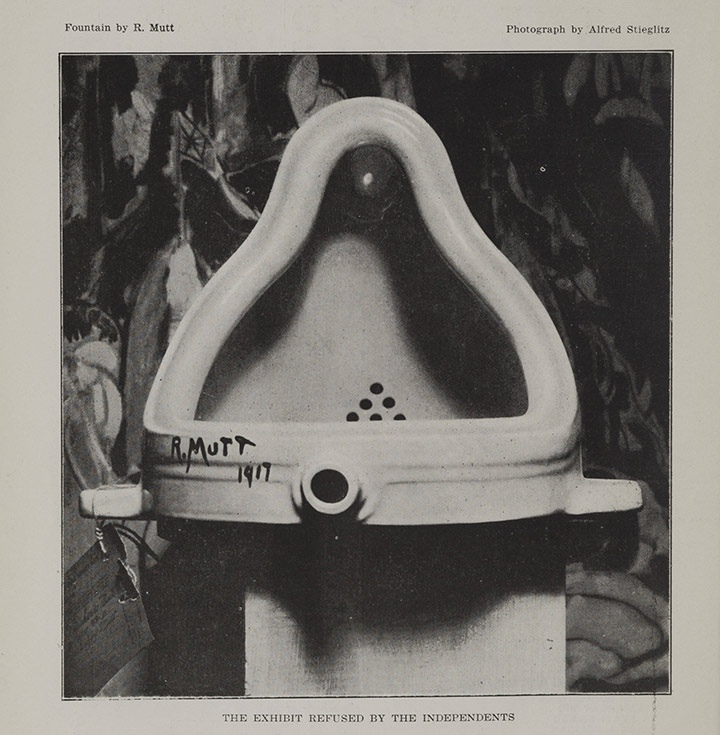
These catalogs join the thousands of books—50,000 titles in all—at the Met’s Digital Collections. There, you’ll find collections such as Rare Books Published in Imperial and Early Soviet Russia, with unusual treasures like the book Churches of Uglich, a survey of one Russian town’s churches, with photos, from the 1880s. “Interested in Dada?” asks the Met, and who isn’t? The museum has just added a 1917 issue of journal The Blind Man, edited by Marcel Duchamp and containing Alfred Stieglitz’s photograph of Duchamp’s found art prank Fountain.
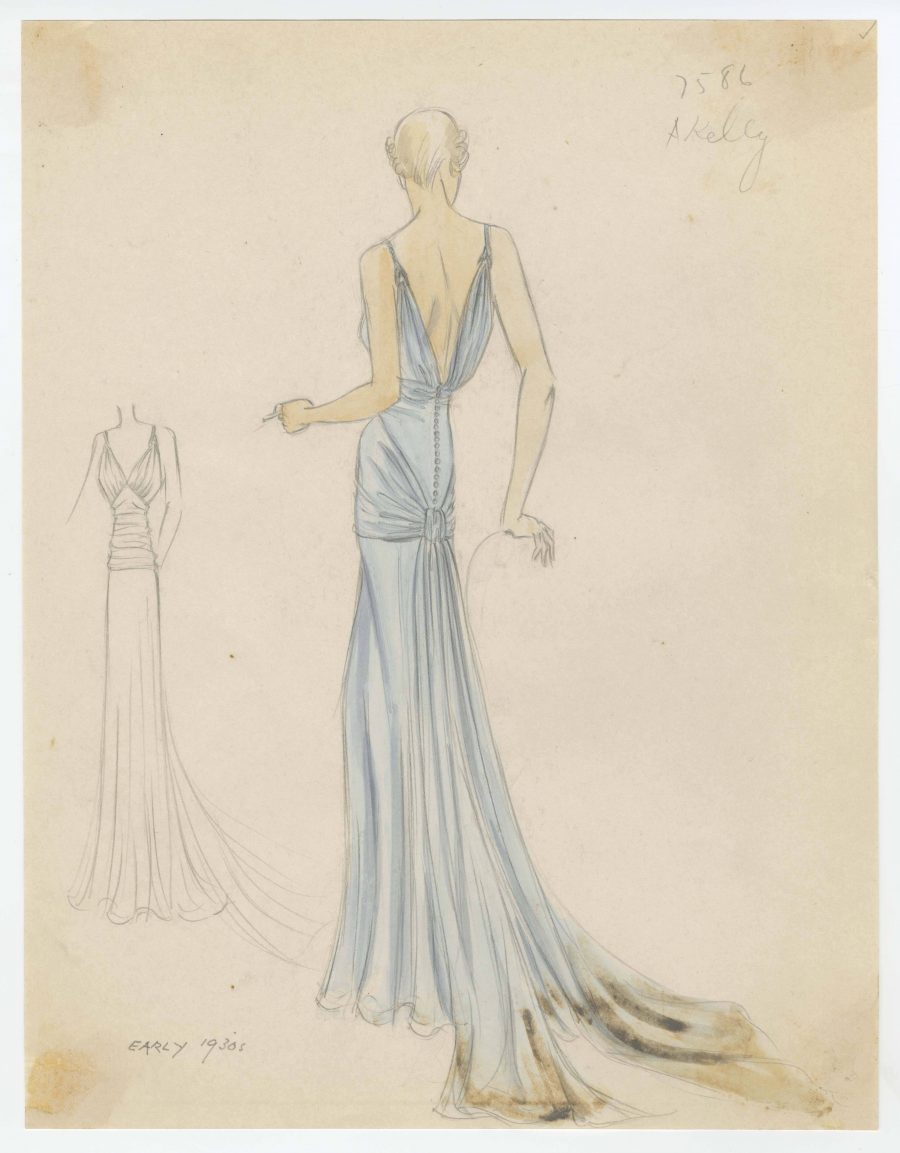
If fashion’s your thing, the museum has added thousands of Bergdorf Goodman sketches from 1929 to 1952 (see a particularly elegant example above from the 1930s). Maybe you’re into the history of the Met itself? If so, check out this massive collection of historical images of the museum, inside and out, dating from its inception in 1870 to the present. There’s even a selection of photos of its iconic special exhibition banners from 1970 through 2004 (like that below from 1982).
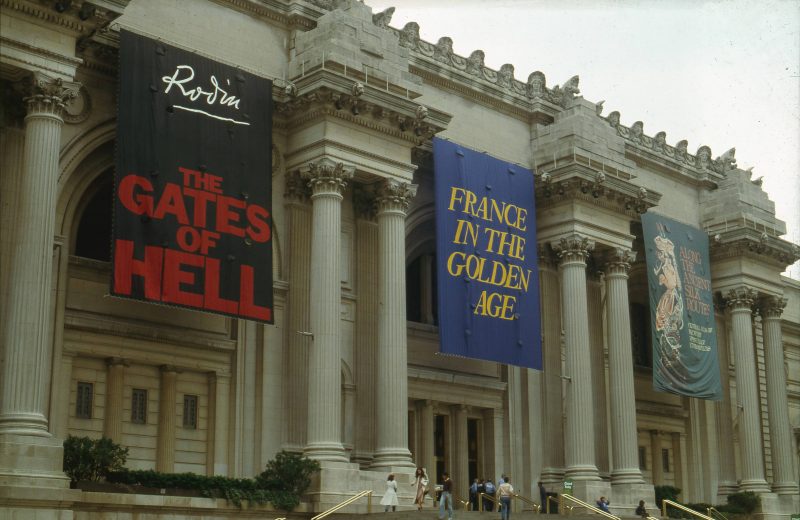
If you’re headed to the Met to see one of these special exhibits, take my advice and don’t get distracted once you’re inside. But if you want to access a range of the museum’s cultural treasures from afar, you can’t do any better than browsing its Digital Collections, where you’re also likely to get lost for hours, maybe days.
Related Content:
Download 200+ Free Modern Art Books from the Guggenheim Museum
2,000+ Architecture & Art Books You Can Read Free at the Internet Archive
Josh Jones is a writer and musician based in Durham, NC. Follow him at @jdmagness
Read More...Watch the Winners of the 48 Hour Science Fiction Film Challenge: The 2018 Edition
Writes Metafilter: “Every year, as part of their science fiction film festival, Sci-Fi London organise a challenge in which entrants are given a title, line of dialogue and description of a prop, and then have 48 hours to turn in a completed 5 minute film or piece of flash fiction. The winning films and flash fiction stories from the SciFi London 48 Hour Challenge are now available to watch and read.” The first place film winner you can view above. Find other winning entries via the links below:
THE FILM CHALLENGE:
- 1st Place: Under Duress by team Retrograde
- 2nd Place: On My Watch by team Badger Way
- 3rd Place: Details to Follow by team Hyvemind
THE FLASH FICTION CHALLENGE:
- 1st Place: Survival Mechanism by Natalie Dixon
- 2nd Place: All My Blood by Simon Bennett
- 3rd Place: The Charm by Bethan James
Enjoy.
If you would like to support the mission of Open Culture, consider making a donation to our site. It’s hard to rely 100% on ads, and your contributions will help us continue providing the best free cultural and educational materials to learners everywhere. You can contribute through PayPal, Patreon, and Venmo (@openculture). Thanks!
Related Content:
Arthur C. Clarke Creates a List of His 12 Favorite Science-Fiction Movies (1984)
The Art of Sci-Fi Book Covers: From the Fantastical 1920s to the Psychedelic 1960s & Beyond
Read More...Watch the New Trailer for Worlds of Ursula K Le Guin, the First Feature Film on the Pioneering Sci-Fi Author
On June 10th, at the Sheffield Doc/Fest in England, director Arwen Curry will premiere Worlds of Ursula K Le Guin, the first feature film about the groundbreaking science fiction writer. The film’s website notes that “Curry filmed with Le Guin for 10 years to produce the film, which unfolds an intimate journey of self-discovery as Le Guin comes into her own as a major feminist author, opening new doors for the imagination and inspiring generations of women and other marginalized writers along the way.” Starring Le Guin herself, who sadly passed away earlier this year, Worlds of Ursula K Le Guin features appearances by Margaret Atwood, David Mitchell, Neil Gaiman, Samuel R. Delany, and Michael Chabon. You can watch the brand new trailer for the film above.
If you would like to support the mission of Open Culture, consider making a donation to our site. It’s hard to rely 100% on ads, and your contributions will help us continue providing the best free cultural and educational materials to learners everywhere. You can contribute through PayPal, Patreon, and Venmo (@openculture). Thanks!
Related Content:
Hear Ursula K. Le Guin’s Space Rock Opera Rigel 9: A Rare Recording from 1985
Ursula Le Guin Gives Insightful Writing Advice in Her Free Online Workshop
Ursula K. Le Guin Names the Books She Likes and Wants You to Read
Read More...Watch an Animated Visualization of the Bass Line for the Motown Classic, “Ain’t No Mountain High Enough”
Jamerson is the Schoenberg of getting from the I chord to the IV chord. He’s algorithmically generating a new pattern every phrase…[He] belongs with Bach, Debussy and Mozart.
- Jack Stratton
Sideman James Jamerson, Paul McCartney’s musical hero and a co-author of the Motown sound, is a great illustration of the bass’ importance in pop and R&B history.
He kept a funky beat for such artists as Stevie Wonder, Martha and the Vandellas, Marvin Gaye, and the Supremes. His low notes helped the harmonies sing.
Jack Stratton, leader of the modern American funk band, Vulfpeck, named Jamerson to his Holy Trinity of Bass, along with Chic’s Bernard Edwards and Sly and the Family Stone’s Larry Graham.
(Joe Dart, Vulfpeck’s bassist, is a pretty hot ticket too.)
Stratton’s reverence extended to a side project in which he visually plots some of Jamerson’s savoriest baselines.
Check out the craggy peaks and valleys on Marvin Gaye & Tammi Terrell’s famous rendition of Ashford & Simpson’s “Ain’t No Mountain High Enough,” above.
No wonder it’s the most listened to isolated bass track on No Treble, the online magazine for bass players.
All together now:
Stratton’s visualizations of the Jameson lines for Stevie Wonder’s “I Was Made to Love Her” and “For Once In My Life” are pretty mesmerizing too.
Learn more about Jamerson’s highly influential bass technique in Dr. Lick’s Standing in the Shadows of Motown: The Life and Music of Legendary Bassist James Jamerson.
Related Content:
What Makes Flea Such an Amazing Bass Player? A Video Essay Breaks Down His Style
The Story of the Bass: New Video Gives Us 500 Years of Music History in 8 Minutes
Ayun Halliday is an author, illustrator, theater maker and Chief Primatologist of the East Village Inky zine. Her solo show Nurse!, in which one of Shakespeare’s best loved female characters hits the lecture circuit to set the record straight premieres in June at The Tank in New York City. Follow her @AyunHalliday.
Read More...Support Us
We're hoping to rely on loyal readers, rather than erratic ads. Please click the Donate button and support Open Culture. You can use Paypal, Venmo, Patreon, even Crypto! We thank you!

About Us

Open Culture scours the web for the best educational media. We find the free courses and audio books you need, the language lessons & educational videos you want, and plenty of enlightenment in between.
Advertise With Us

FREE UPDATES!
GET OUR DAILY EMAIL
Get the best cultural and educational resources on the web curated for you in a daily email. We never spam. Unsubscribe at any time.
FOLLOW ON SOCIAL MEDIA

Open Culture editor Dan Colman scours the web for the best educational media. He finds the free courses and audio books you need, the language lessons & movies you want, and plenty of enlightenment in between.
Advertise With Us


