The 50 Best Ambient Albums of All Time: A Playlist Curated by Pitchfork
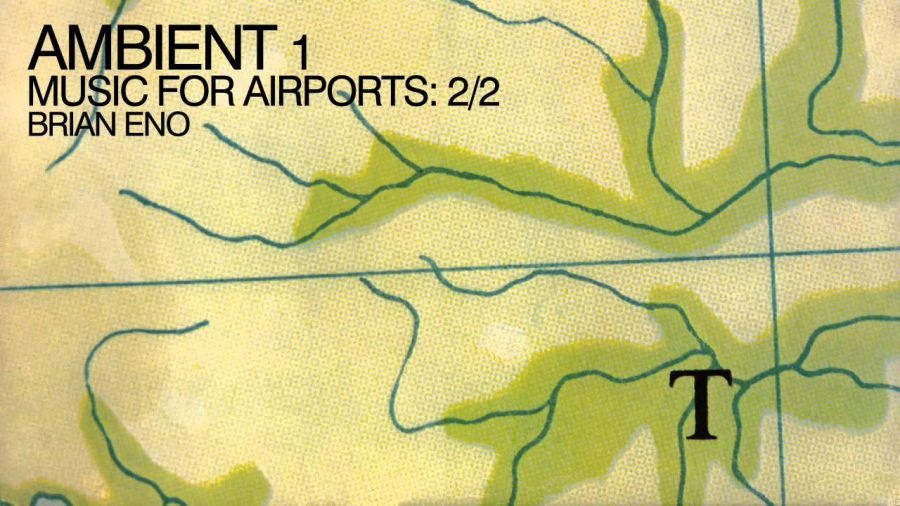
What makes a good ambient record? I’m not sure I can even begin to answer that question, and I count myself a longtime fan of the genre, such as it is. Though conceived, ostensibly, by Brian Eno as modernist mood music—“as ignorable as it is interesting,” he wrote in the liner notes to 1978’s Ambient 1: Music for Airports—the term has come to encompass “tracks you can dance to all the way to harsh noise.” This description from composer and musician Keith Fullerton Whitman at Pitchfork may not get us any closer to a clear definition in prose, though “cloud of sound” is a lovely turn of phrase.
Unlike other forms of music, there is no set of standards—both in the jazz sense of a canon and the formal sense of a set of rules. Reverberating keyboards, squelching, burping synthesizers, droning guitar feedback, field recordings, found sounds, laptops, strings… whatever it takes to get you there—“there” being a state of suspended emotion, “drifting” rather than “driving,” the sounds “soothing, sad, haunting, or ominous.” (Cheerful, upbeat ambient music may be a contradiction in terms.)
Given the looseness of these criteria, it only stands to reason that “good” ambient must be judged on far more subjective terms than most any other kind of music. Next to “atmospheric,” a primary operative word in an ambient critical lexicon is “evocative,” and what the music evokes will differ vastly from listener to listener. “No one agrees on the language surrounding this music,” Whitman admits, “not the musicians who make it, not the audience.”
Ambient’s close association with trends in avant-garde minimalism, from Erik Satie to Steve Reich, La Monte Young, and Charlemagne Palestine, may prepare us for its many crossover strains in electronic music, but not, perhaps, for the seeming synergy between ambient and certain developments in heavy metal (though Lou Reed seems to have presaged this evolution). “There are many roads one can take into this particular sector,” writes Whitman, “virtually every extant sub- and micro-genre has an ambient shadow.”
Such ecumenicalism is a feature: it means that a list like Pitchfork’s “50 Best Ambient Albums of All Time” (stream most of those albums on the Spotify playlist above) can pull from an impressively wide array of musical domains, from the early experimental electronic music of Laurie Spiegel to the spiritual jazz of Alice Coltrane; the chill-out electronica of The Orb and The KLF to the ethereal indie post-folk dreampop of Grouper, a very rare entry with vocals.
If the genre has stars, Tim Hecker and William Basinski might be considered two of them; if it has august forebears, Pauline Oliveros, Terry Riley, and of course Eno are three. (Music for Airports comes in at number one, though another very well-chosen inclusion here is Eno and Harold Budd’s utterly gorgeous The Pearl.) Other entries I’m very pleased to see on this list include albums by Gas, composer Max Richter, and vocal experimentalist Juliana Barwick, artists who might never share a stage, but sit quite comfortably next to each other here.
What’s missing? Maybe the glacially slow, guitar and bass drones of Sunn O))) or the deeply unnerving noise of Prurient or the lush electro-acoustic compositions of Ashley Bellouin, I don’t know. These aren’t complaints but suggestions on the order of if you like Pitchfork’s “50 Best Ambient Albums of All Time,” check out…. I could go on, but I’d rather leave it to you, reader. What’s on your list that didn’t make the cut?
Visit Pitchfork’s list here.
Related Content:
The “True” Story Of How Brian Eno Invented Ambient Music
10 Hours of Ambient Arctic Sounds Will Help You Relax, Meditate, Study & Sleep
Josh Jones is a writer and musician based in Durham, NC. Follow him at @jdmagness
Read More...When Pinball Was Deemed Immoral & Outlawed in Major American Cities
I remember the early days of the video arcade, where my friends and I went to have fun and spent our parents’ cash on Galaga, Robotron 2084, or–if you were a really big spender–Dragon’s Lair. Then, when we’d get home, and we would see scare pieces on the national news about the evils of the very arcades we had just visited, dens of drugs and depravity! Where were *those* arcades, we wondered.
Nothing has changed, it seems. Let’s go back nearly 80 years to another moral panic: pinball.
As these two mini docs show, in the 1930s and ‘40s pinball was banned in cities like New York (by mayor and future airport Fiorello LaGuardia) and Chicago because of its association with organized crime, but also the appeal it had to the children of the working class.
They kind of had a point: early pinball machine were purely games of chance, which put it very close to gambling. (A modern pachinko machine is closer to these early versions.) Like a carny game, you paid your money, and you watched as the ball careened down the table, out of your control.
But with the invention of user-controlled flippers that sent the ball back in play, these games of chance became games of skill. But that didn’t stop some moral crusaders.
And, as several pinball fans have found out–like the gentleman in the VICE doc below who wanted to open a pinball museum–antiquated laws remained on the books from those early years and had never been changed for modern times.
Roger Sharpe, known as “The Man Who Saved Pinball,” even went to a Chicago court in 1976 to prove that pinball was a game of skill. In a scene that sounds perfect for a final act in a movie, Sharpe, with his barbershop quartet mustache and groovy outfit, played pinball in front of legislators. Calling shots like a pool player might, he soon convinced the court that skill was everything. Sharpe would go on to become a star witness in similar hearings in Ohio, West Virginia, and Texas over their pinball laws.
Ironically, while video games replaced pinball in most arcades, home systems and computers replaced the need for arcades. It’s now a perfect time for these purely analog and tactile machines to make a comeback. Hell, a rock band might even make a musical about it one day.
Related Content:
Orson Welles Teaches Baccarat, Craps, Blackjack, Roulette, and Keno at Caesars Palace (1978)
Ted Mills is a freelance writer on the arts who currently hosts the artist interview-based FunkZone Podcast and is the producer of KCRW’s Curious Coast. You can also follow him on Twitter at @tedmills, read his other arts writing at tedmills.com and/or watch his films here.
Read More...19-Year-Old Russian Guitarist Plays an Ingenious Cover of Michael Jackson’s “Billie Jean”
Alexandr Misko, only 19 years old when this video was made, comes from a small town in Russia. There, he steeped himself in the music of modern American composers, including Steve Reich and Philip Glass. And he taught himself a fingerstyle technique of playing guitar, he tells the web site California Rocker, that involves “tapping,” or playing notes on the fretboard of the guitar. (It’s a technique that has a long tradition, but reached its apotheosis, if you will, with the 70s and 80s work of Eddie Van Halen.) While tapping with one hand, Misko also plays percussion with the other, using the body of the guitar to create a drum-like rhythm. And then he realized, “Hmm, and I can put a little scrunchy on 2 low strings to mute them and create that signature sound,” known to everyone who’s heard Michael Jackson’s 1982 hit, “Billie Jean.”
Misko’s “Billie Jean” arrangement took a couple of days to work out, then a week to practice playing without flaws. The result, you have above.
Visit Misko’s Youtube channel to see his take on other pop hits like George Michael’s “Careless Whisper,” The Cranberries’ “Zombie,” and A‑ha’s “Take on Me,” to name a few. You can purchase his new album, Beyond the Box, on iTunes.
If you would like to support the mission of Open Culture, consider making a donation to our site. It’s hard to rely 100% on ads, and your contributions will help us continue providing the best free cultural and educational materials to learners everywhere. You can contribute through PayPal, Patreon, and Venmo (@openculture). Thanks!
Related Content:
One Man-Band Plays Amazing Covers, Note-for-Note, of Yes, CSNY, Zeppelin & More
Read More...David Lynch Made a Disturbing Web Sitcom Called “Rabbits”: It’s Now Used by Psychologists to Induce a Sense of Existential Crisis in Research Subjects
David Lynch has stayed productive in recent years — putting out an album and reviving Twin Peaks, to name just two projects — but more than a decade has gone by since his last feature film. Still, images from that one, 2006’s Inland Empire, may well linger in the heads of its viewers to this day. Some of the most haunting sequences that compose its three hours include clips of Rabbits, a television show about those very creatures. Or rather, a television show about humanoid rabbits who exchange lines of cryptic dialogue in a shadowy living room located, as the show puts it, “in a nameless city deluged by a continuous rain” where they live “with a fearful mystery.”
So far, so Lynchian. Part of the director’s signature atmosphere arises, of course, from the menacingly presented 1950s domesticity and the bizarre appearance of human actors wearing expressionless rabbit heads. But just as much has to do with sound: along with an ominous score by frequent Lynch collaborator Angelo Badalamenti we hear that constant deluge of rain, with occasional sonic punctuation from an inexplicably timed laugh track. You can binge-watch Rabbits’ episodes on YouTube, an experience which will give you a fuller sense of why University of British Columbia psychologists used it to induce a sense of existential crisis in research subjects.
Lynch shot Rabbits in 2002 on digital video, a medium whose freedom, compared to traditional film, he had recently discovered. (When he went on to use it for the whole of Inland Empire, the choice seemed as cinematically startling, at the time, as any he’d ever made.) The shoots happened at night, on a set built in his backyard. Its principal cast of Naomi Watts, Laura Harring, and Scott Coffey had all appeared the previous year in Lynch’s critically acclaimed Mulholland Drive, which itself began as a prospective television series. (Even the singer Rebekah del Rio, star of Club Silencio, turns up in one episode.) Lynch first “aired” the series on his web site, which must place him among not just the artistic but technical pioneers of the web series form.
But why, exactly, did he make it in the first place? “Rabbits is a sitcom,” writes a contributor called Peek 824545301 at The Artifice. “It is not merely parody or satire; it exists as perhaps the most bizarre and arguably literal sitcom imaginable, though still an opposing force that challenges and defamiliarizes basic concepts.” Abstracting the basic elements of the sitcom form while stripping them of narrative, the show also signals comedy on one level and darkness on another, putting itself “simultaneously in alignment with situation comedies in its essence while also serving as a destructive criticism.” In this view, Lynch moves from medium to medium not just as a singular kind of creator but — with his imagination that has somehow come up with even stranger things than this rabbit sitcom — a singular kind of critic as well.
Related Content:
What Makes a David Lynch Film Lynchian: A Video Essay
Angelo Badalamenti Reveals How He and David Lynch Composed the Twin Peaks‘ “Love Theme”
Dumbland, David Lynch’s Twisted Animated Series (NSFW)
David Lynch’s New ‘Crazy Clown Time’ Video: Intense Psychotic Backyard Craziness (NSFW)
Based in Seoul, Colin Marshall writes and broadcasts on cities and culture. His projects include the book The Stateless City: a Walk through 21st-Century Los Angeles and the video series The City in Cinema. Follow him on Twitter at @colinmarshall or on Facebook.
Read More...Explore 7,600 Works of Art by Edvard Munch: They’re Now Digitized and Free Online
If there were ever an exhibition of artistic “one-hit-wonders,” surely Edvard Munch’s The Scream would occupy a central place, maybe hung adjacent to Grant Wood’s American Gothic. The ratio of those who know this single painting to those who know the artist’s other works must be exponentially high, which is something of a shame. That’s not to say The Scream does not deserve its exalted place in popular culture—like Wood’s stone-faced Midwest farmers, the wavy figure, clutching its screaming skull-like head, resonates at the deepest of psychic frequencies, an archetypal evocation of existential horror.
Not for nothing has Sue Prideaux subtitled her Munch biography Behind the Scream. “Rarely in the canon of Western art,” writes Tom Rosenthal at The Independent, “has there been so much anxiety, fear and deep psychological pain in one artist. That he lived to be 80 and spent only one period in an asylum is a tribute not only to Munch’s physical stamina but to his iron will and his innate, robust psychological strength.” Born in Norway in 1863, the sickly Edvard, whose mother died soon after his birth, was raised by a harsh disciplinarian father who read Poe and Dostoevsky to his children and, in addition to beating them “for minor infractions,” would “invoke the image of their blessed mother who saw them from heaven and grieved over their misbehavior.”
The trauma was compounded by the death of Munch’s sister and, later, his brother, and by the institutionalization of another sister, Laura, diagnosed with schizophrenia. Munch’s own childhood illness made his schooling erratic, though he did manage to receive some artistic training, briefly, at Oslo’s Art Association, an artist’s club where he “learnt by copying the works on display.”
From there the young Munch launched himself into an extraordinarily productive career, punctuated by legendary bouts of drinking and carousing and intense friendships with literary figures like August Strindberg.
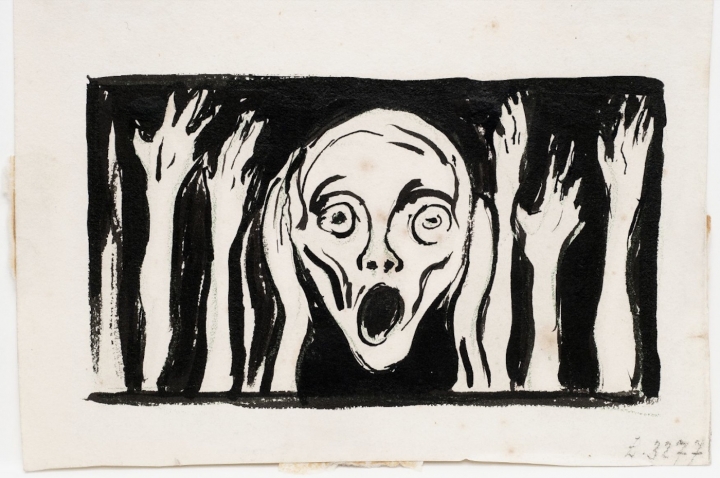
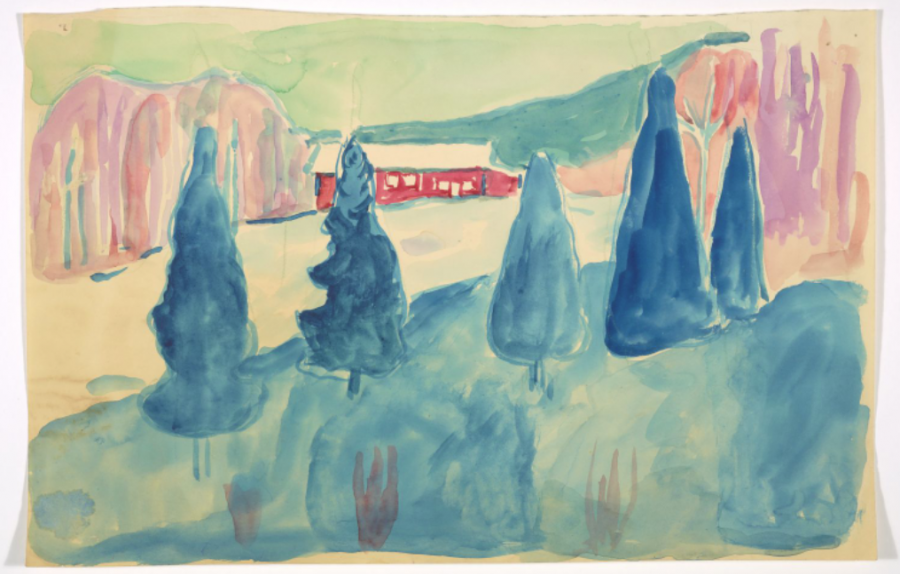
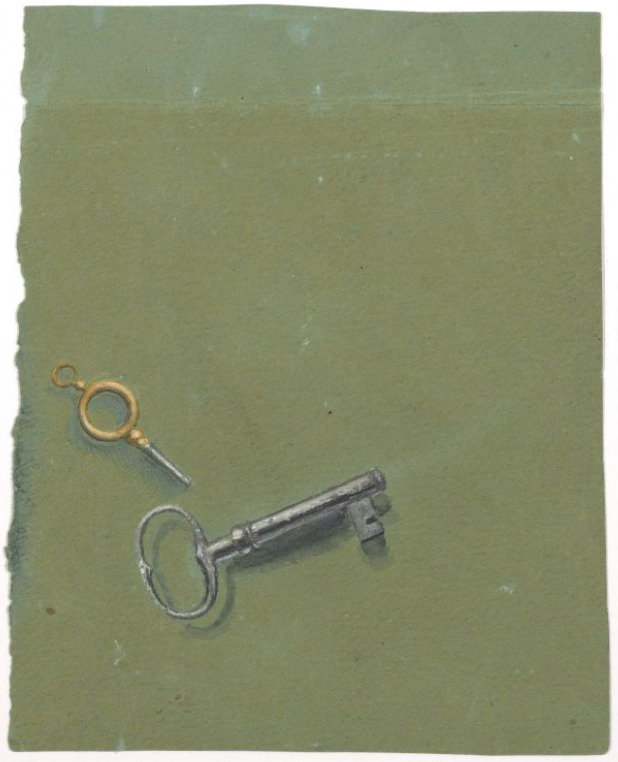
If we count ourselves among those who know little of Munch’s work, a new initiative from the Munch Museum in Oslo aims to correct that by making over 7,600 of Munch’s drawings available online. “The online catalog, free to all,” notes Hyperallergic’s Sarah Rose Sharp, “represents a tremendous feat of logistics, and features drawings that go back as far as the artist’s childhood, sketchbooks, studies of tools, coins, and keys that demonstrate Munch’s dedication as a disciplined draftsman, and watercolors of buildings that were some of the first bodies of work developed by the artist in his youth.”
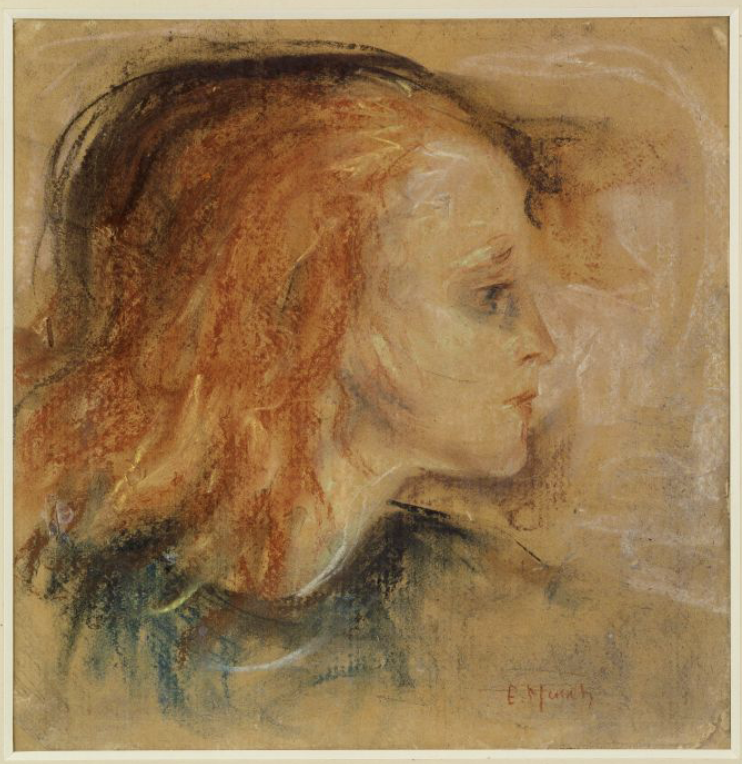
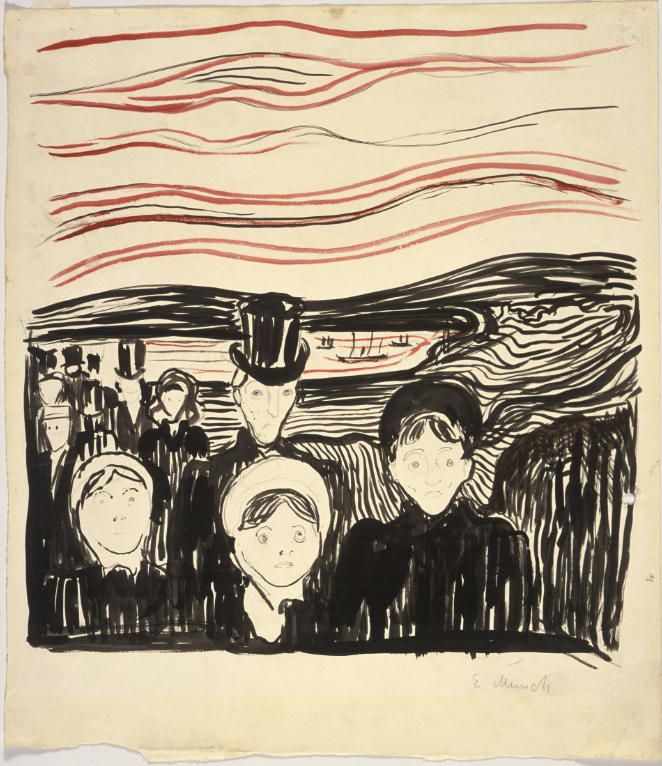
Over 90% of the drawings on digital display come from the Museum’s holdings, the rest from other public and private collections. “The goal is to make Munch’s art known and easily accessible to as many people as possible,” Magne Bruteig, Senior Curator for Prints and Drawings, tells Hyperallergic. “Since the majority of the drawings had never been exhibited or published in any way, it has been of special importance to reveal this ‘hidden treasure.’” The online collection, then, not only serves as an introduction for Munch novices but also for longtime admirers of the artist’s work, who have hitherto had little to no access to this huge collection of studies, preparatory sketches, watercolors, etc., which includes the miserable family grouping of Angst, at the top, the reprise of his infamous Scream figure, further up, from 1898, and The Sick Child, above, a portrait of his sister Sophie who died in childhood.
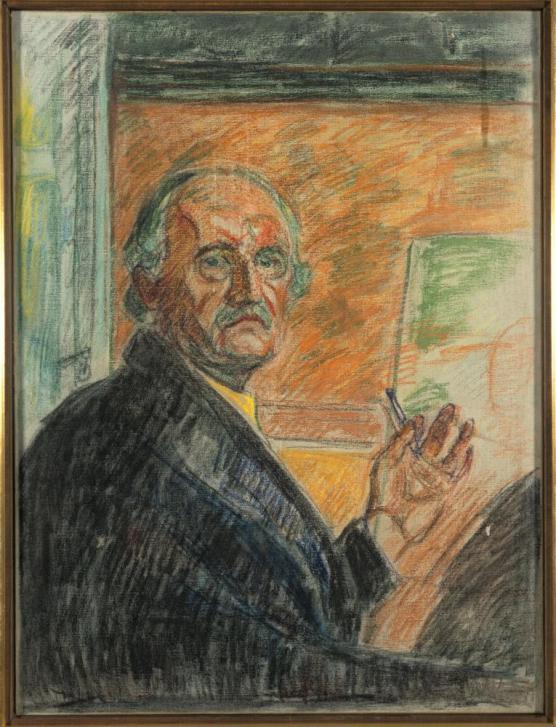
The drawings date back to 1873, when Munch was only ten years old and inserted a series of his own illustrations into a copy of Grimm’s Fairytales. The final works date from 1943, the year before the artist’s death, when he made the self-portrait above in pastel crayon. Munch’s work, writes Rosenthal, “is compulsively autobiographical.” Remaining a committed bachelor all of his life, he said that “his paintings were his children, even though he gave many of them a somewhat Spartan upbringing, deliberately leaving them not only unvarnished but exposed to the elements in his vast outdoor studio or hung on walls, unframed and with nails through them.” The several thousand drawings he fathered seem to have been treated with more care. Delve into the enormous collection at the Oslo Munch Museum site here, where you can also view many of the artist’s paintings and learn much more about his life and work through articles and essays.
Related Content:
30,000 Works of Art by Edvard Munch & Other Artists Put Online by Norway’s National Museum of Art
Edvard Munch’s Famous Painting “The Scream” Animated to the Sound of Pink Floyd’s Primal Music
The Edvard Munch Scream Action Figure
Josh Jones is a writer and musician based in Durham, NC. Follow him at @jdmagness
Read More...Hip Hop Fan Freaks Out When He Hears Rage Against the Machine’s Debut Album for the Very First Time
I consider myself lucky to have been a child of the nineties. As you know from Portlandia’s tribute to the decade of slack, it was a time when “people were content to be unambitious and sleep to 11 and just hang out with their friends.” Start a band, start a t‑shirt company, build a website, go to clown school, or don’t, whatever, no pressure…. In contrast to the hypercompetitive, social media-saturated, precarious gig economy lives of harried, overworked, underpaid millennials, we had it pretty easy. But we knew things were poised to explode. At the same time, it was a decade of cultural passion for revolution, peace, and justice—conscious hip hop, Riot Grrrl, Lilith Fair, and Rage Against the Machine, maybe the most radically uncompromising band since Crass. The rap/rock/metal hybrid seamlessly blended the revolutionary funk and political fury of Public Enemy with the virtuoso riffage of Eddie Van Halen.
I only wish that, like the guy in the video above, I could hear them again for the first time, blasting from the car stereo, blowing my mind every few seconds. How is it that this guy had never heard Rage’s incredible self-titled debut? For one thing, I guess, he probably hadn’t even been born when it came out in 1992.
For another, he’s a hip-hop head who didn’t listen to rock and metal until recently, when, as his YouTube channel documents, he decided to start sampling bands in his car and uploading his real-time reactions. How very 2018. He’s exposed himself to some great stuff—Megadeth, Deftones, Iron Maiden, Metallica, Motörhead. He’s sampled Audioslave, guitarist Tom Morello’s post-Rage supergroup. And some other bands I won’t comment on.
He also put together a mixtape of metal he thinks would cross over to his hip hop friends. Unsurprisingly, many of the bands he recommends pull heavily from Rage Against the Machine, who themselves pulled from the Beastie Boys, Anthrax, Suicidal Tendencies, Faith No More.… Rage didn’t come from nowhere—we’d heard conscious rap and metal meet before, even just the previous year when Anthrax and Public Enemy put out their version of “Bring the Noise.” The late eighties/early nineties produced organic rap/metal crossovers before the problematic advent of “nu metal.” But when YouTuber YouYouYou!!! hits pause at 3:38 and screams “WHAT IS THIS! WHAT IS THIS!” I relate. It was more or less my reaction when I first heard “Know Your Enemy,” “Take the Power Back,” and “Killing in the Name” blast from the tape deck. YouYouYou!!! takes recommendations. I recommend he work his way through all of Rage’s catalog.
Related Content:
A Massive 800-Track Playlist of 90s Indie & Alternative Music, in Chronological Order
Josh Jones is a writer and musician based in Durham, NC. Follow him at @jdmagness
Read More...How to Use Psychedelic Drugs to Improve Mental Health: Michael Pollan’s New Book, How to Change Your Mind, Makes the Case
The history of research on psychedelic drugs is so sensational that more sober-minded experiments (so to speak) often get obscured by the hip, the weird, and the nefarious, the latter including secret CIA and Army testing of LSD and other drugs as a means of psychological warfare and “enhanced interrogation.” These experiments inadvertently led to Ken Kesey’s infamous “Acid Tests” in Northern California. On the other side of the country, Harvard psychologist Timothy Leary used questionable methods in his psilocybin experiments with prisoners and students, before getting fired and going on to expand the mind of the counterculture, earning the distinction of having Richard Nixon call him “the most dangerous man in America.”
Meanwhile, working in relative obscurity in very different circumstances in the late 50s, a UC Irvine psychiatrist named Oscar Janiger brought volunteer subjects, including several dozen artists, to a house outside L.A., where they were given LSD and psychotherapy. Janiger’s work has its sensational side—a cousin of Allen Ginsberg, he reportedly introduced Cary Grant, Anais Nin, Jack Nicholson, and Aldous Huxley to acid. But his primary achievement, in data that remained mostly unpublished during his lifetime, were his discoveries of the therapeutic and creative use of psychedelic drugs under controlled conditions with subjects who were prepared for the experience and guided through it by trained professionals.
The experiments conducted by Janiger and others differed markedly from the freewheeling recreational drug use of the counterculture and the weaponization of psychedelics by the U.S. government. In recent years, scientists and psychologists have conducted similar kinds of research under even more tightly controlled conditions, substantiating and expanding on the conclusions of early experimenters who found that psychedelics seem remarkably effective in treating depression, anxiety, alcoholism, drug addiction, and other stubbornly destructive human ills. This research supports with sound evidence LSD inventor Albert Hoffman’s description of his drug as “medicine for the soul.”
While research organizations like MAPS (Multidisciplinary Association for Psychedelic Studies) have centralized and promoted much of the current research, it’s now getting a huge popular boost from none other than food writer Michael Pollan, bestselling author of books like The Omnivore’s Dilemma and In Defense of Food. “A self-described ‘reluctant psychonaut,’” writes NPR, Pollan submitted himself as a test subject for experiments with “LSD, psilocybin and 5‑MeO-DMT, a substance in the venom of the Sonoran Desert toad.” He has described his experiences and the work of the research community in a new book titled How to Change Your Mind: What the New Science of Psychedelics Teaches Us About Consciousness, Dying, Addiction, Depression, and Transcendence.
At the top of the post, see Pollan describe the book in a short video from Penguin. He discusses such ancient ideas (as he has in past writings) of psychoactive drugs as “entheagens”—or chemical conduits to the divine. “In the Darwinian sense,” he says, the evolutionary purpose of psychedelic experiences may be an increase in cognitive variety and the stimulation of “more metaphors, more insights.” In his Fresh Air interview above, Pollan further explains how this works therapeutically. “One of the things our mind does is tell stories about ourselves,” he says. “If you’re depressed, you’re being told a story perhaps that you’re worthless, that no one could possibly love you… that life will not get better.”
“These stories,” Pollan says, “trap us in these ruminative loops that are very hard to get out of. They’re very destructive patterns of thought.” Psychedelic drugs “disable for a period of time the part of the brain where the self talks to itself. It’s called the default mode network, and it’s a group of structures that connect parts of the cortex — the evolutionarily most recent part of the brain — to deeper levels where emotion and memory reside.” Disrupting old narratives helps people to write better, healthier stories.
As Pollan says in the Time video above, psychedelics have been popularly conceived as drugs that make you crazy—and in some cases, that happens. But they are also “drugs that can make you sane, or more sane.” One of the major differences between one outcome and the other is the conditions under which the drug is taken. When quality and dosage of the drugs are controlled, and when subjects are prepared for “bad trips” with specific instructions, even frightening hallucinations can contribute to better mental health.
In his psilocybin experiment, for example, Pollan was accompanied by two “guides” and given “a set of ‘flight instructions,” including what to do if you see a monster.
…don’t try to run away. Walk right up to it, plant your feet and say, “What do you have to teach me? What are you doing in my mind?” And if you do that, according to the flight instructions, your fear will morph into something much more positive very quickly.
In another example, another psylocybin subject, Alana, describes in the Vox video below her guided experience with the drug during a smoking cessation trial at Johns Hopkins. “There were scary parts, foreboding parts,” she says, but thanks to controlled conditions and the reassuring presence of a guide, “I always knew there was joy and peace on the other side of it. It was freeing.”
Using psychedelics to confront and conquer fears goes back many thousands of years in traditional societies. Modern technological culture has largely turned to antidepressants and other pharmaceuticals to regulate anxiety, but as Pollan points out, “Prozac doesn’t help when you’re confronting mortality,” the deepest, most universal fear of all. But psychedelics—as Aldous Huxley found when he took LSD on his deathbed—can “occasion an experience in people—a mystical experience—that somehow makes it easier to let go.” Surely, there are other ways to do so. In any case, psychedelic drugs seem so beneficial to psychological well-being that they can be, and hopefully will be in the future, used to positively (responsibly) shift the consciousness and creative potential of millions of suffering people.
For more on this subject, read Pollan’s latest book–How to Change Your Mind: What the New Science of Psychedelics Teaches Us About Consciousness, Dying, Addiction, Depression, and Transcendence.
Related Content:
Aldous Huxley’s Most Beautiful, LSD-Assisted Death: A Letter from His Widow
Ken Kesey Talks About the Meaning of the Acid Tests
Josh Jones is a writer and musician based in Durham, NC. Follow him at @jdmagness
Read More...The Device Invented to Resuscitate Canaries in Coal Mines (Circa 1896)

Lewis Pollard, the curator of the Museum of Science and Industry in Manchester, England, recently highlighted his favorite object in his museum’s collections–this gadget, created circa 1896, used to resuscitate canaries in coal mines.
For about a century–from the 1890s through the 1980s–British coal miners had a tradition of lowering canaries into a coal mine to detect the presence of noxious gases. As the BBC explains, the “canary is particularly sensitive to toxic gases such as carbon monoxide which is colourless, odourless and tasteless. This gas could easily form underground during a mine fire or after an explosion. Following a mine fire or explosion, mine rescuers would descend into the mine, carrying a canary in a small wooden or metal cage. Any sign of distress from the canary was a clear signal the conditions underground were unsafe and miners should be evacuated from the pit and the mineshafts made safer.”
In deciding to send canaries into the mines, inventors came up with the somewhat humane device shown above. According to Pollard, the circular door of the cage “would be kept open and had a grill to prevent the canary [from] escaping. Once the canary showed signs of carbon monoxide poisoning the door would be closed and a valve opened, allowing oxygen from the tank on top to be released and revive the canary. The miners would then be expected to evacuate the danger area.” This practice continued for almost 100 years, until canaries officially started to get replaced by technology in 1986.
Read more about Pollard’s favorite object here.
Related Content:
Two Million Wondrous Nature Illustrations Put Online by The Biodiversity Heritage Library
Read More...You Can Now Airbnb the Home of F. Scott and Zelda Fitzgerald, Where the Author Wrote Tender Is the Night

Photo by George F. Landegger, via Wikimedia Commons
F. Scott Fitzgerald started writing in earnest at Princeton University, several of whose literary and cultural societies he joined after enrolling in 1913. So much of his time did he devote to what would become his vocation that he eventually found himself on academic probation. Still, he kept on writing novels even after dropping out and joining the Army in 1917. He wrote hurriedly, with the prospect of being shipped out to the trenches hanging over his head, but that grim fate never arrived. Instead the Army transferred him to Camp Sheridan outside Montgomery, Alabama, at one of whose country clubs young Scott met a certain Zelda Sayre, the “golden girl” of Montgomery society.
With his sights set on marriage, Scott spent several years after the war trying to earn enough money to make a credible proposal. Only the publication of This Side of Paradise, his debut novel about a literarily minded student at Princeton in wartime, convinced Zelda that he could maintain the lifestyle to which she had become accustomed. Between 1921, when they married, and 1948, by which time both had died, F. Scott and Zelda Fitzgerald lived an occasionally productive, often miserable, and always intensely compelling life together. The story of this early cultural “power couple” has an important place in American literary history, and Fitzgerald enthusiasts can now use Airbnb to spend the night in the home where one of its chapters played out.
The rentable apartment occupies part of the F. Scott Fitzgerald Museum in Montgomery, an operation run out of the house in which the Fitzgeralds lived in 1931 and 1932. For the increasingly troubled Zelda, those years constituted time in between hospitalizations. She had come from the Swiss sanatorium that diagnosed her with schizophrenia. She would afterward go to Johns Hopkins Hospital in Baltimore, where she would write an early version of her only novel Save Me the Waltz, a roman à clef about the Fitzgerald marriage. For Scott’s part, the Montgomery years came in the middle of his work on Tender is the Night, the follow-up to The Great Gatsby for which critics had been waiting since that book’s publication in 1925.
“The house dates to 1910,” writes the Chicago Tribune’s Beth J. Harpaz. “The apartment is furnished in casual 20th century style: sofa, armchairs, decorative lamps, Oriental rug, and pillows embroidered with quotes from Zelda like this one: ‘Those men think I’m purely decorative and they’re fools for not knowing better.’ ” Evocative features include “a record player and jazz albums, a balcony, and flowering magnolia trees in the yard.” It may not offer the kind of space needed to throw a Gatsby-style bacchanal — to the endless relief, no doubt, of the museum staff — but at $150 per night as of this writing, travelers looking to get a little closer to these defining literary icons of the Jazz Age might still consider it a bargain. It also comes with certain modern touches that the Fitzgeralds could hardly have imagined, like wi-fi. But then, given the well-documented tendency toward distraction they already suffered, surely they were better off without it.
You can book your room at Airbnb here.
Related Content:
Free: The Great Gatsby & Other Major Works by F. Scott Fitzgerald
Rare Footage of Scott and Zelda Fitzgerald From the 1920s
Winter Dreams: F. Scott Fitzgerald’s Life Remembered in a Fine Film
The Evolution of F. Scott Fitzgerald’s Signature: From 5 Years Old to 21
Based in Seoul, Colin Marshall writes and broadcasts on cities and culture. His projects include the book The Stateless City: a Walk through 21st-Century Los Angeles and the video series The City in Cinema. Follow him on Twitter at @colinmarshall or on Facebook.
Read More...Patti Smith, The Godmother of Punk, Is Now Putting Her Pictures on Instagram
As evidenced by her Instagram feed the Godmother is just like you and me. She posts pictures of her kids.
She gives her mom a Mothers Day shout out…
She celebrates her friends’ birthdays, posts selfies, travel shots, and pet pics…
She’s not above self-promotion if the situation warrants.
But the accompanying captions set punk’s poet laureate apart. No LOLs here. It’s clear that the award-winning author of Just Kids and M Train thinks about her content, carefully crafting each post before she publishes. Each is a bite-sized reflection, a page-a-day meditation on what it means to be alive:
This is day two of my Venice report.
I bummed around thinking of
Venice in the seventies. It had
a strong Rasta vibe with Reggae
music drifting from the head shops
and boom boxes on the beach.
Burning Spear and Jimmy Cliff
and Bob Marley. Venice has an
ever changing atmosphere but
I always like walking around,
anonymous, just another freak.
On Pacific next to the Cafe Collage
I had steamed dumplings and
ginger tea at Mao’s Kitchen.
The food is great and reasonable.
Because it was early it was
nearly empty. Since I was awake
since 4am i was nearly hypnotized
by the turning of their overhead
fan. Before I left they gave me a
fortune cookie. It was a true one.
Reflecting my past and certainly
my future. A very good day.
Follow Patti Smith on Instagram here.
Related Content:
Patti Smith’s 40 Favorite Books
Ayun Halliday is an author, illustrator, theater maker and Chief Primatologist of the East Village Inky zine. Her solo show Nurse!, in which one of Shakespeare’s best loved female characters hits the lecture circuit to set the record straight premieres in June at The Tank in New York City. Follow her @AyunHalliday.
Read More...Support Us
We're hoping to rely on loyal readers, rather than erratic ads. Please click the Donate button and support Open Culture. You can use Paypal, Venmo, Patreon, even Crypto! We thank you!

About Us

Open Culture scours the web for the best educational media. We find the free courses and audio books you need, the language lessons & educational videos you want, and plenty of enlightenment in between.
Advertise With Us

FREE UPDATES!
GET OUR DAILY EMAIL
Get the best cultural and educational resources on the web curated for you in a daily email. We never spam. Unsubscribe at any time.
FOLLOW ON SOCIAL MEDIA

Open Culture editor Dan Colman scours the web for the best educational media. He finds the free courses and audio books you need, the language lessons & movies you want, and plenty of enlightenment in between.
Advertise With Us

