Buckminster Fuller Appears on the Los Angeles New Age Cable TV Shows, Psychic Phenomena and Quest Four (1979–82)
Has the world ever known a more compellingly eccentric cultural outlet than the fringes of Los Angeles television in the 1970s and 80s? For the most part a realm of false prophets, unhinged crackpots, desperate pitchmen, and Cal Worthington, its airwaves also occasionally carried the thoughts of important minds. Take, for instance, the appearances on the public-access cable programs Psychic Phenomena: The World Beyond and Quest Four: The Fourth Dimension of none other than prolific architect-theorist-inventor Buckminster Fuller. You can watch both together, and thereby get an overview of the then already octogenarian Fuller’s life and ideas in a fairly unusual context, in the videos of the Youtube playlist above.
On both programs, the first of which aired in 1979 and the second in 1983, Fuller sits across from Damien Simpson. The founder of an organization called the Universal Mind Science Church, Simpson seems to have spent his life as something of a seeker. After time in the seminary, he lived for a period in a monastery under a vow of silence.
In the years after starting his own church, he hosted new-age television and radio programs whose guest lists included, according to his bio, everyone from Elisabeth Kübler-Ross to Dennis Weaver. But Simpson clearly considered Fuller the catch to beat them all, more than once likening himself to “a kid in a candy store” as he revels in his chance to converse with the man who thought up the geodesic dome and much else besides.
Born in the 19th century, usually dressed in a suit and tie, and constantly working on the development and application of ultra-practical ideas, Fuller hardly projected the image of a 70s new-ager. Yet he and the audiences of shows like Psychic Phenomena and Quest Four shared more than a few habits of mind. Fuller, for instance, insisted on always considering the world as not a collection of nations but one whole system (one he memorably labeled “Spaceship Earth”), an example of “holistic thinking” in the truest sense. He also believed, as he spells out in these interviews, that humanity faces an existential “final examination,” a test of our collective intellect and will to determine whether we can bring about an era — quite literally, a new age — of peace. It will demand much of us, he tells Simpson and and his viewers all across Los Angeles, not least our naiveté: “Dare to be naive. That’s the only way you’ll ever learn anything.”
via Ubuweb
Related Content:
Everything I Know: 42 Hours of Buckminster Fuller’s Visionary Lectures Free Online (1975)
Watch an Animated Buckminster Fuller Tell Studs Terkel All About “the Geodesic Life”
Based in Seoul, Colin Marshall writes and broadcasts on cities and culture. His projects include the book The Stateless City: a Walk through 21st-Century Los Angeles and the video series The City in Cinema. Follow him on Twitter at @colinmarshall or on Facebook.
Read More...The Map of Philosophy: See All of the Disciplines, Areas & Subdivisions of Philosophy Mapped in a Comprehensive Video
In the introduction to his sweeping History of Western Philosophy, Bertrand Russell wastes no time getting to a definition of his subject. “The conceptions of life and the world which we call ‘philosophical,’” he writes in the first sentence, “are a product of two factors: one, inherited religious and ethical conceptions; the other, the sort of investigation which may be called ‘scientific,’ using the word in its broadest sense. … Philosophy, as I shall understand the word, is something intermediate between theology and science.” (Russell makes a similar argument, in slightly different terms, in the essay “Mysticism and Logic.”)
Although this distinction between broadly “theological” and broadly “scientific” thinking may not map directly onto the modern schism between “Continental” and “Analytic” philosophy, a comparison still seems highly relevant. Though some continental thinkers may not wish to admit it, their categories and modes of reasoning—or intuiting, reflecting, speculating, etc.—derive from theological thought denuded of its specific religious content or beliefs. Or as philosopher Thomas R. Wells writes at his blog The Philosopher’s Beard, the continental proceeds from a “direct concern with the human condition, its ambition, its reflexivity, its concern with the media as well as the message.”
The analytic, on the other hand, strives for “universal scope, clarity and public accountability…. It tries to systematize knowledge” and approximate scientific methods of inquiry (which also once mixed freely with the theological). Both approaches can move too close to the poles Russell identifies—can move too far away, that is, from philosophy and toward the obscure and purely mystical or the inhumanely, unreflectively rational. Perhaps one way of thinking about the history of philosophy is as a dance between this play of opposites, with each approach offering a corrective to the other’s excesses, sometimes within the same thinker’s body of work.
But before applying such abstractions, we should consider the ways philosophy developed as a discipline distinct from the hard sciences and theology—and from art, psychology, anthropology, physics, mathematics, linguistics, economics, etc. “Once upon a time,” notes the video at the top—a comprehensive “map of philosophy” made by Carneades.org— “Philosophy was anything you can study. Everything in the realm of study was a type of philosophy.” The breaking off of other fields into their own domains happened over the course of several hundred years. Nonetheless, “philosophy still had its fingers in all of those other pies.”
One can think philosophically about anything—philosophy can “put different disciplines on the same playing field to talk to each other.” It is, the video’s introduction declares, “the glue that holds all of academia together” (hence, the top academic degree, the Ph.D., or “doctor of philosophy”). For reasons of his own training, the video’s creator, who simply goes by the pseudonym “Carneades,” leans more heavily on the analytic side of things, neglecting or only lightly touching on much of the continental thought that flourished in the wake of Heidegger, Hegel, Nietzsche, Kierkegaard, Sartre, and others. (Further up, you can see a video focused on one specific school of moral philosophy—Consequentialism. See more such videos at the Carneades.org YouTube channel.)
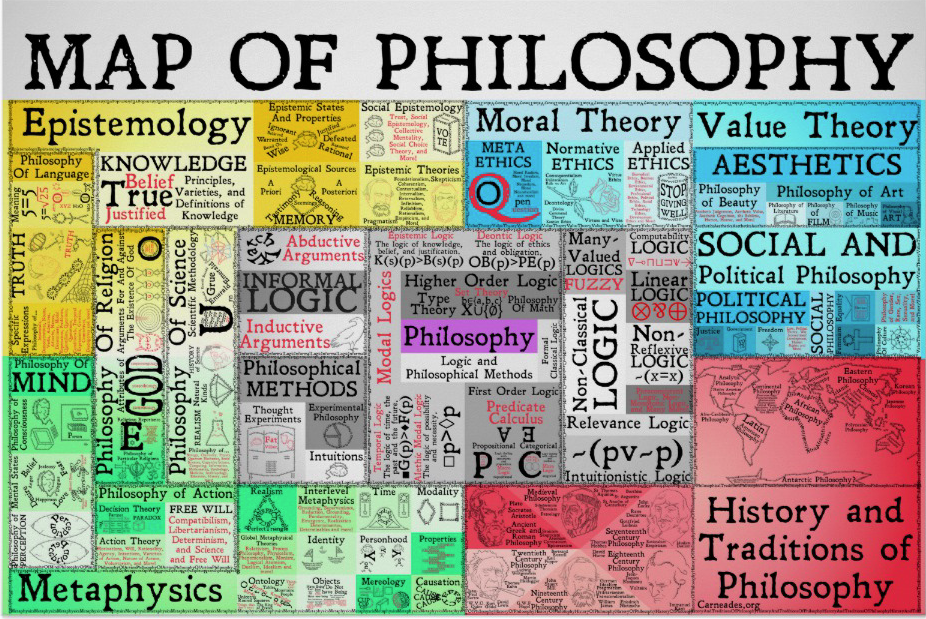
Carneades admits his biases and blind spots and welcomes corrections from those better versed in other traditions. To his credit, he includes Native American, African, Latin American, Afro-Caribbean, Polynesian, Japanese, Islamic, Tibetan, and many other global philosophical traditions in his extensive map—traditions that are usually completely ignored or deemed “unphilosophical” in other such surveys. His sensitivity to global thought may have something to do with the fact that he is not based in a Western academic department, but in West Africa, where he does humanitarian work.
See a complete table of contents, with links to specific sections, for the lengthy “Map of Philosophy” just below, and an image of the full map just above (purchase a hard copy here). Carneades’ intention to bring “these ideas back to the modern agora from the Ivory Tower” is a noble one. If you agree, and find these videos informative and intellectually stimulating, you can donate to or become a patron of his efforts at the Carneades.org Patreon page.
Table of Contents:
00:00 Introduction
01:44 Logic and Philosophical Methods
02:14 Formal Classical Logic
04:55 Non-Classical Logic
06:35 Informal Logic
08:00 Philosophical Methods
10:20 The History of Philosophy
13:30 Philosophical Traditions Around the World
20:55 Aesthetics
22:35 Political Philosophy
23:34 Social Philosophy
25:00 Moral Theory & Ethics
28:08 Epistemology
30:34 Metaphysics
34:13 Philosophy of Science
37:35 Philosophy of Religion
40:17 Philosophy of Language
41:58 Philosophy of Mind
43:49 Philosophy of Action
44:57 Full Map
Related Content:
Free Online Philosophy Courses
The History of Philosophy … Without Any Gaps
350 Animated Videos That Will Teach You Philosophy, from Ancient to Post-Modern
A History of Philosophy in 81 Video Lectures: From Ancient Greece to Modern Times
Josh Jones is a writer and musician based in Durham, NC. Follow him at @jdmagness
Read More...Discover the Lost Early Computer Art of Telidon, Canada’s TV Proto-Internet from the 1970s
Most of us got hooked up to the internet in the 1990s or thereabouts, though the true early adopters did it when personal computers first blew up in the 1980s. But certain Canadian households got online even earlier, in the late 1970s, although not quite on the internet as we know it: they had Telidon, a phone line-connected videotex/teletex system that used a regular television as a display. “It is no exaggeration to say that the telecommunications marketplace in Canada was gripped by Telidon fever from late 1979 to late 1982,” writes Donald Gilles in the Canadian Journal of Communications. Fueling that fever was “hope and belief in technology – science-based technology – as an agent of change, a bringer of novelty, and enhancer of life.”
When it first came available, Telidon’s content providers included “corporations and interests such as The Bay, Encyclopedia Britannica and the Toronto Star,” writes the CBC’s Chris Hampton, but “a community of arts-minded electronics wonks, telecom prophets and other curious sorts coalesced around it, embracing it as an art medium.”
You can see some of those Telidon creators interviewed in the short Motherboard documentary at the top of the post. While businesses experimented with possibilities of banking and shopping through the system, artists pushed its boundaries even further, using its now severe-seeming technological limitations as a catalyst for visual creativity. On some months, artist Bill Perry’s Telidon magazine Computerese drew more viewers than every other provider combined.
Now, more than 30 years after its discontinuation, Telidon has attracted attention again. It turns out that its early-computer-art aesthetic has aged quite well, as seen in the examples now being pulled from the archives and Instagrammed by Toronto new-media center InterAccess. Originally founded to make Telidon development tools available to the artist community, InterAccess launched this social media project as a way of celebrating its own 35th birthday. Looking back on all the uses artists found for Telidon — everything from abstract quasi-animations to a study of perspectives on the Cold War — we can imagine how comparatively boundless the modern internet would have seemed to them. But we might also wonder what that modern internet would look like if it had a little more of their artistically and technologically adventurous spirit.
Related Content:
The Internet Imagined in 1969
From the Annals of Optimism: The Newspaper Industry in 1981 Imagines its Digital Future
What the Entire Internet Looked Like in 1973: An Old Map Gets Found in a Pile of Research Papers
Andy Warhol’s Lost Computer Art Found on 30-Year-Old Floppy Disks
Watch Brian Eno’s “Video Paintings,” Where 1980s TV Technology Meets Visual Art
The Story of Habitat, the Very First Large-Scale Online Role-Playing Game (1986)
Based in Seoul, Colin Marshall writes and broadcasts on cities and culture. His projects include the book The Stateless City: a Walk through 21st-Century Los Angeles and the video series The City in Cinema. Follow him on Twitter at @colinmarshall or on Facebook.
Read More...Explore Meticulous 3D Models of Endangered Historical Sites in Google’s “Open Heritage” Project
One brisk thumping by a natural disaster, totalitarian regime, or terrorist group is more than enough to reduce an awe-inspiring heritage site to rubble.
With that sad fact in mind, Google Arts & Culture has paired with CyArk, a non profit whose mission is using the latest technologies to digitally document and preserve the world’s significant cultural heritage in an easily shareable format.
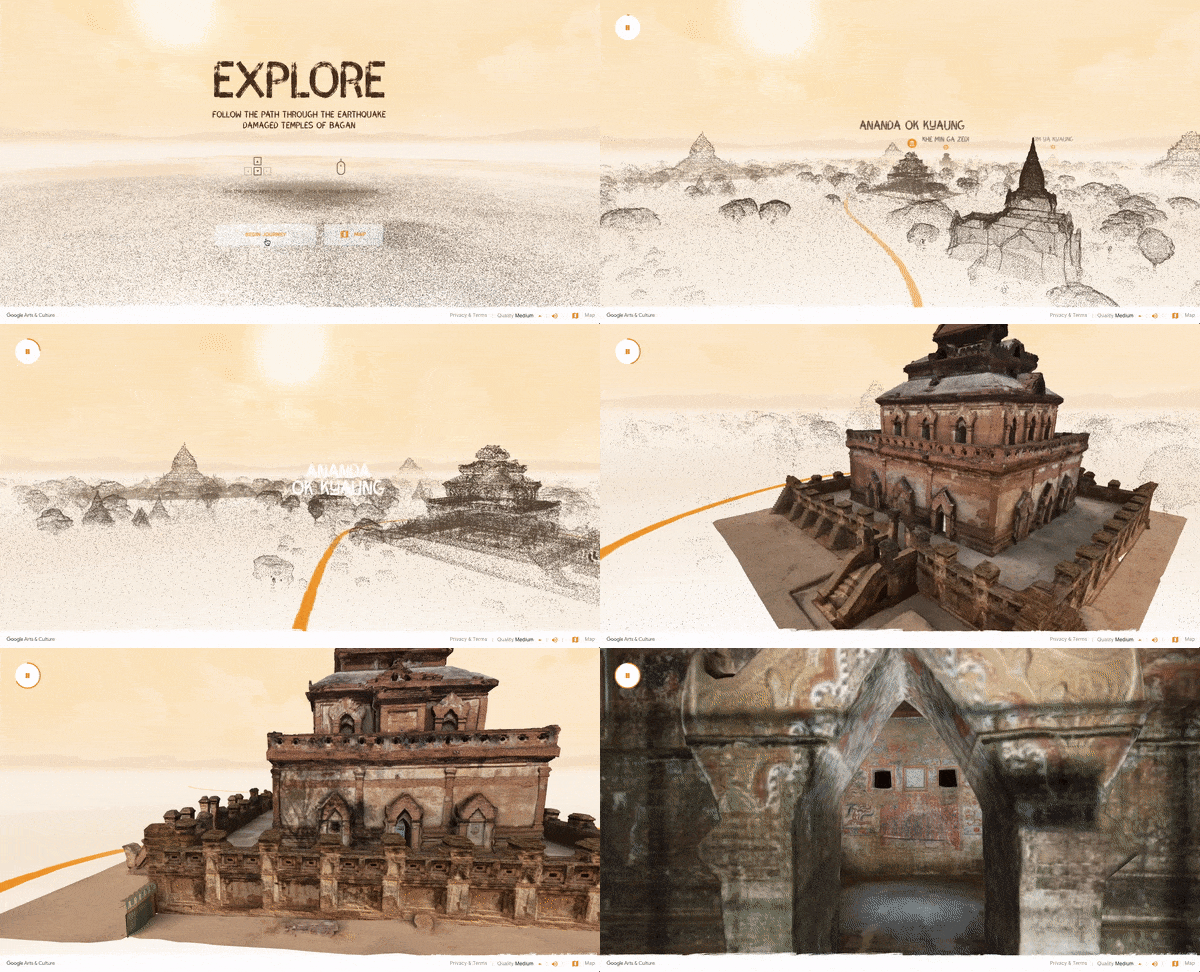
The resulting project, Open Heritage, is a massive browsable collection of 3D heritage data, already the largest of its kind, and certain to increase as its creators race against the clock.
As of this writing, visitors can explore 3D models of 27 heritage sites from 18 countries.
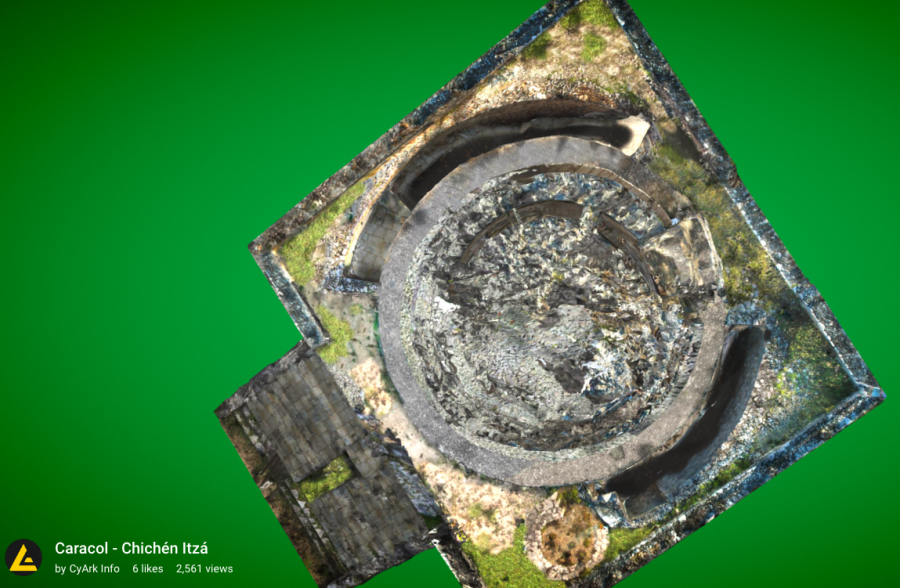
Even those of us who’ve had the good fortune to visit these sites in person have much to gain from the drone’s eye view of the Caracol observatory that’s part of Mexico’s ancient Mayan metropolis Chichén Itzá or Berlin’s iconic Brandenburg Gate.
Each model is accompanied by an expedition overview that details the site’s history and significance, as well as its location on a map. Time lapse photos help give a sense of the site’s human traffic during the time it was being documented, as well as the nature of the work CyArk does on location. Significant details are highlighted, and their symbolism discussed.
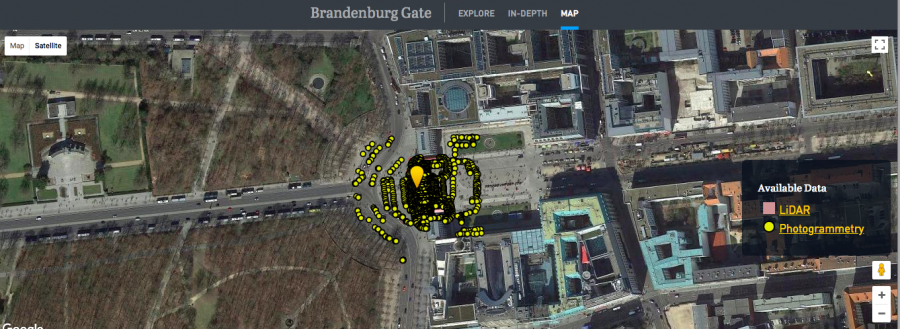
CyArk will share project data with viewers who request it, using a Creative Commons Attribution-NonCommercial 4.0 International License.
Equally important is the role these comprehensive 3D scans can play in current and future restoration efforts, by identifying areas of damage and documenting existing color and texture with down-to-the-millimeter precision.
Begin your virtual explorations of such Open Heritage sites as Greece’s Ancient Corinth, Lebanon’s Temple of Echoun, and Ayutthaya, Thailand’s Wat Si Sanphet, here.
Learn more about aerial photogrammetry, 3D laser scanning, stereoscopic 360 imagery, and other tools of the digital preservation trade here.
And stay abreast of CyArk’s work by subscribing to their free monthly newsletter here.
Related Content:
Visit 890 UNESCO World Heritage Sites with Free iPhone/iPad App
Google Puts Over 57,000 Works of Art on the Web
Google Digitizes and Puts Online a Vast Archive of Latino Artworks and Artifacts
Ayun Halliday is an author, illustrator, theater maker and Chief Primatologist of the East Village Inky zine. Her solo show Nurse!, in which one of Shakespeare’s best loved female characters hits the lecture circuit to set the record straight premieres in June at The Tank in New York City. Follow her @AyunHalliday.
Read More...When Robert Rauschenberg Asked Willem De Kooning for One of His Paintings … So That He Could Erase It
How to make a name for oneself in the art world? Every up-and-coming artist has to face that intimidating question in one way or another, but Robert Rauschenberg, now remembered as a leading light of the pop art movement, came up with a particularly memorable answer. When in 1953 he got the counterintuitive idea to make a drawing not by drawing, but by erasing, he at first tried erasing images he’d drawn himself. This brought him to the realization that not only should his erasing constitute more than half the process — “I wanted it to be the whole,” he later said — but that, to make a real artistic impact, he’d have to erase the work of someone important.
The logical choice at the time: Willem de Kooning, then already considered a master of abstract expressionism. “I bought a bottle of Jack Daniels and went up and knocked on his door, praying the whole time that he wouldn’t be home,” says Rauschenberg in the interview clip above, “but he was home.” Eventually he sold the older and more eminent artist on the idea of taking a drawing, erasing it, and turning that into art of his own, a pitch no doubt assisted by Rauschenberg and de Kooning’s already friendly relationship. (The already vast difference between their artistic styles also took the notion of artistic patricide out of the question.)
De Kooning at first resisted, but then doubled down: “I want it to be something I’ll miss,” Rauschenberg remembers him saying before picking out the sacrifice. Erased de Kooning Drawing, the result of two months of erasing and countless spent erasers, “essentially remained an underground, art world phenomenon for more than ten years after it was completed.” So writes SFMOMA curator Sarah Roberts in an essay on the piece. “Significantly, it was excluded from numerous important solo and group exhibitions in the late 1950s and early 1960s, crucial years when Rauschenberg’s reputation was becoming established internationally.”
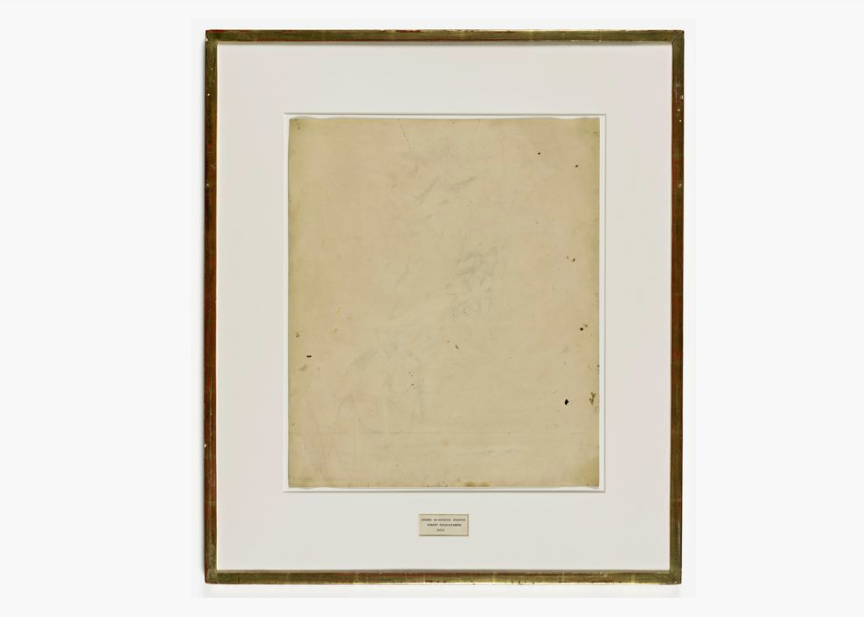
But slowly, over the years, word spread through the art media and social scenes, and now the 27-year-old Rauschenberg’s brazen artistic act has a place among the progenitors of conceptual art. “Yes, the erasure was an act of destruction,” writes Roberts, “but as a creative gesture it was also an act of reverence or even devotion—to de Kooning, to drawing, to art history, and to the idea of taking a risk and being open to whatever comes as a result.” Though practically unknown for quite a long time, Erased de Kooning Drawing can now hardly be forgotten — which takes erasing a respected forebear’s work off the table as a means of name-making for young artists today, each of whom will have to find their own way to set off a slow-burn shock.
Related Content:
Robert Rauschenberg’s 34 Illustrations of Dante’s Inferno (1958–60)
The MoMA Teaches You How to Paint Like Pollock, Rothko, de Kooning & Other Abstract Painters
Based in Seoul, Colin Marshall writes and broadcasts on cities and culture. His projects include the book The Stateless City: a Walk through 21st-Century Los Angeles and the video series The City in Cinema. Follow him on Twitter at @colinmarshall or on Facebook.
Read More...All of the Rulers of Europe Over the Past 2,400 Years Presented in a Timelapse Map (400 B.C. to 2017 A.D.)
Theories of power, from Machiavelli and Hobbes to Locke and Jefferson, have drawn their lessons from the towering figure of the Sovereign, the principle actor in dramas of old European statecraft. One philosopher advises cunning, another fear and awe. When we come to ideas of civil society based in property rights, we see theorists arguing with proponents of monarchical divine right, or struggling, constitutionally, militarily, with a mad king.
Maybe this survey seems banal, passé, boring, blah.
It can be difficult for post-post-moderns to fully appreciate the Sovereign’s once-crushing weight. (See John Milton’s many defenses of regicide and revolution, for example.) Maybe, schooled in the work of Gilles Deleuze, Michel Foucault, George Orwell, Hannah Arendt, Theodor Adorno, etc., we have learned to think of power—whether from below or above—as diffuse, interrelated, networked, spread across classes, impersonal bureaucracies, institutional practices.
The word “despot,” for example, sounds so exotic, an ossified term from antiquity. Studying the video above could bring it to life again, if discourses around current events haven’t. Sprinting through two-thousand, four-hundred, and seventeen years of history, this dramatic presentation names the names of every ruler in Europe, from 400 B.C.E. to 2017.
Despite its Eurocentric association with the East (as in the stereotype of the “Oriental Despot”), Western history offers hundreds of examples of despotism. Put simply, “despotism,” says Foucault in his lecture series The Birth of Biopolitics, “refers any injunction made by the public authorities back to the sovereign’s will, and to it alone.”
Despotism, he argues, stands in contrast to the police state, or absolute rule by administrators and enforcers, and to the Rule of Law, in which rulers and ruled are both ostensibly bound by external charters and legal codes.
Watch the procession of emperors, kings, usurpers, tyrants…. Do we know the names of any of their functionaries? Do we need to? If Claudius or Constantine decreed, what does it matter who carried out the order? When and where do those terms change—when do the names become a kind of synecdoche, standing in for administrations, parties, juntas, etc. rather than the singular will of individuals, benevolent, enlightened, or otherwise?
How many of these rulers’ names are unfamiliar to us? Why haven’t we heard them? At what period in history does Europe become predominantly ruled by other forms of government? Does despotism ever disappear? Does it reappear in the 20th century (were Lenin, Franco, or Marshall Tito despots?), or must we use another rubric to describe dictators and autocrats? (Does it make any sense to call contemporary figureheads like Elizabeth II “rulers of Europe”?)
Pick your own mode of analysis, explore the outer edges and obscure interiors of empires, and you might find yourself getting very interested in European history (learn more here), or curious about how “despotism” divided, metamorphosed, and metastasized into whatever various forms of rule the names “Merkel,” “Macron,” “Putin,” “Poroshenko,” or “Erdogan,” for example, represent today.
Related Content:
Free Online History Courses
The History of Europe: 5,000 Years Animated in a Timelapse Map
Watch the History of the World Unfold on an Animated Map: From 200,000 BCE to Today
Josh Jones is a writer and musician based in Durham, NC. Follow him at @jdmagness
Read More...An 82-Year-Old Japanese Audiophile Searches for the Best Sound by Installing His Own Electric Utility Pole in His Yard
As a longtime record collector (first because it was before CDs were invented) and a budding audiophile (because vinyl does sound better than digital, have at me in the comments if you must), I appreciate a good story about the search for perfect sound. But Takeo Morita takes it to a new level.
In the Wall Street Journal story above, we learn that the 82-year-old has installed a 42-foot utility pole next to his house. Why? To get that clean electricity to his system, not that shared, filthy electricity from a common-as-muck utility pole. Electricity is like blood, he explains, and the cleaner the blood, the better for the system.
Now this reminds me, while we’re here, to tell you about a show I once saw on Japanese TV and which I one day hope to see on YouTube. A news show profiled Japan’s number one Bob Dylan collector, who had every vinyl release of the musician, even to redundancy. At one point he pulled out an album still in its shrink wrap that was no different from the one next to it. “This has a green sticker on it,” he said, pointing to the right hand corner. “But that’s just a sticker,” said the host. Blank stare. Pause. “But this has a green sticker on it.”
That’s the spirit, I thought.
Also: Never catch that spirit, I thought.
This article at residentadvisor.net explores the world of Tokyo’s audiophile underground, which is both a logical outcome for those into hearing the best music systems and something quintessentially Japanese. I can’t imagine an audiophile bar opening up in the States anytime soon. But the listening venue has a long history in Japan:
It can be traced back to the rise of jazz kissa (jazz cafés) and meikyoku kissa (classical music cafés) in the years following World War II, a time when imported records were prohibitively expensive. This meant that, for many people, the kissaten were the only places to hear good music from abroad. The focus at these cafés was on deep, concentrated listening.
As the article mentions, there are as many mini clubs in Tokyo as there are genres, from classical to drone/glitch. And it comes down to the idea, started by American sociologist Ray Oldenburg, of “The Third Place,” the place that is neither home, nor work:
As civilization has advanced, going to work and back home has become our routine as humans,” Ariizumi says. “The third place is not quite home, and it’s not work, but a community where everyone can be welcomed and relax, with a nice atmosphere. I heard about the term ‘third place’ for the first time just when we opened Bridge, and I remember thinking, ‘This is exactly what I want to create.’ That’s what I want to do, create a third space. People can come here and talk about their jobs or their love life, or they can come here and dance. It’s a place between work and home. People need that.
Question is, dear reader: do you have a third space?
Related content:
How Steely Dan Wrote “Deacon Blues,” the Song Audiophiles Use to Test High-End Stereos
How Good Are Your Headphones? This 150-Song Playlist, Featuring Steely Dan, Pink Floyd & More, Will Test Them Out
The Distortion of Sound: A Short Film on How We’ve Created “a McDonald’s Generation of Music Consumers”
Ted Mills is a freelance writer on the arts who currently hosts the artist interview-based FunkZone Podcast and is the producer of KCRW’s Curious Coast. You can also follow him on Twitter at @tedmills, read his other arts writing at tedmills.com and/or watch his films here.
Read More...Short Fascinating Film Shows How Japanese Soy Sauce Has Been Made for the Past 750 years
A few years back, we visited Hōshi, a hotel located in Komatsu, Japan, which holds the distinction of being the 2nd oldest hotel in the world, and “the oldest still running family business in the world.” Built in 718 AD, Hōshi has been operated by the same family for 46 consecutive generations.
It’s hard to imagine. But it’s true. Once established, Hōshi would have to wait another 500 years before soy sauce came to Japan and could be served to its guests. According to the National Geographic video above, a buddhist monk traveled from China to Yuasa, Japan in the 13th century. And there he began producing soy sauce, fermenting soy beans, wheat, salt and water. That tradition continues to this day. This fascinating short film by Mile Nagaoka gives you a good glimpse into this timeless process.
If you would like to support the mission of Open Culture, consider making a donation to our site. It’s hard to rely 100% on ads, and your contributions will help us continue providing the best free cultural and educational materials to learners everywhere. You can contribute through PayPal, Patreon, and Venmo (@openculture). Thanks!
Related Content:
Early Japanese Animations: The Origins of Anime (1917–1931)
Hand-Colored Photographs of 19th Century Japan
A Hypnotic Look at How Japanese Samurai Swords Are Made
Female Samurai Warriors Immortalized in 19th Century Japanese Photos
Hand-Colored 1860s Photographs Reveal the Last Days of Samurai Japan
Read More...Philip Roth (RIP) Creates a List of the 15 Books That Influenced Him Most
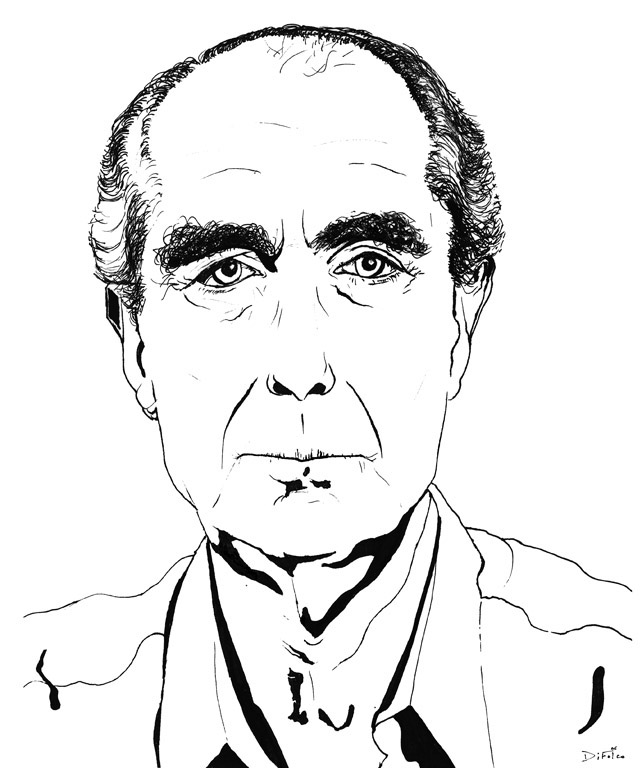
Image by Thierry Ehrmann, via Flickr Commons
We stand at a pivotal time in history, and not only when it comes to presidential politics and other tragedies. The boomer-era artists and writers who loomed over the last several decades—whose influence, teaching, or patronage determined the careers of hundreds of successors—are passing away. It seems that not a week goes by that we don’t mourn the loss of one or another towering figure in the arts and letters. And along with the eulogies and tributes come critical reappraisals of often straight white men whose sexual and racial politics can seem seriously problematic through a 21st century lens.
Surely such pieces are even now being written after the death of Philip Roth yesterday, novelist of, among many other themes, the unbridled straight male Id. From 1969’s sex-obsessed Alexander Portnoy—who masturbates with raw liver and screams at his therapist “LET’S PUT THE ID BACK IN YID!”—to 1995’s aging, sex-obsessed puppeteer Mickey Sabbath, who masturbates over his own wife’s grave, with several obsessive men like David Kepesh (who turns into a breast) in-between, Roth created memorably shocking, frustrated Jewish male characters whose sexuality might generously be described as selfish.
In a New York Times interview at the beginning of this year, Roth, who retired from writing in 2012, addressed the question of these “recurrent themes” in the era of Trump and #MeToo. “I haven’t shunned the hard facts in these fictions of why and how and when tumescent men do what they do, even when these have not been in harmony with the portrayal that a masculine public-relations campaign — if there were such a thing — might prefer.… Consequently, none of the more extreme conduct I have been reading about in the newspapers lately has astonished me.”
The psychological truths Roth tells about fitfully neurotic male egos don’t flatter most men, as he points out, but maybe his depictions of obsessive male desire offer a sobering perspective as we struggle to confront its even uglier and more violent, boundary-defying irruptions in the real world. That said, many a writer after Roth handled the subject with far less humor and comic awareness of its bathos. From where did Roth himself draw his sense of the tragically absurd, his literary interest in extremes of human longing and its often-destructive expression?
He offered one collection of influences in 2016, when he pledged to donate his personal library of over 3,500 volumes to the Newark Public Library (“my other home”) upon his death. Along with that announcement, Roth issued a list of “fifteen works of fiction,” writes Talya Zax at Forward, “he considers most significant to his life.” Next to each title, he lists the age at which he first read the book.
- Citizen Tom Paine by Howard Fast, first read at age 14
- Finnley Wren by Philip Wylie, first read at age 16
- Look Homeward Angel by Thomas Wolfe, first read at age 17
- Catcher in the Rye by J.D. Salinger, first read at age 20
- The Adventures of Augie March by Saul Bellow, first read at age 21
- A Farewell to Arms by Ernest Hemingway, first read at age 23
- The Assistant by Bernard Malamud, first read at age 24
- Madame Bovary by Gustave Flaubert, first read at age 25
- The Sound and the Fury by William Faulkner, first read at age 25
- The Trial by Franz Kafka, first read at age 27
- The Fall by Albert Camus, first read at age 30
- Crime and Punishment by Fyodor Dostoyevsky, first read at age 35
- Anna Karenina by Leo Tolstoy, first read at age 37
- Cheri by Colette, first read at age 40
- Street of Crocodiles by Bruno Schulz, first read at age 41
“It’s worth noting,” Zax points out, “that Roth, who frequently fields accusations of misogyny, included only one female author on the list: Colette.” Make of that what you will. We might note other blind spots as well, but so it is. Should we read Philip Roth? Of course we should read Philip Roth, for his keen insights into varieties of American masculinity, Jewish identity, aging, American hubris, literary creativity, Wikipedia, and so much more besides, spanning over fifty years. Start at the beginning with two of his fist published stories from the late 50s, “Epstein” and “The Conversion of the Jews,” and work your way up to the 21st century.
via The Forward
Related Content:
What Was It Like to Have Philip Roth as an English Prof?
Philip Roth Predicts the Death of the Novel; Paul Auster Counters
Josh Jones is a writer and musician based in Durham, NC. Follow him at @jdmagness
Read More...Watch The Hedy Lamarr Story, a New Documentary on the 1940s Film Star & Inventor of Wi-Fi Technology (Streaming Free for a Limited Time)
We told you last year about Hedy Lamarr, the 1940s film star who also helped invent the technology behind wi-fi and bluetooth during World War II. Now, she’s the subject of a new documentary from PBS’s American Masters series. Directed by Alexandra Dean, and streaming free online for a limited time, Bombshell: The Hedy Lamarr Story, “explores how Lamarr’s true legacy is that of a technological trailblazer” and features, among other things, “four never-before-heard audio tapes of Lamarr speaking on the record about her incredible life, finally giving her the chance to tell her own story.” The winner of several film festival awards, The Hedy Lamarr Story premiered across the US on May 18th. Stream it online above or also here.
If you would like to support the mission of Open Culture, consider making a donation to our site. It’s hard to rely 100% on ads, and your contributions will help us continue providing the best free cultural and educational materials to learners everywhere. You can contribute through PayPal, Patreon, and Venmo (@openculture). Thanks!
Related Content:
Watch The Strange Woman, the 1946 Noir Film Starring Hedy Lamarr
Read More...Support Us
We're hoping to rely on loyal readers, rather than erratic ads. Please click the Donate button and support Open Culture. You can use Paypal, Venmo, Patreon, even Crypto! We thank you!

About Us

Open Culture scours the web for the best educational media. We find the free courses and audio books you need, the language lessons & educational videos you want, and plenty of enlightenment in between.
Advertise With Us

FREE UPDATES!
GET OUR DAILY EMAIL
Get the best cultural and educational resources on the web curated for you in a daily email. We never spam. Unsubscribe at any time.
FOLLOW ON SOCIAL MEDIA

Open Culture editor Dan Colman scours the web for the best educational media. He finds the free courses and audio books you need, the language lessons & movies you want, and plenty of enlightenment in between.
Advertise With Us

