The New Studs Terkel Radio Archive Will Let You Hear 5,000+ Recordings Featuring the Great American Broadcaster & Interviewer

Sitting down with a famous (or not) person and asking questions–and recording them– might seem like the most natural thing in the world these days. We have talk shows, podcasts, radio interviews. We read them in magazines, newspapers, online. But this was not always the case, certainly not before the invention of modern media in the 20th century. And one of the main people to start interviewing folks was Studs Terkel. He called it “guerrilla journalism” because it was direct and live and the journalist was not an intermediary.
“I realized very early on,” he said, “that the conventional way of approaching an interview was useless; that taking in a notebook full of questions, for instance, only made people feel interrogated.”
And now The Studs Terkel Radio Archive (STRA) is set to go live on the Internet, a huge collection of his interviews. Between 1952 and 1997, at his hometown radio station WFMT in Chicago, he recorded a whopping 5,600 programs. The archive is being unveiled on what would be Terkel’s 106th birthday, May 16, 2018. (He passed away at 95 in 2008.)
His list of guests is formidable: Martin Luther King, Simone de Beauvoir, Bob Dylan, Cesar Chavez, Marlon Brando, Toni Morrison, Ted Turner, Arnold Schwarzenegger. But it’s the list of unknowns, the common folk, that make his work rise above. A good socialist, he gave voice to those who might never have considered speaking up, in books like Working, Race, or Coming of Age. Here was the story of America, from poor to rich, and Terkel had time, and a listening ear, for all of them. He was interested in civil rights, workers’ rights, the promise of America and the sins of America.
The STRA has five components: the digital platform (where people can access his interviews), the “Digital Bughouse” where other broadcasters and such can license his works; an educational component to be used in the classroom; the “Bughouse Square” a podcast intended for younger listeners; and a series of upcoming live events in Chicago and around the world.
Related Content:
Studs Terkel Interviews Bob Dylan, Shel Silverstein, Maya Angelou & More in New Audio Trove
Ted Mills is a freelance writer on the arts who currently hosts the artist interview-based FunkZone Podcast and is the producer of KCRW’s Curious Coast. You can also follow him on Twitter at @tedmills, read his other arts writing at tedmills.com and/or watch his films here.
Read More...How the Sounds You Hear in Movies Are Really Made: Discover the Magic of “Foley Artists”
Have you ever worked as an “extra” on a film or television shoot, one of the anonymous many somewhere in the background while the main characters advance the story up front? If so, you know that to be seen but not heard onscreen requires doing exactly that. Even though a crowded party scene, for instance, really does sound like a crowded party scene in the final product, the shoot happens in something close to silence. Only the stars speak, and indeed make any sound at all; everyone else just mimes their lively conversations. Sound designers add the crowd noise later, after the shoot, just like they add music, footsteps, doors opening and closing, crackling of fires and the whipping of winds, and pretty much every other sound you hear besides speech.
“The Magic of Making Sound,” the Great Big Story video above, reveals the work of Foley artists, some of the most little-known craftsmen in the entertainment industry. We usually think of realism as a primarily visual quality, praising something that “looks real” almost as often as we complain about what “looks fake,” but much of what makes dramatic action onscreen feel real happens on a completely unseen level.
Foley artists (named for early sound-effects designer Jack Foley) create all the incidental sounds you’d expect to hear in real life, so if and only if they do their work well, nobody in the audience will notice it. (Minimal Foley work, combined with dialogue dubbed in a studio instead of recorded during the shoot, contributes greatly to the “dreamlike” quality of some older films, especially from Europe and Asia.)
The Great Big Story video, along with the short profile of veteran Hollywood Foley artist Gary Hecker just above, show masters of the trade employing a variety of its tools: bags of corn starch for snow, gloves with paperclips taped to the fingertips for dog paws, and for that inevitable (if implausible) schwing of a sword being unsheathed, a kitchen spatula. Just like visuals, sound requires a certain degree of not just imagination but exaggeration to achieve that “larger than life” feeling. Still, the Foley craft has its origins in nothing more grand than the sounds made by hand to accompany radio dramas in the 1920s. The profession may have moved on from the coconut-shell horse hooves of nearly a century ago — these videos show the current industry standard, a jerry-rigged looking device made of plunger cups — but most of its equipment has remained reliably unchanged. How many other kinds of film-and-television technicians can say the same?
Related Content:
How the Sound Effects on 1930s Radio Shows Were Made: An Inside Look
Based in Seoul, Colin Marshall writes and broadcasts on cities and culture. His projects include the book The Stateless City: a Walk through 21st-Century Los Angeles and the video series The City in Cinema. Follow him on Twitter at @colinmarshall or on Facebook.
Read More...Why Stradivarius Violins Are Worth Millions
In 2011, a Stradivarius violin in pristine condition sold for $15.9 million. And then, in 2014, another Strad went up for auction with a minimum bid of $45 million. That auction failed, but it underscored a trend: The price and prestige of Stradivarius violins keep climbing, driven by the insatiable demand of investors and professional musicians.
But is a Stradivarius really worth that large sum of money? As this primer from Vox suggests, it depends who you ask. In a highly-publicized blind test, professional violinists couldn’t tell the difference between multi-million dollar Strads and more modestly-priced modern violins. On the other hand, some elite violinists swear by the Stradivarius, claiming that the subtle superiority of the instrument only becomes apparent over time, when it’s played over years, not days or months.
That debate will continue. And as it does, the Stradivarius will only get older–and, yes, more fetishized as an historical object that’s considered priceless.
Related Content:
Why Violins Have F‑Holes: The Science & History of a Remarkable Renaissance Design
Musician Plays the Last Stradivarius Guitar in the World, the “Sabionari” Made in 1679
Read More...19th Century Atlas Creatively Visualizes the Expansion of Geographical Knowledge Over 4000 Years of World History: From the Biblical Flood to the Industrial Revolution
The age of the “universal history” has come and gone. The genre flourished in times when it seemed possible to assume a vantage point outside of time—to see purpose and pattern in thousands of years of human action. “It might be possible,” wrote Immanuel Kant, “to have a history with a definite natural plan for creatures who have no plan of their own.” The view assumed by such a history tends to exclude the circumscribed perspective of the viewer, or—in Ralph Waldo Emerson’s famous, and oft-parodied, phrasing, “all mean egotism vanishes. I become a transparent eyeball; I am nothing; I see all; the currents of the Universal Being circulate through me; I am part and parcel of God.”
Few historians today assume such a gods-eye-view, for better or worse, but without it, we would never have seen the development of its visual analogue: the timeline map, an infographic form especially popular in the 18th to the early 20th centuries, when thinkers from Schiller to Herder to Kant to Hegel to Marx to Weber produced universal accounts of human history that, to varying degrees, purported to account for vast historical developments as the movement of impersonal forces toward some definite goal.
From the perspective of the timeline map, civilizations grow naturally from each other like branches from a tree, or flow one into another like a river’s tributaries, or produce, as in John B. Sparks “Histomap,” colorful puzzles in which every piece has its neatly-assigned place….
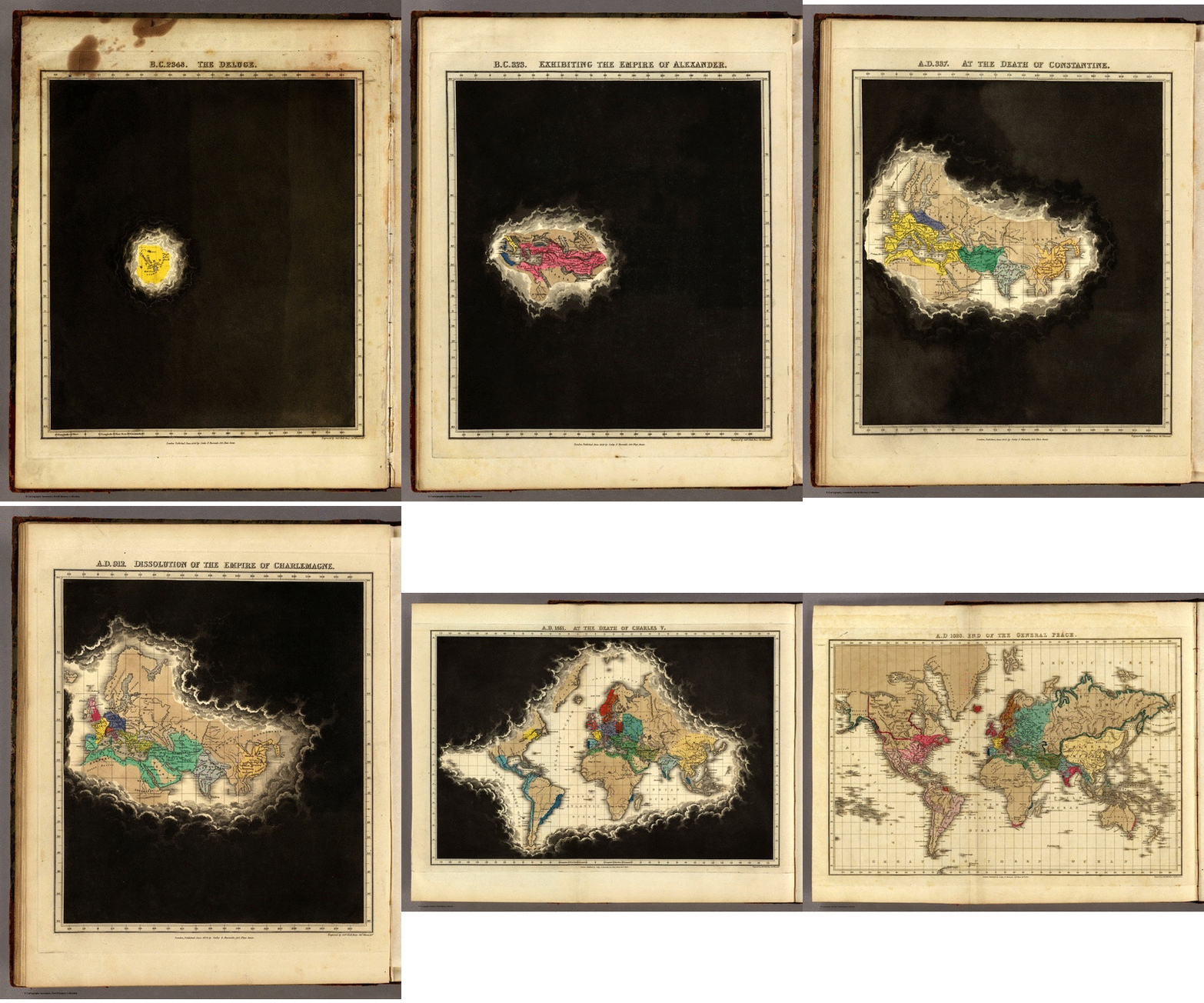
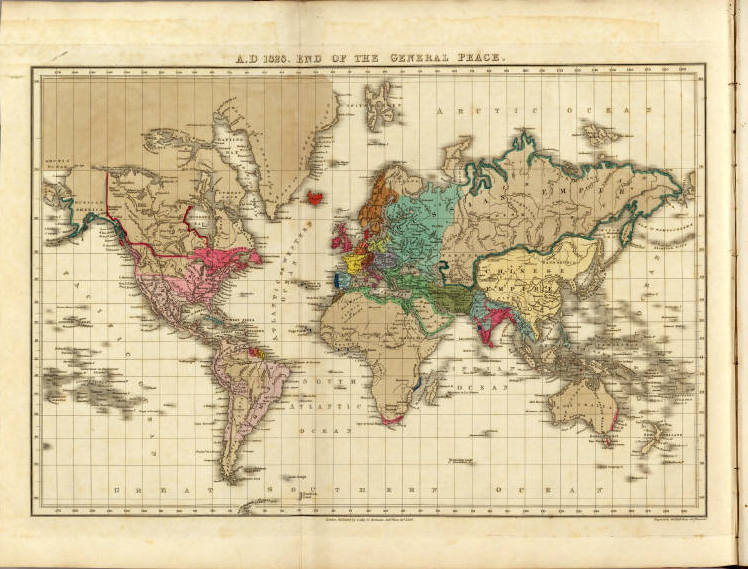
We’ve featured several such maps here, like the Histomap and Eugene Pick’s 1858 Tableau De L’Histoire Universelle, both from the extensive map collection of David Rumsey. In the version you see here, we have a very unusual variation on the theme—rather than a historical timeline map, Edward Quin produced in 1830 An Historical Atlas; In a Series of Maps of the World as Known at Different Periods.
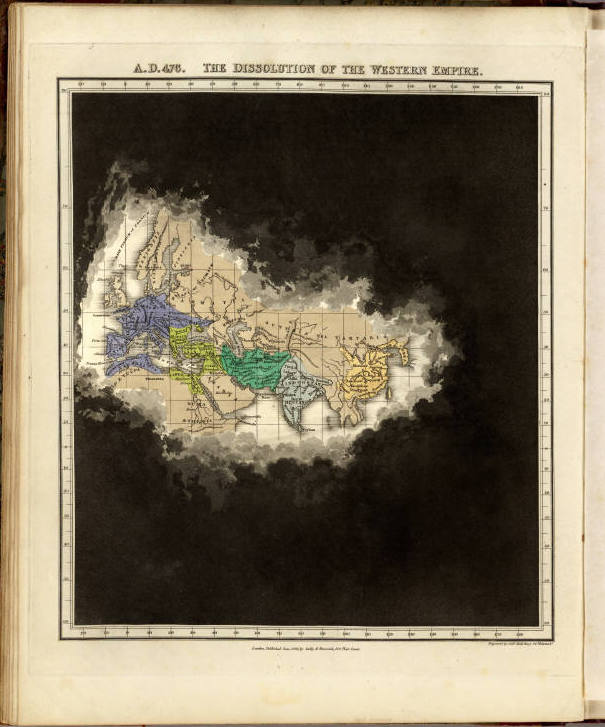
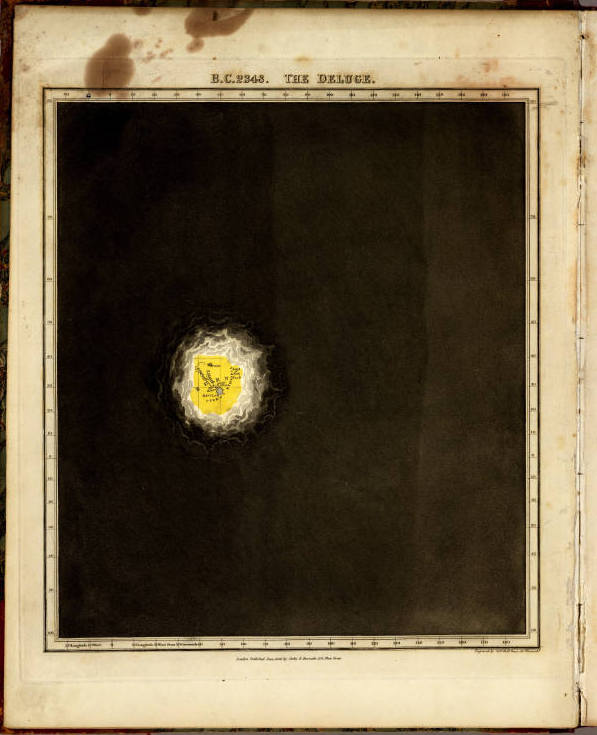
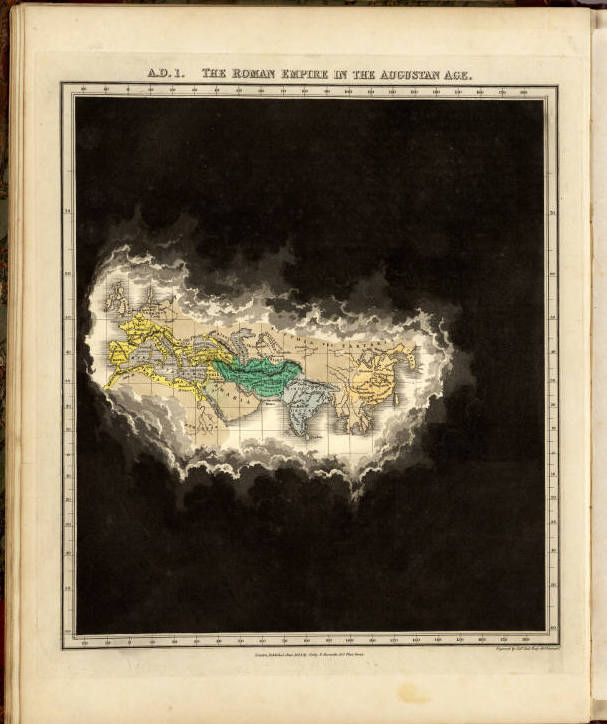
The question, “as known by whom?” seems entirely relevant. The perspective of Quin’s atlas is godlike, gazing down at the world through the clouds, but unlike Emerson’s transparent view, it does not “see all”—those clouds occlude the vision, restricting it to indicate, as the Rumsey collection notes, “the expansion of geographical knowledge over time.” You’ll have to read Quin’s text—available here—to understand how he accounts for the chronology and perspective.
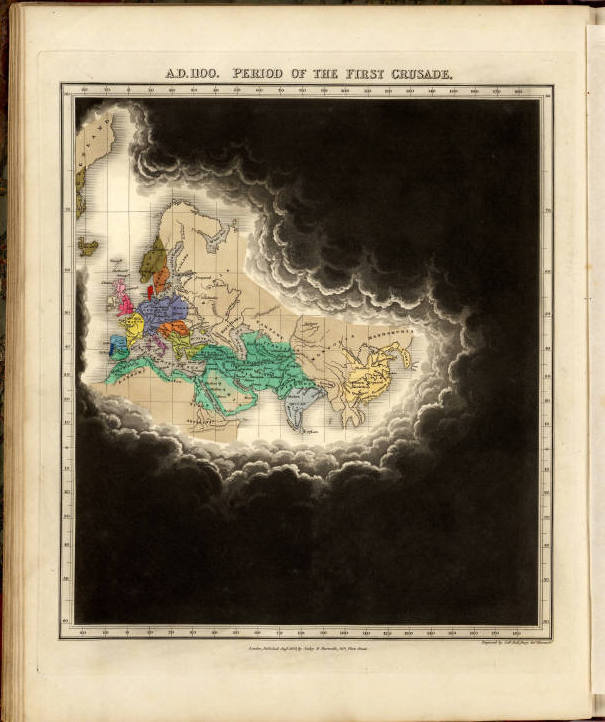
The atlas begins in 2348 B.C. with “the Deluge,” the mythical Biblical flood. Biblical history inexplicably gives way to the secular. In a description of the atlas by Donald A. Head rare books, this strange document “intended to cartographically depict political change from the time of creation to the year 1828,” when it reveals “the enlightened world in the midst of the Industrial Revolution…. Divided into twenty-one periods… the clouds fully disappear at the nineteenth period: ‘A.D. 1783 at the separation of the United States of America, from England.” In his preface, Quin explains his project in the typical terms of universal history, as illustrating “by the changes of colour the empires which succeed each other.”
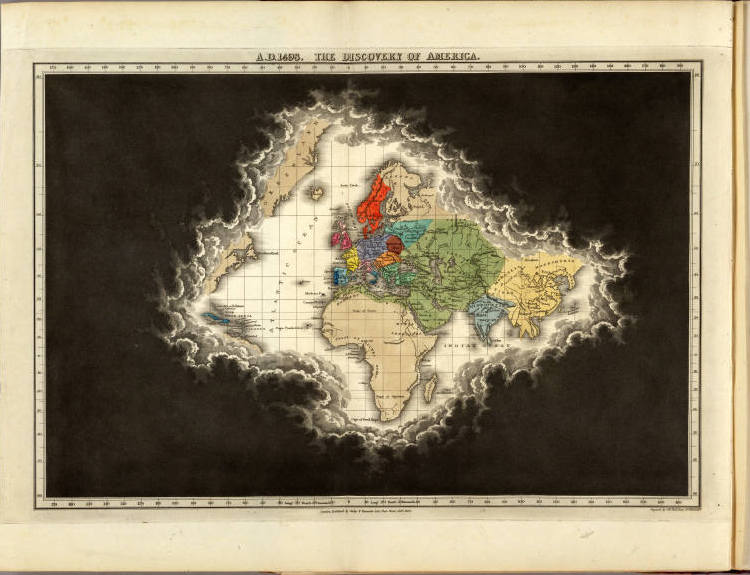
Quin’s description of the unchanging perspective he adopts might remind some modern readers of certain comic book characters as much as of the vision of a god or a transparent, detached eye: “Like the watchman on some beacon-tower, he views the hills and peopled valleys around him, always the same in situation and in form, but every changing aspect of the hours and seasons….” View Quin’s complete Historical Atlas, scanned in high resolution detail, at the David Rumsey Map Collection.
On our page here, see individual pages from the Historical Atlas. Or, up top, see an animated gif that lets you view all 21 maps in the atlas in chronological order.
Related Content:
4000 Years of History Displayed in a 5‑Foot-Long “Histomap” (Early Infographic) From 1931
Groundbreaking Map from 1858 Colorfully Visualizes 6,000 Years of World History
10 Million Years of Evolution Visualized in an Elegant, 5‑Foot Long Infographic from 1931
Josh Jones is a writer and musician based in Durham, NC. Follow him at @jdmagness
Read More...Hear a 12-Hour Playlist of Experimental Symphonic Noise Rock by Avant-Garde Guitarist and Composer Glenn Branca (RIP)
Glenn Branca died on Monday at age 69. In tributes from august publications like The Guardian and The New York Times, the guitarist and composer’s name is mentioned by and alongside minimalist luminaries like Steve Reich and John Cage. Branca himself cited composers like Olivier Messiaen and György Ligeti as influences. He belongs in the company of these avant-garde pioneers, but many who might recognize their names may not have heard the name Glenn Branca.
Branca worked in a much more anarchic milieu, namely the downtown New York noise rock scene that came to be called No Wave. “My real influence was punk,” he told Pitchfork in 2016. “I must have listened to the first Patti Smith album 300 times.” In turn, the composer influenced the next generation of underground New York artists, nurturing the talents of Sonic Youth’s Thurston Moore and Lee Ranaldo, who honed their art-rock chops—the drone notes, odd tunings, etc.—in the early ‘80s while playing in one of Branca’s notoriously noisy guitar ensembles.
Branca released Sonic Youth’s first two albums on his record label, tutored abrasive noise pioneers Swans’ guitarist Norman Westberg, and inspired essential downtown figures like Lounge Lizards’ John Lurie, who described seeing the composer’s band Theoretical Girls in 1979 as a life-changing event. Minimalist post-rock masterminds like Godspeed You! Black Emperor owe much to Branca’s innovations. Given that he occupied such a seminal place at such a key musical moment, giving birth to such seminal bands, why isn’t Branca’s work better known?
Perhaps this is because, while he drew from classical avant-garde, jazz, and punk rock, he refused to settle comfortably into any particular camp or to clearly define the boundaries of his work. Branca created a template all his own. Reich described him as “an absolute original,” which made him a very inspirational figure, but a difficult one to slot into a genre bin.
His treatment of rock instruments in orchestral settings made for intense, and for some unlistenable, music that thoroughly defied the conventions of rock and orchestral music, with ensembles of up to 100 electric guitars playing at once. (John Cage objected to Branca’s overwhelming performances on “political” grounds, saying they “resembled fascism.”)
But while Branca’s music has never had mass appeal, the few who love it, love it passionately. Of his classic 1981 album The Ascension (hear the title track at the top), Allmusic’s Brian Olewnick writes, “if one chooses to categorize the music on this recording as ‘rock,’ this is surely one of the greatest rock albums ever made.” One hears in The Ascension and Branca’s work in general the genesis of a muscular, noisy, orchestral post-rock sound now familiar in, say, the soundtrack work of artists like Radiohead’s Jonny Greenwood.
Despite his contention, as he told the NYT, that “I don’t change,” his work has evolved over time, developing new depths and complexity. In the Spotify playlist further up, hear Branca’s development as a composer in 66 tracks (or 12 hours) of symphonic experimental noise rock, and in the interview just above with the Louisiana Channel, see Branca describe (and demonstrate) his unusual guitar techniques and his breadth of musical influences.
Related Content:
The Music of Avant-Garde Composer John Cage Now Available in a Free Online Archive
Josh Jones is a writer and musician based in Durham, NC. Follow him at @jdmagness
Read More...Hear Tom Wolfe (RIP) Tell Studs Terkel All About Custom-Car Culture, the Subject of His Seminal Piece of New Journalism (1965)
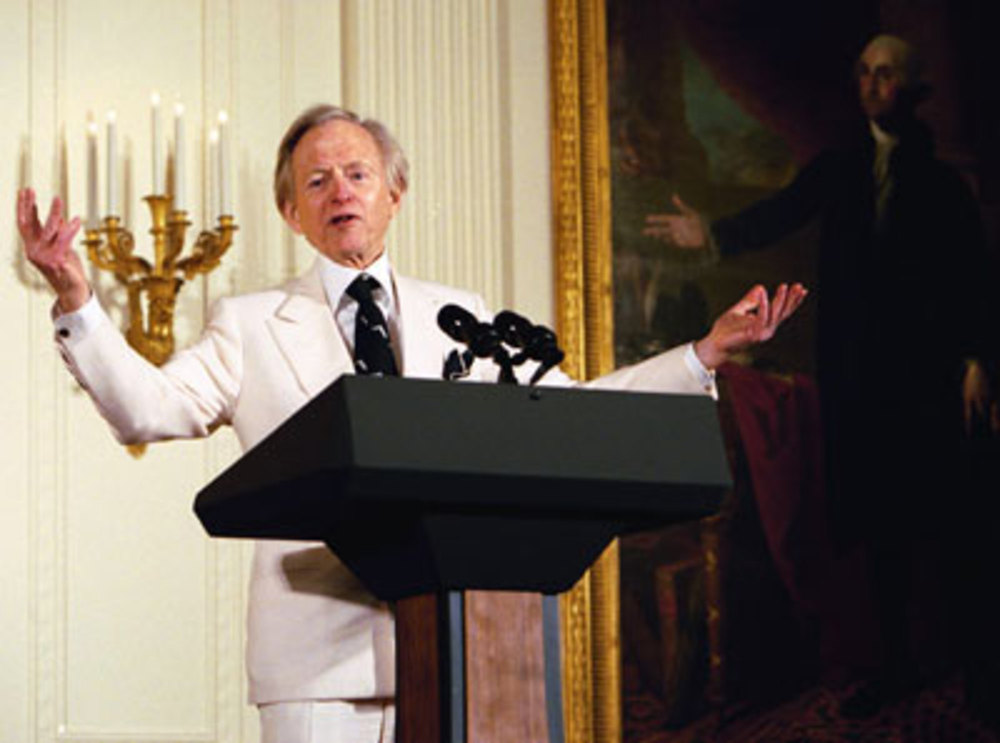
Photo by Susan Sterner, via Wikimedia Commons
American journalism breaks down into two basic varieties: that which came before Tom Wolfe, and that which came after. The 1960s counterculture, the space program, the modern art scene, the influence of Bauhaus architecture: whatever the subject, readers could trust Wolfe–who died this past Monday after a more than sixty-year career in letters–to convey it with great vividness of imagery and inventiveness of prose. He first developed his style of “New Journalism” in 1962, almost inadvertently: while struggling to shape his research on California custom car-culture into an article for Esquire, he wrote a letter to his editor describing what he had seen. The editor, so the legend goes, simply removed the letter’s salutation and printed it — leaving its voluminous detail and casual, conversational style untouched — as reportage.
That piece became the lead essay in 1965’s The Kandy-Kolored Tangerine-Flake Streamline Baby, a collection now considered one of the defining books of the 1960s in America (a list that also includes Wolfe’s own The Electric Kool-Aid Acid Test). After its publication, Wolfe made this appearance on the radio (part one, part two) across from Studs Terkel — a fellow journalist with an equal work ethic but a very different sensibility indeed — to talk about the California car customizer’s highly specialized enterprise as well as his own.
“It’s something that’s a real form of expression,” Wolfe says to Terkel. This is something we’ve overlooked in this country about the automobile and the motorcycle: that these things are forms of expression. We thought we were being very sophisticated a few years ago when we discovered that the automobile was a status symbol.” Looking back, the realm of the Kandy-Kolored Tangerine-Flake Streamline Baby-builders was Wolfe’s ideal starting point, vividly crystallizing as it did phenomena that would go on to number among his major themes: style, status, subculture, self-indulgence.
Just as one can’t imagine William Makepeace Thackeray outside mid-19th-century England or Émile Zola outside late 19th-century France — two cited inspirations in Wolfe’s later efforts to write not just novel journalism but journalistic novels — could Tom Wolfe have become Tom Wolfe anywhere other than postwar America? Looking back, that vast country plunged suddenly into a brand new kind of modernity, brimming as it was with wealth and wonder, vulgarity and violence, seemed to have been waiting for just the right chronicler, one sufficiently (in the highest sense) unorthodox and (in an even higher sense) undiscriminating, to come along. That chronicler came and now has gone, but the writing he leaves behind will let generation after generation experience the overwhelmingly vital decades in America he both observed and had a hand in creating.
Related Content:
The Beginnings of New Journalism: Capote’s In Cold Blood
Read 11 Free Articles by Hunter S. Thompson That Span His Gonzo Journalist Career (1965–2005)
Read 12 Masterful Essays by Joan Didion for Free Online, Spanning Her Career From 1965 to 2013
Studs Terkel Interviews Bob Dylan, Shel Silverstein, Maya Angelou & More in New Audio Trove
Based in Seoul, Colin Marshall writes and broadcasts on cities and culture. His projects include the book The Stateless City: a Walk through 21st-Century Los Angeles and the video series The City in Cinema. Follow him on Twitter at @colinmarshall or on Facebook.
Read More...Watch the Brand New Trailer for Bohemian Rhapsody, the Long-Awaited Biopic on Freddie Mercury & Queen
“Talk of a movie about [Freddie Mercury], who died in 1991, has gone on for years: Dexter Fletcher came up as a potential director, and for the role of Mercury both Ben Wishaw and Sacha Baron Cohen have at different times been attached. But now the film has entered production, having found a director in Bryan Singer, he of the X‑Men franchise, and a star in Rami Malek, best known as the lead in the television series Mr. Robot.”
That’s how our Colin Marshall introduced a post last fall which, among other things, gave us a first unofficial glimpse of Rami Malek as Freddie Mercury. Now comes the first official glimpse of Malek as Mercury. Above, watch the newly-released trailer for Bohemian Rhapsody, the long-awaited biopic that explores 15 years in the history of Queen–from the formation of the band, to their captivating, career-defining 1985 performance at Live Aid, previously featured on our site here.
Enjoy the trailer, and look for Bohemian Rhapsody to hit theaters on November 2.
Related Content:
Hear Freddie Mercury’s Vocals Soar in the Isolated Vocal Track for “Somebody to Love”
Read More...Get the History of the World in 46 Lectures: A Free Online Course from Columbia University
When you dive into our collection of 1,700 Free Online Courses, you can begin an intellectual journey that can last for many months, if not years. The collection lets you drop into the classrooms of leading universities (like Stanford, Harvard, MIT and Oxford) and essentially audit their courses for free. You get to be a fly on the wall and soak up whatever knowledge you want. All you need is an internet connection and some free time on your hands.
Today, we’re featuring two courses taught by Professor Richard Bulliet at Columbia University, which will teach you the history of the world in 46 lectures. The first course, History of the World to 1500 CE (available on YouTube and iTunes Video, or fully streamable below) takes you from prehistoric times to 1500, the cusp of early modernity. The origins of agriculture; the Greek, Roman and Persian empires; the rise of Islam and Christian medieval kingdoms; transformations in Asia; and the Maritime revolution — they’re all covered here.
In the second course, History of the World Since 1500 CE (find it on YouTube, iTunes or embedded below), Bulliet focuses on the rise of colonialism in the Americas and India; historical developments in China, Japan and Korea; the Industrial Revolution; the Ottoman Empire; the emergence of Social Darwinism; and various key moments in 20th century history.
Bulliet helped write the popular textbook The Earth and its Peoples: A Global History, and it serves as the main textbook for the course. Above, we’re starting you off with Lecture 2, which moves from the Origins of Agriculture to the First River — Valley Civilizations, circa 8000–1500 B.C.E. The first lecture deals with methodological issues that underpin the course. All of the remaining lectures are available below.
Once you get the big picture with Professor Bulliet, don’t forget to visit our collection of Free Online History Courses, a subset of our big collection, 1,700 Free Online Courses from Top Universities.
History of the World to 1500 CE
History of the World Since 1500 CE
Note: An earlier version of this post appeared on our site in April, 2013.
Related Content:
Big History: David Christian Covers 13.7 Billion Years of History in 18 Minutes
Download 78 Free Online History Courses: From Ancient Greece to The Modern World
The Complete History of the World (and Human Creativity) in 100 Objects
A Free Yale Course on Medieval History: 700 Years in 22 Lectures
Read More...Extremely Rare Technicolor Film Footage from the 1920s Discovered: Features Louise Brooks Dancing in Her First Feature Film
In brief surveys of film history, the eye-popping process known as Technicolor seems to emerge fully-formed in the 1930s and 40s with classics like Gone with the Wind and The Wizard of Oz, movies so vivid they almost exemplify the phrase “eye candy” with a “richer, color-flooded version of the real world,” writes Adrienne LaFrance at The Atlantic. This golden age of Technicolor, with its “supersaturated aesthetic… created films punctuated by colors so electric they were surreal.”
But like any new technology, color film, and the Technicolor process in particular, followed a long trajectory of trial and error involving many an ambitious failure and many early attempts now lost to history. One such film, 1917’s The Gulf Between, considered the first Technicolor film, employed one of the earliest, two-color versions of the process. Surviving now only in very short fragments, the 58-minute production was “expensive and hard on the eyes,” notes Richard Trenholm at Cnet, “a critical and artistic flop” and “a commercial one, too.”
Technicolor scientists and filmmakers refused to give up on the process, laboring mightily throughout the 1920s to figure out the exact elements needed to connect with moviegoers. Most problematically, the two-color process could not reproduce believable blues, purples, or yellows. As James Layton, co-author of The Dawn of Technicolor, tells The Atlantic, “skies would never reproduce accurately, and water wouldn’t…. There are some great examples. A beach scene… where the sky is this very vivid green, it’s very unnatural.”
One herculean effort to make Technicolor a hit came from Douglas Fairbanks, whose painstaking 1926 film The Black Pirate made artistic use of the process’s limitations, taking inspiration from the Dutch masters to achieve a sense of depth. In 1970, the British National Film Archive began a restoration (see some clips above, with a 70s-sounding soundtrack overlaid).
Fairbanks’ film remains one of only a handful of Technicolor films from the period that has survived in full into the present, likely because it represents one of the few commercial successes. But just last month, Jane Fernandes, a British Film Institute (BFI) conservationist, discovered several snippets of many more 1920s Technicolor films taped to the beginnings and ends of reels from a copy of The Black Pirate donated to BFI in 1959.
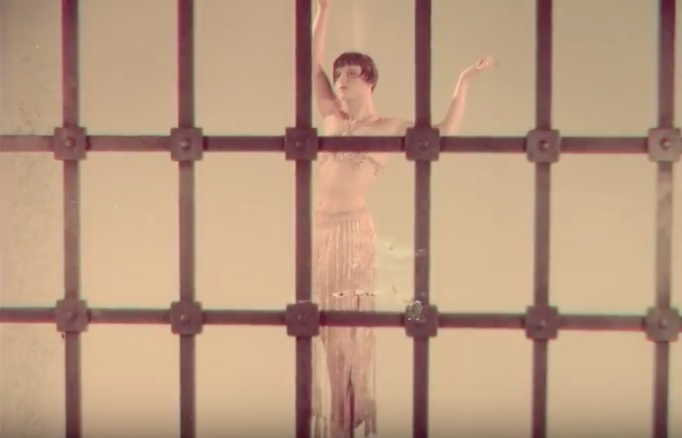
These fragments include a very brief shot of silent icon Louise Brooks in color (at the 1:11 mark), from the lost 1926 film The American Venus, her first feature. Also included in the find are short clips from other Technicolor films made that same year, The Far Cry, The Fire Brigade, and Dance Madness, as well as a test shot from the historical drama Mona Lisa, starring L.A. Times gossip columnist Hedda Hopper as Leonardo da Vinci’s enigmatic model.
You can see these prized snippets in the video at the top of the post, with narration from BFI curator Bryony Dixon. “Another batch of extracts,” reports Smithsonian.com, “was found taped to ads for a North London television shop that ran before and between movies in the 1950s. They include scenes from early Technicolor musicals that came out in 1929 including Sally, Gold Diggers of Broadway, Show of Shows and On with the Show!”
In BFI’s April 30 press release announcing these rare finds, Dixon compares them to “an Egyptian vase shattered into pieces and the shards scattered across museums all over the world…. For now we have the shards but we can dream of seeing Louise Brooks’s first film or a lost Hedda Hopper in colour.” Future discoveries, as well as the latest restoration techniques, may soon return an expanded history of 1920s two-color Technicolor to scholars and film fans of the 21st century.
Related Content:
Early Experiments in Color Film (1895–1935)
Josh Jones is a writer and musician based in Durham, NC. Follow him at @jdmagness
Read More...Groundbreaking Map from 1858 Colorfully Visualizes 6,000 Years of World History
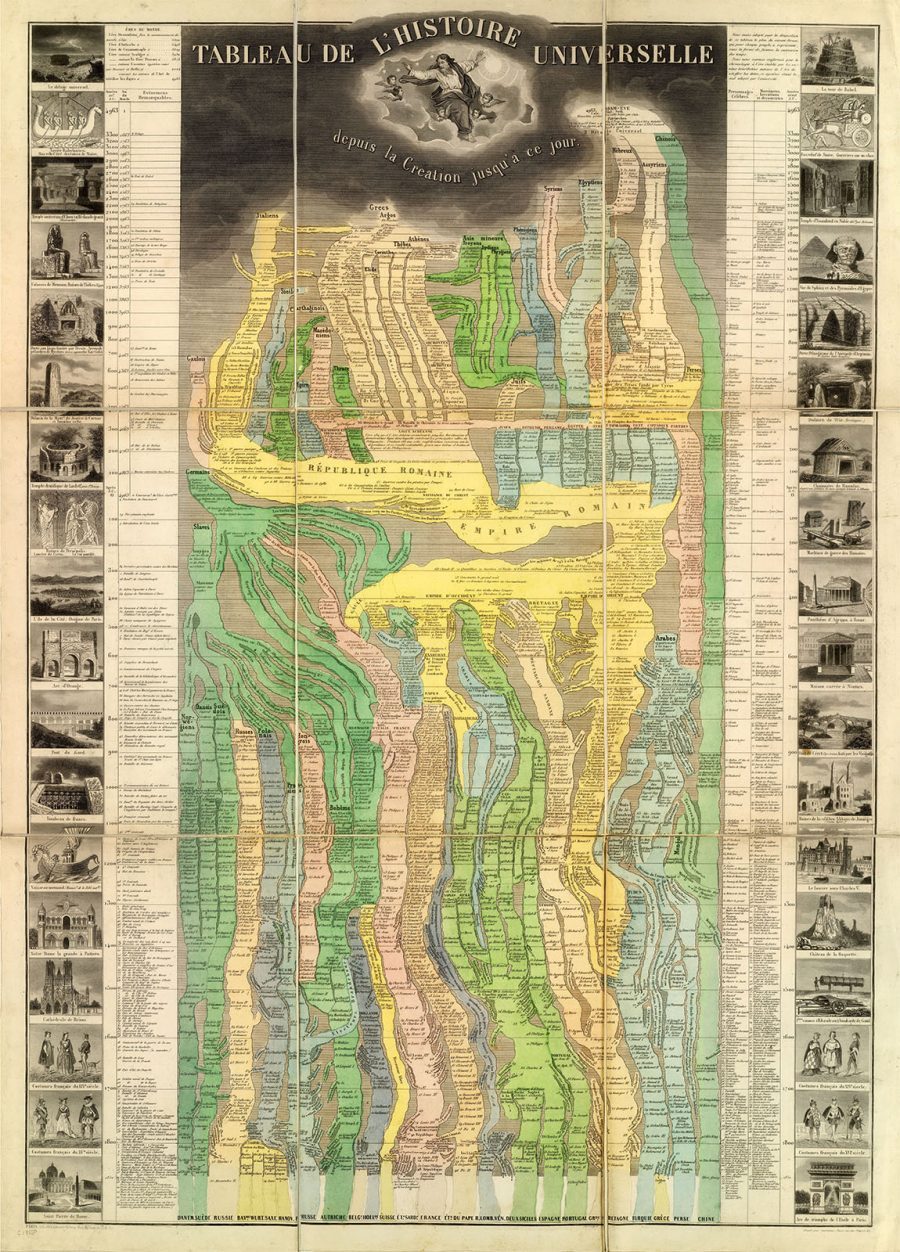
We start to understand history by listening to it told to us verbally, which lets us visualize it in our imagination. But how much more might we understand history if we could see it rendered visually right before our eyes? That question seems to have occupied the minds of certain of the cartographers of 19th-century Europe, those who wanted to take their craft beyond its traditional limits in order to do for chronology what it had long done for geography. Here we have one of the most glorious such attempts in existence, Eugene Pick’s 1858 Tableau De L’Histoire Universelle — or at least the half covering the civilizations of the Eastern Hemisphere — as held in the David Rumsey Map Collection.
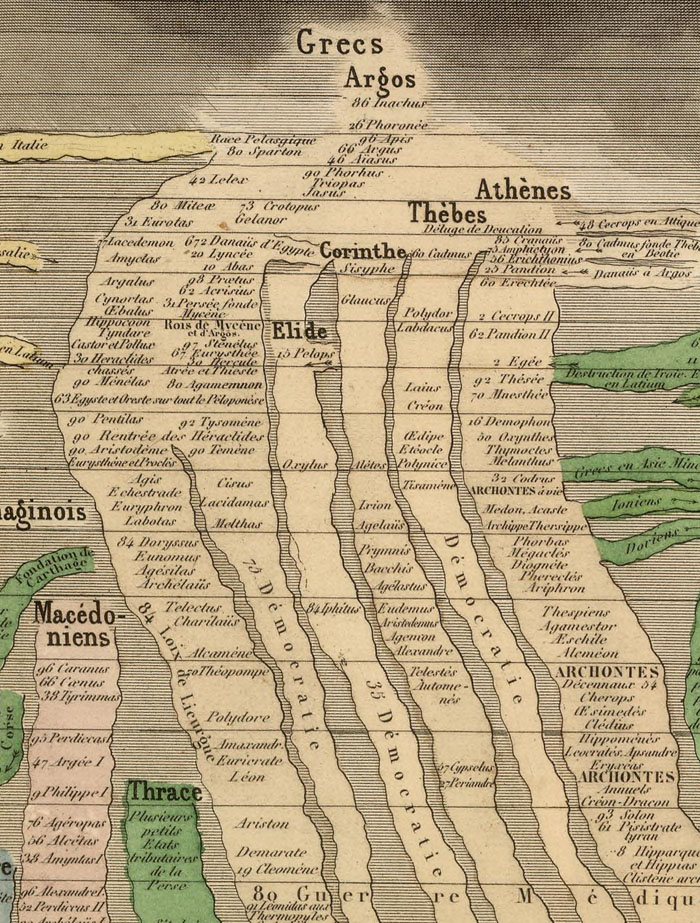
At first glance, all of the information on the map might appear overwhelming. But zoom in (looking at the center first, ideally from top to bottom) and you’ll soon grasp how Pick has depicted the history of the world, as a mid-19th-century Frenchman would conceive of it it, by drawing a kind of network of rivers and tributaries.
The “sources” of ancient civilizations, like those of the Greeks, the Phoenicians, the Egyptians, and the Chinese, flow down to those of various descendants — the Gauls, the Norwegians, the Russians, the Turks — and the mighty empires in which they pool, and arrive at the nations of the Danes, the Swedes, the Belgians, the Spanish, the Persians, and others besides. In total the map covers 6,000 years of history, moving from 4004 B.C. to 1856.
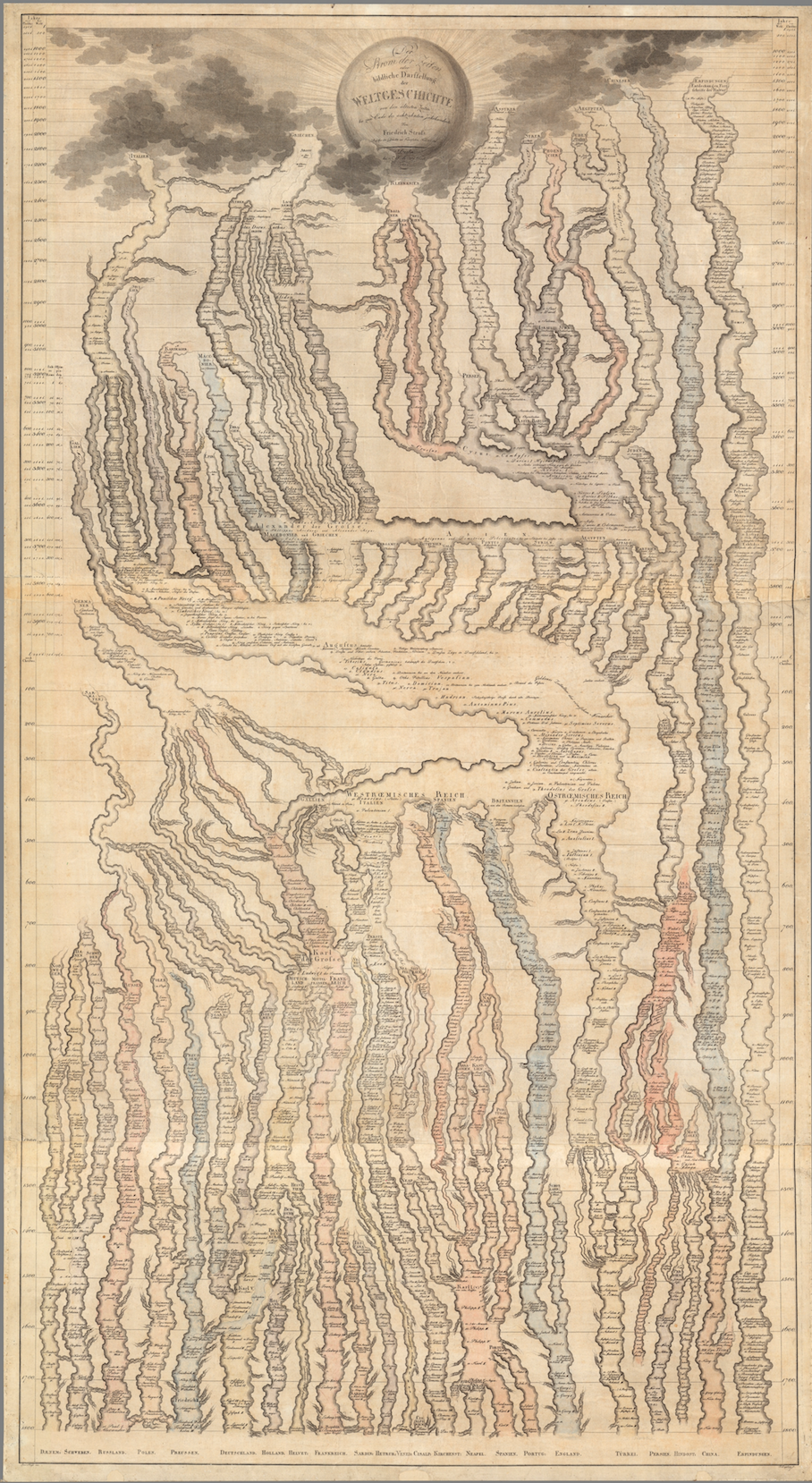
This technique of visualizing history has its precedents, including Friedrich Strass’ Der Strom der Zeiten oder bildliche Darstellung der Weltgeschichte, pictured just above (and later updated by American mapmaker Joseph Hutchins Colton as The Stream of Time in the 1840s and 1860s.) The David Rumsey Map Collection notes that, unlike Strass’ map, Pick’s also has “vignettes of people, buildings, historical scenes and important places in the history of the world” lined up on either side of the main content. It thus illuminates the abstract and continuous central rendering of history with representative, discrete ones, showing viewers everything from the Biblical flood and the Tower of Babel to the Great Sphinx of Giza and Agrippa’s Pantheon to Notre Dame and the Arc de Triomphe. It has a certain francocentrism, to be sure, but consider how many in Pick’s time considered France the center of humanity’s genius. Producing a map as compelling as this one couldn’t have diminished that image.
Related Content:
Watch the History of the World Unfold on an Animated Map: From 200,000 BCE to Today
The History of Civilization Mapped in 13 Minutes: 5000 BC to 2014 AD
5‑Minute Animation Maps 2,600 Years of Western Cultural History
Based in Seoul, Colin Marshall writes and broadcasts on cities and culture. His projects include the book The Stateless City: a Walk through 21st-Century Los Angeles and the video series The City in Cinema. Follow him on Twitter at @colinmarshall or on Facebook.
Read More...Support Us
We're hoping to rely on loyal readers, rather than erratic ads. Please click the Donate button and support Open Culture. You can use Paypal, Venmo, Patreon, even Crypto! We thank you!

About Us

Open Culture scours the web for the best educational media. We find the free courses and audio books you need, the language lessons & educational videos you want, and plenty of enlightenment in between.
Advertise With Us

FREE UPDATES!
GET OUR DAILY EMAIL
Get the best cultural and educational resources on the web curated for you in a daily email. We never spam. Unsubscribe at any time.
FOLLOW ON SOCIAL MEDIA

Open Culture editor Dan Colman scours the web for the best educational media. He finds the free courses and audio books you need, the language lessons & movies you want, and plenty of enlightenment in between.
Advertise With Us


