The Genius of Harry Beck’s 1933 London Tube Map–and How It Revolutionized Subway Map Design Everywhere
The subway is a marvel of engineering, and so is the modern subway map.
For the first 25 years of its existence, London Underground riders relied on a map that reflected the actual distance between stations, as well as rivers, parks, and other aboveground phenomena.

As designer Michael Bierut observes in the video at the top, the radically revised approach it finally adopted in 1933 proved so intuitive and easy to use, it remains the universal template for modern subway maps.
The brainchild of Harry Beck, a young draftsman in the London Underground Signals Office, the new map is more accurately a diagram that prioritized riders’ needs.
He did away with all aboveground references save the Thames, and replotted the stations at equidistant points along color-coded straight lines.
This innovation—for which he was paid about $8—helped riders to glean at a glance where to make the subterranean connections that would allow them to travel from point A to point B.

The former senior curator of London Transport Museum, Anna Renton, said in an interview with The Verge that Beck’s design may have helped persuade city dwellers to make the leap to suburbs serviced by the Underground “by making them look closer to the center, and showing how easy it was to commute.”
It’s not Beck’s fault if service falls short of his map’s efficient ideal, particularly on nights and weekends, when track work and service advisories abound, rendering such commutes a nightmare.
The appeal of subway map-themed souvenirs is also a testament to the visual appeal of Beck’s original design, especially given that such purchases are not limited to tourists.
Related Content:
A Wonderful Archive of Historic Transit Maps: Expressive Art Meets Precise Graphic Design
The Roman Roads of Britain Visualized as a Subway Map
Ayun Halliday is an author, illustrator, theater maker and Chief Primatologist of the East Village Inky zine. Join her in NYC on Monday, April 23 for the third installment of her literary-themed variety show, Necromancers of the Public Domain. Follow her @AyunHalliday.
Read More...A Vending Machine Now Distributes Free Short Stories at Francis Ford Coppola’s Café Zoetrope
I loved the idea of a vending machine, a dispensing machine that doesn’t dispense potato chips or beer or coffee for money but gives you art. I especially liked the fact that you didn’t put money in. — Filmmaker Francis Ford Coppola
Thusly did filmmaker Coppola arrange for a free Short Edition story vending machine to be installed in Café Zoetrope, his San Francisco restaurant.
The French-built machine is the perfect companion for solitary diners, freely dispensing tales on skinny, eco-friendly paper with the push of a button. Readers have a choice over the type of story—romantic, funny, scary—and the amount of time they’re willing to devote to it.
After which, they can perhaps begin the task of adapting it into a feature-length film script. Part of Coppola’s attraction to the form is that short stories, like movies, are intended to be consumed in a single sitting.
Short Edition, the Grenoble-based start-up, has been following up on the public’s embrace of the Café Zoetrope machine by sending even more short story kiosks stateside.
Columbus Public Health just unveiled one near the children’s area at its immunization clinic, providing Ohio kids and parents from mostly disadvantaged backgrounds with access to free literature while they wait.
Philadelphia’s Free Library won a grant to install four story dispensers, with more slated for locations in South Carolina and Kansas.
Part of the allure lays in receiving a tangible object. You can recycle your story into a bookmark, leave it for someone else to find, or—in Coppola’s words—save it for an “artistic lift” while “waiting for a bus, or marriage license, or lunch.”
A café patron described the cognitive dissonance of watching her cousin read the story the Zoetrope machine picked out for her:
The scene seemed archaic: a woman frozen in concentration, in the middle of a buzzing crowd, reading from a line of print instead of scrolling through Instagram, as one might normally do while sitting solo at a bar.
“When people ask [if] we have wifi for the kids,” Café Zoetrope’s general manager told Literary Hub, “We point to the machine and say, ‘No, but you have a story—you can read.’”
Those without access to a Short Edition story vending machine can get a feel for the experience digitally on the company’s website.
Scroll down to the dice icon, specify your preferred tone and a reading time between 1 and 5 minutes.
Or throw caution to the wind by hitting the search button sans specification, as I did to become the 3232nd reader of “Drowned,” a one-minute true crime story by Cléa Barreyre, translated from the French by Wendy Cross.
French speakers can also submit their writing. The vending machines’ stories are drawn from Short Edition’s online community, a trove of some 100,000 short stories by nearly 10,000 authors. Registering for a free account will allow you to read stories, after which you can toggle over to the French site to post your content through the orange author space portal at the top right of the page. The FAQ and Google Translate should come in handy here. The editors are currently reviewing submissions of comics, poems, and micro fiction for the Summer Grand Prix du Court, though again—only in French, for now.
Short Edition hopes to start considering other languages for vending machine content inclusion soon, beginning with English. For now, all stories being dispensed have been translated from the original French by British literary professionals.
Bon courage!
via Literary Hub
Related Content:
Read 19 Short Stories From Nobel Prize-Winning Writer Alice Munro Free Online
Napoleon’s Kindle: See the Miniaturized Traveling Library He Took on Military Campaigns
Discover the Jacobean Traveling Library: The 17th Century Precursor to the Kindle
Ayun Halliday is an author, illustrator, theater maker and Chief Primatologist of the East Village Inky zine. Join her in NYC on Monday, April 23 for the third installment of her literary-themed variety show, Necromancers of the Public Domain. Follow her @AyunHalliday.
Read More...Colorful Wood Block Prints from the Chinese Revolution of 1911: A Gallery of Artistic Propaganda Posters
When you think Chinese Revolution, surely you think of Mao Zedong and the People’s Republic coming to power in 1949, a history that overshadows an earlier seismic event that overthrew the last imperial dynasty and brought the short-lived Republic of China into being. If your sense of this history is somewhat vague, you’re not alone—even those who know the events and the principle actors well are hesitant to ascribe any definitive interpretations to the 1911, or Xinhai, Revolution. “Significant thinkers and activists have… remained hesitant in their final judgment on it,” writes Oxford University’s Rana Mitter: “Its meaning continues to be highly contested… separated from any one path of historical interpretation.”
There is a general consensus, at least, among historians of the period and contemporary chroniclers alike that the Xinhai Revolution was foremost a struggle to modernize the country and get free of colonialist encroachments on Chinese self-determination. As in Russia around the same time, the concept of political modernization had many different meanings to the competing factions seeking to supplant the moribund imperial system.
“Some hoped for a constitutional framework, i.e., parliamentary monarchy,” notes University of Kansas professor Anna M. Cienciala, “while others worked for a democratic republic. Most wanted the abolition of the feudal-Confucian system; all wanted the abolition of foreign privilege and the unification of their vast country.”
This last hope would be dashed. The strongest faction succeeded in gaining support from wealthy Chinese living abroad, who funded the efforts of revolutionary leader Sun Yat-sen, a medical doctor raised in Hawaii who began in the late 19th century “to devote himself to political work for the overthrow of the Qing Dynasty” in order to “create a strong, unified, modern, Chinese republic” with a socialist economy. Despite support from the military, the Republic established in 1912 “proved a miserable failure,” Cienciala argues, and the country fragmented under the rule of various warlords, then suffered through several more upheavals and an attempted Qing restoration in the ensuing decades while the Communists consolidated power.
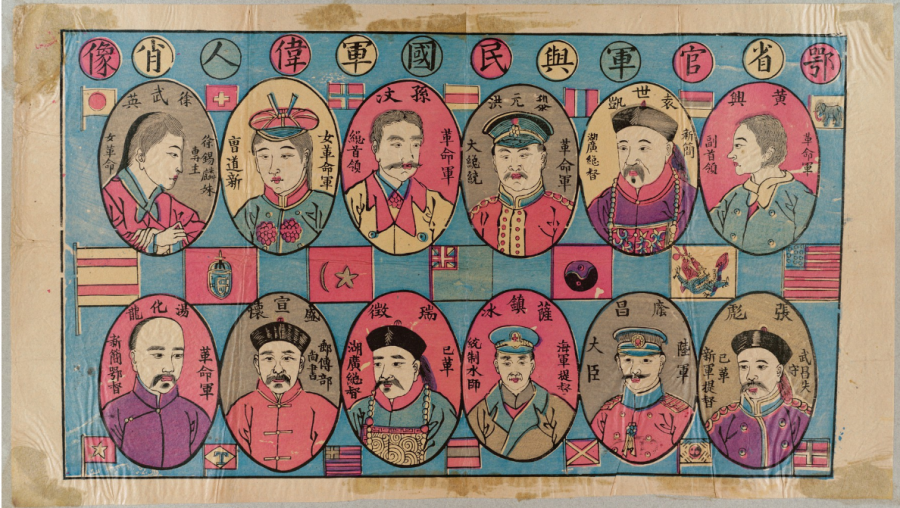
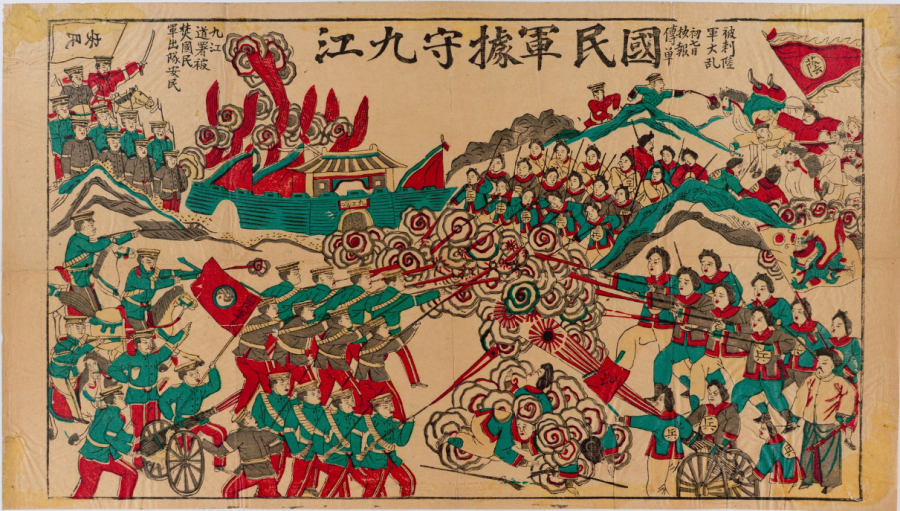
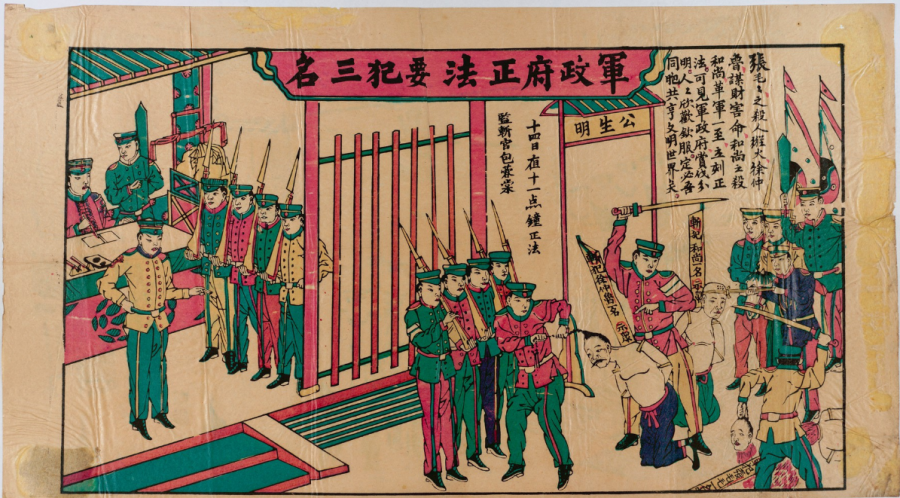
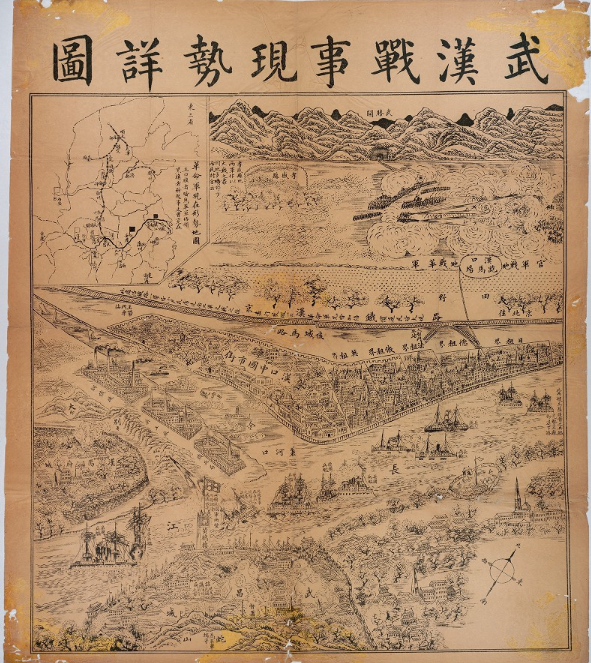
Looking back at the events at the time, historian Peter Zarrow has attempted to trace “the moment when the Wuchang Uprising became the ‘revolution’… that is when general opinion began to regard it as a movement that could overthrow the Qing and establish a new government.” Opinions were largely shaped, he writes, by Shanghai newspapers covering what Britannica Blog calls “a hastily and locally organized mutiny” that first began in one of the three areas that make up the city of Wuhan. In creating the narrative of events, news agencies “immediately printed illustrated sheets for a Chinese public avid for the latest news.” So writes the Princeton University Digital Library, who house a collection of 30 such prints, likely “based on upon artists’ imagination.”
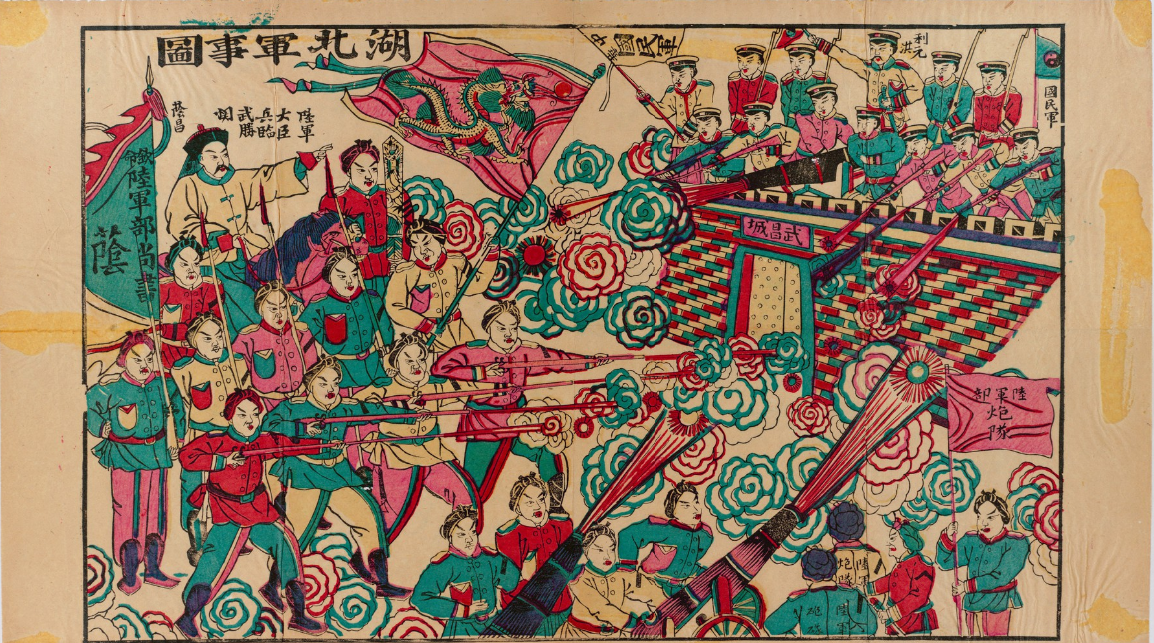
News agency reports of the Wuchang Uprising and subsequent battles in cities across China “generally support the Revolution as a modernizing party, and hence some demonization of the enemy occurs in the prints, as was usual for propaganda prints of that and earlier periods.” What is notable is the degree to which broad themes of “modernity” and “nation” show up, creating a triumphant sense of unity that seems to have been exaggerated.
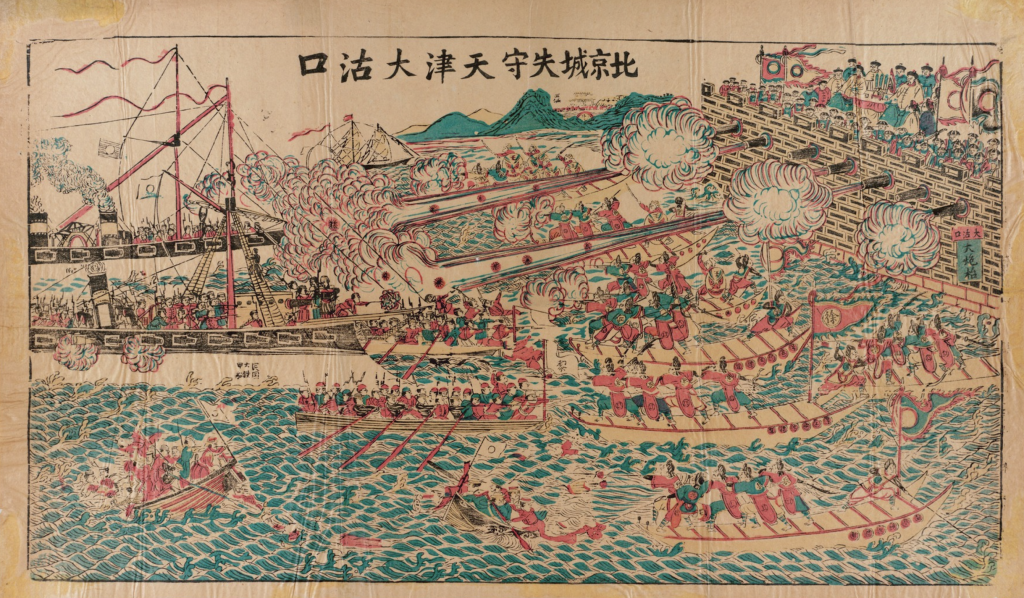
But this is the way propaganda works, in 1911 and today—“manufacturing consent,” to take Noam Chomsky’s phrase. It’s fascinating to see it work in images that seem so quaint to us today, but which, at the time, pushed forward a revolutionary break with over two thousand years of dynastic rule.
See many more of these images at Princeton’s Digital Library.
Related Content:
14,000 Free Images from the French Revolution Now Available Online
China: Traditions and Transformations (A Free Harvard Course)
Download 2,500 Beautiful Woodblock Prints and Drawings by Japanese Masters (1600–1915)
Josh Jones is a writer and musician based in Durham, NC. Follow him at @jdmagness
Read More...Gustave Flaubert Tells His Mother Why Serious Writers Shouldn’t Bother with Day Jobs (1850)
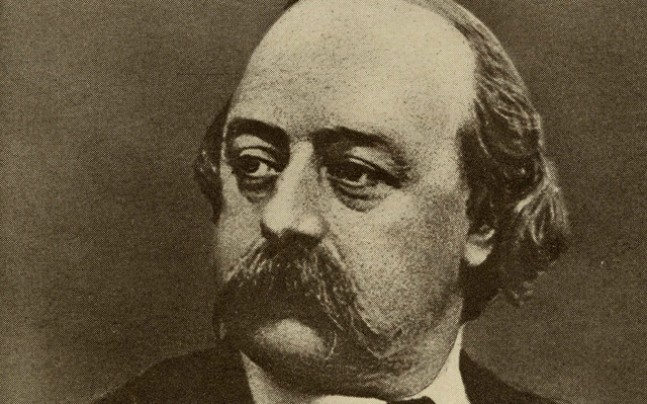
We are what we do — or in other words, we are what we choose to spend our time doing. By this logic, a “musician” who spends one quarter of his time with his instruments and three quarters with Excel, though he counts as no less a human being for it, should by rights call himself a maker of spreadsheets rather than a maker of music. This view may sound stark, but it has its adherents, some of them successful and respected artists. We can rest assured that no less a creator than Gustave Flaubert, for instance, would surely have accepted it, if we take seriously the words of a letter he wrote to his mother in February of 1850.
Though he’d completed several books at the time, the then 28-year-old Flaubert had yet to make it as a man of letters. He did, however, do a fair bit of traveling at that time in his life, composing this particular piece of correspondence during a sojourn in the Middle East. It seems that even halfway across the world, he couldn’t escape his mother’s entreaties to find proper employment, if only “un petite place” that would grant him slightly more social respectability and financial stability. Finally fed up, he clarified his position on the matter of day jobs once and for all:
Now I come to something that you seem to enjoy reverting to and that I utterly fail to understand. You are never at a loss of things to torment yourself about. What is the sense of this: that I must have a job — “a small job,” you say. First of all, what job? I defy you to find me one, to specify in what field, or what it would be like. Frankly, and without deluding yourself, is there a single one that I am capable of filling? You add: “One that wouldn’t take up much of your time and wouldn’t prevent you from doing other things.” There’s the delusion! That’s what Bouilhet told himself when he took up medicine, what I told myself when I began law, which nearly brought about my death from suppressed rage. When one does something, one must do it wholly and well. Those bastard existences where you sell suet all day and write poetry at night are made for mediocre minds — like those horses equally good for saddle and carriage — the worst kind, that can neither jump a ditch nor pull a plow.
In short, it seems to me that one takes a job for money, for honors, or as an escape from idleness. Now you’ll grant me, darling, (1) that I keep busy enough not to have to go out looking for something to do; and (2) if it’s a question of honors, my vanity is such that I’m incapable of feeling myself honored by anything: a position, however high it might be (and that isn’t the kind you speak of) will never give me the satisfaction that I derive from my self-respect when I have accomplished something well in my own way; and finally, if it’s for money, any jobs or job that I could have would bring in too little to make much difference to my income. Weigh all these considerations: don’t knock your head against a hollow idea. Is there any position in which I’d be closer to you, more yours? And isn’t not to be bored one of the principal goals of life?
The letter may well have convinced her: according to a footnote included in The Letters of Gustave Flaubert: 1830–1857, “there seem to have been no further suggestions” that he secure a steady paycheck. Could Flaubert’s mother have had an inkling that her son would become, well, Flaubert? At that point he hadn’t even begun writing Madame Bovary, a project that would begin upon his return to France. Its inspiration came in part from the early version of The Temptation of Saint Anthony he’d completed before embarking on his travels, which his friends Maxime Du Camp and Louis Bouilhet (the reluctant medical student mentioned in the letter) suggested he toss in the fire, telling him to write about the stuff of everyday life instead.
Not all of us, of course, can work the same way Flaubert did, with his days spent in revision of each page and his obsessive lifelong hunt for le mot juste: not for nothing do we call him “the martyr of style.” But whatever we create and however we create it, we ignore the words Flaubert wrote to his mother at our peril. The earning of money has its place, but the idea that any old day job can be easily held down without damage to our real life’s work shades all too easily into self-delusion. We must remember that “when one does something, one must do it wholly and well,” a sentiment made infinitely more powerful by the fact that Flaubert didn’t just articulate it, he lived it — and now occupies one of the highest places in the pantheon of the novel as a result.
h/t Tom H.
Related Content:
Read 4,500 Unpublished Pages of Flaubert’s Madame Bovary
Charles Bukowski Rails Against 9‑to‑5 Jobs in a Brutally Honest Letter (1986)
William Faulkner Resigns From His Post Office Job With a Spectacular Letter (1924)
Brian Eno’s Advice for Those Who Want to Do Their Best Creative Work: Don’t Get a Job
Based in Seoul, Colin Marshall writes and broadcasts on cities and culture. His projects include the book The Stateless City: a Walk through 21st-Century Los Angeles and the video series The City in Cinema. Follow him on Twitter at @colinmarshall or on Facebook.
Read More...How to Use the Rotary Dial Phone: A Primer from 1927
Most every piece of technology, no matter how simple, comes with a user manual of some sort. Even the seemingly straightforward rotary dial phone.
Although Alexander Graham Bell patented the first telephone in 1876, the first rotary dial phones didn’t make their way into American homes until 1919. Then came the obligatory tutorial. Created by AT&T in 1927 and originally shown in theatres in Fresno, California, the silent film above breaks down the process of dialing a call–from using a phone directory and finding a number, to picking up the receiver and listening for that steady humming sound called the “dial tone,” to turning and releasing the rotary dial multiple times, and so on. This primer would carry Americans through 1963 when the first push-button phones started to pop up. That advent of the push-button phone also came with a video, of course.
If you would like to support the mission of Open Culture, consider making a donation to our site. It’s hard to rely 100% on ads, and your contributions will help us continue providing the best free cultural and educational materials to learners everywhere. You can contribute through PayPal, Patreon, and Venmo (@openculture). Thanks!
Related Content:
Hear the Voice of Alexander Graham Bell for the First Time in a Century
How Vinyl Records Are Made: A Primer from 1956
Read More...Herbie Hancock Explains the Big Lesson He Learned From Miles Davis: Every Mistake in Music, as in Life, Is an Opportunity
One thing they don’t teach you in parenting school is how to guide a young child into making fewer mistakes in her homework, while also communicating to her that mistakes are not “bad” but often “good” in that they can be conduits for creative thinking and intuitive pathways to progress. This lesson presents even more problems if your child has perfectionist tendencies. (If you have sound pedagogical methods, I’m all ears.)
The problem isn’t just that adults constantly telegraph binary “yes/no,” “good/bad” messages to everyone and everything around them, but that most adults are deeply uncomfortable with ambiguity, and thus deeply afraid of mistakes, as a result of imbibing so many binary messages themselves. Improvisation frightens trained and untrained musicians alike, for example, for this very reason. Who wants to screw up publicly and look like… well, a screw up?
We think that doing something well, and even “perfectly,” will win us the pat on the head/gold star/good report card we have been taught to crave all our lives. Surely there are excellent reasons to strive for excellence. But according to one who should know—the most excellent Miles Davis—excellence by nature obviates the idea of mistakes. How’s that, you ask? Let us attend to one of Davis’ former sidemen, Herbie Hancock, who tells one of his favorite stories about the man above.
Loose improvisation is integral to jazz, but we all know Miles Davis as a very exacting character. He could be mean, demanding, abrasive, cranky, hypercritical, and we might conclude, given these personal qualities, and the consistent excellence of his playing, that he was a perfectionist who couldn’t tolerate screw ups. Hancock gives us a very different impression, telling the tale of a “hot night” in Stuttgart, when the music was “tight, it was powerful, it was innovative, and fun.”
Making what anyone would reasonably call a mistake in the middle of one of Davis’ solos—hitting a noticeably wrong chord—Hancock reacted as most of us would, with dismay. “Miles paused for a second,” he says, “and then he played some notes that made my chord right… Miles was able to turn something that was wrong into something that was right.” Still, Hancock was so upset, he couldn’t play for about a minute, paralyzed by his own ideas about “right” and “wrong” notes.
What I realize now is that Miles didn’t hear it as a mistake. He heard it as something that happened. As an event. And so that was part of the reality of what was happening at that moment. And he dealt with it…. Since he didn’t hear it as a mistake, he thought it was his responsibility to find something that fit.
Hancock drew a musical lesson from the moment, yes, and he also drew a larger life lesson about growth, which requires, he says, “a mind that’s open enough… to be able to experience situations as they are and turn them into medicine… take whatever situation you have and make something constructive happen with it.”
This bit of wisdom reminds me not only of my favorite Radiohead lyric (“Be constructive with your blues”), but also of a story about a Japanese monk who visited a monastery in the U.S. and promised to give a demonstration in the fine art of Zen archery. After much solemn preparation and breathless anticipation, the monk led his hosts on a hike up the mountain, where he then blindly fired an arrow off a cliff and walked away, leaving the stunned spectators to conclude the target must be wherever the arrow happened to land.
What matters, Davis is quoted as saying, is how we respond to what’s happening around us: “When you hit a wrong note, it’s the next note that you play that determines if it’s good or bad.” Or, as he put it more simply and non-dualistically, “Do not fear mistakes. There are none.”
Related Content:
Hear a 65-Hour, Chronological Playlist of Miles Davis’ Revolutionary Jazz Albums
Josh Jones is a writer and musician based in Durham, NC. Follow him at @jdmagness
Read More...Hear Albert Einstein Read “The Common Language of Science” (1941)

Albert Einstein, 1921, by Ferdinand Schmutzer via Wikimedia Commons
Here’s an extraordinary recording of Albert Einstein from the fall of 1941, reading a full-length essay in English:
The essay is called “The Common Language of Science.” It was recorded in September of 1941 as a radio address to the British Association for the Advancement of Science. The recording was apparently made in America, as Einstein never returned to Europe after emigrating from Germany in 1933.
Einstein begins by sketching a brief outline of the development of language, before exploring the connection between language and thinking. “Is there no thinking without the use of language,” asks Einstein, “namely in concepts and concept-combinations for which words need not necessarily come to mind? Has not every one of us struggled for words although the connection between ‘things’ was already clear?”
Despite this evident separation between language and thinking, Einstein quickly points out that it would be a gross mistake to conclude that the two are entirely independent. In fact, he says, “the mental development of the individual and his way of forming concepts depend to a high degree upon language.” Thus a shared language implies a shared mentality. For this reason Einstein sees the language of science, with its mathematical signs, as having a truly global role in influencing the way people think:
The supernational character of scientific concepts and scientific language is due to the fact that they have been set up by the best brains of all countries and all times. In solitude, and yet in cooperative effort as regards the final effect, they created the spiritual tools for the technical revolutions which have transformed the life of mankind in the last centuries. Their system of concepts has served as a guide in the bewildering chaos of perceptions so that we learned to grasp general truths from particular observations.
Einstein concludes with a cautionary reminder that the scientific method is only a means toward an end, and that the welfare of humanity depends ultimately on shared goals.
Perfection of means and confusion of goals seem–in my opinion–to characterize our age. If we desire sincerely and passionately for the safety, the welfare, and the free development of the talents of all men, we shall not be in want of the means to approach such a state. Even if only a small part of mankind strives for such goals, their superiority will prove itself in the long run.
The immediate context of Einstein’s message was, of course, World War II. The air force of Einstein’s native country had only recently called off its bombing campaign against England. A year before, London weathered 57 straight nights of bombing by the Luftwaffe. Einstein had always felt a deep sense of gratitude to the British scientific community for its efforts during World War I to test the General Theory of Relativity, despite the fact that its author was from an enemy nation.
“The Common Language of Science” was first published a year after the radio address, in Advancement of Science 2, no. 5. It is currently available in the Einstein anthologies Out of My Later Years and Ideas and Opinions.
Note: An earlier version of this post appeared on our site in March 2013.
If you would like to support the mission of Open Culture, consider making a donation to our site. It’s hard to rely 100% on ads, and your contributions will help us continue providing the best free cultural and educational materials to learners everywhere. You can contribute through PayPal, Patreon, and Venmo (@openculture). Thanks!
Related Content:
Find Courses on Einstein in the Physics Section of our Free Online Courses Collection
Read More...Aldous Huxley Tells Mike Wallace What Will Destroy Democracy: Overpopulation, Drugs & Insidious Technology (1958)
Overpopulation, manipulative politics, imbalances of societal power, addictive drugs, even more addictive technologies: these and other developments have pushed not just democracy but civilization itself to the brink. Or at least author Aldous Huxley saw it that way, and he told America so when he appeared on The Mike Wallace Interview in 1958. (You can also read a transcript here.) “There are a number of impersonal forces which are pushing in the direction of less and less freedom,” he told the newly famous news anchor, “and I also think that there are a number of technological devices which anybody who wishes to use can use to accelerate this process of going away from freedom, of imposing control.”
Huxley’s best-known novel Brave New World has remained relevant since its first publication in 1932. He appeared on Wallace’s show to promote Brave New World Revisited (first published as Enemies of Freedom), a collection of essays on how much more rapidly than expected the real world had come to resemble the dystopia he’d imagined a quarter-century earlier.
Some of the reasons behind his grim predictions now seem overstated — he points out that “in the underdeveloped countries actually the standard of living is at present falling,” though the reverse has now been true for quite some time — but others, from the vantage of the 21st century, sound almost too mild.
“We mustn’t be caught by surprise by our own advancing technology,” Huxley says in that time before smartphones, before the internet, before personal computers, before even cable television. We also mustn’t be caught by surprise by those who seek indefinite power over us: to do that requires “consent of the ruled,” something acquirable by addictive substances — both pharmacological and technological — as well as “new techniques of propaganda.” All of this has the effect of “bypassing the sort of rational side of man and appealing to his subconscious and his deeper emotions, and his physiology even, and so, making him actually love his slavery.”
Wallace’s questions bring Huxley to a question of his own: “What does a democracy depend on? A democracy depends on the individual voter making an intelligent and rational choice for what he regards as his enlightened self-interest, in any given circumstance.” But democracy-debilitating commercial and political propaganda appeals “directly to these unconscious forces below the surfaces so that you are, in a way, making nonsense of the whole democratic procedure, which is based on conscious choice on rational ground.” Hence the importance of teaching people “to be on their guard against the sort of verbal booby traps into which they are always being led.” The skill has arguably only grown in importance since, as has his final thought in the broadcast: “I still believe in democracy, if we can make the best of the creative activities of the people on top plus those of the people on the bottom, so much the better.”
Related Content:
Aldous Huxley Reads Dramatized Version of Brave New World
Huxley to Orwell: My Hellish Vision of the Future is Better Than Yours (1949)
An Animated Aldous Huxley Identifies the Dystopian Threats to Our Freedom (1958)
Aldous Huxley Predicts in 1950 What the World Will Look Like in the Year 2000
Based in Seoul, Colin Marshall writes and broadcasts on cities and culture. His projects include the book The Stateless City: a Walk through 21st-Century Los Angeles and the video series The City in Cinema. Follow him on Twitter at @colinmarshall or on Facebook.
Read More...Stream a 144-Hour Discography of Classic Jazz Recordings from Blue Note Records: Miles Davis, Art Blakey, John Coltrane, Ornette Coleman & More
There have been many influential jazz record labels throughout the previous century and into the current one, but there is no more recognizable label than Blue Note Records. Blue Note is “unquestionably the most iconic jazz label there has ever been,” claims the site Udiscover Music in a post on the “50 Greatest” Blue Note albums. Indeed, “it may well be the most iconic record label of all time… a brand recognized the world over for the ‘finest in jazz.’”
Outside of the label identities in certain subcultures like punk and electronic music, no other name so instantly conjures up a fully-formed, distinctive look and sound. It is the monochrome look of dapper, too-cool musical giants in tailored suits and skinny ties, and the sound, primarily, of the Hard Bop era—of Art Blakey, Wayne Shorter, Sonny Rollins, Dexter Gordon, Bud Powell, McCoy Tyner, and, of course, Miles Davis, Thelonious Monk, and John Coltrane, artists who totally enlarged the boundaries of jazz. (See the trailer above for the Sophie Huber documentary Blue Note Records: Beyond the Notes.)
By design, Blue Note’s unforgettable 50s and 60s album covers—most created by artist Reid Miles and photographer Francis Wolff—suggest brimfuls of possibility. “Right from the beginning,” says producer and writer Michael Cuscuna in the video above, “they really took their covers seriously.”
But this would have meant little if they hadn’t taken the music just as seriously as the stylish artwork that adorns it. Founded in 1939 by Alfred Lion and Max Margulis, the label first served as a home for more traditional big band and swing, but in the late forties, Blue Note seemed to realize better than any other commercial entity that the future of jazz had arrived, thanks in part to saxophonist and talent scout Ike Quebec.
“Not really in the pantheon of Blue Note players of the 1960s,” writes Burning Ambulance (he died in early ’63), Quebec is still central to the label’s success. As an A&R man, he signed Monk and Bud Powell, and “it’s been said that he did a lot of uncredited arranging on other musicians’ sessions, too.” His later recordings fit right in with his more famous peers (check out his “Blue and Sentimental”). Quebec’s own work doesn’t come up in many Blue Note retrospectives, including the Spotify discography above, and that’s too bad. But it’s hard to complain when you’ve got so many incredible, iconic Blue Note recordings in one place.
Created by Junior Bonner, the Blue Notes Records Discography playlist is not “complete” in that it contains every album the label ever released—an impossible expectation, surely, especially since Blue Note is still going strong. But, with a run time of 144 hours, it more than sufficiently covers the roster of the label’s greatest players, including several many of us probably haven’t heard before in much depth. Hardcore audiophile record collectors should visit LondonJazzCollector and Jazzdisco.org to get the full Blue Note catalog of every Blue Note artist and release. But lovers of jazz who don’t mind digital streaming instead of precious vinyl and shellac will be thrilled with this impressive anthology.
Related Content:
Hear a 65-Hour, Chronological Playlist of Miles Davis’ Revolutionary Jazz Albums
Hear 2,000 Recordings of the Most Essential Jazz Songs: A Huge Playlist for Your Jazz Education
Women of Jazz: Stream a Playlist of 91 Recordings by Great Female Jazz Musicians
Josh Jones is a writer and musician based in Durham, NC. Follow him at @jdmagness
Read More...The Illustrated Medicinal Plant Map of the United States of America (1932): Download It in High Resolution

Two years ago, we highlighted collector David Rumsey’s huge map archive, which he donated to Stanford University in April of 2016 and which now resides at Stanford’s David Rumsey Map Center. The opening of this physical collection was a pretty big deal, but the digital collection has been on the web, in some part, and available to the online public since 1996. Twenty years ago, however, though the internet was decidedly becoming an everyday feature of modern life, it was difficult for the average person to imagine the degree to which digital technology would completely overtake our lives, not to mention the almost unbelievable wealth and power tech companies would amass in such short time.
Similarly, when the above 1932 Medicinal Plant Map of the United States (see in a larger format here) first appeared—one of the tens of thousands of maps available in the digital Rumsey collection—few people other than Aldous Huxley could have foreseen the exponential advances, and the rise of wealth and power, to come in the pharmaceutical industry.
But the pharmacists had a clue. The map, produced by the National Wholesale Druggists’ Association, “was intended to boost the image of the profession,” writes Rebecca Onion at Slate, “at a time when companies were increasingly compounding new pharmaceuticals in labs,” thereby rendering much of the drug-making knowledge and skill of old-time druggists obsolete.
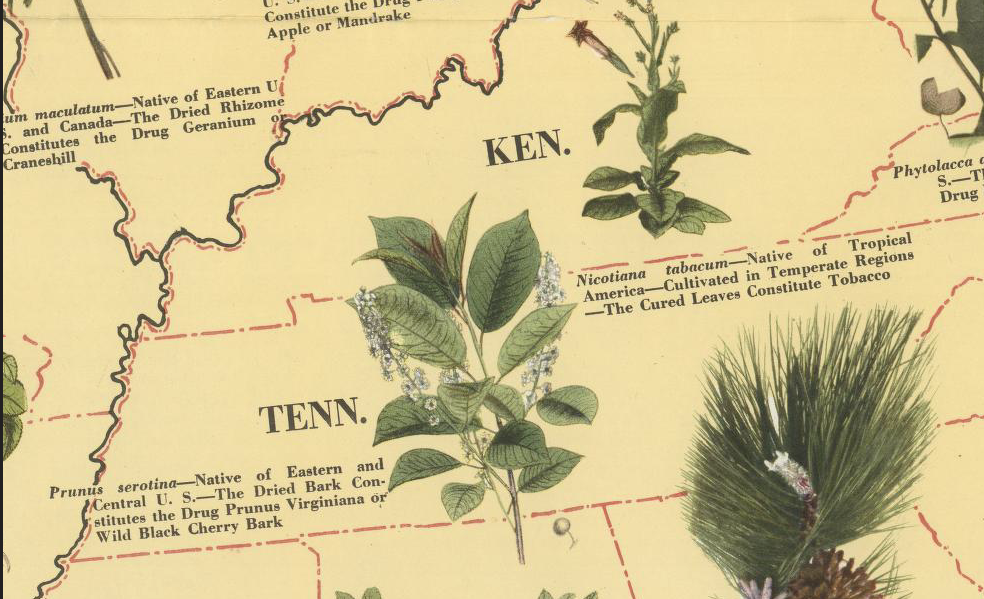
Although the commercial pharmaceutical industry began taking shape in the late 19th century, it didn’t fully come into its own until the so-called “golden era” of 1930–1960, when, says Onion, researchers developed “a flood of new antibiotics, psychotropics, antihistamines, and vaccines, increasingly relying on synthetic chemistry to do so.” Over-the-counter medications proliferated, and pharmacists became alarmed. They sought to persuade the public of their continued relevance by pointing out, as a short blurb at the bottom left corner of the map notes, that “few people realize the extent to which plants and minerals enter into the practice of pharmacy.”
The map appeared during “Pharmacy Week” in October, when “pharmacists in Anglo-Saxon countries” promote their services. Losing sight of those important services, the Druggists’ Association writes, will lead to suffering, should the traditional pharmacist’s function “be impaired or destroyed by commercial trends.” Thus we have this visual demonstration of competence. The map identifies important species—native or cultivated—in each region of the country. In Kentucky, we see Nicotina tabacum, whose cured leaves, you guessed it, “constitute tobacco.” Across the country in Nevada, we are introduced to Apocynum cannabinum, “native of U.S. and Southern Canada—the dried rhizome and roots constitute the drug apocynum or Canadian hemp.”
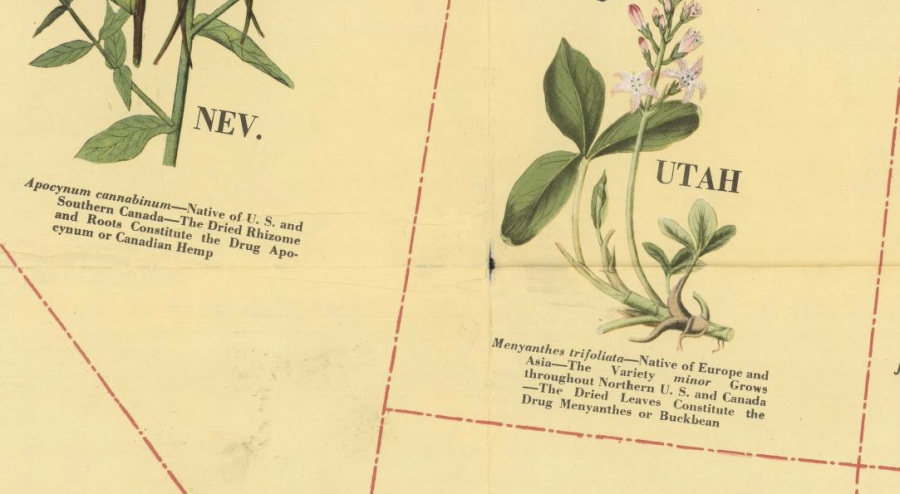
The better-known Cannibus sativa also appears, in one of the boxes around the map’s border that introduce plants from outside North America, including Erythroxylon coca, from Bolivia and Peru, and Papaver somniferum, from which opium derives. Many of the other medications will be less familiar to us—and belong to what we now call naturopathy, herbalism, or, more generally, “traditional medicine.” Though these medicinal practices are many thousands of years old, the druggists try to project a cutting-edge image, assuring the map’s readers that “intense scientific study, expert knowledge, extreme care and accuracy are applied by the pharmacist to medicinal plants.”
While pharmacists today are highly-trained professionals, the part of their jobs that involved the making of drugs from scratch has been ceded to massive corporations and their research laboratories. The druggists of 1932 saw this coming, and no amount of colorful public relations could stem the tide. But it may be the case, given changing laws, changing attitudes, the backlash against overmedication, and the devastating opioid epidemic, that their craft is more relevant than it has been in decades, though today’s “druggists” work in marijuana dispensaries and health food stores instead of national pharmacy chains.
View and download the map in a high resolution scan at the David Rumsey Map Collection, where you can zoom in to every plant on the map and read its description.
via Slate
Related Content:
1,000-Year-Old Illustrated Guide to the Medicinal Use of Plants Now Digitized & Put Online
Josh Jones is a writer and musician based in Durham, NC. Follow him at @jdmagness
Read More...Support Us
We're hoping to rely on loyal readers, rather than erratic ads. Please click the Donate button and support Open Culture. You can use Paypal, Venmo, Patreon, even Crypto! We thank you!

About Us

Open Culture scours the web for the best educational media. We find the free courses and audio books you need, the language lessons & educational videos you want, and plenty of enlightenment in between.
Advertise With Us

FREE UPDATES!
GET OUR DAILY EMAIL
Get the best cultural and educational resources on the web curated for you in a daily email. We never spam. Unsubscribe at any time.
FOLLOW ON SOCIAL MEDIA

Open Culture editor Dan Colman scours the web for the best educational media. He finds the free courses and audio books you need, the language lessons & movies you want, and plenty of enlightenment in between.
Advertise With Us


