Hidden Ancient Greek Medical Text Read for the First Time in a Thousand Years — with a Particle Accelerator
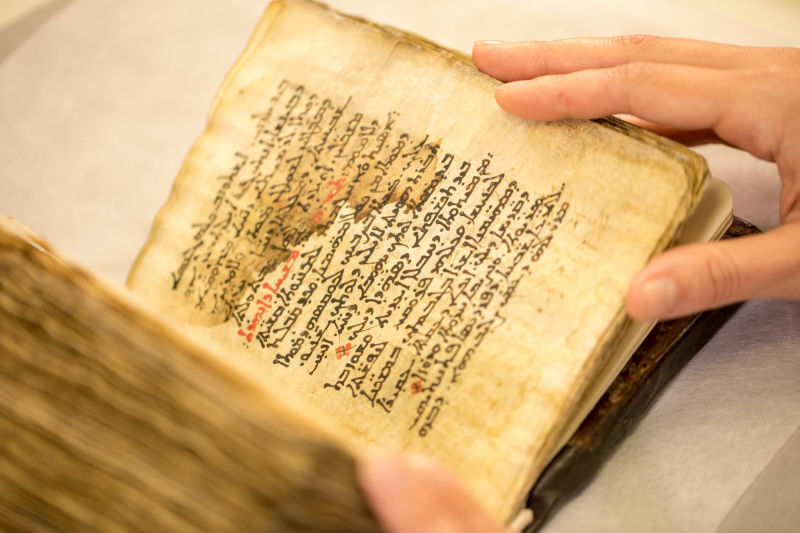
Image by Farrin Abbott/SLAC, via Flickr Commons
Long before humanity had paper to write on, we had papyrus. Made of the pith of the wetland plant Cyperus papyrus and first used in ancient Egypt, it made for quite a step up in terms of convenience from, say, the stone tablet. And not only could you write on it, you could rewrite on it. In that sense it was less the paper of its day than the first-generation video tape: given the expense of the stuff, it often made sense to erase the content already written on a piece of papyrus in order to record something more timely. But you couldn’t completely obliterate the previous layers of text, a fact that has long held out promise to scholars of ancient history looking to expand their field of primary sources.
The decidedly non-ancient solution: particle accelerators. Researchers at the Stanford Synchrotron Radiation Lightsource (SSRL) recently used one to find the hidden text in what’s now called the Syriac Galen Palimpsest. It contains, somewhere deep in its pages, “On the Mixtures and Powers of Simple Drugs,” an “important pharmaceutical text that would help educate fellow Greek-Roman doctors,” writes Amanda Solliday at the SLAC National Accelerator Laboratory.
Originally composed by Galen of Pergamon, “an influential physician and a philosopher of early Western medicine,” the work made its way into the 6th-century Islamic world through a translation into a language between Greek and Arabic called Syriac.
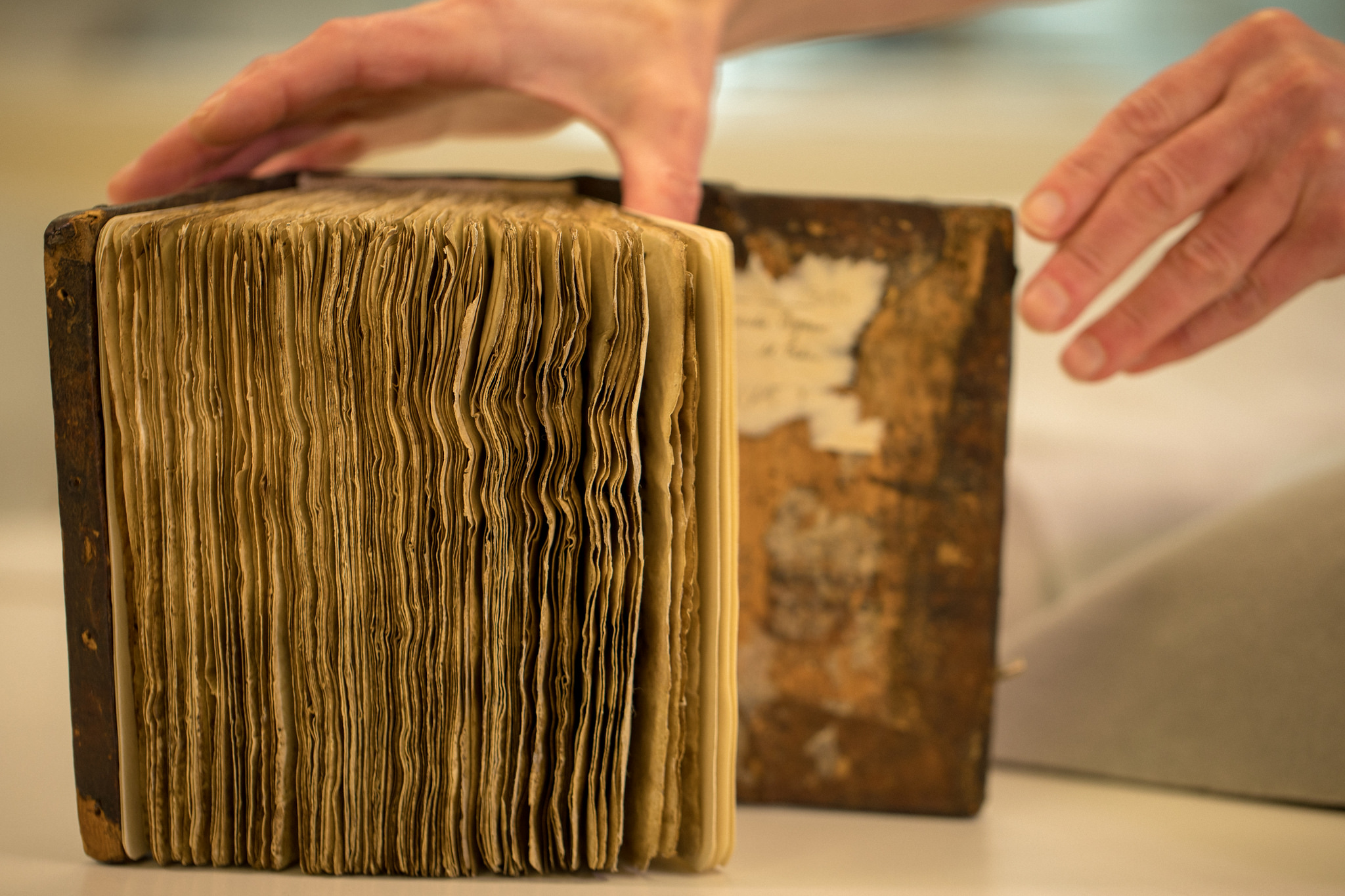
Image by Farrin Abbott/SLAC, via Flickr Commons
Alas, “despite the physician’s fame, the most complete surviving version of the translated manuscript was erased and written over with hymns in the 11th century – a common practice at the time.” Palimpsest, the word coined to describe such texts written, erased, and written over on pre-paper materials like papyrus and parchment, has long since had a place in the lexicon as a metaphor for anything long-historied, multi-layered, and fully understandable only with effort. The Stanford team’s effort involved a technique called X‑ray fluorescence (XRF), whose rays “knock out electrons close to the nuclei of metal atoms, and these holes are filled with outer electrons resulting in characteristic X‑ray fluorescence that can be picked up by a sensitive detector.”
Those rays “penetrate through layers of text and calcium, and the hidden Galen text and the newer religious text fluoresce in slightly different ways because their inks contain different combinations of metals such as iron, zinc, mercury and copper.” Each of the leather-bound book’s 26 pages takes ten hours to scan, and the enormous amounts of new data collected will presumably occupy a variety of experts on the ancient world — on the Greek and Islamic civilizations, on their languages, on their medicine — for much longer thereafter. But you do have to wonder: what kind of unimaginably advanced technology will our descendants a millennium and a half years from now be using to read all of the stuff we thought we’d erased?
Related Content:
The Turin Erotic Papyrus: The Oldest Known Depiction of Human Sexuality (Circa 1150 B.C.E.)
Try the Oldest Known Recipe For Toothpaste: From Ancient Egypt, Circa the 4th Century BC
Learn Ancient Greek in 64 Free Lessons: A Free Course from Brandeis & Harvard
Introduction to Ancient Greek History: A Free Online Course from Yale
Based in Seoul, Colin Marshall writes and broadcasts on cities and culture. His projects include the book The Stateless City: a Walk through 21st-Century Los Angeles and the video series The City in Cinema. Follow him on Twitter at @colinmarshall or on Facebook.
Read More...Meet Nadia Boulanger, “The Most Influential Teacher Since Socrates,” Who Mentored Philip Glass, Leonard Bernstein, Aaron Copland, Quincy Jones & Other Legends
We recently featured a video of Brian Eno giving controversial advice to artists: “don’t get a job.” Easier said than done, of course, but he makes a compelling case. Along the way, he says something interesting about the fetish we make of genius—an obsessive focus on lone, and almost always male, artists as self-made, heroic embodiments of greatness. “Although great new ideas are usually articulated by individuals,” he says, “they’re nearly always generated by communities.” (He proposes the neologism “scenius” in place of “genius” to describe “cooperative intelligence.”) Eno would probably agree that great art not only comes out of creative communities of peers, but also from the influence of great teachers.
One such figure, Nadia Boulanger (1887 –1979), has been described as “the most influential teacher since Socrates.” This is hardly hyperbole. As Clemency Burton-Hill notes at the BBC, “her roster of music students reads like the ultimate 20th Century Hall of Fame. Leonard Bernstein. Aaron Copland. Quincy Jones. Astor Piazzolla. Philip Glass,” and so on.
“It is no exaggeration, then, to consider Boulanger the most important musical pedagogue of the modern—or indeed any—era.” She was also a talented composer, a mentor and fierce champion of Igor Stravinsky, and the first woman to conduct major symphonies in Europe and the U.S., such as the New York Philharmonic and the Boston Symphony Orchestra.
Boulanger had her own take on genius: “We are as fools to say, ‘he’s a genius,’” she opines in the interview at the top. She also describes her method of weeding out unserious students by asking them, “Can you live without music?” If the answer is yes, she tells them “thank the Lord and goodbye!” Even at an advanced age, her fiercely uncompromising approach is palpable, a quality Philip Glass remembers from his first meeting with her in 1964, when “she was already a relic,” writes Matthew Guerrieri at Red Bull Academy. She identified a bar from one of Glass’s compositions as “written by a real composer,” says Glass. “It was “the first and last time she said anything nice to me for the next two years.”
American composers subjected themselves to Boulanger’s harsh discipline as a “rite of passage,” visiting her in her Paris apartment where she did most of her teaching. She also made her way through “leading conservatoires,” Burton-Hill notes, “including the Juilliard School, the Yehudi Menuhin School, the Royal College of Music and the Royal Academy of Music.” Boulanger’s early life is as fascinating as her teaching career; she was the definition of “a tough, aristocratic Frenchwoman,” as Glass describes her, and grew up surrounded by music. Her father, Ernest, was a composer, conductor, and singing professor. Her younger sister Lili, who died in 1918 at the age of 24, was the more talented composer. (Nadia, writes Burton-Hill, was “riven with envy.”)
A few years after Lili’s tragic death, Nadia abandoned composition to focus primarily on her teaching, mentoring students with tremendous promise and those with less evident gifts alike. “Anyone could be a Boulanger student,” Guerrieri writes (provided they couldn’t live without music): “Those with lesser skills were taken in alongside prodigies and professionals.” She did not discriminate on any basis, though her political attitudes make her a difficult figure for many people to fully embrace. “She espoused nationalism, monarchism and, although her good manners kept it from her often-Jewish students, anti-Semitism.” She held democracy in contempt and did not believe women should vote. And she was especially hard on her female students. (When one woman finally met her approval, Boulanger addressed her as “Monsieur.”)
Boulanger was as traditional in her musical attitudes—spurning Arnold Schoenberg’s innovations, for example—as in her politics. Yet she worked with jazz musicians like Jones and Donald Byrd, and with composers like Joe Raposo, “the musical chameleon behind the songs of Sesame Street and The Electric Company.” She was an encouraging presence in the lives of her students long after they had gone on to success and fame. When Leonard Bernstein sent her the score to West Side Story, she pronounced, “I am enchanted by its dazzling nature” (though she added a critique about its “facility”). Perhaps her most radical student, Philip Glass, has never been accused of musical conservatism. But through his difficult course of study with Boulanger, he says, “I learned to hear.”
“To undergo Boulanger’s rigorous training,” writes Guerrieri, “was to absorb her sense of music history: evolution, not revolution.” Then again, many of history’s revolutionaries have also been some of the keenest students of tradition, usually assisted, guided, and trained by history’s great teachers.
via @dark_shark/Red Bull Academy
Related Content:
A Minimal Glimpse of Philip Glass
Josh Jones is a writer and musician based in Durham, NC. Follow him at @jdmagness.
Read More...Hear Marvin Gaye Sing “I Heard It Through the Grapevine” A Capella: The Haunting Isolated Vocal Track
Marvin Gaye’s mega-hit, “I Heard it Through the Grapevine,” turns 50 this year.
Smokey Robinson and Gladys Knight got the first cracks at the now iconic Barrett Strong-Norman Whitfield tune, but Gaye’s 1968 rendition is the famous one, the bestselling Motown single of the decade.
Gaye’s former brother-in-law, Motown Records founder Berry Gordy, is perhaps the only one who wasn’t impressed, refusing to believe it could be a viable single until its enthusiastic reception by radio DJs and the listening public convinced him otherwise. In short order, In The Groove, the 1968 album on which it first appeared, was retitled with the name of its monster hit.
It’s given a considerable boost to the dancing raisins, Lawrence Kasdan’s film, The Big Chill, and the many emerging talents who’ve sampled the track in the decades following the singer’s untimely death.
Strip all that away.
For an even purer listening experience, strip away its famous orchestration, described by Time Magazine’s Gilbert Cruz as “ a single drum shot,” “a dangerous-sounding electric-piano riff,” and “a portentous tambourine rattle.”
As author Nelson George, an historian of African American music, observed in his 1984 essay, “Marvin Gaye’s Abiding Unrest”:
In the ’60s Marvin bent his voice to the wishes of Motown, but he did so his way, vocally if not musically. He claimed he had three different voices, a falsetto, a gritty gospel shout, and a smooth midrange close to his speaking voice…. His version of “Grapevine” is so intense, so pretty, so goddamn black in spirit, it seems to catalogue that world of black male emotions Charles Fuller evokes in his insightful Soldier’s Play.
The superlatives that accompany Gaye’s 6th place ranking on Rolling Stone’s 2010 list of the 100 Greatest Singers of All Time speak to both the emotional power he brought to his work, as well as his “brilliant musicality”:
These days we have Pro Tools and a thousand tracks, and you can do different vocals on every track. But back then you really had to innovate, like the way Marvin answered himself in songs, or all that really distant backing work, where his voice is all the way in the back and echoing. It’s haunting; he delivered every single song with such clarity…
Even ex-wife Janis Gaye had sweet words for that voice in a recent interview with Voice Council magazine. Among the shocking revelations that got left out of her tell-all memoir about their tempestuous relationship—Gaye was a primarily self-taught artist who smoked unfiltered Camels:
…sometimes he would walk around like Pavarotti just to make the kids laugh. But, yes, he would also run through scales, drink tea with honey and lemon and little concoctions of cayenne pepper with vinegar and things like that. But he didn’t warm up before every performance.
Listen to “Let’s Get It On,” “Sexual Healing,” and other isolated vocal tracks from Marvin Gaye’s hit list here.
via Twisted Sifter
Related Content:
Ayun Halliday is an author, illustrator, theater maker and Chief Primatologist of the East Village Inky zine. Join her at the New York Society Library on April 23 for her monthly low-budget variety show, Necromancers of the Public Domain. Follow her @AyunHalliday.
Read More...Applause Fills the Air as Stephen Hawking Gets Laid to Rest in Cambridge, England
applause fills the air as Stephen is carried into Great St Mary’s Church pic.twitter.com/PLtualKgC2
— Haskan Kaya (@HaskanKaya) March 31, 2018
Earlier today, they laid Stephen Hawking to rest in a private funeral held at University Church of St. Mary the Great in Cambridge, England. Although the funeral itself was attended by only 500 guests, the streets of Cambridge swelled with onlookers who broke into applause as the coffin holding the physicist made its way into the church, leaving us with some proof that there’s still something right in a world tilting toward the wrong, that we can still appreciate someone who overcame so much, and left us with even more.
If you would like to support the mission of Open Culture, consider making a donation to our site. It’s hard to rely 100% on ads, and your contributions will help us continue providing the best free cultural and educational materials to learners everywhere. You can contribute through PayPal, Patreon, and Venmo (@openculture). Thanks!
Related Content:
The Big Ideas of Stephen Hawking Explained with Simple Animation
Stephen Hawking’s Lectures on Black Holes Now Fully Animated with Chalkboard Illustrations
Hear Beowulf and Gawain and the Green Knight Read in Their Original Old and Middle English by an MIT Medievalist
Many a mocking critique floats around pointing out that some people who tell their multilingual neighbors to “speak English” seem to have a lot of trouble with the language themselves. I must confess, I find the observation more sad than funny. I’ve met many English speakers who struggle with understanding the peculiarities of the language and do not know its history. Increasingly, such things are not taught to those who don’t devote themselves to language study.
When people do learn how the language evolved, they can be shocked that for much of its history, English was unrecognizable to modern ears. Indeed, the study of Old English—or Anglo-Saxon, the language of Beowulf—satisfies foreign language requirements in many English departments. Originally written in runic before it incorporated the Latin alphabet (and retaining some of those early symbols afterward), this Germanic language slowly became more Latinate, and gave way among the reading classes in Britain to Anglo-Norman, a Germanic-French cousin, for a few centuries after 1066.
That’s the very short version. These strains and more eventually commingled to form Middle English, the language of Chaucer, which also sounds to modern ears like another tongue, though we recognize more of it. In the video above, Medievalist and MIT professor Arthur Bahr gives us demonstrations of both Old and Middle English in readings of Beowulf and Sir Gawain and the Green Knight as part of his 2014 course, “Major Authors: Old English and Beowulf.” (You can still visit the course site, read the syllabus and download course materials.)
Bahr reads the first 20 lines of the ancient epic poem, which begins:
Hwæt. We Gardena in geardagum,
þeodcyninga, þrym gefrunon,
hu ða æþelingas ellen fremedon.
“Besides being the language of Rohan in the novels of Tolkien,” he writes, “Old English is a language of long, cold, and lonely winters; of haunting beauty found in unexpected places; and of unshakable resolve in the face of insurmountable odds.” For all its distance from us, we can still recognize quite a lot in Old English if we listen closely. Much of its vocabulary and inflections survive, unchanged but for pronunciation and spelling, in modern English, including many of the language’s most basic words, like “the,” “in” and “are,” and most common, like “god,” “name,” “me,” “hand,” and even “old.”
After the Viking and Norman invasions, Old English became “the third language in its own country,” notes Luke Mastin at his History of English site. More spoken than written, it “effectively sank to the level of a patois or creole,” with several distinct regional variants. English seemed at one time “in dire peril” of dying out but “showed its resilience once again, and, two hundred years after the Norman Conquest, it was English not French that emerged as the language of England,” though it remained a diffuse collection of dialects. As you’ll hear in Bahr’s Middle English reading, it was also an English entirely transformed by the languages around it, as it would be once again a few hundred years later, when we get to the English of Shakespeare.
via Laughing Squid
Related Content:
Hear Beowulf Read In the Original Old English: How Many Words Do You Recognize?
1,000-Year-Old Manuscript of Beowulf Digitized and Now Online
Seamus Heaney Reads His Exquisite Translation of Beowulf and His Memorable 1995 Nobel Lecture
Hear What Shakespeare Sounded Like in the Original Pronunciation
Josh Jones is a writer and musician based in Durham, NC. Follow him at @jdmagness
Read More...A Shazam for Nature: A New Free App Helps You Identify Plants, Animals & Other Denizens of the Natural World

Do you ever long for those not-so-long-ago days when you skipped through the world, breathless with the anticipation of catching Pokémon on your phone screen?
If so, you might enjoy bagging some of the Pokeverse’s real world counterparts using Seek, iNaturalist’s new photo-identification app. It does for the natural world what Shazam does for music.
Aim your phone’s camera at a nondescript leaf or the grasshopper-ish-looking creature who’s camped on your porch light. With a bit of luck, Seek will pull up the relevant Wikipedia entry to help the two of you get better acquainted.
Registered users can pin their finds to their personal collections, provided the app’s recognition technology produces a match.
(Several early adopters suggest it’s still a few houseplants shy of true functionality…)
Seek’s protective stance with regard to privacy settings is well suited to junior specimen collectors, as are the virtual badges with which it rewards energetic uploaders.

While it doesn’t hang onto user data, Seek is building a photo library, composed in part of user submissions.
(Your cat is ready for her close up, Mr. DeMille…)
(Ditto your Portobello Mushroom burger…)
Download Seek for free on iTunes or Google Play.
Related Content:
Two Million Wondrous Nature Illustrations Put Online by The Biodiversity Heritage Library
Ayun Halliday is an author, illustrator, theater maker and Chief Primatologist of the East Village Inky zine. Follow her @AyunHalliday.
Read More...The Fall’s Mark E. Smith’s (RIP) Creates a List of His Favorite Books, Films & Music, Circa 1981
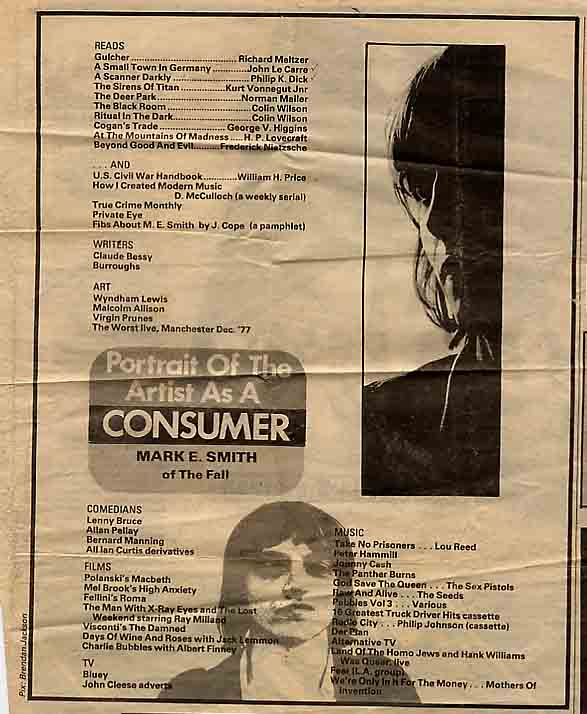
Some of us are still reeling from the death this last January of Mark E. Smith, the frontman and acerbic brains behind The Fall, surely one of post-punk’s finest groups, and definitely its longest lasting. The band might not have scored that many Top 40 singles, but Britain’s music press loved and feared Smith in equal amounts. He was always good for a belligerent quote, or a beer-fueled interview down the pub. To paraphrase DJ John Peel, Smith was the yardstick against which other musicians were measured.
And his death has also brought out a treasure trove of clippings, including this one from the August 15, 1981 edition of NME. “Portrait of the Artist as a Consumer” was an occasional series, asking musicians for their favorite books, art, writers, comedians, films, and even other music. We’ve pasted the original scan above, but just in case, we’ve transcribed his lists with a little bit of commentary.
READS
Gulcher — Richard Meltzer
A Small Town in Germany — John Le Carré
A Scanner Darkly — Philip K. Dick
The Sirens of Titan — Kurt Vonnegut Jr.
The Deer Park - Norman Mailer
The Black Room — Colin Wilson
Ritual in the Dark — Colin Wilson
Cogan’s Trade — George V. Higgins
At the Mountains of Madness - H.P. Lovecraft
Beyond Good and Evil — Frederich Nietzsche
AND
U.S. Civil War Handbook — William H. Price
How I Created Modern Music — D. McCulloch (a weekly serial)
True Crime Monthly
Private Eye
Fibs About M.E. Smith by J. Cope (a pamphlet)
Okay, for longtime fans of The Fall, the appearance of Philip K. Dick and H.P. Lovecraft should come as no surprise, as Smith referenced them often in his lyrics. Gulcher (subtitled Post-Rock Cultural Pluralism in America) was one of the first ever collections of serious rock criticism from one of the first ever rock critics. The blurb on Colin Wilson over at Amazon says he “wrote widely on true crime, mysticism and the paranormal” which sounds pretty much like Smith’s CV. George V. Higgins was also a crime writer, with a gift for mafioso gab. And as for The Deer Park by Mailer, Smith took the title for an early Fall song:
Of Smith’s fascination with the U.S. Civil War, I can think of his own visualizing between the North and South in his own beleaguered Britain, and the lyric from “The N.W.R.A.”:
“The streets of Soho did reverberate
With drunken Highland men
Revenge for Culloden dead
The North had rose again
But it would turn out wrong”
Don’t go looking for the McCulloch and Cope writings—they’re both jokes at the expense of fellow Mancunians Ian McCulloch (Echo and the Bunnymen) and Julian Cope, who Smith gigged with back in the day and went on to—as Smith no doubt saw it—sell out to the mainstream
WRITERS
Claude Bessy
Burroughs
Of William S. Burroughs much has been written, but Claude Bessy was a French writer who started and/or wrote for several punk fanzines, including Angeleno Dread and Slash, was the resident VJ at Manchester’s Hacienda Club, and directed—supposedly—music videos for The Fall (which ones, I can’t discern).
ART
Wyndham Lewis
Malcolm Allison
Virgin Prunes
The Worst live, Marchester Dec. ’77
Those who have seen Lewis’ writings for BLAST, the magazine of the vorticist movement in Britain, circa 1914, might be mistaken that they were looking at a M.E.S. lyric sheet.
The list is Smith’s joke over what is considered art: Malcolm Allison was an English football player and manager; the Virgin Prunes were an Irish post-punk band; The Worst was a little known punk band that shared the bill with The Fall and John Cooper Clark at the Electric Circus gig—the recording of which was the Fall’s first release.
COMEDIANS
Lenny Bruce
Alan Pellay
Bernard Manning
All Ian Curtis derivatives
Lenny Bruce and Bernard Manning are opposite ends of a very odd spectrum. More interesting is Alan Pellay aka Al Pellay aka Lana Pellay, who fronted a group I Scream Pleasures that often opened for The Fall, and whose angry declarations over dub tracks by Adrian Sherwood are sonic cousins to Smith.
FILMS
Polanski’s Macbeth
Mel Brook’s (sic) High Anxiety
Fellini’s Rome
The Man with X‑Ray Eyes and The Lost Weekend starring Ray Milland
Visconti’s The Damned
Days of Wine and Roses with Jack Lemmon
Charlie Bubbles with Albert Finney
The most personal selection here is the last one, a 1968 film that starred Finney as a desperate but successful writer who returns to his childhood home…Salford, near Manchester, Smith’s own hometown.
TV
Bluey
John Cleese adverts
Of the two, Bluey is the rare one, a cult Australian cop drama from 1976 created by Jock Blair and Ian Jones. We also have no idea why he liked it.
MUSIC
Take No Prisoners — Lou Reed
Peter Hammill
Johnny Cash
The Panther Burns
God Save the Queen — The Sex Pistols
Raw and Alive — The Seeds
Pebbles Vol. 3 — Various
16 Greatest Truck Driver Hits cassette
Radio City — Philip Johnson (cassette)
Der Plan
Alternative TV
Land of the Homo Jews and Hank Williams Was Queer, live — Fear (L.A. Group)
We’re Only In It for the Money — Mothers of Invention
So, at last, the music list. No surprises seeing Lou Reed, Johnny Cash, The Pistols, or Zappa on here. The Panther Burns was a favorite group of Claude Bessy; The Seeds was a great garage rock band of the ‘60s; Pebbles is a compilation of American psyche rock; Alternative TV, Fear, and Der Plan had varying degrees of success in the punk and electronic genres.
Of note, two things: the 16 Greatest Truck Driver Hits cassette, which the band must have picked up somewhere on tour. A baffling release, it has songs not credited to any artist, so perhaps this is a studio band concoction of country covers. But it might have inspired Smith to write his own version of the American trucker song, “Container Drivers”:
Also Philip Johnson. Radio City was one of a dozen self-released cassettes by an early electronic artist, which DieorDIY described as “A fantastic cut up of various current affairs radio broadcasts, with the classic AM radio sound quality, made good by that cosily depressing ferric oxide degradation technique.” For those looking for the various influences on the genius of Mark E. Smith, this entire list gives you a good place to start.
Related Content:
Patti Smith’s 40 Favorite Books
Springsteen’s Favorite Books & Reading List
Hayao Miyazaki Picks His 50 Favorite Children’s Books
Ted Mills is a freelance writer on the arts who currently hosts the FunkZone Podcast. You can also follow him on Twitter at @tedmills, read his other arts writing at tedmills.com and/or watch his films here.
Read More...Martin Scorsese Creates a List of 38 Essential Films About American Democracy

Image by “Siebbi,” Wikimedia Commons
So many of us, throughout so much of the 20th century, saw the nature of American-style democracy as more or less etched in stone. But the events of recent years, certainly on the national level but also on the global one, have thrown our assumptions about a political system that once looked destined for universality — indeed, the much-discussed “end” toward which history itself has been working — into question. Whatever our personal views, we’ve all had to remember that the United States, approaching a quarter-millennium of history, remains an experimental country, one more subject to re-evaluation and revision than we might have thought.
The same holds true for the art form that has done more than any other to spread visions of America: the movies. Martin Scorsese surely knows this, just as deeply as he knows that a full understanding of any society demands immersion into that society’s dreams of itself. The fact that so many of America’s dreams have taken cinematic form makes Scorsese well-placed to approach the subject, given that he’s dreamed a fair few of them himself. Taxi Driver, Raging Bull, Goodfellas, Gangs of New York, The Wolf of Wall Street: most of his best-known films tell thoroughly American stories, rooted in not just his country’s distinctive history but the equally distinctive politics, society, and culture that have resulted from it.
Now, along with his nonprofit The Film Foundation, Scorsese passes his understanding of America along to all of us with their curriculum, “Portraits of America: Democracy on Film.” It comes as part of their larger project “The Story of Film,” described by its official site as “an interdisciplinary curriculum introducing students to classic cinema and the cultural, historical, and artistic significance of film.” Scorsese and The Film Foundation offer its materials free to schools, but students of all ages and nationalities can learn a great deal about American democracy from the pictures it includes, the sequence of which runs as follows:
Module 1: The Immigrant Experience
Introductory Lesson: From Penny Claptrap to Movie Palaces—the First Three Decades
Chapter 1: “The Immigrant” (1917, d. Charlie Chaplin)
Chapter 2: “The Godfather, Part II” (1974, d. Francis Ford Coppola)
Chapter 3: “America, America” (1963, d. Elia Kazan)
Chapter 4: “El Norte” (1983, d. Gregory Nava)
Chapter 5: “The Namesake” (2006, d. Mira Nair)Module 2: The American Laborer
Introductory Lesson: The Common Good
Chapter 1: “Black Fury” (1935, d. Michael Curtiz)
Chapter 2: “Harlan County U.S.A.” (1976, d. Barbara Kopple)
Chapter 3: “At the River I Stand” (1993, d. David Appleby, Allison Graham and Steven Ross)
Chapter 4: “Salt of the Earth” (1954, d. Herbert J. Biberman)
Chapter 5: “Norma Rae” (1979, d. Martin Ritt)Module 3: Civil Rights
Introductory Lesson: The Camera as Witness
Chapter 1: King: A Filmed Record…Montgomery to Memphis (1970, conceived & created by
Ely Landau; guest appearances filmed by Sidney Lumet and Joseph L.
Mankiewicz)
Chapter 2: “Intruder in the Dust” (1949, d. Clarence Brown)
Chapter 3: “The Times of Harvey Milk” (1984, d. Robert Epstein)
Chapter 4: “Smoke Signals” (1998, d. Chris Eyre)
Module 4: The American Woman
Introductory Lesson: Ways of Seeing Women
Chapter 1: Through a Woman’s Lens: Directors Lois Weber (focusing on “Suspense,” 1913 and
“Where Are My Children,” 1916) and Dorothy Arzner (“Dance, Girl, Dance,” 1940)
Chapter 2: “Imitation of Life” (1934, d. John M. Stahl)
Chapter 3: “Woman of the Year” (1942, d. George Stevens)
Chapter 4: “Alien” (1979, d. Ridley Scott)
Chapter 5: “The Age of Innocence” (1993, d. Martin Scorsese)Module 5: Politicians and Demagogues
Introductory Lesson: Checks and Balances
Chapter 1: “Gabriel Over the White House” (1933, d. Gregory La Cava)
Chapter 2: “A Lion is in the Streets” (1953, d. Raoul Walsh)
Chapter 3: “Advise and Consent” (1962, d. Otto Preminger)
Chapter 4: “A Face in the Crowd” (1957, d. Elia Kazan)Module 6: Soldiers and Patriots
Introductory Lesson: Movies and Homefront Morale
Chapter 1: “Sergeant York (1941, d. Howard Hawks)
Chapter 2: Private Snafu’s Private War—three Snafu Shorts from WWII
Chapter 3: “Three Came Home” (1950, d. Jean Negulesco)
Chapter 4: “Glory” (1989, Edward Zwick)
Chapter 5: “Saving Private Ryan” (1998, d. Steven Spielberg)Module 7: The Press
Introductory Lesson: Degrees of Truth
Chapter 1: “Meet John Doe” (1941, d. Frank Capra)
Chapter 2: “All the President’s Men” (1976, d. Alan J. Pakula)
Chapter 3: “Good Night, and Good Luck” (2005, d. George Clooney)
Chapter 4: “An Inconvenient Truth” (2006, d. Davis Guggenheim)
Chapter 5: “Ace in the Hole” (1951, d. Billy Wilder)Module 8: The Auteurs
Introductory Lesson: Film as an Art Form
Chapter 1: “Modern Times” (1936, Charlie Chaplin)
Chapter 2: “The Grapes of Wrath”(1940, d. John Ford)
Chapter 3: “Citizen Kane” (1941, d. Orson Welles)
Chapter 4: “An American in Paris” (1951, d. Vincente Minnelli)
Chapter 5: “The Aviator” (2004, d. Martin Scorsese)
“Division, conflict and anger seem to be defining this moment in culture,” says Scorsese, quoted in a Film Journal International article about the curriculum. “I learned a lot about citizenship and American ideals from the movies I saw. Movies that look squarely at the struggles, violent disagreements and the tragedies in history, not to mention hypocrisies, false promises. But they also embody the best in America, our great hopes and ideals.” Few could watch all 38 of the films on his curriculum without feeling that the experiments of democracy and cinema are still on to something – and hold out the promise of more possibilities than we’d imagined before.
via Indiewire
Related Content:
Martin Scorsese to Teach His First Online Course on Filmmaking
Martin Scorsese Makes a List of 85 Films Every Aspiring Filmmaker Needs to See
Based in Seoul, Colin Marshall writes and broadcasts on cities and culture. His projects include the book The Stateless City: a Walk through 21st-Century Los Angeles and the video series The City in Cinema. Follow him on Twitter at @colinmarshall or on Facebook.
Read More...Behold the MusicMap: The Ultimate Interactive Genealogy of Music Created Between 1870 and 2016
A Pandora for the adventurous antiquarian, the highly underrated site Radiooooo gives users streaming music from all over the world and every decade since 1900. While it offers an aural feast, its limited interface leaves much to be desired from an educational standpoint. On the other end of the audio-visual spectrum, clever diagrams like those we’ve featured here on electronic music, alternative, and hip hop show the detailed connections between all the major acts in these genres, but all they do so in silence.
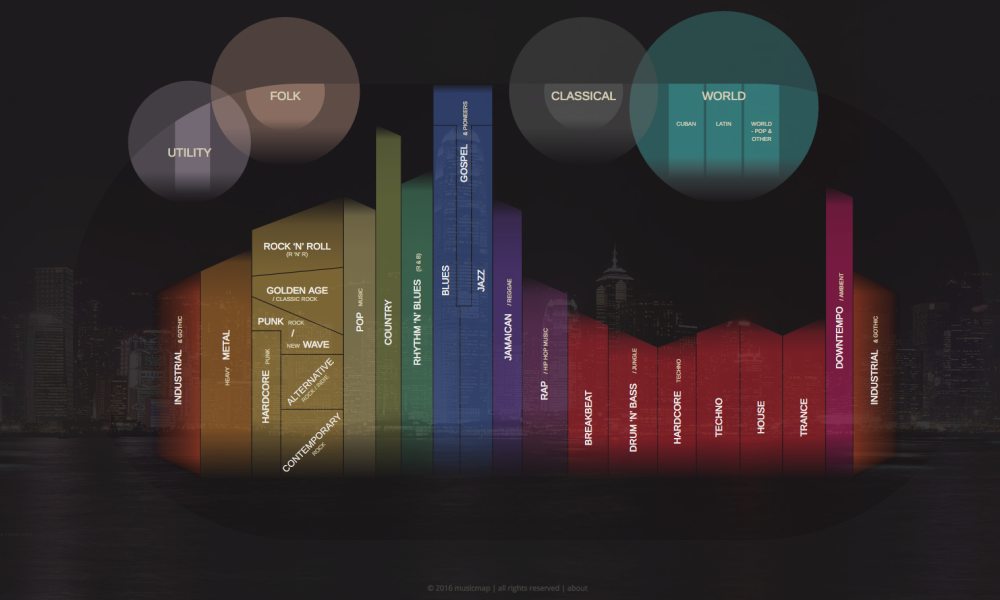
Now a new interactive infographic built by Belgian architect Kwinten Crauwels brings together an encyclopedic visual reference with an exhaustive musical archive. Though it’s missing some of the features of the resources above, the Musicmap far surpasses anything of its kind online—“both a 23and me-style ancestral tree and a thorough disambiguation of just about every extant genre of music,” writes Fast Company.
Or as Frank Jacobs explains at Big Think, Crauwels’ goal is “to provide the ultimate genealogy of popular music genres, including their relations and history.”

With over 230 genres in all—linked together in intricate webs of influence, mapped in a zoomable visual interface that organizes them all at macro and micro levels of description, and linked to explanatory articles and representative playlists (drawn from YouTube)—the project is almost too comprehensive to believe, and its degree of sophistication almost too complex to summarize concisely (though Jacobs does a good job of it). The Musicmap spans the years 1870–2016 and covers 22 major categories (with Rock further broken into six and “World” into three).
In an oval around the colorful skyscraper-like “super-genres” are decades, moving from past to present from top to bottom. Zoom into the “super-genres” and find “a spider’s web of links within and between the different houses” of subgenres. “Those links can indicate parentage or influence, but also a backlash (i.e. as ‘anti-links’).” Clicking on the name of each subgenre reveals “a short synopsis and a playlist of representative songs.” These two functions, in turn, link to each other, allowing users to click through in a more Wikipedia-like way once they’ve entered the minutiae of the Musicmap’s contents.

The map not only draws connections between subgenres but also between their relatives in other “super-genres” (learn about the relationship, for example, between folk rock and classic metal). On the left side of the screen is a series of buttons that reveal an introduction, methodology, abstract, several navigational functions, a glossary of musical terms, and a bibliography (called “Acknowledgments”). Aside from visually reducing all the way down to the level of individual bands within each subgenre, which could become a little dizzying, it’s hard to think of anything seriously lacking here.
Anything we might find fault with might be changed in the near future. Although Crauwels spent almost ten years on research and development, first conceiving of the project in 2008, the current site “is still version 1.0 of Music map. In later versions, the playlists will be expanded, perhaps even community-generated.” Crauwels also wants to sync up with Spotify. Although not a musician himself, he is as passionate about music as he is about design and education, making him very likely the perfect person to take on this task, which he admits can never be completed.
Crauwels does not currently seem to have plans to monetize his map. His stated motives are altruistic, in the same public service spirit as Radiooooo. “Musicmap,” he says, “believes that knowledge about music genres is a universal right and should be part of basic education.” At the moment, the education here only applies to popular music, although enough of it to acquire a graduate-level historical knowledge base.
The four categories at the top of the map—the strangely named “Utility” (which includes hymns, military marches, musicals, and soundtracks), Folk, Classical, and World—are zoomable but do not have clickable links or playlists. Given Crauwels’ completist instincts, this may well change in future updates. In the TED talk above, see him tell the story of how he created Musicmap, a DIY effort that came out of his frustration that nothing like it existed, so he had to create it himself.
Enter the Musicmap here and try not to get lost for several hours.
via Big Think
Related Content:
Radio Garden Lets You Instantly Tune into Radio Stations Across the Entire Globe
A Massive 800-Track Playlist of 90s Indie & Alternative Music, in Chronological Order
Josh Jones is a writer and musician based in Durham, NC. Follow him at @jdmagness
Read More...Hear 48 Hours of Lectures by Joseph Campbell on Comparative Mythology and the Hero’s Journey
What does it mean to “grow up”? Every culture has its way of defining adulthood, whether it’s surviving an initiation ritual or filing your first tax return. I’m only being a little facetious—people in the U.S. have long felt dissatisfaction with the ways we are ushered into adulthood, from learning how to fill out IRS forms to learning how to fill out student loan and credit card applications, our culture wants us to understand our place in the great machine. All other pressing life concerns are secondary.
It’s little wonder, then, that gurus and cultural father figures of all types have found ready audiences among America’s youth. Such figures have left lasting legacies for decades, and not all of them positive. But one public intellectual from the recent past is still seen as a wise old master whose far-reaching influence remains with us and will for the foreseeable future. Joseph Campbell’s obsessive, erudite books and lectures on world mythologies and traditions have made certain that ancient adulthood rituals have entered our narrative DNA.
When Campbell was awarded the National Arts Club Gold Medal in Literature in 1985, psychologist James Hillman stated that “no one in our century—not Freud, not Thomas Mann, not Levi-Strauss—has so brought the mythical sense of the world and its eternal figures back into our everyday consciousness.” Whatever examples Hillman may have had in mind, we might rest our case on the fact that without Campbell there would likely be no Star Wars. For all its success as a megamarketing phenomenon, the sci-fi franchise has also produced enduringly relatable role models, examples of achieving independence and standing up to imperialists, even if they be your own family members in masks.
In the video interviews above from 1987, Campbell professes himself no more than an “underliner” who learned everything he knows from books. Like the contemporary comparative mythologist Mircea Eliade, Campbell did not conduct his own anthropological research—he acquired a vast amount of knowledge by studying the sacred texts, artifacts, and rituals of world cultures. This study gave him insight into stories and images that continue to shape our world and feature centrally in huge pop cultural productions like The Last Jedi and Black Panther.
Campbell describes ritual entries into adulthood that viewers of these films will instantly recognize: Defeating idols in masks and taking on their power; burial enactments that kill the “infantile ego” (academics, he says with a straight face, sometimes never leave this stage). These kinds of edge experiences are at the very heart of the classic hero’s journey, an archetype Campbell wrote about in his bestselling The Hero with a Thousand Faces and popularized on PBS in The Power of Myth, a series of conversations with Bill Moyers.
In the many lectures just above—48 hours of audio in which Campbell expounds his theories of the mythological—the engaging, accessible writer and teacher lays out the patterns and symbols of mythologies worldwide, with special focus on the hero’s journey, as important to his project as dying and rising god myths to James Frazer’s The Golden Bough, the inspiration for so many modernist writers. Campbell himself is more apt to reference James Joyce, Carl Jung, Pablo Picasso, or Richard Wagner than science fiction, fantasy, or comic books (though he did break down Star Wars in his Moyers interviews). Nonetheless, we have him to thank for inspiring the likes of George Lucas and becoming a “patron saint of superheroes” and space operas.
We will find some of Campbell’s methods flawed and terminology outdated (no one uses “Orient” and “Occident” anymore)—and modern heroes can just as well be women as men, passing through the same kinds of symbolic trials in their origin stories. But Campbell’s ideas are as resonant as ever, offering to the wider culture a coherent means of understanding the archetypal stages of coming of age. As Hollywood executive Christopher Vogler said in 1985, after recommending The Hero with a Thousand Faces as a guide for screenwriters, Campbell’s work “can be used to tell the simplest comic story or the most sophisticated drama”—a sweeping vision of human cultural history and its meaning for our individual journeys.
You can access the 48 hours of Joseph Campbell lectures above, or directly on Spotify.
Related Content:
Joseph Campbell and Bill Moyers Break Down Star Wars as an Epic, Universal Myth
Josh Jones is a writer and musician based in Durham, NC. Follow him at @jdmagness
Read More...Support Us
We're hoping to rely on loyal readers, rather than erratic ads. Please click the Donate button and support Open Culture. You can use Paypal, Venmo, Patreon, even Crypto! We thank you!

About Us

Open Culture scours the web for the best educational media. We find the free courses and audio books you need, the language lessons & educational videos you want, and plenty of enlightenment in between.
Advertise With Us

FREE UPDATES!
GET OUR DAILY EMAIL
Get the best cultural and educational resources on the web curated for you in a daily email. We never spam. Unsubscribe at any time.
FOLLOW ON SOCIAL MEDIA

Open Culture editor Dan Colman scours the web for the best educational media. He finds the free courses and audio books you need, the language lessons & movies you want, and plenty of enlightenment in between.
Advertise With Us


