A Periodic Table Visualizing the Year & Country in Which Each Element Was Discovered

On the “Data is Beautiful” subreddit, a user named Udzu posted a visualisation of the Periodic Table of Elements that highlights the year and country in which each element was discovered. You can view it in a larger format here. Elaborating on how the graphic was made, he adds (his words, not mine, follow):
- The year and country of discovery are taken from Wikipedia and are based on when the element was first observed or predicted rather than when it was first isolated.
- The priority for the discoveries is often contentious. The visualisation uses the listings currently in the Wikipedia article, with no claim as to their accuracy.
- The country is typically both the citizenship of the discoverer and the location of discovery. Exceptions include Hafnium (discovered by a Dutch and Hungarian duo in Copenhagen) and Radon (discovered by a British and American duo in Montreal); these are listed under location.
- Countries and flags are of the modern equivalents when appropriate: e.g. Russia rather than the USSR, UK rather than England/Scotland, and Mexico rather than New Spain.
- The etymologies are also taken from Wikipedia.
- The legends contain summary counts of the data. Good work, Sweden.
Ranked in order, the UK could lay claim to 19 elements, Sweden and Germany to 18 each, France to 16, and Russia and the United States to 11 each.
Related Content:
The Periodic Table of Elements Scaled to Show The Elements’ Actual Abundance on Earth
Periodic Table Battleship!: A Fun Way To Learn the Elements
“The Periodic Table Table” — All The Elements in Hand-Carved Wood
World’s Smallest Periodic Table on a Human Hair
“The Periodic Table of Storytelling” Reveals the Elements of Telling a Good Story
Chemistry on YouTube: “Periodic Table of Videos” Wins SPORE Prize
Read More...Read and Hear Tristan Tzara’s “Dada Manifesto,” the Avant-Garde Document Published 100 Years Ago (March 23, 1918)
Dada demands explanation, yet it somehow also demands not to be explained. In the nearly 102 years since its inception, many attempts at summary and analysis of that early 20th-century European avant-garde movement have emerged; as you can see in the related links at the bottom of the post, we’ve featured a fair few of them here on Open Culture. But to truly understand Dada, you must, to the extent possible, get inside the heads of its founders, and one shortcut to that artistically rich destination takes the form of something any movement worth its salt — especially any early 20th-century European avant-garde movement — will have drawn up: its manifesto.
“The magic of a word – Dada – which has brought journalists to the gates of a world unforeseen, is of no importance to us,” wrote Romanian-French essayist, poet, and performance artist Tristan Tzara almost exactly a century ago.
To put out a manifesto you must want: ABC
to fulminate against 1, 2, 3
to fly into a rage and sharpen your wings to conquer and disseminate little abcs and big ABCs, to sign, shout, swear, to organize prose into a form of absolute and irrefutable evidence, to prove your non plus ultra and maintain that novelty resembles life just as the latest-appearance of some whore proves the essence of God. His existence was previously proved by the accordion, the landscape, the wheedling word. To impose your ABC is a natural thing — hence deplorable.
In this Dada Manifesto of March 23, 1918 (read it online here), Tzara goes on to define “Dada” as “a word that throws up ideas so that they can be shot down; every bourgeois is a little playwright, who invents different subjects and who, instead of situating suitable characters on the level of his own intelligence, like chrysalises on chairs, tries to find causes or objects (according to whichever psychoanalytic method he practices) to give weight to his plot, a talking and self-defining story.” And further down, just in case you haven’t quite got the picture: “DADA DOES NOT MEAN ANYTHING.”
Different translations of Tzara’s words, of which you can hear readings in the videos at the top of the post and just above, put it somewhat differently: “Dada means nothing,” says another. But whatever it means, exactly — or doesn’t mean, exactly — Dada burned brightly enough during its brief heyday to produce not just one manifesto, but two. “As in every human endeavor when two strong personalities meet, opinions may clash and an argument often ensues,” writes Eli Anapur at Widewalls. The German writer Hugo Ball actually wrote his own Dada manifesto before Tzara did, in 1916. “Both Manifestos are explanations of the Dada movement and its goals, but the content differs as long as the modes of spreading the movement throughout Europe and ultimately world, were concerned.”
Ball begins by describing Dada as “a new tendency in art. One can tell this from the fact that until now nobody knew anything about it, and tomorrow everyone in Zurich will be talking about it.” For the word itself he cites several dictionary definitions: “In French it means ‘hobby horse.’ In German it means ‘good-by,’ ‘Get off my back,’ ‘Be seeing you sometime.’ In Romanian: ‘Yes, indeed, you are right, that’s it. But of course, yes, definitely, right.’ ” Yet what a useful word it can be:
How does one achieve eternal bliss? By saying dada. How does one become famous? By saying dada. With a noble gesture and delicate propriety. Till one goes crazy. Till one loses consciousness. How can one get rid of everything that smacks of journalism, worms, everything nice and right, blinkered, moralistic, europeanized, enervated? By saying dada. Dada is the world soul, dada is the pawnshop. Dada is the world’s best lily-milk soap. Dada Mr. Rubiner, dada Mr. Korrodi. Dada Mr. Anastasius Lilienstein.
One hundred years on, the tenets of Dada may not look like an obvious route to eternal bliss, fame, or the excision of bothersome elements of life. But something about the notion at the movement’s core — of moving radically beyond sense as a response to the state of the world — still resonates today. The Europe of 1918 found itself in a bad spot, to put it mildly, but most of us in the early 21st century also feel, at least occasionally, surrounded by a reality that has lost its own sense. How much could it hurt to heed Ball and Tzara’s words and just say dada?
You can read Tzara’s manifesto at this University of Pennsylvania website.
Related Content:
The ABCs of Dada Explains the Anarchic, Irrational “Anti-Art” Movement of Dadaism
Based in Seoul, Colin Marshall writes and broadcasts on cities and culture. His projects include the book The Stateless City: a Walk through 21st-Century Los Angeles and the video series The City in Cinema. Follow him on Twitter at @colinmarshall or on Facebook.
Read More...The Museum of Failure: A Living Shrine to New Coke, the Ford Edsel, Google Glass & Other Epic Corporate Fails
All successful products are alike; every unsuccessful product is unsuccessful in its own way. Or so a modern-day Tolstoy might find himself inspired to write after a visit to the Museum of Failure, a movable feast of flops which began last year in Helsingborg, Sweden and has now opened its doors on Hollywood Boulevard in Los Angeles. The Donald Trump board game, Apple’s Newton, Nokia’s N‑Gage, Ford’s Edsel, Colgate Beef Lasagne, Harley-Davidson Cologne, New Coke, Google Glass: these and other shining examples of failure appear in the videos about the museum at the top of the post and just below.
Considered today, many of these products, whether well-known or thoroughly obscure, look hilariously ill-conceived. But the Museum of Failure’s founder, a psychologist named Samuel West, does have high praise for some of the products he’s collected in his institution.
As you’ll find out on a visit there, though, they’ve all got at least one fatal flaw — a design problem, bad timing, misjudgment of the market, falling into the cracks of existing offerings — that drove consumers away. You can’t say that any of them didn’t take a risk, but risks, by their very nature, burn out more often than they pay off.
“Why do I have all these failures?” asks West in his TED Talk. “The point of having the museum is that we can learn from these failures. I want us to start to admit our failures as companies, as individuals, so we can learn from it.” America’s relative lack of cultural stigmatization of failure often gets cited among the reasons for the country’s reputation for innovation and economic dynamism, but there, as anywhere else, an increased willingness not just to fail but to better understand the nature of individual failures wouldn’t go amiss. Nothing succeeds like success, so the saying goes, but the fascination that has built around the Museum of Failure so far suggests that we have much to gain from its opposite as well.
Related Content:
Hear Thomas Edison’s Creepy Talking Dolls: An Invention That Scared Kids & Flopped on the Market
Why Do So Many People Adore The Room, the Worst Movie Ever Made? A Video Explainer
Meet the World’s Worst Orchestra, the Portsmouth Sinfonia, Featuring Brian Eno
Paulo Coelho on The Fear of Failure
Based in Seoul, Colin Marshall writes and broadcasts on cities and culture. His projects include the book The Stateless City: a Walk through 21st-Century Los Angeles and the video series The City in Cinema. Follow him on Twitter at @colinmarshall or on Facebook.
Read More...A 17-Hour Chronological Playlist of Pink Floyd Albums: The Evolution of the Band Revealed in 209 Tracks (1967–2014)
At the intersection of progressive rock, conceptual psychedelia, bluesy, anthemic classic rock, and experimental sound you’ll find Pink Floyd, a band everyone thinks they know but who always manage to surprise even ardent fans with the strange twists and turns of their discography. One might even say, as Bill Wyman writes at Vulture, that “there are at least four, or arguably five, Pink Floyds.”
“The first was a goofy and absurdist pop-rock band, led by one Syd Barrett,” writes Wyman. This original Floyd released The Piper at the Gates of Dawn then fell apart after its lead singer/writer/guitarist’s mental health declined precipitously. The second Pink Floyd first took shape “before Barrett joined, and then reached full pretentious flower after his departure” and replacement by David Gilmour. This was the “psychedelic, space-rock‑y, quasi-improvisational ensemble” of A Saucerful of Secrets, Ummagumma, and Atom Heart Mother.
The third Floyd, Wyman argues, “is the one we know and love; the organic unit that created Meddle, The Dark Side of the Moon, and Wish You Were Here”—arguably the band’s creative zenith. From here, we move to the fourth version, “which saw a domineering [Roger] Waters taking control,” producing records that increasingly became Roger Waters solo albums—Animals, The Wall, and The Final Cut. The band’s stadium shows became bombastic affairs of Spinal Tap proportions.
Finally, the fifth and final iteration, critically snubbed but commercially successful, left the disaffected Waters to his solo work and went on with Gilmour at the helm to record A Momentary Lapse of Reason, The Division Bell, and twenty years later, the final Pink Floyd album, the mostly instrumental Endless River, made in 2014 after keyboardist Richard Wright’s death and drawing on recordings from The Division Bell sessions.
It’s easy to find fault with this schematic outline of Pink Floyd’s career—which leaves out their detours into film soundtracks with More, Obscured by Clouds, and an aborted score for Michelangelo Antonioni’s film Zabriskie Point. It leaves out a misbegotten, but notable excursion into ballet (!), and experiments with found sound recordings in the late-60s. This quick survey also underestimates the importance of Syd Barrett.
Pink Floyd’s first frontman may have taken his oddball sensibility with him when he left the band—and brought it to his captivatingly weird solo work—but his presence remained with them for years afterward and haunts one of their finest achievements, 1975’s Wish You Were Here. There are all sorts of lines that run through the various versions of Pink Floyd, connecting their strange, youthful, unpredictable early work to the highly-polished, and much less interesting, mature late recordings.
And yet, Wyman’s summary is a useful categorization nonetheless, a succinct explanation for how Pink Floyd “may be the only rock band that can credibly be compared to both the Beatles and Spinal Tap.” His massive undertaking—ranking every Pink Floyd song from worst to best—deserves a thorough read. Longtime lovers of the band and newcomers alike will find the commentary enlightening and informative (and he does include those film scores and gives Barrett his due).
While you read about each of the band’s officially-released, 165 songs, you can listen to them as well in the Spotify playlist above, which not only includes every studio release, but every live album as well. 17 hours total of Pink Floyd’s quirky pop, space‑y, proggy experimentalism, masterful psych-rock soundscapes, climactic, politically-charged concept albums, and the denouement of their final three albums. No matter how long you’ve followed the band over their 40-plus year career, you’re likely to find some surprises here.
Related Content:
Pink Floyd’s “Echoes” Provides a Soundtrack for the Final Scene of Kubrick’s 2001: A Space Odyssey
Josh Jones is a writer and musician based in Durham, NC. Follow him at @jdmagness
Read More...Tom Waits Curates a 76-Song Playlist of His Own Music: An Introduction to Tom Waits by Tom Waits
If you ever find yourself in an argument about the best Tom Waits songs, say, or best Tom Waits albums, or best Tom Waits period, you now have the luxury of calling Mr. Waits himself to the stand. Or, at least, you can point to the 76-song playlist below, curated by Waits to mark the re-release of his first seven albums, all “originally released through Elektra Asylum Records in the 1970s,” notes Folk Radio UK, “many of which have been long out of print.” (If you don’t have Spotify, you can also stream the playlist on iTunes if you have Apple Music.)
All seven records have been re-mastered and made available digitally, on CD, and vinyl pre-order at the official Tom Waits online store. Closing Time, Heart of Saturday Night, Nighthawks at the Diner, Small Change, Foreign Affairs, Blue Valentine, Heart Attack and Vine…. If you don’t know this first phase of Waits’ career, the titles alone should clue you in to the fact that he spent most of the 70s as a Sinatra-loving lounge singer, composing the sad drunken sound of 2 A.M. heartbreak at a seedy Hollywood dive.
This side of Waits survives, of course, in better-known albums like Swordfishtrombones, Rain Dogs, and Real Gone, but it’s often buried deep within the crashing, smashing, banging, clanging sound of his later work (or—in the case of his cover of Daniel Johnston’s “King Kong”—beatboxing, Tom Waits-style). In the 1987 live version of Rain Dogs’ “Clap Hands” (top), the first song on Waits’ playlist, he mixes his registers, trading his earlier raspy croon for his later commanding bark, over cool, lounge‑y Latin-tinged jazz.
“Spanning decades of material,” writes Reid McCarter at The Onion’s A.V. Club, the playlist has Waits, “like a growling Virgil taking your soft little hand safely into his gnarled grip,” leading you through his catalog as only he could. Have a quarrel with his choices? “Upset that the first half hour is dominated by piano ballads?” Well, take it up with the man himself. “Surely,” McCarter taunts, “you must know Tom Waits’ music better than Tom Waits himself.”
Of course, we’re always free to disagree with the artist’s assessment of his work. But if you’re a Waits newbie, I couldn’t recommend a better guide. Alternately, you can work your way through his entire catalog from start to finish—stream it all, from Closing Time to his last studio album Bad as Me, here.
via A.V. Club
Related Content:
Stream All of Tom Waits’ Music in a 24 Hour Playlist: The Complete Discography
Tom Waits Makes a List of His Top 20 Favorite Albums of All Time
Tom Waits For No One: Watch the Pioneering Animated Tom Waits Music Video from 1979
Josh Jones is a writer and musician based in Durham, NC. Follow him at @jdmagness
Read More...Come on Down to David Byrne’s Giant Suit Emporium: We’re Burning Down the House with Savings!
Come on down to David Byrne’s Giant Suit Emporium — We’re burning down the house with savings! @ColbertLateShow @StephenAtHome pic.twitter.com/LxxlThSt4D
— DavidByrne.com (@DBtodomundo) March 21, 2018
A funny bit of comedy that accompanied David Byrne’s recent visit to The Late Show with Stephen Colbert, where he performed ‘Everybody’s Coming To My House,’ the lead track off of his new album American Utopia. Pick up the album. Catch one of his concerts this summer. And don’t miss his new uplifting web site, Reasons to Be Cheerful.
If you would like to support the mission of Open Culture, consider making a donation to our site. It’s hard to rely 100% on ads, and your contributions will help us continue providing the best free cultural and educational materials to learners everywhere. You can contribute through PayPal, Patreon, and Venmo (@openculture). Thanks!
Related Content:
David Byrne: From Talking Heads Frontman to Leading Urban Cyclist
Read More...Philosophy for Beginners: A Free Introductory Course from Oxford University
Philosophy doesn’t have to be daunting. Thanks to the Continuing Education program at Oxford University, you can now ease into philosophical thinking by listening to five lectures collectively called Philosophy for Beginners. (The video above is admittedly grainy, so you could always explore the audio options available on iTunes or this Oxford website.) Taught by Marianne Talbot, Lecture 1 starts with a “Romp Through the History of Philosophy” and moves in a brief hour from Ancient Greece to the present. Subsequent lectures (usually running about 90 minutes) cover the following topics: logic, ethics, politics, metaphysics, epistemology, and language.
Lecture One: A Romp Through the History of Philosophy from the Pre-Socratics to the present day
Lecture Two: The Philosophical Method: Logic and Argument
Lecture Three: Ethics and Politics
Lecture Four: Metaphysics and Epistemology
Lecture Five: Philosophy of Language and Mind
You can find more courses by Talbot in our collection of Free Online Philosophy Courses, a subset of our meta collection, 1,700 Free Online Courses from Top Universities.
If you would like to support the mission of Open Culture, consider making a donation to our site. It’s hard to rely 100% on ads, and your contributions will help us continue providing the best free cultural and educational materials to learners everywhere. You can contribute through PayPal, Patreon, and Venmo (@openculture). Thanks!
Related Content:
Oxford’s Free Introduction to Philosophy: Stream 41 Lectures
Oxford’s Free Course A Romp Through Ethics for Complete Beginners Will Teach You Right from Wrong
Download 100 Free Online Philosophy Courses & Start Living the Examined Life
A History of Philosophy in 81 Video Lectures: From Ancient Greece to Modern Times
Death: A Free Philosophy Course from Yale
Read More...The History of the U.S. Civil War Visualized Month by Month and State by State, in an Infographic from 1897

There’s been a lot of handwringing over the i‑Generation’s lack of map reading skills.
While we’re at it, let’s take a cold, hard look at the Gilded Age infographic, above.…
… and conclude that people who live in glass houses should stop reaching for stones.
Published in 1897 by the Comparative Synoptical Chart Company, this now unfathomable document–History of the Civil War in the United States: 1860–1865–achieved its goal of squeezing the maximum amount of content onto a single sheet.
This is in direct opposition to today’s generally accepted rules for creating successful infographics, one of which is to simplify.
Another holds that text should be used sparingly, lest it clutter up strong visuals. Consumers have a limited attention span, and for content to be considered shareable, they should be able to take it in at a glance.
Modern eyes may be forgiven for mistaking this chart for the world’s most convoluted subway map. But those aren’t stops, friend. They’re minor engagements. Bloodier and better-known battles are delineated with larger circles—yellow centers for a Union victory, pale green for Confederate.
The fastest way to begin making heads or tails of the chart is to note that each column is assigned to a different state.
The vertical axis is divided into months. Notice all the negative space around Fort Sumter.
And the constant entries in Virginia’s column.
The publisher noted that the location of events was “entirely governed” by this time scale.
You’ll have to look hard for Lincoln’s assassination.
Consumers who purchased the History of the Civil War in the United States 1860–1865 presumably pored over it by candlelight, supplementing it with maps and books.
It would still make a superb addition to any history teacher’s classroom, both as decoration and the tinder that could ignite discussion as to how we receive information, and how much information is in fact received.
Explore a larger, zoomable version of the map here.
Related Content:
A Free Course from Yale on the U.S. Civil War
Watch Veterans of The US Civil War Demonstrate the Dreaded Rebel Yell (1930)
Visualizing Slavery: The Map Abraham Lincoln Spent Hours Studying During the Civil War
Ayun Halliday is an author, illustrator, theater maker and Chief Primatologist of the East Village Inky zine. Follow her @AyunHalliday.
Read More...Spike Lee Teaching an Online Course on Independent Filmmaking: The Course Is Now Officially Live
FYI: If you sign up for a MasterClass course by clicking on the affiliate links in this post, Open Culture will receive a small fee that helps support our operation.
When Spike Lee makes a movie, people talk about it. People talked in 1986 when he made the black-and-white indie comedy She’s Gotta Have It; they talked even more when he came out with Do the Right Thing a few years later; they talked, with sharply divided opinion, about his most recent picture, the crime-themed musical Chi-Raq; and they’re already talking about his upcoming Black Klansman, and not just because of the title. Lee has managed to remain culturally and artistically relevant throughout a career of more than thirty years and counting, and his new online course at Masterclass just might let us in on how he’s done it.
“When you’re an independent filmmaker, and making films outside Hollywood, that’s hard,” says the long Brooklyn-based Lee in the trailer for the course above. “You have to pray on bended knee at the church of cinema.” But even as an aspiring auteur with a pocket-change budget — Lee remembers well when he “was a caterer, the producer, the director, the screenwriter, acted in it, and I was the first AD” on his first feature — you already possess “tools that can help you tell a story”: heightening dynamic camerawork to heighten the emotions, for instance, or writing characters with strong beliefs to intensify the conflicts of the story. He used such techniques when he started out, and he still uses them today.
Though Lee seems more than willing to talk about his methods, you can’t fully understand any filmmaker unless you understand that filmmaker’s influences. And so we offer you Lee’s list of 95 essential movies every aspiring director should see, expanded from his original list of 87, drawn up to hand out to the graduate-school classes he’s taught. Featuring multiple works from directors like Akira Kurosawa, Alfred Hitchcock, Federico Fellini, John Huston, and Stanley Kubrick, the first version of the list runs as follows:
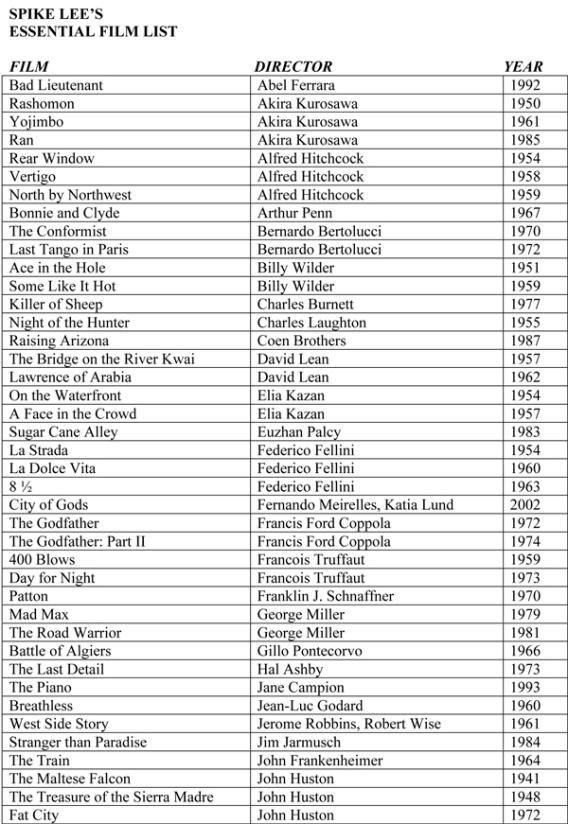
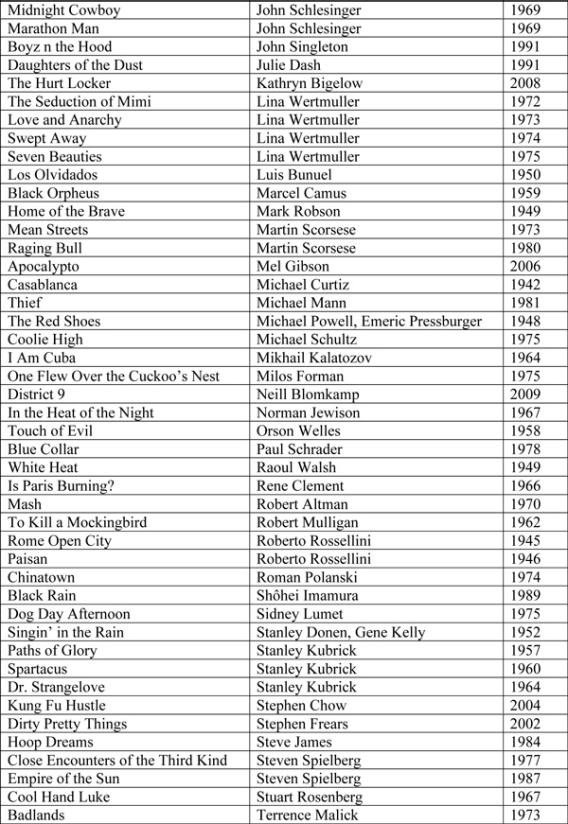
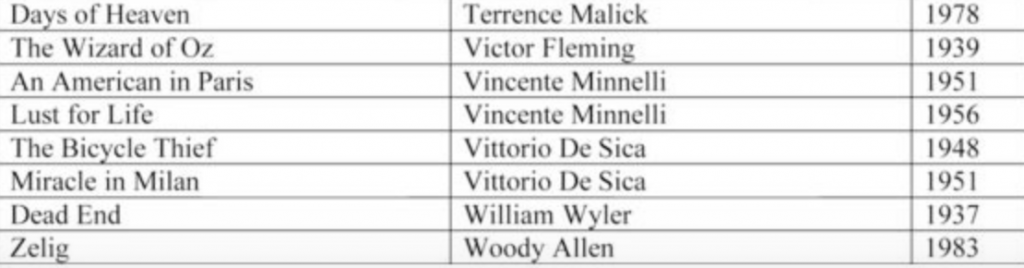
Taken to task for that list’s lack of female filmmakers, Lee came up with these additions:
- The Piano — Jane Campion (1993)
- Daughters of the Dust — Julie Dash (1991)
- The Hurt Locker — Kathryn Bigelow (2008)
- Sugar Cane Alley - Euzhan Palcy (1983)
- The Seduction of Mimi — Lina Wertmuller (1972)
- Love and Anarchy - Lina Wertmuller (1973)
- Swept Away - Lina Wertmuller (1974)
- Seven Beauties — Lina Wertmuller (1975)
Lee’s Masterclass on filmmaking joins the site’s other offerings on the same subject from auteurs no less distinctive than Martin Scorsese and Werner Herzog. Though all three became major filmmakers at different times and under different circumstances — and ended up with very different cinematic sensibilities — they all, as Lee might put it, pray at the same church.
And just as it takes the perspective of many theologists to get a sense of the ineffable essence of the divine, so it takes the perspective of many filmmakers to get an ineffable essence of cinema. You could take all three courses with Masterclass’ $180 all-access pass, or you could pay $90 for just Lee’s. Either way, you’ll learn how he made She’s Gotta Have It for a then-dirt-cheap $175,000, but these days you could surely go out and shoot your own film afterward for not much more than the cost of the Masterclass itself. It’s still hard out there for an indie filmmaker, mind you; just not quite as hard as it was.
Related Content:
How Spike Lee Got His First Big Break: From She’s Gotta Have It to That Iconic Air Jordan Ad
Spike Lee’s List of 95 Essential Movies – Now with Women Filmmakers
Martin Scorsese to Teach His First Online Course on Filmmaking
Werner Herzog Teaches His First Online Course on Filmmaking
Based in Seoul, Colin Marshall writes and broadcasts on cities and culture. His projects include the book The Stateless City: a Walk through 21st-Century Los Angeles and the video series The City in Cinema. Follow him on Twitter at @colinmarshall or on Facebook.
Read More...The MC5’s Wayne Kramer Demonstrates the Correct & Official Way to Play “Kick Out the Jams” on the Guitar
If you’re an aspiring guitar player, you’re in luck. In the age of YouTube, there’s no shortage of talented YouTubers who will teach you how to play the guitar parts of your favorite songs. How to play George Harrison’s guitar solo on “Let It Be”? This video has every little detail covered. Meanwhile, other videos neatly map out the finer points of Pink Floyd’s “Wish You Were Here” or Led Zeppelin’s “Stairway to Heaven.” Pick your favorite song, and chances are someone has created a primer.
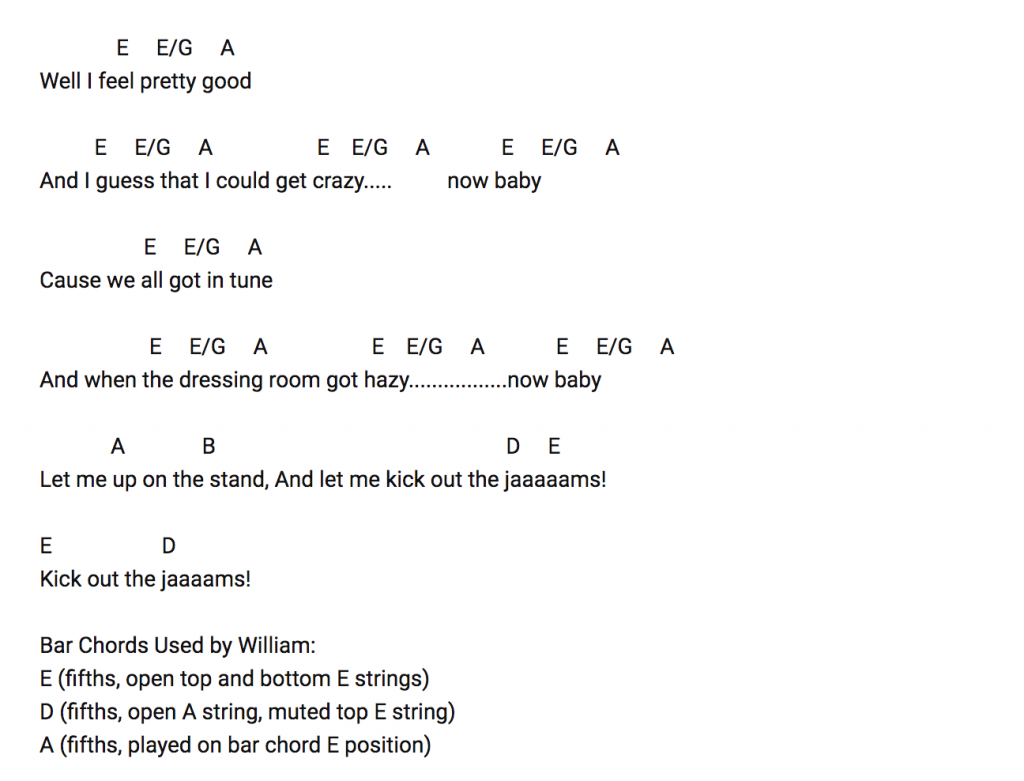
Then occasionally you run into videos like this–a tutorial straight from the artist him or herself. Above, Wayne Kramer, co-founder of Detroit’s ur-punk band, the MC5, sets the record straight and shows you the authentic way to play the 1969 anthem, “Kick Out the Jams.” “There are guys out there trying to show you how to play ‘Kick Out the Jams,’ and they’re all getting it wrong,” says Kramer. “They’re all messing it up. None of them are doing it right, and I’ve had enough.” So here is the “the proper, correct and official way” to play it. Let the lesson begin.
For good measure, he includes the lyrics and chords in the YouTube blurb:
You can find more lessons from Professor Kramer here.
This fall, Kramer will be launching a 50th anniversary MC5 tour and also releasing a memoir entitled The Hard Stuff: Dope, Crime, the MC5, and My Life of Impossibilities. You can pre-order it now.
For a very different set of guitar lessons, see: James Taylor Teaches You to Play “Carolina in My Mind,” “Fire and Rain” & Other Classics on the Guitar.
Related Content:
Pete Seeger Teaches You How to Play Guitar for Free in The Folksinger’s Guitar Guide (1955)
Read More...Support Us
We're hoping to rely on loyal readers, rather than erratic ads. Please click the Donate button and support Open Culture. You can use Paypal, Venmo, Patreon, even Crypto! We thank you!

About Us

Open Culture scours the web for the best educational media. We find the free courses and audio books you need, the language lessons & educational videos you want, and plenty of enlightenment in between.
Advertise With Us

FREE UPDATES!
GET OUR DAILY EMAIL
Get the best cultural and educational resources on the web curated for you in a daily email. We never spam. Unsubscribe at any time.
FOLLOW ON SOCIAL MEDIA

Open Culture editor Dan Colman scours the web for the best educational media. He finds the free courses and audio books you need, the language lessons & movies you want, and plenty of enlightenment in between.
Advertise With Us