The Improbable Time When Orson Welles Interviewed Andy Kaufman (1982)
“Sitcoms are the lowest form of entertainment,” declares Andy Kaufman as portrayed by Jim Carrey in Milos Forman’s biopic Man on the Moon. “I mean, it’s just stupid jokes and canned laughter.” The scene comes in the period of Kaufman’s life in the late 1970s when, growing ever more well-known on the back of acts like his “Foreign Man” character, he receives an offer to take part in ABC’s Taxi. The real-life Kaufman, eventually convinced to join the show’s cast, developed the Foreign Man into the unplaceable mechanic Latka Gavras. Quite possibly Taxi’s most memorable character, Latka also won the appreciation of no less demanding a cultural figure than Orson Welles.
Guest-hosting the Merv Griffin Show in June of 1982, Welles describes Taxi as a show that has “kept television from being a criminal felony” just before bringing Kaufman on for a brief (and uncharacteristically straightforward) chat. He heaps praise on Kaufman’s performance as Latka, adding, “I want to know why it is that you go and wrestle with people when you can act so well.” Kaufman had shown up wearing a neck brace, an accessory signifying the end of his stint as a professional wrestler, one of the many inexplicable but somehow compelling choices in a short career that blurred the lines between comedy, performance art, and life itself.
“Nobody ever came from nowhere more completely,” Welles says, drawing a big studio-audience laugh with this description of not just Latka but Kaufman as well. Asked how he came up with such a distinctive character voice, Kaufman says only that he “grew up in New York, and you hear a lot of different voices in New York” (“You don’t hear that one,” replies Welles). He also cites the accents of a high-school friend from South America and a college roommate from Iran. Less than four years later, both Kaufman and Welles would be gone (and actor Ron Glass, looking on from the other side of the couch, joined them this past November).
Or at least both men would be gone if you don’t credit the rumors about Kaufman having elaborately faked his death. “I don’t know whether it’s the innocence of the fellow or the feeling you have that he is not stupider than everybody, but maybe smarter, that adds to the fascination,” Welles says. Again he speaks ostensibly of Kaufman’s Foreign Man/Latka persona, but his words apply equally to the man who not just played but periodically — and sometimes unpredictably — became him. 33 years after Kaufman’s death, or in any case disappearance from life, that fascination remains as strong as ever.
Related Content:
A Look Back at Andy Kaufman: Absurd Comic Performance Artist and Endearing Weirdo
Orson Welles’ Last Interview and Final Moments Captured on Film
Based in Seoul, Colin Marshall writes and broadcasts on cities and culture. His projects include the book The Stateless City: a Walk through 21st-Century Los Angeles and the video series The City in Cinema. Follow him on Twitter at @colinmarshall or on Facebook.
Read More...Andy Warhol’s 15 Minutes: Discover the Postmodern MTV Variety Show That Made Warhol a Star in the Television Age (1985–87)
“In the future, everyone will be world-famous for 15 minutes,” said Andy Warhol. Actually, no, he didn’t. But Warhol suggested to photographer Nat Finkelstein that everyone wanted to be famous, to which Finkelstein added, “yeah, for 15 minutes.” It’s a slightly different meaning. (The idea first appeared in its well-known form in a 1968 program for a Warhol exhibition in Sweden.)
Is it true that everyone wants to be famous? It’s certainly true that Andy Warhol wanted to, and for much longer than 15 minutes. Like the hardest-working YouTube celebrity today, he didn’t wait to be discovered but set about making it happen himself.
But while he achieved pop art stardom in the 60s, Warhol truly longed to be on TV, a dream that took a little longer to materialize. His first program, a New York public-access interview show, debuted in 1979, then a second version in 1980 (see Richard Berlin interview Frank Zappa on Andy Warhol’s T.V. in 1983). Over a period of four years, he brought on a host of major celebrities, but attracted a necessarily limited audience.
In ’81, Warhol finally got a mainstream TV break when he “made his way to NBC,” notes Alexxa Gotthardt, “with a series of spots for Saturday Night Live…. Warhol’s foray into television allowed him to become even more of a celebrity himself.” His persistent efforts paid dividends when he joined the nascent 1985 MTV lineup with one of its first non-music-video shows, Andy Warhol’s Fifteen Minutes.
As you can see in the promo at the top of the post, the show promised a “ride downtown” and a “ride to the wild side.” It did not disappoint. A sort of postmodern variety show, the program “put everybody together,” explains Andy Warhol Museum curator Geralyn Huxley, “The high and the low. The rich and the famous. The struggling artists and the rising stars.” Just above, you can see Ian McKellen recite Shakespeare while garage rockers the Fleshtones play some psychedelic grooves behind him.
Above, see Debbie Harry interview Courtney Love, “a flamboyant rising star,” just come from the success of Sid and Nancy. Further down, the Ramones bitch about the state of rock and roll in 1987, then play “Bonzo Goes to Bitburg,” a scathing response to Ronald Reagan’s disturbing visit to Germany on the 40th anniversary of V‑E Day. (The song contains the line, “You’re a politician don’t become one of Hitler’s children.”) These are but a tiny sampling of the many hundreds of artists who traipsed through the soundstage of Warhol’s show: dozens of people appeared in a single episode—as many as 30 guests in some of the later shows.
Running for two years, until his death in 1987, Andy Warhol’s Fifteen Minutes introduced millions of people to the artist in just the way he’d always wanted. “More and more kids were watching MTV,” says his producer Vincent Fremont. “I don’t know if they knew that Andy was a famous artist, but to them he was certainly a television personality.” And on TV, Warhol wrote in 1975, a person “has all the space anyone could ever want, right there in the television box.” If you’re Andy Warhol, you also have all the celebrity guests anyone could ever want.
See a complete list of the five episodes that aired between 1985 and 1987—full of stars, rising stars, and scores of fascinating unknowns—at Warholstars.org.
Related Content:
Andy Warhol’s Brief Moment of Professional Wrestling Fame (1985)
The Case for Andy Warhol in Three Minutes
The Big Ideas Behind Andy Warhol’s Art, and How They Can Help Us Build a Better World
Josh Jones is a writer and musician based in Durham, NC. Follow him at @jdmagness
Read More...What Is a Life-Changing Realization You Wish You’d Had Sooner in Life?
The calendar date may be arbitrary, a quirk of history that could have been otherwise—but it’s no coincidence, I think, that New Year’s produces a reflective mood, a time of looking both backward and forward, especially in those parts of the world currently held in winter’s chill and dark, awaiting the thaw of spring. The turn of the Gregorian calendar seems to beg us to produce some sober wisdom amidst the revelry of the holidays: to account for what we’ve learned, ruminate on intentions, take general stock of our personal stores.
It’s also a time when we connect with our younger selves (many of us having just spent a few days visiting parents, hometowns, and childhood bedrooms). Those younger selves can seem callow and naïve in hindsight, and though it’s hardly any use living with regret, we might wish with some degree of rue that we could have handled some things better—and applied the hard-won realizations of the present much earlier. It’s a common enough sentiment, handled perfectly in The Faces’ “Ooh La La.”
I wish, for example, that I had learned how to meditate years before I did. It might have saved my young, moody, impulsive self a world a grief. (But then again, without that grief, would I have ever learned to meditate?) Recently, a MetaFilter user revisited a post from 2013 that asked the question (“What is a life changing realization that you wish you’d had sooner?”) to the internet community at large. The responses ranged from the fairly generic (“it’s okay if you don’t want to be friends with your exes”) to the personal, specific, and colorful. See a sampling of the answers below from both the original 2013 thread and the recent 2017 repost:
Love leaves scars. And that’s a good thing. We want to be permanently affected by the ones that we love. Otherwise, it’s not really love. And like any other scar, it begins as a painful wound, goes through the period of laudable pus during which you drain out all the bad stuff, and then, eventually, heals to a painless but visible scar.
This seems kinda silly, but a couple of years ago I realized that I am under no obligation to finish a book that I don’t like. As a reader, that was such an epiphany!
The most important and dangerous tool in the lives of average people is compound interest.
Behaviour is driven by emotion, not rational thought: instead of trying to force myself to do things by berating myself, I get my emotions in order first by synthesising the feeling of having already done it. My procrastination has been radically reduced, and I’m freer to get on and do the things I need to do.
Take other people’s head injuries seriously. Someone who’s just had a blow to the brain is not qualified to judge whether it is “no big deal.”
Honor the parts of yourself that are elusive and mysterious and maybe unintelligible to other people. Whether that means embracing an identity like “queer nonbinary trans woman” or becoming more comfortable with crying and not knowing why or not having opinions and answers at hand… Practice not knowing.
I’m partial to these offerings because I find them moving, funny, or conversant with whatever meager wisdom I like to think I’ve acquired after much trial and error. But what about you? As 2017 winds to a close—a year fraught with more stress and anxiety than most—which answers leap out to you? Or, if you’re brave and feel like sharing, what would you like to pass on to your younger, more bumbling self if you could go back and have a sit-down with him or her? Please pass along your thoughts and wisdom in the comments below.
via MetaFilter
Related Content:
Josh Jones is a writer and musician based in Durham, NC. Follow him at @jdmagness
Read More...Mark Twain on Why “Travel is Fatal to Prejudice, Bigotry and Narrow-Mindedness, and Many of Our People Need It Sorely on These Accounts” (1869)
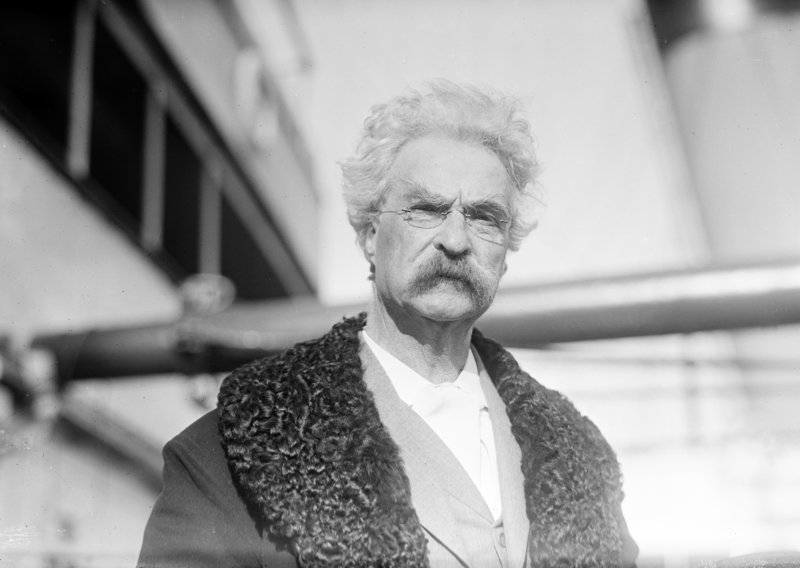
Public Domain image via Wikimedia Commons
Humanity has come up with many negative stereotypes of Americans, some of them not entirely groundless: the widely held belief, for example, that Americans don’t get out much. I admit the truth of that one as an American myself — albeit an American who now lives in Asia — because I certainly did drag my feet on getting a passport and getting out there in the world at first. Perhaps I can take comfort in the fact that no less a colossus of American letters began his international travels even later than I did, though when he did get around to it, he got even more out of it: not only The Innocents Abroad, one of the best-loved travel books of all time, but an insight into what makes travel so vital a pursuit in the first place.
The travels Mark Twain recounts in the book began in 1867 on the chartered vessel Quaker City, which took him and a group of his countrymen through Europe and the Holy Land, an itinerary including a stop at the 1867 Paris Exhibition and journeys through the Papal States to Rome and through the Black Sea to Odessa, all followable on a hypertext map at the University of Virginia’s Mark Twain in His Times page. “In his account Mark Twain assumes two alternate roles,” says the Library of America, “at times the no-nonsense American who refuses to automatically venerate the famous sights of the Old World (preferring Lake Tahoe to Lake Como), or at times the put-upon simpleton, a gullible victim of flatterers and ‘frauds,’ and an awe-struck admirer of Russian royalty.”
Whether you read The Innocents Abroad in the Library of America’s edition or in one of a variety of free formats downloadable from Project Gutenberg, you’ll eventually come to Twain’s justification for the entire project: not the writing project with its handsome remuneration and name-making popularity, but the project of travel itself. Though many elements of the Old World experience, as well as prolonged exposure to his fellow Americans, put his formidable complaining ability to the test, the “breezy, shrewd, and comical manipulator of English idioms and America’s mythologies about itself and its relation to the past” (as the Library of America describes him) ultimately admits that
I have no fault to find with the manner in which our excursion was conducted. Its programme was faithfully carried out—a thing which surprised me, for great enterprises usually promise vastly more than they perform. It would be well if such an excursion could be gotten up every year and the system regularly inaugurated. Travel is fatal to prejudice, bigotry and narrow-mindedness, and many of our people need it sorely on these accounts. Broad, wholesome, charitable views of men and things can not be acquired by vegetating in one little corner of the earth all one’s lifetime.
Distinctly Twainian words, of course, but many other writers have since also tried to express the uniquely mind-expanding properties of spending time outside your homeland. As Rudyard Kipling memorably put it to his own countrymen, a few decades after The Innocents Abroad, in “The English Flag,” “What should they know of England who only England know?”
Or as one writer friend of mine, well-known for the globalized nature of his books and well as of his own identity, once said, “If Americans don’t travel, we’re like a man who lives in a hovel assuming everyone else lives in a worse hovel.” But it always comes back to Twain, who knew that “nothing so liberalizes a man and expands the kindly instincts that nature put in him as travel and contact with many kinds of people” — and who also knew that nobody quite realized “what a consummate ass he can become until he goes abroad.” We can all think of much worse reasons to head across the ocean than that.
Related Content:
Mark Twain Makes a List of 60 American Comfort Foods He Missed While Traveling Abroad (1880)
A Journey Back in Time: Vintage Travelogues
Free: Read 9 Travel Books Online by Monty Python’s Michael Palin
Petite Planète: Discover Chris Marker’s Influential 1950s Travel Photobook Series
Join Clive James on His Classic Television Trips to Paris, LA, Tokyo, Rio, Cairo & Beyond
Based in Seoul, Colin Marshall writes and broadcasts on cities and culture. His projects include the book The Stateless City: a Walk through 21st-Century Los Angeles and the video series The City in Cinema. Follow him on Twitter at @colinmarshall or on Facebook.
Read More...Why Should We Read Charles Dickens? A TED-Ed Animation Makes the Case
You can’t go near the literary press lately without hearing mention of Nathan Hill’s sprawling new novel, The Nix, widely praised as a comic epic on par with David Foster Wallace’s Infinite Jest. Novelist John Irving, to whom Hill has drawn comparisons, goes so far as to compare the novelist to Charles Dickens. Such praise goes too far, if you ask Current Affairs editor Brianna Rennix. In a caustic review essay, Rennix unfavorably measures not only The Nix, but also the postmodern novels of Wallace, Pynchon, McCarthy, Franzen, and DeLillo, against the baggy Victorian serialized works of writers like Dickens and George Eliot. “Books like Middlemarch,” she writes, “took seriously the idea that novels had the power to transform human life, not merely—as seems to be the goal of a lot of postmodern novels—to riff off its foibles for the purpose of making the author look clever.”
It’s possible to appreciate Rennix’s essay as a reader of more ecumenical tastes—as someone who happens to enjoy Dickens and Eliot and all the authors she dismisses. There’s much more to the postmodern novel than she allows, but there are also very good reasons particular to our age for us turn, or return, to Dickens.
In the TED-Ed video above, scripted by literary scholar Iseult Gillespie (who previously made a case for Virginia Woolf), we get some of them. For all the fun he had with human foibles, Dickens was also a social realist, the greatest influence on later literary naturalism, who “shed light on how his society’s most invisible people lived.” Unlike many novelists, in his own time and ours, Dickens had the personal experience of living in such conditions to draw on for his authentic portrayals.
Nonetheless, Dickens’ did not allow his enormous popular success to blunt his compassion and concern for the plight of working people and the poor and socially marginalized. The engrossing, highly entertaining plots and characters in his novels are always pressed into service. We might call his motives political, but the term is too often pejorative. The “Dickensian” mode is a humanist one. Dickens’ did not push specific ideological agendas; he tried, as Alain de Botton says in his introductory video above, “to get us interested in some pretty serious things: the evils of an industrializing society, the working conditions in factories, child labor, vicious social snobbery, the maddening inefficiencies of government bureaucracy.” He tried, in other words, to move his readers to care about the people around them. What they chose to do with that care was, of course, then, as now, up to them.
Related Content:
An Animated Introduction to Charles Dickens’ Life & Literary Works
Why Should We Read Virginia Woolf? A TED-Ed Animation Makes the Case
Josh Jones is a writer and musician based in Durham, NC. Follow him at @jdmagness
Read More...How Fleetwood Mac Makes A Song: A Video Essay Exploring the “Sonic Paintings” on the Classic Album, Rumours
Pretty much everyone with a passing familiarity with Fleetwood Mac knows at least a little something about the personal tumult behind their landmark 1977 album Rumours: it’s one of rock’s most famous soap operas,” writes Jordan Runtagh at Rolling Stone. Christine McVie put it even more succinctly— “Drama. Dra-ma.”
But isn’t this how great songs get written, as we find out when we read the autobiographies and interviews of great songwriters, who sublimate their personal ups and downs in lyrics that touch the emotional lives of millions? The saga of Fleetwood Mac just happens to be a particularly juicy example, given that the band members’ romantic anguish mostly came from failed relationships with each other.
The tale will forever be a cautionary one for musicians, though it’s hardly much of a deterrent. Just listen to those songs! But as Evan Puschak—otherwise known as video essayist the Nerdwriter—shows above, it takes a lot more than a bad breakup with the guitar player to make timeless pop art. Rumours “feels alive, months and years and decades after its creation.” It’s so much more than the sum of its parts, even if those parts are rare and indispensable: the considerable musicianship on display, the songwriting experience, and especially the “virtually unlimited budget and time” Warner Brothers allotted the band.
Such extravagance is virtually impossible for anyone else to come by. Still, noodling indefinitely with fancy instruments and equipment does not a great album make. Puschak takes Stevie Nicks’ “Dreams” as an example of how the band excelled in the studio. Written “in about 10 minutes,” as Nicks tells it, while she sat in a “big black-velvet bed with Victorian drapes” in a studio belonging to Sly Stone, the song’s studio version shows off the lush, layered production the band spent the better part of a year bringing to her two-chord demo.
“Dreams”—one of the most mesmerizing songs in the band’s canon—acquired its hypnotic qualities through the use of a looped drum pattern, pulsing, repetitive bassline, and the subtle coloration of guitar textures that give the deceptively simple song its ebb and flow.
The story of Rumours is as much about fantastic songcraft, musicianship, arranging, and production as it is about triumph over the human resources nightmare behind the scenes. The personal inspiration for these songs makes for good gossip, but these are not life events anyone needs to emulate to make art. Fleetwood Mac’s collective inventiveness, emotional honesty, and skill are what ultimately make them such an inspiration to musicians, and creative types in general. For another example of how they built the architectural marvels on Rumours, see the short take above from Polyphonic about the album’s moodiest song, “The Chain.”
Related Content:
Watch Documentaries on the Making of Pink Floyd’s Dark Side of the Moon and Wish You Were Here
Josh Jones is a writer and musician based in Durham, NC. Follow him at @jdmagness
Read More...Advanced Algorithms: A Free Course from Harvard University
From Harvard professor Jelani Nelson comes “Advanced Algorithms,” a course intended for graduate students and advanced undergraduate students. All 25 lectures you can find on Youtube here.
Here’s a quick course description:
“An algorithm is a well-defined procedure for carrying out some computational task. Typically the task is given, and the job of the algorithmist is to find such a procedure which is efficient, for example in terms of processing time and/or memory consumption. CS 224 is an advanced course in algorithm design, and topics we will cover include the word RAM model, data structures, amortization, online algorithms, linear programming, semidefinite programming, approximation algorithms, hashing, randomized algorithms, fast exponential time algorithms, graph algorithms, and computational geometry”
“Advanced Algorithms” will be added to our collection of Free Computer Science Courses, a subset of our collection, 1,700 Free Online Courses from Top Universities.
Related Content:
Learn Digital Photography with Harvard University’s Free Online Course
Learn to Code with Harvard’s Popular Intro to Computer Science Course: The 2016 Edition
Algorithms for Big Data: A Free Course from Harvard
Read More...Stream a Playlist of 79 Punk Rock Christmas Songs: The Ramones, The Damned, Bad Religion & More
There’s a war on Christmas, don’t you know. The attacks are relentless—at every shopping mall, drugstore, grocery, family dinner, badly-lit office party. It is the scourge of bland Christmas music, and it can absolutely ruin your holiday. There you are, merrily shopping for the perfect gift or the perfect ham, and, wham! The most dispiriting version of “Little Drummer Boy” you’ve ever heard in your life. You feel sick, depressed, deranged. Is this some kind of sonic weapon? Or do you respect the season too much to let it be demeaned by mediocrity?
Fight back, my friend, with the playlist below. Keep your Christmas cheer—if that’s your bag. The discriminating Yuletide celebrant must guard their ears zealously, lest some undead zombie travesty of a “White Christmas” (or worse yet, “Blue Christmas”) does them in. Opt instead for the simple celebration of the Ramones’ “Merry Christmas (I Don’t Want to Fight Tonight).” Listen to the Damned. You don’t have to believe in Santa Claus, but you know “There Ain’t No Sanity Clause.”
The Vandals keep it moving with “My First X‑Mas (As A Woman),” a straight-ahead burst of positivity, empowerment, and coming out as trans to the family. They return later with “Grandpa’s Last X‑Mas,” an honest reckoning with mortality during the season. Check out the earnest rendition of “O Come All Ye Faithful” from Bad Religion, who clearly adore the song enough to really do it justice, even if many of their usual lyrics can be summed up by swapping the words in their name. (They put out a whole album of respectful Christmas tunes. “Anyone expecting some sort of subversion of the holiday classics,” notes Apple Music, “will be disappointed.”)
As this playlist shows, punk rock has always had a special relationship with Christmas. But if you think about it, so have many indie, fringe, and avant-garde movements. John Waters believes the “whole purpose of life is Christmas.” Andy Warhol “really, really loved Christmas,” and made several Christmas-themed artworks. And in 1977, the Sex Pistols played their last UK gig, a Christmas benefit for an audience of seven and eight year olds. Johnny Rotten remembered it later as “one of the highlights of mine and Sid’s career.”
Fantastic. The ultimate reward. One of my all-time favourite gigs. Young kids, and we’re doing Bodies and they’re bursting out with laughter on the ‘f*ck this f*ck that’ verse. The correct response: not the shock horror ‘How dare you?’
The kids get it, why can’t we? Christmas is a fine time for irreverence, camp, crude humor, booze, and candor. It is also a time for the heartfelt appreciation most punks seem to feel for the holiday of light shows and inflatable reindeer, of a crackling fire on TV and a place that does delivery. Santa Claus, the Holy Baby, and Gremlins. Stuck with relatives who can’t get the spirit of giving? Put on “Bloody Unholy Christmas,” “I’ve Got a Boner for Christmas,” and “Credit Crunch Christmas,” and turn them all the way up. And have a very Merry Christmas and Happy Holidays.
Related Content:
John Waters Makes Handmade Christmas Cards, Says the “Whole Purpose of Life is Christmas”
Josh Jones is a writer and musician based in Durham, NC. Follow him at @jdmagness
Read More...An Innocent Christmas Typo Causes Sir Patrick Stewart to Star as Satan In This Animated Holiday Short
In certain sectors, over-the-top ad agency greetings are as much a part of the holiday season as A Christmas Carol and How the Grinch Stole Christmas!.
Anomaly London put in their thumb and pulled out a plum when Sir Patrick Stewart agreed to voice their latest effort, above.
And what better way to top his celebrated turn as Ebeneezer Scrooge than by tackling the most Christmas‑y role of them all?
Santa, is that you?
No, dear child, ’tis Satan, summoned by an innocent mis-spelling on the part of a young girl eager for a Christmas puppy.
When the post office delivers her similarly misaddressed envelope to hell by December 25, the buff and tattooed Lord of Darkness’ heart grows three sizes. Everyone likes to be told they’re special.
Next thing you know, he’s traded the fiery furnace for a gluten-free bakery in Shoreditch, where he’s a happy team player, making latte art and wearing a goofy cap.
The ending is a sweet mix of “I hate you, you ruined Christmas, go to hell!” and “God bless us everyone.” Santa doesn’t survive, but the childlike capacity for wonder does.
Those with sensitive stomachs may want to go easy on the eggnog while watching this soon-to-be-holiday classic. The projectile vomiting rivals the Exorcist’s.
And happy holidays from all of us at Open Culture!
Related Content:
Hear Paul McCartney’s Experimental Christmas Mixtape: A Rare & Forgotten Recording from 1965
Sir Patrick Stewart & Sir Ian McKellen Play The Newlywed Game
Ayun Halliday is an author, illustrator, theater maker and Chief Primatologist of the East Village Inky zine. Follow her @AyunHalliday.
Read More...Watch Santa Claus, the Earliest Movie About Santa in Existence (1898)
Santa Claus Is Comin’ to Town, The Santa Clause, Santa Claus: the Movie, Bad Santa, the unforgettable Santa Claus Conquers the Martians: we all have a preferred depiction of Saint Nicholas on film, the selection of which grows larger each and every Christmas. The tradition of Santa in cinema goes back 120 years to a couple of obscure 1897 shorts, Santa Claus Filling Stockings and The Christmas Tree Party, made by a company called American Mutoscope, but it finds its fullest early expression in the following year’s Santa Claus.
Directed by hypnotist and magic lanternist turned filmmaker George Albert Smith, this 66-second production, though a highly elaborate one for the time, purports to show just how Santa Claus makes a visit to drop off gifts for a couple of sleeping children. When their nanny turns off the lights for the night, we see superimposed on their darkened wall a vision of the jolly old elf himself landing on the roof and clambering down the chimney.
“What makes this treatment considerably more interesting than a conventional piece of editing,” writes the British Film Institute’s Michael Brooke, “is the way that Smith links the shots in terms of both space and time, by placing the new image over the space previously occupied by the fireplace, and continuing to show the children sleeping throughout.”
Brooke calls that effect “cinema’s earliest known example of parallel action and, when coupled with double-exposure techniques” that Smith had developed for his previous films, it makes Santa Claus “one of the most visually and conceptually sophisticated British films made up to then.” He notes also that Smith corresponded with Georges Méliès, his fellow pioneer of not just special effects but cinema itself, around the time of this film, no surprise since “the two men shared a common goal in terms of creating an authentic cinema of illusion.”
Watch Santa Claus on this Christmas Day, and you’ll find that, in the words of Kieron Casey at The Totality, “the plot is simple, but the magic is not — viewed over 100 years later, it’s impossible not to be touched to the very core with the wonder on display in the film. In the same way young hands will find the most simple of toys mesmerising when touched for the first time, there is a real innocence and enthusiasm in G.A. Smith’s film – it’s a short movie which is full of imagination and discovery, the type of which will never again be experienced in cinema.” But seeing as Santa Claus existed long before cinema and will exist long after it, rest assured that he’ll bring his trademark twinkle to any storytelling medium humanity comes up with next.
Santa Claus will be added to our list of Classic Silent Films, a subset of our collection 4,000+ Free Movies Online: Great Classics, Indies, Noir, Westerns, Documentaries & More.
Related Content:
A Christmas Carol Presented in a Thomas Edison Film (1910)
Captivating GIFs Reveal the Magical Special Effects in Classic Silent Films
A Trip to the Moon (and Five Other Free Films) by Georges Méliès, the Father of Special Effects
Watch the Films of the Lumière Brothers & the Birth of Cinema (1895)
1,150 Free Movies Online: Great Classics, Indies, Noir, Westerns, etc.
Based in Seoul, Colin Marshall writes and broadcasts on cities and culture. His projects include the book The Stateless City: a Walk through 21st-Century Los Angeles and the video series The City in Cinema. Follow him on Twitter at @colinmarshall or on Facebook.
Read More...Support Us
We're hoping to rely on loyal readers, rather than erratic ads. Please click the Donate button and support Open Culture. You can use Paypal, Venmo, Patreon, even Crypto! We thank you!

About Us

Open Culture scours the web for the best educational media. We find the free courses and audio books you need, the language lessons & educational videos you want, and plenty of enlightenment in between.
Advertise With Us

FREE UPDATES!
GET OUR DAILY EMAIL
Get the best cultural and educational resources on the web curated for you in a daily email. We never spam. Unsubscribe at any time.
FOLLOW ON SOCIAL MEDIA

Open Culture editor Dan Colman scours the web for the best educational media. He finds the free courses and audio books you need, the language lessons & movies you want, and plenty of enlightenment in between.
Advertise With Us


