Did Santa Claus & His Reindeers Begin with a Mushroom Trip?: Discover the Psychedelic, Shamanistic Side of Christmas
Just when you thought you had Christmas all figured out, Matthew Salton comes along with this new animated short, “Santa Is a Psychedelic Mushroom.” It makes the case that maybe, just maybe, “the story of our modern Santa Claus, the omnipotent man who travels the globe in one night, bearing gifts, and who’s camped out in shopping malls across the United States, is linked to a hallucinogenic mushroom-eating shaman from the Arctic.” Specifically a historic Shaman from Lapland, in northern Finland, who tripped out on Amanita muscaria, the toxic, red-and-white toadstool mushroom you’ve seen in fairy tales so many times before. Elaborating, Salton talks with Carl Ruck, a Boston University professor who studies mythology, religion and the sacred role of psychoactive plants. And also Lawrence Millman. Writing at The New York Times, Salton adds:
According to the writer and mycologist Lawrence Millman, the shaman would make use of Amanita muscaria’s psychoactive effects in order to perform healing rituals. The use of Amanita muscaria as an entheogen (that is, a drug used to bring about a spiritual experience) would enable the shamans to act as intermediaries between the spirit and human world, bringing gifts of healing and problem-solving. (Although these mushrooms are poisonous, the Sami reduced their toxicity by drying them..) Various accounts describe the shaman and the rituals performed in ways that are fascinatingly similar to the narrative of Santa. An all-knowing man who defies space and time? Flying reindeer? Reindeer-drawn sleds? Climbing down the chimney? The giving of gifts? The tales of the Sami shamans have it all.
To learn more about the psychedelic origins of Santa, you can read this 2010 article published at NPR, “Did ‘Shrooms Send Santa And His Reindeer Flying?”
If you would like to support the mission of Open Culture, consider making a donation to our site. It’s hard to rely 100% on ads, and your contributions will help us continue providing the best free cultural and educational materials to learners everywhere. You can contribute through PayPal, Patreon, and Venmo (@openculture). Thanks!
Related Content:
Artist Draws Nine Portraits on LSD During 1950s Research Experiment
Aldous Huxley, Dying of Cancer, Left This World Tripping on LSD (1963)
Read More...David Bowie & Bing Crosby Sing “The Little Drummer Boy/Peace on Earth” (1977)
We like to bring this chestnut back from time to time. Watch it, and you’ll know why.
In 1977, just a short month before Bing Crosby died of a heart attack, the 40s crooner hosted David Bowie, the glam rocker, on his Christmas show. The awkwardness of the meeting is palpable. An older, crusty Crosby had no real familiarity with the younger, androgynous Bowie, and Bowie wasn’t crazy about singing The Little Drummer Boy. So, shortly before the show’s taping, a team of writers had to frantically retool the song, blending the traditional Christmas song with a newly-written tune called Peace on Earth. (You can watch the writers tell the story, years later, below.)
After one hour of rehearsal, the two singers recorded The Little Drummer Boy/Peace on Earth and made a little classic. The Washington Post has the backstory on the strange Bing-Bowie meeting. Also find a Will Ferrell parody of the meeting here. We hope you enjoy revisiting this clip with us. Happy holidays to you all.
If you would like to support the mission of Open Culture, consider making a donation to our site. It’s hard to rely 100% on ads, and your contributions will help us continue providing the best free cultural and educational materials to learners everywhere. You can contribute through PayPal, Patreon, and Venmo (@openculture). Thanks!
Related Content:
David Bowie’s Fashionable Mug Shot From His 1976 Marijuana Bust
How Leonard Cohen & David Bowie Faced Death Through Their Art: A Look at Their Final Albums
Read More...Hear Kurt Cobain’s 50 Favorite Albums: A 38 Hour Playlist Featuring Lead Belly, David Bowie, Public Enemy, The Breeders & More
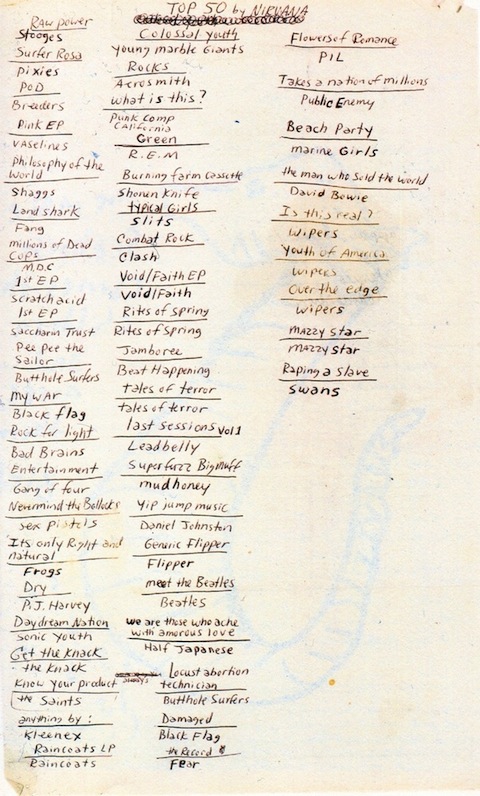
Several years ago, we featured a list Kurt Cobain made of his top 50 albums, which appeared in his journals, published in 2002. It’s mostly a typical list of standards one would find in any young punk’s record collection in the late 80s/90s. As we wrote then, his “‘Top 50 by Nirvana’… seems like the ideal code for producing a 90s alternative star.” But these sources were not widely accessible at the time. Cobain’s influence was such that he turned millions of people on to music they’d never heard before. That influence continues, of course, and you can partake of it yourself in the playlist below.
Amid the classic rock and classic punk—the Beatles, the Clash, the Sex Pistols—are a few slabs of classic DC hardcore, then and now pretty obscure. Dave Grohl—stalwart of the DC scene before Cobain recruited him to move across the country and join Nirvana—may have added these albums to the list, or Cobain might have done so himself. In any case, his mentions of them, and their posthumous appearance in his letters and notes, brought bands like long-defunct Faith and Void new recognition, as well as post-hardcore pioneers Rites of Spring, who helped inspire the emo and screamo to come, for better or worse.
Alongside Iggy Pop, Black Flag, and Bad Brains are lesser-known punk bands like the Raincoats, the Vaselines, and the Saints, playful lo-fi weirdos like Daniel Johnson, the Shaggs, and Half Japanese; the country blues of Lead Belly, caustic noise of Butthole Surfers, thunderous, punishing nihilism of Swans…. Cobain may have helped them all sell a few records, and he definitely inspired new bands that sound like them by turning people on to their music for the first time. (When Cobain covered David Bowie, however, fans started to mistake “The Man Who Sold the World” for a Nirvana song, to Bowie’s understandable consternation.)
Cobain’s list is limited to a fairly narrow range of styles, with some rare exceptions: Lead Belly, Public Enemy, Aerosmith (!)—it’s an almost purist punk and punk-derived palate, the DNA of Nirvana. In the age of the internet, one can cobble together a list like this—with no real prior knowledge—in an hour or so, simply by googling around and doing a bit of research. During Cobain’s formative years on the outskirts of Seattle, when a lot of this music circulated only on limited cassette runs and poorly recorded mixtapes and copies, on record labels financed by vegan bake sales and loans from the ‘rents—it could be very hard to come by.
While Cobain’s list may look, in hindsight, like standard fare to many longtime fans, what it represents for those who came of age musically in the years just before the Web is a physical journey through all of the relationships, concerts, and record shops one had to move through to discover the bands that spoke directly to you and your friends.
Related Content:
Kurt Cobain’s Home Demos: Early Versions of Nirvana Hits, and Never-Released Songs
Watch The Last 48 Hours of Kurt Cobain on the 20th Anniversary of the Musician’s Suicide
Josh Jones is a writer and musician based in Durham, NC. Follow him at @jdmagness
Read More...Hear the Christmas Carols Made by Alan Turing’s Computer: Cutting-Edge Versions of “Jingle Bells” and “Good King Wenceslas” (1951)
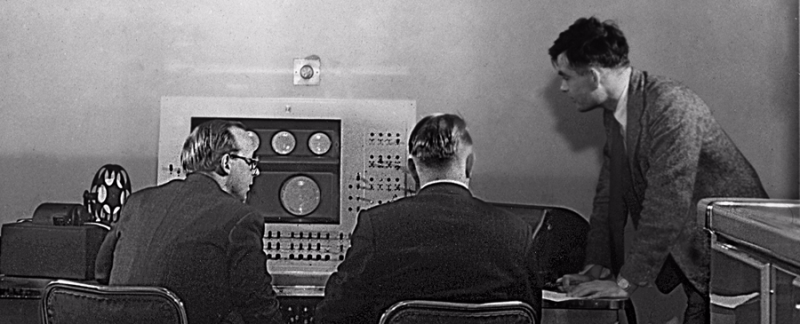
This Christmas, as our computers fast learn to compose music by themselves, we might gain some perspective by casting our minds back to 66 Christmases ago, a time when a computer’s rendition of anything resembling music at all had thousands and thousands listening in wonder. In December of 1951, the BBC’s holiday broadcast, in most respects a naturally traditional affair, included the sound of the future: a couple of much-loved Christmas carols performed not by a choir, nor by human beings of any kind, but by an electronic machine the likes of which almost nobody had even laid eyes upon.
“Among its Christmas fare the BBC broadcast two melodies that, although instantly recognizable, sounded like nothing else on earth,” write Jack Copeland and Jason Long at the British Library’s Sound and Vision Blog. “They were Jingle Bells and Good King Wenceslas, played by the mammoth Ferranti Mark I computer that stood in Alan Turing’s Computing Machine Laboratory” at the Victoria University of Manchester. Turing, whom we now recognize for a variety of achievements in computing, cryptography, and related fields (including cracking the German “Enigma code” during the Second World War), had joined the university in 1948.
That same year, with his former undergraduate colleague D. G. Champernowne, Turing began writing a purely theoretical computer chess program. No computer existed on which he could possibly try running it for the next few years until the Ferranti Mark 1 came along, and even that mammoth proved too slow. But it could, using a function designed to give auditory feedback to its operators, play music — of a kind, anyway. The computer company’s “marketing supremo,” according to Copeland and Long, called its brief Christmas concert “the most expensive and most elaborate method of playing a tune that has ever been devised.”
Since no recording of the broadcast survives, what you hear here is a painstaking reconstruction made from tapes of the computer’s even earlier renditions of “God Save the King,” “Baa Baa Black Sheep,” and “In the Mood.” By manually chopping up the audio, write Copeland and Long, “we created a palette of notes of various pitches and durations. These could then be rearranged to form new melodies. It was musical Lego.” But do “beware of occasional dud notes. Because the computer chugged along at a sedate 4 kilohertz or so, hitting the right frequency was not always possible.” Even so, somewhere in there I hear the historical and technological seeds of the much more elaborate electronic Christmas to come, from Mannheim Steamroller to the Jingle Cats and well beyond.
Related Content:
Hear Paul McCartney’s Experimental Christmas Mixtape: A Rare & Forgotten Recording from 1965
The Enigma Machine: How Alan Turing Helped Break the Unbreakable Nazi Code
Based in Seoul, Colin Marshall writes and broadcasts on cities and culture. His projects include the book The Stateless City: a Walk through 21st-Century Los Angeles and the video series The City in Cinema. Follow him on Twitter at @colinmarshall or on Facebook.
Read More...Eudora Welty’s Handwritten Eggnog Recipe, and Charles Dickens’ Recipe for Holiday Punch
’Tis the season to break out the family recipes of beloved relatives, though often their provenance is not quite what we think.
(Imagine the cognitive dissonance upon discovering that Mother swiped “her” Italian Zucchini Crescent Pie from Pillsbury Bake-Off winner, Millicent Nathan of Boca Raton, Florida…)
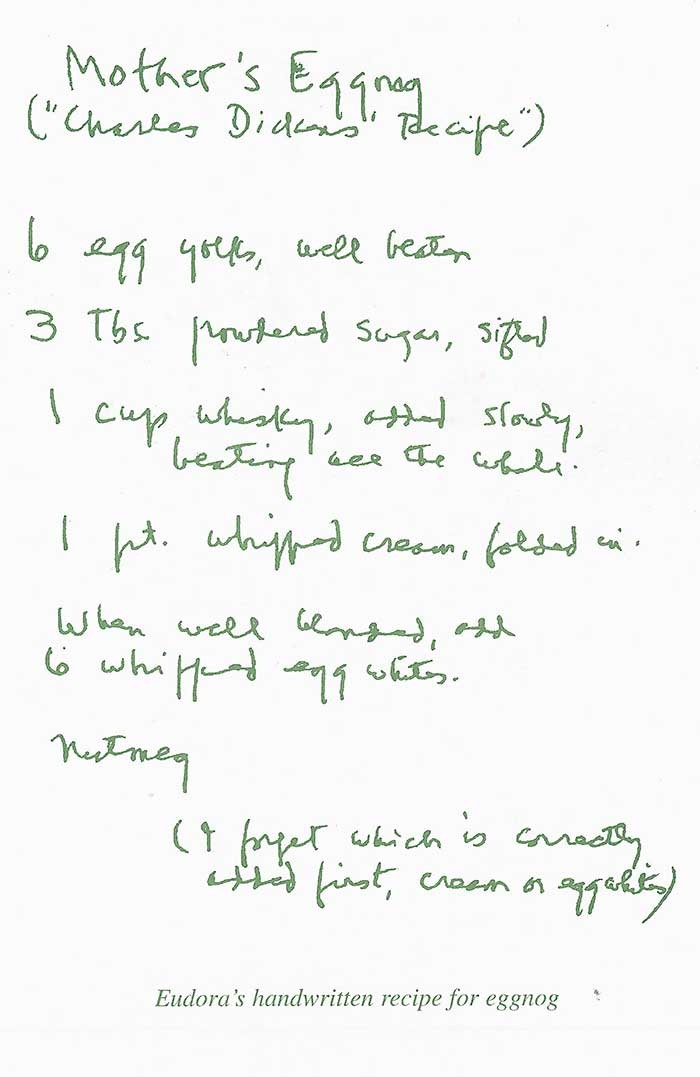
When it came to crediting the eggnog she dubbed “the taste of Christmas Day,” above, Pulitzer Prize-winning author Eudora Welty shared it out equally between her mother and author Charles Dickens:
In our house while I was growing up, I don’t remember that hard liquor was served at all except on one day in the year. Early on Christmas morning, we woke up to the sound of the eggbeater: Mother in the kitchen was whipping up eggnog. All in our bathrobes, we began our Christmas before breakfast. Throughout the day Mother made batches afresh. All our callers expected her eggnog.
It was ladled from the punch bowl into punch cups and silver goblets, and had to be eaten with a spoon. It stood up in peaks. It was rich, creamy and strong. Mother gave full credit for the recipe to Charles Dickens.
Nice, but perhaps Dickens is undeserving of this honor? The contents of his punchbowl bore little resemblance to Mother Welty’s, as evidenced by an 1847 letter to his childhood friend, Amelia Filloneau, in which he shared a recipe he promised would make her “a beautiful Punchmaker in more senses than one”:
Peel into a very strong common basin (which may be broken, in case of accident, without damage to the owner’s peace or pocket) the rinds of three lemons, cut very thin, and with as little as possible of the white coating between the peel and the fruit, attached. Add a double-handfull of lump sugar (good measure), a pint of good old rum, and a large wine-glass full of brandy — if it not be a large claret-glass, say two. Set this on fire, by filling a warm silver spoon with the spirit, lighting the contents at a wax taper, and pouring them gently in. Let it burn for three or four minutes at least, stirring it from time to Time. Then extinguish it by covering the basin with a tray, which will immediately put out the flame. Then squeeze in the juice of the three lemons, and add a quart of boiling water. Stir the whole well, cover it up for five minutes, and stir again.
This sounds very like the “seething bowls of punch” the jolly Ghost of Christmas Present shows Ebenezer Scrooge in A Christmas Carol, dimming the chamber with their delicious steam.
It’s also vegan, in contrast to what you might have been served in the Welty ladies’ home.
Why not serve both? In the words of Tiny Tim, “Here’s to us all!”
Eudora Welty’s Mother’s Eggnog (Attributed, Perhaps Erroneously, to Charles Dickens)
6 egg yolks, well beaten
Add 3 tbsp. powdered sugar
Add 1 cup whiskey, added slowly, beating all the while
Fold in 1 pint whipped cream
Whip 6 whipped egg whites and add to the mixture above.
Charles Dickens’ Holiday Punch (adapted from Punch by David Wondrich)
3/4 cup sugar
3 lemons
2 cups rum
1 1/4 cups cognac
5 cups black tea (or hot water)
Garnish: lemon and orange wheels, freshly grated nutmeg
In the basin of an enameled cast-iron pot or heatproof bowl, add sugar and the peels of three lemons.
Rub lemons and sugar together to release citrus oils. For more greater infusion, let sit for 30 minutes.
Add rum and cognac to the sugar and citrus.
Light a match, and, using a heatproof spoon (stainless steel is best), pick up a spoonful of the spirit mix.
Carefully bring the match to the spoon to light.
Carefully bring the lit spoon to the spirits in the bowl.
Let the spirits burn for about three minutes. The fire will melt the sugar and extract the oil from the lemon peels.
Extinguish the bowl by covering it with a heatproof pan or tray.
Skim off the lemon peels (leaving them too long in may impart a bitter flavor).
Squeeze in the juice of the three peeled lemons, and add hot tea or water.
If serving the punch hot, skip to the next step. If serving cold, cool punch in the refrigerator and, when cooled, add ice.
Garnish with citrus wheels and grated nutmeg.
Ladle into individual glasses.
Learn more about these and other festive holiday drinks in Master of Wine Elizabeth Gabay’s essay “Celebrating Christmas and New Year With Punch.”
Image above via Garden and Gun
Related Content:
Charles Mingus’ “Top Secret” Eggnog Recipe Contains “Enough Alcohol to Put Down an Elephant”
Blue Christmas: Feed Your Seasonal Depression with Holiday Masterpieces
Ayun Halliday is an author, illustrator, theater maker and Chief Primatologist of the East Village Inky zine. Follow her @AyunHalliday.
Read More...Need a Last Minute Gift? Give Online Courses Created by Cultural Icons Like Annie Leibovitz, Herbie Hancock, Werner Herzog and Many More

FYI: If you sign up for a MasterClass course by clicking on the affiliate links in this post, Open Culture will receive a small fee that helps support our operation.
If you’re looking for a last minute gift for a thoughtful person in your life, here’s one option to consider. MasterClass lets you electronically purchase online courses and give them as gifts to family members and friends. For $90, you could give the gift of a single course. (The recipient gets to choose which particular course they want to take.) Or, for $180, you can give the recipient a year-long pass to every course in the MasterClass catalogue. You can get started with the gift-giving process here. And find a list of available courses below.
- Annie Leibovitz Teaches Photography
- Gordon Ramsay Teaches Cooking
- Frank Gehry Teaches Architecture & Design
- Samuel Jackson Teaches Acting
- Judy Blume Teaches Writing
- Steve Martin Teaches Comedy
- Jane Goodall Teaches Conservation
- Herbie Hancock Teaches Jazz
- Garry Kasparov Teaches Chess
- Werner Herzog Teaches Filmmaking
- Aaron Sorkin Teaches Screenwriting
- David Mamet Teaches Dramatic Writing
- James Patterson Teaches Writing
- Hans Zimmer Teaches Film Scoring
- Thomas Keller Teaches Cooking Techniques
- Stephen Curry Teaches Shooting, Ball-Handling, Scoring
- Christina Aguilera Teaches Singing
- Deadmau5 Teaches Electronic Music Production
- Shonda Rhimes Teaches Writing for Television
- Marc Jacobs Teaches Fashion Design
- Usher Teaches the Art of Performance
- Serena Williams Teaches Tennis
- Reba McEntire Teaches Country Music
Note: MasterClasss and Open Culture have a partnership. If you sign up for a MasterClass course, it benefits not just you and MasterClass. It benefits Open Culture too. So consider it win-win-win.
If you would like to support the mission of Open Culture, consider making a donation to our site. It’s hard to rely 100% on ads, and your contributions will help us continue providing the best free cultural and educational materials to learners everywhere. You can contribute through PayPal, Patreon, and Venmo (@openculture). Thanks!
Read More...Algorithms for Big Data: A Free Course from Harvard
From Harvard professor Jelani Nelson comes “Algorithms for Big Data,” a course intended for graduate students and advanced undergraduate students. All 25 lectures you can find on Youtube here.
Here’s a quick course description:
“Big data is data so large that it does not fit in the main memory of a single machine, and the need to process big data by efficient algorithms arises in Internet search, network traffic monitoring, machine learning, scientific computing, signal processing, and several other areas. This course will cover mathematically rigorous models for developing such algorithms, as well as some provable limitations of algorithms operating in those models. Some topics we will cover include”:
- Sketching and Streaming. Extremely small-space data structures that can be updated on the fly in a fast-moving stream of input.
- Dimensionality reduction. General techniques and impossibility results for reducing data dimension while still preserving geometric structure.
- Numerical linear algebra. Algorithms for big matrices (e.g. a user/product rating matrix for Netflix or Amazon). Regression, low rank approximation, matrix completion, …
- Compressed sensing. Recovery of (approximately) sparse signals based on few linear measurements.
- External memory and cache-obliviousness. Algorithms and data structures minimizing I/Os for data not fitting on memory but fitting on disk. B‑trees, buffer trees, multiway mergesort.
“Algorithms for Big Data” will be added to our collection of Free Computer Science Courses, a subset of our collection, 1,700 Free Online Courses from Top Universities.
Related Content:
Learn Digital Photography with Harvard University’s Free Online Course
Learn to Code with Harvard’s Popular Intro to Computer Science Course: The 2016 Edition
Read More...How the Russian Theatre Director Constantin Stanislavski Revolutionized the Craft of Acting: A New Video Essay
From Travis Lee Ratcliff comes a video essay that explores the influence of Constantin Stanislavski, the Russian theatre director whose “system” of actor training shaped a generation of iconic American actors. Here’s how Ratcliff sets the stage for his video essay.
In the 1950s, a wave of “method actors” took Hollywood by storm.
Actors like James Dean, Marlon Brando, and Montgomery Clift, brought a whole new toolset and perspective on the actor’s craft to the films they performed in.
The foundation of their work, however, was laid in Russia more than fifty years prior to their stardom.
Stanislavski’s conception of “psychological realism” in performance challenged ideas about the essential features of the actor’s craft that had been held for centuries.
In theatre before Stanislavski, acting was defined as a craft of vocal and gestural training. The role the actor played was to give life to the emotions of the text in a broad illustrative fashion. Formal categories such as melodrama, opera, vaudeville, and musicals, all played to this notion of the actor as chief representer of dramatic ideas.
Stanislavski’s key insight was in seeing the actor as an experiencer of authentic emotional moments.
Suddenly the craft of performance could be about seeking out a genuine internal experience of the narrative’s emotional journey.
From this foundation, realism in performance began to flourish. This not only changed our fundamental idea of the actor but invited a reinvention of the whole endeavor of telling stories through drama.
Teachers would adopt Stanisvlaski’s methods and ideas and elaborate upon them in American theatre schools. The result, in the 1950s, would be a new wave of actors and a style of acting that emphasized psychological realism to a greater degree than their peers in motion pictures.
This idea of realism grew to dominate our notion of successful performances in cinema. Stanislavskian-realism is now central to the DNA of how we direct and read performances, whether we are conscious of it or not.
I think it is important to know this history and consider its revolutionary character. Understanding the nature of Stanislavski’s insights allows us to look at other unasked questions, other foundational elements of our craft that we might take for granted.
Beyond this, Ratliff also provides a list of Stanislavski’s books, which still provide “fascinating explorations of the craft of performance.” Check them out:
If you would like to support the mission of Open Culture, consider making a donation to our site. It’s hard to rely 100% on ads, and your contributions will help us continue providing the best free cultural and educational materials to learners everywhere. You can contribute through PayPal, Patreon, and Venmo (@openculture). Thanks!
Related Content:
A Visual Introduction to Soviet Montage Theory: A Revolution in Filmmaking
Marlon Brando Screen Tests for Rebel Without A Cause (1947)
The James Dean Story: The Early Documentary by Robert Altman
Read More...The First Photographs of Snowflakes: Discover the Groundbreaking Microphotography of Wilson “Snowflake” Bentley (1885)

What kind of a blighted society turns the word “snowflake” into an insult?, I sometimes catch myself thinking, but then again, I’ve never understood why “treehugger” should offend. All irony aside, being known as a person who loves nature or resembles one of its most elegant creations should be a mark of distinction, no? At least that’s what Wilson “Snowflake” Bentley surely thought.
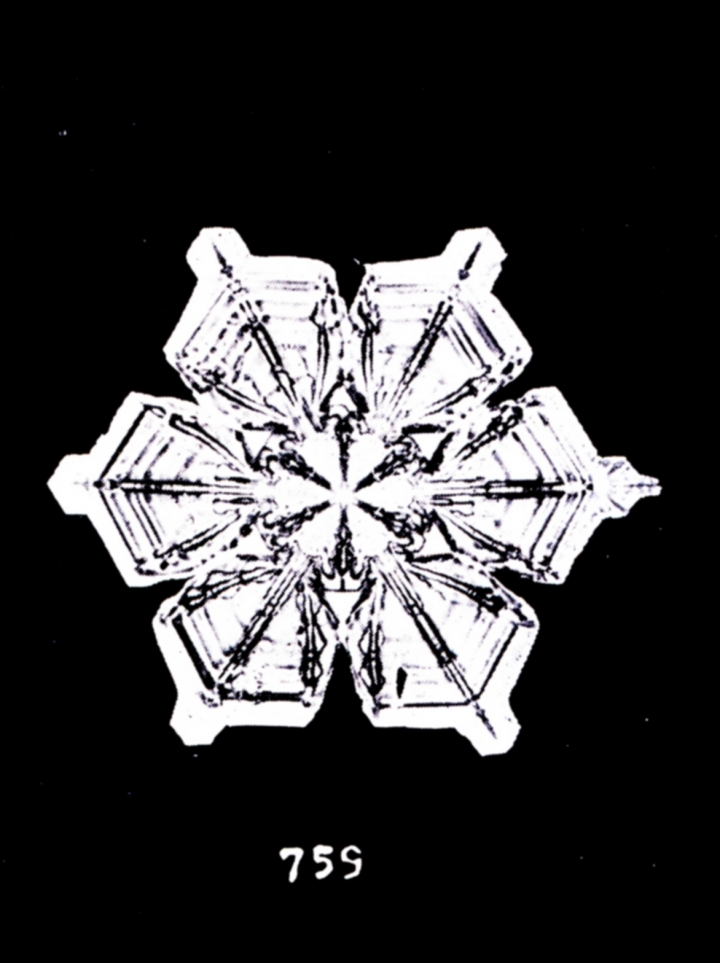
The Vermont farmer, self-educated naturalist, and avid photographer, was the first person to offer the following wisdom on the record, then illustrate it with hundreds upon hundreds of pictures of snowflakes, 5,000 in all:
I found that snowflakes were miracles of beauty; and it seemed a shame that this beauty should not be seen and appreciated by others. Every crystal was a masterpiece of design and no one design was ever repeated. When a snowflake melted, that design was forever lost. Just that much beauty was gone, without leaving any record behind.
Bentley left a considerable record—though still an insignificant sample size given the scope of the object of study. But his photographs give the impression of an infinite variety of different types, each with the same basic crystalline latticework structure. He took his first photograph of a snowflake, the first ever taken, in 1885, by adapting a microscope to a bellows camera, after years of making sketches and much trial and error.

Some great portion of this work must have been tedious and frustrating—Bentley had to hold his breath for each exposure lest he destroy the photographic subject. But it was worth the effort. Bentley, the Smithsonian informs us, “was a pioneer in ‘photomicrography,’ the photographing of very small objects.” Five hundred of his photographs now reside at the Smithsonian Institution Archives, “offered by Bentley in 1903 to protect against ‘all possibility of loss and destruction, through fire or accident.” You can see a huge digital gallery of those hundreds of photos here.

Along with U.S. Weather Bureau physicist William J. Humphreys, he published 2300 of his snowflake photographs in a monograph titled Snow Crystals. Bentley also published over 60 articles on the subject (read two of them here). Despite his contributions, he receives no mention in most histories of photomicrography. This may be due to his provincial location (he never left Jericho, VT) or his lack of scientific training and credentials, or a lack of interest in photos of snowflakes on the part of most photomicrography historians.

Or it may be because Bentley was thought to be a fraud. When a German meteorologist commissioned some images of his own and got some very different results, he accused the farmer of retouching. Bentley readily admitted it, saying, “a true scientist wishes above all to have his photographs as true to nature as possible, and if retouching will help in this respect, then it is fully justified.”
The defense is a good one. Although the “nature” Bentley’s photos show us may be a theoretical idealization, so too are the hand-rendered illustrations of most scientists throughout history (and nearly every medical diagram today). Take, for example, the psychedelic, brightly colored patterns of accomplished biologist Ernst Haeckel, who turned the micro- and macroscopic world into surreally symmetrical art in his drawings. Though he might not have said so directly, Bentley was doing something similar with a camera. Just listen to him describe his process in a 1900 issue of Harper’s:
Quick, the first flakes are coming; the couriers of the coming snow storm. Open the skylight, and directly under it place the carefully prepared blackboard, on whose ebony surface the most minute form of frozen beauty may be welcome from cloud-land. The mysteries of the upper air are about to reveal themselves, if our hands are deft and our eyes quick enough.
In the “quiet frenzy of his winter’s quest,” writes Allison Meier at Hyperallergic, he produced images of “beautiful ghosts from a winter that bristled the air over a century ago.” Learn more about Bentley’s life, work, and the Smithsonian collection in the short documentary further up, the Washington Post video above, and the Radiolab episode below, in which a breathless Latif Nasser takes us into the heart of Bentley’s origin story, and “snowflake expert and photographer Ken Libbrecht helps set the record straight.”
Real snowflakes have many imperfections, and perhaps Bentley did snow a disservice to so strenuously suggest otherwise. But the record he left us, Meier notes, “is appreciated as much as an artistic archive as a meteorological one.” He might have been a scientist when it came to technique, but Bentley was a romantic when it came to snow. His story is as fascinating as his photographs. Maybe a delightful alternative to the usual Christmas fare. There’s even a children’s book called… what else?… Snowflake Bentley.
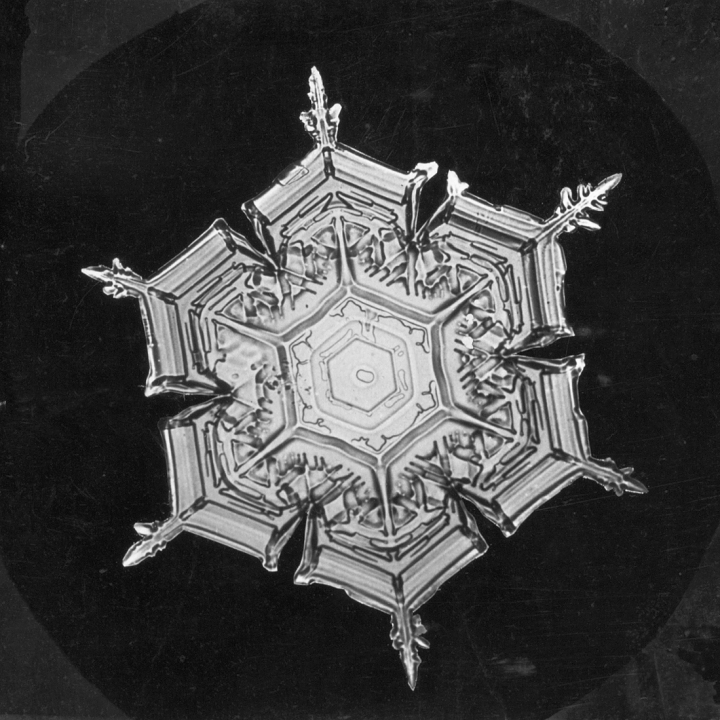
via Smithsonian/Hyperallergic
Related Content:
See the First Photograph of a Human Being: A Photo Taken by Louis Daguerre (1838)
The First Known Photograph of People Sharing a Beer (1843)
Josh Jones is a writer and musician based in Durham, NC. Follow him at @jdmagness
Read More...“Inemuri,” the Japanese Art of Taking Power Naps at Work, on the Subway, and Other Public Places
If you’ve visited any big city in Japan, you’ve no doubt seen a fair few commuters sleeping on the subway. The more time you spend there, the more places in which you’ll see normal, everyday-looking folks fast asleep: parks, coffee shops, bookstores, even the workplace during office hours. People in Korea, where I live, have also been known to fall asleep in places not normally associated with sleeping, but the Japanese take it to such a level that they’ve actually got a word for it: inemuri (居眠り, a mash-up of the verb for being present and the one for sleeping.
“I first encountered these intriguing attitudes to sleep during my first stay in Japan in the late 1980s,” writes University of Cambridge lecturer Brigitte Steger. “At that time Japan was at the peak of what became known as the Bubble Economy, a phase of extraordinary speculative boom. Daily life was correspondingly hectic. People filled their schedules with work and leisure appointments, and had hardly any time to sleep.” Amid it all, she heard many a boastful complaint that “We Japanese are crazy to work so much!” Yet “at the same time, I observed countless people dozing on underground trains during my daily commute. Some even slept while standing up, and no one appeared to be at all surprised by this.”
Steger, who researches the social and cultural aspects of sleep in Japan, has found a rich subject in inemuri, which on a certain level “is not considered sleep at all,” and in fact works more like “a subordinate involvement which can be indulged in as long as it does not disturb the social situation at hand – similar to daydreaming. Even though the sleeper might be mentally ‘away’, they have to be able to return to the social situation at hand when active contribution is required. They also have to maintain the impression of fitting in with the dominant involvement by means of body posture, body language, dress code and the like.”
Inemuri, a phenomenon whose documentation goes back a millennium, also offers an unconventionally angled window onto several aspects of Japanese culture, such as the belief that “co-sleeping with children until they are at least at school age will reassure them and help them develop into independent and socially stable adults.” That surely gets people more comfortable, in every sense, with the idea of falling asleep in a public or quasi-public space, as does Japan’s famously high level of public safety. (Nobody who has somewhere else to sleep does so on, say, the New York subway.)
In recent years, as you can see in the TRT World report above, Japanese companies have actually made provisions for proper workday napping on the theory that a better-rested worker is the more productive worker. (And they couldn’t be much worse-rested there: “according to the US National Sleep Foundation’s poll of sleeping habits around the world,” reports the Guardian, “Japanese workers sleep, on average, for just six hours 22 minutes on work nights – less than those in any other country.”) That sounds forward-thinking enough, and the most intense days of the Bubble Economy have indeed long gone, but do bear in mind that in Japan, one still does occasionally hear the word karōshi (過労死) — death by overwork.
Related Content:
How a Good Night’s Sleep — and a Bad Night’s Sleep — Can Enhance Your Creativity
Dr. Weil’s 60-Second Technique for Falling Asleep
Based in Seoul, Colin Marshall writes and broadcasts on cities and culture. His projects include the book The Stateless City: a Walk through 21st-Century Los Angeles and the video series The City in Cinema. Follow him on Twitter at @colinmarshall or on Facebook.
Read More...Support Us
We're hoping to rely on loyal readers, rather than erratic ads. Please click the Donate button and support Open Culture. You can use Paypal, Venmo, Patreon, even Crypto! We thank you!

About Us

Open Culture scours the web for the best educational media. We find the free courses and audio books you need, the language lessons & educational videos you want, and plenty of enlightenment in between.
Advertise With Us

FREE UPDATES!
GET OUR DAILY EMAIL
Get the best cultural and educational resources on the web curated for you in a daily email. We never spam. Unsubscribe at any time.
FOLLOW ON SOCIAL MEDIA

Open Culture editor Dan Colman scours the web for the best educational media. He finds the free courses and audio books you need, the language lessons & movies you want, and plenty of enlightenment in between.
Advertise With Us


