3,500 Occult Manuscripts Will Be Digitized & Made Freely Available Online, Thanks to Da Vinci Code Author Dan Brown
If there’s one thing The Da Vinci Code’s Dan Brown and “The Library of Babel”’s Jorge Luis Borges have in common it is a love for obscure religious and occult books and artifacts. But why do I compare Borges—one of the most highly-regarded, but difficult, of Latin American poets and writers—to a famous American writer of entertaining paperback thrillers? One reason only: despite the vast differences in their styles and registers, Borges would be deeply moved by Brown’s recent act of philanthropy, a donation of €300,000 to Amsterdam’s Ritman Library, also known as the Bibliotheca Philosophica Hermetica House of Living Books.
The generous gift will enable the Ritman to digitize thousands of “pre-1900 texts on alchemy, astrology, magic, and theosophy,” reports Thu-Huong Ha at Quartz, including the Corpus Hermeticum (1472), “the source work on Hermetic wisdom”; Giordano Bruno’s Spaccio de la bestia trionfante (1584); and “the first printed version of the tree of life (1516): A graphic representation of the sefirot, the 10 virtues of God according to the Kabbalah.”
Brown, the Ritman notes, “is a great admirer of the library and visited on several occasions while writing his novels The Lost Symbol and Inferno.” Now he’s giving back. Some of the revenue generated by his bestselling novels, along with a €15,000 contribution from the Dutch Prins Bernhard Cultuurfonds, will allow the library’s core collection, “some 3,500 ancient books,” to come online soon in an archive called “Hermetically Open.”
For now, the curious can download the 44-page guide to the collection as a free ebook, and watch the animated video at the top, a breezy explainer of how the books will be transported, digitized, and uploaded. Just above, see a trailer for a documentary about the Ritman, founded by businessman Joost R. Ritman in 1984. The library holds over 20,000 volumes on mysticism, spirituality, religion, alchemy, Gnosticism, and more.
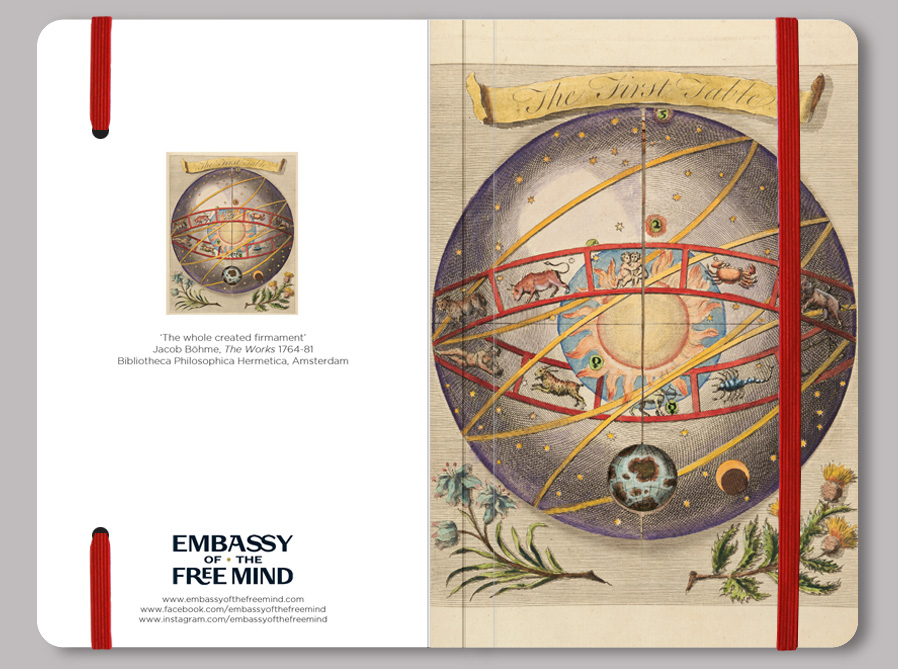
Many a writer, like Brown, has found inspiration among the Ritman’s more accessible works (though, sadly, Borges, who was blind in 1984 and died two years later, could not have appreciated it). Now, thanks to the Da Vinci Code author’s magnanimity, a new generation of scholars will be able to virtually access, for example, the first English translation of the works of 17-century German mystic Jakob Böhme, which librarian and director Esther Ritman describes as “travelling in an entire new world.”
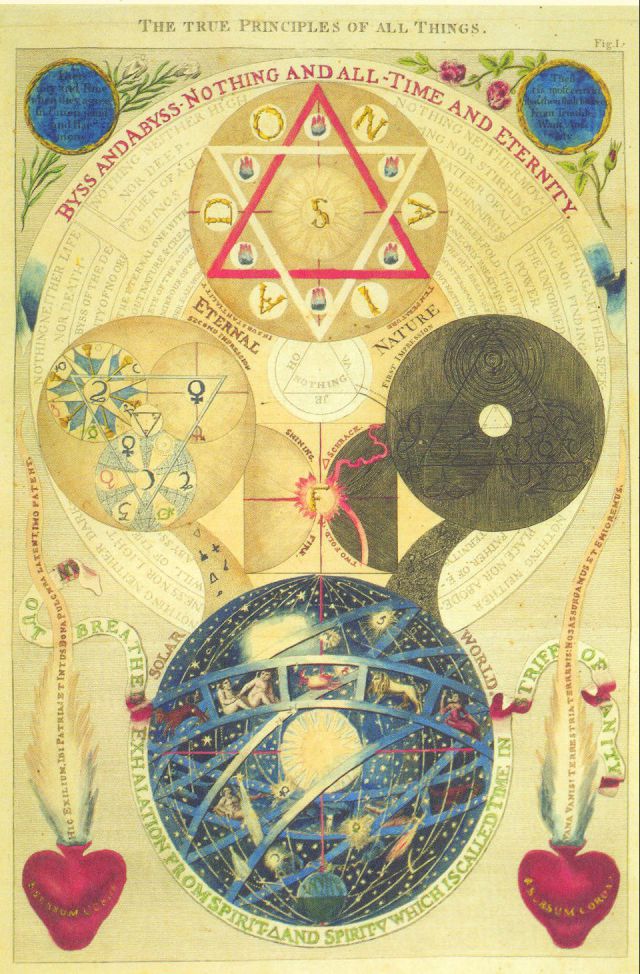
In an introductory essay, the Ritman notes that academic interest in occult and hermetic writing has increased lately among scholars like W.J. Hanegraaff, who tells “the ‘neglected’ story of how the intellectual community since the Renaissance has tried to come to terms with ‘esoteric’ and ‘occult’ currents present in Western culture.” That those currents are as much a part of the culture as the scientific or industrial revolutions need not be in doubt. The Hermetically Open project opens up that history with “an invitation to anyone wishing to consult or study sources belonging to the field of Christian-Hermetic Gnosis for personal, academic or other purposes.” Look for the digitization project to hit the web in the coming months.
Note: You can now see the first texts online. See our follow up post here:
Related Content:
1,000-Year-Old Illustrated Guide to the Medicinal Use of Plants Now Digitized & Put Online
Aleister Crowley Reads Occult Poetry in the Only Known Recordings of His Voice (1920)
Josh Jones is a writer and musician based in Durham, NC. Follow him at @jdmagness
Read More...The 1883 Krakatoa Explosion Made the Loudest Sound in History–So Loud It Traveled Around the World Four Times
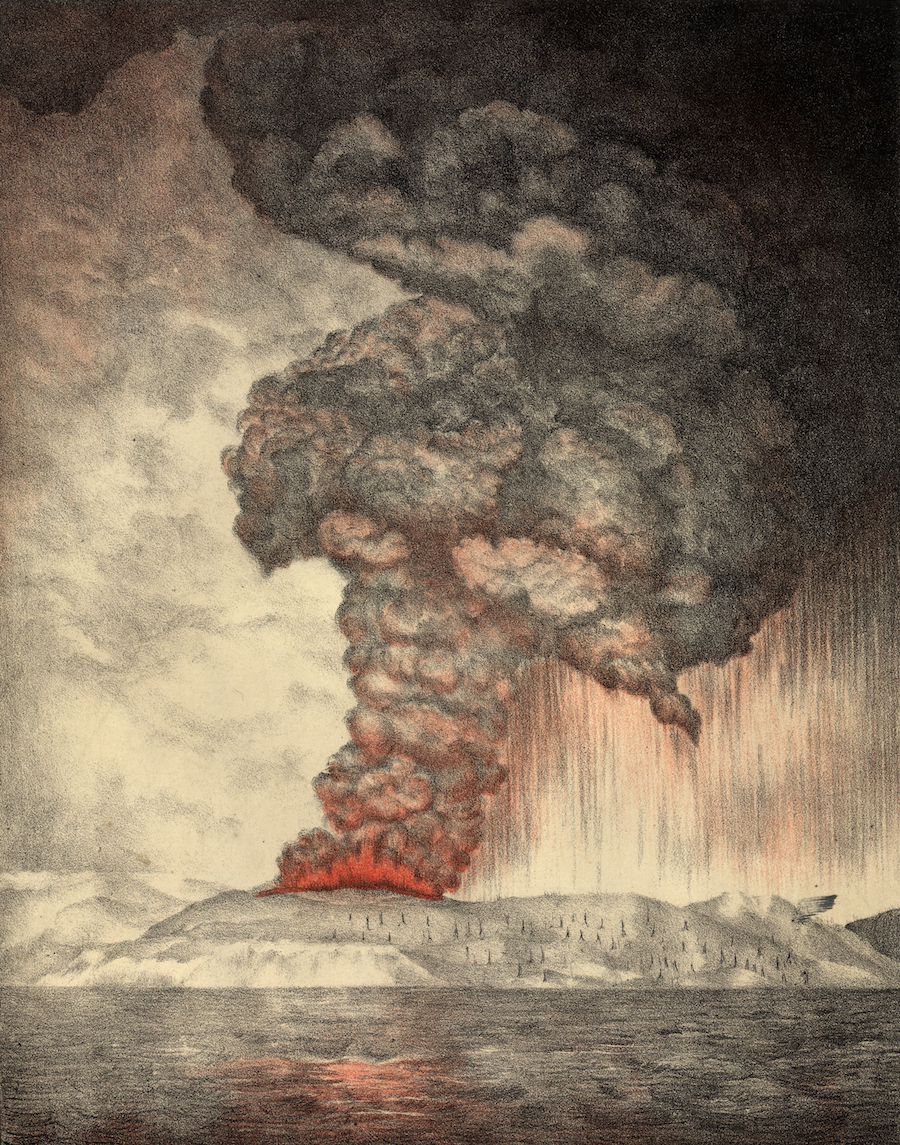
Think of ourselves though we may as living in a noisy era, none of us — not even members of stadium-filling rock bands known specifically for their high-decibel intensity — have experienced anything like the loudest sound in history. That singular sonic event came as a consequence of the explosion of Krakatoa, one of the names (along with Vesuvius) that has become a byword for volcanic disaster. And with good cause: when it blew in modern-day Indonesia on Sunday, 26 August 1883, it caused not only 36,000 deaths at the very least and untold destruction of other kinds, but let out a sound heard 3,000 miles away.
“Think, for a moment, just how crazy this is,” writes Nautilus’ Aatish Bhatia. “If you’re in Boston and someone tells you that they heard a sound coming from New York City, you’re probably going to give them a funny look. But Boston is a mere 200 miles from New York. What we’re talking about here is like being in Boston and clearly hearing a noise coming from Dublin, Ireland. Traveling at the speed of sound (766 miles or 1,233 kilometers per hour), it takes a noise about four hours to cover that distance. This is the most distant sound that has ever been heard in recorded history.”
Anyone who writes about the sound of Krakatoa, which split the island itself, struggles to properly describe it, seeing as even jet mechanics lack a comparable sonic experience. Bhatia quotes the captain of the British ship Norham Castle, 40 miles from Krakatoa when it erupted, writing in his log that “so violent are the explosions that the ear-drums of over half my crew have been shattered. My last thoughts are with my dear wife. I am convinced that the Day of Judgement has come.” Krakatoa’s reverberations – not heard, but felt and recorded as changes in atmospheric pressure – passed across the whole of the Earth not once but four times.
The sound of the explosion aside, “the rest of the world heard such stories almost instantly because a series of underwater telegraph cables had been recently laid traversing the globe,” writes the Independent’s Sanjida O’Connell. “This new technology meant that Krakatoa also generated the first modern scientific study of a volcanic eruption.” A Dutch scientist named Rogier Verbeek turned up first to gather details for a detailed and pioneering report, followed by geologists from London’s Royal Society, whose 627-page The Eruption of Krakatoa and Subsequent Phenomena you can read at the Internet Archive.
Since nobody would have got the explosion on tape in 1883, such verbal descriptions will have to suffice. Not that even today’s highest-grade recording technology could withstand capturing such a sound, nor could even speakers that go up to a Spinal Tap-level 11 reproduce it. And no other sound is likely to break Krakatoa’s record in our lifetimes – not if we’re lucky, anyway.
via Nautilus
Related Content:
Based in Seoul, Colin Marshall writes and broadcasts on cities and culture. His projects include the book The Stateless City: a Walk through 21st-Century Los Angeles and the video series The City in Cinema. Follow him on Twitter at @colinmarshall or on Facebook.
Read More...What the Entire Internet Looked Like in 1973: An Old Map Gets Found in a Pile of Research Papers
In 1923, Edwin Hubble discovered the universe—or rather, he discovered a star, and humans learned that the Milky Way wasn’t the whole of the cosmos. Less than 100 years later, thanks to the telescope named after him, NASA scientists estimate the universe contains at least 100 billion galaxies, and who-knows-what beyond that. The exponential growth of astronomical data collected since Hubble’s time is absolutely staggering, and it developed in tandem with the revolutionary increase in computing power over an even shorter span, which enabled the birth and mutant growth of the internet.
Modern “maps” of the internet can indeed look like sprawling clusters of star systems, pulsing with light and color. But the “weird combination of physical and conceptual things,” Betsy Mason remarks at Wired, results in such an abstract entity that it can be visually illustrated with an almost unlimited number of graphic techniques to represent its hundreds of millions of users. When the internet began as ARPANET in the late sixties, it included a total of four locations, all within a few hundred miles of each other on the West Coast of the United States. (See a sketch of the first four “nodes” from 1969 here.)
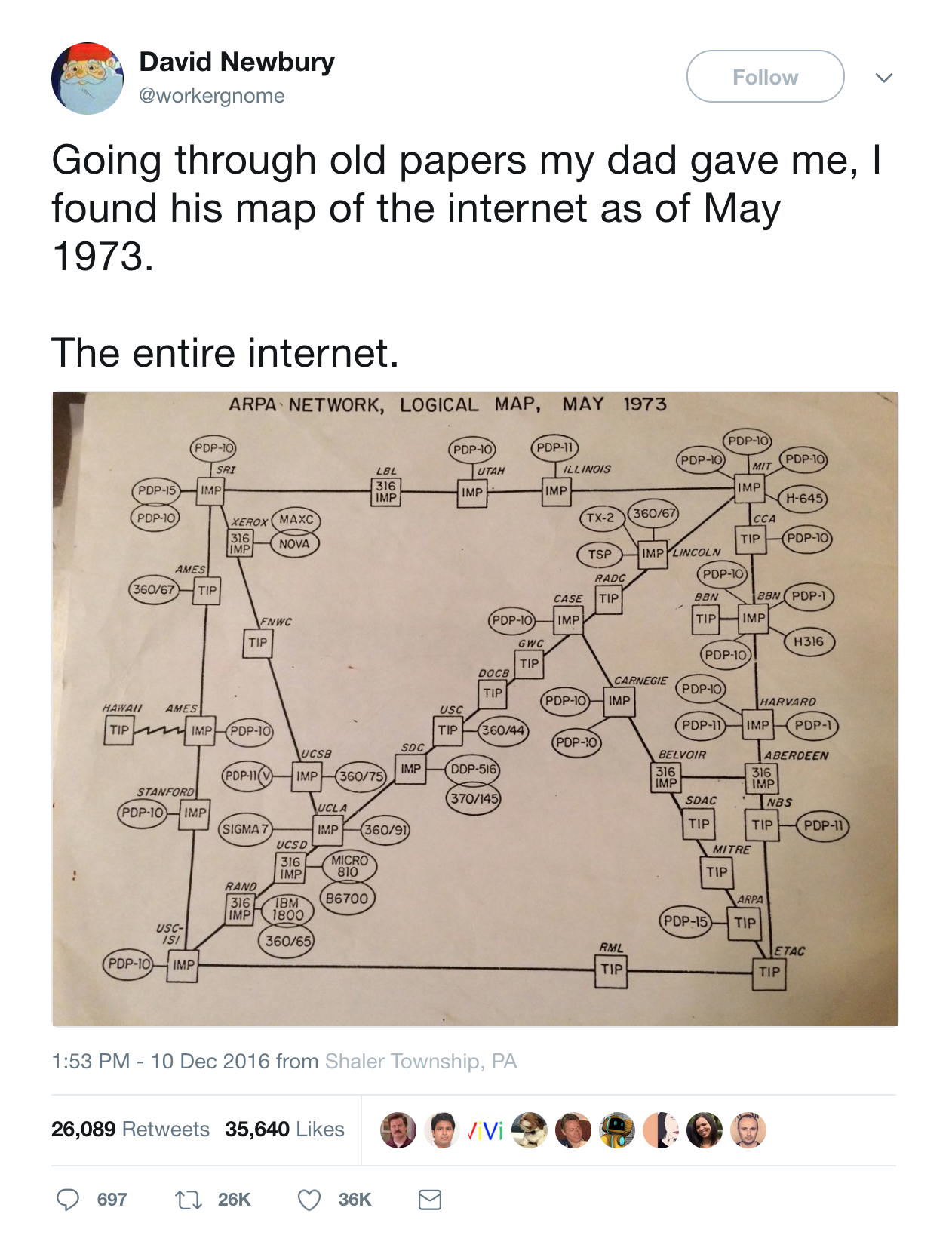
By 1973, the number of nodes had grown from U.C.L.A, the Stanford Research Institute, U.C. Santa Barbara, and the University of Utah to include locations all over the Midwest and East Coast, from Harvard to Case Western Reserve University to the Carnegie Mellon School of Computer Science in Pittsburgh, where David Newbury’s father worked (and still works). Among his father’s papers, Newbury found the map above from May of ’73, showing what seemed like tremendous growth in only a few short years.

The map is not geographical but schematic, with 36 square “nodes”—early routers—and 42 oval computer hosts (one popular mainframe, the massive PDP-10, is sprinkled throughout), and only naming a few key locations. Significantly, Hawaii appears as a node, linked to the mainland by satellite. Just above, you can see an update from just a few months later, now representing 40 nodes and 45 computers. “The network,” writes Selina Chang, “became international: a satellite link connected ARPANET to nodes in Norway and London, sending 2.9 million packets of information every day.”
These early networks of global interconnectivity, created by the Defense Department and used mostly by scientists, predate Tim Berners-Lee and CERN’s development of the World Wide Web in 1991, which opened up the enormous, expanding alternate universe we know as the internet today (and was, coincidentally, invented around the same time as the Hubble Telescope). Though maps aren’t territories (a 1977 ARPANET “logical map” disclaims total accuracy in a note at the bottom), these early representations of the internet resemble medieval maps of the cosmos next to the beautiful complexity of glowing colors we see in 21st century infographics like the authoritatively-named “The Internet Map.”
Related Content:
The History of the Internet in 8 Minutes
What Happens on the Internet in 60 Seconds
The Internet Imagined in 1969
Josh Jones is a writer and musician based in Durham, NC. Follow him at @jdmagness
Read More...The Vincent Van Gogh Action Figure, Complete with Detachable Ear
If you liked Mr. Potato Head, you may love the Vincent Van Gogh Action Figure, which raised $142,000 on Kickstarter this summer and can now be purchased for $35 over at the Today is Art Day web site. Made of PVC and standing 5 inches high, the action figure comes with:
- 2 removable ears (Van Gogh cut his left ear)
- 1 bandaged ear
- 1 paintbrush
- 5 masterpieces and 1 cardboard easel
- 10 fun facts about the artist on the box
Other figures included in the collection include Frida Kahlo and soon Vermeer, da Vinci, Magritte and Rembrandt. Enjoy.
If you would like to support the mission of Open Culture, consider making a donation to our site. It’s hard to rely 100% on ads, and your contributions will help us continue providing the best free cultural and educational materials to learners everywhere. You can contribute through PayPal, Patreon, and Venmo (@openculture). Thanks!
Related Content:
The Edvard Munch Scream Action Figure
The Frida Kahlo Action Figure
Famous Philosophers Imagined as Action Figures: Plunderous Plato, Dangerous Descartes & More
Read More...Dr. Demento’s New Punk Album Features William Shatner Singing The Cramps, Weird Al Yankovic Singing The Ramones & Much More
Calling all fans of the Dr. Demento Show. The new album, Dr. Demento Covered in Punk, features “demented” covers of classic punk tunes and “30 covers of songs originally aired on the Dr. Demento radio show.” Think “Fish Heads.”
On the nostalgia-inducing album, you can notably enjoy two fixtures of American oddball culture, William Shatner and Weird Al Yankovic, singing “The Garbageman” by The Cramps (above) and The Ramones’ “Beat on the Brat” (below). The Misfits, Joan Jett, Fred Schneider of the B52s, the Vandals, The Dead Milkmen, The Meatmen–they all make an appearance on the album too. It’s due out today.
If you would like to support the mission of Open Culture, consider making a donation to our site. It’s hard to rely 100% on ads, and your contributions will help us continue providing the best free cultural and educational materials to learners everywhere. You can contribute through PayPal, Patreon, and Venmo (@openculture). Thanks!
Related Content:
The History of Punk Rock in 200 Tracks: An 11-Hour Playlist Takes You From 1965 to 2016
The Cramps Play a Mental Hospital in Napa, California in 1978: The Punkest of Punk Concerts
Two Legends: Weird Al Yankovic “Interviews” James Brown (1986)
DC’s Legendary Punk Label Dischord Records Makes Its Entire Music Catalog Free to Stream Online
Read More...A 17-Hour Chronological Playlist of Beatles Songs: 338 Tracks Let You Hear the Musical Evolution of the Iconic Band
The Beatles have seemingly never been just a band; they’ve been a brand, a history, an institution, a genre, a generational soundtrack, a merchandising empire, and so much more—possessed of the kind of cultural importance that makes it impossible to think of them as only musicians. Their “narrative arc,” Tom Ewing writes at Pitchfork, from Beatlemania to their current enshrinement and everything in-between, “is irresistible.” But the story of the Beatles as we typically understand it, Ewing writes, does their music a disservice, setting it apart from “the rest of the pop world” and “making newcomers as resentful as curious.”
For all the deification (which John Lennon scandalously summed up in his “bigger than Jesus” quip), the band began as nothing particularly out of the ordinary. “Britain in the early 1960s swarmed with rock’n’roll bands,” and though the Beatles excelled early on, they mostly followed trends, they didn’t invent them.
Their sound was so of the time that Decca’s A&R executive Dick Rowe passed on them in 1962, telling Brian Epstein, “guitar groups are on their way out.” Little could he have known, however: “guitar groups” came roaring back because of the band’s first album, Please, Please Me, and the especially savvy marketing skills of Epstein, who helped land them that fateful Ed Sullivan Show appearance.
Millions of people saw them play their single “I Want to Hold Your Hand” and the world changed forever, so the story goes. In so many ways that’s so. The Ed Sullivan gig launched a thousand bands, and remains at top of the list of nearly every baby boomer musician’s most influential moments. But as the sixties wore on, and Beatlemania assumed the various forms of lunchboxes, fan clubs, and a wacky cartoon series with badly impersonated voices, their act seemed like it might run its course as a passing pop-culture fad. They were, in effect, a very talented boy band, subject to the fate of boy bands everywhere. Their ascent into Olympus wasn’t inevitable, and “every record they made was born out of a new set of challenges.”
Rubber Soul, the band’s 1965 farewell to the carefree, boyish pop band they had been, perfectly met the challenge they faced—how to grow up. It was “the most out-there music they’d ever made, but also their warmest, friendliest and most emotionally direct,” Rob Sheffield writes at Rolling Stone. They were “smoking loads of weed, so all through these songs, wild humor and deep emotion go hand in hand.” These threads of playful, drug-fueled experimentation, screwball comedy, and earnest sentiment changed not only the band’s career trajectory, but “cut the story of pop music in half,” Sheffield opines.
Such proclamations can and have been made of the groundbreaking Sgt. Pepper’s Lonely Hearts Club Band. Each Beatles milestone cements our impression of them as a messianic force, destined to steer the course of pop music history—a story that glosses over their novelty records, lesser works, many outtakes and half thoughts, cover songs, and flops, like their 1967 Magical Mystery Tour film. Some of these lesser works deserve the label. The mellotron-heavy “Only a Northern Song” on Yellow Submarine, for example, sounds far too much like an inferior “Strawberry Fields Forever.”
Others, like the Magical Mystery Tour soundtrack album, give us gems like McCartney’s “Penny Lane” (a song originally recorded during the Sgt. Pepper’s sessions), as well as “I Am the Walrus,” “Hello Goodbye,” “Baby, You’re a Rich Man,” “All You Need is Love” … the film may have disappointed, but the record, I’d say, is essential.
In the chronological Spotify playlist further up of 338 songs, you can follow the quirky, upbeat, downbeat, sometimes uneven, sometimes breathtakingly brilliant musical journey of the band everyone thinks they know and see why they are so much more interesting than a museum exhibit or rock and roll mythology. They were, after all, only human, but their willingness to indulge in weird experiments and to master genre exercises gave them the discipline and experience they needed to make their masterpieces.
Related Content:
How The Beatles’ Sgt. Pepper’s Lonely Hearts Club Band Changed Album Cover Design Forever
Josh Jones is a writer and musician based in Durham, NC. Follow him at @jdmagness
Read More...How to Draw in the Style of Japanese Manga: A Series of Free & Wildly Popular Video Tutorials from Artist Mark Crilley
In Japan, the word manga refers broadly to the art form we know in English as comics. But as used in the West, it refers to a comic art style with distinctive aesthetic and storytelling conventions of its own, originating from but now no longer limited to Japan. Just as the past century or so has seen the emergence of Western masters of such things thoroughly Japanese as sushi, judo, and even tea ceremony, the past few decades brought us the work of the Western mangaka, or manga artist. Mark Crilley stands as one of the best-known practitioners of that short tradition, thanks not only to his art but to his efforts to teach fans how to draw in the style of Japanese manga themselves as well.
Apart from comic-book series like Akiko, Miki Falls, and Brody’s Ghost, the Detroit-born Crilley has also published a trilogy of Mastering Manga instructional books. In an interview with Wired, he frames his own manga-mastering process as a project similar to language-learning: “When I went to Taiwan to teach English after graduating from college, I threw myself into learning Chinese with a real ‘tunnel vision’ kind of dedication. As a result I became conversational in Mandarin within about a year. More recently I decided to teach myself how to draw in a manga-influenced style and thus focused exclusively on that for many months.”
Crilley first took to Youtube to promote his then-new manga series, but he “soon found that people were watching my videos as drawing lessons. As more people watched I got hooked on passing on drawing tips to the next generation, and so I continued producing more and more instructional videos.”
More youngsters seem to have an interest in drawing in the style of Japanese comics and animation than ever (at least if my friends’ kids are generationally representative), and Crilley finds that they “appreciate having an art teacher who takes manga seriously, and doesn’t dismiss it as an inferior art form. I’m sure plenty of art teachers are all, ‘Stop drawing those saucer-eyed characters! Draw this still life instead!’ ”
Not to say that Crilley doesn’t appreciate realism: he’s put out a whole book on the subject, and some of his instructional videos cover how to draw lifelike eyes (a tutorial that has drawn 27 million views and counting), leopards, mushrooms, and much else besides. But for the aspiring mangaka of any nationality, his Youtube channel offers a wealth of lessons on how to draw everything from faces to clothes to figures in motion to big eyes in the manga aesthetic. But as he surely knows — having cited in the Wired interview a wide range of influences from Star Wars to Mad magazine to Monty Python’s Flying Circus — if you want to truly find your own style, you can’t limit yourself to any one source of inspiration. Acquire the skills, of course, but then take them to new places.
You can see a playlist of 256 how-to-draw videos by Crilley here. Or a series of smaller drawing playlists here.
Related Content:
A Big List of Free Art Lessons on YouTube
How to Draw the Human Face & Head: A Free 3‑Hour Tutorial
Watch Groundbreaking Comic Artist Mœbius Draw His Characters in Real Time
Cartoonist Lynda Barry Shows You How to Draw Batman in Her UW-Madison Course, “Making Comics”
W.B. Yeats’ Poem “When You Are Old” Adapted into a Japanese Manga Comic
Based in Seoul, Colin Marshall writes and broadcasts on cities and culture. His projects include the book The Stateless City: a Walk through 21st-Century Los Angeles and the video series The City in Cinema. Follow him on Twitter at @colinmarshall or on Facebook.
Read More...Thelonious Monk’s 25 Tips for Musicians (1960)
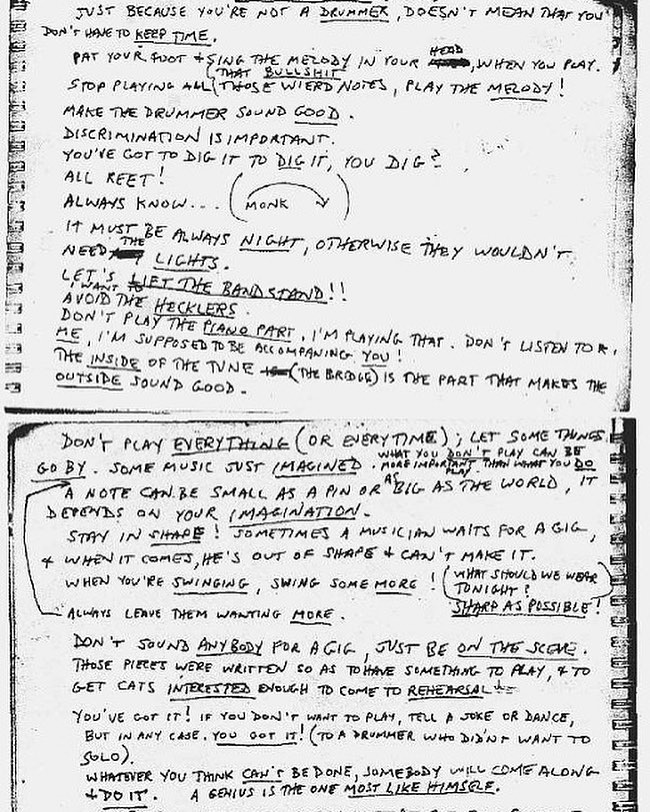
Stories of idiosyncratic and demanding composers and bandleaders abound in mid-century jazz—of pioneers who pushed their musicians to new heights and in entirely new directions through seeming sheer force of will. Miles Davis’ name inevitably comes up in such discussions. Davis was “not a patient man,” jazz historian Dan Morgenstern remarks, “and I think he got impatient with himself just as he did with other people.” Jazz and other forms of music have been immeasurably enriched by that impatience.
Other bop eccentrics—like John Coltrane—brought their own personality quirks and personal struggles to bear on their styles, pushing toward new insights and experiments that shaped the future of the music. Their peer Thelonious Monk, writes Candace Allen at The Guardian, “the jobbing musician who couldn’t, more than wouldn’t, conform to the conventions of the job,” seemed the odd man out. He “spent most of his professional life struggling to support his family.” Monk’s “misdiagnosed and ignorantly medicated bipolar condition” and his stubborn refusal to follow trends made it difficult for him to achieve the success he deserved.
But it was Monk’s inability to do things any way but his way that made up the essence of his greatness—his insistence on “playing angular, spacious and ‘slow,’” his “daunting and mysterious” silences. A musical prodigy, Monk honed his piano chops in Baptist churches and New York rent parties before his residency as house pianist for Teddy Hill’s band at the famed Minton’s Playhouse in Harlem, where he helped usher in the “bebop revolution.” While he “charted a new course for modern music few were willing to follow,” notes All About Jazz, those who did learned a new way of playing, Monk’s way.
What does that mean? The list above, as transcribed by saxophonist Steve Lacy, lays it all out. “T. Monk’s Advice,” as it’s called, offers guidelines, pointers, and pointed commands. Some of these instructions relate directly to live performance (“don’t sound anybody for a gig, just be on the scene,” “avoid the hecklers”). Others get at the heart of Monk’s genius—his talent for creating space, both inside the arrangements and between the notes. Monk makes sure he’s the only one playing “weird notes,” demanding that musicians “play the melody!” “Don’t play the piano part,” he says, “I am playing that.” And he peppers the list with cryptic philosophical and social observations (“discrimination is important,” “always know,” “a genius is the one most like himself”).
In the last item on the list (cut off in the image above), Monk veers sharply away from music with some humorous social commentary. It’s a move that’s typical Monk—both deeply serious and playful, entirely unexpected, and leaving us, as he instructs his musicians, “wanting more.” See a transcription of Monk’s list of advice for musicians below.
Just because you’re not a drummer, doesn’t mean that you don’t have to keep time.
Pat your foot and sing the melody in your head when you play.
Stop playing all that bullshit, those weird notes, play the melody!
Make the drummer sound good.
Discrimination is important.
You’ve got to dig it to dig it, you dig?
All reet!
Always know
It must be always night, otherwise they wouldn’t need the lights.
Let’s lift the band stand!!
I want to avoid the hecklers.
Don’t play the piano part, I am playing that. Don’t listen to me, I am supposed to be accompanying you!
The inside of the tune (the bridge) is the part that makes the outside sound good.
Don’t play everything (or everytime); let some things go by. Some music just imagined.
What you don’t play can be more important than what you do play.
A note can be small as a pin or as big as the world, it depends on your imagination.
Stay in shape! Sometimes a musician waits for a gig & when it comes, he’s out of shape & can’t make it.
When you are swinging, swing some more!
(What should we wear tonight?) Sharp as possible!
Always leave them wanting more.
Don’t sound anybody for a gig, just be on the scene.
Those pieces were written so as to have something to play & to get cats interested enough to come to rehearsal!
You’ve got it! If you don’t want to play, tell a joke or dance, but in any case, you got it! (to a drummer who didn’t want to solo).
Whatever you think can’t be done, somebody will come along & do it. A genius is the one most like himself.
They tried to get me to hate white people, but someone would always come along & spoil it.
via Lists of Note
Related Content:
Captain Beefheart Issues His “Ten Commandments of Guitar Playing”
John Coltrane’s Handwritten Outline for His Masterpiece A Love Supreme (1964)
Josh Jones is a writer and musician based in Durham, NC. Follow him at @jdmagness
Read More...The Doodles in Leonardo da Vinci’s Manuscripts Contain His Groundbreaking Theories on the Laws of Friction, Scientists Discover

Just like the rest of us, Leonardo da Vinci doodled and scribbled: you can see it in his digitized notebooks, which we featured this past summer. But the prototypical Renaissance man, both unsurprisingly and characteristically, took that scribbling and doodling to a higher level entirely. Not only do his margin notes and sketches look far more elegant than most of ours, some of them turn out to reveal his previously unknown early insight into important subjects. Take, for instance, the study of friction (otherwise known as tribology), which may well have got its start in what at first just looked like doodles of blocks, weights, and pulleys in Leonardo’s notebooks.
This discovery comes from University of Cambridge engineering professor Ian M. Hutchings, whose research, says that department’s site, “examines the development of Leonardo’s understanding of the laws of friction and their application. His work on friction originated in studies of the rotational resistance of axles and the mechanics of screw threads, but he also saw how friction was involved in many other applications.”
One page, “from a tiny notebook (92 x 63 mm) now in the Victoria and Albert Museum in London, dates from 1493” and “contains Leonardo’s first statement of the laws of friction,” sketches of “rows of blocks being pulled by a weight hanging over a pulley – in exactly the same kind of experiment we might do today to demonstrate the laws of friction.”
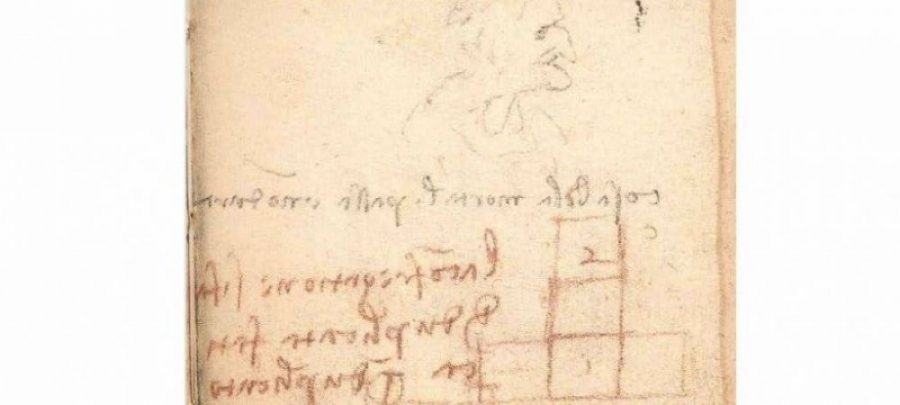
“While it may not be possible to identify unequivocally the empirical methods by which Leonardo arrived at his understanding of friction,” Hutchings writes in his paper, “his achievements more than 500 years ago were outstanding. He made tests, he observed, and he made powerful connections in his thinking on this subject as in so many others.” By the year of these sketches Leonardo “had elucidated the fundamental laws of friction,” then “developed and applied them with varying degrees of success to practical mechanical systems.”
And though tribologists had no idea of Leonardo’s work on friction until the twentieth century, seemingly unimportant drawings like these show that he “stands in a unique position as a quite remarkable and inspirational pioneer of tribology.” What other fields of inquiry could Leonardo have pioneered without history having properly acknowledged it? Just as his life inspires us to learn and invent, so research like Hutchings’ inspires us to look closer at what he left behind, especially at that which our eyes may have passed over before. You can open up Leonardo’s notebooks and have a look yourself. Just make sure to learn his mirror writing first.
Related Content:
Leonardo da Vinci’s Visionary Notebooks Now Online: Browse 570 Digitized Pages
Leonardo da Vinci’s Bizarre Caricatures & Monster Drawings
Leonardo Da Vinci’s To Do List (Circa 1490) Is Much Cooler Than Yours
Based in Seoul, Colin Marshall writes and broadcasts on cities and culture. His projects include the book The Stateless City: a Walk through 21st-Century Los Angeles and the video series The City in Cinema. Follow him on Twitter at @colinmarshall or on Facebook.
Read More...The Not Yorker: A Collection of Rejected & Late Cover Submissions to The New Yorker
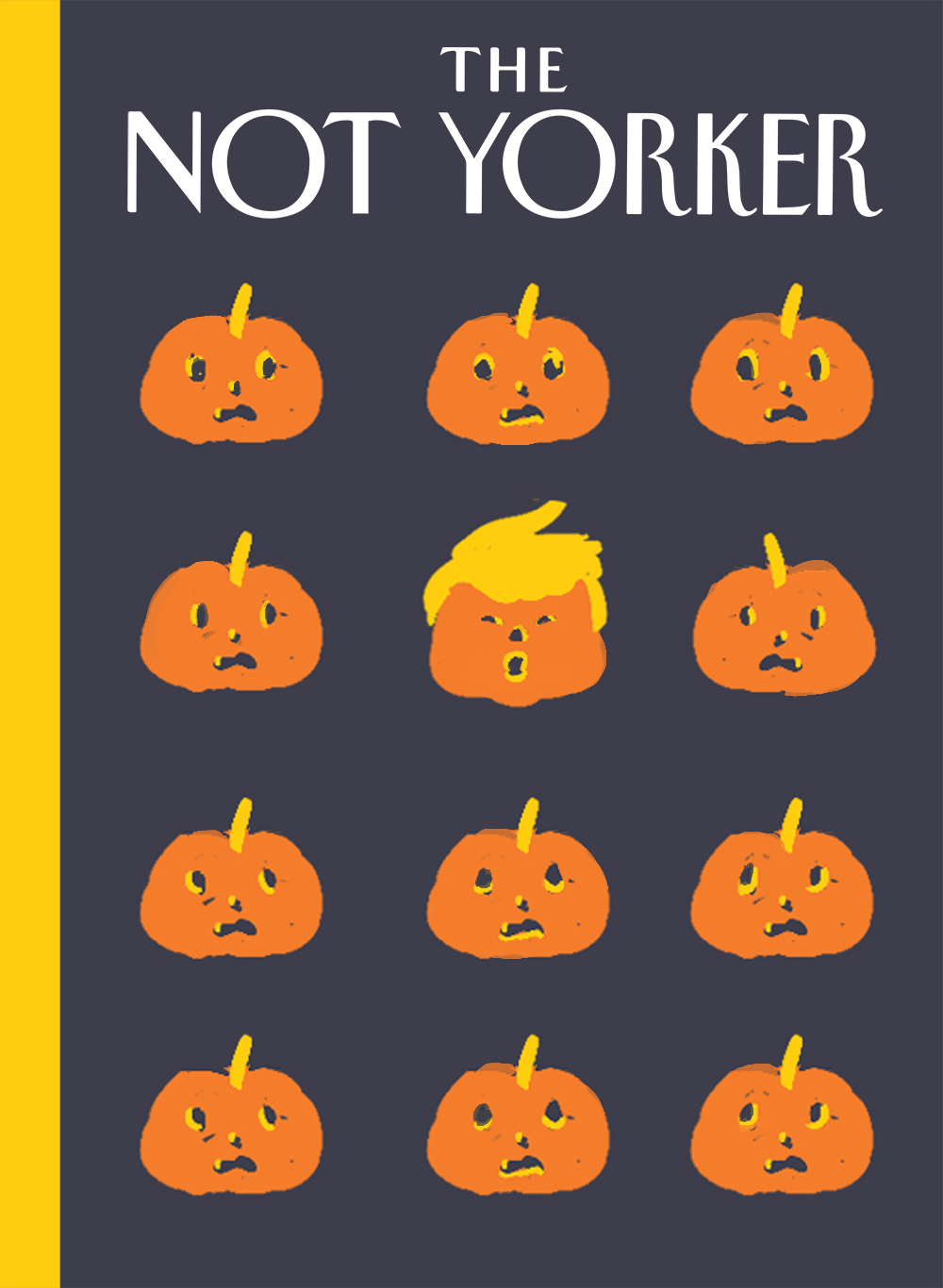
What’s happened to the thousands of cover designs that have been submitted to The New Yorker? And then been rejected, either summarily or with much consideration? Probably most have faded into oblivion. But at least some are now seeing the light of day over at The Not Yorker, a web site that collects “declined or late cover submissions” to the storied magazine. See a gallery of declined illustrations here.
The creators of the new site encourage illustrators to submit their rejected covers here. And lest there be any doubt, The Not Yorker is not officially affiliated with The New Yorker.
If you would like to support the mission of Open Culture, consider making a donation to our site. It’s hard to rely 100% on ads, and your contributions will help us continue providing the best free cultural and educational materials to learners everywhere. You can contribute through PayPal, Patreon, and Venmo (@openculture). Thanks!
Related Content
Download a Complete, Cover-to-Cover Parody of The New Yorker: 80 Pages of Fine Satire
The New Yorker’s Fiction Podcast: Where Great Writers Read Stories by Great Writers
Read More...Support Us
We're hoping to rely on loyal readers, rather than erratic ads. Please click the Donate button and support Open Culture. You can use Paypal, Venmo, Patreon, even Crypto! We thank you!

About Us

Open Culture scours the web for the best educational media. We find the free courses and audio books you need, the language lessons & educational videos you want, and plenty of enlightenment in between.
Advertise With Us

FREE UPDATES!
GET OUR DAILY EMAIL
Get the best cultural and educational resources on the web curated for you in a daily email. We never spam. Unsubscribe at any time.
FOLLOW ON SOCIAL MEDIA

Open Culture editor Dan Colman scours the web for the best educational media. He finds the free courses and audio books you need, the language lessons & movies you want, and plenty of enlightenment in between.
Advertise With Us