Annie Leibovitz Teaches Photography in Her First Online Course
FYI: If you sign up for a MasterClass course by clicking on the affiliate links in this post, Open Culture will receive a small fee that helps support our operation.
John Lennon and Yoko Ono, Dolly Parton and Arnold Schwarzenegger, Barack Obama and family, Bruce Springsteen, Whoopi Goldberg, Bill Gates, Queen Elizabeth II, Lady Gaga: name someone who has risen to the very top of the zeitgeist over the past few decades, and Annie Leibovitz has probably photographed them. Her images, in fact, have often come to stand for the images of her subjects in the culture: when we think of certain celebrities, we instinctively imagine them as they appeared on a Leibovitz-shot cover of Rolling Stone or Vanity Fair. Safe to say, then, that she knows a thing or two about how to take a picture that makes an impact.
The people at online education company Masterclass have now packaged that knowledge in “Annie Leibovitz Teaches Photography,” a course that joins their existing lineup that includes Helen Mirren on acting, Steve Martin on comedy, Werner Herzog on filmmaking, and Herbie Hancock on jazz. For a price of $90 (or $180 for a year-long pass to all of their classes), Masterclass offers a package of workbook-accompanied video lessons in which “Annie teaches you how to develop concepts, work with subjects, shoot with natural light, and bring images to life in post-production.”
The early lessons in “Annie Leibovitz Teaches Photography” cover subjects like memories of her own development as a photographer to discussions of her influences and her view of the medium itself. Later on, she gets into the real-life case study of shooting chef Alice Waters for Vanity Fair, digital post-production, how to come up with the right concept (ideally, so her career has shown, one just strange or daring enough to get people talking), and how to work with your subject. “There’s this idea that in portraiture, it’s the photographer’s job to set the subject at ease,” Leibovitz says in the class trailer above. “I don’t believe that.”
Few aspects of Leibovitz’s method have drawn as much attention as the way she handles her subjects, which tends to involve both developing enough of a relationship with them to gain some understanding of their inner lives and putting them in situations which, so she has studiously learned while getting to know them, may lie a bit outside of their comfort zone. Few of us will ever have that much face time with a photographer like Leibovitz, let alone enough to ask her in-depth questions about the craft, but if you suspect you might find yourself one day in a position to photograph the next Caitlyn Jenner, Mark Zuckerberg, or Kim Kardashian — or someone more important to you personally — the strategies explained in her Masterclass course will surely come in handy.
If you would like to support the mission of Open Culture, consider making a donation to our site. It’s hard to rely 100% on ads, and your contributions will help us continue providing the best free cultural and educational materials to learners everywhere. You can contribute through PayPal, Patreon, and Venmo (@openculture). Thanks!
Related Content:
Take a Free Course on Digital Photography from Stanford Prof Marc Levoy
Learn Digital Photography with Harvard University’s Free Online Course
School of Visual Arts Presents 99 Hours of Free Photography Lectures
1972 Diane Arbus Documentary Interviews Those Who Knew the American Photographer Best
Hunter S. Thompson’s Advice for Aspiring Photographers: Skip the Fancy Equipment & Just Shoot
Based in Seoul, Colin Marshall writes and broadcasts on cities and culture. His projects include the book The Stateless City: a Walk through 21st-Century Los Angeles and the video series The City in Cinema. Follow him on Twitter at @colinmarshall or on Facebook.
Read More...
350 Animated Videos That Will Teach You Philosophy, from Ancient to Post-Modern
Philosophy is not an idle pursuit of leisured gentlemen and tenured professors, though the life circumstances of many a philosopher might make us think otherwise. The foremost example of a privileged philosopher is Marcus Aurelius, famous expositor of Stoicism, and also, incidentally, Emperor of Rome. Yet we must also bear in mind that Epictetus, the other most famous expositor of Stoicism, whom Aurelius quotes repeatedly in his Meditations, was born a slave.
Against certain tendencies of modern thinking, we might hazard to believe that both men shared enough common human experience to arrive at some universal principles fully applicable to everyday life. Stoicism, after all, is nothing if not practical. Consider, for example, the emperor’s advice below—how challenging it might be for anyone, and how beneficial, not only for the individual, but—as Aurelius makes plain—for everyone.
Begin the morning by saying to yourself, I shall meet with the busybody, the ungrateful, arrogant, deceitful, envious, unsocial. All these things happen to them by reason of their ignorance of what is good and evil. But I who have seen the nature of the good that it is beautiful, and of the bad that it is ugly, and the nature of him who does wrong, that it is akin to mine, not only of the same blood or seed, but that it participates in the same intelligence and the same portion of divinity, I can neither be harmed by any of them, nor no one can fix on me what is ugly, nor can I be angry with my brother, nor hate him. For we are made for cooperation, like feet, like hands, like eyelids, like the rows of the upper and lower teeth. To act against one another then is contrary to nature; and it is acting against one another to be vexed and to turn away.
Yes, a passage that might have come from the speeches of Gandhi, the Dalai Lama, or Martin Luther King, Jr. also belongs to the philosophical traditions of ancient Rome, though in the mouth of an emperor it may not sound to us as compellingly radical.
Nowadays, several million more people have access to books, literacy, and leisure than in Marcus Aurelius’ era (and one wonders where even an emperor found the time), though few of us, it’s true, have access to a nobleman’s education. While currently under threat, the internet still provides us with a wealth of free content—and many of us are much better positioned than Epictetus was to educate ourselves about philosophical traditions, schools, and ways of thinking.
We can learn about the Stoics, for example—or get the gist, and hopefully a taste for more—with Alain de Botton’s video appetizer at the top, just one of 35 short animated videos on the philosophy YouTube channel of his School of Life.

We can cruise through a summary of Aristotle’s views on “flourishing” in the video above, narrated by the always-affable Stephen Fry as part of the BBC’s “History of Ideas” series, currently up to 48 uniquely animated videos featuring other smart-sounding celebrity narrators like Harry Shearer and Gillian Anderson.
The Macat series of philosophy explainer videos (136 in total) may lack celebrity cred, but it makes up for it with some very thorough short summaries of important works in philosophy—as well as sociology, psychology, history, politics, economics, and literature. “The essential purpose of politics is freedom,” Hannah Arendt wrote in her 1958 The Human Condition, we learn above, a work of hers that is not focused on mass murder and totalitarianism. Arendt had much more to say, and in this book, she relies on a classical distinction well known to the Greeks and Romans and all who came after them: the contrast between two kinds of life—the vita activa and vita contemplativa.
While philosophy may have become much more accessible, it has also become less “open access”—in the sense of being a public affair, taking place in city squares and actively encouraged by statesmen and ordinary loiterers alike. For all its possibilities—and we hope they can remain—the internet has never been able to recreate the Athenian ideal of the philosophical public square, if such a thing ever really existed. But projects like Wireless Philosophy—sponsored by Yale, MIT, Duke, and other elite institutions—have sought for years to introduce people from every walk of life to the kinds of ideas that Athenians supposedly threw around like frisbees in their spare time, including Plato’s notion (via his mouthpiece, Socrates) of “the good life,” which University of New Orleans professor Chris Surprenent, summarizes above. See all of Wireless Philosophy’s 130 animations here.
The material is out there. We’ve highlighted 350 philosophical animations above, and also separately gathered 200+ Free Online Philosophy Courses. And, if you’re reading this, it’s a good bet you’ve probably got a little time to spare. If it’s an old-fashioned sales pitch you need to get going, consider that for just pennies, er, minutes a day, you can become more knowledgeable about ancient Greek and Roman thought, Kantian ethics, 20th century Critical Theory, Nietzsche, critical thinking skills, Scholastic theological thought, Buddhism, Wittgenstein, Sartre, etc., etc, etc., etc. That said, however, acquiring the concentration, discipline, and will to do your own thinking about what you’ve learned, and to apply it, has never been so free and easy to come by for anyone at any time in history.
Related Content:
48 Animated Videos Explain the History of Ideas: From Aristotle to Sartre
Josh Jones is a writer and musician based in Durham, NC. Follow him at @jdmagness
Read More...Why Coffee Naps Will Perk You Up More Than Either Coffee, or Naps, Alone
We’ve all had a cup of coffee after a nap. But maybe we’ve been doing it all wrong. Maybe we should put the cup of coffee before the nap. It sounds counterintuitive. But apparently the coffee nap–a cup of joe followed immediately by a quick nap–has some scientific merits and unexpected health benefits.
Over at Vox, they’ve summarized the findings of researchers at Loughborough University in the UK, who found that “when tired participants took a 15-minute coffee nap, they went on to commit fewer errors in a driving simulator than when they were given only coffee, or only took a nap.”
Or “a Japanese study found that people who took a caffeine nap before taking a series of memory tests performed significantly better on them compared with people who solely took a nap, or took a nap and then washed their faces or had a bright light shone in their eyes.”
The accompanying Vox video above explains how the coffee nap works its magic. The biology and chemistry all get discussed in a quick two-minute clip.
If you would like to support the mission of Open Culture, consider making a donation to our site. It’s hard to rely 100% on ads, and your contributions will help us continue providing the best free cultural and educational materials to learners everywhere. You can contribute through PayPal, Patreon, and Venmo (@openculture). Thanks!
Related Content:
Stream 72 Hours of Ambient Sounds from Blade Runner: Relax, Go to Sleep in a Dystopian Future
10 Hours of Ambient Arctic Sounds Will Help You Relax, Meditate, Study & Sleep
Dr. Weil’s 60-Second Technique for Falling Asleep
Read More...Will You Really Achieve Happiness If You Finally Win the Rat Race? Don’t Answer the Question Until You’ve Watched Steve Cutts’ New Animation
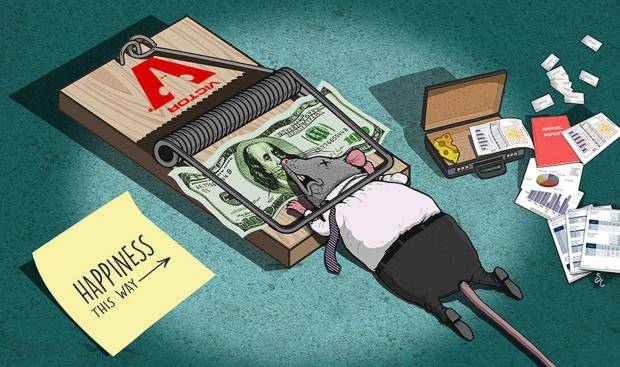
Illustrator Steve Cutts sets his latest animation, “Happiness,” in a teeming urban environment, with hundreds of near identical cartoon rats standing in for human drudges in an unfulfilling, and not unfamiliar race.
Packed subway cars, a bombardment of advertising, soul-deadening office jobs, and Black Friday sales are just a few of the indignities Cutts’ rodents are subjected to, to the tune of Bizet’s “L’amour est un oiseau rebelle.”
Rampant over-consumption—a major preoccupation for this artist—offers illusory relief, and a great deal of fun for viewers with the time to hit pause, to better savor the grim details.
The maximalist frames read like a gratifying perversion of Richard Scarry’s relentlessly sunny Busytown. As with Cutts’ 80s-throwback Simpson’s couch gag: pop-culture references and visual input whip by at subliminal warp speed.
They may also serve as an antidote to the sort of messaging we’re constantly on the receiving end of, whether we live in city, country or somewhere in-between. Check out the scene as Cutts pans up from the subway platform, 52 seconds in:
The panty-clad female model for Blah cologne’s fashionably black and white ad is emaciated nearly to the point of death.
“You’re better than laces” flatters the latest (laceless) shoe from a swoosh-bedecked footwear manufacturer, while a radiator-colored beverage floats above the motto “Just drink it, morons.”
Krispo Flakes fight depression with “the bits other cereals don’t want.”
Heaven help us all, there’s even a poster for TRUMP The Musical.
This freeze-frame scrutiny could make an excellent activity for any class where middle and high schoolers are encouraged to think critically about their role as consumers.
As Cutts, a one-time employee of the digital marketing agency, Isobar, who contributed to campaigns for such global giants as Coca-Cola, Google, Reebok, and Toyota, told Reverb Press in 2015:
These are things that affect us all on a fundamental level so naturally they’re a main focus for a lot of my work. Humanity has the power to be great in so many ways and yet at the same time we are fundamentally flawed. I think it’s the conflict between these two that fascinates me the most. As a race of beings we’ve made incredible achievements in such a short space, but at the same time we seem so overwhelmingly intent on destroying ourselves and everything around us. It would be very interesting to see where we’ll be in a hundred years. The term insanity is intriguing – it’s almost like we’re encouraged to act in a way that seems genuinely insane when you look at it objectively, but it’s often accepted as normal right now. I think we will have to evolve beyond our current thinking and way of doing things if we want to survive.
See more of Cutts’ animated work here. And while he doesn’t go out of his way to hype his online store, a gallery quality print of The Rat Trap would make a fantastic gift from your cubicle mate’s Secret Santa. (HURRY! TIME IS RUNNING OUT!!!)
Related Content:
The Employment: A Prize-Winning Animation About Why We’re So Disenchanted with Work Today
Bertrand Russell & Buckminster Fuller on Why We Should Work Less, and Live & Learn More
Charles Bukowski Rails Against 9‑to‑5 Jobs in a Brutally Honest Letter (1986)
Ayun Halliday is an author, illustrator, theater maker and Chief Primatologist of the East Village Inky zine. Follow her @AyunHalliday.
Read More...The Tree of Modern Art: Elegant Drawing Visualizes the Development of Modern Art from Delacroix to Dalí (1940)
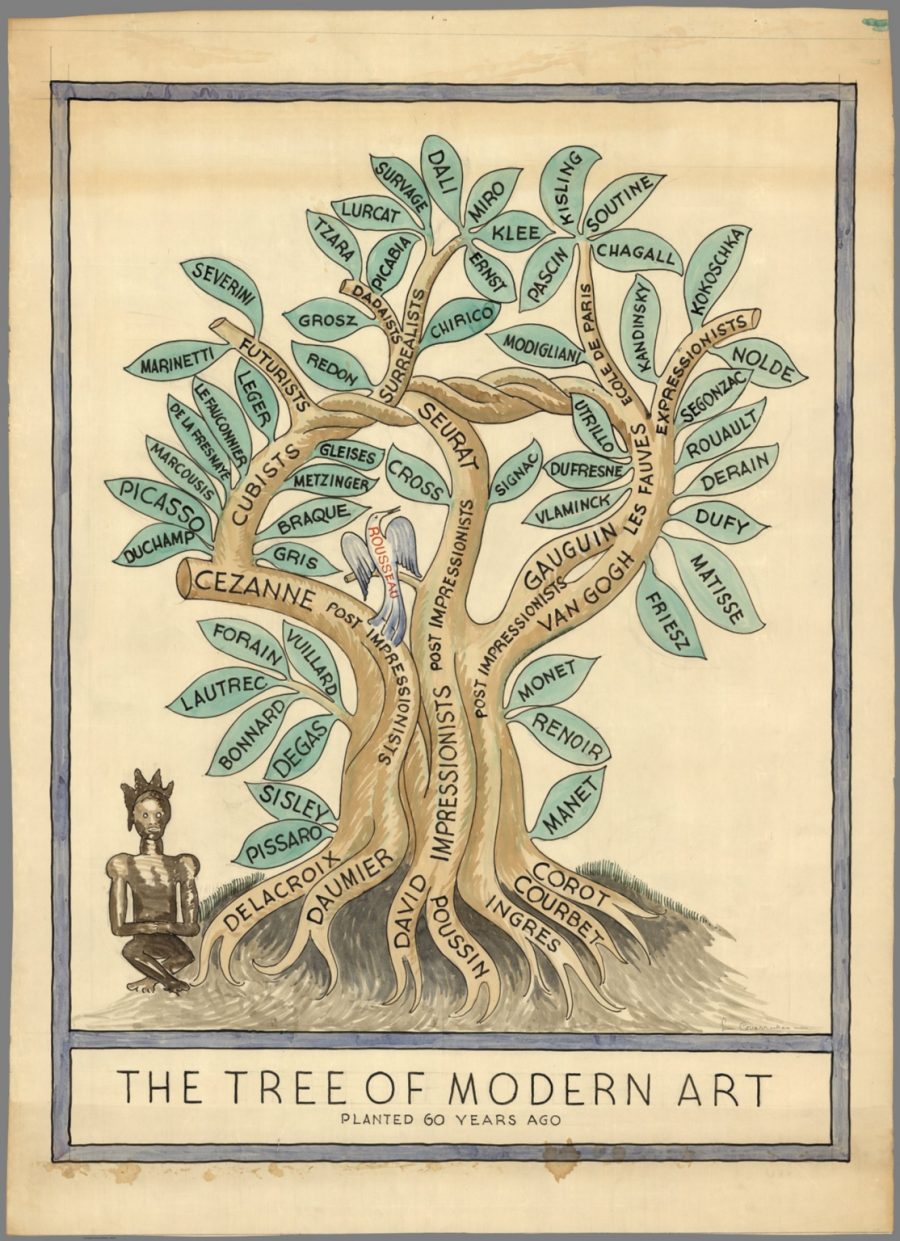
Selecting certain features, simplifying them, exaggerating them, and using them to provide a deep insight, at a glance, into the subject as a whole: such is the art of the caricaturist, one that Miguel Covarrubias elevated to another level in the early- to mid-20th century. Those skills, combined with his knowledge as an art historian, also served him well when he drew “The Tree of Modern Art.” This aesthetically pleasing diagram first appeared in Vanity Fair in May of 1933, a time when many readers of such magazines would have felt a great curiosity about how, exactly, all these new paintings and sculptures and such — many of which didn’t seem to look much like the paintings and sculptures they knew at all — related to one another.
“Because it stops in 1940, the tree fails to account for abstract expressionism and other post–World War II movements,” writes Vox’s Phil Edwards, in a piece that includes a version of the Covarrubias’ 1940 “Tree of Modern Art” revision with clickable examples of relevant artwork.
But “the organizational structure alone reveals a surprisingly large amount about the way art has evolved,” including how it “becomes broader and more inclusive over time,” eventually turning into a “global affair”; how “artistic schools have become more aesthetically diverse”; how “the canon evolved quickly”; and how “all art is intertwined,” created as it has so long been by artists who “work together, borrow from each other, and grow in tandem.”
You can also find the “Tree of Modern Art” at the David Rumsey Historical Map Collection, a holding that illustrates, as it were, just how wide a swath of information design the term “map” can encompass. “The date is estimated based on the verso of the paper being a blue lined base map of the National Park Service dated 12/28/39,” says the collection’s site. “This drawing was found in the papers of B. Ashburton Tripp” — also a mapmaker in the collection — “and we assume that Covarrubias and Tripp were friends (verified by Tripp’s descendants) and that the blue line base map was something Tripp was working on in his landscape architecture business.”
The legend describes the tree as having been “planted 60 years ago,” a number that has now passed 130. Many more leaves have grown off those branches of impressionism, expressionism, post-impressionism, surrealism, cubism, and futurism in the years since Covarrubias drew the tree, but for someone to go back and augment such a fully-realized creation wouldn’t do at all — as with any work of art, modern or otherwise.
Related Content:
The History of Modern Art Visualized in a Massive 130-Foot Timeline
The Guggenheim Puts Online 1600 Great Works of Modern Art from 575 Artists
Based in Seoul, Colin Marshall writes and broadcasts on cities and culture. His projects include the book The Stateless City: a Walk through 21st-Century Los Angeles and the video series The City in Cinema. Follow him on Twitter at @colinmarshall or on Facebook.
Read More...Underground Cartoonist Robert Crumb Creates an Illustrated Introduction to Franz Kafka’s Life and Work
The use of an author’s name as an adjective to describe some kind of general style can seem, well, lazy, in a wink-wink, “you know what I mean,” kind of way. One must leave it to readers to decide whether deploying a “Baldwinian” or a “Woolfian,” or an “Orwellian” or “Dickensian,” is justified. When it comes to “Kafkaesque,” we may find reason to consider abandoning the word altogether. Not because we don’t know what it means, but because we think it means what Kafka meant, rather than what he wrote. Maybe turning him into shorthand, “a clever reference,” writes Chris Barsanti, prepares us to seriously misunderstand his work.
The problem motivated author David Zane Mairowitz and underground comics legend Robert Crumb to create a graphic biography, first published in 1990 as Kafka for Beginners. “The book,” writes Barsanti of a 2007 Fantographics edition called Kafka, “states its case rather plain: ‘No writer of our time, and probably none since Shakespeare, has been so widely over-interpreted and pigeon holed… [Kafkaesque] is an adjective that takes on almost mythic proportions in our time, irrevocably tied to fantasies of doom and gloom, ignoring the intricate Jewish Joke that weaves itself through the bulk of Kafka’s work.’” Or, as Maria Popova puts it, “Kafka’s stories, however grim, are nearly always also… funny.”
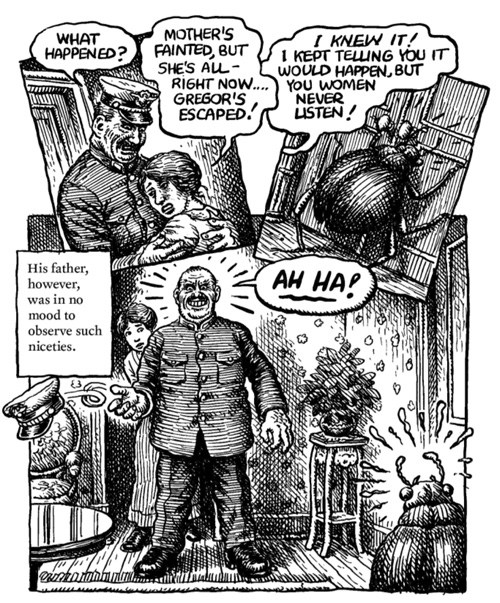
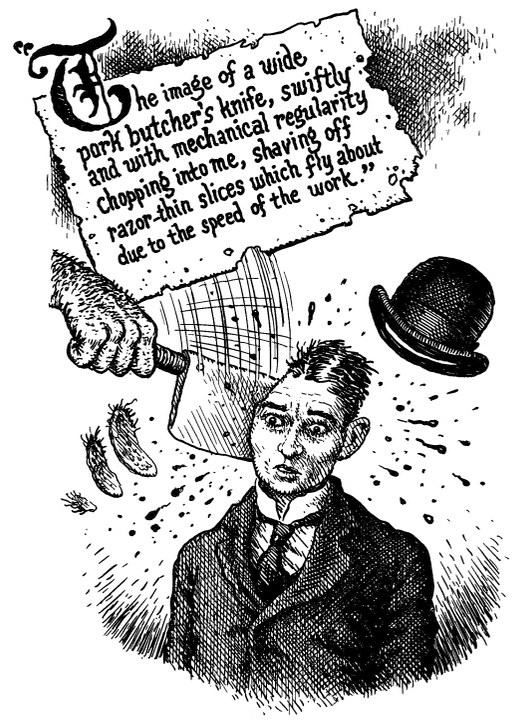
Much of that humor derives from “the author’s coping mechanisms amid Prague’s anti-Semitic cultural climate.” Mairowitz describes Kafka’s Jewish humor as “healthy anti-Semitism.… but sooner or later, even the most hateful of Jewish self-hatreds has to turn around and laugh at itself.” Crumb provides graphic illustrations of Kafka’s especially mordant, absurdist humor in adaptations of The Metamorphosis, A Hunger Artist, In the Penal Colony, and The Judgement and brief sketches from The Trial, The Castle, and Amerika. These illustrations draw out the grotesque nature of Kafka’s humor from the start, Barstanti notes, “with a gruesome graphic rendering of Kafka’s nightmares of his own death.”

Kafka’s self-violence leaps out at us in its incredible specificity, which can produce horrors, like the ghoulish execution of “In the Penal Colony,” and darkly funny fantasies like a “pork butcher’s knife” sending thin slices of Kafka flying around the room, “due to the speed of the work.” Turned into cold cuts, as it were. Crumb’s illustration (top), imagines this grisly joke with exquisite glee—halo of blood spurts like squiggly exclamation marks and bowler hat taking flight. Along with Mairowitz’s literary analysis and biographical detail, Crumb’s finely rendered illustrations make Kafka an “invaluable book,” Barsanti writes, one that gives Kafka “back his soul.”
One only wishes they had paid more attention to Kafka’s weird animal stories, some of the funniest he ever wrote. Stories like “Investigations of a Dog” and “In Our Synagogue” express with more vivid imagination and wicked humor Kafka’s profoundly ambivalent relationship to Judaism and to himself as a “tortured, gentle, cruel, and brilliant,” and yet very funny, outsider.
Related Content:
What Does “Kafkaesque” Really Mean? A Short Animated Video Explains
Robert Crumb Illustrates Philip K. Dick’s Infamous, Hallucinatory Meeting with God (1974)
Josh Jones is a writer and musician based in Durham, NC. Follow him at @jdmagness
Read More...500,000 Years of Humans Degrading Nature Captured in a Biting Three Minute Animation by Steve Cutts
English animator Steve Cutts has a knack for satirizing the excesses of modern society. Just watch his 2012 short animation “Man,” and you’ll see what I mean. In three short minutes, Cutts covers a lot of ground, documenting the rise of human civilization and its ever-escalating assault on nature and our natural resources. It’s funny. It’s biting. And it may give you pause as we gear up for Christmas, the apotheosis of American materialism.
If you would like to support the mission of Open Culture, consider making a donation to our site. It’s hard to rely 100% on ads, and your contributions will help us continue providing the best free cultural and educational materials to learners everywhere. You can contribute through PayPal, Patreon, and Venmo (@openculture). Thanks!
Related Content:
The Employment: A Prize-Winning Animation About Why We’re So Disenchanted with Work Today
Watch Glass Walls, Paul McCartney’s Case for Going Vegetarian
Read More...Hear Paul McCartney’s Experimental Christmas Mixtape: A Rare & Forgotten Recording from 1965
If you hear someone complaining about the scarcity of good Christmas music, you know they’re doing something wrong. As we pointed out a couple years back, you can keep a Christmas party going for hours upon hours with holiday classics and funky originals from James Brown, Johnny Cash, The Jackson 5, Dinah Washington, Willie Nelson, Ella Fitzgerald, The Beach Boys, Bob Dylan, Low, Bad Religion, Christopher Lee, The Ventures, and so much more besides.
And then there’s the Beatles, whom we wouldn’t ever think of as an acquired taste, but whose Christmas records may only appeal to a special kind of fan, one who appreciates, and perhaps remembers, the band’s aggressively cheerful spirit of marketing. Throughout the 60s, they made short, whimsical Christmas “flexi discs” for fan club members. These are amusing, but hardly essential, though I’d recommend putting 1967’s “Christmas Time (Is Here Again)” on any playlist, holiday or otherwise.
While the band made their light and breezy 1965 Christmas record, Paul McCartney undertook a decidedly different holiday solo side project—recording experimental tape loops at home, including, writes author Richie Unterberger, “singing, acting, and sketches.” Only “three copies were pressed, one each for John, George, and Ringo.” As McCartney himself described the recording, “I put together something crazy, something left field, just for the other Beatles, a fun thing which they could play late in the evening.”
You can hear what survives of the recording above. McCartney calls it “Unforgettable” and begins the disc in an American announcer’s voice, “a fast-talking New York DJ,” Rolling Stone writes, followed by Nat King Cole, then “an inventive selection of songs by the Rolling Stones, the Beach Boys, and Martha and the Vandellas.” McCartney described the project as “a magazine program: full of weird interviews, experimental music, tape loops” and “some tracks I knew the others hadn’t heard.”
Unfortunately, much of the experimentation has not survived, or made it to a digital format. Nonetheless, the tape “might be the earliest evidence of the Beatles using home recording equipment for specifically experimental/avant-garde purposes,” Unterberger notes, “something that John and Paul did in the last half of the 1960s, though John’s ventures in this field are more widely known than Paul’s.” It isn’t Christmas music, exactly, but when you put it on, you’ll know it began its life as a special mixtape McCartney made just for his bandmates, not the fans. We might think of it as the holiday album he really wanted to make.
via Dangerous Minds/Rolling Stone
Related Content:
David Bowie Sends a Christmas Greeting in the Voice of Elvis Presley
Josh Jones is a writer and musician based in Durham, NC. Follow him at @jdmagness
Read More...New Gabriel García Márquez Digital Archive Features More Than 27,000 Digitized Letters, Manuscript Pages, Photos & More
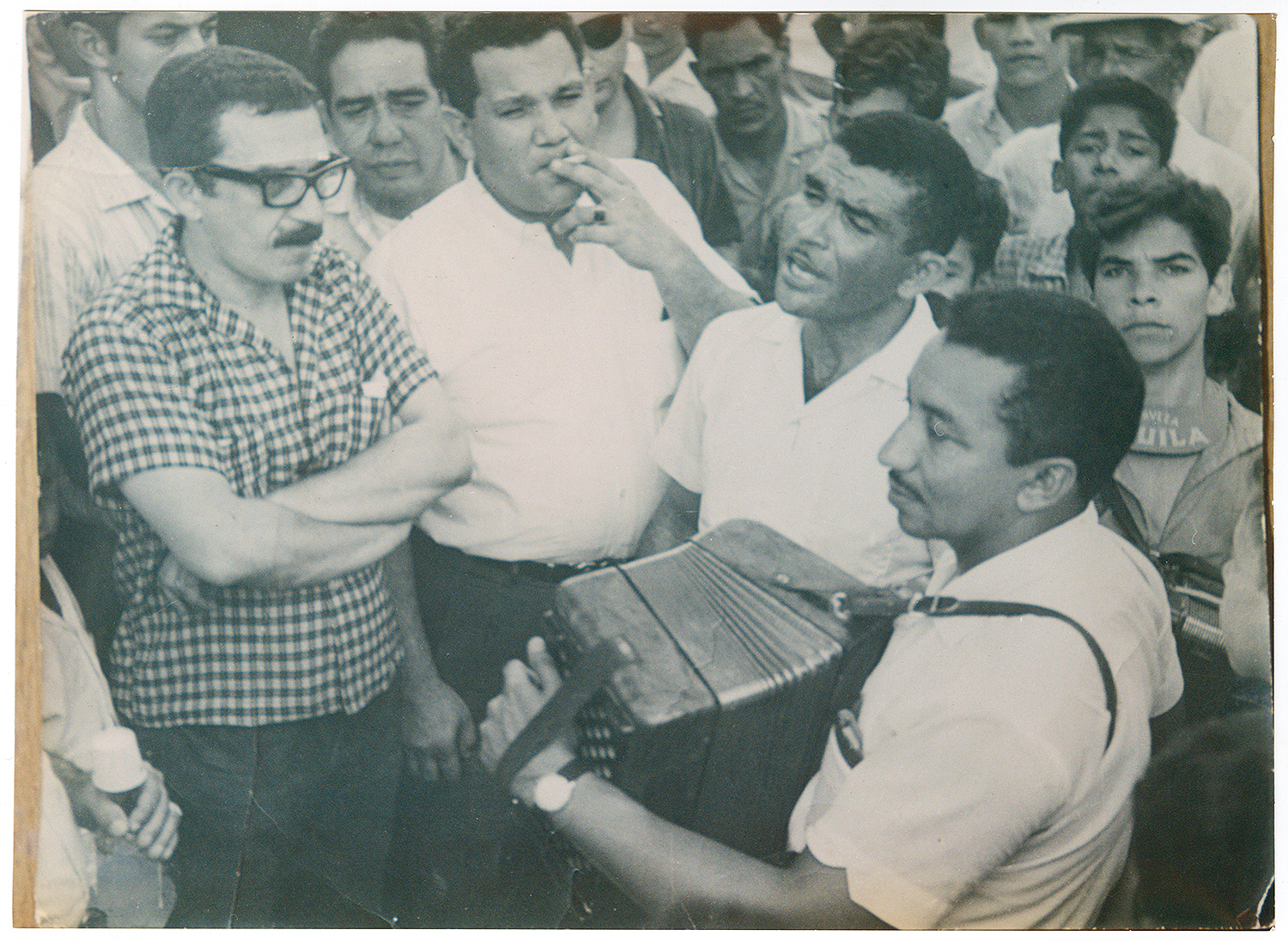
Unidentified photographer. Gabriel García Márquez in Aracataca, March 1966.
Courtesy Harry Ransom Center.
When Gabriel García Márquez died in 2014, it was said that only the Bible had sold more books in Spanish than the Colombian writer’s work: Love in the Time of Cholera, The Autumn of the Patriarch, Chronicle of a Death Foretold, The General in His Labyrinth… and yes, of course, One Hundred Years of Solitude, the 1967 novel William Kennedy described in a New York Times review as “the first piece of literature since the Book of Genesis that should be required reading for the entire human race.”
García Márquez began to hate such elevated praise. It raised expectations he felt he couldn’t fulfill after the enormous success of that incredibly brilliant, seemingly sui generis second novel. Everyone in South America read the book. To avoid the crowds, the author moved to Spain (where Mario Vargas Llosa wrote a doctoral dissertation on him). He needn’t have worried.
Everything he wrote afterward met with near-universal acclaim—bringing earlier work like No One Writes to the Colonel, Leaf Storm, short story collections like A Very Old Man with Enormous Wings, and decades of journalism and non-fiction writing—to a much wider readership than he’d ever had before.
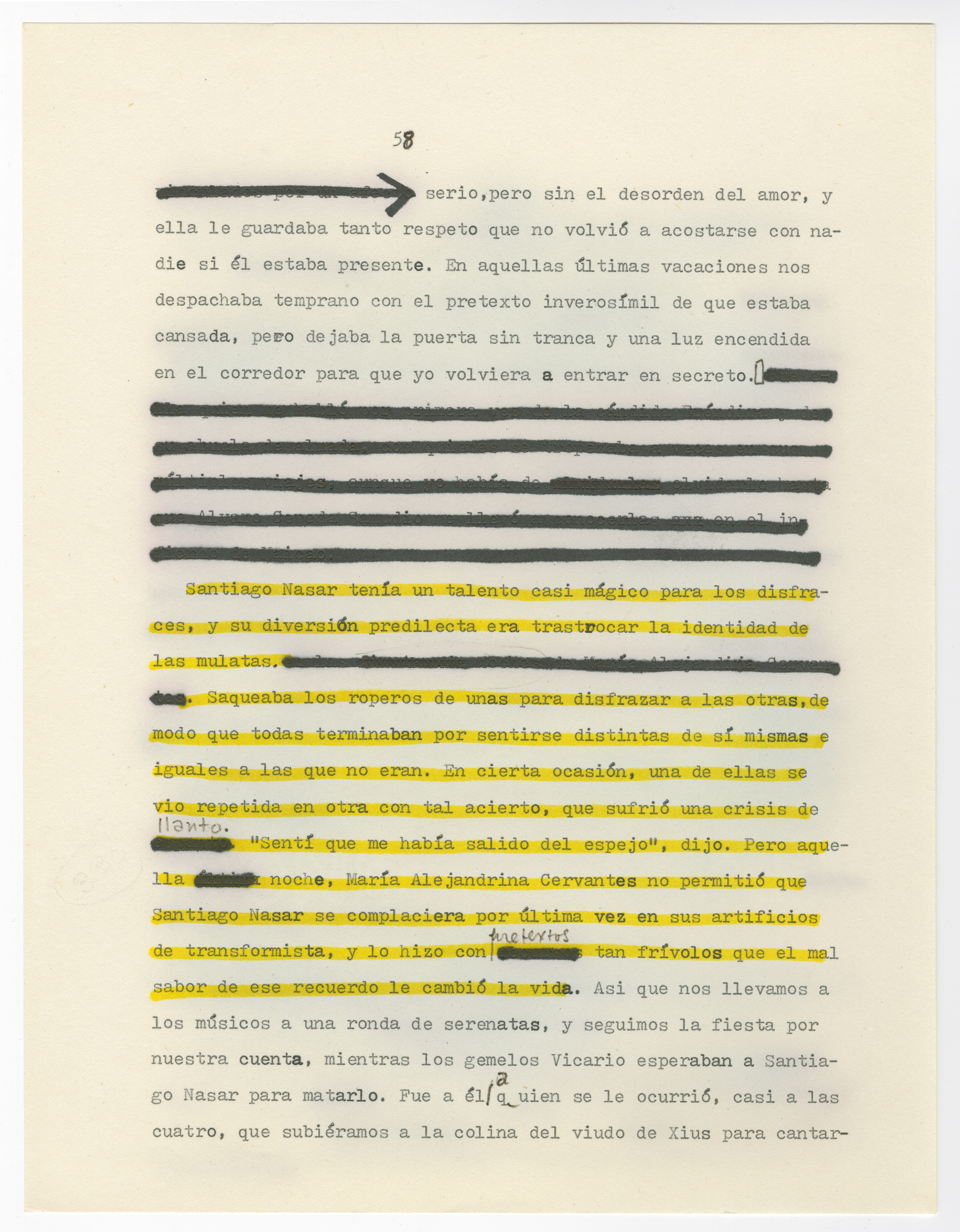
Gabriel García Márquez’s revised typescript of Chronicle of a Death Foretold, 1980.
Courtesy Harry Ransom Center.
After Gregory Rabassa’s 1970 translation of One Hundred Years of Solitude, waves of “magical realist” and Latin American literature from the 50s and 60s swept through the English-speaking world, much of it in translation for the first time. García Márquez declared the English version of his novel better than the original, and affectionately called Rabassa, “the best Latin American writer in the English language.” Upwards of 50 million people worldwide now know the story of the Buendía family. “Published in 44 languages,” The Atlantic notes, “it remains the most translated literary work in Spanish after Don Quixote, and a survey among international writers ranks it as the novel that has most shaped world literature over the past three decades.”
The story of the book’s composition is even more fascinating. In the Democracy Now tribute video below, you can hear García Márquez himself tell it. And at the University of Texas at Austin’s Harry Ransom Center, we can see artifacts like the photograph of the author at the top, in his hometown of Aracataca, Colombia in March of 1966, during the composition of One Hundred Years of Solitude. We can see scanned images of typescript like the page above from Chronicle of a Death Foretold.
In all, the archive “includes manuscript drafts of published and unpublished works, research material, photographs, scrapbooks, correspondence, clippings, notebooks, screenplays, printed material, ephemera, and an audio recording of García Márquez’s acceptance speech for the Nobel Prize in Literature in 1982… approximately 27,500 items from García Márquez’s papers.” These documents and photos, like that further down of young journalist García Márquez with Emma Castro and, just below, of the seasoned famous novelist, with her brother, tell the story of a writer who lived his life steeped in the politics and history of Latin America, and who translated those stories faithfully for the rest of the world.
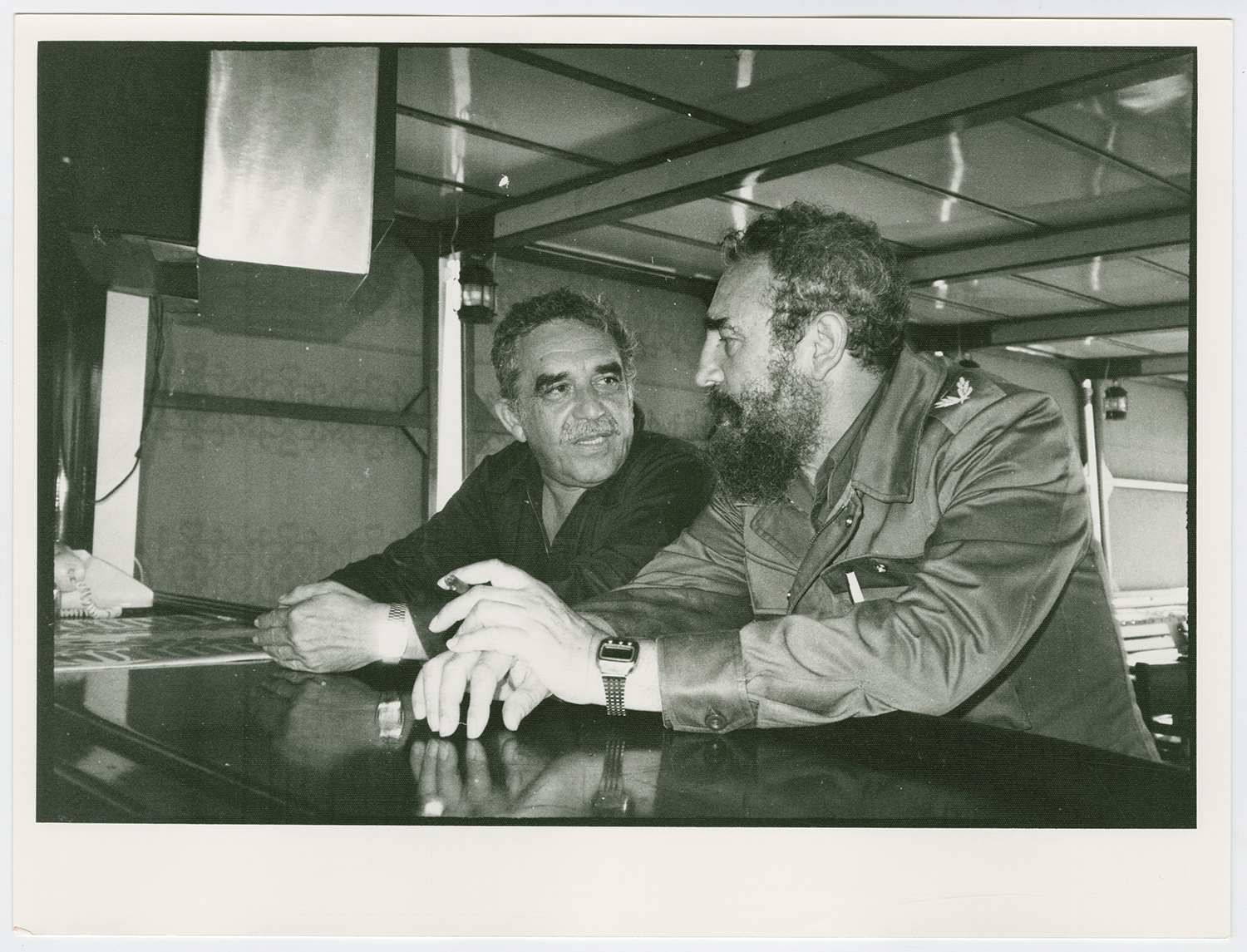
Unidentified photographer. Gabriel García Márquez with Fidel Castro, undated.
Courtesy Harry Ransom Center.
Enter, search, and explore the archive here. This amazing resource opens up to the general public a wealth of material previously only available to scholars and librarians. The project features “text-searchable English- and Spanish-language materials, took 18 months and involved the efforts of librarians, archivists, students, technology staff members and conservators.” Perhaps only coincidentally, 18 months is the time it took García Márquez to write One Hundred Years of Solitude, barricaded in his office while he ran out of money, pulled forward by some irresistible force. “I did not stop writing for a single day for 18 straight months, until I finished the book,” he tells us. As always, we believe him.
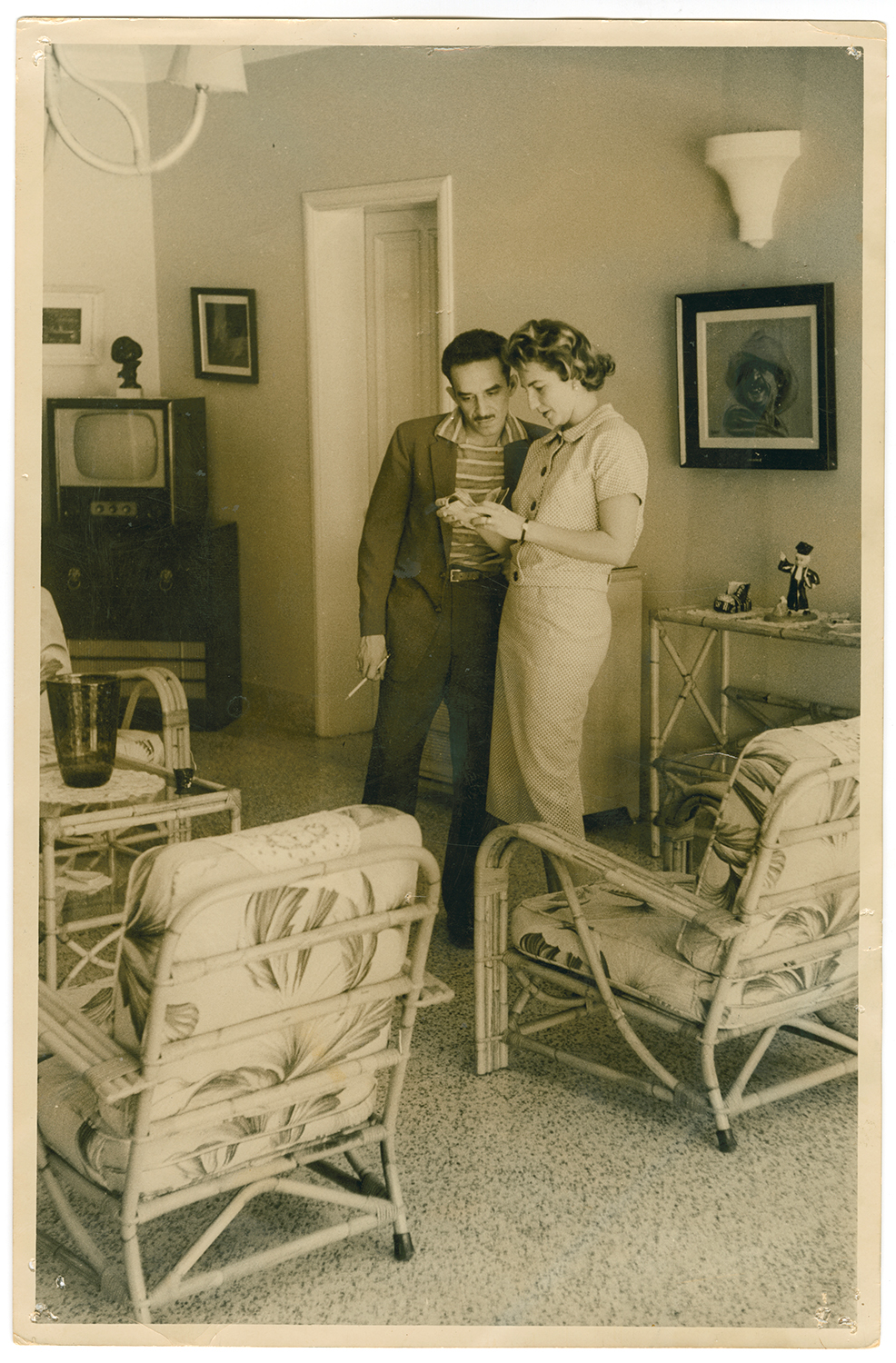
Unidentified photographer. Gabriel García Márquez with Emma Castro, 1957.
Courtesy Harry Ransom Center.
Related Content:
Read 10 Short Stories by Gabriel García Márquez Free Online (Plus More Essays & Interviews)
Josh Jones is a writer and musician based in Durham, NC. Follow him at @jdmagness
Read More...10 Reasons Why Hannibal’s Military Genius Still Captures Our Imagination Today
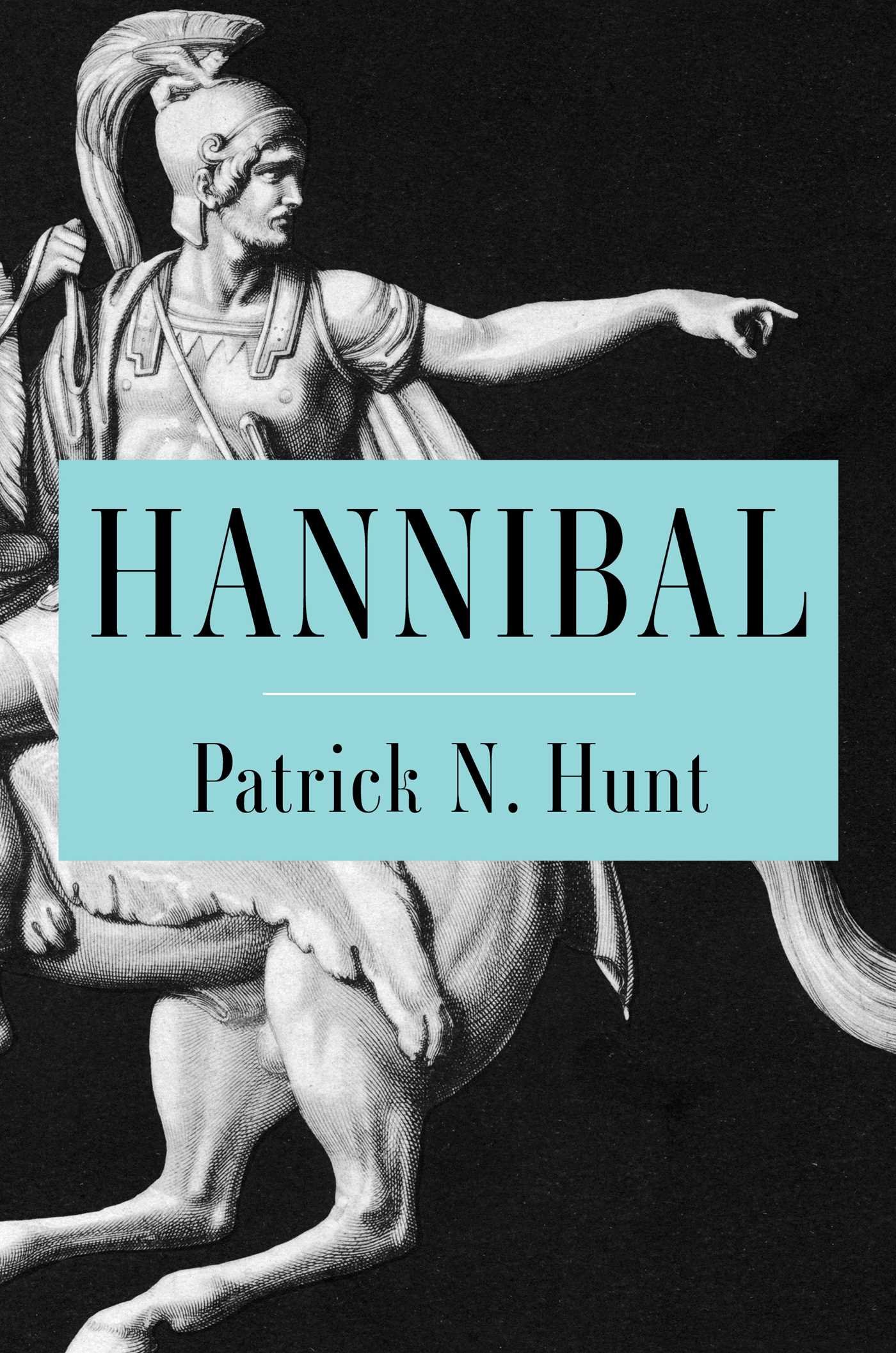
Note: This is a guest post from Patrick Hunt, author of the new book, Hannibal.
Hannibal Barca, otherwise simply known as Hannibal, lived and waged war over two thousand years ago – but is he still relevant in a world where the Romans are long gone? His famous crossing of the Alps in winter with an intrepid army and elephants is unforgettable, but are his brilliant maneuvers and intelligence gathering still worth examining? Despite the enigma of this great Carthaginian general being unable to preserve Carthage after him, Hannibal’s tactics and methods offer great lessons not only for military history but also for civilization at large. History reveals the Romans had a destiny of world conquest, but what is less well known is how much Hannibal changed the ways in which the Romans conducted the wars that eventually brought them Pax Romana, a peace often forged out of violence after a brutal expansion that killed and enslaved millions, including Carthage a century after Hannibal.
Before Hannibal, Rome was hemmed in by seas on almost all sides and could hardly expand except northward into Etruscan and Celtic territory; acquiring Sicily was Rome’s first step outside its mainland. But Hannibal forced Rome to fight a very different kind of war; his victories taught them how exploitable their military organization was, and he pressured Rome to change for survival. More relevant, while Hannibal didn’t invent spycraft, he seemingly used it more effectively than any other ancient general by his careful contingency planning. Hannibal set precedents for spy agencies and intelligence gathering and how to stage battles in any kind of terrain and weather–templates that current nations still study and follow. Every military academy today offers detailed classes and seminars on Hannibal’s tactics. I am frequently invited to lecture on Hannibal’s intelligence gathering in venues like the U.S. Naval War College, where classes are filled with Navy, Army, Marines, and Air Force officers along with representatives of the intelligence agencies. That is also why the National Geographic Society sponsored my Hannibal field research – sending me to every Hannibal battle site and to Carthage in Tunisia, along with Spain, France, Italy and even Turkey where Hannibal concluded his dramatic life — and also why Simon and Schuster published my biography Hannibal this summer. Here are some nuggets from 20 years of Hannibal fieldwork found in this new book.
- Hannibal studied his opponents very carefully, employing every means of gathering intelligence in enemy camps, including spies from allied populations who provisioned the Romans.
- When necessary, Hannibal paid for credible intelligence with silver supplied from mines in Carthaginian Spain; as long as that silver lasted to pay for good intel, he was unbeatable. Once Rome conquered Spain’s silver mines, Hannibal’s ability to gather and exploit such military intelligence was cut off. There is a direct correlation to Hannibal’s access to silver for intel or mercenary use and his brilliant victories.
- Hannibal usually went for the unpredictable surprise maneuver that had never been seen before, including crossing the Alps in winter and forcing the Romans to fight in the dead of winter and at night.
- Hannibal got into the minds of his enemies with psy-ops, exposing their weaknesses, triggering their anger and vanity, and making them fall into his traps; undermining the confidence of the Roman foot soldiers in big battles and paralyzing them with fear. Romans taught their children to fear Hannibal as the bogeyman – always warning in crises for centuries that “Hannibal is at the Gates”.
- Hannibal proved it’s not the size of your army but how well prepared it is. He epitomizes the old adage, “Better 10 men wisely led than 100 with a fool at the head.” Even if austere, Hannibal’s leadership was legendarily charismatic – he even slept with his men on the ground wrapped in a blanket. He taught his men the brutality of war with likely less PTSD than his enemies because he always prepared them with ideas like “fight or die.” Much later, Machiavelli even alluded to Hannibal in The Prince with the concept that it’s “better to be feared than loved.”
- Hannibal effectively used the most mobile units possible with his Numidian cavalry, often outflanking the Roman infantry on multiple campaigns, especially in his famous “double envelopment” or where he finished battles with ambushes from the rear where there was no escape.
- Because his armies were almost always smaller – especially after his difficult Alps crossing when he lost many soldiers – Hannibal augmented his arsenal with weapons of nature: forcing the Romans to cross the frozen Trebbia River, hiding his armies in the fog above Lake Trasimene, driving captured cattle with torches tied to their horns to fool the Romans into thinking he was on the move at night at Volturnus, making the Romans face the blinding dust and sand blowing from Africa at Cannae. He even confused the Romans at Cannae with some of his troops outfitted with captured Roman gear.
- Similarly, after studying terrain and topography, Hannibal always chose his battle sites when possible for the best possible advantage, especially constricting the larger Roman armies where they would be unable to outflank him and instead they would be hemmed in by rivers or hills, etc., also choosing terrain where he could hide ambushes in nearby forests.
- Hannibal sagely exploited the 2‑consul Roman alternating command rotated one day between an experienced military veteran and the next day with a political appointee populist leading. On at least three occasions, Hannibal annihilated the Romans on the days when fools were the supposed commanders. The following Roman generations learned the hard lesson from this and the Senate created a professional army commanded by veteran leadership. Eventually Rome also amped up its cavalry and became less dependent on infantry thanks to Hannibal.
- Hannibal taught his one formidable Roman opponent Scipio how to implement brilliant tactics, how to mine data from military intelligence and how to benefit from Spain’s mercenary silver to bribe the Numidians to abandon Carthage. Scipio – the only one to beat Hannibal — respected Hannibal more than any other Roman because he learned so much from him. It’s one of the great ironies in history that Hannibal is apparently more famous than Scipio, and it’s not only because of crossing the Alps with elephants: ultimately the Romans didn’t appreciate a victorious Scipio any more than the Carthaginians appreciated a victorious Hannibal. Hannibal will remain a profound enigma in that he could not ultimately win the war with Rome, yet he could win so many brilliant battles with incredibly memorable tactics still taught today.
The Roman book Stratagemata by Frontinus — a compilation of military stratagems — has more clever ruses of Hannibal than any other commander up to that time. Historic great commanders or officers who studied or emulated Hannibal include but are not limited to Julius Caesar, Belisarius, Charlemagne, Napoleon, Suvorov, Kutuzov, von Clausewitz, Montgomery, Liddell Hart, Rommel, Patton and Schwarzkopf, among many others. Even the term blitzkrieg alluded to Hannibal’s clan (Barca = “lightning”) and his rapid advance in his invasion of Italy.” So, of course, Hannibal is at least as relevant as any other memorable person in history, especially in a time of world chaos and rethinking strategic allegiances.
Postscript: Hannibal (Simon and Schuster 2017) has been acclaimed in reviews from The New York Times, Christian Science Monitor, Philadelphia Inquirer, Ancient History Encyclopedia, a starred Kirkus Review and many others, and also nominated in the Kirkus List of Best Nonfiction Books of 2017.
Read More...Support Us
We're hoping to rely on loyal readers, rather than erratic ads. Please click the Donate button and support Open Culture. You can use Paypal, Venmo, Patreon, even Crypto! We thank you!

About Us

Open Culture scours the web for the best educational media. We find the free courses and audio books you need, the language lessons & educational videos you want, and plenty of enlightenment in between.
Advertise With Us

FREE UPDATES!
GET OUR DAILY EMAIL
Get the best cultural and educational resources on the web curated for you in a daily email. We never spam. Unsubscribe at any time.
FOLLOW ON SOCIAL MEDIA

Open Culture editor Dan Colman scours the web for the best educational media. He finds the free courses and audio books you need, the language lessons & movies you want, and plenty of enlightenment in between.
Advertise With Us

