Academic Journal Devotes an Entire Issue to Prince’s Life & Music: Read and Download It for Free
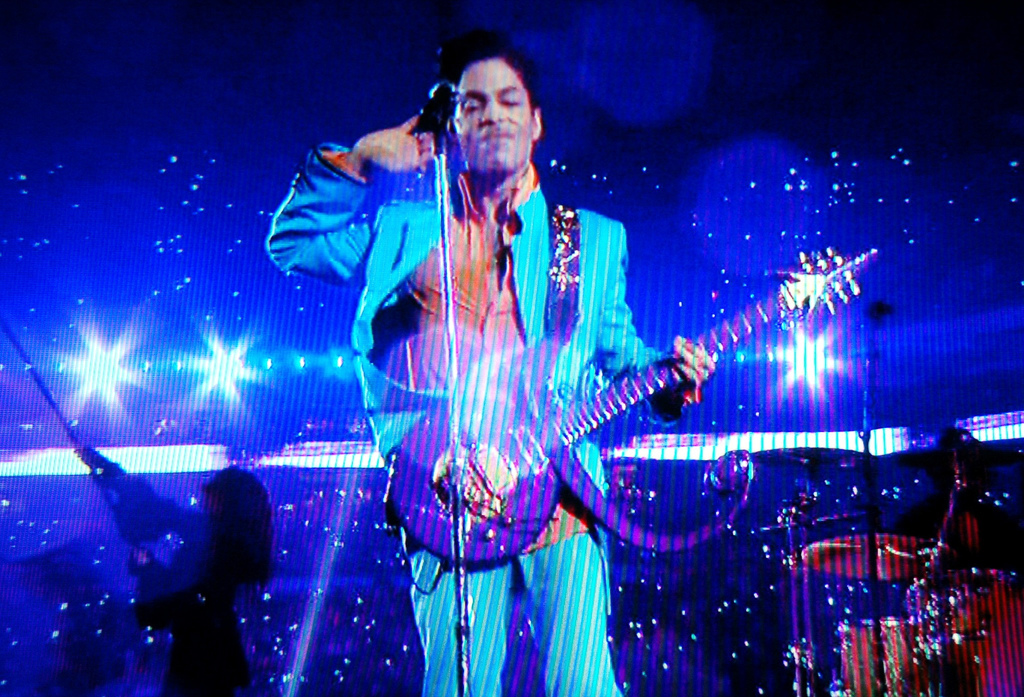
Image by Ann Althouse, via Flickr Commons
For decades now, academics have made popular culture a worthy area of study, from hip hop, comic books, and Hollywood film and television to video games and internet culture. And for just as long, there have been those who sneered at the disciplines emerging around pop culture studies. But really, what are we to do with someone like Prince, someone so clearly, profoundly, a musical genius, with such an outsized impact on popular culture, that he cannot help being a major historical figure just a year and a half after his death?
Devote an entire journal issue to him, of course, as the Journal of African American Studies did this past September. This is not, by far, Prince’s first appearance in a scholarly publication. And a slew of academic conferences devoted to the artist this past year has raised him to the academic status achieved by other megastars like Bruce Springsteen and Pink Floyd. This special journal issue, however, may be one of the most comprehensive collections of Prince scholarship you’re likely to find online. And unlike the majority of academic articles, these are all free. Just click the “Download PDF” link under each title found on this page.
The issue was published to coincide with the 40th anniversary of Prince’s signing with Warner Brothers in 1977, the day he “turned pro.” The following year, he released the debut album For You, to modest critical success. While it didn’t make him a star overnight, For You announced him as a virtuoso, “as Prince played every instrument and sang all the vocals, something unheard of, then and now.” Prince’s musical skill could be taken for granted. It is easy to do with an artist who reconfigured culture in so many ways that had nothing to do with playing guitar or piano.
Prince’s radical, if very complicated, redefinition of gender and cultural expression provides an example, writes Deirdre T. Guion Peoples, of “Optimal Distinctiveness,” in the way he “negotiated his social identity.” He lived an ardent, consistently utopian vision in his music and also in his life; and his “singular vision of utopia cast women as essential to its creation,” notes H. Zahra Caldwell. And Prince’s “creative practices,” James Gordon Williams argues, “were linked to his covert, but avid, support of social justice initiatives that support black humanity.”
These ten articles elaborate things we thought we knew about Prince, but maybe didn’t, and introduce us to aspects of his life and work we’ve never considered. They are joined by seven essays and personal reflections and two book reviews. Read online or download the special Prince issue here.
via @WFMU
Related Content:
Read Prince’s First Interview, Printed in His High School Newspaper (1976)
The Life of Prince in a 24-Page Comic Book: A New Release
Josh Jones is a writer and musician based in Durham, NC. Follow him at @jdmagness
Read More...Brian Eno Presents a Crash Course on How the Recording Studio Radically Changed Music: Hear His Influential Lecture “The Recording Studio as a Compositional Tool” (1979)
The rapid development of studio technology in the 1960s could seem like something of an avalanche, started, say, by Phil Spector, expanded by Brian Wilson, who spurred the Beatles and George Martin, who inspired dozens of artists to experiment in the studio, including Jimi Hendrix. By the time we get to the 70s it begins to seem like one man drives forward the progress of studio as instrument, Brian Eno—from his work with Robert Fripp, to the refinement of almost fully synthetic ambient music, to his groundbreaking work on David Bowie’s “Berlin Trilogy” and Talking Heads’ Remain in Light in 1980.
Eno called himself a “non-musician” who valued theory over practice. But we know this to be untrue. He’s a profoundly hypnotic, engaging composer, player, and even singer, as well as a virtuoso practitioner of the studio recording arts, which, by 1979, he had honed sufficiently to expound on in a lecture titled “The Recording Studio as a Compositional Tool.” By ’79, when Eno delivered the talk captured above at the Inaugural New Music American Festival in New York, he had already done so three times. In 1983, Down Beat magazine published the influential lecture (read it here).
Eno displays the critical acumen of Walter Benjamin in discussing the history and cultural significance of his art form, with philosophically punchy lines like his take on jazz: “the interesting thing about improvisations is that they become more interesting as you listen to them more times. What seemed like an almost arbitrary collision of events comes to seem very meaningful on relistening.” A very Eno-like observation, underlining his central thesis, which he delivers in a measured series of clauses to construct a sentence as long as some of his compositions, but one, nonetheless, with perfect clarity:
In this lecture, I want to indicate that recorded music, in certain of its aspects, is an entirely different art form from traditional music, and that the contemporary composer, people like me, those who work directly in relation to studios and multi-tracking and in relation to recording tape, are, in fact, engaged in a different, a radically different, business, from traditional composers.
How does Eno make his case? Recorded music substitutes the “space dimension” for the “time dimension,” and thus has a “detachable aspect,” it’s portable—and never more so than now. Eno seems to anticipate the current technological moment in 1979 when he says, “not only is the whole history of our music with us now, in some sense, on record, but the whole global musical culture is also available.” This results in a break with the European classical tradition as composers acquire “a culture unbounded, both temporally and geographically.”
Before the development of recording technology in the late 19th century, limitations of time and space ensured that every musical performance was a one of a kind event, over forever when it ended. In the 20th century, not only could recording engineers reproduce a performance infinitely, but with the medium of tape, they could cut, splice, rearrange, manipulate, and otherwise edit it together. With multi-tracking, they could create a unified whole from several disparate recordings, often from different times and places. And, as the audience for recorded music was a mass consumer market, popular musical tastes, to some extent, began to shift the kind of music that got made. (Eno has since expressed highly negative criticism of contemporary music that relies too heavily on studio technology.)
Eno begins rather drily, but once he gets going, the lecture becomes totally engrossing. He covers the mixing of Sly and the Family Stone’s Fresh, discusses Sly Dunbar and Lee “Scratch” Perry’s studio inventions, and those of his own Another Green World and Music for Airports. He offers a crash course on basic studio technology, and describes owning a recording of a recorded telephone message from Germany that sought apprehension of the Baader Meinhoff gang by playing a recording of one of their voices. He may be one of the most coolly dispassionate artists in modern popular music, but Brian Eno is never boring. Read a transcript of the lecture here.
Related Content:
Brian Eno Explains the Loss of Humanity in Modern Music
Brian Eno on Why Do We Make Art & What’s It Good For?: Download His 2015 John Peel Lecture
Josh Jones is a writer and musician based in Durham, NC. Follow him at @jdmagness
Read More...Stream 74 Sun Ra Albums Free Online: Decades of “Space Jazz” and Other Forms of Intergalactic, Afrofuturistic Musical Creativity
He was born Herman Poole Blount, but the many who appreciate his music and the otherworldly philosophy behind it know him only as Sun Ra. Or rather, they don’t just appreciate it but find themselves transported to other places by it, even places located far beyond this Earth. Often space, as the title of the 1975 Afrofuturist science-fiction film that stars Sun Ra states, is the place, and if you seek to take such an interstellar journey through jazz music yourself, doing so has become easier than ever: just steer your ship over to Bandcamp, where you can stream the music of Sun Ra and his ever-shifting “Arkestra” for free.
Since you’ll have no fewer than 74 albums to choose from, you might consider charting your voyage with Bandcamp Daily’s guide to Sun Ra and his Arkestra’s prolific and varied output.
It begins with his “Chicago Space Jazz” years in the 1950s, many of the recordings from which “sound a lot like jazz with traditional forms, rich ensemble writing, and plenty of swing,” but which already show such characteristic choices and tools as “peculiar intervals and juxtapositions, the newly-developed electric piano, lots of percussion, extra baritone sax, group shouts, and so forth,” as well as the influence of “exotica and mood music,” the Bible, “occult philosophy,” and cosmology.
The guide continues on to Sun Ra’s time in New York in the 1960s, where “the ‘space jazz’ or quirky hard-bop of the Arkestra’s Chicago days starts to morph, reflecting the new ‘free jazz’ ideas being developed literally all around them by Albert Ayler, Ornette Coleman, John Coltrane, and others.” This period culminates in The Magic City, “a nearly 28-minute tone poem, collectively improvised under Ra’s cues and direction, without preconceived themes; at times it is brooding and spare, at others it is full-on screeching saxophones.” Thereafter came a time of solo and small-group work, and then of mind-bending live performances that the Arkestra, under the direction of longtime saxophonist Marshall Allen, continues to put on to this day.
Sun Ra himself ascended to another plane almost a quarter-century ago, but if you believe the elaborate mythology that remains inseparable from his musical work, he still exists, in some form and in some galaxy, no doubt imagining new kinds of jazz that the mere human mind may never sufficiently evolve to comprehend. Streaming these dozens of albums that Sun Ra left us on this Earth, you may not immediately think to compare them with the music of David Bowie, but as far as 20th-century outer space-oriented self-reinventors go, those two are in a class of their own. As Blount became Sun Ra in the 1940s, so David Jones transformed from Ziggy Stardust into the Thin White Duke into Aladdin Sane in the 1970s. Both remained musical experimenters all their lives, as their discographies will always attest, but when Sun Ra reinvented himself, he stayed reinvented.
Stream Sun Ra’s albums at Bandcamp, and know that you can also purchase digital downloads of these albums (in MP3 and FLAC formats) for a reasonable price.
Related Content:
Hear Sun Ra’s 1971 UC Berkeley Lecture “The Power of Words”
Hear the One Night Sun Ra & John Cage Played Together in Concert (1986)
A Collection of Sun Ra’s Business Cards from the 1950s: They’re Out of This World
Based in Seoul, Colin Marshall writes and broadcasts on cities and culture. His projects include the book The Stateless City: a Walk through 21st-Century Los Angeles and the video series The City in Cinema. Follow him on Twitter at @colinmarshall or on Facebook.
Read More...The Future of Blues Is in Good Hands: Watch 12-Year-Old Toby Lee Trade Riffs with Chicago Blues Guitarist Ronnie Baker Brooks
Earlier this year, we highlighted some footage from 1989, showing then 12-year-old Joe Bonamassa wowing crowds and announcing his arrival on the blues scene. Years from now, we might look back in similar fashion at this footage of 12-year-old blues prodigy Toby Lee. Recorded last month at the Blues Heaven Festival in Denmark, this video features Lee trading riffs with Chicago blues guitarist Ronnie Baker Brooks. It runs a good five minutes–enough to convince you that the future of the blues is in good hands.
By the way, Toby has a Youtube channel where you can watch him evolve as a musician. Below, see one of his earlier clips, where, as a 9 or 10-year-old, he pounds out some Stevie Ray Vaughan in a cowboy hat and tiger suit.
Related Content:
Watch 12-Year-Old Joe Bonamassa Shred the Blues as He Opens for B.B. King in 1989
B.B. King Plays Live at Sing Sing Prison in One of His Greatest Performances (1972)
Read More...Depression & Melancholy: Animated Videos Explain the Crucial Difference Between Everyday Sadness and Clinical Depression
“Depression,” the TED-Ed video above informs us, “is the leading cause of disability in the world.” This may be a hard fact to swallow, the product, we might think, of pharmaceutical advertising. We all feel down from time to time, we think. “Then circumstances change, and those sad feelings disappear.” Isn’t it like this for everyone? It is not. “Clinical depression is different. It’s a medical disorder, and it won’t go away just because you want it to.”
Depression can linger for up to two weeks, and become so debilitating that sufferers cannot work or play. It interferes with important relationships and “can have a lot of different symptoms: a low mood, loss of interest in things you’d normally enjoy, changes in appetite, feeling worthless or excessively guilty,” restlessness and insomnia, or extreme lethargy, poor concentration, and possible thoughts of suicide. But surely we can hear a paid promotional voice when the narrator states, “If you have at least 5 of those symptoms, according to psychiatric guidelines, you qualify for a diagnosis of depression.”
What we don’t typically hear about in pharmaceutical ads are the measurable physiological changes depression writes in the brain, including decreased brain matter in the frontal lobe and atrophy of the hippocampus. These effects are measurable in humans and rats, in study after study after study. But while most of us know the names of a neurotransmitter or two these days, not even neuroscientists fully understand the biology of depression. They do know that some combination of medication, therapy, and, in extreme cases electroconvulsive treatment, can allow people to more fully experience life.
People in treatment will still feel “down” on occasion, just like everyone does. But depression, the explainer wants us to understand, should never be compared to ordinary sadness. Its effects on behavior and brain health are too wide-ranging, pervasive, persistent, and detrimental. These effects can be invisible, which adds to an unfortunate social stigma that dissuades people from seeking treatment. The more we talk about depression openly, rather than treating as it as a shameful secret, the more likely people at risk will be to seek help.
Just as depression cannot be alleviated by trivializing or ignoring it, the condition does not respond to being romanticized. While, indeed, many a famous painter, poet, actor, etc. has suffered from clinical depression—and made it a part of their art—their examples should not suggest to us that artists shouldn’t get treatment. Sadness is never trivial.
Unlike physical pain, it is difficult, for example, to pinpoint the direct causes of sadness. As the short video above demonstrates, the assumption that sadness is caused by external events arose relatively recently. The humoral system of the ancient Greeks treated all sadness as a biological phenomenon. Greek physicians believed it was an expression of black bile, or “melaina kole,” from which we derive the word “melancholy.” It seems we’ve come full circle, in a way. Ancient humoral theorists recommended nutrition, medical treatment, and physical exercise as treatments for melancholia, just as doctors do today for depression.
But melancholy is a much broader term, not a scientific designation; it is a collection of ideas about sadness that span thousands of years. Nearly all of those ideas include some sense that sadness is an essential experience. “If you’ve never felt melancholy,” the narrator says, “you’ve missed out on part of what it means to be human.” Thinkers have described melancholia as a precursor to, or inevitable result of, acquiring wisdom. One key example, Robert Burton’s 1621 text The Anatomy of Melancholy, “the apogee of Renaissance scholarship,” set the tone for discussions of melancholy for the next few centuries.
The scientific/philosophical/literary text argues, “he that increaseth wisdom, increaseth sorrow,” a sentiment the Romantic poets turned on its head. Before them came John Milton, whose 1645 poem Il Penseroso addresses melancholy as “thou Goddes, sage and holy… Sober, stedfast, and demure.” The deity Melancholy oversees the contemplative life and reveals essential truths through “Gorgeous Tragedy.”
One of the poem’s loftiest themes showed the way forward for the Romantics: “The poet who seeks to attain the highest level of creative expression must embrace the divine,” write Milton scholars Katherine Lynch and Thomas H. Luxon, “which can only be accomplished by following the path set out in Il Penseroso.” The divine, in this case, takes the form of sadness personified. Yet this poem cannot be read in isolation: its companion, L’Allegro, praises Mirth, and of sadness says, “Hence loathed Melancholy / Of Cerberus, and blackest midnight born, in Stygian Cave forlorn / ‘Mongst horrid shapes, and shrieks, and sights unholy.”
Rather than contradict each other, these two characterizations speak to the ambivalent attitudes, and vastly different experiences, humans have about sadness. Fleeting bouts of melancholy can be sweet, touching, and beautiful, inspiring art, music, and poetry. Sadness can force us to reckon with life’s unpleasantness rather than deny or avoid it. On the other hand, in its most extreme, chronically intractable forms, such as what we now call clinical depression, sadness can destroy our capacity to act, to appreciate beauty and learn important lessons, marking the critical difference between a universal existential condition and a, thankfully, treatable physical disease.
Related Content:
Stephen Fry on Coping with Depression: It’s Raining, But the Sun Will Come Out Again
Josh Jones is a writer and musician based in Durham, NC. Follow him at @jdmagness
Read More...Watch “The “Art of Flying,” a Short Film Capturing the Wondrous Murmurations of the Common Starling
In the tradition of Andrew Sullivan’s Dish, we start the week–before it even gets a bit hectic–with a Mental Health break. Above, watch The Art of Flying, Jan van Ijken’s short film that captures the mysterious flights–or murmurations–of the Common Starling. A blurb accompanying the film adds a bit more context:
It is still unknown how the thousands of birds are able to fly in such dense swarms without colliding. Every night the starlings gather at dusk to perform their stunning air show. Because of the relatively warm winter of 2014/2015, the starlings stayed in the Netherlands instead of migrating southwards. This gave filmmaker Jan van IJken the opportunity to film one of the most spectacular and amazing natural phenomena on earth.
Also, over at janvanijken.com, you’ll find a longer seven-minute version of this film, featuring “wonderful close-ups and a spectacular final scene.” The €2,99 fee for watching that full-length film goes toward supporting van Ijken’s work as an independent filmmaker.
Enjoy.
If you would like to support the mission of Open Culture, consider making a donation to our site. It’s hard to rely 100% on ads, and your contributions will help us continue providing the best free cultural and educational materials to learners everywhere. You can contribute through PayPal, Patreon, and Venmo (@openculture). Thanks!
Related Content:
A Stunning, Chance Encounter With Nature
The Falcon and the Murmuration: Nature’s Aerial Battle Above Rome
A Bird Ballet in Southern France
Read More...The Proof That Mel Blanc–the Voice Behind Bugs Bunny, Daffy Duck & Porky Pig–Was a Genius
Bugs Bunny is a talented mimic.
His effortless impersonations of the celebrities of his day are not always politic (see Al Jolson) but there’s no denying that his impressions of Liberace, Edgar G. Robinson, Bing Crosby, and Hollywood Bowl conductor Leopold Stokowski introduced these personages to subsequent generations.
Clearly he was not working alone. In the 1981 interview with David Letterman below, Mel Blanc, who voiced Bugs, Daffy Duck, Porky Pig, Foghorn Leghorn and many other animated favorites demonstrated his versatility.
Blanc shaped the characters from the get go, inventing voices for character sketches and storyboards, though it was clear to him that tough nut Bugs should have an equally tough accent — either Brooklyn or the Bronx. (Rather than split hairs, he invented a hybrid.)
Hank Azaria, who is as central to The Simpsons’ mythology as Blanc is to Warner Brothers, marvels (up top) at Blanc’s ability to mimic one character imitating another, as Bugs and Daffy Duck do above.
Regionalism steered many of Blanc’s most memorable creations, from Foghorn Leghon’s Texas drawl to French loverboy, Pepe Le Pew.
Nice Maurice Chevalier, Bugs…
Related Content:
The Strange Day When Bugs Bunny Saved the Life of Mel Blanc
Ayun Halliday is an author, illustrator, theater maker and Chief Primatologist of the East Village Inky zine. Follow her @AyunHalliday.
Read More...The “True Size” Maps Shows You the Real Size of Every Country (and Will Change Your Mental Picture of the World)

We all understand, on some level, that as adults we must go back and correct the oversimplifications we learned as schoolchildren. But for a sense of how large the scale of those quasi-truths, you must imagine the whole world: that is, you must imagine how you imagine the whole world, a mental picture probably taken straight from the map hung on the classroom wall. And the lines of that map came straight, in a sense, from the work of 16th-century cartographer Gerardus Mercator.
Though Mercator’s world-mapping method came as a revolution, it has also given generation after generation after generation very much the wrong idea about how big the world’s countries actually are. Mercator Projection, as Citymetric describes it, “re-imagines the earth as the surface of a cylinder.
When laid out flat, it’s pleasingly rectangular, and its eastern and western edges line up neatly.” But while “in reality, lines of longitude converge at the poles; on the map, they’re parallel. As a result, the closer you get to the poles, the more distorted the map becomes, and the bigger things look relative to their actual size.”
Hence the need for such re-imaginings of the world map as The True Size, “a website that lets you compare the size of any nation or US state to other land masses, by allowing you to move them around to anywhere else on the map.” Just search for any country in the box in the map’s upper-left corner, and that country’s borders will appear highlighted in color. When you click and drag those borders to another part of the world, specifically a part of the world at a different latitude, you’ll notice that the shape of the dragged country seems to deform.

But that appearance of distortion is only relative to the shapes and sizes we’ve long internalized from the Mercator map: when you move Australia up and it covers a third of Russia, or when you move the vast-looking Greenland down and it doesn’t even cover Argentina, you’re looking — perhaps for the first time — at a geographically accurate size comparison. Does that (to quote the humorless representative of the Organization of Cartographers for Social Equality in the West Wing episode cited as one inspiration for the True Size Map) blow your mind?
Explore the True Size Map here.

Related Content:
Japanese Designers May Have Created the Most Accurate Map of Our World: See the AuthaGraph
The History of Cartography, the “Most Ambitious Overview of Map Making Ever,” Now Free Online
New York Public Library Puts 20,000 Hi-Res Maps Online & Makes Them Free to Download and Use
Why Making Accurate World Maps Is Mathematically Impossible
Based in Seoul, Colin Marshall writes and broadcasts on cities and culture. His projects include the book The Stateless City: a Walk through 21st-Century Los Angeles and the video series The City in Cinema. Follow him on Twitter at @colinmarshall or on Facebook.
Read More...Meet Mandy Harvey, the Deaf Singer Songwriter Who Performs Barefoot & Feels the Music Through Vibrations in the Ground
Attractive young female singer-songwriters who shuck their shoes onstage sometimes find that this small attempt to pass themselves off as folksy and “real” has the opposite effect.
Mandy Harvey, however, is above reproach. The deaf singer-songwriter performs barefoot out of necessity, using her unclad soles to pick up on the vibrations of various instruments through the floorboards. It allows her to keep time and, in so doing, helps her to stay emotionally connected to the other musicians with whom she’s performing, as she told NPR earlier this year, when she was one of 10 finalists on America’s Got Talent.
“I’ll feel and concentrate on the drums through the floor, through my feet and then the bass through your chest,” she said in an interview with Colorado Public Radio. “And then if a saxophone player is next to me then it will be on my arm. So you just designate different parts of your body so you can concentrate on who’s playing what and when.”
Born with near perfect pitch and a connective tissue disorder that impaired her hearing, she was able to pursue her love of music by relying on hearing aids and lip reading until 18, when she finally lost her hearing for good, as a freshman Vocal Music Education major at Colorado State University.
While she has never heard fellow songbirds Adele or Taylor Swift, she has gotten over the stage fright that plagued her when she still retained some hearing. Vocally, she turns to muscle memory and visual tuners to see her through.
Her talent is such that some listeners are convinced her deafness is a publicity stunt, a misperception that eats at Wayne Connell, founder of the Invisible Disabilities Association, a non-profit with whom Harvey is active:
We’ve created an idea [of] how people are supposed to look when they’re broken and so when you don’t fit that imaginary mold, then it’s a trick, or you’re a liar — or you’re not really broken, so you shouldn’t be doing certain things.
See Harvey performing barefoot at the Kennedy Center on the 23rd anniversary of the Americans with Disabilities Act, below.
Related Content:
How Did Beethoven Compose His 9th Symphony After He Went Completely Deaf?
Ayun Halliday is an author, illustrator, theater maker and Chief Primatologist of the East Village Inky zine. Follow her @AyunHalliday.
Read More...Meet the Characters Immortalized in Lou Reed’s “Walk on the Wild Side”: The Stars and Gay Rights Icons from Andy Warhol’s Factory Scene
Lou Reed weathered his share of bad press in the decades after leaving one of the most influential bands in rock history—either for his famed irascibility or his spells of lackluster songwriting. Somehow, he always had a way of bouncing back, proving again and again his cultural relevance. For example, when it seemed like he had cashed in all his credibility with the godawful “Original Rapper” in the mid-eighties, he returned in 1989 with the gritty classic rock and roll of New York (and played the White House at the request of his longtime fan and friend Vaclav Havel). Reed was a true survivor of a downtown scene that claimed more casualties than it made stars, and he mostly made survival look pretty good.
When he released his first solo album after quitting the Velvet Underground in 1972, however, it seemed likely Reed was headed for obscurity. Lou Reed is mostly a great collection of (mostly overproduced) songs, “but it isn’t a terribly interesting” record, writes Mark Deming at Allmusic, “and it stands today more as a historical curiosity than anything else” for its early versions of songs like “Berlin.” Not so the follow-up, Transformer, an album boasting what may well be some of the best recordings Reed ever made, like “Perfect Day” and “Satellite of Love.” What made the difference? The influence of David Bowie, who produced with Mick Ronson, didn’t hurt one bit.
Transformer also happens to contain the only song that broke Reed “through to the mainstream,” notes the Polyphonic video above, the “rock classic” hit, “Walk on the Wild Side.” The song draws its narrative strength and its “incredibly subversive” nature from its subject: the 60s Factory scene surrounding Andy Warhol, which, in effect, made Lou Reed, Lou Reed when Warhol took the Velvet Underground under his wing. The song reminds us that Reed was at his strongest when he told the tales of his milieu, whether that be the world of junkies, hustlers, and sexual outsiders, or of fringe downtown artists unafraid to experiment with new identities and personas.
These were shared worlds, and Reed knew them well enough to capture them in a literary frame provided by Nelson Algren’s novel A Walk on the Wild Side (1956). Rather than create an adaptation of the book as he first intended, Reed wrote about six compelling Factory characters, “Superstars” in Warhol’s coterie, who embodied the edgy, courageous cool Reed made his theme. First up is Holly Woodlawn, a transgender woman who moved to New York from Miami to escape discrimination. Warhol discovered Woodlawn working the streets, and put her in films, “where she thrived,” the video notes, becoming “an important figure in LGBTQ history and, thanks to Lou Reed, in music history, too.”
The next verse introduces us to another important member of Warhol’s inner circle, Candy Darling, who was also transgender and a star of Warhol’s films, and who inspired not only “Walk on the Wild Side” but “Candy Says” and, quite possibly, the Kinks’ “Lola.” Darling is already familiar to those who know the Factory scene, as is the subject of the third vignette, Joe Dallesandro, whom Warhol turned into a cult star in films like Flesh, and who—unlike most of the Factory artists—actually achieved mainstream success, with roles in The Cotton Club and The Limey. (He also served as the crotch model on the cover of the Rolling Stones’ Sticky Fingers and the “topless torso” on the cover of The Smiths’ debut album.)
As the video outlines brief biographies of each “Walk on the Wild Side” muse, we see that Reed wasn’t only paying homage to his artistic community of origin, he also was also preserving a pantheon of cultural figures who were important to the gay rights movement in one way or another, as well as to the 60s Warhol aesthetic and the birth of glam rock in the 70s. “Walk on the Wild Side,” notes Polyphonic, “gives us a great little glimpse into a historical scene, and it helps us understand the people around Lou Reed that influenced the great artist he was.” Without a doubt, Reed’s most enduring work comes from his sympathetic portraits of the artists and hangers-on who made the world he wrote of so sexy, dangerous, complex, and intriguing.
Related Content:
Lou Reed Creates a List of the 10 Best Records of All Time
Lou Reed Sings “Sweet Jane” Live, Julian Schnabel Films It (2006)
Josh Jones is a writer and musician based in Durham, NC. Follow him at @jdmagness
Read More...Support Us
We're hoping to rely on loyal readers, rather than erratic ads. Please click the Donate button and support Open Culture. You can use Paypal, Venmo, Patreon, even Crypto! We thank you!

About Us

Open Culture scours the web for the best educational media. We find the free courses and audio books you need, the language lessons & educational videos you want, and plenty of enlightenment in between.
Advertise With Us

FREE UPDATES!
GET OUR DAILY EMAIL
Get the best cultural and educational resources on the web curated for you in a daily email. We never spam. Unsubscribe at any time.
FOLLOW ON SOCIAL MEDIA

Open Culture editor Dan Colman scours the web for the best educational media. He finds the free courses and audio books you need, the language lessons & movies you want, and plenty of enlightenment in between.
Advertise With Us

