How Josephine Baker Went From Homeless Street Performer to International Superstar, French Resistance Fighter & Civil Rights Hero
There has maybe never been a better time to critically examine the granting of special privileges to people for their talent, personality, or wealth. Yet, for all the harm wrought by fame, there have always been celebrities who use the power for good. The twentieth century is full of such figures, men and women of conscience like Muhamad Ali, Nina Simone, and Paul Robeson—extraordinary people who lived extraordinary lives. Yet no celebrity activist, past or present, has lived a life as extraordinary as Josephine Baker’s.
Born Freda Josephine McDonald in 1906 to parents who worked as entertainers in St. Louis, Baker’s early years were marked by extreme poverty. “By the time young Freda was a teenager,” writes Joanne Griffith at the BBC, “she was living on the streets and surviving on food scraps from bins.” Like every rags-to-riches story, Baker’s turns on a chance discovery. While performing on the streets at 15, she attracted the attention of a touring St. Louis vaudeville company, and soon found enormous success in New York, in the chorus lines of a string of Broadway hits.
Baker became professionally known, her adopted son Jean-Claude Baker writes in his biography, as “the highest-paid chorus girl in vaudeville.” A great achievement in and of itself, but then she was discovered again at age 19 by a Parisian recruiter who offered her a lucrative spot in a French all-black revue. “Baker headed to France and never looked back,” parlaying her nearly-nude danse sauvage into international fame and fortune. Topless, or nearly so, and wearing a skirt made from fake bananas, Baker used stereotypes to her advantage—by giving audiences what they wanted, she achieved what few other black women of the time ever could: personal autonomy and independent wealth, which she consistently used to aid and empower others.
Throughout the 20s, she remained an archetypal symbol of jazz-age art and entertainment for her Folies Bergère performances (see her dance the Charleston and make comic faces in 1926 in the looped video above). In 1934, Baker made her second film Zouzou (top), and became the first black woman to star in a major motion picture. But her sly performance of a very European idea of African-ness did not go over well in the U.S., and the country she had left to escape racial animus bared its teeth in hostile receptions and nasty reviews of her star Broadway performance in the 1936 Ziegfeld Follies (a critic at Time referred to her as a “Negro wench”). Baker turned away from America and became a French citizen in 1937.
American racism had no effect on Baker’s status as an international superstar—for a time perhaps the most famous woman of her age and “one of the most popular and highest-paid performers in Europe.” She inspired modern artists like Picasso, Hemingway, E.E. Cummings, and Alexander Calder (who sculpted her in wire). When the war broke out, she hastened to work for the Red Cross, entertaining troops in Africa and the Middle East and touring Europe and South America. During this time, she also worked as a spy for the French Resistance, transmitting messages written in invisible ink on her sheet music.
Her massive celebrity turned out to be the perfect cover, and she often “relayed information,” the Spy Museum writes, “that she gleaned from conversations she overheard between German officers attending her performances.” She became a lieutenant in the Free French Air Force and for her efforts was awarded the Croix de Guerre and the Medal of the Resistance by Charles De Gaulle and lauded by George S. Patton. Nonetheless, many in her home country continued to treat her with contempt. When she returned to the U.S. in 1951, she entertained huge crowds, and dealt with segregation “head –on,” writes Griffith, refusing “to perform in venues that would not allow a racially mixed audience, even in the deeply divided South.” She became the first person to desegregate the Vegas casinos.
But she was also “refused admission to a number of hotels and restaurants.” In 1951, when employees at New York’s Stork Club refused to serve her, she charged the owner with discrimination. The Stork club incident won her the lifelong admiration and friendship of Grace Kelly, but the government decided to revoke her right to perform in the U.S., and she ended up on an FBI watch list as a suspected communist—a pejorative label applied, as you can see from this declassified 1960 FBI report, with extreme prejudice and the presumption that fighting racism was by default “un-American.” Baker returned to Europe, where she remained a superstar (see her perform a medley above in 1955).
She also began to assemble her infamous “Rainbow Tribe,” twelve children adopted from all over the world and raised in a 15th-century chateau in the South of France, an experiment to prove that racial harmony was possible. She charged tourists money to watch the children sing and play, a “little-known chapter in Baker’s life” that is also “an uncomfortable one,” Rebecca Onion notes at Slate. Her estate functioned as a “theme park,” writes scholar Matthew Pratt Guterl, a “Disneyland-in-the-Dordogne, with its castle in the center, its massive swimming pool built in the shape of a “J” for its owner, its bathrooms decorated like an Arpège perfume bottle, its hotels, its performances, and its pageantry.” These trappings, along with a menagerie of exotic pets, make us think of modern celebrity pageantry.
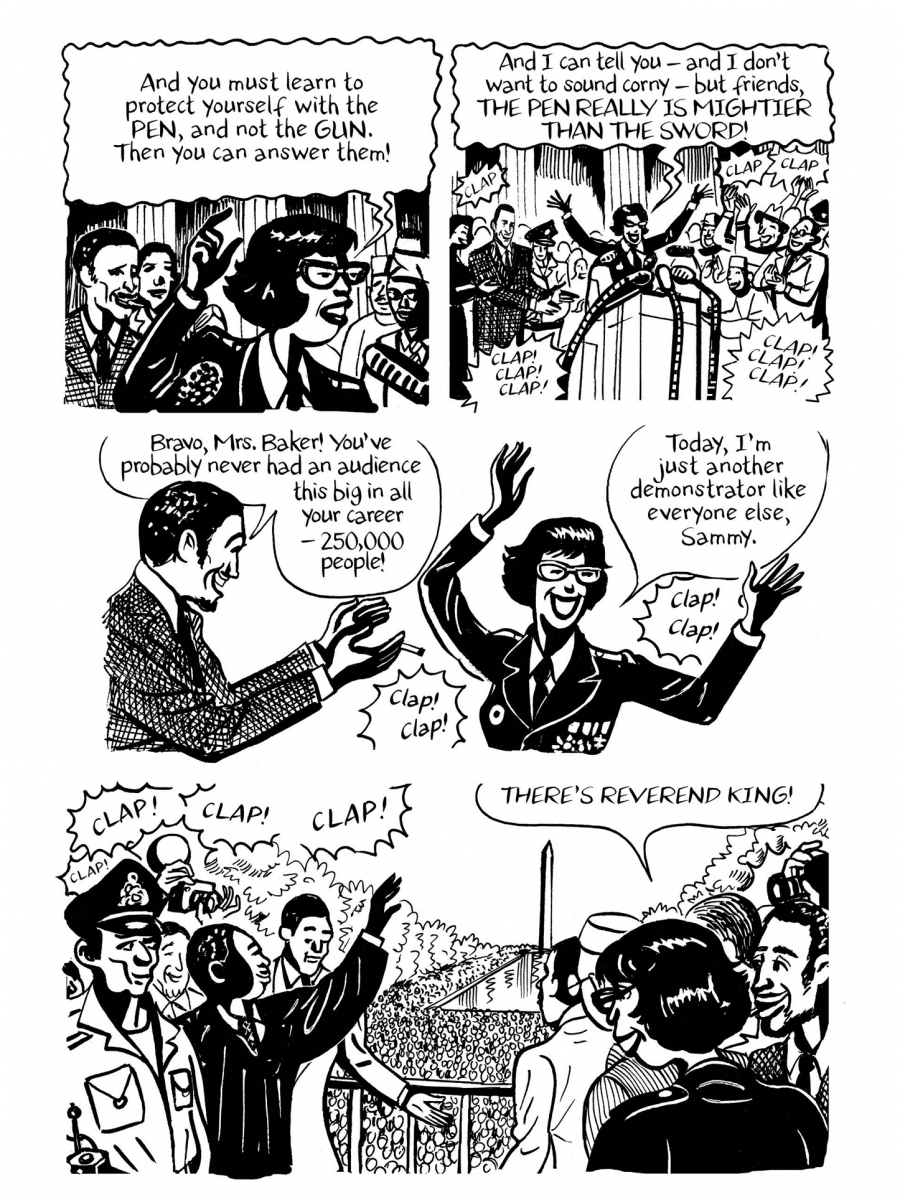
But for all its strange excesses, Guturl maintains, her “idiosyncratic project was in lockstep with the mainstream Civil Rights Movement.” She wouldn’t return to the States until 1963, with the help of Attorney General Robert Kennedy, and when she did, it was as a guest of Martin Luther King, Jr. and the organizers of the March on Washington, where, in her Free French Air Force uniform, she became the only woman to address the crowd. The visual recounting of that moment above comes from a new 600-page graphic biography that follows Baker’s “trajectory from child servant in St. Louis,” PRI writes, “to her days as a vaudeville performer, a major star in France, and later, a member of the French Resistance and an American civil rights activist.”
In her speech, she directly confronted the government who had turned her into an enemy:
They thought they could smear me, and the best way to do that was to call me a communist. And you know, too, what that meant. Those were dreaded words in those days, and I want to tell you also that I was hounded by the government agencies in America, and there was never one ounce of proof that I was a communist. But they were mad. They were mad because I told the truth. And the truth was that all I wanted was a cup of coffee. But I wanted that cup of coffee where I wanted to drink it, and I had the money to pay for it, so why shouldn’t I have it where I wanted it?
Baker made no apologies for her wealth and fame, but she also took every opportunity, even if misguided at times, to use her social and financial capital to better the lives of others. Her plain-speaking demands opened doors not only for performers, but for ordinary people who could look to her as an example of courage and grace under pressure into the 1970s. She continued to perform until her death in 1975. Just below, you can see rehearsal footage and interviews from her final performance, a sold-out retrospective.
The opening night audience included Sophia Lauren, Mick Jagger, Shirley Bassey, Diana Ross, and Liza Minelli. Four days after the show closed, Baker was found dead in her bed at age 68, surrounded by rave reviews of her performance. Her own assessment of her five-decade career was distinctly modest. Earlier that year, Baker told Ebony magazine, “I have never really been a great artist. I have been a human being that has loved art, which is not the same thing. But I have loved and believed in art and the idea of universal brotherhood so much, that I have put everything I have into them, and I have been blessed.” We might not agree with her critical self-evaluation, but her life bears out the strength and authenticity of her convictions.
Related Content:
Women of Jazz: Stream a Playlist of 91 Recordings by Great Female Jazz Musicians
James Baldwin Bests William F. Buckley in 1965 Debate at Cambridge University
Josh Jones is a writer and musician based in Durham, NC. Follow him at @jdmagness
Read More...“Try Again. Fail Again. Fail Better”: How Samuel Beckett Created the Unlikely Mantra That Inspires Entrepreneurs Today
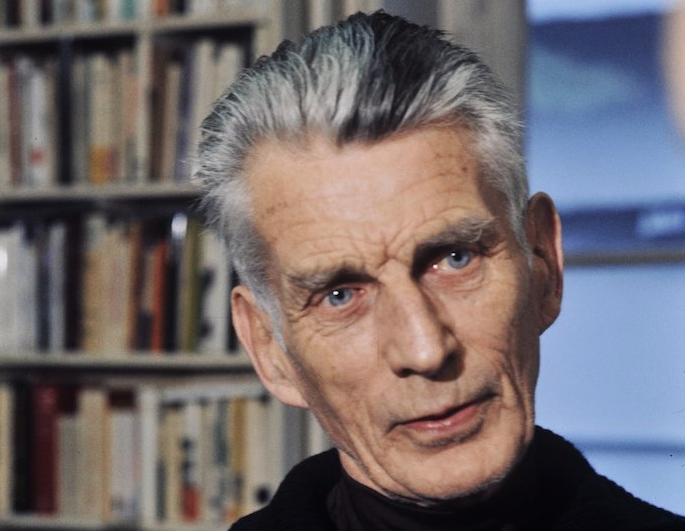
Image by the Bibliothèque nationale de France, via Wikimedia Commons
To what writer, besides Ayn Rand, do the business-minded techies and tech-minded businessmen of 21st-century Silicon Valley look for their inspiration? The name of Samuel Beckett may not, at first, strike you as an obvious answer — unless, of course, you know the origin of the phrase “Fail better.” It appears five times in Beckett’s 1983 story “Worstward Ho,” the first of which goes like this: “Ever tried. Ever failed. No matter. Try again. Fail again. Fail better.” The sentiment seems to resonate naturally with the mentality demanded by the world of tech startups, where nearly every venture ends in failure, but failure which may well contain the seeds of future success.
Or rather, the apparent sentiment resonates. “By itself, you can probably understand why this phrase has become a mantra of sorts, especially in the glamorized world of overworked start-up founders hoping against pretty high odds to make it,” writes Books on the Wall’s Andrea Schlottman.
“We think so, too. That is, until you read the rest of it.” The paragraph immediately following those much-quoted lines runs as follows:
First the body. No. First the place. No. First both. Now either. Now the other. Sick of the either try the other. Sick of it back sick of the either. So on. Somehow on. Till sick of both. Throw up and go. Where neither. Till sick of there. Throw up and back. The body again. Where none. The place again. Where none. Try again. Fail again. Better again. Or better worse. Fail worse again. Still worse again. Till sick for good. Throw up for good. Go for good. Where neither for good. Good and all.
“Throw up for good” — a rich image, certainly, but perhaps not as likely to get you out there disrupting complacent industries as “Fail better,” which The New Inquiry’s Ned Beauman describes as “experimental literature’s equivalent of that famous Che Guevara photo, flayed completely of meaning and turned into a successful brand with no particular owner. ‘Worstward Ho’ may be a difficult work that resists any stable interpretation, but we can at least be pretty sure that Beckett’s message was a bit darker than ‘Just do your best and everything is sure to work out ok in the end.’
But if Beckett’s words don’t provide quite the cause for optimism we thought they did, the story of his life actually might. “Beckett had already experienced plenty of artistic failure by the time he developed it into a poetics,” writes Chris Power in The Guardian. “No one was willing to publish his first novel, Dream of Fair to Middling Women, and the book of short stories he salvaged from it, More Pricks Than Kicks (1934), sold disastrously.” And yet today, even those who’ve never read a page of his work — indeed, those who’ve never even read the “Fail better” quote in full — acknowledge him as one of the 20th century’s greatest literary masters. Still, we have good cause to believe that Beckett himself probably regarded his own work as, to one degree or another, a failure. Those of us who revere it would do well to remember that, and maybe even to draw some inspiration from it.
Related Content:
Start Your Day with Werner Herzog Inspirational Posters
Based in Seoul, Colin Marshall writes and broadcasts on cities and culture. His projects include the book The Stateless City: a Walk through 21st-Century Los Angeles and the video series The City in Cinema. Follow him on Twitter at @colinmarshall or on Facebook.
Read More...The Periodic Table of Endangered Elements: Visualizing the Chemical Elements That Could Vanish Before You Know It

The Periodic Table of Elements lists the 118 chemical elements that make up everything in our world. Some you’re familiar with–Hydrogen, Oxygen, Nitrogen, etc. Others maybe less so–Vanadium, Germanium and Yttrium.
According to the American Chemical Society, 44 of those 118 elements might disappear by century’s end. Enter the Periodic Table of Endangered Elements (shown above). The most endangered ones, highlighted in red, are Zinc, Gallium, Germanium, Arsenic (is this a good or very bad thing?), Silver, Indium, Tellurium, and Hafnium. Made available under a Creative Commons license, the Periodic Table of Endangered Elements can be viewed in a larger format here.
If you would like to support the mission of Open Culture, consider making a donation to our site. It’s hard to rely 100% on ads, and your contributions will help us continue providing the best free cultural and educational materials to learners everywhere. You can contribute through PayPal, Patreon, and Venmo (@openculture). Thanks!
Related Content:
The Periodic Table of Elements Scaled to Show The Elements’ Actual Abundance on Earth
Periodic Table Battleship!: A Fun Way To Learn the Elements
“The Periodic Table Table” — All The Elements in Hand-Carved Wood
World’s Smallest Periodic Table on a Human Hair
“The Periodic Table of Storytelling” Reveals the Elements of Telling a Good Story
Chemistry on YouTube: “Periodic Table of Videos” Wins SPORE Prize
Free Online Chemistry Courses
Read More...How Scientology Works: A Primer Based on a Reading of Paul Thomas Anderson’s Film, The Master
Paul Thomas Anderson’s The Master focuses, with almost unbearable intensity, on two characters: Joaquin Phoenix’s impulsive ex-sailor Freddie Quell, and Philip Seymour Hoffman’s Lancaster Dodd, “the founder and magnetic core of the Cause — a cluster of folk who believe, among other things, that our souls, which predate the foundation of the Earth, are no more than temporary residents of our frail bodily housing,” writes The New Yorker’s Anthony Lane in his review of the film. “Any relation to persons living, dead, or Scientological is, of course, entirely coincidental.”
Before The Master came out, rumor built up that the film mounted a scathing critique of the Church of Scientology; now, we know that it accomplishes something, par for the course for Anderson, much more fascinating and artistically idiosyncratic.
Few of its gloriously 65-millimeter-shot scenes seem to have much to say, at least directly, about Scientology or any other system of thought. But perhaps the most memorable, in which Dodd, having discovered Freddie stown away aboard his chartered yacht, offers him a session of “informal processing,” does indeed have much to do with the faith founded by L. Ron Hubbard — at least if you believe the analysis of Evan Puschak, better known as the Nerdwriter, who argues that the scene “bears an unmistakable reference to a vital activity within Scientology called auditing.”
Just as Dodd does to Freddie, “the auditor in Scientology asks questions of the ‘preclear’ with the goal of ridding him of ‘engrams,’ the term for traumatic memory stored in what’s called the ‘reactive mind.’ ” By thus “helping the preclear relive the experience that caused the trauma,” the auditor accomplishes a goal that, in a clip Puschak includes in the essay, Hubbard lays out himself: to “show a fellow that he’s mocking up his own mind, therefore his own difficulties; that he is not completely adrift in, and swamped by, a body.” Scientological or not, such notions do intrigue the desperate, drifting Freddie, and although the story of his and Dodd’s entwinement, as told by Anderson, still divides critical opinion, we can say this for sure: it beats Battlefield Earth.
Related Content:
When William S. Burroughs Joined Scientology (and His 1971 Book Denouncing It)
Space Jazz, a Sonic Sci-Fi Opera by L. Ron Hubbard, Featuring Chick Corea (1983)
Based in Seoul, Colin Marshall writes and broadcasts on cities and culture. His projects include the book The Stateless City: a Walk through 21st-Century Los Angeles and the video series The City in Cinema. Follow him on Twitter at @colinmarshall or on Facebook.
Read More...The Case for Why Kraftwerk May Be the Most Influential Band Since the Beatles
They are performance artists of self-parody—four stiff Teutonic robots (sometimes played by actual robots), standing behind drum machines and sequencers, pushing buttons and singing things like “Wir fahr’n fahr’n fahr’n auf der Autobahn” and “it’s more fun to compute.” As if the Beach Boys had been reimagined from broken memory by German androids thousands of years in the future. Onstage, they match or exceed the commitment of later musical-theatrical acts they inspired like the Blue Man Group. Kraftwerk may be the most German of contributions to popular culture since Wagner.
For all their computerized industrial campiness, they really did come from the future, or they either anticipated or invented it, depending on your point of view. Kraftwerk (meaning “power station”) “essentially created the sonic blueprint from which the British new romantic and techno-pop movements arose, and provided the essential technology for much of hip-hop,” writes the Trouser Press Record Guide.
In addition to birthing Depeche Mode and Soft Cell’s synth pop and the smooth robo-funk of Afrika Bambaataa’s seminal “Planet Rock,” the band built the architecture of post-punk, techno, acid house, and Britpop with their experiments throughout the 70s and 80s, including the infamous “Autobahn.”
Kraftwerk began as two long-haired students, Ralf Hütter and Florian Schneider, who met in Dusseldorf in 1969, playing experimental music with electric, acoustic, and electronic instruments and with a variety of musicians, including guitarist Michael Rother and drummer Klaus Dinger. In Dinger’s pounding, repetitive drumming, they found their mekanik sound as early as 1970 (above), but had not yet transitioned into pop, or the clean-cut suit and tie look, until fully absorbing the influence of British artists Gilbert and George and receiving the guidance of superproducer Conny Plank. The early incarnation of Kraftwerk—along with other so-called early “Krautrock” groups like Can, and especially Rother and Dinger’s hugely influential, if obscure, NEU!—created the scaffolding for bands from Joy Division to Suicide to Sonic Youth to Stereolab (and the hundreds and hundreds of bands those bands inspired).
The driving “motorik” beat played by Dinger, and later by a drum machine, has been described by Brian Eno as one of the three great beats of the 70s, next to Clyde Stubblefield’s funk and Tony Allen’s Afrobeat. But the band’s other, song-oriented elements are just as influential for different reasons. In “Autobahn,” they use a more typical beat, slowed to a leisurely cruise. Their deadpan sprechgesang over an entirely synthesized pop composition set the template for generations. “They were the first band to embrace modern technology—not only in the instruments they played, but in the subject matter of their songs,” William Cook writes at The Spectator, who argues that the “po-faced kraut-rockers have become the most influential pop group of all time.”
While “today urban alienation is a common theme in pop music… back in the 1970s they seemed so avant-garde, it was almost impossible to take them seriously.” Those who know little of their legacy may still find this to be the case. A stiff satirical joke playing with German stereotypes as much as Monty Python telegraphed broadly hilarious versions of Englishness. But they are not soulless pranksters, but brilliant musicians whose finest work—like 1981’s “Computer Love,” from the album of the same name—is “cold, clean and clear—and wonderfully harmonious.” These haunting songs contain all of the ennui of the internet-dating age, before the internet (“I call this number / For a data date.”), the musical forebear of Her.
Cook argues that Kraftwerk did “more to shape modern music than anything since the Beatles,” an idea he shares with many other critics, such as the L.A. Times’ Randall Roberts, who names 1977’s “Trans Europe Express” as “the most important pop album of the last 40 years” and the “first high-art electronic pop record.” Looking on the album’s cover like computer programmers on their way to the prom, Kraftwerk, Roberts insists, was as influential as the experiments of Steve Jobs and Steve Wozniak around the same time. Dismiss these seemingly hyperbolic comparisons if you will, but consider the fish who do not know what water is. If you were born in the mid-seventies or later, there’s never been a time in your life when you haven’t heard the elements of Kraftwerk’s alienated, ultra-modern, and—at its best, a little tongue-in-cheek—sound coming from car, home, dance club, or shopping mall speakers.
So much more than a novelty act, the band created the gorgeous sounds of European electronic pop that defined the 80s, especially with singles like “Computer Love” and “Tour de France.” Their stylish revolution never stopped, though they withdrew for a few years only to return in the 90s and 2000s with fully updated sounds, and always with a perfectly synchronous vision. When Schnieder briefly left to pursue a solo career, The Independent remarked, “it has apparently taken Schneider and his musical partner Ralf Hütter, four decades to discover musical differences.” They have continued to tour, now in light-up, neoprene bodysuits, like robot surfers, who might be mistaken for Daft Punk or any number of other similar major dance music superstars…. Except that Kraftwerk got there first, and, many a die-hard fan would argue, did it best.
Related Content:
Kraftwerk’s First Concert: The Beginning of the Endlessly Influential Band (1970)
Kraftwerk’s “The Robots” Performed by German First Graders in Adorable Cardboard Robot Outfits
Josh Jones is a writer and musician based in Durham, NC. Follow him at @jdmagness
Read More...A Salute to Every Frame a Painting: Watch All 28 Episodes of the Finely-Crafted (and Now Concluded) Video Essay Series on Cinema
Documentaries about film itself have existed for decades, but only with the advent of short-form internet video — preceded by the advents of powerful desktop editing software and high-quality home-video formats — did the form of the cinema video essay that we know today emerge. Over the past few years, the Youtube channel Every Frame a Painting has become one of the modern cinema video essay’s most respected purveyors, examining everything from how editors think to the bland music of superhero films to why Vancouver never plays itself to the signature technique of auteurs like Martin Scorsese, Jackie Chan, and, yes, Michael Bay.
Alas, Every Frame a Painting has come to an end. “When we started this YouTube project, we gave ourselves one simple rule: if we ever stopped enjoying the videos, we’d also stop making them,” says series co-creator Taylor Ramos. “And one day, we woke up and felt it was time.”
She says it in the never-produced script for a concluding episode, a text that takes us on a journey from Every Frame a Painting’s inception — born, as co-creator Tony Zhou puts it, out of frustration at having to “discuss visual ideas with non-visual people” — through its evolution into a series about film form rather than content (“most YouTube videos seemed to focus on story and character, so we went in the opposite direction”) to its conclusion.
Just as Every Frame a Painting’s episodes reveal to us how movies work, this final script reveals to us how Every Frame a Painting works — or more specifically, what factors led to its video essays looking and feeling like they do. “Nearly every stylistic decision you see about the channel ‚” Zhou says by way of giving one example, “was reverse-engineered from YouTube’s Copyright ID,” trying to find ways around the platform’s automatic copyright-violation detection system that would occasionally reject even the kind of fair use they were doing. Other choices they made more deliberately, such as to do old-fashioned library research whenever possible. “It’s very tempting to use Google because it’s so quick and it’s right there,” says Zhou in a much-highlighted passage, “but that’s exactly why you shouldn’t go straight to it.”
Whatever the origins of Zhou and Ramos’ rigorous process, it has ended up producing a series greatly appreciated by filmgoers and filmmakers alike. Binge-watch all 28 of Every Frame a Painting’s episodes (up top)— which will explain to you dramatic struggle as seen in The Silence of the Lambs, how the movies have depicted texting, the cinematic possibilities of the chair, and much more besides — and you’ll end up with, at the very least, an equivalent of a few semesters of film-school education. And maybe, just maybe, you’ll come away with the idea for a cinema video essay series of your own.
Related Content:
Buster Keaton: The Wonderful Gags of the Founding Father of Visual Comedy
How Orson Welles’ F for Fake Teaches Us How to Make the Perfect Video Essay
Vancouver Never Plays Itself
Based in Seoul, Colin Marshall writes and broadcasts on cities and culture. His projects include the book The Stateless City: a Walk through 21st-Century Los Angeles and the video series The City in Cinema. Follow him on Twitter at @colinmarshall or on Facebook.
Read More...How Technicolor Revolutionized Cinema with Surreal, Electric Colors & Changed How We See Our World
Though only one process in a very long history of film coloring techniques, from hand-tinting to chemical and mechanical means, Technicolor has had the most influence of them all. During the Golden Age of cinema, the 1930s and 40s, the technology was “undoubtedly,” write Kristen Thompson and David Bordwell in their Film History, “the most striking innovation” of the era, and it came to dominate by way of massive hit films like The Wizard of Oz and Gone with the Wind. It didn’t hurt that “the Technicolor company monopolized the process, supplying all cameras, providing supervisors for each production, and processing and printing the film.”
But Technicolor didn’t arise overnight. Founded in 1914, the Technicolor company produced color films for two decades that were “still experimental,” notes Atlantic editor Adrienne LaFrance, “oftentimes to the point of being absurd.” But by the mid-30s, Technicolor No. IV—which used prisms to split the light onto three strips of film for the three primary colors—could produce hyperreal, strikingly beautiful images. By 1939, when audiences saw the yellow brick road, lion, scarecrow, green-faced wicked witch, and those sparkling ruby slippers come alive before their eyes, Technicolor had triumphed.
In the video essay above from Vox, Phil Edwards explains what this means, and how “the technology shaped the look of the twentieth century,” and debunks three misconceptions about The Wizard of Oz, including the idea that it was the first Technicolor movie. Edwards explains the origins of the company with three colleagues from M.I.T., from which the “Tech” part of the name derived, and how the three-strip process came into its own seven years before The Wizard of Oz, in a 1932 Disney cartoon called “Flowers and Trees.” This animation was the first to feature the three-strip innovation, which used an “insanely difficult” dye-transfer process. (In the follow-up video below, Edwards addresses comments, questions, and corrections to his essay above.)
Despite Technicolor IV’s advance, live-action films throughout the 30s still used earlier features of the technique, “amping up” the contrast with a black and white layer of film underneath the color. Other technical limitations contributed to Technicolor’s distinctive, eye-popping look. The Wizard of Oz, for example, does not actually move from black and white to color when Dorothy leaves her displaced Kansas house and walks into Oz. Instead, the filmmakers painted the set sepia and used a Judy Garland double (also painted). Massive, and massively loud, cameras and a considerable expense added more burdens for Technicolor filmmaking, but the advantages outweighed these problems, Edwards argues, including the ability to adjust the dyes to use color in strikingly different ways from movie to movie.
Brilliant, oversaturated greens, yellows, and reds in films like The Wizard of Oz and Singin’ in the Rain led to new ways of using color to tell stories, such as those perfected by Stanley Kubrick over 40 years after Technicolor IV’s debut. “The three-color process,” LaFrance explains, “created films punctuated by colors so electric they were surreal.” Imagine the effects of these visions on young impressionable audiences in the forties and fifties—who went on to design the look of the sixties and seventies. We may forget that the dawn of Technicolor “was itself a reflection of film processes that created a richer, color-flooded version of the real world,” yet both film and the design of the real world came to look the way they did due in large part to Technicolor film.
Related Content:
Early Experiments in Color Film (1895–1935)
Josh Jones is a writer and musician based in Durham, NC. Follow him at @jdmagness
Read More...New App, Litlong, Lets You Take a Literary Tour of Edinburgh: Features 50,000 Book Excerpts

FYI. The University of Edinburgh and Napier University have teamed up to create Litlong, a website and mobile app that lets you explore Edinburgh and its rich literary tradition. Writes the Scottish newspaper The National:
From Sir Walter Scott to Dame Muriel Spark, Ian Rankin and many others, the city of Edinburgh has inspired countless writers over the centuries.
Now students, visitors and readers around the world will be able to explore the capital’s literary highlights via a free interactive app containing a staggering 50,000 book excerpts.
The app guides users to 1,600 locations in the city made famous by writers from Robert Louis Stevenson to Irvine Welsh, then highlights what they wrote about these parts of the city.
The resource, called LitLong, has excerpts from classic and contemporary texts so users can experience the Unesco City of Literature’s attractions.
Made with “natural language processing technology informed by literary scholars’ input,” Litlong draws on digital collections from across the world, including the British Library, the National Library of Scotland, and Project Gutenberg. Access Litlong here.
via The National
If you would like to support the mission of Open Culture, consider making a donation to our site. It’s hard to rely 100% on ads, and your contributions will help us continue providing the best free cultural and educational materials to learners everywhere. You can contribute through PayPal, Patreon, and Venmo (@openculture). Thanks!
Related Content
Sir Ian McKellen Releases New Apps to Make Shakespeare’s Plays More Enjoyable & Accessible
Stanford University Launches Free Course on Developing Apps with iOS 10
Free Online Literature Courses
Read More...Neil Young Offers His Entire Catalog of Music Free Online (Until June), at the Highest Digital Audio Quality Possible
Neil Young has always been an artist in conversation with the world around him—a troubadour, truth-teller, town crier, and chronicler of the excesses and evils of his age. His is not always a subtle art, but is often all the better for it. When he speaks out in song, people listen. And though Canadian, he’s done as much as any American songwriter of his generation to crystalize the U.S.’s seemingly perpetual domestic and foreign conflicts.
Young often works quickly and to spec, so to speak, to the needs of the moment. (He wrote his classic After the Gold Rush album in three weeks.) 1970’s Kent State-shooting response “Ohio” is plain-spoken and spare, its most indelible line a stark newspaper headline: “Four dead in Ohio.” It’s such an effectively poignant treatment that the song still resonates deeply forty-seven years later in a recent cover by Gary Clark, Jr. Young reportedly wrote the song in fifteen minutes.
His early 70s songs “Southern Man” and “Alabama” inspired one of the most famous, and famously misunderstood, feuds in rock history when Lynyrd Skynyrd responded with “Sweet Home Alabama.” Ronnie Van Zandt claimed he wrote the song as a joke, and he and Young were always mutual admirers and friends. But Young’s deservedly angry lyrics made millions of people furious in return. (He has since looked back on “Alabama” with some regret, calling it, “not fully thought out” and saying it “ richly deserved the shot” Van Zandt took at him.)
As a longtime fan of Young’s loose, noisy, abstract psychedelic garage rock and of his tender acoustic ballads, I feel that it’s profoundly reductive to call him a protest singer. He’s had a long and incredibly varied career, which he now invites us to survey, all of it, with the release of the Neil Young Archives, a smart, chronologically-organized online catalog spanning over 50 years, 39 studio albums, records made with Buffalo Springfield and CSNY, ten unreleased albums, and a few unreleased films.
The archive, Young says, “is designed to be a living document, constantly evolving and including every new recording and film as it is made.” All of this music is currently free, until June 30th, though you’ll have to create an account. After that date, users can subscribe for an unspecified but “very modest” cost.
The breadth of Young’s songwriting interests is on full display, from gentle love songs to dusty western sagas. In each decade, however, he has never hesitated to get political when he feels the call. And when Neil Young writes a protest song, he goes all in.
He’s taken in the past few years to writing entire protest albums. There’s the 2006 Iraq War protest, Living with War, a rush release Young penned quickly and recorded in only 9 days after seeing a USA Today headline. It went on to earn a Grammy nomination.
There’s the 2015 The Monsanto Years, recorded with his recent band Promise of the Real (which includes Willie Nelson’s sons Lukas and Micah). Recorded in live sessions at a converted movie theater, the album prompted Billboard to solicit responses from the corporations Young takes to task, including not only Monsanto but also Starbucks, Chevron, and Walmart.
The Visitors, Young’s new album with Promise of the Real, released just yesterday, may not be a full protest album, but it does have some straightforward protest songs, “Already Great” (top) contains the lyrics “You’re already great / You’re the promised land / You’re the helping hand” and ends with chants of “Whose streets? Our streets!” The track “Children of Destiny,” with its earnestly patriotic video (above) recalls, in some respects, Bruce Springsteen’s anthem “The Rising,” but with unambiguously lefty messaging referencing, among other things, the brutally repressed Standing Rock protests and the need to “stand up for the land.”
Young looks around him and looks ahead even when he’s looking back, seeking out new sounds, styles, recording techniques and technologies. Fittingly, on the day of The Visitors’ release, Young announced the Archives, which provides, as he wrote in a tweet, “fans & music historians with access to all of my music and to my entire archives in one location.” True to his forward-looking vision, he has updated the sound quality of these recordings to suit the needs of a digital age.
Rather than succumbing to the trend of streaming services’ low quality mp3s—a phenomenon he has long fought—Young offers all of this music at the highest quality possible, “not compromised,” he writes on the site, “by compression schemes to save memory.” He promises “the clarity richness, transparency, and detail of the original performance.” He doesn’t promise that the hundreds of live, studio, and unreleased songs in the archive merit this careful, high-tech treatment, but if you’re a Neil Young fan, you’re already convinced most of them do, from the most earnest political anthems to the quietest ballads and most raucous free-form jams.
Visit the Neil Young Archive here.
Related Content:
Neil Young Performs Classic Songs in 1971 Concert: “Old Man,” “Heart of Gold” & More
Great Story: How Neil Young Introduced His Classic 1972 Album Harvest to Graham Nash
The Time Neil Young Met Charles Manson, Liked His Music, and Tried to Score Him a Record Deal
Josh Jones is a writer and musician based in Durham, NC. Follow him at @jdmagness
Read More...Hear a Complete Reading of the Newly-Discovered Kurt Vonnegut Story, “The Drone King”
Twenty some years before a young engineer named Ray Tomlinson invented email, writer Kurt Vonnegut invented bee-mail in “The Drone King,” a story that didn’t see the light of day until his friend and fellow author Dan Wakefield unearthed it while going through old papers for a new Vonnegut collection.
The collection’s co-editor, Vonnegut scholar Jerome Klinkowitz, estimates that it was written in the early 50s, likely before the publication of his first novel, Player Piano, in 1952.
This early work, recently published in The Atlantic as well as Wakefield and Klinkowitz’s collection, shows an author whose gallows humor is already firmly in place.
Several of his favorite themes crop up, too: the enthusiasm of the misguided entrepreneur, the battle of the sexes, and technology taken to absurd extremes (i.e. bees delivering scraps of messages in soda straws tied to their thoraxes).
If we’re not mistaken Indianapolis, Vonnegut’s boyhood home, now host to his Memorial Library, puts in an unbilled appearance, as well. The story’s Millennium Club bears an uncanny resemblance to that city’s Athletic Club, now defunct.
The self-pitying male haplessness Vonnegut spoofs so ably feels just as skewer-able in the post-Weinstein era, though the doddering black waiter’s dialect is rather queasy-making, especially in the mouth of the white narrator reading the story, above.
You can buy “The Drone King” as part of Kurt Vonnegut Complete Stories collection or read it free online here. The Atlantic was also good enough to create an audio version. It’s excerpted up top. And it appears in its entirety right above.
“The Drone King” will be added to our Free Audio Books and Free eBooks collections.
Related Content:
Kurt Vonnegut’s 8 Tips on How to Write a Good Short Story
Ayun Halliday is an author, illustrator, theater maker and Chief Primatologist of the East Village Inky zine. Follow her @AyunHalliday.
Read More...Support Us
We're hoping to rely on loyal readers, rather than erratic ads. Please click the Donate button and support Open Culture. You can use Paypal, Venmo, Patreon, even Crypto! We thank you!

About Us

Open Culture scours the web for the best educational media. We find the free courses and audio books you need, the language lessons & educational videos you want, and plenty of enlightenment in between.
Advertise With Us

FREE UPDATES!
GET OUR DAILY EMAIL
Get the best cultural and educational resources on the web curated for you in a daily email. We never spam. Unsubscribe at any time.
FOLLOW ON SOCIAL MEDIA

Open Culture editor Dan Colman scours the web for the best educational media. He finds the free courses and audio books you need, the language lessons & movies you want, and plenty of enlightenment in between.
Advertise With Us


