1,600 Rare Color Photographs Depict Life in the U.S During the Great Depression & World War II
The title of Walker Evans and James Agee’s extraordinary work of literary photojournalism, Let Us Now Praise Famous Men, may have lost some of its ironic edge with subsequent acclaim and the fame of its writer and photographer. First begun in 1936 as a project documenting the largely invisible lives of white sharecropping families in rural Alabama, when the book appeared in print in 1941 it only sold about 600 copies. But over time, writes Malcolm Jones at Daily Beast, “it has established itself as a unique and enduring mashup of reporting, confession, and oracular prose.” As essential as Agee’s documentary prose poetics is to the book’s appeal, Evans’ photographs, like those of his many Depression-era contemporaries, have served as models for generations of photographers in decades hence.
Evans “photographs are not illustrative,” wrote Agee in the Preface. “They, and the text, are coequal, mutually independent, and fully collaborative.” If “the text was written with reading aloud in mind,” and Agee wanted us to hear, not simply see the language, perhaps we are also meant to see the individuals Evans captured, rather than just gaze at weathered faces and battered clothing, and view their bearers collectively as forlorn objects of pity.
Moreover, we shouldn’t look at these individuals only as members of a particular national group. In the book’s first paragraph, Agee writes:
The world is our home. It is also the home of many, many other children, some of whom live in far-away lands. They are our world brothers and sisters….
We are meant to see the subjects of Evans’ photographs and Agee’s exquisite descriptions as distinctive parts who make up the whole of humanity—or, more precisely, the world’s laboring people. Agee opens with a famous epigraph from The Communist Manifesto: “Workers of the world, unite and fight. You have nothing to lose but your chains, and a world to win.” (With a canny qualifying footnote explaining these words and their author as potentially “the property of any political party, faith, or faction”).
Several photographers employed, like Evans, by the Farm Security Administration during the Great Depression shared these sensibilities. The sympathies of Dorothea Lange, for example, lay with working people, not with the noblesse oblige of middle-class audiences who might support relief efforts but who had little desire to mingle with the great American unwashed. Many viewers—disconnected from rural life—stared at the photographs, writes Carrie Melissa Jones, “in issues of the now-defunct Life magazine, Time, Fortune, Forbes, and more,” and “took a paternalistic view of the south, asking: ‘How do we save them from themselves?’”
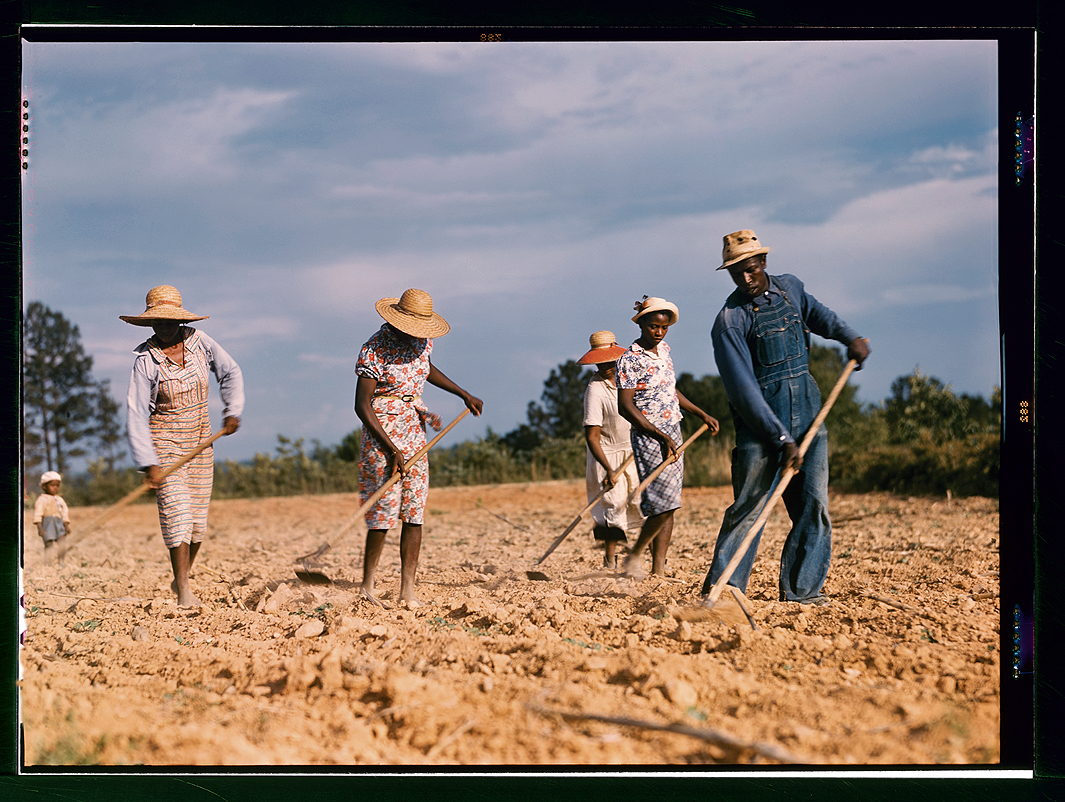
Can viewers of Depression-era photographs today put aside their implicit or explicit sense of moral superiority? Perhaps seeing photos of the era in color brings their subjects more immediacy and vividness, and you can see them by the hundreds at the Library of Congress’s online collection of work commissioned by the federal government during the Depression and World War II. Evans himself may have thought color photography “garish” and “vulgar,” Jordan G. Teicher notes at Slate (though Evans began taking his own color images in 1946). But contemporaries like Russell Lee, Marion Post Wolcott, Jack Delano, and John Vachon proved him wrong.
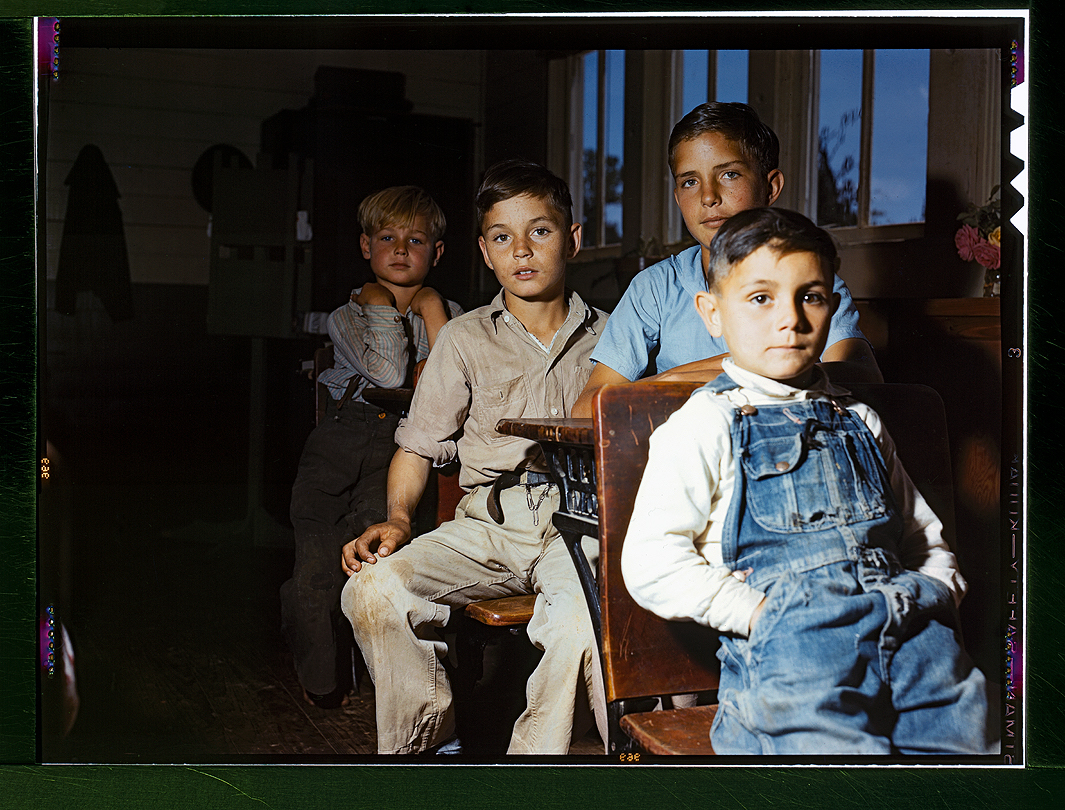
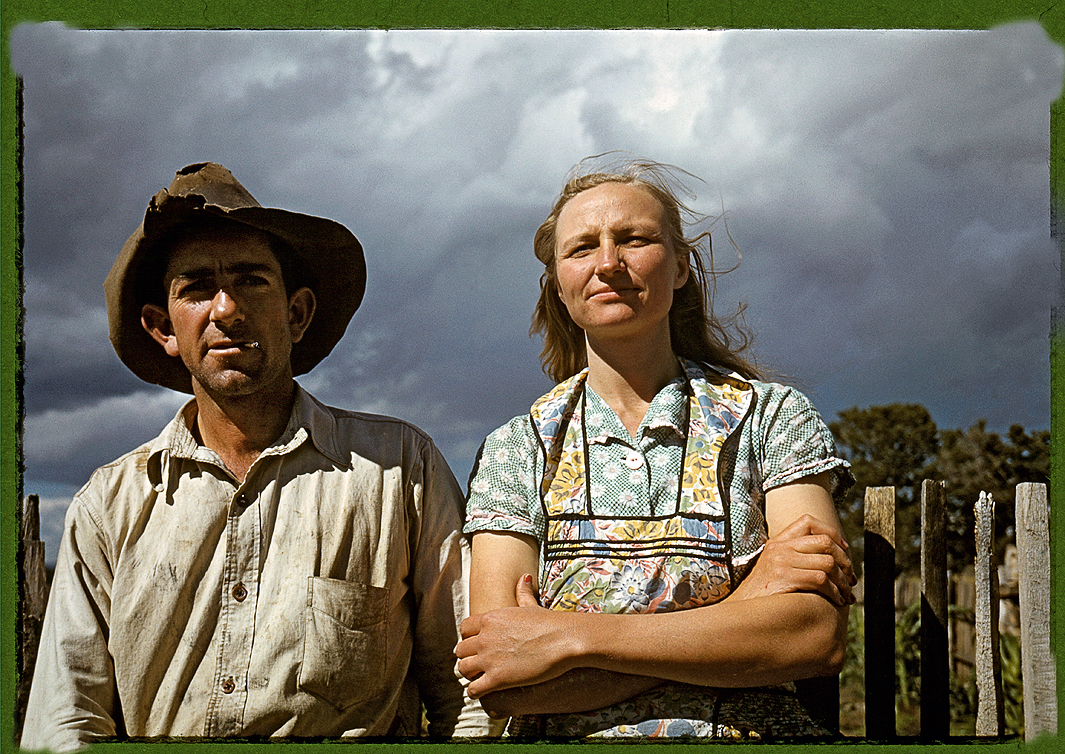
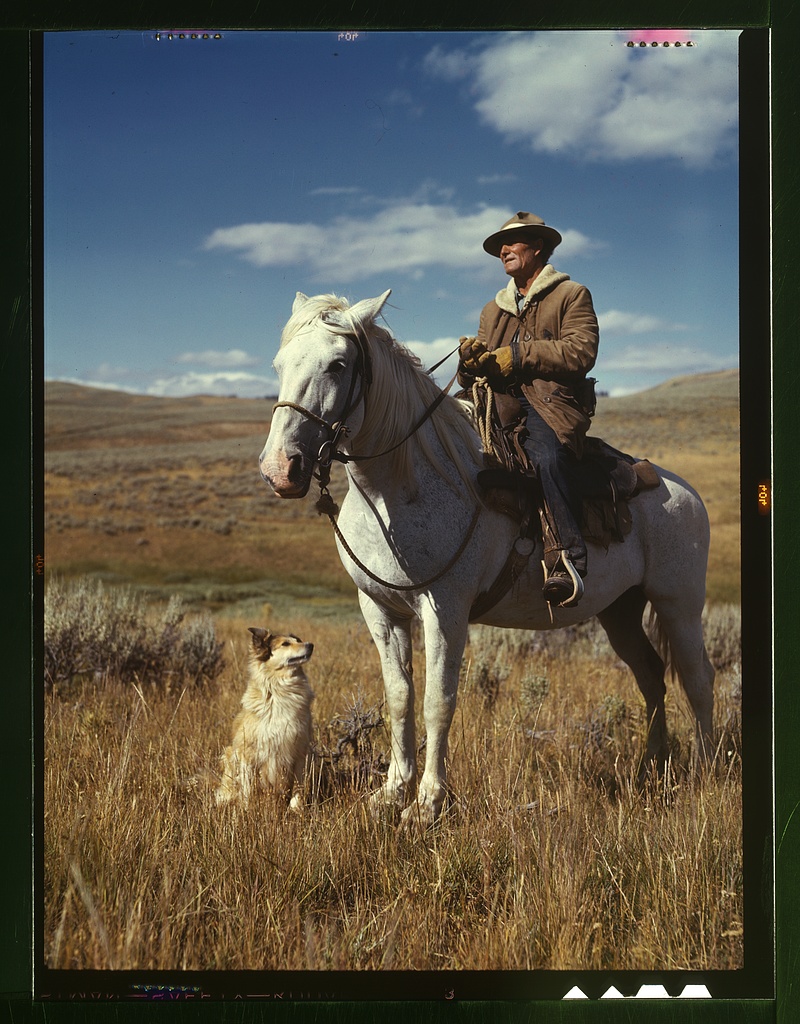
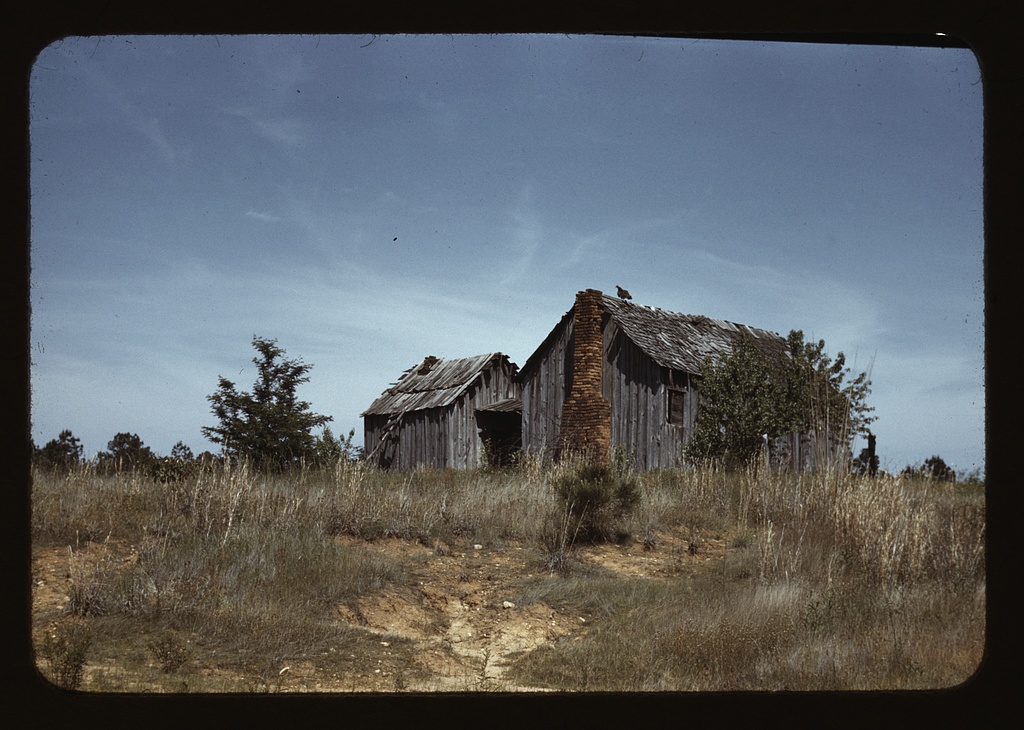
At the top of the post, see two photos from Lee—of two homesteaders in New Mexico (1940) and a shepherd with his horse and dog in Montana (1942). Beneath that, we have Wolcott’s striking photo of a rural cabin somewhere “in Southern U.S.,” circa 1940. Further up, see Delano’s image of sharecroppers chopping cotton in White Plains, Georgia (1941), which resembles the heroic figures in a Diego Rivera mural. And just above we have John Vachon’s image of rural school children in San Augustine County, Texas (1943). As we scan these faces and places, we might consider again Agee’s preface: “The governing instrument—which is also one of the centers of the subject—is individual, anti-authoritative human consciousness.” His instructions invite us to both empathy for each person we see and to broad human sympathy for all of them.
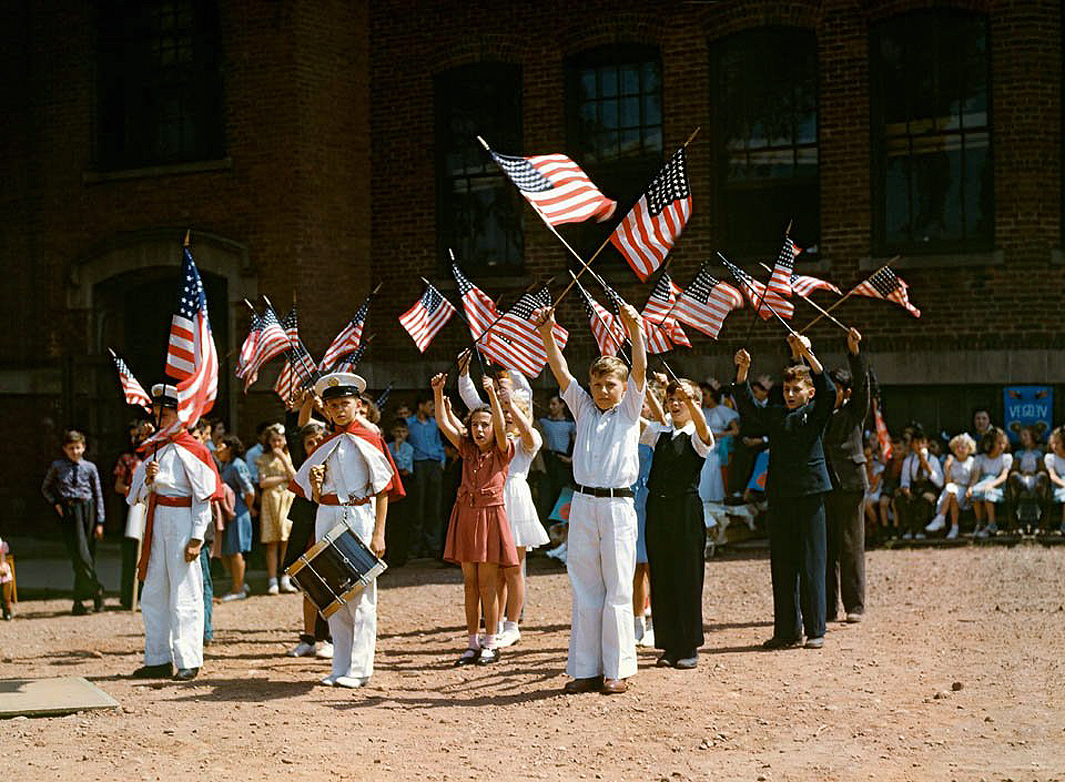
Once the U.S. entered the war, many Farm Security Administration photographers were reassigned to make propaganda for the Office of War Information (and a few, like Lange, also received commissions to photograph the Japanese Internment Camps). The nature of documentary photography began to change, largely reflecting small town American industriousness and civic pride, rather than rural desperation and struggle. Images like Fenno Jacobs’ patriotic demonstration in Southington Connecticut (1942) above, are typical. Quaint rows of houses and storefronts dominate during the war years. We also find interesting images like that of the woman below working on a “Vengeance” dive bomber in Tennessee, taken by Alfred T. Palmer in 1943. Aside from the dated clothing and machinery, her photograph seems as fresh and compelling as the day it first appeared.

“In color,” writes Emory University’s Jesse Karlsberg, “these images present themselves as relevant to the present, rather than consigned to the past. By displaying the problems they depict—such as segregation, poverty, and environmental degradation—in a contemporary form, the images imply that such problems may continue to be critical today.” They are indeed critical today. And may become even more so. And one hopes that writers, photographers, and artists, though they will not do so under the aegis of New Deal agencies, can find ways to document what is happening as they did decades ago. Such work carries global significance. And, as a recent Taschen book that collects New Deal photography from 1935 to 1943 describes it, photographs like those you see here “introduced America to Americans.” They also introduced Americans—who have been as divided in the past as they are today—to each other.
Related Content:
Found: Lost Great Depression Photos Capturing Hard Times on Farms, and in Town
Yale Launches an Archive of 170,000 Photographs Documenting the Great Depression
Josh Jones is a writer and musician based in Durham, NC. Follow him at @jdmagness
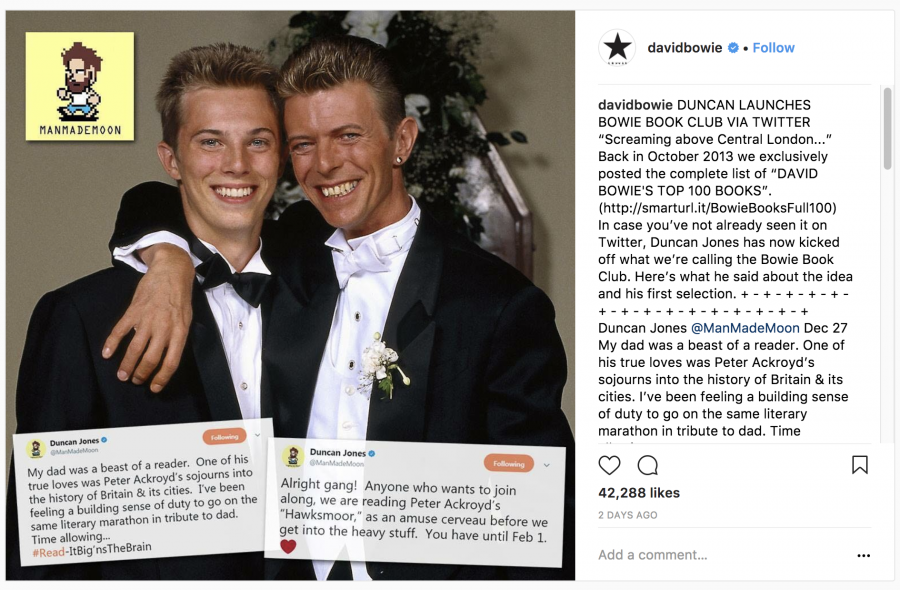
Read More...The David Bowie Book Club Gets Launched by His Son: Read One of Bowie’s 100 Favorite Books Every Month
Cast as the star of 1976’s The Man Who Fell to Earth, David Bowie traveled to New Mexico for the shoot, meeting with director Nicolas Roeg soon upon arrival. “I took with me hundreds and hundreds of books,” Bowie said to The Face magazine a few years later. “And I had these cabinets” — a modernized Jacobean traveling library — “and they were rather like the boxes that amplifiers get packed up in, and I was going through all these books and they were pouring out all over the floor — there were just mountains of books. And Nick was sitting there watching me and he said, ‘Your great problem, David, is that you don’t read enough.’ ”
Due to Bowie’s hyper-serious state of mind in those days, he went on to recall, “it didn’t occur to me at the time that it was a joke.” Though he changed his ways of thinking and even dropped the traveling library, Bowie seems to have maintained his formidable reading habits for the rest of his life. (In 1987, he even posed for one of the American Library Association’s “READ” posters.) A few years ago we featured his Top 100 Book List, whose variety encompasses everything from The Outsider to Sexual Personae to A Confederacy of Dunces.
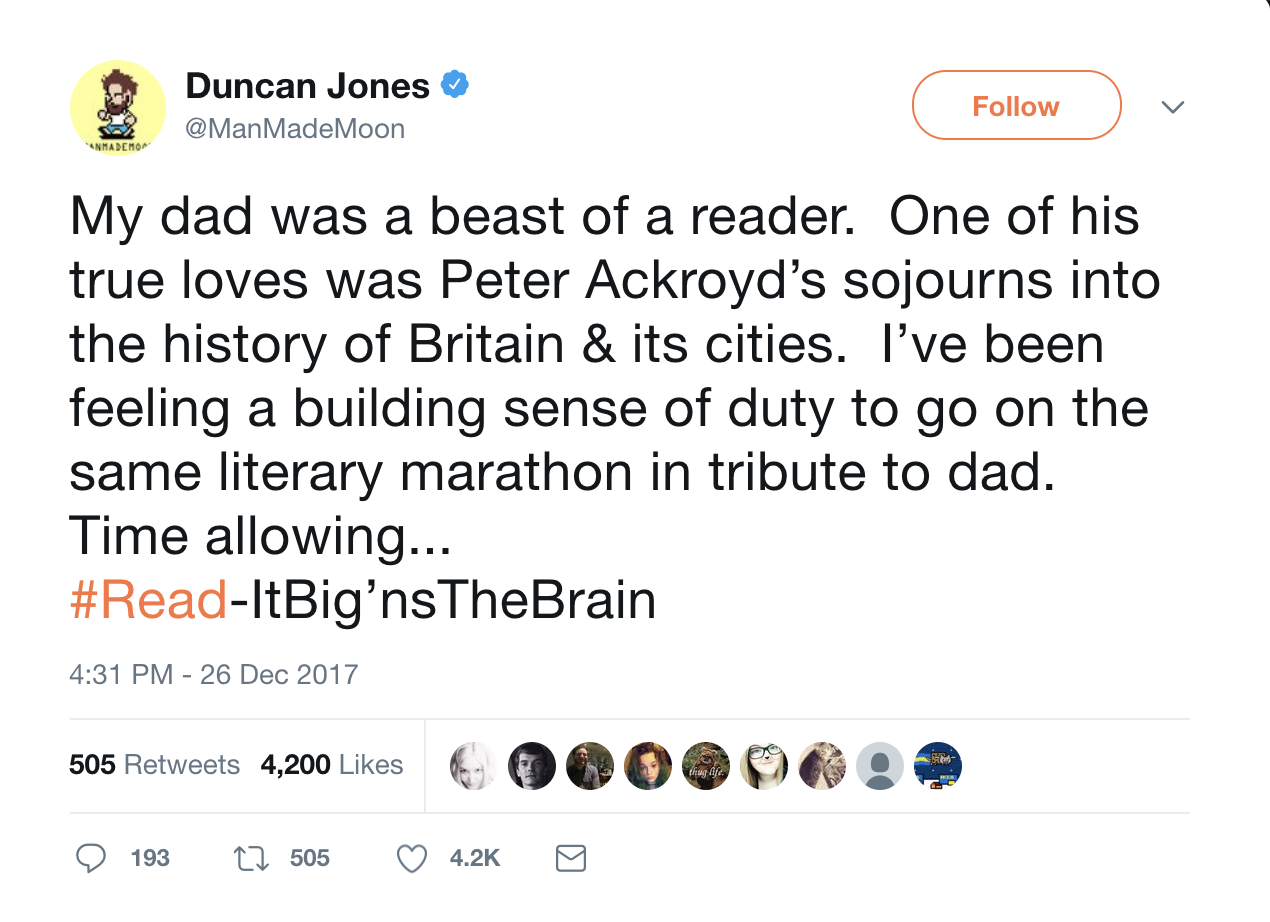
“My dad was a beast of a reader,” Bowie’s son Duncan Jones, an avid Twitter user, tweeted last week. “One of his true loves was Peter Ackroyd’s sojourns into the history of Britain & its cities. I’ve been feeling a building sense of duty to go on the same literary marathon in tribute to dad.” And so Jones’ informal David Bowie book club begins with Ackroyd’s 1985 postmodern novel Hawksmoor, which tells the parallel stories of an early 18th-century London architect and a late 20th-century London detective and which Joyce Carol Oates called “a witty and macabre work of the imagination, intricately plotted, obsessive in its much-reiterated concerns with mankind’s fallen nature.”
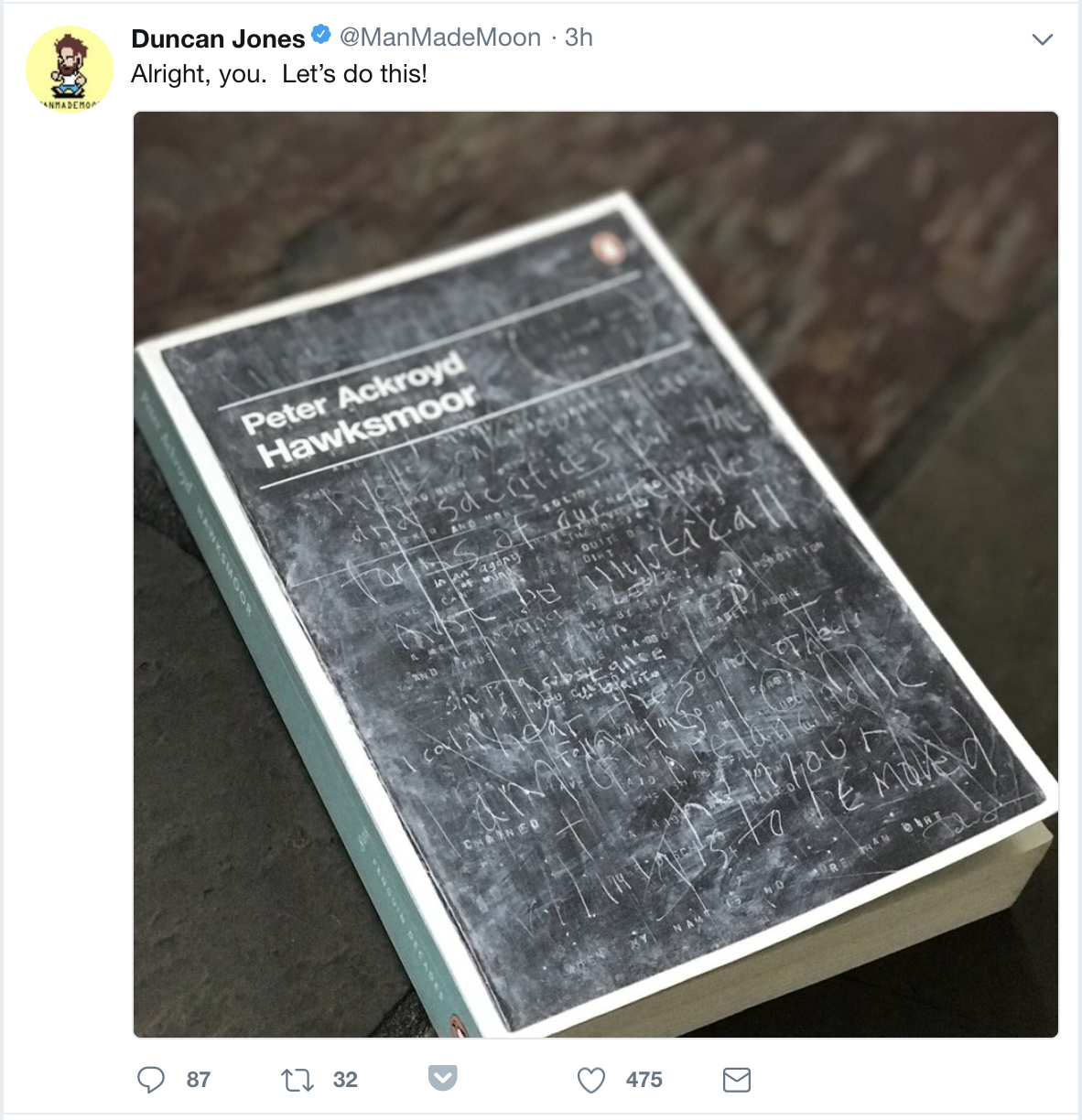
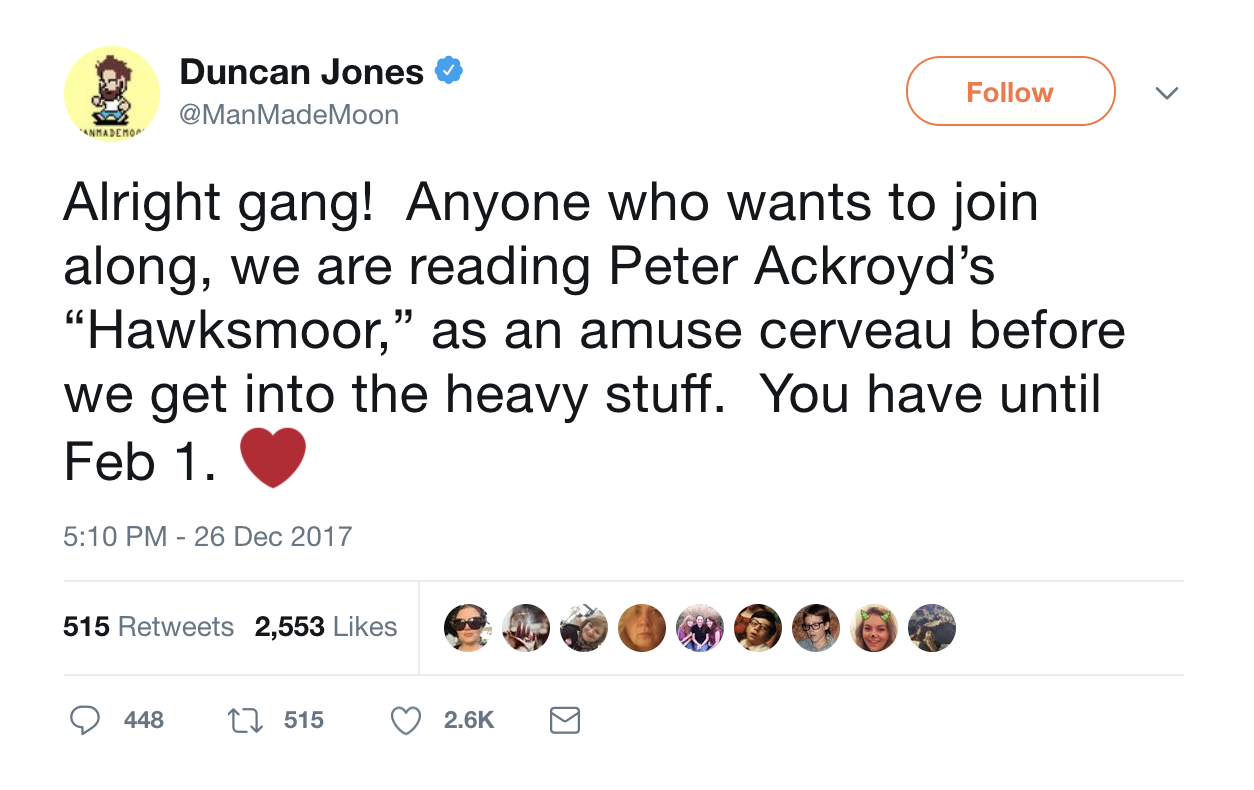
Jones calls the book “an amuse cerveau before we get into the heavy stuff,” the “heavy stuff” presumably including other such Bowie picks as White Noise, A Clockwork Orange and Last Exit to Brooklyn. If you’d like to participate in the Jones-led discussion of Hawksmoor on his Twitter page, you’ve got until the first of February to get it read. If you feel like you don’t read enough, consider this the Bowiest possible way to fulfill a new year’s resolution to do more of it.
Note: Separately you can also check out The Bowie Book Club Podcast where two friends spend a month reading a book on Bowie’s list. Find those episodes here.
Related Content:
David Bowie Urges Kids to READ in a 1987 Poster Sponsored by the American Library Association
Discover the Jacobean Traveling Library: The 17th Century Precursor to the Kindle
Based in Seoul, Colin Marshall writes and broadcasts on cities and culture. His projects include the book The Stateless City: a Walk through 21st-Century Los Angeles and the video series The City in Cinema. Follow him on Twitter at @colinmarshall or on Facebook.
Read More...Listen to Glenn Gould’s Shockingly Experimental Radio Documentary, The Idea of North (1967)
If genius is an infinite capacity for taking pains, Glenn Gould merits each and every one of the many applications of the word “genius” to his name. The world knows that name primarily as one of a genius of the piano, of course, especially when interpreting the genius of Johann Sebastian Bach, but he also made an impression in his homeland of Canada as a genius of the radio editing suite. Having recorded for the Canadian Broadcasting Corporation’s classical-and-jazz record label CBC Records placed him well to realize his ideas on the CBC’s airwaves, most memorably in the form of The Idea of North, an hourlong meditation on the vast, cold expanse that constitutes the top third of the country, which first aired on December 28, 1967.
The broadcast’s fiftieth anniversary has prompted Canadians and non-Canadians alike to have another listen to Gould’s best-known radio project, back then shockingly experimental and still boldly unconventional today. “The pianist used a technique he called ‘contrapuntal radio,’ layering speaking voices on top of each other to create a unique sonic environment situated in the space between conversation and music,” says the site of CBC’s Ideas, which recently aired a new episode about the making of The Idea of North called Return to North.
The page quotes Gould biographer Geoffrey Payzant as describing it and Gould’s subsequent documentaries as “hybrids of music, drama, and several other strains, including essay, journalism, anthropology, ethics, social commentary, [and] contemporary history.”
One might might well compare The Idea of North’s form to that of a fugue, the type of complex contrapuntal composition so closely associated with Bach and thus with Gould as well. But the form also serves the substance, “that incredible tapestry of tundra and taiga which constitutes the Arctic and sub-Arctic of our country,” as Gould himself puts it in the broadcast’s introduction. “I’ve read about it, written about it, and even pulled up my parka once and gone there,” he continues, but like most Canadians remained ever “an outsider” to the North, “and the North has remained for me, a convenient place to dream about, spin tall tales about, and, in the end, avoid.”
The North also offered Gould a powerful symbol of solitude, a condition which he sought throughout his life, especially after quitting live performance to focus exclusively on the studio shortly before making The Idea of North. In the decade thereafter he made two more formally and thematically similar documentaries, one on coastal Newfoundlanders and another on Mennonites in Manitoba, and the three together make up his “Solitude Trilogy.” A television film of The Idea of North, co-produced by the CBC and PBS, appeared in 1970, layering images of the North atop of the words about the North Gould had collected. It certainly adds a dimension to Gould’s painstakingly constructed audio collage, but somehow pure radio, the old “theater of the mind,” still suits it best: the images of the North he wanted to evoke, one senses just as well now as half a century ago, exist only in the mind.
Related Content:
Glenn Gould Explains the Genius of Johann Sebastian Bach (1962)
Watch a 27-Year-Old Glenn Gould Play Bach & Put His Musical Genius on Display (1959)
Glenn Gould Gives Us a Tour of Toronto, His Beloved Hometown (1979)
Based in Seoul, Colin Marshall writes and broadcasts on cities and culture. His projects include the book The Stateless City: a Walk through 21st-Century Los Angeles and the video series The City in Cinema. Follow him on Twitter at @colinmarshall or on Facebook.
Read More...What Is Procrastination & How Can We Solve It? An Introduction by One of the World’s Leading Procrastination Experts
I don’t know about you, but my tendency to procrastinate feels like a character flaw. And yet, no amount of moralizing with myself makes any difference. Feeling bad, in fact, only makes things worse. Perhaps that’s because—as Tim Pychyl, Associate Professor in Psychology at Carleton University argues—procrastination is not a moral failing so much as a coping mechanism for painful feelings, a psychological avoidance of tasks we fear for some reason: because we fear rejection or failure, or even the burdens of success.
Pychyl should know. He’s made studying procrastination the basis of his career and runs the 20-year-old Procrastination Research Group. Procrastination is a “puzzle,” he theorizes (the title of one of his books is Solving the Procrastination Puzzle: A Concise Guide to Strategies for Change). Solving it involves understanding how its pieces work, including our beliefs about how it operates. Pychyl’s lecture above addresses graduate students charged with helping undergraduates who procrastinate, but its lessons apply to all of us. In his first slide, Pychyl outlines four typical beliefs about procrastination:
It’s me
It’s the task
It’s the way I think
It’s my lack of willpower
Pychyl wants to debunk these notions, but he also argues that procrastination is “something we seem to understand very well” in popular parlance. One of his slides shows a typical “successories”-type poster that reads, “Procrastination: hard work often pays off after time, but laziness always pays off now.” While Pychyl doesn’t use judgmental language like “laziness,” he does acknowledge that procrastination results from ideas about short- versus long-term gain. We want to feel good, right now, a drive common to everyone.
The next poster reads “if the job’s worth doing, it will still be worth doing tomorrow.” The notion of the “future self” plays a role—the you of tomorrow who still has to face the work your present self puts off. “What are we doing to ‘future self?’” Pychyl asks. “If we can just bring future self into clearer vision, lots of times the procrastination may go away.” This has been demonstrated in research studies, Ana Swanson notes at The Washington Post, in which people made better decisions after viewing digitally-aged photographs of themselves. But in general, we tend not to have much consideration for “future self.”
A final successories slide reads, “Procrastination: by not doing what you should be doing, you could be having this much fun.” This is one of the most pervasive forms of self-delusion. We may convince ourselves that putting difficult things off for tomorrow means more fun today. But the amount of guilt we feel ensures a different experience. “Guilt is a paralyzing emotion,” Pychyl says. When we put off an important task, we feel terrible. And often, instead of enjoying life, we create more work for ourselves that makes us feel purposeful, like cooking or cleaning. This “task management” game temporarily relieves guilt, but it does not address the central problem. We simply “manage our emotions by managing our tasks.”
The word procrastination comes directly from classical Latin and translates to “put forward” that which “belongs to tomorrow.” This sounds benign, given that many a task does indeed belong to tomorrow. But prudent planning is one thing, procrastination is another. When we put off what we can or should accomplish today, we invoke tomorrow as “a mystical land where 98% of all human productivity, motivation, and achievement are stored.” The distinction between planning or unavoidable delay and procrastination is important. When delays are either intentional or the consequence of unpredictable life events, we need not consider them a problem. “All procrastination is delay, but not all delay is procrastination.”
So, to sum up Pychyl’s research on our attitudes about procrastination: “we think we’re having more fun, but we’re not”; “we think we’re not affecting future self, but we are”; and “it’s all about giving in to feel good,” which—see point number one—doesn’t actually work that well.
While we might minimize procrastination as a minor issue, its personal costs tell us otherwise, including severe impacts to “performance, well-being, health, relationships, regrets & bereavement.” Procrastinators get sick more often, report higher rates of depression, and suffer the somatic and psychological effects of elevated stress. Procrastination doesn’t only affect our personal well-being and integrity, but it has an ethical dimension, affecting those around us who suffer “second-hand,” either because of the time we take away from them when we rush off to finish things last-minute, or because the stress we put ourselves under negatively affects the health of our relationships.
But procrastination begins first and foremost with our relationship to ourselves. Again, we put things off not because we are morally deficient, or “lazy,” but because our emotional brains are trying to cope. We feel some significant degree of fear or anxiety about the task at hand. The guilt and shame that comes with not accomplishing the task compounds the problem, and leads to further procrastination. “The behavior,” writes Swanson, turns into “a vicious, self-defeating cycle.”
How do we get out of the self-made loop of procrastination? Just as in the failure of the “Just say No” campaign, simply shaking ourselves by the metaphorical shoulders and telling ourselves to get to work isn’t enough. We have to deal with the emotions that set things in motion, and in this case, that means going easy on ourselves. “Research suggests that one of the most effective things that procrastinators can do is to forgive themselves for procrastinating,” Swanson reports.
Once we reduce the guilt, we can weaken the proclivity to procrastinate. Then, paradoxically, we need to ignore our emotions. “Most of us seem to tacitly believe,” Pychyl says, “that our emotional state has to match the task at hand.” For writers and artists, this belief has a lofty pedigree in romantic ideas about inspiration and muses. Irrelevant, the procrastination expert says. When approaching something difficult, “I have to recognize that I’m rarely going to feel like it, and it doesn’t matter if I don’t feel like it.” Feelings of motivation and creative inspiration often strike us in the midst of a task, not before. Breaking down daunting activities into smaller tasks, and approaching these one at a time, gives us a practical roadmap for conquering procrastination. For more insights and research findings, watch Pychyl’s full lecture above.
Related Content:
The Neuroscience & Psychology of Procrastination, and How to Overcome It
How Information Overload Robs Us of Our Creativity: What the Scientific Research Shows
Why You Do Your Best Thinking In The Shower: Creativity & the “Incubation Period”
Josh Jones is a writer and musician based in Durham, NC. Follow him at @jdmagness
Read More...Where Are They Now? An Animated Mockumentary Reveals What Happened to Your Favorite 1980s Cartoon Characters After Their Heyday
It’s a cautionary tale about what happens when the world you prepared yourself for changes and leaves you behind. Coldly, and sometimes without warning.
Above, watch Steve Cutts’ 2014 animated mockumentary, “Where Are They Now?”. Starring Roger and Jessica Rabbit, and featuring cameos by Garfield and The Smurfs, the short film revisits cartoon characters who had it all in the 1980s. Then hit the skids in the early 90s. Hard. “We had done our jobs,” says an aged Jessica Rabbit. “Now we were forgotten about. Obsolete.” It’s a bleak picture that Cutts paints. But, it’s not all bad. He-Man became a wealthy lingerie designer. We could all use a well-thought-out Plan B.
Related Content:
Read More...Watch Russian Dancers Appear to Float Magically Across the Stage: A Mesmerizing Introduction to The Berezka Ensemble
As the Rockettes are to legs, Russia’s Berezka Ensemble, above, is to the seeming absence of them.
There are certain similarities between the two troops. Both are composed exclusively of young women in peak physical condition. The choreography and costuming dazzle by way of uniformity. So many girls, all doing the exact same thing at the exact same time!
(On a personal note, no one expects the Rockettes to out-feminist Barbie, but they could do a better job at diversifying their annual Christmas Spectacular cast’s racial make up—unlike the city in which it takes place, that kick line’s mighty white.)
The Berezka Ensemble, aka the Little Birch Tree Choreographic group’s wholesomeness is more in keeping with the Waldorf School. Their costumes are maidenly folk art affairs—much better suited to twirling birch branches than their American counterparts’ snug sequins…
But on to the signature moves…
To master their famed floating step, the Berezka Ensemble’s dancers’ submit to a training regimen every bit as grueling as the one the Rockettes undergo in pursuit of their synchronized eye-high kicks.
The floating step was invented in the 40’s by company founder Nadezhda Nadezhdina, and enjoys a mystical reputation, despite various how-to videos floating around online.
Conspiracy theories abound. What’s underneath those hooped hemlines? Roller skates?
A hidden track?
Calves of steel, as it turns out. A rehearsal video reveals many, many mincing steps, taken en demi-pointe.
But what really sells the frictionless illusion is the dancers’ placid above-waist facades, which one YouTube commenter aptly compared to ducks gliding about on a pond, their feet paddling furiously just below the water’s surface.
A recent LED-enhanced performance, below, shines some literal light on the fancy footwork.
Related Content:
Watch a Step-by-Step Breakdown of La La Land‘s Incredibly Complex, Off Ramp Opening Number
Statistics Explained Through Modern Dance: A New Way of Teaching a Tough Subject
Ayun Halliday is an author, illustrator, theater maker and Chief Primatologist of the East Village Inky zine. Follow her @AyunHalliday.
Read More...The Favorite Literary Work of Every Country Visualized on a World Map
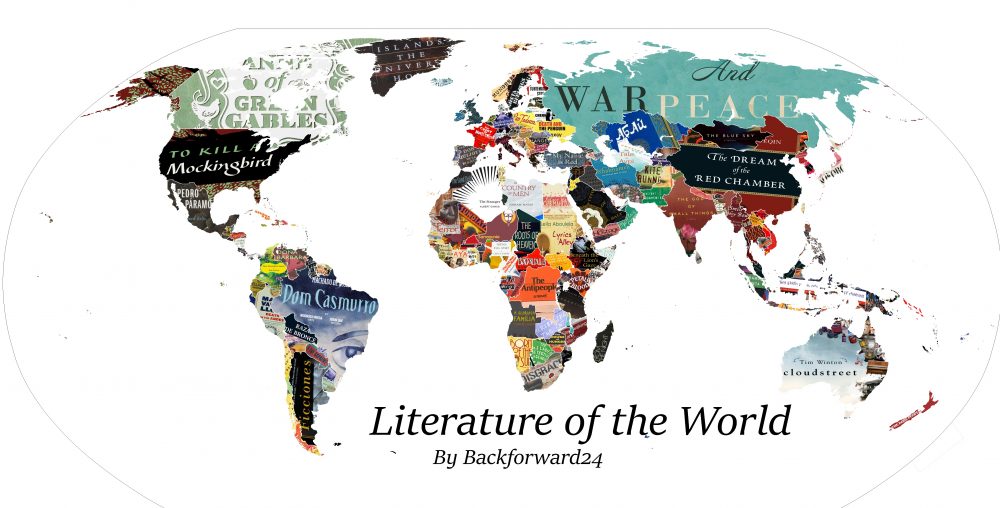
Begun by user “BackForward24” and crowdsourced through Reddit, this map of the world illustrates the most beloved/popular book of each country by pasting a scan of the book cover over its space on the world map. For book lovers who want to read themselves around the world, it will prove invaluable. (And if you can’t read the map, no worries, there is a text version available.)
But let’s unpack the larger (and yes, first world) countries first. The United States is represented by To Kill a Mockingbird, which ticks off a lot of the marks that make it quintessentially American: most high schoolers have read it, and it deals with both racism and our shameful history and the faith that the law can eventually right wrongs. Canada has Anne of Green Gables. Great Britain has Charles Dickens’ Great Expectations, and Ireland Ulysses (no surprise there.)
Our Australian readers might want to weigh in on Tom Winton’s Cloudstreet (a quite recent novel), and New Zealanders please tell us about The Bone People by Keri Hulme.
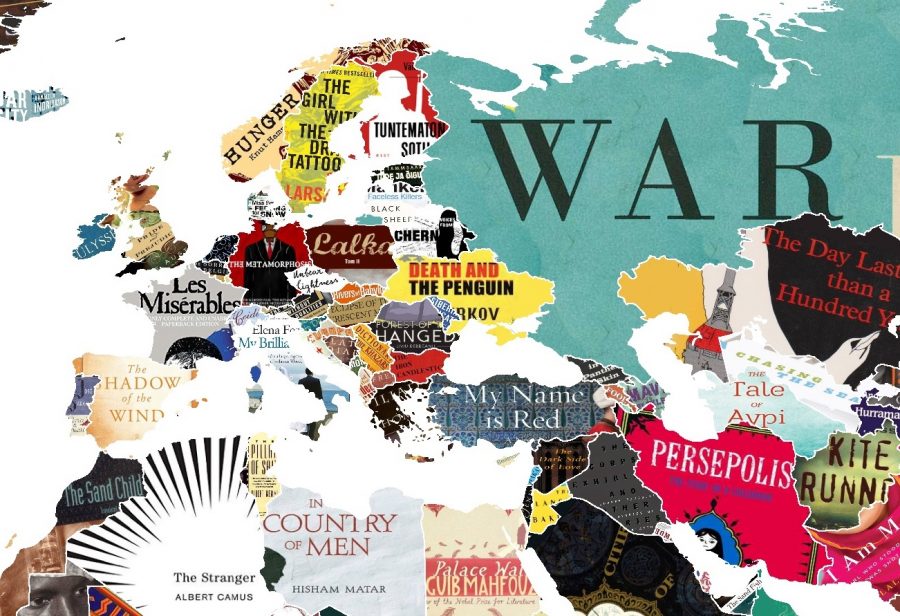
My takeaway and possibly yours from the map is how many titles are new to the Westerner. Europe has some familiar titles: Spain gets Cervantes’ Don Quixote (of course), Italy gets Dante’s The Divine Comedy, and France gets Les Misérables by Hugo. And while Russia is represented by Tolstoy’s War and Peace, Eastern Europe is rather unfamiliar, at least compared to South America, where Argentina has Borges’ Fictions, Chile has Isabel Allende’s The House of Spirits, and Colombia has Marquez’s One Hundred Years of Solitude, all well known from decades of prizes, book club attention, and film adaptations.
This Reddit thread contains much criticism and debate, so please check it out. Some good points are raised: if the Iliad represents Greece, why not the Mahabharata/Ramayan for India? “Honestly there is work to do (in) the Africa part,” says another (very politely). There’s also debate over countries not being represented at all, such as Tibet (under Chinese occupation), along with Western Sahara, Somaliland, Kashmir, Balochistan, and Kurdistan. Frankly, if you start trying to talk about the culture of nations, there will be debate over what constitutes a nation. (I’m not sure if Palestine is covered, but some Redditors are voting for Susan Abulhawa’s Mornings in Jenin.)
Another thing to keep in mind: the novel is very much a Western genre. For many countries, that might not be the case. However, I sense that that debate (and future map) will be another Reddit thread, somewhere, sometime.
Related Content:
A Map Showing How Much Time It Takes to Learn Foreign Languages: From Easiest to Hardest
An Interactive Map of Every Record Shop in the World
Ted Mills is a freelance writer on the arts who currently hosts the artist interview-based FunkZone Podcast and is the producer of KCRW’s Curious Coast. You can also follow him on Twitter at @tedmills, read his other arts writing at tedmills.com and/or watch his films here.
Read More...Hear Lou Reed’s The Raven, a Tribute to Edgar Allan Poe Featuring David Bowie, Ornette Coleman, Willem Dafoe & More
?si=rqKGlh_6B4Li4YxX
It’s not immediately apparent that Lou Reed and Edgar Allan Poe would have that much in common. It’s true Reed inherited a gothic sensibility (though one could argue that this element in the Velvet Underground came mainly from Nico and John Cale), and he worked in a self-consciously literary vein. But in almost every other respect, he spoke a totally different idiom. Drawn to the seedy bars and street corners rather than the great houses, laboratories, and scholar’s nooks of Poe, Reed inclined his ear toward the common tongue, in contrast to Poe’s carefully composed Romantic diction.
But while it’s hard to imagine Poe thinking much of Reed’s rock and roll, the themes of sexual obsession, madness, terror, and morbid reflection that Poe brought into prominence seem to find their fruition over 100 years later in the work of the Velvets (and the thousands of post-punk bands they inspired), and in much of Reed’s subsequent solo work—up to his final album, the critically-reviled Lulu with Metallica, which his longtime partner Laurie Anderson declared full of “fear and rage and venom and terror and revenge and love,” and which David Bowie pronounced a “masterpiece.”
While we know where much of Reed’s personal angst came from, we can also hear—in the vivid shock of his imagery and the extremity of his emotions—the echo of Poe’s crazed protagonists. Leave it to Reed, then, to take on the task of interpreting Poe in the 21st century, in his 2003 album, The Raven, a collection of Poe-themed musical pieces (“This is the story of Edgar Allan Poe / Not exactly the boy next door”), with such collaborators as Anderson, Bowie, Ornette Coleman, the Blind Boys of Alabama, Antony, Elizabeth Ashley, and Willem Dafoe, who reads a Reed-adapted version of the poem at the top (track 9 in the album below), over a video tribute to B horror actress Debbie Rochon (for some reason).
What did Reed seek to accomplish with this conceptual project? As he himself writes in the liner notes, “I have reread and rewritten Poe to ask the same questions again. Who am I? Why am I drawn to do what I should not?… Why do we love what we cannot have? Why do we have a passion for exactly the wrong thing?” These are timeless philosophical questions, indeed, which transcend matters of style and genre. Again and again, both Poe and Reed pursued them into the darkest recesses of the human psyche—the places most of us fear to go. And perhaps for that reason especially, we are perenially drawn back to their work.
Related Content:
The Raven: a Pop-up Book Brings Edgar Allan Poe’s Classic Supernatural Poem to 3D Paper Life
Josh Jones is a writer and musician based in Durham, NC. Follow him at @jdmagness
Read More...Invisible Cities Illustrated: Artist Illustrates Each and Every City in Italo Calvino’s Classic Novel
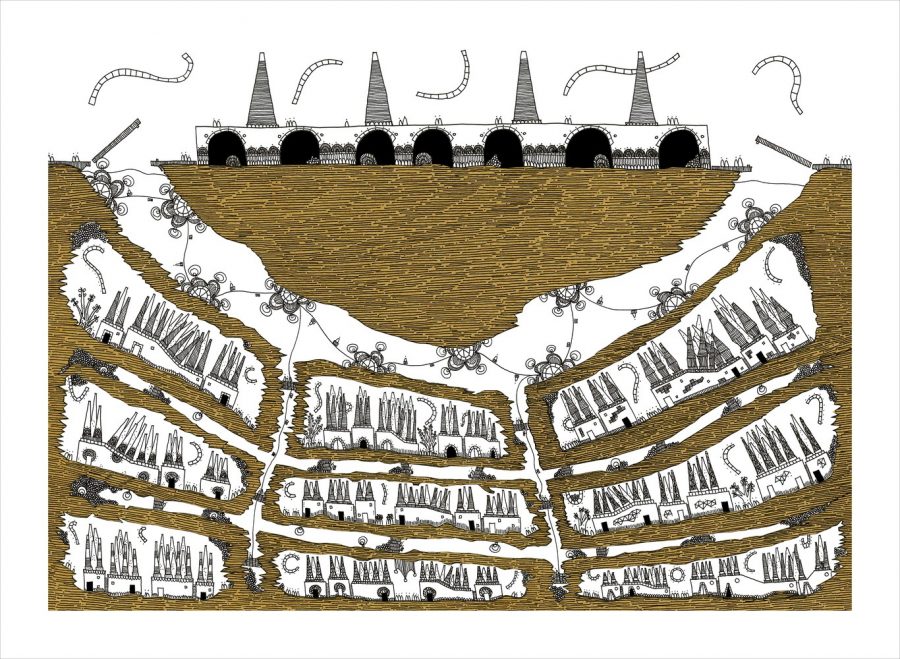
If you want to read a book about cities, you still can’t do much better than a slim, plotless work of fiction by Italo Calvino wherein the explorer Marco Polo tells the emperor Kublai Khan of what he’s seen in his travels across the world. Originally published in Italian in 1972, Invisible Cities has inspired generations of readers, hailing from all across the world themselves, to think in entirely new ways not just about cities but about travel, place, perception, reality, myth, and literature itself. Though very much a work concerned with what’s seen only in the imagination, the book has also inspired artists to try their hand at rendering the 55 fictitious cities Polo describes within.
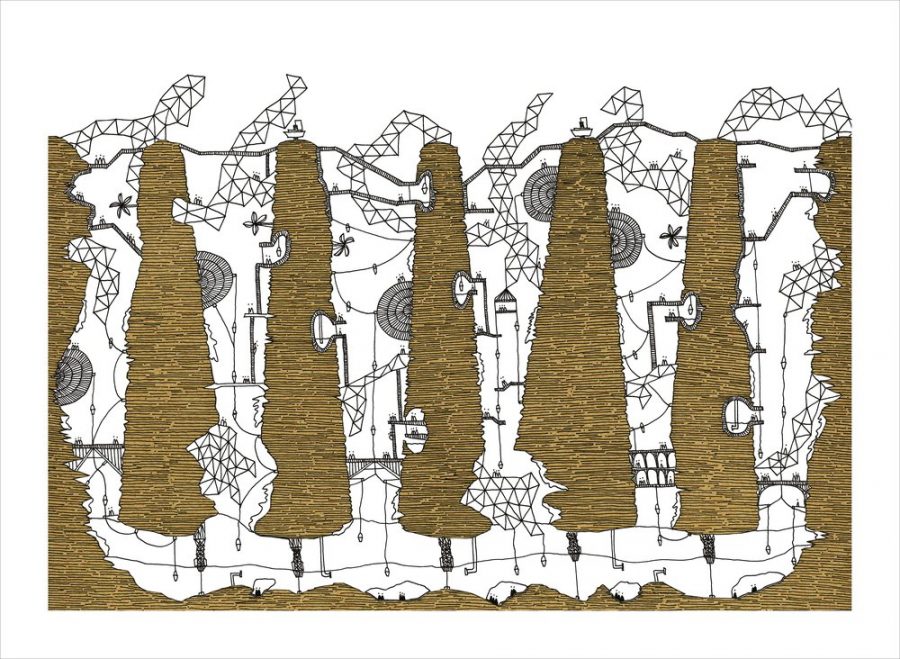
A few years ago we featured “Seeing Calvino,” a joint effort by artists Matt Kish, Leighton Connor, Joe Kuth to illustrate, among other elements of the Calvino canon, each and every one of Invisible Cities’ fantastical, often impossible collections of structures, lives, and, ideas. More recently, the Peru-based architect and artist Karina Puente has, with her Invisible Cities Project, put herself to work on a similar endeavor. Each of Puente’s intricate renderings takes about a week to produce, and as she tells Archdaily, “they are not only drawn – I use different types of paper and draw on each one before cutting them out with exacto knives. All the drawings are composed of layers of paper which are cut out and glued.”
At the top we have Puente’s city of Dorotea where, bearing in mind the rules of its infrastructural division by gates, drawbridges, and canals and those of the marriages between the trading families that reside there, “you can then work from these facts until you learn everything you wish about the city in the past, present, and future.” In the middle is Isaura, a city built on a deep subterranean lake whose gods, “according to some people, live in the depths,” and to others live in the associated buckets, pump handles, windmill blades, pipes, and every other built element of this “city that moves entirely upward.”
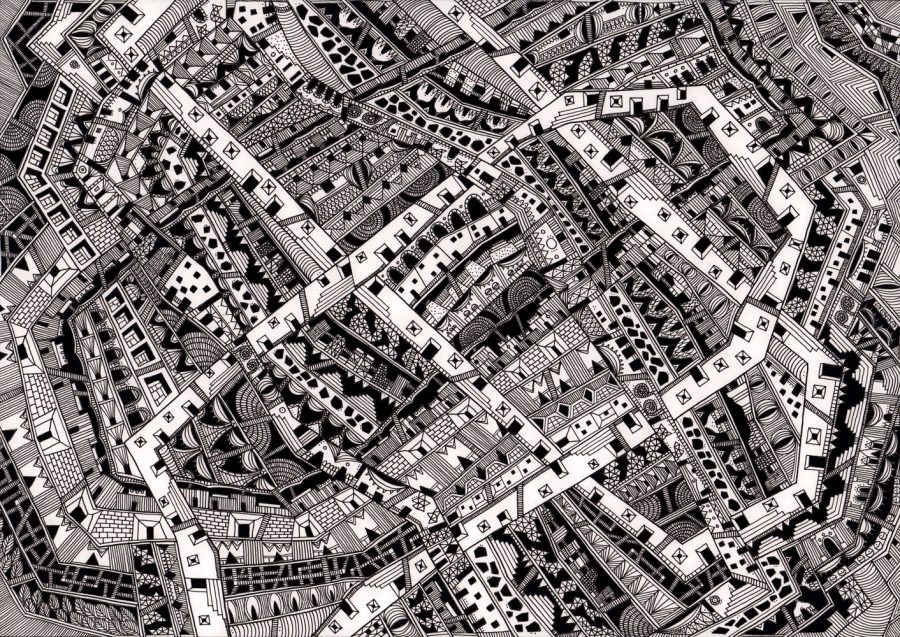
Just above you can see Zobeide, laid out according to a series of dreams of “a woman running at night through an unknown city,” pursued but never found, altered to conform to each dream until new arrivals “could not understand what drew these people to Zobeide, this ugly city, this trap.” While at first Polo’s descriptions of the cities all across Khan’s empire may strike readers as completely fantastical, they’ll soon hear echoes of the places they live in in these metaphorical metropolises. And if they take a look at Puente’s illustrations as they read, they’ll see them as well.
Visit Puente’s Invisible Cities Project here.
via Archdaily
Related Content:
Invisible Cities Illustrated: Three Artists Paint Every City in Italo Calvino’s Classic Novel
Italo Calvino Offers 14 Reasons We Should Read the Classics
Based in Seoul, Colin Marshall writes and broadcasts on cities and culture. His projects include the book The Stateless City: a Walk through 21st-Century Los Angeles and the video series The City in Cinema. Follow him on Twitter at @colinmarshall or on Facebook.
Read More...The American Revolution: A Free Course from Yale University
When you have a little time, you can drop in on a free course that revisits a seminal moment in U.S. history–the American Revolution. Taught by Yale historian Joanne Freeman, the course explores how the Revolution brought about “some remarkable transformations–converting British colonists into American revolutionaries, and a cluster of colonies into a confederation of states with a common cause.” You can access the 25 lectures above, or on YouTube and iTunes. Also find a syllabus for the course on this Yale web site.
“The American Revolution” will be added to our list of Free History Courses, a subset of our larger collection, 1,700 Free Online Courses from Top Universities.
If you would like to support the mission of Open Culture, consider making a donation to our site. It’s hard to rely 100% on ads, and your contributions will help us continue providing the best free cultural and educational materials to learners everywhere. You can contribute through PayPal, Patreon, and Venmo (@openculture). Thanks!
Related Content:
The History of the World in 46 Lectures From Columbia University
14,000 Free Images from the French Revolution Now Available Online
Read More...Support Us
We're hoping to rely on loyal readers, rather than erratic ads. Please click the Donate button and support Open Culture. You can use Paypal, Venmo, Patreon, even Crypto! We thank you!

About Us

Open Culture scours the web for the best educational media. We find the free courses and audio books you need, the language lessons & educational videos you want, and plenty of enlightenment in between.
Advertise With Us

FREE UPDATES!
GET OUR DAILY EMAIL
Get the best cultural and educational resources on the web curated for you in a daily email. We never spam. Unsubscribe at any time.
FOLLOW ON SOCIAL MEDIA

Open Culture editor Dan Colman scours the web for the best educational media. He finds the free courses and audio books you need, the language lessons & movies you want, and plenty of enlightenment in between.
Advertise With Us