Hear the Hagia Sophia’s Awe-Inspiring Acoustics Get Recreated with Computer Simulations, and Let Yourself Get Transported Back to the Middle Ages
The technology used to produce, record, and process music has become ever more sophisticated and awe-inspiring, especially in the capability of software to emulate real instruments and acoustic environments. Digital emulation, or “modeling,” as it’s called, doesn’t simply mimic the sounds of guitar amplifiers, pianos, or synthesizers. At its best, it reproduces the feel of an aural experience, its textures and sonic dimensions, while also adding a seemingly infinite degree of flexibility.
When it comes to a technology called “convolution reverb,” we can virtually feel the air pressure of sound in a physical space, such that “listening in may be viewed as much as a spatial experience as it is a temporal one.” So notes Stanford’s Icons of Sound, a collaboration between the University’s Center for Computer Research in Music and Acoustics (CCRMA) and the Department of Art & Art History. The researchers in this joint project have combined resources to create a performance of Byzantine chant from the 6th century CE, simulated to sound like it takes place inside a prime acoustic environment designed for this very music, the Hagia Sophia in Istanbul.
Built by the emperor Justinian between 532 and 537, when the city was Constantinople, the massive church (later mosque and now state-run museum) “has an extraordinarily large nave spreading over 70 meters in length; it is surrounded by colonnaded aisles and galleries. Marble covers the floor and walls.” Its center is “crowned by a dome glittering in gold mosaics and rising 56 meters above the ground.” The effect of the building’s heavy, reflective surfaces and its architectural enormity “challenges our contemporary expectation of the intelligibility of language.”
We are accustomed to hear the spoken or sung word clearly in dry, non-reverberant spaces in order to decode the encoded message. By contrast, the wet acoustics of Hagia Sophia blur the intelligibility of the message, making words sound like emanation, emerging from the depth of the sea.
The Icons of Sound team has reconstructed the underwater acoustics of the Hagia Sophia using convolution reverb techniques and what are called “impulse responses”—recordings of the reverberations in particular spaces, which are then loaded into software to digitally simulate the same psychoacoustics, a process known as “auralization.” CCRMA describes an impulse response as an “imprint of the space,” which is then applied to sounds recorded in other environments. Typically, the process is used in studio music production, but Icons of Sound brought it to live performance at Stanford’s Bing Concert Hall last year, and made the group Cappella Romana sound like their voices had transported from the Holy Roman Empire.
“To recreate the unique sound,” writes Kat Eschner at Smithsonian, “performers sang while listening to the simulated acoustics of Hagia Sophia through earphones. Their singing was then put through the same acoustic simulator and played during the live performance through speakers in the concert hall.” As you can hear in these clips, the result is immersive and profound. One can only imagine what it must have been like live. To complete the effect, the production used “atmospheric reinforcement,” notes Stanford Live, “via projected images and lighting.” The audience was “immersed in an environment where the unique interplay of music, light, art, and sacred text has the potential to induce a quasi-mystical state of revelation and wonder.”
The only sounds the researchers were able to record in the actual space of the ancient church were four popping balloons. By layering the reverberations captured in these recordings, and compensating for the different decay times inside the Bing, they were able to approximate the acoustic properties of the building. You can hear several more audio samples recorded in different places at this site. In the video above, associate professor of medieval art Bissera Pentcheva explains how and why the Hagia Sophia shapes sound and light the way it does. While purists might prefer to see a performance in the actual space, one must admit, the ability to virtually deliver a version of it to potentially any concert hall in the world is pretty cool.
Related Content:
David Byrne: How Architecture Helped Music Evolve
What Did Ancient Greek Music Sound Like?: Listen to a Reconstruction That’s ‘100% Accurate’
Josh Jones is a writer and musician based in Durham, NC. Follow him at @jdmagness.
Read More...The Story of How Beethoven Helped Make It So That CDs Could Play 74 Minutes of Music
We music fans of the increasingly all-digital 2010s take compact discs for granted, so much so that many of us haven’t slid one into a player in years. But if we cast our minds back, and not even all that far, we can remember a time when CDs were precious, and the medium itself both impressive and controversial. Back when it first came on the market in 1982 (packaged in longboxes, you’ll recall) it seemed impossibly high-tech, inspiring dreamily futuristic promotional videos like the one below and emerging from a process of development that required the combined R&D and industrial might of both Japan and Europe’s biggest consumer-electronics giants, Sony and Philips.
That years-long coordinated effort, as Greg Milner writes in Perfecting Sound Forever, saw a team of engineers from both companies “shuttling between Eindhoven and Tokyo,” the prototype CD player “given its own first-class seat on KLM.”
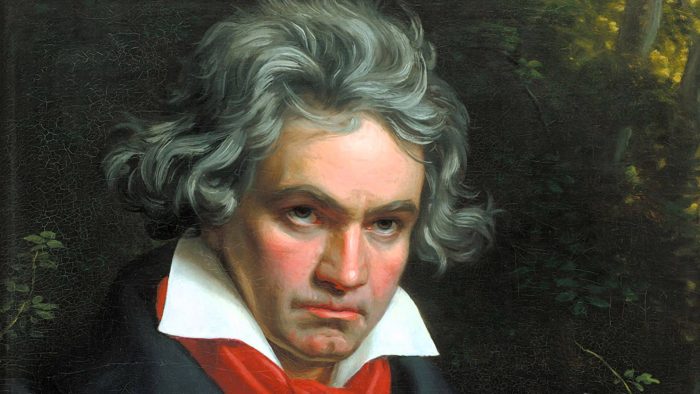
Milner also mentions that “Philips wanted a 14-bit system and a disc that could hold an hour of music, while Sony argued for 16 bits and 74 minutes, supposedly because that was the length of Beethoven’s Ninth Symphony,” though he calls the Beethoven bit “likely a digital audio urban legend.” But, like any urban legend, it contains grains of truth, though how many grains nobody quite knows for sure.
Philips’ preferred system would play 115-millimeter discs, while Sony’s would play 120-millimeter discs. As Wired’s Randy Alfred tells it:
When Sony and Philips were negotiating a single industry standard for the audio compact disc in 1979 and 1980, the story is that one of four people (or some combination of them) insisted that a single CD be able to hold all of the Ninth Symphony. The four were the wife of Sony chairman Akio Morita, speaking up for her favorite piece of music; Sony VP Norio Ohga (the company’s point man on the CD), recalling his studies at the Berlin Conservatory; Mrs. Ohga (her favorite piece, too); and conductor Herbert von Karajan, who recorded for Philips subsidiary Polygram and whose Berlin Philharmonic recording of the Ninth clocked in at 66 minutes.
Further research to find the longest recorded performance came up with a mono recording conducted by Wilhelm Furtwängler at the Bayreuth Festival in 1951. That playing went a languorous 74 minutes.
A good story, sure, but as Philips Engineer Kees A. Schouhamer Immink writes in a technical article marking the CD’s 25th anniversary, “everyday practice is less romantic than the pen of a public relations guru.” Whatever the influence of Beethoven, in 1979 “Philips’ subsidiary Polygram — one of the world’s largest distributors of music — had set up a CD disc plant in Hanover, Germany that could produce large quantities of CDs with, of course, a diameter of 115mm. Sony did not have such a facility yet. So if Sony had agreed on the 115mm disc, Philips would have had a significant competitive edge in the music market. Ohga was aware of that, did not like it, and something had to be done.”
How much does the running time of a CD, which would enjoy a long reign as the dominant media for recorded music, owe to what Immink calls “Mrs. Ohga’s great passion for [Beethoven],” and how much to “the money and competition in the market of the two partners”? Not even Snopes, which rules the claim of a connection between Beethoven’s Ninth and the development of the CD as “undetermined,” can settle the matter. But whatever determined the length of the albums in the CD era, that 74-minute runtime remains a strong influence on our expectations of album length even now that musicians can record and sell them at any length they like — and now that we the consumers can listen any way we like, fragmenting, re-arranging, and customizing all of our music experiences, even Beethoven’s Ninth.
Related Content:
How Did Beethoven Compose His 9th Symphony After He Went Completely Deaf?
How Steely Dan Wrote “Deacon Blues,” the Song Audiophiles Use to Test High-End Stereos
A Celebration of Retro Media: Vinyl, Cassettes, VHS, and Polaroid Too
Neil Young on the Travesty of MP3s
Based in Seoul, Colin Marshall writes and broadcasts on cities and culture. His projects include the book The Stateless City: a Walk through 21st-Century Los Angeles and the video series The City in Cinema. Follow him on Twitter at @colinmarshall or on Facebook.
Read More...A Big 44-Hour Chronological Playlist of Rolling Stones Albums: Stream 613 Tracks
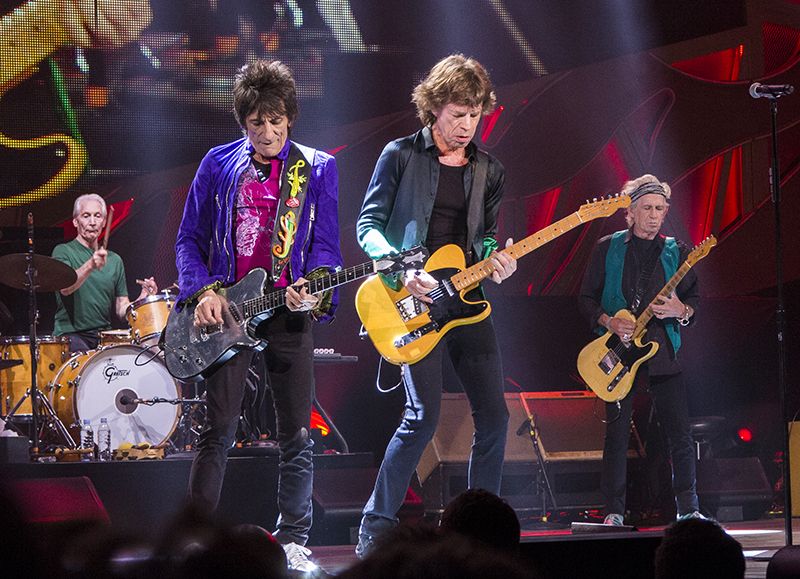
Image by Jim Pietryga, via Wikimedia Commons
“Would you let your daughter marry a Rolling Stone?”
From the start, the Rolling Stones were promoted as the more debauched, dangerous alternative to the Beatles, prompting the above rather-famous tabloid headline from their first years of fame. The Spotify playlist below collects a whopping 613 tracks from this seminal rock band, all placed for the most part in chronological order. (At 44 hours, there’s still whole albums–not major one mind you–missing, due to Spotify). The Stones may have been more complex than their bad boy image, but they’ve never shrugged it off over their five decades in music, and it’s probably too late to stop now.
But it was rough going at the start, wasn’t it? Their first single was a cover of a Chuck Berry song on the A‑side, and a Willie Dixon song on the flip. Their debut album contained only three originals, with only “Tell Me” standing out from the pack as something other than a carbon copy. Their second single was a song the Beatles gave to them–and even then the Fab Four recorded a version of it, unlike the hits they gave to Cilla Black and others. Andrew Loog Oldham was their manager first and a producer second, not used to the studio at all, and instead of the state-of-the-art Abbey Road studios to play in, the band had Regent Sound studios, with egg cartons taped to the ceiling to baffle noise. If this was competition against the Beatles, it certainly didn’t look good at first.
But despite–or due to–those challenges, the band gained success and earned respect, starting with “(I Can’t Get no) Satisfaction” and appearances on Ed Sullivan and the T.A.M.I. Show, where they actually followed James Brown and weren’t forgotten by history.
The Stones spent those first years following fashion, always one step behind the Beatles, going so far as to offer their own “Satanic” version of the psychedelic Sgt. Pepper’s. But then, instead of playing devilish dress-up, in May of 1968 they dropped “Jumpin Jack Flash,” which for the first time embodies a very real, dangerous energy. It wasn’t planned. But 1968 was when the Stones took the rock mantle from their friendly rivals. If any band was ready to be the bridge from the hopeful ‘60s to the grimy ‘70s, it was the Stones.
Their earlier mimicry of blues and rock’n’roll was one thing, but their amalgam of rock, blues, and Americana on albums like Sticky Fingers and Exile on Main Street was something else entirely, a special kind of alchemy that also seemed to tax the entire band–which eventually lost one founding member and shuffled through guitarists to find Ron Wood.
The late ‘70s and early ‘80s were an odd time for the band, as their biggest hits then were most unlike their previous hits, dallying with disco, channeling Lou Reed, and setting themselves up for a very confused decade. But still! All along the way the Stones kept releasing singles that other bands would give their eye teeth for.
The playlist ends with the release of 2016’s Blue and Lonesome, which found them right back where they started: a collection of well loved blues covers from Howlin’ Wolf, Little Walter, and Willie Dixon. In the end, they brought it all back home.
Related Content:
The Rolling Stones Release a Soulful, Never-Heard Acoustic Version of “Wild Horses”
Ted Mills is a freelance writer on the arts who currently hosts the artist interview-based FunkZone Podcast and is the producer of KCRW’s Curious Coast. You can also follow him on Twitter at @tedmills, read his other arts writing at tedmills.com and/or watch his films here.
Read More...Introducing the Librarian Action Figure: The Caped Crusader Who Fights Against Anti-Intellectualism, Ignorance & Censorship Everywhere

We’ve featured action figures that pay tribute to some cultural icons like Edvard Munch, Vincent Van Gogh and Frida Kahlo. But now comes a new action figure that honors a less appreciated cultural force–all of the great librarians, those crusaders for the printed and electronic word, who “keep it all organized for us and let us know about the best of it.” Standing almost four inches tall and made of hard vinyl, the librarian action figure is based on Seattle librarian Nancy Pearl. She has “a removable cape that symbolizes how much of a hero a librarian really is.” The action figure should come in handy in your own fights again anti-intellectualism, censorship and ignorance. Enjoy!
If you would like to support the mission of Open Culture, consider making a donation to our site. It’s hard to rely 100% on ads, and your contributions will help us continue providing the best free cultural and educational materials to learners everywhere. You can contribute through PayPal, Patreon, and Venmo (@openculture). Thanks!
Related Content:
Discover the Jacobean Traveling Library: The 17th Century Precursor to the Kindle
Napoleon’s Kindle: See the Miniaturized Traveling Library He Took on Military Campaigns
Let Me Librarian That for You: What People Asked Librarians Before Google Came Along
The Boston Public Library Will Digitize & Put Online 200,000+ Vintage Records
Read More...Free, Open Source Modular Synth Software Lets You Create 70s & 80s Electronic Music—Without Having to Pay Thousands for a Real-World Synthesizer
In the past decade or so, the analog modular synth—of the kind pioneered by Robert Moog and Don Buchla—has made a comeback, creating a booming niche market full of musicians chasing the sounds of the 70s and 80s. These inscrutable racks of patchbays, oscillators, filters, etc. look to the non-initiated more like telephone operator stations of old than musical instruments. But the sounds they produce are sublime and otherworldly, with a saturated warmth unparalleled in the digital world.
But while analog technology may have perfected certain tones, one can’t beat the convenience of digital recording, with its nearly unlimited multi-tracking capability, ability to save settings, and the ease of editing and arranging in the computer. Digital audio workstations have become increasingly sophisticated, able to emulate with “plug-ins” the capabilities of sought-after analog studio gear of the past. It has taken a bit longer for virtual instruments to meet this same standard, but they may be nearly there.

Only the most finely-tuned ears, for example, can hear the difference between the highest-quality digitally modeled guitar amplifiers and effects and their real-world counterparts in the mix. Even the most high-end modeling packages don’t cost as much as their real life counterparts, and many also come free in limited versions. So too the wealth of analog synth software, modeled to sound convincingly like the old and newly reissued analog boxes that can run into the many thousands of dollars to collect and connect.
One such collection of synths, the VCV Rack, offers open-source virtual modular synths almost entirely free, with only a few at very modest prices. The standalone virtual rack works without any additional software. Once you’ve created an account and installed it, you can start adding dozens of plug-ins, including various synthesizers, gates, reverbs, compressors, sequencers, keyboards, etc. “It’s pretty transformative stuff,” writes CDM. “You can run virtual modules to synthesize and process sounds, both those emulating real hardware and many that exist only in software.”
The learning curve is plenty steep for those who haven’t handled this perplexing technology outside the box. A series of YouTube tutorials, a few of which you can see here, can get you going in short order. Those already experienced with the real-world stuff will delight in the expanded capabilities of the digital versions, as well as the fidelity with which these plug-ins emulate real equipment—without the need for a roomful of cables, unwieldly racks, and soldiering irons and spare parts for those inevitable bad connections and broken switches and inputs.
You can download the virtual rack here, then follow the instructions to load as many plug-ins as you like. CDM has instructions for the developer version (find the source code here), and a YouTube series called Modular Curiosity demonstrates how to install the rack and use the various plugins (see their first video further up and find the rest here). Modular System Beginner Tutorial is another YouTube guide, with five different videos. See number one above and the rest here. The longer video at the top of the post offers a “first look and noob tutorial.”
VCV Rack is only the latest of many virtual modular synths, including Native Instruments’ Reaktor Blocks and Softube’s Modular. “But these come with a hefty price tag,” notes FACT magazine. “VCV Rack can be downloaded for free on Linux, Mac and Windows platform.” And if you’re wondering how it stacks up against the real-life boxes it emulates, check out the video below.
Related Content:
How the Moog Synthesizer Changed the Sound of Music
The Mastermind of Devo, Mark Mothersbaugh, Shows Off His Synthesizer Collection
Josh Jones is a writer and musician based in Durham, NC. Follow him at @jdmagness.
Read More...How Isaac Newton Lost $3 Million Dollars in the “South Sea Bubble” of 1720: Even Geniuses Can’t Prevail Against the Machinations of the Markets

The Aristotelian notion of “man” as a “rational animal” has seen its share of detractors, from the Cynics to Bertrand Russell to nearly the whole of Poststructuralist thought. Leave it up to Oscar Wilde to compress the debate between intellect and passion into a pithy aphorism: “Man is a rational animal who always loses his temper when he is called upon to act in accordance with the dictates of reason.”
We no longer need clever verbal barbs to refute too-optimistic assessments of human behavior. Economics is catching up: we have the language of neuroscience and psychology, which consistently tells us that humans decidedly do not behave rationally very often, but are driven by bias and biology in inexplicable ways. And for over a hundred years now, we’ve known that the clockwork Newtonian view of the physical universe turns out be a much messier and indeterminate affair, as does the universe of the human mind.
Why, then, has so much economic theory operated with a kind of dogged Aristotelianism, insisting that the units of capitalist society, the workers, managers, investors, consumers, owners, renters, speculators, etc. behave in predictable ways? We have case after case showing that intelligence and critical reasoning often have little to do with success or failure in the market. In such cases, however, one often hears the “madness of crowds” or other cliches invoked as an explanation.
To illustrate, market reporters and business writers have seized upon the story of Isaac Newton’s spectacular rise and fall in the so-called “South Sea Bubble” of 1720. We find the story in Benjamin Graham’s 1949 classic The Intelligent Investor, a widely-read book that attributes the irrationality of market systems to an anthropomorphic entity named “Mr. Market.”
Graham writes,
Back in the spring of 1720, Sir Isaac Newton owned shares in the South Sea Company, the hottest stock in England. Sensing that the market was getting out of hand, the great physicist muttered that he ‘could calculate the motions of the heavenly bodies, but not the madness of the people.’ Newton dumped his South Sea shares, pocketing a 100% profit totaling £7,000. But just months later, swept up in the wild enthusiasm of the market, Newton jumped back in at a much higher price — and lost £20,000 (or more than $3 million in [2002–2003’s] money. For the rest of his life, he forbade anyone to speak the words ‘South Sea’ in his presence.
The quotation in bold may or may not have been uttered by Newton, but the events Graham describes did indeed happen. As the Wall Street Journal’s Jason Zwieg relates, University of Minnesota professor Andrew Odlyzko found that “Newton had shifted from a prudent investor with his money spread across several securities to a speculator who had plunged essentially all of his capital into a single stock. The great scientist was chasing hot performance as desperately as a day trader in 1999 or many bitcoin buyers in 2017.” (Odlyzko estimates Newton’s losses closer to $4 million.) Perhaps it was not a metaphorical “Mr. Market” who cost Newton up to 77% “on his worst purchases,” nor was it widespread “wild enthusiasm”—the mass movement of passion that Enlightenment philosophers so feared.
Perhaps it was Newton himself who, Elena Holodny writes at Business Insider, “let his emotions get the best of him, and got swayed by the irrationality of the crowd.” Maybe it’s more accurate to say Newton succumbed to greed when the bubble expanded. “Throughout history,” Barbara Kollmeyer writes at Market Watch in her interview with author Richard Dale, “people—especially those at the top rung of society—have been greedy and gullible participants in financial bubbles. And Sir Isaac Newton was only human, after all.” (How many at the top rung of society fell prey to Bernie Madoff’s schemes? And a century before the South Sea Bubble, hundreds of wealthy investors lost their shirts in the Dutch Tulip Bulb craze.)
Some business writers, like investment editor Richard Evans at The Telegraph, recommend a calculable formula to avoid losing a fortune in bubbles, advice that takes rational agency for granted. Perhaps it should not. In addition to citing the contagion of crowds, nearly every discussion of Newton’s folly allows that a failure of emotional discipline played a significant role. Benjamin Graham invokes another Aristotelian notion—the idea that “character” counts as much or more than intelligence when it comes to investing. “The investor’s chief problem,” he writes, “and even his worst enemy—is likely to be himself.”
Far fewer commenters note that the South Sea venture was itself a failure of character from its inception. The company had secured an exclusive monopoly on trade with South America; much of that trade involved selling slaves. It is also the case that the company artificially inflated its stock prices, and colluded with several MPs in insider trading schemes. The so-called “Bubble Act” of Parliament in 1720, presumably passed to prevent crashes like the one that devastated Newton, turned out to be corporate giveaway. The terms of the act had been dictated by the South Sea Company in order to prevent other companies from poaching their investors. Although these circumstances are well-known to economic historians, they rarely make their way into commentary on Newton’s great loss.
Economists instead tend to blame abstractions for economic events like the South Sea Bubble, or they blame the overreaching profit-seeking of investors, and maybe for good reason. The other explanations haunt the margins: the inherently exploitative nature of most forms of corporate capitalism, and the corruption and collusion between the state and private enterprise that inhibits fair competition and makes it impossible for investors to evaluate the situation transparently. For all of his scientific and mathematical genius, Isaac Newton was no exception—he was just as subject to irrational greed as the next investor, and to the predatory machinations of “market forces.”
Related Content:
In 1704, Isaac Newton Predicts the World Will End in 2060
Isaac Newton Creates a List of His 57 Sins (Circa 1662)
Sir Isaac Newton’s Papers & Annotated Principia Go Digital
Josh Jones is a writer and musician based in Durham, NC. Follow him at @jdmagness
Read More...What Actually Is Bitcoin?: Princeton’s Free Online Course “Bitcoin and Currency Technologies” Provides Much-Needed Answers
“Don’t Understand Bitcoin?” asked the headline of a recent video from Clickhole, the Onion’s viral-media parody site. “This Man Will Mumble an Explanation at You.” The inexplicable hilarity of the mumbling man and his 72-second explanation of Bitcoin contains, like all good humor, a solid truth: most of us don’t understand Bitcoin, and the simplistic information we seek out, for all we grasp of it, might as well be delivered unintelligibly. A few years ago we featured a much clearer three-minute explanation of that best-known form of cryptocurrency here on Open Culture, but how to gain a deeper understanding of this technology that, in one form or another, so many of us will eventually use?
Consider joining “Bitcoin and Currency Technologies,” a free course from Coursera taught by several professors from Princeton University, including computer scientist Arvind Narayanan, whose Princeton Bitcoin Textbook we featured last year.
The eleven-week online course (classroom versions of whose lectures you can check out here) just began, but you can still easily join and learn the answers to questions like the following: “How does Bitcoin work? What makes Bitcoin different? How secure are your Bitcoins? How anonymous are Bitcoin users? What determines the price of Bitcoins? Can cryptocurrencies be regulated? What might the future hold?” All of those, you’ll notice, have been raised more and more often in the media lately, but seldom satisfactorily addressed.
“Real understanding of the economic issues underlying the cryptocurrency is almost nonexistent,” writes Nobel-winning economist Robert J. Shiller in a recent New York Times piece on Bitcoin. “It is not just that very few people really comprehend the technology behind Bitcoin. It is that no one can attach objective probabilities to the various possible outcomes of the current Bitcoin enthusiasm.” Take Princeton’s course, then, and you’ll pull way ahead of many others interested in Bitcoin, even allowing for all the still-unknowable unknowns that have caused such thrilling and shocking fluctuations in the digital currency’s eight years of existence so far. All of it has culminated in the current craze Shiller calls “a marvelous case study in ambiguity and animal spirits,” and where ambiguity and animal spirits rule, a little intellectual understanding certainly never hurts.
Enroll free in “Bitcoin and Currency Technologies” here. Find other related courses on cyrptocurrency and blockchain here.
Related Content:
Bitcoin, the New Decentralized Digital Currency, Demystified in a Three Minute Video
The Princeton Bitcoin Textbook Is Now Free Online
Free Online Economics/Finance Courses
1,700 Free Online Courses from Top UniversitiesBased in Seoul, Colin Marshall writes and broadcasts on cities and culture. His projects include the book The Stateless City: a Walk through 21st-Century Los Angeles and the video series The City in Cinema. Follow him on Twitter at @colinmarshall or on Facebook.
Read More...The Health Benefits of Drumming: Less Stress, Lower Blood Pressure, Pain Relief, and Altered States of Consciousness
Drumming—from tablas to tympani to djembes—is universal, so much so, says author Sayer Ji, that it seems “hard-wired into our biological, social and spiritual DNA.” Drumming may well be “an inborn capacity and archetypal social activity.” But many modern people have become alienated from the drum. We outsource drumming to professionals, and machines. Neuroscientists theorize that drummers may have different brains than “non-drummers”—findings that suggest the activity is confined to specially-designed people. Not so, say many scientists who believe that “drumming has some profound and holistic uses,” as Luke Sumpter writes at Reset.me, “to enhance physical, mental and emotional health.”
In addition to anthropological evidence noting the centrality of drumming to human culture, abundant research has demonstrated its potential for personal healing. While drum therapy may be nothing new for cultures who have retained the practice, those who haven’t can learn group drumming easily enough with teachers like Peter Marino in the short clip above. The benefits, as studies have shown, include reduced stress and increased immunity. Group drumming may reduce anxiety and blood pressure, it may work as pain relief and boost positive emotions, and may even lead to “improved executive function” and a growth in white matter in the brains of patients with Huntington’s disease and other neurological conditions.
The evidence-based approach to group drumming’s socio-physical benefits should sway skeptics, even those likely to see drum circle therapy as some kind of hippy-dippy woo. Science-minded people without such hangups may also take an interest in studies of drumming as a “shamanic” activity that “induces specific subjective experiences.” As Michael Drake reports, one recent study “demonstrates that even a brief drumming session can double alpha brain wave activity,” which is “associated with meditation, shamanic trance, and integrative modes of consciousness.” Drumming with others “produces greater self-awareness” as well as a sense of interconnectedness, and can strengthen social bonds among adults as well as children.
While much of the writing about group drumming as therapy stresses more intangible, mystical benefits, no small amount of data suggests that the physical effects are measurable and significant. This is not to minimize the musical prowess of your favorite drummers, or to belittle the musical value of machine-made beats. But the research strongly suggests that not only is most everyone able to pick up a drum and get into a groove, but also that most everyone who does so will be happier, healthier, and more peaceful and tuned-in.
via Reset
Related Content:
The Neuroscience of Drumming: Researchers Discover the Secrets of Drumming & The Human Brain
Playing an Instrument Is a Great Workout For Your Brain: New Animation Explains Why
Isolated Drum Tracks From Six of Rock’s Greatest: Bonham, Moon, Peart, Copeland, Grohl & Starr
Josh Jones is a writer and musician based in Durham, NC. Follow him at @jdmagness.
Read More...The 10 Most Popular Courses on Coursera in 2017 (and 2,000 Courses You Can Take for Free in January, 2018)
Back in 2012, Coursera started offering MOOCS (Massive Open Online Courses) to the world at large. And they’ve since amassed some 28 million registered users, a catalogue of 2,000 courses, and reams of data about what people want to learn. In the waning days of December, Coursera published a list of their 1o most popular courses of 2017. (Find below, and enroll in any of these courses for free.) From this list, it drew some larger conclusions about trends in education and technology.
The list shows, writes Nikhil Sinha, Coursera’s Chief Content Officer, that “cutting-edge tech skills continue to be the most sought after in online education.” Artificial intelligence–encompassing Machine Learning, Neural Networks and Deep Learning–topped the list of courses. Meanwhile “Blockchain has also burst onto the scene, putting Princeton’s Bitcoin and Cryptocurrency course at number five on the list.” But, Sinha adds, it’s “not just technology skills that are trending.” The “basic learning and information-retention skills taught in our popular Learning How to Learn course are extremely sought-after by people of all ages.” The same applies to the problem-solving skills taught by Stanford’s Introduction to Mathematical Thinking.
You can review the Top 10 list below, and enroll in any of those regularly-offered courses.
- Machine Learning: A primer from Stanford University on getting computers to act without being explicitly programmed.
- Neural Networks and Deep Learning: Building on the course above, this course will teach you to feed a computer system a lot of data, which it can then use to make decisions about other data.
- Learning How to Learn: Powerful Mental Tools to Help You Master Tough Subjects: The most popular MOOC ever, this course developed by Dr. Barbara Oakley gives you access to the invaluable learning techniques used by experts in art, music, literature, math, science, sports, and many other disciplines.
- Introduction to Mathematical Thinking: Stanford University will teach you a style of thinking that will help you think outside the box and solve real problems in the everyday world.
- Bitcoin and Cryptocurrency Technologies: From Princeton University comes a course that explains what is special about Bitcoin, and how it works at a technical level.
- Programming for Everybody (Getting Started with Python): The University of Michigan offers a course everyone should take–a primer on the basics of programming computers, using Python.
- Algorithms, Part I: Princeton’s course covers “essential information that every serious programmer needs to know about algorithms and data structures, with emphasis on applications and scientific performance analysis of Java implementations.”
- English for Career Development: Created by the University of Pennsylvania, this course is for non-native English speakers “interested in advancing their careers in the global marketplace.” Along the way, you’ll learn about the job search, application, and interview process in the U.S., and also explore your own global career path.
- Neural Networks for Machine Learning: The University of Toronto gives you the chance to “learn about artificial neural networks and how they’re being used for machine learning, as applied to speech and object recognition, image segmentation, modeling language and human motion, etc.”
- Financial Markets: Created by Yale’s Robert Shiller (winner of the Nobel Prize in Economics), this course offers an overview of the financial markets, which allow human society to manage risks and foster enterprise. It includes an introduction to risk management and behavioral finance principles underlying the securities, insurance, and banking industries.
Note: Open Culture has a partnership with Coursera. If readers enroll in certain Coursera courses, it helps support Open Culture.
Related Content:
Learning How to Learn: The Most Popular MOOC of All Time
Read More...5,000+ Photographs by Minor White, One of the 20th Century’s Most Important Photographers, Now Digitized and Available Online

When the photographer Minor White died in 1976, after a prolific career and an epic journey of a life, he left his archives to Princeton University. But it took about forty years before that institution could make the collection truly available to the world in the form of the Minor White Archive online. He became “one of the most important photographic artists of the twentieth century” and “a key figure in shaping a distinctly modern American photographic style,” as the archive’s “About” page puts it, by capturing the images of humans, landscapes urban and rural, and even abstract subjects, all the while pursuing new and ever more personal ways to capture them.
In his endless search for inspirations with which to refine his photographic practice, White seemed to turn down no potential source. Not only did he put in time with such colossal predecessors in American photography as Alfred Stieglitz, Edward Weston, and Ansel Adams (who taught him, among other things, his reliable “visualization” technique), he also drew deeply from less conventional wells: the I Ching, Zen meditation, mythology, astrology, Gestalt psychology, and the mystic philosophy of G. I. Gurdjieff (who also had an influence on the comic persona of Bill Murray).
“To some in the 1960s and ‘70s,” remembers onetime associate John Weiss, “Minor White was a deity. Every word was an invocation. To others he was a self-promoter, a fraud, talking nonsense.”

Chinatown 1953. From The Minor White Archive, Princeton University Art.
Either way, White was above all a photographer. Princeton’s digital archive features more than 5,000 of his photographs (and other materials like proof cards, contact sheets, and even journals) free to view online. It offers “a comprehensive survey of White’s career,” as Hyperallergic’s Claire Voon writes, “from his early captures of Portland, Oregon in 1938 to his latest work in 1974 of portraits and landscapes taken around the US.” Have a look through the archive, starting at its search page and, once there, either entering search terms or browsing by subject or location, and you’ll see why, when it comes to American photographic art, Minor was very much major.
Related Content:
Alfred Stieglitz: The Eloquent Eye, a Revealing Look at “The Father of Modern Photography”
Yale Launches an Archive of 170,000 Photographs Documenting the Great Depression
Based in Seoul, Colin Marshall writes and broadcasts on cities and culture. His projects include the book The Stateless City: a Walk through 21st-Century Los Angeles and the video series The City in Cinema. Follow him on Twitter at @colinmarshall or on Facebook.
Read More...Support Us
We're hoping to rely on loyal readers, rather than erratic ads. Please click the Donate button and support Open Culture. You can use Paypal, Venmo, Patreon, even Crypto! We thank you!

About Us

Open Culture scours the web for the best educational media. We find the free courses and audio books you need, the language lessons & educational videos you want, and plenty of enlightenment in between.
Advertise With Us

FREE UPDATES!
GET OUR DAILY EMAIL
Get the best cultural and educational resources on the web curated for you in a daily email. We never spam. Unsubscribe at any time.
FOLLOW ON SOCIAL MEDIA

Open Culture editor Dan Colman scours the web for the best educational media. He finds the free courses and audio books you need, the language lessons & movies you want, and plenty of enlightenment in between.
Advertise With Us


