Visit Monte Testaccio, the Ancient Roman Hill Made of 50 Million Crushed Olive Oil Jugs
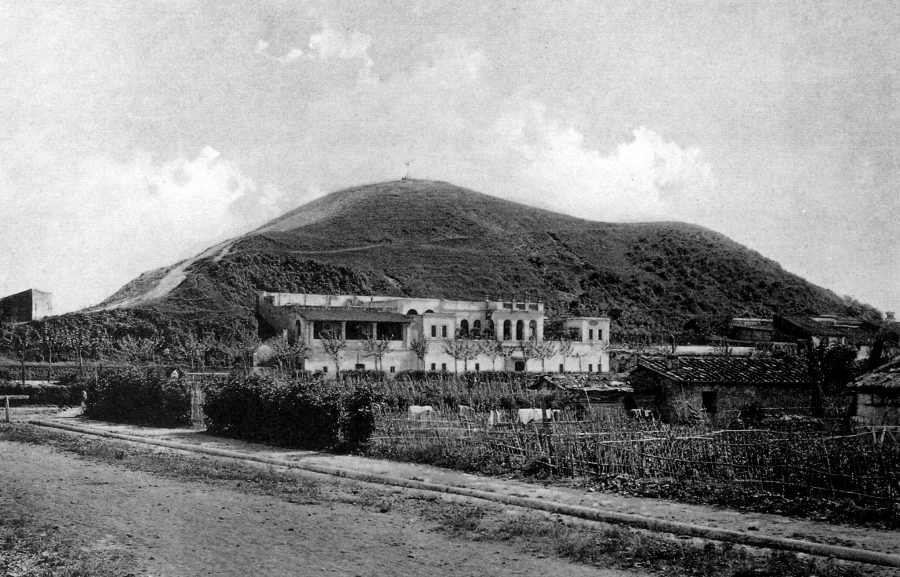
Image by patrimoni gencat, via Flickr Commons
It may be one of the more curious manmade garbage piles on our planet. Located in Rome, and dating back to 140 A.D., Monte Testaccio rises 150 feet high. It covers some 220,000 square feet. And it’s made almost entirely of 53 million shattered amphorae–that is, Roman jugs used to transport olive oil during ancient times. How did the remnants of so many amphorae end up here? The web site Olive Oil Times offers this explanation:
Firstly, the site of the mound on the east bank of the Tiber is located near the Horrea Galbae – a huge complex of state controlled warehouses for the public grain supply as well as wine, food and building materials. As ships came from abroad bearing the olive oil supplies, the transport amphorae were decanted into smaller containers and the used vessels discarded nearby.
There’s a reason for this: Due to the clay utilized to make the amphorae not being lined with a glaze, after transportation of olive oil, the amphorae could not be re-used because the oil created a rancid odour within the fabric of the clay.
You might consider this Roman garbage dump an historical oddity. But as they say, one man’s trash is another man’s treasure. And according to Archaeology (a website of the Archaeological Institute of America) Monte Testaccio promises to reveal much about the inner-workings of the Roman economy. They write:
As the modern global economy depends on light sweet crude, so too the ancient Romans depended on oil—olive oil. And for more than 250 years, from at least the first century A.D., an enormous number of amphoras filled with olive oil came by ship from the Roman provinces into the city itself, where they were unloaded, emptied, and then taken to Monte Testaccio and thrown away. In the absence of written records or literature on the subject, studying these amphoras is the best way to answer some of the most vexing questions concerning the Roman economy—How did it operate? How much control did the emperor exert over it? Which sectors were supported by the state and which operated in a free market environment or in the private sector?
For historians, these are important questions, and they’re precisely the questions being asked by University of Barcelona professor, José Remesa, who notes, “There’s no other place where you can study economic history, food production and distribution, and how the state controlled the transport of a product.”
Above get a distant view of Monte Testaccio. Below get a close up view of the amphorae shards themselves.

Image by Alex, via Flickr Commons
If you would like to support the mission of Open Culture, consider making a donation to our site. It’s hard to rely 100% on ads, and your contributions will help us continue providing the best free cultural and educational materials to learners everywhere. You can contribute through PayPal, Patreon, and Venmo (@openculture). Thanks!
Related Content:
The Oldest Unopened Bottle of Wine in the World (Circa 350 AD)
How to Bake Ancient Roman Bread Dating Back to 79 AD: A Video Primer
Rome Reborn: Take a Virtual Tour of Ancient Rome, Circa 320 C.E.
Read More...George Orwell Predicted Cameras Would Watch Us in Our Homes; He Never Imagined We’d Gladly Buy and Install Them Ourselves
Normalization—the mainstreaming of people and ideas previously banished from public life for good reason—has become the operative description of a massive societal shift toward something awful. Whether it’s puff pieces on neo-Nazis in major national newspapers or elected leaders who are also documented sexual predators, a good deal of work goes into making the previously unthinkable seem mundane or appealing.
I try not to imagine too often where these things might lead, but one previously unthinkable scenario, the openly public mass surveillance apparatus of George Orwell’s 1984 has pretty much arrived, and has been thoroughly normalized and become both mundane and appealing. Networked cameras and microphones are installed throughout millions of homes, and millions of us carry them with us wherever we go. The twist is that we are the ones who installed them.
As comic Keith Lowell Jensen remarked on Twitter a few years ago, “What Orwell failed to predict is that we’d buy the cameras ourselves, and that our biggest fear would be that nobody was watching.” By appealing to our basic human need for connection, to vanity, the desire for recognition, and the seemingly instinctual drive for convenience, technology companies have persuaded millions of people to actively surveille themselves and each other. They incessantly gather our data, as Tim Wu shows in The Attention Merchants, and as a byproduct have provided access to our private spaces to government agents and who-knows-who-else.
Computers, smartphones, and “smart” devices can nearly all be hacked or commandeered. Former director of national intelligence James Clapper reported as much last year, telling the U.S. Senate that intelligence agencies might make extended use of consumer devices for government surveillance. Webcams and “other internet-connected cameras,” writes Eric Limer at Popular Mechanics, “such as security cams and high-tech baby monitors, are… notoriously insecure.” James Comey and Mark Zuckerberg both cover the cameras on their computers with tape.
The problem is far from limited to cameras. “Any device that can respond to voice commands is, by its very nature, listening to you all the time.” Although we are assured that those devices only hear certain trigger words “the microphone is definitely on regardless” and “the extent to which this sort of audio is saved or shared is unclear.” (Recordings on an Amazon Echo are pending use as evidence in a murder trial in Arkansas.) Devices like headphones have even been turned into microphones, Limer notes, which means that speakers could be as well, and “Lipreading software is only getting more and more impressive.”
I type these words on a Siri-enabled Mac, an iPad lies nearby and an iPhone in my pocket… I won’t deny the appeal—or, for many, the necessity of connectivity. The always-on variety, with multiple devices responsible for controlling greater aspects of our lives may not be justifiable. Nonetheless, 2017 could “finally be the year of the smart home.” Sales of the iPhone X may not meet Apple’s expectations. But that could have more to do with price or poor reviews than with the creepy new facial recognition technology—a feature likely to remain part of later designs, and one that makes users much less likely to cover or otherwise disable their cameras.
The thing is, we mostly know this, at least abstractly. Bland bulleted how-to guides make the problem seem so ordinary that it begins not to seem like a serious problem at all. As an indication of how mundane insecure networked technology has become in the consumer market, major publications routinely run articles offering helpful tips on how “stop your smart gadgets from ‘spying’ on you” and “how to keep your smart TV from spying on you.” Your TV may be watching you. Your smartphone may be watching you. Your refrigerator may be watching you. Your thermostat is most definitely watching you.
Yes, the situation isn’t strictly Orwellian: Oceana’s constantly surveilled citizens did not comparison shop, purchase, and customize their own devices voluntarily. (It’s not strictly Foucauldian either, but has its close resemblances.) Yet in proper Orwellian doublespeak, “spying” might have a very flexible definition depending on who is on the other end. We might stop “spying” by enabling or disabling certain features, but we might not stop “spying,” if you know what I mean.
So who is watching? CIA documents released by a certain unsavory organization show that the Agency might be, as the BBC segment at the top reports. As might any number of other interested parties from data-hoarding corporate bots to tech-savvy voyeurs looking to get off on your candid moments. We might assume that someone could have access at any time, even if we use the privacy controls. That so many people have become dependent on their devices, and will increasingly become so in the future, makes the question of what to do about it a trickier proposition.
Related Content:
Josh Jones is a writer and musician based in Durham, NC. Follow him at @jdmagness
Read More...Lou Reed Sings “Sweet Jane” Live, Julian Schnabel Films It (2006)
“Lou Reed’s Berlin is a disaster, taking the listener into a distorted and degenerate demimonde of paranoia, schizophrenia, degradation, pill-induced violence and suicide,” wrote Rolling Stone’s Stephen Davis in 1973, adding that “there are certain records that are so patently offensive that one wishes to take some kind of physical vengeance on the artists that perpetrate them.” Could this “last shot at a once-promising career,” as Davis described it, really have come from the onetime leader of as influential a band as the Velvet Underground — from the man who could, just three years earlier, have written a song like “Sweet Jane”?
Yet Lou Reed survived Berlin’s drubbing, and indeed spent the next forty years fulfilling his promise, to the very end drawing the occasional round of pans (most resoundingly for Lulu, his 2011 collaboration with Metallica) that verified his artistic vitality. By the 21st century, critical opinion had come around on Berlin, and in 2003 even Rolling Stone put it on its list of the 500 greatest albums of all time.
Three years later, Reed took the then-33-year-old rock-opera album on tour, playing it live with a 30-piece band and twelve choristers. Painter-filmmaker Julian Schnabel designed the tour and shot a documentary of five nights of its performances in Brooklyn, releasing it in 2008 as Lou Reed Berlin.
In the clip above, you can see the very last song of the show, played during the film’s closing credits. It isn’t “Sad Song,” which draws the curtain over Berlin, but the last of a three-part encore that ends with none other than “Sweet Jane.” Having first appeared on the Velvet Underground’s 1970 album Loaded (#110 on the Rolling Stone list to Berlin’s #344), the song became a favorite in Reed’s live performances in the decades thereafter, an evocation of a particular creative era in a career that encompassed so many. “Goodbye, Lou,” Davis said to Reed at the end of his Berlin review, but for that album, and even more so for the man who made it, the show had only just begun.
Related Content:
Martin Scorsese Captures Levon Helm and The Band Performing “The Weight” in The Last Waltz
Jefferson Airplane Plays on a New York Rooftop; Jean-Luc Godard Captures It (1968)
Jean-Luc Godard Shoots Marianne Faithfull Singing “As Tears Go By” (1966)
Based in Seoul, Colin Marshall writes and broadcasts on cities and culture. His projects include the book The Stateless City: a Walk through 21st-Century Los Angeles and the video series The City in Cinema. Follow him on Twitter at @colinmarshall or on Facebook.
Read More...The Robots of Your Dystopian Future Are Already Here: Two Chilling Videos Drive It All Home
A year ago, Boston Dynamics released a video showing its humanoid robot “Atlas” doing, well, rather human things–opening doors, walking through a snowy forest, hoisting cardboard boxes, and lifting itself off of the ground. Rarely has something so banal seemed so peculiar.
What is “Atlas” doing these days? As shown in this newly-released video above, it’s jumping to new heights, twisting in the air, and doing backflips with uncanny ease. Standing six feet tall and weighing 180 pounds, Atlas was designed to take care of mundane problems–like assisting emergency services in search and rescue operations and “operating powered equipment in environments where humans could not survive.” But that’s not where the applications of Atlas end. Seeing that the Pentagon has helped finance and design Atlas, you can easily see the humanoid fighting on the battlefield. Stay tuned for that clip in 2018.
Which brings us to our next video. The new short film, “Slaughterbots,” comes from the Campaign to Stop Killer Robots and it follows this plot:
A military firm unveils a tiny drone that hunts and kills with ruthless efficiency. But when the technology falls into the wrong hands, no one is safe. Politicians are cut down in broad daylight. The machines descend on a lecture hall and spot activists, who are swiftly dispatched with an explosive to the head.
According to UC Berkeley AI expert Stuart Russell, “Slaughterbots” looks like science fiction. But it’s not. “It shows the results of integrating and miniaturizing technologies that we already have.” It is “simply an integration of existing capabilities… In fact, it is easier to achieve than self-driving cars, which require far higher standards of performance.” Recently shown at the United Nations’ Convention on Conventional Weapons, “Slaughterbots” comes on the heels of an open letter signed by 116 robotics and AI scientists (including Tesla’s Elon Musk), urging the UN to ban the development and use of killer robots. It reads:
Lethal autonomous weapons threaten to become the third revolution in warfare. Once developed, they will permit armed conflict to be fought at a scale greater than ever, and at timescales faster than humans can comprehend. These can be weapons of terror, weapons that despots and terrorists use against innocent populations, and weapons hacked to behave in undesirable ways. We do not have long to act. Once this Pandora’s box is opened, it will be hard to close.
If we already have military drones taking out enemies across the world (in places like Yemen, Somalia, Iraq, Syria, Libya and Afghanistan), the mental leap to deploying Slaughterbots doesn’t seem too great. Do you trust our leaders to make finer distinctions and keep a lid on Pandora’s Box? Or could you see them tearing Pandora’s Box open like a gift on Christmas day? Yeah, me too. The robots of your dystopian future are now here.
If you would like to support the mission of Open Culture, consider making a donation to our site. It’s hard to rely 100% on ads, and your contributions will help us continue providing the best free cultural and educational materials to learners everywhere. You can contribute through PayPal, Patreon, and Venmo (@openculture). Thanks!
Related Content:
Artificial Intelligence: A Free Online Course from MIT
Read More...Watch Footage of the Velvet Underground Composing “Sunday Morning,” the First Track on Their Seminal Debut Album The Velvet Underground & Nico (1966)
Before its many layers of well-deserved hagiography, the Velvet Underground’s first album emerged in 1967 on its own terms, in near obscurity, introducing something so mysteriously cool and hauntingly grim and beautiful. Goth and punk and post-punk and New Wave and chamber pop and shoegaze and indie folk and Britpop and noise and drone and No Wave… all came decades later. But first there was The Velvet Underground & Nico. Of its unlikely creation, Tyler Wilcox writes, “talent, vision, fearlessness, a touch of genius: they’re all necessary ingredients for the creation of a classic album. But you’re also going to need a lot of luck.”
Wilcox describes in his history how all of those qualities—luck, and Andy Warhol, included—brought the five original VU members together in 1965; how the band debuted with Nico at the Delmonico Hotel 1966, occasioning the New York Herald Tribune’s headline, “Shock Treatment for Psychiatrists”; and how their lo-fi drone and Medieval folk meets decadent, literary 60s pop derived from influences like Booker T. & The MG’s and avant-garde minimalist La Monte Young. It’s one thing to read about this total re-imaging of rock and roll, and another thing entirely to see it. Unfortunately, little film of the band exists from that time—some of it very fragmentary or very rare.
Just above, you can see one of the best pieces of footage: Lou Reed, John Cale, and Sterling Morrison composing the album’s first track, the delicate “Sunday Morning,” whose handful of wistful, ambiguous lyrics introduce Reed’s “spiritual seeking” as a thematic thread that weaves through songs of sadomasochism, heroin, and death. The silent film was shot in 1966 by filmmaker Rosalind Stevenson while the band rehearsed in her apartment. This debut broadcast, with the studio recording overlaid, comes from a 1994 BBC program called Peel Slowly and See (after the instruction telling buyers of the vinyl LP to peel the banana sticker and discover this).
Had the band only recorded their first album, it’s hard to imagine their importance in rock history would be much lessened, but it’s also hard to imagine rock history without follow-ups White Light/White Heat, The Velvet Underground, and Loaded. Yet these were all products of deliberate focus, and a diminishing number of key singers/songwriters. The first Velvet Underground album is magical for its serendipity and almost schizoid collection of fully-formed personalities, each so distinctive that “each track” on The Velvet Underground & Nico “has launched an entire genre.”
So notes WBEZ’s Sound Opinions. Just above you can hear the show’s Jim DeRogatis and Greg Kot discuss the influences and significance, with many sonic examples, of the album that launched a few thousand bands. Watch the creation of “Sunday Morning” and think about the number of times you’ve heard it haunting bands like Belle and Sebastian, the Decembrists, or Beach House. And if you’ve somehow missed all the other genres to which this first record gave birth, DeRogatis and Kot should get you caught up on why “no album has had a greater influence on rock in that last half-century than the Velvet Underground’s debut.”
Find more early VU footage in the Relateds right below.
Related Content:
An Animation of The Velvet Underground’s “Sunday Morning” … for Your Sunday Morning
Lou Reed, John Cale & Nico Reunite, Play Acoustic Velvet Underground Songs on French TV, 1972
The Velvet Underground’s John Cale Plays Erik Satie’s Vexations on I’ve Got a Secret (1963)
Josh Jones is a writer and musician based in Durham, NC. Follow him at @jdmagness
Read More...How Art Spiegelman Designs Comic Books: A Breakdown of His Masterpiece, Maus
Maus, cartoonist Art Spiegelman’s groundbreaking, Pulitzer Prize-winning account of his complicated relationship with his Holocaust survivor father, is a story that lingers.
Spiegelman famously chose to depict the Jews as mice and the Nazis as cats. Non-Jewish civilians of his father’s native Poland were rendered as pigs. He flirted with the idea of depicting his French-born wife, the New Yorker’s art editor, Françoise Mouly, as a frog or a poodle, until she convinced him that her conversion to Judaism merited mousehood, too.
The characters’ anthropomorphism is not the only visual innovation, as the Nerdwriter, Evan Puschak, points out above.
Drawing on interviews in MetaMaus: A Look Inside a Modern Classic, taped conversations with Neil Gaiman, and the University of Washington’s Marcia Alvar, and other sources, the Nerdwriter pans an eight-panel page from the first chapter for maximum meaning.
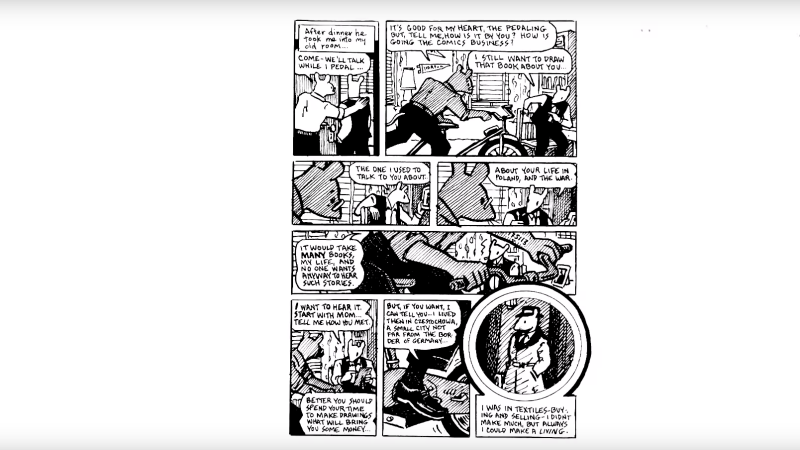
On first glance, nothing much appears to be happening on that page—hoping to convince his elderly father to submit to interviews for the book that would eventually become Maus, Spiegelman trails him to his childhood bedroom, which the older man has equipped with an exercise bike that he pedals in dress shoes and black socks.
But, as Spiegelman himself once pointed out:
Those panels are each units of time. You see them simultaneously, so you have various moments in time simultaneously made present.
Readers must force themselves to proceed slowly in order to fully appreciate the coexistence of all those moments.
Left to our own devices, we might pick up on the senior Spiegelman’s concentration camp tattoo, or the introduction of Art’s late mother via the framed photo he shows himself picking up.
But Puschak takes us on an even deeper dive, noting the significance of Art’s placement in the long mid-page panel. Watch out for the 4:30 mark, another visual stunner is teased out in a manner reminiscent of the revelation of a message written in invisible ink.
So Maus conferred commercial success upon its creator, while hanging onto some of the bold visual experiments from earlier in his career, when he and Mouly helped drive the underground comix scene—the past and present entwined yet again.
And this is just one page. Should you venture forth in search of further visual cues later in the text, please use the comments section to share your discoveries.
Related Content:
23 Cartoonists Unite to Demand Action to Reduce Gun Violence: Watch the Result
Ayun Halliday is an author, illustrator, theater maker and Chief Primatologist of the East Village Inky zine. Follow her @AyunHalliday.
Read More...How American Women “Kickstarted” a Campaign to Give Marie Curie a Gram of Radium, Raising $120,000 in 1921

Image by Bibliothèque nationale de France, via Wikimedia Commons
Marie Curie has a place in history because of her research on radioactivity, of course, but a look into her biography reveals another area she had a part in pioneering: crowdfunding. It happened in 1921, 23 years after she discovered radium and a decade after she won the Nobel Prize in Chemistry (her second Nobel, the first being the Physics prize, shared with her husband Pierre and physicist Henri Becquerel in 1903). The previous year, writes Ann M. Lewicki in the journal Radiology, an American reporter by the name of Marie Meloney had landed a rare interview with Curie, during which the famed physicist-chemist admitted her greatest desire: “some additional radium so that she could continue her laboratory research.”
It seems that “she who had discovered radium, who had freely shared all information about the extraction process, and who had given radium away so that cancer patients could be treated, found herself without the financial means to acquire the expensive substance.” Radium no longer exists in its pure form now, and even in 1921 it was, to quote Back to the Future’s Doc Brown on plutonium, a little hard to come by: it cost $100,000 per gram back then, which Smithsonian.com’s Kat Eschner estimates at “about $1.3 million today.”
The solution arrived in the form of the Marie Curie Radium Fund, launched by Meloney and contributed to by numerous female academics, who raised more than half the full sum in less than a year. And so in 1921, as the National Institute of Standards and Technology tells it, “Marie Curie made her first visit to the United States accompanied by her two daughters Irène and Eve.” They visited, among other places, the Radium Refining Plant in Pittsburgh and the White House, where she received her gram of radium from President Warren Harding. “The hazardous source itself was not brought to the ceremony,” the NIST hastens to add. “Instead, she was presented with a golden key to the coffer and a certificate.”
The real stuff went back on the ship to Paris with her. As for that extra $56,413.54 proto-crowdfunded by the Marie Curie Radium Fund, it eventually went on to support the Marie Curie Fellowship, first awarded in 1963 to support a French or American woman studying chemistry, physics, or radiology. Given the costs of innovative research in those fields today, Curie’s intellectual descendants might have a hard time funding their work on, say, Kickstarter, but they have only to remember what happened when she ran out of radium to remind themselves of the untapped support potentially all around them.
Related Content:
An Animated Introduction to the Life & Work of Marie Curie, the First Female Nobel Laureate
Marie Curie Invented Mobile X‑Ray Units to Help Save Wounded Soldiers in World War I
Marie Curie’s Research Papers Are Still Radioactive 100+ Years Later
New Archive Puts 1000s of Einstein’s Papers Online, Including This Great Letter to Marie Curie
Based in Seoul, Colin Marshall writes and broadcasts on cities and culture. His projects include the book The Stateless City: a Walk through 21st-Century Los Angeles and the video series The City in Cinema. Follow him on Twitter at @colinmarshall or on Facebook.
Read More...Google Street View Lets You Walk in Jane Goodall’s Footsteps and Visit the Chimpanzees of Tanzania
As mentioned here last month, Dr. Jane Goodall is now teaching her first online course through Masterclass. In 29 video lessons, her course will teach you about the three pillars of her lifelong work: environmental conservation, animal intelligence, and activism. But that’s not the only way you can digitally engage with Jane Goodall’s world. Over on Google Maps, you can take a visual journey through Gombe National Park in Tanzania, where Goodall conducted her historic chimpanzee research, starting back in July, 1960. As Google writes: this visual initiative lets you experience “what it’s like to be Jane for a day.” You can “peek into her house, take a dip in Lake Tanganyika, spot the chimp named Google and try to keep up with Glitter and Gossamer.” Completed in partnership with Tanzania’s National Parks and the Jane Goodall Institute, this project contributes to an effort to use satellite imagery and mapping to protect 85 percent of the remaining chimpanzees in Africa. To get the most out of Street View Gombe, visit the accompanying website Jane Goodall’s Roots and Shoots.
If you would like to support the mission of Open Culture, consider making a donation to our site. It’s hard to rely 100% on ads, and your contributions will help us continue providing the best free cultural and educational materials to learners everywhere. You can contribute through PayPal, Patreon, and Venmo (@openculture). Thanks!
Related Content:
Animated: The Inspirational Story of Jane Goodall, and Why She Believes in Bigfoot
Google Lets You Take a 360-Degree Panoramic Tour of Street Art in Cities Across the World
Read More...Stream All of Tom Waits’ Music in a 24 Hour Playlist: The Complete Discography
Some singers are born with the voices of angels, some with voices like bags of gravel. Both, I’d say, are blessed in their own way. Take the haunting, unforgettable Blind Willie Johnson, the weirdo genius Captain Beefheart, and, of course, the inimitable Tom Waits, whose mercurial persona has expressed itself as a down-and-out lounge singer, junkshop bluesman, Tin Pan Alley raconteur, Broadway showman, and more. Each iteration seems to get grittier than the last as age weathers Waits’ sandpaper voice to a rougher and rougher cut.
Waits first emerged in 1973 with Closing Time, an album Rolling Stone’s Stephen Holden described as “all-purpose lounge music… a style that evokes an aura of crushed cigarettes in seedy bars and Sinatra singing ‘One for My Baby.’” Though Waits is “more than a chip off the Randy Newman block,” Holden wrote, “he sounds like a boozier, earthier version of the same.” The description might cause some fans of Waits who discovered him ten years later with Swordfishtrombones to furrow their brows. Sure, we may always hear some Sinatra in his songwriting or delivery, but a Randy Newman-like lounge singer? A little hard to feature…. As Noel Murray notes at The Onion’s A.V. Club, “Swordfishtrombones has sounded more and more like a baseline for ‘normal’” in Waits’ oeuvre.
Although he has always drawn liberally from music of the past, in the 80s and 90s, he reached further back in time for his influences and instrumentation—into the back corners of early 20th-century outsider gospel and washtub blues, 19th-century sea shanties and murder ballads. For all his avant-garde bona fides—including his many collaborations with experimental guitarist Marc Ribot—few contemporary artists as Waits best exemplify the “old, weird America” Luc Sante describes as the “playground of God, Satan, tricksters, Puritans, confidence men, illuminati, braggarts, preachers, anonymous poets of all stripes.” Each of these at one time or another is a character Waits has played in song.
Waits’ old, weird Americana is wildly askew even for genres that prize the off-kilter. He went from making records that sound like Hollywood’s seediest corners to records that sound like drunk marching bands in machine shops. By 2004’s Real Gone, his voice modulated into a terrifying bark that commands attention and respect, yet still communicates with all the emotive power of the most angelic soprano.
You can hear Waits’ transition from ironic lovelorn crooner to demonic carnival barker—and a few dozen more old, weird American characters—in the 24-hour, 380-track Spotify playlist just above. It covers Waits’ entire career, from that first, 1973 album, Closing Time, and its follow-ups The Heart of Saturday Night and Nighthawks at the Diner, to Rain Dogs, Bone Machine, Blood Money, and his last studio album, Bad as Me, “a fun reminder,” Murray writes, “of Waits’ ability to be a badass when necessary.” I’d say, if you’ve heard Waits’ deep, gravelly growl at any stage of his career, you’d hardly need reminding.
Related Content:
Tom Waits Makes a List of His Top 20 Favorite Albums of All Time
Tom Waits For No One: Watch the Pioneering Animated Tom Waits Music Video from 1979
Tom Waits Sings and Tells Stories in Tom Waits: A Day in Vienna, a 1979 Austrian Film
Josh Jones is a writer and musician based in Durham, NC. Follow him at @jdmagness
Read More...The Museum of Modern Art (MoMA) Presents a Free Online Class on Fashion: Enroll in Fashion as Design Today
Fashion as Design, a free online course by the Museum of Modern Art (MoMA), beginning this coming week , may not equip you with the skills to bring a fabulous garment to fruition, but it will help you understand the context behind clothes both workaday and wild.
Led by Department of Architecture and Design Senior Curator Paola Antonelli, Curatorial Assistant Michelle Millar Fisher, and Research Assistant Stephanie Kramer—whose respective fashion heroes are actor Cate Blanchett, designer Claire McArdle, and activist Gloria Steinem—the course will consider the history and impact of 70+ individual garments.
The pieces can be examined in person through the end of January as part of MoMA’s Items: Is Fashion Modern? exhibition.
Some of the duds on the syllabus benefited from a celebrity boost, such as Bruce Lee’s iconic red track suit, recreated with its proper early 70’s cut, below.
Others, just as iconic, can be bought without fanfare in a drugstore or supermarket—witness the plain white t‑shirt, introduced to MoMA’s collection when Antonelli was curating 2004’s Humble Masterpieces: Everyday Marvels of Design.
Students with no particular interest in fashion may be intrigued to consider the threads on their backs through such lenses as marketing, distribution, politics, identity, and economics.
Students will also delve into the lifecycle of clothing, fashion-related labor practices, and sustainability. The more consumers understand this side of the biz, the likelier it is that the fashion industry will be pushed toward adopting more ethical practices.
Enroll in the Museum of Modern Art’s free Fashion as Design course here or stick a toe in with the companion exhibition’s Youtube playlist or the teachers’ delightfully candid first-person commentary in Surface Magazine’s behind-the-scenes coverage:

The Hoodie
The hoodie is one of those items that has had a long and multifaceted life, and one that’s become so politically charged. But this sweater, with the hood and the string, with or without the zipper, is from the 1930s, from a company that was called Knickerbocker Knitting Company, before it became Champion. Initially the hoodie was made for athletes, to keep them warm before or after training. It was immediately co-opted by construction and cold-storage workers. Then in the 1970s and ’80s it became city-dwelling kids’ garment of choice when skateboarding illegally or writing graffiti or breakdancing. There’s an aspect of the hoodie that’s become a kind of quiet defiance of the system—of wanting to be in the middle of it but somehow away from it. The hoodie gives you a false impression of being invisible. All these different histories bring us to today. The Trayvon Martin and George Zimmerman incident a few years ago transformed the hoodie into this symbol of injustice. We’re going to have this red Champion hoodie from the 1980s—when it’s at the moment of transition. But it’s going to be there by itself and we’re hoping it’s going to be really resonant. It shows the power that certain garments have to become symbols for political struggle. —Paola Antonelli
Related Content:
1930s Fashion Designers Predict How People Would Dress in the Year 2000
Ayun Halliday is an author, illustrator, theater maker and Chief Primatologist of the East Village Inky zine. Follow her @AyunHalliday
Read More...Support Us
We're hoping to rely on loyal readers, rather than erratic ads. Please click the Donate button and support Open Culture. You can use Paypal, Venmo, Patreon, even Crypto! We thank you!

About Us

Open Culture scours the web for the best educational media. We find the free courses and audio books you need, the language lessons & educational videos you want, and plenty of enlightenment in between.
Advertise With Us

FREE UPDATES!
GET OUR DAILY EMAIL
Get the best cultural and educational resources on the web curated for you in a daily email. We never spam. Unsubscribe at any time.
FOLLOW ON SOCIAL MEDIA

Open Culture editor Dan Colman scours the web for the best educational media. He finds the free courses and audio books you need, the language lessons & movies you want, and plenty of enlightenment in between.
Advertise With Us


