The Art of Hand-Drawn Japanese Anime: A Deep Study of How Katsuhiro Otomo’s Akira Uses Light
Animation before the days of modern computer graphics technology may impress today for the very reason that it had no modern computer graphics technology, or CGI, at its disposal. But if we really think about it — and we really watch the animated masterpieces of those days — we’ll realize that much of it should impress us on many more levels than it already does. Take, for instance, Katsuhiro Otomo’s 1988 cyberpunk vision Akira, one of the most beloved Japanese animated films of all time and the subject of the Nerdwriter video essay above, “How to Animate Light.”
Akira, says Nerdwriter Evan Puschak, “is well known for its painstaking animation. Every frame of the film was composed with the closest attention to detail, and that gives it an unmatched richness and soul.”
But he points up one quality of the production in particular: “I see the film’s many lights, their different qualities and textures, as a powerful motif and symbol, and a vital element of its genius.” But animators, especially animators using traditional hand-painted cels, can’t just tell their directors of photography to set up a scene’s lighting in a certain way; they’ve got to render all the different types of light in the world they create by hand, manually creating its play on every face, every object, every surface.
“The lines between shadow and light are distinct and evocative in the same way that film noir lighting is,” Puschak elaborates, “and like in film noir, light in Akira is intimately connected to the city at night.” In the dystopian “Neo-Tokyo” of 2019, elaborately crafted by Otomo and his collaborators, “authority is as much a blinding spotlight as it is a gun or a badge” and neon “is the bitter but beautiful light that signifies both the colorful radiance and the gaudy consumerism of modernity.” And then we have Tetsuo, “at once the protagonist and the antagonist of the film, a boy who gains extraordinary psychic power” that “so often produces a disruption in the light around him.” When the end comes, it comes in the form of “a giant ball of light, one single uniform white light that erases the countless artificial lights of the city,” and Akira makes us believe in it. Could even the most cutting-edge, spectacularly big-budgeted CGI-age picture do the same?
Related Content:
How the Films of Hayao Miyazaki Work Their Animated Magic, Explained in 4 Video Essays
Based in Seoul, Colin Marshall writes and broadcasts on cities and culture. His projects include the book The Stateless City: a Walk through 21st-Century Los Angeles and the video series The City in Cinema. Follow him on Twitter at @colinmarshall or on Facebook.
Read More...The Power of Introverts: Author Susan Cain Explains Why We Need to Appreciate the Talents & Abilities of the Quiet Ones
Ours is a loud culture of nonstop personal sharing, endless chatter, and 24-hour news, opinion, and entertainment. Even those people who prefer reading alone to the overstimulating carnival of social media feel pressured to participate. How else can you keep up with your family—whose Facebook posts you’d rather see die than have to read? How else to build a profile for employers—whom you desperately hope won’t check your Twitter feed?
For the introvert, maintaining an always-on façade can be profoundly enervating—and the problem goes far beyond the personal, argues author Susan Cain, reaching into every area of our lives.
“If you take a group of people and put them into a meeting,” says Cain in the short RSA video above, “the opinions of the loudest person, or the most charismatic person, or the most assertive person—those are the opinions that the group tends to follow.” This despite the fact that research shows “zero correlation” between being the loudest voice in the room and having the best ideas. Don’t we know this all too well.
Cain is the author of Quiet: The Power of Introverts in a World That Can’t Stop Talking, a book about leadership for introverts, the group least likely to want the social demands leadership requires. And yet, she argues, we nonetheless need introverts as leaders. “We’re living in a society now that is so overly extroverted,” she says. Cain identifies the phenomenon as a symptom of corporate capitalism overcoming predominantly agricultural ways of life. Aside from the significant question of whether we can change the culture without changing the economy, Cain makes a timely and compelling argument for a society that values different personality types equally.
But can there be a “world where it’s yin and yang” between introverts and extroverts? That depends, perhaps on how much credence we lend these well-worn Jungian categories, or whether we think of them as existing in binary opposition rather than on a spectrum, a circle, a hexagram, or whatever. Cain is not a psychologist but a former corporate lawyer who at least seems to believe the balancing act between extroverted and introverted can be achieved in the corporate world. She has given talks on “Networking for Introverts,” addressed the engineers at Google, and taken to the TED stage, the thought leader arena that accommodates all kinds of personalities, for better or worse.
Cain’s TED talk above may be one of the better ones. Opening with a moving and funny personal narrative, she walks us through the barrage of messages introverts receive condemning their desire for quietude as somehow perverse and selfish. Naturally solitary people are taught to think of their introversion as “a second-class personality trait,” Cain writes in her book, “somewhere between a disappointment and a pathology.” Introverts must swim against the tide to be themselves. “Our most important institutions,” she says above, “our schools and our workplaces, they are designed mostly for extroverts, and for extroverts’ need for stimulation.”
The bias is deep, reaching into the classrooms of young children, who are now forced to do most of their work by committee. But when introverts give in to the social pressure that forces them into awkward extroverted roles, the loss affects everyone. “At the risk of sounding grandiose,” Cain says, “when it comes to creativity and to leadership, we need introverts doing what they do best.” Paradoxically, that can look like introverts taking the helm, but out of a genuine sense of duty rather than a desire for the spotlight.
Introverted leaders are more likely to share power and give others space to express ideas, Cain argues. Gandhi, Eleanor Roosevelt, and Rosa Parks exemplify such introverted leadership, and a quieter, more balanced and thoughtful culture would produce more leaders like them. Maybe this is a proposition anyone can endorse, whether they prefer Friday nights with hot tea and a novel or in the crush and bustle of the crowds.
Related Content:
Carl Jung Explains His Groundbreaking Theories About Psychology in a Rare Interview (1957)
The Neuroscience & Psychology of Procrastination, and How to Overcome It
Daily Meditation Boosts & Revitalizes the Brain and Reduces Stress, Harvard Study Finds
Josh Jones is a writer and musician based in Durham, NC. Follow him at @jdmagness
Read More...Criterion Collection Films 50% Off for the Next 13 Hours: Get Great Films at Half Price

FYI. For the next 13 hours, the Criterion Collection is running a flash sale (click here), giving you a chance to purchase “all in-stock Blu-rays & DVDs at 50% off.” Just use the promo code COOP and get classic films by Hitchcock, Lynch, Welles, Kubrick, the Coen Brothers, and many others.
Read More...A‑ha Performs a Beautiful Acoustic Version of Their 1980s Hit, “Take on Me”: Recorded Live in Norway
When the Norwegian synthpop band A‑ha recorded “Take on Me” in 1984, the song didn’t meet instant success. It took recording two different versions of the track, and releasing it three separate times, before the song managed to climb the charts, peaking at #1 on the US Billboard Hot 100 and #2 on the UK Singles Chart.
Since then, the song has enjoyed a pretty fine afterlife. It has clocked nearly 500 million plays on YouTube. You’ll find it on countless 1980s anthologies and playlists. And now you can watch an entirely new performance of the song, which has already gone viral on YouTube. Recorded this past June in Norway, as part of an unplugged concert for MTV, this version is more subtle and melancholy than the original. And, as many Youtube commenters readily note, it’s rather beautiful.
Find more details about the performance on A‑ha’s website.
If you would like to support the mission of Open Culture, consider making a donation to our site. It’s hard to rely 100% on ads, and your contributions will help us continue providing the best free cultural and educational materials to learners everywhere. You can contribute through PayPal, Patreon, and Venmo (@openculture). Thanks!
Related Content:
New Order’s “Blue Monday” Played with Obsolete 1930s Instruments
1980s Metalhead Kids Are All Right: New Study Suggests They Became Well-Adjusted Adults
All Hail the Beat: How the 1980 Roland TR-808 Drum Machine Changed Pop Music
Read More...An Animated Introduction to Michel de Montaigne
Considered the first great humanist essayist, Michel de Montaigne was also the first to use the word “essay” for the casual, often meandering, frequently first-person explorations that now constitute the most prevalent literary form of our day. “Anyone who sets out to write an essay,” notes Anthony Gottlieb in The New York Times, “for a school or college class,” a magazine, newspaper, Tumblr, or otherwise, “owes something” to Montaigne, the French “magistrate and landowner near Bordeaux who retired temporarily from public life in 1570 to spend more time with his library and to make a modest memento of his mind.”
Montaigne’s resulting book, called the Essais—“trials” or “attempts”—exemplifies the classical and Christian preoccupations of the Renaissance; he dwelt intently on questions of character and virtue, both individual and civic, and he constantly refers to ancient authorities, the companions of his book-lined fortress of solitude. “Somewhat like a link-infested blog post,” writes Gottlieb, “Montaigne’s writing is dripping with quotations.” But he was also a distinctly modern writer, who skewered the overconfidence and blind idealism of ancients and contemporaries alike, and looked with amusement on faith in reason and progress.
For all his considerable erudition, Montaigne was “keen to debunk the pretensions of learning,” says Alain de Botton in his introductory School of Life video above. An “extremely funny” writer, he shares with countryman François Rabelais a satirist’s delight in the vulgar and taboo and an honest appraisal of humanity’s checkered relationship with the good life. Though we may call Montaigne a moralist, the description should not imply that he was strictly orthodox in any way—quite the contrary.
Montaigne’s ethics often defy the dogma of both the Romans and the Christians. He strenuously opposed colonization, for example, and made a sensible case for cannibalism as no more barbarous a practice than those engaged in by 16th century Europeans.
In a contrarian essay, “That to Study Philosophy is to Learn to Die”—its title a quotation from Cicero’s Tusculan Disputations—Montaigne threads the needle between memento mori high seriousness and offhand witticism, writing, “Let the philosophers say what they will, the main thing at which we all aim, even in virtue itself, is pleasure. It amuses me to rattle in their ears this word, which they so nauseate to hear.” But in the next sentence, he avows that we derive pleasure “more due to the assistance of virtue than to any other assistance whatever.”
The greatest benefit of practicing virtue, as Cicero recommends, is “the contempt of death,” which frees us to live fully. Montaigne attacks the modern fear and denial of death as a paralyzing attitude. Instead, “we should always, as near as we can, be booted and spurred, and ready to go,” he breezily suggests. “The deadest deaths are the best.… I want death to find me planting cabbages.” The irreverence he brought to the gravest of subjects—making, for example, a list of sudden and ridiculous deaths of famous people—serves not only to entertain but to edify, as de Botton argues above in an episode of his series “Philosophy: A Guide to Happiness.”
Montaigne “seemed to understand what makes us feel bad about ourselves, and in his book tries to make us feel better.” He endeavors to show, as he wrote in his first essay, “that men by various means arrive at the same end.” Like later first-person philosophical essayists Kierkegaard and Nietzsche, Montaigne addresses our feelings of inadequacy by reminding his readers how thoroughly we are governed by the same irrational passions, and subject to the same fears, conceits, and ailments. There is much wisdom and comfort to be found in Montaigne’s essays. Yet he is beloved not only for what he says, but for how he says it—with a style that makes him seem like an eloquent, brilliant, practical, and self-deprecatingly sympathetic friend.
Related Content:
An Animated Introduction to Goethe, Germany’s “Renaissance Man”
Josh Jones is a writer and musician based in Durham, NC. Follow him at @jdmagness
Read More...200,000+ Vintage Records Being Digitized & Put Online by the Boston Public Library
It may be a great irony that our age of cultural destruction and—many would argue—decline also happens to be a golden age of preservation, thanks to the very new media and big data forces credited with dumbing things down. We spend ample time contemplating the losses; archival initiatives like The Great 78 Project, like so many others we regularly feature here, should give us reasons to celebrate.
In a post this past August, we outlined the goals and methods of the project. Centralized at the Internet Archive—that magnanimous citizens’ repository of digitized texts, recordings, films, etc.—the project contains several thousand carefully preserved 78rpm recordings, which document the distinctive sounds of the early 20th century from 1898 to the late-1950s.
Thanks to partners like preservation company George Blood, L.P. and the ARChive of Contemporary Music, we can hear many thousands of records from artists both famous and obscure in the original sound of the first mass-produced consumer audio format.
Just a few days ago, the Internet Archive announced that they would be joined in the endeavor by the Boston Public Library, who, writes Wendy Hanamura, “will digitize, preserve” and make available to the public “hundreds of thousands of audio recordings in a variety of historical formats,” including not only 78s, but also LP’s and Thomas Edison’s first recording medium, the wax cylinder. “These recordings have never been circulated and were in storage for several decades, uncatalogued and inaccessible to the public.”
The process, notes WBUR, “could take a few years,” given the sizable bulk of the collection and the meticulous methods of the Internet Archive’s technicians, who labor to preserve the condition of the often fragile materials, and to produce a number of different versions, “from remastered to raw.” The object, says Boston Public Library president David Leonard, is to “produce recordings in a way that’s interesting to the casual listener as well as to the hard-core music listener in the research business.”
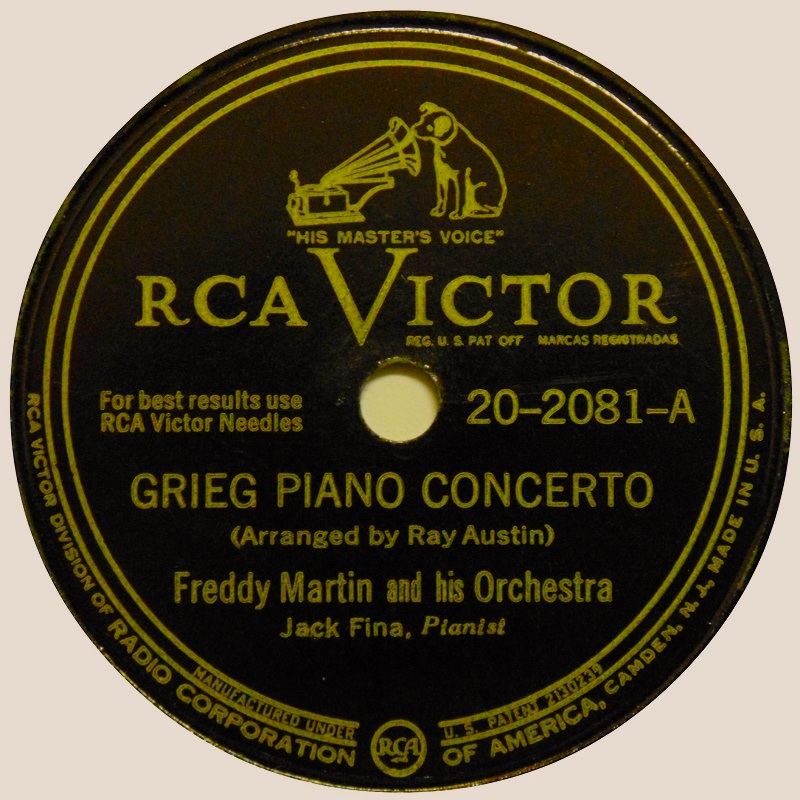
Thus far, only two recordings from BPL’s extensive collections have become available—a 1938 recording called “Please Pass the Biscuits, Pappy (I Like Mountain Music)” by W. Lee O’Daniel and His Hillbilly Boys and Edvard Grieg’s only piano concerto, recorded by Freddy Martin and His Orchestra in 1947. Even in this tiny sampling, you can see the range of material the archive will feature, consistent with the tremendous variety the Great 78 Project already contains.
While we can count it as a great gain to have free and open access to this historic vault of recorded audio, it is also the case that digital archiving has become an urgent bulwark against total loss. Current recording formats instantly spawn innumerable copies of themselves. The physical media of the past existed in finite numbers and are subject to total erasure with time. “The simple fact of the matter,” archivist George Blood tells the BPL, “is most audiovisual recordings will be lost. These 78s are disappearing left and right. It is important that we do a good job preserving what we can get to, because there won’t be a second chance.”
Related Content:
BBC Launches World Music Archive
Josh Jones is a writer and musician based in Durham, NC. Follow him at @jdmagness
Read More...Why Should We Read Virginia Woolf? A TED-Ed Animation Makes the Case
Virginia Woolf dissuaded readers from playing the critic in her essay “How Should One Read a Book?” But in addition to her novels, she is best known for her literary criticism and became a foundational figure in feminist literary theory for her imaginative polemic “A Room of One’s Own,” an essay that takes traditional criticism to task for its presumptions of male literary superiority.
Women writers like herself, she argues, had always been a privileged few with the means and the freedom to pursue writing in ways most women couldn’t. These conditions were so rare for women throughout literary history that innumerable artists may have gone unnoticed and unheralded for their lack of opportunity. Her observation would have put her readers in mind of Thomas Gray’s revered “Elegy Written in a Country Churchyard,” with its famous line about a pauper’s grave: “Some mute inglorious Milton here may rest.”
Woolf alludes to the poem, writing of “some mute and inglorious Jane Austen,” and makes a case that would-have-been women writers were exceptionally marginalized by gender—by its intersections with power and privilege and their lack. She famously constructed a scenario—brought into pop culture by The Smiths and Bananarama singer Siobhan Fahey—involving Shakespeare’s fictional sister Judith, whose talent and ambition are squashed for the sake of her brother’s education. It is hardly a far-fetched idea. We might remember Mozart’s sister Nannerl, who was also a child prodigy, whose career ended with her childhood, and who disappeared in her brother’s shadow.
In the TED-Ed video at the top, Woolf scholar and doctoral candidate at the University of Wisconsin Iseult Gillespie describes the import of Woolf’s thought experiment. Shakespeare’s sister stands in for every woman who is pushed into domestic labor and marriage while the men in her family pursue their goals unhindered. “Woolf demonstrates the tragedy of genius restricted,” just as Langston Hughes would do a couple decades later. Her particular genius, says Gillespie, lies in her ability to portray “the internal experience of alienation…. Her characters frequently live inner lives that are deeply at odds with their external existence.”
The video outlines Woolf’s own biography: her inclusion in the “Bloomsbury Group”—a social circle including E.M. Forster and Virginia’s soon-to-be husband Leonard Woolf. And it sketches out the innovative literary techniques of her novels. Woolf thought of herself, as Alain de Botton says in his short introduction above, as a “distinctively modernist writer at odds with a raft of the staid and complacent assumptions of 19th century English literature.” One such assumption, as she writes in “A Room of One’s Own,” includes an opinion that “the best woman was intellectually the inferior of the worst man.”
Woolf’s own modernist breakthroughs rival those of her contemporaries James Joyce and Ezra Pound. Her favorite women writers rank as highly as men in the same canon in any serious study; but this is of course beside the point. It wasn’t the truth or falsehood of claims about women’s inferiority that determined their power, but rather the social power of those who made such claims.
Domineering fathers, spotlight-stealing brothers, moralizing clergymen, the gatekeeping intellectuals of “Oxbridge”—Woolf’s portmanteau for the snobbery and chauvinism of Oxford and Cambridge dons: it was such men who determined not only whether or not a woman might pursue her writing, but whether she lived or died in penury, mute and inglorious. Woolf knew much of what she wrote, having grown up surrounded by the cream of 19th-century literary society, and having had to “steal an education from her father’s study,” as de Botton notes, while her brothers went off to Cambridge. She was nonetheless well aware of her privilege and used it not only to create new forms of writing, but to open new literary spaces for women writers to come.
Related Content:
An Animated Introduction to Virginia Woolf
The Steamy Love Letters of Virginia Woolf and Vita Sackville-West (1925–1929)
Josh Jones is a writer and musician based in Durham, NC. Follow him at @jdmagness
Read More...Hear Florence Welch’s Radio Documentary About the Making of David Bowie’s Heroes (Free for a Limited Time)

Image by AVRO and Becky Sullivan, via Wikimedia Commons
As of this moment, you have 22 days left to stream a one-hour radio documentary hosted by Florence Welch (of Florence + The Machine). It takes a close look at the making of David Bowie’s landmark album Heroes, released 40 years ago. The documentary (streamable here) explores “the personal and musical factors that influenced the album’s writing and recording in Berlin in 1977.” It also covers, according to the BBC, the following ground:
Florence will feature [archival material] of the late David Bowie explaining why he chose to live and work in Berlin and the impact the city’s history had on the masterpiece he created. She’ll also meet the album’s producer Tony Visconti to get an insight to the unique recording techniques he employed to interpret Bowie’s creative vision and how the characteristics of the famous Hansa Studios, which are situated in a huge former chamber music concert hall, contributed to the album’s influential sounds. Iggy Pop, who was living with Bowie in Berlin during the recording of the album, recalls how a battle with drug addition, bankruptcy and a legal dispute with his ex wife for access to his son all provided inspiration for the album’s lyrics and Brian Eno, who collaborated with David throughout the LP’s recording, explains the unique musical structures he and David employed to compose the innovative songs.
Berlin’s radical cultural diversity had always fascinated Bowie and Florence will explain how the opportunity to live and work in the city during the turbulent political period prior to the fall of ‘the Wall’ provided the perfect austere environment for David and his collaborators to experiment with music inspired by several German techno bands of the 70’s, including Neu!, Kraftwerk and Can.
When you’re done listening, we’d strongly recommend watching this wonderful video where Tony Visconti, the producer of David Bowie’s 1977 album, takes you inside the LP’s making. Don’t miss it. It’s a gem.
Related Content:
Depeche Mode Releases a Goosebump-Inducing Cover of David Bowie’s “Heroes”
David Bowie & Brian Eno’s Collaboration on “Warszawa” Reimagined in a Comic Animation
Read More...Ralph Steadman’s Hellish Illustrations for Ray Bradbury’s Classic Dystopian Novel, Fahrenheit 451
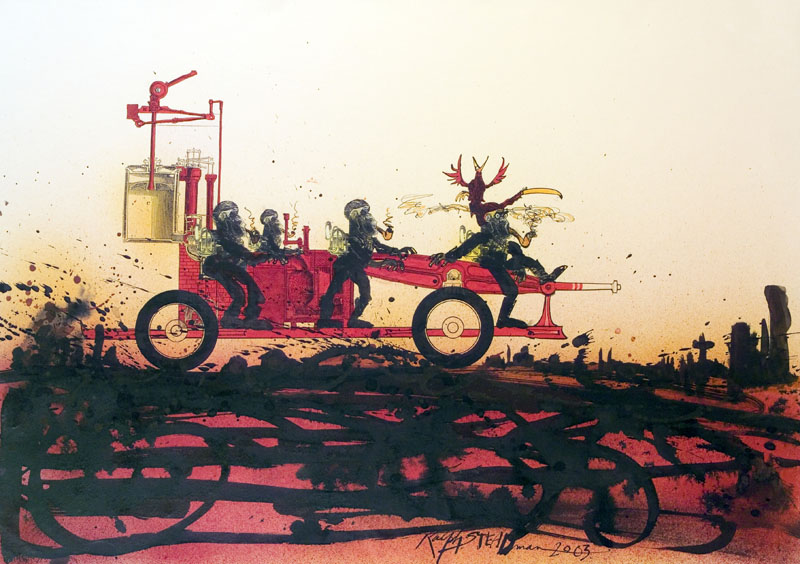
Hunter S. Thompson and Ray Bradbury would at first seem to have little in common, other than having made their livings by the pen. Or rather, both of them having developed as writers in the mid-20th century, by the typewriter–though Thompson famously shot his and a young Bradbury once had to rent one for ten cents per hour at UCLA’s library. In one nine-day rental in the early 1950s, Bradbury typed up Fahrenheit 451, still his best-known work and one whose central idea, that of a future society that methodically destroys all books, has stayed compelling almost 65 years after its first publication.
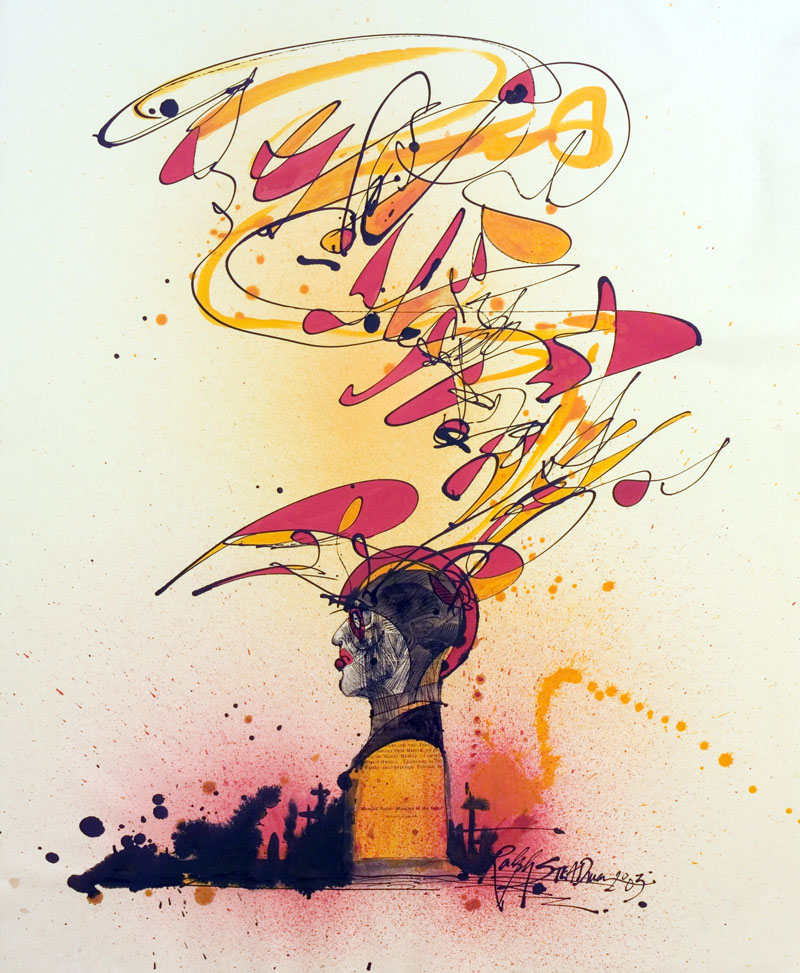
Thompson’s best-known work, 1971’s Fear and Loathing in Las Vegas, deals in different kinds of frightening visions, some of them brought to illustrated life by the English artist Ralph Steadman. Thirty years later years later and with his name long since made by his collaboration with Thompson, Steadman would bring his talents to Bradbury’s dystopia. Brain Pickings’ Maria Popova quotes him describing the theme of Fahrenheit 451 as “vitally important.” According to Dangerous Minds’ Paul Gallagher, when Bradbury saw Steadman’s illustrations, commissioned for a limited edition of the book around its fiftieth anniversary, he said to the artist, “You’ve brought my book into the 21st century.”
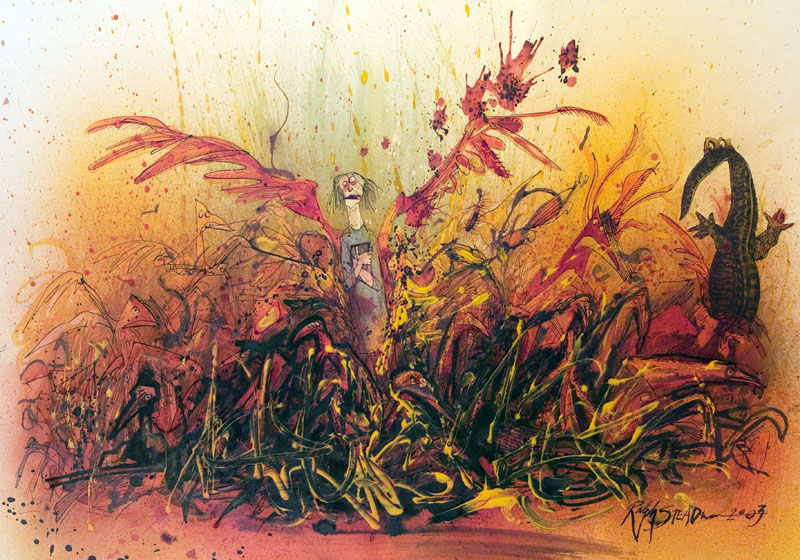
Steadman repaid the compliment when he said that he considers Fahrenheit 451 “as important as 1984 and Animal Farm as real powerful social comment,” and he should know, having previously poured his artistic energies into a 1995 edition of George Orwell’s deceptively simple allegory of the Russian Revolution and its consequences. More than a few of us would no doubt love to see what Steadman could do with 1984 here in the 21st century, a time when we’ve hardly extinguished the societal dangers of which Orwell, or Bradbury, or indeed Thompson, tried, each in his distinctive literary way, to warn us. Book-burning may remain a fringe pursuit, but the fight against thought control in its infinite forms demands constant vigilance — and no small amount of imagination.
You can see more illustrations of Fahrenheit 451 at Brain Pickings and Dangerous Minds. Also, you can purchase used copies of the limited print edition online, though they seem quite rare at this point. Editions can be found on AbeBooks–for example here and here.
Related Content:
Gonzo Illustrator Ralph Steadman Draws the American Presidents, from Nixon to Trump
Ralph Steadman’s Surrealist Illustrations of George Orwell’s Animal Farm (1995)
Based in Seoul, Colin Marshall writes and broadcasts on cities and culture. His projects include the book The Stateless City: a Walk through 21st-Century Los Angeles and the video series The City in Cinema. Follow him on Twitter at @colinmarshall or on Facebook.
Read More...Cult Director John Waters Hosts a Summer Camp for Naughty Adult Campers: Enrollment for the 2018 Edition Opens Today

I hated sports at camp, so at this camp I think we should reward every team that loses. This would be the camp where the fat people get picked first in dodge ball.
- Filmmaker-cum-Camp Director John Waters
I can think of many children who would scramble toward the refuge of the compassionate statement above, but Camp John Waters is a decidedly adult activity.
The Pope of Trash shares actor Bill Murray’s relish for oddball settings in which he can meet the public as something close to a peer. But whereas Murray specializes in surprise drop-in appearances—reciting poetry to construction workers, crashing parties—Waters favors more immersive experiences, such as hitchhiking coast to coast.
His latest stunt brought him and 300 fellow travelers to a rustic Connecticut facility (from Sept 22–24) that normally hosts corporate team building events, family camps, and weekend getaways for playful 20-to-30-somethings keen to make new friends while zip lining, playing pingpong, and partying in the main lodge.
ARTnews pegged the inaugural session thusly:
The Waters camp combines two of the more absurd developments in contemporary leisure: the celebrity-based getaway (see also: the Gronk Cruise) and a certain recreational aesthetic that seems to advocate for a sort of developmental purgatory.
Here, there were no reluctant, homesick campers, weeping into their Sloppy Joes. This was a self-selecting bunch, eager to break out their wigs and leopard print, weave enemy bracelets at the arts and crafts station, and bypass anything smacking of official outdoor recreation, save the lake, where inflatable pink flamingos were available for aquatic lollygagging.
“Who really wants to go wall climbing?” the founder himself snorted in his welcoming speech, adding that he would if Joe Dallesandro, the Warhol superstar who according to Waters “forever changed male sexuality in cinema,” waited up top.
Naughty references to water sports aside, certain aspects of the camp were downright wholesome. Pine trees and s’mores. Canoes and cabins. Presumably there was a camp nurse. (In Waters’ ideal world, this position would be filled by Cry Baby’s Traci Lords.)
Waters’ recollections of his own stint at Maryland’s Camp Happy Hollow seem primarily fond. It makes sense. Anyone who truly loathed summer camp would be unlikely to recreate the experience for themselves and their fellow adults.
Camp Waters harkens back to the 1950s transgressions its director merrily fesses up to having participated in: unfiltered cigarettes and short sheeted beds, circle jerks and panty raids. From here on out the subversion will be taking place in the sunlight.
Another special camp memory for Waters is regaling his cabin mates with an original, serialized horror story. He retells it on Celebrity Ghost Stories, above:
At the end there was this hideous gory thing and then all the kids had nightmares and their parents called the camp and complained — and I’m still doing that! It was the beginning of my career…. It was a wonderful lesson for me as a 10-year-old kid that I think helped me become whatever I am today. It gave me the confidence to go ahead, to believe in things, to believe in behavior I couldn’t understand, to be drawn to subject matter I couldn’t understand.
Registration for Camp John Waters 2018 opens today at noon, so grab the bug spray and get ready to sing along:
There is a camp in a place called Kent
It’s name is Camp John Waters
For here we come to spend the night
For we all love to fuck and fight
Camp John Waters — rah rah rah!
Camp John Waters — sisboombah!
Camp John Waters — rah rah rah!
Three cheers for Camp John Waters!
Could Waters’ own contribution to such camp classics as Meatballs, Little Darlings and Wet Hot American Summer be far behind?
Related Content:
John Waters’ RISD Graduation Speech: Real Wealth is Never Having to Spend Time with A‑Holes
John Waters Narrates Offbeat Documentary on an Environmental Catastrophe, the Salton Sea
The Philosophy of Bill Murray: The Intellectual Foundations of His Comedic Persona
Ayun Halliday is an author, illustrator, theater maker and Chief Primatologist of the East Village Inky zine. She attended Gnawbone Camp in Gnawbone, Indiana, recapturing that happy experience three decades later as the Mail Lady of Beam Camp. Follow her @AyunHalliday.
Read More...Support Us
We're hoping to rely on loyal readers, rather than erratic ads. Please click the Donate button and support Open Culture. You can use Paypal, Venmo, Patreon, even Crypto! We thank you!

About Us

Open Culture scours the web for the best educational media. We find the free courses and audio books you need, the language lessons & educational videos you want, and plenty of enlightenment in between.
Advertise With Us

FREE UPDATES!
GET OUR DAILY EMAIL
Get the best cultural and educational resources on the web curated for you in a daily email. We never spam. Unsubscribe at any time.
FOLLOW ON SOCIAL MEDIA

Open Culture editor Dan Colman scours the web for the best educational media. He finds the free courses and audio books you need, the language lessons & movies you want, and plenty of enlightenment in between.
Advertise With Us


