The Existential Philosophy of Cowboy Bebop, the Cult Japanese Anime Series, Explored in a Thoughtful Video Essay
Super Dimension Fortress Macross, Mobile Suit Gundam Wing, Neon Genesis Evangelion — these are the kind of titles that might ring a bell even if you have no particular interest in futuristic Japanese animated television shows. But how about Cowboy Bebop? That evocatively Western name itself, not an awkward English translation of a Japanese title but English in the original, hints that the series stands apart from all the dimension fortresses, mobile suits, and neon geneses out there. And indeed, when it first aired in 1997, viewers the world over took quick note of the distinctive sensibility of its stories of a shipful of bounty hunters drifting through outer space in the year 2071.
“On paper, Cowboy Bebop, the legendary cult anime series from Shinichirō Watanabe” — recently director of one of Blade Runner 2049’s short prequels — “reads like something John Wayne, Elmore Leonard, and Philip K. Dick came up with during a wild, all-night whiskey bender.” So writes the Atlantic’s Alex Suskind in a piece on the show’s lasting legacy. “Everyone speaks like they’re background extras in Chinatown. The show ultimately features so many cross-ranging influences and nods to other famous works it’s almost impossible to keep track. It’s Sergio Leone in a spacesuit. It’s Butch Cassidy and the Sundance Kid with automatic weapons.”
And yet Cowboy Bebop remains, thoroughly, a work of Japanese imagination, and like many of the most respected of the form, it has serious philosophical inclinations. Channel Criswell creator Lewis Bond examines those in “The Meaning of Nothing,” his video essay on the series. “Can we as humans find something in nothing, find purpose beyond survival?” Bond asks. “These ontological thoughts that plague us make up the same existential drift our characters repeatedly find themselves in, and it’s what is most significant to the journey of Cowboy Bebop.” He looks past the cooler-than-cool style, snappy dialogue, witty gags, and rich, unexpected mixture of aesthetic influences to which fans have thrilled to find “a metaphysical expression of how people overcome their lives, particularly the lingering grief that comes with them.”
Taken as a whole, the show resolves into a presentation of life as “less of a linear path towards a goal, more of a haze that we must venture through without any guidance, because the sad reality of Bebop’s story is that our cast of characters are lost in the cosmos without any justification for why they live, other than to exist.” The series came to a famously ambiguous end after 26 episodes, but this past summer we heard that it may return, rebooted as a live-action series. Whatever its medium, the world of Cowboy Bebop — with its spacecraft, its interplanetary cops and robbers, and its superintelligent corgi — amounts to nothing less than the human condition, a place we have no choice but to revisit. Might as well do it in style.
The complete Cowboy Bebop series can be bought on blu-ray, or if you’re a subscriber, you can watch the episodes on Hulu.
Related Content:
How the Films of Hayao Miyazaki Work Their Animated Magic, Explained in 4 Video Essays
Early Japanese Animations: The Origins of Anime (1917–1931)
Based in Seoul, Colin Marshall writes and broadcasts on cities and culture. His projects include the book The Stateless City: a Walk through 21st-Century Los Angeles and the video series The City in Cinema. Follow him on Twitter at @colinmarshall or on Facebook.
Read More...Download New Storyboarding Software That’s Free & Open Source
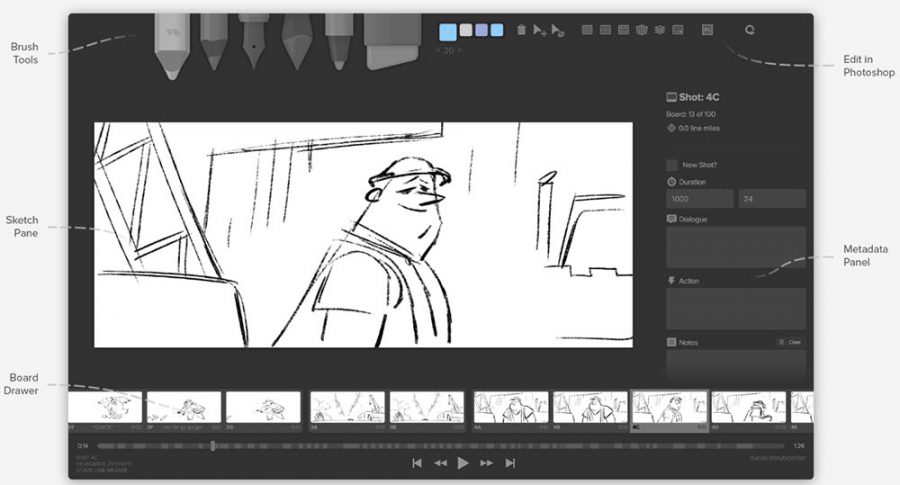
Quick tip: The new software package, Storyboarder, makes it “easy to visualize a story as fast you can draw stick figures.” You can create a story idea without actually making a full-blown movie and see how it looks. Storyboarder is free. It’s open source. It’s available for Mac, Windows, and Linux. And you can download it here.
As the website Cartoon Brew notes, the stories created in Storyboarder “can be exported to Premiere, Final Cut, Avid, PDF, and animated GIF formats.” Or you can “refine the artwork in Photoshop.”
Get Storyboarder here.
If you would like to support the mission of Open Culture, consider making a donation to our site. It’s hard to rely 100% on ads, and your contributions will help us continue providing the best free cultural and educational materials to learners everywhere. You can contribute through PayPal, Patreon, and Venmo (@openculture). Thanks!
Related Content:
Google Makes Its $149 Photo Editing Software Now Completely Free to Download
NASA Puts Its Software Online & Makes It Free to Download
Read More...Watch David Gilmour Play the Songs of Syd Barrett, with the Help of David Bowie & Richard Wright
Though he eventually disappeared from the public eye, Syd Barrett did not fade into obscurity all at once after his “erratic behavior,” as Andy Kahn writes at JamBase, “led to his leaving” Pink Floyd in 1968. The founding singer/songwriter/guitarist went on in the following few years to write, record, and even sporadically perform new solo material, appearing on John Peel’s BBC show in 1970 and giving a long Rolling Stone interview the following year. He even started, briefly, a new band in 1972 and worked on new recordings in the studio until 1974.
Barrett released two solo albums, The Madcap Laughs and Barrett, in 1970. Like the solo work of Roky Erickson and Skip Spence—two other tragic psychedelic-era geniuses with mental health struggles—Barrett’s later compositions are frustratingly rough-cut gems: quirky, sinister, meandering folk-psych adventures that provide an alternate look into what Pink Floyd might have sounded like if their original intentions of keeping him on as a non-performing songwriter had worked out.
Assisting him during his studio sessions were former bandmates Roger Waters, Richard Wright, and David Gilmour. The band still admired his singular talent, but they found working, and even speaking, with him difficult in the extreme.
As Gilmour has described those years in interviews, they carried a considerable amount of guilt over Barrett’s ouster. In addition to the heartbreaking tribute “Shine on You Crazy Diamond,” Gilmour has often performed Syd’s solo songs onstage in affecting, often solo acoustic, renditions that became all the more poignant after Barrett’s death in 2006.
In the videos at the top, you can see Gilmour play two songs from Barrett’s The Madcap Laughs—“Terrapin” and “Dark Globe”—and further up, see him play “Dominoes” from Barrett, with Richard Wright on Keyboards. Gilmour has also revisited onstage Pink Floyd’s earliest, Barrett-fronted, days. Just above, we have the rare treat of seeing him play the band’s first single, “Arnold Layne,” with special guest David Bowie on lead vocals. And below, see Gilmour and Wright play a version of the early Floyd classic “Astronomy Domine,” live at Abbey Road studios.
It was, sadly, at Abbey Road where the band last saw Barrett, when he entered the studio in 1975 during the final mixes of Wish You Were Here. Overweight and with shaved head and eyebrows, Barrett was at first unrecognizable. After this last public appearance, he felt the need, as Waters put it, to “withdraw completely” from “modern life.” But the tragic final months with Pink Floyd and few sightings afterward should hardly be the way we remember Syd Barrett. He may have lost the ability to communicate with his former friends and bandmates, but for a time he continued to speak in hauntingly strange, thoroughly original songs.
This collection of videos comes to us via JamBase.
Related Content:
Syd Barrett’s “Effervescing Elephant” Comes to Life in a New Retro-Style Animation
Josh Jones is a writer and musician based in Durham, NC. Follow him at @jdmagness
Read More...The History of Hip Hop Music Visualized on a Turntable Circuit Diagram: Features 700 Artists, from DJ Kool Herc to Kanye West

Every genre of music has its lineages and filiations, and each generation tries to outdo its predecessors. In no genre of music are these relationships so clearly defined as in hip-hop, where good-natured battles, furious beefs, nostalgic tributes, and guest appearances explicitly connect rappers from different eras, cities, and styles. Since the earliest days of hip-hop, groups have formed crews and loose alliances, built their own labels and media empires together, and defined the sounds of their region. At the center of it all was the turntable, which founding fathers like Kool DJ Herc repurposed from consumer playback machines to electronic instruments and proto-samplers. No matter how far the music has come in its sophisticated adaptations of digital studio technology, hip-hop’s essential architecture came from the meeting of two turntables, a mixer, and a microphone.
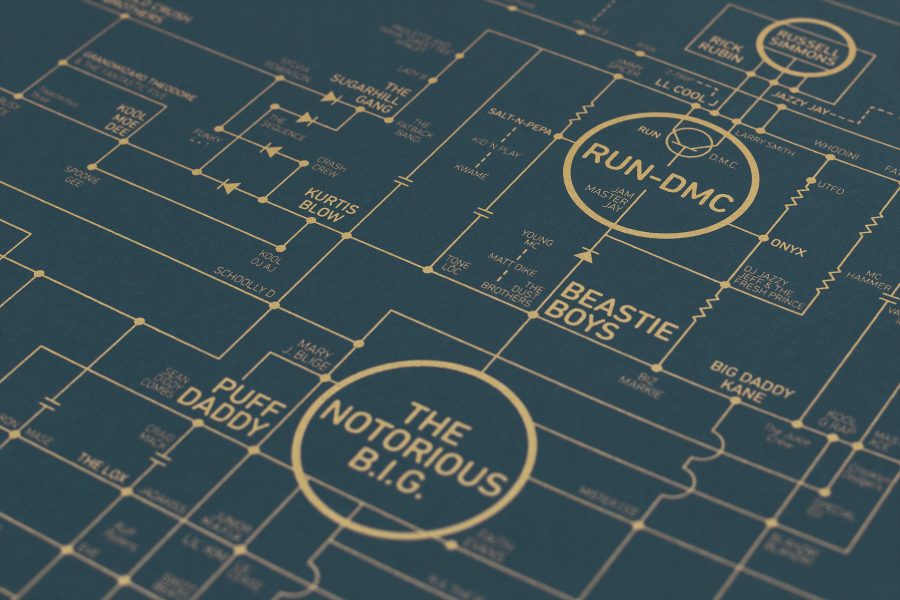
Paying homage to that humble origin, the Hip-Hop Love Blueprint by design house Dorothy takes the circuit diagram of a turntable as the basis for a map connecting 700 of hip-hop’s major players, from godfathers like Cab Calloway, Gil Scott-Heron, and the Last Poets, to originators like Herc and Grandmaster Flash, golden age heroes like Run-DMC and Eric B. and Rakim, political artists like Public Enemy and KRS-One, West Coast giants like N.W.A. and Dr. Dre, underground and indie rappers, turntablists and star producers, and everything in-between.
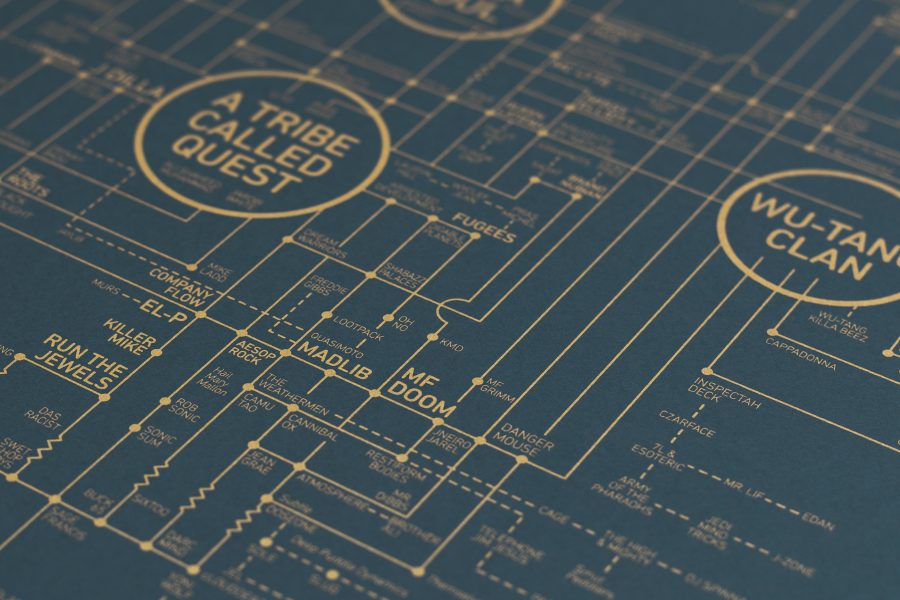
Contemporary stars like Kendrick Lamar, Drake, Jay‑Z, and Kanye appear, as, of course, do the martyred icons Biggie and Tupac. The Beastie Boys, De La Soul, Eminem, Nas, Jurassic 5, J Dilla, Mos Def, MF Doom, Kool Keith, Run the Jewels… you name ‘em, they’ve probably made the cut. The diagram–viewable online for free, and purchasable for £35.00–even features the names of early breakdancers like the Rock Steady Crew and graffiti artists like Lady Pink and Futura 2000.
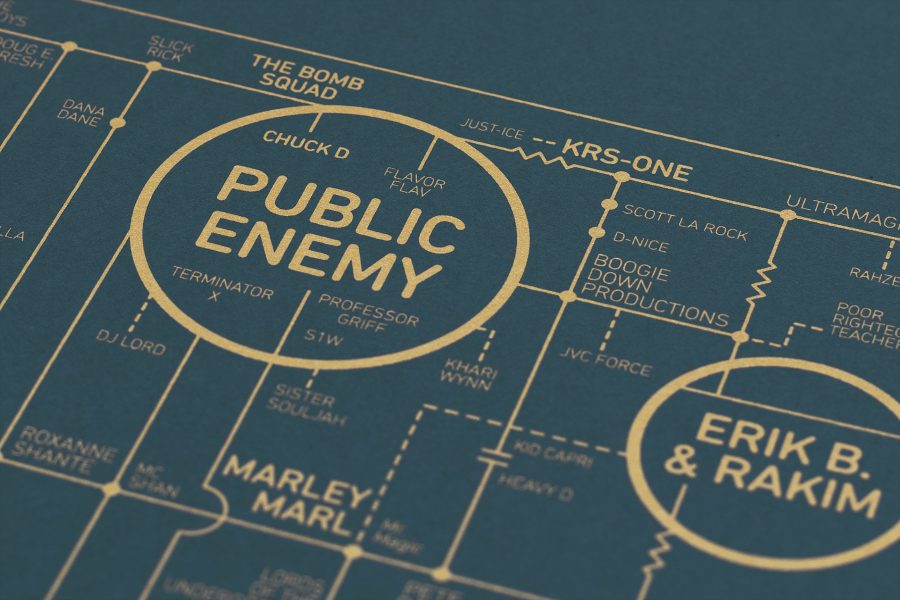
As in earlier such charts from Dorothy, like Alternative Love and Electric Love, fans may find fault with the placement of certain figures and groups, and with the choice of emphasis. Rap abounds in masculine bravado—and at times no small amount of misogyny—but it should go without saying that female stars like Salt ‘n’ Pepa, MC Lyte, Queen Latifah, Missy Elliott, and Lauryn Hill are as influential as many of the biggest male names on the chart. Yet not one of them gets top billing, so to speak, here. This unfortunate fact aside, Hip-Hop Love does a very impressive job of cataloguing and connecting the most commercially successful, big-name artists with some of the most underground and experimental. Though we associate artists with particular regions—Outkast epitomizes the South, for example, Wu-Tang Clan is New York to the core—the blueprint pulls them all together, reaching out even to UK grime and trip-hop, in a schematic that resembles one huge, interconnected electric city. You can get your own copy of the poster online here.
Related Content:
Josh Jones is a writer and musician based in Durham, NC. Follow him at @jdmagness
Read More...90,000 Fans Sing “I Won’t Back Down” at University of Florida Football Game: A Goosebump-Inducing Tribute to Tom Petty
Tom Petty grew up in Gainesville, Florida, in the backyard of the University of Florida. On Saturday, during a football game against LSU, some 90,000 Gators fans gave Petty a raucous send off, singing “I Won’t Back Down” in unison. Don’t know about you, but it gave me the chills.
BTW, if you’re wondering what the occasional boos are all about, it’s the U. of Florida fans taking the LSU marching band to task for disrupting the Petty sing-along. Or so it was perceived.
Related Content:
Tom Petty Takes You Inside His Songwriting Craft
Prince, Joined by Tom Petty, Plays a Mind-Blowing Guitar Solo On “While My Guitar Gently Weeps”
Read More...The Philosophical Appreciation of Rocks in China & Japan: A Short Introduction to an Ancient Tradition
In addition to summing up Socrates and his European heirs, Alain de Botton has also applied his five-minute animated video approach to the very basics of Eastern philosophy. While offering its introductory surveys, the series may hopefully spur viewers on to greater appreciation of, for example, the Buddha, Lao Tzu, and Japanese Zen master Sen no Rikyu, who refined the tea ceremony as a meticulous meditative ritual. Rikyu’s practice shows us how much philosophical and religious traditions (often a distinction without a difference) in Japan and China engage rigorously with everyday objects and routines as often as they do with texts and lectures.
Yesterday, we brought you several short explanations of one such practice, Kintsugi, the wabi sabi art of “finding beauty in broken things” by turning cracked and broken pottery into gilded, beautifully flawed vessels. Several hundred years earlier, in 826 AD, renowned Tang Dynasty poet and civil servant Bai Juyi discovered a pair of oddly shaped rocks that captivated his attention. Taking them home to his study, he then wrote a poem about them, influenced by Daoism’s reverence for the forces of nature and inspired by the hard evidence such forces carved into the rocks. Like the broken pottery of Japan’s Kintsugi, Bai’s rocks come in part to symbolize human frailty. In this case, he casts the rocks as friends in his lonely old age, asking them, “Can you keep company with an old man like myself?”
After Bai Juyi, aesthetic meditations on the beauty of rock formations became highly popular and quickly refined into “four principal criteria,” writes the Metropolitan Museum of Art: “thinness (shou), openness (tou), perforations (lou), and wrinkling (zhou).” The found artifacts are often known as “scholar’s rocks”—a mistranslation, de Botton says, of a term meaning “spirit stones”—and are chosen for their natural wildness, as well as shaped by human hands. They were placed in gardens and studies, and “became a favorite and enduring pictorial genre.” During the early Song dynasty, such stones were “constant sources of inspiration,” and were “valued quite as highly as any painting or calligraphic scroll.”
So highly-prized were these objects, in fact, that they appear to “have hastened the collapse of the Northern Song Empire,” through a mania not unlike that which drove the tulip craze in the 17th century Netherlands. As did many Chinese cultural traditions—including Zen Buddhism—the love of rocks crossed over into Japan, where it was adapted “in a particularly Japanese way” in the 15th century, inspiring the “subdued, smooth,” minimalist rock gardens we’re likely familiar with, if only through their consumer novelty versions.
As per usual, de Botton imbues his lesson with a takeaway moral: rock reverence teaches us that “wisdom can hang off bits of the natural world just as well as issuing from books.” We may also see the love of rocks as a kind of anti-consumerist practice, in which we shift the attention we typically lavish on disposable objects destined for landfills, trashheaps, and plastic-littered oceans, and instead apply it to beautiful bits of the natural world, which require few investments of labor or capital to enrich our lives, and can be found right outside our doors, if we’re careful and attentive enough to see them.
Related Content:
Eastern Philosophy Explained with Three Animated Videos by Alain de Botton’s School of Life
Josh Jones is a writer and musician based in Durham, NC. Follow him at @jdmagness
Read More...Watch the New Trailer for Electric Dreams, the Philip K. Dick TV Series, Starring Bryan Cranston, Steve Buscemi & More
If you had told critics and film executives thirty-five years ago that Ridley Scott’s Blade Runner would be one of the most beloved sci-fi films of all time—that it would transcend cult status to become a near-religious object in science fiction and anime filmmaking—you would likely have been laughed out of the room. If you had predicted that, thirty-five years later, it would spawn one of the most spectacular sequels imaginable, you might have been met with concern for your sanity. The world was just not ready for Blade Runner in 1982, just as it was not ready for Philip K. Dick in the 50s when he began his writing career and “couldn’t even pay the late fees on a library book.”
In the following decade, however, Dick’s work came into its own. Many years before it provided a near-infallible source for technological prescience and existential futurism in cinema, Do Androids Dream of Electric Sheep?, the novella from which Blade Runner adapted its story, got a Nebula award nomination, one of three Dick received in the 60s. Five years earlier, he won a Hugo award for The Man in the High Castle.
Now, after the success of that speculative historical novel’s grim Amazon adaptation, the company has partnered with Channel 4 and Sony for another small-screen Dick project—Electric Dreams, co-produced by Bryan Cranston, a longtime fan of the author.
An anthology series based on Dick’s stories, Electric Dreams first airs on Channel 4 in the U.K., and will soon move to Amazon, where Prime users will be able to stream the whole 10-episode season for free. (If you aren’t a Prime user, you can get a 30-day free trial to watch the series, then keep or cancel the membership.) Electric Dreams reminds us that a couple of phenomena from Dick’s heyday have made a significant comeback in recent years. First, imaginative, high-concept anthology shows like Charlie Brooker’s Black Mirror and the Duplass brothers’ Room 104 hearken back to the success of The Twilight Zone and lesser-known shows like Roald Dahl’s Way Out.
Secondly, we’ve made a return to the paranoia, social unrest, authoritarianism, and threats of nuclear war that formed the backdrops of Dick’s visionary fables. These are indeed “anxious times,” as Cranston says, but he and the show’s other producers instructed the writers to “use the original material as a springboard to your own re-imagining of the story—keep the core… or idea behind it and enhance that and see how that affects not a Cold War period when it was written, but now. How does it affect the modern-day audience?”
Given the all-star cast and high-dollar production values evident in the trailer above, we can likely expect the same kind of quality from Electric Dreams as we have seen in nearly every Dick adaptation thus far. And if it doesn’t catch on right away, well, that may be everyone’s loss but those viewers who recognize, as Dick himself recognized when he saw Blade Runner in 1982, that they have experienced something truly unique.
Related Content:
Josh Jones is a writer and musician based in Durham, NC. Follow him at @jdmagness
Read More...An Animated Introduction to “the World’s Most Mysterious Book,” the 15th-Century Voynich Manuscript
It has 240 pages filled with writing and illustration. Carbon dating places it around the year 1420. Scholars have spent countless thousands of hours scrutinizing it. But the so-called Voynich Manuscript has one quality more notable than any other: nobody understands a word of it. Last month, Josh Jones wrote about this singularly strange textual artifact here at Open Culture, including the digitized version at the Internet Archive that you can flip through and read yourself — or rather “read,” since the text’s language, if it be a language at all, remains unidentified. But before you do that, you might want to watch TED-Ed’s brief introduction to the Voynich Manuscript above.
The video’s narrator describes pages of “real and imaginary plants, floating castles, bathing women, astrology diagrams, zodiac rings, and suns and moons with faces accompany the text,” reading from a script by Stephen Bax, Voynich Manuscript researcher and Professor of Modern Languages and Linguistics at the Open University.
“Cryptologists say the writing has all the characteristics of a real language — just one that no one’s ever seen before.” Highly decorated throughout with “scroll-like embellishments,” the manuscript features the work of what looks like no fewer than three hands: two who did the writing, and one who did the painting.
Intrigued yet? Or perhaps you already feel an inkling of a new theory to explain this bizarre, seemingly encyclopedia-like volume’s provenance to add to the many that have come before: some believe the manuscript’s author or authors wrote it in code, some that “the document is a hoax, written in gibberish to make money off a gullible buyer” by a “medieval con man” or even Voynich himself, and some that it shows an attempt “to create an alphabet for a language that was spoken, but not yet written.” Maybe the thirteenth-century philosopher Roger Bacon wrote it. Or maybe the Elizabethan mystic John Dee. Or maybe Italian witches, or space aliens. At just a glance, the Voynich Manuscript poses questions that could take an eternity to answer — as any great work of literature should.
Related Content:
1,000-Year-Old Illustrated Guide to the Medicinal Use of Plants Now Digitized & Put Online
Wonderfully Weird & Ingenious Medieval Books
Based in Seoul, Colin Marshall writes and broadcasts on cities and culture. His projects include the book The Stateless City: a Walk through 21st-Century Los Angeles and the video series The City in Cinema. Follow him on Twitter at @colinmarshall or on Facebook.
Read More...Kintsugi: The Centuries-Old Japanese Craft of Repairing Pottery with Gold & Finding Beauty in Broken Things
We all grow up believing we should emphasize the inherent positives about ourselves. But what if we also emphasized the negatives, the parts we’ve had to work to fix or improve? If we did it just right, would the negatives still look so negative after all? These kinds of questions come to mind when one ponders the traditional Japanese craft of kintsugi, a means of repairing broken pottery that aims not for perfection, a return to “as good as new,” but for a kind of post-breakage reinvention that dares not to hide the cracks.
“Translated to ‘golden joinery,’ Kintsugi (or Kintsukuroi, which means ‘golden repair’) is the centuries-old Japanese art of fixing broken pottery with a special lacquer dusted with powdered gold, silver, or platinum” says My Modern Met.
“Beautiful seams of gold glint in the cracks of ceramic ware, giving a unique appearance to the piece. This repair method celebrates each artifact’s unique history by emphasizing its fractures and breaks instead of hiding or disguising them. Kintsugi often makes the repaired piece even more beautiful than the original, revitalizing it with new life.”
Kintsugi originates, so one theory has it, in the late 15th century under the culturally inclined shogun Ashikaga Yoshimasa, during whose reign the sensibilities of traditional Japanese art as we known them emerged. When Ashikaga sent one of his damaged Chinese tea bowls back to his motherland for repairs, it came back reassembled with ungainly metal staples. This prompted his craftsmen to find a better way: why not use that gilded lacquer to emphasize the cracks instead of hiding them? The technique was said to have won the admiration of famed (and not easily impressed) tea master Sen no Rikyū, major proponent of the imperfection-appreciating aesthetic wabi sabi.
You can hear and see these stories of kintsugi’s origins in the videos from Nerdwriter and Alain de Botton’s School of Life at the top of the post. The clip just above offers a closer look at the painstaking techniques of modern kintsugi, which not only survives but thrives today, having expanded to include other materials, repairing glassware as well as ceramics, for example, or filling the cracks with silver instead of gold. And what could underscore the current global relevance of kintsugi more than the fact that the craft has inspired not one but two TEDTalks, the first by Audrey Harris in Kyoto in 2015 and the second by Maddie Kelly in Adelaide last year. We all, it seems, want to repair our cracks; kintsugi shows the way to do it not just honestly but artfully.
h/t the nugget
Related Content:
Wabi-Sabi: A Short Film on the Beauty of Traditional Japan
20 Mesmerizing Videos of Japanese Artisans Creating Traditional Handicrafts
The Making of Japanese Handmade Paper: A Short Film Documents an 800-Year-Old Tradition
Watch a Japanese Craftsman Lovingly Bring a Tattered Old Book Back to Near Mint Condition
Japanese Craftsman Spends His Life Trying to Recreate a Thousand-Year-Old Sword
Based in Seoul, Colin Marshall writes and broadcasts on cities and culture. His projects include the book The Stateless City: a Walk through 21st-Century Los Angeles and the video series The City in Cinema. Follow him on Twitter at @colinmarshall or on Facebook.
Read More...Your Brain on Art: The Emerging Science of Neuroaesthetics Probes What Art Does to Our Brains
If you’ve followed debates in popular philosophical circles, you’ve surely heard the critique of “scientism,” the “view that only scientific claims are meaningful.” The term doesn’t apply only in defenses of religious explanations, but also of the arts and humanities—long imperiled by sweeping budget cuts and now seemingly upended by neuroscience.
We have the neuroscience of music, of literature, of painting, of creativity and imagination themselves…. What need anymore for those pedants and obscurantists in their ivory tower academic cubicles? Sweep them all away for better MRI machines and statistical programs! Who, gasp the opponents of scientism, would hold such a philistine view? Maybe only a straw man or two.
For those in the emerging field of “neuroaesthetics,” the goal is not to vivisect the arts, but to observe what art—however defined—does to the brain. Neuroaesthetics, notes the Washington Post video above, theorizes that “some of the answers to art’s mysteries can be found in the realm of science.” As University of Houston Professor of Electrical and Computer Engineering Jose Luis Contreras-Vidal puts it in the video below, “the more we understand the way the brain responds to the arts, the better we can understand ourselves.” Such understanding does not obviate the mystery of art as, the Post writes in an accompanying article, “the domain of the heart.”
The spectacle of performing artists, writers, and musicians wearing skullcaps covered with wires while in the midst of their creative acts may look ludicrous to us layfolk. The University of Houston takes this research quite seriously, however, appointing three visual artists-in-residence to work alongside many others on Professor Contraras-Vidal’s ongoing neuroaesthetic projects, which also include dancers and musicians. In addition to studying artists’ brains, the NSF-funded project has recorded “electrical signals in the brains of 450 individuals as they engaged with the work of artist Dario Robleto in a public art installation.”
The Post summarizes some of the possible answers offered by this kind of research: arts such as dance and theater stimulate our desire to experience intense emotions together in a group as a form of social cohesion. Seeing live performances—and surely even films, though that particular art form is slighted in many of these accounts—triggers a “neural rush…. With our brain’s capacity for emotion and empathy, even in the wordless art of dance we can begin to discover meaning—and a story.” This brings us to the importance our brains place on narrative, on movement, the “logic of art” and much more.
For better or worse, neuroaesthetics is—at least at an institutional level—in some competition with those branches of philosophy classically concerned with aesthetics, though often the two endeavors are complementary. But using science to interpret art, or interpret the brain on art, should in no way put the arts in jeopardy. Serious scientific curiosity about the oldest and most universal of distinctively human activities might instead provide justification—or better yet, funding and public support—for the generous production of more public art.
Related Content:
How Information Overload Robs Us of Our Creativity: What the Scientific Research Shows
The Neuroscience of Drumming: Researchers Discover the Secrets of Drumming & The Human Brain
Josh Jones is a writer and musician based in Durham, NC. Follow him at @jdmagness
Read More...Support Us
We're hoping to rely on loyal readers, rather than erratic ads. Please click the Donate button and support Open Culture. You can use Paypal, Venmo, Patreon, even Crypto! We thank you!

About Us

Open Culture scours the web for the best educational media. We find the free courses and audio books you need, the language lessons & educational videos you want, and plenty of enlightenment in between.
Advertise With Us

FREE UPDATES!
GET OUR DAILY EMAIL
Get the best cultural and educational resources on the web curated for you in a daily email. We never spam. Unsubscribe at any time.
FOLLOW ON SOCIAL MEDIA

Open Culture editor Dan Colman scours the web for the best educational media. He finds the free courses and audio books you need, the language lessons & movies you want, and plenty of enlightenment in between.
Advertise With Us

