Stream Online The Vietnam War, the New Documentary by Ken Burns & Lynn Novick
Right now, PBS is in the midst of airing The Vietnam War, a ten-part, 18-hour documentary film series directed by Ken Burns and Lynn Novick. The “immersive 360-degree narrative” tells “the epic story of the Vietnam War,” using never-before-seen footage and interviews. If you’re not watching the series on the TV, you can also view it on the web and through PBS apps for smartphones, tablets, Apple TV, Roku and Amazon Fire TV. Episode 1 appears above. Find all of them here.
Note: If these videos don’t stream outside of the US, we apologize in advance. Sometimes PBS geo-restricts their videos. Also, these videos likely won’t stay online forever. If you’re interested in watching the series, I’d get going sooner than later.
If you would like to support the mission of Open Culture, consider making a donation to our site. It’s hard to rely 100% on ads, and your contributions will help us continue providing the best free cultural and educational materials to learners everywhere. You can contribute through PayPal, Patreon, and Venmo (@openculture). Thanks!
Related Content:
Read More...Hamilton Mania Inspires the Library of Congress to Put 12,000 Alexander Hamilton Documents Online
Remember when bloody, bloody Andrew Jackson seemed like a shoe in for Best Sepulchral Historical Figure Brought Back to Life by an American Musical?
Alas for the 7th President, a little juggernaut called Hamilton came along, and just like that, it was the first Treasury Secretary and author of the Federalist Papers who had a fan base on the order of Beatlemania.
Teachers, historians, and librarians thrilled to reports of kids singing along with the Hamilton soundtrack. Playwright and original star Lin-Manuel Miranda’s clever rap lyrics ensured that young Hamilfans (and their parents, who reportedly were never allowed to listen to anything else in the car) would become well versed in their favorite founding father’s personal and professional history.
Out of town visitors who spend upwards of a month’s grocery budget for Broadway tickets voluntarily side trip way uptown to tour Hamilton Grange. The insatiable selfie imperative drives them to Central Park and Museum of the City of New York in search of larger than life sculptures. They take the PATH train to Weehawken to pay their respects in the spot where Hamilton was felled by Aaron Burr…
Hamilton merchandise, needless to say, is selling briskly. Books, t‑shirts, jewelry, bobble heads commemorative mugs…
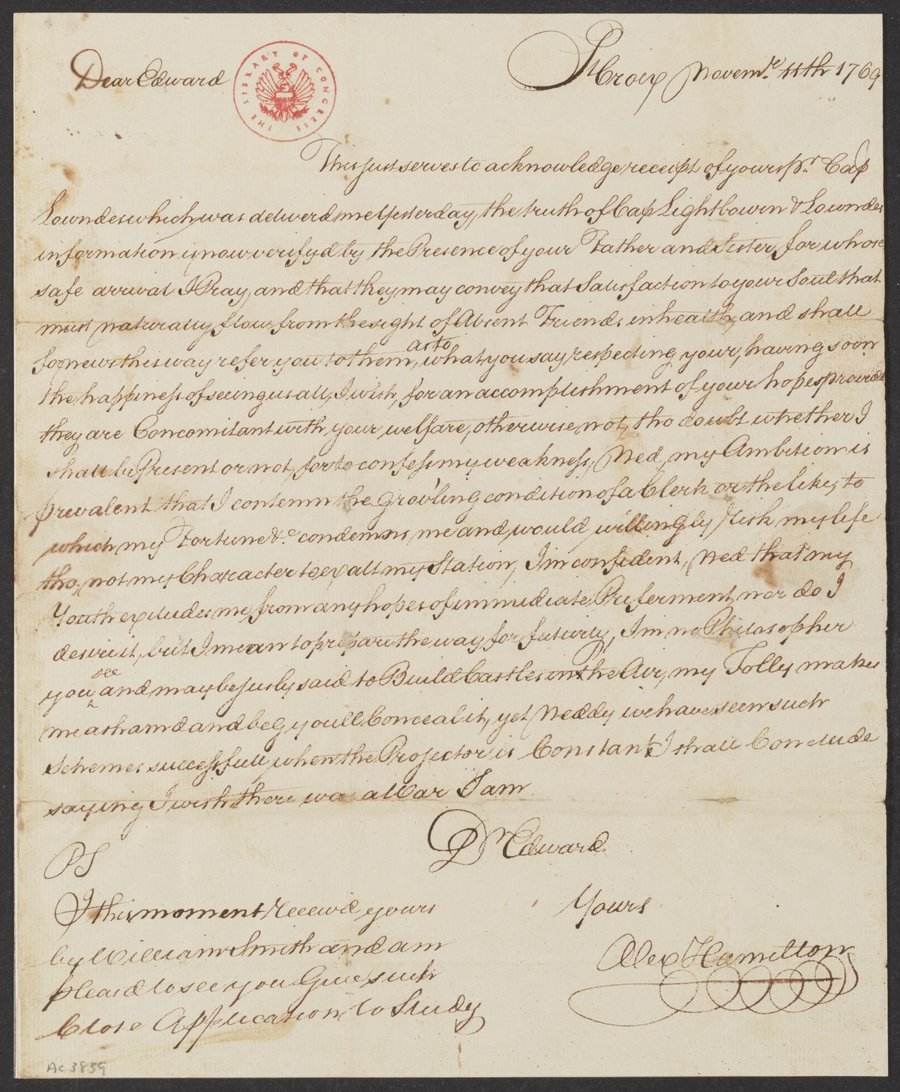
The Library of Congress is not out to cash in on this cultural moment in the monetary sense. But “given the increased interest in Hamilton,” says Julie Miller, a curator of early American manuscripts, it’s no accident that the Library has taken pains to digitize 12,000 Hamilton documents and make them available on the web. The collection includes speeches, a draft of the Reynolds Pamphlet, financial accounts, school exercises and correspondence, both personal and public, encompassing such marquee names as John Adams, Thomas Jefferson, the Marquis de Lafayette, and George Washington.

One need not be a musical theater fan to appreciate the emotion of the letter he wrote to his wife, Elizabeth Schuyler, on the eve of his fateful duel with Aaron Burr:
I need not tell you of the pangs I feel, from the idea of quitting you and exposing you to the anguish which I know you would feel.… Adieu best of wives and best of Women. Embrace all my darling Children for me.
Explore the Library of Congress’ Hamilton collection here.
And enter the online lottery for $10 Hamilton tickets because, hey, somebody’s got to win.
Related Content:
Watch a Witty, Gritty, Hardboiled Retelling of the Famous Aaron Burr-Alexander Hamilton Duel
“Alexander Hamilton” Performed with American Sign Language
Ayun Halliday is an author, illustrator, theater maker and Chief Primatologist of the East Village Inky zine. Follow her @AyunHalliday.
Read More...Behold the “Book Wheel”: The Renaissance Invention Created to Make Books Portable & Help Scholars Study Several Books at Once (1588)
Devotees of print may object, but we readers of the 21st century enjoy a great privilege in our ability to store a practically infinite number of digitized books on our computers. What’s more, those computers have themselves shrunk down to such compactness that we can carry them around day and night without discomfort. This would hardly have worked just forty years ago, when books came only in print and a serious computer could still fill a room. The paper book may remain reasonably competitive even today with the convenience refined over hundreds and hundreds of years, but its first handmade generations tended toward lavish, weighty decoration and formats that now look comically oversized.

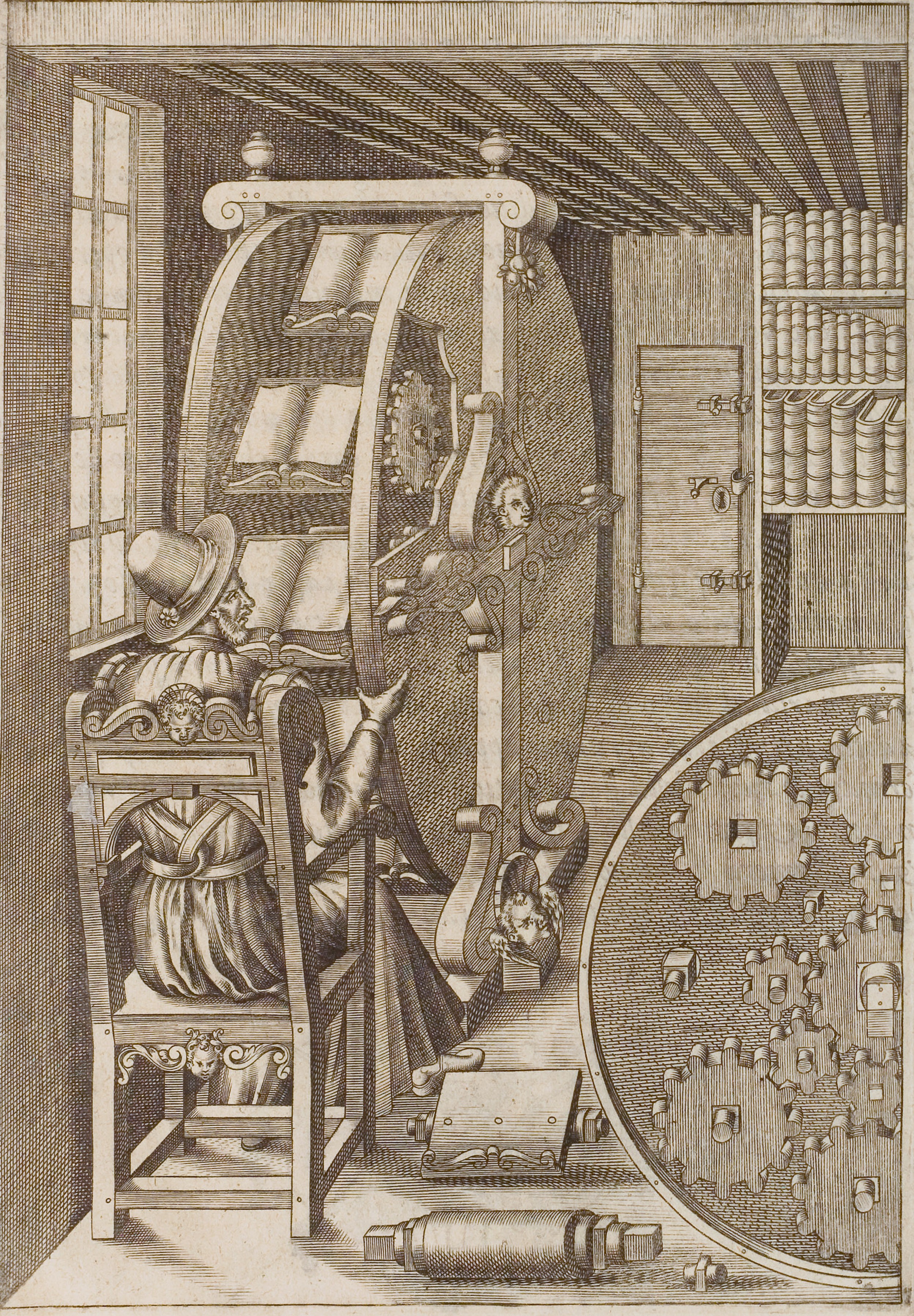
These posed real problems of unwieldiness, one solution to which took the unlikely form of the bookwheel. In 1588’s The Various and Ingenious Machines of Captain Agostino Ramelli, the Italian engineer of that name “outlined his vision for a wheel-o-books that would employ the logic of other types of wheel (water, Ferris, ‘Price is Right’, etc.) to rotate books clockwork-style before a stationary user,” writes the Atlantic’s Megan Garber.
The design used “epicyclic gearing — a system that had at that point been used only in astronomical clocks — to ensure that the shelves bearing the wheel’s books (more than a dozen of them) would remain at the same angle no matter the wheel’s position. The seated reader could then employ either hand or foot controls to move the desired book pretty much into her (or, much more likely, his) lap.” This rotating bookcase gave 16th century readers the ability to read heavy books in place, with far greater ease.
In his 1588 book, Ramelli added:
This is a beautiful and ingenious machine, very useful and convenient for anyone who takes pleasure in study, especially those who are indisposed and tormented by gout. For with this machine a man can see and turn through a large number of books without moving from one spot. Moveover, it has another fine convenience in that it occupies very little space in the place where it is set, as anyone of intelligence can clearly see from the drawing.
Inventors all over Europe created their own versions of the bookwheel during the 17th and 18th centuries, fourteen examples of which still exist. (The one pictured in the middle of the post, built around 1650, now resides in Leiden.) Even architect Daniel Libeskind has built one, based on Ramelli’s design and exhibited in his homeland at the 1986 Venice Biennale. Alas, after it went to Geneva for an exhibition at the Palais Wilson, it fell victim to a terrorist fire bombing. Innovation, it seems, will always have its enemies.
Related Content:
Discover the Jacobean Traveling Library: The 17th Century Precursor to the Kindle
The Art of Making Old-Fashioned, Hand-Printed Books
Wonderfully Weird & Ingenious Medieval Books
Wearable Books: In Medieval Times, They Took Old Manuscripts & Turned Them into Clothes
800 Free eBooks for iPad, Kindle & Other Devices
Based in Seoul, Colin Marshall writes and broadcasts on cities and culture. He’s at work on the book The Stateless City: a Walk through 21st-Century Los Angeles, the video series The City in Cinema, the crowdfunded journalism project Where Is the City of the Future?, and the Los Angeles Review of Books’ Korea Blog. Follow him on Twitter at @colinmarshall or on Facebook.
Read More...Martin Scorsese to Teach His First Online Course on Filmmaking
FYI: If you sign up for a MasterClass course by clicking on the affiliate links in this post, Open Culture will receive a small fee that helps support our operation.
If you need to make movies, if you feel like you can’t rest until you’ve told this particular story that you’re burning to tell, then Martin Scorsese has a course for you. Through MasterClass, the director of Goodfellas, Raging Bull, Taxi Driver, and Mean Streets is now set to teach his first online course. According to the video trailer above, Scorsese will explore in 20+ lessons everything from cinematography and editing, to working with actors, on-set directing, and developing a personal filmmaking style. The $90 course won’t be released until early 2018, but anyone who pre-enrolls now will get early access to the class.
While you wait, you can also take Werner Herzog’s own course on filmmaking (also offered through MasterClass). Or explore Scorsese’s lists of recommended films that we’ve previously featured here on Open Culture. Find them in the Relateds right below.
If you would like to support the mission of Open Culture, consider making a donation to our site. It’s hard to rely 100% on ads, and your contributions will help us continue providing the best free cultural and educational materials to learners everywhere. You can contribute through PayPal, Patreon, and Venmo (@openculture). Thanks!
Note: MasterClass is one of our partners. So if you sign up for a course, it benefits not just you and MasterClass. It benefits Open Culture too. So consider it win-win-win.
Other MasterClass courses worth exploring include:
- Herbie Hancock on Jazz
- Garry Kasparov on Chess
- Dr. Jane Goodall on the Environment
- David Mamet on Dramatic Writing
- Steve Martin on Comedy
- Aaron Sorkin on Screenwriting
- Gordon Ramsay on Cooking
Related Content:
Martin Scorsese Creates a List of 39 Essential Foreign Films for a Young Filmmaker
Martin Scorsese Makes a List of 85 Films Every Aspiring Filmmaker Needs to See
Martin Scorsese Names His Top 10 Films in the Criterion Collection
Werner Herzog Teaches His First Online Course on Filmmaking
Read More...
Watch the New Trailer for Wes Anderson’s Stop Motion Film, Isle of Dogs, Inspired by Akira Kurosawa
It surprised everyone, even die-hard fans, when Wes Anderson announced that he would not just adapt Roald Dahl’s children’s book Fantastic Mr. Fox for the screen, but do it with stop-motion animation. But after we’d all given it a bit of thought, it made sense: Anderson’s films and Dahl’s stories do share a certain sense of inventive humor, and stepping away from live action would finally allow the director of such detail-oriented pictures as Rushmore, The Royal Tenenbaums, and The Life Aquatic with Steve Zissou fuller control over the visuals. Eight years later, we find Anderson overseeing another team of animators to tell another, even more fantastical-looking story, this one set not in an England of the past but a Japan of the future.
There, according to the project’s newly released trailer, “canine saturation has reached epic proportions. An outbreak of dog flu rips through the city of Megasaki. Mayor Kobayashi issues emergency orders calling for a hasty quarantine. Trash Island becomes an exile colony: the Isle of Dogs.” Equals in furriness, if not attire, to Fantastic Mr. Fox’s woodland friends and voiced by the likes of Jeff Goldblum, Scarlet Johansson, Tilda Swinton, and of course Bill Murray (in a cast also including Japanese performers like Ken Watanabe, Mari Natsuki, and Yoko Ono — yes, that Yoko Ono), the canines of various colors and sizes forcibly relocated to the bleak titular setting must band together into a kind of ragtag family.
Anderson must find himself very much at home in this thematic territory by now. It would also have suited the towering figure in Japanese film to whom Isle of Dogs pays tribute. Although Anderson has cited the 1960s and 70s stop-animation holiday specials of Rankin/Bass like Rudolph the Red-Nosed Reindeer and The Little Drummer Boy — all produced, incidentally, in Japan — as one inspiration, he also said on an ArteTV Q&A earlier this year that “the new film is really less influenced by stop-motion movies than it is by Akira Kurosawa.” Perhaps he envisioned Atari Kobayashi, the boy who journeys to Trash Island to retrieve his lost companion, as a twelve-year-old version of one of Kurosawa’s lone heroes.
And perhaps it owes to Kurosawa that the setting — at least from what the trailer reveals — combines elements of an imagined future with the look and feel of Japan’s rapidly developing mid-20th century, a period that has long fascinated Anderson in its European incarnations but one captured crisply in Kurosawa’s homeland in crime movies like High and Low and The Bad Sleep Well. Anderson has made little to no reference to the Land of the Rising Sun before, but his interest makes sense: no land better understands what Anderson has expressed more vividly with every project, the richness of the aesthetic mixture of the past and future that always surrounds us. And from what I could tell on my last visit there, its dog situation remains blessedly under control — for now.
via Uncrate
Related Content:
A Complete Collection of Wes Anderson Video Essays
The Geometric Beauty of Akira Kurosawa and Wes Anderson’s Films
Based in Seoul, Colin Marshall writes and broadcasts on cities and culture. He’s at work on the book The Stateless City: a Walk through 21st-Century Los Angeles, the video series The City in Cinema, the crowdfunded journalism project Where Is the City of the Future?, and the Los Angeles Review of Books’ Korea Blog. Follow him on Twitter at @colinmarshall or on Facebook.
Read More...How Can We Know What is True? And What Is BS? Tips from Carl Sagan, Richard Feynman & Michael Shermer
Science denialism may be a deeply entrenched and enormously damaging political phenomenon. But it is not a wholly practical one, or we would see many more people abandon medical science, air travel, computer technology, etc. Most of us tacitly agree that we know certain truths about the world—gravitational force, navigational technology, the germ theory of disease, for example. How do we acquire such knowledge, and how do we use the same method to test and evaluate the many new claims we’re bombarded with daily?
The problem, many professional skeptics would say, is that we’re largely unaware of the epistemic criteria for our thinking. We believe some ideas and doubt others for a host of reasons, many of them having nothing to do with standards of reason and evidence scientists strive towards. Many professional skeptics even have the humility to admit that skeptics can be as prone to irrationality and cognitive biases as anyone else.
Carl Sagan had a good deal of patience with unreason, at least in his writing and television work, which exhibits so much rhetorical brilliance and depth of feeling that he might have been a poet in another life. His style and personality made him a very effective science communicator. But what he called his “Baloney Detection Kit,” a set of “tools for skeptical thinking,” is not at all unique to him. Sagan’s principles agree with those of all proponents of logic and the scientific method. You can read just a few of his prescriptions below, and a full unabridged list here.
Wherever possible there must be independent confirmation of the “facts.”
Encourage substantive debate on the evidence by knowledgeable proponents of all points of view.
Arguments from authority carry little weight — “authorities” have made mistakes in the past. They will do so again in the future. Perhaps a better way to say it is that in science there are no authorities; at most, there are experts.
Spin more than one hypothesis. If there’s something to be explained, think of all the different ways in which it could be explained. Then think of tests by which you might systematically disprove each of the alternatives.
Try not to get overly attached to a hypothesis just because it’s yours. It’s only a way station in the pursuit of knowledge. Ask yourself why you like the idea. Compare it fairly with the alternatives. See if you can find reasons for rejecting it. If you don’t, others will.
Another skeptic, founder and editor of Skeptic magazine Michael Shermer, surrounds his epistemology with a sympathetic neuroscience frame. We’re all prone to “believing weird things,” as he puts it in his book Why People Believe Weird Things and his short video above, where he introduces, following Sagan, his own “Baloney Detection Kit.” The human brain, he explains, evolved to see patterns everywhere as a matter of survival. All of our brains do it, and we all get a lot of false positives.
Many of those false positives become widespread cultural beliefs. Shermer himself has been accused of insensitive cultural bias (evident in the beginning of his video), intellectual arrogance, and worse. But he admits up front that scientific thinking should transcend individual personalities, including his own. “You shouldn’t believe anybody based on authority or whatever position they might have,” he says. “You should check it out yourself.”
Some of the ways to do so when we encounter new ideas involve asking “How reliable is the source of the claim?” and “Have the claims been verified by somebody else?” Returning to Sagan’s work, Shermer offers an example of contrasting scientific and pseudoscientific approaches—the SETI (Search for Extraterrestrial Intelligence) Institute and UFO believers. The latter, he says, uncritically seek out confirmation for their beliefs, where the scientists at SETI rigorously try to disprove hypotheses in order to rule out false claims.
Yet it remains the case that many people—and not all of them in good faith—think they’re using science when they aren’t. Another popular science communicator, physicist Richard Feynman, recommended one method for testing whether we really understand a concept or whether we’re just repeating something that sounds smart but makes no logical sense, what Feynman calls “a mystic formula for answering questions.” Can a concept be explained in plain English, without any technical jargon? Can we ask questions about it and make direct observations that confirm or disconfirm its claims?
Feynman was especially sensitive to what he called “intellectual tyranny in the name of science.” And he recognized that turning forms of knowing into empty rituals resulted in pseudoscientific thinking. In a wonderfully rambling, informal, and autobiographical speech he gave in 1966 to a meeting of the National Science Teachers Association, Feynman concluded that thinking scientifically as a practice requires skepticism of science as an institution.
“Science is the belief in the ignorance of experts,” says Feynman. “If they say to you, ‘Science has shown such and such,’ you might ask, ‘How does science show it? How did the scientists find out? How? What? Where?’” Asking such questions does not mean we should reject scientific conclusions because they conflict with cherished beliefs, but rather that we shouldn’t take even scientific claims on faith.
For elaboration on Shermer, Sagan and Feynman’s approaches to telling good scientific thinking from bad, read these articles in our archive:
Carl Sagan Presents His “Baloney Detection Kit”: 8 Tools for Skeptical Thinking
Richard Feynman Creates a Simple Method for Telling Science From Pseudoscience (1966)
Michael Shermer’s Baloney Detection Kit: What to Ask Before Believing
Josh Jones is a writer and musician based in Durham, NC. Follow him at @jdmagness
Read More...Lin-Manuel Miranda Reads Junot Diaz’s The Brief Wondrous Life of Oscar Wao
It’s worth taking note of this: In a newly-released audiobook, Lin-Manuel Miranda (the creator and star of Hamilton) narrates Junot Diaz’s Pulitzer Prize-winning novel, The Brief Wondrous Life of Oscar Wao. Above and below, listen to excerpts of an unabridged reading that lasts nearly 10 hours. And also note that Miranda is joined at points by Tony Award-winning actress, Karen Olivo.
If you’re tempted to hear the full production, you can purchase the audiobook online. Or you can download it for free by signing up for Audible’s 30-day free trial. As I’ve mentioned before, if you register for Audible’s free trial program, they let you download two free audiobooks. At the end of 30 days, you can decide whether you want to become an Audible subscriber (as I have) or not. No matter what you decide, you get to keep the two free audiobooks. Miranda’s reading of The Brief Wondrous Life of Oscar Wao can be one of them.
For anyone who wants free readings of Diaz stories, see our post: 7 Short Stories by Junot Díaz Free Online, In Text and Audio.
NB: Audible is an Amazon.com subsidiary, and we’re a member of their affiliate program.
If you would like to support the mission of Open Culture, consider making a donation to our site. It’s hard to rely 100% on ads, and your contributions will help us continue providing the best free cultural and educational materials to learners everywhere. You can contribute through PayPal, Patreon, and Venmo (@openculture). Thanks!
Related Content:
Hamilton’s Lin-Manuel Miranda Creates a 19-Song Playlist to Help You Get Over Writer’s Block
Hamilton’s Lin-Manuel Miranda Creates a Playlist of Protest Music for Our Troubled Times
“Alexander Hamilton” Performed with American Sign Language
Read More...The Smithsonian Design Museum Digitizes 200,000 Objects, Giving You Access to 3,000 Years of Design Innovation & History
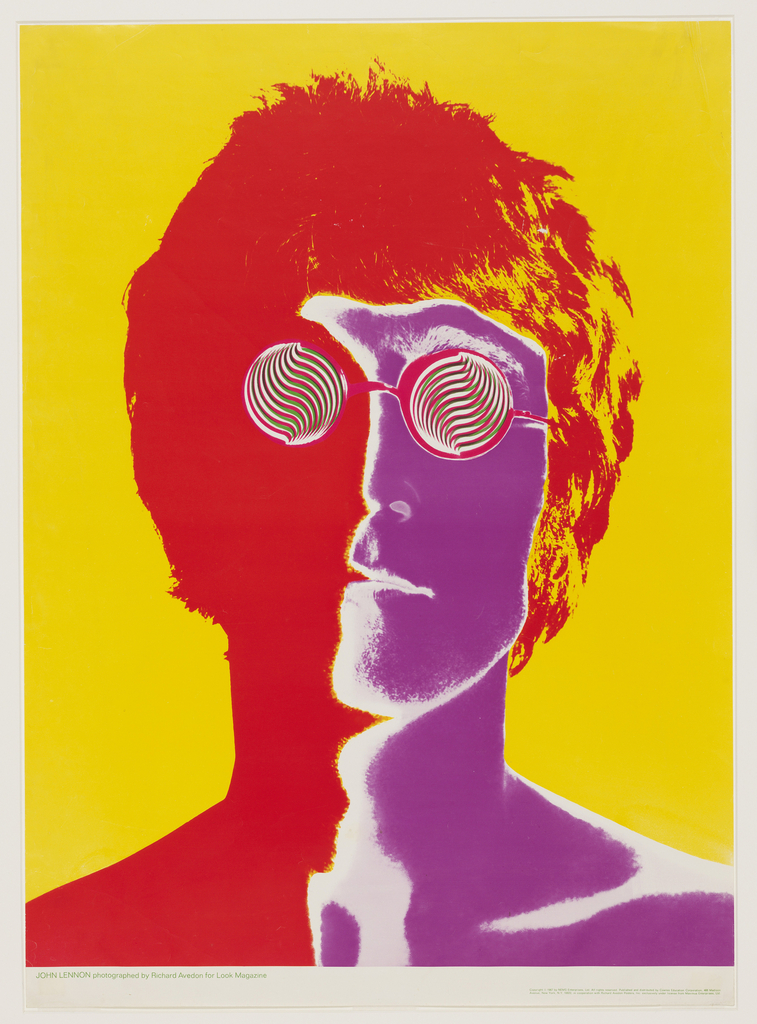
John Lennon poster by Richard Avedon
When we think of design, each of us thinks of it in our own way, focusing on our own interests: illustration, fashion, architecture, interfaces, manufacturing, or any of a vast number of sub-disciplines besides. Those of us who have paid a visit to Cooper Hewitt, also known as the Smithsonian Design Museum, have a sense of just how much human innovation, and even human history, that term can encompass. Now, thanks to an ambitious digitization project that has so far put 200,000 items (or 92 percent of the museum’s collection) online, you can experience that realization virtually.
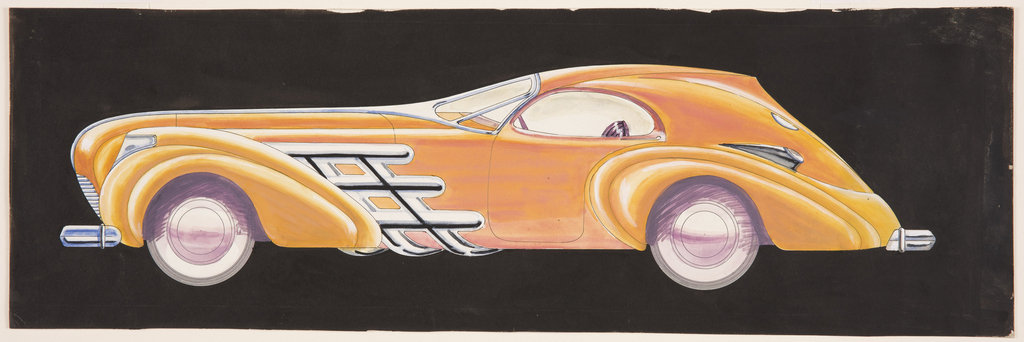
Concept car designed by William McBride
The video below explains the system, an impressive feat of design in and of itself, with which Cooper Hewitt made this possible. “In collaboration with the Smithsonian’s Digitization Program Office, the mass digitization project transformed a physical object (2‑D or 3‑D) from the shelf to a virtual object in one continuous process,” says its about page. “At its peak, the project had four photographic set ups in simultaneous operation, allowing each to handle a certain size, range and type of object, from minute buttons to large posters and furniture. A key to the project’s success was having a completely barcoded collection, which dramatically increased efficiency and allowed all object information to be automatically linked to each image.”
Given that the items in Cooper Hewitt’s collection come from all across a 3000-year slice of history, you’ll need an exploration strategy or two. Have a look at the collection highlights page and you’ll find curated sections housing the items pictured here, including psychedelic posters, designs for automobiles, architect’s eye, and designs for the Olympics — and that’s just some of the relatively recent stuff. Hit the random button instead and you may find yourself beholding, in high resolution, anything from a dragonish fragment of a panel ornament from 18th-century France to a late 19th-century collar to a Swedish vase from the 1980s.
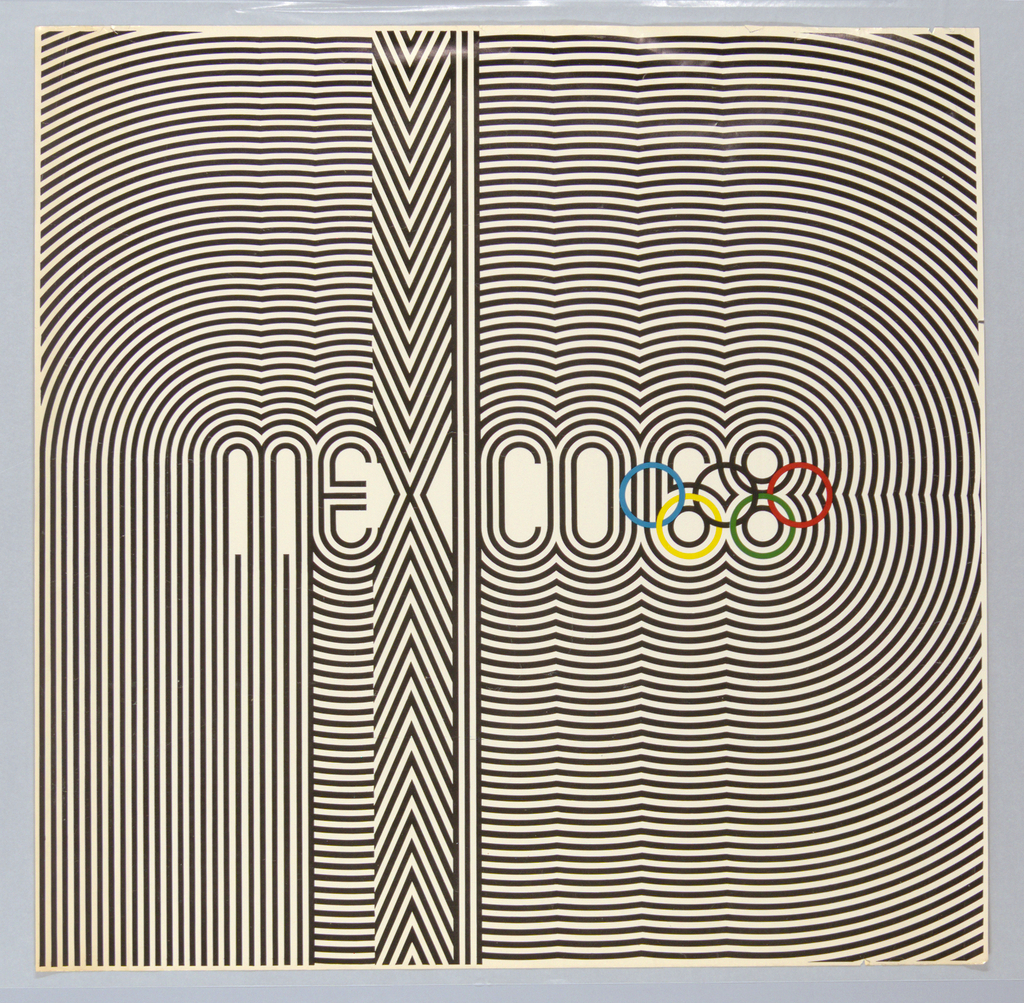
Mexico 68 designed by Lance Wyman
Cooper Hewitt has also begun integrating its online and offline experiences, having installed a version of its collection browser on tables in its physical galleries. There visitors can “select items from the ‘object river’ that flows down the center of each table” about which to learn more, as well as use a “new interactive Pen” that “further enhances the visitor experience with the ability to “collect” and “save” information, as well as create original designs on the tables.” So no matter how much time you spend with Cooper Hewitt’s online collection — and you could potentially spend a great deal — you might, should you find yourself on Manhattan’s Museum Mile, consider stopping into the museum to see how physical and digital design can work together. Enter the Cooper Hewitt’s online collection here.
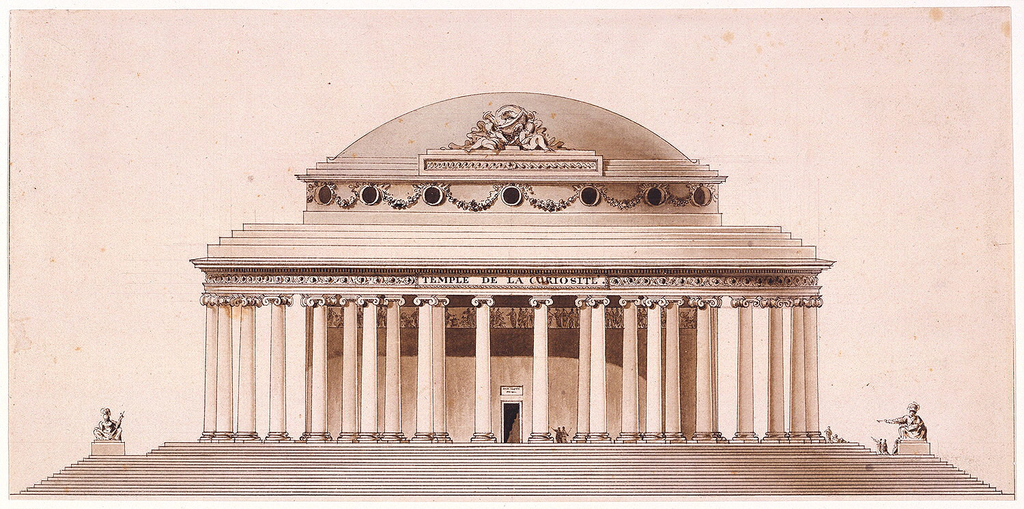
Temple of Curiosity by Etienne-Louis Boullée
Related Content:
Free: A Crash Course in Design Thinking from Stanford’s Design School
Bauhaus, Modernism & Other Design Movements Explained by New Animated Video Series
Abstract: Netflix’s New Documentary Series About “the Art of Design” Premieres Today
The Smithsonian Picks “101 Objects That Made America”
Smithsonian Digitizes & Lets You Download 40,000 Works of Asian and American Art
Based in Seoul, Colin Marshall writes and broadcasts on cities and culture. He’s at work on the book The Stateless City: a Walk through 21st-Century Los Angeles, the video series The City in Cinema, the crowdfunded journalism project Where Is the City of the Future?, and the Los Angeles Review of Books’ Korea Blog. Follow him on Twitter at @colinmarshall or on Facebook.
Read More...Circus Artist Roxana Küwen Will Captivate You with Her Foot Juggling Routine
Roxana Küwen is a German-born circus artist who “likes to take her audience into her world and make them be astonished, confused or amazed by playing with categories and presence.” Witness the video above, where Küwen does something quite simple. She puts her feet next to her hands and moves her 20 digits in unison. Familiar body parts are put into strange motion, leaving you feeling charmed. But also a bit disconcerted.
Then Roxana starts her foot juggling routine. It’s not the most high velocity, risk-filled juggling act. The balls move slowly and never get more than a few feet off of the ground. There’s a strange simplicity to it, though captivating nonetheless.
Related Content
How Marcel Marceau Started Miming to Save Children from the Holocaust
Read More...Musician Taryn Southern Is Composing Her New Album with Artificial Intelligence: Hear the First Track
“Break Free” is a new song by Taryn and Amper. The former, Taryn Southern, is a musician and singer popular on Youtube. The latter, however, is not human at all. Instead, Amper is an artificially intelligent music composer, producer and performer, developed by a combination of “music and technology experts” and now put to the test, being the engine behind Taryn’s single and eventually a full album, tentatively called I AM AI.
To understand what is Taryn and what is Amper in this project, the singer talks about it in this Verge interview:
The way it works is to give the platform certain input like BPM, instrumentation that I like, genre, key, etc. The platform will spit a song out at me, and then I can iterate from there, making adjustments to the instruments and the key. I can even change the genre or emotional feel or the song, until I get something that I’m relatively happy with. Once I have that, I download all the stems of the instrumentation to build actual song structure.
What Amper’s really good at is composing and producing instrumentation, but it doesn’t yet understand song structure. It might give you a verse or the chorus and it’s up to me to stitch these pieces together so that it sounds like something familiar you would hear on the radio. Once I’m happy with the song, then I write the vocal melody and lyrics.
The key sentence for cynics is the second to last one. Amper delivers the familiar, or rather, Taryn makes Amper work until she gets something familiar. AI is not at the stage yet where it might surprise us with a decision, except in the cases where it goes spectacularly wrong. Right now it’s very good at learning patterns, at imitating, at delivering a variation on a theme. (That’s why it’s really good at imitation Bach, for example.)
We could imagine, however, a future where AI would be able to take a number of musical elements, styles, and genres and come out with a hybrid that we’ve never heard before. And would that be any better than having a human do so?
By the way, you can try out Amper yourself here. Your mileage may vary.
Related content:
Artificial Intelligence Program Tries to Write a Beatles Song: Listen to “Daddy’s Car”
Ted Mills is a freelance writer on the arts who currently hosts the FunkZone Podcast. You can also follow him on Twitter at @tedmills, read his other arts writing at tedmills.com and/or watch his films here.
Read More...Support Us
We're hoping to rely on loyal readers, rather than erratic ads. Please click the Donate button and support Open Culture. You can use Paypal, Venmo, Patreon, even Crypto! We thank you!

About Us

Open Culture scours the web for the best educational media. We find the free courses and audio books you need, the language lessons & educational videos you want, and plenty of enlightenment in between.
Advertise With Us

FREE UPDATES!
GET OUR DAILY EMAIL
Get the best cultural and educational resources on the web curated for you in a daily email. We never spam. Unsubscribe at any time.
FOLLOW ON SOCIAL MEDIA

Open Culture editor Dan Colman scours the web for the best educational media. He finds the free courses and audio books you need, the language lessons & movies you want, and plenty of enlightenment in between.
Advertise With Us

