How Did the Egyptians Make Mummies? An Animated Introduction to the Ancient Art of Mummification
Not every child looks forward to a trip to the museum, but how many have failed to thrill at the sight of an ancient Egyptian mummy? How many adults, for that matter, can resist the fascination of this well over 5000-year-old process of preserving dead bodies in a state if not perfectly lifelike then at least eerily intact? If you’ve ever wondered exactly how mummification worked — or if you’ve simply forgotten the descriptions accompanying the displays you saw on those museum trips — this short video from the Getty Museum’s Youtube channel provides an insight into how the ancient Egyptians did it.
The video uses a real mummy as a case study, the preserved body of a twenty-year-old man named Herakleides (as we know because his mummifiers, though themselves unidentified, wrote it on his feet), who died in the first century A.D. He had most of his internal organs removed — even his heart, which common practice usually dictated leaving in, but for some reason not his lungs — and spent forty days buried in salt that drew every last bit of moisture out of him.
He then received rubbings of perfumed oils, followed by a poured-on layer of resin to which strips of linen (the mummy’s characteristically copious “bandages” of popular culture) could adhere. Wrapped onto a board, equipped with a “mysterious pouch” as well as a mummified ibis, and covered with an unusual red shroud emblazoned with symbols and a portrait of himself, Herakleides was ready for his journey into the afterlife.
“Such elaborate burial practices might suggest that the Egyptians were preoccupied with thoughts of death,” says the Smithsonian’s page on Egyptian mummies. “On the contrary, they began early to make plans for their death because of their great love of life. They could think of no life better than the present, and they wanted to be sure it would continue after death.” The ancient Egyptians believed “that the mummified body was the home for this soul or spirit. If the body was destroyed, the spirit might be lost.”
If you find yourself sharing these beliefs, do have a look at National Geographic’s guide on how to make a mummy in 70 days or less. And just as you’d need to arrange the right ingredients to prepare a satisfying meal, something else the Egyptians enjoyed, don’t attempt any mummification at home without making sure you’re fully stocked with resin, ointments, lichen, strawdust, beeswax, palm wine, incense, and myrrh. And it goes without saying that however many feet of wrappings you’ve got, it couldn’t hurt to have more.
Related Content:
The Opening of King Tut’s Tomb, Shown in Stunning Colorized Photos (1923–5)
How the Egyptian Pyramids Were Built: A New Theory in 3D Animation
Try the Oldest Known Recipe For Toothpaste: From Ancient Egypt, Circa the 4th Century BC
The Turin Erotic Papyrus: The Oldest Known Depiction of Human Sexuality (Circa 1150 B.C.E.)
A Drone’s Eye View of the Ancient Pyramids of Egypt, Sudan & Mexico
Based in Seoul, Colin Marshall writes and broadcasts on cities and culture. His projects include the book The Stateless City: a Walk through 21st-Century Los Angeles and the video series The City in Cinema. Follow him on Twitter at @colinmarshall or on Facebook.
Read More...Ralph Steadman’s Wildly Illustrated Biography of Leonardo da Vinci (1983)
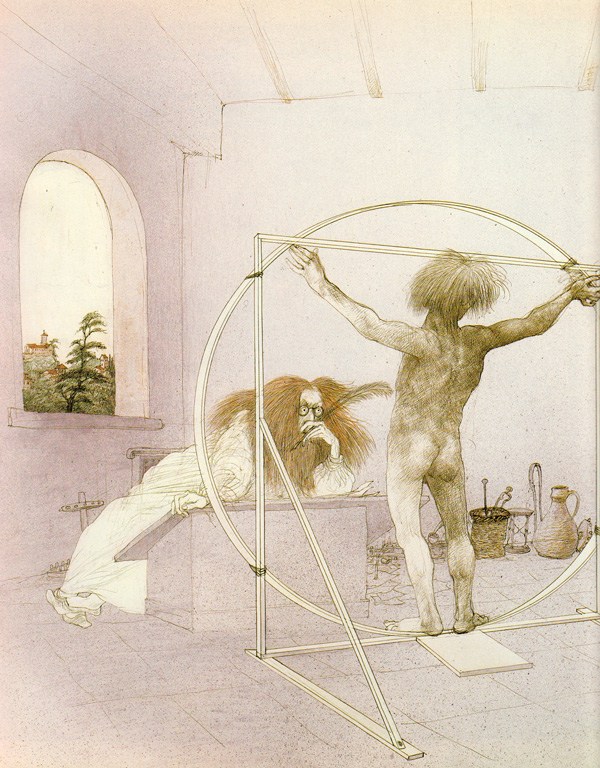
It is for good reason that we forever associate illustrator Ralph Steadman with the delirious work of Hunter S. Thompson. It took the two of them together to invent the gonzo style of journalism, which we may almost call incomplete now if published without the requisite cartoon grotesques. Steadman conjures visions of devils and demons as deftly as any medieval church painter, but his hells remain above ground and are mostly man-made. Whether illustrating Ambrose Bierce’s Devil’s Dictionary, George Orwell’s Animal Farm, the cast of Breaking Bad, or the visages of American presidents, he excels at showing us the freakish fever dreams of the modern world. He may, wrote The New York Times’ Sherwin Smith in 1983, “be the most savage political cartoonist of the late 20th century.”
Steadman’s illustrative legacy places him in the company of history’s greatest visual satirists, but also makes him an odd choice for a biography of Leonardo da Vinci. Though Leonardo frequently drew caricatures in his notebooks, the bulk of the Renaissance genius’s work concerns itself with order and precision—the purposefulness of his line a stark contrast to the crazed ink splatters of Steadman’s work.
Nonetheless, Steadman’s I, Leonardo, which he undertook not on commission but on his own initiative, exhibits a profound insight into the Italian painter-sculptor-philosopher-inventor’s restless creative mind. Leonardo presented a very cool exterior, but his inner life may well have resembled a Steadman drawing.
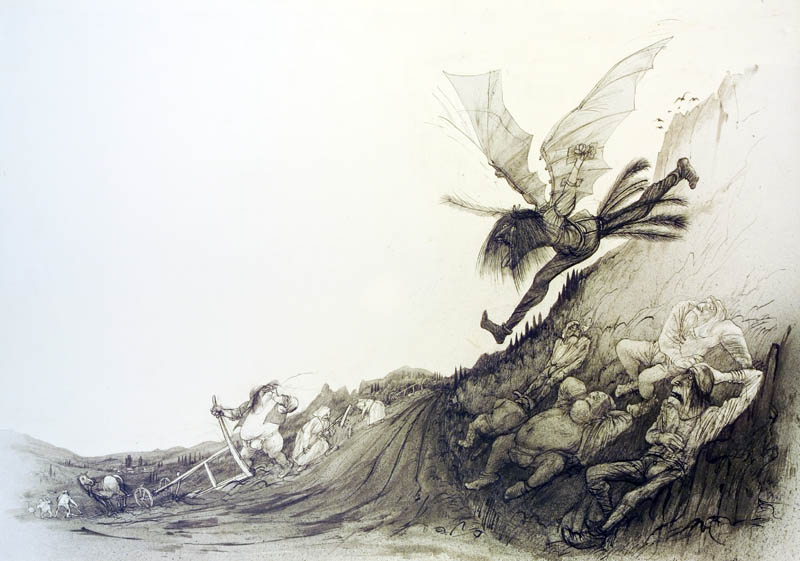
The project came to life in 1983 as what Steadman called “a quasi-historical mishmash,” a “tongue-in-cheek” supposed long-lost autobiography of Leonardo in pictures. “It is more than a collection of illustrations on Leonardo’s life, based upon three years of work and research,” remarked a Washington Post review. “Steadman does not merely theorize about the man, but attempts to go inside the artist’s bones.” Steadman, writes Maria Popova, “even travelled to Italy to stand where Leonardo stood, seeking to envision what it was like to inhabit that endlessly imaginative mind.” The illustrations are a surprisingly effective combination of da Vinci-esque discipline and Steadmanesque sick humor.
In his introduction to the book, Steadman comments on Leonardo’s split persona. His “experience showed him that man was not what he appeared to be, despite the prevailing atmosphere of fine thoughts and high aspirations…. The purity of his painting set the divine standard of Renaissance art—and of any art for that matter. I believe he preserved intact a part of his private self which found outlet in his more personal notes and drawings.” Many of those drawings include the aforementioned caricatures of monstrous, grimacing beings who would fit right in with Steadman’s nightmarish drawings.
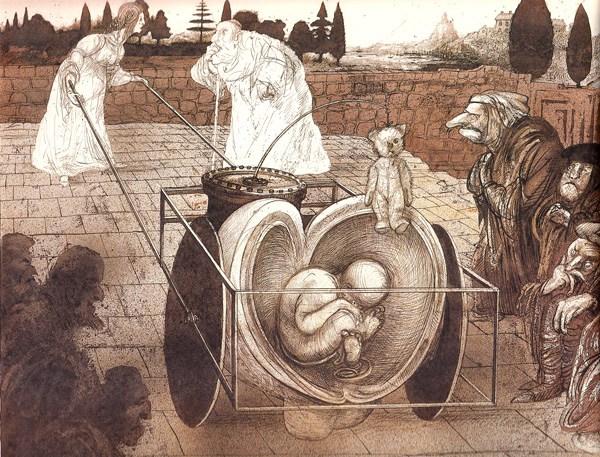
The gonzo illustrator found a kindred satirical Leonardo inside the famed master draughtsman and engineer. His interest in the Renaissance artist’s anarchic psyche mirrors that of another keen observer, Sigmund Freud, who described Leonardo as “a man who awoke too early in the darkness, while the others were all still asleep.” (Steadman’s first “historical mishmash” project was a 1979 illustrated Freud biography.) The artist behind I, Leonardo has a slightly different take on the subject. Steadman, writes Smith, saw Leonardo “in 1980’s terms—as ‘a man taken up by a corporation that couldn’t use him.’”
See many more of Steadman’s Leonardo illustrations at Brain Pickings and purchase a copy of the book here.
Related Content:
Ralph Steadman’s Surrealist Illustrations of George Orwell’s Animal Farm (1995)
Gonzo Illustrator Ralph Steadman Draws the American Presidents, from Nixon to Trump
Breaking Bad Illustrated by Gonzo Artist Ralph Steadman
Josh Jones is a writer and musician based in Durham, NC. Follow him at @jdmagness
Read More...Hugh Hefner (RIP) Defends “the Playboy Philosophy” to William F. Buckley, 1966
“Mr. Hefner’s magazine is most widely known for its total exposure of the human female,” says William F. Buckley, introducing the guest on this 1966 broadcast of his talk show Firing Line. “Though of course other things happen in its pages.” Not long before, publisher and pleasure empire-builder Hugh Hefner’s Playboy magazine ran a series of articles on “the Playboy philosophy,” a set of observations of and propositions about human sexuality that provided these men fodder for their televised debate. Hefner stands against religiously mandated, chastity-centered codes of sexual morality; Buckley demands to know how Hefner earned the qualifications to issue new codes of his own. Describing the Playboy philosophy as “sort of a hedonistic utilitarianism,” Buckley tries simultaneously to understand and demolish these 20th-century revisions of the rules of sex.
“The Playboy founder is no match for the Catholic who snipes him at will with ‘moral’ bullets,” writes the poster of the video. “The acerbic, dry Buckley is on attack mode with a conservative audience, in moral panic, behind him. The Catholic had the era of conservatism behind him. [ … ] In the 21st century though, Buckley would have a harder time defending morality with Hefner.” One wonders how Buckley and Hefner, were they still alive today, might revisit this debate in 2017. (Buckley died in 2008, and Hefner passed away yesterday at the age of 91.) Times have certainly changed, but I suspect Buckley would raise the same core objection to Hefner’s argument that loosening the old strictures on sex leads, perhaps counterintuitively, to more satisfied, more monogamous pairings: “How in the hell do you know?” Though this and certain other of Buckley’s questions occasionally wrong-foot Hefner, the faithful can rest assured that he keeps enough cool to fire up his signature pipe on camera.
Note: This post first appeared on our site back in 2012. We brought it back today for obvious reasons, and updated it to reflect Hefner’s passing. Since 2012, a huge archive of “Firing Line” episodes have been put online. Get more on that here.
Related Content:
Yeah, Baby! Deep Purple Gets Shagadelic on Playboy After Dark
James Baldwin Bests William F. Buckley in 1965 Debate at Cambridge University
Jack Kerouac Meets William F. Buckley (1968)
Colin Marshall hosts and produces Notebook on Cities and Culture. Follow him on Twitter at @colinmarshall.
Read More...Judy Blume Now Teaching an Online Course on Writing
FYI: If you sign up for a MasterClass course by clicking on the affiliate links in this post, Open Culture will receive a small fee that helps support our operation.
After announcing that Martin Scorsese will be teaching an online course on filmmaking, MasterClass made it known today that Judy Blume has created an online course on Writing. In 24 lessons, the beloved author of Are You There God? It’s Me, Margaret and Tales of a Fourth Grade Nothing will show you “how to develop vibrant characters and hook your readers.” The individual course costs $90 and is now ready go. You can also buy an All-Access Annual Pass for $180 and explore every course in the MasterClass catalogue. Some courses worth exploring include:
- Herbie Hancock on Jazz
- Garry Kasparov on Chess
- Dr. Jane Goodall on the Environment
- David Mamet on Dramatic Writing
- Steve Martin on Comedy
- Aaron Sorkin on Screenwriting
- Gordon Ramsay on Cooking
You can take this class by signing up for a MasterClass’ All Access Pass. The All Access Pass will give you instant access to this course and 85 others for a 12-month period.
If you would like to support the mission of Open Culture, consider making a donation to our site. It’s hard to rely 100% on ads, and your contributions will help us continue providing the best free cultural and educational materials to learners everywhere. You can contribute through PayPal, Patreon, and Venmo (@openculture). Thanks!
Related Content:
Enter an Archive of 6,000 Historical Children’s Books, All Digitized and Free to Read Online
Hayao Miyazaki Picks His 50 Favorite Children’s Books
Read More...When John Cage & Marcel Duchamp Played Chess on a Chessboard That Turned Chess Moves Into Electronic Music (1968)

When is a chess game not a chess game?
When it’s played between Marcel Duchamp and John Cage.
Both the man who turned a urinal into a piece of modern art and the man who reduced musical composition all the way down to silence were fans of taking things to absurd conclusions. And they were both fans of chess; Duchamp the grand master and Cage the dutiful student. Asked in 1974 whether Duchamp was a good teacher, Cage replied, “I was using chess as a pretext to be with him. I didn’t learn, unfortunately, while he was alive to play well.”
But Cage seemed to have little interest in competition. “Duchamp once watched me playing and became indignant when I didn’t win,” he said. “He accused me of not wanting to win.” Instead, he approached chess as he approached the piano—as a decoy, a feint, that leads into another kind of game entirely. In a 1944 tribute to Duchamp, he painted a chessboard that was actually a musical score, and, in 1968, he arranged a public game as a pretext for a musical performance called Reunion, performed in Toronto with Duchamp and his wife Teeny (we have no film of the game-slash-concert; you can see Cage play Teeny in the video above).
Cage was an admirer of the elder artist for over 20 years, playing chess with him frequently. But he “didn’t want to bother Duchamp with his friendship,” writes Sylvere Lotringer, “until he realized that Duchamp’s health was failing. Then he decided to actively seek his company.” Playing on an electronic chess board designed by Lowell Cross, known as the inventor of the laser light show, the two created an extemporaneous composition that lasted as long as the audience, and Duchamp, could tolerate. “The concert,” Cross remembered on the fortieth anniversary of the piece, “began shortly after 8:30 on the evening of March 5, 1968, and concluded at approximately 1:00 a.m. the next morning.”
Debunking a number of misconceptions about the chessboard, Cross explains that its operation “depended upon the covering or uncovering of its 64 photoresistors.” It also contained contact microphones so that “the audience could hear the physical moves of the pieces of the board.” When either player made a move, it triggered one of several electronic “sound-generating systems” created by composers David Behrman, Gordan Mumma, David Tudor, and Cross himself. Additionally, “oscilloscopic images emanated from… modified monochrome and color television screens, which provided visual monitoring of some of the sound events passing through the chessboard.”
As Lotringer describes the scene, the two modernist giants “played until the room emptied. Without a word said, Cage had managed to turn the chess game (Duchamp’s ostensive refusal to work) into a working performance…. Playing chess that night extended life into art—or vice versa. All it took was plugging in their brains to a set of instruments, converting nerve signals into sounds. Eyes became ears, moves music.” Duchamp had given the impression he was done making art. “Cage found a way to lure him into one final public appearance as an artist,” notes the Toronto Dreams Project blog.
Indeed, Cage may have been formulating the idea for over twenty years, each time he sat down to play a game with Duchamp, and lost. When Duchamp arrived in Canada for the performance at what was called the Sightsoundsystems Festival, he had no idea that he would be participating in the headlining event.
What he found when he arrived was a surreal scene. Two of the greatest artists of the twentieth century took their seats in the middle of the stage at the Ryerson Theatre, bathed in bright light and the gaze of the audience. Photographers circled around them, shutters snapping; a movie camera whirred. The stage was a mess of gadgets. There were wires everywhere; a tangle of them plugged right into side of the chessboard. A pair of TV screens was set up on either side of the stage. The Toronto Star called it “a cross between an electronic factory and a movie set.”
Cage lost, as usual, though he was more evenly matched when he played Duchamp’s wife. The three of them, wrote the Globe, were “like figures in a Beckett play, locked in some meaningless game. The audience, staring silently and sullenly at what was placed before it, was itself a character; and its role was as meaningless as the others. It was total non-communication, all around.” The wires running from the chessboard connected to “tuners, amplifiers and all manner of electronic gadgetry,” the Star wrote, filling the room with “screeches, buzzes, twitters and rasps.”
The Star pronounced the event “infinitely boring,” a widely shared critical assessment of the night. (Cage explains the Zen of boredom in his voice-over at the top.) But we can hardly expect most reviewers of either artist’s most experimental work to respond with less than bewilderment, if not outright hostility. It was to be Duchamp’s last public appearance. He passed away a few months later. For Cage, the evening had been a success. As Cross put it, Reunion was “a public celebration of Cage’s delight in living everyday life as an art form.”
Everyday life with Duchamp meant playing chess, and there were few greater influences than Duchamp on Cage’s conceptual approach to what music could be—and what could be music. “Like Duchamp,” writes PBS, “Cage found music around him and did not necessarily rely on expressing something from within.” Further up, see Cage’s 1944, Duchamp-inspired “Chess Pieces” performed on harp and accordion, and above hear a piece he wrote for Duchamp for a sequence in Hans Richter’s 1947 surrealist film Dreams that Money Can Buy.
To delve deeper, you can explore the book, Marcel Duchamp: The Art of Chess by Francis M. Naumann.
Related Content:
Play Chess Against the Ghost of Marcel Duchamp: A Free Online Chess Game
The Music of Avant-Garde Composer John Cage Now Available in a Free Online Archive
Josh Jones is a writer and musician based in Durham, NC. Follow him at @jdmagness
Read More...Watch the New Anime Prequel to Blade Runner 2049, by Famed Japanese Animator Shinichiro Watanabe
The run-up to Blade Runner 2049, befitting what now looks like the cinematic event of the decade, has consisted of not just marketing hype (though it does include plenty of that) but genuine artistic material as well. Last month we featured Nexus: 2036, the first of three short “prequels” to Denis Villeneuve’s upcoming Blade Runner sequel. That one and its follow up 2048: Nowhere to Run, both directed by Luke Scott (son of Blade Runner director Ridley Scott), use live action to fill in some of the story between the 2019 of the first movie and the 2049 of the second. The just-released third short, Black Out 2022, from Cowboy Bebop director Shinichirō Watanabe, brings the Blade Runner universe into the realm of Japanese animation.
“Blade Runner was definitely the movie that influenced me the most as an anime director,” says Watanabe in the preview of his prequel down below. He and other Japanese viewers understood the film’s power long before most anyone in the West (with the notable exception of Philip K. Dick, author of its source material), and Japanese artists began paying tribute to it almost immediately.
In a sense, Blade Runner took anime form thirty years ago: Katsuhito Akiyama’s animated series Bubblegum Crisis, the story of artificial humans (called “booomers” instead of replicants) run amok and the advanced police team (called “Knight Sabers” instead of “Blade Runners”) who hunt them down in a Tokyo of the future rebuilt after a disastrous earthquake, could hardly wear its influence more openly.
Filled with visual, sonic, and thematic references to the original Blade Runner while taking the story in new directions — and also introducing two new replicant characters — Watanabe’s Black Out 2022–viewable up top–depicts the events leading up to the detonation of an electromagnetic pulse that destroys the electronics and machinery on which humanity has become so reliant. Humanity blames the replicants, and so begins a period of prohibition on replicant production, only brought to an end by the efforts of Niander Wallace, the character so eerily played by Jared Leto in Nexus: 2036. Blade Runner 2049 will pick things up 26 years after the EMP attack. What shape will Los Angeles be in then? What shape will the cat-and-mouse game between replicants and Blade Runners take there? We’ll find out, and surely in no small amount of detail, next month.
Related Content:
Jared Leto Stars in a New Prequel to Blade Runner 2049: Watch It Free Online
The Official Trailer for Ridley Scott’s Long-Awaited Blade Runner Sequel Is Finally Out
Watch an Animated Version of Ridley Scott’s Blade Runner Made of 12,597 Watercolor Paintings
Based in Seoul, Colin Marshall writes and broadcasts on cities and culture. His projects include the book The Stateless City: a Walk through 21st-Century Los Angeles and the video series The City in Cinema. Follow him on Twitter at @colinmarshall or on Facebook.
Read More...Photo Archive Lets You Download 4,300 High-Res Photographs of the Historic Normandy Invasion

Taxis to Hell – and Back – Into the Jaws of Death, by Robert F. Sargent, via Wikimedia Commons
In the mid-20th century, theorists like Roland Barthes and Pierre Bourdieu exploded naive notions of photography as “a perfectly realistic and objective recording of the visible world… a ‘natural language,’” as Bourdieu wrote in Photography: A Middlebrow Art. Bourdieu himself wielded a camera during his ethnographic work in Algeria, taking dozens of conventional and unconventional photographs of the nation’s struggle for independence from France in the 50s. Yet he urged us to see photography as formally mediating social reality rather than transparently representing the truth.

We have been trained to interpret the perspectives most photographs adopt as objective views, when in fact they are “perfectly in keeping with the representation of the world which has dominated Europe since the Quattrocento.” Photography, in other words, tends to give us art imitating Renaissance art. It can be difficult to bear this in mind when we look at individual photographs—what Barthes calls “the This.”
Whether they document our own family histories or such momentous events as the Normandy Invasion that began on D‑Day, June 6th, 1944, photographs elicit powerful emotional reactions that defy aesthetic categories.

At the Flickr account PhotosNormandie, you can browse and search over 4,300 high resolution photographs from the pivotal Normandy campaign, “From iconic images like Into the Jaws of Death by Robert F. Sargent,” My Modern Met writes, “to troops interacting with locals as they liberate areas of Normandy.” The photos are deeply affecting, often awe-inspiring. When we look with a critical eye, we’ll find ourselves asking certain questions about them.

The skewed perspective and ominous sky in Sargent’s “Into the Jaws of Death,” for example, at the top of the post, might make us think of the Sturm und Drang of many a dramatic shipwreck painting from the Romantic period. Was Sargent aware of the similarity when he looked through the lens? Did he position himself to heighten the effect? In photos like that further up, of a French home displaying a pro‑U.S. sign on July 11th, 1944, we might wonder whether the residents made the sign or whether it was given to them, perhaps for this very photo op. As always, we’re justified in asking about the role of the photographer in staging or framing a particular scene.

For example, the photo of a German soldier surrendering to American G.I.s, above, looks staged. But what exactly these soldiers are doing remains a mystery. How much do these external details matter? Photography is unique among other visual arts in that “the Photograph,” Barthes writes, “reproduces to infinity” what has “occurred only once.” It is the meeting of infinity with “only once” that engages us in more existential explorations. All of these soldiers and civilians, sharing their joy and anguish, most of them now passed into history. Who were these people? What did these moments mean to them? What do they mean to us 70 years later?

The bombed-out cathedrals and defeated tanks make us ponder the fragility of our own built environment, though the destructive forces threatening to undo the modern world now seem as likely to be natural as man-made—or rather some new, frightening combination of the two. In the faces of the wounded and the displaced, we see specific manifestations of the same tragic invasions and migrations that reach back to Thucydides and forward to the present moment in world history, in which some 60 million people displaced by war and hardship seek sanctuary.

The images draw us away into general observations as they draw us back to the unrepeatable moment. This project began on the 60th anniversary of D‑Day “as a way,” My Modern Met explains, “to crowdsource descriptions of images on the now defunct Archives Normandie, 1939–1945. Thus, users are encouraged to comment on photos if they are able to improve descriptions, locations, and identifications.” History may rhyme with the present—as one famous quote attributed to Mark Twain has it—but it never exactly repeats. The photograph, Barthes wrote, “mechanically repeats what could never be repeated existentially.” Moments forever lost to time, transmuted into timelessness by the camera’s eye. Enter the PhotosNormandie gallery here.
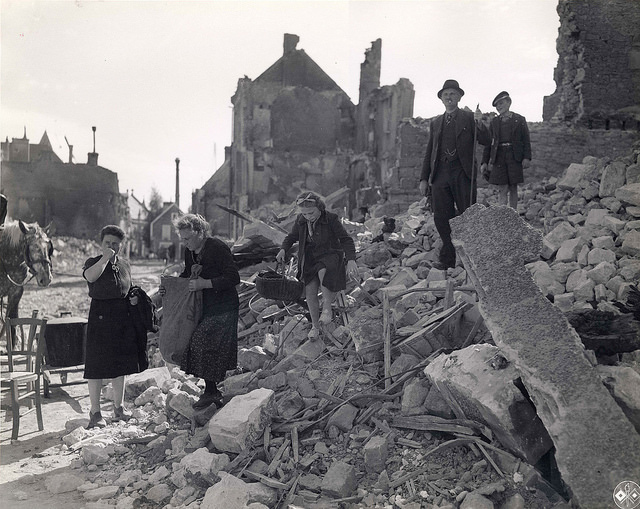
via My Modern Met
Related Content:
The Finland Wartime Photo Archive: 160,000 Images From World War II Now Online
31 Rolls of Film Taken by a World War II Soldier Get Discovered & Developed Before Your Eyes
Josh Jones is a writer and musician based in Durham, NC. Follow him at @jdmagness
Read More...The Strange Story of Dr. James Barry, the Pioneering 19th Century British Doctor Who Was a Woman in Disguise
The work of many recent historians has brought more balance to the field, but even within heavily masculinist, Eurocentric histories, we find nonwhite people who slipped past racial gatekeepers to leave their mark, and women who made it past the gender police—sometimes under the guise of male pen names, and sometimes in disguise, as in the case of Dr. James Barry, who, upon his death in 1865, turned out to be “a perfect female,” as the surprised woman who washed the body discovered.
What makes Dr. Barry—born in Ireland as Margaret Bulkley, niece of the painter James Barry—such a noteworthy person besides passing for male in the company of people who did not tolerate gender fluidity? As the Irish Times writes in a review of a new biography, “her life as James Barry was a succession of audacious firsts—the first woman to become a doctor; the first to perform a successful caesarean delivery; a pioneer in hospital reform and hygiene; and the first woman to rise to the rank of general in the British Army (Barry’s commission, signed by Queen Victoria, still exists).”
When Barry’s sex was discovered, it caused a sensation, inspiring everyone from muckraking anonymous journalists to Charles Dickens to weigh in on the case. The tale “was explored in novels,” notes The Guardian, “and even a play,” but the “true story is both more prosaic and infinitely more strange.” The video at the top of the post walks us through Barry’s career serving the Empire in South Africa, where she treated soldiers, lepers, and ailing mothers. Margaret’s story as Dr. Barry begins in Cork when, longing for adventure at 18, she first decided to take on the persona of “a hot-tempered ladies’ man,” Atlas Obscura writes, “donning three-inch heeled shoes, a plumed hat, and sword.” When her wealthy uncle passed away and left the family his fortune, she also took his name.
Three years later in 1809, with the encouragement of her mentor and guardian, Venezuelan general Francisco Miranda, “she decided to embody a smooth-faced young man in order to attend the men’s‑only University of Edinburgh and practice medicine—a guise that would last for 56 years.” Margaret’s early years were marked by hardship and tragedy. In her teens she had been raped by a family member and had born a child. When she became James Barry, a physician attending to pregnant women, she “had a secret advantage,” her biographers Michael du Preez and Jeremy Dronfield write. “There was not another practicing physician in the world who knew from personal experience what it was like to bear a child.”
But of course, she did not need to experience leprosy or gunshot wounds to treat the many hundreds of patients in her care. Her sex was incidental to her skill as a physician. Margaret Bulkley’s transformation may be “one of the longest deceptions of gender identity ever recorded,” writes du Preez. Barry “is remembered for this sensational fact rather than for the real contributions that she made to improve the health and the lot of the British soldier as well as civilians.” The doctor’s wild personal story weaves through the lives of commoners and aristocrats, soldiers and revolutionaries, duels and illicit love affairs, and is surely worthy of an HBO miniseries. Her medical accomplishments are worthy of public memorialization, Joanna Smith argues at CBC News, along with a host of other accomplished women who changed the world, even as their legacies were elbowed aside to make even more room for famous men.
Related Content:
Marie Curie Invented Mobile X‑Ray Units to Help Save Wounded Soldiers in World War I
Josh Jones is a writer and musician based in Durham, NC. Follow him at @jdmagness
Read More...A Virtual Tour of Japan’s Inflatable Concert Hall
After the massive Fukushima earthquake in 2011, architect Arata Isozaki and artist Anish Kapoor created the Ark Nova, an inflatable mobile concert hall, designed to bring music to devastated parts of Japan. Made of a stretchy plastic membrane, the Ark Nova can be inflated within two hours. Add air in the afternoon. At night, enjoy a concert in a 500-seat performance hall. Afterwards, deflate, pack on truck, and move the gift of music to the next city.
Marc Kushner, author of The Future of Architecture in 100 Buildings, takes us on a virtual tour of the concert hall in the video above. Over on the website Dezeen, you can see an array of photos, showing both the interior and exterior of this ingenious structure.
If you would like to support the mission of Open Culture, consider making a donation to our site. It’s hard to rely 100% on ads, and your contributions will help us continue providing the best free cultural and educational materials to learners everywhere. You can contribute through PayPal, Patreon, and Venmo (@openculture). Thanks!
Related Content:
The World Concert Hall: Listen To The Best Live Classical Music Concerts for Free
Stanford Prof Makes Ukuleles from Wood Floor of New Concert Hall
Read More...Wes Anderson’s Cinematic Debt to Stanley Kubrick Revealed in a Side-By-Side Comparison
Most film fans hold the work of Stanley Kubrick and Wes Anderson in high regard, even if they don’t find one, the other, or both to their particular taste. And at first glance, it might seem hard to understand what kind of taste could possibly encompass both Kubrick and Anderson. The former made mostly complex and emotionally chilled period pieces, visually grand yet stark, tinged with grim humor, and possessing a dim view of humanity. The latter makes colorful, outwardly high-spirited comedies, sometimes even animated ones, that seem to delight in their own carefully cultivated aesthetics.
But both bodies of work reveal directorial minds that take cinema itself very seriously indeed. “Kubrick is one of my favorites,” says Anderson in an interview clip used in the video essay comparing shots from his films to shots from Kubrick’s, just above. “Usually, by the time I’m making the movie, I don’t really know where I’m stealing everything from. By the time it’s a movie, I think it’s my thing, and I forget where I took it all — but I think I’m always pretty influenced by Kubrick.” That influence, on a visual level, does come through in this comparison, certainly in all those first-person perspectives and views through portholes, but even more so with the camera moves, especially in the tracking shots and zooms.
As Bill Murray said in a 1999 interview with Charlie Rose of Rushmore, the picture that would make Murray an Anderson regular, “Boy, this has got some great moves in it.” By that he meant “the way stories get told in pictures.” A filmmaker needs a script, of course, but “the way you shoot it, too, shows how you want to impact things on an audience.” He describes Anderson and his collaborators as possessed of “an enormous film culture,” recalling shots from cinema past and, in their own productions, repurposing them completely. Murray remembers Anderson describing a shot in Rushmore as “one I saw in Barry Lyndon.” “You remember Barry Lyndon?” Murray asks Rose. “It was this enormous thing. Ours, though, is the intermission of the school play.”
That school play, you may recall, appears as one of several put on by Rushmore’s protagonist Max Fischer, whose sensibilities (and artistic abilities) may differ from Anderson’s, but who shows just the same zeal for creatively “ripping off” from the movies. “I talk to a lot of those guys who come in here, these young directors,” Rose says of Anderson and his generation. “They’ve seen every movie. They’re more students of cinema than most.” Murray cautions that “it always gets perverted when people say, ‘Oh, the good ones copy, the great ones steal,’ ” an idea that can lead to empty formal tributes, but “Wes,” to his mind, was different. Possessed of both “mind and body,” he “just knows how to get these things together in one place,” using the language of cinema, whether invented or borrowed, for maximum impact — as, in a different yet startlingly similar way, did Kubrick.
Related Content:
Stanley Kubrick’s The Shining Reimagined as Wes Anderson and David Lynch Movies
The Perfect Symmetry of Wes Anderson’s Movies
Signature Shots from the Films of Stanley Kubrick: One-Point Perspective
A Glimpse Into How Wes Anderson Creatively Remixes/Recycles Scenes in His Different Films
Cult Films by Kubrick, Tarantino & Wes Anderson Re-imagined as 8‑Bit Video Games
Based in Seoul, Colin Marshall writes and broadcasts on cities and culture. He’s at work on the book The Stateless City: a Walk through 21st-Century Los Angeles, the video series The City in Cinema, the crowdfunded journalism project Where Is the City of the Future?, and the Los Angeles Review of Books’ Korea Blog. Follow him on Twitter at @colinmarshall or on Facebook.
Read More...Support Us
We're hoping to rely on loyal readers, rather than erratic ads. Please click the Donate button and support Open Culture. You can use Paypal, Venmo, Patreon, even Crypto! We thank you!

About Us

Open Culture scours the web for the best educational media. We find the free courses and audio books you need, the language lessons & educational videos you want, and plenty of enlightenment in between.
Advertise With Us

FREE UPDATES!
GET OUR DAILY EMAIL
Get the best cultural and educational resources on the web curated for you in a daily email. We never spam. Unsubscribe at any time.
FOLLOW ON SOCIAL MEDIA

Open Culture editor Dan Colman scours the web for the best educational media. He finds the free courses and audio books you need, the language lessons & movies you want, and plenty of enlightenment in between.
Advertise With Us


