The Philosophy & Music of Devo, the Avant-Garde Art Project Dedicated to Revealing the Truth About De-Evolution
The chief difficulty for anyone wanting to make an assault on our municipal theatre… is that there can be no question of revealing a mystery. He cannot just point a stumpy finger at the theatre’s ongoings and say, “You may have thought this amounted to something, but let me tell you, it’s a sheer scandal; what you see before you proves your absolute bankruptcy; it’s your own stupidity, your mental laziness and your degeneracy that are being publically exposed.” No, the poor man can’t say that, for it’s no surprise to you; you’ve known it all along; nothing can be done about it.
–Berthold Brecht, “A Reckoning”
Have you ever felt like Network’s Howard Beale? Ranting to anyone who’ll listen about how mad as hell you are? “I don’t have to tell you things are bad. Everybody knows things are bad.”
Or maybe agreed with the weary cynicism of his boss, Max Schumacher? “All of life is reduced to the common rubble of banality.”
Faced with the cruel, stupid theater of mass politics and culture, we begin to feel a blanket of overwhelming futility descend. All of the possible moves have been made and absorbed into the programming—including the outraged critic pointing his finger at the stage.
Avant-garde artists since the late 19th century have correctly sized up this depressing reality. But rather than seize up in fits of rage or succumb to cynicism, they made new forms of theater: Jarry, Dada, Debord, Artaud, Brecht—all had designs to disrupt the oppressive banality of modern stage- and state-craft with mockery, sadism, and shock.
And so too did DEVO, the authors of “Whip It.”
Their 80s New Wave antics seemed like a juvenile art-school prank. Behind it lay theoretical sophistication and serious political intent. “When we first started Devo,” says Mark Mothersbaugh in the “California Inspires Me” video above, “we were artists who were working in a number of different media. We were around for the shootings at Kent State. And it affected us. We were thinking, like, ‘What are we observing?’ And we decided we weren’t observing evolution, we were observing de-evolution.”
Wondering how to change things, the band looked to Madison Avenue for inspiration—intent on taking the techniques of mass persuasion to subvert the enchantments of mass persuasion, “reporting the good news of De-Evolution” in a joyous theater of mockery. The philosophy itself evolved over time, first taking shape in 1970 when Mothersbaugh and Gerald Casale met at Kent State. Casale had already coined the term “De-Evolution”; Mothersbaugh introduced him to its mascot, Jocko-Homo, the 1924 creation of anti-evolution fundamentalist pamphleteer B.H. Shadduck.
Fascinated by Shadduck’s bizarre, proto-Jack Chick, illustrated freak-outs, Mothersbaugh and his bandmates adopted the character for the first single from their 1978 debut album (top). Are We Not Men? We Are Devo! announced their carnivalesque gospel of human stupidity. Devo proved nothing we didn’t already know. Instead, they showed us the elevation of idiocy to the status of a civil religion. (Later in the 80s, they would expressly parody the national religion with their Evangelical satire DOVE.)
The theater of Devo was weirdly compelling then and is wierdly compelling now, since the banality and casual violence of late-capitalism that threatened to swallow up everything in the twentieth century has, if anything, only become more bloated and grotesque. “As far as Devo was concerned,” writes Ray Padgett at The New Yorker, “Devo wasn’t a band at all but, rather, an art project… inspired by the Dadaists and the Italian Futurists, Devo’s members were also creating satirical visual art, writing treatises, and filming short videos.”
One of those videos, “In the Beginning Was the End: The Truth About De-Evolution,” featured their “first ever cover”—Johnny Rivers’ “Secret Agent Man”—before they re-invented (or “corrected,” as they put it), the Rolling Stones’ “Satisfaction.” They would screen the 9‑minute film, with its footage of two men in monkey masks spanking a housewife, before gigs.
The concepts are aggressively wink-nudge adolescent, reflecting not only Devo’s take on the regressive state of the culture, but also Casale’s belief that “high-school kids know everything already.” But amidst the synths and shiny suits, we still hear Howard Beale’s cri de coeur, “I’m a human being dammit! My life has value!” Only in Devo’s hands it turns to dark comedy—as in the title of a song from their 2010 comeback record Something for Everybody, taken from words printed on the back of a hunter’s safety vest that call back to the band’s beginnings at Kent State: “Don’t Shoot, I’m a Man.”
Related Content:
The Mastermind of Devo, Mark Mothersbaugh, Shows Off His Synthesizer Collection
Josh Jones is a writer and musician based in Durham, NC. Follow him at @jdmagness
Read More...How Buddhism & Neuroscience Can Help You Change How Your Mind Works: A New Course by Bestselling Author Robert Wright
Buddhist thought and culture has long found a comfortable home among hippies, beatniks, New Age believers, artists, occultists and mystics. Recently, many of its tenets and practices have become widely popular among very different demographics of scientists, skeptics, and atheist communities. It may seem odd that an increasingly secularizing West would widely embrace an ancient Eastern religion. But even the Dalai Lama has pointed out that Buddhism’s essential doctrines align uncannily with the findings of modern science
The Pali Canon, the earliest collection of Buddhist texts, contains much that agrees with the scientific method. In the Kalama Sutta, for example, we find instructions for how to shape views and beliefs that accord with the methods espoused by the Royal Society many hundreds of years later.
Robert Wright—bestselling author and visiting professor of religion and psychology at Princeton and Penn—goes even further, showing in his book Why Buddhism is True how Buddhist insights into impermanence, delusion, ignorance, and unhappiness align with contemporary findings of neuroscience and evolutionary biology.
Wright is now making his argument for the compatibility of Buddhism and science in a new MOOC from Coursera called “Buddhism and Modern Psychology.” You can watch the trailer for the course, which you can take any time, just above.
The core of Buddhism is generally contained in the so-called “Four Noble Truths,” and Wright explains in his lecture above how these teachings sum up the problem we all face, beginning with the first truth of dukkha. Often translated as “suffering,” the word might better be thought of as meaning “unsatisfactoriness,” as Wright illustrates with a reference to the Rolling Stones. Jagger’s “can’t get no satisfaction,” he says, captures “a lot of the spirit of what is called the First Noble Truth,” which, along with the Second, constitutes “the Buddha’s diagnosis of the human predicament.” Not only can we not get what we want, but even when we do, it hardly ever makes us happy for very long.
Rather than impute our misery to the displeasure of the gods, the Buddha, Wright tells Lion’s Roar, “says the reason we suffer, the reason we’re not enduringly satisfied, is that we don’t see the world clearly. That’s also the reason we sometimes fall short of moral goodness and treat other human beings badly.” Desperate to hold on to what we think will satisfy us, we become consumed by craving, as the Second Noble Truth explains, constantly clinging to pleasure and fleeing from pain. Just above, Wright explains how these two claims compare with the theories of evolutionary psychology. His course also explores how meditation releases us from craving and breaks the vicious cycle of desire and aversion.
Overall, the issues Wright addresses are laid out in his course description:
Are neuroscientists starting to understand how meditation “works”? Would such an understanding validate meditation—or might physical explanations of meditation undermine the spiritual significance attributed to it? And how are some of the basic Buddhist claims about the human mind holding up? We’ll pay special attention to some highly counterintuitive doctrines: that the self doesn’t exist, and that much of perceived reality is in some sense illusory. Do these claims, radical as they sound, make a certain kind of sense in light of modern psychology? And what are the implications of all this for how we should live our lives? Can meditation make us not just happier, but better people?
As to the last question, Wright is not alone among scientifically-minded people in answering with a resounding yes. Rather than relying on the beneficence of a supernatural savior, Buddhism offers a course of treatment—the “Noble Eightfold Path”—to combat our disposition toward illusory thinking. We are shaped by evolution, Wright says, to deceive ourselves. The Buddhist practices of meditation and mindfulness, and the ethics of compassion and nonharming, are “in some sense, a rebellion against natural selection.”
You can see more of Wright’s lectures on YouTube. Wright’s free course, Buddhism and Modern Psychology, has been added to our list of Free Religion Courses, a subset of our collection, 1,700 Free Online Courses from Top Universities.
Related Content:
Daily Meditation Boosts & Revitalizes the Brain and Reduces Stress, Harvard Study Finds
Philosopher Sam Harris Leads You Through a 26-Minute Guided Meditation
Josh Jones is a writer and musician based in Durham, NC. Follow him at @jdmagness
Read More...The Famously Controversial “Monty Hall Problem” Explained: A Classic Brain Teaser
When the news broke last week of the death of game-show host Monty Hall, even those of us who couldn’t quite put a face to the name felt the ring of recognition from the name itself. Hall became famous on the long-running game show Let’s Make a Deal, whose best-known segment “Big Deal of the Day” had him commanding his players to choose one of three numbered doors, each of which concealed a prize of unknown desirability. It put not just phrases like “door number three” into the English lexicon but contributed to the world of stumpers the Monty Hall Problem, the brain-teaser based on the much-contested probability behind which door a contestant should choose.
Let’s Make a Deal premiered in 1963, but only in 1990, when Marilyn vos Savant wrote one of her Q&A columns about it in Parade magazine, did the Monty Hall Problem draw serious, frustrated public attention.
“Behind one door is a car; behind the others, goats,” went the question, setting up a Let’s Make a Deal-like scenario. “You pick a door, say No. 1, and the host, who knows what’s behind the doors, opens another door, say No. 3, which has a goat. He then says to you, ‘Do you want to pick door No. 2?’ Is it to your advantage to switch your choice?” Yes, replied the unhesitating Savant and her Guinness World Record-setting IQ, you should switch. “The first door has a 1/3 chance of winning, but the second door has a 2/3 chance.”
This logic, which you can see broken down by University of California, Berkeley statistics professor Lisa Goldberg in the Numberphile video at the top of the post, drew about 10,000 letters of disagreement in total, many from academics at respectable institutions. Michael Shermer received a similarly vehement response when he addressed the issue in Scientific American eighteen years later. “At the beginning of the game you have a 1/3rd chance of picking the car and a 2/3rds chance of picking a goat,” he explained. “Switching doors is bad only if you initially chose the car, which happens only 1/3rd of the time. Switching doors is good if you initially chose a goat, which happens 2/3rds of the time.” Thus the odds of winning by switching becomes two out of three, double those of not switching.
Useful advice, presuming you’d prefer a Bricklin SV‑1 or an Opel Manta to a goat, and that the host opens one of the unselected doors every time without fail, which Hall didn’t actually do. When he did open it, he later explained, the contestants made the same assumption many of Savant and Shermer’s complainants did: “They’d think the odds on their door had now gone up to 1 in 2, so they hated to give up the door no matter how much money I offered. By opening that door we were applying pressure.” Ultimately, “if the host is required to open a door all the time and offer you a switch, then you should take the switch. But if he has the choice whether to allow a switch or not, beware. Caveat emptor. It all depends on his mood” — a rare consideration in anything related to mathematics, but when dealing with the Monty Hall problem, one ignores at one’s peril the words of Monty Hall.
Related Content:
Are You One of the 2% Who Can Solve “Einstein’s Riddle”?
Can You Solve These Animated Brain Teasers from TED-Ed?
John Cage Performs Water Walk on US Game Show I’ve Got a Secret (1960)
A Young Hunter S. Thompson Appears on the Classic TV Game Show, To Tell the Truth (1967)
Based in Seoul, Colin Marshall writes and broadcasts on cities and culture. His projects include the book The Stateless City: a Walk through 21st-Century Los Angeles and the video series The City in Cinema. Follow him on Twitter at @colinmarshall or on Facebook.
Read More...Before the Bookmobile: When Librarians Rode on Horseback to Deliver Books to Rural Americans During the Great Depression
An odd phenomenon has been at work in the past few years. Print book sales slope upward while eBook sales creep down. The trend manifests the opposite of what most people—or most people who write about these things—expected to happen, quite reasonably in many respects. Perhaps through sheer historical momentum, print retains its aura of authority.
But everyone knows that buying isn’t reading, which may indeed be in decline given the primacy of images, audio, and video, of YouTube explainers and documentaries such as the one above, which tells the tale of the “Pack Horse Librarians.”
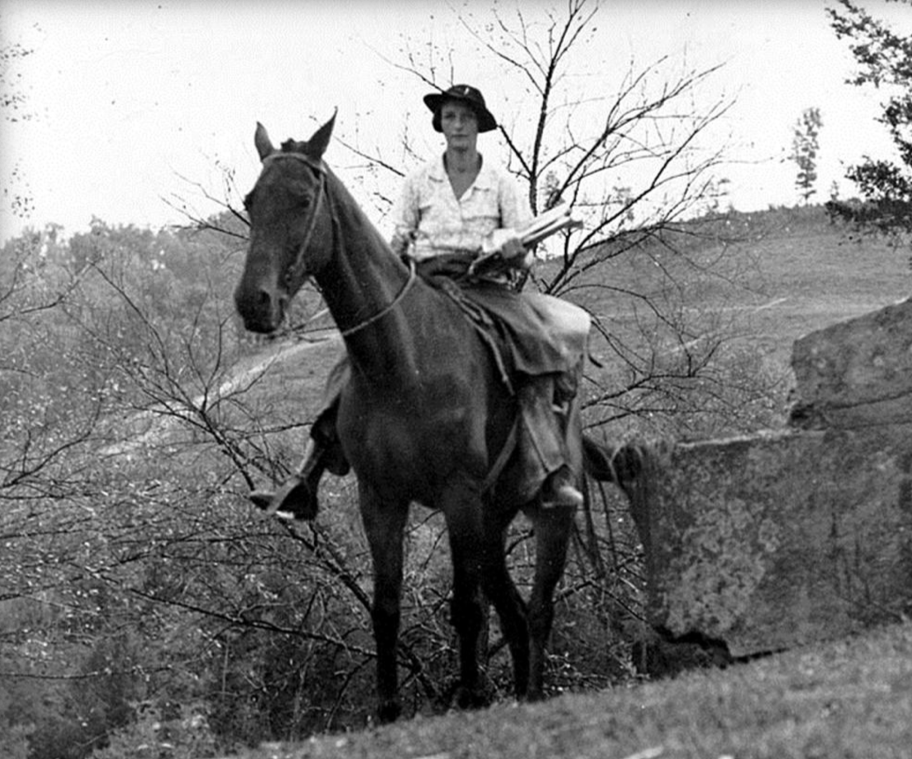
These forgotten heroes, like the famed Pony Express, braved wind, rain, and rough terrain to deliver books to isolated settlers who otherwise may have had nothing to read.

But this is not a tale of cowboys and frontiersmen. The Pack Horse Librarians appeared in an Industrial Age, and what’s more they were mostly women. Called “book ladies” and “packsaddle librarians,” the librarians were deputized during the New Deal, when FDR sought to end the Great Depression by creating hundreds of jobs addressed to the country’s real social, material, and cultural needs. In this case, the Pack Horse Librarians responded to what many of us might consider a crisis, if not a crime.
“About 63% of the residents of Kentucky were without access to public libraries,” and somewhere around 30% of rural Kentuckians were illiterate. Those rural Kentuckians saw education as a way out of poverty, and the Works Progress Administration agreed, overseeing the book delivery project between 1935 and 1943. “Book women” made around $28 a month (a little over $500 in 2017) delivering books to homes and schoolhouses. By 1936, writes the site Appalachian History, “handmade and donated materials could not sustain the circulation needs of the pack horse patrons.”
Surveys of readers found that pack horse patrons could not get enough of books about travel, adventure and religion, and detective and romance magazines. Children’s picture books were also immensely popular, not only with young residents but also their illiterate parents. Per headquarters, approximately 800 books had to be shared among five to ten thousand patrons.
To compensate for scarcity, a University of Kentucky presentation notes, librarians themselves created books of “mountain recipes and scrap books of current events.” But the service quickly grew to delivering more than 3,000 donated books per month, after a drive in which every PTA member in the state gave to the cause.

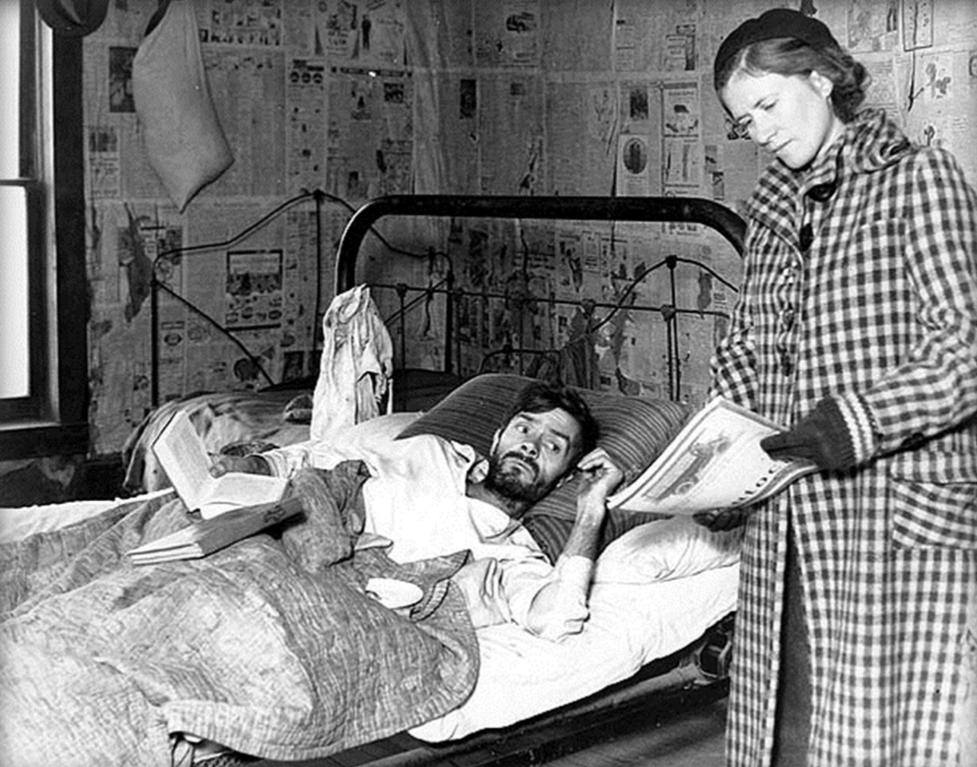
Eleanor Roosevelt (photographed above visiting a Packhorse Library in West Liberty, KY) was a champion of the service, which founder Elizabeth Fullerton modeled after a similar venture in 1913, itself a professionalization of work done by the Kentucky Federation of Women’s Clubs in the late 19th century.
We can see that the history of women librarians on horseback goes back quite a ways. But it is a history now forgotten, despite the efforts of recent books like Down Cut Shin Creek: The Pack Horse Librarians of Kentucky. A recent trend involves suggesting historical American figures who might replace all those monuments to the Confederacy. We might well add Pack Horse Librarians to the distinguished list of candidates.
The service lost its funding in 1943, “leaving some communities without access to books for decades,” Appalachian History writes, “until bookmobiles were introduced to the area in the late 1950s.” These services seem quaint in an era when widespread delivery by drone seems imminent. We seemingly live in the most information-rich, instant access society in history. Yet a significant number of people in the U.S. and around the world have little to no access to the internet. And a similar degree of illiteracy—at least of basic information and critical reasoning—may warrant a similarly direct intervention.
Related Content:
The Future of Content Delivery
Josh Jones is a writer and musician based in Durham, NC. Follow him at @jdmagness
Read More...An Intimate Look at Alberto Giacometti in His Studio, Making His Iconic Sculptures (1965)
A visit to an artist’s studio can shed light on his or her work.
The British Arts Council’s short film above affords an intimate glimpse into Alberto Giacometti’s studio in Montparnasse circa 1965, the year when he was the subject of major retrospectives at both the Tate Gallery and the Museum of Modern Art in New York.
The artist passed most of his working life in cramped space at 46 rue Hippolyte. Early on, he entertained plans to relocate “because it was too small – just a hole.”
Others visitors to the studio described the artist’s environs in more literary terms:
In a charming little forgotten garden he has a studio, submerged in plaster, and he lives next to this in a kind of hangar, vast and cold, with neither furniture nor food. He works very hard for fifteen hours at a stretch, above all at night: the cold, his frozen hands – he takes no notice, he works. - Simone de Beauvoir
And:
This ground floor studio… is going to cave in at any moment now. It is made of worm-eaten wood and grey powder.… Everything is stained and ready for the bin, everything is precarious and about to collapse, everything is about to dissolve, everything is floating.… And yet it all appears to be captured in an absolute reality. When I leave the studio, when I am outside on the street, then nothing that surrounds me is true. — Playwright Jean Genet
And:
The whole place looking as if it had been thrown together with a few old sticks and a lot of chewing gum.… In short, a dump. Anyway he said come in when I knocked.… He turned and glanced at me, holding out his hand which was covered in clay, so I shook his wrist.… He immediately resumed work, running his fingers up and down the clay so fiercely that lumps fell onto the floor - Essayist James Lord
These impressions paint a portrait of a driven, and disciplined artist, who logged untold hours modeling his formes elongee in clay, unceremoniously crumpling and rebuilding in the pursuit of excellence.
The camera documents this intensity, though his untranslated remarks suggest a man capable of taking himself lightly, certainly more so than the accompanying narration does.
Like the narration, Roger Smalley’s dissonant score lays it on thick, the sonic equivalent of heads like blades and “limbs bound as though bandaged for the grave.” Perhaps we should conceive of the studio as a scary place?
In actuality, it proved a hospitable work environment and the impulse to relocate eventually waned, with the artist observing that “the longer I stayed, the bigger it became. I could fit anything I wanted into it.”
Explore the recent Tate Modern Giacometti retrospective here and take a closer look at the studio via Ernst Scheidegger’s photos.
“Giacometti” will be added to our list of Free Documentaries, a subset of our collection, 4,000+ Free Movies Online: Great Classics, Indies, Noir, Westerns, Documentaries & More.
Related Content:
1.8 Million Free Works of Art from World-Class Museums: A Meta List of Great Art Available Online
Ayun Halliday is an author, illustrator, theater maker and Chief Primatologist of the East Village Inky zine. Follow her @AyunHalliday.
Read More...1,000+ Historic Japanese Illustrated Books Digitized & Put Online by the Smithsonian: From the Edo & Meji Eras (1600–1912)
Surely we’ve all wondered what we might do as prominent nineteenth-century industrialists, and more than a few of us (especially here in the Open Culture crowd) would no doubt invest our fortunes in the art of the world. Railcar manufacturing magnate Charles Lang Freer did just that, as we can see today in the Freer Gallery of Art in Washington, D.C. Together with the Arthur M. Sackler Gallery (Sackler having made it as “the father of modern pharmaceutical advertising”), it constitutes the Smithsonian Institution’s national museum of Asian art, gathering everything from ancient Egyptian stone sculpture to Chinese paintings to Korean pottery to Japanese books.
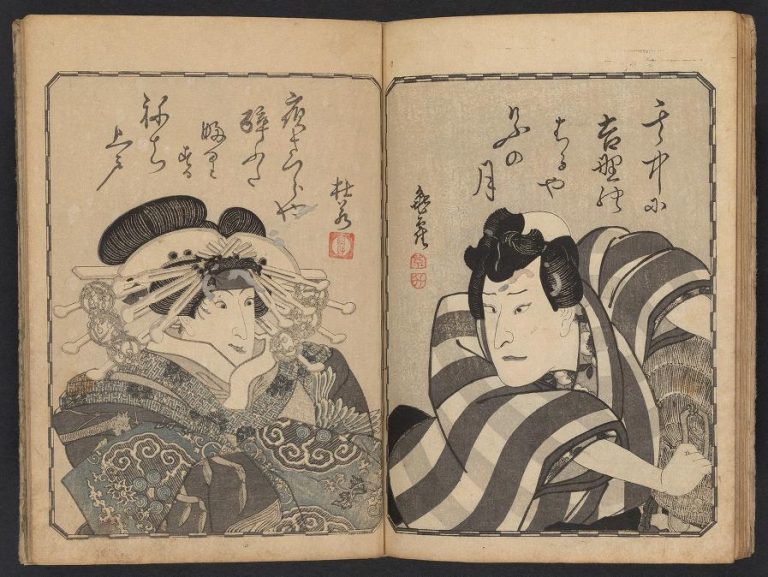
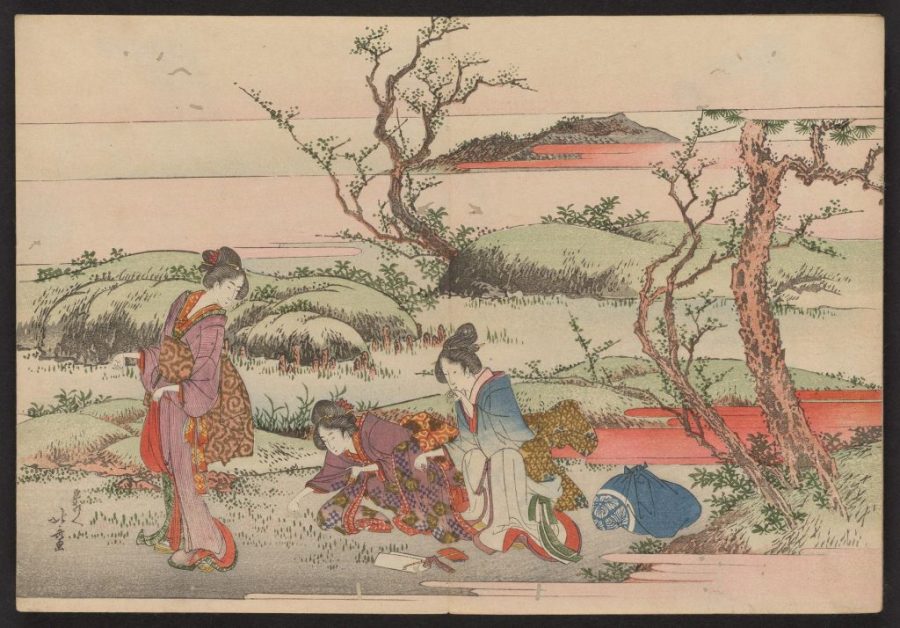
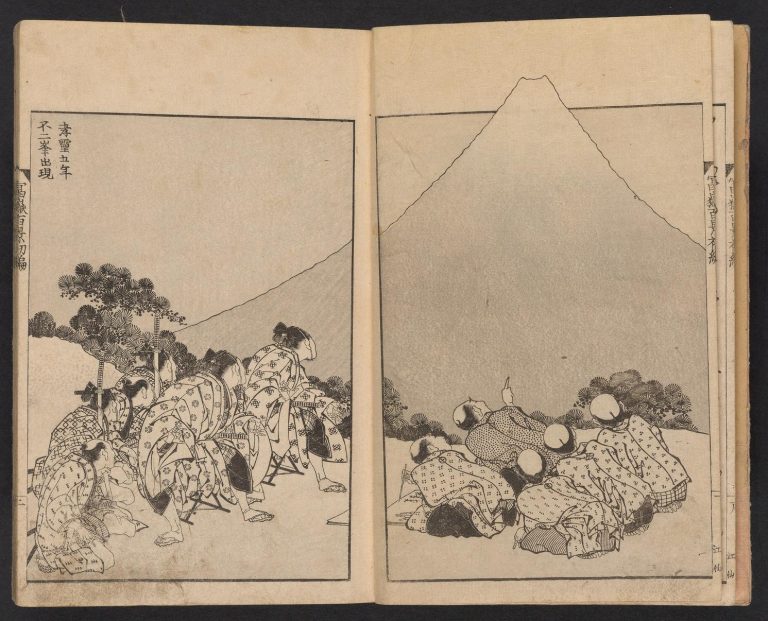
We like to highlight Japanese book culture here every so often (see the related content below) not just because of its striking aesthetics and consummate craftsmanship but because of its deep history. You can now experience a considerable swath of that history free online at the Freer|Sacker Library’s web site, which just this past summer finished digitizing over one thousand books — now more than 1,100, which breaks down to 41,500 separate images — published during Japan’s Edo and Meiji periods, a span of time reaching from 1600 to 1912. “Often filled with beautiful multi-color illustrations,” writes Reiko Yoshimura at the Smithsonian Libraries’ blog, “many titles are by prominent Japanese traditional and ukiyo‑e (‘floating world’) painters such as Ogata Kōrin (1658–1716), Andō Hiroshige (1797–1858) and Katsushika Hokusai (1760–1849).”
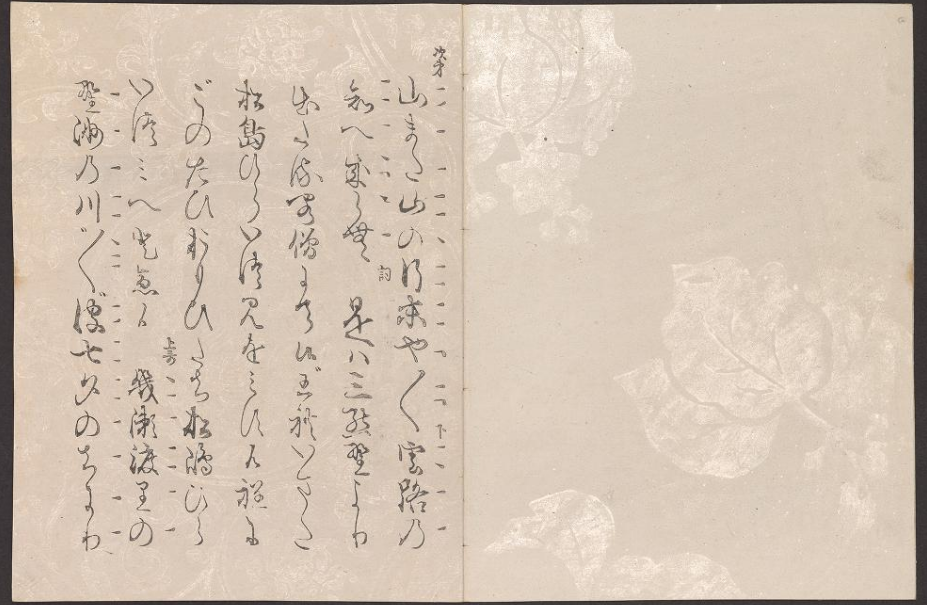
Yoshimura directs readers to such volumes as Hokusai’s One Hundred Views of Mt. Fuji, Utagawa Toyokuni’s Thirty-Six Popular Actors, and artist, craftsman, and designer Kōetsu’s collection of one hundred librettos for noh theater performances. Even those who can’t read classical Japanese will admire an aesthete like Kōetsu’s way with what Yoshimura calls his “caligraphic ‘font,’ ” all “skillfully printed on luxurious mica embellished papers using wooden movable-type.”
While the online collection’s scans come in a more than high enough resolution for general appreciation, to get the full effect of bookmaking techniques like mica embellishment — which only sparkles when seen in real life — you’d have to visit the physical collection. Some things, it seems, can’t yet be digitized.
Enter the collection of Japanese Illustrated Books here.
Related Content:
Watch a Japanese Craftsman Lovingly Bring a Tattered Old Book Back to Near Mint Condition
Enter a Digital Archive of 213,000+ Beautiful Japanese Woodblock Prints
Based in Seoul, Colin Marshall writes and broadcasts on cities and culture. His projects include the book The Stateless City: a Walk through 21st-Century Los Angeles and the video series The City in Cinema. Follow him on Twitter at @colinmarshall or on Facebook.
Read More...Leonardo da Vinci’s Bizarre Caricatures & Monster Drawings
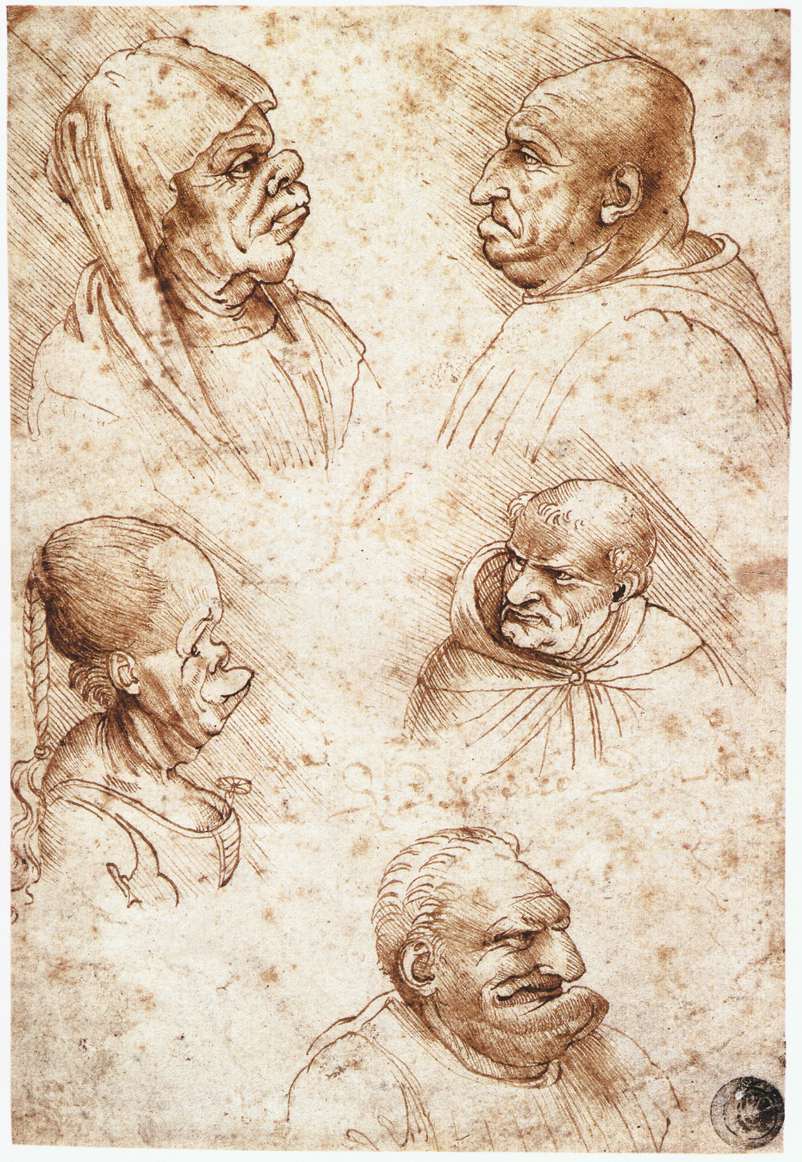
The caricature was once a highly-regarded art form, before it was cornered on the upper end by the New York Review of Books and on the more pedestrian side by boardwalk and street fair artists. During the European Renaissance and the ensuing centuries of artistic development, nearly every artist had a caricature side project—if only in the margins of their sketchbooks—and some, like Leonardo da Vinci, were widely known and appreciated for their skill in the art.
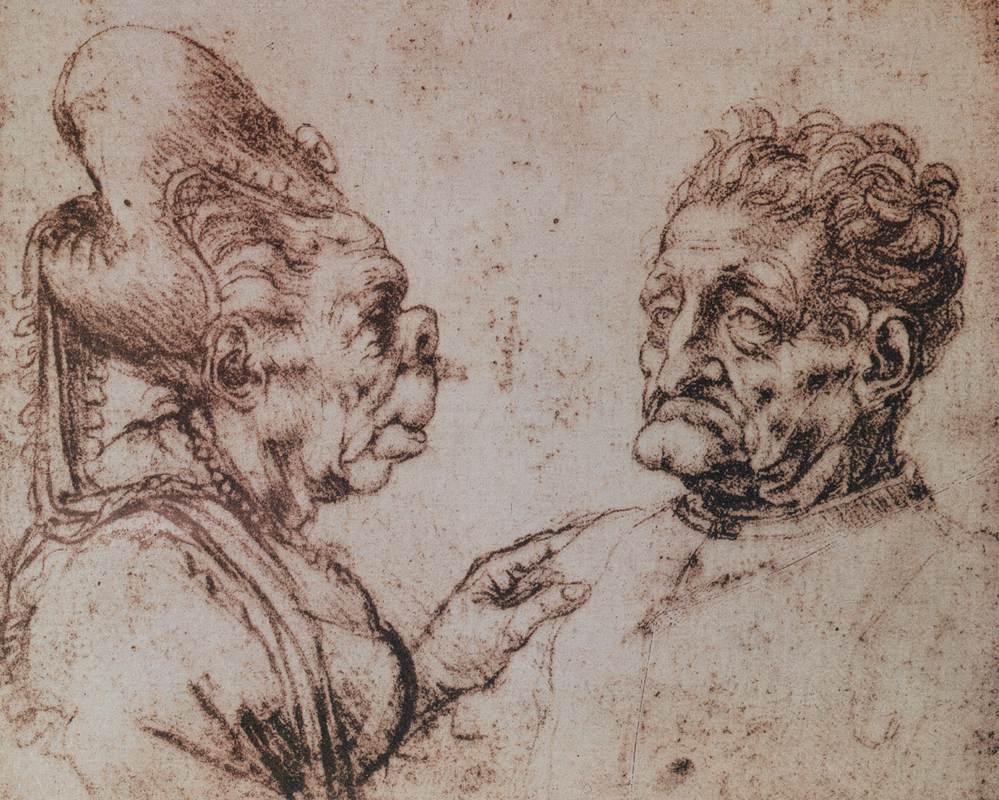
Generally renowned these days for the high seriousness of his Mona Lisa, Last Supper, and Vitruvian Man, Leonardo does not tend to be associated with grotesque humor. Yet the caricatures “were some of his most popular and influential works,” writes Jonathan Jones at The Guardian, “from the 16th century up to the time of [William] Hogarth,” the hugely popular 18th century English visual satirist.
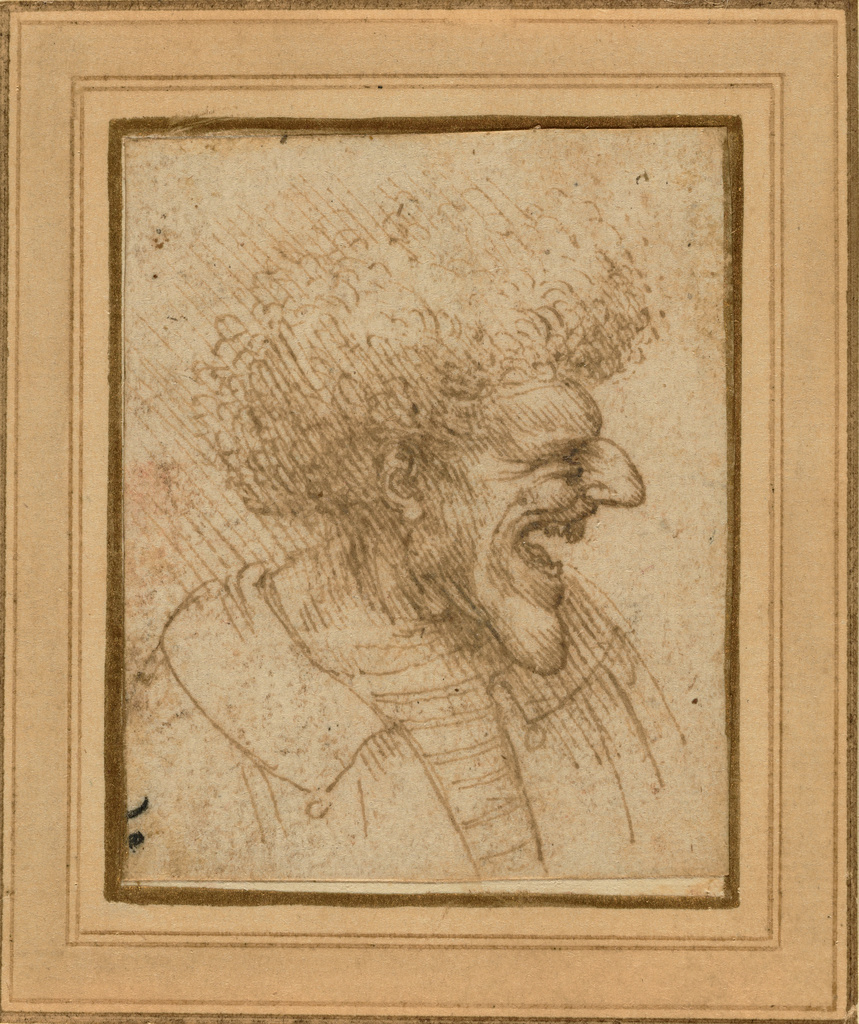
These caricatures connect Leonardo not only to graphic art of the future but to an earlier, Medieval world—the “hellish visions of Bosch and Bruegel.” They are “Gargoyles,” wrote critic Kenneth Clark, “the complement to saints; Leonardo’s caricatures were complementary to his untiring search for ideal beauty.
And gargoyles were the expression of all the passions, the animal forces, the Caliban gruntings and groanings which are left in human nature when the divine has been poured away.” Clark tempers this characterization by noting that these drawings “in their expression of passionate energy, merge imperceptibly into the heroic.”
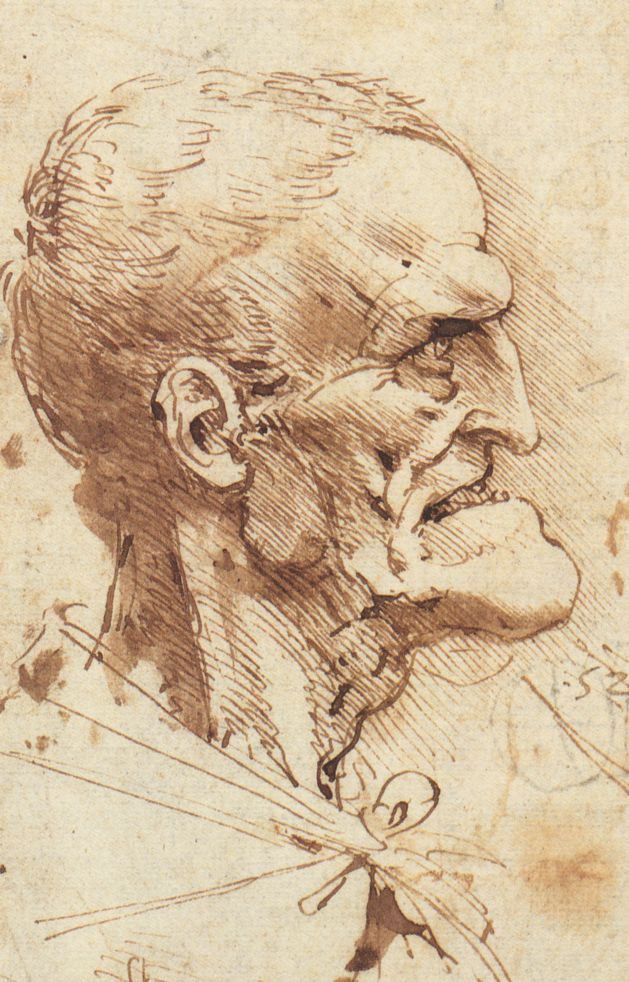
Indeed, Leonardo loved unusual faces and heads—he found odd-looking people of all kinds fascinating, and turned them into tragicomic figures fit for the stage. Giorgio Vasari, the 16th century biographer of Renaissance artists, wrote that Leonardo was “so delighted when he saw curious heads, whether bearded or hairy, that he would follow anyone who had thus attracted his attention for a whole day, acquiring such a clear idea of him that when he went home he would draw the head as well as if the man had been present.”
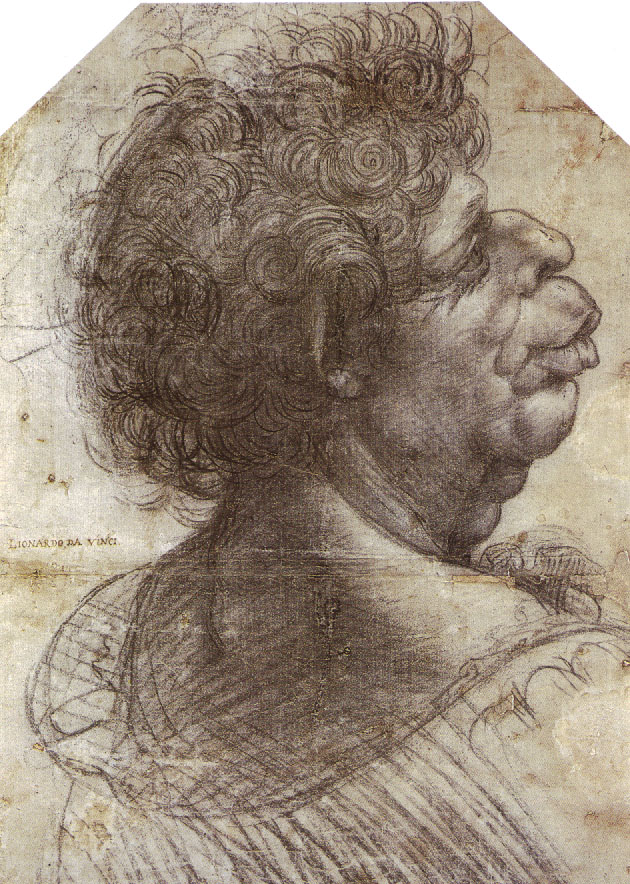
We can’t say that stalking exhibits much respect for the kinds of boundaries most people would prefer to maintain, but Leonardo’s behavior does display a reverence for interesting human physiognomy, both a source and a foil for his idealizations of the human form. Leonardo’s caricatures resonate into the late 20th century in the work of Ralph Steadman, the gonzo illustrator and political cartoonist.
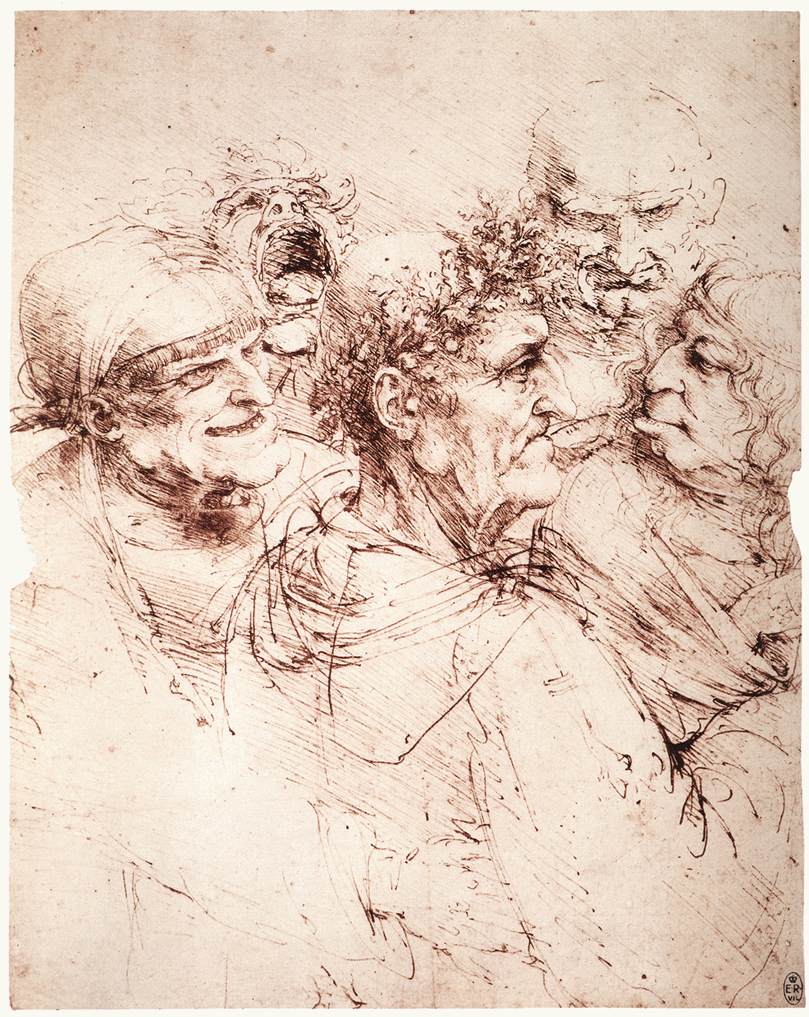
In his satirical illustrated biography of Leonardo, Steadman remarked that the Renaissance artist who ennobled the human form also found “that man was not what he appeared to be, despite the prevailing atmosphere of fine thoughts and high aspirations.” Steadman quotes a passage from Leonardo’s notebooks that sounds much more Swiftian or Rabelaisian than high-minded Renaissance humanist:
His Holiness the Pope surrounded himself with none but craven guzzlers, gross pretenders and a host of fawning dignitaries who grimaced through their days at court with no more grace than beggars I had entertained in days gone by — though they had neither choice nor wit to rise above themselves and in that they had a reason.
Oh that I had ways to surely serve their putrid masquerades and twittery to make a dragon from the very menagerie within the Vatican itself.
If I could take for its head that of a mastiff or setter, for its eyes those of a cat, for its ears those of a greyhound, with the eyebrows of a lion, the temples of an old cock and the neck of a water tortoise.
O vile monster! How much better it for men that thou shouldst go back to hell! For this the vast forests shall be stripped of their trees; for this an infinite number of creatures shall lose their lives.
Though the caricatures may not go as far as the horrifying hodgepodge in this description, they do portray human beings with rather less classical equanimity than the serene Mona Lisa or the very composed Christ. But due to Leonardo’s skill and seemingly irrepressible love for the human form—even if he had a jaundiced view of human nature—the caricatures continue to be inspiring pieces of work.
Related Content:
Leonardo da Vinci’s Visionary Notebooks Now Online: Browse 570 Digitized Pages
Ralph Steadman’s Wildly Illustrated Biography of Leonardo da Vinci (1983)
What Leonardo da Vinci Really Looked Like
Josh Jones is a writer and musician based in Durham, NC. Follow him at @jdmagness
Read More...Dr. Weil’s 60-Second Technique for Falling Asleep
Give Dr. Andrew Weil three minutes, and he can teach you a 60-second technique for falling asleep. Above, the alternative medicine guru walks you through the 4–7‑8 breathing method. As he demonstrates, it “takes almost no time, requires no equipment and can be done anywhere.” And once you master it, you can use the 4–7‑8 breathing technique (explained and demonstrated in greater detail here ) to lower your anxiety levels (useful these days!), navigate tension-filled moments, and deal with food cravings.
Elsewhere, Weil has said, “If I had to limit my advice on healthier living to just one tip, it would be simply to learn how to breathe correctly.” Hence why he created an audio recording, Breathing: The Master Key to Self Healing, which you can still purchase online.
If you would like to support the mission of Open Culture, consider making a donation to our site. It’s hard to rely 100% on ads, and your contributions will help us continue providing the best free cultural and educational materials to learners everywhere. You can contribute through PayPal, Patreon, and Venmo (@openculture). Thanks!
Related Content:
10 Hours of Ambient Arctic Sounds Will Help You Relax, Meditate, Study & Sleep
How a Good Night’s Sleep — and a Bad Night’s Sleep — Can Enhance Your Creativity
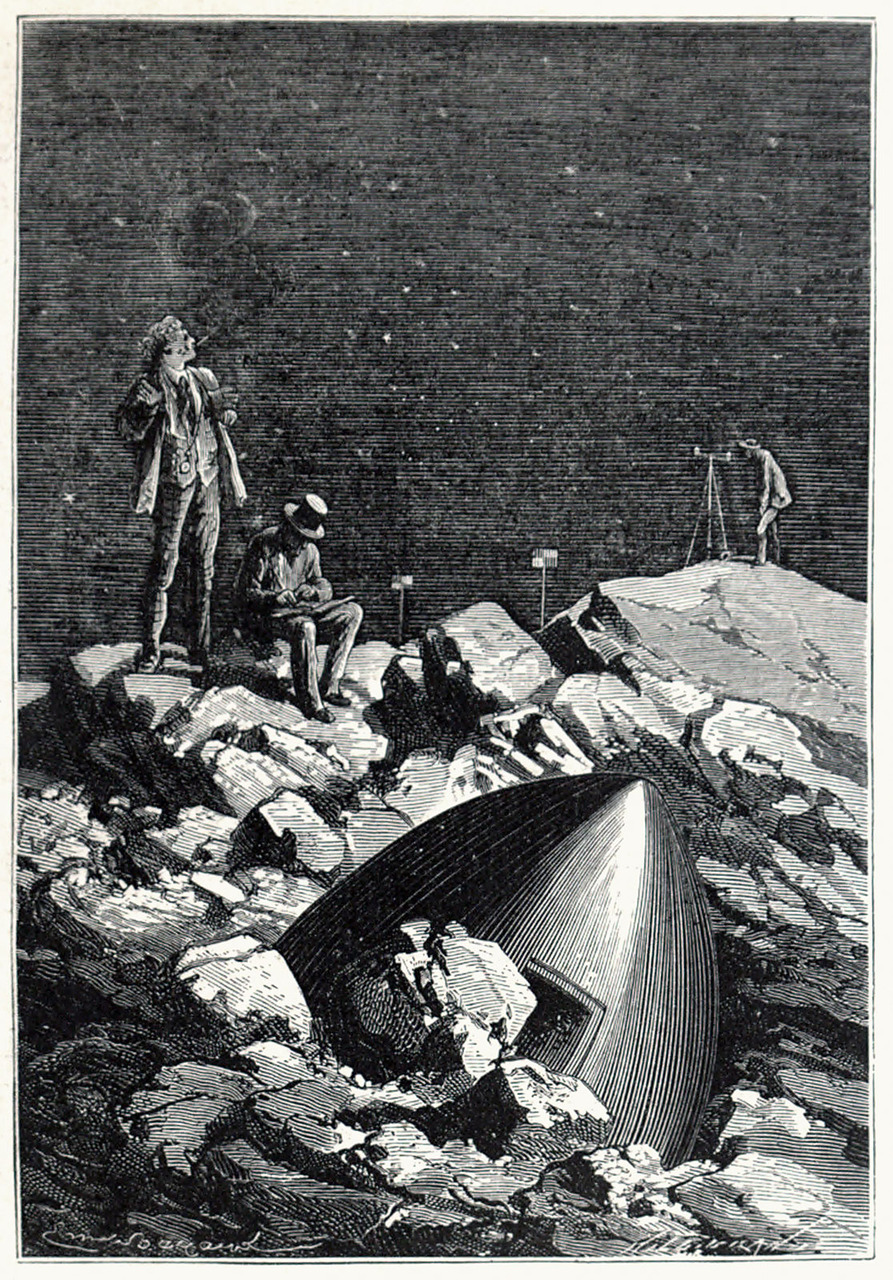
Read More...Émile-Antoine Bayard’s Vivid Illustrations of Jules Verne’s Around the Moon: The First Serious Works of Space Art (1870)

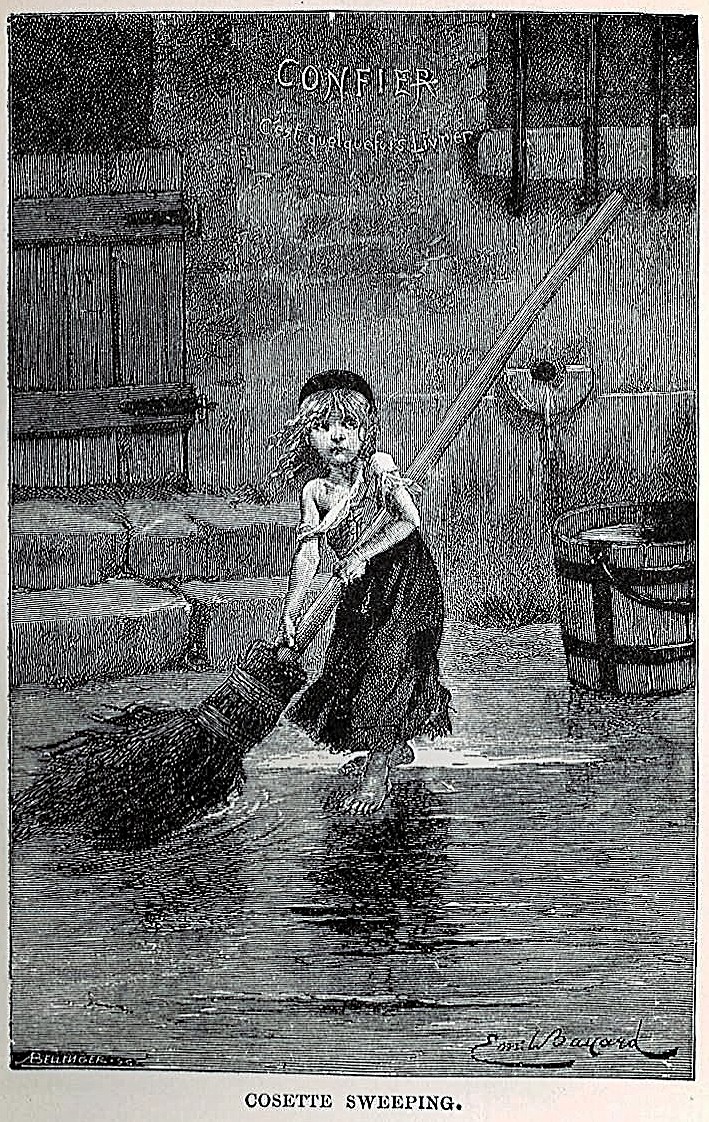
What does space travel look like? Even now, in the 21st century, very, very few of us know first-hand. But we’ve all seen countless images from countless eras purporting to show us what it might look like. As with anything imagined by man, someone had to render a convincing vision of space travel first, and that distinction may well go to 19th-century French illustrator Émile-Antoine Bayard who, perhaps not surprisingly, worked with Jules Verne. Verne’s pioneering and prolific work in science fiction literature has kept him a household name, but Bayard’s may sound more obscure; still, we’ve all seen his artwork, or at least we’ve all seen the drawing of Cosette the orphan he did for Les Misérables.
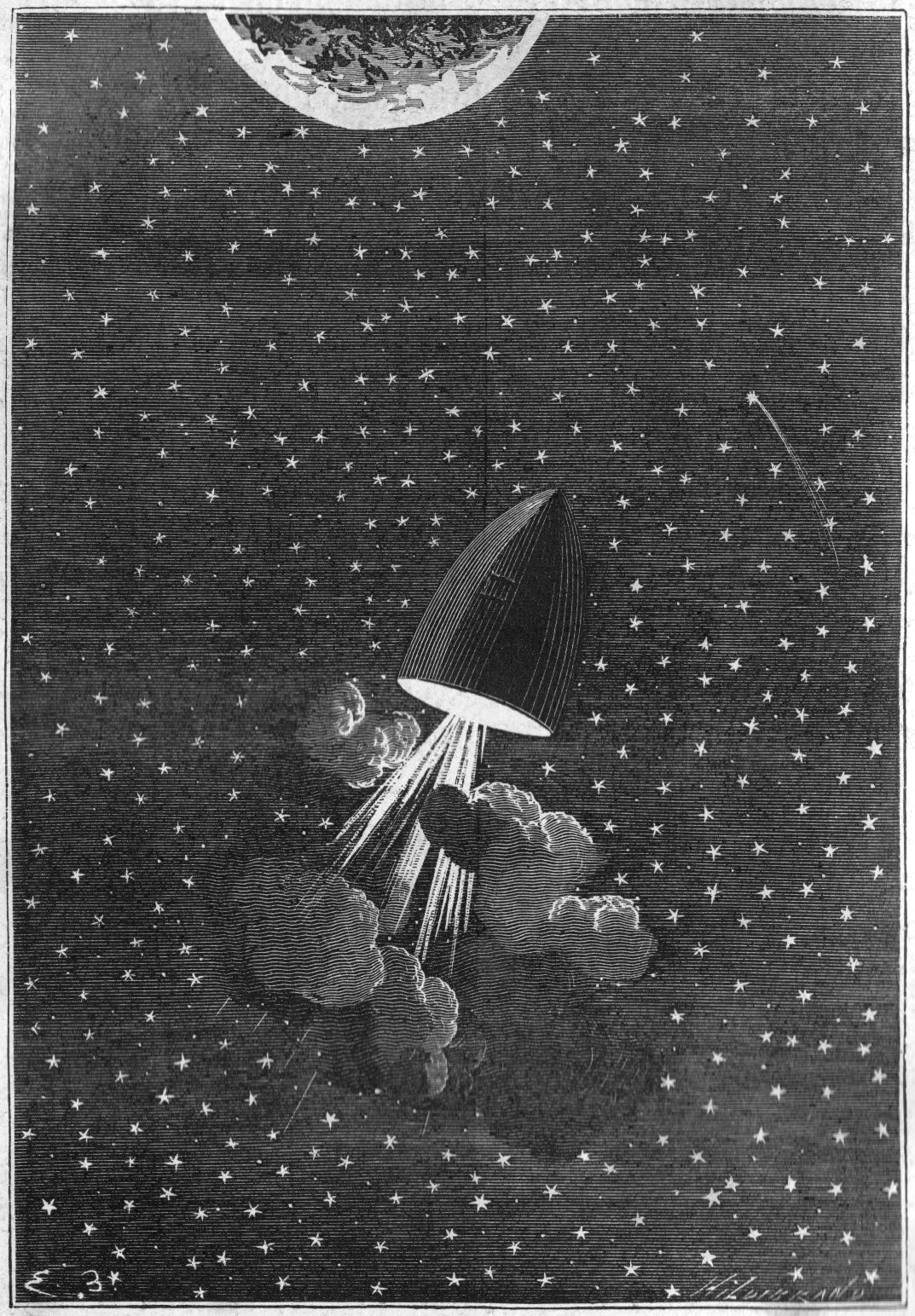
“Readers of Jules Verne’s early science-fiction classic From the Earth to the Moon (De la terre à la lune) — which left the Baltimore Gun Club’s bullet-shaped projectile, along with its three passengers and dog, hurtling through space — had to wait a whole five years before learning the fate of its heroes,” says The Public Domain Review.
When it appeared, 1870’s Around the Moon (Autour de la Lune) offered not just “a fine continuation of the space adventure” but “a superb series of wood engravings to illustrate the tale” created by Bayard. “There had been imaginary views of other worlds, and even of space flight before this,” writes Ron Miller in Space Art, “but until Verne’s book appeared, these views all had been heavily colored by mysticism rather than science.”
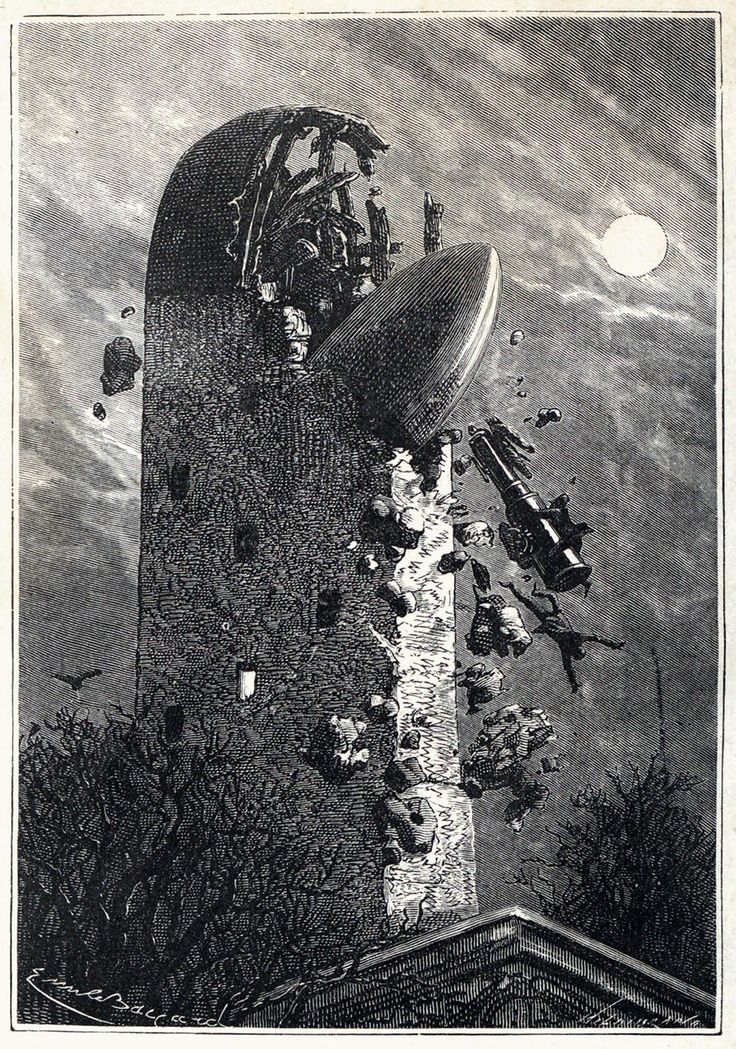
Composed strictly according to the scientific facts known at the time — with a departure here and there in the name of imagination and visual metaphor — the illustrations for A Trip Around the Moon, later published in a single volume with its predecessor as A Trip to the Moon and Around It, stand as the earliest known example of scientific space art. Verne went as far as to commission a lunar map by famed selenographers (literally, scholars of the moom’s surface) Beer and Maedlerm, and just last year the Linda Hall Library named Bayard a “scientist of the day.” As with the uncannily accurate predictions in Verne’s earlier novel Paris in the Twentieth Century, a fair few of the ideas here, especially to do with the mechanics of the rocket’s launch and return to Earth, remain scientifically plausible.
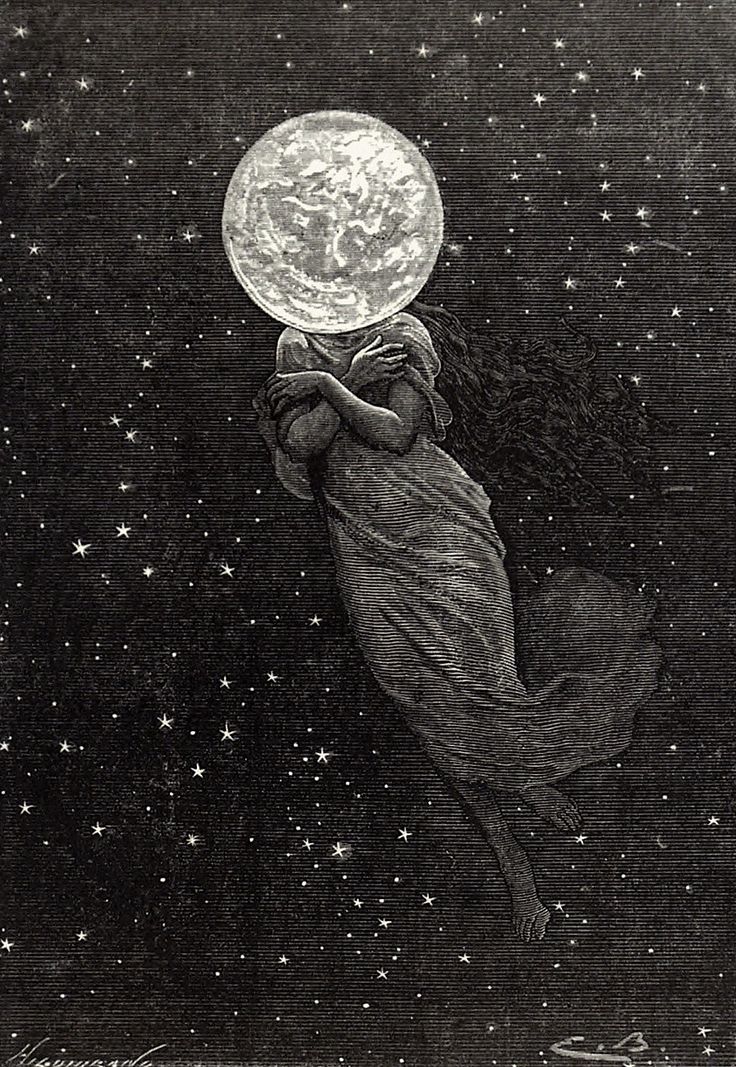
Whatever the innovation of the project’s considerable scientific basis, its artistic impression fired up more than a few other imaginations: both Verne’s words and Bayard’s art, all 44 pieces of which you can view here, served as major inspirations for early filmmaker and “father of special effects” Georges Méliès, for instance, when he made A Trip to the Moon. Disappointed complaints about our persistent lack of moon colonies or even commercial space flight may have long since grown tiresome, but the next time you hear one of us denizens of the 21st century air them, remember the work of Verne and Bayard and think of how deep into history that desire really runs.
Via The Public Domain Review.
Related Content:
How French Artists in 1899 Envisioned Life in the Year 2000: Drawing the Future
Soviet Artists Envision a Communist Utopia in Outer Space
A Trip to the Moon (and Five Other Free Films) by Georges Méliès, the Father of Special Effects
Based in Seoul, Colin Marshall writes and broadcasts on cities and culture. His projects include the book The Stateless City: a Walk through 21st-Century Los Angeles and the video series The City in Cinema. Follow him on Twitter at @colinmarshall or on Facebook.
Read More...A Massive 55-Hour Chronological Playlist of Bob Dylan Songs: Stream 763 Tracks

Cropped image by Rowland Scherman, via Wikimedia Commons
Shakespeare may have come up with the seven ages of man (see: As You Like It for more info), but Bob Dylan has had more than seven ages in his five decades of making music. There’s the young Woody Guthrie fan, the protest singer, the poet of a generation, the recluse, the Christian convert, the man who made Greil Marcus ask “What is this shit?” about his 1970 Self-Portrait album, the Mystic who channeled “old weird America” as Marcus would also define it, the endless touring workhorse, the Traveling Wilbury, the pencil-mustache dapper standards interpreter, and on and on.
You get the point, so this Spotify collection (gathered together by Samuel Huxley Cohen) sets out to take on this monumental career with a 55 hour playlist of Dylan’s music, 763 songs in total, in chronological order, from 1962’s “You’re No Good” to “Melancholy Mood” from 2016’s Fallen Angels. (His current album from this year, the three-disc Triplicate is not represented, though it’s separately on Spotify here.)
Not only can one chart the artistic progression from earnest folkie to living enigma, one can chart the changes in Dylan’s voice over time, which has long been the subject of criticism. His young voice was once compared to a “cow stuck in an electric fence,” and now in his 70s, “ Dylan’s voice has been in ruins during many of his recent concerts, somewhere between Howlin’ Wolf’s growl and a tubercular wheeze,” as the Chicago Tribune’s Greg Kot wrote recently. But in between, there were softer moments. As a younger Dylan fan I was exposed at first only to his classic 1960s trilogy—Bringing It All Back Home through Blonde on Blonde—and his nasal, accusatory tone, only to be befuddled by the voice on Nashville Skyline. It didn’t even sound like the same person.
Yes, there are bones to pick with this playlist, mostly in its strict adherence to release date chronology and not so much recording chronology, which would make more sense (but would be way more time consuming). The Basement Tapes make more fascinating listening coming as they really did after Blonde on Blonde in 1967, after Dylan’s motorcycle accident and before John Wesley Harding, the album highly informed by those sessions. Not so much placed here right after the astounding but intimate and bleak Blood on the Tracks. And a lot of the live and rare recordings found on the ever increasing Bootleg Series are just a jumble.
But put it this way, the man himself could care less in what order you listen to them, or if at all. A really thorough chronology might reveal the “real Dylan,” but then again…maybe not. Enter at your own risk.
Click here to access the playlist on Spotify. Or stream it above.
Related Content:
Hear Bob Dylan’s Newly-Released Nobel Lecture: A Meditation on Music, Literature & Lyrics
The First Episode of The Johnny Cash Show, Featuring Bob Dylan & Joni Mitchell (1969)
Ted Mills is a freelance writer on the arts who currently hosts the FunkZone Podcast. You can also follow him on Twitter at @tedmills, read his other arts writing at tedmills.com and/or watch his films here.
Read More...Support Us
We're hoping to rely on loyal readers, rather than erratic ads. Please click the Donate button and support Open Culture. You can use Paypal, Venmo, Patreon, even Crypto! We thank you!

About Us

Open Culture scours the web for the best educational media. We find the free courses and audio books you need, the language lessons & educational videos you want, and plenty of enlightenment in between.
Advertise With Us

FREE UPDATES!
GET OUR DAILY EMAIL
Get the best cultural and educational resources on the web curated for you in a daily email. We never spam. Unsubscribe at any time.
FOLLOW ON SOCIAL MEDIA

Open Culture editor Dan Colman scours the web for the best educational media. He finds the free courses and audio books you need, the language lessons & movies you want, and plenty of enlightenment in between.
Advertise With Us