A New Animation Explains How Caffeine Keeps Us Awake
Let’s preface this by recalling that Honoré de Balzac drank up to 50 cups of coffee a day and lived to the ripe old age of … 51.
Of course, he produced dozens of novels, plays, and short stories before taking his leave. Perhaps his caffeine habit had a little something to do with that?
Pharmacist Hanan Qasim’s TED-Ed primer on how caffeine keeps us awake top loads the positive effects of the most world’s commonly used psychoactive substance. Global consumption is equivalent to the weight of 14 Eiffel Towers, measured in drops of coffee, soda, chocolate, energy drinks, decaf…and that’s just humans. Insects get theirs from nectar, though with them, a little goes a very long, potentially deadly way.
Caffeine’s structural resemblance to the neurotransmitter adenosine is what gives it that special oomph. Adenosine causes sleepiness by plugging into neural receptors in the brain, causing them to fire more sluggishly. Caffeine takes advantage of their similar molecular structures to slip into these receptors, effectively stealing adenosine’s parking space.
With a bioavailability of 99%, this interloper arrives ready to party.
On the plus side, caffeine is both a mental and physical pick me up.
In appropriate doses, it can keep your mind from wandering during a late night study session.
It lifts the body’s metabolic rate and boosts performance during exercise—an effect that’s easily counteracted by getting the bulk of your caffeine from chocolate or sweetened soda, or by dumping another Eiffel Tower’s worth of sugar into your coffee.
There’s even some evidence that moderate consumption may reduce the likelihood of such diseases as Parkinson’s, Alzheimer’s, and cancer.
What to do when that caffeine effect starts wearing off?
Gulp down more!
As with many drugs, prolonged usage diminishes the sought-after effects, causing its devotees (or addicts, if you like) to seek out higher doses, negative side effects be damned. Nervous jitters, incontinence, birth defects, raised heart rate and blood pressure… it’s a compelling case for sticking with water.
Animator Draško Ivezić (a 3‑latte-a-day man, according to his studio’s website) does a hilarious job of personifying both caffeine and the humans in its thrall, particularly an egg-shaped new father.
Go to TED-Ed to learn more, or test your grasp of caffeine with a quiz.
Related Content:
Wake Up & Smell the Coffee: The New All-in-One Coffee-Maker/Alarm Clock is Finally Here!
Physics & Caffeine: Stop Motion Film Uses a Cup of Coffee to Explain Key Concepts in Physics
This is Coffee!: A 1961 Tribute to Our Favorite Stimulant
Ayun Halliday is an author, illustrator, theater maker and Chief Primatologist of the East Village Inky zine. Follow her @AyunHalliday.
Read More...The “Lost” Pink Floyd Soundtrack for Michelangelo Antonioni’s Only American Film, Zabriskie Point (1970)
There’s a good argument to be made that some of the most insightful writing about the United States comes from artists observing the country from afar or through the eyes of a bemused newcomer. For European artists and thinkers, writing about the behemoth across the sea seems to have proven an irresistible challenge from the start, even if, like Franz Kafka, some never set foot on the continent. Alexis de Tocqueville, Werner Herzog, Martin Amis, Wim Wenders, the list could go on and on, and would include many very enlightening perspectives.
But not every such effort has been a success, in either critical or commercial terms. Michelangelo Antonioni’s Zabriskie Point (1970), for example, the Italian director’s “only American movie,” writes Richard Metzger at Dangerous Minds, “completely missed its mark and failed to capture the zeitgeist of the hippie New Left counterculture of the era.”
When the film was released in 1970, “audiences and critics alike hated it, just hated it.” The film’s young, unknown male lead Mark Frechette “distanced himself from the director,” writes Dennis Lim at Slate, saying, “he wasn’t making a film about any America I knew.” Guitarist John Fahey, in Rome to record a song for the film, almost came to blows with Antonioni “when the maestro launched into an anti-American rant.”
If Antonioni came off to his critics as a “clueless tourist” cinematically, he also passed up an excellent opportunity musically. In the studio when the Doors recorded “L’America” for L.A. Woman, he “inexplicably turned down the track, which could have worked spectacularly well in his film.” Instead, thanks in large part to his co-writer and current girlfriend Clare Peploe, Antonioni chose Pink Floyd to score the film, after hearing Peploe’s copy of Ummagumma. He loved the album, and listened to it obsessively, especially the dramatic, psychedelic “Careful with that Axe, Eugene.”
In the end, however, only three songs from the band made the final cut. Antonioni instead filled out the soundtrack with music by Fahey, The Youngbloods, Roy Orbison, The Grateful Dead, and others. The complete recording of the original Floyd soundtrack was never commercially released and has only officially existed in fragments. One fan in a music forum notes that the 2 CD Zabriskie Point soundtrack includes the three songs from the film and four unused bonus tracks. The huge, and hugely expensive, Floyd box set The Early Years contains 16 outtakes, none of them on the soundtrack CD.
The only way fans have been able to hear the complete, original soundtrack has been through a series of bootlegs, some featuring only the eight intended final songs, others including some or all of the known outtakes. One such compilation, above, collects several songs and outtakes, but doesn’t include the full completed soundtrack. Despite this discographic disarray, the discarded original soundtrack, in its many forms, has proven “an extremely satisfying listen,” Metzger writes. If it sounds “like a ‘lost’ Pink Floyd album recorded at the end of 1969,” it’s “because that’s exactly what it is.” Reminding us at times of Atom Heart Mother, or Meddle, or Ummagumma, it both looks back at previous work and ahead toward what’s to come.
The band turned out some uncharacteristically straight-ahead electric barroom blues (above). “Heart Beat, Pig Meant,” which appears over the film’s opening credits (top) “was Pink Floyd’s first time using a human heartbeat as a musical instrument (but it would not be the last).” Richard Wright’s “The Violent Sequence,” further up, may have been scrapped by Antonioni, but it would later “be retooled as ‘Us and Them’ on Dark Side of the Moon.” Aside from that album’s unintended life as uncanny sonic accompaniment to The Wizard of Oz, the band did some of its most experimental, and transitional, work through film soundtracks, such as those for Barbet Schroeder’s 1969 More and 1972 film The Valley. Their work with Antonioni is no exception, but Zabriskie Point, likely because of its many confusing states of existence, has not received as much attention.
Perhaps it’s time to revisit Zabriskie Point, the film, as well as its original soundtrack. As fans of Pink Floyd, we can see what inspired the band to create music that would help determine the direction of their epic albums to come. As fans of Antonioni, perhaps, we may come to a greater appreciation of his much-maligned flop, which Lim contends “is of a piece with Antonioni’s best work: a luxuriant portrait of spiritual alienation with a sense of place far more expressive than its blankly beautiful characters.” Given that description, it’s no wonder Antonioni found Pink Floyd such an intriguing choice, even if neither the Italian director nor English band had said much of anything in their work about the cauldron of political unrest, sexual experimentation, and cultural disaffection of the U.S. in the late 60s.
Related Content:
Pink Floyd’s “Echoes” Provides a Soundtrack for the Final Scene of Kubrick’s 2001: A Space Odyssey
Syd Barrett’s “Effervescing Elephant” Comes to Life in a New Retro-Style Animation
Josh Jones is a writer and musician based in Durham, NC. Follow him at @jdmagness
Read More...A Free Trial Offer for The Great Courses Plus: A Special Deal for Open Culture Readers

We’ve told you about the Great Courses Plus (now called Wondrium) before–a new video subscription service that lets you watch free courses (about 8,000 lectures in total) across a wide range of subjects, all taught by some of the best lecturers in the country. The topics cover everything from History, Philosophy, Literature, and Economics, to Math, Science, Professional Development, Cooking, and Photography. And you can binge-watch entire college courses in a matter of days by watching videos on your TV, tablet, laptop and smart phone, with the help of apps designed for Apple, Google Play, Kindle Fire, and Roku.
Interested in trying out this service? Right now, the Great Courses Plus/Wondrium is offering a special deal for Open Culture readers. If you click here, and sign up for a free trial, you can use this service for 30 days … for free. And then, if you would like, you can continue to subscribe and pay their normal prices. If you have time on your hands, this is a great way to keep your mind engaged and stream what PC Magazine has called “an excellent library of college-level lectures.”
Note: The Great Courses is a partner with Open Culture. So if you sign up for a free trial, it benefits not just you and Great Courses Plus. It benefits Open Culture too. So consider it win-win-win.
Read More...Al Franken Provides Comic Relief at the Grateful Dead’s 1980 Halloween Concert: A Tribute to Our Favorite Deadhead Senator
Our illustrious Senator from Minnesota Al Franken has long been a Deadhead, or at least an ardent fan. He and comedy partner Tom Davis were the first writers hired by Saturday Night Live in 1975 and occasionally also performed routines on the show. They were also Grateful Dead fans responsible for getting the band booked on SNL.
So by the time 1980 and the eight-night residency of the Grateful Dead at Radio City Music Hall rolled around, Franken and Davis were asked to host the final night, Halloween, for a show that was simulcast on radio and closed circuit television to 14 movie theaters around the country. Their job? To help entertain viewers and fill the two 40-minute breaks in the Dead’s show.
For Radio City Music Hall, the event saved its financial skin. According to Rolling Stone, by the late ‘70s, “with New York City in fiscal freefall, Radio City’s future was suddenly shaky; movie attendance dropped, and plans to convert it into an office building or parking lot loomed.”
The solution was to book pop and rock acts. The first was Linda Ronstadt. The second was the Dead, and soon Deadheads descended on Rockefeller center, buying up 36,000 tickets.
Franken and Davis pre-taped many of the segments, and the Dead loved mocking themselves. There’s a Jerry Lewis Telethon parody for “Jerry’s Kids,” where Franken urges donations for acid casualties; Bob Weir’s luxurious hair is admired; drugs and penis jokes abound; and at one point Davis “mistakenly” drinks acid-dosed urine and trips out. (In reality, Davis actually had dropped acid for the live portion.)
Radio City’s lawyers sued after the concerts for damaging its reputation, but later settled. A compilation video of the Halloween show and the previous night’s concert was released in 1981 as Dead Ahead, the source of these clips.
Tom Davis died in 2012 from throat and neck cancer; and Al Franken represents the citizens of Minnesota, but did briefly take over SiriusXM’s Grateful Dead channel in May of 2017 to host a full day of music and interviews with Bob Weir, Bill Kreutzmann and Mickey Hart, the surviving members of the Dead (always an ironic turn of phrase).
Related Content:
Senator Al Franken Does a Pitch Perfect Imitation of Mick Jagger (1982)
Al Franken Effortlessly Draws the Map of America
11,215 Free Grateful Dead Concert Recordings in the Internet Archive
Bob Dylan and The Grateful Dead Rehearse Together in Summer 1987. Listen to 74 Tracks.
The Grateful Dead Play at the Egyptian Pyramids, in the Shadow of the Sphinx (1978)
Ted Mills is a freelance writer on the arts who currently hosts the artist interview-based FunkZone Podcast and is the producer of KCRW’s Curious Coast. You can also follow him on Twitter at @tedmills, read his other arts writing at tedmills.com and/or watch his films here.
Read More...The Tokyoiter: Artists Pay Tribute to the Japanese Capital with New Yorker-Style Magazine Covers

When humorist and New Yorker contributor David Sedaris quit smoking about a decade ago, he chose Tokyo in which to do it: “Its foreignness would take me out of myself, I hoped, and give me something to concentrate on besides my own suffering.” That first extended trip not only allowed him to kick the habit and gave him plenty of culture clashes to write about, but began his relationship with Tokyo that continues to this day. “Windows flanked the moving sidewalks, and on their ledges sat potted flowers,” he writes in appreciation in his first diaries there. “No one had pulled the petals off. No one had thrown trash into the pots or dashed them to the floor. How different life looks when people behave themselves.”

Most strikingly of all, there stood all “those vending machines, right out in the open, lined up on the sidewalk like people waiting for a bus.” The then-Paris-based Sedaris commiserates with a French Japanese language school classmate: “ ‘Can you believe it?’ he asked. ‘In the subway station, on the street, they just stand there, completely unmolested.’ ”
Our Indonesian classmate came up, and after listening to us go on, he asked what the big deal was.
“In New York or Paris, these machines would be trashed,” I told him.
The Indonesian raised his eyebrows.
“He means destroyed,” Christophe said. “Persons would break the glass and cover everything with graffiti.”
The Indonesian student asked why, and we were hard put to explain.
“It’s something to do?” I offered.
“But you can read a newspaper,” the Indonesian said.
“Yes,” I explained, “but that wouldn’t satisfy your basic need to tear something apart.”
Those vending machines, a basic expectation to Tokyoites but a barely imaginable luxury to many a foreigner, appear on one cover of the Tokyoiter, a collaborative art project producing a series of covers for an imaginary New Yorker-style magazine based in the Japanese capital. This tribute to a distinctively Japanese form of automated sidewalk commerce comes from Hennie Haworth, an illustrator based in England (where Sedaris also now lives, incidentally) who spent six months in Japan doing nothing but drawing its vending machines.
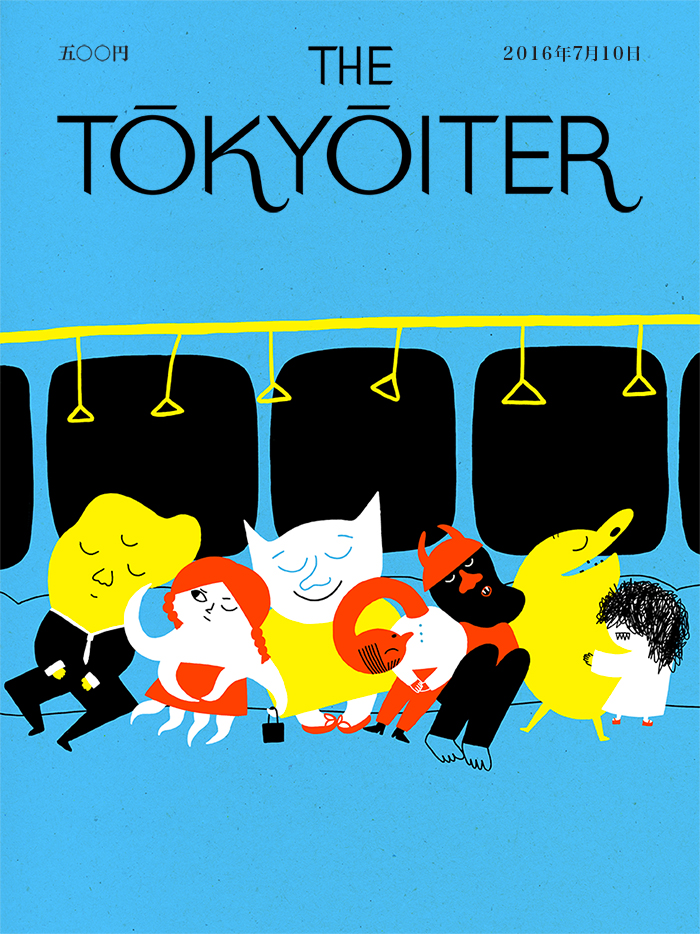
“I have a family member living in Japan which gives me excuse to visit every now and again,” writes illustrator Yuliya. “One of the main inspirations I find in folklore and all the magical beings of Japan. I’m originally from Ukraine and grew up surrounded by folk tales and superstitions, and even though I never truly believed in any of it, it always fascinated me. I miss that in modern Western world. So the creatures on my cover are made up but they are inspired by Japanese Yokai and just like the rest of Tokyo, they’re taking a spontaneous nap on the train.” Other Tokyoiter covers, contributed by artists from all around the world, take as their subjects Tokyo’s architecture, its food, its street life, its bath houses, and much more besides.
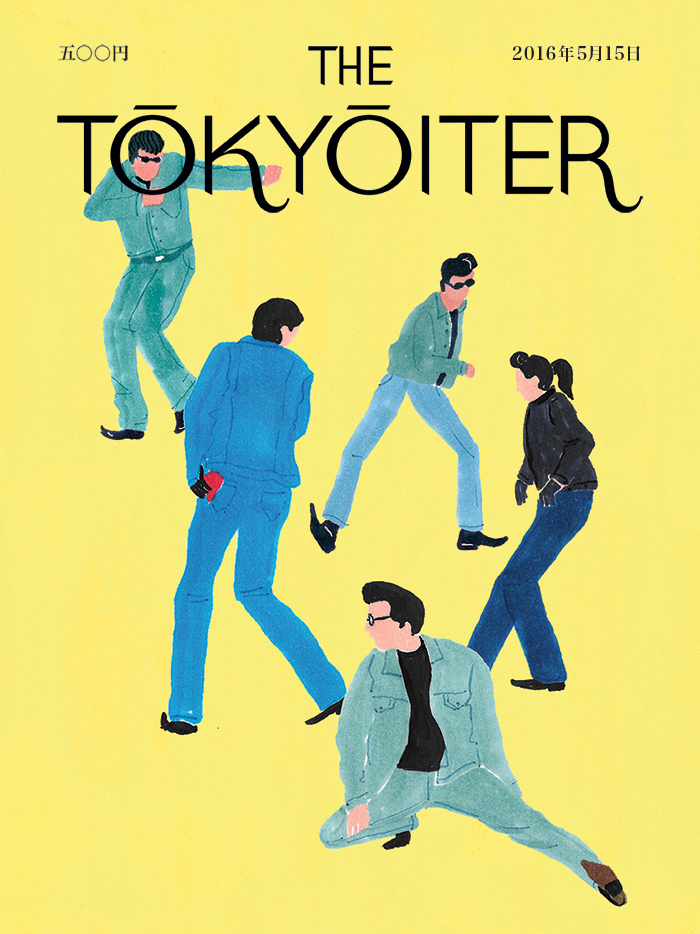
Taken as a collection, the project presents a combination of images of Tokyo familiar even to those who’ve never set foot in the city and references whose nuances only a Tokyoite — or at least someone with a Sedaris-level familiarity with the place — can immediately grasp. What could be more Tokyo, for instance, than the Rockabilly dancers of Yoyogi Park, portrayed here by Australian artist Grace Lee, who for more than 40 years have spent their Sunday afternoons taking 1950s Americana to its absolute limit for the enjoyment of all who pass by? And if you’ve gone to see them yourself, you’ll know that, if you get thirsty while watching, you can simply buy a drink from one of the many vending machines nearby, all lined up right out in the open.
See more covers in the Tokyoiter collection here.
Related Content:
A Curated Collection of Vintage Japanese Magazine Covers (1913–46)
New Archive Presents The Chicagoan, Chicago’s Jazz-Age Answer to The New Yorker (1926 to 1935)
Mashup Artist “Kutiman” Travels to Tokyo and Creates an Incredible Musical Postcard
Based in Seoul, Colin Marshall writes and broadcasts on cities and culture. He’s at work on the book The Stateless City: a Walk through 21st-Century Los Angeles, the video series The City in Cinema, the crowdfunded journalism project Where Is the City of the Future?, and the Los Angeles Review of Books’ Korea Blog. Follow him on Twitter at @colinmarshall or on Facebook.
Read More...A Short Documentary on Artist Jeff Koons, Narrated by Scarlett Johansson
If you don’t move, nothing happens. — Jeff Koons
Jeff Koons, the subject of Oscar Boyson’s recent pop video essay, above, is surely one of the most widely known living artists. As with fellow artists Damien Hirst and Cindy Sherman the spotlight has produced an army of detractors who know very little about him, or his large, far-ranging body of work.
The choice of Scarlett Johansson to provide snarky second-person narration might not jolly Koons’ naysayers into suspending judgment long enough for a proper reintroduction. (His show-and-tell display of his Venus of Willendorf coffee mug causes her to quip, “You sexy motherfucker.” Ugh.)
On the other hand, there’s rapper Pharrell Williams’ onscreen observation that, “We need haters out there. They’re our walking affirmations that we’re doing something right.”
The potential for clamorous negative reaction has never propelled Koons to shy away from doing things on the grand scale in the public arena, as the giant open air display of such sculptures as “Seated Ballerina,” “Balloon Flower,” and “Puppy” will attest.
Surely, the genial affect he brings to the film is not what those who abhor “Made in Heaven,” a series of erotic 3‑D self-portraits co-starring his then-wife, porn-star Ilona “Cicciolina” Staller, would have expected.
Nor does he come off as a pandering, high priest of kitsch, something certain to disappoint those who abhor “Michael Jackson and Bubbles,” his gaudy, larger-than-life glazed porcelain sculpture of the King of Pop and his pet chimp.
“Kitsch is a word I really don’t believe in,” he smiles (possibly all the way to the bank).
Instead, he veers toward reflection, a fitting preoccupation for an artist given to mirror-polished stainless steel and more recently, gazing balls of the sort commonly found on 20th-century American lawns. He wants viewers to take a good look at themselves, along with his work.
Those whose hearts are set against him are unlikely to be swayed, but the undecided and open-minded might soften to a list of influences including Duchamp, Dali, DaVinci, Fragonard, Bernini, and Manet.
Ditto the opinions of a diverse array of talking heads like Frank Gehry, Larry Gagosian, and fellow post-modernist David Salle, who praises Koons’ artistic dedication to “everyday American-style happiness.”
Related Content:
John Waters: The Point of Contemporary Art
Teens Ponder Meaning of Contemporary Art
Ayun Halliday is an author, illustrator, theater maker and Chief Primatologist of the East Village Inky zine. Follow her @AyunHalliday.
Read More...Jared Leto Stars in a New Prequel to Blade Runner 2049: Watch It Free Online
Blade Runner, as anyone who’s seen so much as its first shot knows, takes place in the Los Angeles of November 2019. Though the film flopped when it came out in 1982, the acclaim and fans it has drawn with each of the 35 years that have passed since didn’t take long to reach the kind of critical mass that demands a sequel. After numerous rumors and false starts, the October release of Blade Runner 2049, produced by Blade Runner director Ridley Scott and directed by Arrival director Denis Villeneuve, now fast approaches. The new movie’s promotional push, which has so far included trailers and making-of featurettes, has now begun to tell us what happened between 2019 and 2049.
“I decided to ask a couple of artists that I respect to create three short stories that dramatize some key events that occurred after 2019, when the first Blade Runner takes place, but before 2049, when my new Blade Runner story begins,” says Villeneuve in his introduction to the brand new short above.
Taking place in the Los Angeles of 2036, the Luke Scott-directed piece “revolves around Jared Leto’s character, Niander Wallace,” writes Collider’s Adam Chitwood, who “introduces a new line of ‘perfected’ replicants called the Nexus 9, seeking to get the prohibition on replicants repealed,” the government having shut replicant production down thirteen years before due to a devastating electromagnetic pulse attack for which replicants took the blame.
A timeline appeared at Comic-Con this past summer covering the events of the thirty years between Blade Runner and Blade Runner 2049, though in very broad strokes: in 2020 “the Tyrell Corporation introduces a new replicant model, the Nexus 8S, which has extended lifespans,” in 2025 “a new company, Wallace Corp., solves the global food shortage and becomes a massive super power,” in 2049 “life on Earth has reached its limit and society divides between Replicant and human.” The two other short films to come should just about tide over fans until the release of Blade Runner 2049 — not that those who’ve been waiting for a new Blade Runner movie since the 1980s can’t handle another month.
The short Blade Runner 2049 prequel, entitled “Nexus: 2036,” will be added to our list, 4,000+ Free Movies Online: Great Classics, Indies, Noir, Westerns, Documentaries & More.
Related Content:
The Official Trailer for Ridley Scott’s Long-Awaited Blade Runner Sequel Is Finally Out
The Blade Runner Promotional Film
Based in Seoul, Colin Marshall writes and broadcasts on cities and culture. He’s at work on the book The Stateless City: a Walk through 21st-Century Los Angeles, the video series The City in Cinema, the crowdfunded journalism project Where Is the City of the Future?, and the Los Angeles Review of Books’ Korea Blog. Follow him on Twitter at @colinmarshall or on Facebook.
Read More...The Periodic Table of Elements Presented as Interactive Haikus
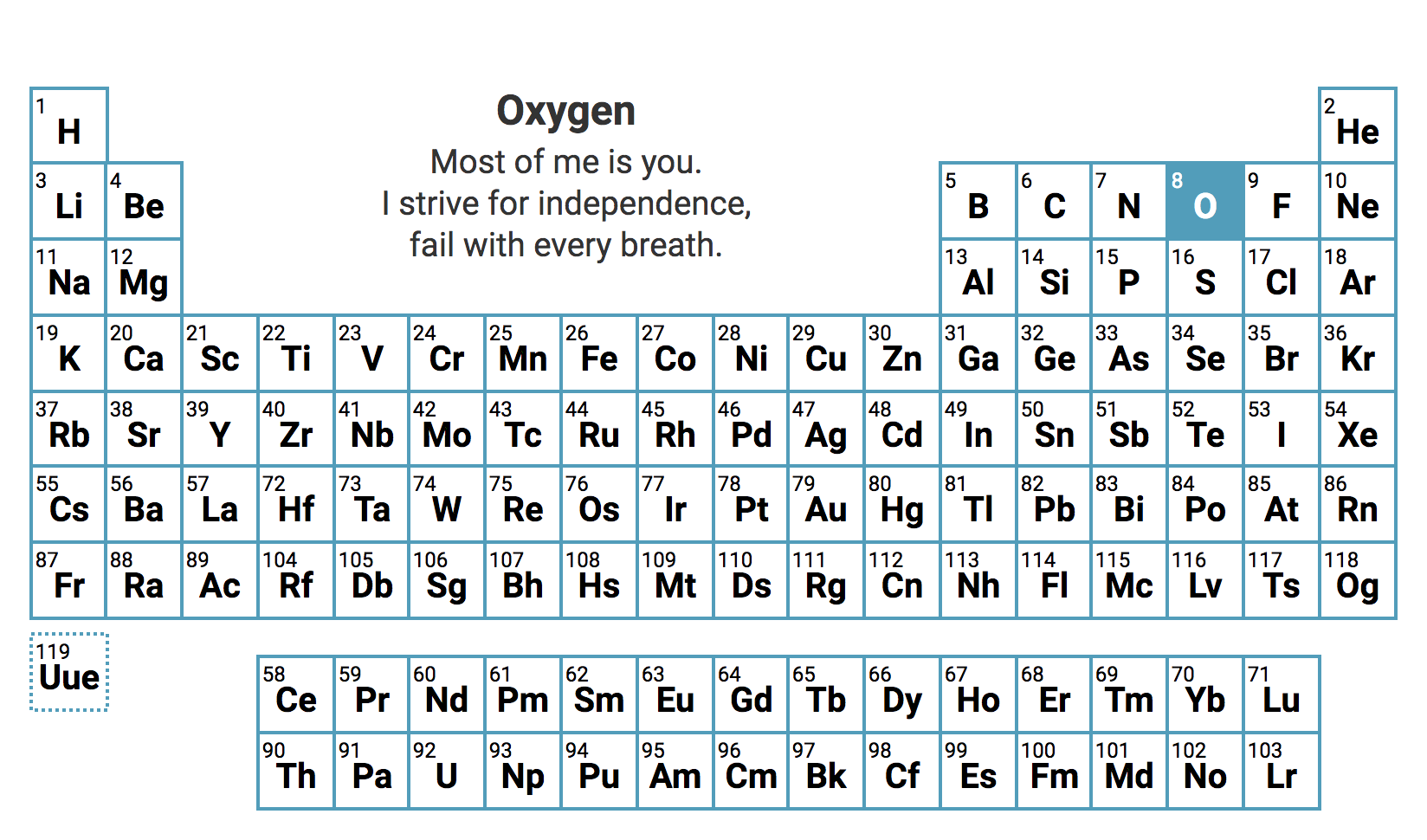
British poet and speculative fiction writer recently got a little creative with the Periodic Table, writing one haiku for each element.
Carbon
Show-stealing diva,
throw yourself at anyone,
decked out in diamonds.
Silicon
Locked in rock and sand,
age upon age
awaiting the digital dawn.
Strontium
Deadly bone seeker
released by Fukushima;
your sweet days long gone.
You can access the complete Elemental haiku here.
If you would like to support the mission of Open Culture, consider making a donation to our site. It’s hard to rely 100% on ads, and your contributions will help us continue providing the best free cultural and educational materials to learners everywhere. You can contribute through PayPal, Patreon, and Venmo (@openculture). Thanks!
Related Content
The Periodic Table of Elements Scaled to Show The Elements’ Actual Abundance on Earth
Periodic Table Battleship!: A Fun Way To Learn the Elements
“The Periodic Table Table” — All The Elements in Hand-Carved Wood
World’s Smallest Periodic Table on a Human Hair
“The Periodic Table of Storytelling” Reveals the Elements of Telling a Good Story
Chemistry on YouTube: “Periodic Table of Videos” Wins SPORE Prize
Free Online Chemistry Courses
Read More...An Animated Introduction to Ludwig Wittgenstein & His Philosophical Insights on the Problems of Human Communication
In the recorded history of philosophy, there may be no sharper a mind than Ludwig Wittgenstein. A bête noire, enfant terrible, and all other such phrases used to describe affronts to order and decorum, Wittgenstein also represented an anarchic force that disturbed the staid discipline. His teacher Bertrand Russell recognized the existential threat Wittgenstein posed to his profession (though not right away). When Wittgenstein handed Russell the compact, cryptic Tractatus Logico-Philosophicus, he admitted his student had gone beyond his own analytic insights in the pursuit of absolute clarity. Wittgenstein’s longtime mentor and friend, famed logician and mathematician Gottlob Frege, expressed criticism. Some have suggested he did so in part because he saw that Wittgenstein had rendered much of his work irrelevant.
Alain de Botton gives a brief but fascinating sketch of Wittgenstein’s ideas and incredibly odd biography in the School of Life video above. The eccentric Austrian savant, he asserts, “can help us with our communication problems” through his penetrating, though often impenetrable, claims about language. That may be so. But we may need to redefine what we mean by “communication.” According to Wittgenstein in the Tractatus, an overwhelming percentage of what we obsess about on a daily basis—political and religious abstractions, for example—is so totally incoherent and muddled that it means nothing at all. He revised this opinion dramatically in his later thought.
Though he published nothing after the Tractatus and soon became a near-recluse after his startling entry into analytic philosophy, notes from his students were collected and published as well as a posthumous book called Philosophical Investigations. This version of Wittgenstein’s approach to the problems of communication involves a development of the “ostensive”—or demonstrative—role of language. Wittgenstein made an argument that language can only serve a social, rather than a personal, subjective, function. To make the point, he introduced his “Beetle in a Box” analogy, which you can see explained above in an animated BBC video written by Nigel Warburton and narrated by Aidan Turner.
The analogy uses the idea of each of us claiming to have a beetle in a box as a stand in for our individual, private experiences. We all claim to have them (we can even observe brain states), but no one can ever see inside the theater of our minds to verify. We simply have to take each other’s word for it. We play “language games,” which only have meaning in respect to their context. That such games can be mutually intelligible among individuals who are otherwise opaque to each other has to do with our shared environment, abilities, and limitations. Should we, however, meet a lion who could speak—in perfectly intelligible English—we would not, Wittgenstein asserted, be able to understand a single word. The vastly different experiences of human versus lion would not translate through any medium.
Just above, we have an explanation of this thought experiment from an unlikely source, Ricky Gervais, in an attempted explanation to his comic foil Karl Pilkington, who takes things in his own peculiar direction. Though Wittgenstein used the idea for a different purpose, his observation about the unbridgeable chasm between humans and lions anticipates Thomas Nagel’s provocative claims in the 1974 essay “What is it like to be a bat?” We cannot inhabit the subjective states of beings so different from us, and therefore cannot say much of anything about their consciousness. Maybe it isn’t like anything to be a bat. Luckily for humans, we do have the ability to imagine each other’s experiences, in indirect, imperfect, roundabout, ways, and we all have enough shared context that we can, at least theoretically, use language to produce more clarity of thought and greater social harmony.
Related Content:
Hear Wittgenstein’s Tractatus Logico-Philosophicus Sung as a One-Woman Opera
In Search of Ludwig Wittgenstein’s Secluded Hut in Norway: A Short Travel Film
Ludwig Wittgenstein’s Short, Strange & Brutal Stint as an Elementary School Teacher
Wittgenstein and Hitler Attended the Same School in Austria, at the Same Time (1904)
Josh Jones is a writer and musician based in Durham, NC. Follow him at @jdmagness
Read More...Margaret Hamilton, Lead Software Engineer of the Apollo Project, Stands Next to Her Code That Took Us to the Moon (1969)
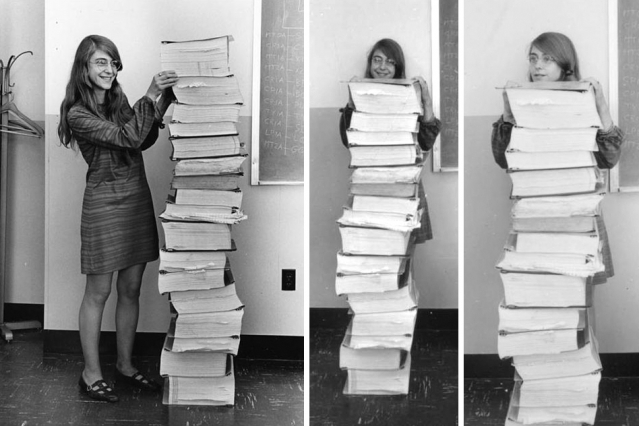
Photo courtesy of MIT Museum
When I first read news of the now-infamous Google memo writer who claimed with a straight face that women are biologically unsuited to work in science and tech, I nearly choked on my cereal. A dozen examples instantly crowded to mind of women who have pioneered the very basis of our current technology while operating at an extreme disadvantage in a culture that explicitly believed they shouldn’t be there, this shouldn’t be happening, women shouldn’t be able to do a “man’s job!”
The memo, as Megan Molteni and Adam Rogers write at Wired, “is a species of discourse peculiar to politically polarized times: cherry-picking scientific evidence to support a pre-existing point of view.” Its specious evolutionary psychology pretends to objectivity even as it ignores reality. As Mulder would say, the truth is out there, if you care to look, and you don’t need to dig through classified FBI files. Just, well, Google it. No, not the pseudoscience, but the careers of women in STEM without whom we might not have such a thing as Google.
Women like Margaret Hamilton, who, beginning in 1961, helped NASA “develop the Apollo program’s guidance system” that took U.S. astronauts to the moon, as Maia Weinstock reports at MIT News. “For her work during this period, Hamilton has been credited with popularizing the concept of software engineering.” Robert McMillan put it best in a 2015 profile of Hamilton:
It might surprise today’s software makers that one of the founding fathers of their boys’ club was, in fact, a mother—and that should give them pause as they consider why the gender inequality of the Mad Men era persists to this day.
Hamilton was indeed a mother in her twenties with a degree in mathematics, working as a programmer at MIT and supporting her husband through Harvard Law, after which she planned to go to graduate school. “But the Apollo space program came along” and contracted with NASA to fulfill John F. Kennedy’s famous promise made that same year to land on the moon before the decade’s end—and before the Soviets did. NASA accomplished that goal thanks to Hamilton and her team.
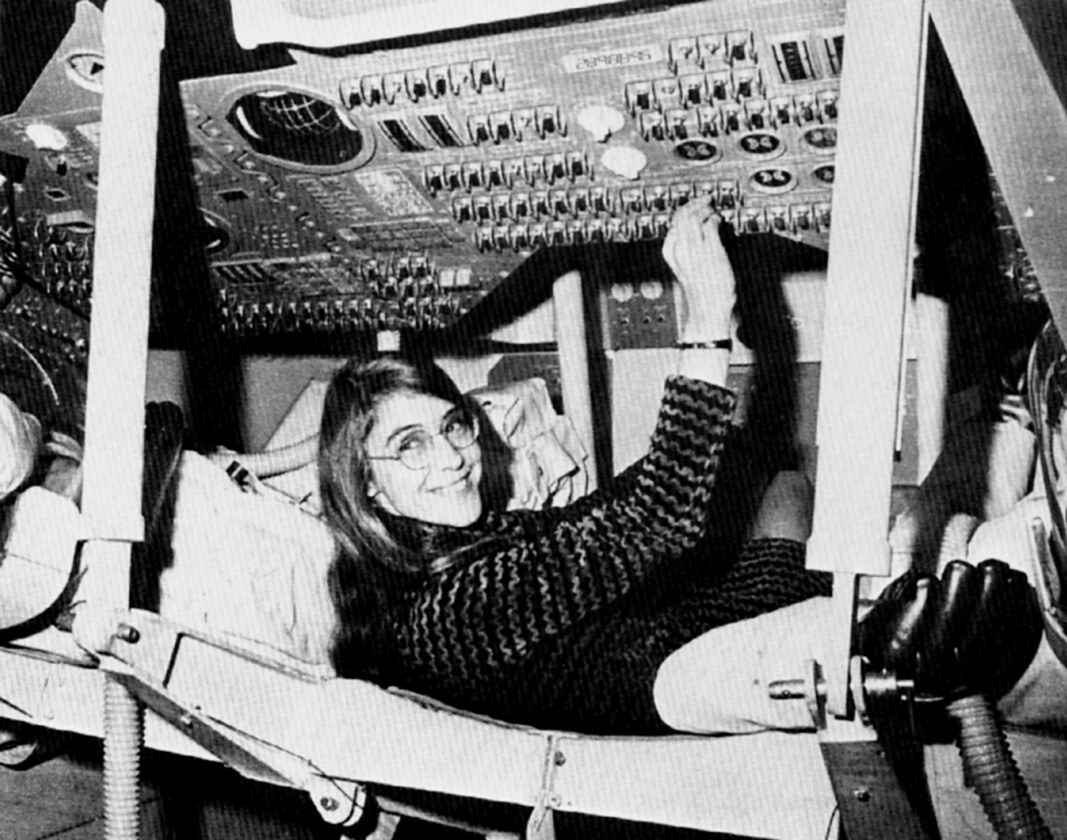
Photo courtesy of MIT Museum
Like many women crucial to the U.S. space program (many doubly marginalized by race and gender), Hamilton might have been lost to public consciousness were it not for a popular rediscovery. “In recent years,” notes Weinstock, “a striking photo of Hamilton and her team’s Apollo code has made the rounds on social media.” You can see that photo at the top of the post, taken in 1969 by a photographer for the MIT Instrumentation Laboratory. Used to promote the lab’s work on Apollo, the original caption read, in part, “Here, Margaret is shown standing beside listings of the software developed by her and the team she was in charge of, the LM [lunar module] and CM [command module] on-board flight software team.”
As Hank Green tells it in his condensed history above, Hamilton “rose through the ranks to become head of the Apollo Software development team.” Her focus on errors—how to prevent them and course correct when they arise—“saved Apollo 11 from having to abort the mission” of landing Neil Armstrong and Buzz Aldrin on the moon’s surface. McMillan explains that “as Hamilton and her colleagues were programming the Apollo spacecraft, they were also hatching what would become a $400 billion industry.” At Futurism, you can read a fascinating interview with Hamilton, in which she describes how she first learned to code, what her work for NASA was like, and what exactly was in those books stacked as high as she was tall. As a woman, she may have been an outlier in her field, but that fact is much better explained by the Occam’s razor of prejudice than by anything having to do with evolutionary determinism.
Note: You can now find Hamilton’s code on Github.
Related Content:
NASA Puts Its Software Online & Makes It Free to Download
Josh Jones is a writer and musician based in Durham, NC. Follow him at @jdmagness
Read More...Support Us
We're hoping to rely on loyal readers, rather than erratic ads. Please click the Donate button and support Open Culture. You can use Paypal, Venmo, Patreon, even Crypto! We thank you!

About Us

Open Culture scours the web for the best educational media. We find the free courses and audio books you need, the language lessons & educational videos you want, and plenty of enlightenment in between.
Advertise With Us

FREE UPDATES!
GET OUR DAILY EMAIL
Get the best cultural and educational resources on the web curated for you in a daily email. We never spam. Unsubscribe at any time.
FOLLOW ON SOCIAL MEDIA

Open Culture editor Dan Colman scours the web for the best educational media. He finds the free courses and audio books you need, the language lessons & movies you want, and plenty of enlightenment in between.
Advertise With Us

