Follow Cartoonist Lynda Barry’s 2017 “Making Comics” Class Online, Presented at UW-Wisconsin
Professor Skeletor—aka cartoonist and educator Lynda Barry—is at it again. Making Comics (& other Graphic Formations), her fall offering at the University of Wisconsin’s Institute for Discovery is just getting underway.
Those of us who can’t study in person with an educator whose department chair called her “the best classroom teacher” that he’s ever seen can happily follow along online.
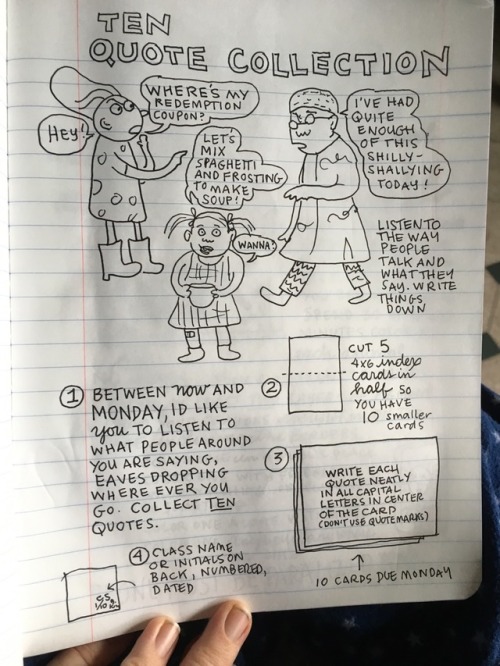
As always, her handwritten homework assignments will be posted to her Nearsighted Monkey tumblr account, along with in-class reflections and inspirational bits and bobs pulled off the Internet.
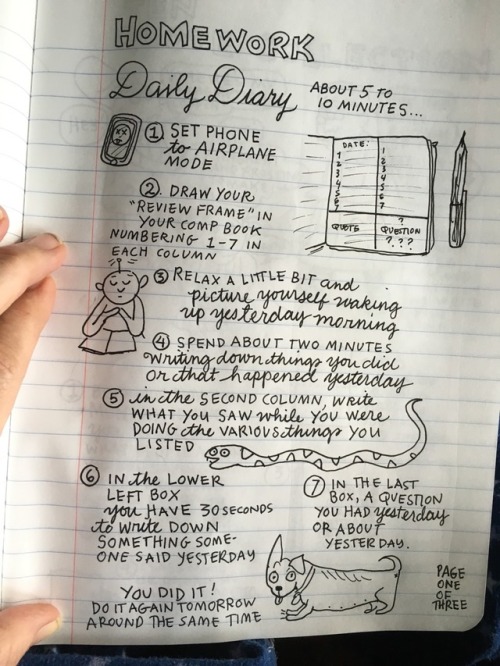
The first task, familiar to readers of her Syllabus workbook, is to begin a daily diary practice, filling in a template frame of Barry’s own devising.
Begin by putting your phone on airplane mode. “The phone gives us a lot but it takes away three key elements of discovery: loneliness, uncertainty and boredom,” she stated last year, on a visit to NASA’s Goddard Space Flight Center. “Those have always been where creative ideas come from.”
Amen.
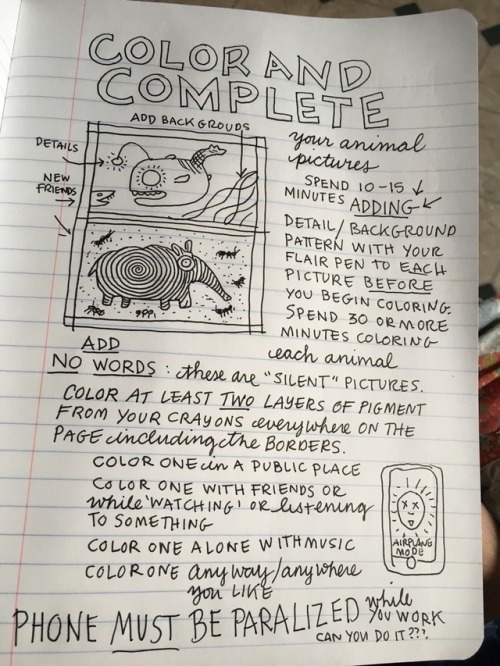
Any one of the exercises will renew your powers of observation and sense of connection with the world around you. Don’t be surprised if you find yourself getting up early or skipping some must-see TV in order to fully comply with Professor Skeletor’s feel-good assignments. There are no wrong answers, provided you go at the assignments with energy and a willingness to play. As Barry said in an interview:
Because we tend to give up on the arts so early in life, I became really interested in what would happen if we reintroduce the arts without the thought of ‘you’re going to do this to become a great writer or painter,’ but rather that it might help people with the other work in their field.
For added value, complete your first daily diary frame to an audio recording of Barry’s timed instruction here. (Ignore the background noise of your teacher’s life—her sneezing cat, her happy pet birds—or better yet, let her household’s zesty energy seep into your work.)
Related Content:
Join Cartoonist Lynda Barry for a University-Level Course on Doodling and Neuroscience
Ayun Halliday is an author, illustrator, theater maker and Chief Primatologist of the East Village Inky zine. Follow her @AyunHalliday.
Read More...The Map of Computer Science: New Animation Presents a Survey of Computer Science, from Alan Turing to “Augmented Reality”
I’ve never wanted to start a sentence with “I’m old enough to remember…” because, well, who does? But here we are. I remember the enormously successful Apple IIe and Commodore 64, and a world before Microsoft. Smart phones were science fiction. To do much more than word process or play games one had to learn a programming language. These ancient days seemed at the time—and in hindsight as well—to be the very dawn of computing. Before the personal computer, such devices were the size of kitchen appliances and were hidden away in military installations, universities, and NASA labs.
But of course we all know that the history of computing goes far beyond the early 80s: at least back to World War II, and perhaps even much farther. Do we begin with the abacus, the 2,200-Year-Old Antikythera Mechanism, the astrolabe, Ada Lovelace and Charles Babbage? The question is maybe one of definitions. In the short, animated video above, physicist, science writer, and YouTube educator Dominic Walliman defines the computer according to its basic binary function of “just flipping zeros and ones,” and he begins his condensed history of computer science with tragic genius Alan Turing of Turing Test and Bletchley Park codebreaking fame.
Turing’s most significant contribution to computing came from his 1936 concept of the “Turing Machine,” a theoretical mechanism that could, writes the Cambridge Computer Laboratory “simulate ANY computer algorithm, no matter how complicated it is!” All other designs, says Walliman—apart from a quantum computer—are equivalent to the Turing Machine, “which makes it the foundation of computer science.” But since Turing’s time, the simple design has come to seem endlessly capable of adaptation and innovation.
Walliman illustrates the computer’s exponential growth by pointing out that a smart phone has more computing power than the entire world possessed in 1963, and that the computing capability that first landed astronauts on the moon is equal to “a couple of Nintendos” (first generation classic consoles, judging by the image). But despite the hubris of the computer age, Walliman points out that “there are some problems which, due to their very nature, can never be solved by a computer” either because of the degree of uncertainty involved or the degree of inherent complexity. This fascinating, yet abstract discussion is where Walliman’s “Map of Computer Science” begins, and for most of us this will probably be unfamiliar territory.
We’ll feel more at home once the map moves from the region of Computer Theory to that of Computer Engineering, but while Walliman covers familiar ground here, he does not dumb it down. Once we get to applications, we’re in the realm of big data, natural language processing, the internet of things, and “augmented reality.” From here on out, computer technology will only get faster, and weirder, despite the fact that the “underlying hardware is hitting some hard limits.” Certainly this very quick course in Computer Science only makes for an introductory survey of the discipline, but like Wallman’s other maps—of mathematics, physics, and chemistry—this one provides us with an impressive visual overview of the field that is both broad and specific, and that we likely wouldn’t encounter anywhere else.
As with his other maps, Walliman has made this the Map of Computer Science available as a poster, perfect for dorm rooms, living rooms, or wherever else you might need a reminder.
Related Content:
Free Online Computer Science Courses
Watch Breaking the Code, About the Life & Times of Alan Turing (1996)
The Map of Mathematics: Animation Shows How All the Different Fields in Math Fit Together
The Map of Physics: Animation Shows How All the Different Fields in Physics Fit Together
The Map of Chemistry: New Animation Summarizes the Entire Field of Chemistry in 12 Minutes
Josh Jones is a writer and musician based in Durham, NC. Follow him at @jdmagness
Read More...Watch Steve Martin Make His First TV Appearance: The Smothers Brothers Comedy Hour (1968)
“What if there were no punch lines?” asks Steve Martin in his autobiography Born Standing Up. “What if there were no indicators? What if I created tension and never released it? What if I headed for a climax, but all I delivered was an anticlimax?” These questions motivated him to develop the distinctive style of stand-up comedy — in a sense, an anti-stand-up comedy — that rocketed him to superstardom in the 1970s. But before the world knew him as a banjo-playing funnyman, Martin worked for a couple of his especially notable comedian-musician elders: Tom and Dick Smothers, better known as the Smothers Brothers.
“We happened to be walking through the writer area of the show, and there he was, sitting at one of our writers’ desks,” Tom says of Martin on the 1968 broadcast of The Smothers Brothers Comedy Hour above. “Later we found out that he actually was one of our writers. Since he hasn’t been paid for his work, we thought we’d let him come out tonight and make a few dollars.”
So introduced, the 22-year-old Martin begins his television debut by re-introducing himself: “As Tom just said, I’m Steve Martin, and I’ll be out here in a minute. While I’m waiting for me, I’d like to jump into kind of a socko-boffo comedy routine.” With his prop table ready, he then launches into “the fabulous glove-into-dove trick.”
Though the studio audience may look pretty square by today’s standards (or even those of the late 1960s), The Smothers Brothers Comedy Hour had already built a reputation for pushing the envelope of mainstream television comedy. Still, it’s safe to say that its audience had never seen any performer – and certainly not any prop comic — quite like Martin before. In this short set, he performs a number of deliberately botched or otherwise askew magic tricks, using his tone to generate the humor. “If I kept denying them the formality of a punch line,” as he writes more than 40 years later in Born Standing Up, “the audience would eventually pick their own place to laugh, essentially out of desperation. This type of laugh seemed stronger to me, as they would be laughing at something they chose, rather than being told exactly when to laugh.”
Watching today, Martin’s fans will recognize his trademark sensibility more quickly than his appearance, since the clip predates both the white suit and the white hair. Even then, he wanted to perform in a way that, in the words of The Guardian’s Rafael Behr, “would unnerve and alienate the audience, but also, through self-deprecation, engage them in conspiracy against himself.” Martin seems to take a dim view of his own early television work, having described himself in a 1971 Virginia Graham Show appearance as “mannered, slow and self-aware. I had absolutely no authority,” a quality that he has since developed in abundance, and of which “the art of having an act so bad it was good,” as Behr puts it, demands a surprising amount.
Related Content:
Steve Martin Will Teach His First Online Course on Comedy
Steve Martin on the Legendary Bluegrass Musician Earl Scruggs
Steve Martin Writes a Hymn for Hymn-Less Atheists
Steve Martin, “Home Crafts Expert,” Explains the Art of Paper Wadding, Endorses Bob Kerrey
Steve Martin Releases Bluegrass Album/Animated Video
Based in Seoul, Colin Marshall writes and broadcasts on cities and culture. He’s at work on the book The Stateless City: a Walk through 21st-Century Los Angeles, the video series The City in Cinema, the crowdfunded journalism project Where Is the City of the Future?, and the Los Angeles Review of Books’ Korea Blog. Follow him on Twitter at @colinmarshall or on Facebook.
Read More...NASA Lets You Download Free Posters Celebrating the 40th Anniversary of the Voyager Missions
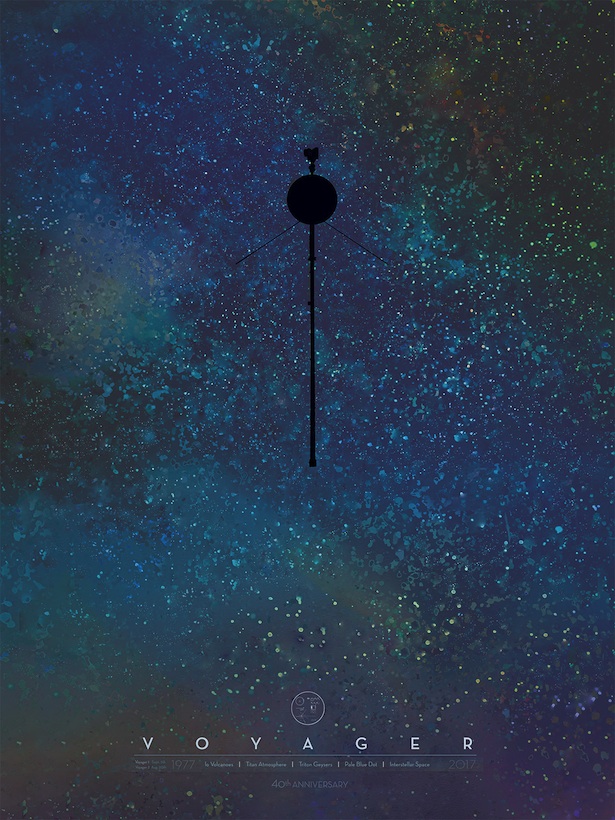
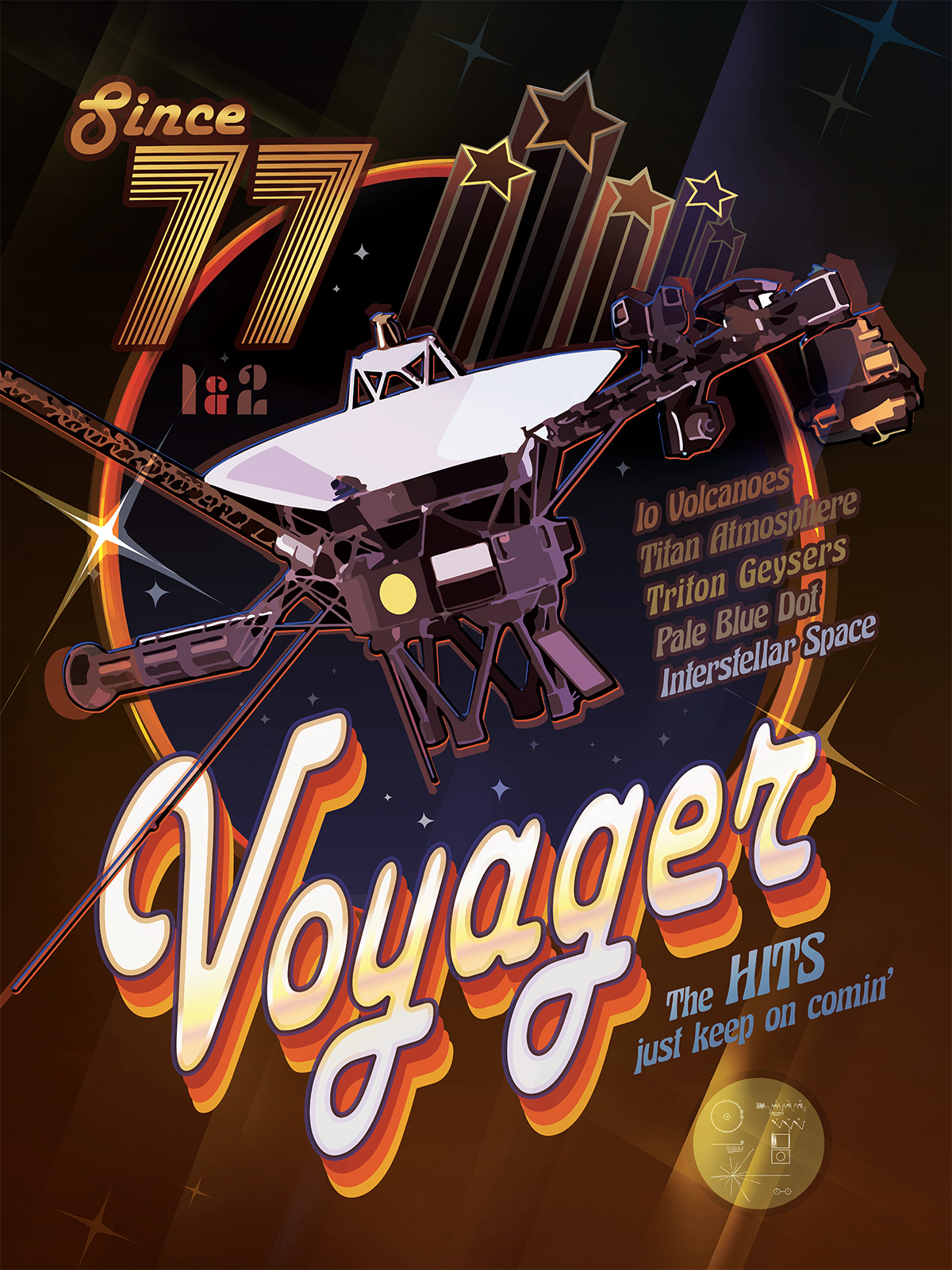
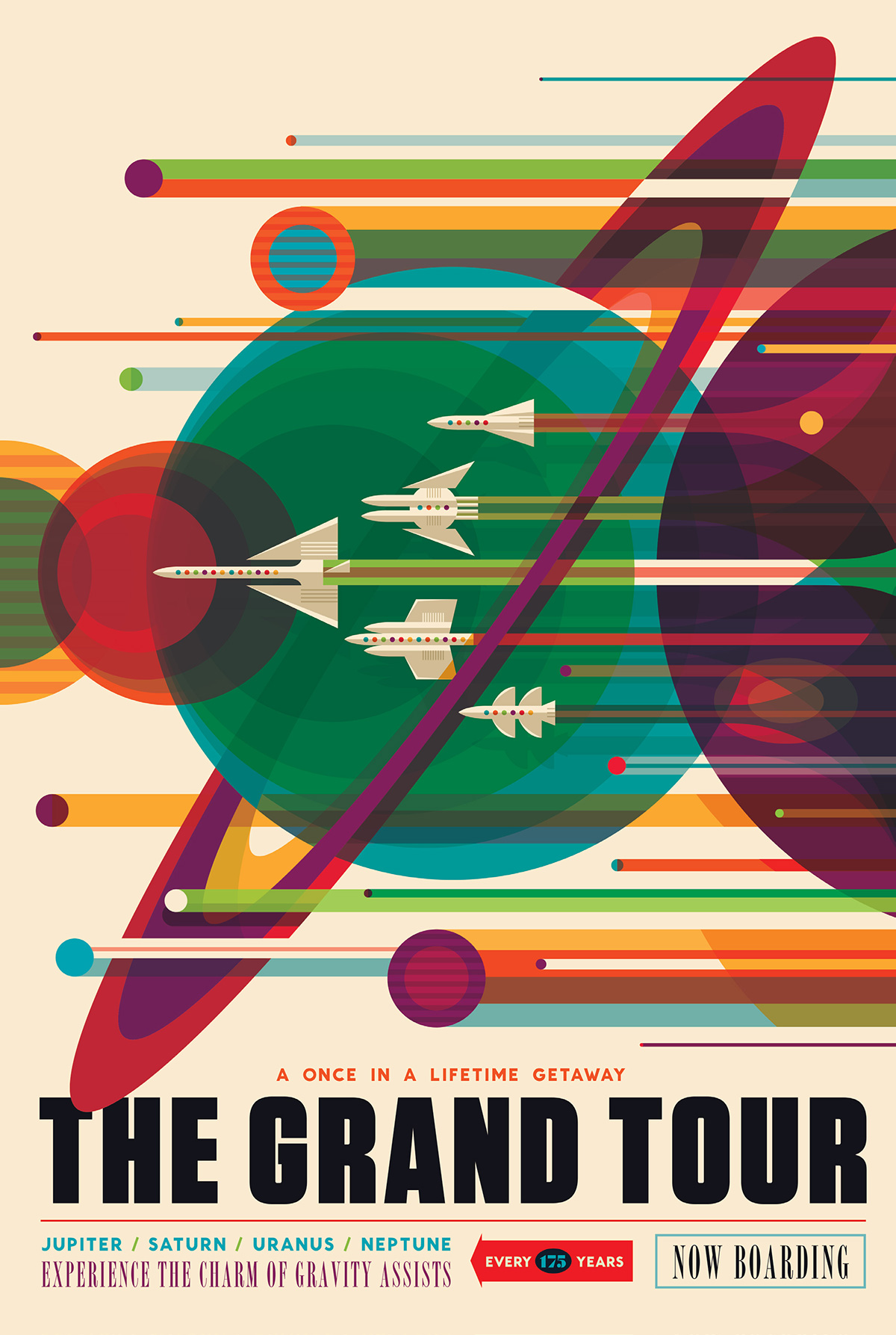
A quick fyi: Last year, NASA released 14 Free Posters That Depict the Future of Space Travel in a Captivatingly Retro Style. Now, on the 40th anniversary of the Voyager missions (Aug. 20 and Sept. 5, 1977), the space agency has issued three attractive new posters to celebrate our “ambassadors to the rest of the Milky Way.” All are free to download and print here. Writes Space.com: “One of the Voyager posters is an image of a starry night sky [see above], and another advertises the mission using the flamboyant design style of the 1970s, the decade when the probes launched. A third poster honors the probes’ ‘grand tour’ of the planets, on their way to the edge of the solar system.” Happy downloading!
If you would like to support the mission of Open Culture, consider making a donation to our site. It’s hard to rely 100% on ads, and your contributions will help us continue providing the best free cultural and educational materials to learners everywhere. You can contribute through PayPal, Patreon, and Venmo (@openculture). Thanks!
Related Content:
How the Iconic 1968 “Earthrise” Photo Was Made: An Engrossing Visualization by NASA
NASA Archive Collects Great Time-Lapse Videos of our Planet
Ray Bradbury Reads Moving Poem on the Eve of NASA’s 1971 Mars Mission
NASA Presents “The Earth as Art” in a Free eBook and Free iPad App
NASA Sends Image of the Mona Lisa to the Moon and Back
Leonard Nimoy Narrates Short Film About NASA’s Dawn: A Voyage to the Origins of the Solar System
The Best of NASA Space Shuttle Videos (1981–2010)
Read More...
The Planetarium Table Clock: Magnificent 1775 Timepiece Tracks the Passing of Time & the Travel of the Planets

If you’re in Zurich, head over to the Beyer Clock and Watch Museum, which presents the history of timekeeping and timekeeping instruments, from 1400 BC to modern times. On display, you’ll find sundials, water and tower clocks, Renaissance automata, and pendulum clocks. And the Planetarium Table Clock featured above.
Made circa 1775, the planetarium clock keeps time … and so much more. According to the Museum of Artifacts website, the earth (look in the glass orb) “rotates around the sun in perfect real time.” And the “other five planets rotate as well–they “go up, down, around, in relation to the etched constellations of precisely positioned stars on the crystal globe, which if you are smart enough will reveal what season it is.” This fine timekeeping piece was the joint creation of Nicole-Reine Lepaute, a French astronomer who predicted the return of Halley’s Comet, and her husband, Jean-André Lepaute, who presided over a clockmaking dynasty and became horloger du Roi (clockmaker to the king).
It’s hard to imagine that the Planetarium clock didn’t somehow inspire a more modern creation–the Midnight Planétarium, an astronomical watch that shows the rotation of five planets — Mercury, Venus, Earth, Mars, Jupiter, and Saturn. It has a price tag of $220,000 (excluding sales tax). See it on display below.
If you would like to support the mission of Open Culture, consider making a donation to our site. It’s hard to rely 100% on ads, and your contributions will help us continue providing the best free cultural and educational materials to learners everywhere. You can contribute through PayPal, Patreon, and Venmo (@openculture). Thanks!
Related Content:
How Clocks Changed Humanity Forever, Making Us Masters and Slaves of Time
Carl Sagan Presents Six Lectures on Earth, Mars & Our Solar System … For Kids (1977)
Read More...What Is Freedom? Watch Four Philosophy Animations on Freedom & Free Will Narrated by Harry Shearer
Growing up in America, I heard nearly every behavior, no matter how unpleasant, justified with the same phrase: “It’s a free country.” In her recent book Notes on a Foreign Country, the Istanbul-based American reporter Suzy Hansen remembers singing “God Bless the USA” on the school bus during the first Iraq war: “And I’m proud to be an American / Where at least I know I’m free.” That “at least,” she adds, is funny: “We were free – at the very least we were that. Everyone else was a chump, because they didn’t even have that obvious thing. Whatever it meant, it was the thing that we had, and no one else did. It was our God-given gift, our superpower.”
But how many of us can explain what freedom is? These videos from BBC Radio 4 and the Open University’s animated History of Ideas series approach that question from four different angles. “Freedom is good, but security is better,” says narrator Harry Shearer, summing up the view of seventeenth-century philosopher Thomas Hobbes, who imagined life without government, laws, or society as “solitary, poor, nasty, brutish, and short.” The solution, he proposed, came in the form of a social contract “to put a strong leader, a sovereign or perhaps a government, over them to keep the peace” — an escape from “the war of all against all.”
But that escape comes hand in hand with the unpalatable prospect of living under “a frighteningly powerful state.” The nineteenth-century philosopher John Stuart Mill, who wrote a great deal about the state’s proper limitations, based his concept of freedom in something called the “harm principle,” which holds that “the state, my neighbors, and everyone else should let me get on with my life, as long as I don’t harm anyone in the process.” As “the seedbed of genius” and “the basis of enduring happiness for ordinary people,” this individual freedom needs protection, especially when it comes to speech: “Merely causing offense, he thinks, is no grounds for intervention, because, in his view, that is not a harm.”
That proposition remains debated more heatedly now, in the 21st century, than Mill probably could have imagined. But then as now, and as in any time of human history, we live in more or less the same world, “a world festering with moral evil, a world of wars, torture, rape, murder, and other acts of meaningless violence,” not to mention “natural evil” like disease, famine, floods, and earthquakes. This gives rise to perhaps the oldest problem in the philosophical book, the problem of evil: “How could a good god allow anyone to do such horrific things?” Some have taken the fact that the wars, murders, floods, and earthquakes continue as evidence that no such god exists.
But had that god created “human beings that always did the right thing, never harmed anyone else, never went astray,” we’d all have ended up “automata, preprogrammed robots.” Better, in this view, “to have free will with the genuine risk that some people will end up evil than to live in a world without choice.” Even so, the mere mention of free will, a concept no more easily defined than that of freedom itself, opens up a whole other can of worms, especially in light of research like neuroscientist Benjamin Libet’s.
Libet, who “wired up subjects to an EEG machine, measuring brain activity via electrodes on our scalps,” found that brain activity initiating a movement actually happened before the subjects thought they’d decided to make that movement. Does that disprove free will? Does evil disprove the existence of a good god? Does offense cause the same kind of harm as physical violence? Should we give up more security for freedom, or more freedom for security? These questions remain unanswered, and quite possibly unanswerable, but that doesn’t make considering the very nature of freedom any less necessary as human societies — those in “free countries” and otherwise — find their way forward.
Related Content:
47 Animated Videos Explain the History of Ideas: From Aristotle to Sartre
An Animated Aldous Huxley Identifies the Dystopian Threats to Our Freedom (1958)
Based in Seoul, Colin Marshall writes and broadcasts on cities and culture. He’s at work on the book The Stateless City: a Walk through 21st-Century Los Angeles, the video series The City in Cinema, the crowdfunded journalism project Where Is the City of the Future?, and the Los Angeles Review of Books’ Korea Blog. Follow him on Twitter at @colinmarshall or on Facebook.
Read More...Gustav Klimt’s Haunting Paintings Get Re-Created in Photographs, Featuring Live Models, Ornate Props & Real Gold
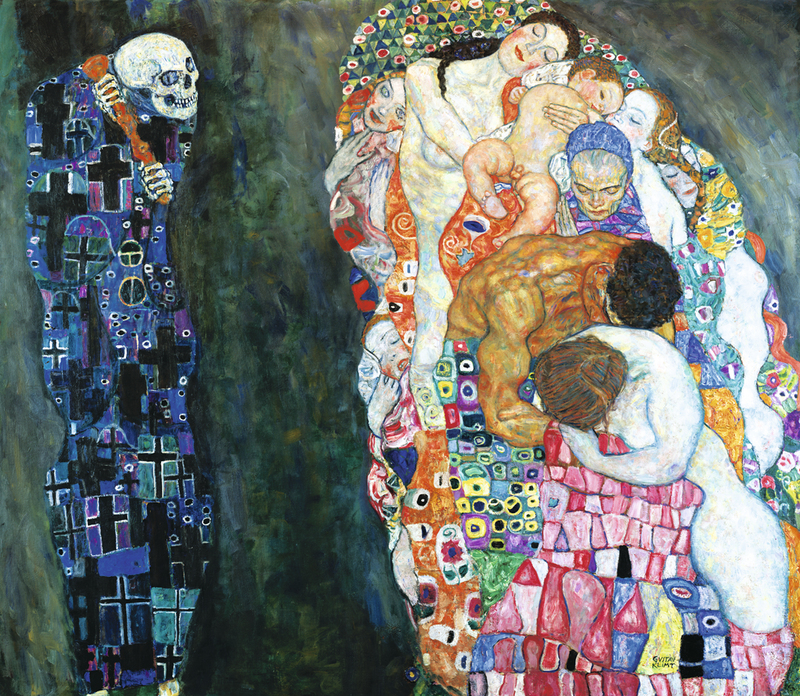
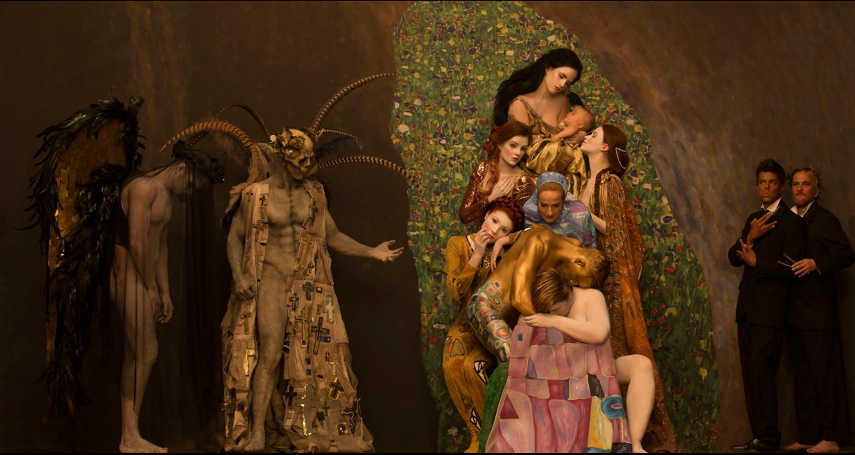
Image by Inge Prader
Gustav Klimt painted a glittering, erotic, haunting reality of his own, distinctive even by the standards of his artistically abundant environment of late 19th- and early 20th-century Vienna. “Whoever wants to know something about me,” he once wrote in a commentary on the self-portrait he never painted, “ought to look carefully at my pictures.” Given the level of scrutiny with which she’s no doubt had to look at his pictures, Klimt’s countrywoman Inge Prader must therefore know everything about the painter there is to know.
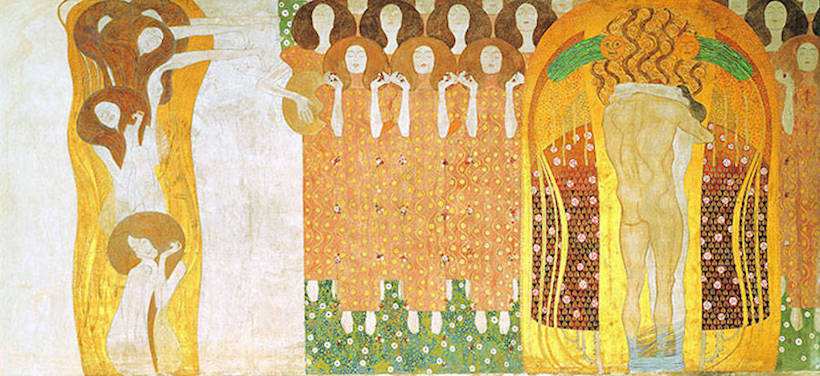
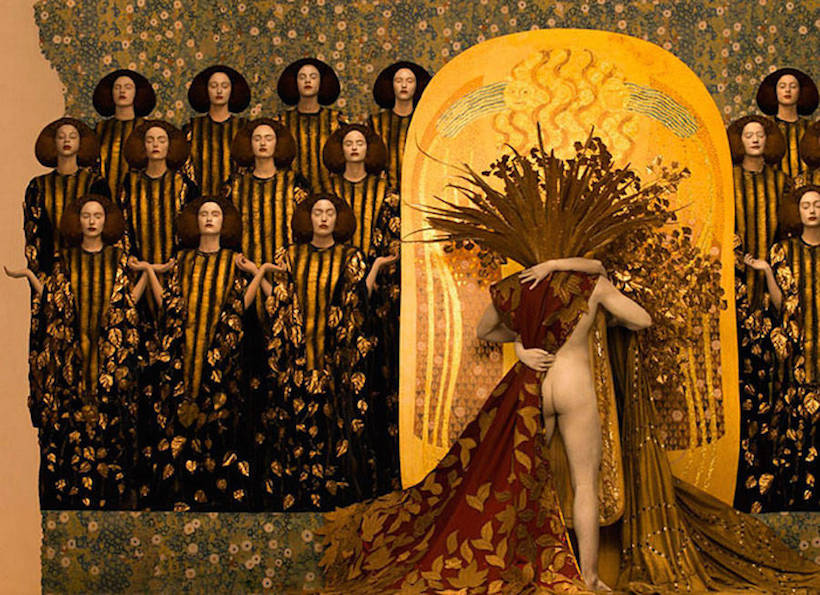
Image by Inge Prader
A photographer with a wide variety of corporate clients, Prader has drawn a good deal of attention by shooting recreations of Klimt’s canvasses made for Vienna’s Life Ball, an AIDS charity event, using real models, real costumes, and real gold. That last has a particular importance, given Prader’s focus on paintings from the “Golden Phase” that Klimt entered after becoming a success. “In 1903 Klimt visited Venice, Ravenne and Florence,” writes Konbini’s Donnia Ghezlane-Lala. “It was his visit to the San Vitale basilica in Ravenne that struck him the most. Fascinated by Byzantine mosaics, he decided to integrate the colour gold into his work using gold paper and gold leaf. Also, fun fact, Klimt was the son of a goldsmith.”
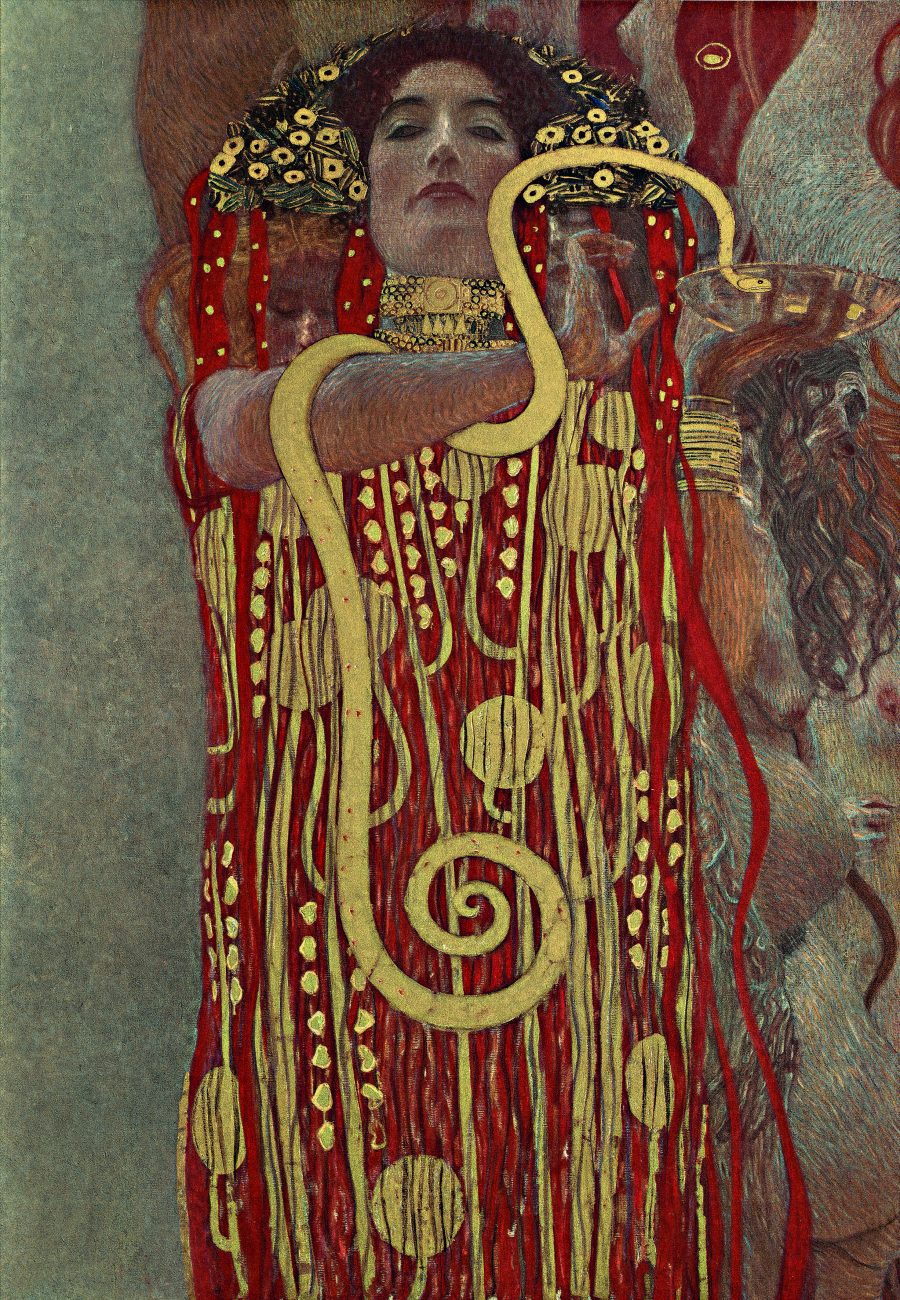
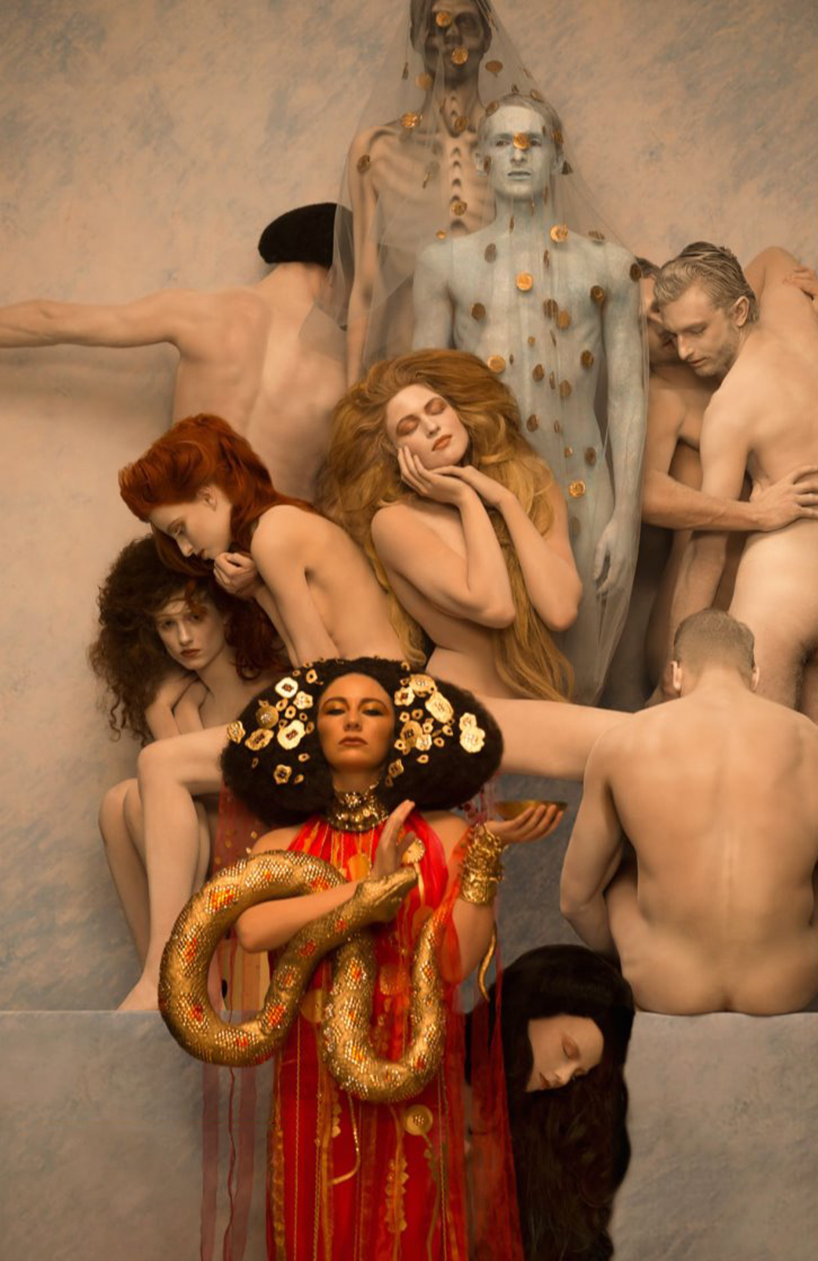
Image by Inge Prader
Prader’s “carefully posed models and intricately crafted props duplicate some of Klimt’s most iconic masterworks like Death and Life and Beethoven Frieze, mirroring the gold hued, highly decorative and erotic aesthetic the Austrian artist became best known for,” writes Designboom’s Nina Azzarello. “Richly ornamented costumes clothing warriors and women alike are situated alongside semi-nude figures and set against detailed mosaic backdrops.” These “paradise-like conditions” on the canvas transfer surprisingly well to photography, especially with the eye Prader has developed in fashion and advertising, two realms guaranteed to instill anybody with a positively Klimt-like appreciation for striking compositions, luxurious materials, and beautiful women.
You can see more of Prader’s Klimt recreations at Konbini and Designboom.
Related Content:
Flashmob Recreates Rembrandt’s “The Night Watch” in a Dutch Shopping Mall
Based in Seoul, Colin Marshall writes and broadcasts on cities and culture. He’s at work on the book The Stateless City: a Walk through 21st-Century Los Angeles, the video series The City in Cinema, the crowdfunded journalism project Where Is the City of the Future?, and the Los Angeles Review of Books’ Korea Blog. Follow him on Twitter at @colinmarshall or on Facebook.
Read More...The Earliest Known Appearance of the F‑Word, in a Bizarre Court Record Entry from 1310

Photo by Paul Booth
You value decorum, propriety, eloquence, you treasure le mot juste and agonize over diction as you compose polite but strongly-worded letters to the editor. But alas, my literate friend, you have the misfortune of living in the age of Twitter, Tumblr, et al., where the favored means of communication consists of readymade mimetic words and phrases, photos, videos, and animated gifs. World leaders trade insults like 5th graders—some of them do not know how to spell. Respected scientists and journalists debate anonymous strangers with cartoon avatars and work-unsafe pseudonyms. Some of them are robots.
What to do?
Embrace it. Insert well-placed profanities into your communiqués. Indulge in bawdiness and ribaldry. You may notice that you are doing no more than writers have done for centuries, from Rabelais to Shakespeare to Voltaire. Profanity has evolved right alongside, not apart from, literary history. T.S. Eliot, for example, knew how to go lowbrow with the best of them, and gets credit for the first recorded use of the word “bullshit.” As for another, even more frequently used epithet in 24-hour online commentary?—well, the word “F*ck” has a far longer history, granting its apt public use recently by seismologist Steven Gibbons an added authority.
Not long ago we alerted you to the first known use of the versatile obscenity in a 1528 marginal note scribbled in Cicero’s De Officiis by a monk cursing his abbot. Not long after this discovery, notes Medievalists.net, another scholar found the word in a 1475 poem called Flen flyys. This was thought to be the earliest appearance of “f*ck” as a purely sexual reference until medieval historian Paul Booth of Keele University discovered an instance dating over a hundred years earlier. Rather than within, or next to, a work of literature, however, the word appears in a set of 1310 English court records. And no, it is decidedly not a legal term.
The documents concern the case of “a man named Roger Fuckebythenavele.” Used three times in the record, the name, says Booth, is probably not a joke made by the scribe but some kind of bizarre nickname, though one hopes not a description of the crime. “Either it refers to an inexperienced copulator, referring to someone trying to have sex with a navel,” says Booth, stating the obvious, “or it’s a rather extravagant explanation for a dimwit, someone so stupid they think that this is the way to have sex.” Our medieval gent had other problems as well. He was called to court three times within a year before being pronounced “outlawed,” which The Independent’s Loulla-Mae Eleftheriou-Smith suggests execution but probably refers to banishment.
For the word to have such casually hilarious or insulting currency in the early 14th century, it must have come from an even earlier time. Indeed, “f*ck is a word of German origin,” notes Jesse Sheidlower, author of an etymological history called The F Word, “related to words in several other Germanic languages, such as Dutch, German, and Swedish, that have sexual meanings as well as meaning such as ‘to strike’ or ‘to move back and forth’” (naturally). So, in other words, it’s just a word. But in this case it might have also been a weapon, Booth speculates, wielded “by a revengeful former girlfriend. Fourteenth-century revenge porn perhaps…” If that’s not evidence for you that the present may not be unlike the past, then maybe take note of the appearance of the word “twerk” in 1820.
Related Content:
Steven Pinker Explains the Neuroscience of Swearing (NSFW)
Stephen Fry, Language Enthusiast, Defends The “Unnecessary” Art Of Swearing
Josh Jones is a writer and musician based in Durham, NC. Follow him at @jdmagness
Read More...Learn the Untold History of the Chinese Community in the Mississippi Delta
The word “nativist” always sounds odd to me given that most of those to whom it applies descend from people who arrived in North America one or two hundred years ago to find people who had been on the continent for many thousands of years. But if we were, in defiance of history, to confer native status upon the many waves of European immigrants who populated the country before and after the Civil War, then we must also grant such status to the many Chinese immigrants who did so, building railroads and businesses all over the U.S., including on the western frontier in Mississippi.
Chinese immigrants first arrived in the Mississippi Delta after the end of slavery, responding to cotton planters’ need for a newly exploitable workforce. Chinese laborers, says the narrator in the Al Jazeera video above, “were cheap, disposable, and politically voiceless.” But they were, at least, paid for their work, and free to leave it, as most of them did when they could, to build their own economic means—largely businesses “serving the black community when the white community wouldn’t.” In an NPR profile of the Delta Chinese community, Melissa Block interviewed Raymond Wong, whose family arrived somewhat later, in the 1930s. “We were in-between,” he tells her, “We’re not black, we’re not white. So that by itself gives you some isolation.”

Photo by Marion Post Wolcott/Library of Congress
That in-between-ness also grants a good deal of invisibility to communities that don’t fit into the binary patterns of thinking in Southern culture and history or the oversimplifications of U.S. demographic history in general. As historian David Reimers demonstrates in his book Other Immigrants, in addition to native Amerindians, Europeans, and enslaved African people, the country has been inhabited by free Black, Caribbean, Asian, and Latin American communities since the 16th century and up to, and after, the harsh exclusion acts of the 19th century. The U.S. would not be recognizable without such communities. As far back as the eighteenth century, he writes, “Pennsylvania and New York City, with their ethnically diverse populations, became models for the American future, a pluralist society.”
In the South, non-European immigrant communities have been smaller minorities, like the Delta Chinese. Nonetheless, as Mississippi resident Frieda Quon recalls of growing up in segregated Mississippi, the Chinese immigrants who settled from Memphis to Vicksburg “really filled a particular need”—first for labor then for services—“because nobody else wanted to do it.” Even after the community endured many years of bigotry and legal discrimination during the exclusion acts, several men distinguished themselves among the 13,000 Chinese Americans who served in the U.S. armed forces during World War II.
The 10-minute trailer above for Honor and Duty, a three part documentary series about the Mississippi Delta Chinese community, begins with a brief profile of the almost two hundred Chinese American soldiers, marines, sailors, and airmen from the region. Director E. Samantha Cheng made the film as part of her larger mission to tell Asian-American history, which few Americans of any descent know very much about. In fact, she took on her mission after recovering from the shock of learning as an adult about the U.S.‘s Japanese internment camps during the war, something she had never been taught in New York City public schools.
Cheng was surprised during her filming to meet so many Chinese-Americans with molasses-thick Southern accents. “Even their Chinese accent has a Southern twang to it,” she tells NBC. That’s because, though accent alone does not a “native” make, the Chinese communities in the Mississippi Delta are, as much as anyone else in the region, Southerners.
The AJ video is part of a series on 150 years of Chinese culture and cuisine in the U.S. See Part One, on San Francisco, here, and the Part Two, covers Los Angeles, here.
Related Content:
Josh Jones is a writer and musician based in Durham, NC. Follow him at @jdmagness
Read More...The 100 Funniest Films of All Time, According to 253 Film Critics from 52 Countries
Does comedy come with an expiration date? Scholars of the field both amateur and professional have long debated the question, but only one aspect of the answer has become clear: the best comedy films certainly don’t. That notion manifests in the variety of cinematic eras represented in BBC Culture’s recent poll of 177 film critics to determine the 100 greatest comedy films of all time. Most of us have seen Harold Ramis’ Groundhog Day at some point (and probably at more than one point) over the past 24 years; fewer of us have seen the Marx Brothers’ picture Duck Soup, but even those of us who consider ourselves far too cool and modern to watch the Marx Brothers have to acknowledge its genius.
That top ten runs as follows:
- Some Like It Hot (Billy Wilder, 1959)
- Dr. Strangelove or: How I Learned to Stop Worrying and Love the Bomb (Stanley Kubrick, 1964)
- Annie Hall (Woody Allen, 1977)
- Groundhog Day (Harold Ramis, 1993)
- Duck Soup (Leo McCarey, 1933)
- Life of Brian (Terry Jones, 1979)
- Airplane! (Jim Abrahams, David Zucker and Jerry Zucker, 1980)
- Playtime (Jacques Tati, 1967)
- This Is Spinal Tap (Rob Reiner, 1984)
- The General (Clyde Bruckman and Buster Keaton, 1926)
The BBC have published the top 100 results (the last spot being a tie between the late Jerry Lewis’ The Ladies Man and Martin Scorsese’s The King of Comedy) on their site, accompanied by a full list of participating critics and their votes, critics’ comments on the top 25, an essay on whether men and women find different films funny (mostly not, but with certain notable splits on movies like Clueless and Animal House), another on whether comedy differs from region to region, and another on why Some Like It Hot is number one.
Though no enthusiast of classic Hollywood would ever deny Billy Wilder’s gender-bending 1959 farce any honor, it wouldn’t have come out on top in a poll of American and Canadian critics alone: Stanley Kubrick’s Dr. Strangelove wins that scenario handily. “Intriguingly, Eastern European critics were much more likely to vote for Dr Strangelove than Western European critics,” adds Christian Blauvelt. “Perhaps the US and countries that used to be behind the Iron Curtain appreciate Dr. Strangelove so much because it ruthlessly satirises the delusions of grandeur held by both sides. And perhaps Some Like It Hot is embraced more by Europeans than US critics because, although it’s a Hollywood film, it has a continental flair and distinctly European attitude toward sex.”
Other entries, such as Jacques Tati’s elaborate modernity-critiquing 70-millimeter spectacle Playtime, have also been received differently, to put it mildly, at different times and in different places. But if all comedy ultimately comes down to making us laugh, the only way to know your own position on the cultural comedic spectrum is to simply sit down and see what has that singularly enjoyable effect on you. Why not start with Keaton’s The General, which happens to be free to view online — and on some level the predecessor of (and, in the eyes of may critics, the superior of) even the physical comedies that come out today?
Related Content:
The Art of Making Intelligent Comedy Movies: 8 Take-Aways from the Films of Edgar Wright
The 10 Greatest Films of All Time According to 358 Filmmakers
The 10 Greatest Films of All Time According to 846 Film Critics
1,150 Free Movies Online: Great Classics, Indies, Noir, Westerns, etc.
Based in Seoul, Colin Marshall writes and broadcasts on cities and culture. He’s at work on the book The Stateless City: a Walk through 21st-Century Los Angeles, the video series The City in Cinema, the crowdfunded journalism project Where Is the City of the Future?, and the Los Angeles Review of Books’ Korea Blog. Follow him on Twitter at @colinmarshall or on Facebook.
Read More...Support Us
We're hoping to rely on loyal readers, rather than erratic ads. Please click the Donate button and support Open Culture. You can use Paypal, Venmo, Patreon, even Crypto! We thank you!

About Us

Open Culture scours the web for the best educational media. We find the free courses and audio books you need, the language lessons & educational videos you want, and plenty of enlightenment in between.
Advertise With Us

FREE UPDATES!
GET OUR DAILY EMAIL
Get the best cultural and educational resources on the web curated for you in a daily email. We never spam. Unsubscribe at any time.
FOLLOW ON SOCIAL MEDIA

Open Culture editor Dan Colman scours the web for the best educational media. He finds the free courses and audio books you need, the language lessons & movies you want, and plenty of enlightenment in between.
Advertise With Us