Free: A Crash Course in Design Thinking from Stanford’s Design School
If you ask a few of today’s youngsters what they want to do when they grow up, the word “design” will almost certainly come up more than once. Ask them what design itself means to them, and you’ll get a variety of answers from the vaguely general to the ultra-specialized. The concept of design — and of designing, and of being a designer — clearly holds a strong appeal, but how to define it in a useful way that still applies in as many cases as possible?
One set of answers comes from the 90-minute “Crash Course in Design Thinking” above, a production of Stanford University’s Hasso Plattner Institute of Design, or d.school. The Interaction Design Foundation defines design thinking as “an iterative process in which we seek to understand the user, challenge assumptions we might have, and redefine problems in an attempt to identify alternative strategies and solutions that might not be instantly apparent with our initial level of understanding.” In a brief history of the subject there, Rikke Dam and Teo Siang write that “business analysts, engineers, scientists and creative individuals have been focused on the methods and processes of innovation for decades.”
Stanford comes into the picture in the early 1990s, with the formation of the Design Thinking-oriented firm IDEO and its ” design process modelled on the work developed at the Stanford Design School.” In other words, someone using design thinking, on the job at IDEO or elsewhere, knows how to approach new, vague, or otherwise tricky problems in various sectors and work step-by-step toward solutions. D.school, with their mission to “build on methods from across the field of design to create learning experiences that help people unlock their creative potential and apply it to the world,” aims to instill the principles of design thinking in its students. And this crash course, through an activity called “The Gift-Giving Project,” offers a glimpse of how they do it.
You can just watch the video and get a sense of the “design cycle” as d.school teaches it, or you can get hands-on by assembling the simple required materials and a group of your fellow design enthusiasts (make sure you add up to an even number). Youngster or otherwise, you may well emerge from the experience, a mere hour and a half later, with not just new problem-solving habits of mind but a newfound zeal for design, however you define it.
“Crash Course in Design Thinking” will be added to our collection, 1,700 Free Online Courses from Top Universities. You can find a number of MOOCS on design thinking and design at Coursera.
Related Content:
Download 20 Free eBooks on Design from O’Reilly Media
Saul Bass’ Advice for Designers: Make Something Beautiful and Don’t Worry About the Money
Bauhaus, Modernism & Other Design Movements Explained by New Animated Video Series
Abstract: Netflix’s New Documentary Series About “the Art of Design” Premieres Today
Based in Seoul, Colin Marshall writes and broadcasts on cities and culture. He’s at work on the book The Stateless City: a Walk through 21st-Century Los Angeles, the video series The City in Cinema, the crowdfunded journalism project Where Is the City of the Future?, and the Los Angeles Review of Books’ Korea Blog. Follow him on Twitter at @colinmarshall or on Facebook.
Read More...The Roland TR-808, the Drum Machine That Changed Music Forever, Is Back! And It’s Now Affordable & Compact
You don’t have to be a gearhead to instantly recognize the sound of the Roland TR-808. Introduced in 1980, the legendary drum machine is all over the 80s, 90s, and the retro 2000s, from dance progenitors like Afrika Bambaataa’s “Planet Rock” to formative Def Jam releases like Run DMC’s debut and the Beastie Boy’s Licensed to Ill (one of the original machines used on such classics recently went on sale). The 808 provides the backbeat for Marvin Gaye’s “Sexual Healing,” New Order’s “Shellshock,” and LL Cool J’s “Going Back to Cali”… track after era-defining track pulses with the iconic drum machine’s deep, thudding kick drum and comically synthetic congas, claves, maracas, handclaps, and cowbells.
The 808 inspired a tribute celebration around the world on August 8th (8/08) and stars in its own full-length documentary, “a nerdy love letter” to the electric instrument, writes Slate. You can buy 808 Adidas that actually play beats, play with a virtual TR-808 in your browser, and enjoy the sounds of Kanye West’s oddly influential 2008 album 808s and Heartbreak. With all this renewed attention, you might think it’s a good time for Japan’s Roland to bring the device back into production, just as Moog briefly reissued its Minimoog Model D (since discontinued) amidst a swirl of renewed mainstream interest in analog synthesizers.
Roland has obviously felt the pop cultural winds blowing its way. Yesterday, on 808 Day, the company announced a new iteration, now called the TR-08, as part of its Boutique line. (A previous revival, the TR‑8, saw Roland combine the 808 with the classic 909, renowned in rave circles.) The video at the top features some of the 808’s original adopters—producer Jimmy Jam, rapper Marley Marl, and DJs Jazzy Jeff and Juan Atkins—marveling over the new product. Just above, in case you’ve somehow forgotten, we have a demonstration of famous TR-808 beats from tracks like “Planet Rock” and Cybotron’s “Clear,” songs that made innovative use of samples and which themselves became choice material for dozens of sample-based productions.
The 808 was the choice of drum machine for tinkerers. Its sound was “crowd-sourced,” writes Chris Norris, “with artists building on one another’s modifications of the device. One of the first major innovations came about in 1984,” with the “fine tuning of the 808’s low frequencies and further widening of its bass kick drum to create the sound of an underground nuke test” heard on producer Strafe’s club hit “Set it Off.” The new TR-08 has a much smaller footprint and expands the machine’s capabilities with contemporary features like an LED screen, controls over gain and tuning, battery or USB power, and audio or MIDI through a USB connection.
Arguably “one of the most impactful pieces of modern music hardware,” writes The Verge, upon its debut the 808 “received mixed reviews and was considered a commercial failure as its analog circuitry didn’t create the ‘traditional’ drum sounds” most producers expected. This meant that 808s could be picked up relatively cheaply by bedroom producers and local DJs. As a result, “the trembling feeling of that sound,” Norris writes, “booming down boulevards in Oakland, the Bronx, and Detroit are part of America’s cultural DNA, the ghost of Reagan-era blight” and the renaissance of creativity born in its midst. To get a sense of the breadth of the 808’s musical contributions, listen to the playlist above, with everyone from Talking Heads to 2 LIVE CREW, Phil Collins, and Whitney Houston putting in an appearance.
Related Content:
All Hail the Beat: How the 1980 Roland TR-808 Drum Machine Changed Pop Music
The “Amen Break”: The Most Famous 6‑Second Drum Loop & How It Spawned a Sampling Revolution
Josh Jones is a writer and musician based in Durham, NC. Follow him at @jdmagness
Read More...25,000+ 78RPM Records Now Professionally Digitized & Streaming Online: A Treasure Trove of Early 20th Century Music
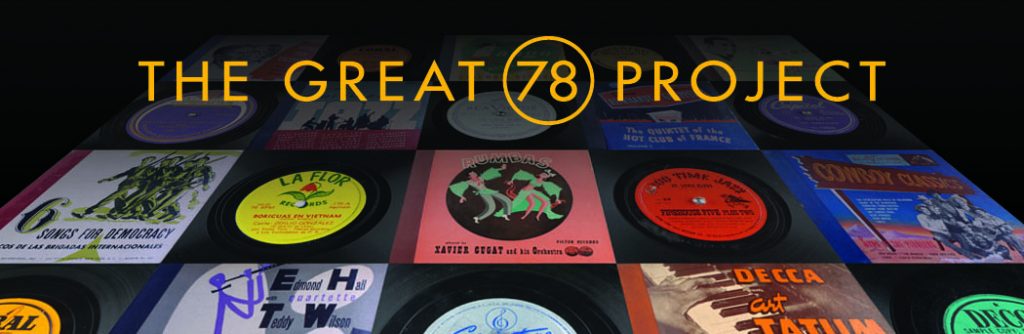
Every recording medium works as a metonym for its era: the term “LP” conjures up associations with a broad musical period of classic rock ‘n’ roll, soul, doo-wop, R&B, funk, jazz, disco etc.; we talk of the “CD era,” dominated by dance music and hip-hop; the 45 makes us think of jukeboxes, diners, and sock-hops; and the cassette, well… at least one subgenre of music, what John Peel called “shambling,” jangly, lo-fi pop, came to be known by the name “C86,” the title of an NME compilation, short for “Cassette, 1986.” (Readers of the magazine had to clip coupons and send money by postal mail to receive a copy of the tape.)
Soon, however, fewer and fewer people will remember the age of the 78rpm record, the preferred vehicle for the music of the early 20th century. From classical and opera to blues, bluegrass, swing, ragtime, gospel, Hawaiian, and holiday novelties the 78 epitomizes the sounds of its heyday as much as any of the media mentioned above.
While cassettes recently made a nostalgic comeback, and turntables are found in every big box store, we’re generally not equipped to play back 78s. These are brittle records made from shellac, a resin secreted by beetles. They were often played on appliances that doubled as quality parlor furniture.
Thanks now to the Internet Archive, that stalwart of digital cataloguing and curation, we can play twenty five thousand 78s and immerse ourselves in the early 20th century, whether for research purposes or pure enjoyment. Previous efforts at preservation have “restored or remastered… commercially viable recordings” on LP or CD, writes The Great 78 Project, the archive’s volunteer program to digitize musical history. The current effort seeks to go beyond popularity and collect everything, from the rarest and strangest to the already historic. “I want to know what the early 20th century sounded like,” writes Internet Archive founder Brewster Kahle, “Midwest, different countries, different social classes, different immigrant communities and their loves and fears.”
You can hear several selections here, and thousands more at this archive of 78s uploaded by audio-visual preservation company, George Blood, L.P. Other 78rpm archives from volunteer collectors and the ARChive of Contemporary Music are being digitized and uploaded as well. You’ll note the recordings are often submerged in crackle and hiss, and generally lack bass and treble (most playback systems of the time could not reproduce the lower and higher ends of the audible spectrum). “We have preserved the often very prominent surface noise and imperfections,” the Archive writes, “and included files generated by different sizes and shapes of stylus to facilitate different kinds of analysis.” Different playback systems could produce markedly different sounds, and the recordings were not always strictly 78rpm.
These conditions of the transfer ensure that we roughly hear what the first audiences heard, though the records’ age and our penchant for 7 speaker audio systems introduce some new variables. None of these recordings were even made in stereo. The 78 period, notes Yale Library, lasted between 1898 and the late 1950s, when the 33 1/2 rpm long-playing record fully edged out the older model. For approximately fifty years, these records carried recorded music, sound, and speech into homes around the world. “What is this?” Kahle asks of this formidable digitization project. “A reference collection? A collector’s dream? A discovery radio station? The soundtrack of the early 20th century?” All of the above. To learn more about The Great 78 Project, including the technical details of the transfer and how you can carefully package up and mail in your own 78rpm records, visit their Preservation page.
Related Content:
BBC Launches World Music Archive
DC’s Legendary Punk Label Dischord Records Makes Its Entire Music Catalog Free to Stream Online
Josh Jones is a writer and musician based in Durham, NC. Follow him at @jdmagness
Read More...The Nano Guitar: Discover the World’s Smallest, Playable Microscopic Guitar

In 1997, the Cornell Chronicle announced: “The world’s smallest guitar — carved out of crystalline silicon and no larger than a single cell — has been made at Cornell University to demonstrate a new technology that could have a variety of uses in fiber optics, displays, sensors and electronics.”
Invented by Dustin W. Carr, the so-called “nanoguitar” measured 10 micrometers long–roughly the size of your average red blood cell. And it had six strings, each “about 50 nanometers wide, the width of about 100 atoms.”
According to The Guardian, the vintage 1997 nanoguitar was actually never played. That honor went to a 2003 edition of the nanoguitar, whose strings were plucked by miniature lasers operated with an atomic force microscope, creating “a 40 megahertz signal that is 130,000 times higher than the sound of a full-scale guitar.” The human ear couldn’t hear something at that frequency, and that’s a problem not even a good amp–a Vox AC30, Fender Deluxe Reverb, etc.–could fix.
Thus concludes today’s adventure in nanotechnology.
If you would like to support the mission of Open Culture, consider making a donation to our site. It’s hard to rely 100% on ads, and your contributions will help us continue providing the best free cultural and educational materials to learners everywhere. You can contribute through PayPal, Patreon, and Venmo (@openculture). Thanks!
Related Content:
Stephen Fry Introduces the Strange New World of Nanoscience
A Boy And His Atom: IBM Creates the World’s Smallest Stop-Motion Film With Atoms
Read More...New Deep Learning Courses Released on Coursera, with Hope of Teaching Millions the Basics of Artificial Intelligence

FYI: If you follow edtech, you know the name Andrew Ng. He’s the Stanford computer science professor, who co-founded MOOC-provider Coursera and later became chief scientist at Baidu. Since leaving Baidu, he’s been working on three artificial intelligence projects, the first of which he unveiled yesterday. On Medium, he wrote:
I have been working on three new AI projects, and am thrilled to announce the first one: deeplearning.ai, a project dedicated to disseminating AI knowledge, is launching a new sequence of Deep Learning courses on Coursera. These courses will help you master Deep Learning, apply it effectively, and build a career in AI.
Speaking to the MIT Technology Review, Ng elaborated: “The thing that really excites me today is building a new AI-powered society… I don’t think any one company could do all the work that needs to be done, so I think the only way to get there is if we teach millions of people to use these AI tools so they can go and invent the things that no large company, or company I could build, could do.”
Andrew’s new 5‑part series of courses on Deep Learning can be accessed here. Courses include: Neural Networks and Deep Learning, Improving Deep Neural Networks, Structuring Machine Learning Projects, Convolutional Neural Networks, and Sequence Models.
You can find these courses on our list of Free Computer Science Courses, a subset of our collection, 1,700 Free Online Courses from Top Universities.
If you would like to support the mission of Open Culture, consider making a donation to our site. It’s hard to rely 100% on ads, and your contributions will help us continue providing the best free cultural and educational materials to learners everywhere. You can contribute through PayPal, Patreon, and Venmo (@openculture). Thanks!
Related Content:
Google’s DeepMind AI Teaches Itself to Walk, and the Results Are Kooky, No Wait, Chilling
Artificial Intelligence: A Free Online Course from MIT
Read More...Marshall McLuhan Explains Why We’re Blind to How Technology Changes Us, Raising the Question: What Have the Internet & Social Media Done to Us?
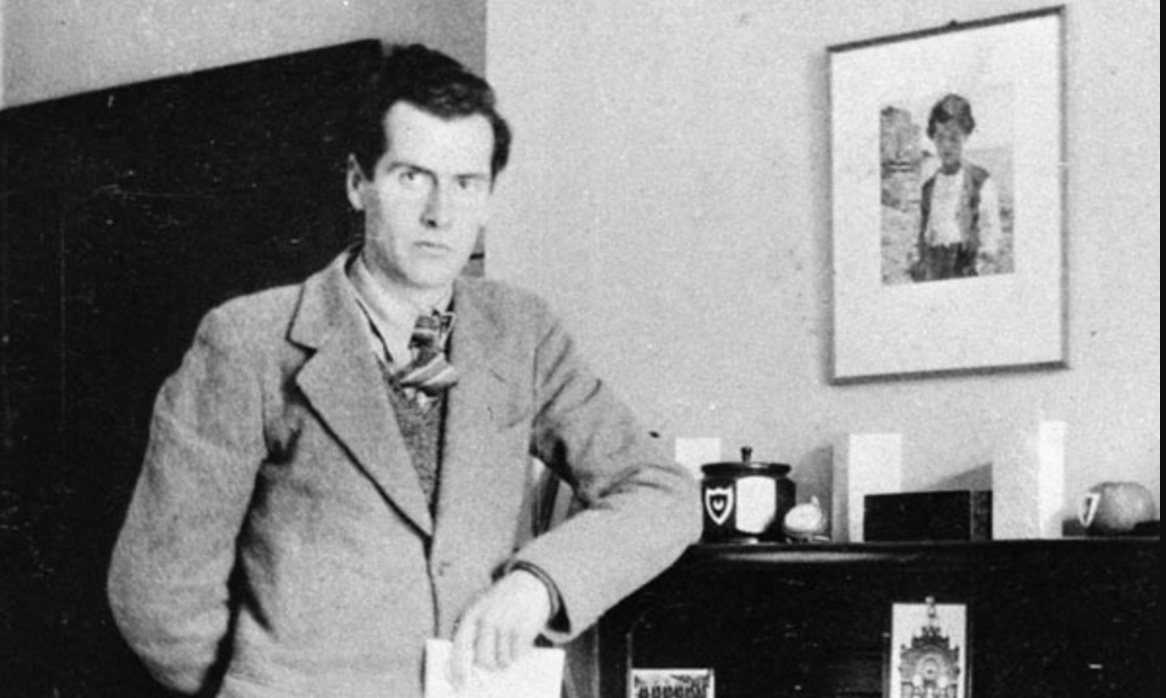
Image of Marshall McLuhan at Canada, by Wikimedia Commons
So many of us use Facebook every day, but how many of us know that its enormous presence in our lives owes, in part, to modern philosophy? “In the course of his studies at Stanford,” writes John Lanchester in a recent London Review of Books piece of Facebook, Silicon Valley billionaire Peter Thiel, an early investor in the company, “became interested in the ideas of the US-based French philosopher René Girard, as advocated in his most influential book, Things Hidden since the Foundation of the World,” especially a concept he called “mimetic desire.”
“Human beings are born with a need for food and shelter,” writes Lanchester. “Once these fundamental necessities of life have been acquired, we look around us at what other people are doing, and wanting, and we copy them.” Or as Thiel explained it, “Imitation is at the root of all behavior.” Lanchester reports that “the reason Thiel latched onto Facebook with such alacrity was that he saw in it for the first time a business that was Girardian to its core: built on people’s deep need to copy,” yet few of us, its users, have clearly perceived that essential aspect of Facebook and other social media platforms.
Marshall McLuhan, despite having died decades before their development, would have caught on right away — and he understood why even we savvy denizens of the 21st century haven’t. “For the past 3500 years of the Western world, the effects of media — whether it’s speech, writing, printing, photography, radio or television — have been systematically overlooked by social observers,” said the author of Understanding Media and The Medium is the Message. “Even in today’s revolutionary electronic age, scholars evidence few signs of modifying this traditional stance of ostrichlike disregard.”
Those words come from an in-depth 1969 interview with Playboy magazine that broke the celebrity literature professor McLuhan’s ideas to an even wider audience than they’d had before. In it he diagnosed a “peculiar form of self-hypnosis” he called “Narcissus narcosis, a syndrome whereby man remains as unaware of the psychic and social effects of his new technology as a fish of the water it swims in. As a result, precisely at the point where a new media-induced environment becomes all pervasive and transmogrifies our sensory balance, it also becomes invisible.”
As McLuhan saw it, “most people, from truck drivers to the literary Brahmins, are still blissfully ignorant of what the media do to them; unaware that because of their pervasive effects on man, it is the medium itself that is the message, not the content, and unaware that the medium is also the massage — that, all puns aside, it literally works over and saturates and molds and transforms every sense ratio. The content or message of any particular medium has about as much importance as the stenciling on the casing of an atomic bomb.”
Just last month, no less omnipresent an internet titan than Google celebrated McLuhan’s 106th birthday, and a social observer called PR Professor saw in it a certain irony: though “it seems like technology that extends man’s ability to experience and interpret the world is positive and desirable,” McLuhan pointed out “that the inherent tendency to focus on the messages within the media make us blind to the limits and structures imposed by the mediums themselves.” This blindness has consequences indeed, since, according to McLuhan, each time a society develops a new media technology, “all other functions of that society tend to be transmuted to accommodate that new form” as that technology “saturates every institution of that society.”
This went for speech, writing, print, and the telegraph as well as it goes for “social media platforms like Twitter, which reduce expressive possibilities to 140 characters of text or expressing one’s self through the ‘re-tweeting’ of posts by others.” McLuhan believed that at one time only the interpretive work of the artist, “who has had the power — and courage — of the seer to read the language of the outer world and relate it to the inner world,” could allow the rest of us to recognize the thoroughgoing effects of technology on society, but that “the new environment of electric information” had made possible “a new degree of perception and critical awareness by nonartists.” At least more of us, if we step back, can now understand our affliction by mimetic desire, Narcissus narcosis, or any number of other troubling conditions. What to do about them remains an open question.
Related Content:
McLuhan Said “The Medium Is The Message”; Two Pieces Of Media Decode the Famous Phrase
New Animation Explains Sherry Turkle’s Theories on Why Social Media Makes Us Lonely
Based in Seoul, Colin Marshall writes and broadcasts on cities and culture. He’s at work on the book The Stateless City: a Walk through 21st-Century Los Angeles, the video series The City in Cinema, the crowdfunded journalism project Where Is the City of the Future?, and the Los Angeles Review of Books’ Korea Blog. Follow him on Twitter at @colinmarshall or on Facebook.
Read More...Bertrand Russell Reveals the 4 Human Desires That Make Our World: Acquisitiveness, Rivalry, Vanity & Love of Power
Contrary to Aristotle, the eminent logician, philosopher, and activist Bertrand Russell believed that virtue and morality play little part in political life. Rather, what most drives us to action, he argued, is selfish desire. Russell’s political philosophy could seem almost Machiavellian, most notably in his Nobel Prize speech 1950, in which he proclaims that “all human activity is prompted by desire.” (Hear Russell read an excerpt above.)
There is a wholly fallacious theory advanced by some earnest moralists to the effect that it is possible to resist desire in the interests of duty and moral principle. I say this is fallacious, not because no man ever acts from a sense of duty, but because duty has no hold on him unless he desires to be dutiful. If you wish to know what men will do, you must know not only, or principally, their material circumstances, but rather the whole system of their desires with their relative strengths.
Russell’s argument about desire admits “there is no limit to the efforts that men will make, or to the violence that they will display” in the face of perceived scarcity, and his observations recall not only the realpolitik of Machiavelli, but the insights of that most prominent theorist of desire, Sigmund Freud.
Man differs from other animals in one very important respect, and that is that he has some desires which are, so to speak, infinite, which can never be fully gratified, and which would keep him restless even in Paradise. The boa constrictor, when he has had an adequate meal, goes to sleep, and does not wake until he needs another meal. Human beings, for the most part, are not like this.
Rather than libidinous instincts, however, Russell names four main political desires that cannot be satisfied: Acquisitiveness (“the wish to possess as much as possible), Rivalry (“a much stronger motive”), Vanity (“a motive of immense potency”), and Love of Power (“which outweighs them all”). We may note the tremendous degree to which all four desires seem actively at work in shaping our current world. All four of these qualities greet us every morning on our smartphones and never let up, day after day. But it has always been so to one degree or another, Russell argues. The important thing is to be clearsighted on the matter. Although selfish political desires can and largely are destructive, they need not always be so.
Political desires like the love of power may “have other sides which are more desirable.” Scholarly and scientific endeavors may be “mainly actuated by a love of power.…. In politics, also, a reformer may have just as strong a love of power as a despot. It would be a complete mistake to decry love of power altogether as a motive.” “Russell,” writes Maria Popova, is “a thinker of exceptional sensitivity to nuance and to the dualities of which life is woven.” He cautions that we cannot simply dismiss our most powerful motive as “a wholesale negative driver.”
The real problem, as Russell sees it, lies in “circumstances in which populations will fall below selfishness, if selfishness is interpreted as enlightened self-interest.” The phenomenon we observe of people “voting against their interests” is for Russell an occasion “on which they are convinced that they are acting from idealistic motives.”
Much that passes as idealism is disguised hatred or disguised love of power. When you see large masses of men swayed by what appear to be noble motives, it is as well to look below the surface and ask yourself what it is that makes these motives effective. It is partly because it is so easy to be taken in by a facade of nobility that a psychological inquiry, such as I have been attempting, is worth making.
Rather than virtue or morality, politics most requires “intelligence,” Russell concludes, “a thing that can be fostered by known methods of education.” These are not the forms of education we generally receive: “Schools are out to teach patriotism,” he says, “newspapers are out to stir up excitement; and politicians are out to get re-elected. None of the three, therefore, can do anything towards saving the human race from reciprocal suicide.”
The Cold War threat of nuclear annihilation hangs heavy over Russell’s speech. As long as humans are gripped by hatred and fear of others and held in thrall to political delusions, he suggests, the possibility of mutually assured destruction remains. On the other hand, if we were honest about our desires, and “if men were actuated by self-interest,” Russell writes, “which they are not.… if men desired their own happiness as ardently as they desired the misery of their neighbors.… the whole human race would cooperate.” Read the full text of Russell’s Nobel speech here.
Related Content:
Free Online Political Science Courses
7 Nobel Speeches by 7 Great Writers: Hemingway, Faulkner, and More
Bertrand Russell & Buckminster Fuller on Why We Should Work Less, and Live & Learn More
Josh Jones is a writer and musician based in Durham, NC. Follow him at @jdmagness
Read More...New Yorkers Can Now Stream 30,000 Free Movies, Including the Entire Criterion Collection, with Their Library Cards

Image by Andrés Nieto Porras, via Flickr Commons
A quick heads up for the 8+ million people living in New York City. According to The New York Times, anyone “who has a New York Public Library or Brooklyn Public Library card can now watch more than 30,000 feature films, documentaries, foreign-language films and training videos.” This includes the entire catalogue of films in The Criterion Collection (think Fellini, Lynch and Kurosawa), and also complete lecture series from The Great Courses.
The films can be viewed streamed anywhere, anytime, on smartphones, tablets, PCs and smart TVs.
New York Public Library members can get started here. And Brooklyn Public Library fans can do the same here.
Please someone, beam me back to New York.
If you would like to support the mission of Open Culture, consider making a donation to our site. It’s hard to rely 100% on ads, and your contributions will help us continue providing the best free cultural and educational materials to learners everywhere. You can contribute through PayPal, Patreon, and Venmo (@openculture). Thanks!
Related Content:
4,000+ Free Movies Online: Great Classics, Indies, Noir, Westerns, Documentaries & More120 Artists Pick Their Top 10 Films in the Criterion Collection
100,000+ Wonderful Pieces of Theater Ephemera Digitized by The New York Public Library
Foodie Alert: New York Public Library Presents an Archive of 17,000 Restaurant Menus (1851–2008)
New York Public Library Puts 20,000 Hi-Res Maps Online & Makes Them Free to Download and Use
Read More...When Mistakes/Studio Glitches Give Famous Songs Their Personality: Pink Floyd, Metallica, The Breeders, Steely Dan & More
Before the advent of digital studio technology, a degree of imprecision naturally resulted from the recording process. It may now be too easy to erase and correct perceived errors. As Brian Eno has pointed out, “the temptation of the technology is to smooth everything out.” Perhaps that’s why so many of the famous songs containing mistakes in pop culture lore come from a pre-digital age. In any case, such lore abounds. Some of it speculative, some anecdotal, some apocryphal, and much of it clearly evident in close listens and confirmed by the musicians, engineers, and producers themselves.
A recent Reddit thread compiled 500 comments worth of discussion on the subject. One prominent example is Ella Fitzgerald’s 1960 “Mack the Knife,” in which she forgets the lyrics to the chorus and improvises. “Talk about failing gracefully,” writes user Bleue22. The album, they note, went on to win a Grammy.
But this example, you may object, comes from a live album—no second takes allowed. And Fitzgerald sets up the error by saying beforehand, “we hope we remember all the words.” (I’d guess she’s using the royal “we,” to which she’s fully entitled.) Nonetheless, her “Mack the Knife” may have no equal.
Still, we don’t lack for studio examples of mistakes in great recordings. If you’re a metal fan, Metallica’s “Seek and Destroy” from 1983’s Kill ‘Em All likely holds a special place of honor in your collection. As Kirk Hammett revealed in a 2002 interview with Guitar World after his induction into the magazine’s hall of fame, his solo on the track was only a second or third take, with little rehearsal. “There were no frills, no contemplation, no overintellectualizing,” he says. The result? Amazing, right? But, Hammett continues, “On a couple of notes in that solo, I bend the notes out of pitch; for 18 years, every time I’ve heard that guitar solo, those sour notes come back to haunt me!”
Every guitarist has suffered through this experience while listening back to their records. Few make Guitar World’s hall of fame. The point is that greatness and perfection are not always the best of friends. Another example of the kind of thing that might only haunt a musician: In Steely Dan’s “Aja” from the 1977 Grammy-winning album of the same name, drummer Steve Gadd plays “one of the best drum solos ever recorded,” writes Michael Duncan as Sonic Scoop. Drummers for decades have sought to replicate the moment, especially an idiosyncratic click at 4:57. Turns out, it was “actually a slip of his stick; albeit a well-timed one.” The solo, Duncan notes, was done in one take.
Other examples may have had life-changing consequences for the musician in question. It’s rumored that David Gilmour’s faintly recorded coughing on Pink Floyd’s “Wish You Were Here” bothered him so much that he quit smoking. In some cases, the mistake can turn into a hook or a musical statement, such as Cindy Wilson’s shout of “Tiiiiiiin Roof! Rusted” in the B‑52’s “Love Shack,” apparently a mistake on Wilson’s part. The phenomenon, granted, tends to manifest in genres that accommodate all varieties of looseness—rock, blues, jazz, etc.—and the great bulk of examples in the Reddit mistake thread come from such recordings. I couldn’t say whether it’s possible to compile such a list in music with far stricter arrangements or reliance on electronic instrumentation.
I also couldn’t say whether mistakes in, say classical or electronic music, would produce such desirable results. What often emerges in these discussions is the degree to which mistakes, unplanned improvisations, or happy accidents can become essential features of a song. Take The Breeder’s “Cannonball,” which intentionally incorporates a mistake bassist Josephine Wiggs repeatedly made in rehearsals, sliding to the wrong note in the solo bass intro, then correcting when the guitars came in. “We all just thought it was hilarious and thought it sounded really great,” she remembered. “It was clear to us at that moment that that was the right thing to do, to keep the wrong note in there.” Does it matter that some recorded mistakes are intentional and others are not? That question may be fodder for another 500-comment-long discussion. Or we could heed the wisdom of Brian Eno or Miles Davis and just go with it either way.
Related Content:
Brian Eno Explains the Loss of Humanity in Modern Music
Jump Start Your Creative Process with Brian Eno’s “Oblique Strategies” Deck of Cards (1975)
John Cleese on The Importance of Making and Embracing Mistakes
Josh Jones is a writer and musician based in Durham, NC. Follow him at @jdmagness
Read More...What Happens When the Books in William S. Burroughs’ Personal Library Get Artistically Arranged — with His Own “Cut-Up” Method
If your Facebook news feed looks anything like mine, you wake up each morning to a stream of not just food snapshots and selfies but pictures of books, whether stacked up, dumped into a pile, or arranged neatly on shelves. Why do we post digital photos of our printed matter? Almost certainly for the same reason we do anything on social media: to send a message about ourselves. We want to tell our friends who we are, or who we think we are, but not in so many words, or rather not in so few; a few of the books we’ve read (or intend to read), carefully selected and arranged, does the job. But what if, instead of assembling a self-portrait through books, someone else entered your personal library and did it for you?
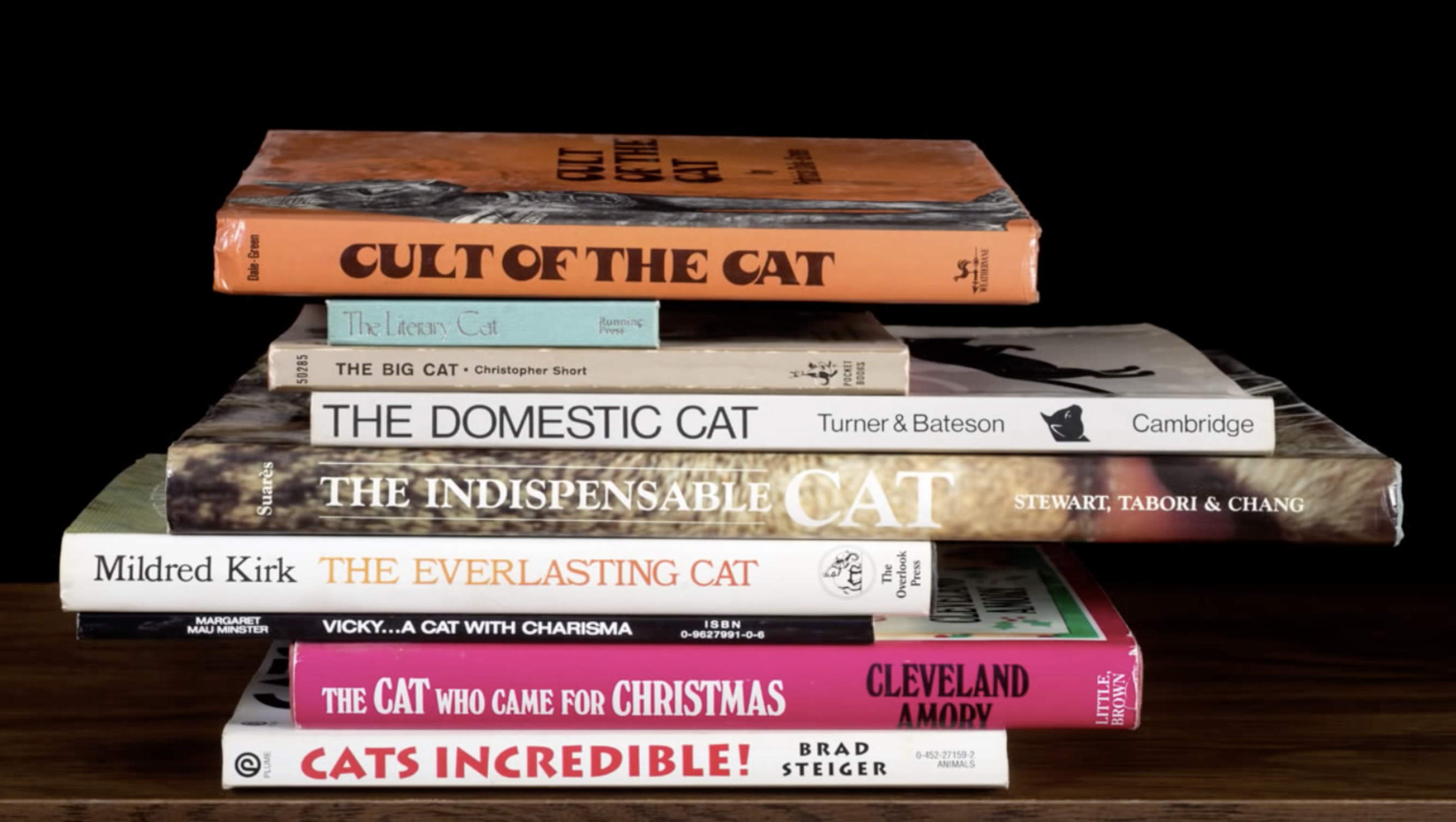
Artist Nina Katchadourian (she of, among many other endeavors, the airplane-bathroom 17th-century Flemish portraiture) recently took on that task in the Lawrence, Kansas home of famously hard-living and furiously creative beat writer William S. Burroughs. She did it as part of her long-running Sorted Books project, in which, in her words, “I sort through a collection of books, pull particular titles, and eventually group the books into clusters so that the titles can be read in sequence.
The final results are shown either as photographs of the book clusters or as the actual stacks themselves, often shown on the shelves of the library they came from. Taken as a whole, the clusters are a cross-section of that library’s holdings that reflect that particular library’s focus, idiosyncrasies, and inconsistencies.”
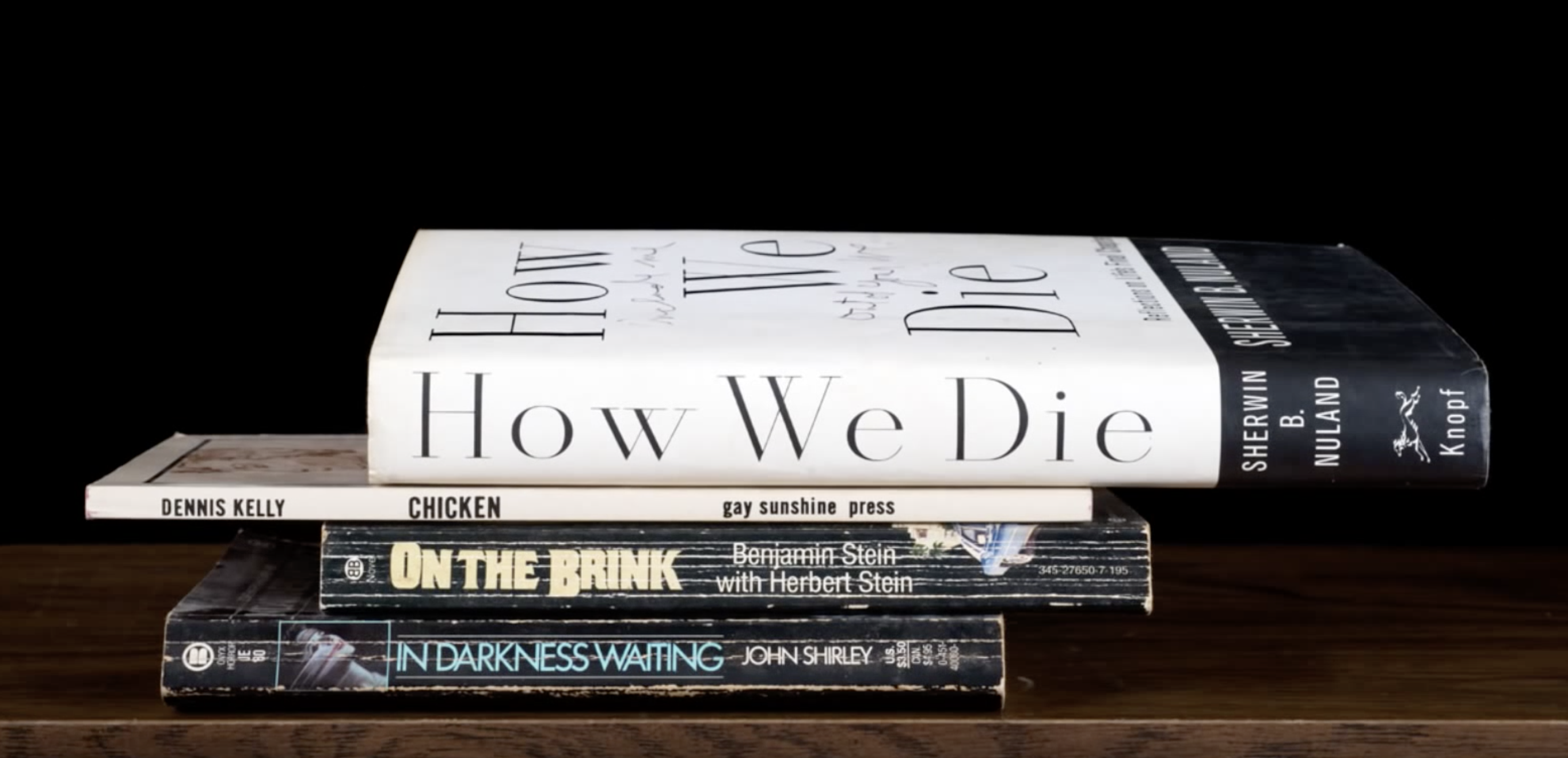
Kansas Cut-Up, the Burroughs chapter of Sorted Books, features such arrangements as How Did Sex Begin? / Uninvited Guests / Human Error, Memoirs of a Bastard Angel / A Night of Serious Drinking / A Little Original Sin, and American Diplomacy / Physical Interrogation Techniques / In the Secret State. Thom Robinson of the European Beat Studies Network describes Burroughs’ book collection as “a selection of largely European works whose contents include paranoia, theories of language, pseudoscience, mordant humour and drugs: in retrospect, it’s easy to imagine the owner of such an idiosyncratic library producing the melange of Naked Lunch. Perhaps for this reason, it seems hard to resist reordering the books which Burroughs owned in 1944 in order to emphasise the most recognisable elements of the later Burroughs persona.”
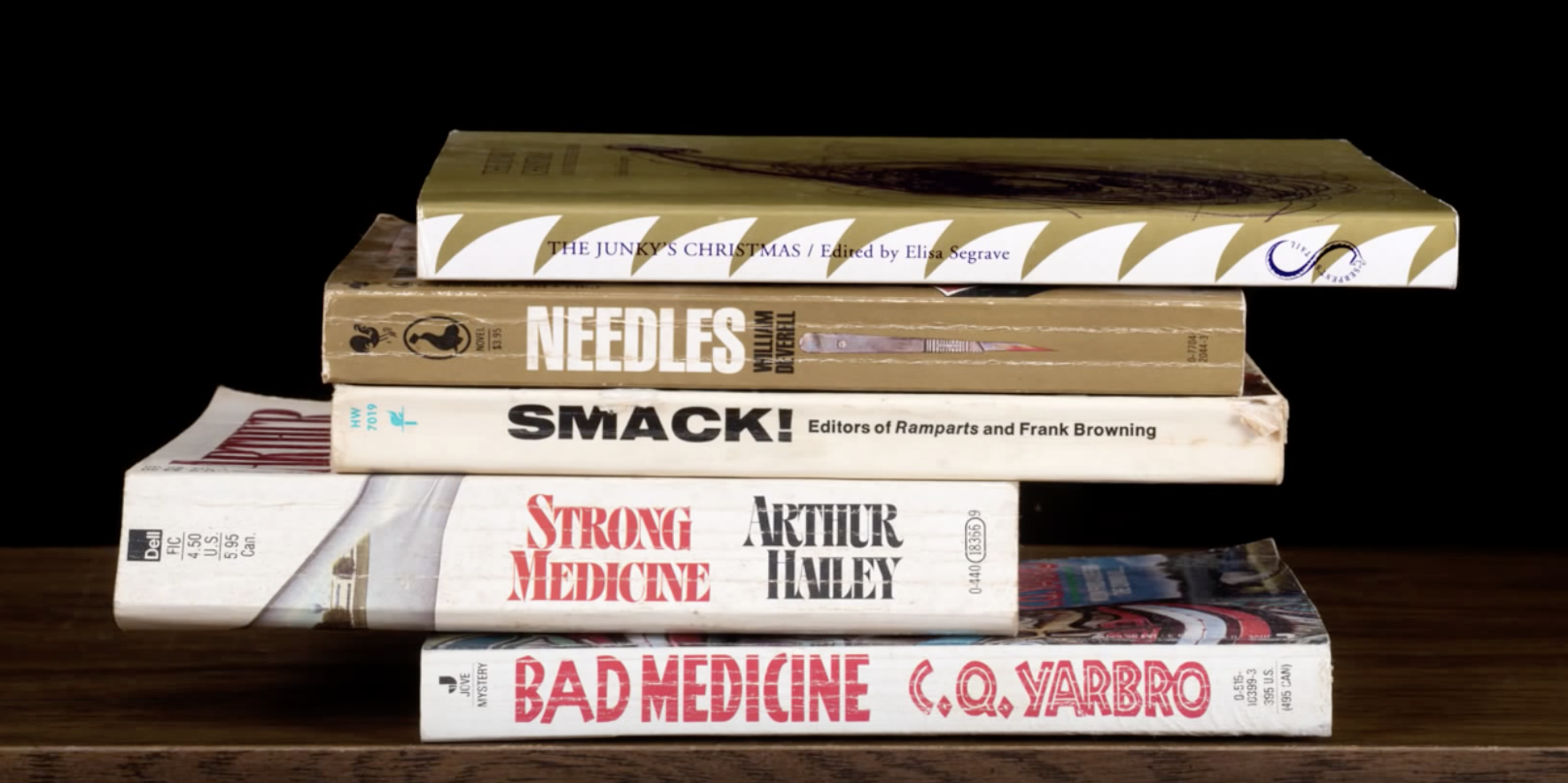
Sometimes Katchadourian seems to do just that and sometimes she doesn’t, but her method of book-sorting, which she explains in the episode of John and Sarah Green’s series The Art Assignment at the top of the post, bears more than a little resemblance to Burroughs’ own “cut-up” method of literary composition. “Take a page,” as Burroughs himself explained it. “Now cut down the middle and cross the middle. You have four sections: 1 2 3 4 … one two three four. Now rearrange the sections placing section four with section one and section two with section three. And you have a new page. Sometimes it says much the same thing. Sometimes something quite different.” And just as a rearranged book can speak in a new and strange voice, so can a rearranged library.
via Austin Kleon’s newsletter (which you should subscribe to here)
Related Content:
How to Jumpstart Your Creative Process with William S. Burroughs’ Cut-Up Technique
115 Books on Lena Dunham & Miranda July’s Bookshelves at Home (Plus a Bonus Short Play)
The 430 Books in Marilyn Monroe’s Library: How Many Have You Read?
Based in Seoul, Colin Marshall writes and broadcasts on cities and culture. He’s at work on the book The Stateless City: a Walk through 21st-Century Los Angeles, the video series The City in Cinema, the crowdfunded journalism project Where Is the City of the Future?, and the Los Angeles Review of Books’ Korea Blog. Follow him on Twitter at @colinmarshall or on Facebook.
Read More...Support Us
We're hoping to rely on loyal readers, rather than erratic ads. Please click the Donate button and support Open Culture. You can use Paypal, Venmo, Patreon, even Crypto! We thank you!

About Us

Open Culture scours the web for the best educational media. We find the free courses and audio books you need, the language lessons & educational videos you want, and plenty of enlightenment in between.
Advertise With Us

FREE UPDATES!
GET OUR DAILY EMAIL
Get the best cultural and educational resources on the web curated for you in a daily email. We never spam. Unsubscribe at any time.
FOLLOW ON SOCIAL MEDIA

Open Culture editor Dan Colman scours the web for the best educational media. He finds the free courses and audio books you need, the language lessons & movies you want, and plenty of enlightenment in between.
Advertise With Us


