Stream 35 Hours of Classic Blues, Folk, & Bluegrass Recordings from Smithsonian Folkways: 837 Tracks Featuring Lead Belly, Woody Guthrie & More

Image of Woody Guthrie by Al Aumuller, via Wikimedia Commons
Marshall McLuhan’s chestnut “the medium is the message” contains some of the most important theory about mass media to have emerged in the past century. In its honor, we might propose another slogan—less conceptually tidy and alliterative—that brings to mind the arguments of critical theorists like Theodor Adorno: “the economy is the culture”—the economic mechanisms that govern the “culture industry,” as Adorno would say, determine the kinds of productions that saturate our shared environment. In a purely corporate capitalist model, we consume culture—that which is marketed most aggressively and distributed most plentifully—and often discard it just as quickly. In an economy that doesn’t make profit the fulcrum of its every move, things go otherwise. The lines between consumers, creators, and communities become blurred in weird and wonderful ways.
This can happen in decentralized environments like the wilds of the early internet. And it can happen in institutions that code it into their design. The Smithsonian is one of those institutions. The public collections in its vast network of museums has remained, outside of special exhibits and films, free and “open access” for everyone. And one of their key cultural contributions, the Smithsonian Center for Folklife and Cultural Heritage, has devoted itself since its founding in the late sixties to “culture of, by, and for the people.”
Even if you’ve never taken the time to delve into their curatorial efforts (and you should), you’ll know their work through Folkways Recordings, the record label created in by Moses Asch—founder of Folkways Records in 1949. After he passed away in 1986, Asch’s family donated over 2,000 records, his entire discography, to the Smithsonian, with the proviso that they always remain in print, whether or not they made a buck.
This has meant that scholars and fans of folk from all over the world have always been able to find the work of Pete Seeger, The Carter Family, Woody Guthrie, and Lead Belly, to name but a few of the label’s “stars.” There are many more: Bill Monroe, Doc Watson, Elizabeth Cotten, Reverend Gary Davis…. So many names in the pantheon of folk giants Robert Crumb immortalized in his colorful, and unusually tasteful, Heroes of Blues, Jazz, and Country. But Folkways has preserved much more besides. Kentucky’s Old Regular Baptist Church’s a capella hymns, Kilby Snow’s autoharp, Snooks English’s New Orleans street singing, Alice Gerrard and Hazel Dickens’ 60s interpretations of traditional bluegrass…. Music that appealed to small but culturally rich communities in its day, and that may have disappeared along with those communities in the scrum of cultural history, dominated as it is by mass entertainments.
The small, regional creations, some teetering on genius, some haunting in their artlessness, are critical documents of old America, the hollers, deserts, streets, swamps, low country, back country, mountains, valleys…. Hear it all in the Spotify playlist above (or access it here), 837 tracks of Folkways recordings. Smithsonian Folkways is perhaps best known for its North American artists, but it has released recordings from all over the world. Rather than creating commodities, the institution functions as a repository of global cultural memory, collecting and preserving “people’s music.” Since Asch’s endowment, Folkways has created an additional six labels under its umbrella and released over 300 new recordings. In 2003, they partnered with the American Folklife Center for the “Save Our Sounds” project, which aims to preserve recordings like those made by Thomas Edison on wax cylinders. Folkways opens a window on an alternate world where cultural production is not a perpetual struggle for ratings, reviews, and sales dominance.
It’s not entirely a utopian vision. There is the danger of a paternalizing approach. Curators like Asch, Harry Smith, John and Alan Lomax, and hundreds more serious enthusiasts and ethnographers have their own agendas, interests, biases, and blind spots. What we understand now as traditional Delta blues, for example, is a product of selection bias—it excludes many artists and varieties that didn’t catch on with collectors. Still Folkways remedies much of this shortcoming by including work from a broad spectrum of unknown composers, interpreters, and performers. There may be no form of modern folk music today that hasn’t been crafted and molded by the music industry, which might mean, by definition, that there is no modern folk music. For such a thing to exist—the “people’s music”—perhaps more democratic economies and institutions must prevail.
Related Content:
Hear 17,000+ Traditional Folk & Blues Songs Curated by the Great Musicologist Alan Lomax
Alan Lomax’s Music Archive Houses Over 17,400 Folk Recordings From 1946 to the 1990s
Legendary Folklorist Alan Lomax: ‘The Land Where the Blues Began’
Woody Guthrie at 100: Celebrate His Amazing Life with a BBC Film
Hear Zora Neale Hurston Sing the Bawdy Prison Blues Song “Uncle Bud” (1940)
Josh Jones is a writer and musician based in Durham, NC. Follow him at @jdmagness
Read More...An Animated Look at Vladimir Nabokov’s Passion for Butterfly Collecting: “Literature & Butterflies Are the Two Sweetest Passions Known to Man”
Literature and butterflies are the two sweetest passions known to man. — Vladimir Nabokov
A 1941 family road trip along Route 66 planted the seeds for Vladimir Nabokov’s novel Lolita.
It also enriched the American Museum of Natural History’s butterfly collection by some 300 North American specimens.
The author, an avid amateur lepidopterist, indulged his hobby along the way, depositing butterflies collected on this and other trips in glassine envelopes labeled with the name of the towns where the creatures encountered his net. Upon his return, he decided to donate most of his haul to the museum’s Lepidoptera collection, where he was as an eager volunteer.
Years later, Suzanne Rab Green, a Tiger Moth specialist and assistant curator at the museum, uncovered Nabokov’s specimens packed in a vintage White Owl cigar box.
Recognizing that this collection had literary value as well as scientific, Green decided to sort it by location rather than species, preserving the carefully hand-lettered envelopes along with the fragile wings and thoraxes.
Using Google Earth, she retraced Nabokov’s 3‑week journey for the museum’s Shelf Life series, digitally pinning his finds alongside vintage postcards of Gettysburg, Yosemite National Park, and the Grande Tourist Lodge in Dallas, Texas—all fertile collection sites, at least in 1941.
Butterflies remained a lifelong obsession for the author. He served for six years as curator of Harvard’s Museum of Comparative Zoology’s Lepidoptera wing and developed an evolutionary theory related to his study of the Polyommatus blues Green mentions in the 360° video above. (Be aware, the 360° feature will not work in Safari).

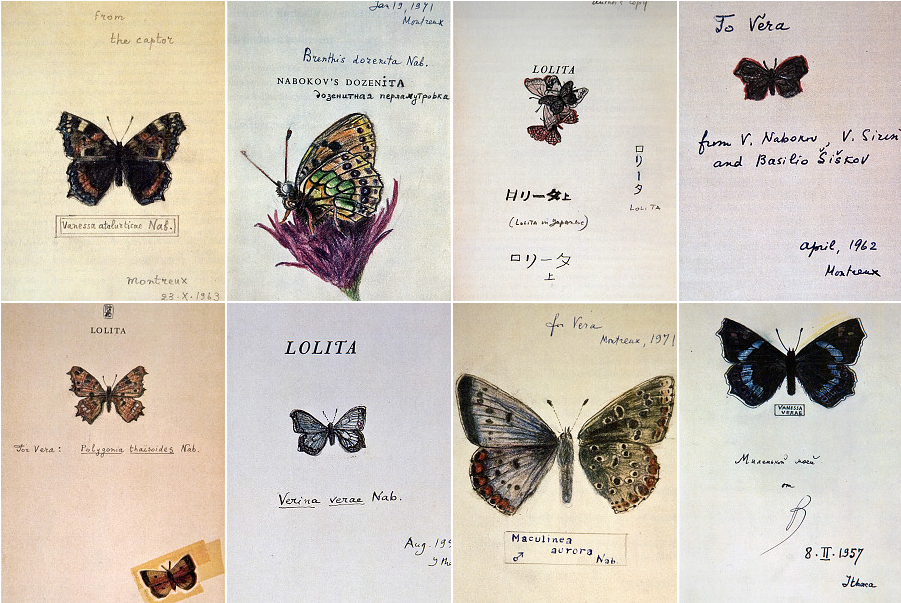
He also wooed his wife, Vera, by making charming and keenly observed drawings of butterflies for her.
An avowed enemy of symbols and allegory, Nabokov prevented butterflies from occupying too significant a role in his fictional oeuvre, though he gushed unabashedly in his memoir, Speak, Memory:
Let me also evoke the hawkmoths, the jets of my boyhood! Colors would die a long death on June evenings. The lilac shrubs in full bloom before which I stood, net in hand, displayed clusters of a fluffy gray in the dark—the ghost of purple. A moist young moon hung above the mist of a neighboring meadow. In many a garden have I stood thus in later years—in Athens, Antibes, Atlanta—but never have I waited with such a keen desire as before those darkening lilacs. And suddenly it would come, the low buzz passing from flower to flower, the vibrational halo around the streamlined body of an olive and pink Hummingbird moth poised in the air above the corolla into which it had dipped its long tongue…. Through the gusty blackness, one’s lantern would illumine the stickily glistening furrows of the bark and two or three large moths upon it imbibing the sweets, their nervous wings half open butterfly fashion, the lower ones exhibiting their incredible crimson silk from beneath the lichen-gray primaries. “Catocala adultera!” I would triumphantly shriek in the direction of the lighted windows of the house as I stumbled home to show my captures to my father.
Despite the author’s stated distaste for overt symbolism, a few butterflies did manage to flutter onto the pages of his best known work, resulting in at least one thesis papers that makes a case for Lolita as butterfly—irresistible, beautiful, easily ensnared….
Did I ever mention that her bare arm bore the 8 of vaccination? That I loved her hopelessly? That she was only fourteen? An inquisitive butterfly passed, dipping, between us.
- Lolita, Vladimir Nabokov, 1955
Track Nabokov’s cross-country butterfly collecting trip, courtesy of the American Museum of Natural History, here.
Related Content:
Vladimir Nabokov’s Delightful Butterfly Drawings
Vladimir Nabokov Names the Greatest (and Most Overrated) Novels of the 20th Century
Take Vladimir Nabokov’s Quiz to See If You’re a Good Reader–The Same One He Gave to His Students
Vladimir Nabokov (Channelled by Christopher Plummer) Teaches Kafka at Cornell
Ayun Halliday is an author, illustrator, theater maker and Chief Primatologist of the East Village Inky zine. Follow her @AyunHalliday.
Read More...An Online Guide to 350 International Art Styles & Movements: An Invaluable Resource for Students & Enthusiasts of Art History
If you majored in art history, you no doubt have lasting memories, and possibly painful ones, of long nights spent in the library memorizing the names and signal characteristics of various art movements. What a shame, you might well think when looking back, that a subject as fascinating and important as the transformation of human creativity over time could become such a chore. Now that you’re free to learn about art history in whatever manner and order you like, why not start in Monoskop’s expansive online guide to art styles and movements?
As “a wiki for collaborative studies of the arts, media and humanities,” Monoskop has long offered a wide selection of downloadable books, videos, sound recordings, and other materials invaluable for anyone with an interest in the arts, especially the modern arts.
Its movement-and-style guide “brings together some 350 art styles and movements from the 1860s until today. Besides the canonical isms of modern art, it expands the list with movements usually treated as secondary to the visual art canon, such as Lettrism, Situationism, Sound art, Expanded cinema, Neoism, or Software art, and does not leave out non-Western art either.”
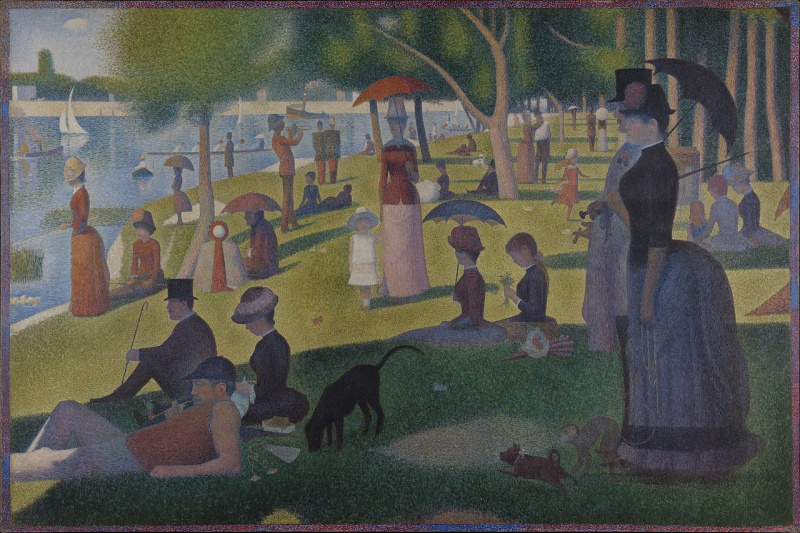
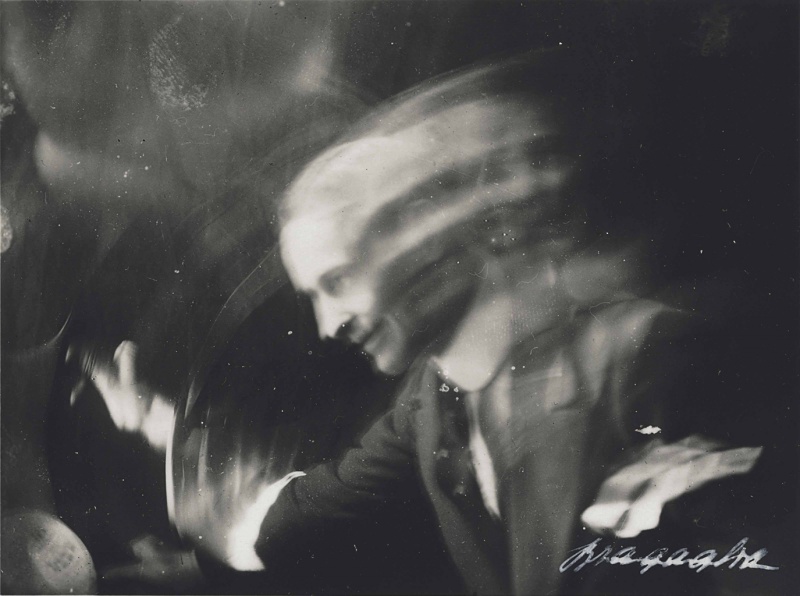
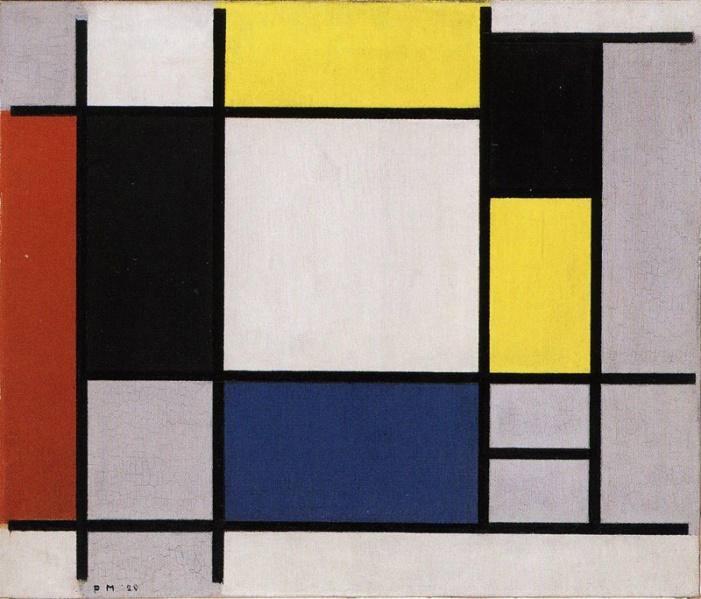
Each movement or style’s entry provides, among other information, the major artists, events, and texts (including, of course, “manifestos” and proclamations) associated with it, the media its works used, and links to all the relevant items both within and outside of Monoskop’s collections. It also includes related historical images, such as Futurist photographer Anton Giulio Bragaglia’s 1911 Salutando, De Stijl painter Piet Mondrian’s 1920 Composition with Yellow, Red, Black, Blue, and Gray, George Seurat’s Pointillism-defining 1884 A Sunday Afternoon on the Island of La Grande Jatte, or stills from computer art pioneers Lillian Schwartz and Ken Knowlton’s 1970 animation Pixillation.

You may arrive in Monoskop’s guide to art styles and movements intending only to learn about one style or movement, but none of them developed in isolation. The organization makes it easy enough to see the connections that a dip in to research Arts and Crafts could well finish up, who knows how later, in Precisionism, Neo-Dada, or the aforementioned Expanded Cinema (an intriguing term; if you don’t know the art to which it refers, you can follow that link and find out). Or maybe you are currently a student majoring in art history, and you need something a bit more interesting than your textbook to solidify in your mind the nature of and connections between all these artistic ventures, influential or minor, long-lived or flash-in-the-pan — in which case, bookmark Monoskop’s guide right away.
Related Content:
The History of Modern Art Visualized in a Massive 130-Foot Timeline
Bauhaus, Modernism & Other Design Movements Explained by New Animated Video Series
The Metropolitan Museum of Art Puts 400,000 High-Res Images Online & Makes Them Free to Use
Based in Seoul, Colin Marshall writes and broadcasts on cities and culture. He’s at work on the book The Stateless City: a Walk through 21st-Century Los Angeles, the video series The City in Cinema, the crowdfunded journalism project Where Is the City of the Future?, and the Los Angeles Review of Books’ Korea Blog. Follow him on Twitter at @colinmarshall or on Facebook.
Read More...Apple’s Hypercard Software, the Innovative 1980s Precursor to Hypertext, Now Made Available by Archive.org
Archive.org is on a bit of a roll lately. After recently making available 25,000+ digitized 78rpm records from the early 20th century, they’ve turned around and put online Apple Hypercard software. When Hypercard was released in 1987, The New York Times published an article entitled “Apple to Introduce Unusual Software,” which began:
Apple Computer Inc. will introduce an unusual database and management information program Tuesday that the company hopes will help it maintain its lead in technology for making computers easy to use.
The new software, known as Hypercard, will enable users of Apple’s Macintosh computers to organize information on computerized file cards that can be linked to other file cards in intricate ways. The program will be included for no charge with each Macintosh sold, starting this month.
Hypercard made its appearance precisely when Apple also released “a communications device, known as a modem, that will enable the Macintosh to send documents to and from facsimile machines.” Some of us still use modems today. Hypercard, not so much. At least not directly.
As Hypercard’s creator Bill Atkinson indicates above, Hypercard started working with the hypertext concept that’s now prevalent on the web today. Think those links you find in HTML. On Archive.org, you can find and play with Hypercard software, or what they call emulated Hypercard stacks. (They also host a library of emulated software for the early Macintosh computer). Read more about Archive.org’s Hypercard project on their blog here.
If you would like to support the mission of Open Culture, consider making a donation to our site. It’s hard to rely 100% on ads, and your contributions will help us continue providing the best free cultural and educational materials to learners everywhere. You can contribute through PayPal, Patreon, and Venmo (@openculture). Thanks!
Related Content:
Free Online Computer Science Courses
Free: You Can Now Read Classic Books by MIT Press on Archive.org
How Brewster Kahle and the Internet Archive Will Preserve the Infinite Information on the Web
The Internet Arcade Lets You Play 900 Vintage Video Games in Your Web Browser (Free)
Read More...Adam Savage Takes Us Inside Jack White’s Third Man Records, the First New Record-Pressing Plant in the US in 30 Years
Jack White, best known as the frontman of The White Stripes, launched Third Man Records in 2001, which has since positioned itself as “an innovator in the world of vinyl records and a boundary pusher in the world of recorded music, aiming to bring tangibility and spontaneity back into the record business.”
After establishing a physical location in Nashville in 2009, Third Man Records opened a second site in Detroit, and now a new vinyl pressing plant in the Motor City, providing a home to eight German-made record pressing machines. Jack White told CBS, “One day, I want this place to be like what I had heard about Henry Ford wanted for Ford Motor company. Which was you pour in raw materials on this side and out the other side of the factory pop out cars.”
Above you can get a half hour tour of the new record plant from Mythbuster’s Adam Savage. Enjoy.
If you would like to support the mission of Open Culture, consider making a donation to our site. It’s hard to rely 100% on ads, and your contributions will help us continue providing the best free cultural and educational materials to learners everywhere. You can contribute through PayPal, Patreon, and Venmo (@openculture). Thanks!
Related Content:
Handmade Animation Shows You “How To Make a 1930 Paramount Record”
How Vinyl Records Are Made: A Primer from 1956
Read More...Video Essayist Kogonada Makes His Own Acclaimed Feature Film: Watch His Tributes to Its Inspirations Like Ozu, Linklater & Malick
We’ve featured the work of many cinema-loving video essayists (myself included) here on Open Culture, none of it more artistic than that of a man who goes by the name of Kogonada. Whether dealing with the films of auteurs like Stanley Kubrick, Andrei Tarkovsky, Alfred Hitchcock, or Wes Anderson, he finds new and striking ways — often free of traditional narration, and sometimes even free of spoken words altogether — to show us how their cinematic visions work, and in so doing to create new cinematic visions of his own. But when, we Kogonada fans have long wondered, would this mysterious fellow make a movie of his own?
The answer arrived at this year’s Sundance Film Festival in the form of Columbus, Kogonada’s feature directorial debut. “Columbus gets its title from the city where it’s set — Columbus, Indiana, home to a remarkable collection of renowned works of modern architecture,” writes the New Yorker’s Richard Brody, one of the many critics to have already lavished praise on the newly released picture.
“Those buildings provide an extraordinary premise for the drama, which is a visionary transformation of a familiar genre: a young adult’s coming-of-age story. For once, that trope doesn’t involve a sexual awakening or a family revelation; it’s the tale of an intellectual blossoming, thanks to a new friendship that arises amid troubled circumstances.”
Those troubled circumstances have to do with the parents of the two main characters: Casey, a recent high-school graduate who’s stayed in town to care for a mother trying to kick a methamphetamine habit, and Jin, a fortysomething translator who’s flown in from his home in Korea (birthplace of both the Midwest-raised Kogonada and the film’s Los Angeles-raised star John Cho) to watch over his father, an architectural theorist plunged into a coma by a stroke. “These parallel lines meet when Casey offers to show the stranger her town,” writes Rolling Stone’s Peter Travers in his review. “ ‘Meth and modernism are really big here,’ she tells Jin, as he becomes increasingly intrigued by this girl who sees the art and the humanity in buildings.”
Soon Jin and Casey take “baby steps toward a relationship, in a manner that recalls Richard Linklater’s Before Sunrise.” That film, and its successors Before Sunset and Before Midnight, figure heavily into Kogonada’s video essay on Linklater, “On Cinema & Time.” Other influences, cited by critics as well as Kogonada himself, include Terence Malick, whose way with the elemental he examined in “Fire & Water,” and Yasujiro Ozu, whose films got him thinking about cinema in the first place. As he put it to Indiewire, he started by thinking he would “try to figure out what it is about his films that initially felt very unimpressive, but kept haunting me,” to understand why Ozu “isn’t easy to just reduce to something — he certainly is not this sort of traditionalist, he’s certainly not a western modernist, he is something else and whatever he was exploring and offering felt so relevant, even today.”
Kogonada’s video essays “Way of Ozu” and “Passageways” reveal not just the Japanese master’s use of architectural spaces, but Kogonada’s interest in such spaces. Columbus brings the depth of that interest to the fore: “The director provokes awareness of the Modernist Columbus by treating it as one of the film’s characters,” writes Architectural Record’s Dante A. Ciampaglia. “It’s both protagonist and nemesis for Casey and Jin as they wander the city, explore its architectural bounty, and find it both reflecting inner struggles and inspiring epiphanies.” As Kogonada himself puts it, “I think that’s the thing that interests me, the relationship between empty spaces and life itself.” May he find many more opportunities to explore it onscreen.
Related Content:
The Perfect Symmetry of Wes Anderson’s Movies
“Auteur in Space”: A Video Essay on How Andrei Tarkovsky’s Solaris Transcends Science Fiction
Signature Shots from the Films of Stanley Kubrick: One-Point Perspective
Based in Seoul, Colin Marshall writes and broadcasts on cities and culture. He’s at work on the book The Stateless City: a Walk through 21st-Century Los Angeles, the video series The City in Cinema, the crowdfunded journalism project Where Is the City of the Future?, and the Los Angeles Review of Books’ Korea Blog. Follow him on Twitter at @colinmarshall or on Facebook.
Read More...Positive Psychology: A Free Online Course from Harvard University
A quick fyi: Tal Ben-Shahar teaches a course on Positive Psychology at Harvard. And it’s apparently one of the most popular courses the university has ever offered. Above you can watch the 30 lectures in an admittedly grainy format. In 2006, NPR wrote: “Twice a week, some 900 students attend Tal Ben-Shahar’s class on what he calls “how to get happy.” … His class offers research from the relatively new field of positive psychology, which focuses on what makes people happy, rather than just their pathologies.”
The Positive Psychology lectures have been added to our collection of Free Psychology Courses, a subset of our meta collection, 1,700 Free Online Courses from Top Universities.
If you would like to support the mission of Open Culture, consider making a donation to our site. It’s hard to rely 100% on ads, and your contributions will help us continue providing the best free cultural and educational materials to learners everywhere. You can contribute through PayPal, Patreon, and Venmo (@openculture). Thanks!
Related Content:
Introduction to Psychology: A Free Course from Yale University
A Crash Course on Psychology: A 30-Part Video Series from Hank Green
Free Online Psychology & Neuroscience Courses
Read More...Ray Bradbury Reveals the True Meaning of Fahrenheit 451: It’s Not About Censorship, But People “Being Turned Into Morons by TV”
Even those of us who’ve never read Ray Bradbury’s Fahrenheit 451 know it as a searing indictment of government censorship. Or at least we think we know it, and besides, what else could the story of a dystopian future where America has outlawed books whose main character burns the few remaining, secreted-away volumes to earn his living be about? It turns out that Bradbury himself had other ideas about the meaning of his best-known novel, and in the last years of his life he tried publicly to correct the prevailing interpretation — and to his mind, the incorrect one.
“Fahrenheit 451 is not, he says firmly, a story about government censorship,” wrote the Los Angeles Weekly’s Amy E. Boyle Johnson in 2007. “Nor was it a response to Senator Joseph McCarthy, whose investigations had already instilled fear and stifled the creativity of thousands.” Rather, he meant his 1953 novel as “a story about how television destroys interest in reading literature.” It’s about, as he puts it above, people “being turned into morons by TV.” Johnson quotes Bradbury describing television as a medium that “gives you the dates of Napoleon, but not who he was,” spreading “factoids” instead of knowledge. “They stuff you with so much useless information, you feel full.”
He didn’t much like radio either: just two years before Fahrenheit 451, Bradbury wrote to his sci-fi colleague Richard Matheson bemoaning its contribution to “our growing lack of attention,” and its creation of a “hopscotching existence” that “makes it almost impossible for people, myself included, to sit down and get into a novel again.” For the abandonment of reading he saw in society, and from which he extrapolated in his book, he blamed not the state but the people, an entertaiment-as-opiate-addicted “democratic society whose diverse population turns against books: Whites reject Uncle Tom’s Cabin and blacks disapprove of Little Black Sambo,” leading to widespread censorship and eventually the burning of all reading material.
But books still do face challenges (and the FBI even had its eye on Bradbury and his genre), challenges only an intelligent, non-numbed public can beat back. “I get letters from teachers all the time saying my books have been banned temporarily,” says Bradbury in the clip above. “I say, don’t worry about it, put ’em back on the shelves. You keep putting them back and they keep taking them off, and you finally win.” The authors, even Bradbury, can’t help, but he would always tell these literarily-minded people who wrote to him in distress the same thing: “You do the job. You’re the librarian. You’re the teacher. Stand firm and you’ll win. And they always do.”
If you would like to support the mission of Open Culture, consider making a donation to our site. It’s hard to rely 100% on ads, and your contributions will help us continue providing the best free cultural and educational materials to learners everywhere. You can contribute through PayPal, Patreon, and Venmo (@openculture). Thanks!
Related Content:
Who Was Afraid of Ray Bradbury & Science Fiction? The FBI, It Turns Out (1959)
Ray Bradbury: “I Am Not Afraid of Robots. I Am Afraid of People” (1974)
Ray Bradbury: Literature is the Safety Valve of Civilization
Hear Ray Bradbury’s Classic Sci-Fi Story Fahrenheit 451 as a Radio Drama
Based in Seoul, Colin Marshall writes and broadcasts on cities and culture. He’s at work on the book The Stateless City: a Walk through 21st-Century Los Angeles, the video series The City in Cinema, the crowdfunded journalism project Where Is the City of the Future?, and the Los Angeles Review of Books’ Korea Blog. Follow him on Twitter at @colinmarshall or on Facebook.
Read More...A Century of Global Warming Visualized in a 35 Second Video
Antti Lipponen, a researcher at the Finnish Meteorological Institute, gathered historical data from NASA and produced a short video effectively showing that, from 1900 through 2016, the temperature has steadily gotten warmer worldwide. Each spoke of the wheel represents one of 191 different countries. And the hotter the color (e.g. oranges and reds), the warmer the temperature. You can get a closer look at the historical progression here. The materials have been released under a Creative Commons license on Flickr.
Note: If you want to better understand the science of Global Warming, we’d recommend watching the lectures from this free Global Warming course from the University of Chicago:
If you would like to support the mission of Open Culture, consider making a donation to our site. It’s hard to rely 100% on ads, and your contributions will help us continue providing the best free cultural and educational materials to learners everywhere. You can contribute through PayPal, Patreon, and Venmo (@openculture). Thanks!
Related Content:
Global Warming: A Free Course from UChicago Explains Climate Change
132 Years of Global Warming Visualized in 26 Dramatically Animated Seconds
A Song of Our Warming Planet: Cellist Turns 130 Years of Climate Change Data into Music
Frank Capra’s Science Film The Unchained Goddess Warns of Climate Change in 1958
Read More...Rebecca Solnit Picks 13 Songs That Will Remind Us of Our Power to Change the World, Even in Seemingly Dark Times

Image by Shawn, via Flickr Commons
Apocalypses have always been popular as mass belief and entertainment. Maybe it’s a collective desire for retribution or redemption, or a kind of vertigo humans experience when staring into the abyss of the unknown. Better to end it all than live in neurotic uncertainty. Maybe we find it impossible to think of a future world existing hundreds, thousands, millions of years after our deaths. As Rebecca Solnit observes in Hope in the Dark: Untold Histories, Wild Possibilities, “people have always been good at imagining the end of the world, which is much easier to picture than the strange sidelong paths of change in a world without end.” What if the world never ends, but goes on forever, changing and evolving in unimaginable ways?
This is the bailiwick of science fiction, but also the domain of history, a hindsight view of centuries past when wars, tyrannical conquests, famines, and diseases nearly wiped out entire populations—when it seemed to them a near certainty that nothing would or could survive the present horror. And yet it did.
This may be no consolation to the victims of violence and plague, but the world has gone on for the living, people have adapted and survived, even under the current, very real threats of nuclear war and catastrophic climate change. And throughout history, both small and large groups of people have changed the world for the better, though it hardly seemed possible at the time. Solnit’s book chronicles these histories, and last year, she released a playlist as a companion for the book.
Hope in the Dark makes good on its title through a collection of essays about “everything,” writes Alice Gregory at The New York Times, “from the Zapatistas to weather forecasting to the fall of the Berlin Wall.” The book is “part history of progressive success stories, part extended argument for hope as a catalyst for action.” Solnit wrote the book in 2004, during the reelection of George W. Bush—a time when progressives despaired of ever seeing the end of chickenhawk sabre-rattling, wars for profit, privatization of the public sphere, environmental degradation, theocratic political projects, curtailing of civil rights, or the disaster capitalism the administration wholeheartedly embraced (as Naomi Klein’s The Shock Doctrine detailed). Plus ça change.…
In March of last year, Haymarket Books reissued Hope in the Dark, and on November 10th, Solnit posted a link to a free download of the book on Facebook. It was downloaded over 30,000 times in one week. Along with other progressive intellectuals like Klein and Richard Rorty, Solnit—who became internationally known for the term “mansplaining” in her essay, then book, Men Explain Things to Me—has now been cast as a “Cassandra figure of the left,” Gregory writes. But she rejects the disastrous futility inherent in that analogy:
If you think of a kind of ecology of ideas, there are more than enough people telling us how horrific and terrible and bad everything is, and I don’t really need to join that project. There’s a whole other project of trying to counterbalance that — sometimes we do win and this is how it worked in the past. Change is often unpredictable and indirect. We don’t know the future. We’ve changed the world many times, and remembering that, that history, is really a source of power to continue and it doesn’t get talked about nearly enough.
If we don’t hear enough talk about hope, maybe we need to hear more hopeful music, Solnit suggests in her Hope in the Dark playlist. Thirteen songs long, it moves between Beyoncé and The Clash, Iggy Pop and Stevie Nicks, Black Flag and Big Freedia.
While the selections speak for themselves, she offers brief commentary on each of her choices in a post at Powell’s. Beyoncé’s “Formation,” Solnit writes, “reformulates, digging deep into the past of sorrow and suffering and injustice and pulling us all with her into a future that could be different.” Patti Smith’s anthem “People Have the Power” feels like hope, Solnit says: “it’s right about the power we have, which obliges us to act, and which many duck by pretending we’re helpless.” Maybe that’s what apocalypses are all about—making us feel small and powerless in the face of impending doom. But there are other kinds of religion, like that of Lee Williams’ “Steal My Joy.” It’s a “gorgeous gospel song,” writes Solnit. “Joystealers are everywhere. Never surrender to them.” That sounds like an ideal exhortation to imagine and fight for a better future.
Related Content:
89 Essential Songs from The Summer of Love: A 50th Anniversary Playlist
The History of Punk Rock in 200 Tracks: An 11-Hour Playlist Takes You From 1965 to 2016
Josh Jones is a writer and musician based in Durham, NC. Follow him at @jdmagness
Read More...Support Us
We're hoping to rely on loyal readers, rather than erratic ads. Please click the Donate button and support Open Culture. You can use Paypal, Venmo, Patreon, even Crypto! We thank you!

About Us

Open Culture scours the web for the best educational media. We find the free courses and audio books you need, the language lessons & educational videos you want, and plenty of enlightenment in between.
Advertise With Us

FREE UPDATES!
GET OUR DAILY EMAIL
Get the best cultural and educational resources on the web curated for you in a daily email. We never spam. Unsubscribe at any time.
FOLLOW ON SOCIAL MEDIA

Open Culture editor Dan Colman scours the web for the best educational media. He finds the free courses and audio books you need, the language lessons & movies you want, and plenty of enlightenment in between.
Advertise With Us


