Miyazaki Meets Warhol in Campbell’s Soup Cans Reimagined by Designer Hyo Taek Kim

M’m! M’m! Good! M’m! M’m! Good!,
That’s what Warhol Campbell’s Soup Cans reconceived as Miyazaki films are,
M’m! M’m! Good!
Brazilian-Korean designer Hyo Taek Kim has found a continuing font of inspiration in his childhood love of Hayao Miyazaki’s animated films.
He has deconstructed them into a series of Pantone of color palettes and captured several favorite moments through the lens of VHS tape glitches.
Miyazaki–Special Soup Series, his latest exploratory journey into the enchanted world of the revered master animator and director–finds him reducing each film to a couple of essential flavors.
One can imagine Mom calling the kids in from an afternoon of sledding for a warm, Cream of Tomato-ish bowl of Totoro.
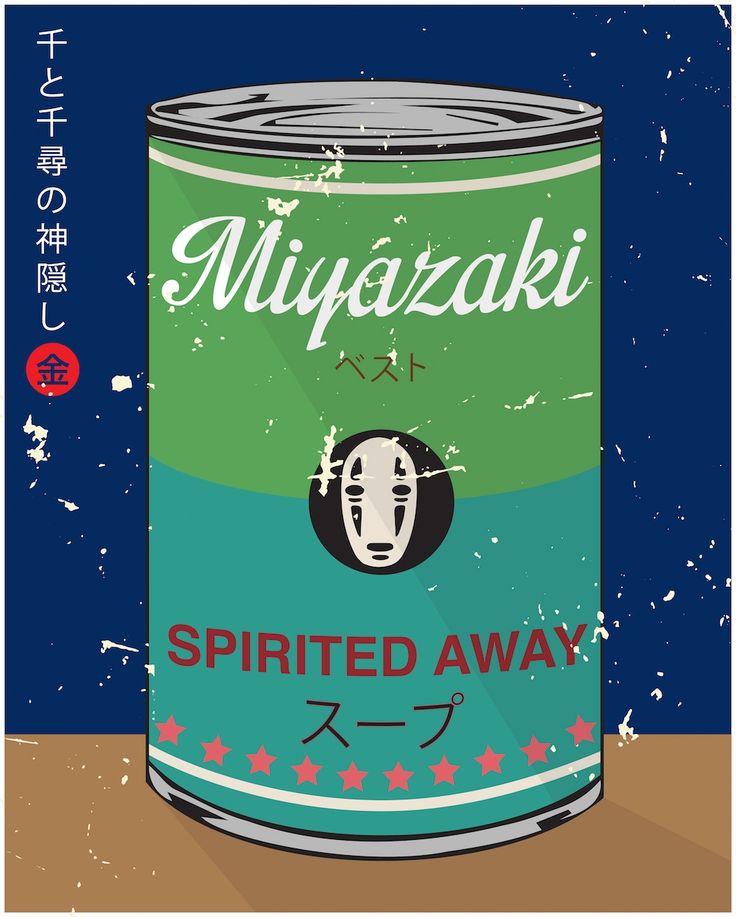
Spirited Away and Howl’s Moving Castle are slightly more sophisticated flavors, that may involve leafy greens.
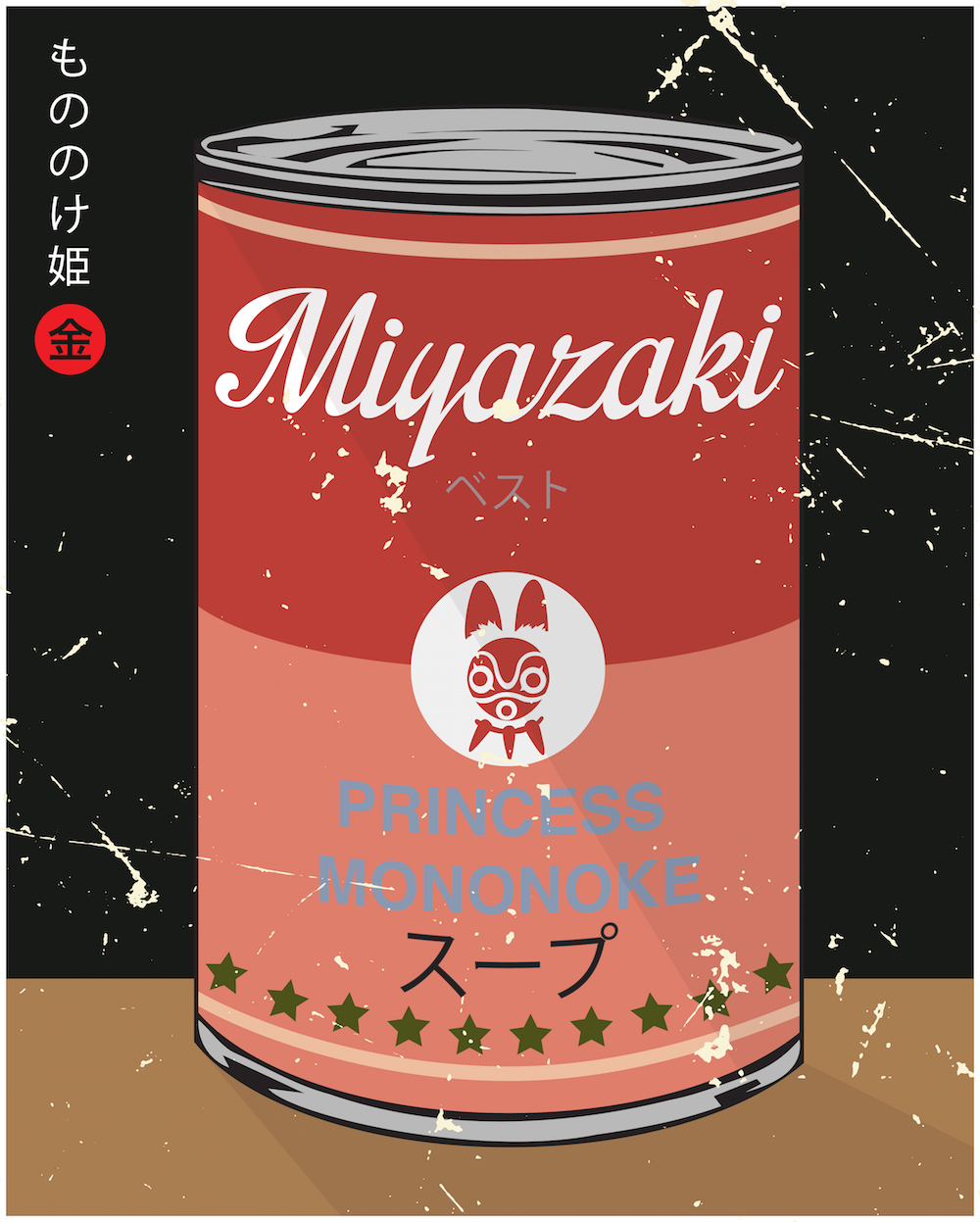
Princess Mononoke and Porco Rosso are Grandpa’s favorites–real stick to your ribs fare.
The subtle iconography brings added dimension to the stark product design Warhol duplicated to such acclaim.
As Kim told the Creators Project:
Simple design that works is always so much harder to create than you might expect. It’s just very fun to marry two ideas, artists and/or concepts into one big image. Andy Warhol changed the world of physical arts. Hayao Miyazaki changed the world of animated arts.
This is not Kim’s first go at Campbell’s. His earlier Supersoup Series reduced superheroes to consommé and cream ofs. Don’t forget the oyster crackers.
Posters and t‑shirts of Hyo Taek Kim’s Miyazaki Special Soup and Soupersoup Series can be purchased here.
View more of Kim’s soup cans online at the Creators Project.
Related Content:
Roy Lichtenstein and Andy Warhol Demystify Their Pop Art in Vintage 1966 Film
A New Theme Park Based on Hayao Miyazaki’s My Neighbor Totoro Set to Open in 2020
Watch Moebius and Miyazaki, Two of the Most Imaginative Artists, in Conversation (2004)
Ayun Halliday is an author, illustrator, theater maker and Chief Primatologist of the East Village Inky zine. Follow her @AyunHalliday.
Read More...Watch 50 Hours of Nature Soundscapes from the BBC: Scientifically Proven to Ease Stress and Promote Happiness & Awe
A recent study from BBC Earth and UC-Berkeley has shown that watching nature documentaries can inspire “significant increases in feelings of awe, contentedness, joy, amusement and curiosity” and conversely “reduce feelings of tiredness, anger and stress.” In short, they can engender what the authors of the study call ‘real happiness’ – a kind of happiness that leads to actual improvement in individuals’ health and wellbeing,
With that in mind, the BBC has just released 50 hours of HD “visual soundscapes” on YouTube, using leftover footage from their Planet Earth II TV series. Ten hours of mountains; ten hours of jungle; ten hours of islands; ten hours of desert; and ten hours of grasslands–they’re all featured in the long, soothing soundscape playlist featured above. Use them well.
If you would like to support the mission of Open Culture, consider making a donation to our site. It’s hard to rely 100% on ads, and your contributions will help us continue providing the best free cultural and educational materials to learners everywhere. You can contribute through PayPal, Patreon, and Venmo (@openculture). Thanks!
Related Content:
Read More...Alice’s Adventures in Wonderland, Illustrated by Salvador Dalí in 1969, Finally Gets Reissued
On canvas and paper, Salvador Dalí created apparently nonsensical realities that nevertheless operated according to logic all their own; in writing, Lewis Carroll, author of Alice’s Adventures in Wonderland, did the very same. It thus only makes sense, despite their differences in nationality and sensibility as well as their barely overlapping life spans, that their artistic worlds — one with its grotesquely misshapen objects, obscure symbols, and hauntingly empty vistas, the other full of wordplay, whimsy, and mathematics — would one day collide. It happened in 1969, when an editor at Random House commissioned the master surrealist to create illustrations for an exclusive edition of Carroll’s timeless story for the house’s book-of-the-month club.
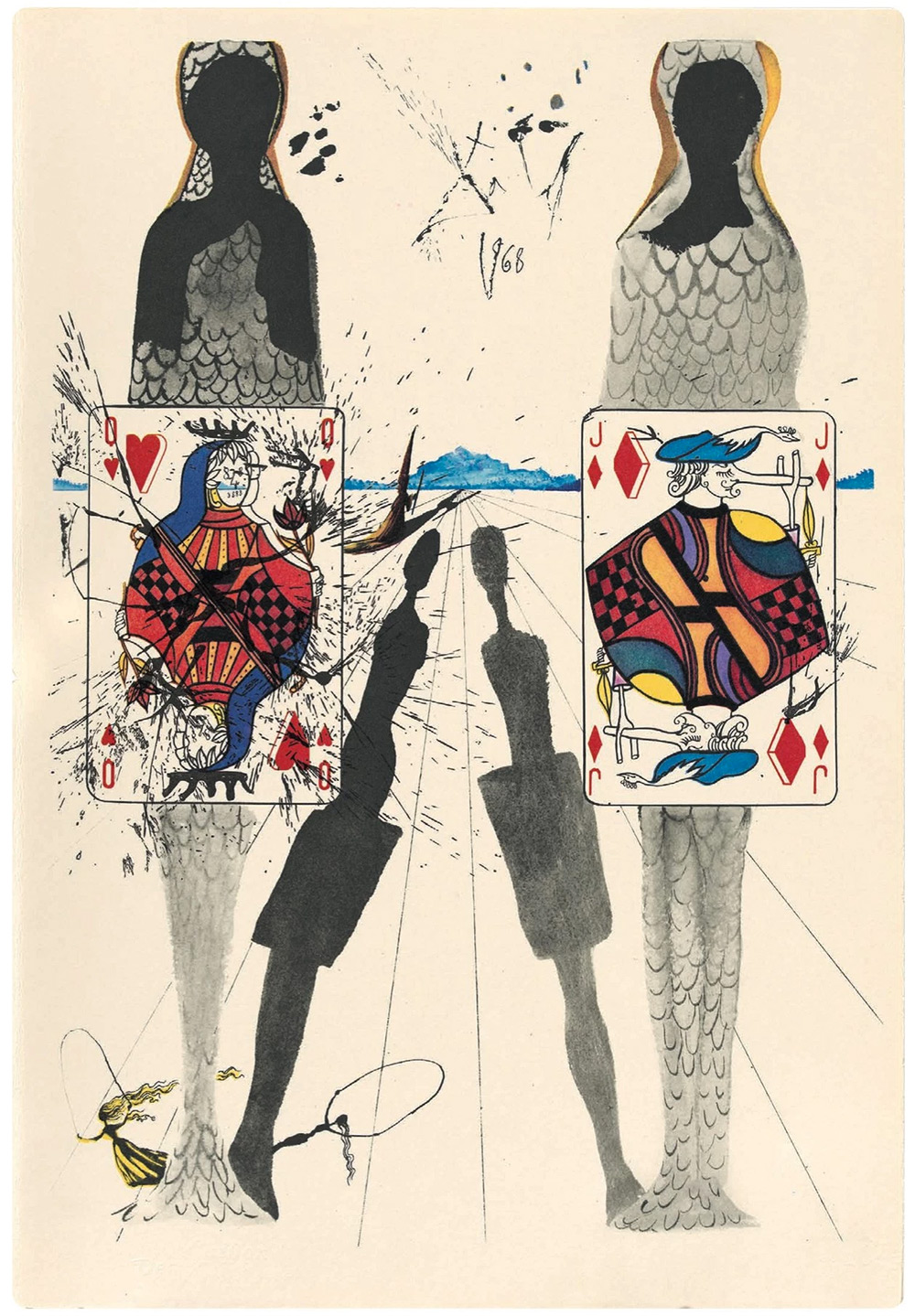
“Dalí created twelve heliogravures — a frontispiece, which he signed in every copy from the edition, and one illustration for each chapter of the book,” writes Brain Pickings’ Maria Popova. “For more than half a century, this unusual yet organic cross-pollination of genius remained an almost mythic artifact, reserved for collectors and scholars,” until Princeton University Press saw fit to reprint it for Alice’s Adventures in Wonderland’s 150th anniversary (much as Taschen recently reissued Dalí’s bizarre cookbook Les Diners de Gala). Sweetening the deal still further, they’ve included essays by mathematician and Dalí collaborator Thomas Banchoff as well as Lewis Carroll Society of North America president Mark Burstein.
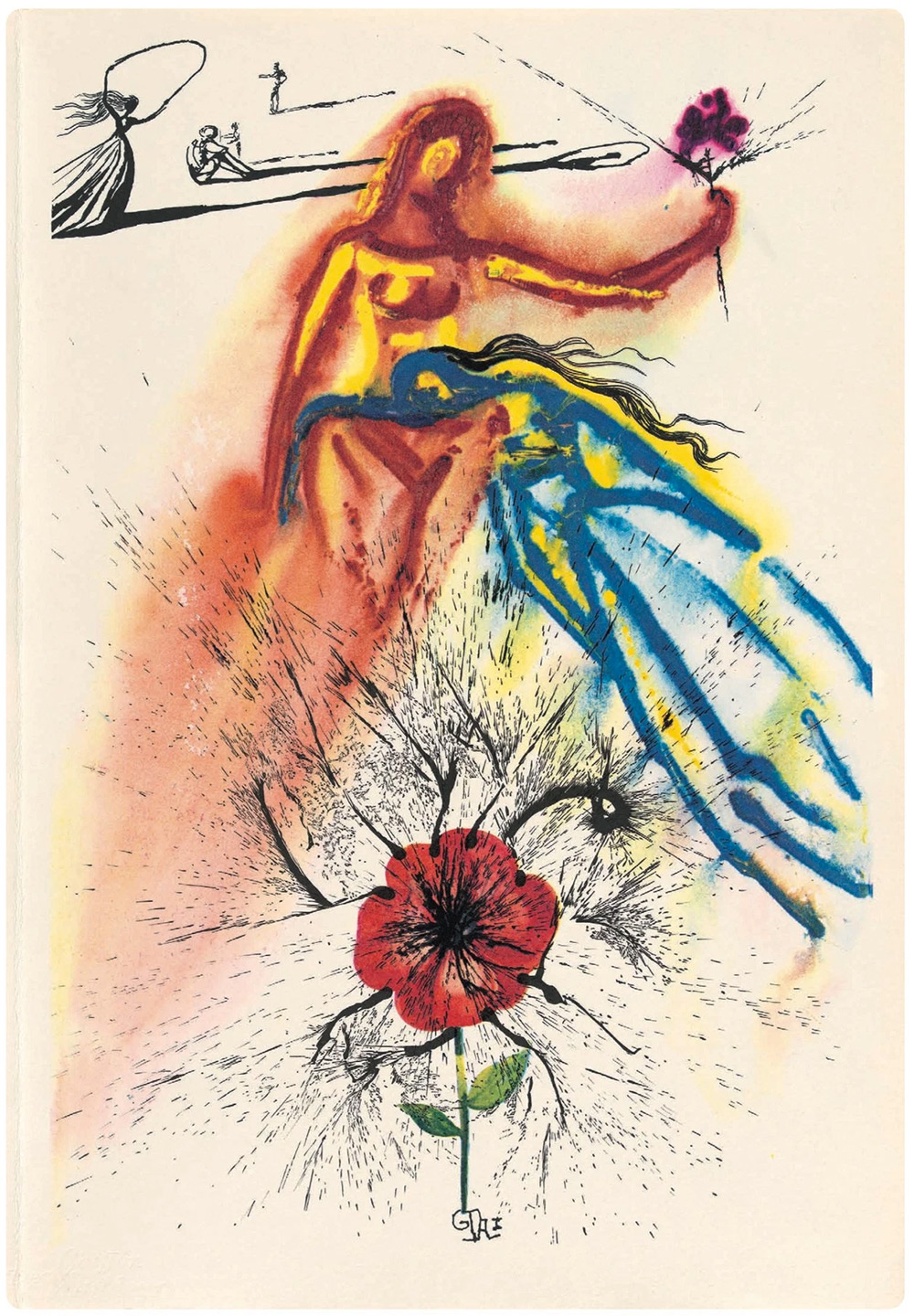
“Although the outrageousness of Reverend Charles Lutwidge Dodgson, who came up with the pen name Lewis Carroll in 1856, was limned within a conventional fairy tale,” writes Burstein, “the surrealists deliberately sought outrage and provocation in their art and lives and questioned the nature of reality. For both Carroll and the surrealists, what some call madness could be perceived by others as wisdom.” He describes surrealism’s initial objective as making “accessible to art the realms of the unconscious, the irrational, and the imaginary, and its influence soon went far beyond the visual arts and literature, embracing music, film, theater, philosophy, and popular culture. As have the Alice books.” And with so many realms of the unconscious, the irrational, and the imaginary left to explore, this intersection of Carroll and Dalí’s different yet compatible methods of exploration should hold more appeal than ever.
You can find copies of the Princeton reissue of Dalí’s Alice’s Adventures in Wonderland here.
Related Content:
The Tarot Card Deck Designed by Salvador Dalí
Salvador Dalí’s 1973 Cookbook Gets Reissued: Surrealist Art Meets Haute Cuisine
Salvador Dalí’s Avant-Garde Christmas Cards
Based in Seoul, Colin Marshall writes and broadcasts on cities and culture. He’s at work on the book The Stateless City: a Walk through 21st-Century Los Angeles, the video series The City in Cinema, the crowdfunded journalism project Where Is the City of the Future?, and the Los Angeles Review of Books’ Korea Blog. Follow him on Twitter at @colinmarshall or on Facebook.
Read More...People Who Swear Are More Honest Than Those Who Don’t, Finds a New University Study
I’ve heard it said many times: “I don’t trust people who don’t swear.” It’s not an empirical statement. Just an intuition, that people who shy away from salty language might also shy away from certain truths—may even be, perhaps, a little delusional. Few people characterize teetotalers of swearing with more bite than Stephen Fry, who believes “the sort of twee person who thinks swearing is in any way a sign of a lack of education or of a lack of verbal interest is just a fucking lunatic.” George Carlin would approve. A comically exaggerated view. No, swearing isn’t necessarily a sign of mental illness. But it does correlate strongly with truthtelling.
It seems all the suspicious salts out there may have happened upon a measurable phenomenon. A study published last year with the cheeky title “Frankly, We Do Give a Damn: The Relationship Between Profanity and Honesty,” notes, “the consistent findings across the studies suggest that the positive relation between profanity and honesty is robust, and that relationship found at the individual level indeed translates to the society level.” It’s true, some research shows that people who swear may be likely to violate other social norms, god bless ‘em, but they are also less likely to lie during police interrogations.
After reviewing the literature, the researchers, led by Maastricht University Psychologist Gilad Feldman, describe the results of their own experiments. They asked 276 people to report on their swearing habits (or not) in detail. Those people then took a psychological test that measured their levels of honesty. Next, the team analyzed 70,000 social media interactions, and reported that “profanity and honesty were found to be significantly and positively correlated, indicating that those who used more profanity were more honest in their Facebook status updates.” They did not say whether high levels of honesty on Facebook is desirable.
Finally, Feldman and his colleagues widened their scope to 48 U.S. states, and were able to correlate social media data with measures of government accountability. States with higher levels of swearing had a higher integrity score according to a 2012 index published by the Center for Public Integrity. (Believe or not, New Jersey had some of the highest scores.) All three of their studies yielded similar results. “At both the individual and society level,” they conclude, “we found that a higher rate of profanity use was associated with more honesty.” This does not mean, as Ephrat Livni writes at Quartz, that “people who curse like sailors” won’t “commit serious ethical crimes—but they won’t pretend all’s well online.”
As to the question of whether swearing betrays a lack of education and an impoverished vocabulary, we might turn to linguist, psychologist, and neuroscientist Steven Pinker, who has made a learned defense of foul language, in drily humorous talks, books, and essays. “When used judiciously,” he writes in a 2008 Harvard Brain article, “swearing can be hilarious, poignant, and uncannily descriptive.” His is an argument that relies not only on data but on philosophical reflection and literary appreciation. “It’s a fact of life that people swear,” he says, and so, it’s a fact of art. Shakespeare invented dozens of swears and was never afraid to work blue. Perhaps that’s why we find his representations of humanity so perennially honest.
You can read “Frankly, We Do Give a Damn: The Relationship Between Profanity and Honesty” here. In addition to Gilad Feldman, the research paper was also written by Huiwen Lian (The Hong Kong University of Science and Technology,) Michal Kosinski (Stanford), and David Stillwell (Cambridge).
Related Content:
Stephen Fry, Language Enthusiast, Defends The “Unnecessary” Art Of Swearing
Steven Pinker Explains the Neuroscience of Swearing (NSFW)
George Carlin Performs His “Seven Dirty Words” Routine: Historic and Completely NSFW
Free Online Psychology & Neuroscience Courses
Josh Jones is a writer and musician based in Durham, NC. Follow him at @jdmagness
Read More...Watch the Earliest Known Footage of the Jimi Hendrix Experience (February, 1967)
Note: If the video plays and you don’t hear sound, look for the volume control in the lower right hand corner of the video.
Within months of moving to London in autumn of 1966, Jimi Hendrix found himself a band, recorded a single, got himself a longterm girlfriend, and proceeded to take the UK by storm. His gigs were essential viewing by rock’s then-royalty–the Who, the Beatles, the Rolling Stones, Cream, all made sure they caught the American wonder. By the end of the year his first single “Hey Joe” landed him on British television and in the Top 10.
The above video is the first known footage of a live Jimi Hendrix Experience, though the band had been gigging for months. It takes place at the Chelmsford Corn Exchange, in the City of Chelmsford, about 50 miles north-east of London. The date is February 25, 1967, and the gig had only been advertised in the paper two days before (where he was listed as “Jimi Hendric”). As you can see, that’s all it took to fill this old traders building-turned-rock venue to the rafters.
The footage was shot for “Telixer: A Thing of Beat Is a Joy Forever,” a documentary on the current British music scene made for KRO, The Netherlands.
Hendrix and the band launch into Dylan’s “Like a Rolling Stone,” with a few ordinary opening bars setting up the guitar magic to follow. He then plays “Stone Free,” the b‑side of “Hey Joe.” You can see Pete Townshend and John Entwistle to the side of the stage, very briefly. The footage is intercut with shots of Swinging London and fashion hub Portobello Road, where it is said Hendrix bought his Hussars military jacket.
The website Chelmsford Rocks features a remembrance of that night from Shaun Everett, who was a Mod at the time and knew he had to make his way up on the train after work to catch Hendrix at the “Corn’ole,” as the youth called it.
Everett fills in the rest of the evening:
Hendrix gave two sets. That was the normal arrangement for the Corn’ole. Both sets usually 45 minutes to one hour each and there was absolutely no music to be had after 11.30pm…I have spent a long time looking for myself on that film clip but to no avail. I was probably still at the rear of the venue or even more likely in the local pub for the break!…Hendrix, at the end of the performance, walked straight up to a few of us standing just there and one of my mates lit his joint for him. They were so knocked out by that I recall. My recollection was more nasal. Rock musicians have this uncanny ability to harbour their own post-set aromas about themselves: in this case that unmistakeable aroma of cannabis…I will always remember that part even if my music recollections are a bit sparse. I have also ‘dined out’ on that anecdote for many years since. I had passed close by the ‘God’.
The Corn Exchange hosted many acts over its time as a music venue, including David Bowie and Pink Floyd. But in 1969, the city tore down the 19th century building, assuming something more accommodating for live music would be built in its place. That didn’t happen. On this page you can see the aftermath of the bulldozers, and a modern shot of the city street corner that added so much to rock history.
Related Content:
Jimi Hendrix Wreaks Havoc on the Lulu Show, Gets Banned From the BBC (1969)
Ted Mills is a freelance writer on the arts who currently hosts the artist interview-based FunkZone Podcast and is the producer of KCRW’s Curious Coast. You can also follow him on Twitter at @tedmills, read his other arts writing at tedmills.com and/or watch his films here.
Read More...James Franco Hosts Philosophy Time, a New Videos Series Created to Help Philosophy Reach a Wider Audience
How do you get ordinary people interested in philosophy? If we are to believe the accounts of Plato, this wasn’t so difficult in ancient Athens. One simply lounged around the Acropolis harassing passersby, a tactic sure to fail in most city centers, town squares, and strip malls today. Podcasts and YouTube videos grab their share of eyes and ears, though many in their audiences also sing in the choir. Former Python John Cleese has done his part to popularize philosophical thinking. As someone who has moved between the worlds of academia and popular culture, Cleese has both credibility and visibility on his side. Some younger audiences (I write with apologies to Cleese) may be inclined to tune him out.
How about another actor with both fame and higher ed cred? Someone “very appealing to a younger demographic”? Someone like… James Franco—currently a doctoral student at Yale, and formerly a lecturer and/or student/graduate of UCLA, Columbia, NYU, Brooklyn College, Warren Wilson College, and the Rhode Island School of Design? This might seem like the resume either of an academic dilettante, or of a lifelong student and lover of knowledge.
Given Franco’s commitment to teaching, writing, and developing and starring in literary films like As I Lay Dying, The Sound and the Fury, The Broken Tower, and Howl, we might give him the benefit of the doubt. Not everyone’s a fan, but he does bring a good deal of academic enthusiasm to the role of philosophy popularizer.
Franco also brings along an actual philosopher, Eliot Michaelson, of King’s College, a former teacher of his. He proposed the idea of their project, “Philosophy Time,” while the two were at UCLA together, Michaelson as a grad student and Franco as an undergrad finishing his English degree after taking a hiatus from college to become a star. “We had somehow ended up becoming friends,” writes Michaelson, “In part, probably because I had no idea who he was.” Their long-gestating idea—an attempt to widen philosophy’s audience—has finally come to fruition. In the short episodes here, you can see the two in conversation with Rutgers University’s Andy Egan, at the top (on beauty), Princeton’s Liz Harmon, further up (on the fraught topic of abortion), and Rutgers’ Liz Camp, above and below (on imagination and metaphor).
Michaelson is a moderating influence. Franco’s laid back presentation will remind you of his performances in stoner comedy Pineapple Express, the 83rd Academy Awards ceremony, and the 2008 High Times Stoner of the Year event (though he swears he doesn’t touch the stuff anymore). Squiggly, animated word and thought bubbles add another comic touch. But whether or not viewers are charmed by his persona, they’ll find that he lets his guests do most of the talking, and they each make it plain that philosophy can be fascinating and imminently relevant to our ordinary modern lives. The kinds of questions Socrates needled hapless Athenians with—about beauty, ethics, and language—are just as pressing now as they were 2400 years ago.
You can find the emerging trove of “Philosophy Time” videos on YouTube here.
via Leiter Reports
Related Content:
James Franco Reads a Dreamily Animated Version of Allen Ginsberg’s Epic Poem ‘Howl’
James Franco Reads 6 Short Poems from His New Collection
140+ Free Online Philosophy Courses
The Partially Examined Life: A Philosophy Podcast
Josh Jones is a writer and musician based in Durham, NC. Follow him at @jdmagness
Read More...When Soviet Artists Turned Textiles (Scarves, Tablecloths & Curtains) into Beautiful Propaganda in the 1920s & 1930s
Americans swim in propaganda all the time, even those of us who think the word refers to some exotic form of foreign authoritarianism rather than our own good ol’ home-cooked variety. But the sad fact—admittedly very far down the list of rather tragic facts—is that U.S. propaganda is particularly crude, obnoxious, and unappealing. Contrast, for example, the symbol of the pantsuit, or the casual racism, misogyny, and homicidal fantasies on trucker hats, t‑shirts, and beach towels with the alarming pageantry of Maoist China, Stalinist Russia, or name-your-showy-totalitarian-regime.
In the early days of the Soviet Union, state propaganda received a special boost from a cadre of eager and willing avant-garde artists, including poet, actor, director, etc. Vladimir Mayakovsky, who wrote Soviet children’s books, and a number of Russian Futurists who seized the opportunity to promote the new order with totally incomprehensible poetry and art.
In no way regimented or standardized, as were later Socialist Realists, early Soviet propagandists used politics as another material in their work, rather than its primary raison d’être.
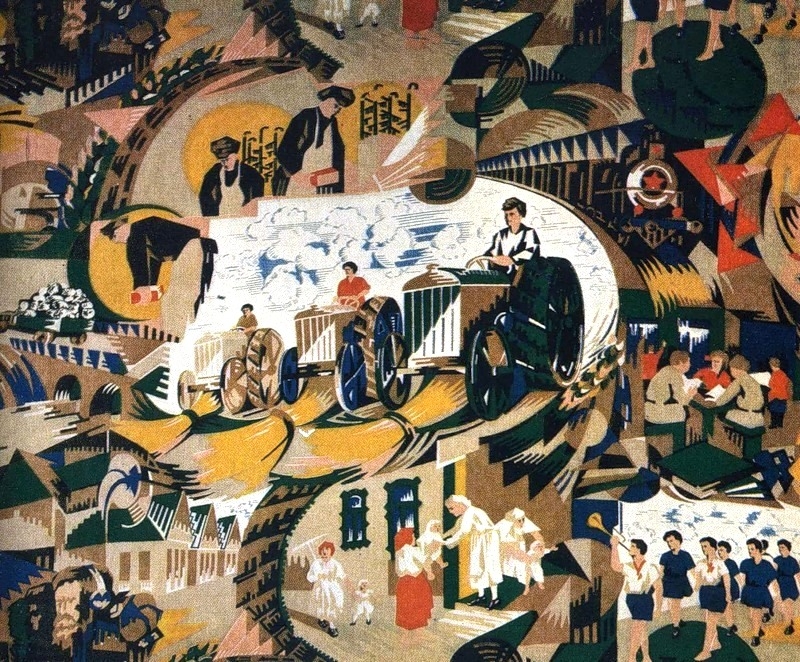
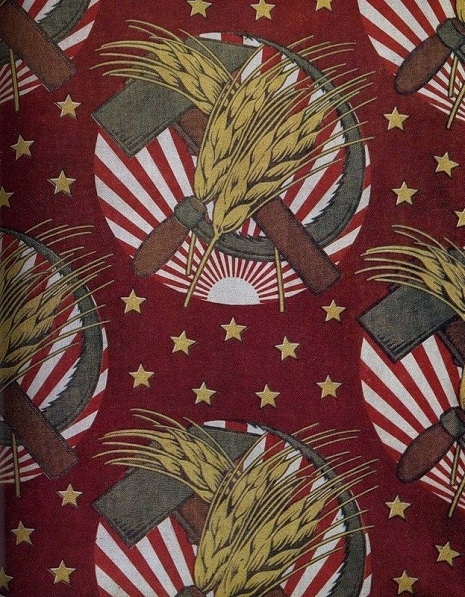
These pioneers were joined by experimental composers, filmmakers, and even textile designers, who had a brief moment under the shining Soviet star between 1927 and 1933, when, as one publication from a wealthy collector notes, “a fascinating experiment in textile making took place in the Soviet Union. As the new nation emerged and the Communist party struggled to transform an agrarian country into an industrialized state, a group of young designers began to create thematic textile designs.”
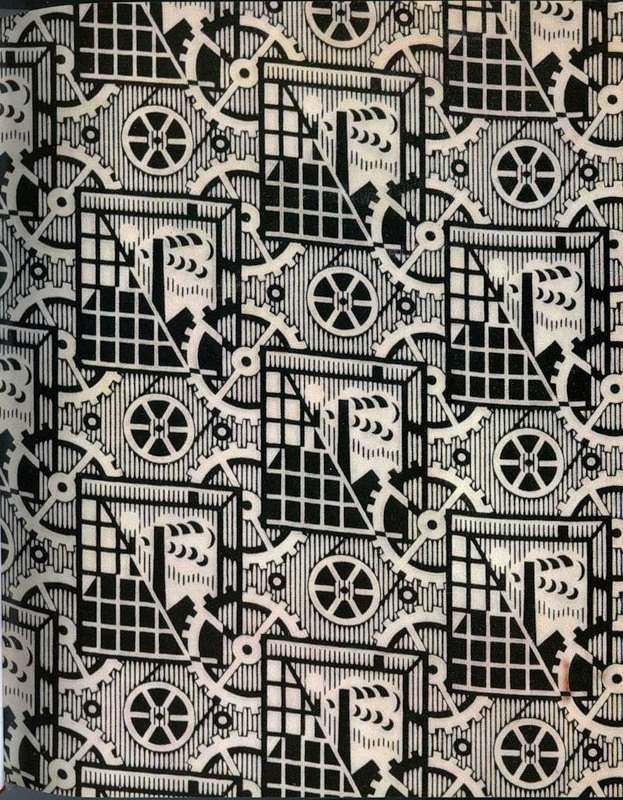
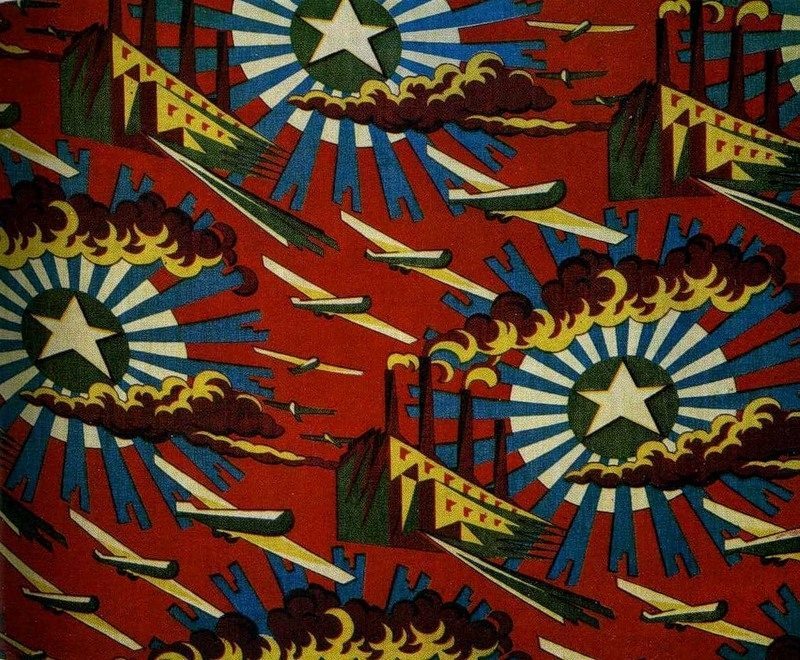
Their designs—adorning tablecloths, sheets, curtains, and scarves and other items of everyday, off-the-rack wear—showcase bold, striking patterns, many, writes Dangerous Minds, “thematic of classical Russian art: you see lush color, dense scapes and even the odd Orientalist trope.” They are also filled with “delightfully propagandist imagery,” notes Marina Galperina at Flavorwire, “of revving tractors, smoke-pumping factor pipes, and babushka-clad women taking a sickle to wheat… woven in between opulent florals and pretty, constructivist squiggles.”
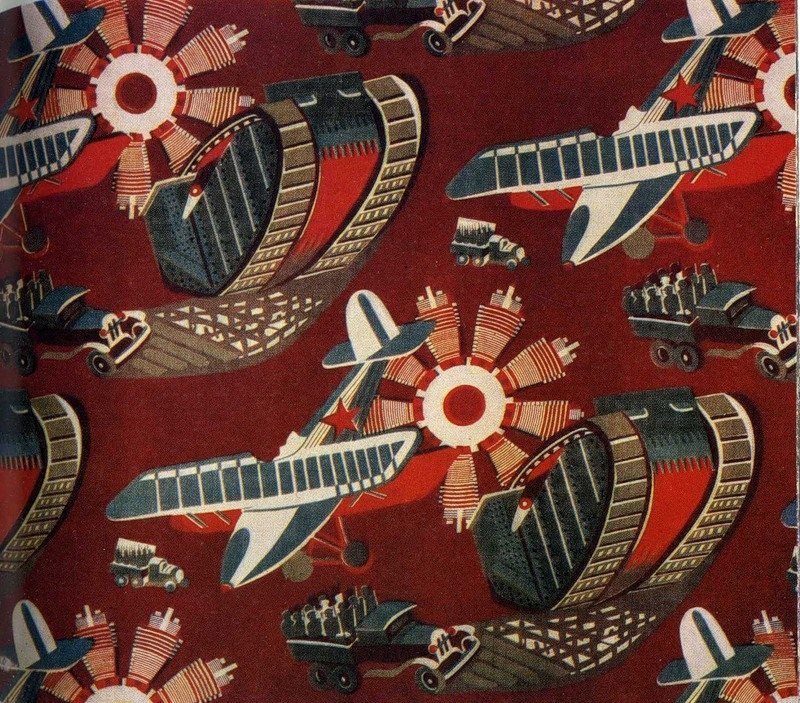
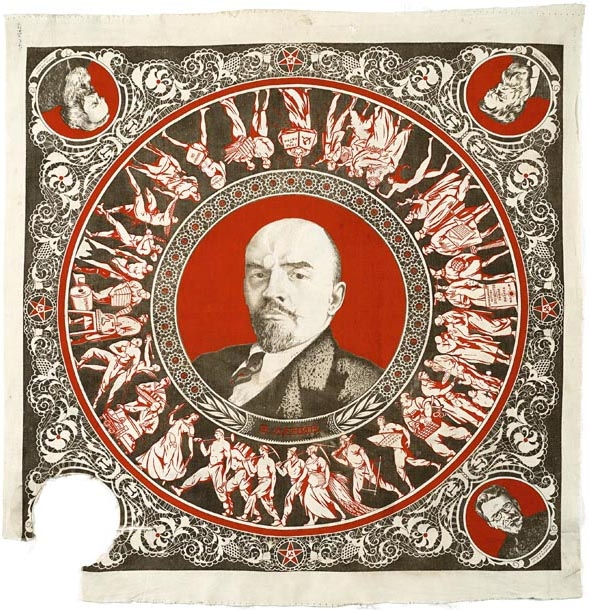
Factory gears, war machines, athletes, and scenes of industry were popular, as were the expected state symbols and iconography—as in the Lenin linen at the top, framed at the top by Marx and Engels; Trotsky at the bottom left has been purged from the textile record. See many more examples of early Soviet textiles at io9, Flashbak, and Messy Nessy.
via English Russia and @TedGioia
Related Content:
Josh Jones is a writer and musician based in Durham, NC. Follow him at @jdmagness
Read More...How Did Akira Kurosawa Make Such Powerful & Enduring Films? A Wealth of Video Essays Break Down His Cinematic Genius
No Japanese filmmaker has received quite as much international scrutiny, and for so long, as Akira Kurosawa. Though now almost twenty years gone, the man known in his homeland as the “Emperor” of cinema only continues to grow in stature on the landscape of global film culture. Film students still watch Rashomon, swords-and-sandals fans still thrill to Seven Samurai and Yojimbo, midcentury crime-picture buffs still turn up for screenings of Drunken Angel and Stray Dog, and many a Shakespeare buff still looks in admiration at his interpretations of Macbeth (as Throne of Blood) and King Lear (as Ran).
How did Kurosawa and his collaborators imbue these and many other acclaimed pictures with such enduring power? An entire subgenre of video essays has emerged to approach an answer to that question. At the top of the post we have one from Tony Zhou, creator of the well-known cinematic video essay series Every Frame a Painting, on Kurosawa’s “innate understanding of movement and how to capture it onscreen.”
His staging also demonstrates a highly developed sense of space, which Zhou reveals in the short essay just above by breaking down a scene from 1960’s corporate-corruption drama The Bad Sleep Well.
All of those film students watching Seven Samurai may not consider it a true action film, at least by their ultra-modern standards, but the way Kurosawa’s best-known picture tells its story through artfully rendered movement and violence has stood as an example for action filmmakers ever since. Lewis Bond, the video essayist behind Channel Criswell, draws out the lessons Seven Samurai still holds for action cinema today, in the essay above. But what happens in the frame also gains much of its impact from the construction of the frame itself. A video essayist by the name of Mr. Nerdista looks at Kurosawa’s unusual mastery of the art of framing, as seen in Rashomon, in the essay below.
But no film, no matter how skillfully made, could cross as many historical and cultural boundaries as Kurosawa’s have with aesthetics alone. The strong moral sense at the dramatic core of his work — a characteristic, too, of the Shakespeare plays from which he drew inspiration — will keep it forever relevant, not because it presents the audience with simple lessons about what to do and what not to do, but because it forces them to consider the most difficult moral questions. This comes most clearly to the fore in 1963’s modern-day ransom story High and Low, examined in the Jack’s Movie Reviews essay below.
A.O. Scott selected High and Low as a New York Times “Critic’s Pick” back in 2012, and you can see him discuss the movie’s virtues in this video. It appears as just one of a roundup of Kurosawa-related videos at akirakurosawa.info, a selection that also includes Scott on Ran, a Criterion Collection clip of Kurosawa experts on the violence of Seven Samurai, a look at Kurosawa’s evolution as an artist through four of his best-known movies, a two-part essay on Kurosawa’s influences as well as those he has influenced. For as much as all these videos have to say about Kurosawa’s movies, though, few of them reference the details of Kurosawa’s life. The Emperor, who once wrote that, “there is nothing that says more about its creator than the work itself,” would have approved.
Related Content:
How Akira Kurosawa Used Movement to Tell His Stories: A Video Essay
How Akira Kurosawa’s Seven Samurai Perfected the Cinematic Action Scene: A New Video Essay
Akira Kurosawa’s Advice to Aspiring Filmmakers: Write, Write, Write and Read
Based in Seoul, Colin Marshall writes and broadcasts on cities and culture. He’s at work on the book The Stateless City: a Walk through 21st-Century Los Angeles, the video series The City in Cinema, the crowdfunded journalism project Where Is the City of the Future?, and the Los Angeles Review of Books’ Korea Blog. Follow him on Twitter at @colinmarshall or on Facebook.
Read More...Hear the 150 Greatest Albums by Women: NPR Creates a New Canon of Albums That Puts Women at the Center of Music History
What is it with all the trendpieces on great women artists, writers, directors, singers, etc.? What, indeed. To ask the question is to acknowledge the premise of such pieces. Why should they need to be written at all if women in these fields received fair representation elsewhere? That lists and articles can be written in the hundreds puts the lie to phony claims that “great” women do not exist in every field in numbers. This is especially true in the 20th century, when hard-won political gains opened cultural doors unimaginable to many previous generations. But those gains did not fundamentally alter how cultural histories have been written.
Music critic Anne Powers and Lincoln Center program director Jill Sternheimer recently considered this problem, one which, Powers writes at NPR, persists even in the ways “music history’s being recorded and revised in the digital age.”
They wondered, “why… was the importance of women so often recognized as a trend instead of a source of lasting impact? We came to a conclusion that, in 2017, will likely strike no one as a surprise: that the general history of popular music is told through the great works of men, and that without a serious revision of the canon, women will always remain on the margins.”
This is a truth reinforced in many different ways: by the shelves weighed down with books about Jimi Hendrix and Nirvana, while only one or two about Aretha Franklin or Patti Smith sit nearby; by the radio playlists that still only feature women once or twice every hour.
This isn’t a problem of “representation”—the term we so often hear applied to casting decisions and awards shows. Powers isn’t making a case for diversity in hiring, but for accuracy in writing the historical record. To that end, Powers and Lincoln Center, together with “nearly 50 women who play a role in NPR… compiled and voted” on a list: “Turning the Tables: The 150 Greatest Albums by Women.” You can hear nearly all of those albums in our Spotify playlist below. Calling the list “an intervention, a remedy, a correction,” Powers writes, “These albums were released between 1964, the year The Beatles invaded America… and 2016, when Beyoncé arguably ushered in a new period with her ‘visual album’ Lemonade.”
The point is to offer a view of popular music history with women’s work at the center. The list does not represent an “alternate history.” It stands for music history, touching upon every significant trend, social issue, set of sonic innovations, and new avenue for self-expression that popular music has intersected in the past fifty years.
Against the argument for “affirmative action”—or simply rewriting old “great album” lists to include more women—Powers argues, “once a canon is formed, it gains an aura of immutability.” Plenty of lists include female artists. Almost none of them include women in the top spots, suggesting that “the paradigms that define greatness remain masculine at their core.” Tokenism, no matter how well-intentioned, does not make for “a shift in perspective beyond the simple mandate to adjust the numbers.”
Ava Duvernay has made a similar argument against mandated “diversity” in Hollywood as a mollifying tactic that maintains status quo power relationships. “The fact that the mainstream starts to gaze at this space doesn’t make it a moment,” she tells Hollywood Reporter, “it makes it a moment for them.” As Powers writes of the way Joni Mitchell was often treated by the rock establishment, “the female musician is a dream, a surprise and a disruptor. She can claim the center of attention, but her rightful point of origin, and the place to which she returns, is a margin.”
Instead of marginal inclusion in existing cliques, Powers argues for a cultural shift, a “new canon,” that isn’t hedged with the usual standards that often exclude women on arbitrary purist grounds. Keeping “wide parameters,” the contributors “left room for acknowledged rock-era classics as well as pop hits dismissed by others as fluff.” That disclaimer aside, there’s precious little “fluff” on this list—meaning it’s hard to find albums here that wouldn’t qualify for “greatest” status on more narrowly-defined genre lists. It is a list, that is to say, of 150 great albums, written, recorded, and released over the course of fifty plus years, by some of the most talented writers, players, and musicians in modern music history.
“Lists have their limitations,” Powers admits, “They reflect biases and whispered compromises.” She and her contributors offer this one “as the beginning of a new conversation” rather than an authoritative statement. At such depth and breadth, however, “Turning the Tables” makes room for nearly every possible genre, from all over the world. Read the full list of 150 albums, with commentary, here. A few of the 150 albums, including Lemonade, Bikini Kill’s Yeah Yeah Yeah, Joan Jett’s I Love Rock ‘n’ Roll, Joanna Newsome’s Ys, and Laurie Anderson’s Big Science aren’t on Spotify, so didn’t make our playlist above. The top ten albums on the list are:
- Joni Mitchell, Blue (Reprise, 1971)
- Lauryn Hill, The Miseducation of Lauryn Hill (Ruffhouse/Columbia, 1998)
- Nina Simone, I Put a Spell on You (Philips, 1956)
- Aretha Franklin, I Never Loved a Man the Way I Loved You (Atlantic, 1967)
- Missy Eliot, Supa Dupa Fly (The Goldmine/Elekra, 1997)
- Beyoncé, Lemonade (Parkwood/Columbia 2016)
- Patti Smith, Horses (Arista, 1975)
- Janis Joplin, Pearl (Columbia, 1971)
- Amy Winehouse, Back to Black (Island, 2006)
- Carole King, Tapestry (Ode, 1971)
Related Content:
Hear Seven Hours of Women Making Electronic Music (1938–2014)
Women of Jazz: Stream a Playlist of 91 Recordings by Great Female Jazz Musicians
Josh Jones is a writer and musician based in Durham, NC. Follow him at @jdmagness
Read More...The British Museum Creates 3D Models of the Rosetta Stone & 200+ Other Historic Artifacts: Download or View in Virtual Reality
Back in 2015, The British Museum gave the world online access to the Rosetta Stone, along with 4,700 other artifacts in the great London museum. But that access was only in 2D.
Now they’ve upped the ante and published a 3D model of the Rosetta Stone and 200+ other essential items in the museum’s collections. “This scan was part of our larger attempt to capture as many of our iconic pieces from the collection — and indeed the unseen in store objects — and make them available for people to view in 3D or in more tactile forms,” Daniel Pett, a British Museum adviser told Digital Trends.
Other 3D models you might want to check out include the granite head of Amenemhat III, a portrait bust of Sir Robert Bruce Cotton, and a statue of Roy, High Priest of Amun.
Note: If you put your mouse on the objects and swivel on your trackpad, you can see different sides of the artifacts. Created with a company called Sketchfab, the 3D models are all available to download. You can also see them in virtual reality. (Look for the little “View in VR” icon at the bottom of each image.)
If you would like to support the mission of Open Culture, consider making a donation to our site. It’s hard to rely 100% on ads, and your contributions will help us continue providing the best free cultural and educational materials to learners everywhere. You can contribute through PayPal, Patreon, and Venmo (@openculture). Thanks!
Related Content:
1.8 Million Free Works of Art from World-Class Museums: A Meta List of Great Art Available Online
Read More...Support Us
We're hoping to rely on loyal readers, rather than erratic ads. Please click the Donate button and support Open Culture. You can use Paypal, Venmo, Patreon, even Crypto! We thank you!

About Us

Open Culture scours the web for the best educational media. We find the free courses and audio books you need, the language lessons & educational videos you want, and plenty of enlightenment in between.
Advertise With Us

FREE UPDATES!
GET OUR DAILY EMAIL
Get the best cultural and educational resources on the web curated for you in a daily email. We never spam. Unsubscribe at any time.
FOLLOW ON SOCIAL MEDIA

Open Culture editor Dan Colman scours the web for the best educational media. He finds the free courses and audio books you need, the language lessons & movies you want, and plenty of enlightenment in between.
Advertise With Us


