Batman Goes Surfing: Remembering Adam West (RIP) with Perhaps the Campiest Batman Episode Ever
In the various obits I read this weekend for Adam West, one word repeatedly came up–“campy.”
Reuters started its obit: “Adam West, who earned a place in American pop culture history with his campy portrayal of the title character in the classic 1960s TV series “Batman,” has died at age 88, his family said on Saturday.”
The New York Times added: “His straight-faced portrayal of Batman in the campy 1960s TV series lifted the tight-clad Caped Crusader into the national consciousness, and inspired future wearers of the superhero’s cape and cowl. The TV show was among the most popular in 1966, the year of its debut, and some of the era’s top actors signed on to play villains.”
And The Hollywood Reporter capped things with off: Yes, the Batman series was campy. But it was also ironic — in that, all winks aside, there was something truly righteous and exciting about this purple-clad goofball.” Indeed!
If you want Exhibit 1 of the wonderful campiness, check out the clip above, an outtake from the November 1967 episode, “Surf’s Up, Joker’s Under,” which turns on this plot:
The Joker plans to become the king of surfing, hoping the fame will give him control over the hearts and minds of Gotham City. He captures top surfer Skip Parker, then uses his “Surfing Experience & Ability Transferometer” to transfer the needed skills and stamina from Skip to himself. When all the other contestants drop out of the upcoming surfing match, Batman steps up to challenge the Joker’s supremacy.
Just so you know. The Joker finishes first, but Batman wins on points.
The full episode (along with 119 other ones) can be viewed on Batman: The Complete Series, a remastered box set released just a few years ago. I loved watching the series in syndication as a kid. Do they play as well decades later? We’ll find out.
Note: If you want to see where Adam West figured into the long line of Batman actors, see this video from our archive: The Evolution of Batman in Cinema: From 1939 to Present
Related Content:
Batman Stars in an Unusual Cartoon Adaptation of Dostoyevsky’s Crime and Punishment
The Evolution of Batman in Cinema: From 1939 to Present
Read More...Radiohead’s “Creep” Played on the Gayageum, a Korean Instrument Dating Back to the 6th Century
Every now and then, we check in on the fascinating musical world of Luna Lee–a musician who performs Western music on the Gayageum, a traditional Korean stringed instrument which dates back to the 6th century. Over the years, we’ve shown you her adaptations of Jimi Hendrix’s ‘Voodoo Chile;’ David Bowie’s “The Man Who Sold The World;” Leonard Cohen’s “Hallelujah;” blues classics by John Lee Hooker, B.B. King & Muddy Waters; and Pink Floyd’s “Comfortably Numb,” “Another Brick in the Wall” & “Great Gig in the Sky.” To keep the tradition going, today we bring you Luna’s beautiful take on Radiohead’s debut single, “Creep” (1992). For anyone who somehow missed the 90s, we’ve included the original Radiohead music video below. Enjoy both.
If you would like to support the mission of Open Culture, consider making a donation to our site. It’s hard to rely 100% on ads, and your contributions will help us continue providing the best free cultural and educational materials to learners everywhere. You can contribute through PayPal, Patreon, and Venmo (@openculture). Thanks!
Related Content:
Pakistani Musicians Play an Enchanting Version of Dave Brubeck’s Jazz Classic, “Take Five”
Ultra Orthodox Rabbis Sing Pink Floyd’s “Wish You Were Here” on the Streets of Jerusalem
Read More...What Is German Expressionism? A Crash Course on the Cinematic Tradition That Gave Us Metropolis, Nosferatu & More
German Expressionism: we’ve all heard of it, and though only some would even try to define it, we all, like old Potter Stewart, know it when we see it. Or do we? The movements under the umbrella of German Expressionism bore vivid and influential fruits in architecture, painting, sculpture and especially film — The Cabinet of Dr. Caligari, Nosferatu, and Metropolis, to say nothing of their countless descendants, will come right to the minds of most movie-lovers — but the circumstance from which it first arose remain not particularly well-understood by the public, or at least those of the public who haven’t seen the brief Crash Course video on German Expressionism above (and the even shorter No Film School explainer below).
Though it also stands perfectly well alone, this primer comes as the seventh chapter of the sixteen-part Crash Course Film History, which we first featured back in April. Here host Craig Benzine addresses the question of just what makes The Cabinet of Dr. Caligari, Nosferatu, and Metropolis in particular so memorable by examining each film and its auteur director — Robert Wiene, F.W. Murnau, and Fritz Lang, respectively — in turn.
The creativity of German Expressionist film, like so much creativity, arose from limitations: Germany had just lost World War I, most of its film industry had undergone state-sponsored consolidation, and independent filmmakers who didn’t want to make large-scale costume dramas (the genre of choice to distract the public from the country’s poverty and disorder) had to find a new way not just to get their movies made, but to give audiences a reason to watch them. With 1920’s The Cabinet of Dr. Caligari (which you can watch below along with Nosferatu), a small studio named Decla led the way.
“Written by Hans Janowitz and Carl Mayer,” says Benzine, “this film was thematically based on their experiences as soldiers in World War I and their distrust of authoritarian leadership.” It innovated by presenting its story “expressionistically, rather than realistically. That is, instead of making things like the sets, costumes, and props as realistic as possible,” the filmmakers “deliberately distorted everything within the frame,” all “designed to look deliberately artificial and throw you off balance.” This “highly subjective” cinematic sensibility, developed in Germany and then elsewhere (especially the countries to which German artists moved in flight from fascism) throughout the 1920s, still appears in modern film, well beyond the work of avowed fan Tim Burton: Benzine finds that, “from Silence of the Lambs to Don’t Breathe to anything M. Night Shyamalan has ever put on film, the techniques of German Expressionism are creeping us out to this very day.”
You can see 10 classic films from this tradition in our post: Watch 10 Classic German Expressionist Films: From Nosferatu to The Cabinet of Dr. Caligari
Related Content:
How German Expressionism Influenced Tim Burton: A Video Essay
Based in Seoul, Colin Marshall writes and broadcasts on cities and culture. He’s at work on a book about Los Angeles, A Los Angeles Primer, the video series The City in Cinema, the crowdfunded journalism project Where Is the City of the Future?, and the Los Angeles Review of Books’ Korea Blog. Follow him on Twitter at @colinmarshall or on Facebook.
Read More...150 Songs from 100+ Rappers Get Artfully Woven into One Great Mashup: Watch the “40 Years of Hip Hop”
On what he deemed the 30th anniversary of hip hop, in 2004, Village Voice critic Greg Tate wrote that the music’s “ubiquity has created a common ground and a common vernacular for Black folk from 18 to 50 worldwide.” Its global reach, however, has made it a rich site for “corporate exploitation.” The complicated relationship of hip hop and capitalism is something of a “bitter trick.” The music “represents Black culture and Black creative license in unique ways to the global marketplace, no matter how commodified it becomes.” And yet it “has now become a seller’s market, in which what does or does not get sold as hiphop to the masses is whatever the boardroom approves.”
Tate’s argument that the music and culture of hip hop are inseparable from globalized capitalism may partly explain why it roared into life in the eighties as a “convergence of ex-slaves and ch-hing,” just as the global consumer marketplace began to take its modern shape. Young, artistic entrepreneurs begged, borrowed, and stole records and equipment, sensing the opportunity for fame and riches in the creative recuperation of old sounds with new technology. Theirs was a language of ambition and desire, a celebration of sex and power—the language of modernity written in complex rhyme and call-and-response. A language spoken over generations and nations, and—now over ten years after Tate’s essay—spoken for over forty years of ever-increasing market share.
The origins of hip hop have provided ample material for entertaining fictionalizations like Baz Luhrmann’s The Get Down and popular histories like the documentary Hip-Hip Evolution. These linear accounts present the genre to us in formats we find easily digestible. Even as Luhrmann’s series attempts to mimic the hyperkinetic pace of rap, it tells a story as conventional as they come. To experience the past 40 years of hip hop on the genre’s own terms—its perpetual callbacks to its ancestors, its seamless interweaving of past and present—it’s almost as though you’d need to experience it all at once. And so you can, in the incredible mash-up video above from The Hood Internet.
Taking over 150 songs from over 100 artists, the video puts them all in conversation with each other “40 Years of Hip Hop” mashes up “rappers from different eras finishing each other’s rhymes over intersecting beats, all woven together to make one song.” It’s an impressive technical achievement, and one that throws into relief not only hip hop’s smooth, shiny hyper-capitalist embrace of technology but also, as theorist and Black Atlantic author Paul Gilroy wrote, its counter-cultural core as a “means towards both individual self-fashioning and communal liberation.”
See all of the artists represented here at the video’s YouTube page and stream or download the audio here.
Related Content:
Josh Jones is a writer and musician based in Durham, NC. Follow him at @jdmagness
Read More...
Dire Straits’ “Walk of Life” Is the Perfect Song to End Any Movie: The Graduate, Psycho, Easy Rider & 50+ Other Films
It’s hard to conceive of director Stanley Kubrick choosing a more perfect song for Dr. Strangelove’s final mushroom cloud montage than Vera Lynn’s “We’ll Meet Again.”
Ditto Mike Nichols’ The Graduate. Can you imagine Ben and Elaine making their existential getaway to the tune of anything other than “The Sound of Silence”?
Freelance video editor Peter Salomone can (see above). If he had his druthers, all films would end with Dire Straits’ 1985 hit, ”Walk of Life” a tune Rolling Stone described upon its release as a “bouncy Fifties rock & roll song about cool Fifties rock & roll songs,” noting its “cheesy organ sound.”
More recently, the New Zealand-based music blog Off the Tracks proclaimed it “god-awful,” suggesting that the CIA could surgically implant its “obnoxious” keyboard riff to trigger assassins, and asserting that it (“and those fucking sweatbands”) were the demise of Dire Straits.
Such critical evaluations are immaterial where Salomone’s The Walk of Life Project is concerned. Over the course of a couple months, he has gleefully applied it to the final minutes of over five dozen films, leaving the visuals unmolested.
There are no sacred cows in this realm. Casablanca and The Godfather are subjected to this aural experiment, as, somewhat mystifyingly, are Nanook of the North and Chaplin’s City Lights. Horror, Disney, musicals…Salomone dabbles in a wide variety of genres.
For my money, the most successful outcomes are the ones that impose a commercial send-em-up-the-aisles-smiling sensibility on deliberately bleak endings.
Director Danny Boyle may have allowed audiences to decompress a bit with heartwarming footage of the real life Aron Ralston, whose autobiographical account of a life-changing accident inspired the film 127 Hours, but Salomone’s choice to move the playhead to the moment shocked hikers encounter a dazed and dehydrated James Franco clutching his mutilated arm is sublime. That helicopter could not be more perfectly timed:
Some other dark gems:
Salomone told Gizmodo that he’s taking a break from the project, so if there’s a film you think would benefit from the Walk of Life treatment, you’ll have to do it yourself, with his blessing. Fan stabs at Scarface, The Silence of the Lambs and Gone with the Wind suggest that the trick is not quite as easy to pull off as one might think.
You can view the complete collection on The Walk of Life Project’s website or YouTube channel.
via Gizmodo
Related Content:
The Art of Film and TV Title Design
Watch Steven Soderbergh’s Creative Mashup of Hitchcock and Gus Van Sant’s Psycho Films
Hear 4+ Hours of Jazz Noir: A Soundtrack for Strolling Under Street Lights on Foggy Nights
Ayun Halliday is an author, illustrator, theater maker and Chief Primatologist of the East Village Inky zine. She’ll is currently appearing as one of the clowns in Paul David Young’s Faust 3, opening this weekend in New York City. Follow her @AyunHalliday.
Read More...7‑Foot Tall Clown with a Golden Voice Sings Chris Cornell’s “When I’m Down:” A Tribute Filled with Raw Emotion
Back in April, Ayun Halliday gave you a glimpse into the world of “Puddles Pity Party,” the 6’8” ‘Sad Clown with the Golden Voice,’ who makes his home in Atlanta, Georgia. And does all kinds of wonderful things–like sing “Pinball Wizard” in the style of Johnny Cash. Don’t miss that one. It’s pretty spectacular.
In his latest video, Puddles joins up with Matthew Kaminski, organist for the Atlanta Braves, and delivers a tribute to Soundgarden’s Chris Cornell, covering his 1999 song “When I’m Down,” with a little bit of “What’ll I Do” by Irving Berlin mixed in. You won’t find another tribute like it. That we can assure you.
If you would like to support the mission of Open Culture, consider making a donation to our site. It’s hard to rely 100% on ads, and your contributions will help us continue providing the best free cultural and educational materials to learners everywhere. You can contribute through PayPal, Patreon, and Venmo (@openculture). Thanks!
Related Content:
Large Choir Sings “Black Hole Sun”: A Moving Tribute to Chris Cornell
Read More...10-Story High Mural of Muddy Waters Goes Up in Chicago

Image by Terence Faircloth, via Flickr Commons
If you find yourself near State and Washington streets in Chicago, look up and you’ll see a mural of bluesman Muddy Waters rising 10 stories high. It was painted, the Chicago Tribune tells us, by Brazilian street artist Eduardo Kobra and fellow painters. And it was officially dedicated yesterday, at the beginning of the Chicago Blues Festival. Respect.
If you would like to support the mission of Open Culture, consider making a donation to our site. It’s hard to rely 100% on ads, and your contributions will help us continue providing the best free cultural and educational materials to learners everywhere. You can contribute through PayPal, Patreon, and Venmo (@openculture). Thanks!
Related Content:
Muddy Waters and Friends on the Blues and Gospel Train, 1964
Read More...Ancient Rome’s System of Roads Visualized in the Style of Modern Subway Maps

Sasha Trubetskoy, an undergrad at U. Chicago, has created a “subway-style diagram of the major Roman roads, based on the Empire of ca. 125 AD.” Drawing on Stanford’s ORBIS model, The Pelagios Project, and the Antonine Itinerary, Trubetskoy’s map combines well-known historic roads, like the Via Appia, with lesser-known ones (in somes cases given imagined names). If you want to get a sense of scale, it would take, Trubetskoy tells us, “two months to walk on foot from Rome to Byzantium. If you had a horse, it would only take you a month.”
You can view the map in a larger format here. And if you follow this link and send Trubetskoy a few bucks, he promises to email you a crisp PDF for printing. Enjoy.
If you would like to support the mission of Open Culture, consider making a donation to our site. It’s hard to rely 100% on ads, and your contributions will help us continue providing the best free cultural and educational materials to learners everywhere. You can contribute through PayPal, Patreon, and Venmo (@openculture). Thanks!
Related Content:
Designer Massimo Vignelli Revisits and Defends His Iconic 1972 New York City Subway Map
Fashionable 2,000-Year-Old Roman Shoe Found in a Well
The Rise & Fall of the Romans: Every Year Shown in a Timelapse Map Animation (753 BC ‑1479 AD)
Read More...The History of Classical Music in 1200 Tracks: From Gregorian Chant to Górecki (100 Hours of Audio)
What is classical music? It may seem like a remedial question, but it is a serious one. Leonard Bernstein took it seriously enough to design an entire program around it. His “Young People’s Concerts” with the New York Philharmonic—broadcast on TV from Carnegie Hall in 1959—began with an admission of how unclear the term’s usage had become in popular culture. “You see,” he told his young audience, “everybody thinks he knows what classical music is… People use this word to describe music that isn’t jazz or popular songs or folk music, just because there isn’t any other word that seems to describe it better.”
Classical music is often thought of in even more nebulous, and perhaps elitist, terms as “art music,” over and above these other forms. Yet Bernstein goes on to define classical music in more precise ways: A classical composer “puts down the exact notes that he wants, the exact instruments or voices that he wants to play or sing those notes—even the exact number of instruments or voices; and he also writes down as many directions as he can think of” about tempo, dynamics, etc. What might sound like a straightjacket for musicians instead offers an interpretive challenge: “No performance can be perfectly exact.… But that’s what makes the performer’s job so exciting–to try and find out from what the composer did write down as exactly as possible what he meant.”
This working definition, while devoid of technical jargon for the sake of Bernstein’s untrained audience, still manages to give us a good sense of the parameters he set for the “classical.” They do not stretch widely enough to include improvisatory modernism (though he had a high regard for jazz as a separate category). But they do include much instrumental and choral European music from the start of the medieval period into the 20th century. The definition could be a much narrower one. “One of the first things you learn when you’re introduced to classical music,” Jay Gabler writes at online radio station Classical MPR, “is that the term ‘classical’ most properly describes music composed from about 1750 to 1820.”
This means Mozart and Haydn, most of Beethoven, but not Bach, Wagner, Debussy, or Copland. And certainly not aleatory experimentalists like John Cage, minimalists like Steve Reich, or atonal oddballs like Arnold Schoenberg. While Bernstein seems to settle the issue with relative ease, “musicologists,” Gabler notes, “can stay up all night talking about the shape and trajectory of classical music, debating questions like the importance of the score, the role of improvisation, and the nature of musical form.” These are the kinds of discussions one might have over the 1200-track Spotify playlist above, “The History of Classical Music–From Gregorian Chant to Górecki.” (If you need Spotify’s software, download it here.)
We begin with the 11th century church music of Leonin and Perotin, two composers associated with Notre Dame who are credited with “the beginning of modern music” for their use of polyphony and various rhythmic modes. (Hear the especially haunting “Viderunt Omnes” by Leonin at the top of the post.) The playlist, created by a curator who goes by Ulysses Classical, then takes us through the late Medieval and Renaissance periods and into the Baroque, exemplified by Handel, Bach, Vivaldi, Pachelbel, Scarlatti, and others. Beethoven and Mozart get their due, but not more so than Dvořák and Tchaikovsky.
By the time we reach the 20th century, we begin to move quite far from the formalism of Bernstein’s definition and into the strange realms of Schoenberg, Messiaen, Ligeti, Reich, and Philip Glass, with whom this history ends. Obviously the strict periodization Gabler mentions cannot contain all of what we mean by classical music, but just how much can the designation encompass atonal experimental modernism and still be a coherent concept? Let the musicologists debate. For those of us who approach this music as a form of pure pleasure, it’s enough just to sit back and listen.
Related Content:
Stream 58 Hours of Free Classical Music Selected to Help You Study, Work, or Simply Relax
The World Concert Hall: Listen To The Best Live Classical Music Concerts for Free
Josh Jones is a writer and musician based in Durham, NC. Follow him at @jdmagness
Read More...Download 2,500 Beautiful Woodblock Prints and Drawings by Japanese Masters (1600–1915)

No one art form has done more to shape the world’s sense of traditional Japanese aesthetics than the woodblock print. But not so very long ago, in historical terms, no such works had ever left Japan. That changed when, according to the Library of Congress, “American naval officer Matthew Calbraith Perry (1794–1858) led an expedition to Japan between 1852 and 1854 that was instrumental in opening Japan to the Western world after more than 200 years of national seclusion.” As travelers, materials, and products began flowing between Japan and the West, so did art.

This flow happened, of course, by sea, and so Japanese artists working in woodblock and other forms soon found that the port city of Yokohama had become “an incubator for a new category of images that straddled convention and novelty.”
In their depictions of modern Yokohama, “bewhiskered men and crinoline-clad women were shown striding through the city, clambering on and off ships, riding horses, enjoying local entertainments, and interacting with an endless array of objects from goblets to locomotives.” This new genre in an established tradition took on the name “Yokohama‑e,” or “pictures of Yokohama.”

Hundreds of years earlier, during the Tokugawa Period that began in the year 1600, that tradition had already produced the now well-known genre of “Ukiyo‑e,” or “pictures of the floating world,” woodblock depictions of the pleasure districts of Edo, now called Tokyo. “Various forms of entertainment, particularly kabuki theater and the pleasure quarters, lured monied patrons who were eager in turn to acquire the vivid images of celebrated actors and beautiful courtesans.” Later, “travel became a popular form of leisure and the pleasures of the natural environment, interesting landmarks, and the adventures encountered en route also became favorite Ukiyo‑e themes.” Ukiyo‑e also looked to “Japanese myth, legend, literature, history, and daily life” for subjects, and so its prolific artists captured the culture nearly whole.
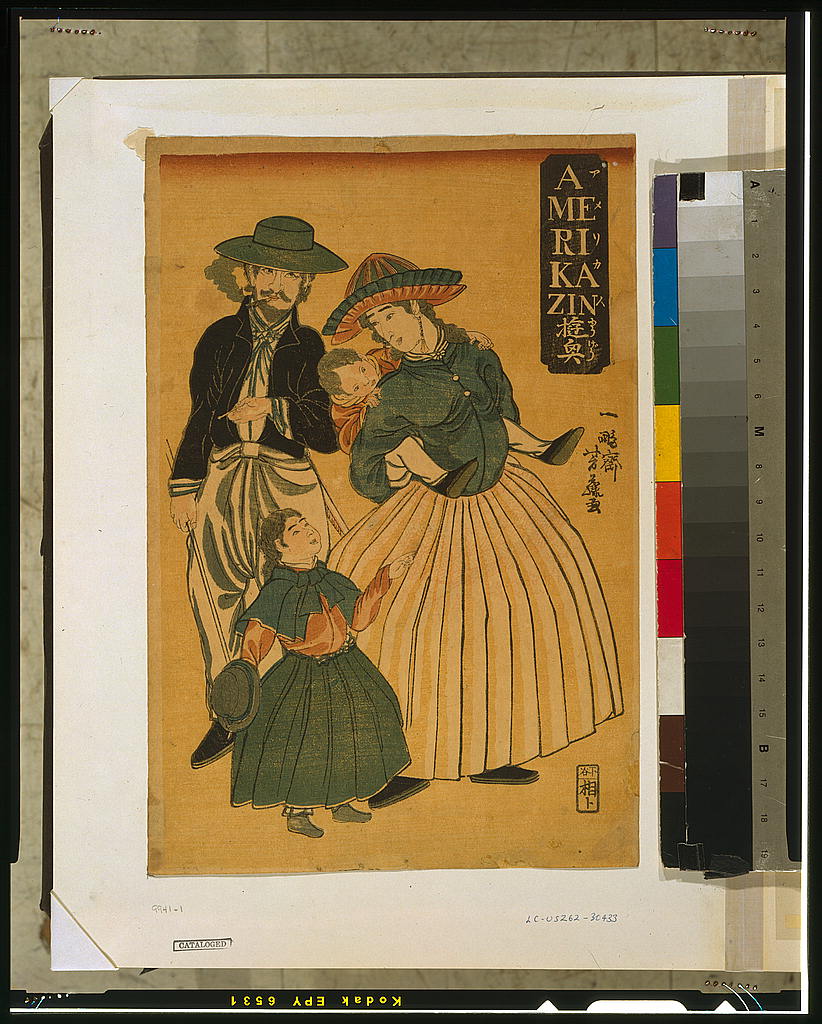
You can come as close as possible to experiencing that culture by viewing, and downloading, more than 2,500 Japanese woodblock prints and drawings at the Library of Congress’ online collection “Fine Prints: Japanese, pre-1915.” It includes work from such prolific Ukiyo‑e artists as Hokusai Katsushika (whose Teahouse at Koishikawa the Morning After a Snowfall appears at the top of the post), Andō Hiroshige (Minakuchi below that), Isoda Koryūsai (Kisaragi, third from the top), and Utagawa Yoshifuji (whose Amerikajin Yūgyō, one of his depictions of Americans, appears just above). As much as Japan has changed since the heyday of the Yokohama‑e, much less the Ukiyo‑e, any visitor to the country in the 21st century will first notice not how much the surfaces of Japan’s real urban and natural landscapes, domestic interiors, and public scenes differ from those in classical woodblock prints, but how deeply they’ve remained the same.
Enter the collection here.
Related Content:
Download Hundreds of 19th-Century Japanese Woodblock Prints by Masters of the Tradition
The (F)Art of War: Bawdy Japanese Art Scroll Depicts Wrenching Changes in 19th Century Japan
Hayao Miyazaki’s Beloved Characters Reimagined in the Style of 19th-Century Woodblock Prints
Based in Seoul, Colin Marshall writes and broadcasts on cities and culture. He’s at work on a book about Los Angeles, A Los Angeles Primer, the video series The City in Cinema, the crowdfunded journalism project Where Is the City of the Future?, and the Los Angeles Review of Books’ Korea Blog. Follow him on Twitter at @colinmarshall or on Facebook.
Read More...Support Us
We're hoping to rely on loyal readers, rather than erratic ads. Please click the Donate button and support Open Culture. You can use Paypal, Venmo, Patreon, even Crypto! We thank you!

About Us

Open Culture scours the web for the best educational media. We find the free courses and audio books you need, the language lessons & educational videos you want, and plenty of enlightenment in between.
Advertise With Us

FREE UPDATES!
GET OUR DAILY EMAIL
Get the best cultural and educational resources on the web curated for you in a daily email. We never spam. Unsubscribe at any time.
FOLLOW ON SOCIAL MEDIA

Open Culture editor Dan Colman scours the web for the best educational media. He finds the free courses and audio books you need, the language lessons & movies you want, and plenty of enlightenment in between.
Advertise With Us