Meet Alexander Graham Bell, Inventor of the Telephone and Popular TV Pitchman
Mr. Watson, come here! I want you to tell me why I keep showing up in television commercials. Is it because they think I invented the television?
- The ghost of Alexander Graham Bell
Not at all, my dear Mr. Bell. A second’s worth of research reveals that a 21-year-old upstart named Philo Taylor Farnsworth invented television. By 1927, when he unveiled it to the public, you’d already been dead for five years.
You invented the telephone, a fact of which we’re all very aware.
Though you might want to look into intellectual property law.… Historic figures make popular pitchmen, especially if — like Lincoln, Copernicus, and a red hot Alexander Hamilton, they’ve been in the grave for over 100 years. (Hint — you’ve got five years to go.)
Or you could take it as a compliment! You’ve made an impression so lasting, the briefest of establishing shots is all we television audiences need to understand the advertiser’s premise.
Thusly can you be co-opted into selling the American public on the apparently revolutionary concept of chicken for breakfast, above.
And that’s just the tip of the iceberg!
Mr. Watson gets a cameo in your 1975 ad for Carefree Gum. You definitely come off the better of the two.
You’re an obvious choice for a recent AT&T spot tracing a line from your revelatory moment to 20-something hipsters wielding smartphones and sparklers on a Brooklyn rooftop. Their devices aren’t the only thing connecting you. It’s also the beards…
Apologies for the beardlessness of this 10 year old, low-budget spot for Able Computing in Papua New Guinea. Possibly the costumer thought Einstein invented the phone? Or maybe the creative director was counting on the local viewing audience not to sweat the small stuff. Your invention matters more than your facial hair.
Lego took a cue from the 80s Muppet Babies craze by sending you back to childhood. They also saddled you and your mom with American accents, a regrettably common practice. I bet you would’ve liked Legos, though. They’re like blocks.
As for this one, your guess is as good as mine.
Readers, please share your favorite ads featuring historic figures in the comments below.
Related Content:
Hear the Voice of Alexander Graham Bell for the First Time in a Century
Thomas Edison’s Silent Film of the “Fartiste” Who Delighted Crowds at Le Moulin Rouge (1900)
Ayun Halliday is an author, illustrator, theater maker and Chief Primatologist of the East Village Inky zine. See her onstage in New York City in Paul David Young’s Faust 3, an indictment of the Trump administration that adapts and mangles Goethe’s Faust (Parts 1 and 2) and the Gospels in the King James translation, as well as bits of Yeats, Shakespeare, Christmas carols, Stephen Foster, John Donne, Heiner Müller, Julia Ward Howe, and Abel Meeropol. Follow her @AyunHalliday.
Read More...Japanese Kabuki Actors Captured in 18th-Century Woodblock Prints by the Mysterious & Masterful Artist Sharaku
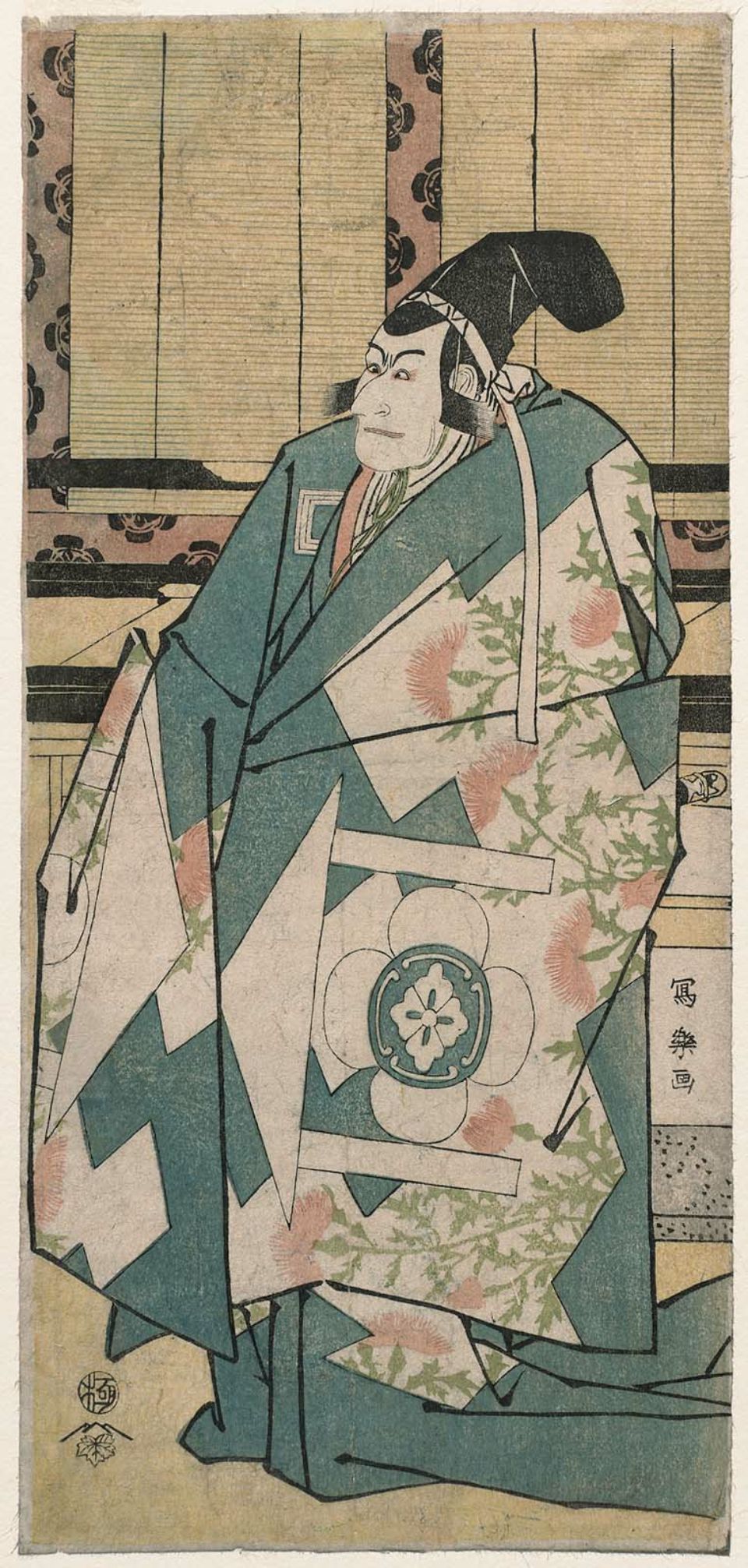
“Kabuki,” as a cultural reference, has traveled astonishingly far beyond the early seventeenth-century Japan in which the form of kabuki theatre originated. Even 21st-century Westerners are quick to use the word when describing anything elaborately performative or melodramatic: in the negative sense, it criticizes an excessive artificiality; in the positive one, it praises complex, nuance-laden mastery. Many scholars of kabuki will disagree about when, exactly, kabuki had its heyday, but none would doubt the immortality, for a kabuki actor of the late eighteenth century, granted by a Sharaku portrait.
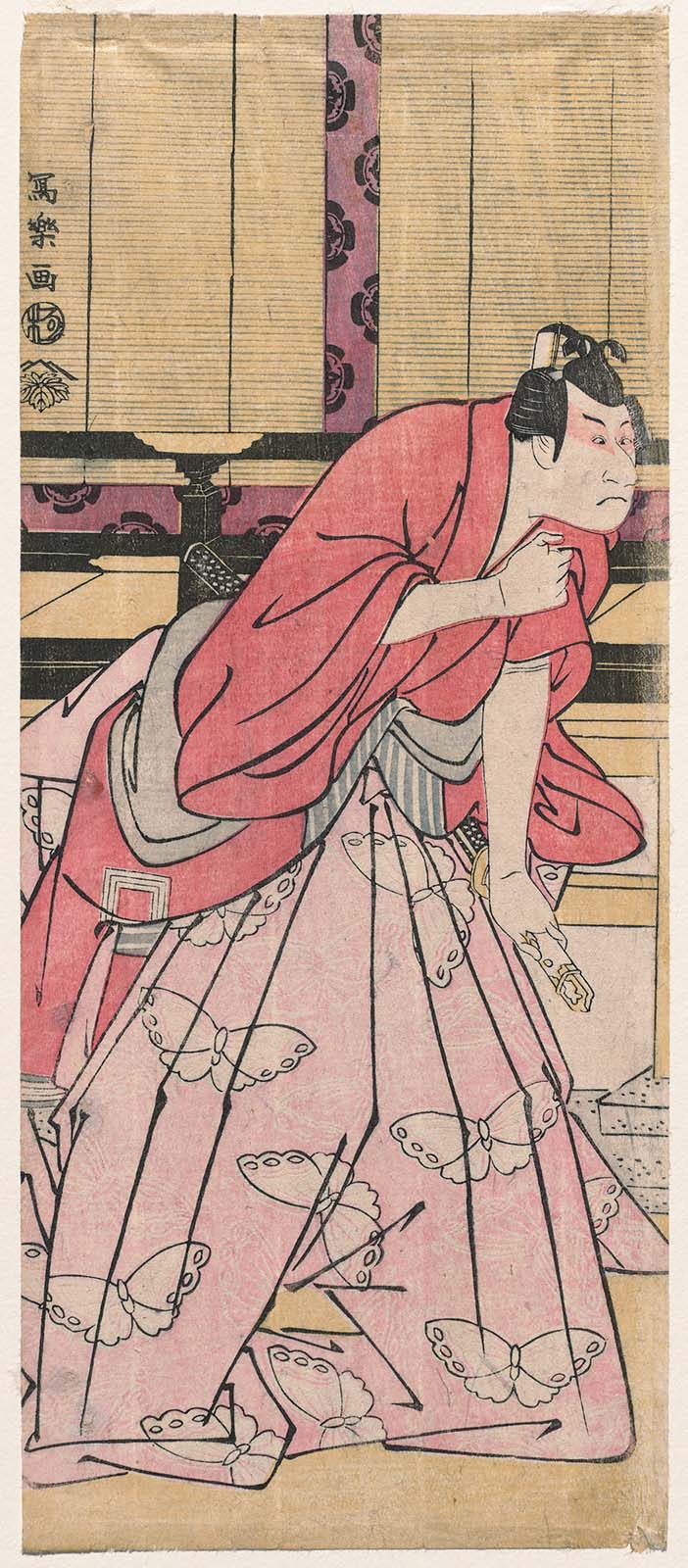
Also known to us as Tōshūsai Sharaku (probably not his real name), Sharaku worked in the form of yakusha‑e woodblock prints, a kind of ukiyo-e focusing on actors, but only for a scant ten months in 1794 and 1795, and not always to a warm public reception.
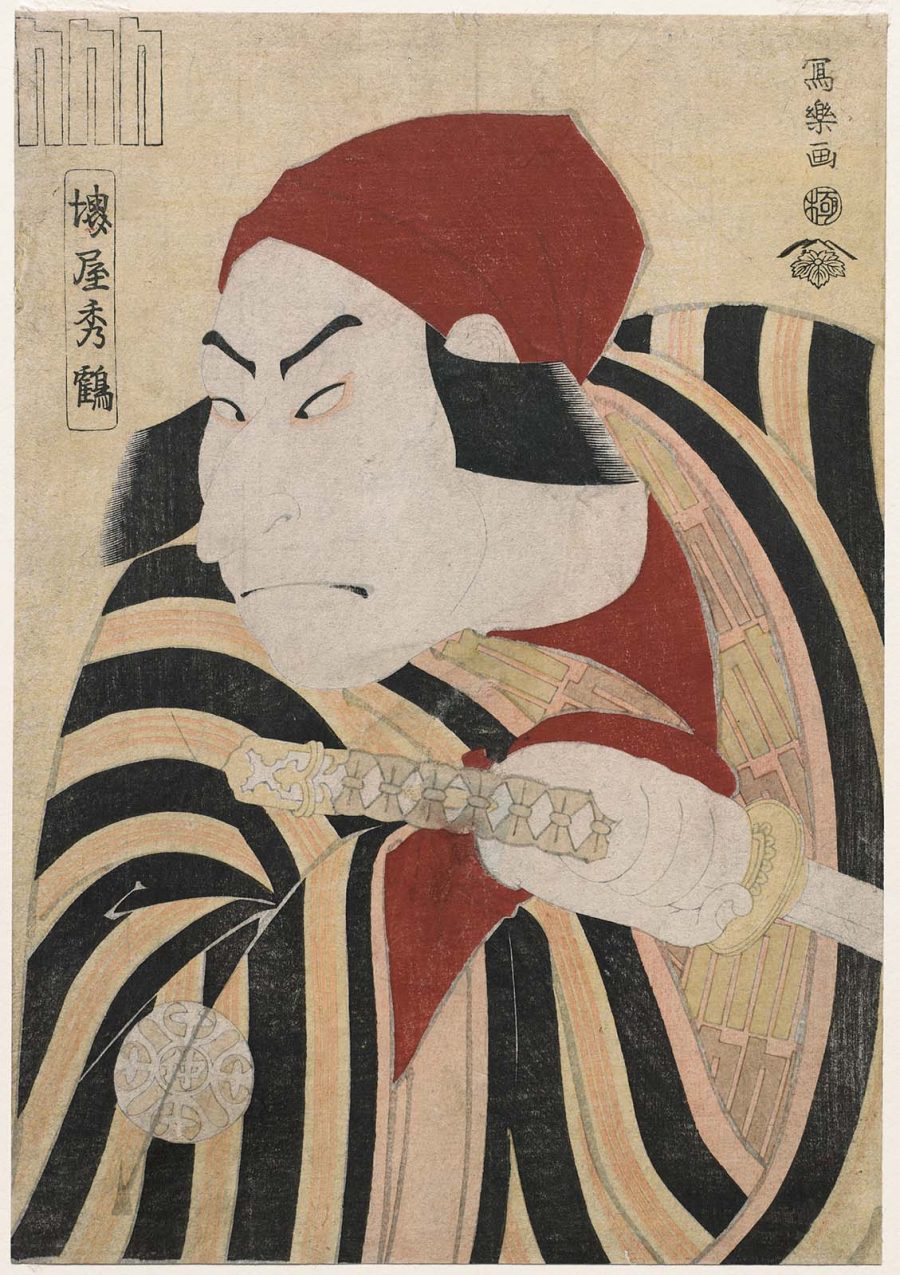
“Renowned for creating visually bold prints that gave rare revealing glimpses into the world of kabuki,” says the Metropolitan Museum of Art, “he was not only able to capture the essential qualities of kabuki characters, but his prints also reveal, often with unflattering realism, the personalities of the actors who were famous for performing them.” Breaking somewhat from ukiyo‑e portraitist tradition, “Sharaku did not idealize his subjects or attempt to portray them realistically. Rather, he exaggerated facial features and strove for psychological realism.”

Nobody knows much about this mysterious artist’s background or his life after yakusha‑e. During it, he designed over 140 prints, and potentially many more, given the number that remain unverifiable as his work. Though he did occasional portraits of sumo wrestlers and warriors, the majority of his portraits depict actors, and seldom in an idealized fashion.

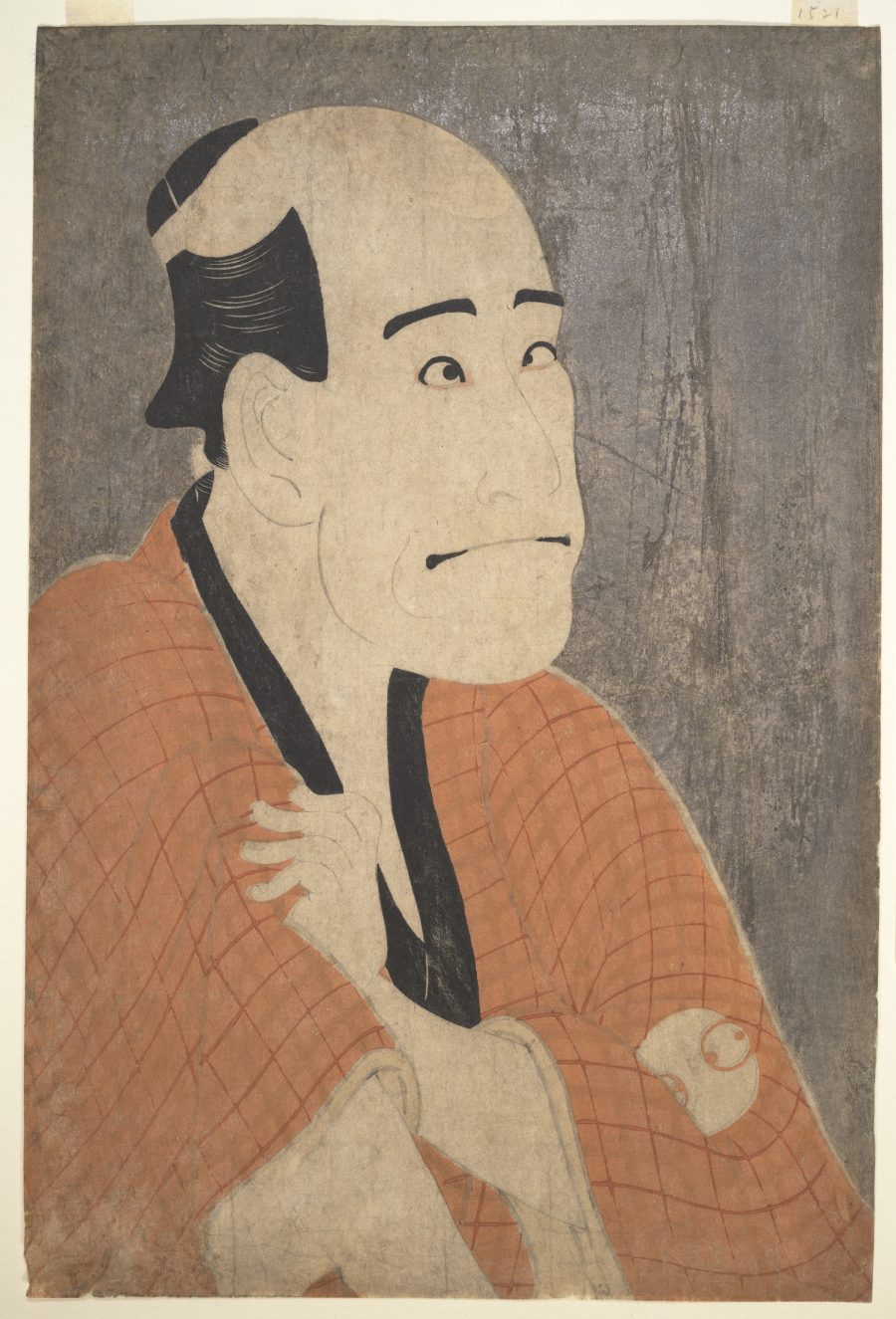
That sense of heightened reality also brought with it a certain vitality to that point unseen in yakusha‑e; art historian Muneshige Narazaki wrote that Sharaku could, within a single print of a kabuki actor or scene, depict “two or three levels of character revealed in the single moment of action forming the climax to a scene or performance.”

At the top of the post, we have three prints from the fourth and final period of Sharaku’s short career: Ichikawa Ebizō as Kudō Saemon Suketsune, Ichikawa Danjūrō VI as Soga no Gorō Tokimune, and Sawamura Sōjūrō III as Satsuma Gengobei. Below that, from top to bottom, appear Ōtani Oniji III in the Role of the Servant Edobei, Segawa Kikujurō III as Oshizu, Wife of Tanabe (one of the many female roles played without exception by male actors after the kabuki theatre attained its current form), Nakamura Nakazō II as the farmer Tsuchizō, actually Prince Koretaka, and Arashi Ryūzō I as Ishibe Kinkichi, which set an auction record for an ukiyo‑e print by selling for €389,000 at Piasa in 2009.
If you want to learn a little more about kabuki theatre itself, have a look at TED-Ed’s four-minute primer on its history. Though many of us may now regard kabuki as a high classical art form, it began as a “people’s” version of the aristocratic noh theatre, and an avant-garde one at that. Its very name appears to derive from the Japanese verb kabuku, which means “to lean” or “to be out of the ordinary.” Sharaku must have seen how incisively this theatre of the unusual, already long established by this day, could present the elements of real life; did he consider it his mission, during his woodblock-designing stint, to bring the elements of real life into its portraiture?
Related Content:
Download 2,500 Beautiful Woodblock Prints and Drawings by Japanese Masters (1600–1915)
Download Hundreds of 19th-Century Japanese Woodblock Prints by Masters of the Tradition
Based in Seoul, Colin Marshall writes and broadcasts on cities and culture. He’s at work on the book The Stateless City: a Walk through 21st-Century Los Angeles, the video series The City in Cinema, the crowdfunded journalism project Where Is the City of the Future?, and the Los Angeles Review of Books’ Korea Blog. Follow him on Twitter at @colinmarshall or on Facebook.
Read More...The Art of the Marbler: An Enchanting Film on the Centuries-Old Craft of Making Handmade Marbled Paper
The current mode of scandal in business and politics involves email and tweets rather than memoranda. But we do not yet live a paperless world, even if you haven’t dusted your printer in months. Book production and sales continue to rise, for example, defying predictions of a few years back that eBooks would overtake print. Even if we have to someday make paper in laboratories rather than forests and mills, it’s hard to imagine readers ever letting go of the pleasures of its textures and smells, or of simple, yet satisfying acts like placing a favorite paper bookmark in the creases.
We do, however, seem to live in a largely stationary-less world, and we have for some time. As the fine art of making artisanal papers recedes into history, so too does the printing of books with marbled covers and pages.
Yet, if you have on your shelf hardback books anywhere from 30 to 130 years old, you no doubt have a few with marbled patterns on them or in them. And if you’ve ever wondered about this strange art form, wonder no more. The 1970 British educational film, “The Art of the Marbler,” above, offers a broad overview of this fascinating “material which has covered books for many centuries.”
Produced by Bedfordshire Record Office of Cockerell Marbling and directed by K.V. Whitbread, the short film is a marvel of quaintness. It effortlessly achieves the kind of quirk Wes Anderson’s films strive for simply by being itself. We learn that every marbled paper, unlike Christmas wrapping paper, is a “separate and unique original.” And that the process is precious and specialized, and nearly all done by hand. Lest we become too enamored of the idea that marbling is strictly a historical curiosity these days, the mesmerizing video above from 2011 by Seyit Uygur shows us up close how his parents perform the art of Ebru, Turkish for paper marbling.
Marbling, the “printmaking technique that basically looks like capturing a galaxy on a page,” as Emma Dajska writes at Rookie, became quite popular in the Islamic world, where intricate patterns stood in lieu of portraits. But the process originated neither in England nor Turkey, but in China and, later, Japan, where it is known as Suminagashi, or “floating ink.” The Japanese technique, as you can see in the video tutorial above from Chrystal Shaulis, is very different from British Marbling or Turkish Ebru, seeming to combine the methods of Jackson Pollack with those of the Zen gardener. However it’s done, the results, as “The Art of the Marbler” tells and shows us, are each one a “unique original.”
“The Art of the Marbler” will be added to our list of Free Documentaries, a subset of our collection, 4,000+ Free Movies Online: Great Classics, Indies, Noir, Westerns, Documentaries & More.
Related Content:
The Making of Japanese Handmade Paper: A Short Film Documents an 800-Year-Old Tradition
How Ink is Made: The Process Revealed in a Mouth-Watering Video
Josh Jones is a writer and musician based in Durham, NC. Follow him at @jdmagness
Read More...Free Libraries Shaped Like Doctor Who’s Time-Traveling TARDIS Pop Up in Detroit, Saskatoon, Macon & Other Cities

Image courtesy of Dan Zemke.
If you live in a major American city — and maybe even if you live in a major non-American one — you may well have come across a Little Free Library, those boxes of books open to the public for whomever would like to take one or leave one. Most Little Free Libraries, often put up on private property by the residents of that property, tend to look like oversized birdhouses, but none of the program’s rules requires them to look that way. A Tokyo subway station, for instance, built one to resemble a subway car. Other industrious Little Free Library members have used the opportunity to pay tribute to their obsessions, and few obsessions run as deep (deeper, even, than the obsession for trains in Japan) as the one for Doctor Who.
The English genre-bending speculative-fiction show has, since its debut on the BBC back in 1963, followed the titular Doctor (just “the Doctor,” not “Doctor Who,” and certainly never “Dr. Who”) through many dramatic changes of settings, and even more notably changes of actors, as he falls into adventures with the various Earthlings he encounters. Always on the move, the Doctor gets around by means of a machine called a TARDIS, which stands for “Time And Relative Dimension In Space.” Theoretically able to change its shape depending on the period of time it lands in, the TARDIS — in a neat demonstration of the creativity that arises from constraints, in this case a severely limited production budget — gets permanently stuck in the shape of a London police call box, thus repurposing one of the best-known icons of English cities into one of the best-known icons of English television.
The best-known TARDIS-shaped Little Free Library, which appears at the top of this post, entered service in a vacant lot in Detroit, a place by now well used to making urban improvements by hand. The father and son behind it “began work last Labor Day, and were aided by an online building community called Tardis Builders,” writes The Verge’s Andrew Liptak.
“The final structure stands almost 10 feet tall, weighs almost a ton, and its front shelves holds around 140 books.” These videos show off other book-lending TARDISes in North America, from Bloomington, Indiana to Macon, Georgia to Saskatoon, Saskatchewan — all standing evidence of how far Doctor Who’s appeal has spread beyond its native culture.
As much as it may seem like nothing more than the proudly nerdy pursuit of worshipful fans, building a Little Free Library (or in most of these cases, a not-so-Little Free Library) in the form of a TARDIS has a certain conceptual validity in and of itself. As every Doctor Who viewer knows, the TARDIS, not just a device enabling travel to any point in time-space, accomplishes another kind of spatial feat by having an interior much larger than its the exterior. “We thought it would be cool to fill the TARDIS with items that are large on the inside, like books that hold whole literary worlds,” says Dan Zemke, co-builder of the one in Detroit, in a Parade article. Borges, as well as all the other most brilliant speculative minds before Doctor Who and after it, would no doubt approve.
Related Content:
BritBox Now Streaming Now Streaming 550 Episodes of Doctor Who and Many Other British TV Shows
30 Hours of Doctor Who Audio Dramas Now Free to Stream Online
The Fascinating Story of How Delia Derbyshire Created the Original Doctor Who Theme
Based in Seoul, Colin Marshall writes and broadcasts on cities and culture. He’s at work on the book The Stateless City: a Walk through 21st-Century Los Angeles, the video series The City in Cinema, the crowdfunded journalism project Where Is the City of the Future?, and the Los Angeles Review of Books’ Korea Blog. Follow him on Twitter at @colinmarshall or on Facebook.
Read More...Google Creates a Digital Archive of World Fashion: Features 30,000 Images, Covering 3,000 Years of Fashion History
Both the fashion and art worlds foster the creation of rarified artifacts inaccessible to the majority of people, often one-of-a-kind pieces that exist in specially-designed spaces and flourish in cosmopolitan cities. Does this mean that fashion is an art form like, say, painting or photography? Doesn’t fashion’s ephemeral nature mark it as a very different activity? We might consider that we can ask many of the same questions of haute couture as we can of fine art. What are the social consequences of taking folk art forms, for example, out of their cultural context and placing them in gallery spaces? What is the effect of tapping street fashion as inspiration for the runway, turning it into objects of consumption for the wealthy?
Such questions should remind us that fashion and the arts are embedded in human cultural and economic history in some very similar ways. But they are also very different social practices. Much like trends in food (both fine dining and cheap consumables) fashion has long been implicated in the spread of markets and industries, labor exploitation, environmental degradation, and even microbes. As Jason Daley points out at Smithsonian, “The craze for silk in ancient Rome helped spawn the Silk Road, a fashion for feathered hats contributed to the first National Wildlife Refuges. Fashion has even been wrapped up in pandemics and infectious diseases.”
So how to tell the story of a human activity so deeply embedded in every facet of world history? Expansively. Google Arts & Culture has attempted to do so with its “We wear culture” project. Promising to tell “the stories behind what we wear,” the project, as you can see in the teaser video at the top, “travelled to over 40 countries, collaborating with more than 180 cultural institutions and their world-renowned historians and curators to bring their textile and fashion collections to life.” Covering 3,000 years of history, “We wear culture” uses video, historical images, short quotes and blurbs, and fashion photography to create a series of online gallery exhibits of, for example, “The Icons,” profiles of designers like Oscar de la Renta, Coco Chanel, and Issey Miyake.
Another exhibit “Fashion as Art” includes a feature on Florence’s Museo Salvatore Ferragamo, a gallery dedicated to the famous designer and containing 10,000 models of shoes he created or owned. Asking the question “is fashion art?”, the exhibit “analyses the forms of dialogue between these two worlds: reciprocal inspirations, overlaps and collaborations, from the experiences of the Pre-Raphaelites to those of Futurism, and from Surrealism to Radical Fashion.” It’s a wonder they don’t mention the Bauhaus school, many of whose resident artists radicalized fashion design, though their geometric oddities seem to have had little effect on Ferragamo.
As you might expect, the emphasis here is on high fashion, primarily. When it comes to telling the stories of how most people in the world have experienced fashion, Google adopts a very European, supply side, perspective, one in which “The impact of fashion,” as one exhibit is called, spans categories “from the economy and job creation, to helping empower communities.” Non-European clothing makers generally appear as anonymous folk artisans and craftspeople who serve the larger goal of providing materials and inspiration for the big names.
Cultural historians may lament the lack of critical or scholarly perspectives on popular culture, the distinct lack of other cultural points of view, and the intense focus on trends and personalities. But perhaps to do so is to miss the point of a project like this one—or of the fashion world as a whole. As with fine art, the stories of fashion are often all about trends and personalities, and about materials and market forces.
To capitalize on that fact, “We wear culture” has a number of interactive, 360 degree videos on its YouTube page, as well as short, advertising-like videos, like that above on ripped jeans, part of a series called “Trends Decoded.” Kate Lauterbach, the program manager at Google Arts & Culture, highlights the videos below on the Google blog (be aware, the interactive feature will not work in Safari).
- Find out how Chanel’s black dress made it acceptable for women to wear black on any occasion (Musée des Arts Décoratifs, Paris, France — 1925)
- Step on up—way up—to learn how Marilyn Monroe’s sparkling red high heels became an expression of empowerment, success and sexiness for women (Museo Salvatore Ferragamo from Florence, Italy — 1959)
- See designer Vivienne Westwood’s unique take on the corset, one of the most controversial garments in history (Victoria and Albert Museum, London, UK — 1990)
- Discover the Comme des Garçons sweater and skirt with which Rei Kawakubo brought the aesthetics and craftsmanship of Japanese design onto the global fashion stage (Kyoto Costume Institute, Kyoto, Japan — 1983)
Does the project yet deliver on its promise, to “tell the stories behind what we wear”? That all depends, I suppose, on who “we” are. It is a very valuable resource for students of high fashion, as well as “a pleasant way to lose an afternoon,” writes Marc Bain at Quartz, one that “may give you a new understanding of what’s hanging in your own closet.”
“We wear culture” features 30,000 fashion pieces and more than 450 exhibits. Start browsing here.
Related Content:
1930s Fashion Designers Predict How People Would Dress in the Year 2000
Punk Meets High Fashion in Metropolitan Museum of Art Exhibition PUNK: Chaos to Couture
Josh Jones is a writer and musician based in Durham, NC. Follow him at @jdmagness
Read More...American Archive of Public Broadcasting Lets You Stream 7,000 Hours of Historic Public TV & Radio Programs

An archive worth knowing about: The Library of Congress and Boston’s WGBH have joined forces to create The American Archive of Public Broadcasting and “preserve for posterity the most significant public television and radio programs of the past 60 years.” Right now, they’re overseeing the digitization of approximately 40,000 hours of programs. And already you can start streaming “more than 7,000 historic public radio and television programs.”
The collection includes local news and public affairs programs, and “programs dealing with education, environmental issues, music, art, literature, dance, poetry, religion, and even filmmaking.” You can browse the complete collection here. Or search the archive here. For more on the archive, read this About page.
If you would like to support the mission of Open Culture, consider making a donation to our site. It’s hard to rely 100% on ads, and your contributions will help us continue providing the best free cultural and educational materials to learners everywhere. You can contribute through PayPal, Patreon, and Venmo (@openculture). Thanks!
Related Content:
The Library of Congress Makes 25 Million Records From Its Catalog Free to Download
Library of Congress Releases Audio Archive of Interviews with Rock ‘n’ Roll Icons
Read More...A Short, Animated Introduction to Emil Cioran, the “Philosopher of Despair”
It is admittedly a gross oversimplification, but if asked to summarize a critical difference between analytical Anglo-American philosophers and so-called “Continentals,” one might broadly say that the former approach philosophy as thinking, the latter as writing. Contrast, for example, John Locke, Thomas Hobbes, and Bertrand Russell—none of whom are especially known as prose stylists—with Michel de Montaigne, Kierkegaard, Nietzsche, or Albert Camus. While the Englishmen struck out into heady intellectual waters indeed, the Europeans brought the full weight of their personalities to bear on their investigations. They invented personae, wrote literary aphorisms, and often wrote fiction, drama, and dialogue in addition to philosophy.
Surely there are many exceptions to this scheme, but on the whole, Continental thinkers have been looser with the laws of logic and more intimate with the rules of rhetoric, as well as with their own emotional lives. But perhaps one of the greatest examples of such a philosophical writer is someone most of us have never heard of. After watching this short School of Life video introduction on Romanian-French philosopher Emil Cioran, we may be persuaded to get to know his work. Cioran, says Alain de Botton above, “is very much worthy of inclusion in the line of the greatest French and European moral philosophers and writers of maxims stretching back to Montaigne, Chamfort, Pascal, and La Rochefoucauld.”
Costica Bradatan describes Cioran as a “20th-century Nietzsche, only darker and with a better sense of humor.” Called a “philosopher of despair” by the New York Times upon his death in 1995, Cioran’s “hair-shirted world view resonated in the titles” of books like On the Heights of Despair, Syllogisms of Bitterness, and The Trouble with Being Born. Though his deeply pessimistic outlook was consistent throughout his career, he was not a systematic thinker. “Cioran often contradicts himself,” writes Bradatan, “but that’s the least of his worries. With him, self-contradiction is not even a weakness, but the sign a mind is alive.”
Like Nietzsche, Cioran possessed a “brooding, romantic, fatalistic temperament” combined with an obsession with religious themes, inherited from his father, a Greek Orthodox priest. The two also share a penchant for pithy aphorisms both shocking and darkly funny in their brutal candor. De Botton quotes one example: “It is not worth the bother of killing yourself, since you always kill yourself too late.” For Cioran, Bradatan remarks, writing philosophy was “not about being consistent, nor about persuasion or keeping a readership entertained.” It was a personal act of survival. “You write not to produce some body of text, but to act upon yourself; to bring yourself together after a personal disaster or to pull yourself out of a bad depression.”
Cioran put it this way: “Write books only if you are going to say in them the things you would never dare confide to anyone.” In his thematic obsessions, literary elegance, and personal investment in his work, Cioran resembles a number of writers we admire because philosophy for them was not a matter of rational abstraction; it was an active engagement with the most personal, yet universal, questions of life and death.
Related Content:
Free Online Philosophy Courses
Josh Jones is a writer and musician based in Durham, NC. Follow him at @jdmagness
Read More...Akira Kurosawa Names His 21 Favorite Art Films in the Criterion Collection
The highly auteur-respecting Criterion Collection has, as you might expect, done quite well by the work of Akira Kurosawa, director of Rashomon, Seven Samurai, Ikiru, and Ran — to name just a few out of his many films in their catalog. Given all the time and attention Criterion puts into not just the pictures themselves but the wealth of supplemental material that goes with them, you could potentially become a Kurosawa expert from only what you can learn through Criterion releases. That includes an understanding of the 21 Criterion films that Kurosawa included on his list of favorite movies. Find them listed right below.
You’ll notice that Kurosawa’s Criterion selections, a subset of his list of 100 favorite movies we featured here on Open Culture a few years ago, include more than just pictures to which he would have thrilled during his formative years in Japan in the 1920s and 30s. In fact, it skews toward much more recent and international productions, right up to Paris, Texas (1984) by German New Wave star Wim Wenders, who once interviewed Kurosawa for a magazine. The younger filmmaker asked the elder only technical questions such as “ ‘Mr. Kurosawa, you let it rain really beautifully. How do you shoot it?” “To be honest,” Kurosawa admitted, “for me also such topics are more welcome, and we discussed it further. But the editors were pretty embarrassed.”
- The Gold Rush, by Charlie Chaplin (1925)
- The Threepenny Opera, by G. W. Pabst (1931)
- Ivan the Terrible, by Sergei Eisenstein (1944–58)
- Bicycle Thieves, by Vittorio De Sica (1948)
- The Third Man, by Carol Reed (1949)
- Late Spring, by Yasujiro Ozu (1949)
- Orpheus, by Jean Cocteau (1950)
- The Life of Oharu, by Kenji Mizoguchi (1952)
- La strada, by Federico Fellini (1954)
- Godzilla, by Ishiro Honda (1956)
- Les cousins, by Claude Chabrol (1959)
- The 400 Blows, by François Truffaut (1959)
- Breathless, by Jean-Luc Godard (1960)
- Purple Noon, by René Clément (1960)
- Zazie dans le métro, by Louis Malle (1960)
- Last Year at Marienbad, by Alain Resnais (1961)
- Red Desert, by Michelangelo Antonioni (1964)
- Solaris, by Andrei Tarkovsky (1972)
- The Spirit of the Beehive, by Víctor Erice (1973)
- Fanny and Alexander Box Set, by Ingmar Bergman (1982)
- Paris, Texas, by Wim Wenders (1984)
Throughout his long life and career, Kurosawa enjoyed opportunities to meet more than a few of the other filmmakers whose work he admired as well. Last year we featured the story of his first meeting with Andrei Tarkovsky, at a screening of the latter’s Solaris. “We were very good friends. He was like a little brother for me,” Kurosawa remembered, recalling in particular one incident when the two of them got drunk together and ended up singing the Seven Samurai theme. His other Criterion selections reveal a love for the work of others in what we might call the Tarkovsky class of late 20th-century auteurs as well, from François Truffaut and Jean-Luc Godard to Ingmar Bergman and Michelangelo Antonioni.
At the top of the post you can watch the first film on Kurosawa’s Criterion list, Charlie Chaplin’s 1925 The Gold Rush, free online. (The version up top, we should note, is not the Criterion release itself. It’s another version.) “Chaplin was very talented as an actor as well,” said Kurosawa. “Do you know, comedies are most difficult to make. It’s much easier to jerk tears from the audience. He, of course, was gifted as a director as well, well-versed in music. I think he was so gifted that he himself didn’t know what he should do with his own talents.” But Kurosawa, gifted as he was, couldn’t say the same of himself, knowing as he always did exactly what movie he wanted to make next, even in periods when he couldn’t shoot a single frame, working right up until the end of his days. Even the title of his final film expresses that sensibility, one that surely resonates with every lover or maker of film who knows how much of cinema always remains to explore: Madadayo, or “Not yet!”
Related Content:
Akira Kurosawa’s List of His 100 Favorite Movies
Hayao Miyazaki Meets Akira Kurosawa: Watch the Titans of Japanese Film in Conversation (1993)
Akira Kurosawa’s Advice to Aspiring Filmmakers: Write, Write, Write and Read
Based in Seoul, Colin Marshall writes and broadcasts on cities and culture. He’s at work on a book about Los Angeles, A Los Angeles Primer, the video series The City in Cinema, the crowdfunded journalism project Where Is the City of the Future?, and the Los Angeles Review of Books’ Korea Blog. Follow him on Twitter at @colinmarshall or on Facebook.
Read More...Introduction to Python, Data Science & Computational Thinking: Free Online Courses from MIT
FYI: MIT has posted online the video lectures for an essential series of courses. In the playlist of 38 lectures above, you can get an Introduction to Computer Science and Programming in Python. Recorded this past fall, and taught by Prof. Eric Grimson, Prof. John Guttag, and Dr. Ana Bell, the course is “intended for students with little or no programming experience. It aims to provide students with an understanding of the role computation can play in solving problems and to help students, regardless of their major, feel justifiably confident of their ability to write small programs that allow them to accomplish useful goals. The class uses the Python 3.5 programming language.” Find accompanying course materials, including syllabus, here.
The follow up course, Introduction to Computational Thinking and Data Science, is again intended for students with little or no programming experience. “It aims to provide students with an understanding of the role computation can play in solving problems and to help students, regardless of their major, feel justifiably confident of their ability to write small programs that allow them to accomplish useful goals. The class uses the Python 3.5 programming language.” Find related course materials here, and the 15 lectures on this playlist.
Both courses will be added to our collection of Free Computer Science Courses, a subset of our collection, 1,700 Free Online Courses from Top Universities.
If you would like to support the mission of Open Culture, consider making a donation to our site. It’s hard to rely 100% on ads, and your contributions will help us continue providing the best free cultural and educational materials to learners everywhere. You can contribute through PayPal, Patreon, and Venmo (@openculture). Thanks!
Related Content:
Learn Python: A Free Online Course from Google
Learn How to Code for Free: A DIY Guide for Learning HTML, Python, Javascript & More
Read More...Rare Footage Shows US and British Soldiers Getting Dosed with LSD in Government-Sponsored Tests (1958 + 1964)
We’re usually right to reserve judgement when it comes to conspiracy theories. But the reason they often sound plausible is a compelling one: What we do know about the secret activities of agencies like the CIA, FBI, KGB, NSA, etc. often points to a surreal, nefarious, extra-legal dimension full of plots Kurt Vonnegut or Philip K. Dick might have written. In such a dimension was born Project MK-ULTRA, the mind control program developed by the CIA in the early fifties and only officially stopped in 1973.
Most famous for introducing a young hospital orderly named Ken Kesey to LSD when he volunteered for an experiment—and thus acting as a primary cause of the Acid-fueled Haight-Ashbury movement to come—MK-ULTRA tested drugs, hypnosis, sensory deprivation, and psychological torture as a means of manipulating interrogation subjects. At the same time as the CIA drugged willing and unwilling participants, Army intelligence conducted research into using LSD as a mind control agent.
Raffi Khatchadourian tells the story in The New Yorker of Dr. Van Murray Sim, founder of the Army’s Edgewood Arsenal program of clinical research on psychochemicals. To his colleagues, Sim “was like Dr. Strangelove; he was a leader; he was the ‘Mengele of Edgewood’… manipulative and vengeful, ethically shortsighted, incoherently rambling… and devoted to chemical-warfare research.” He volunteered himself as a test subject for VX, a lethal nerve agent, for Red Oil, a “highly potent synthetic version of marijuana,” and for other hallucinogens designed for “psychochemical warfare.”
Sim dosed himself several times with LSD and in 1957 proposed a series of “practical experiments” with the drug at Edgewood. “It was deemed important,” writes Khatchadodourian, “to conduct LSD tests on people who were provided no information about what the drug would do.” You can see film of one of those tests above, conducted in 1958 on Army volunteers who, the narrator tells us, “responded like well-trained soldiers to the request: immediately and without question.”
The soldiers are put through a series of drills. Then they are dosed and drilled again. There is much laughter among the squad, but one man succumbed to such severe depression that five minutes after they begin, the medical officers “end his participation.” After a few more minutes, “the men found it difficult to obey orders. And soon the results were chaos,” the narrator says. In reality, as we can see, the soldiers seemed happy and relaxed, not in a “chaotic” state, though their unwillingness to obey would certainly seem so to the brass.
British intelligence also tested LSD on its troops. In the film above from 1964, several armed British Marines are given a dose and sent out into the field exercises. The results are strikingly similar. Immediately after taking the field the drugged marines begin to giggle, laugh, and relax. But one man “is more severely affected than the others, losing all contact with reality, dropping his rifle, and becoming unable to take part in the operation. In fact, he has to be withdrawn from the exercise a few minutes later.” The remainder of the test subjects collapse in fits of hilarity.
“In the end,” writes Rich Remsberg at NPR, the U.S. Army decided that LSD “was too expensive” and “unstable once airborne,” though it did lead to something called Agent BZ, “which was weaponized but never used in combat.” But at the peak of its testing programs, Army intelligence, the CIA, and even Operation Paperclip—the secretive program that recruited former Nazi scientists into its ranks—showed an obsession with the drug, amassing huge supplies of it, and testing it on witting and unwitting subjects alike.
In one operation, called “Midnight Climax,” unsuspecting clients “at CIA brothels in New York and San Francisco were slipped LSD and then monitored through one-way mirrors to see how they reacted,” writes David Hambling at Wired. “Colleagues were also considered fair game for secret testing, to the point where a memo was issued instructing that the punch bowls at office Christmas parties were not to be spiked” with acid.
While the CIA pulled pranks—and inspired Kesey’s Merry Pranksters—the Army took its program overseas to Europe under the aegis of “Operation Special Purpose.” Even today, Khatchadourian writes, “the non-Americans who were tested have still not been identified.” Operation Special Purpose’s experiments “were disastrous, offering little or no useful intelligence, and risking untold psychological damage to the subjects.” The Cold Warriors in charge thought of the drug as a weapon, and threw ethics and scientific caution to the wind. In certain tests, interrogators intended “to cause maximum anxiety and fear.” They degraded and threatened subjects “as long as the drug was effective: eight hours, or possibly more.”
In recent years, LSD research has made a promising return, and has shown that, when used for purposes other than mind control, torture, and manipulation, the hallucinogenic compound might actually have beneficial effects on mental health and well-being. Today’s research builds on experiments conducted by psychiatrists at the same time as MK-ULTRA and Operation Special Purpose. “From the 1950s through the early 1970s,” writes the Multidisciplinary Association for Psychedelic Studies (MAPS), “psychiatrists, therapists, and researchers administered LSD to thousands of people for alcoholism, as well as for anxiety and depression” in terminal patients.
As in the tests in the films above, they found that—with notable exceptions—the drug made people happier, more relaxed, and less afraid of death. “When used by people without a family history or risk of psychological problems,” reported The Washington Post in a story last year on new research, “psychedelics can make us kinder, calmer and better at our jobs. They can help us solve problems more creatively and make us more open-minded and generous.” Perhaps part of the government conspiracy to use hallucinogenic drugs for ill involved suppressing all of the ways they could be used for good.
Related Content:
Hofmann’s Potion: 2002 Documentary Revisits History of LSD
Ken Kesey’s First LSD Trip Animated
Ken Kesey Talks About the Meaning of the Acid Tests
Aldous Huxley’s Most Beautiful, LSD-Assisted Death: A Letter from His Widow
A Short Anti-LSD Horror Film Made by the Lockheed Corporation (1969)
Josh Jones is a writer and musician based in Durham, NC. Follow him at @jdmagness
Read More...Support Us
We're hoping to rely on loyal readers, rather than erratic ads. Please click the Donate button and support Open Culture. You can use Paypal, Venmo, Patreon, even Crypto! We thank you!

About Us

Open Culture scours the web for the best educational media. We find the free courses and audio books you need, the language lessons & educational videos you want, and plenty of enlightenment in between.
Advertise With Us

FREE UPDATES!
GET OUR DAILY EMAIL
Get the best cultural and educational resources on the web curated for you in a daily email. We never spam. Unsubscribe at any time.
FOLLOW ON SOCIAL MEDIA

Open Culture editor Dan Colman scours the web for the best educational media. He finds the free courses and audio books you need, the language lessons & movies you want, and plenty of enlightenment in between.
Advertise With Us


