Behold The Paintings of David Bowie: Neo-Expressionist Self Portraits, Illustrations of Iggy Pop, and Much More
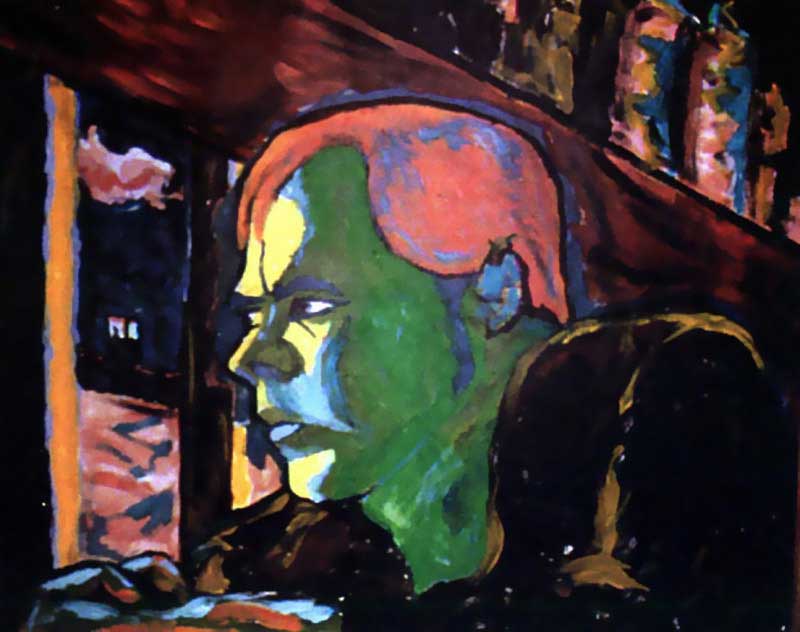
Would you believe that David Bowie, era-transcending pop star, actor, and avid reader, found not just the time to build a formidable art collection (auctioned off for $41 million last year at Sotheby’s), but to do quite a few paintings of his own? Even Bowie fans who know only his music will have seen one of those paintings, a self-portrait which made the cover of his 1995 album Outside. That same year he had his first show as a painter, “New Afro/Pagan and Work: 1975–1995,” at The Gallery, Cork Street.
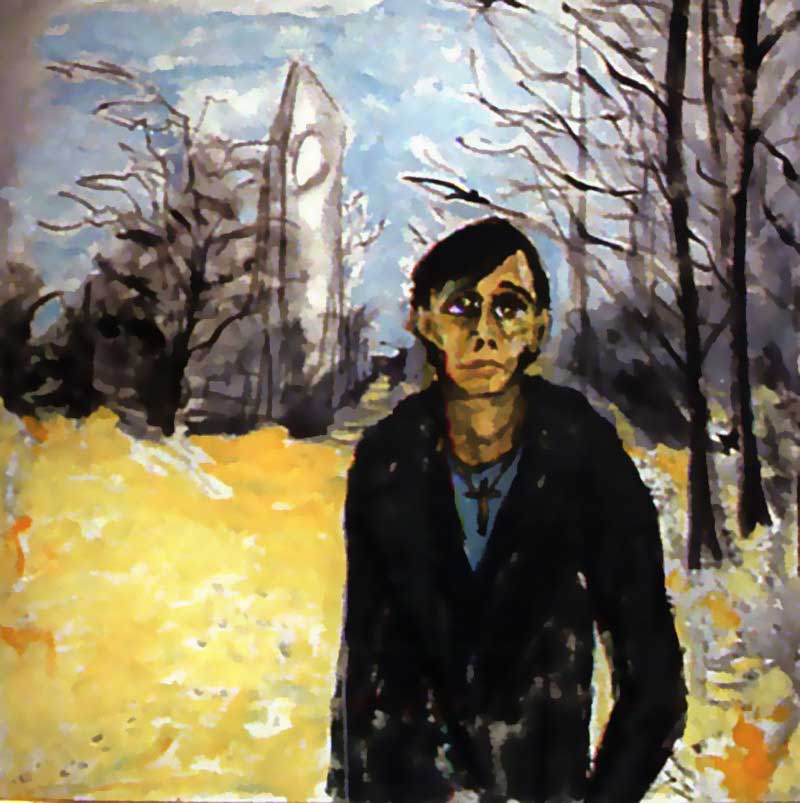
“David Bowie paintings show a knowledgeable approach to art, influenced by Frank Auerbach, David Bomberg, Francis Bacon, Francis Picabia…” says Very Private Gallery in a post on 25 of those works of art, adding that his style “also shows a touch of post-modernism, more precisely neo-expressionism movement.”
Comprising canvases painted between 1976 and 1996, the selections include not just Bowie’s self-portraits but depictions of such friends and associates as Iggy Pop, painted in Berlin in 1978 just above, and pianist Mike Garson.
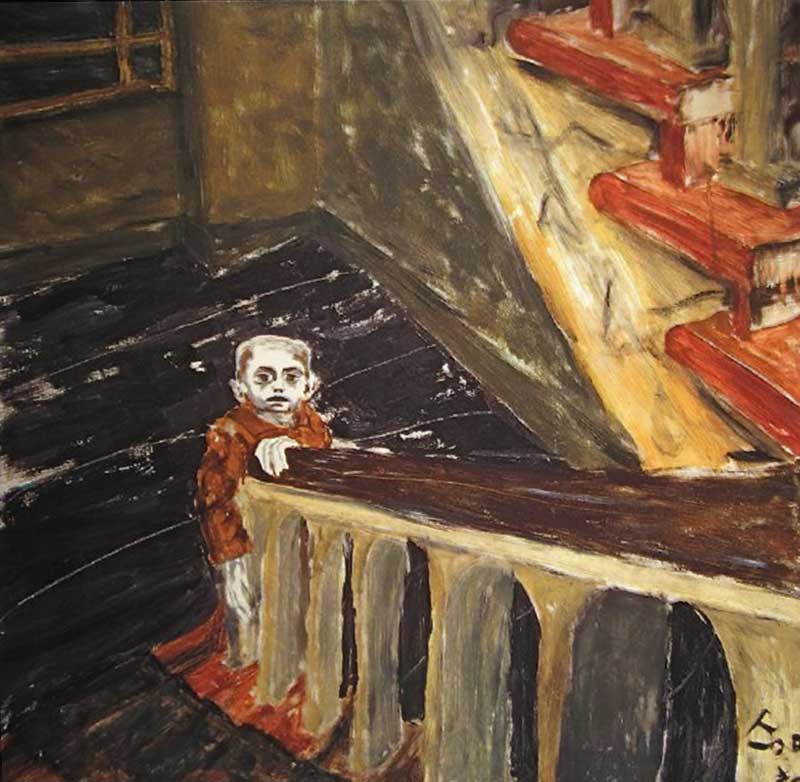
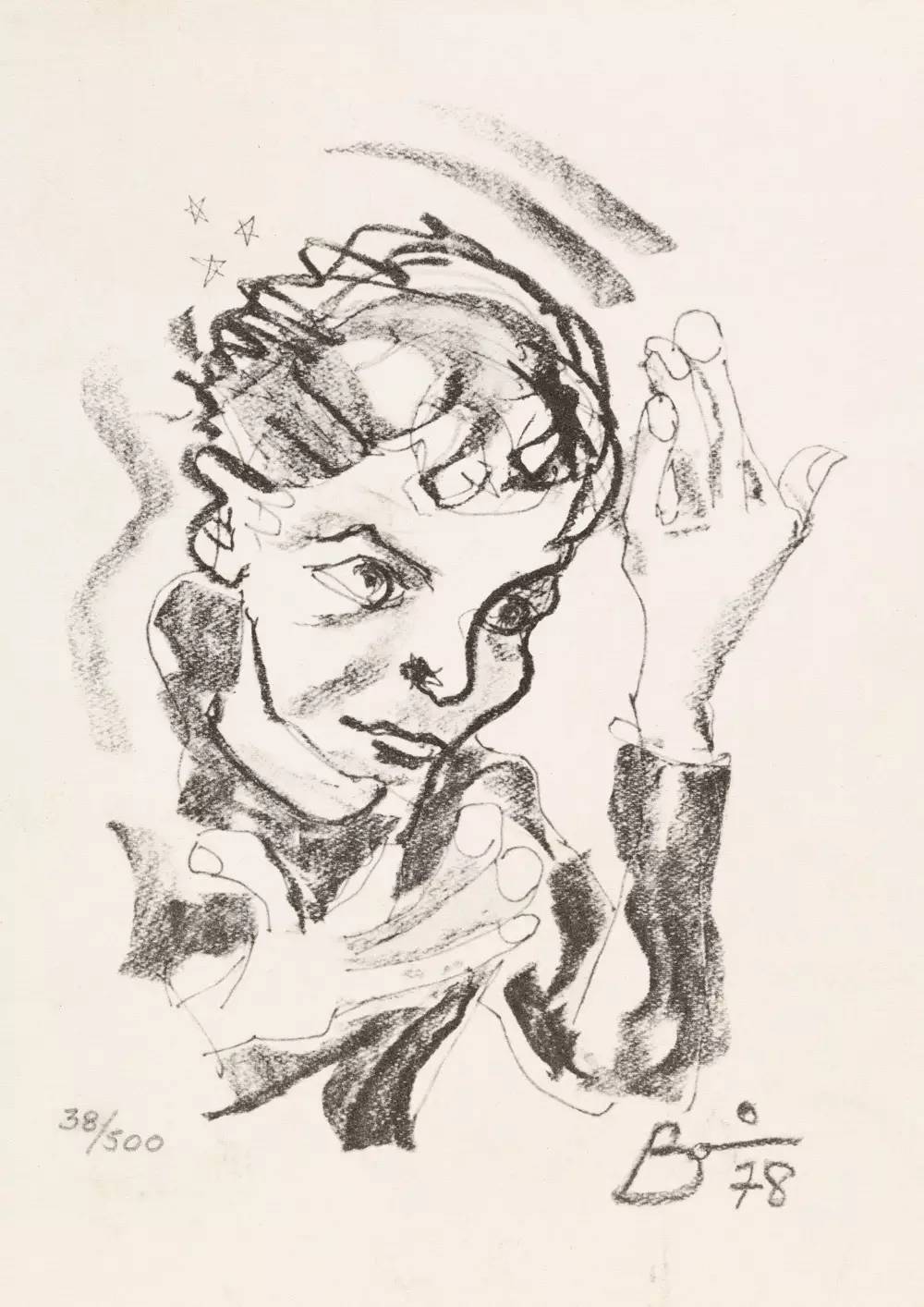
Bowieologists recognize his “Berlin era” in the late 1970s, which produced the albums Low, Lodger, and “Heroes” (all to varying degrees involving the collaboration of Brian Eno) as an especially fruitful period of his musical career. But the galleries and museums of the German capital also witnessed Bowie’s first immersion into the world of visual art, both as an enthusiast and as a creator. The city even found its way into some of his paintings, such as 1977’s Child in Berlin above. “Heroes”, the final album of Bowie’s “Berlin trilogy,” even inspired a bit of Bowie artwork, the self-portrait sketch below modeled on the record’s famous cover photo by Masayoshi Sukita, itself inspired by Erich Heckel’s 1917 painting Roquairol.
But just as Bowie the musician and performer couldn’t stop seeking out and incorporating new influences, so did Bowie the painter’s attention continually turn to new subject matter, including the mythology of the tribes inhabiting present-day South Africa. At Very Private Gallery you can see not just more of his finished work but more of his sketches, including studies of Hunger City, the thematic setting of his elaborate Diamond Dogs tour as well as for a film planned, but never actually shot, in the mid-1970s. Despite the considerable difference in medium between music and images, Bowie’s visual work still comes across clearly as Bowie’s work — especially a face drawn, true to elegantly nostalgic form, on a pack of Gitanes.
Related Content:
96 Drawings of David Bowie by the “World’s Best Comic Artists”: Michel Gondry, Kate Beaton & More
The Art from David Bowie’s Final Album, Blackstar, is Now Free for Fans to Download and Reuse
David Bowie Lists His 25 Favorite LPs in His Record Collection: Stream Most of Them Free Online
The Story of Ziggy Stardust: How David Bowie Created the Character that Made Him Famous
Based in Seoul, Colin Marshall writes and broadcasts on cities and culture. He’s at work on the book The Stateless City: a Walk through 21st-Century Los Angeles, the video series The City in Cinema, the crowdfunded journalism project Where Is the City of the Future?, and the Los Angeles Review of Books’ Korea Blog. Follow him on Twitter at @colinmarshall or on Facebook.
Read More...Watch a Star Get Devoured by a Supermassive Black Hole
Likely, in a moment of quiet downtime, you’ve wondered: Just what would happen if a star, burning bright in the sky, wandered by a black hole? What would that meeting look like? What kinds of cosmic things would go down?
Now, thanks to an artistic rendering made available by NASA, you don’t have to leave much to imagination. Above, watch a star stray a little too close to a black hole and get shredded apart by “tidal disruptions,” causing some stellar debris to get “flung outward at high speed while the rest falls toward the black hole.”
This rendering isn’t theoretical. It’s based on observations gleaned from “an optical search by the All-Sky Automated Survey for Supernovae (ASAS-SN) in November 2014.” The “tidal disruptions” witnessed above, writes NASA, “occurred near a supermassive black hole estimated to weigh a few million times the mass of the sun in the center of PGC 043234, a galaxy that lies about 290 million light-years away.” It’s a sight to behold.
If you would like to support the mission of Open Culture, consider making a donation to our site. It’s hard to rely 100% on ads, and your contributions will help us continue providing the best free cultural and educational materials to learners everywhere. You can contribute through PayPal, Patreon, and Venmo (@openculture). Thanks!
Related Content:
Free Online Astronomy Courses
NASA Puts Online a Big Collection of Space Sounds, and They’re Free to Download and Use
Free NASA eBook Theorizes How We Will Communicate with Aliens
NASA Archive Collects Great Time-Lapse Videos of our Planet
Read More...The First Bloomsday: See Dublin’s Literati Celebrate James Joyce’s Ulysses in Drunken Fashion (1954)
Here’s a fascinating glimpse of the very first Bloomsday celebration, filmed in Dublin in 1954.
The footage shows the great Irish comedic writer Brian O’Nolan, better known by his pen name Flann O’Brien, appearing very drunk as he sets off with two other renowned post-war Irish writers, Patrick Kavanagh and Anthony Cronin, and a cousin of James Joyce, a dentist named Tom Joyce, on a pilgrimage to visit the sites in James Joyce’s epic novel Ulysses.
The footage was taken by John Ryan, an artist, publisher and pub owner who organized the event. The idea was to retrace the steps of Leopold Bloom and other characters from the novel, but as Peter Costello and Peter van de Kamp explain in this humorous passage from their book, Flann O’Brien: An Illustrated Biography, things began to go awry right from the start:
The date was 16 June, 1954, and though it was only mid-morning, Brian O’Nolan was already drunk.
This day was the fiftieth anniversary of Mr. Leopold Bloom’s wanderings through Dublin, which James Joyce had immortalised in Ulysses.
To mark this occasion a small group of Dublin literati had gathered at the Sandycove home of Michael Scott, a well-known architect, just below the Martello tower in which the opening scene of Joyce’s novel is set. They planned to travel round the city through the day, visiting in turn the scenes of the novel, ending at night in what had once been the brothel quarter of the city, the area which Joyce had called Nighttown.
Sadly, no-one expected O’Nolan to be sober. By reputation, if not by sight, everyone in Dublin knew Brian O’Nolan, otherwise Myles na Gopaleen, the writer of the Cruiskeen Lawn column in the Irish Times. A few knew that under the name of Flann O’Brien, he had written in his youth a now nearly forgotten novel, At Swim-Two-Birds. Seeing him about the city, many must have wondered how a man with such extreme drinking habits, even for the city of Dublin, could have sustained a career as a writer.
As was his custom, he had been drinking that morning in the pubs around the Cattle Market, where customers, supposedly about their lawful business, would be served from 7:30 in the morning. Now retired from the Civil Service, on grounds of “ill-health”, he was earning his living as a free-lance journalist, writing not only for the Irish Times, but for other papers and magazines under several pen-names. He needed to write for money as his pension was a tiny one. But this left little time for more creative work. In fact, O’Nolan no longer felt the urge to write other novels.
The rest of the party, that first Bloomsday, was made up of the poet Patrick Kavanagh, the young critic Anthony Cronin, a dentist named Tom Joyce, who as Joyce’s cousin represented the family interest, and John Ryan, the painter and businessman who owned and edited the literary magazine Envoy. The idea of the Bloomsday celebration had been Ryan’s, growing naturally out of a special Joyce issue of his magazine, for which O’Nolan had been guest editor.
Ryan had engaged two horse drawn cabs, of the old fashioned kind, which in Ulysses Mr. Bloom and his friends drive to poor Paddy Dignam’s funeral. The party were assigned roles from the novel. Cronin stood in for Stephen Dedalus, O’Nolan for his father, Simon Dedalus, John Ryan for the journalist Martin Cunningham, and A.J. Leventhal, the Registrar of Trinity College, being Jewish, was recruited to fill (unkown to himself according to John Ryan) the role of Leopold Bloom.
Kavanagh and O’Nolan began the day by deciding they must climb up to the Martello tower itself, which stood on a granite shoulder behind the house. As Cronin recalls, Kavanagh hoisted himself up the steep slope above O’Nolan, who snarled in anger and laid hold of his ankle. Kavanagh roared, and lashed out with his foot. Fearful that O’Nolan would be kicked in the face by the poet’s enormous farmer’s boot, the others hastened to rescue and restrain the rivals.
With some difficulty O’Nolan was stuffed into one of the cabs by Cronin and the others. Then they were off, along the seafront of Dublin Bay, and into the city.
In pubs along the way an enormous amount of alcohol was consumed, so much so that on Sandymount Strand they had to relieve themselves as Stephen Dedalus does in Ulysses. Tom Joyce and Cronin sang the sentimental songs of Tom Moore which Joyce had loved, such as Silent, O Moyle. They stopped in Irishtown to listen to the running of the Ascot Gold Cup on a radio in a betting shop, but eventually they arrived in Duke Street in the city centre, and the Bailey, which John Ryan then ran as a literary pub.
They went no further. Once there, another drink seemed more attractive than a long tour of Joycean slums, and the siren call of the long vanished pleasures of Nighttown.
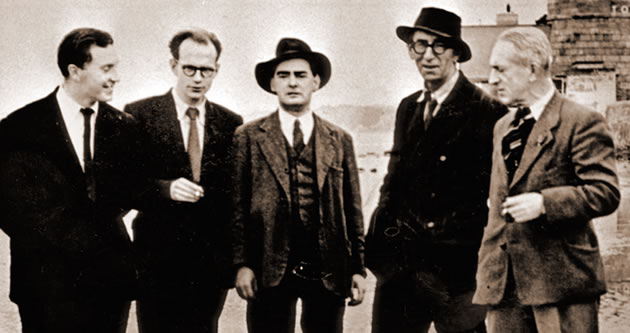
Celebrants of the first Bloomsday pause for a photo in Sandymount, Dublin on the morning of June 16, 1954. From left are John Ryan, Anthony Cronin, Brian O’Nolan (a.k.a. Flann O’Brien), Patrick Kavanagh and Tom Joyce, cousin of James Joyce.
Note: This post originally appeared on our site in 2013–likely before many of you started to frequent our site. So it’s time to bring it back.
Related content:
Vladimir Nabokov Creates a Hand-Drawn Map of James Joyce’s Ulysses
On Bloomsday, Hear James Joyce Read From his Epic Ulysses, 1924
Stephen Fry Explains His Love for James Joyce’s Ulysses
Henri Matisse Illustrates 1935 Edition of James Joyce’s Ulysses
James Joyce, With His Eyesight Failing, Draws a Sketch of Leopold Bloom (1926)
Read More...How to Build Leonardo da Vinci’s Ingenious Self-Supporting Bridge: Renaissance Innovations You Can Still Enjoy Today
Leonardo da Vinci, the most accomplished example of the polymathic, artist-engineer “Renaissance man,” came up with an astonishing number of inventions great and small in the late 15th and early 16th century, from the helicopter to the musical viola organista, the tank to the automated bobbin winder. Even the devices he was born too late to invent, he improved: humans had crossed the humble bridge, for instance, for countless centuries, but then Leonardo created a new, self-supporting variety whose design, as followed by a kid and his dad in the video above, still impresses today.
“With a series of wooden poles and beams, ‘Stick-Boy’ shows his Dad how to build Leonardo da Vinci‘s self-supporting arch bridge, also known as the emergency bridge,” say the description by Rion Nakaya at The Kid Should See This. “No nails, screws, rope, glues, notches, or other fasteners are holding the bridge in place… just friction and gravity.”
Clearly it works, but how? According to a post at the blog ArchiScriptor on self-supporting structures, all such bridges, from Leonardo’s on down, really do rely on only those two forces. “Notches in the members make it easier to construct, but strictly speaking aren’t necessary as long as there is some friction. Gravity will do the rest.”
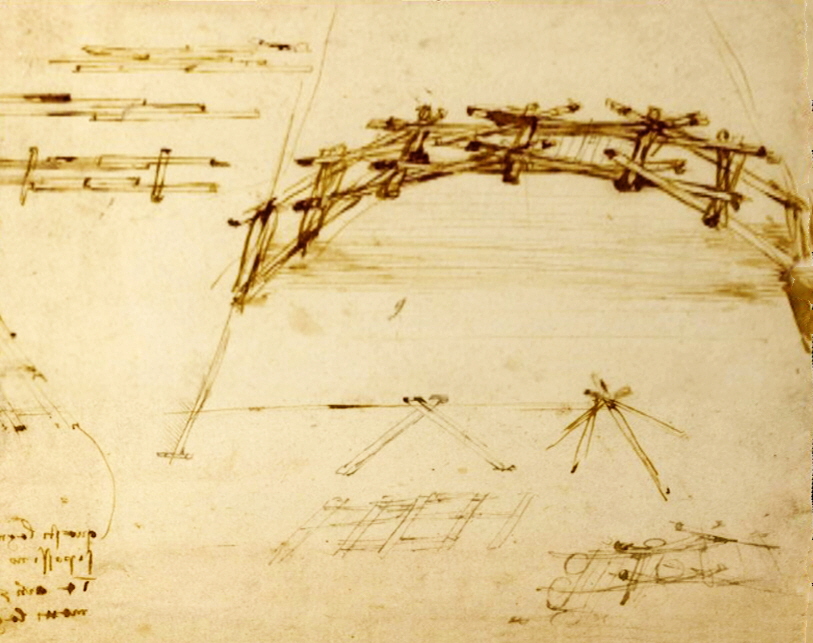
Leonardo, the post continues, “explored two forms of the structure – a bridge and a dome. His work was commissioned by the Borgia family, with the mandate to design light and strong structures which could be built and taken down quickly. This was to aid them in their constant struggle for power with the Medici family in Renaissance Italy.” The site of the Leonardo3 Museum adds, “we do not know whether this bridge was ever put to practical use, but it is not hard to believe that such a modular construction, extremely easy to transport and to assemble, must have met with great favor from the Renaissance lords who were always on the lookout for new technologies to put to military use.”
Leonardo himself called this “the bridge of safety,” and it counts as only one of the ingenious bridges he designed in his lifetime. For the Duke Sforza he also invented several others including a revolving bridge which, according to Leonardo da Vinci Inventions, “could be quickly packed up and transported for use by armies on the move to pass over bodies of water,” could “swing across a stream or moat and set down on the other side so that soldiers could pass with little trouble,” and “incorporated a rope-and-pulley system for both quick employment and easy transport.” All useful tools indeed for those who once sought military dominance in Italy, but even more beneficial as inspiration for the Renaissance boys and girls of the 21st century.
Related Content:
Leonardo Da Vinci’s To Do List (Circa 1490) Is Much Cooler Than Yours
Leonardo da Vinci Draws Designs of Future War Machines: Tanks, Machine Guns & More
The Anatomical Drawings of Renaissance Man, Leonardo da Vinci
Leonardo da Vinci’s Handwritten Resume (1482)
An Animated History Of Aviation: From da Vinci’s Sketches to Apollo 11
Did Leonardo da Vinci Paint a First Mona Lisa Before The Mona Lisa?
Based in Seoul, Colin Marshall writes and broadcasts on cities and culture. He’s at work on the book The Stateless City: a Walk through 21st-Century Los Angeles, the video series The City in Cinema, the crowdfunded journalism project Where Is the City of the Future?, and the Los Angeles Review of Books’ Korea Blog. Follow him on Twitter at @colinmarshall or on Facebook.
Read More...Evelyn Glennie (a Musician Who Happens to Be Deaf) Shows How We Can Listen to Music with Our Entire Bodies
Composer and percussionist Dame Evelyn Glennie, above, feels music profoundly. For her, there is no question that listening should be a whole body experience:
Hearing is basically a specialized form of touch. Sound is simply vibrating air which the ear picks up and converts to electrical signals, which are then interpreted by the brain. The sense of hearing is not the only sense that can do this, touch can do this too. If you are standing by the road and a large truck goes by, do you hear or feel the vibration? The answer is both. With very low frequency vibration the ear starts becoming inefficient and the rest of the body’s sense of touch starts to take over. For some reason we tend to make a distinction between hearing a sound and feeling a vibration, in reality they are the same thing. It is interesting to note that in the Italian language this distinction does not exist. The verb ‘sentire’ means to hear and the same verb in the reflexive form ‘sentirsi’ means to feel.
It’s a philosophy born of necessity—her hearing began to deteriorate when she was 8, and by the age of 12, she was profoundly deaf. Music lessons at that time included touching the wall of the practice room to feel the vibrations as her teacher played.
While she acknowledges that her disability is a publicity hook, it’s not her preferred lede, a conundrum she explores in her “Hearing Essay.” Rather than be celebrated as a deaf musician, she’d like to be known as the musician who is teaching the world to listen.
In her TED Talk, How To Truly Listen, she differentiates between the ability to translate notations on a musical score and the subtler, more soulful skill of interpretation. This involves connecting to the instrument with every part of her physical being. Others may listen with ears alone. Dame Evelyn encourages everyone to listen with fingers, arms, stomach, heart, cheekbones… a phenomenon many teenagers experience organically, no matter what their earbuds are plugging.
And while the vibrations may be subtler, her philosophy could cause us to listen more attentively to both our loved ones and our adversaries, by staying attuned to visual and emotional pitches, as well as slight variations in volume and tone.
Related Content:
How Did Beethoven Compose His 9th Symphony After He Went Completely Deaf?
Ayun Halliday is an author, illustrator, theater maker and Chief Primatologist of the East Village Inky zine. She’ll is appearing onstage in New York City this June as one of the clowns in Paul David Young’s Faust 3. Follow her @AyunHalliday.
Read More...Sci-Fi Radio: Hear Radio Dramas of Sci-Fi Stories by Ray Bradbury, Philip K. Dick, Ursula K. LeGuin & More (1989)

Image by Mr.Hasgaha, via Flickr Commons
If you dig through our archives, you can find no shortage of finely-produced radio dramatizations of your favorite science fiction stories. During the 1950s, NBC’s Dimension X adapted stories by the likes of Isaac Asimov, Ray Bradbury, Robert Heinlein, and even Kurt Vonnegut. Later in the ’50s, X Minus One continued that tradition, dramatizing stories by Robert A. Heinlein, Philip K. Dick, Poul Anderson and others. By the 1970s, Mind Webs got into the act and produced 188 adaptations–classics by Ursula K. LeGuin, Isaac Asimov, Arthur C. Clarke. And the BBC did up Isaac Asimov’s Foundation Trilogy.
Those productions will keep you busy for a good while. But if you’re wondering what the 1980s delivered, then tune into Sci-Fi Radio, a series of 26 half-hour shows which aired on NPR Playhouse, starting in 1989. Some of the adapted stories include: “Sales Pitch” and “Imposter” by Philip K. Dick, “Diary of the Rose” and “Field of Vision” by Ursula K. LeGuin, “Wall of Darkness” by Arthur C. Clarke, and “Frost and Fire” by Ray Bradbury.
You can stream all episodes below, or over at Archive.org. Sci-Fi Radio will be added to our collection, 1,000 Free Audio Books: Download Great Books for Free. Hope you enjoy.
If you would like to support the mission of Open Culture, consider making a donation to our site. It’s hard to rely 100% on ads, and your contributions will help us continue providing the best free cultural and educational materials to learners everywhere. You can contribute through PayPal, Patreon, and Venmo (@openculture). Thanks!
Related Content:
Isaac Asimov’s Foundation Trilogy: Hear the 1973 Radio Dramatization
X Minus One: Hear Classic Sci-Fi Radio Stories from Asimov, Heinlein, Bradbury & Dick
Hear 6 Classic Philip K. Dick Stories Adapted as Vintage Radio Plays
Read More...Talking Heads Perform The Ramones’ “I Wanna Be Your Boyfriend” Live in 1977 (and How the Bands Got Their Start Together)
Back in the summer of 1975, the Talking Heads were still an unknown band, laboring away in obscurity. Amidst a stifling heat wave, they practiced in every day in a New York City loft. And so it went until they got an early break–a chance to perform live at CBGB, as the opening act for The Ramones. “Hilly [Kristal, owner of CBGB, asked Johnny [Ramone] if we could open for them, and Johnny said, ‘Sure, they’re gonna suck, so no problem,’ ” Chris Frantz (Talking Heads drummer), recalled in an interview with The New York Post. “There were very few people in the audience, maybe 10 altogether,” he adds. “Five came to see us and five came to see the Ramones.” The lucky ones.
By 1977, the bands had released their debut albums and embarked on a European tour together. Equally innovative but stylistically different, their histories would remain forever intertwined–something that’s perhaps best captured by the clip above. If we have our facts right, in January 1977, the Talking Heads opened a show at the Jabberwocky Club at Syracuse University with a cover of The Ramones’ 1976 single “I Wanna Be Your Boyfriend.” You can listen to the complete 20 minute set below. Also, in the Relateds further down, find footage of both bands playing at CBGB in 1974 and 1975.
If you would like to support the mission of Open Culture, consider making a donation to our site. It’s hard to rely 100% on ads, and your contributions will help us continue providing the best free cultural and educational materials to learners everywhere. You can contribute through PayPal, Patreon, and Venmo (@openculture). Thanks!
Related Content:
The Talking Heads Play CBGB, the New York Club that Shaped Their Sound (1975)
The Ramones, a New Punk Band, Play One of Their Very First Shows at CBGB (1974)
Watch the Talking Heads Play a Vintage Concert in Syracuse (1978)
Read More...Download 36 Dadaist Magazines from The Digital Dada Archive (Plus Other Avant-Garde Books, Leaflets & Ephemera)
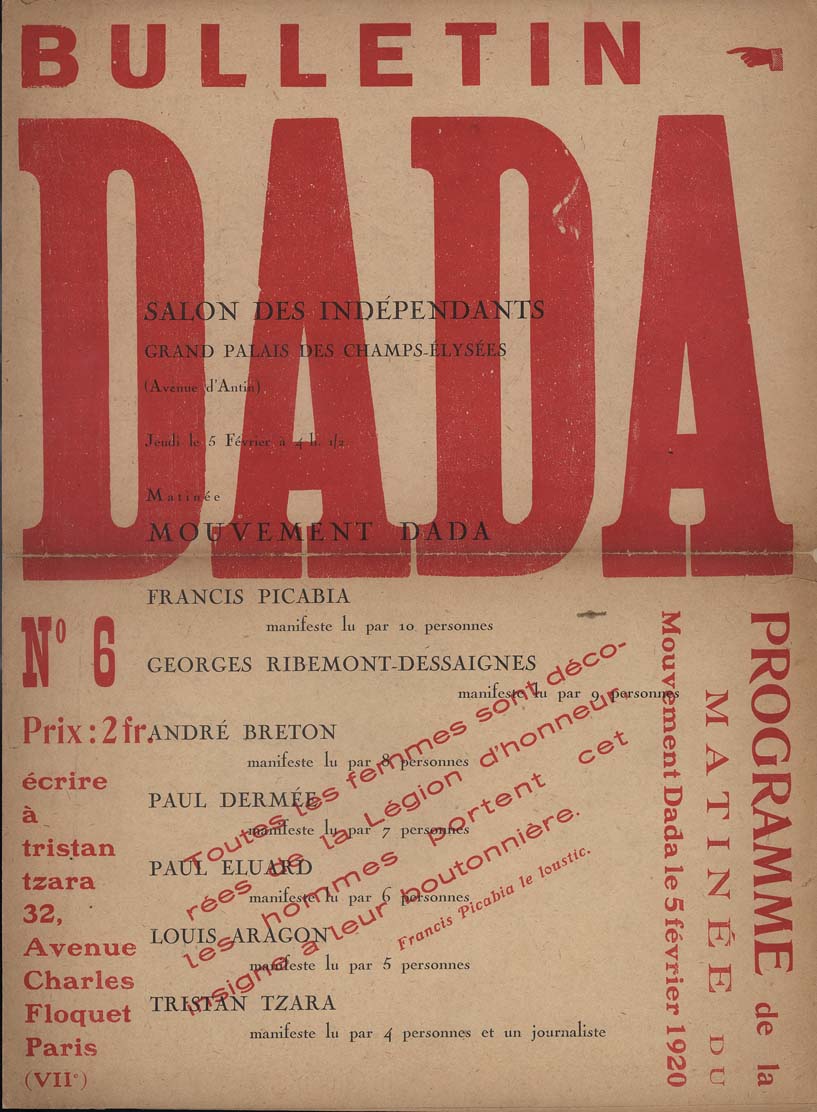
In searching for a treasure trove of publications springing from the avant-garde, deliberately irrational, early 20th-century European “anti-art” art movement known as Dada, where would you first look? Many corners of the world’s historic cultural capitals may come right to mind, but might we suggest the University of Iowa? Even if you don’t feel like traveling to the middle of the United States to plunge into an archive of highly purposeful nonsense, you can view their impressive collection of Dada periodicals (36 in total), books, leaflets, and ephemera online.
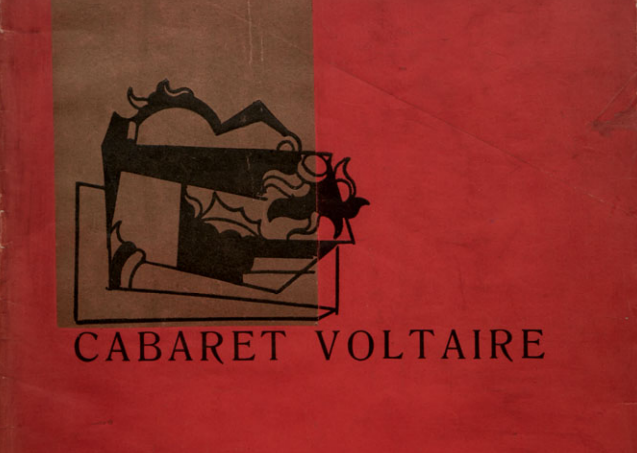
“Founded in 1979 as part of the Dada Archive and Research Center, the International Dada Archive is a scholarly resource for the study of the historic Dada movement,” says its front page. The collection contains “works by and about the Dadaists including books, articles, microfilmed manuscript collections, videorecordings, sound recordings, and online resources,” and in its digital form it “provides links to scanned images of original Dada-era publications in the International Dada Archive,” including the influential Dada and 291, as well as “many of the major periodicals of the Dada movement from Zurich, Berlin, Paris, and elsewhere, as well as books, exhibition catalogs, and broadsides by participants in the Dada movement.” (Note: if you click on magazines in the collection, you can download the various pages.)
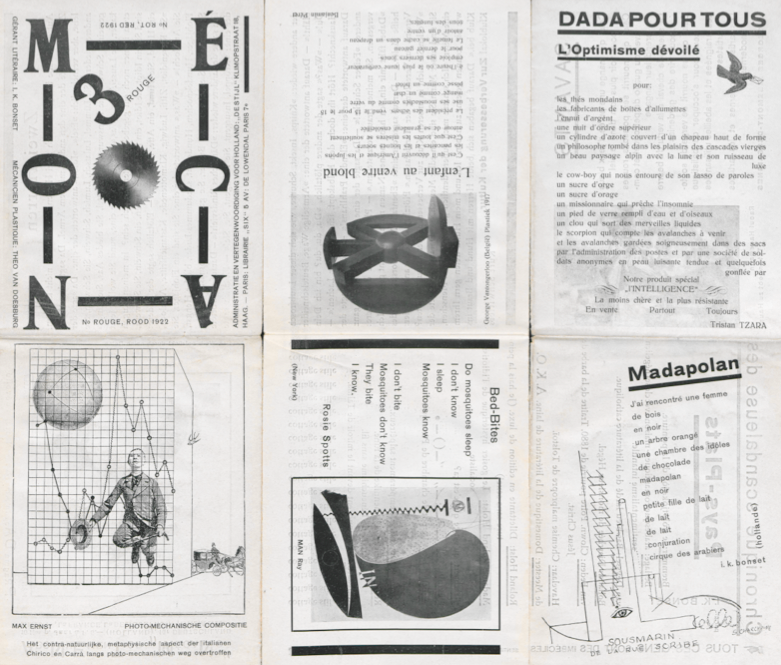
The history of the archive, written by Timothy Shipe, also addresses an important question: “Why Iowa? One answer lies in a clear affinity between the Dada movement and this University. The internationalist, multilingual, multimedia nature of Dada makes Iowa, with its International Writers’ Program, its Writers’ Workshop, its Center for Global Studies, its Translation Workshop and Center, its dynamic programs in music, dance, art, theater, film, literature, and languages, an especially appropriate place to house the Dada Archive. A brief glance at the history of Dada will make this affinity clear.”
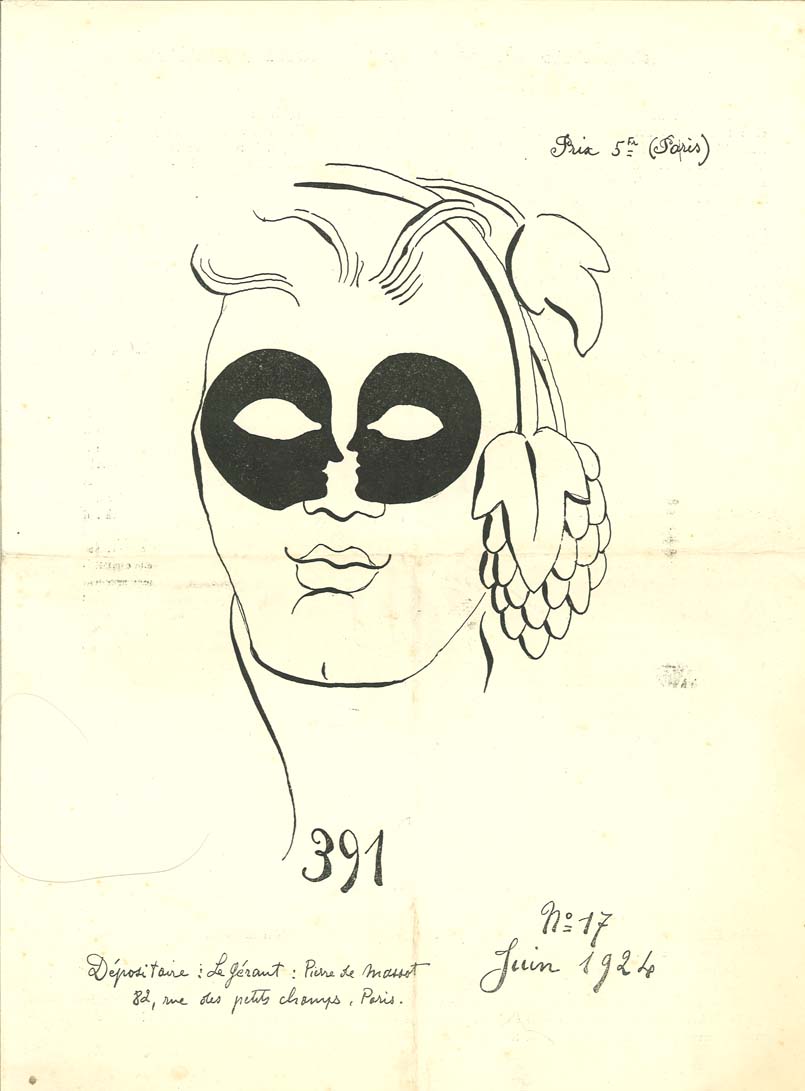
You can learn more about that history from the Dada material we’ve previously featured here on Open Culture: the video series The ABCs of Dada which explains the movement (or at least explains it as well as anyone can hope to); the material we gathered in celebration of its hundredth anniversary last year; and three essential Dadaist films by Hans Richter, Man Ray, and Marcel Duchamp. That will put into clearer context the 36 journals you can peruse in the University of Iowa’s Digital Dada Archive, some of which put out many issues, some of which stopped after the first, and all of which offer a glimpse of an artistic spirit, scattered across several different countries, which flared up briefly but brightly with anarchic energy, destructive creativity, a forward-looking aesthetic sense, and no small amount of humor.
Related Content:
Three Essential Dadaist Films: Groundbreaking Works by Hans Richter, Man Ray & Marcel Duchamp
The ABCs of Dada Explains the Anarchic, Irrational “Anti-Art” Movement of Dadaism
Based in Seoul, Colin Marshall writes and broadcasts on cities and culture. He’s at work on the book The Stateless City: a Walk through 21st-Century Los Angeles, the video series The City in Cinema, the crowdfunded journalism project Where Is the City of the Future?, and the Los Angeles Review of Books’ Korea Blog. Follow him on Twitter at @colinmarshall or on Facebook.
Read More...Hear the 20 Favorite Punk Albums of Black Flag Frontman Henry Rollins
The punk movement gave birth to hundreds of bands in a small amount of time, like a petri dish that just explodes under the right conditions. Forty years later, we are still living in the aftermath of that explosion and sorting things out. Lists need to be made. And if you consider garage rock to be proto-punk, the list can be very long.
Four years ago, L.A. Weekly created a list of the Top 20 punk albums of all time, but purists might despair to see Green Day on there or just anything after the ‘90s.
But they also turned to their columnist, Black Flag vocalist, intense spoken word performer, and radio deejay Henry Rollins, and asked him to create his own list. See them below, and hear them above (via this playlist).
- The Clash — The Clash (1977)
- Generation X — Generation X (1977)
- The Adverts — Crossing the Red Sea (1978)
- X Ray Spex — Germ Free Adolescents (1978)
- The Sex Pistols — Never Mind the Bollocks (1977)
- The Ramones — The Ramones (1976)
- Eater — The Album (1977)
- The Damned — Damned Damned Damned (1977)
- The Fall — Hex Enduction Hour (1982)
- The Buzzcocks — Another Music In A Different Kitchen (1978)
- The Saints — (I’m) Stranded (1977)
- UK Subs — Another Kind of Blues (1979)
- Wire — Pink Flag (1977)
- The Lurkers — Fulham Fallout (1978)
- Alternative TV — The Image Has Cracked (1978)
- The Ruts — The Crack (1979)
- The Germs — GI (1979
- X — Los Angeles (1980)
- The Minutemen — The Punchline (1981)
- Stiff Little Fingers — Inflammable Material (1979)
In his brief intro, Rollins mulls over the eternal genre question–where does punk stop and post-punk begin?
Could Wire, also be considered Post Punk? Where do you put bands like PIL, Joy Division, Television, Patti Smith, Suicide, and Killing Joke? What about Gang of Four, 999 and the Banshees? For me, as a lean definition, I go by the classic UK 1977 graduating class, Pistols, Clash, etc., and go from there.
The list, he says, is in no particular order, but it’s not a surprise to see the first Clash album at the top, followed by the debut albums of the Ramones, the Sex Pistols, The Damned, X, Wire, The Buzzcocks, The Saints, The Germs, X‑Ray Spex, The Adverts, and Stiff Little Fingers. Very few on that list went on to top their debut, or even–such as the Pistols and The Germs–record a follow-up.
Rollins talked about this in an essay (also for the L.A. Weekly) on why he loves another band on his list, the U.K. Subs.
How some of those bands were able to follow up with another album is a fascinating bit of musical history, as well as a study of talent, vision and integrity. It is where the rubber truly meets the road. After the explosive excitement of the initial batch of songs has settled, the band often is left with a success-derived self-awareness that hangs like a cloud over the practice room. The awfulness of expectation enters the equation, and the results are not always good.
Rollins is a fan of the first four U.K. Subs LPs–“they are like desert island LPs. Records you can’t do without,” he once said.
Other interesting choices on Rollins’ list: the shameless Ramones-copyists The Lurkers, The Minutemen’s first album (instead of the undisputed classic Double Nickels on the Dime), the lesser-known Eater, the Ruts, and the Fall’s Hex Enduction Hour, which is punk in aesthetic, but certainly not in production.
For a man who usually has something to say, it would have been cool to have some commentary from Rollins on his choices. On the other hand, maybe he’d just tell us to shut up. The music speaks for itself.
Related Content:
The History of Punk Rock in 200 Tracks: An 11-Hour Playlist Takes You From 1965 to 2016
Four Female Punk Bands That Changed Women’s Role in Rock
Ted Mills is a freelance writer on the arts who currently hosts the artist interview-based FunkZone Podcast and is the producer of KCRW’s Curious Coast. You can also follow him on Twitter at @tedmills, read his other arts writing at tedmills.com and/or watch his films here.
Read More...Take Free Philosophy Courses from The Institute of Art and Ideas: From “The Meaning of Life” to “Heidegger Meets Van Gogh”
Back in 2014, we told you about how The Institute of Art and Ideas (IAI) launched IAI Academy — an online educational platform that features free courses from world-leading scholars “on the ideas that matter.” They have since put online a number of philosophy courses, many striving to address questions that affect our lives today. We’ve listed a number of them below, and added them to our list of 150+ Free Online Philosophy courses. For a complete list of IAI Academy courses, visit this page.
- Heidegger Meets Van Gogh: Art, Freedom and Technology — Web video — Simon Glendinning, London School of Economics
- Dark Matter of the Mind — Web video — Daniel Everett, Bentley University
- Fear and Trembling in the 21st Century — Web video — Clare Carlisle, King’s College London
- Knowledge and Rationality — Web Video — Corine Besson, University of Sussex
- Life, Meaning and Morality — Web video — Christopher Hamilton, King’s College, London
- Minds, Morality and Agency — Web video — Mark Rowlands, University of Miami
- On Romantic Love — Web video — Berit Brogaard, University of Miami
- The Human Compass — Web video — Janne Teller
- The Meaning of Life — Web video — Steve Fuller, University of Warwick
- The Universe As We Find It — Web video — John Heil, Washington University in St Louis
- Unveiling Reality — Web video — Bryan Roberts, London School of Economics
- Why the World Does Not Exist — Web video — Markus Gabriel, Freiburg Institute of Advanced Study.
Note: The courses are all free. However, to take a course you will need to create a user account.
If you would like to support the mission of Open Culture, consider making a donation to our site. It’s hard to rely 100% on ads, and your contributions will help us continue providing the best free cultural and educational materials to learners everywhere. You can contribute through PayPal, Patreon, and Venmo (@openculture). Thanks!
Related Content:
Take First-Class Philosophy Courses Anywhere with Free Oxford Podcasts
The Great War and Modern Philosophy: A Free Online Course
Søren Kierkegaard: A Free Online Course on the “Father of Existentialism”
Introduction to Political Philosophy: A Free Yale Course
1,700 Free Online Courses from Top Universities Read More...Support Us
We're hoping to rely on loyal readers, rather than erratic ads. Please click the Donate button and support Open Culture. You can use Paypal, Venmo, Patreon, even Crypto! We thank you!

About Us

Open Culture scours the web for the best educational media. We find the free courses and audio books you need, the language lessons & educational videos you want, and plenty of enlightenment in between.
Advertise With Us

FREE UPDATES!
GET OUR DAILY EMAIL
Get the best cultural and educational resources on the web curated for you in a daily email. We never spam. Unsubscribe at any time.
FOLLOW ON SOCIAL MEDIA

Open Culture editor Dan Colman scours the web for the best educational media. He finds the free courses and audio books you need, the language lessons & movies you want, and plenty of enlightenment in between.
Advertise With Us


