Experts Predict When Artificial Intelligence Will Take Our Jobs: From Writing Essays, Books & Songs, to Performing Surgery and Driving Trucks

We know they’re coming. The robots. To take our jobs. While humans turn on each other, find scapegoats, try to bring back the past, and ignore the future, machine intelligences replace us as quickly as their designers get them out of beta testing. We can’t exactly blame the robots. They don’t have any say in the matter. Not yet, anyway. But it’s a fait accompli say the experts. “The promise,” writes MIT Technology Review, “is that intelligent machines will be able to do every task better and more cheaply than humans. Rightly or wrongly, one industry after another is falling under its spell, even though few have benefited significantly so far.”
The question, then, is not if, but “when will artificial intelligence exceed human performance?” And some answers come from a paper called, appropriately, “When Will AI Exceed Human Performance? Evidence from AI Experts.” In this study, Katja Grace of the Future of Humanity Institute at the University of Oxford and several of her colleagues “surveyed the world’s leading researchers in artificial intelligence by asking them when they think intelligent machines will better humans in a wide range of tasks.”
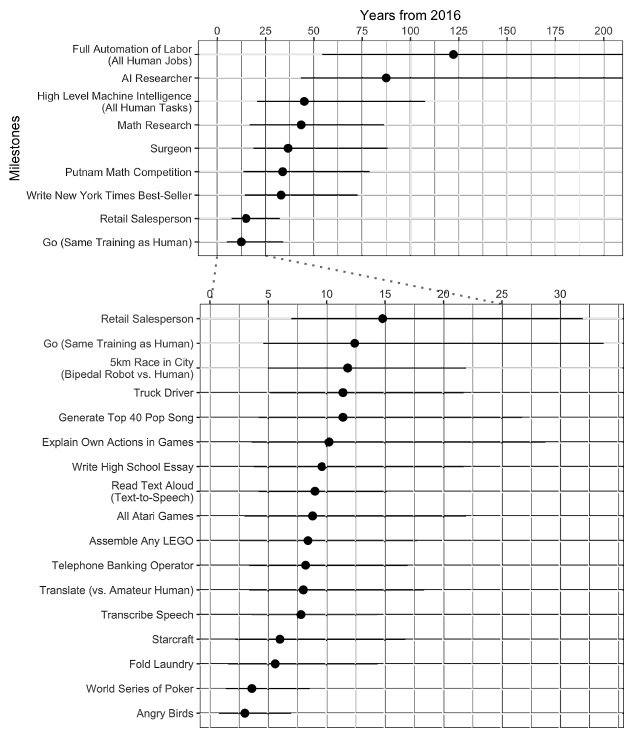
You can see many of the answers plotted on the chart above. Grace and her co-authors asked 1,634 experts, and found that they “believe there is a 50% chance of AI outperforming humans in all tasks in 45 years and of automating all human jobs in 120 years.” That means all jobs: not only driving trucks, delivering by drone, running cash registers, gas stations, phone support, weather forecasts, investment banking, etc, but also performing surgery, which may happen in less than 40 years, and writing New York Times bestsellers, which may happen by 2049.
That’s right, AI may perform our cultural and intellectual labor, making art and films, writing books and essays, and creating music. Or so the experts say. Already a Japanese AI program has written a short novel, and almost won a literary prize for it. And the first milestone on the chart has already been reached; last year, Google’s AI AlphaGo beat Lee Sedol, the South Korean grandmaster of Go, the ancient Chinese game “that’s exponentially more complex than chess,” as Cade Metz writes at Wired. (Humane video game design, on the other hand, may have a ways to go yet.)
Perhaps these feats partly explain why, as Grace and the other researchers found, Asian respondents expected the rise of the machines “much sooner than North America.” Other cultural reasons surely abound—likely those same quirks that make Americans embrace creationism, climate-denial, and fearful conspiracy theories and nostalgia by the tens of millions. The future may be frightening, but we should have seen this coming. Sci-fi visionaries have warned us for decades to prepare for our technology to overtake us.
In the 1960s Alan Watts foresaw the future of automation and the almost pathological fixation we would develop for “job creation” as more and more necessary tasks fell to the robots and human labor became increasingly superfluous. (Hear him make his prediction above.) Like many a technologist and futurist today, Watts advocated for Universal Basic Income, a way of ensuring that all of us have the means to survive while we use our newly acquired free time to consciously shape the world the machines have learned to maintain for us.
What may have seemed like a Utopian idea then (though it almost became policy under Nixon), may become a necessity as AI changes the world, writes MIT, “at breakneck speed.”
via Big Think/MIT Technology Review
Related Content:
Hear Alan Watts’s 1960s Prediction That Automation Will Necessitate a Universal Basic Income
Bertrand Russell & Buckminster Fuller on Why We Should Work Less, and Live & Learn More
Artificial Intelligence Program Tries to Write a Beatles Song: Listen to “Daddy’s Car”
Artificial Intelligence: A Free Online Course from MIT
Josh Jones is a writer and musician based in Durham, NC. Follow him at @jdmagness
Read More...Allen Ginsberg’s Howl Manuscripts Now Digitized & Put Online, Revealing the Beat Poet’s Creative Process
Somehow you have to imagine that, from its very opening — “I saw the best minds of my generation destroyed by madness, starving hysterical naked, dragging themselves through the negro streets at dawn looking for an angry fix” — Allen Ginsberg’s poem “Howl” simply emerged fully formed and launched itself permanently into American culture. But deep down we all know that no work, poetic or otherwise, actually does that, no matter how widely read it becomes, no matter how vividly it captures a time and a place, no matter how many generations look to it as an example. Ginsberg had to work on “Howl,” and now, thanks to Stanford Libraries, we have an up-close way to see some of that work in progress.
“From its first public reading at the Six Gallery in San Francisco in October 1955 to the notorious obscenity trial that followed in the wake of its first publication in 1956,” writes Stanford Curator for American and British Literature Rebecca Wingfield, “the poem is indelibly tied to the Beat Generation and their critique of the staid morals and customs of Eisenhower-era America.”
Before all that, it began with a seven-page first draft written in Ginsberg’s North Beach apartment, gained a second section before that now-legendary Six Gallery reading, and finally, after Ginsberg tried out different compositional techniques and followed different suggestions in search of a way to capture America as he saw it, evolved into a long poem comprising three sections and a footnote, published alongside other works by City Lights Books as the paperback that made him famous.
“The ‘Howl’ manuscripts and typescripts in the Allen Ginsberg Papers,” which you can view online at Stanford Libraries, “document the formal development of the poem, tracing Ginsberg’s experiments with different structures and wording in each of the poem’s sections.” These pre-“Howl” “Howl“s, manuscripts and typescripts both, retain the corrections and annotations that reveal details about Ginsberg’s distinctive creative process. But given the most well-known aspect of the poem’s construction, that each line lasts as long as exactly one breath, a full understanding can only come from hearing it as well as reading it. You can hear Ginsberg’s earliest recorded performance of the poem, at Portland’s Reed College (alma mater of Ginsberg’s Beat colleague Gary Snyder) in 1956, at the top of the post, and a later reading on record here. (The text of the completed poem can be viewed here.) Look and listen closely, and you’ll find that a cri de coeur, especially as Ginsberg cried it, demands deliberate craftsmanship.
See the Howl manuscripts online here.
via Stanford News/Boing Boing
Related Content:
The First Recording of Allen Ginsberg Reading “Howl” (1956)
Allen Ginsberg Reads His Famously Censored Beat Poem, “Howl” (1959)
James Franco Reads a Dreamily Animated Version of Allen Ginsberg’s Epic Poem ‘Howl’
Allen Ginsberg Recordings Brought to the Digital Age. Listen to Eight Full Tracks for Free
Allen Ginsberg’s Handwritten Poem For Bernie Sanders, “Burlington Snow” (1986)
Based in Seoul, Colin Marshall writes and broadcasts on cities and culture. He’s at work on a book about Los Angeles, A Los Angeles Primer, the video series The City in Cinema, the crowdfunded journalism project Where Is the City of the Future?, and the Los Angeles Review of Books’ Korea Blog. Follow him on Twitter at @colinmarshall or on Facebook.
Read More...Everything You Need to Know About Modern Russian Art in 25 Minutes: A Visual Introduction to Futurism, Socialist Realism & More
Few things fascinated me as a child more than Russia. I wasn’t alone in this. Everyone experienced it. And it wasn’t only the Soviet Union—though it played the bogeyman in Cold War films, loomed over history textbooks, and seemed to exist in a forbidden parallel universe in Reagan’s America. But what came before it was equally outsized and tragic: the Romanovs, Rasputin, Catherine the Great, Peter the Great, Ivan the Terrible.… Russia’s modern history came into focus through its novelists—the intricate social distinctions and complicated family dynamics, the palace intrigues, the gallows humor, discontent, and resignation of ordinary Russians….
After 40 years of uneasy détente with the world’s other superpower, Americans found the pieces of their view of Russia falling into place almost imperceptibly. But nothing—I repeat, nothing—prepared The West for Russian modernism. It drove the CIA to such distraction that they secretly funneled money to jazz artists and Abstract Expressionists to fight a culture war. It made no sense to us. “This is completely ridiculous!” says Brian Cox above, expressing a sentiment shared by many when they encounter Russian Formalism, or Suprematism, or Futurism, and other avant-gardisms.
Cox, narrating the “Quickest History of 20th Century Art in Russia,” does an excellent job of conveying the shock, excitement, and bewilderment we feel when we encounter Malevich and Mayakovsky, the startling folk Neoclassicism of Russian Art Nouveau—where the film begins—the Conceptualists of the Thaw, and the outrageous performance artists of the post-Soviet era. None of this, to quote Tristan Tzara, is art made to “cajole the nice nice bourgeois”—with the ironic exception of Socialist Realism, which outlawed the Russian avant-garde and said “look, everything we have is so grand, abundant! We have everything aplenty!”
Socialist Realism resembles nothing so much as American magazine advertising of the Life magazine and Norman Rockwell eras, a reminder of one way the two belligerent empires came to increasingly resemble each other over time. “Socialist Realism,” says Cox, “is almost a caricature, only with incredible pathos.” It is “the first tendency to rule out criticism completely.” It absorbed critique and turned it into celebration and denunciation, both of them noble acts of State. Where American didactic art sold hundreds of products and a handful of ideological poses, the Soviet variety sold one thing: the Party. This does not, however, mean that Socialist Realism is “bad”—not entirely. It is, instead, like so much modern Russian Art to non-Russian eyes… uncanny.
The 25-minute “Quickest History of 20th Century Art in Russia” comes from a series of “Crash Courses” from Arzamas Academy that includes “Ancient Rome in 20 minutes” and “Ancient Greece in 18 minutes.” All of them feature the wry, mellifluous voice of Cox, and I highly recommend them all.
Related Content:
How the CIA Secretly Funded Abstract Expressionism During the Cold War
Josh Jones is a writer and musician based in Durham, NC. Follow him at @jdmagness
Read More...Lou Reed Curates an Eclectic Playlist of His Favorite Songs During His Final Days: Stream 27 Tracks Lou Was Listening To
Lou Reed was a voracious listener. Rather than consume music, he imbibed it, drank it down in draughts, then sweated it out through his pores. His inexhaustible thirst for songs resulted in a body of work that has always sounded intimately familiar, even when it takes us to places no songwriters had before: the bitter, tender, violent underside of glamour, art, and romance.
But where, exactly, did Reed’s wry, bleak, yet tender sensibility come from? How did he manage so much complex emotional resonance in such seemingly simple songs as “Sunday Morning” and “Perfect Day”? Part of the answer comes from his veneration of Beat poets and writers like Allen Ginsberg and William Burroughs, as well as his one-time mentor Delmore Schwartz. “I thought if you could do what those writers did,” he said, “and put it to drums and guitar, you’d have the greatest thing on earth.”
This was no easy accomplishment. It took someone like Reed, steeped in pop, folk, rock, and jazz songcraft, to pull it off in such a way that Rolling Stone could call the Velvet Underground “the most influential American rock band of all time”—largely, writes the Daily Dot, “because of Reed’s sonic and lyrical contributions.” For most of Reed’s career, however, discovering the sources of his magic could be difficult.
Reed’s interview moods ranged from irascibly confrontational to disdainfully taciturn to facetiously garrulous. “Everything is jokes to this bibulous bozo,” remarked Lester Bangs in a 1973 interview. “He really makes a point of havin’ some fun!” But age, it seems, and the internet, mellowed him out and made him more likely to share. He opened up about his love for Kanye West’s Yeezus and other things. He appeared on Saturday Night Live to dispute internet rumors that he had died in 2001.
And when he did die, in 2013, he left behind the Spotify account “he was curating… himself,” keeping “playlists of songs he liked from the radio,” and showing both serious and casual students of Lou Reed that “the best online source on Lou Reed is… Lou Reed.” In the two volume playlist above called “What I’m Listening To,” Reed shows us just how serious he was about soaking up all of the sounds around him.
Nicki Minaj, Prince, Waylon Jennings, indie funk/soul Canadians King Khan & BBQ, psychedelic indie chamber pop band Of Montreal, Tom Waits, Miles Davis, Deerhoof, post-hardcore band Fucked Up, brilliant neo-soul singer/rapper/songwriter Georgia Anne Muldrow, Captain Beefheart… and that’s just volume one. Name a genre—Reed has found what he clearly considers its perfect exemplar. You can almost see him taking notes, scowling with envy, smirking with appreciation for how his own influence has permeated the past few the decades.
Famous musicians aren’t always the most interesting people, though Reed’s private life was sensational enough to warrant retelling. But many fans will find it much more interesting to get into the mind of Reed the artist. And for that, you’ll need to try and hear what he heard. Or, at least, listen to what he listened to.
If you need Spotify’s free software, download it here. Here are the direct links to the two Spotify playlists: Playlist 1 — Playlist 2.
Related Content:
Lou Reed Creates a List of the 10 Best Records of All Time
Teenage Lou Reed Sings Doo-Wop Music (1958–1962)
An Animation of The Velvet Underground’s “Sunday Morning” … for Your Sunday Morning
Josh Jones is a writer and musician based in Durham, NC. Follow him at @jdmagness
Read More...Hear Bob Dylan’s Newly-Released Nobel Lecture: A Meditation on Music, Literature & Lyrics
The furor surrounding Bob Dylan’s Nobel Prize win in Literature last October now seems several ages away. What was all that about again? Could it possibly have meant, as many a disgruntled writer suggested, that “people don’t care about books anymore”? Was this an “ill-conceived nostalgia award,” as Irvine Welsh bitterly proclaimed, bestowed by a committee of “senile, gibbering hippies”? Even Dylan himself seemed confused and embarrassed. He remained silent after the announcement, ignoring the Swedish Academy’s calls and seeming to one Academy member “impolite and arrogant.”
As anyone who has ever seen a Dylan interview from the mid-sixties can attest, these qualities once defined his public persona. And yes, he isn’t nearly as culturally relevant now as he was in those days, when he played the near-untouchable superstar and mercurial pop culture savant. But the Swedish Academy voted to celebrate Dylan as a literary writer, not a celebrity. And while writers may fall in and out of fashion, we like to think of literature as timeless. Many, perhaps most, authors awarded the Nobel have been “past their prime,” in the sense of having a lifetime’s worth of work behind them. Dylan is certainly no exception.
The question of whether folk and rock and roll songs can be properly considered literature is another matter, but you’d have to be naïve not to know that all literature began its life as song. Maybe much of it will return to this primordial state in the future. Sensing that songcraft needed an advocate before critics of literature, when he recorded his Nobel lecture–with musical accompaniment, on June 4th, six months after his win (hear him read it above)–Dylan discussed the interdependence of the two. He pointed to Homer’s Odyssey, an epic song in verse before it assumed written form, as the source for not only so much Western literature, but also so much American folk song, including his own.
“The Odyssey is a great book whose themes have worked its way into the ballads of a lot of songwriters,” says Dylan, then he concedes that “songs are unlike literature. They’re meant to be sung, not read.” That’s okay. “The words in Shakespeare’s plays were meant to be acted on the stage,” not read by groups of students in uncomfortable desks and airless rooms. No one became furiously angry when playwright Harold Pinter won the Nobel Prize in 2005. Should they have? But Dylan doesn’t pursue this line of reasoning, and he doesn’t necessarily compare himself to Shakespeare. Not quite.…
He did, however, make a similar argument in his short acceptance speech (read it here)—which he wrote and handed to the U.S. Ambassador to Sweden, Azita Raji, to read in his place at the ceremony (see her deliver it above)–asking whether Shakespeare, and hence Dylan, should be considered literature: “I would reckon he thought of himself as a dramatist… I would bet that the farthest thing from Shakespeare’s mind was the question ‘Is this literature?’” Like Shakespeare, Dylan writes, he has been busy with the exigencies of touring, creating ensembles, and performing: “not once have I ever had the time to ask myself, ‘Are my songs literature?’” (Believe that or not.) He thanks the Swedish Academy for taking up the question, and “for providing such a wonderful answer.”
In his newly-released recorded lecture, at the top, Dylan also doesn’t answer the question directly. He carefully considers it—“wondering, exactly, how my songs relate to literature.” He confesses needing to “reflect on it, and see where the connection was.” It is in the influence of The Odyssey, Moby Dick, All Quiet on the Western Front and other great works. It is also, he suggests, in the way music participates in literary traditions, trading similar themes and establishing similar affiliations. But he expresses no commitment to collapsing the distinctions between them. “His apparent attitude throughout the process” of winning the Nobel Prize, writes Emily Temple at Lit Hub, “has been… something along the lines of: ‘okay, if you say so.”
“The fact that Bob Dylan doesn’t consider his songs literature doesn’t make them not literature, of course,” writes Temple. We’re free to agree or disagree with him, but in either case his lecture might make us “consider the possibility that they will become literature, as William Shakespeare’s plays have.” By that time, Shakespeare was long dead. While he still lives, Dylan concludes, “I hope some of you will get the chance to listen to these lyrics the way they were intended to be heard: in concert or on record or however people are listening to songs these days. I return once again to Homer, who says, ‘Sing in me, oh Muse, and through me tell the story.’”
You can read the transcript of Dylan’s lecture here.
Related Content:
Kurt Vonnegut on Bob Dylan: He “Is the Worst Poet Alive”
Josh Jones is a writer and musician based in Durham, NC. Follow him at @jdmagness
Read More...
Hear the Musical Compositions of A Clockwork Orange Author Anthony Burgess, and Download His Musical Scores for Free
Most of us remember Anthony Burgess not as the author of dozens of novels, as well as short stories, essays, and poems, but as the author of A Clockwork Orange. This owes, for better or for worse, to Stanley Kubrick’s 1971 film adaptation of the “badly flawed” American edition of Burgess’ 1962 dystopian satire, although even if A Clockwork Orange didn’t overshadow the rest of his literary career, his literary career would probably still overshadow what he considered his life’s truly serious endeavor: music.
“I wish people would think of me as a musician who writes novels,” Burgess once went so far as to say, “instead of a novelist who writes music on the side.” Since even those of us who’ve read widely in his bibliography may never have heard any of the over 250 pieces of music he wrote in his lifetime, today we offer you a listen as well as a look at his orchestral compositions.
In the Spotify playlists embedded here (and if you don’t have Spotify’s free software, you can download it here), you can hear the albums Burgess: Orchestral Music, The Piano Music of Anthony Burgess, and the anthology Anthony Burgess: The Man and His Music (the title of that last a reference to This Man and His Music, the book that brought together his two great pursuits most directly).
“Music was at the heart of Anthony Burgess’s creative life,” says the site of The Burgess Foundation, who there have made “scores of his music available free of charge to anybody who wishes to study or play it.” Prolific in his writing as well as his composing, Burgess’ music includes a piece only discovered in 2012, nearly twenty years after death; the news clip at the top of the post briefly tells the story of Burgess’ “lost sonata,” his earliest surviving complete musical work.
Many of Burgess novels, including but hardly limited to A Clockwork Orange, suggest a deep interest and understanding of music, but they also (recall the Droogs’ wide lexicon of invented slang) reveal a similar capacity for linguistics. Call no Burgess fan a completist, then, unless they’ve read his books, heard his music, and also read his translations. “Translation is not a matter of words only,” the man once said. “It is a matter of making intelligible a whole culture.” Practiced in fields as “untranslatable” as poetry and as translation-independent as orchestral music, he should know. But one wonders: what other little-known cultural side career remains hidden in the depths of the Burgess archives?
Related Content:
Anthony Burgess’ Lost Introduction to Joyce’s Dubliners Now Online
Hunter S. Thompson Writes a Blistering, Over-the-Top Letter to Anthony Burgess (1973)
Based in Seoul, Colin Marshall writes and broadcasts on cities and culture. He’s at work on a book about Los Angeles, A Los Angeles Primer, the video series The City in Cinema, the crowdfunded journalism project Where Is the City of the Future?, and the Los Angeles Review of Books’ Korea Blog. Follow him on Twitter at @colinmarshall or on Facebook.
Read More...Dr. Jane Goodall Will Teach an Online Course About Conserving Our Environment
FYI: If you sign up for a MasterClass course by clicking on the affiliate links in this post, Open Culture will receive a small fee that helps support our operation.
A quick heads up: The great primatologist and anthropologist Dr. Jane Goodall–now 83 years old–will soon teach her first online course ever. Hosted by Masterclass, the course, consisting of 25 video lectures, will teach students how they can conserve the environment. It will also share Goodall’s research on the behavioral patterns of chimpanzees and what they taught her about conservation. The course won’t get started until this fall, but you can pre-enroll now. The cost is $90.
Other courses currently offered by Masterclass include:
- Werner Herzog on Filmmaking
- David Mamet on Dramatic Writing
- Steve Martin on Comedy
- Aaron Sorkin on Screenwriting
Find more courses taught by star instructors here.
If you would like to support the mission of Open Culture, consider making a donation to our site. It’s hard to rely 100% on ads, and your contributions will help us continue providing the best free cultural and educational materials to learners everywhere. You can contribute through PayPal, Patreon, and Venmo (@openculture). Thanks!
Read More...Hunter S. Thompson Typed Out The Great Gatsby & A Farewell to Arms Word for Word: A Method for Learning How to Write Like the Masters
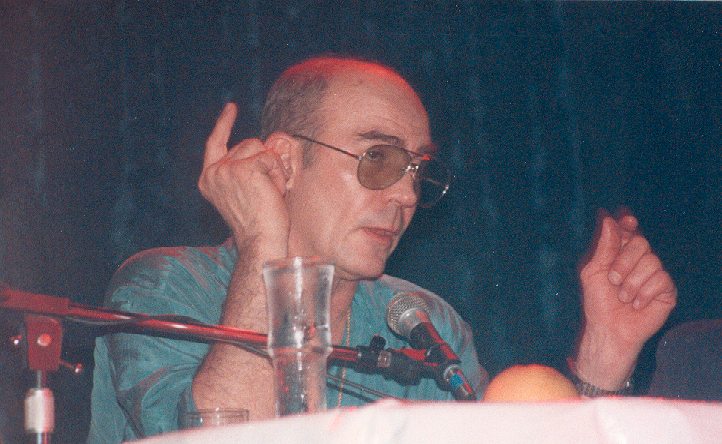
Image via Wikimedia Commons
The word quixotic derives, of course, from Miguel Cervantes’ irreverent early 17th century satire, Don Quixote. From the novel’s eponymous character it carries connotations of antiquated, extravagant chivalry. But in modern usage, quixotic usually means “foolishly impractical, marked by rash lofty romantic ideas.” Such designations apply in the case of Jorge Luis Borges’ story, “Pierre Menard, Author of the Quixote,” in which the titular academic writes his own Quixote by recreating Cervantes’ novel word-for-word.
Why does this fictional minor critic do such a thing? Borges’ explanations are as circuitously mysterious as you might expect. But we can get a much more straightforward answer from a modern-day Quixote—an individual who has undertaken many a “foolishly impractical” quest: Hunter S. Thompson. Though he would never be mistaken for a knight-errant, Thompson did tilt at more than a few windmills, including Fitzgerald’s The Great Gatsby and Hemingway’s A Farewell to Arms, from which he typed whole pages, word-for-word “just to get the feeling,” writes Louis Menand at The New Yorker, “of what it was like to write that way.”
“You know Hunter typed The Great Gatsby,” an awestruck Johnny Depp told The Guardian in 2011, after he’d played Thompson himself in Fear and Loathing in Las Vegas and a fictionalized version of him in an adaptation of Thompson’s lost novel The Rum Diaries. “He’d look at each page Fitzgerald wrote, and he copied it. The entire book. And more than once. Because he wanted to know what it felt like to write a masterpiece.” This exercise prepared him to write one, or his cracked version of one, 1972’s gonzo account of a more-than-quixotic road trip, Fear and Loathing in Las Vegas. Menand points out that Thompson first called the book The Death of the American Dream, likely inspired by Fitzgerald’s first Gatsby title, The Death of the Red White and Blue.
Thompson referred to Gatsby frequently in books and letters. Just as often, he referenced another literary hero—and pugnacious Fitzgerald competitor—Ernest Hemingway. He first began typing out Gatsby while employed at Time magazine as a copy boy in 1958, one of many magazine and newspaper jobs in a “pattern of disruptive employment,” writes biographer Kevin T. McEneaney. “Thompson appropriated armloads of office supplies” for the task, and also typed out Hemingway’s A Farewell to Arms and “some of Faulkner’s stories—an unusual method for learning prose rhythm.” He was fired the following year, not for misappropriation, but for “his unpardonable, insulting wit at a Christmas party.”
In a 1958 letter to his hometown girlfriend Ann Frick, Thompson named the Fitzgerald and Hemingway novels as two especially influential books, along with Brave New World, William Whyte’s The Organization Man, and Rona Jaffe’s The Best of Everything (or “Girls before Girls”), a novel that “hardly belongs in the abovementioned company,” he wrote, and which he did not, presumably, copy out on his typewriter at work. Surely, however, many a Thompson close reader has discerned the traces of Fitzgerald, Faulkner, and Hemingway in his work, particularly the latter, whose macho escapades and epic drinking bouts surely inspired more than just Thompson’s writing.
In Borges’ “Pierre Menard,” the title character first sets out to “be Miguel de Cervantes”—to “Learn Spanish, return to Catholicism, fight against the Moor or Turk, forget the history of Europe from 1602 to 1918….” He finds the undertaking not only “impossible from the outset,” but also “the least interesting” way to go about writing his own Quixote. Thompson may have discovered the same as he worked his way through his influences. He could not become his heroes. He would have to take what he’d learned from inhabiting their prose, and use it as fuel for his literary firebombs–or, seen differently, for his idealistic, impractical, yet strangely noble (in their way) knight’s quests.
Not since Thompson’s Nixonian heyday has there been such need for a ferocious outlaw voice like his. He may have become a stock character by the end of his life, caricatured as Uncle Duke in Doonesbury, given pop culture sainthood by Depp’s unhinged portrayal. But “at its best,” writes Menand, “Thompson’s anger, in writing, was a beautiful thing, fearless and funny and, after all, not wrong about the shabbiness and hypocrisy of American officialdom.” Perhaps even now, some hungry young intern is typing out Fear and Loathing word-for-word, preparing to absorb it into his or her own 21st century repertoire of barbed-wire truth-telling about “the death of the American dream.” The method, it seems, may work with any great writer, be it Cervantes, Fitzgerald, or Hunter S. Thompson.
Related Content:
Read 18 Lost Stories From Hunter S. Thompson’s Forgotten Stint As a Foreign Correspondent
Hunter S. Thompson, Existentialist Life Coach, Gives Tips for Finding Meaning in Life
Josh Jones is a writer and musician based in Durham, NC. Follow him at @jdmagness
Read More...Omni, the Iconic Sci-Fi Magazine, Now Digitized in High-Resolution and Available Online
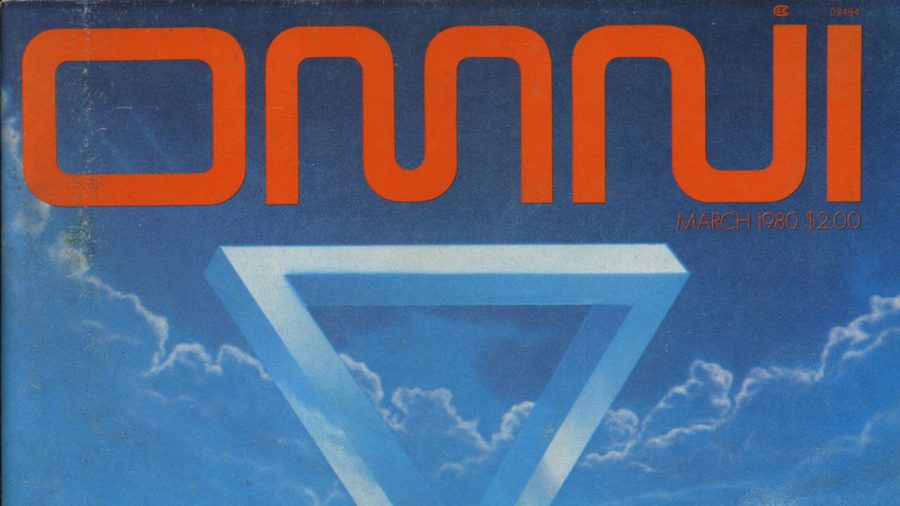
There was a time, not so long ago, when not only could a blockbuster Hollywood comedy make a reference to a science magazine, but everyone in the audience would get that reference. It happened in Ghostbusters, right after the titular boys in gray hit it big with their first high-profile busting of a ghost. In true 1980s style, a success montage followed, in the middle of which appeared the cover of Omni magazine’s October 1984 issue which, according to the Ghostbusters Wiki, “featured a Proton Pack and Particle Thrower. The tagline read, ‘Quantum Leaps: Ghostbusters’ Tools of the Trade.’ ”
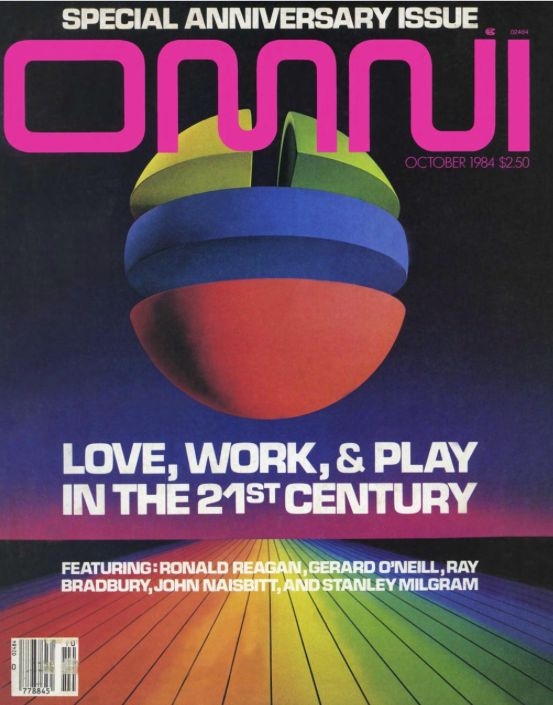
The movie made up that cover, but it didn’t make up the publication. In reality, the cover of Omni’s October 1984 issue, a special anniversary edition which appears at the top of the magazine’s Wikipedia page today, promised predictions of “Love, Work & Play in the 21st Century” from the likes of beloved sci-fi writer Ray Bradbury, social psychologist Stanley Milgram, physicist Gerard O’Neill, trend-watcher John Naisbitt — and, of course, Ronald Reagan. Now you can find that issue of Omni, as well as every other from its 1978-to-1995 run, digitized in high-resolution and made available on Amazon.
“Omni was a magazine about the future,” writes Motherboard’s Claire Evans, telling the story of “the best science magazine that ever was.” In its heyday, it blew minds by regularly featuring extensive Q&As with some of the top scientists of the 20th century–E.O. Wilson, Francis Crick, Jonas Salk–tales of the paranormal, and some of the most important science fiction to ever see magazine publication” by William Gibson, Orson Scott Card, Harlan Ellison, George R. R. Martin — and even the likes of Stephen King, Joyce Carol Oates, and William S. Burroughs. “By coupling science fiction and cutting-edge science news, the magazine created an atmosphere of possibility, where even the most outrageous ideas seemed to have basis in fact.”
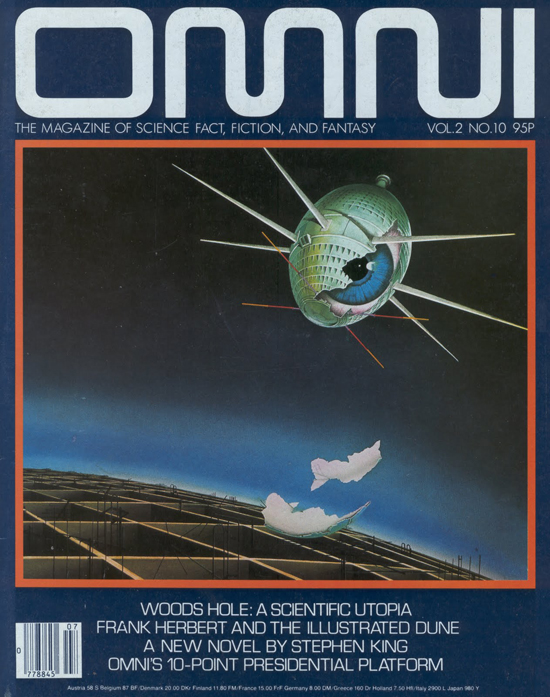
Originally founded by Kathy Keeton (formerly, according to Evans, “a South African ballerina who went from being one of the highest-paid strippers in Europe”) and Penthouse publisher Bob Guccione, Omni not only had an impact in unexpected areas (the eccentric musical performer Klaus Nomi, himself a cultural innovator, took his name in part from the magazine’s) but took steps into the digital realm long before other print publications dared. It first established its online presence on Compuserve in 1986; seven years later, it opened up its archives, along with forums and new content, on America Online, a first for any major magazine. Now Amazon users can purchase Omni’s digital back issues for $2.99 each, or read them for free if they have Kindle Unlimited accounts. (You can sign up for a 30-day free trial for Kindle Unlimited and start binge-reading Omni here.)
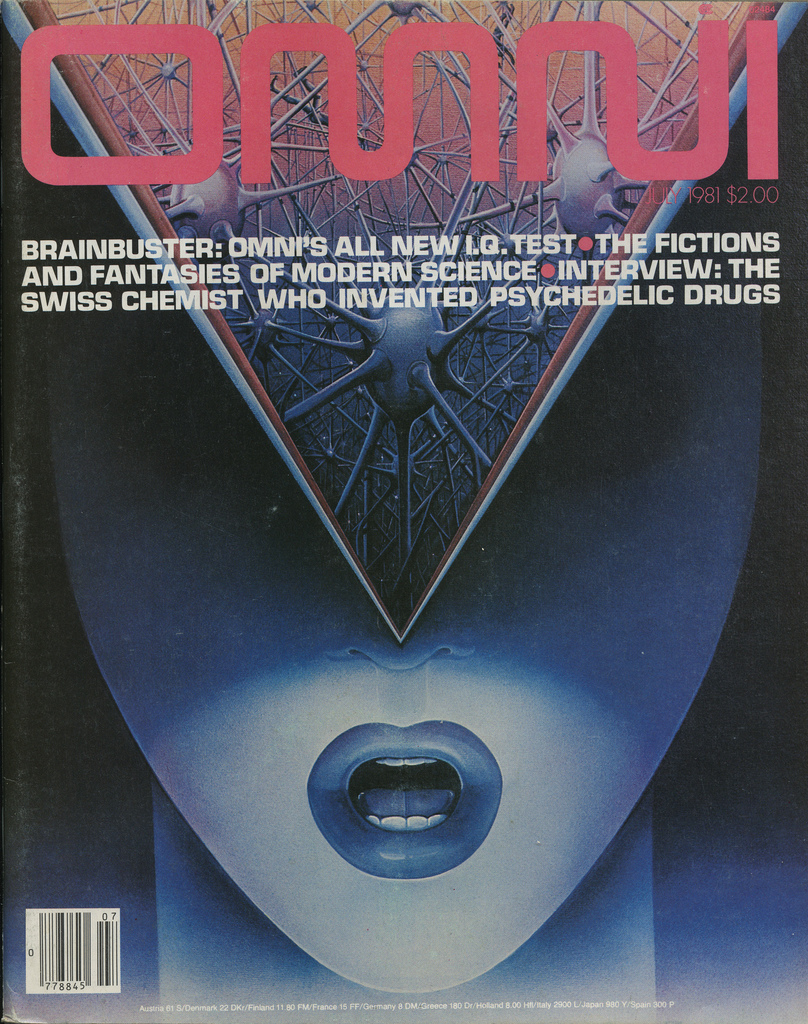
Jerrick Media, owners of the Omni brand, have also begun to make available on Vimeo on Demand episodes of Omni: The New Frontier, the 1980s syndicated television series hosted by Peter Ustinov. And without paying a dime, you can still browse the fascinating Omni material archived at Omni Magazine Online, an easy way to get a hit of the past’s idea of the future — and one presenting, in the words of 1990s editor-in-chief Keith Farrell, “a fascination with science and speculation, literature and art, philosophy and quirkiness, serious speculation and gonzo speculation, the health of the planet and its cultures, our relationship to the universe and its (possible) cultures, and a sense that whatever else, tomorrow would be different from today.”
Related Content:
Spy Magazine (1986–1998) Now Online
Based in Seoul, Colin Marshall writes and broadcasts on cities and culture. He’s at work on a book about Los Angeles, A Los Angeles Primer, the video series The City in Cinema, the crowdfunded journalism project Where Is the City of the Future?, and the Los Angeles Review of Books’ Korea Blog. Follow him on Twitter at @colinmarshall or on Facebook.
Read More...
Long Strange Trip, the New 4‑Hour Documentary on the Grateful Dead, Is Now Streaming Free on Amazon Prime
FYI: Long Strange Trip, the first comprehensive documentary to tell the story of the Grateful Dead, is steaming free right now on Amazon Prime. Executive produced by Martin Scorsese, and directed by Amir Bar-Lev, the four-hour film can be streamed right here if already have a Prime account. If you don’t, you can sign up for a 30-day free trial, watch the doc, and then decide whether to remain a subscriber or not. It’s your call. (Note: they also offer a similar deal for audiobooks from Audible.)
By the way, if you can watch the film with a good sound system, I’d recommend it!
If you would like to support the mission of Open Culture, consider making a donation to our site. It’s hard to rely 100% on ads, and your contributions will help us continue providing the best free cultural and educational materials to learners everywhere. You can contribute through PayPal, Patreon, and Venmo (@openculture). Thanks!
Related Content:
Bob Dylan & The Grateful Dead Rehearse Together in Summer 1987: Hear 74 Tracks
The Night When Miles Davis Opened for the Grateful Dead in 1970: Hear the Complete Recordings
The Grateful Dead Play at the Egyptian Pyramids, in the Shadow of the Sphinx (1978)
Read More...Support Us
We're hoping to rely on loyal readers, rather than erratic ads. Please click the Donate button and support Open Culture. You can use Paypal, Venmo, Patreon, even Crypto! We thank you!

About Us

Open Culture scours the web for the best educational media. We find the free courses and audio books you need, the language lessons & educational videos you want, and plenty of enlightenment in between.
Advertise With Us

FREE UPDATES!
GET OUR DAILY EMAIL
Get the best cultural and educational resources on the web curated for you in a daily email. We never spam. Unsubscribe at any time.
FOLLOW ON SOCIAL MEDIA

Open Culture editor Dan Colman scours the web for the best educational media. He finds the free courses and audio books you need, the language lessons & movies you want, and plenty of enlightenment in between.
Advertise With Us


