“Calling Bullshit”: Watch Lectures for the College Course Designed to Combat the BS in our Information Age
This past January, we highlighted a syllabus for a tentative course called “Calling Bullshit,” designed by two professors at the University of Washington, Carl Bergstrom and Jevin West.
The course–also sometimes called “Calling Bullshit in the Age of Big Data”–ended up being offered this spring. And now you can see how it unfolded in the classroom. The 10 video lectures from the class are available online. Watch them above, or at this YouTube playlist. Also find them housed in our collection, 1,700 Free Online Courses from Top Universities.
According to The Seattle Times, the course “achieved the academic version of a chart-topping pop single: At the UW [University of Washington], it reached its 160-student capacity shortly after registration opened this spring.” And now colleges “in Canada, France, Portugal, England and Australia have contacted the professors about teaching a version of the course this fall.”
The course itself was premised on this basic idea: “Bullshit is everywhere, and we’ve had enough. We want to teach people to detect and defuse bullshit wherever it may arise.”
A longer overview of the course appears below. It was cited in our original post. And it’s worth highlighting again:
The world is awash in bullshit. Politicians are unconstrained by facts. Science is conducted by press release. Higher education rewards bullshit over analytic thought. Startup culture elevates bullshit to high art. Advertisers wink conspiratorially and invite us to join them in seeing through all the bullshit — and take advantage of our lowered guard to bombard us with bullshit of the second order. The majority of administrative activity, whether in private business or the public sphere, seems to be little more than a sophisticated exercise in the combinatorial reassembly of bullshit.
We’re sick of it. It’s time to do something, and as educators, one constructive thing we know how to do is to teach people. So, the aim of this course is to help students navigate the bullshit-rich modern environment by identifying bullshit, seeing through it, and combating it with effective analysis and argument.
What do we mean, exactly, by the term bullshit? As a first approximation, bullshit is language, statistical figures, data graphics, and other forms of presentation intended to persuade by impressing and overwhelming a reader or listener, with a blatant disregard for truth and logical coherence.
While bullshit may reach its apogee in the political domain, this is not a course on political bullshit. Instead, we will focus on bullshit that comes clad in the trappings of scholarly discourse. Traditionally, such highbrow nonsense has come couched in big words and fancy rhetoric, but more and more we see it presented instead in the guise of big data and fancy algorithms — and these quantitative, statistical, and computational forms of bullshit are those that we will be addressing in the present course….
Our aim in this course is to teach you how to think critically about the data and models that constitute evidence in the social and natural sciences.
If you’re interested in watching the course, get started with Lecture 1: Introduction to Bullshit.
To learn more about the course, please visit this website.
If you would like to support the mission of Open Culture, consider making a donation to our site. It’s hard to rely 100% on ads, and your contributions will help us continue providing the best free cultural and educational materials to learners everywhere. You can contribute through PayPal, Patreon, and Venmo (@openculture). Thanks!
Related Content:
How to Spot Bullshit: A Primer by Princeton Philosopher Harry Frankfurt
Read More...Hear the 10 Best Albums of the 1960s as Selected by Hunter S. Thompson

Image via Wikimedia Commons
Hunter S. Thompson, the writer who gave vivid, inimitable form to “gonzo journalism,” honed his literary chops the hard way, using rigorous techniques including but not limited to retyping the entire texts of The Great Gatsby and A Farewell to Arms himself. But he would let no one claim that his artistic appreciation extended only to the printed word: “I resent your assumption that Music is Not My Bag,” he wrote in late 1970 to Rolling Stone editor John Lombardo, “because I’ve been arguing for the past few years that music is the New Literature, that Dylan is the 1960s’ answer to Hemingway, and that the main voice of the ’70s will be on records & videotape instead of books.”
In this same letter, collected in his second volume of correspondence Fear and Loathing in America, Thompson included a list of the best albums of the “rock age” of the 1960s, “because the ’60s are going to go down like a repeat, somehow, of the 1920s; the parallels are too gross for even historians to ignore.”
The list didn’t come from Thompson, strictly speaking, but “from Raoul Duke,” the hard-living alter-ego who would star in Fear and Loathing in Las Vegas, published the following year. You can find a slightly cleaned-up version of the list in this Beatdom post by David S. Willis:
- Herbie Mann’s 1969 Memphis Underground (“which may be the best album ever cut by anybody”)
- Bob Dylan’s 1965 Bringing It All Back Home
- Dylan’s 1965 Highway 61 Revisited
- The Grateful Dead’s 1970 Workingman’s Dead (“the heaviest thing since Highway 61 and ‘Mr. Tambourine Man‘”)
- The Rolling Stones’ 1969 Let it Bleed
- Buffalo Springfield’s 1967 Buffalo Springfield
- Jefferson Airplane’s 1967 Surrealistic Pillow
- Roland Kirk’s “various albums”
- Miles Davis’s 1959 Sketches of Spain
- Sandy Bull’s 1965 Inventions
You can also hear most of Thompson/Duke’s Best Albums of the 1960s selections gathered in the Spotify playlist embedded above. (If you don’t have Spotify’s free software, you can download it here.) Unfortunately, Spotify hasn’t yet incorporated into its collection the work of experimental solo folk guitarist Sandy Bull, whose 1965 Inventions takes tenth place. (You can hear it on YouTube, however.) Bull, whose life was as abundant with creativity as it was with substances, cut something of a Thompsonian — or Dukean? — figure himself. His long-form compositions “Blend” and “Blend II,” the latter of which opens Inventions, will give you a sense of how far he pushed the boundaries of his tradition.
“Jesus, what a hassle to even think quickly about a list like that,” wrote Thompson, bringing the characteristically expansive letter to a close, still trying to convince Lombardi that such a then-untested concept as a 1960s top-ten-albums list could work. “Even now I can think of 10 more I might have added… but what the fuck, it’s only a rude idea. But a good one, I think.”
If you would like to support the mission of Open Culture, consider making a donation to our site. It’s hard to rely 100% on ads, and your contributions will help us continue providing the best free cultural and educational materials to learners everywhere. You can contribute through PayPal, Patreon, and Venmo (@openculture). Thanks!
Related Content:
Hunter S. Thompson Interviews Keith Richards, and Very Little Makes Sense
Hunter S. Thompson’s Harrowing, Chemical-Filled Daily Routine
Hunter S. Thompson’s Ballsy & Hilarious Job Application Letter (1958)
Hunter S. Thompson, Existentialist Life Coach, Gives Tips for Finding Meaning in Life
Read 10 Free Articles by Hunter S. Thompson That Span His Gonzo Journalist Career (1965–2005)
Based in Seoul, Colin Marshall writes and broadcasts on cities and culture. He’s at work on a book about Los Angeles, A Los Angeles Primer, the video series The City in Cinema, the crowdfunded journalism project Where Is the City of the Future?, and the Los Angeles Review of Books’ Korea Blog. Follow him on Twitter at @colinmarshall or on Facebook.
Read More...Franz Kafka’s Unfinished Novel, The Castle, Gets Turned Into an Album by Czech Musicians: Watch a Music Video for the Song, “The Grave”
If, for some unfathomable reason, author Franz Kafka should emerge from his grave to direct a music video, the result would most certainly resemble the one for “The Grave” by The Kafka Band, above.
The air of futility and social foreboding…
The chilly broken landscape, rendered in black and white…
Bikinis and bling…
(Kidding! Overcoats and haggard expressions.)
“The Grave” was directed by animator, Noro Holder, but the lyrics are credited to Kafka, drawn directly from his unfinished novel, The Castle. As the band’s name might imply, this is no fickle flirtation with the author’s sensibilities.
“The Grave” is actually part of a ten-song album inspired by The Castle. (Stream it on Spotify below.) As bandmate, author Jaroslav Rudiš, observed:
Kafka is often deemed as a dark author, yet we strive to challenge this cliché. The novel possesses plenty of black and absurd humour, which we reflected in some of our compositions.
The album led to a collaboration with Germany’s Theater Bremen on a theatrical adaptation that featured the music played live.
The moody woodcut-inspired visuals seen above come from a graphic novel adaptation of The Castle illustrated by Rudiš’ bandmate, Jaromír 99, in collaboration with David Zane Mairowitz, an American playwright who previously tackled Kafka’s The Trial.
At the point where another group might decide to take a detour into sunnier territory—a pop romp through the oeuvre of Milan Kundera perhaps—the Kafka Band is doubling down on another coproduction with Theater Bremen, an adaptation of Kafka’s novel Amerika (or The Man Who Disappeared), slated to open this fall.
The Grave
I’m dreaming of
Being with you
Without interruption
On earth
There is no space
For our love
Not in the village
Not anywhere else.
Deep in the earth / around us only death / the living won’t find us.
I’m imagining a grave
Deep and tight
We hold each other
My face next to yours
Yours next to mine
Nobody will ever see us
On earth there is no space
For our love.
Deep in the earth / around us only death / the living won’t find us.
Watch the video for “Arrival,” another track inspired by The Castle, with drawings by Jaromír 99 here.
Related Content:
Ayun Halliday is an author, illustrator, and theater maker, soon to be appearing in a clown adaptation of Faust, inspired by the current administration and opening in New York City this June. Follow her @AyunHalliday.
Read More...Discover “The Ghost Club,” the Historic Paranormal Society Whose Members Included Charles Dickens, Arthur Conan Doyle & W.B. Yeats
Japanese Computer Artist Makes “Digital Mondrians” in 1964: When Giant Mainframe Computers Were First Used to Create Art
In the 21st century, most of us have tried our hand at making some kind of digital art or another — even if only touching up cellphone photos of ourselves — but imagine the task of producing it 50 years ago. To make digital art before the world had barely heard the term “digital” required access to a mainframe computer, those hugely expensive hulks that filled rooms and printed out reams and reams of paper data, and the considerable technical know-how to operate it.
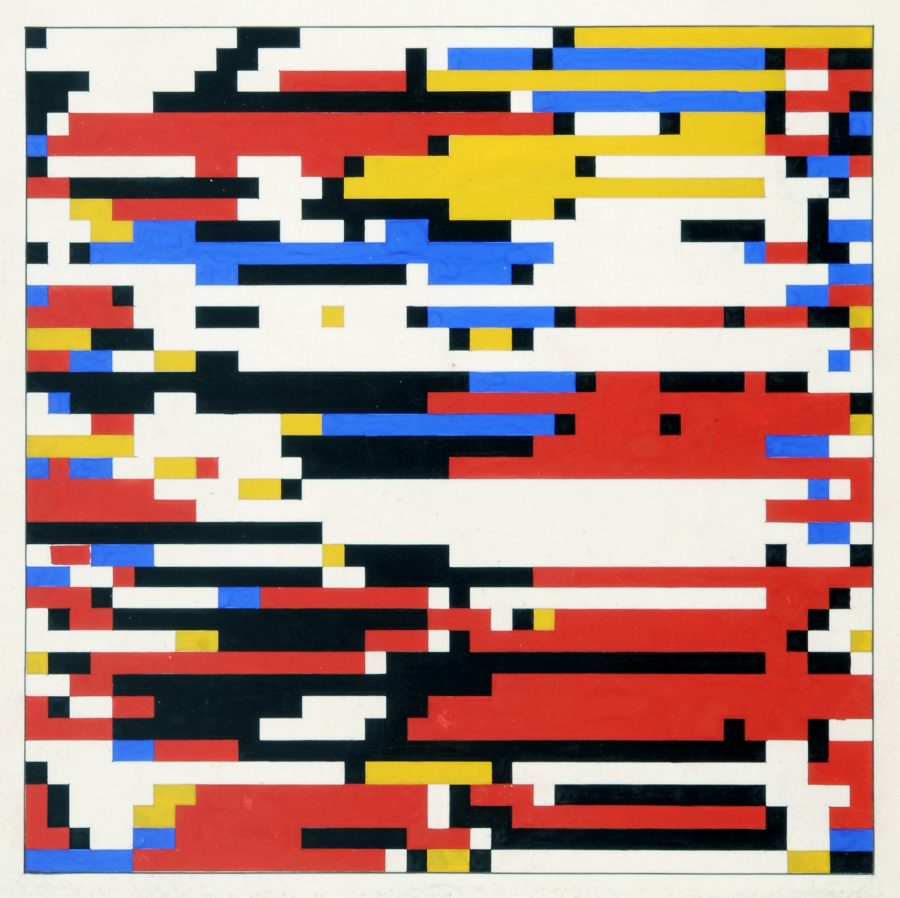
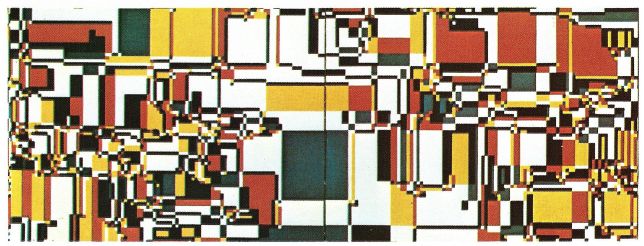
But the achievement also, to go by the very early example of Hiroshi Kawano, required a background in philosophy. A graduate of the University of Tokyo majoring in aesthetics and the philosophy of science before becoming a research assistant at that school and then a lecturer at the Tokyo Metropolitan College of Air-Technology, Kawano marshaled his knowledge and experience to create these “digital Mondrians,” so described because of their computer-generated resemblance to that Dutch painter’s most rigorously angular, solidly colored work.

Kawano had drawn inspiration, according to a Deutsche Welle article on his donation of his archives to Germany’s Center for Media Art, from “the writings of the German philosopher Max Bense, who proposed (among other things) the idea of measuring beauty using scientific rules. At the same time, Kawano heard that scientists were using computers to create music. Putting the two together, he decided to explore the possibility of using a computer to program beauty.”
Doing so required “writing programs in complex computer languages, then laboriously punching these programs into hundreds of cards before feeding them into the machine.” And “while the design of his works produced during the 1960s might look simple — they’re not. They are the result of complex mathematical algorithms programmed so that, although Kawano sets the rules for how the picture could look, he can’t determine exactly what will appear on the printer.”
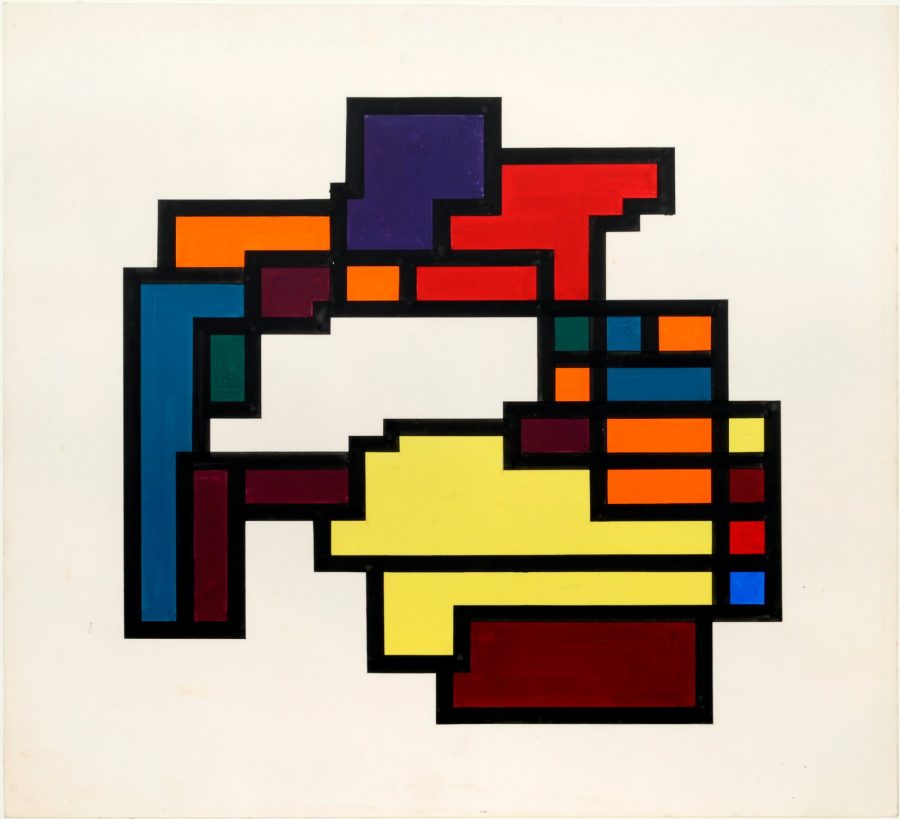
Just before Kawano passed away in 2012, the ZKM (or Center for Art and Media Karlsruhe), celebrated his pioneering digital art with the exhibition “The Philosopher at the Computer,” some of which you can see in this German-language video clip. “The retrospective emphasizes Kawano’s special role in the circle of pioneers in ‘computer art,’ ” says its introduction. “He was neither artist, who discovered the computer as a new production medium and theme, nor engineer who came to art via the new machine, but a philosopher, who left his desk for the computer center to experiment with theoretical models.”
Can computers create art? Can they even be used to create art? These questions now have practically obvious answers in the affirmative, but back in 1964 when Kawano produced the first of these pieces, working through trial and error with the advice of the curious staff of his university’s computer center, the questions must have sounded impossibly philosophical. Today, writes Overhead Compartment’s Claudio Rivera, Kawano’s digital Mondrians “suggest themselves as an oddly ephemeral transition in the nexus of technology and art. The familiar colors and forms are flash-frozen in crystalline pixelation, almost as if seized up in the final, overheated throes of a suddenly-too-old computer.”
Related Content:
Andy Warhol’s Lost Computer Art Found on 30-Year-Old Floppy Disks
Watch the Dutch Paint “the Largest Mondrian Painting in the World”
Based in Seoul, Colin Marshall writes and broadcasts on cities and culture. He’s at work on a book about Los Angeles, A Los Angeles Primer, the video series The City in Cinema, the crowdfunded journalism project Where Is the City of the Future?, and the Los Angeles Review of Books’ Korea Blog. Follow him on Twitter at @colinmarshall or on Facebook.
Read More...Sigmund Freud, Father of Psychoanalysis, Introduced in a Monty Python-Style Animation
Pity the hedgehog. The freezing temperatures of winter compel them to cozy up to others of its kind, but the prickly spines covering their bodies prevent them from sustaining the easy, ongoing intimacy they so crave.
It’s a hell of a metaphor for human relationships, compliments of 19th-century philosopher Arthur Schopenhauer. It certainly spoke to Sigmund Freud, who devoted his life trying to figure out why so many of us resort to petty behaviors, spurning those we love, and sabotaging ourselves at every turn.
Popular representations would have us believe that the father of psychoanalysis was a detached sort of know-it-all, emotionally superior to the basket cases sniveling on his couch. Not so. As he noted in 1897:
I have been through some kind of neurotic experience, curious states… twilight thoughts, veiled doubts… The chief patient I am preoccupied with is myself… my little hysteria… the analysis is more difficult than any other. Something from the deepest depths of my own neurosis sets itself against any advance in understanding neuroses…
We feel ya’, doc, and so does The School of Life, the London-based organization for developing emotional intelligence, co-founded by philosophical essayist, Alain de Botton:
… consulting a psychotherapist should be as accessible and as normal as developing your career, getting help for a physical problem, or going to the gym to get healthy. Just as we take care of our bodies and physical health, a vital element of self-care is devoting focused time and energy to exploring and understanding our thoughts and feelings.
The school puts your money where its mouth is by retaining a roster of licensed psychotherapists who can be booked for in-person or Skype sessions.
It’s not for everyone. There are those who are determined to pursue the path to contentment and self-knowledge solo, impervious to Freud’s belief that “No one who disdains the key will ever be able to unlock the door.”
The therapy-averse can still learn something from the video above. Narrator de Botton charms his way through an easily digested overview of Freud’s personal and professional life, and the resulting tenets of psychoanalysis.
And filmmaker Mad Adam ensures that this brief trip through the infant phases—oral, anal, phallic—will be a jolly one, replete with droll, mostly vintage images.
Release more monsters of the id with the School of Life’s psychotherapy playlist.
Related Content:
What is Love? BBC Philosophy Animations Feature Sartre, Freud, Aristophanes, Dawkins & More
Ayun Halliday is an author, illustrator, theater maker and Chief Primatologist of the East Village Inky zine. Follow her @AyunHalliday.
Read More...A Free Course on Machine Learning & Data Science from Caltech
Right now, Machine Learning and Data Science are two hot topics, the subject of many courses being offered at universities today. Above, you can watch a playlist of 18 lectures from a course called Learning From Data: A Machine Learning Course, taught by Caltech’s Feynman Prize-winning professor Yaser Abu-Mostafa. The course is summarized as follows:
This is an introductory course in machine learning (ML) that covers the basic theory, algorithms, and applications. ML is a key technology in Big Data, and in many financial, medical, commercial, and scientific applications. It enables computational systems to adaptively improve their performance with experience accumulated from the observed data. ML has become one of the hottest fields of study today, taken up by undergraduate and graduate students from 15 different majors at Caltech. This course balances theory and practice, and covers the mathematical as well as the heuristic aspects. The lectures follow each other in a story-like fashion.
A real Caltech course (it’s not watered down at all), the course assumes a familiarity with basic probability, matrices, and calculus.

The lectures can be found on YouTube, iTunes U and this Caltech website, which hosts slides and other course materials. The professor wrote the course textbook, also called Learning from Data.
Learning From Data will be permanently added to our list of Free Online Computer Science Courses, part of our ever-growing collection, 1,700 Free Online Courses from Top Universities.
If you would like to support the mission of Open Culture, consider making a donation to our site. It’s hard to rely 100% on ads, and your contributions will help us continue providing the best free cultural and educational materials to learners everywhere. You can contribute through PayPal, Patreon, and Venmo (@openculture). Thanks!
Related Content:
The Neuronal Basis of Consciousness Course: A Free Online Course from Caltech
Read More...The History of the World in 20 Odd Minutes
Last year, we flagged Bill Wurtz’s “History of Japan,” an idiosyncratic video that covered 40,000 years of Japanese history in 9 minutes–everything from the rise of technology and religion, to the influence of China on Japan’s language and brand of buddhism, the emergence of the samurai, the country’s vexed relationship with the West, and the bombing of Nagasaki and Hiroshima. Although quantity isn’t everything, the video clocked more than 25 million views on YouTube–pretty impressive considering that Wurtz created the video as “a prototype to see if I could do a long video in the first place.”
Now comes his new, more expansive video–History of the World in 20 minutes. Released on Wednesday, the video has already surpassed 4.5 millions views (surely more by the time you read this), and it may teach you a thing … or two … about world history. Have fun with it. And if you’re looking for meatier media that covers the big sweep of history, check out the items in the Relateds below.
If you would like to support the mission of Open Culture, consider making a donation to our site. It’s hard to rely 100% on ads, and your contributions will help us continue providing the best free cultural and educational materials to learners everywhere. You can contribute through PayPal, Patreon, and Venmo (@openculture). Thanks!
Related Content:
Take Big History: A Free Short Course on 13.8 Billion Years of History, Funded by Bill Gates
The History of the World in 46 Lectures From Columbia University
Free Online History Courses
Read More...The Frida Kahlo Action Figure
Earlier this week, an organization called “Today Is Art Day” launched a Kickstarter campaign to produce the latest in a line of action figures. First came the Vincent van Gogh action figure. Now, joining him in the ‘Art History Heroes Collection,’ there will be a Frida Kahlo figure. (Yes, they’ve already raised $19,490, surpassing their $14,585 goal.) Standing 5 inches tall, made of high quality plastic, Frida will come with a monkey attached to her back, and a detachable surrealist heart. Expect delivery in September.
If you would like to support the mission of Open Culture, consider making a donation to our site. It’s hard to rely 100% on ads, and your contributions will help us continue providing the best free cultural and educational materials to learners everywhere. You can contribute through PayPal, Patreon, and Venmo (@openculture). Thanks!
Related Content:
Frida Kahlo’s Colorful Clothes Revealed for the First Time & Photographed by Ishiuchi Miyako
Frida Kahlo and Diego Rivera Visit Leon Trotsky in Mexico, 1938
Read More...Alfred Hitchcock Recalls Working with Salvador Dali on Spellbound: “No, You Can’t Pour Live Ants All Over Ingrid Bergman!”
In 1945 Alfred Hitchcock had to explain one of Hollywood’s unwritten rules to Salvador Dalí: No, you can’t pour live ants all over Ingrid Bergman! Hitchcock had approached Dalí for help with a dream sequence in his upcoming thriller, Spellbound, starring Bergman and Gregory Peck. He was unhappy with the fuzziness of Hollywood dream sequences. “I wanted to convey the dream with great visual sharpness and clarity–sharper than film itself,” Hitchcock recalled in a 1962 interview with François Truffaut. “I wanted Dali because of the architectural sharpness of his work. Chirico has the same quality, you know, the long shadows, the infinity of distance and the converging lines of perspective. But Dali had some strange ideas. He wanted a statue to crack like a shell falling apart, with ants crawling all over it. And underneath, there would be Ingrid Bergman, covered by ants! It just wasn’t possible.” The result you can watch below:
Note: This video first appeared on our site in 2011. Seeing that it’s Dali’s birthday today, we’re bringing it back!
If you would like to support the mission of Open Culture, consider making a donation to our site. It’s hard to rely 100% on ads, and your contributions will help us continue providing the best free cultural and educational materials to learners everywhere. You can contribute through PayPal, Patreon, and Venmo (@openculture). Thanks!
Related Content:
The Tarot Card Deck Designed by Salvador Dalí
Salvador Dalí’s 1973 Cookbook Gets Reissued: Surrealist Art Meets Haute Cuisine
Salvador Dalí’s Avant-Garde Christmas Cards
Walk Inside a Surrealist Salvador Dalí Painting with This 360º Virtual Reality Video
Read More...Support Us
We're hoping to rely on loyal readers, rather than erratic ads. Please click the Donate button and support Open Culture. You can use Paypal, Venmo, Patreon, even Crypto! We thank you!

About Us

Open Culture scours the web for the best educational media. We find the free courses and audio books you need, the language lessons & educational videos you want, and plenty of enlightenment in between.
Advertise With Us

FREE UPDATES!
GET OUR DAILY EMAIL
Get the best cultural and educational resources on the web curated for you in a daily email. We never spam. Unsubscribe at any time.
FOLLOW ON SOCIAL MEDIA

Open Culture editor Dan Colman scours the web for the best educational media. He finds the free courses and audio books you need, the language lessons & movies you want, and plenty of enlightenment in between.
Advertise With Us


