An Animated Alan Watts Waxes Philosophical About Time in The Fine Art of Goofing Off, the 1970s “Sesame Street for Grown-Ups”
Time is a measure of energy, a measure of motion. And we have agreed internationally on the speed of the clock. And I want you to think about clocks and watches for a moment. We are of course slaves to them. And you will notice that your watch is a circle, and that it is calibrated, and that each minute, or second, is marked by a hairline which is made as narrow as possible, as yet to be consistent with being visible.
However true, that’s a particularly stress-inducing observation from one who was known for his Zen teachings…
The pressure is ameliorated somewhat by Bob McClay’s trippy time-based animation, above, narrated by Watts. Putting Mickey Mouse on the face of Big Ben must’ve gone over well with the countercultural youth who eagerly embraced Watts’ Eastern philosophy. And the tangible evidence of real live magic markers will prove a tonic to those who came of age before animation’s digital revolution.
The short originally aired as part of the early 70’s series, The Fine Art of Goofing Off, described by one of its creators, the humorist and sound artist, Henry Jacobs, as “Sesame Street for grown-ups.”
Time preoccupied both men.
One of Jacobs’ fake commercials on The Fine Art of Goofing Off involved a pitchman exhorting viewers to stop wasting time at idle pastimes: Log a few extra golden hours at the old grindstone.
A koan-like skit featured a gramophone through which a disembodied voice endlessly asks a stuffed dog, “Can you hear me?” (Jacobs named that as a personal favorite.)
Watts was less punchline-oriented than his friend and eventual in-law, who maintained an archival collection of Watts’ lectures until his own death:
And when we think of a moment of time, when we think what we mean by the word “now”; we think of the shortest possible instant that is here and gone, because that corresponds with the hairline on the watch. And as a result of this fabulous idea, we are a people who feel that we don’t have any present, because the present is instantly vanishing — it goes so quickly. It is always becoming past. And we have the sensation, therefore, of our lives as something that is constantly flowing away from us. We are constantly losing time. And so we have a sense of urgency. Time is not to be wasted. Time is money. And so, because of the tyranny of this thing, we feel that we have a past, and we know who we are in terms of our past. Nobody can ever tell you who they are, they can only tell you who they were.
Watch a complete episode of The Fine Art of Goofing Off here. Your time will be well spent.
Related Content:
The Wisdom of Alan Watts in Four Thought-Provoking Animations
Take a Break from Your Frantic Day & Let Alan Watts Introduce You to the Calming Ways of Zen
Hear Alan Watts’s 1960s Prediction That Automation Will Necessitate a Universal Basic Income
Ayun Halliday is an author, illustrator, theater maker and Chief Primatologist of the East Village Inky zine. Follow her @AyunHalliday.
Read More...Guillermo del Toro Creates a List of His 20 Favorite Art House/Criterion Films
When it comes to films released by the Criterion Collection, we’d all struggle to narrow our favorites down to only ten, but we probably wouldn’t have quite as hard a time as Guillermo del Toro. The director of Mimic, Hellboy, and Pan’s Labyrinth characteristically takes it to another level, bemoaning the “unfair, arbitrary, and sadistic top ten practice,” crafting instead a series of “thematic/authorial pairings” (and in first place, a trifecta) for his Criterion “top-ten” feature. The list, whether he meant us to take it linearly or not, runs as follows:
- Akira Kurosawa’s Throne of Blood, High and Low, and Ran, the Emperor of Cinema’s “most operatic, pessimistic, and visually spectacular films.”
- Ingmar Bergman’s The Seventh Seal and Fanny and Alexander (theatrical version), which “have the primal pulse of a children’s fable told by an impossibly old and wise narrator, both “ripe with fantastical imagery and a sharp sense of the uncanny.”
- Jean Cocteau’s Beauty and the Beast and Georges Franju’s Eyes Without a Face, both of which “depend on sublime, almost ethereal, imagery to convey a sense of doom and loss: mad, fragile love clinging for dear life in a maelstrom of darkness.”
- David Lean’s Great Expectations and Oliver Twist, two “epics of the spirit [ … ] plagued by grand, utterly magical moments and settings” and laced with passages that “skate the fine line between poetry and horror.”
- Terry Gilliam’s Time Bandits and Brazil, the work of a “living treasure” who “understands that ‘bad taste’ is the ultimate declaration of independence from the discreet charm of the bourgeoisie” and tells stories in elaborate worlds “made coherent only by his undying faith in the tale he is telling.”
- Kaneto Shindo’s Onibaba and Kuroneko, a “perverse, sweaty double bill” fusing “horrors and desire, death and lust” that, when del Toro first saw them at age ten, “did some serious damage to my psyche.”
- Stanley Kubrick’s Spartacus and Paths of Glory, which “speak eloquently about the scale of a man against the tide of history, and both raise the bar for every ‘historical’ film to follow.”
- Preston Sturges’ Sullivan’s Travels and Unfaithfully Yours, “masterful films full of mad energy and fireworks, but Sullivan’s Travels also manages to encapsulate one of the most intimate reflections about the role of the filmmaker as entertainer.”
- Carl Theodor Dreyer’s Vampyr and Benjamin Christensen’s Häxan, the former “a memento mori, a stern reminder of death as the threshold of spiritual liberation” and the latter “the filmic equivalent of a hellish engraving by Bruegel or a painting by Bosch.”
- Victor Erice’s The Spirit of the Beehive and Charles Laughton’s The Night of the Hunter, “the two supreme works of childhood/horror [ … ] lamentations of worlds lost and the innocents trapped in them.”
Having already featured a tour of del Toro’s man cave and a tour of his imagination by way of his sketches here on Open Culture, it makes for a natural follow-up to offer this tour of his distinctive cinematic consciousness. A director since his childhood back in Mexico (then equipped with his dad’s Super 8, his own action figures, and a potato he once cast as a serial killer), he went on to study not filmmaking, strictly speaking, but makeup and special effects design. The resultant mastery of visual richness, especially in service of the grotesque, shows up even in his earliest available works, such as the 1987 short Geometria we posted a few years ago.
Del Toro’s next feature, a fantasy adventure set in Cold War America called The Shape of Water and involving a fish-man locked away in a secret government facility, will no doubt make even more use of all the tastes the director’s favorite Criterion films have instilled in him: for grand spectacle, for freakishness, for the uncanny, for “mad, fragile love,” and for sheer disturbance. May he continue to do “serious damage” to the psyches of his own audiences for decades to come.
Related Content:
Geometria: Watch Guillermo del Toro’s Very Early, Ghoulish Short Film (1987)
Sketches by Guillermo del Toro Take You Inside the Director’s Wildly Creative Imagination
A Guided Tour of Guillermo del Toro’s Creativity-Inducing Man Cave, “Bleak House”
Martin Scorsese Names His Top 10 Films in the Criterion Collection
120 Artists Pick Their Top 10 Films in the Criterion Collection
Based in Seoul, Colin Marshall writes and broadcasts on cities and culture. He’s at work on a book about Los Angeles, A Los Angeles Primer, the video series The City in Cinema, the crowdfunded journalism project Where Is the City of the Future?, and the Los Angeles Review of Books’ Korea Blog. Follow him on Twitter at @colinmarshall or on Facebook.
Read More...The Map of Chemistry: New Animation Summarizes the Entire Field of Chemistry in 12 Minutes
Philosophers, technologists, and futurists spend a good deal of time obsessing about the nature of reality. Recently, no small number of such people have come together to endorse the so-called “simulation argument,” the mind-boggling, sci-fi idea that everything we experience exists as a virtual performance inside a computer system more sophisticated than we could ever imagine. It’s a scenario right out of Philip K. Dick, and one Dick believed possible. It’s also, perhaps, terminally theoretical and impossible to verify.
So… where might the perplexed turn should they want to understand the world around them? Are we doomed to experience reality—as postmodern theorist Jean Baudrillard thought—as nothing more than endless simulation? It’s a little old-fashioned, but maybe we could ask a scientist? One like physicist, science writer, educator Dominic Walliman, whose series of short videos offer to the layperson “maps” of physics, math, and, just above, chemistry.
Walliman’s ingenious teaching tools excel in conveying a tremendous amount of complex information in a comprehensive and intelligible way. We not only get an overview of each field’s intellectual history, but we see how the various subdisciplines interact.
One of the oddities of chemistry is that it was once just as much, if not more, concerned with what isn’t. Many of the tools and techniques of modern chemistry were developed by alchemists—magicians, essentially, whom we would see as charlatans even though they included in their number such towering intellects as Isaac Newton. Walliman does not get into this strange story, interesting as it is. Instead, he begins with a prehistory of sorts, pointing out that since humans started using fire, cooking, and working with metal we have been engaging in chemistry.
Then we’re launched right into the basic building blocks—the parts of the atom and the periodic table. If, like me, you passed high school chemistry by writing a song about the elements as a final project, you may be unlikely to remember the various types of chemical bonds and may never have heard of “Van der Waals bonding.” There’s an opportunity to look something up. And there’s nothing wrong with being a primarily auditory or visual learner. Walliman’s instruction does a real service for those who are.
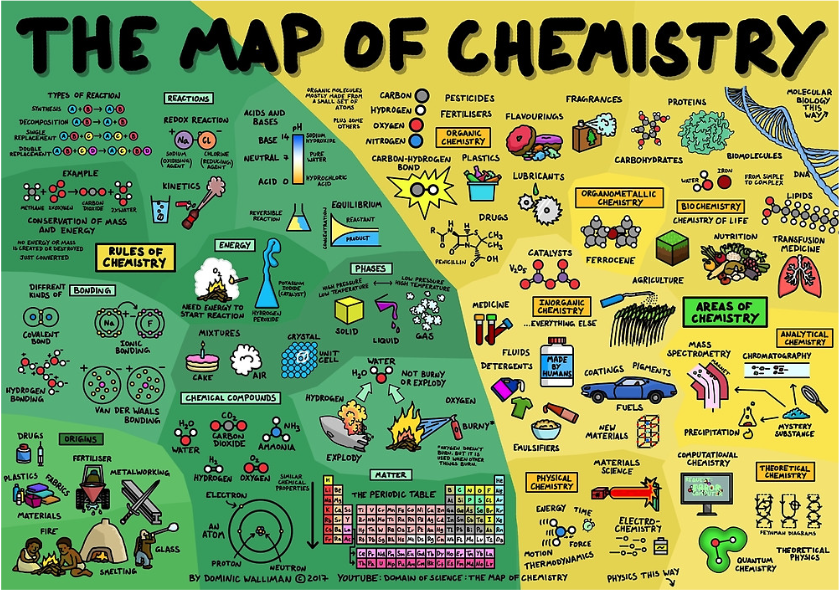
Walliman moves through the basics briskly and into the differences between and uses of organic and inorganic chemistry. As the animation pulls back to reveal the full map, we see it is comprised of two halves: “rules of chemistry” and “areas of chemistry.” We do not get explanations for the extreme end of the latter category. Fields like “computational chemistry” are left unexplored, perhaps because they are too far outside Walliman’s expertise. One refreshing feature of the videos on his “Domain of Science” channel is their intellectual humility.
If you’ve enjoyed the physics and mathematics videos, for example, you should check back in with their Youtube pages, where Walliman has posted lists of corrections. He has a list as well on the chemistry video page. “I endeavour to be as accurate as possible in my videos,” he writes here, “but I am human and definitely don’t know everything, so there are sometimes mistakes. Also, due to the nature of my videos, there are bound to be oversimplifications.” It’s an admission that, from my perspective, should inspire more, not less, confidence in his instruction. Ideally, scientists should be driven by curiosity, not vanity, though that is also an all-too-human trait. (See many more maps, experiments, instructional videos, and talks on Walliman’s website.)
In the “Map of Physics,” you’ll note that we eventually reach a gaping “chasm of ignorance”—a place where no one has any idea what’s going on. Maybe this is where we reach the edges of the simulation. But most scientists, whether physicists, chemists, or mathematicians, would rather reserve judgment and keep building on what they know with some degree of certainty. You can see a full image of the “Map of Chemistry” further up, and purchase a poster version here.
Find Free Chemistry Courses in our collection, 1,700 Free Online Courses from Top Universities.
Related Content:
The Map of Physics: Animation Shows How All the Different Fields in Physics Fit Together
The Map of Mathematics: Animation Shows How All the Different Fields in Math Fit Together
Josh Jones is a writer and musician based in Durham, NC. Follow him at @jdmagness
Read More...Learn Python with a Free Online Course from MIT
The programming language Python takes its name from Monty Python (true story!), and now courses that teach Python are in very high demand. Last December, we featured a free Python course created by Google. Today, it’s a free Python course from MIT.
Designed for students with little or no programming experience, the course “aims to provide students with an understanding of the role computation can play in solving problems. It also aims to help students, regardless of their major, to feel justifiably confident of their ability to write small programs that allow them to accomplish useful goals.” Beyond offering a primer on Python, the course offers an introduction to computer science itself.
The 38 lectures above were presented by MIT’s John Guttag. On this MIT website, you can find related course materials, including a syllabus and software. And if you’re interested in taking this course as a MOOC (Massive Open Online Course), you can sign up for the version that begins on May 27th over at edx.
The course will be added to our list of Free Computer Science Courses, a subset of our collection, 1,700 Free Online Courses from Top Universities.
If you would like to support the mission of Open Culture, consider making a donation to our site. It’s hard to rely 100% on ads, and your contributions will help us continue providing the best free cultural and educational materials to learners everywhere. You can contribute through PayPal, Patreon, and Venmo (@openculture). Thanks!
Related Content:
Learn Python: A Free Online Course from Google
Learn How to Code for Free: A DIY Guide for Learning HTML, Python, Javascript & More
Read More...Everything Thing You Ever Wanted to Know About the Synthesizer: A Vintage Three-Hour Crash Course
Recently I’ve been diving back into making music on my laptop. Just like the iPhone has done to bulky equipment like cameras and keyboards, the digital workstation has shrunk tons of gear, from music to mastering, down into software. There’s certainly no way I’m going to lug a mini-Moog to a coffee shop. But I’m willing to dabble with synth software, turn those dials and knobs, and see what happens.
So this upload of “Intro to Synthesis,” an instructional VHS from 1985, is perfect for me, and maybe you too. The hair, the clothes, and the jokes might be dated, but the info is not. In the above video, Dean Friedman–who if you close your eyes sounds like late night host Seth Meyers–lays out the building blocks of sound (pitch, timbre, volume), the five types of waveforms, and the seven components of a synthesizer, from oscillators to the LFO.
All of these features are still found on the synth interfaces used today in some form or another, and Friedman goes through every element at a methodical but appreciated pace. The three videos are an hour each.
And it pays to study the controls of synths and learn what makes them tick. The Yamaha DX‑7 contained many pre-sets which, unfiddled with, sound dated and appear on many an ‘80s pop hit. Meanwhile, Brian Eno, one of the few to actually read the manual, made “The Shutov Assembly” and other mid-era ambient tracks with the very same machine and nothing sounds quite like it.
Happy twiddling!
Related Content:
Hear Seven Hours of Women Making Electronic Music (1938- 2014)
Ted Mills is a freelance writer on the arts who currently hosts the artist interview-based FunkZone Podcast and is the producer of KCRW’s Curious Coast. You can also follow him on Twitter at @tedmills, read his other arts writing at tedmills.com and/or watch his films here.
Read More...Hear 2,000 Recordings of the Most Essential Jazz Songs: A Huge Playlist for Your Jazz Education
If you were to ask me “What is jazz?” I wouldn’t presume to know the answer, and I’m not sure any single composition exists to which one could point to as an ideal type. Maybe the only thing I’m certain of when it comes to jazz is—to quote Wallace Stevens—“it must change.”
Of course, there’s an incredibly rich history of jazz, broadly known, especially to those who have seen Ken Burns’ expansive documentary. I’d also recommend the excellent jazz writing of Amiri Baraka, Stanley Crouch, or Philip Larkin. For the young, we might consult Langston Hughes’ illustrated jazz history. And maybe everyone should read Charles Mingus’ Grammy-nominated essay “What is a Jazz Composer?” in which the contrarian genius writes, “each jazz musician is supposed to be a composer. Whether he is or not, I don’t know.”
Mingus the iconoclast argued for tearing up the text even as he sought a classical pedigree for jazz. His wish was partly granted by the influence of jazz on composers like Leonard Bernstein, who sought to answer the question “What is Jazz?” in a 1956 spoken-word LP. The tension between jazz as a compositional or wholly improvisational art seems to resound throughout the form, in all of its many guises and variations. But one thing I think every jazz musician knows is this: Standards, a common compendium of songs in the tradition.
You’ve got to know the rulebook (or the fakebook, at the least), before you can throw it out the window. Even some of the most innovative jazz artists who more or less invented their own scales, modes, and harmonies—like Cecil Taylor and Ornette Coleman—either studied at conservatory or paid their dues as sidemen playing other people’s songs. Jazz—Coleman once told Jacques Derrida—is “a conversation with sounds.” Its underlying grammar comes from the Standards.
Until fairly recently, the only way one could get a proper education in the standards was on the job. Critic, jazz historian, and pianist Ted Gioia writes as much in his comprehensive 2012 reference, The Jazz Standards: A Guide to the Repertoire. Gioia’s “education in this music was happenstance and hard earned.” He writes, “aspiring musicians today can hardly imagine how opaque the art form was just a few decades ago—no school I attended had a jazz program or even offered a single course on jazz.”
How times have changed. These days, if you can get in, you can take graduate-level classes taught by the greats, such as Herbie Hancock and Wayne Shorter at UCLA. Hundreds more less-famous jazz musician professors stand at the ready in music departments worldwide or at the renowned Berklee College of Music.
But for those autodidacts out there, Gioia—who has served on the faculty at Stanford University and been called “one of the outstanding music historians in America”—offers an exceptional guide to the Standards, one we can not only read, but also, thanks to Jim Higgins of the Journal Sentinel, listen to, in the Spotify playlist above. (If you need Spotify’s free software, download it here.) In a companion essay, Higgins describes the process of compiling “as many of the performances [Gioia] recommended” in his commentary on 250 jazz standards.
Gioia names over 2,000 different performances of those 250 standards, and the playlist contains nearly all of them. You’ll find, for example, “several different recordings of ‘In a Sentimental Mood’ by the composer (including one with John Coltrane), as well as versions by Sonny Rollins, Art Tatum, McCoy Tyner, Abdullah Ibrahim and Buddy Tate, and Chris Potter.” While the playlist is “not a complete reflection of Gioia’s recommendations,” given that certain artists’ work cannot be streamed, “there’s a lot of music here”—a whole lot—“spanning a century.”
The experience of listening to this incredible library will not be complete without some context. Gioia’s book contains a “short historical and musical essay” on each of the 250 songs and he isn’t shy about offering incisive critical commentary. Other than going to music school or joining a touring band, I can’t think of a better way to learn the Standards.
Related Content:
Hear What is Jazz?: Leonard Bernstein’s Introduction to the Great American Art Form (1956)
Langston Hughes Presents the History of Jazz in an Illustrated Children’s Book (1955)
Josh Jones is a writer and musician based in Durham, NC. Follow him at @jdmagness.
Read More...An Animated Introduction to Samuel Beckett, Absurdist Playwright, Novelist & Poet
Though he’s best known for his spare, absurdist tragicomedy, Waiting for Godot, playwright, poet, and novelist Samuel Beckett wrote what might be his most-quoted line at the end of The Unnamable, the third book in a hypnotic trilogy that begins with Molloy and continues with Malone Dies: “I can’t go on, I’ll go on.”
These novels, and the original Godot, were all written in French, then translated into English by Beckett himself. But Beckett was an Irish writer, who—like his contemporary, hero, countryman, and almost-father-in-law James Joyce—lived most of his life in voluntary exile. Like Joyce, Beckett wrote about Irish characters, and his “theme,” noted a 1958 New York Times reviewer of The Unnamable, “is the very Irish one in this century: the identity of opposites.”
Nothing in Beckett encapsulates this idea more concisely than the seven-word concluding line of The Unnamable. It’s a sentence that sums up so much of Beckett—his elliptical aphorisms; his dry, acerbic wit; and his unwavering stare into the abyss. As one contemporary of his suggested, Beckett will remain relevant “as long as people still die.” His primary subject is indeed one of the few truly universal themes.
But to only think of Beckett as morbid is not to read Beckett or see his work performed. While he can be unrelentingly grim, he is also never not in control of the dry humor of his voice. In his animated School of Life introduction to Beckett above, Alain de Botton begins with an anecdote about Beckett at a much-anticipated cricket match. Observing the perfect weather, a companion of his remarked, “This is the sort of day that would make you glad to be alive.” To which Beckett replied, “I wouldn’t go as far as that.”
The story, de Botton, says, “nicely encompasses two aspects of Samuel Beckett: his famously bleak view of life, and his mordant sense of humor.” They are qualities that for Beckett have the status of philosophical principles—though the author himself had a very fraught, almost allergic, relationship to philosophy. He gave up teaching early in his career, as we learn in the video, because “he felt he could not teach to others what he did not know himself.” When a version of Waiting for Godot debuted in 1952, Beckett sent a note to be read in his place. He wrote, in part:
All I knew I showed. It’s not much, but it’s enough for me, by a wide margin. I’ll even say that I would have been satisfied with less. As for wanting to find in all that a broader, loftier meaning to carry away from the performance, along with the program and the Eskimo pie, I cannot see the point of it. But it must be possible …
The necessity of the pointless exercise; the richness in the poverty of existence—stripped of its pretense and grand, self-important narratives.… These ideas arise from “the themes of failure that so dominate his work,” says de Botton. Though Beckett resisted interpretation in his own writing, he wrote an early study of Marcel Proust that interpreted the French author’s work as a philosophy of life which rests “on the making and appreciation of art.” Given that this is a School of Life video, this interpretation becomes the favored way to read Beckett. There are many others. But as the title of a 1994 Samuel Beckett reader—I Can’t Go On, I’ll Go On—suggests, every approach to Beckett must somehow try to account for the stubborn intensity of his contradictions.
Related Content:
Hear Samuel Beckett’s Avant-Garde Radio Plays: All That Fall, Embers, and More
When Samuel Beckett Drove Young André the Giant to School: A True Story
The Books Samuel Beckett Read and Really Liked (1941–1956)
How James Joyce’s Daughter, Lucia, Was Treated for Schizophrenia by Carl Jung
Josh Jones is a writer and musician based in Durham, NC. Follow him at @jdmagness
Read More...Huge Hands Rise Out of Venice’s Waters to Support the City Threatened by Climate Change: A Poignant New Sculpture
Upon arriving in Venice in the late 1930s, columnist and Algonquin Round Table regular Robert Benchley immediately sent a telegram back home to America: “Streets full of water. Please advise.” The line has taken its place in the canon of American humor, but in more recent times the image of water-filled streets — unintentionally water-filled streets, that is — has arisen most often in the conversation about climate change. Some of the potential disaster scenarios envision every major coastal city on Earth eventually turning into a kind of Venice, albeit a much less pleasant version thereof.
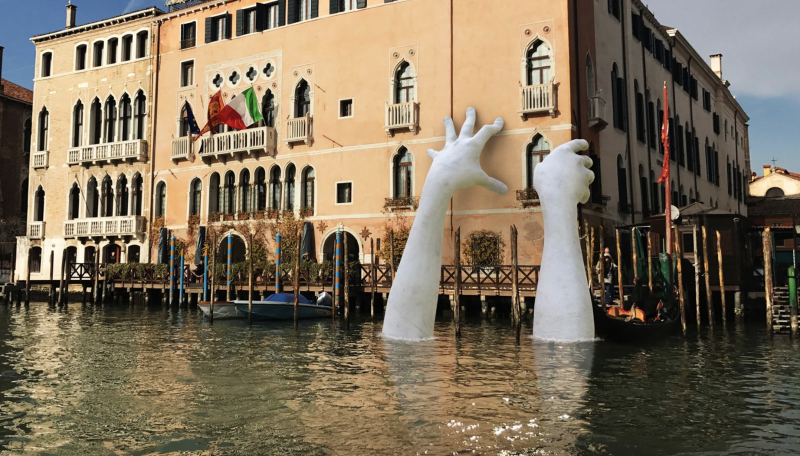
And so what better place than the one that hosts perhaps the world’s best known art exhibition, the Venice Biennale, to express climate-change anxiety in the form of public sculpture? “Venice is known for its gondolas, canals, and historic bridges,” writes Condé Nast Traveler’s Sebastian Modak, “but visitors will now also be greeted by another, albeit temporary, reminder of the city’s intimate relationship with water: a giant pair of hands reaching out of the Grand Canal and appearing to support the walls of the historic Ca’ Sagredo Hotel.” The piece is called Support, and it’s created by Barcelona-based Italian sculptor Lorenzo Quinn.
“I have three children, and I’m thinking about their generation and what world we’re going to pass on to them,” Quinn told Mashable’s Maria Gallucci. “I’m worried, I’m very worried.” The hands of his 11-year-old son actually provided the model for the polyurethane-and-resin hands of Support, weighing 5,000 pounds each, that stand on 30-foot pillars at the bottom of the Grand Canal. Modak quotes one of Quinn’s Instagram posts which describes the work as speaking to the people “in a clear, simple and direct way through the innocent hands of a child and it evokes a powerful message, which is that united we can make a stand to curb the climate change that affects us all.”
Those arguing in favor of more aggressive political measures to counteract the effects of climate change have gone to great lengths to point out what forms those effects have so far taken. But the fact that, apart from a stretch of hot summers, few of those effects have yet manifested undeniably in most people’s lives has certainly made their job harder. But nobody who visits Venice during the Biennale could fail to pause before Support, a work whose visual drama demands a reaction that temperature charts or data-filled studies can’t hope to provoke by themselves. And even apart from the issue at hand, as it were, Quinn’s sculpture reminds us that art, even in as deeply historical a setting as Venice, can also keep us thinking about the future.
Related Content:
Global Warming: A Free Course from UChicago Explains Climate Change
132 Years of Global Warming Visualized in 26 Dramatically Animated Seconds
A Song of Our Warming Planet: Cellist Turns 130 Years of Climate Change Data into Music
How Climate Change Is Threatening Your Daily Cup of Coffee
Frank Capra’s Science Film The Unchained Goddess Warns of Climate Change in 1958
Watch Episode 1 of Years of Living Dangerously, The New Showtime Series on Climate Change
Based in Seoul, Colin Marshall writes and broadcasts on cities and culture. He’s at work on a book about Los Angeles, A Los Angeles Primer, the video series The City in Cinema, the crowdfunded journalism project Where Is the City of the Future?, and the Los Angeles Review of Books’ Korea Blog. Follow him on Twitter at @colinmarshall or on Facebook.
Read More...Edward Gorey Illustrates H.G. Wells’ The War of the Worlds in His Inimitable Gothic Style (1960)
The story of malicious space aliens invading Earth has a resonance that knows no national boundaries. In fact, many modern versions make explicit the moral that only fighting off an existential threat from another planet could unify the inherently fractious human species. H.G. Wells’ 1898 novel The War of the Worlds, in many ways the archetypal telling of the space-invaders tale, certainly proved compelling on both sides of the pond: though set in Wells’ homeland of England, it made a lasting impact on American culture when Orson Welles produced a thoroughly localized version for radio, his infamous War of the Worlds Halloween 1938 broadcast. (Listen to it here.)
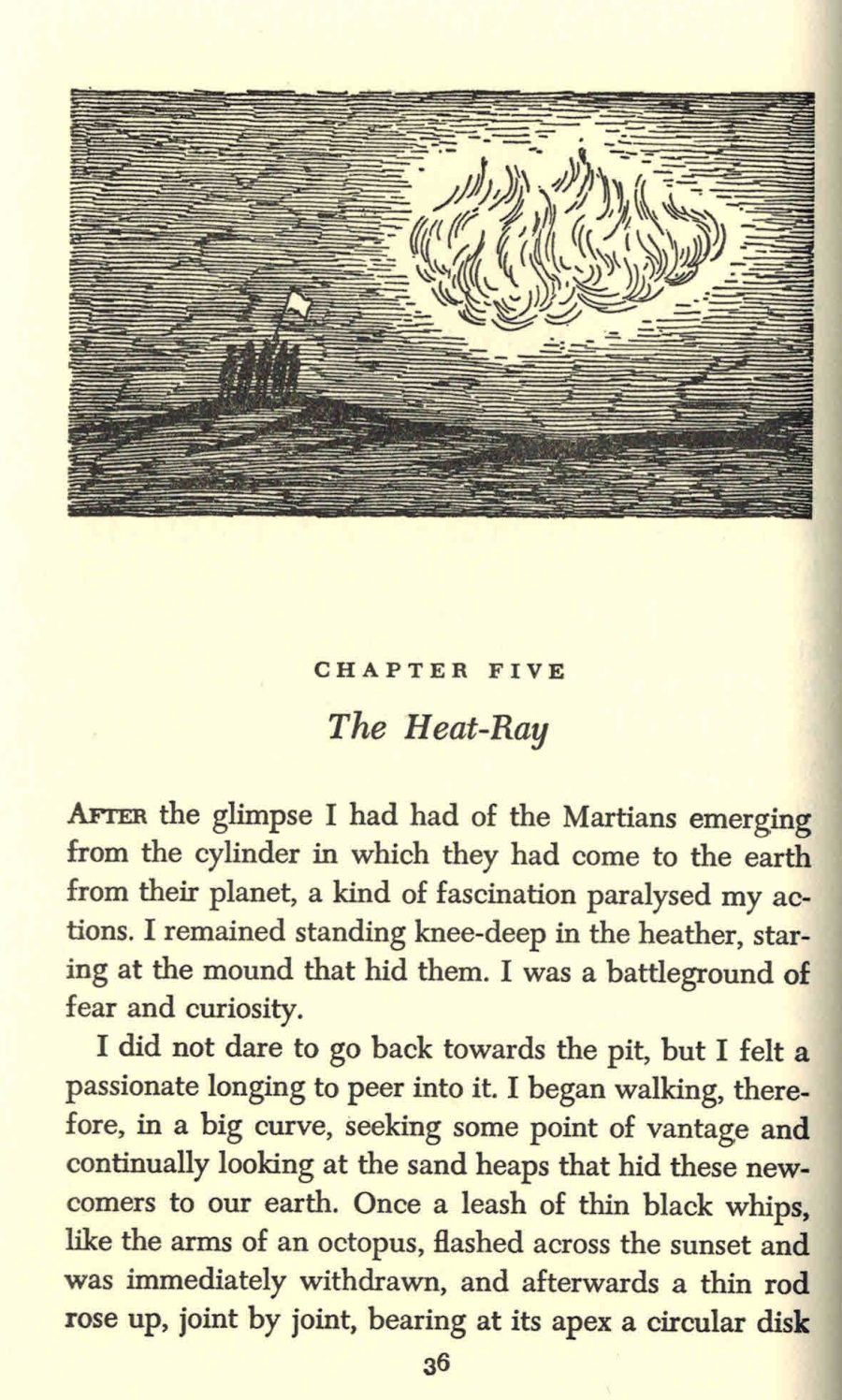
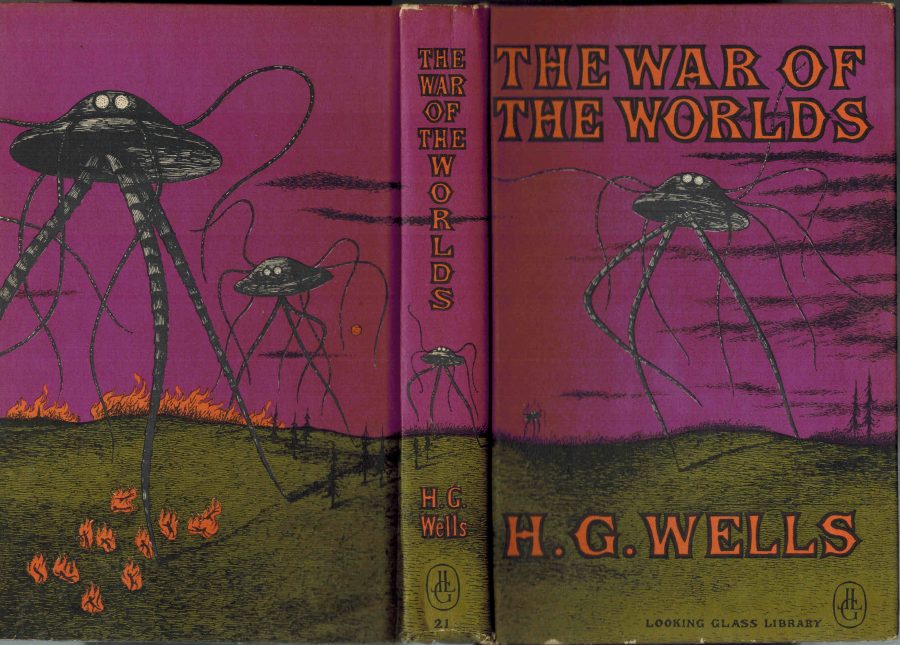
And so who better to illustrate a mid-2oth-century edition of the novel than Edward Gorey? He was born in and spent nearly all his life in America, but developed an artistic sensibility that struck its many appreciators as uncannily mid-Atlantic. His work continues to draw descriptions like “Victorian” and “gothic,” surely underscored by his association with the British literature-adapting television show Mystery!, for whose title sequences he drew characters and settings, and the young-adult gothic mystery novels of Anglophile author John Bellairs. The Gorey-illustrated War of the Worlds came out in 1960 from Looking Glass Library, featuring his drawings not just at the top of each chapter but on its wraparound cover as well. Though out of print, you can find old copies for sale online.
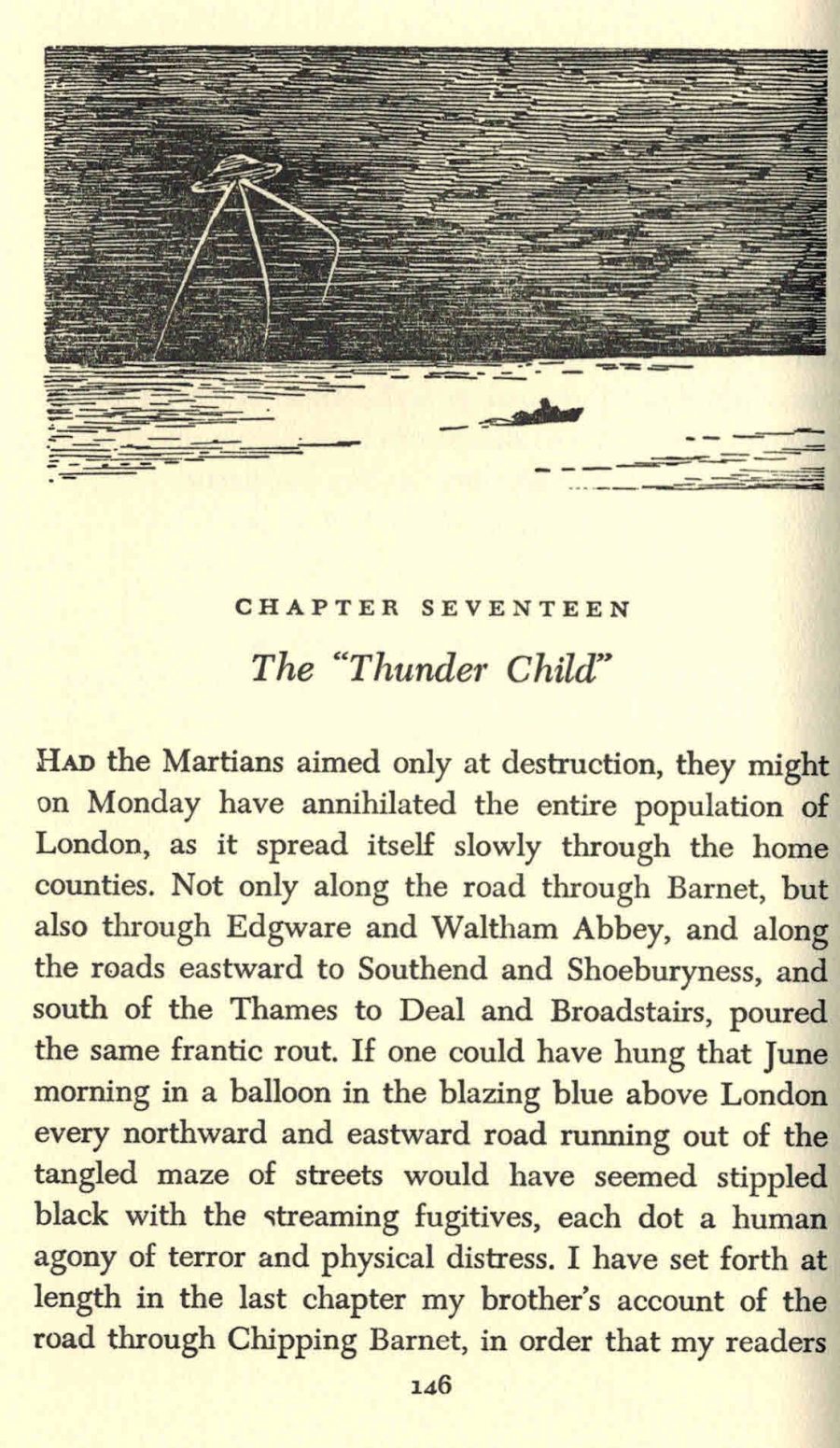
Gorey had begun his career in the early 1950s at the art department of publisher Doubleday Anchor, creating book covers and occasionally interior illustrations. In addition to Bellairs’ novels, he would also go on to put his artistic stamp on such literary classics as Bram Stoker’s Dracula and T.S. Eliot’s Old Possum’s Book of Practical Cats, bringing to each his signature combination of whimsy and dread in just the right proportions. Given the inherent ominousness and threat of The War of the Worlds, Gorey’s dark side comes to the fore as the story’s long-legged terrors arrive and wreak havoc on Earth, only to fall victim to common disease.
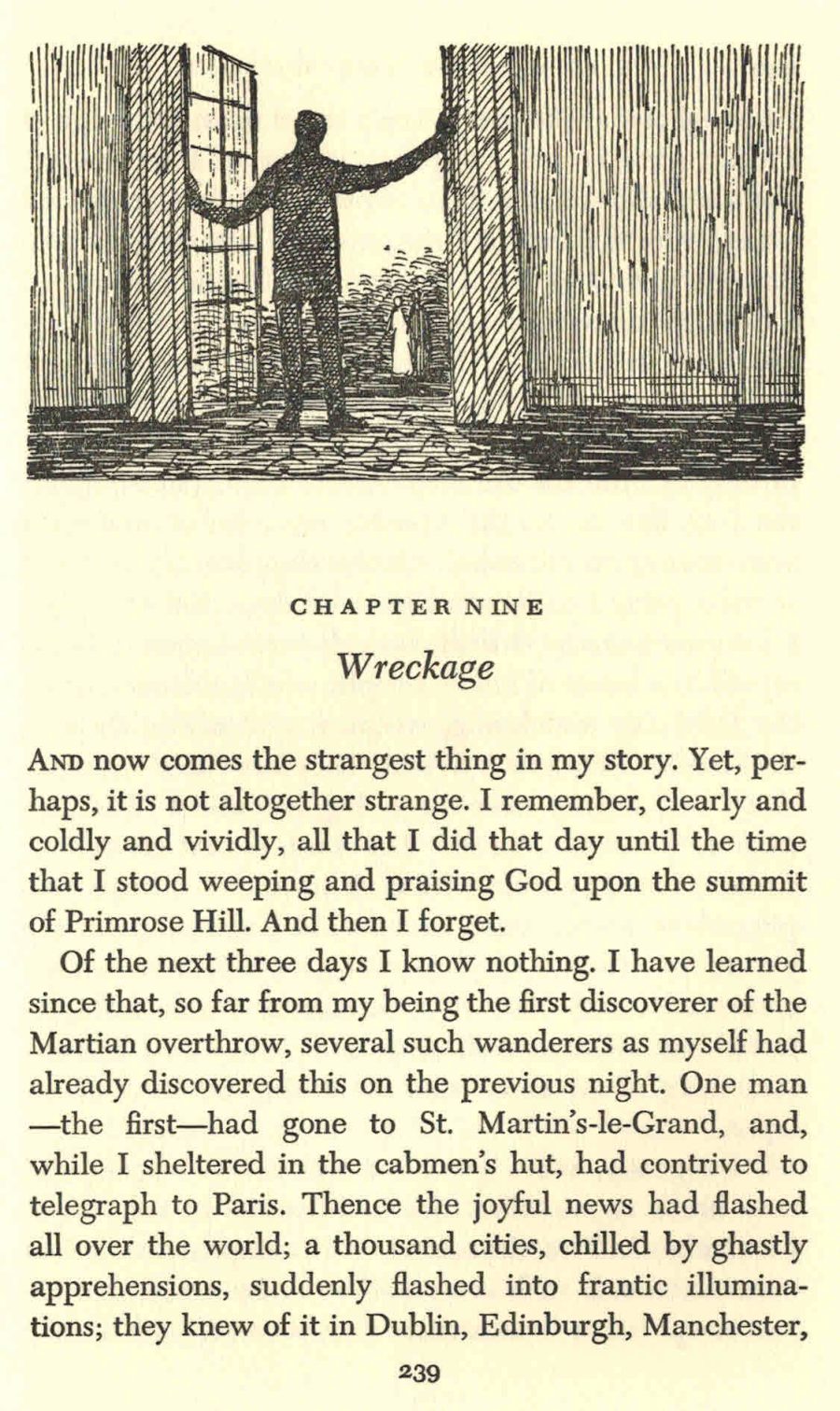
Gorey’s War of the Worlds illustrations also seem to draw some inspiration from the very first ones that accompanied the novel upon its initial publication as a Pearson’s Magazine serial in 1897. You can compare and contrast them by browsing the high-resolution scans of the out-of-print 1960 Looking Glass Library War of the Worlds at this online exhibition at Loyola University Chicago Digital Special Collections, in partnership with the Edward Gorey Charitable Trust.
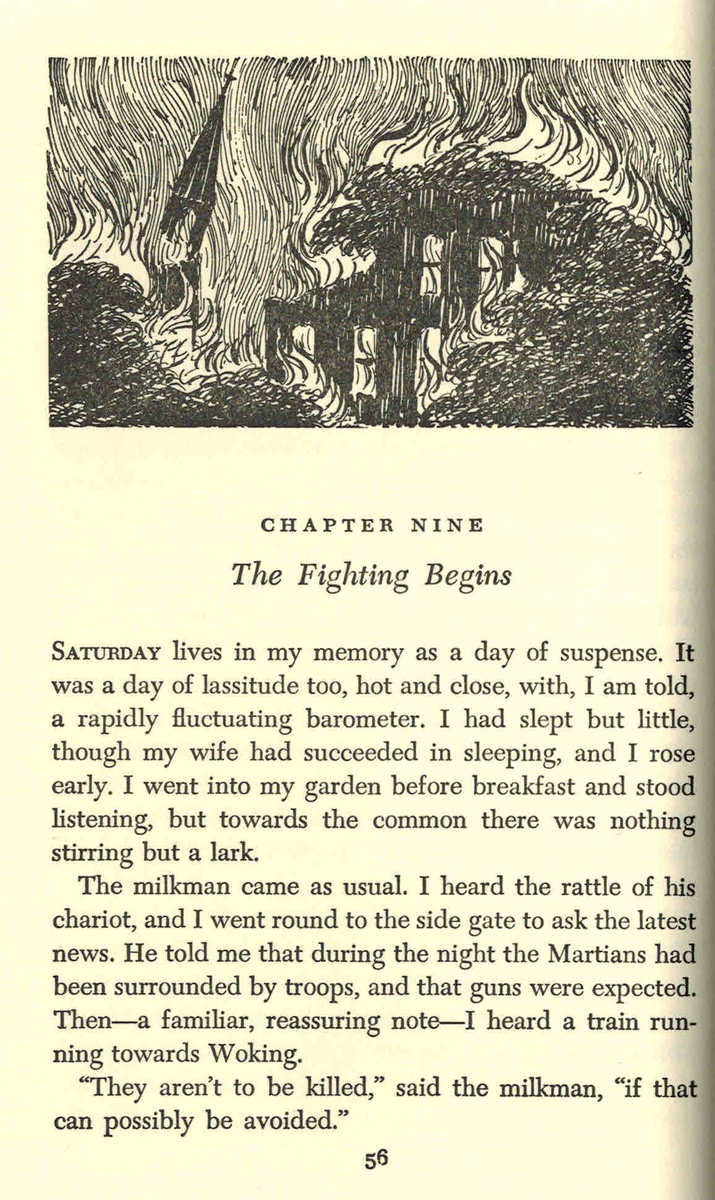
Though conceptually similar to the illustrations in Pearson’s, drawn by an artist (usually of children’s books) named Warwick Goble, they don’t get into quite as much detail — but then, they don’t have to. To evoke a complex mixture of fascinated anticipation and creeping fear, Gorey never needed more than an old house, a huddle of silhouettes, or a pair of eyes glowing in the darkness.
via Heavy Metal
Related Content:
The Very First Illustrations of H.G. Wells’ The War of the Worlds (1897)
Hear Orson Welles’ Iconic War of the Worlds Broadcast (1938)
The Great Leonard Nimoy Reads H.G. Wells’ Seminal Sci-Fi Novel The War of the Worlds
Based in Seoul, Colin Marshall writes and broadcasts on cities and culture. He’s at work on a book about Los Angeles, A Los Angeles Primer, the video series The City in Cinema, the crowdfunded journalism project Where Is the City of the Future?, and the Los Angeles Review of Books’ Korea Blog. Follow him on Twitter at @colinmarshall or on Facebook.
Read More...Meet the Iconic Figures on the Cover of The Beatles’ Sgt. Pepper’s Lonely Hearts Club Band
June 1 will mark the 50th anniversary of the release of The Beatles’ Sgt. Pepper’s Lonely Hearts Club Band, an album considered revolutionary in every respect. Everything from the music itself, down to the album’s cover design, broke new ground. To commemorate the upcoming anniversary, the BBC has started to release a series of videos introducing you to the 60+ figures who appeared in the cutout cardboard collage that graced the album’s iconic cover. (See a mapping of the figures here.)
Some of the figures are enduring legends–Carl Jung, Marilyn Monroe and James Joyce. Others (e.g., Tommy Handley, Bobby Breen and Tom Mix) have faded into obscurity.
Up top, watch the video featuring Bob Dylan. No stranger, right? Down below, see the video on Aubrey Beardsley, the English artist who created striking illustrations for works by Edgar Allan Poe and Oscar Wilde, both also featured in the collage.
At the bottom, see a clip on pioneering electronic composer Karlheinz Stockhausen. The BBC will be adding yet more videos here.
If you would like to support the mission of Open Culture, consider making a donation to our site. It’s hard to rely 100% on ads, and your contributions will help us continue providing the best free cultural and educational materials to learners everywhere. You can contribute through PayPal, Patreon, and Venmo (@openculture). Thanks!
Related Content:
How The Beatles’ Sgt. Pepper’s Lonely Hearts Club Band Changed Album Cover Design Forever
Read More...Support Us
We're hoping to rely on loyal readers, rather than erratic ads. Please click the Donate button and support Open Culture. You can use Paypal, Venmo, Patreon, even Crypto! We thank you!

About Us

Open Culture scours the web for the best educational media. We find the free courses and audio books you need, the language lessons & educational videos you want, and plenty of enlightenment in between.
Advertise With Us

FREE UPDATES!
GET OUR DAILY EMAIL
Get the best cultural and educational resources on the web curated for you in a daily email. We never spam. Unsubscribe at any time.
FOLLOW ON SOCIAL MEDIA

Open Culture editor Dan Colman scours the web for the best educational media. He finds the free courses and audio books you need, the language lessons & movies you want, and plenty of enlightenment in between.
Advertise With Us

