A Big List of Free Art Lessons on YouTube
It may seem like a dubious honor to belong to a select group that includes some of my favorite creative people: art school dropouts. But while a failed endeavor can be painful, many a dropout learns that the experience is valuable not only because failures can fuel future success, but also because the skills, techniques, and ways of thinking one picks up in the first, “boot camp,” year of art school are widely applicable to every creative endeavor.
My favorite art school class was simply called “Foundations.” As the name implies, it dealt exclusively with basic materials and techniques—for joining, painting, sculpting, building, etc. One learns to think of large, complicated, potentially overwhelming projects of as reducible in some sense to materials and techniques. What am I working with? What is the nature of this material and what are the best ways to shape it? What does it want to become?
These are practical, fundamental questions artists ask themselves, no matter how big or high concept their ideas. These days, the materials are likely to be more virtual than physical, or some creative mixture of the two. Still, similar considerations apply, as well as the basic skills of using color, perspective, shadow, and line effectively. In the free video tutorials here, you can learn many of those skills without attending, or dropping out, of art school. They may not provide a complete arts education, but they offer high quality lessons for artists needing to supplement or refresh their skill sets.
At the top, Ahmed Aldoori explains the color wheel and color palettes in Photoshop. In other videos on his YouTube channel, he gives tips on drawing hands (a particular challenge for every artist), artist anatomy, digital painting, and more. Another channel, Draw with Chris, offers free and premium content for both digital and traditional artists, such as the long video on shading technique above. He also has a popular two part series on life drawing (part 1 — part 2).
For artists and animators interested in “semi realistic, manga, and anime style characters, environments, and concept art,” the Lapuka channel features many free short videos on the basics, such as their short intro to “1,2, and 3 point perspective” above. Other videos teach “Multiplying and scaling in 1 point perspective,” “Cutting in 1 point perspective,” “Drawing with a mouse,” and rendering certain popular anime characters.
All of these tutorials come from a list compiled by Deviantart user DamaiMikaz, who has helpfully divided several dozen YouTube instructional series into categories like “Art Fundamentals,” “Tutorial & How to,” “Digital art software,” “Traditional Art,” and others. Whether you’re an aspiring artist, dabbling amateur, working professional, or an art school dropout picking the craft back up, you’ll find what you need here. Know of any other free video resources not listed in this archive? Let us and our readers know in the comments and we’ll add the primo picks to the list.
Below find the list created by DamaiMikaz:
Art fundamentals
People that teach you the fundamentals of art. Anatomy, color, perspective, etc
Ahmed Aldoori
CG Cookie ConceptTutorial & How to
How to’s and tutorials on various subjects
Ahmed Aldoori
Art of Wei
Art ProfBrushboost
CG Cookie Concept
DRAW with Chris
Draw with Jazza
Drawing Tutorials Online
FZDSCHOOL
Happy D. Artist
Imagine FX
Istebrak
Javi can draw!
Jesus Conde
Kienan Lafferty
LevelUp
My Drawing Tutorials
Proko
Sinix Design
Sycra
The Art of Aaron Blaise
The Drawfee Channel
Tyler Edlin
Will Terrell
Xia TaptaraDigital art software
Channels geared towards creating effects in digital art software
digitalfxcube
PHLEARN
Photoshop Training ChannelTraditional art
Channels doing traditional art
agnescecile
Baylee Jae
Happy D. Artist
James Gurney
Lachri Fine Art
Michael James Smith
Robin Clonts
Sara Tepes
Stanley Artgerm Lau
Super Ani
Zimou TanManga / Anime
Channels geared towards drawing manga/anime style
markcrilley
Nuei Neko
Sycra
Whyt MangaTimelapse paintings
Just stare in awe
agnescecile
Alice X. Zhang
Apterus Graphics
Asuka111 Art
Atey Ghailan
axel torvenius
BrotherBaston
Brushboost
Chris Cold
Concept Art Sessions
Daniel Wachter
Draw With Rydi
FZDSCHOOL
Ilya Kuvshinov
Ilya Tyljakov
James Gurney
Jesus Conde
Jordan Grimmer
Kienan Lafferty
Kim-Seang Hong
Kiwa
LevelUp
Lina Sidorova
Nuei Neko
Peixel
saejinoh
Sara Tepes
Scott Robertson
SpoonfishLee
Stanley Artgerm Lau
Super Ani
Xia Taptara
zephyo
Zimou TanCritique’s & Overpaints
People painting over other people’s painting. Great to get insight
Ahmed Aldoori
Art Prof
BORODANTE
CG Cookie Concept
FZDSCHOOL
Istebrak
Related Content:
Brian Eno on Why Do We Make Art & What’s It Good For?: Download His 2015 John Peel Lecture
Free Course: An Introduction to the Art of the Italian Renaissance
Josh Jones is a writer and musician based in Durham, NC. Follow him at @jdmagness
Read More...Visit a New Digital Archive of 2.2 Million Images from the First Hundred Years of Photography
Interested in photography? You’re in the right place. Over the years, we’ve compiled free classes on digital photography, hundreds of photography lectures, courses on photography appreciation, and documentaries on famous greats like Alfred Stieglitz, Diane Arbus, Edward Weston, and Henri Cartier-Bresson. You can learn the history of photography in “five animated minutes,” see the venerable art of tintype recreated, and visit archives from the Soviet Union, the collection of George Eastman, and the work of pioneering motion photographer Eadweard Muybridge (animated in 93 GIFs).
Still not enough? How about a digital library of 2.2 million images from the history of photography? Europeana Collections just launched its “latest thematic collection,” Europeana Photography, which, notes Douglas McCarthy at the site’s blog, “includes images and documents from 50 European institutions in 34 different countries.”
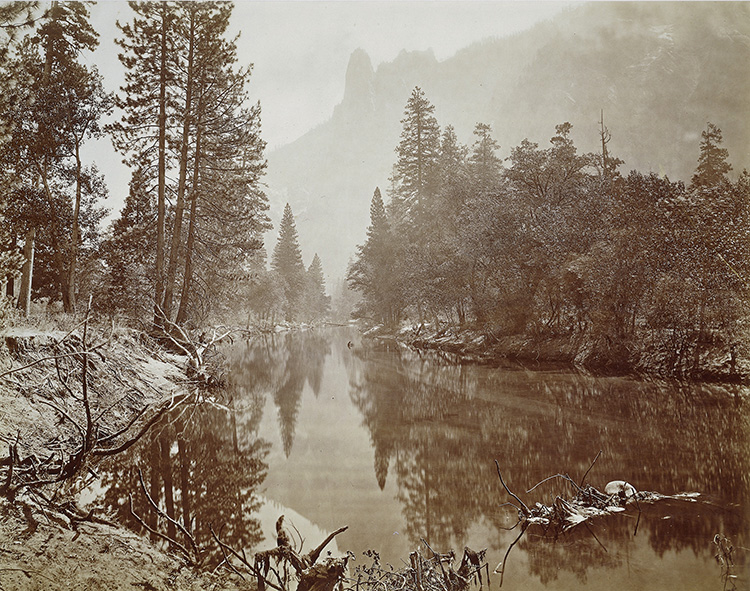
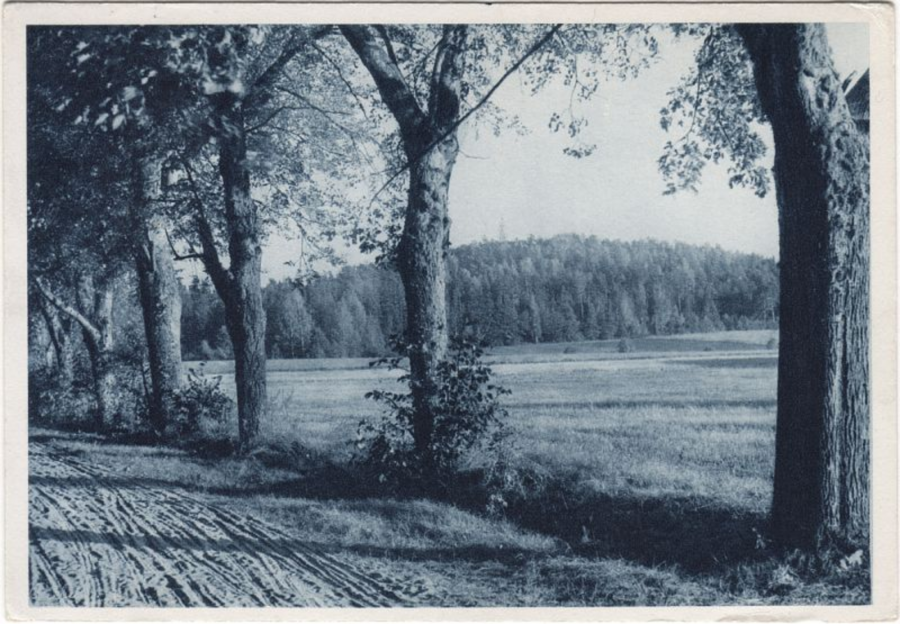
Stunning landscapes like that of Muybridge’s Loya: Valley of the Yosemite, above, and work from other innovators like Julia Margaret Cameron, below, represent highlights of the archive’s digital scans from the first 100 years of photography.
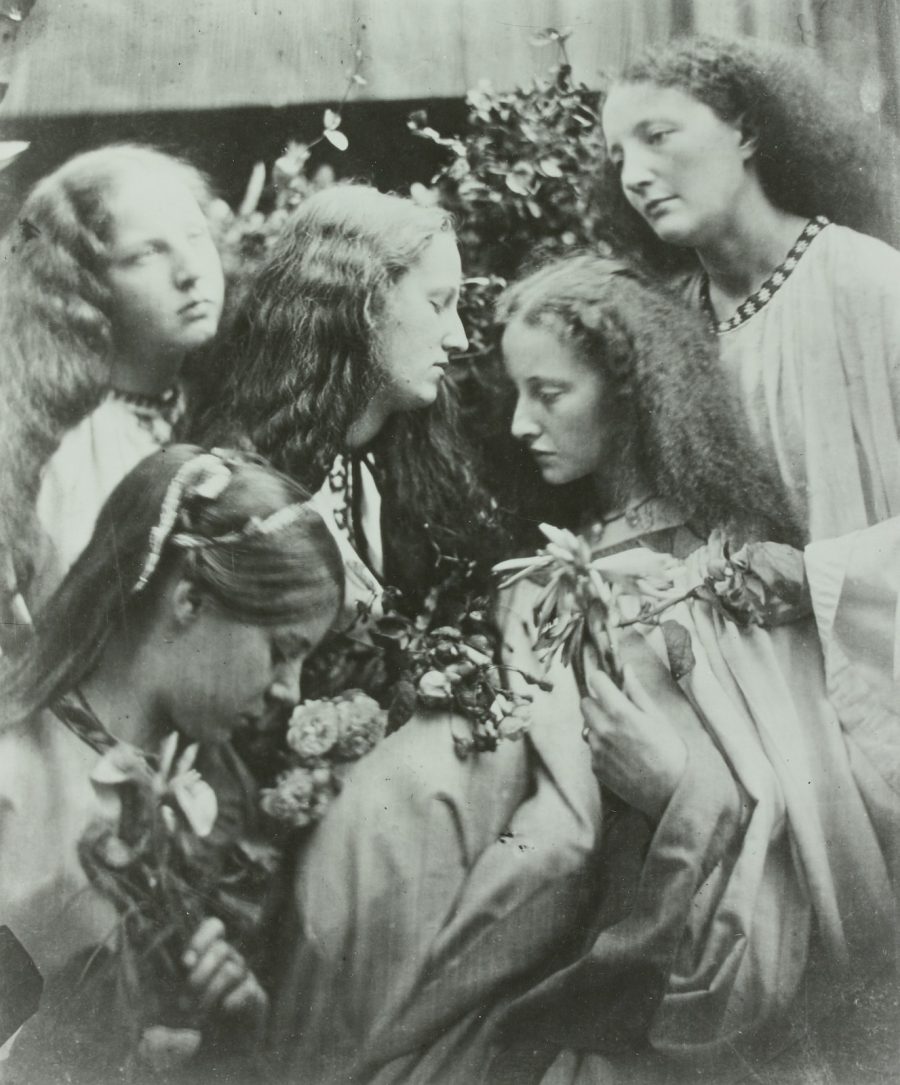
Lilie, 1898–1903. Wilhelm Weimar. Museum für Kunst und Gewerbe Hamburg, CC0
The collection promises, “future exhibitions on specific themes… telling compelling stories with stunning images.” Currently, you’ll find there themed “expositions” like “Industrial Photography in the Machine Age” and “Vintage Postcards of Southeastern Europe,” among others. A gallery on “The Magic Lantern” offers a tour of a pre-cinema entertainment technology. One on photographer Johan Wilhelm Weimar introduces viewers to incredibly striking work from his 1901 Herbarium.

The collection is searchable, downloadable, shareable, and you can choose from 23 different languages, including English. Its mission is international, but also very much built on the idea—some might say political fiction—of a culturally unified Europe, allowing people to “connect with their past, with fellow European citizens, explore remote eras and locations, and better appreciate the value of their continental, national and local cultural heritage.”
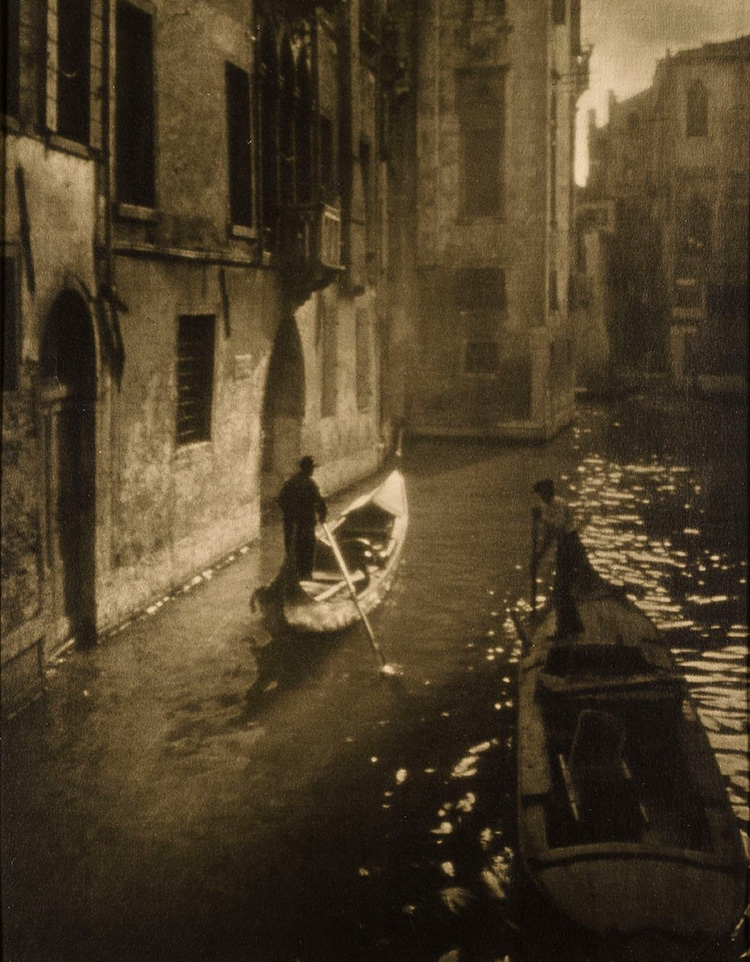
Grand Canal, Venice, 1929. Nicola Perscheid. Museum für Kunst und Gewerbe Hamburg, CC0
Lofty goals, but one need no such larger purpose to simply enjoy casually browsing, and making the kind of odd discoveries one might on a continental walking tour, with no particular destination in mind.
Visit the Europeana Photography archive here.
Related Content:
School of Visual Arts Presents 99 Hours of Free Photography Lectures
Josh Jones is a writer and musician based in Durham, NC. Follow him at @jdmagness
Read More...How Famous Paintings Inspired Cinematic Shots in the Films of Tarantino, Gilliam, Hitchcock & More: A Big Supercut
It’s no accident that one of the best-known series of cinema-analyzing video essays bears the title Every Frame a Painting. When describing the height of film’s visual potential, we often draw metaphors from art history, but the relationship also goes in another direction: more often than we might think, the filmmakers and their collaborators looked to the canvases of the masters for inspiration in the first place. In this trilogy of short video essays, “Film Meets Art,” “Film Meets Art II,” and “Film Meets Art III,” Vugar Efendi highlights some of the most striking paintings-turned-shots in the work of, among other auteurs, Alfred Hitchcock, Terry Gilliam, Quentin Tarantino, and Paul Thomas Anderson.
Efendi, writes Slate’s Madeline Raynor in a post on the second installment, “places shots from films side by side with the paintings that inspired them. And once you see the pairings, you won’t be able to unsee them. Some of these are unmistakable references — like Jean-Luc Godard’s ode to Jean-Auguste-Dominique Ingres — while others are more subtle.
Filmmakers have been recreating paintings since the days of silent film: the video’s earliest example is 1927’s Metropolis.” More recent instances include Alex Colville’s To Prince Edward Island in Wes Anderson’s Moonrise Kingdom, and Thomas Gainsborough’s The Blue Boy in Quentin Tarantino’s Django Unchained. While perhaps too obvious for inclusion into these essays, Wim Wenders once satirized this process with a movie-within-a-movie recreation of Edward Hopper’s Nighthawks in The End of Violence.
Which painters do filmmakers most often turn to for material? Efendi’s visual essays show us a fair few memorable and varied uses of Hopper, whose paintings possess a cinematic atmosphere of their own, and also Magritte, possibly because his dreamlike sensibility aligns well with that of cinema itself: L’empire des lumières in William Friedkin’s The Exorcist, La Robe du soir in Barry Jenkins’ Moonlight (winner of last year’s Best Picture Oscar), and Architecture au clair de Lune in Peter Weir’s The Truman Show. Weir’s work makes another appearance in the essays in the form of Picnic at Hanging Rock, a haunting film based on a haunting novel written in part out of fascination with a haunting painting, William Ford’s At the Hanging Rock — whose imagery then made it back into the screen adaptation. It seems that art, be it on canvas, film, or some medium yet unimagined, tells the story of civilization in more ways than one.
Related Content:
100,000 Free Art History Texts Now Available Online Thanks to the Getty Research Portal
Based in Seoul, Colin Marshall writes and broadcasts on cities and culture. He’s at work on a book about Los Angeles, A Los Angeles Primer, the video series The City in Cinema, the crowdfunded journalism project Where Is the City of the Future?, and the Los Angeles Review of Books’ Korea Blog. Follow him on Twitter at @colinmarshall or on Facebook.
Read More...Lou Reed Creates a List of the 10 Best Records of All Time
If you want to write, most every writer will tell you, you’ve got to read, read, read, and read. “Read more than you write,” advises Teju Cole. Even great filmmakers like Werner Herzog and Akira Kurasawa cite copious reading as a prerequisite for their primarily visual medium. But what about music? What advice might we hope to receive about the art of writing memorable, culturally significant songs? Listen, listen, listen, and listen, perhaps.
One of the greatest of rock and roll greats, Lou Reed, had overt literary ambitions, formed during his years as an English major at Syracuse University, where he studied under poet Delmore Schwartz. “Hubert Selby, William Burroughs, Allen Ginsberg and Delmore Schwartz,” he once told Spin, “To be able to achieve what they did, in such little space, using such simple words. I thought if you could do what those writers did and put it to drums and guitar, you’d have the greatest thing on earth.”
Thematically, Reed accomplished this, bringing the same violence, tenderness, and streetwise decadence to his work as his literary heroes did to theirs. But formally, he drew on another battery of influences: classic soul, doo wop, rhythm and blues, folk, jazz, and early rock and roll. Cribbing from all these genres during his long career, Reed displayed a seemingly effortless mastery of archetypal American pop music.
Unlike Leonard Cohen—another literary songwriter drawn to life’s darker themes—Reed did not leave college and start publishing poetry. In 1964, he moved to New York to begin work as an in-house songwriter for Pickwick Records, soaking up the music around him through his pores, transmuting it into his own warped take on early hits like his dance craze, “The Ostrich,” which included the line “put your head on the floor and have somebody step on it.”
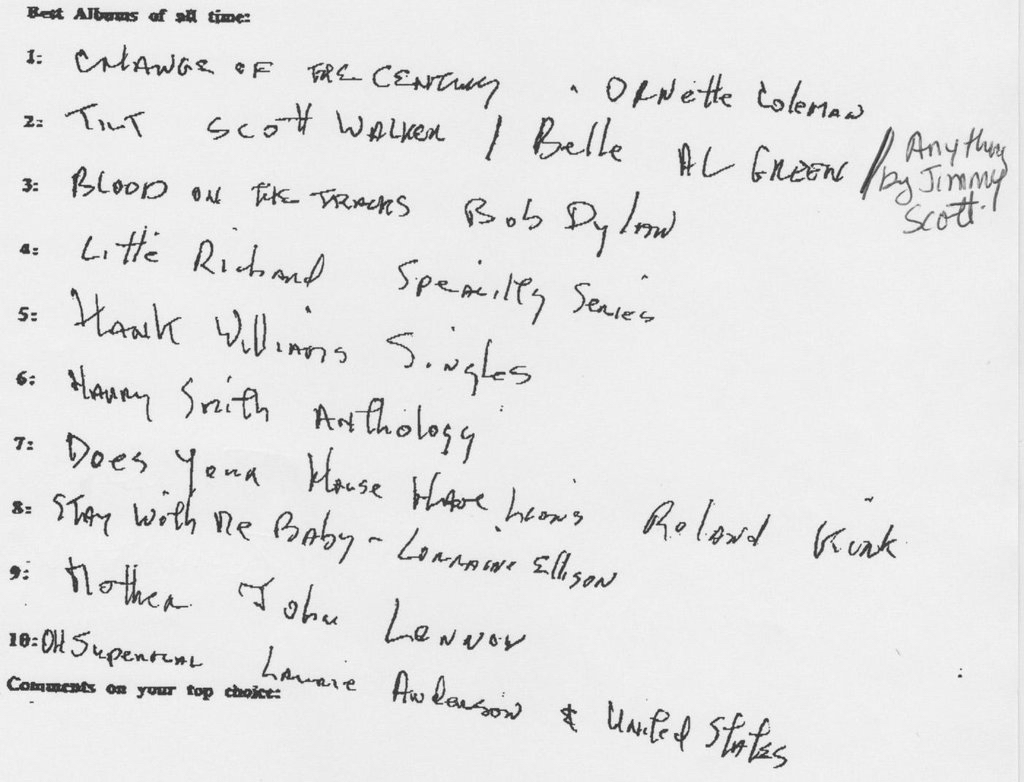
As weird as Reed was even then, he wrote immensely catchy tunes and eventually inspired several thousand punk, post-punk, alternative, and indie songwriters with the novel idea that one could make dangerous, shocking music with simple, catchy—even bubblegum—melodies. Perhaps no one had as great an effect on post-60s rock, but Reed’s own influences drew solidly from the fifties and before, as partially evidenced in his own hand, in a scrawled list of “best albums of all time,” which he submitted for a 1999 magazine interview.
1. Change of the Century—Ornette Coleman
2. Tilt—Scott Walker / Belle—Al Green / Anything by Jimmy Scott
3. Blood on the Tracks—Bob Dylan
4. Little Richard’s Specialty Series
5. Hank Williams’ Singles
6. Harry Smith Anthology
7. Does Your House Have Lions—Roland Kirk
8. “Stay with Me Baby”—Lorraine Ellison
9. “Mother”—John Lennon
10.“Oh Superman”—Laurie Anderson & United States
The list, transcribed above, includes the three-volume Specialty Sessions at number 4, a comprehensive omnibus of Little Richard hits. Below it is Hank Williams’ 3‑disc singles collection, and further down, at twice the size, Harry Smith’s enormous Anthology of American Folk Music. By far, the bulk of Reed’s suggestions saw release before he ever put pen to paper and came up with “The Ostrich.” We’re just peeking into the sixties with Ornette Colemans’ Change of the Century, at number one.
But you’ll also note that, tied at number two with Al Green’s Belle and “Anything by Jimmy Scott” (making his list of ten come out to 13), we have Scott Walker’s bizarre, experimental 1995 masterpiece Tilt (hear “Farmer in the City” further up), a return from oblivion for the reclusive sixties crooner and an album, writes Allmusic, “on a plateau somewhere between Nico’s Marble Index and Lou Reed’s Metal Machine Music.” Ever modest (he once claimed, “my bullshit is worth more than other people’s diamonds”), Reed was acutely aware of his own pivotal place in 20th century music, though he does refrain from listing one of his own records. He ends instead with the pulsing, trance-like single “Oh Superman,” by his romantic and musical partner, Laurie Anderson.
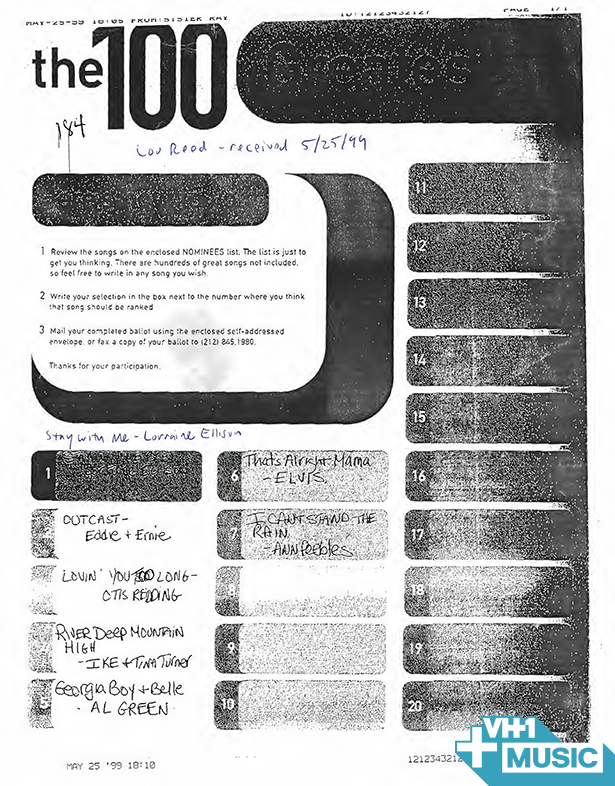
Who knows how seriously Reed took this assignment, given how much he could be “circumspect about the materials and methods of his art” in his often confrontational public statements. That same year, VH1 polled several journalists and “esteemed musicians,” writes the music channel, on their choice of the 100 greatest songs of rock and roll. “Naturally we approached Reed, who sent his choices back via fax. In true iconoclast form, instead of listing out his 100 favorite songs, he picked just eight.” Only two of the artists from his top ten appear here: Lorraine Ellison and Al Green. See his hand-written ballot above, and the eight songs listed below.
1. “Stay With Me” by Lorraine Ellison
2.“Outcast” by Eddie and Ernie
3. “Lovin’ You Too Long” by Otis Redding
4. “River Deep Mountain High” by Ike & Tina Turner
5. + 6. “Georgia Boy” and “Belle” by Al Green
7. “That’s Alright Mama” by Elvis Presley
8. “I Can’t Stand the Rain” by Ann Peebles
Related Content:
Hear Ornette Coleman Collaborate with Lou Reed, Which Lou Called “One of My Greatest Moments”
Lou Reed Reads Delmore Schwartz’s Famous Story “In Dreams Begin Responsibilities”
Josh Jones is a writer and musician based in Durham, NC. Follow him at @jdmagness
Read More...Meet Yasuke, Japan’s First Black Samurai Warrior
“His name was Yasuke. His height was 6 shaku 2 sun” — roughly six feet, two inches — “he was black, and his skin was like charcoal.” Those words come from the 16th-century samurai Matsudaira Ietada, and they describe one of his colleagues. Though we don’t know much detail about his life itself, we do know that there once lived a black samurai called Yasuke, a version of the name he had in Africa, probably the then Portuguese Mozambique. Brought to Japan in 1579 by an Italian Jesuit named Alessandro Valignano on a mission-inspection tour, Yasuke’s appearance in the capital drew so much attention that thrilled onlookers clambered over one another to get so much as a glimpse at this strange visitor with his unfathomable stature and skin tone.
“His celebrity status soon piqued the curiosity of Oda Nobunaga, a medieval Japanese warlord who was striving to unify Japan and bring peace to a country racked by civil war,” writes Ozy’s Leslie Nguyen-Okwu. “Nobunaga praised Yasuke’s strength and stature, describing ‘his might as that of 10 men,’ and brought him on as his feudal bodyguard.”
As many foreigners in Japan still discover today, the foreigner’s outsider status there also has its benefits: “Nobunaga grew fond of Yasuke and treated him like family as he earned his worth on the battlefield and on patrol at Azuchi Castle. In less than a year, Yasuke went from being a lowly page to joining the upper echelons of Japan’s warrior class, the samurai. Before long, Yasuke was speaking Japanese fluently and riding alongside Nobunaga in battle.”
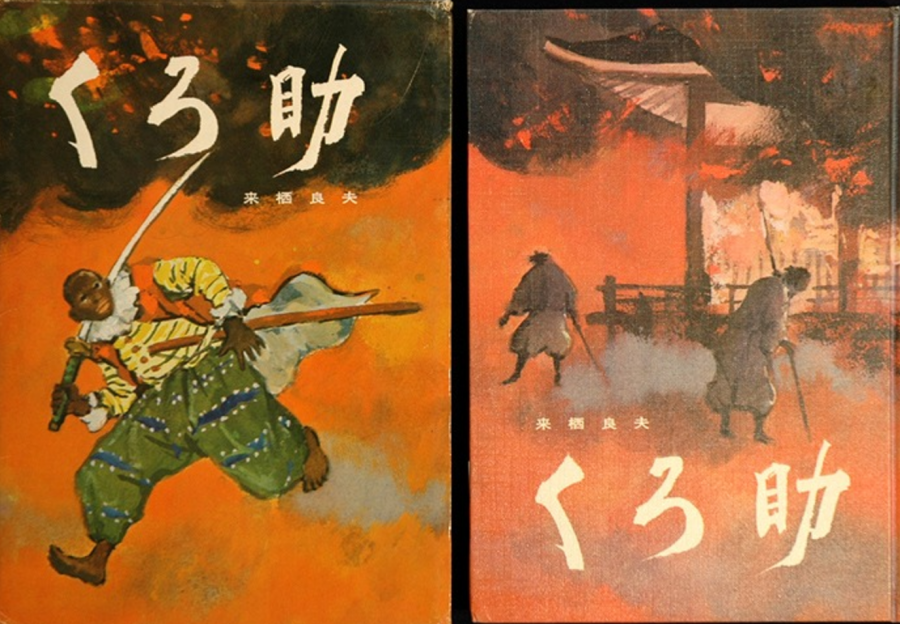
The legend of Yasuke ends soon after, in 1582, with Nobunaga’s fall at the hands of one of his own generals. That resulted in the first and only black samurai’s exile, probably to a Jesuit mission in Kyoto, but Yasuke has lived on in the imaginations of the last few generations of Japanese readers, all of whom grew up with the award-winning children’s book Kuro-suke (kuro meaning “black” in Japanese) by Kurusu Yoshio. This illustrated version of Yasuke’s life story, though told with humor, ends, according to a site about the book, on a bittersweet note: the defeated “Nobunaga kills himself, and Kuro-suke is saved and sent to Namban temple. When he sleeps that night, he dreams of his parents in Africa. Kuro-suke cries silently.”
What the story of Yasuke lacks in thorough historical documentation (though you can see a fair few pieces briefly cited on the site of this documentary project) it more than makes up in fascination, and somehow Hollywood, nearly fifteen years after Tom Cruise’s high-profile turn as a white samurai, has only just awoken to its potential. In March, Hollywood Reporter announced that the film studio Lionsgate “has tapped Highlander creator Gregory Widen to script Black Samurai,” a “period action drama” based on the Yasuke legend. Widen’s considerable experience in the outsider-with-sword genre makes him an understandable choice, but one has to wonder — shouldn’t Quentin Tarantino’s phone be ringing off the hook right about now?
via Ozy
Related Content:
Female Samurai Warriors Immortalized in 19th Century Japanese Photos
Hand-Colored 1860s Photographs Reveal the Last Days of Samurai Japan
A Hypnotic Look at How Japanese Samurai Swords Are Made
Based in Seoul, Colin Marshall writes and broadcasts on cities and culture. He’s at work on a book about Los Angeles, A Los Angeles Primer, the video series The City in Cinema, the crowdfunded journalism project Where Is the City of the Future?, and the Los Angeles Review of Books’ Korea Blog. Follow him on Twitter at @colinmarshall or on Facebook.
Read More...Take a Trip Through the History of Modern Art with the Oscar-Winning Animation Mona Lisa Descending a Staircase
The artistic morphing is already underway before the very first frame of filmmaker Joan Gratz’ 1992 Oscar-winning animation, Mona Lisa Descending a Staircase.
Most viewers will recognize the title as a mashup of Leonardo Da Vinci’s famous work and Marcel Duchamp’s modernist classic Nude Descending a Staircase, No. 2.
What follows is a constantly morphing, chronological trip through the history of modern art, beginning with Impressionism and passing through Cubism and Surrealism en route to Pop art and hyper-realism.
The seamless transitions were created by painstakingly manipulating small pieces of oil-based modeling clay on a solid easel-mounted surface, a technique Gratz developed as an architecture student at the University of Oregon.
Van Gogh’s self-portrait reconfigures itself into Gaugin’s. Andy Warhol’s Gold Marilyn Monroe becomes Roy Lichtenstein’s Woman with Flowered Hat—a far trickier transition than had Gratz started with Picasso’s 1941 Dora Maar au Chat, the original inspiration for Lichtenstein’s 1963 work.
As Gratz told Olivier Cotte, author of Secrets of Oscar-Winning Animation:
The transitions were the most interesting aspect of the work. A great deal of what they show consists of providing information about the style of the paintings…. The relationship between the images depends on the era, the artistic movement and the interconnection between the artists.
Thus the work is not just about capturing the 55 selected images, but also their texture, from the Expressionists’ thick impasto to the post-painterly slickness of 60s pop artists.
The paintings were chosen over nearly eight years of research and planning, but not the minutiae of the transitions, as Gratz preferred to improvise in front of the camera. Just as in more narrative claymations, each painstaking adjustment required her to stop and shoot a frame, a process that ended up taking two-and-a-half years, fit in around Gratz’s schedule for such paying gigs as Return to Oz and the feature-length claymation, The Adventures of Mark Twain.
Given the spontaneous nature of the transformations from one painting to the next, the exact length of the finished film was impossible to predict. When it was at last complete, composer Jamie Haggerty and sound designer Chel White were brought in to provide further historical and cultural context, via music, environmental sounds, and conspicuous use of a digeridoo.
See more of Gratz’s clay painting technique in the music video for Peter Gabriel’s “Digging in the Dirt,” and ads for Coca-Cola and Microsoft.
Read Olivier Cotta’s analysis of Mona Lisa Descending a Staircase, including a longer interview with Joan Gratz here.
Mona Lisa Descending a Staircase will be added to our list of Animations, a subset of our collection, 4,000+ Free Movies Online: Great Classics, Indies, Noir, Westerns, Documentaries & More.
Related Content:
Van Gogh’s 1888 Painting, “The Night Cafe,” Animated with Oculus Virtual Reality Software
Hear Marcel Duchamp Read “The Creative Act,” A Short Lecture on What Makes Great Art, Great
Ayun Halliday is an author, illustrator, theater maker and Chief Primatologist of the East Village Inky zine. She’ll be appearing onstage in New York City this June as one of the clowns in Paul Young’s Faust 3. Follow her @AyunHalliday.
Read More...Sgt. Pepper’s Album Cover Gets Reworked to Remember Icons Lost in 2016

We’re just days away from the 50th anniversary of the release of The Beatles’ Sgt. Pepper’s Lonely Hearts Club Band. And, as we mentioned last week, the BBC has kicked off the celebrations with a series of videos that introduce you to the 60+ figures who appeared in the cardboard collage that graced the album’s iconic cover. Bob Dylan, Edgar Allan Poe, William S. Burroughs, Albert Einstein, Marilyn Monroe, HG Wells, Shirley Temple–they all get a video introduction, among others.
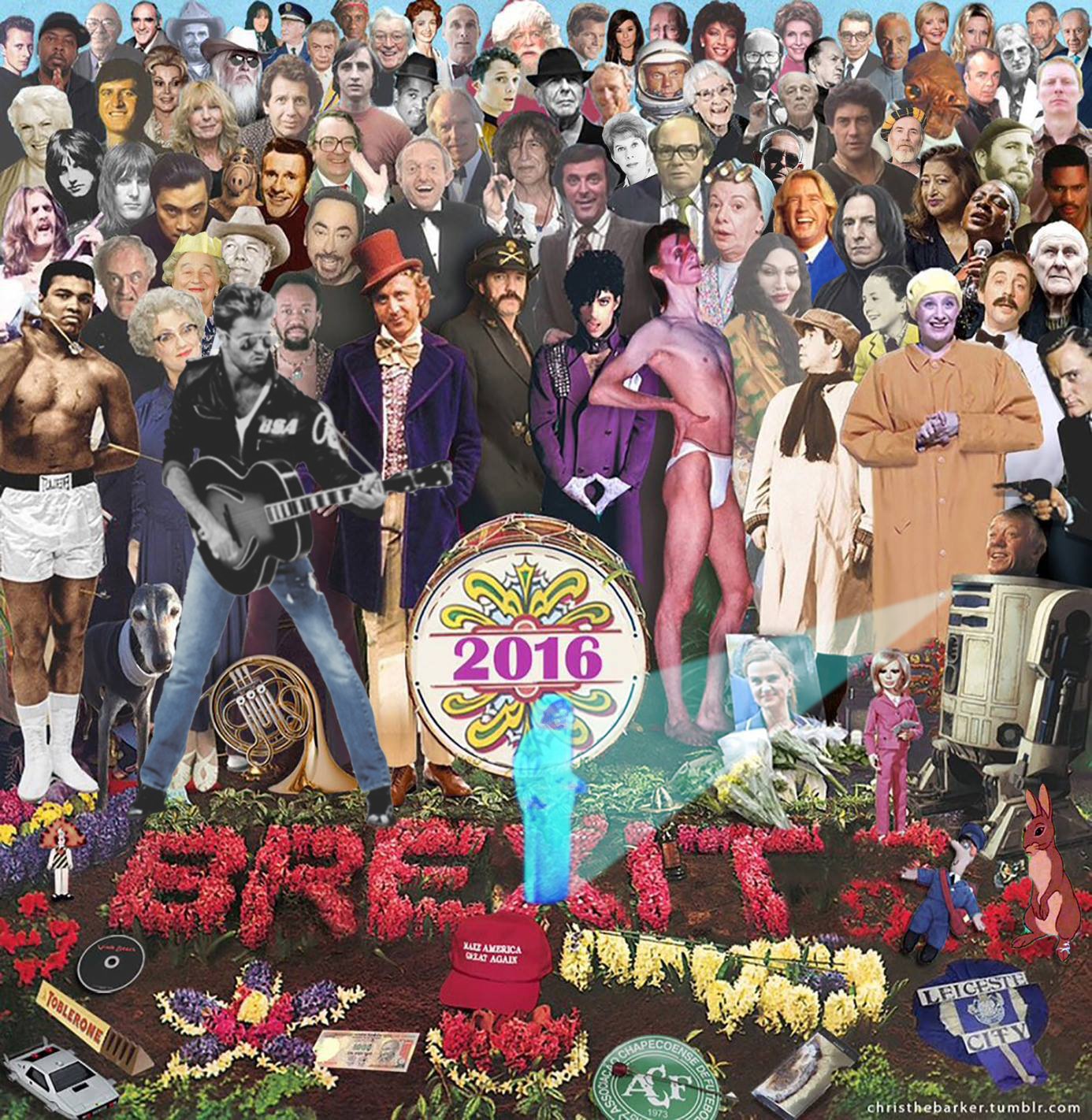
Historic as it is, the Pepper cover recently became a good vehicle for remembering the bewildering number of musicians, artists and celebrities who left this mortal coil in 2016. Above you can see an illustration created by Twitter user @christhebarker in the waning days of last year. If you look closely, you can see some thought went into the design. Muhammad Ali, for example, now stands where boxer Sonny Liston did in the original. Find them all in a larger format here.
If you would like to support the mission of Open Culture, consider making a donation to our site. It’s hard to rely 100% on ads, and your contributions will help us continue providing the best free cultural and educational materials to learners everywhere. You can contribute through PayPal, Patreon, and Venmo (@openculture). Thanks!
Related Content:
Meet the Iconic Figures on the Cover of The Beatles’ Sgt. Pepper’s Lonely Hearts Club Band
How The Beatles’ Sgt. Pepper’s Lonely Hearts Club Band Changed Album Cover Design Forever
Read More...Twin Peaks Essentials to Get You Ready for the Debut of Season 3: A 55-Minute Refresher, Maps, Commercials & Behind-the-Scenes Footage & More
Have you prepared yourself to return, this Sunday, to Twin Peaks, that small Washington town, so well known for its coffee and cherry pie, once rocked by the murder of homecoming queen Laura Palmer? Fans of the eponymous television series, which first made surreal prime-time television history on ABC in 1990, have binge-watched and re-binge-watched its original two seasons in advance of the new Twin Peaks’ May 21st debut on Showtime. Even fans who disliked the second season, in which series creators David Lynch and Mark Frost gave in to network pressure to resolve the story of Palmer’s murder, have re-watched it, and with great excitement.
But can simply watching those first thirty episodes (and maybe the follow-up feature film Twin Peaks: Fire Walk with Me, once booed at Cannes, the very same festival which will screen the first two parts of the new Twin Peaks on the 25th) suffice?
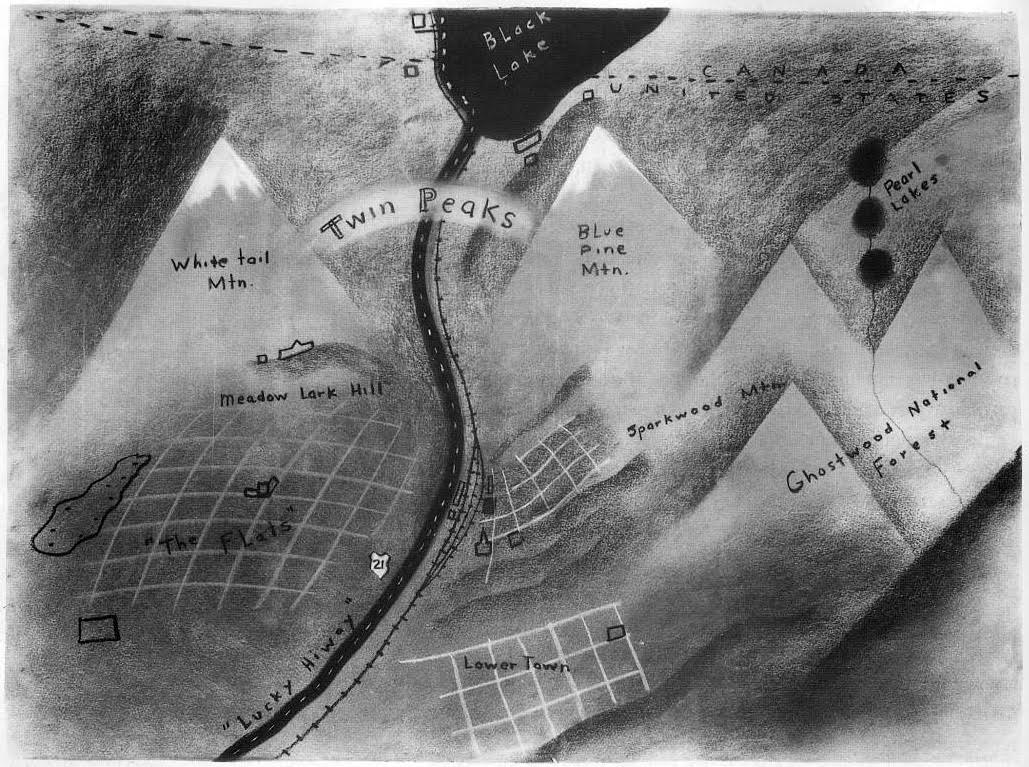
To get yourself as deep into the show’s reality as possible, we recommend dipping into the Twin Peaks material we’ve posted over the years here at Open Culture, beginning with the four-hour video essay on the series’ making and mythology we featured just this past January. You can orient yourself by keeping an eye on Lynch’s hand-drawn map of the the town of Twin Peaks, which he used to pitch the show to ABC in the first place, and which appears just above.
But Twin Peaks has its foundation as much in music as in geography. Just above, you can hear composer Angelo Badalamenti, a frequent collaborator with Lynch, tell the story of how he and the director composed the show’s famous “Love Theme,” which not only made an impact on the televisual zeitgeist but set the tone for the everything to follow. “It’s the mood of the whole piece,” Lynch once said of the composition, “It is Twin Peaks.” Badalamenti has scored the new series as well, joining the long list of returnees to the project that includes not just Lynch and Frost, but Kyle MacLachlan as FBI Special Agent Dale Cooper and many others from the original cast as well, including the late Miguel Ferrer and Warren Frost.
“There’s so much more to Twin Peaks than a riveting murder mystery,” says Alan Thicke, another performer no longer with us, hosting the 1990 behind-the-scenes preview of the show’s second season just above. “There’s a whole look and a feel and a texture,” an experience “180 degrees away from anything else on television.” As dramatically as televisual possibilities have expanded over the past 27 years, it seems safe to say that the continuation of Twin Peaks, which comes after such expansions of its fictional universe as Frost’s Secret History of Twin Peaks, will maintain a similar creative distance from the rest of what’s on the air. “The one thing I feel I can say with total confidence,” to paraphrase David Foster Wallace writing about Lost Highway twenty years ago, is that the new Twin Peaks will be… Lynchian.
Above, you can watch a mini-season of Twin Peaks, which also doubles as a series of Japanese coffee commercials. They, too, come courtesy of David Lynch. And below, watch “Previously, on Twin Peaks…”, an abbreviated, 55-minute refresher on what happened during the first two seasons of the show. (It comes to us via WelcometoTwinPeaks.) Also you can read a recap of every episode over at The New York Times.
Related Content:
Watch an Epic, 4‑Hour Video Essay on the Making & Mythology of David Lynch’s Twin Peaks
David Lynch Draws a Map of Twin Peaks (to Help Pitch the Show to ABC)
Angelo Badalamenti Reveals How He and David Lynch Composed the Twin Peaks‘ “Love Theme”
David Lynch Directs a Mini-Season of Twin Peaks in the Form of Japanese Coffee Commercials
Based in Seoul, Colin Marshall writes and broadcasts on cities and culture. He’s at work on a book about Los Angeles, A Los Angeles Primer, the video series The City in Cinema, the crowdfunded journalism project Where Is the City of the Future?, and the Los Angeles Review of Books’ Korea Blog. Follow him on Twitter at @colinmarshall or on Facebook.
Read More...36 eBooks on Computer Programming from O’Reilly Media: Free to Download and Read
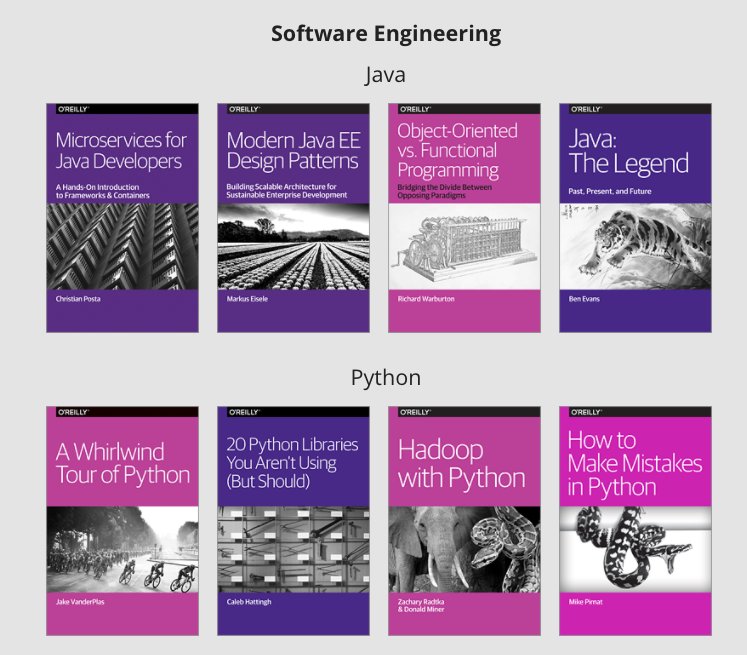
This past week, we featured a free course on the programming language Python, presented by MIT. A handy resource, to be sure.
And then it struck us that you might want to complement that course with some of the 36 free ebooks on computer programming from O’Reilly Media–of which 7 are dedicated to Python itself. Other books focus on Java, C++, Swift, Software Architecture, and more. See the list of programming books here.
If you’re looking for yet more free ebooks from O’Reilly Media, see the post in our archive: Download 243 Free eBooks on Design, Data, Software, Web Development & Business from O’Reilly Media.\
For more computer science resources, see our collections:
Free Online Computer Science Courses
Free Textbooks: Computer Science
If you would like to support the mission of Open Culture, consider making a donation to our site. It’s hard to rely 100% on ads, and your contributions will help us continue providing the best free cultural and educational materials to learners everywhere. You can contribute through PayPal, Patreon, and Venmo (@openculture). Thanks!
Related Content:
Learn Python: A Free Online Course from Google
Free Online Computer Science Courses
Learn Python with a Free Online Course from MIT
800 Free eBooks for iPad, Kindle & Other Devices Read More...Soundgarden’s Chris Cornell Sings Haunting Acoustic Covers of Prince’s “Nothing Compares 2 U,” Michael Jackson’s “Billie Jean” & Bob Marley’s “Redemption Song”
I entered high school to the huge sounds of Soundgarden’s second album, Louder than Love, playing at home, in friends’ cars, on MTV’s 120 Minutes late at night.… The band’s debut, and two previous EPs released on Seattle’s Sub Pop records, had not attracted much notice outside of a fairly small scene. But Louder than Love—especially “Hands All Over”—was as hooky and alarming as breakthrough singles by other emerging bands on the other side of the country, while losing none of the propulsive grit, groove, and raw, metal/hardcore power of their earlier work. Thousands of new listeners started paying attention.
But there’s another reason the songs on Louder than Love resonated so strongly (and scored them a major label deal). The album announced singer Chris Cornell as a vocalist to be reckoned with—a singer with incredible power, melodic instinct, and a four-octave range.
On songs like “Hands All Over” and “Loud Love,” he broke away from a fairly narrow Ozzy Osbourne/Robert Plant style he’d cultivated and introduced a sound that took both influences in a direction neither had gone before, one full of anguish, urgency, and even menace.
Millions more got to know Cornell’s voice after Superunknown’s “Black Hole Sun,” but even then no one would have predicted the direction he would go in after leaving Soundgarden. He injected soul and sensitivity into songs like Audioslave’s “Original Fire” and “Be Yourself”—love ‘em or don’t—qualities we can hear in abundance in his covers of sensitive and soulful songs like Prince’s “Nothing Compares 2 U” and Michael Jackson’s “Billie Jean.” In his unplugged version of Jackson’s pop masterpiece the song acquires the heaviness and grievous beauty of a murder ballad. And I mean that entirely as a compliment. He brings “Nothing Compares 2 U” into “soulful new life,” as Slate writes, which is saying quite a lot, given that Sinead O’Connor’s version is more or less perfect.
Cornell took his own life at age 52 on Wednesday night after playing with a reunited Soundgarden in Detroit, and after struggling with depression for many years. It’s true he was never lauded as a songwriter of a Prince/Michael Jackson caliber. His lyrics were often tossed-off free associations rather than carefully crafted narratives. One’s appreciation for them is a matter of taste. But like the artists he covers here, both of whom also died tragically in their 50s, his music reflected a deep concern for the state of the world. This comes through clearly in songs like “Hands All Over,” “Hunger Strike,” and in some pointed comments he made during his final performance.
Rolling Stone has a few more acoustic Cornell covers of Metallica, the Beatles, Elvis Costello, and more, and they’re all great. He did a profoundly affecting, gospel-like take on Whitney Houston’s belter, “I Will Always Love You.” But for a true, and truly heartbreaking, example of how he could imbue a song with his “unforgettable vulnerability,” watch him play Bob Marley’s “Redemption Song” at New York’s Beacon Theater in 2015 above, in an absolutely riveting duet with his daughter, Toni. Cornell will be dearly missed by everyone who knew him, and by the millions of people who were deeply moved by his voice.
Related Content:
Prince Plays Unplugged and Wraps the Crowd Around His Little Finger (2004)
Johnny Cash & Joe Strummer Sing Bob Marley’s “Redemption Song” (2002)
Patti Smith’s Cover of Nirvana’s “Smells Like Teen Spirit” Strips the Song Down to its Heart
Josh Jones is a writer and musician based in Durham, NC. Follow him at @jdmagness
Read More...Support Us
We're hoping to rely on loyal readers, rather than erratic ads. Please click the Donate button and support Open Culture. You can use Paypal, Venmo, Patreon, even Crypto! We thank you!

About Us

Open Culture scours the web for the best educational media. We find the free courses and audio books you need, the language lessons & educational videos you want, and plenty of enlightenment in between.
Advertise With Us

FREE UPDATES!
GET OUR DAILY EMAIL
Get the best cultural and educational resources on the web curated for you in a daily email. We never spam. Unsubscribe at any time.
FOLLOW ON SOCIAL MEDIA

Open Culture editor Dan Colman scours the web for the best educational media. He finds the free courses and audio books you need, the language lessons & movies you want, and plenty of enlightenment in between.
Advertise With Us