How Filmmakers Tell Their Stories: Three Insightful Video Essays Demystify the Craft of Editing, Composition & Color
Everyone knows that if you want to make a movie, you first have to write down its story. Many of us have tried our hands at writing movie stories ourselves — as treatments, screenplays, or whichever other forms the industry has come up with — and some have made careers out of it. But even if a film begins on the page, it doesn’t, of course, remain there; up on screen, the final product has to tell its story visually as much as it does with words, and usually even more so. Lewis Bond, the video essayist behind the cinema-analyzing Youtube channel Channel Criswell, understands that better than most, hence his three essays dedicated to the three most important elements of visual storytelling, the first chapter of which, “Colour in Storytelling,” we featured a couple months ago here on Open Culture.
The second, “Composition in Storytelling,” explores the possibilities inherent in arranging people, places, and things within a shot. “Deciding the placement of subjects through the viewfinder of a camera isn’t merely a technical decision,” says Bond, “it’s an expressive one.”
Beyond showing the audience what they need to see to understand the story, filmmakers have relied on “tried and tested formulas to make an image pleasing to the eye” such as the rule of thirds, the golden ratio, and triangular composition. But beyond those basics opens up the vast creative space of composing images in order to carefully guide the audience’s attention, craft symbols and subtexts, and make the power of a scene felt — all as dependent upon what gets left out of the picture as what gets put in.
Finally, “Editing in Storytelling” covers the step of the filmmaking process widely considered one of the most important, even more so than writing the story in the first place. “Beyond the basic function of putting a film together,” says Bond, “the craftsmanship of editing can be dealt with such subtlety that it can be the foundation of a film’s pace, its atmosphere — it can even be the enriching ingredient to strengthen all the film’s themes, and you may not even notice.” Though the editor holds “total manipulation over our emotions,” deciding what we see, when we see it, and how we see it, they also labor under the responsibility of knowing the film will stand or fall on their skill. Watch Channel Criswell’s entire visual storytelling essay trilogy and you’ll notice all their techniques much more easily while watching movies — especially if you start watching them, as you might well find yourself inspired to do, with the sound off.
Related Content:
Alfred Hitchcock’s 7‑Minute Master Class on Film Editing
“Bleu, Blanc, Rouge”: a Striking Supercut of the Vivid Colors in Jean-Luc Godard’s 1960s Films
Wes Anderson Likes the Color Red (and Yellow)
Stanley Kubrick’s Obsession with the Color Red: A Supercut
Based in Seoul, Colin Marshall writes and broadcasts on cities and culture. He’s at work on a book about Los Angeles, A Los Angeles Primer, the video series The City in Cinema, the crowdfunded journalism project Where Is the City of the Future?, and the Los Angeles Review of Books’ Korea Blog. Follow him on Twitter at @colinmarshall or on Facebook.
Read More...Hear Aerobic Exercise: When Soviet Musicians Recorded Electronic Music for a Subversive Home Fitness Record (1984)
Last year, Josh Baines at dance music site Thump revisited the 2004 video for “Call on Me,” a dancefloor anthem built around a highly recognizable loop from Steve Winwood’s 1987 hit, “Valerie.” Drawing on the song’s inherent nostalgia factor, the video—which Baines calls, without exaggeration, “the sexiest video of all time”—stages a ridiculously lewd, sweaty aerobics class, recalling the close association during the 1980s fitness craze between sexy aerobics videos and dance music, in advertisements, TV shows, MTV, movies like Hardbodies and its even more ludicrous sequel—and, of course, John Travolta and Jamie Lee Curtis’s hilarious Perfect, which directly inspired “Call on Me.”
The “Call on Me” video is so salacious, in fact, that it nearly caused then British Prime Minister Tony Blair to fall off his rowing machine while watching it, a scene that would fit right in to any 80s workout sex comedy. Might we imagine similar scenes of middle-aged Soviet ministers and apparatchiks losing their cool while sweating to Russian electro and watching fitness videos like “Rhythm,” at the top? Or perhaps even the far-less-sexy morning program above from 1987, with its synthpop soundtrack, baggy sweatsuits, and what look like futon mattresses for exercise mats?
In another example of Soviet aerobics and dance music, one must rely upon imagination to get the moves right. This record, Aerobic Exercises by a collection of obscure artists, was meant for more than just home workouts, as important as they are.
The record label Melodiya—the only record label in Soviet Russia—and the album’s artists managed to get 1984’s Aerobic Exercises certified by the “USSR Sports Committee,” who, writes Terry Matthew at 5 Magazine, “envisioned these records as a sort of robot replacing athletic trainers.” “I don’t know if bureaucrats dream,” writes Matthew, “but if they do, I can imagine them envisioning a whole nation of comrades in legwarmers, rhythmically jogging and touching their toes in time with some of the most fascinating Italo-sounding tracks of the era.”
There is a reason the music sounds so interesting, though some of it, Matthews admits, is “outright putrid.” Most of the artists were well-known engineers and producers recording under pseudonyms. These were people already working in a long tradition of Soviet music that stretched back to Leon Theremin but also drew influence from Europe and the U.S.—“a Funk movement in the Soviet Union, and one for Disco, and an electronic music movement too, both official & above ground and underground and somewhere in between.” Many of those artists only managed to get records made “through luck, through compromise and sometimes through subterfuge.” Records like Aerobic Exercise represent some combination of the last two categories, “ingeniously and absurdly” disguising short original tracks as fitness mood music.
You’ll notice that there’s little instruction on some of these tracks, and it’s in the vocal contributions that much of the music’s “Italo roots are exposed” notes Matthew, referring to the grand tradition of mostly nonsensical Italo-disco, a term for a variety of electronic dance music made in Italy throughout the late 70s and 80s. These tracks “abide and generally adhere to the superficial but abiding principle of Italo—that it’s less important what words mean compared to how they sound.” (Russian speakers will have to confirm this contention, though one doesn’t need to stretch to discern the commands “Left, Right, Left Right!”) If some of this music sounds strikingly hip, that’s because it draws from the same Euro-disco well as so many contemporary retro-electro acts. (I couldn’t help but think of Mira Aroyo’s Bulgarian contributions to Ladytron.)
Aerobic Exercise was apparently a success, such that Melodiya “launched an entire series of records in the style of the album called Sport and Music,” a four LP-collection with much less focus and quality control. Moving away from the aerobics theme, the second of these albums featured “some kind of competitive skateboarder on the cover” and some “pretty dreadful Hollywood Lite incidental music. By the third volume, former jazz musicians were beating out 3rd rate riffs with vaguely electronic-sounding overtones.” As with any fad, derivative copies over several generations will always be subject to serious aesthetic degradation. But for serious fans of Soviet dance music, of 80s fitness, or, ideally, of both, Aerobic Exercise represents something truly special.
via 5 Magazine,
Related Content:
Josh Jones is a writer and musician based in Durham, NC. Follow him at @jdmagness
Read More...How Good Are Your Headphones? This 150-Song Playlist, Featuring Steely Dan, Pink Floyd & More, Will Test Them Out

Photo via Adamantios at Wikimedia Commons
Back in the Mad Men heyday of high-end home stereo, audiophiles could buy records full of sound-but-not-exactly-music, specifically engineered to test the limits of — or simply show off — their personal systems. Less technically obsessive but still proud hi-fi owners could drop the needle on one of the albums known almost as well for the richness of its sound as the artistry of its music, such as Frank Sinatra’s In the Wee Small Hours or Charles Mingus’ Mingus Ah Um. The website, What Hi-Fi?, includes both of those 1950s landmarks on their list of twelve of the best vinyl test records, which goes on to mention Neil Young’s Tonight’s the Night, Talking Heads’ Remain in Light, and Radiohead’s In Rainbows, all worth a listen no matter your setup.
But what if you listen, as so many of us in the 21st century do, not on vinyl through speakers but on digital data internet-streamed through headphones? Spotify (whose free software you can download here) has assembled a 150-song playlist designed to give you a sense of how well those headphones are serving you, bringing together the work of such audio-conscious artists as the aforementioned Neil Young (a vocal critic of today’s music formats), David Bowie, Suzanne Vega (known as “the Mother of the MP3”), Leonard Cohen, Pink Floyd, and those consummate studio geniuses Steely Dan (albeit not “Deacon Blues,” long their audiophile-preferred stereo-testing song). Mixed in with the bigger names, you’ll also hear from musicians less widely known but no less dedicated to crafting rich and varied soundscapes.
You don’t have to be Neil Young, though, to object to the very premise of the playlist, arguing that internet-streamed music, which first undergoes digitization and compression, can offer nothing but a badly substandard listening experience — let alone when through a pair of headphones, and often cheap earbuds at that. But as all the best recording and mixing engineers know today, you shouldn’t release an album unless you’ve first listened to it closely through something humbler than your ultra-high-end studio monitors or fancy professional headphones, making sure it sounds acceptable on everything all the way down to laptop and cellphone speakers. Bear in mind, a music fan who’s never given a thought to audio quality might well, when they’ve tested their cheap earbuds with this nevertheless sonically scintillating playlist, find themselves wanting to hear not just more, but better.
Related Content:
How Steely Dan Wrote “Deacon Blues,” the Song Audiophiles Use to Test High-End Stereos
Suzanne Vega, “The Mother of the MP3,” Records “Tom’s Diner” with the Edison Cylinder
Neil Young on the Travesty of MP3s
Based in Seoul, Colin Marshall writes and broadcasts on cities and culture. He’s at work on a book about Los Angeles, A Los Angeles Primer, the video series The City in Cinema, the crowdfunded journalism project Where Is the City of the Future?, and the Los Angeles Review of Books’ Korea Blog. Follow him on Twitter at @colinmarshall or on Facebook.
Read More...A Complete Digitization of Eros Magazine: The Controversial 1960s Magazine on the Sexual Revolution
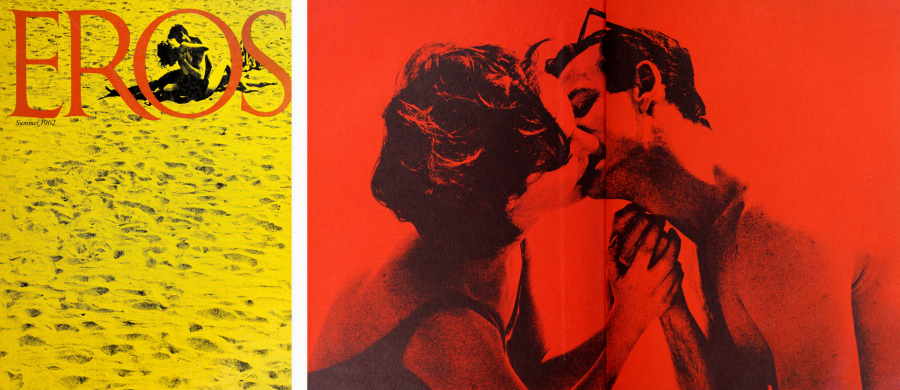
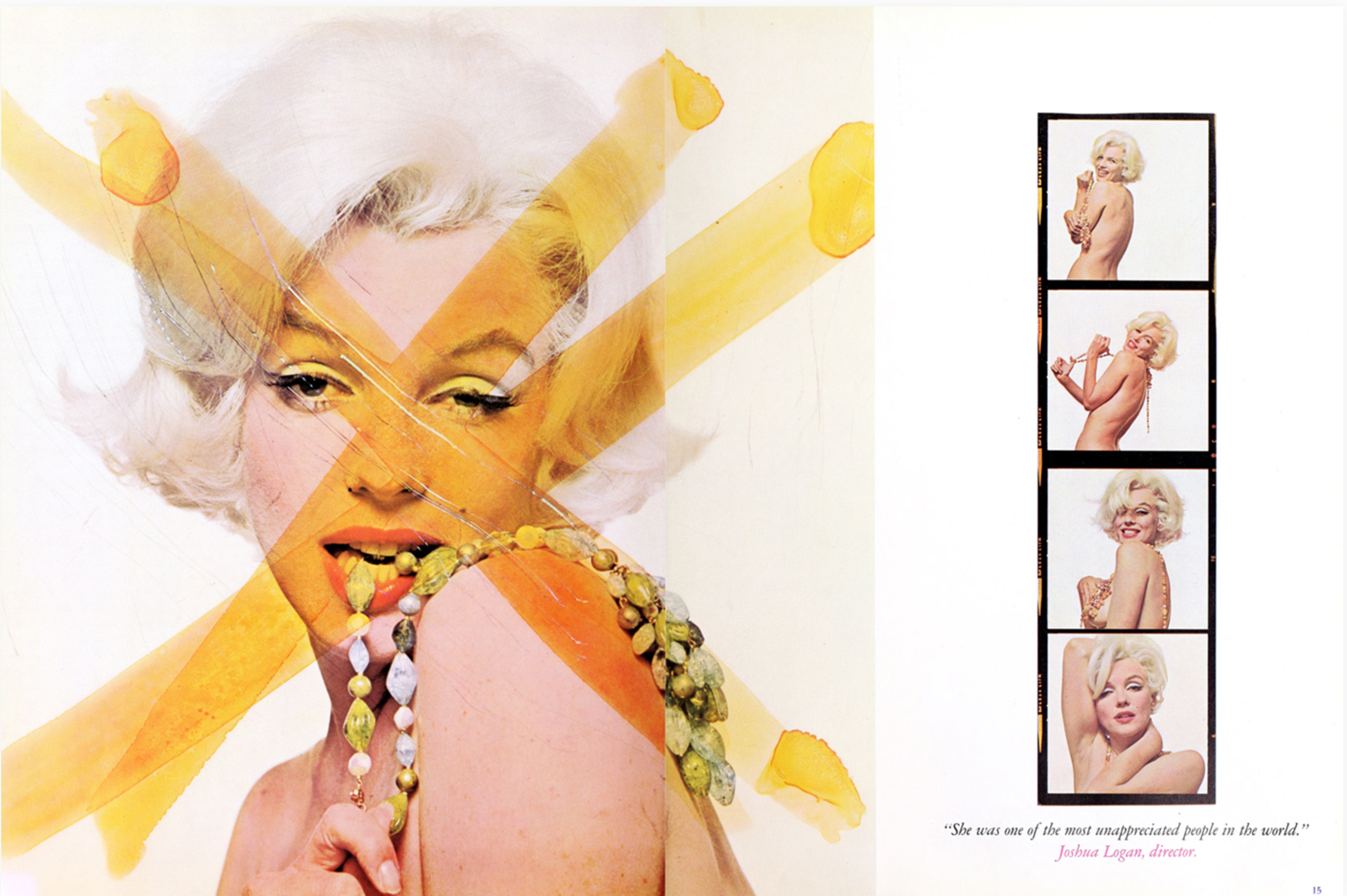
Last year we told you about the digitization of Avant Garde magazine, a short-lived but influential 1960s magazine, which featured lithographs by John Lennon and artistic photographs of Marilyn Monroe. Today, we’re pleased to announce the digitization of Avant Garde’s sister magazine, Eros. Also a collaboration between Ralph Ginzburg (editor) and Herb Lubalin (art director), Eros positioned itself as a quarterly magazine on love and sex in America. Authorities, however, didn’t take kindly to a magazine covering the sexual revolution. Not in 1962. And when Eros published its fourth issue, Robert Kennedy, the U.S. Attorney General, indicted Ginzburg for distributing obscene literature through the mail and violating federal anti-obscenity laws. Ginzburg was convicted (a decision later affirmed by the Supreme Court) and sentenced to five years in prison. Ultimately, he served eight months.
Thanks to Mindy Seu, a newly-created website lets you read digital copies of Eros. All four issues: Spring 1962, Summer 1962, Autumn 1962, and Winter 1962. When you visit the site, click the word “Index” in the top right corner, and then you can easily navigate through individual pages.
As you do, keep one thing in mind: Eros was no flimsy magazine. According to The New York Times, it was a “stunningly designed hardcover ‘magbook’,” covering “a wide swath of sexuality in history, politics, art and literature” and featuring articles by the likes of Nat Hentoff.
Also, if you click on “Resources” once you’re on the new site, you can read articles about Eros magazine and the controversial trial.
If you would like to support the mission of Open Culture, consider making a donation to our site. It’s hard to rely 100% on ads, and your contributions will help us continue providing the best free cultural and educational materials to learners everywhere. You can contribute through PayPal, Patreon, and Venmo (@openculture). Thanks!
Related Content:
Extensive Archive of Avant-Garde & Modernist Magazines (1890–1939) Now Available Online
2,200 Radical Political Posters Digitized: A New Archive
Read More...Watch the 1917 Ballet “Parade”: Created by Erik Satie, Pablo Picasso & Jean Cocteau, It Provoked a Riot and Inspired the Word “Surrealism”
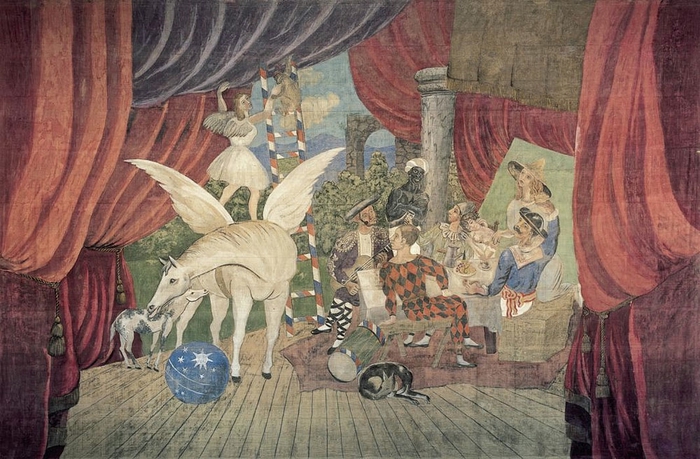
In 1917, a handful of Europe’s leading avant-garde artists collaborated on a project that it’s hard to believe actually exists. Conceived “in the fertile, creative mind of Jean Cocteau,” writes Museworthy, the ballet Parade combined the talents of Cocteau, Erik Satie, Pablo Picasso, and Sergei Diaghilev’s dance company the Ballets Russes in a cubist slice of dreamlike life. Its brings popular entertainments into the high art of ballet, something simply not done at the time, and features a very early use of sound effects in the score, added by Cocteau, to Satie’s annoyance. Parade was Satie’s first ballet and the first (but not the only) time he would work with Picasso.
Cocteau’s short, one-act scenario presents us with a troupe of carnival performers trying to entice passersby into their shows. They are unsuccessful, this troupe, consisting of a Chinese magician, young American girl, a pair of acrobats, a horse, and several dancers in huge cardboard cubist costumes so heavy and awkward they can hardly move.
But “if anyone found Picasso’s costume designs a bit wacky, they’d sure be pleased with his gorgeous set designs,” Museworthy notes, pointing out the backdrop above. Indeed it was hardly unusual for an avant-garde modernist painter to design for the ballet; “Salvador Dali, Marc Chagall, Andre Derain, Joan Miro, and Léon Bakst all worked on costumes and scenery, much of it for the Ballets Russes.”
But there was something especially infuriating about this piece for audiences. (You can see an excerpt from a recent production at the top, and a low quality video of a longer performance above.) The premiere provoked an even bigger riot than Stravinsky’s The Rite of Spring had four years earlier. It’s said that Erik Satie was slapped in the face by an angry attendee. “Critics weren’t much kinder than the masses,” Museworthy adds. After one scathing review, Satie sent the critic angry postcards calling him a “blockhead,” “cretin,” and an “arse.” He was convicted of libel but managed to evade a prison sentence.
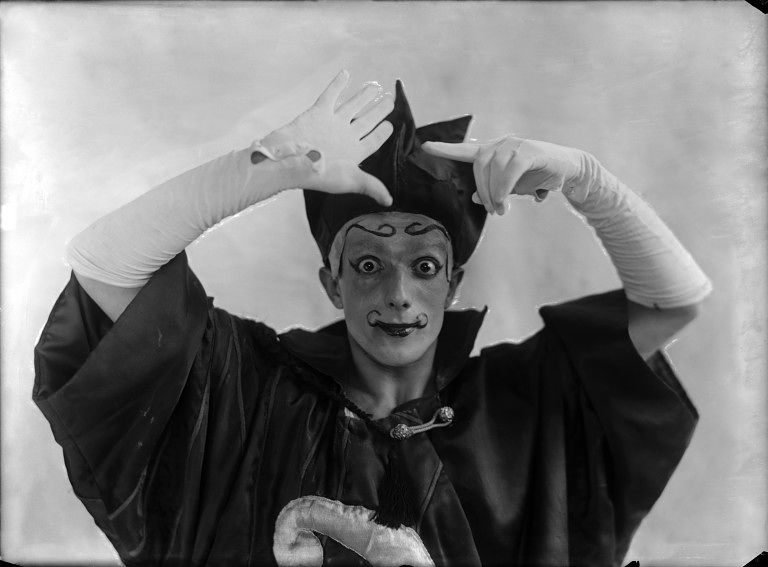
Picasso, on the other hand, “came out of the Parade debacle quite well” and would marry one of the dancers, Olga Khokhlova the following year. His highly-regarded design and costuming partly inspired the poet Guillaume Apollinaire to coin in his program notes the word “surrealism” before Surrealism became an artistic phenomenon in Paris. As such, Parade should maybe be required viewing for every student of Surrealist art, dance, film, etc. from Dali to David Lynch.
Related Content:
Hear Igor Stravinsky’s Symphonies & Ballets in a Complete, 32-Hour, Chronological Playlist
Josh Jones is a writer and musician based in Durham, NC. Follow him at @jdmagness
Read More...How Hunter S. Thompson Gave Birth to Gonzo Journalism: Short Film Revisits Thompson’s Seminal 1970 Piece on the Kentucky Derby
“In 1970, Hunter S. Thompson went to the Kentucky Derby, and he changed sports journalism and broadcasting forever.” Or so claims historian Douglas Brinkley, the oft-imitated but never replicated writer’s literary executor, in the short Gonzo @ the Derby. Directed by Michael G. Ratner and first commissioned by ESPN’s 30 for 30, the thirteen-minute documentary tells the story of how, having made his name with a book on the Hell’s Angels, the 33-year-old, Louisville-born Thompson took a gig with the rebellious and short-lived Scanlan’s Monthly to go back to his hometown and report on its famous horse race — and how he almost inadvertently defined a whole new kind of journalism as a result.
As the 1960s turned into the 1970s, the United States looked like a country in serious turmoil: “Everything seemed to be coming unglued in America,” says Brinkley. “Kent State and the Black Panthers and the rebellion that’s going on around the nation, and yet here is this old-fashioned Kentucky Derby festival going on.” The late Warren Hinckle III, who edited Scanlan’s, had one question: “Who went to these damn things?” And so Thompson, described here by former Rolling Stone managing editor John Walsh as “the quintessential outsider who likes to make himself the quintessential insider,” went — with neither press credentials nor reservations — to find out the answer.
Thompson did not, as every fan knows, find out alone. Scanlan’s also flew in, all the way from England, an illustrator by the name of Ralph Steadman. When Thompson and Steadman managed to meet amid the gregarious chaos of Derby-time Louisville, neither man could have known how inextricably the culture would soon associate their work, the former’s feverish, impressionistic yet hypersensitive prose and the latter’s untamed-looking, distinctively monstrous artwork. Both of them found their voices in presenting reality not as it was, but as grimly heightened as it could feel to them, and both, given the era, occasionally did so with the aid of mind-altering substances.
At the Kentucky Derby, however, they stuck to alcohol — as did, if you believe Thompson’s reporting, all the rest of the attendees, and in an at once hellaciously debaucherous and sinisterly genteel way at that. “Unlike most of the others in the press box, we didn’t give a hoot in hell what was happening on the track,” he writes in the final product of he and Steadman’s trip, “The Kentucky Derby Is Decadent and Depraved.” (Find it in the collection, The Great Shark Hunt: Strange Tales from a Strange Time.) “We had come there to watch the real beasts perform.” Yet even as they gazed, backs to the horses, upon the sheer grotesquerie of what Brinkley calls “the white Southern power elite,” they realized that they, too, amid their blustering fakery, half-remembered altercations, and near-constant binging, had become beastly themselves.
After all that, Thompson, back in New York to write up the story, feared that he didn’t have a story at all. In desperation, he told not of what happened at the 1970 Kentucky Derby but of how he and Steadman experienced the 1970 Kentucky Derby, leaving plenty of room for speculation, remembrance, artistic license, and unverifiable madness that eventually devolves into the raw notes he scribbled amid the storm of high-society Southern squalor. Could he have possibly suspected what a potent combination that and Steadman’s illustrations (described as “sketched with eyebrow pencil and lipstick”) would make? Bill Cardoso, then editor of the Boston Globe, understood its power when he first read the article, even coining a word to describe it: “This is it, this is pure Gonzo. If this is a start, keep rolling.”
The short documentary, “Gonzo @ the Derby,” will be added to our list of Free Online Documentaries, a subset of our collection, 4,000+ Free Movies Online: Great Classics, Indies, Noir, Westerns, Documentaries & More.
Related Content:
Hunter S. Thompson Gets Confronted by The Hell’s Angels: Where’s Our Two Kegs of Beer? (1967)
Playing Golf on LSD With Hunter S. Thompson: Esquire Editor Remembers the Oddest Game of Golf
Hunter S. Thompson’s Harrowing, Chemical-Filled Daily Routine
Hunter S. Thompson, Existentialist Life Coach, Gives Tips for Finding Meaning in Life
Read 10 Free Articles by Hunter S. Thompson That Span His Gonzo Journalist Career (1965–2005)
Based in Seoul, Colin Marshall writes and broadcasts on cities and culture. He’s at work on a book about Los Angeles, A Los Angeles Primer, the video series The City in Cinema, the crowdfunded journalism project Where Is the City of the Future?, and the Los Angeles Review of Books’ Korea Blog. Follow him on Twitter at @colinmarshall or on Facebook.
Read More...The History of Electronic Music Visualized on a Circuit Diagram of a 1950s Theremin: 200 Inventors, Composers & Musicians

No historical leap forward has changed human culture more than the harnessing and commercialization of electricity. It may seem banal to point out such a truism—of course, nothing in the modern world would be what it is without the furious activity of Thomas Edison, Nikola Tesla, and so many other inventors and early electrical engineers. But the scope of electricity’s role in the music of the past hundred plus years becomes truly awe-inspiring when we see it mapped out in the blueprint-like graphic above, “Electric Love,” inspired by circuit diagrams from the 1950s for a Theremin. (You can view the graphic in a larger, zoomable fashion here.)
As we noted in an earlier post, designer of “Electric Love” James Quail has created a similar diagram for Alternative and Indie rock, based on the circuit layout for a 1954 transistor radio. In the electronic music version here, not only does Quail draw on older technology, but he reaches back to earlier ancestors as well: to Edison, Alexander Graham Bell rival Elisha Gray, and Édouard-Léon Scott de Martinville, inventor of the obscure early recording device the phonautograph.
It’s a choice that foregrounds just how much technicians and engineers contributed directly to the sound of the modern world. Among them, of course, is the late Robert Moog, inventor of the portable analog synthesizer that become ubiquitous in nearly every genre of modern music, and whose work “was actually based,” notes Wired, “on technology from the 1800s.”

When it comes to the musicians who took this technology and transformed it into avant-gardism and dance records, the relationships are complex and perhaps impossible to fully represent in simple terms given the number of indirect influences through sampling technology. But “Electric Love” does an admirable job of showing how diffuse and diverse the music made by analog and digital technology has been. From the musique concrete of Pierre Schaffer, the experimentalism of Karlheinz Stockhausen and Arnold Schoenberg, commercial avant-garde of Delia Derbyshire and Wendy Carlos, minimalism of Steve Reich and Philip Glass, new wave of Kraftwerk, house and hip hop of Derrick May, Afrika Bambaataa and Kool DJ Herc, ambient soundscapes of Brian Eno, jittery electronica of Aphex Twin, synthpop of Depeche Mode and New Order…

It’s seemingly all there, and everything in-between, connected, Quail says, according to “common link[s]—whether that’s a style, or an instrument, or an influence on one another.” Even The Beatles and Pink Floyd show up, presumably for their creative studio experiments. On the whole, however, most of the smaller names here are much less familiar by comparison to Quail’s Alternative chart, but for true fans of electronic music, this only means there’s more to discover in this visual compendium of “over 200 inventors, innovators, artists, composers and musicians.” You can purchase “Electric Love” as a print from design house Dorothy.
Related Content:
The History of Electronic Music in 476 Tracks (1937–2001)
Josh Jones is a writer and musician based in Durham, NC. Follow him at @jdmagness
Read More...Dan Rather Introduces Rastafarianism to the U.S. in a 60 Minutes Segment Featuring Bob Marley (1979)
Like many people, I learned the basic tenets of Rastafarianism from Bob Marley and the Wailers, Peter Tosh, Steel Pulse, and later adopters Bad Brains. Marley’s worldwide fame not only spread the religion from Kingston to London to New York, but it also inspired no small number of non-Rastafarians to wear the Pan-African colors of red, green, and gold, grow dreadlocks, and sing about “Babylon” and “I and I.” The irony of suburban Americans in college dorms adopting the trappings of a postcolonial religion with an unabashedly anti-Western, Afrocentric core predates most recent controversies over “cultural appropriation,” but one rarely sees a better example of the phenomenon.
Consumers of Jamaican Rastafarian culture in the past few decades, however, have rarely had to go very far to find it, and to find it appealing. Since the 1960s, the struggling island nation has relied on “Brand Jamaica,” writes Lucy McKeon at The New York Review of Books, “a global brand often associated with protest music, laid-back, ‘One Love’ positivity, and a pot-smoking counterculture.” The themes most non-Rasta fans of Bob Marley derive from his music also drive a lucrative tourism industry. Both tourists and casual listeners tend to ignore the music’s esoteric theology. But reggae as party and protest music is only part of the story.
Those who dig deeper into the music’s belief system usually find it quite odd—by the standards of older religious cultures whose own oddness has long been naturalized. Rastafarians revere a recent historical figure, Ethiopian Emperor Haile Selassie (born Ras Tafari), as the messiah, based on a supposed prophecy made by influential Pan-Africanist Marcus Garvey (who also inspired the founding of the Nation of Islam). Rastafarianism is also integral not only to reggae, but to what began in the 1930s as “a fight for justice by disenfranchised Jamaicans, peasant laborers and the urban underemployed alike, in what was then a British colony.”
You will gather a little bit of this history from the video above, “The Rastafarians,” a 15-minute 60 Minutes segment from 1979 with Dan Rather. But you get it through a condescendingly prejudicial network news filter, a sensibility appalled by the movement’s blackness and poverty. Rather describes Rastafarianism’s origins among the “black masses” in “the ghetto, the slums of Kingston.” In the “squalor of these slums,” he tells his audience, poor residents found solace in the words of Garvey, “a Jamaican slumdweller.” Rather represents a view deeply concerned with the movement’s “criminal element” among “true believers” and “ghetto hustlers” alike. This rather compulsively one-note presentation hardly captures the rich history of Rastafarianism, which began not in the “slums,” but in a mountain settlement called Pinnacle in the 1930s.
In 1940—a decade into the settlement’s founding and growth into a colony of hundreds, sometimes thousands of people—a reporter named John Carradine observed, “The Rastafarians are not essentially a religious sect.… They are rather an economic community.” Founder of the Pinnacle community Leonard Percival Howell promoted what he “reportedly called ‘a socialistic life’ based on principles of communalism and economic independence from the colonial system.” Under Garvey’s tutelage, Howell had absorbed Marxist and socialist doctrine, but the religion was his own peculiar invention. Garvey dismissed it as a “cult,” and amidst its nationalism, it harbors several anti-Semitic and anti-Catholic teachings.
Like all zealous nationalist-religious movements, Rastafarians have defined themselves as much by the perceived Babylon they stand against as by the promised land they hope to inherit. Rastafarianism may have been transformed into a nationalist product, both by its most successful musicians and the tourist industry, but its association with Garvey’s ideas also links it with a Pan-Africanism that called for people of the African diaspora in Europe, the U.S., and the Caribbean to secede from oppressive colonial systems and either emigrate or form alternative, self-sufficient economies. The first Rastafarians did just that by growing ganja, and their community thrived into the mid-fifties, when government crackdowns and pressure from Winston Churchill drove them from their land and into the capital city.
The spread of the religion in Kingston coincided with an anti-colonial movement that eventually won independence in 1962, and with the blending of rural and urban musical styles happening in the midst of social and political change. All of these threads are inseparable from the burgeoning reggae scene that eventually conquered every beach town and resort across the word. As for the theology, we might say that Ethiopia’s Emperor encouraged his elevation to the role of Jah on Earth with his own creative revisionism. At his lavish and widely-publicized coronation, Rather reports, the new monarch was “crowned King of Kings, Lord of Lords, Conquering Lion of the Tribe of Judah.” Quite a bid for god-on-earthhood. And for a struggling Jamaican underclass, quite an inspiration for visions of a glorious future in a renewed African kingdom.
Related Content:
Johnny Cash & Joe Strummer Sing Bob Marley’s “Redemption Song” (2002)
Josh Jones is a writer and musician based in Durham, NC. Follow him at @jdmagness
Read More...Stevie Nicks “Shows Us How to Kick Ass in High-Heeled Boots” in a 1983 Women’s Self Defense Manual
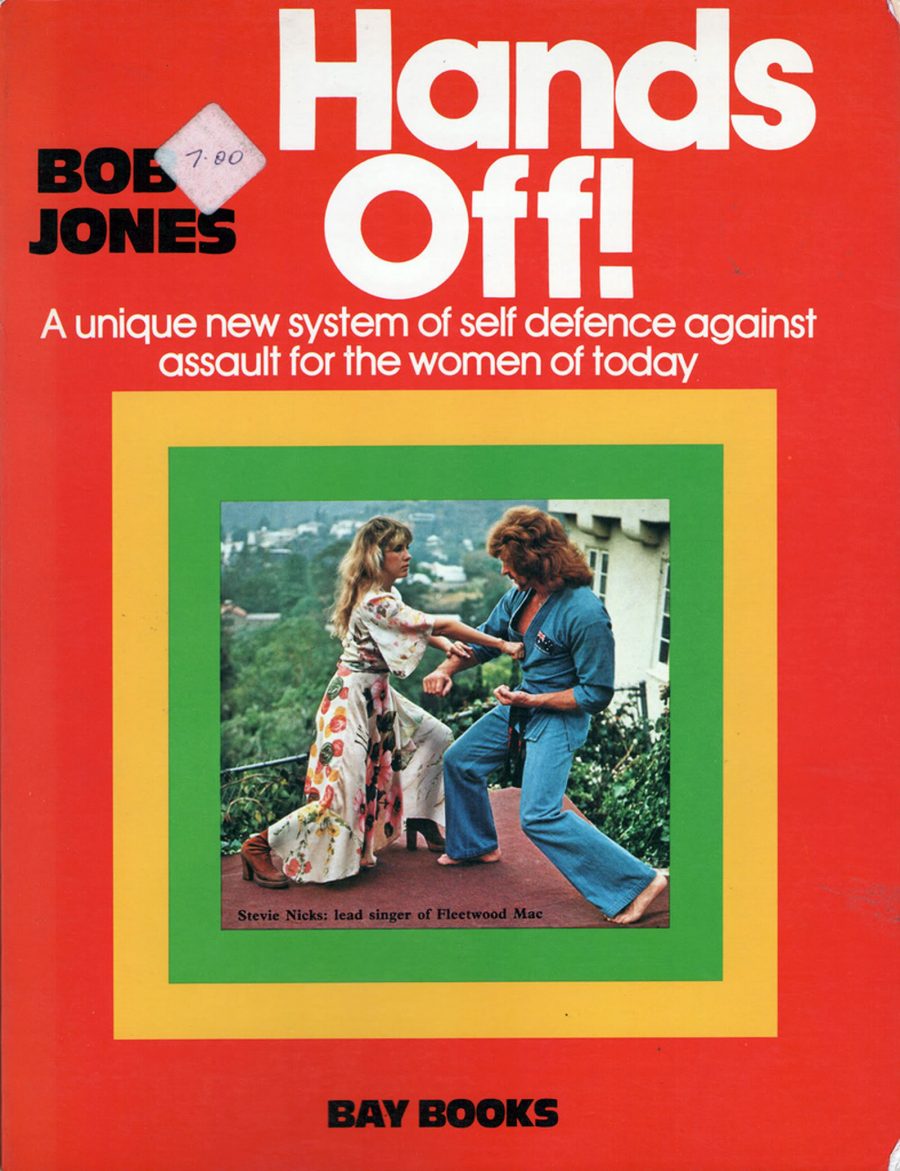
Yesterday, on Twitter, Priscilla Page reminded us of the time when “Stevie Nicks showed us how to kick ass in high-heeled boots in her bodyguard’s self-defense book,” calling our attention to the little-known 1983 book, Hands Off!: A Unique New System of Self Defence Against Assault for the Women of Today.
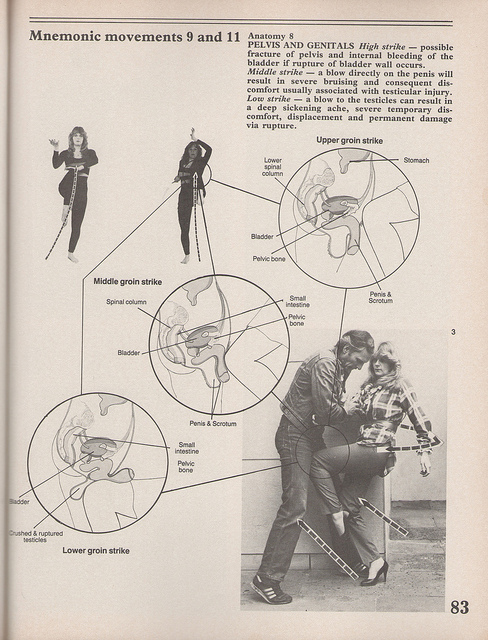
The book itself was written by Bob Jones, an Australian martial arts instructor who doubled as a security guard for Fleetwood Mac, The Beatles, The Rolling Stones, David Bowie, Joe Cocker and other stars. And it featured what Jones called “mnemonic movements”–essentially a series of nine subconscious/reflexive self-defense moves (like a swift knee to the groin). See Jones’ website for a more complete explanation of the exercise routine that also provided, he notes, a great cardio workout.
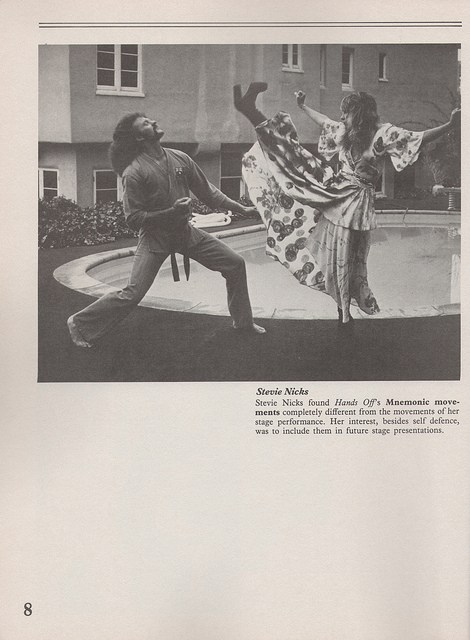
Stevie Nicks agreed to take part in a photoshoot where she would help demonstrate the nine mnemonic movements. Jones recalls,” This lady was a professional: in two hours I had a hundred of the most magnificent photos ever offered to the martial arts, and just one would make the cover [above].”
“On this day of the shoot I was standing in my martial arts training uniform, wearing my Black Belt. Then Stevie appeared, her hair done to resemble the mane of a lion. She was psyched up for some serious photographing. Stevie wore her familiar thick-soled, thick-heeled, knee-high brown suede kid leather boots. High roll-over socks appeared over the top of these elegant Swedish boots and hung tentatively around her knees.” “In these kicking-style photographs the sun also made her dress partially see-through: just enough to be artistically interesting.”
Hands Off is now long out of print. But you can find a series of images from the book on the Voices of East Anglia and Dangerous Minds websites.
If you would like to support the mission of Open Culture, consider making a donation to our site. It’s hard to rely 100% on ads, and your contributions will help us continue providing the best free cultural and educational materials to learners everywhere. You can contribute through PayPal, Patreon, and Venmo (@openculture). Thanks!
Related Content:
Radical French Philosophy Meets Kung-Fu Cinema in Can Dialectics Break Bricks? (1973)
Kung Fu & Martial Arts Movies Online
Read More...The Official Trailer for Ridley Scott’s Long-Awaited Blade Runner Sequel Is Finally Out
Ridley Scott’s Blade Runner (1982) has provided us material for many posts over the years (find some favorites below). If his upcoming sequel Blade Runner 2049 yields half as much, we’ll count ourselves lucky.
The official trailer for the new film came out today. Look for the film in theaters on October 6th.
If you would like to support the mission of Open Culture, consider making a donation to our site. It’s hard to rely 100% on ads, and your contributions will help us continue providing the best free cultural and educational materials to learners everywhere. You can contribute through PayPal, Patreon, and Venmo (@openculture). Thanks!
Related Content:
Watch an Animated Version of Ridley Scott’s Blade Runner Made of 12,597 Watercolor Paintings
Stream 72 Hours of Ambient Sounds from Blade Runner: Relax, Go to Sleep in a Dystopian Future
The Original Blade Runner Promotional Film
How Ridley Scott’s Blade Runner Illuminates the Central Problem of Modernity
Blade Runner Gets Re-Created, Shot for Shot, Using Only Microsoft Paint
Blade Runner is a Waste of Time: Siskel & Ebert in 1982
Read More...Support Us
We're hoping to rely on loyal readers, rather than erratic ads. Please click the Donate button and support Open Culture. You can use Paypal, Venmo, Patreon, even Crypto! We thank you!

About Us

Open Culture scours the web for the best educational media. We find the free courses and audio books you need, the language lessons & educational videos you want, and plenty of enlightenment in between.
Advertise With Us

FREE UPDATES!
GET OUR DAILY EMAIL
Get the best cultural and educational resources on the web curated for you in a daily email. We never spam. Unsubscribe at any time.
FOLLOW ON SOCIAL MEDIA

Open Culture editor Dan Colman scours the web for the best educational media. He finds the free courses and audio books you need, the language lessons & movies you want, and plenty of enlightenment in between.
Advertise With Us


