Every Poem in Baudelaire’s “Les Fleurs du Mal” Set to Music, Illustrated and Performed Live
Charles Baudelaire must be a joyful corpse indeed. His work has succeeded as few others’ have, to be so passionately alive 150 years after his death.
Theater Oobleck, a Chicago artistic collective dedicated to creating original affordable theatrical works, has spent the last eleven years assembling Baudelaire in a Box, a cantastoria cycle based on Les Fleurs du Mal.
Why?
Because he would be so irritated. Because he might be charmed
There is a touch of vaudeville and cabaret in Baudelaire. He tended to go big or go home. Home to his mother.
Because he invented the term “modernity” and even now no one quite knows what it means. Because he wrote a poetry of immersion perfectly suited to the transience and Now-ness of song and of the Ever-Moving scroll. Because we never had a proper goth phase. Sex and death! For all these reasons, and for the true one that remains just out of our grasp.
Each new installment features a line-up of musicians performing live adaptations of another 10 to 15 poems, as artist Dave Buchen’s painted illustrations slowly spool past on hand-turned “crankies.”
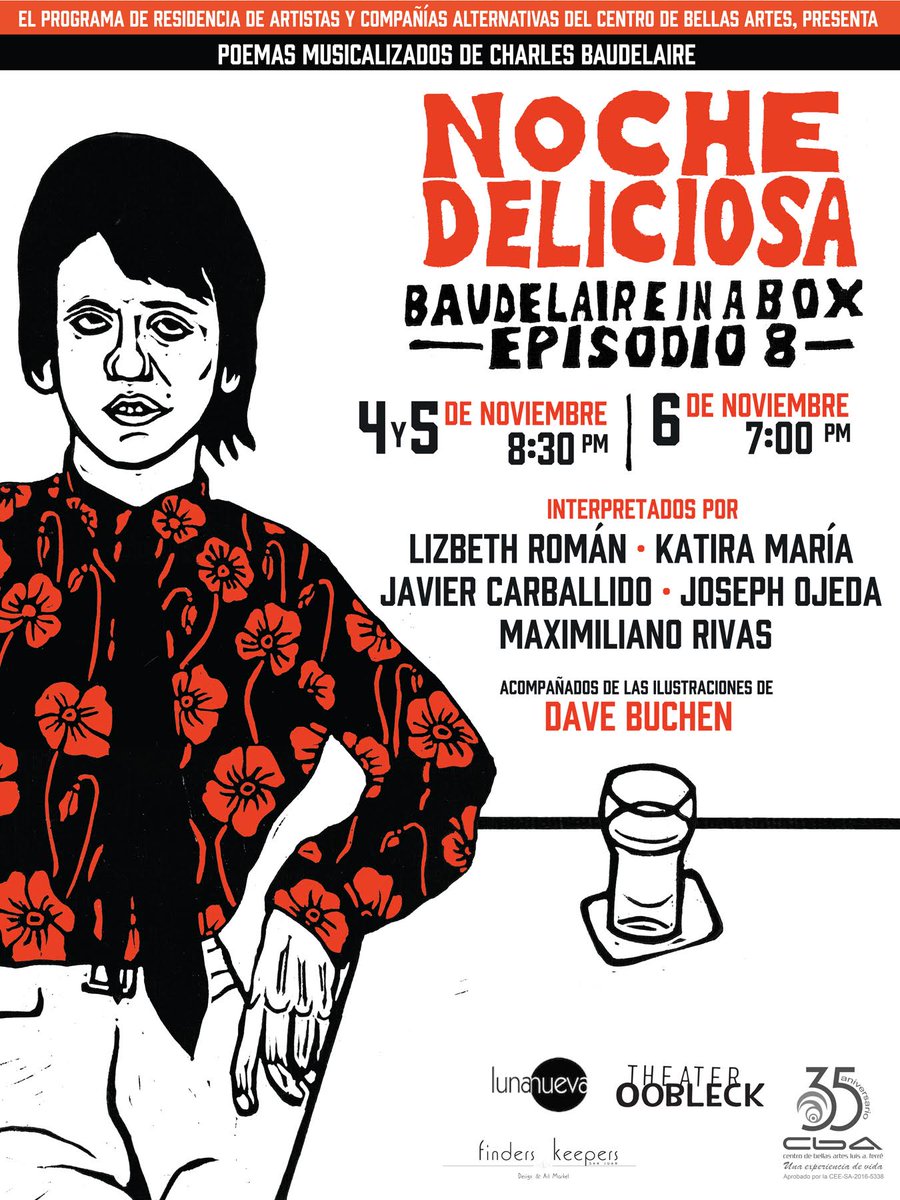
The resulting “proto music videos” are voluptuously intimate affairs, with plenty of time to reflect upon the original texts’ explicit sexuality, the gorgeous urban decay that so preoccupied one of Romantic poetry’s naughtiest boys.
The instruments and musical palate—klezmer, alt-country, antifolk—are befitting of the interpreters’ well honed downtown sensibilities. The lyrics are drunk on their dark imagery.
The entire project makes for the sort of extravagantly eccentric night out that might lead a young poet to lean close to his blind date, mid-show, to whisper “Wouldn’t it be agreeable to take a bath with me?” No word on whether that line worked for the poéte maudit, who reportedly issued such an invitation to a friend mid-sentence.
This August, Theater Oobleck intends to observe the sesquicentennial of Baudelaire’s death in grand style with a marathon performance of the complete Baudelaire in a Box, a three-day effort involving 50 artists and over 130 poems.
Allow a few past examples to set the mood:
The Offended Moon From Episode 9 of Baudelaire In A Box, “Unquenched.” Composed and translated by David Costanza. Emmy Bean: vocal, Ronnie Kuller: accordion, T‑Roy Martin trombone, David E. Smith: clarinet, Chris Schoen: vocal, Joey Spilberg: bass.
The Denial of St. Peter Composed, translated and performed by Sad Brad Smith, with Emmy Bean (hand percussion), Ronnie Kuller (accordion), T‑Roy Martin (trombone), Chris Schoen (mandolin), and Joey Spilberg (bass).
The Drag Music composed by Ronnie Kuller, to Mickle Maher’s translation of “L’Avertisseur” by Charles Baudelaire. Performed by: Emmy Bean (vocal, percussion), Angela James (vocal), Ronnie Kuller (piano, percussion), T‑Roy Martin (vocal), Chris Schoen (vocal), David E. Smith (saxophone), and Joey Spilberg (bass).
The Hard(-est) Working Skeleton Music by Amy Warren, Performed by Nora O’Connor, with Addie Horan, Amalea Tshilds, Kate Douglas, James Becker and Ted Day.
The Possessed Written and performed by Jeff Dorchen.
You can listen to and purchase songs from Episodes 7 (the King of Rain) and 9 (Unquenched) on Bandcamp.
Some of the participating musicians have released their own albums featuring tracks of their Baudelaire-based tunes.
Theater Oobleck is raising funds for the upcoming Closed Casket: The Complete, Final, and Absolutely Last Baudelaire in a Box on Kickstarter, with music and prints and originals of Buchen’s work among the premiums at various pledge levels.
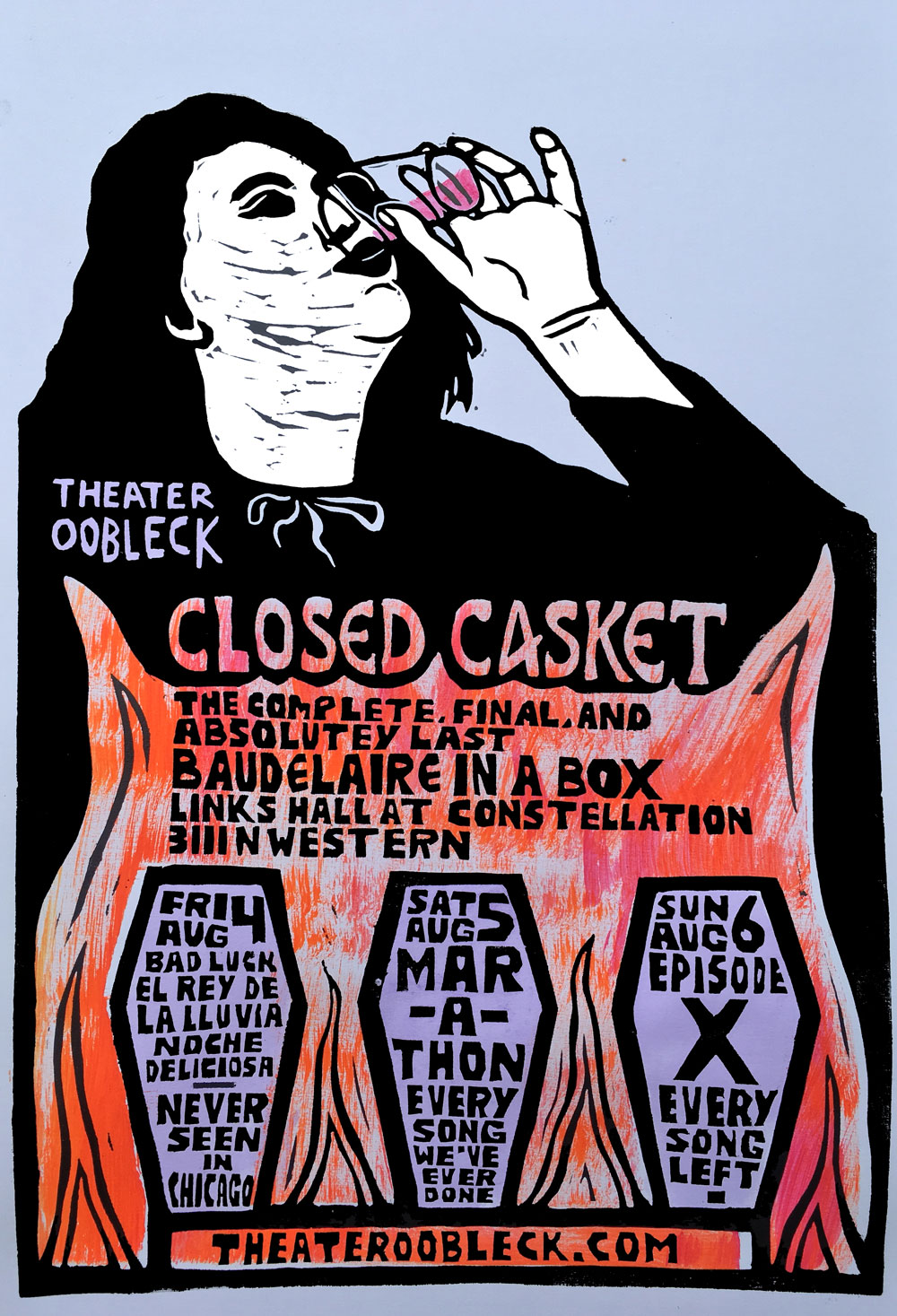
All images used with permission of artist Dave Buchen.
Related Content:
Great 19 Century Poems Read in French: Baudelaire, Rimbaud, Verlaine & More
Baudelaire, Balzac, Dumas, Delacroix & Hugo Get a Little Baked at Their Hash Club (1844–1849)
Henri Matisse Illustrates Baudelaire’s Censored Poetry Collection, Les Fleurs du Mal
Ayun Halliday is an author, illustrator, theater maker and the Chief Primatologist of the East Village Inky zine. She will be appearing in a live excerpt from CB Goodman’s How to Kill an Elephant this Friday at Dixon Place in New York City. Follow her @AyunHalliday.
Read More...The MoMA Teaches You How to Paint Like Pollock, Rothko, de Kooning & Other Abstract Painters
Some may find her insufferable, but most readers adore her: the insouciant little pig Olivia—New Yorker, art lover, and Caldecott Medal winner—has forever embedded herself in children’s literary culture as an archetype of childhood curiosity and self-confidence, especially in scenes like that of the first book of the series, in which the fearless piglet produces her own drip painting on the wall of the family’s Upper East Side apartment after puzzling over Jackson Pollock’s work at the Metropolitan Museum of Art. (Olivia also admires Degas, aspires to the ballet, and dreams of being Maria Callas.)
Olivia’s headstrong challenge to Pollock is infectious, and enacts a notion common among amateur viewers of Abstract Expressionism—“I could do that.” Her “Jackson Piglet Wall Painting” features in a book that gives children their own set of instructions for making a pseudo-Pollock (on paper, of course). As you will see, however, in the video above—a guide for grown-ups who may wish to do the same—Pollock’s process is not so easily duplicated, and cannot be done on the wall. As the Ed Harris-starring biopic dramatized, Pollock made his huge canvasses on the floor—drawing the lines and gestural figures in the air rather than on the canvas.
In these videos from the Museum of Modern Art’s upcoming free online course on Postwar painting, educator and independent conservator Corey D’Augustine demonstrates that, we can, with some degree of stamina and athleticism, approximate Pollock’s technique. We cannot, however, recreate his temperament and emotional state. And, as viewers of the film based on his life will know, we would not want to. Pollock was a violently abusive, depressive alcoholic, and while there may be no necessary relation to creativity and suffering, New York Abstract Expressionists seemed to wrest the intensity of their work from wells of personal pain.
It is no wonder that the longest video in D’Augustine’s series covers the methods of Agnes Martin. The enigmatic Martin used her work as a discipline that took her beyond despair and defeat. Like Gertrude Stein or Samuel Beckett, she insisted that art, though a form of self-expression, must emerge impersonally, such that the artist “can take no credit for its sudden appearance.” On the other side of failure—she told her audience in a poignant and powerful 1973 speech called “On the Perfection Underlying Life”—“we still go on without hope or desire or dreams or anything. Just going on with almost no memory of having done anything.”
The attitude, Martin said, is a discipline, the discipline of art—one that saw her through a lifelong struggle with schizophrenia. Inspired by Taoism and Zen Buddhism, Martin’s “luminous, silent” paintings are studies in patience and deliberation. We see a very different technique in the gestural painting of Willem de Kooning—another Abstract Expressionist with a serious drinking problem. Do these biographical issues matter? While it may do Martin’s work a disservice to reduce it to “the products of a person compelled by mental illness,” as Zoe Pilger writes at The Independent, de Kooning’s eventual sobriety led to a “dramatic shift,” Susan Cheever notes, “in the way he saw and painted the world in his last decade or so.”
We need not psychologize the work of any of these artists, including that of the bipolar Mark Rothko, above, to learn from their techniques. And yet it remains the case that—even were we to duplicate Pollock, Martin, de Kooning, or Rothko on canvas, we would never be able to imbue it with their peculiar personalities, pains, and movements, with the depth and intensity each artist brought to their work. Great art does not require suffering, but many artists have poured their suffering into art that only they could make.
But mimicry is not the goal of MoMA’s class. Instead “In the Studio: Postwar Abstract Painting” intends to give students “a deeper understanding of what a studio practice means and how ideas develop from close looking. They’ll also “gain a sensitivity to the physical qualities of paint,” a key feature of this material and texture-obsessed group, and the course will examine the “broader cultural, intellectual, and historical context about the decades after World War II, when these artists were active.”
The eight-week course covers seven artists, including those above and Ad Reinhardt, Yayoi Kusama, and Barnett Newman. Students are free to do quizzes and written assignments only, or to participate in the optional studio exercises, provided they have the space and the materials. (For those studio practitioners, D’Augustine offers brief tutorials on tools like the palette knife and materials like stains.) Watch the trailer for D’Augustine’s course above. Like the irrepressible Olivia, students will be encouraged “to experiment quite wildly” with what they might learn.
“In the Studio: Postwar Abstract Painting” has been added to our list, 1,700 Free Online Courses from Top Universities.
Related Content:
Jackson Pollock 51: Short Film Captures the Painter Creating Abstract Expressionist Art
How the CIA Secretly Funded Abstract Expressionism During the Cold War
MoMA Puts Pollock, Rothko & de Kooning on Your iPad
Josh Jones is a writer and musician based in Durham, NC. Follow him at @jdmagness
Read More...
30 Hours of Doctor Who Audio Dramas Now Free to Stream Online

“Yes, this should provide adequate sustenance for the Doctor Who marathon,” once said The Simpsons’ Comic Book Guy while pushing a wheelbarrow full of fast-food tacos down the street. As the embodiment of fandom for all things fantasy and sci-fi, he would certainly know that Doctor Who, no longer an obscure BBC television show but an ever-expanding fictional universe with a global fan base, constitutes the ideal material for binge-watching, which he could now do at his convenience on a service like Britbox. But it isn’t just watching: now, on Spotify (whose free software you can download here if you don’t have it already), you can binge-listen to thirty straight hours of Doctor Who audio dramas as well.
“An icon of modern British culture and the longest-running science-fiction TV show in history, Doctor Who has never been more popular than it is today,” wrote Christopher Bahn in the AV Club’s 2010 primer on the series, which had relaunched five years earlier after initially running from 1963 to 1989. “No matter who’s playing the lead, the basic premise has been essentially the same since the show’s debut: A mysterious, eccentric alien known only as The Doctor (not ‘Doctor Who,’ in spite of the title) travels through time and space having adventures and fighting evil. He’s usually accompanied by one or two humans picked up along the way. They journey with him in a time machine called a TARDIS, which looks like a blue phone booth.”
This format “allowed the show to literally go anywhere in the universe and sometimes outside it, with virtually limitless storytelling possibilities.” At its best, “Doctor Who relied on solid, imaginative scripts to create smart science-fiction thrillers with a humanistic, anti-authoritarian heart. Consistently popular through the 1960s and 1970s, the show began to falter in the following decade as tight budgets and questionable artistic choices took their toll.” After its cancellation in 1989, Doctor Who “lived on through the ’90s, as science-fiction shows often do, in the wilderness genres of semi-official novels and radio plays.”
The best known of these Doctor Who radio plays, which you can hear on this playlist, come produced by a company called Big Finish. Having acquired a license from the BBC in 1999 (and recently renewed it into 2025), they’ve put out a range of audio dramas, both one-offs and series of various lengths, using not just the characters but many of the actual actors from the television show, including six of those who have taken on the iconic Doctor role onscreen. Owing to the fact that Doctor Who officially has no canon and thus no need for continuity, rigorous or otherwise, they can get even more imaginative than their source material, going so far as to explore counterfactual storylines such as one where the Doctor never leaves his home planet in the first place.
Below you’ll find a complete list, assembled by a fan on Reddit, of the series and episodes of Big Finish’s Doctor Who audio dramas now available on Spotify and are now housed to our collection of Free Audio Books. The material comes to thirty hours in total, but the question of when to listen to it falls second to a more important consideration: what sort of sustenance will best ensure that you can keep up with all of the Doctor’s audio adventures?
Main Range:
- The Sirens of Time
- Phantasmagoria
- Whispers of Terror
- The Land of the Dead
- The Fearmonger
- The Marian Conspiracy
- The Genocide Machine
- Red Dawn
- The Spectre of Lanyon Moor
- Winter for the Adept
- The Apocalypse Element
- The Fires of Vulcan
- The Shadow of the Scourge
- The Holy Terror
- The Mutant Phase
- Storm Warning
- Sword of Orion
- The Stones of Venice
- Minuet in Hell
- Loups-Garoux
- Dust Breeding
- Bloodtide
- Project: Twilight
- The Eye of the Scorpion
- Colditz
- Primeval
- The One Doctor
- Invaders from Mars
- The Chimes of Midnight
- Seasons of Fear
- Embrace the Darkness
- The Time of the Daleks
- Neverland
- Spare Parts
- …ish
- The Rapture
- The Sandman
- The Church and the Crown
- Bang-Bang-a-Boom!
- Jubilee
- Nekromanteia
- The Dark Flame
- Doctor Who and the Pirates
- Creatures of Beauty
- Project: Lazarus
- Flip-Flop
- Omega
- Davros
- Master
- Zagreus
Special Releases:
Fourth Doctor Adventures:
1.02 The Renaissance Man
Eighth Doctor Adventures:
1.1 Blood of the Daleks, Part 1
1.2 Blood of the Daleks, Part 2
1.5 Phobos
1.6 No More Lies
The Lost Stories:
1.01 The Nightmare Fair
1.02 Mission to Magnus
1.03 Leviathan
1.04 The Hollows of Time
1.05 Paradise 5
1.06 Point of Entry
1.08 The Macros
Box 1. The Fourth Doctor Box Set
The Companion Chronicles:
2.1 Mother Russia
2.2 Helicon Prime
2.3 Old Soldiers
2.4 The Catalyst
Destiny of the Doctor:
- Hunters of Earth
- Shadow of Death
- Vengeance of the Stones
- Babblesphere
- Smoke and Mirrors
- Trouble in Paradise
- Shockwave
- Enemy Aliens
- Night of the Whisper
- Death’s Deal
- The Time Machine
Short Trips:
The Stageplays:
Bernice Summerfield:
Box 2. Road Trip
Box 3. Legion
Box 4. New Frontiers
Box 5. Missing Persons
Graceless:
Dalek Empire:
- Invasion of the Daleks
- The Human Factor
- “Death to the Daleks!”
- Project Infinity
- Dalek War: Chapter One
- Dalek War: Chapter Two
- Dalek War: Chapter Three
- Dalek War: Chapter Four
Jago & Litefoot:
Counter-Measures:
Iris Wildthyme:
2.3 The Two Irises
UNIT:
I, Davros:
Cyberman:
1.1 Scorpius
1.2 Fear
1.3 Conversion
1.4 Telos
2.0 Cyberman 2
Charlotte Pollard:
Related Content:
BritBox Now Streaming Now Streaming 550 Episodes of Doctor Who and Many Other British TV Shows
The Fascinating Story of How Delia Derbyshire Created the Original Doctor Who Theme
Based in Seoul, Colin Marshall writes and broadcasts on cities and culture. He’s at work on a book about Los Angeles, A Los Angeles Primer, the video series The City in Cinema, the crowdfunded journalism project Where Is the City of the Future?, and the Los Angeles Review of Books’ Korea Blog. Follow him on Twitter at @colinmarshall or on Facebook.
Read More...The Pioneering Physics TV Show, The Mechanical Universe, Is Now on YouTube: 52 Complete Episodes from Caltech
In December, Caltech announced that the critically acclaimed TV series, The Mechanical Universe… And Beyond, has been made available in its entirety on YouTube. Created at Caltech and aired on PBS from 1985–86, the 52-episode series offers an introduction to college-level physics, covering everything from the scientific revolution begun by Copernicus, to quantum theory. A university web page offers more details on the production:
The series was based on the Physics 1a and 1b courses developed by David Goodstein, the Frank J. Gilloon Distinguished Teaching and Service Professor and Professor of Physics and Applied Physics, Emeritus.
Each episode opens and closes with Goodstein lecturing to his freshman physics class in 201 E. Bridge, providing philosophical, historical, and often humorous insight into the day’s topic. The show also contains hundreds of computer animation segments, created by JPL computer graphics engineer James F. Blinn, as the primary tool of instruction. Dynamic location footage and historical re-creations are also used to stress the fact that science is a human endeavor…
Although the series was designed as a college-level course, “thousands of high school teachers across the US came to depend on it for instructional and inspirational use,” Goodstein says. “The level of instruction in the US was, and remains, abysmally low, and these 52 programs filled a great void.”
You can stream all 52 episodes above. Or find them on Youtube and DailyMotion. They will also be added to our collection of Free Online Physics Courses, a subset of our collection, 1,700 Free Online Courses from Top Universities.
Visit this Caltech website to get more information on the show.
If you would like to support the mission of Open Culture, consider making a donation to our site. It’s hard to rely 100% on ads, and your contributions will help us continue providing the best free cultural and educational materials to learners everywhere. You can contribute through PayPal, Patreon, and Venmo (@openculture). Thanks!
Related Content:
The Famous Feynman Lectures on Physics: The New Online Edition (in HTML5)
Read More...The Neuronal Basis of Consciousness Course: A Free Online Course from Caltech
“This award-winning, nine unit course (The Neuronal Basis of Consciousness), taught in the spring of each year at Caltech, is concerned with the correlates of consciousness in the brain. The course focuses on the anatomy, physiology and psychology of sensory consciousness in the mammalian brain, in particular visual perception. Other topics include coma and other disturbances of consciousness, clinical case studies (e.g., prosopagnosia, neglect), attention, memory, zombie systems, free will and some philosophical questions of interest to the student of consciousness.
With the help of Leila Reddy, a graduate student in the Koch laboratory, and Leslie Maxfield and her team from Academic Media Technologies at Caltech, these lectures have been filmed, edited and put online.
They are organized into 16 lectures, each about one hour. They follow the textbook by the lecturer, Christof Koch (with much help from his close colleague and mentor, Francis Crick), “The Quest for Consciousness — A Neurobiological Approach.” See each video’s “About” text for the lecture’s corresponding chapter or chapters.”
You can watch the videos all above, or on Youtube via this playlist.
The Neuronal Basis of Consciousness will be added to our list of Free Neuroscience & Psychology courses, a subset of our collection.
If you would like to support the mission of Open Culture, consider making a donation to our site. It’s hard to rely 100% on ads, and your contributions will help us continue providing the best free cultural and educational materials to learners everywhere. You can contribute through PayPal, Patreon, and Venmo (@openculture). Thanks!
Read More...A History of Alternative Music Brilliantly Mapped Out on a Transistor Radio Circuit Diagram: 300 Punk, Alt & Indie Artists

Lumping millions—billions!—of people together arbitrarily by their birthdates sounds ridiculous in the abstract. But when we lump together generations with clusters of pop cultural references, it always seems to give the concept flesh. A certain cohort around the world—ye olde Generation X (though fewer and fewer people probably know where that comes from)—can measure their common sensibilities by a constellation of musical references dating back to the late sixties and forward to the early oughts (whereby the runts of the bunch finally got around to having kids and mostly stopped leaving the house after dinner).
But instead of a constellation for the web of connections that somehow joins Ryan Adams, The Specials, and Suicide, the graphic above (view it in a larger zoomable format here) takes as its source the circuit diagram for the first commercial transistor radio from 1954, and well… “Well Done,” is all I can say. Designer James Quail began “Alternative Love,” as it’s called, with the Sex Pistols, then worked his way back to David Bowie, the MC5, the Stooges, and the Velvet Underground and forward to The Strokes, Radiohead, the Arctic Monkeys, and Arcade Fire.
These lineages seem fairly obvious, as does the progression from the Ramones through the Smiths in the four large circles in the center, which drive powerful currents to the disparate likes of Nirvana, Depeche Mode, Shellac, the Human League, and Can. Does it work historically? Not exactly, but that’s hardly the point.
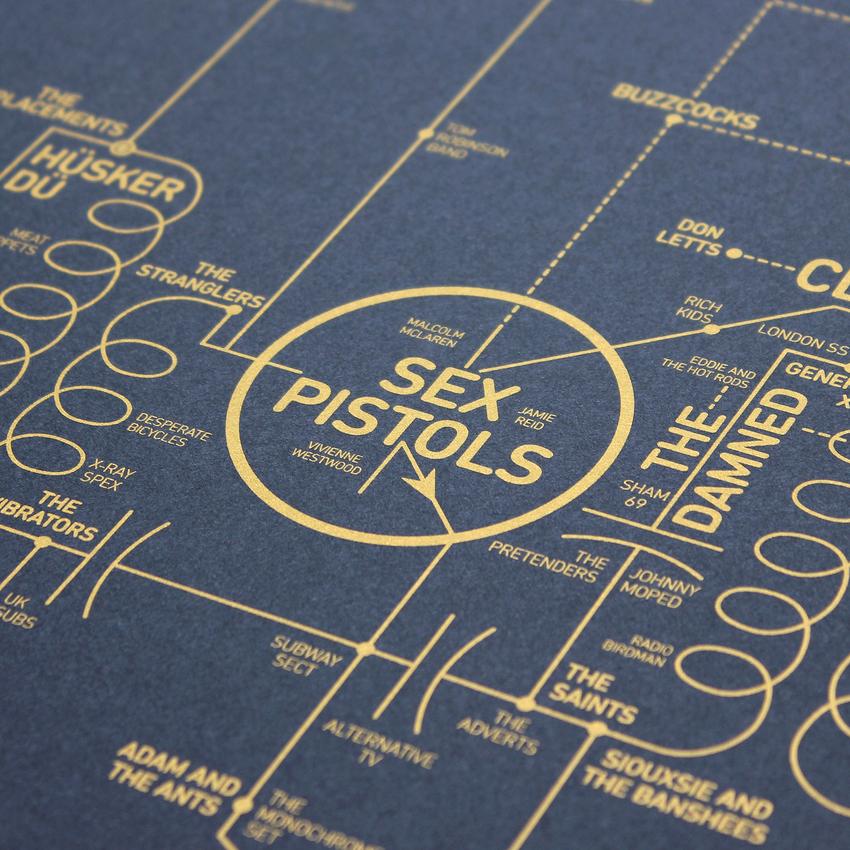
Quail’s “charted history of counter-culture rock music,” writes Margaret Rhodes at Wired, “spills out… not in any kind of linear board game way.” It started with a rumor—that the audience of the Sex Pistols’ June 4, 1976 show at the Lesser Free Trade Hall in Manchester “included guys who would go on to start bands like The Smiths, Joy Division, and the Buzzcocks.” It might as well have jumped off from Brian Eno’s famous quote about everyone who bought the Velvet Underground’s debut album starting their own band. What matters here is that it works: exploring the number of intricate connections between these bands with more breadth and immediacy than most alternative culture histories.
While Rhodes compares it to a streaming service that uses “musical connections to identify listening recommendations,” there’s much more going on here than Pandora’s algorithms might manage. You’ll find the garage rock revivalism of Thee Oh Sees, The White Stripes, and Ty Segall pop up on your internet radio, but most machine intelligences wouldn’t link them so neatly, as Quail does, with seminal, if obscure, acts like Billy Childish’s 90s band Thee Headcoats or 60s garage rockers The Sonics. Dorothy, the design house responsible for “Alternative Love,” allows you to zoom in on every part of the diagram to find little clusters of jangle pop, shoegaze, post-punk, grunge, synth pop, Britpop, hardcore, and neo-psych.
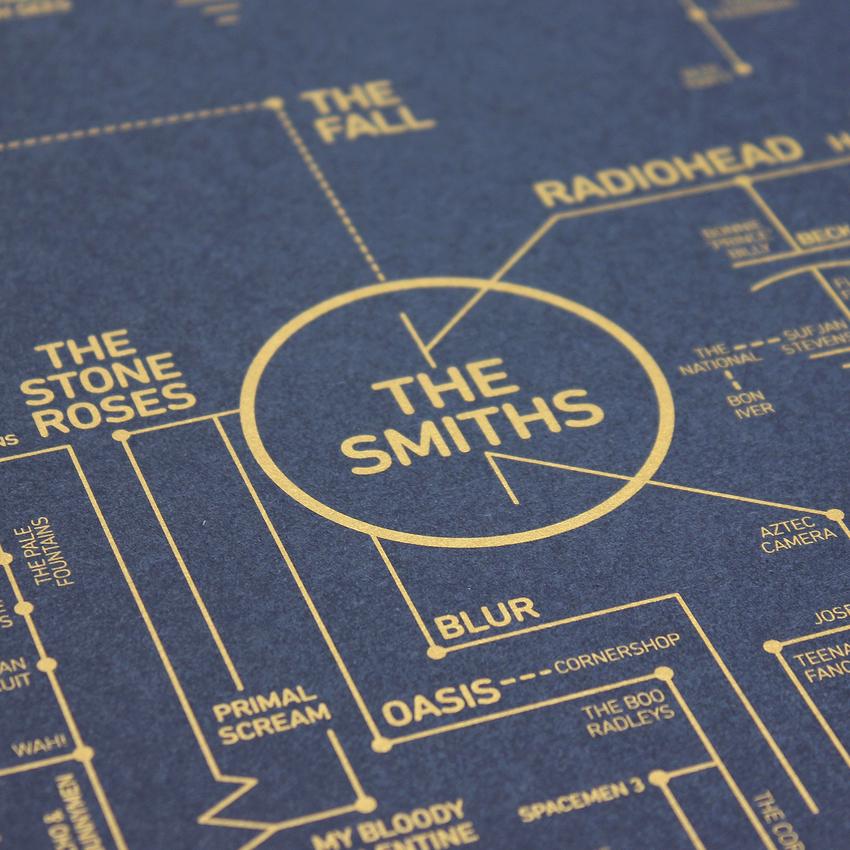
The blueprint, Dorothy explains, “celebrates over 300 musicians, artists, managers and producers who (in our opinion) have been pivotal to the evolution of the alternative and independent music scene.” You can buy the blueprint as a poster ($45), and it will make a brilliant gift for the middle-aged music nerd in your life, as does an earlier diagram, “Electric Love,” which traces the development of electronic music from Thomas Edison to Nine Inch Nails, using—what else?—the schematic of a Theremin.
If you would like to support the mission of Open Culture, consider making a donation to our site. It’s hard to rely 100% on ads, and your contributions will help us continue providing the best free cultural and educational materials to learners everywhere. You can contribute through PayPal, Patreon, and Venmo (@openculture). Thanks!
Related Content:
A Massive 800-Track Playlist of 90s Indie & Alternative Music, in Chronological Order
Three-Hour Mixtape Offers a Sonic Introduction to Underground Goth Music
Josh Jones is a writer and musician based in Durham, NC. Follow him at @jdmagness
Read More...Watch Coda, a Prize-Winning, Thought-Provoking Animation About a Lost Soul’s Encounter with Death
Alan Holly’s short animated film, Coda, was shortlisted for the 2015 Academy Awards and nominated for an Annie Award, on its way to winning 18 awards at film festivals across the world (including Best Animated Short Film at South by Southwest). As you probably know, a coda is typically the passage that brings a song/musical piece to a close. In the case of Holly’s film, it refers to the end of life, a soul’s attempt to bargain with Death before eventually accepting his fate.
According to Filmbase, the nine-minute, hand-animated film is “the culmination of two years of painstaking work by a small team of dedicated animation artists” in Ireland. And it’s voiced “by Brian Gleeson (Standby, The Stag, Love/Hate) and Orla Fitzgerald (The Wind that Shakes the Barley).”
Aesthetically, writes Short of the Week, the “film combines many elements in a unique way—the flat shapes and refined color palettes (seen also in work by Matthias Hoegg) with the painterly, organic movement of greats like Miyazaki. In fact, one could almost view the film as a modern day Miyazaki film with it’s piano score, surreal elements, and powerful characters.”
Coda will be added to our list of Free Animations, a subset of our collection, 4,000+ Free Movies Online: Great Classics, Indies, Noir, Westerns, Documentaries & More. You can watch it above.
If you would like to support the mission of Open Culture, consider making a donation to our site. It’s hard to rely 100% on ads, and your contributions will help us continue providing the best free cultural and educational materials to learners everywhere. You can contribute through PayPal, Patreon, and Venmo (@openculture). Thanks!
Related Content:
Death: A Free Philosophy Course from Yale
Rik Mayall Voices the Animation “Don’t Fear Death” Just Months Before His Untimely Passing
Read More...
“If Life Were Only Like This”: Woody Allen Gets Marshall McLuhan to Put a Pontificating Professor in His Place
The digital revolution created a mighty forum for those who once held forth from around the pickle barrel or atop a sturdy soap box.
The Internet has spawned many commentators whose thoughts are cogent, well researched and well argued, but they’re sadly outnumbered by a multitude of blowhards, windbags, and other self-appointed experts, forcefully expressing opinions as fact.
And, as you’ve likely heard, many consumers fail to check credentials before believing unsubstantiated statements are the rock solid truth, to be repeated and acted upon, sometimes to lasting consequence.
Compare the unmanageability of our situation to that of 40 years ago, when an obnoxious bloviator could apparently be silenced by the introduction of irrefutable authority…
Ah, wait, this is fiction…
A notable thing about the above scene from 1977’s Annie Hall—besides how beautifully the comedy holds up—is that the bad guy’s not stupid. His qualifications are actually quite impressive.
(We speak here of the Guy in Line, not writer-director-star Woody Allen, whose reputation has been permanently tarnished by personal misconduct, some of it easy to substantiate.)
The scene’s best punchline comes from pitting intellectual against intellectual, not intellectual against some mythical “regular” American, as we’ve come to expect.
The audience is well positioned to side with Allen and his ace-in-the-hole, media philosopher Marshall McLuhan. It’s a revenge fantasy designed to appeal to anyone whose freedom has been impinged by some loudmouthed stranger sounding off in a public area.
That’s all of us, right? (Though how many of us are willing to cop to the occasions when we may have been the narcissistic jerk monopolizing the conversation at top volume …)
The courtly McLuhan, a last minute replacement for director Federico Fellini, possessed the perfect temperament to skewer the overinflated self-worth of a pontificating egomaniac.
He was, however, not much of a performer, according to Russell Horton, who played the Guy in Line:
Woody would pull him out and he’d say something like, ‘Well you’re wrong, young man.’ Or, ‘Oh, gee, I don’t know what to say.’… We did like 17 or 18 takes, and if you look at it carefully in the movie, McLuhan says, ‘You mean my whole fallacy is wrong’ which makes no sense. How can you have your fallacy wrong?
Read the recent, and extremely amusing Entertainment Weekly interview with Guy in Line (and voice of the Trix cereal rabbit) Horton in its entirety here.
Related Content:
Woody Allen Amuses Himself by Giving Untruthful Answers in Unaired 1971 TV Interview
Watch a 44-Minute Supercut of Every Woody Allen Stammer, From Every Woody Allen Film
Ayun Halliday is an author, illustrator, theater maker and Chief Primatologist of the East Village Inky zine. Follow her @AyunHalliday.
Read More...“Play Without Bitching About the Key,” and Other Humorous, Blunt Annotations Added to Musical Scores
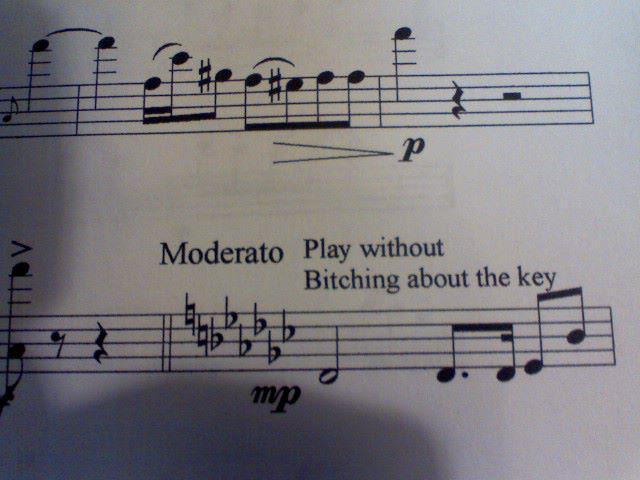
The standard system of musical notation has, throughout its evolution, served many different eras of humanity, and increasingly many different cultures, quite well indeed. Still, though, when its purely visual elements can’t get the compositional intention fully across, one must resort to incorporating verbal instructions, and sometimes those instructions can seem… unconventional. Classic FM’s list of “bizarre, perplexing and distressing performance directions” includes commands to play at “tempo di PBS documentary,” to “continue in tempo, ignoring conductor,” and — these favorites of Erik Satie — to play as if “imbibet” (drunken) and “corpulentus” (corpulent).
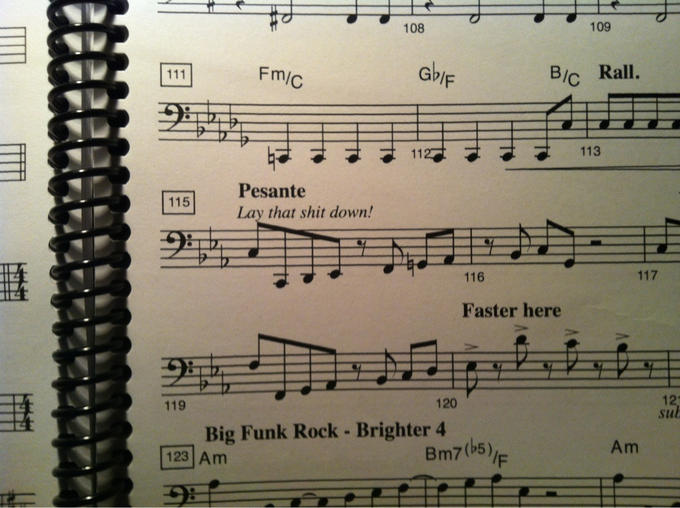
Not long ago, jazz critic Ted Gioia, a man who’s seen a more than a few scores in his time, tweeted out a set of images of what he called “blunt musical directions.” These instruct their performers to “play without bitching about the key” — G‑flat major not, I gather, being the most enjoyable of them all — to make a “soft moan through instrument if possible,” to “STAND; TURN AROUND; BEND OVER AND PLAY OBOE BETWEEN LEGS,” to “play without taking a picture and uploading to Facebook,” and — perhaps most important of all — to “lay that shit down!”
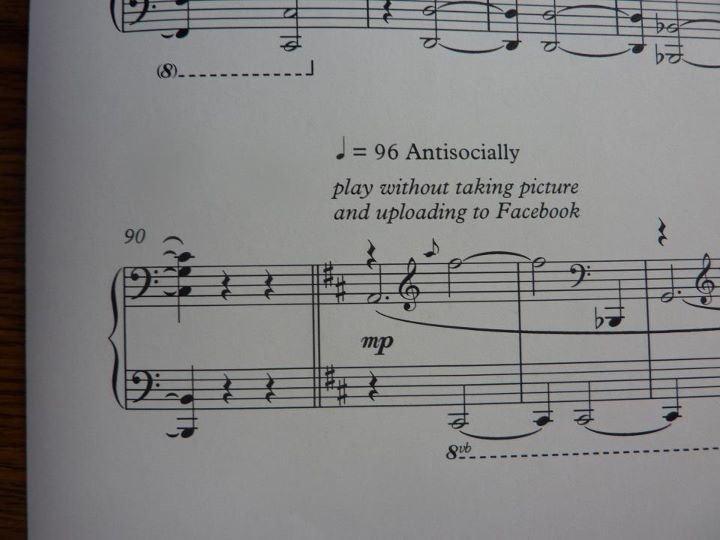
To those who can’t read a score, the ability to turn a bunch of lines, dots, and other even less intuitively decipherable symbols into full-bodied music on the fly looks like a superpower. But those who can read a score know that the real musicianship all happens between what some composer wrote on the page and what the audience hears, balancing loyalty to the composer’s intention with the degree of personal interpretation that makes the piece come alive. All the discipline cultivated through musical training no doubt ensures that most of them can resist the temptation of Facebook while actually playing, but when a composer’s directions get really ambiguous, cranky, or simply strange — well, that’s where their professional judgment comes in. And so live music remains interesting, even this deep into the age of the recorded stuff.
Related Content:
The Curious Score for John Cage’s “Silent” Zen Composition 4’33”
See The Guidonian Hand, the Medieval System for Reading Music, Get Brought Back to Life
“Hummingbird,” A New Form of Music Notation That’s Easier to Learn and Faster to Read
Based in Seoul, Colin Marshall writes and broadcasts on cities and culture. He’s at work on a book about Los Angeles, A Los Angeles Primer, the video series The City in Cinema, the crowdfunded journalism project Where Is the City of the Future?, and the Los Angeles Review of Books’ Korea Blog. Follow him on Twitter at @colinmarshall or on Facebook.
Read More...The Museum of Failure: A New Swedish Museum Showcases Harley-Davidson Perfume, Colgate Beef Lasagne, Google Glass & Other Failed Products
Here, in Silicon Valley, failure isn’t always failure. At least according to the local mythology, it’s something to be embraced, accepted, even celebrated. “Fail fast, fail often,” they say. And eventually you’ll learn enough to achieve real success.
On June 7th, the Museum of Failure will open in Helsingborg, Sweden. There you’ll find the remains of failed innovation. Google Glass, the Sony Betamax, the Apple Newton, Nokia’s N‑gage–they’re all there. Ditto a bottle of Harley-Davidson Perfume, Coca-Cola BlāK (aka coffee-flavored coke), and a Colgate Beef Lasagne TV Dinner. And, don’t forget the Trump monopoly-style board game–part of a long line of failed Trump products and businesses.
Above, curator Samuel West highlights items in the collection. Bringing together over 60 failed products and services from around the world, the collection provides “unique insight into the risky business of innovation.” You can get another glimpse of the new institution below. Fittingly, the museum is free.
If you would like to support the mission of Open Culture, consider making a donation to our site. It’s hard to rely 100% on ads, and your contributions will help us continue providing the best free cultural and educational materials to learners everywhere. You can contribute through PayPal, Patreon, and Venmo (@openculture). Thanks!
Related Content:
Oprah Winfrey’s Harvard Commencement Speech: Failure is Just Part of Moving Through Life
Paulo Coelho on The Fear of Failure
How to Start a Start-Up: A Free Course from Y Combinator Taught at Stanford
Seth Godin’s Startup School: A Free Mini-Course for New Entrepreneurs
Read More...Support Us
We're hoping to rely on loyal readers, rather than erratic ads. Please click the Donate button and support Open Culture. You can use Paypal, Venmo, Patreon, even Crypto! We thank you!

About Us

Open Culture scours the web for the best educational media. We find the free courses and audio books you need, the language lessons & educational videos you want, and plenty of enlightenment in between.
Advertise With Us

FREE UPDATES!
GET OUR DAILY EMAIL
Get the best cultural and educational resources on the web curated for you in a daily email. We never spam. Unsubscribe at any time.
FOLLOW ON SOCIAL MEDIA

Open Culture editor Dan Colman scours the web for the best educational media. He finds the free courses and audio books you need, the language lessons & movies you want, and plenty of enlightenment in between.
Advertise With Us


