Watch “A Family Tree,” Jonathan Demme’s 1980s Sitcom Episode with David Byrne & Rosanna Arquette
It comes as something of a surprise to realize that the filmmaker Jonathan Demme, who died last week, never made a television series of his own. He did, in addition to features like Something Wild and The Silence of the Lambs and documentaries like Stop Making Sense, direct a few episodes of TV shows as varied as Saturday Night Live and Enlightened. But we never got to see a full-on created-by-Demme series that, in this long Golden Age of Television in which we live, could surely have showcased in an even deeper way his much-praised interest in and empathy for humanity. But we can get a sense of how one might have played from “A Family Tree,” the Rosanna Arquette-starring sitcom episode he made in 1987 for the PBS prime-time comedy series Trying Times.
Demme, in the words of The New Yorker’s Dan Piepenbring, “directed an ensemble comedy about CB-radio enthusiasts, a documentary on an Episcopalian minister, and the only episode of Columbo to traffic in the drama of haute cuisine. But never did he roam farther afield than he does in ‘A Family Tree,’ a pitch-black anti-sitcom about an anxious young woman whose desire to belong leads her — perhaps in a nod to Stop Making Sense — to literally burn down the house. Fittingly, David Byrne himself is there to watch the flames go up, enjoying an imperious turn as a cigar-puffing, pie-hiding, reptile-obsessed brother-in-law.” And who could resist, having read a description like that, giving the episode a watch on Youtube, available there in three parts (watch them above and below)?
The production certainly stood out from the American televisual landscape of the time. The Chicago Tribune’s TV critic Clifford Perry, after trashing the then-new Full House, described Demme’s episode of Trying Times, the series’ premiere, as “built upon sick humor and a pervasive nastiness,” highlighting “an appealingly vulnerable performance by Arquette as the harassed outsider who suffers through cigar smoke, belching, homemade applejack, intramural bickering and a barrage of insults — as well as her own ineptitude, which results in a series of household disasters. Fine support is given by Hope Lange as the shrewish mother, Robert Ridgely as the just-fired father,” and particularly Byrne “as the acerbic yet boring brother-in-law-to-be.”
Ultimately, Perry judged “A Family Tree” as a “schizophrenic half-hour” that “veers between the farcical and the surreal,” which presumably wasn’t intended as a straightforward compliment. Today, however, its laugh track-free tone of intimate unease and realism unapologetically tinged with the bizarre would no doubt win it a considerable following. The tributes paid to Demme have described him as a maker of films well rooted in their eras and settings, but now we know he could make television thirty years ahead of its time as well.
Related Content:
Based in Seoul, Colin Marshall writes and broadcasts on cities and culture. He’s at work on a book about Los Angeles, A Los Angeles Primer, the video series The City in Cinema, the crowdfunded journalism project Where Is the City of the Future?, and the Los Angeles Review of Books’ Korea Blog. Follow him on Twitter at @colinmarshall or on Facebook.
Read More...Hear a Reading of James Joyce’s Finnegans Wake Set to Music: Features 100+ Musicians and Readers from Across the World
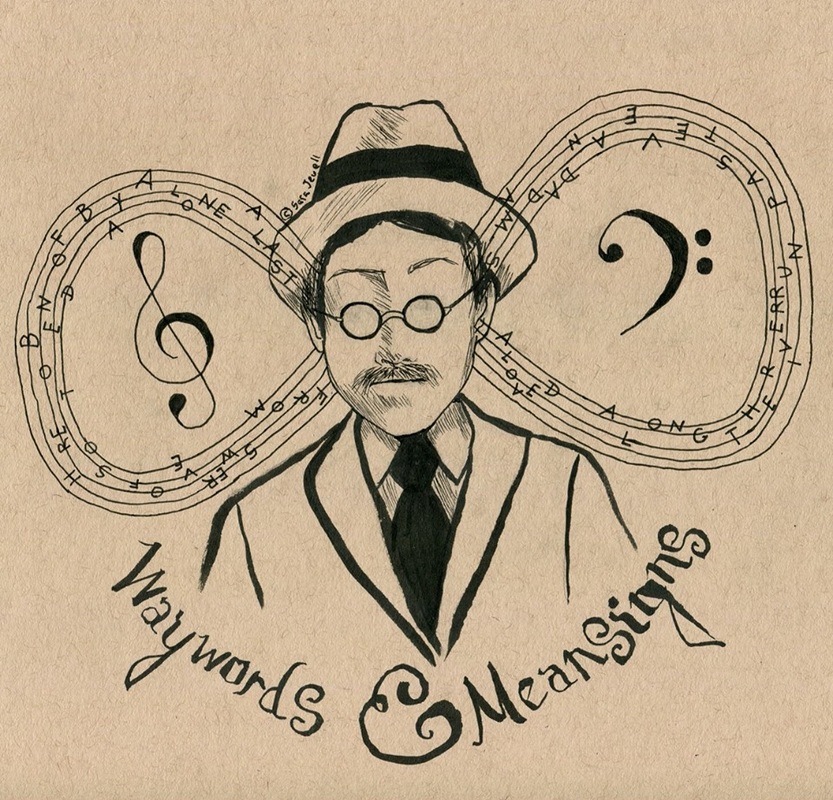
In a post last year on an ambitious musical adaptation of Finnegans Wake, I noted that—when most in bafflement over the Irish writer’s final, seemingly uninterpretable, work—I turn to Anthony Burgess, who not only presumed to abridge the book, but wrote more lucid commentary than any other scholarly critic or writerly admirer of Joyce. In his study ReJoyce, Burgess described the novel—or whatever-you-call-it—as a “man-made mountain… as close to a work of nature as any artist ever got—massive, baffling, serving nothing but itself, suggesting a meaning but never quite yielding anything but a fraction of it, and yet (like a tree) desperately simple.”
Joyce did seem to aspire to omniscience and the power of godlike creation, to supplant the “old father, old artificer” he beseeches at the end of A Portrait of the Artist as a Young Man. And if Finnegans Wake is a work of nature, it seems to me that we might approach it like naturalists, looking for its inner laws and mechanisms, performing dissections and mounting it, flayed open, on display boards.
Or we might approach it like poets, painters, field recordists—like artists, in other words. We might leave its innards intact, and instead represent what it does to our minds when we confront its nigh-inscrutable ontology.
This latter approach is the one adopted by Waywords and Meansigns’ latest release, which brings together recordings from over 100 artists from 15 different countries—some semi-famous, most thrillingly obscure. Joyce’s book, explains project director Derek Pyle, is “the kind of thing that demands creative approaches—from jazz and punk musicians to sound artists and modern composers, each person hears and performs the text in a way that’s totally unique and endlessly exciting.” We first commented on the endeavor two years ago, when it released 31 hours of unabridged Joyce interpretation. Last year’s second edition greatly expanded on the singing, reading, and experimental noodling of and around Finnegans Wake.
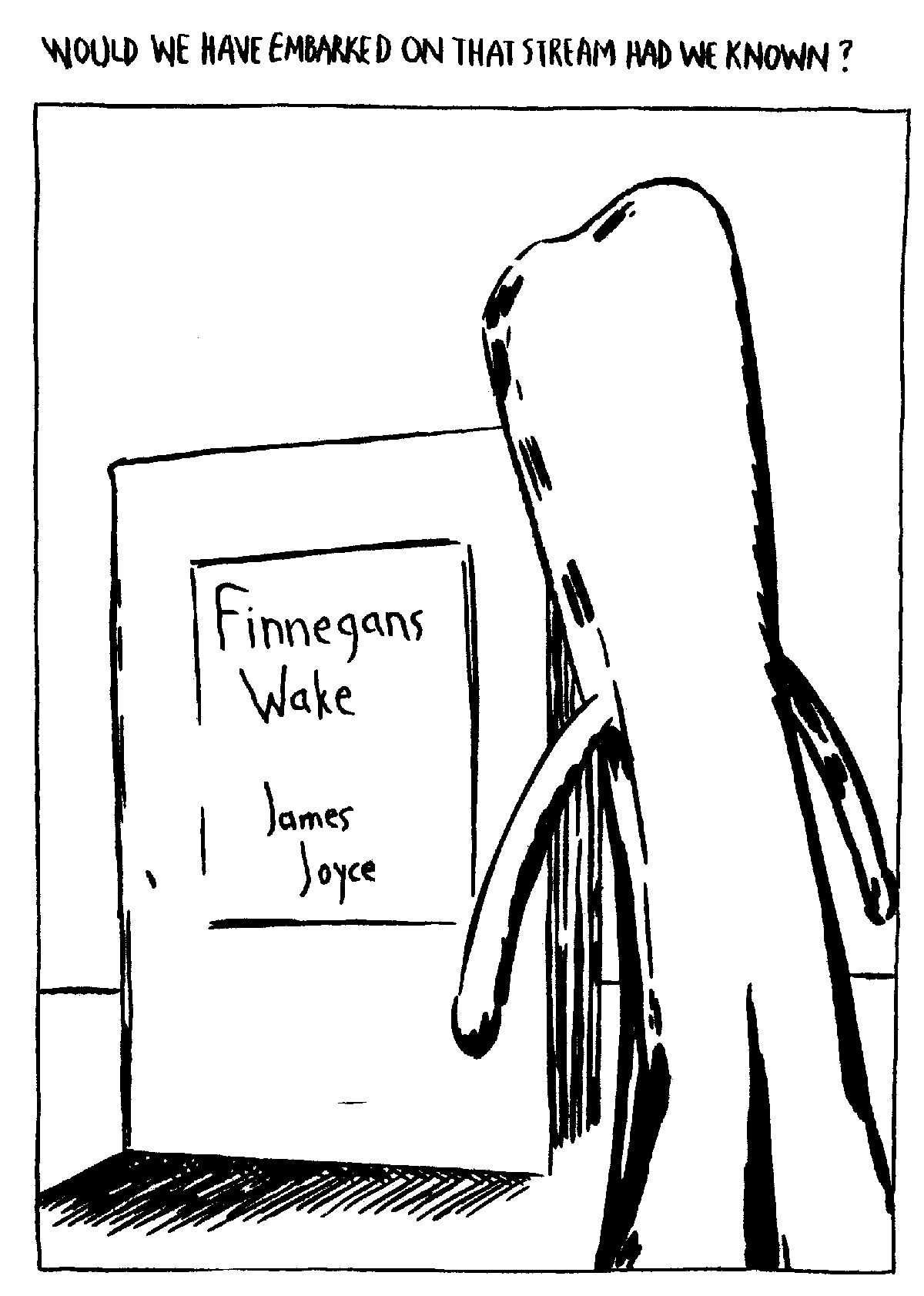
The third edition continues what has becoming a very fine tradition, and perhaps one of the most appropriate responses to the novel in the 78 years since its publication. This release (streamable above, or on Archive.org) adds to the second edition a belated contribution from iconic bassist and songwriter Mike Watt (of The Minutemen, fIREHOSE, and solo fame) and “actor and ‘JoyceGeek” Adam Harvey. (And a Gumby-starring illustration, above, by punk rock cover artist Raymond Pettibon). The third unabridged collection of interpretative musical readings, further up, offers contributions from:
Mercury Rev veterans Jason Sebastian Russo and Paul Dillon, Joe Cassidy of Butterfly Child, Railroad Earth’s Tim Carbone and Lewis & Clarke’s Lou Rogai, psych-rockers Kinski, vocalist Phil Minton, poet S.A. Griffin, translator Krzysztof Bartnicki, “krautrock” pioneer Jean-Hervé Péron of faUSt, British fringe musician Neil Campbell, Martyn Bates of Eyeless in Gaza, Little Sparta with Sally Timms (Mekons) and Martin Billheimer, composer Seán Mac Erlaine, indietronica pioneer Schneider TM, and many more.
If something on that list doesn’t grab you, you may have stumbled into the wrong party. In any case, you’ll find hundreds other readings, songs, etc. to choose from in the expanding three-volume compilation. Or you can listen to it straight through, from the first edition, to the second, to the third. Like the book, this project celebrates, imitates, reflects, and refracts, Waywords and Meansigns admits entry at any point, and nearly always charms even as it perplexes. The fact that no one can really grasp the slippery nature of Finnegans Wake perhaps makes the book, and its best creative interpretations, all the more genuinely for everyone.
Related Content:
James Joyce’s Ulysses: Download as a Free Audio Book & Free eBook
Hear All of Finnegans Wake Read Aloud: A 35 Hour Reading
Josh Jones is a writer and musician based in Durham, NC. Follow him at @jdmagness
Read More...Holocaust Survivor Viktor Frankl Explains Why If We Have True Meaning in Our Lives, We Can Make It Through the Darkest of Times
In one school of popular reasoning, people judge historical outcomes that they think are favorable as worthy tradeoffs for historical atrocities. The argument appears in some of the most inappropriate contexts, such as discussions of slavery or the Holocaust. Or in individual thought experiments, such as that of a famous inventor whose birth was the result of a brutal assault. There are a great many people who consider this thinking repulsive, morally corrosive, and astoundingly presumptuous. Not only does it assume that every terrible thing that happens is part of a benevolent design, but it pretends to know which circumstances count as unqualified goods, and which can be blithely ignored. It determines future actions from a tidy and convenient story of the past.
We might contrast this attitude with a more Zen stance, for example, a radically agnostic “wait and see” approach to everything that happens. Not-knowing seems to give meditating monks a great deal of serenity in practice. But the theory terrifies most of us. Effects must have causes, we think, causes must have effects, and in order to predict what’s going to happen next (and thereby save our skins), we must know why we’re doing what we’re doing. The deep impulse is what psychologist and psychotherapist Viktor Frankl identifies, in his pre-gender-neutrally titled book, as Man’s Search for Meaning. Despite the misuse of this faculty to create neurotic or dehumanizing myths, “man’s search for meaning,” writes Frankl, “is the primary motivation in his life and not a ‘secondary rationalization’ of instinctual drives.”
Frankl understood perfectly well how the construction of meaning—through narrative, art, relationships, social fictions, etc.—might be perverted for murderous ends. He was a survivor of four concentration camps, which took the lives of his parents, brother, and wife. The first part of his book, “Experiences in a Concentration Camp,” recounts the horror in detail, sparing no one accountability for their actions. From these experiences, Frankl draws a conclusion, one he explains in the interview above in two parts from 1977. “The lesson one could learn from Auschwitz,” he says, “and in other concentration camps, in the final analysis was, those who were oriented toward a meaning—toward a meaning to be fulfilled by them in the future—were most likely to survive” beyond the experience. “The question,” Frankl says, “was survival for what?” (See a short animated summary of Frankl’s book below.)
Frankl does not excuse the deaths of his family, friends, and millions of others in his psychological theory, which he calls logotherapy. He certainly does not trivialize the most unimaginable of in-human experiences. “We all said to each other in camp,” he writes, “that there could be no earthly happiness which could compensate for all we had suffered.” But it was not the hope of happiness that “gave us courage,” he writes. It was the “will to meaning” that looked to the future, not to the past. In Frankl’s existentialist view, we ourselves create that meaning, for ourselves, and not for others. Logotherapy, Frankl writes, “defocuses all the vicious-circle formations and feedback mechanisms which play such a great role in the development of neuroses.” We must acknowledge the need to make sense of our lives and fill what Frankl called the “existential vacuum.” And we alone are responsible for writing better stories for ourselves.
To dig deeper in Frankl’s philosophy, you can read not only Man’s Search for Meaning but also The Will to Meaning: Foundations and Applications of Logotherapy.
Related Content:
Albert Camus’ Historic Lecture, “The Human Crisis,” Performed by Actor Viggo Mortensen
Josh Jones is a writer and musician based in Durham, NC. Follow him at @jdmagness
Read More...A Three-Minute Introduction to Buckminster Fuller, One of the 20th Century’s Most Productive Design Visionaries
Architect, inventor, theorist, and all-around fount of ideas Buckminster Fuller came up with many new things, though most of us associate him with one above all: geodesic domes. Those distinctive hemispheric structures built out of strong triangular parts, having gone in and out of vogue over the decades, most recently reappeared in the zeitgeist as the type of lodging promised to the attendees of the ill-conceived Fyre Festival — an ultra-luxury market-targeted disaster not representative, safe to say, of the world Fuller spent his entire career trying to realize. His vision of a future for “Spaceship Earth,” as he called it, drove him to create all he created, from new maps to new houses to new cars to new sleeping methods. But what did he base that vision on?
“Fuller’s philosophy could be best summarized as being a social thinker, believing that humanity’s survival is contingent upon how it manages Spaceship Earth and the resources it contains,” says the narrator of the three-minute Prosocial Progress Foundation primer above, “and that creating abundance whilst doing little to no harm to the environment would help to alleviate a lot of the problems in the world today.”
With every project he emphasized “systems thinking,” or thinking premised on “the idea that the world is an interconnected system with interconnected problems, and that a way to solve these problems would be to call upon collective action.” We’d all have to work together, in his view, to solve the problems we suffer together.
That notion may strike us as utopian even today, and indeed, most of Fuller’s inventions only saw limited application during his lifetime. But the label of utopian, which suggests a disregard for the rigors of reality, doesn’t quite fit the man himself, so much concern did he have for practicalities like the efficient allocation of resources, quick construction and deployment, and ease of use. But given the dystopian terms we’ve increasingly come to use to describe events here on Spaceship Earth, maybe we need a Fuller-style practical utopianism now more than ever. If these three minutes have given you a taste for more of the details, have a look at Fuller’s video lecture series Everything I Know — but make sure to clear 42 hours of your calendar first. The future of humanity may depend on it!
Related Content:
Buckminster Fuller’s Map of the World: The Innovation that Revolutionized Map Design (1943)
The Life & Times of Buckminster Fuller’s Geodesic Dome: A Documentary
Watch an Animated Buckminster Fuller Tell Studs Terkel All About “the Geodesic Life”
A Harrowing Test Drive of Buckminster Fuller’s 1933 Dymaxion Car: Art That Is Scary to Ride
Everything I Know: 42 Hours of Buckminster Fuller’s Visionary Lectures Free Online (1975)
Bertrand Russell & Buckminster Fuller on Why We Should Work Less, and Live & Learn More
Everything I Know: 42 Hours of Buckminster Fuller’s Visionary Lectures Free Online (1975)
Based in Seoul, Colin Marshall writes and broadcasts on cities and culture. He’s at work on a book about Los Angeles, A Los Angeles Primer, the video series The City in Cinema, the crowdfunded journalism project Where Is the City of the Future?, and the Los Angeles Review of Books’ Korea Blog. Follow him on Twitter at @colinmarshall or on Facebook.
Read More...Watch a Reading of Steve Bannon’s Screenplay Which Attempted to Turn Shakespeare’s Coriolanus Into a Rap Musical
Somewhere between working at Goldman Sachs, and calling the shots for Breitbart and Donald Trump, the Voldemortian Steve Bannon went to Hollywood and made 18 films, many of them political. Described “as the Leni Riefenstahl of the Tea Party movement” (by Andrew Breitbart himself), Bannon helped produce the Ronald Reagan documentary In the Face of Evil and Fire from the Heartland: The Awakening of the Conservative Woman. But he’s perhaps best known for writing a treatment for the never-made documentary, Destroying the Great Satan: The Rise of Islamic Fascism in America. The eight page draft, writes The Washington Post, proposed “a three-part movie that would trace ‘the culture of intolerance’ behind sharia law, examine the ‘Fifth Column’ made up of ‘Islamic front groups’ and identify the American enablers paving ‘the road to this unique hell on earth.’ ” Looking back, it’s no wonder that Bannon tried to engineer a ban of Muslims immigrants upon entering the White House.
For anyone interested in revisiting another unrealized Bannon production, you can now watch (above) a table read of his screenplay for The Thing I Am. Co-written with Julia Jones during the late 1990s, it’s a “rap musical adaptation of Shakespeare’s Coriolanus set in South Central Los Angeles during the 1992 riots after the LAPD beating of Rodney King.” Put together by an organization called Now This, the read features Rob Corddry, Lucas Neff, Parvesh Cheena, Daniele Gaither, Gary Anthony Williams, Charlie Carver, Cedric Yarborough, and hip hop artist A.J. Crew. And, as the website Refinery29 warns, it’s “full of cussing, the n‑word, and mentions of crotch grabs.”
Related Content:
Read More...A Hypnotic Look at How Japanese Samurai Swords Are Made
Paper, books, wooden joints, tea whisks — Japanese culture has, for seemingly all of its long recorded history, greatly esteemed the making of objects. But no one object represents the Japanese dedication to craftsmanship, and within that the eternal pursuit of approachable but never quite attainable perfection, than the sword. You can see what it takes to make a katana, the traditional Japanese sword of the kind carried by the armed military class of the samurai between roughly the 8th and 19th centuries, in the 26-minute video above, which offers a close look at each stage of the swordmaking process: the Shinto blessing of the forge, the hammering of the red-hot metal, the tempering of the freshly shaped blade, the construction of the scabbard and hilt, the final assembly, and every painstaking step in between.
Originally produced for the United Kingdom’s National Museum of Arms and Armour and Portland Art Museum’s collaborative 2013 special exhibition “Samurai! Armor from the Ann and Gabriel Barbier-Mueller Collection,” the video’s wordless but certainly not silent portrayal of this ancient and continuing practice has a kind of hypnotic quality.
But if you’d like a more verbal explanation to accompany your views of the making of a traditional Japanese sword, you’ll get it in the 50-minute documentary above, The Secret World of the Japanese Swordsmith, a portrait of the highly respected Yoshindo Yoshihara, one of only thirty full-time swordsmiths currently practicing in Japan. If you then feel up to a Japanese swordsmithing triple-bill, give Samurai Sword: Making of a Legend a watch as well.
This 50-minute program tells the story of the katana itself, beginning with this breathless narration: “For over one thousand years, one weapon has dominated the battlefields of Japan, a weapon so fearsome that it can split a man from throat to groin — yet it spawned an an entirely new art form and spiritual way of life. A sword so technologically perfect in structure, so beautiful in creation, that it gave rise to an aristocratic warrior creed.” It also gave rise to no small number of samurai movies, a tradition that many a cinephile among us can certainly appreciate. Though inextricably tied to a specific time and place in history, and an even more specific class that arose from the peculiar political circumstances of that time and place, the katana continues to fascinate — and in this digital, hands-free age, its makers draw a more intense kind of respect than ever.
Related Content:
Japanese Craftsman Spends His Life Trying to Recreate a Thousand-Year-Old Sword
Female Samurai Warriors Immortalized in 19th Century Japanese Photos
How Japanese Things Are Made in 309 Videos: Bamboo Tea Whisks, Hina Dolls, Steel Balls & More
The Making of Japanese Handmade Paper: A Short Film Documents an 800-Year-Old Tradition
Watch a Japanese Craftsman Lovingly Bring a Tattered Old Book Back to Near Mint Condition
Based in Seoul, Colin Marshall writes and broadcasts on cities and culture. He’s at work on a book about Los Angeles, A Los Angeles Primer, the video series The City in Cinema, the crowdfunded journalism project Where Is the City of the Future?, and the Los Angeles Review of Books’ Korea Blog. Follow him on Twitter at @colinmarshall or on Facebook.
Read More...How the Soviets Imagined in 1960 What the World Would Look in 2017: A Gallery of Retro-Futuristic Drawings
In one of the most impassioned and beautifully written defenses of Burkean conservatism I have ever read, the poet Wendell Berry took government projects of both the left and right to task, proclaiming in 1968 that the emergence of a massive bureaucracy was a tragic sign of the “loss of the future.” His argument is similar to one made over twenty years earlier by the Trotskyist-turned-conservative writer James Burnham, whose 1941 book The Managerial Revolution predicted “at each point,” wrote George Orwell in a thorough review, “a continuation of the thing that is happening.” A “managerial” central state, Burnham also argued, inevitably brought about a “loss of the future.”
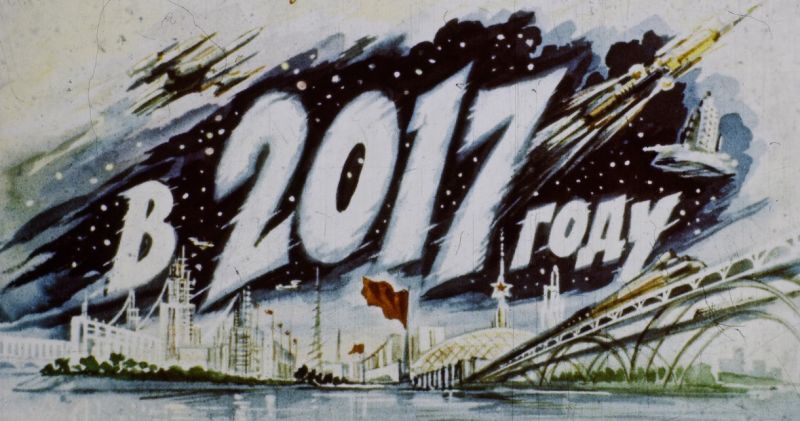
Neither the contemplative Berry nor the incisive Burnham have been able to account for one historically inescapable fact: the periods in which 20th century societies imagined the future most vividly were those most dominated by bureaucratic, technocratic, centralized political economies. This is true under conservative governments like that of the U.S. under Eisenhower, in which huge infrastructure projects—from the highway system to hydroelectric dams— rearranged the lives of millions.
And it was true under Khrushchev’s Soviet state, whose Virgin Lands campaign did the same. Indeed, mid-century Soviet “expectations were pretty similar to the futuristic predictions of Americans,” writes Matt Novak, “with a touch more Communism, of course.” Unsurprising, perhaps, given that the two nations were locked in competition over the domination of both earth and space.
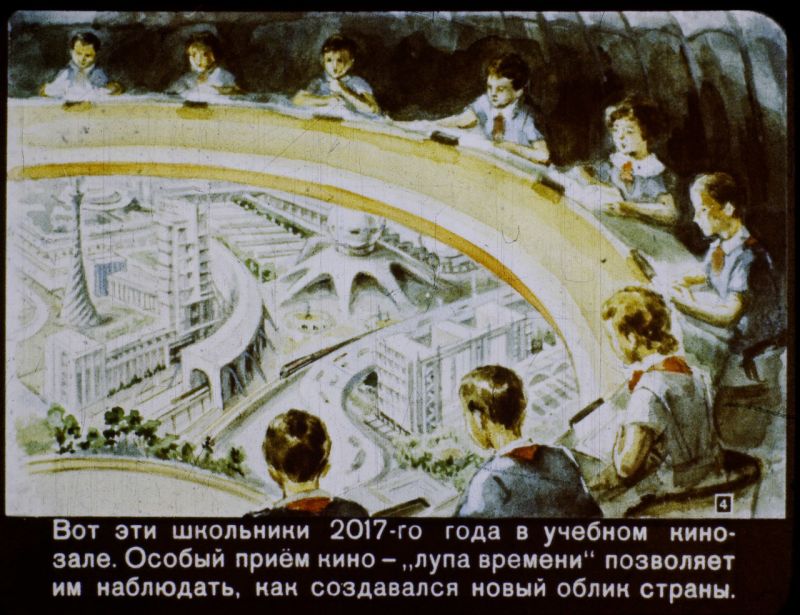
Novak’s understatement is fully warranted. Although the people in images like those you see here tend to appear in more collective arrangements, their sci-fi surroundings almost mirror those in the images from the U.S. that were parodied by The Jetsons two years after this 1960 collection. These detailed scenarios come from a “retro-futuristic filmstrip, which would have been played through a Diafilm,” a kind of slide projector. It’s a vision, it just so happens, of our time, 2017, but it looks backward to get there, both in its technology and its design. The illustration above, for example, “was almost certainly inspired by the Futurama exhibit from the 1939 New York World’s Fair.” (Itself built, we may note, on the shoulders of Roosevelt’s New Deal.)
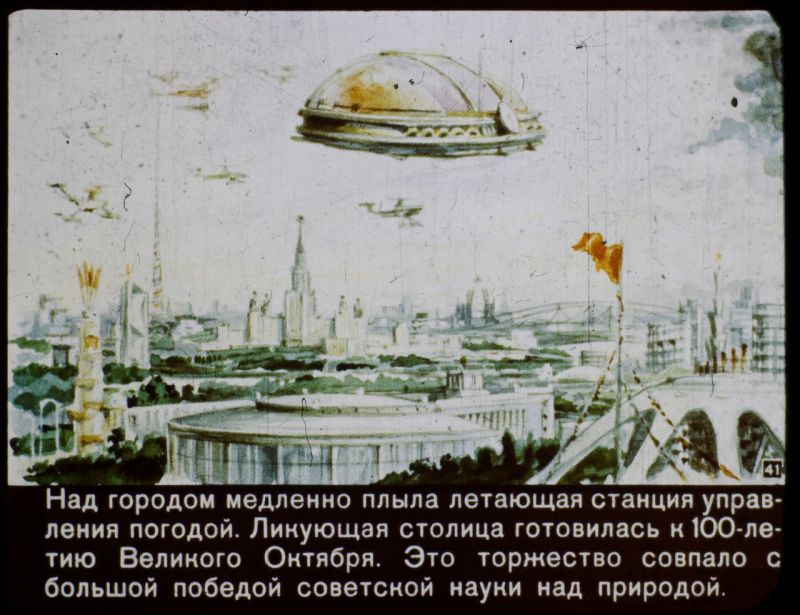
You can see many more of these illustrations at Paleofuture, and at the top of the post watch a video version with “jazzy music and star wipes.” You may find these visions quaint, charming in their naiveté and inaccuracy—yet often quaintly prescient as well. Retro-futurism’s appeal to us seems to rest principally in how silly it can seem in hindsight, even when it gets things right. Perhaps it is the case that the most fully-realized, totalizing visions of tomorrow are as far-fetched as the controlling societies that produce them are unsustainable. As Bob Duggan writes at Big Think, for example, we are bound to associate the “undead art movement” of Italian Futurism with the very short-lived regime of Italian Fascism. Maybe the degree to which a government lacks a future is in inverse proportion to the intensity of its retro-futurism.
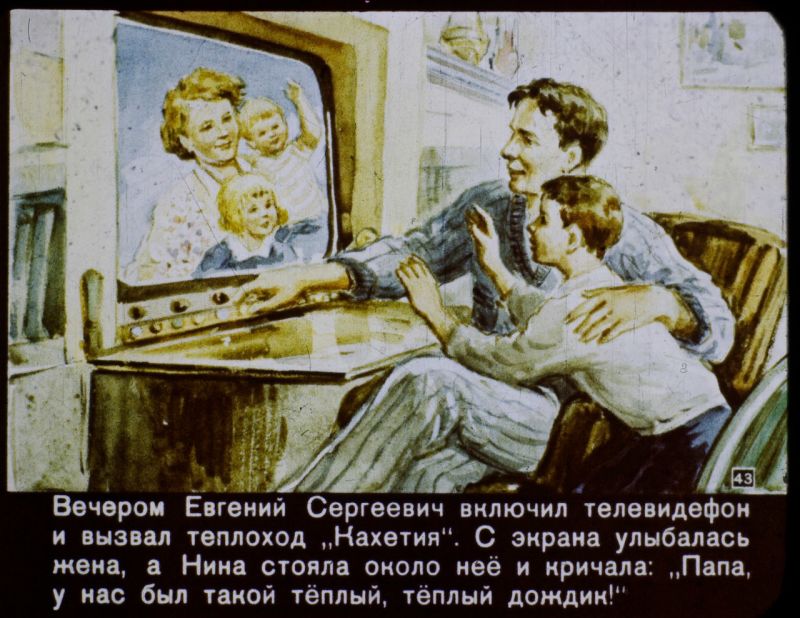
So what exactly is the relationship between state power and utopian futurism? The question invites a dissertation, and surely many have been written, as they have on the symptomology of the techno-dystopian and urban apocalyptic forms of futurism. We might begin by wondering what our actual 2017 will look like 57 years from now. What will people in 2074 make of our endless culture of revivalism, from zombie steampunk to retreads and remakes of everything from Ghost in the Shell, to The Matrix, to Star Wars? Who can say. Perhaps, for whatever sociological reason, we are suffering, as Berry put it, from a loss of the future.
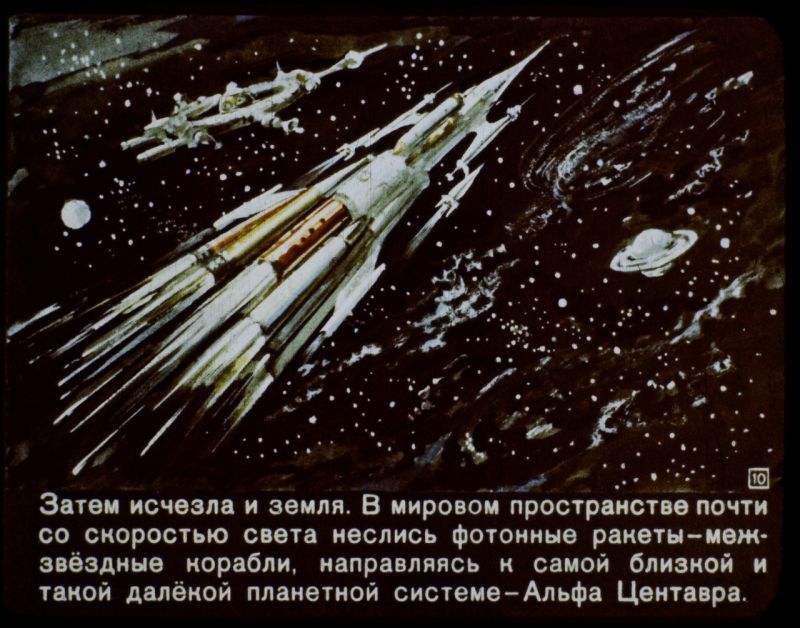
via Paleofuture
Related Content:
Soviet Artists Envision a Communist Utopia in Outer Space
Josh Jones is a writer and musician based in Durham, NC. Follow him at @jdmagness
Read More...A Free Course from Yale on the U.S. Civil War
If there’s a silver lining to the Trump administration, it’s that it provides some teachable moments for historians and students. Just days after the inauguration, Trump commented at a celebration of Black History Month, “Frederick Douglass is an example of somebody who’s done an amazing job and is getting recognized more and more, I notice.” Enter the historians, who quickly reminded us that the great abolitionist, orator and writer had died back in 1895. There’s no present tense here, only past.
And now there’s this: Yesterday, the president speculated in an odd interview that the Civil War could have been averted if Andrew Jackson had been there to stop it:
I mean, had Andrew Jackson been a little later, you wouldn’t have had the Civil War. He was a very tough person, but he had a big heart, and he was really angry that he saw what was happening with regard to the Civil War. He said, “There’s no reason for this.” People don’t realize, you know, the Civil War, you think about it, why?
Historians were quick to point out that Jackson ended his presidency in 1837 and died in 1845–respectively, 24 and 16 years before the start of the Civil War. How Jackson would have handled the lead up to the Civil War is pure speculation. Just as it would be speculation to say how FDR or Truman would have dealt with the Cuban Missile Crisis.
David Blight, a Yale historian and expert on slavery and the Civil War, had a bit stronger reaction to Trump’s comments, telling Mother Jones:
So he really said this about Jackson and the Civil War? All I can say to you is that from day one I have believed that Donald Trump’s greatest threat to our society and to our democracy is not necessarily his authoritarianism, but his essential ignorance—of history, of policy, of political process, of the Constitution. Saying that if Jackson had been around we might not have had the Civil War is like saying that one strong, aggressive leader can shape, prevent, move history however he wishes. This is simply 5th grade understanding of history or worse.
Today, as with the past, Trump seems to be figuring out (the hard way) that one person can’t change the course of a nation by force of will–not when there are so many other forces and players that shape things. A lot of hubris and inflated rhetoric came into White House in January. Whether Trump is actually learning the physics of politics remains to be seen.
But here’s one thing you don’t have to wait for. David Blight has made available a free course on the Civil War. In 27 lectures, his course “explores the causes, course, and consequences of the American Civil War, from the 1840s to 1877,” looking at how the United States was transformed on multiple levels: racially, socially, politically, constitutionally and morally. You can access the 27 free lectures, presented in audio and video, via YouTube, iTunes, and the Yale web site (plus a syllabus). We also have it on the list of our Free History Courses, a subset of our collection 1,700 Free Online Courses from Top Universities.
If you would like to support the mission of Open Culture, consider making a donation to our site. It’s hard to rely 100% on ads, and your contributions will help us continue providing the best free cultural and educational materials to learners everywhere. You can contribute through PayPal, Patreon, and Venmo (@openculture). Thanks!
Related Content:
Animated Map Lets You Watch the Unfolding of Every Day of the U.S. Civil War (1861–1865)
The History of the World in 46 Lectures From Columbia University
African-American History: Modern Freedom Struggle (A Free Course from Stanford)
Read More...Why Should We Read Tolstoy’s War and Peace (and Finish It)? A TED-Ed Animation Makes the Case
War and Peace, Leo Tolstoy’s epic novel of Russia in the Napoleonic wars, has for some time borne the unfortunate, if mildly humorous, cultural role as the ultimate unread doorstop. (At least before David Foster Wallace’s Infinite Jest or Karl Ove Knausgaard’s My Struggle.) The daunting length and complexity of its narrative can seem uniquely forbidding, though it’s equaled or exceeded in bulk by the books of early English novelist Samuel Richardson or later masterworks by the German Robert Musil and French Marcel Proust (not to mention the 8,000 page, 27-volume roman Men of Goodwill by Jules Romains.)
But where it may be necessary in certain circles to have a working knowledge of À la recherche du temps perdu’s “madeleine moment,” one needn’t have read every volume of the painstaking work to get the main flavor for this reference. Tolstoy’s novel, on the other hand, is all of a piece, an operatic text of so many disparate threads that it’s nearly impossible to follow only one of them. And “anyone who tells you that you can skip the ‘War’ parts and only read the ‘Peace’ parts is an idiot,” writes Philip Hensher at The Guardian. (Now he tells me….) Hensher also swears one can read War and Peace “in 10 days maximum.” Very likely, if you approach it without fear or prejudice, and take some vacation time. (But “could you read War and Peace in a week,” Tim Dowling teased in those same pages?)
Tolstoy’s massive psychological portrait of Tsarist Russia in thrall to the French emperor remains a cornerstone of world, and of course, Russian literature. Without it, there may have been no Doctor Zhivago or August 1914. “War and Peace is a long book, sure,” concedes the TED-Ed video above from Brendan Pelsue, “but it’s also a thrilling examination of history, populated with some of the deepest, most realistic characters you’ll find anywhere.” Like most hulking novels of the period, the book was originally serialized in a magazine—the pre-HBO means of disseminating compelling drama—but Tolstoy had not intended for it to grow to such a length or take up five years of his life. One story—that of the Decembrists—led to another. Grand, sweeping views of history emerged from examinations of “the small lives that inhabit those events.”
Pelsue makes a persuasive rhetorical case, but also—for most type‑A, over-employed, or highly distractible readers, at least—inadvertently makes the counterargument. There are no main characters in the book. No Anna Karenina or Ivan Ilyich to follow from start to bitter end. “Instead, readers enter a vast interlocking web of relationships and questions” about the nature of love and war. Maybe you’ve already got one of those—like—in all the time you spend not reading novels. So (snaps fingers), what’s the payoff? The upshot? The “madeline moment”? (No offense to Proust.) Well, no one can—or should attempt to—summarize a complex literary work in such a way that we don’t need to read it for ourselves. Nor, can any interpretation be in any way definitive. To his credit Pelsue doesn’t try for anything of the kind.
Instead, he offers up Tolstoy’s “large, loose baggy monster,” in Henry James’ famously dismissive phrase, not as a novel, nor, as Tolstoy countered, an epic poem or historical chronicle, but as a distinctly Russian form of literature and “the sum total of Tolstoy’s imaginative powers, and nothing less.” A blurb that needs some work? We’re only going to miss the point unless we meet the work itself, whether we read it over 10 days or 10 years. The same can be said for so many epic works that lazy people like… well, all of us at times… complain about. There is absolutely no substitute for reading Moby Dick from start to finish at least twice, I’ve told people with such conviction they’ve rolled their eyes, snorted, and almost kicked me, but I haven’t myself been able to digest all of War and Peace, nor even pretended to. Tolstoy’s greatest work has sadly come to most of us as a book it’s perfectly okay to skim (or watch the movie).
It’s a frustrating work, sometimes boring and disagreeable, didactic and annoying. It has “the worst opening sentence of any major novel,” opines Philip Hensher, and “the very worst closing sentence by a country mile.” And it is also perhaps, “the best novel ever written—the warmest, the roundest, the best story and the most interesting.” Tolstoy not only entertains, but he accomplishes his intention, argues Alain de Botton, of increasing his readers’ “emotional intelligence.” I wouldn’t take anyone’s word for it. We are free to reject Tolstoy, as Tolstoy himself rejected Shakespeare, calling the veneration of the Bard “a great evil.” But we’d have to read him first. There must be some good reasons why people who have actually read War and Peace to the end refuse to let the rest of us forget it.
Related Content:
Watch War and Peace: The Splendid, Epic Film Adaptation of Leo Tolstoy’s Grand Novel (1969)
Josh Jones is a writer and musician based in Durham, NC. Follow him at @jdmagness
Read More...An Aging Louis Armstrong Sings “What a Wonderful World” in 1967, During the Vietnam War & The Civil Rights Struggle
It’s not uncommon to have a knee jerk response to Bob Thiele and George David Weiss’ now-ubiquitous “What a Wonderful World.”
The quality of your reaction is likely determined by your worldview.
A misty-eyed bride-to-be browsing tunes for her upcoming reception’s father-daughter dance will not be coming at things from the same angle as the directors of Bowling for Columbine, Good Morning, Vietnam, and—unexpectedly—Madagascar.
The first version, sung by an aging Louis Armstrong, remains definitive, though it was dismissed at first by record execs, who hoped for another rollicking chart topper along in the “Hello, Dolly!” model.
As Jack Doyle notes on the Pop History Dig, Armstrong dug the song, and performed it often, hoping to strike a chord of hope and optimism during a period of great civil unrest:
Seems to me it ain’t the world that’s so bad but what we’re doing to it, and all I’m saying is: see what a wonderful world it would be if only we’d give it a chance. Love, baby, love. That’s the secret…
The song’s white authors shared his view, and hoped his crossover appeal would promote feelings of racial harmony on all sides of the record-buying public. It was a hit in the UK, but a slow starter in the US, not really catching on until its appearance on Good Morning, Vietnam’s soundtrack (1987).
Half a century after its release, “What a Wonderful World” has entered the pantheon, as anyone with a television and ears can attest.
Its simple lyrics involving roses, rainbows, and babies have resulted in a number of hideously syrupy covers. With so many choices, it’s almost impossible to pick a least-favorite. Their gooeyness does a disservice to the power of the original.
What’s so poignant about the performance, above, are the moments where the darkness cuts through the treacle, ever so briefly. Check out Armstrong’s expressions at :25, :50, and 1:49, and interpret it how you will.
It’s worth noting that the nightly news was monopolized by reports of the war in Vietnam and the struggle for civil rights at home. Armstrong’s health was in decline. The realities of his own New Orleans childhood were far more complex than the crayon-bright vision painted by the lyrics.
A montage of bombings and peaceful demonstrators being stomped underfoot would’ve seemed premature at such an early stage in the song’s history, so Armstrong smiled through, as he laid the groundwork for later performers’ layered interpretations. Some of the ones we find most compelling are below:
Nick Cave & the Pogues’ Shane MacGowan unhappiness has them reeling off their stools, even as they shake hands to comic effect.
Ministry’s sinister take opens with a lovely lonely piano that, like the listener’s eardrums, gets plowed under by a massive attack of industrial noise.
Joey Ramone had already been diagnosed with the cancer that cut his life short when he recorded his version, that ends on a note of unabashed pop-punk joy.
Related Content:
The Cleanest Recordings of 1920s Louis Armstrong Songs You’ll Ever Hear
Ayun Halliday is an author, illustrator, theater maker and Chief Primatologist of the East Village Inky zine. Follow her @AyunHalliday.
Read More...Support Us
We're hoping to rely on loyal readers, rather than erratic ads. Please click the Donate button and support Open Culture. You can use Paypal, Venmo, Patreon, even Crypto! We thank you!

About Us

Open Culture scours the web for the best educational media. We find the free courses and audio books you need, the language lessons & educational videos you want, and plenty of enlightenment in between.
Advertise With Us

FREE UPDATES!
GET OUR DAILY EMAIL
Get the best cultural and educational resources on the web curated for you in a daily email. We never spam. Unsubscribe at any time.
FOLLOW ON SOCIAL MEDIA

Open Culture editor Dan Colman scours the web for the best educational media. He finds the free courses and audio books you need, the language lessons & movies you want, and plenty of enlightenment in between.
Advertise With Us

