An Aging Louis Armstrong Sings “What a Wonderful World” in 1967, During the Vietnam War & The Civil Rights Struggle
It’s not uncommon to have a knee jerk response to Bob Thiele and George David Weiss’ now-ubiquitous “What a Wonderful World.”
The quality of your reaction is likely determined by your worldview.
A misty-eyed bride-to-be browsing tunes for her upcoming reception’s father-daughter dance will not be coming at things from the same angle as the directors of Bowling for Columbine, Good Morning, Vietnam, and—unexpectedly—Madagascar.
The first version, sung by an aging Louis Armstrong, remains definitive, though it was dismissed at first by record execs, who hoped for another rollicking chart topper along in the “Hello, Dolly!” model.
As Jack Doyle notes on the Pop History Dig, Armstrong dug the song, and performed it often, hoping to strike a chord of hope and optimism during a period of great civil unrest:
Seems to me it ain’t the world that’s so bad but what we’re doing to it, and all I’m saying is: see what a wonderful world it would be if only we’d give it a chance. Love, baby, love. That’s the secret…
The song’s white authors shared his view, and hoped his crossover appeal would promote feelings of racial harmony on all sides of the record-buying public. It was a hit in the UK, but a slow starter in the US, not really catching on until its appearance on Good Morning, Vietnam’s soundtrack (1987).
Half a century after its release, “What a Wonderful World” has entered the pantheon, as anyone with a television and ears can attest.
Its simple lyrics involving roses, rainbows, and babies have resulted in a number of hideously syrupy covers. With so many choices, it’s almost impossible to pick a least-favorite. Their gooeyness does a disservice to the power of the original.
What’s so poignant about the performance, above, are the moments where the darkness cuts through the treacle, ever so briefly. Check out Armstrong’s expressions at :25, :50, and 1:49, and interpret it how you will.
It’s worth noting that the nightly news was monopolized by reports of the war in Vietnam and the struggle for civil rights at home. Armstrong’s health was in decline. The realities of his own New Orleans childhood were far more complex than the crayon-bright vision painted by the lyrics.
A montage of bombings and peaceful demonstrators being stomped underfoot would’ve seemed premature at such an early stage in the song’s history, so Armstrong smiled through, as he laid the groundwork for later performers’ layered interpretations. Some of the ones we find most compelling are below:
Nick Cave & the Pogues’ Shane MacGowan unhappiness has them reeling off their stools, even as they shake hands to comic effect.
Ministry’s sinister take opens with a lovely lonely piano that, like the listener’s eardrums, gets plowed under by a massive attack of industrial noise.
Joey Ramone had already been diagnosed with the cancer that cut his life short when he recorded his version, that ends on a note of unabashed pop-punk joy.
Related Content:
The Cleanest Recordings of 1920s Louis Armstrong Songs You’ll Ever Hear
Ayun Halliday is an author, illustrator, theater maker and Chief Primatologist of the East Village Inky zine. Follow her @AyunHalliday.
Read More...Montblanc Unveils a New Line of Miles Davis Pens … and (Kind of) Blue Ink

Got spare cash burning a hole in your pocket? An urge to commodify your favorite jazz artist? The need for an admittedly beautiful writing instrument? All of the above, you say? Good, because Montblanc recently unveiled a new line of Miles Davis pens. They’ve got the Miles Davis ballpoint pen, fountain pen, and roller pen. But surely the pièce de résistance is the Miles Davis Limited Edition 1926 Fountain Pen, which “tells the story of one of the greatest jazz personalities.” “The surface of the cap and barrel is engraved with symbolic motifs that refer to the five major jazz periods he helped to create.” What’s more, “a star, set with a diamond, is engraved on the barrel, and Miles Davis’s famous album Kind of Blue is reflected in the blue color on the cone.” Swank.
And what’s a pen without ink? It’s blue, of course. Get a close up view of that here.
If you would like to support the mission of Open Culture, consider making a donation to our site. It’s hard to rely 100% on ads, and your contributions will help us continue providing the best free cultural and educational materials to learners everywhere. You can contribute through PayPal, Patreon, and Venmo (@openculture). Thanks!
Related Content:
The Night When Miles Davis Opened for the Grateful Dead in 1970: Hear the Complete Recordings
Read More...The Career of Paul Thomas Anderson: A 5‑Part Video Essay on the Auteur of Boogie Nights, Punch-Drunk Love, The Master, and More
For at least the past decade and a half, each of Paul Thomas Anderson’s movies has arrived in theaters as a major cinematic event. By pure chance, I got an especially powerful taste of this a few years ago in Los Angeles when, after a revival screening of The Shining, we in the audience were told to stay right there in our seats for the rest of the night’s surprise double-feature, the second half being Anderson’s as yet unreleased and almost completely unseen The Master — projected in 70-millimeter. Needless to say, nobody left, so palpable was the desire to experience the next phase of the cinematic vision of the auteur who has, to that point, given us Hard Eight, Boogie Nights, Magnolia, Punch-Drunk Love, and There Will Be Blood.
So what makes Anderson’s cinematic vision so compelling? Video essayist Cameron Beyl, creator of The Directors Series (whose explorations of Stanley Kubrick, David Fincher, and the Coen brothers we’ve previously featured here on Open Culture), attempts an answer in this analysis of Anderson’s films, each of whose chapters reflect a chapter of the auteur’s journey to his current prominence. The first of them finds him, at seventeen after a childhood in the San Fernando Valley, shooting a porn-star mockumentary called The Dirk Diggler Story, elements of which would later shape his 1997 porn-industry epic Boogie Nights. Having ditched film school after just two days, the slightly older Anderson set out to make Cigarettes & Coffee, a short tale of low life told in high style that would expand into his first feature, the mistreated but rediscovered Hard Eight.
Beyl’s miniseries of video essays, which runs nearly three hours in total, continues from Anderson’s early Sundance success (a success that did much to raise the profile of the festival itself) to his much larger-budget “California chronicles” Boogie Nights and Magnolia, his “concept comedies” Punch-Drunk Love and various other shorts made at the time, his “portraits of power” There Will Be Blood and The Master, and his ascent to “higher states” in the Thomas Pynchon adaptation Inherent Vice and the documentary Junjun.
Beyl describes Anderson as undeniably “born to be a filmmaker,” and so it stands to reason that, though his favorite themes including family, power, and sexual dysfunction remain constant, each new phase of the director’s life results in a new phase in his filmmaking — or indeed, the other way around. And so everyone who takes film seriously eagerly awaits his next chapter.
Related Content:
The Hidden Secrets in “Daydreaming,” Paul Thomas Anderson’s New Radiohead Music Video
Two Short Films on Coffee and Cigarettes from Jim Jarmusch & Paul Thomas Anderson
Discover the Life & Work of Stanley Kubrick in a Sweeping Three-Hour Video Essay
Based in Seoul, Colin Marshall writes and broadcasts on cities and culture. He’s at work on a book about Los Angeles, A Los Angeles Primer, the video series The City in Cinema, the crowdfunded journalism project Where Is the City of the Future?, and the Los Angeles Review of Books’ Korea Blog. Follow him on Twitter at @colinmarshall or on Facebook.
Read More...An Animation of The Velvet Underground’s “Sunday Morning” … for Your Sunday Morning
50 years ago, The Velvet Underground released their first album The Velvet Underground & Nico. And while the album never topped the charts, its influence you can’t deny. In a 1982 interview with Musician Magazine, Brian Eno famously said:
I was talking to Lou Reed the other day and he said that the first Velvet Underground record sold 30,000 copies in the first five years. The sales have picked up in the past few years, but I mean, that record was such an important record for so many people. I think everyone who bought one of those 30,000 copies started a band! So I console myself thinking that some things generate their rewards in a second-hand way.
“Sunday Morning” was the last song VU recorded for that album–a last ditch attempt to write a hit. According to Lou Reed, Andy Warhol, the band’s patron, suggested the theme for the song: “Andy said, ‘Why don’t you just make it a song about paranoia?’ I thought that was great so I came up with ‘Watch out, the world’s behind you, there’s always someone watching you,’ which I feel is the ultimate paranoid statement in that the world cares enough to watch you.” Writes Joe Harvard, in his short book on the album, the song “calls to mind a sleepy, quiet Sunday so perfectly that you can listen to the song repeatedly before registering what it’s really about: paranoia and displacement.”
Above, you watch a new animation created to commemorate the 50th anniversary of The Velvet Underground & Nico. Created by James Eads and Chris McDaniel, it’ll hopefully get your Sunday underway.
Related Content:
Hear Lost Acetate Versions of Songs from The Velvet Underground & Nico (1966)
Read More...
Inspiration from Charles Bukowski: You Might Be Old, Your Life May Be “Crappy,” But You Can Still Make Good Art
Now more than ever, there’s tremendous pressure to make it big while you’re young.
Pity the 31-year-old who fails to make it onto a 30-under-30 list…
The soon-to-graduate high schooler passed over for YouTube stardom…
The great hordes who creep into middle age without so much as a TED Talk to their names…
Social media definitely magnifies the sensation that an unacceptable number of our peers have been granted first-class cabins aboard a ship that’s sailed without us. If we weren’t so demoralized, we’d sue Instagram for creating the impression that everyone else’s #VanLife is leading to book deals and profiles in The New Yorker.
Don’t despair, dear reader. Charles Bukowski is about to make your day from beyond the grave.
In 1993, at the age of 73, the late writer and self-described “spoiled old toad,” took a break from recording the audiobook of Run With the Hunted to reflect upon his “crappy” life.
Some of these thoughts made it into Drew Christie’s animation, above, a reminder that the smoothest road isn’t always necessarily the richest one.
In service of his ill-paying muse, Bukowski logged decades in unglamorous jobs —dishwasher, truckdriver and loader, gas station attendant, stock boy, warehouseman, shipping clerk, parking lot attendant, Red Cross orderly, elevator operator, and most notoriously, postal carrier and clerk. These gigs gave him plenty of material, the sort of real world experience that eludes those upon whom literary fame and fortune smiles early.
(His alcoholic misadventures provided yet more material, earning him such honorifics as the ”poet laureate of L.A. lowlife” and “enfant terrible of the Meat School poets.”)
One might also take comfort in hearing a writer as prodigious as Bukowski revealing that he didn’t hold himself to the sort of daily writing regimen that can be difficult to achieve when one is juggling day jobs, student loans, and/or a family. Also appreciated is the far-from-cursory nod he accords the therapeutic benefits that are available to all those who write, regardless of any public or financial recognition:
Three or four nights out of seven. If I don’t get those in, I don’t act right. I feel sick. I get very depressed. It’s a release. It’s my psychiatrist, letting this shit out. I’m lucky I get paid for it. I’d do it for nothing. In fact, I’d pay to do it. Here, I’ll give you ten thousand a year if you’ll let me write.
Related Content:
4 Hours of Charles Bukowski’s Riotous Readings and Rants
Hear 130 Minutes of Charles Bukowski’s First-Ever Recorded Readings (1968)
Ayun Halliday is an author, illustrator, theater maker and Chief Primatologist of the East Village Inky zine. Follow her @AyunHalliday.
Read More...Metamorfosis: Franz Kafka’s Best-Known Short Story Gets Adapted Into a Tim Burtonesque Spanish Short Film
In one sense, given their spare settings and allegorical feel, the stories of Franz Kafka could play out anywhere. But in another, one can only with difficulty separate those stories from the late 19th- and early 2oth-century central Europe in which Kafka himself spent his short life. This simultaneous connection to place and placelessness (and also, per David Foster Wallace’s interpretation, playfulness, or at least humor of some kind) has made Kafka’s work appealing material indeed for animators, some of whose work we’ve featured here on Open Culture before.
When filmmakers try their hands at live-action Kafka adaptations, though, they tend to find themselves performing acts of not just artistic but cultural transplantation. Just last year we posted Dominic Allen’s Two Men, an award-winning short film that relocates Kafka’s parable “Passers-by” to a remote section of Western Australia.
Working with a much longer and better-known piece of the Kafka canon, director Fran Estévez’s Metamorfosis brings the tale of Gregor Samsa’s sudden transformation into a large insect to Spain — or into the Spanish language, anyway.
The recipient of quite a few awards itself in South America and Europe (including a festival in Kafka’s own birthplace, the current Czech Republic), Metamorfosis combines Kafka’s still-startling man-turned-bug first-person narration with both stark black-and-white footage and illustrations to create just the right claustrophobic, askew atmosphere. The set design, which at certain moments feels right out of early Tim Burton, underscores the fairy-tale aspect of this grim work of imagination. But then, at the very end, the aesthetic ceiling lifts, widening the viewer’s perspective on not just the movie’s foregoing sixteen minutes but on the nature of The Metamorphosis, Kafka’s original story, itself — though, alas, things still don’t end particularly well for poor old Gregor Samsa.
Metamorfosis will be added to our list, 4,000+ Free Movies Online: Great Classics, Indies, Noir, Westerns, Documentaries & More.
Related Content:
Hear Benedict Cumberbatch Read Kafka’s The Metamorphosis
Franz Kafka Story Gets Adapted into an Award-Winning Australian Short Film: Watch Two Men
Based in Seoul, Colin Marshall writes and broadcasts on cities and culture. He’s at work on a book about Los Angeles, A Los Angeles Primer, the video series The City in Cinema, the crowdfunded journalism project Where Is the City of the Future?, and the Los Angeles Review of Books’ Korea Blog. Follow him on Twitter at @colinmarshall or on Facebook.
Read More...The First 100 Days of Fascist Germany: A New Online Project from Emory University

From Emory University comes The First 100 Days of Fascist Germany, an attempt to document online what happened on each day–from January 30, 1933 through May 9, 1933–when Hitler was named Reichskanzler of Germany.
As you can perhaps imagine, the motivation for the project isn’t entirely divorced from current events. The grad students behind The First 100 Days explain:
During the highly contentious political climate in this country, the terms “fascism” and “Nazi Germany” have been tossed around quite freely by both sides of the political spectrum. As a response to this and in an effort to provide some clarity of what fascism in Nazi Germany actually looked like, we at the Emory University German Department initiated a research project that aims to document the first 100 days of National Socialism- from the day that Adolf Hitler was named Reichskanzler on January 30, 1933 until May 9, 1933.
They continue:
The general plan for our project is that our research team will work its way through the 100 days, investigating and documenting the events of each day and then posting the findings on a daily basis for public consumption.
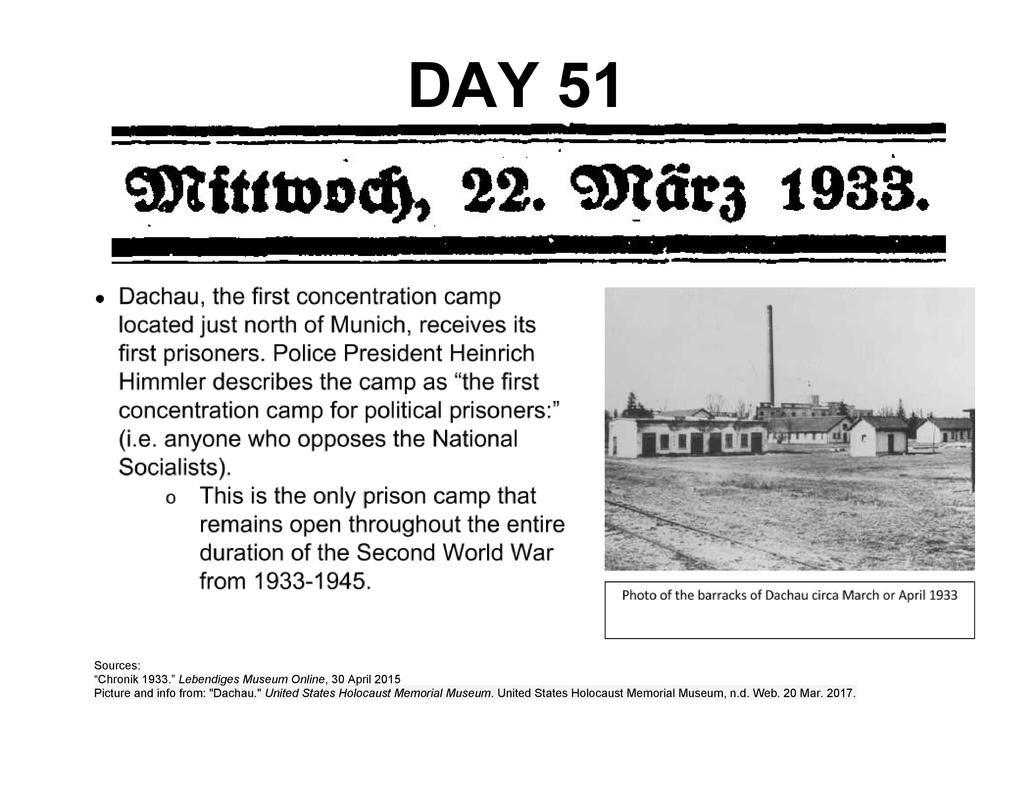
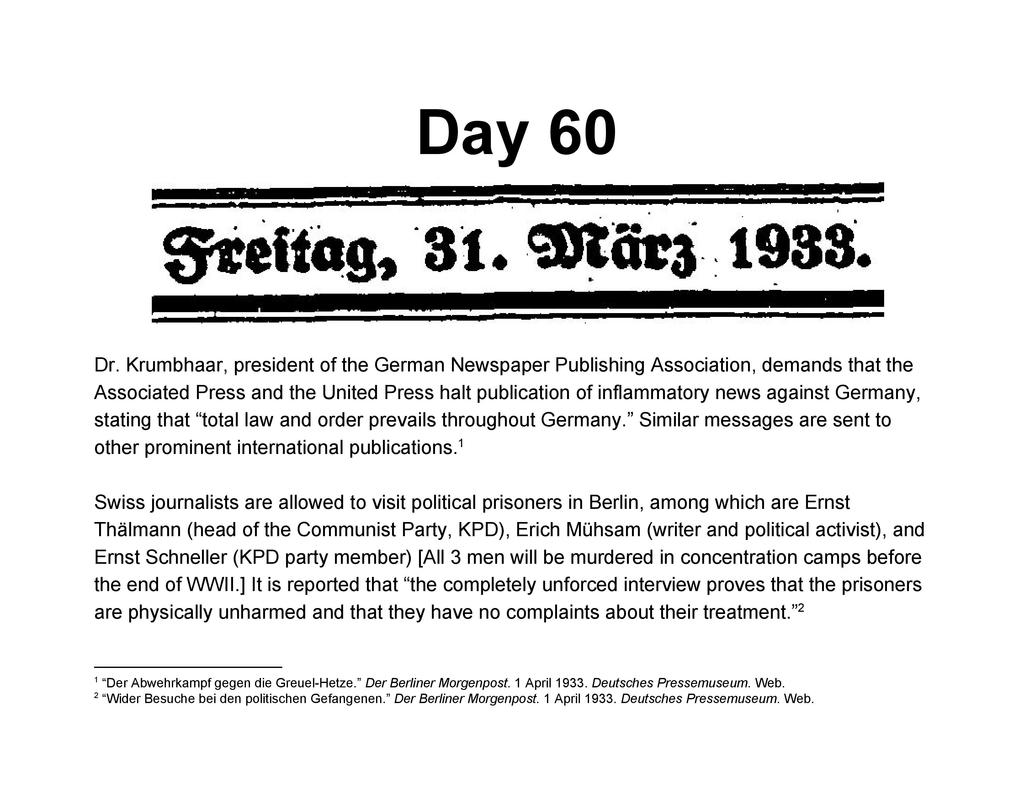
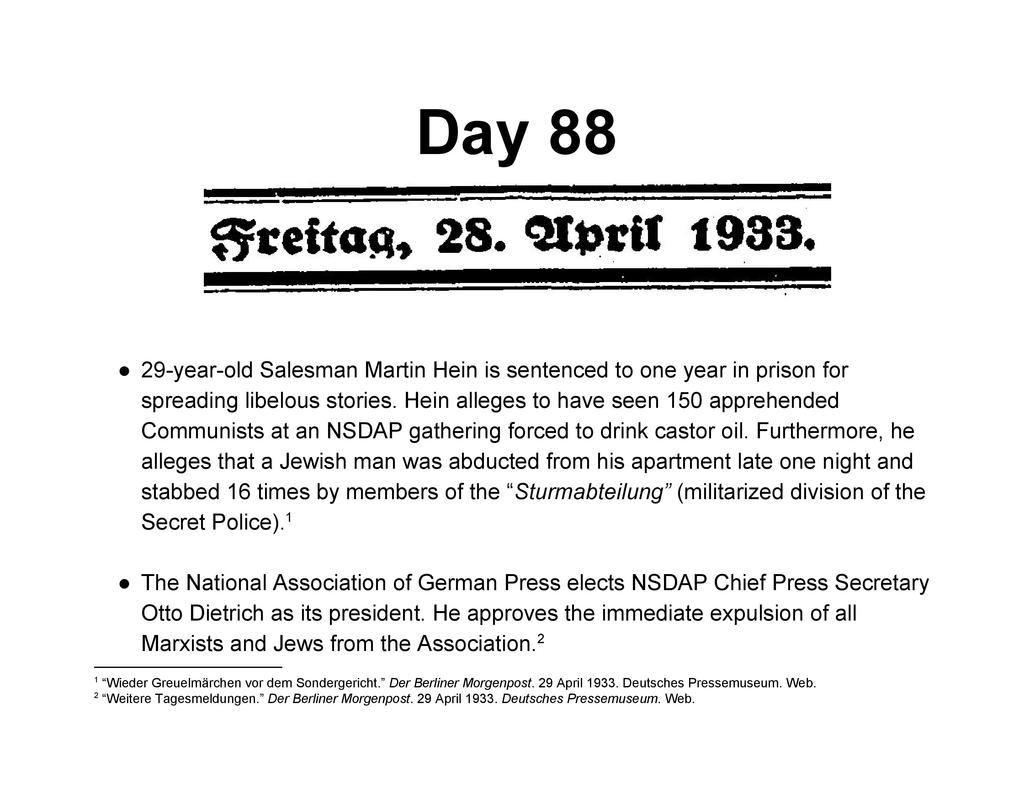
As the daily calendar shows, Hitler didn’t waste a lot of time. By Day 51, Dachau–one of the first concentration camps–opened and received its first prisoners, notes Emory News. By Day 60, all new stories critical of the government were censored. And, by Day 88, the press expelled from its ranks all Marxists and Jews. That was just the beginning.
Meanwhile, on Day 88 over here, Trump’s initiatives (some relatively innocuous, some alarming) have met civil, judicial and political resistance, or collapsed under their own weight. The concern of January has given way to comedy in April. So far, it’s more farce than fascism:
But don’t get complacent, terror might be the operative word in May.
You can learn more about Emory’s historical project here.
If you would like to support the mission of Open Culture, consider making a donation to our site. It’s hard to rely 100% on ads, and your contributions will help us continue providing the best free cultural and educational materials to learners everywhere. You can contribute through PayPal, Patreon, and Venmo (@openculture). Thanks!
Related Content:
Harvard Students Launch a Free Course on How to Resist Trump
Read More...Artist is Creating a Parthenon Made of 100,000 Banned Books: A Monument to Democracy & Intellectual Freedom
With the rise of Far Right candidates in Europe and in America, along with creeping dictatorship in Turkey and authoritarianism in the Philippines, the idea of democracy and freedom of speech feels under threat more than ever. While we don’t talk about political solutions here on Open Culture, we do believe in the power of art to illuminate.
Argentine artist Marta Minujín is creating a large-scale artwork called The Parthenon of Books that will be constructed on Friedrichsplatz in Kassel, Germany, and will be constructed from as many as 100,000 banned books from all over the world.
The location has been chosen for its historical importance. In 1933, the Nazis burned two-thousand books there during the so-called “Aktion wider den undeutschen Geist” (Campaign against the Un-German Spirit), destroying books by Communists, Jews, and pacifists, along with any others deemed un-German.
Minujín chose the Parthenon—one of the great structures of Ancient Greece—for its continuing symbolism of the enduring power of democracy throughout the ages.
When it comes to materials, she using a list of 100,000 books that have been, or still are, banned in countries across the world, going all the way back to the year 1500. You can browse that list here, but for less eye-strain, try this shorter list of 170 or so titles. New titles can be suggested for the project here.
Some of the books that have been banned over the years include Antoine de Saint-Exupéry’s The Little Prince (banned in Argentina), Lewis Carroll’s Alice’s Adventures in Wonderland (banned in China), and Norman Mailer’s The Naked and the Dead (banned in Canada).
Minujín constructed a similar Parthenon in 1983 after the fall of her country’s dictatorship. The original El Partenón de libros featured the books that the former government had banned, and, at the end of the installation, Minujín let the public take what they wanted home. (She will be allowing the same thing to happen this time.)
Her people, as she says in the video above, didn’t know what democracy was after years of military rule. We might be on the opposite side of the spectrum: we won’t know what democracy is until we lose it.
Related Content:
John Waters Reads Steamy Scene from Lady Chatterley’s Lover for Banned Books Week (NSFW)
Read 14 Great Banned & Censored Novels Free Online: For Banned Books Week 2014
The Cover of George Orwell’s 1984 Becomes Less Censored with Wear and Tear
Ted Mills is a freelance writer on the arts who currently hosts the FunkZone Podcast. You can also follow him on Twitter at @tedmills, read his other arts writing at tedmills.com and/or watch his films here.
Read More...George Saunders Tries to Order One Mousetrap Over The Phone
This adventure in modern shopping is brought to you by Clickhole.
If you would like to support the mission of Open Culture, consider making a donation to our site. It’s hard to rely 100% on ads, and your contributions will help us continue providing the best free cultural and educational materials to learners everywhere. You can contribute through PayPal, Patreon, and Venmo (@openculture). Thanks!
Related Content:
George Saunders Demystifies the Art of Storytelling in a Short Animated Documentary
Read More...The News Is Broken, and Wikipedia Founder Jimmy Wales Plans to Fix It With His New Site, Wikitribune
“The news is broken and we can fix it.” That’s the idea driving the creation of Wikitribune, a news platform being built by Wikipedia founder Jimmy Wales.
Borrowing tools and concepts from the influential online encyclopedia, Wikitribune will be free and supported by readers, not ads. It will feature professional journalists and community members, working side by side, to produce fact-checked journalism that’s readily supported by evidence and sources. And anyone can flag mistakes or submit revisions for review.
Watch Wales outline the vision for Wikitribune in the Kirby Ferguson-made video above. Then, consider making a financial contribution to the new news platform here. They’re now raising money to get operations started and hire 10 journalists.
Follow Open Culture on Facebook and Twitter and share intelligent media with your friends. Or better yet, sign up for our daily email and get a daily dose of Open Culture in your inbox.
Read More...Support Us
We're hoping to rely on loyal readers, rather than erratic ads. Please click the Donate button and support Open Culture. You can use Paypal, Venmo, Patreon, even Crypto! We thank you!

About Us

Open Culture scours the web for the best educational media. We find the free courses and audio books you need, the language lessons & educational videos you want, and plenty of enlightenment in between.
Advertise With Us

FREE UPDATES!
GET OUR DAILY EMAIL
Get the best cultural and educational resources on the web curated for you in a daily email. We never spam. Unsubscribe at any time.
FOLLOW ON SOCIAL MEDIA

Open Culture editor Dan Colman scours the web for the best educational media. He finds the free courses and audio books you need, the language lessons & movies you want, and plenty of enlightenment in between.
Advertise With Us